Strategies for Child and Carer Participation in Development Assessment

Verified

Added on  2023/01/19

|3
|863
|92
Report
AI Summary
This report examines effective strategies for encouraging the participation of children (ages 1-4) and their carers in developmental assessments. The author emphasizes the importance of these assessments in measuring cognitive and physical development, as well as informing parents about areas needing attention. Key strategies discussed include raising awareness about the assessment's benefits, increasing involvement through activities and checklists, and utilizing surveys to gather feedback. The report also highlights the importance of tailoring approaches to both children and carers, such as using games for children and relating assessment outcomes to carers' professional development. Ultimately, the report concludes that by implementing these strategies, medical practitioners can foster greater participation, leading to improved patient care and outcomes. The report also includes references to relevant books and journals.
Document Page
Develop strategies to encourage child or
young person and carer's
participation in developmental assessment
tabler-icon-diamond-filled.svg

Paraphrase This Document

Need a fresh take? Get an instant paraphrase of this document with our AI Paraphraser
Document Page
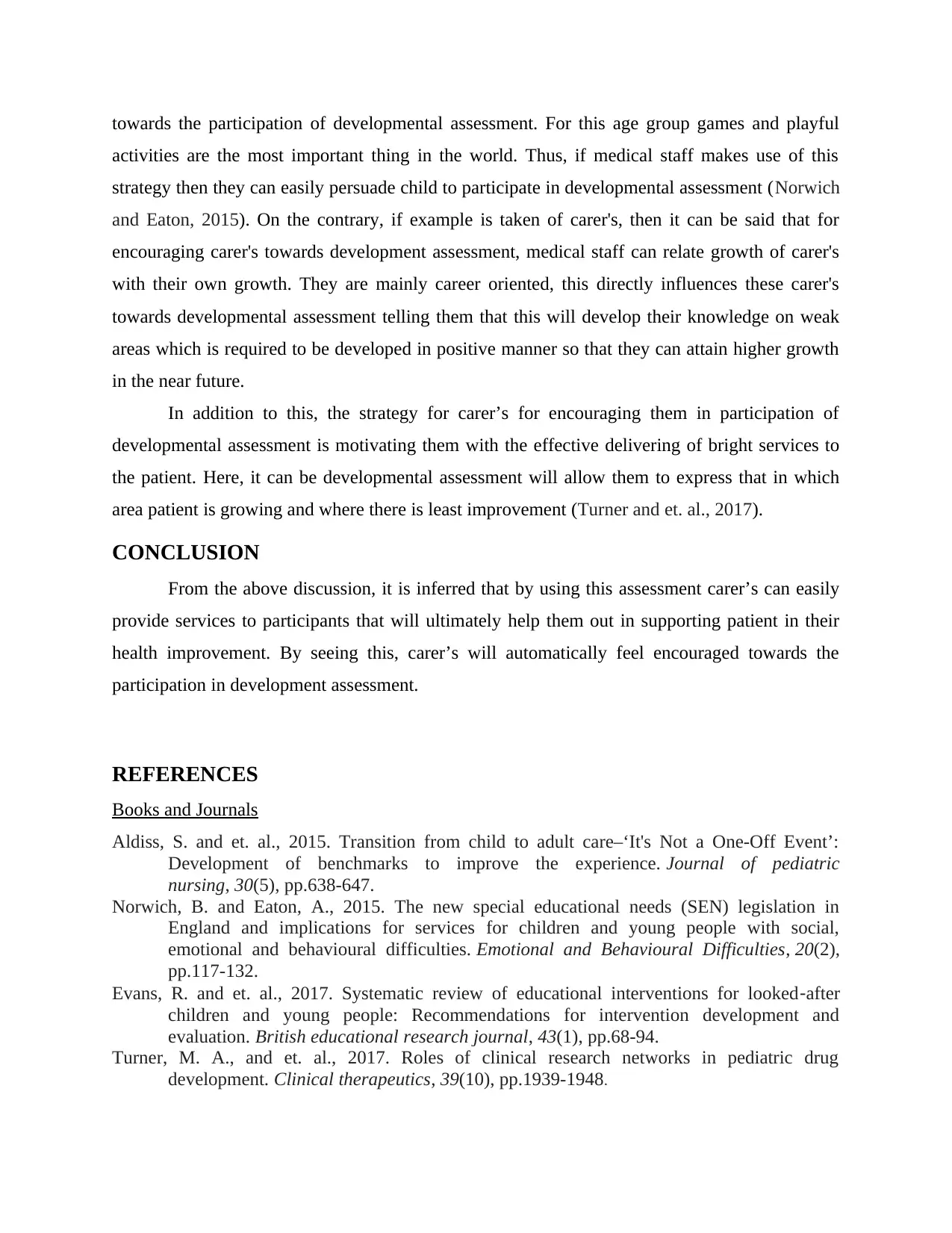
INTRODUCTION
Development assessment is considered as the effective method of measuring child’s(1-4
years) actual development in terms of cognitive as well as physical strengths. It also aware
children as well as their parents about the not developing areas of the child which is required to
be developed for their growth.
MAIN BODY
2.3 Develop strategies to encourage child or young person and carer's Participation in
developmental assessment
It is essential for all that is child and carer’s to participate in the development assessment
so that they can effectively develop themselves (Aldiss and et. al., 2015). For this, medical
practitioners uses certain sort of strategies for encouraging child(1-4 years) and carer’s through
which these people can willingly participate in the developmental assessment effectively. The
first and foremost strategy adopted by medical practitioners is to parents as well as child about
the importance of this assessment so that they can develop their understanding over it and attain
become successful in the near future. This importance will include information on development.
Along with this, child can also assess that whether they are progressing or not. It will also
support carer’s in taking curriculum decisions and exploring learning of children and teaching
problems faced by teachers at the time of helping children in their learning zone. It can be said
that by enhance of awareness of individual medical practitioners can easily encourage them to
participate into developmental assessment. Furthermore, increasing involvement of parent and
children in event activities can also be seen as the main strategy through which participation in
development assessment can be raised. Also, development assessment can also be provided to
parents in the form of checklist so that they actively participate in it. This will ultimately increase
participation in development assessment. Along with this, surveys can also be seen as the
effective method by which participation of children and carers can be increased in development
assessment. This is because; in this survey participants can easily express their views in easier
manner.
At next, medical practitioners can also adopt the strategy of relating actual of individual
with their respective development growth. For instance: If taking example of children, it is
important for medical staff to use method of playing or games in order to convince children
Document Page
towards the participation of developmental assessment. For this age group games and playful
activities are the most important thing in the world. Thus, if medical staff makes use of this
strategy then they can easily persuade child to participate in developmental assessment (Norwich
and Eaton, 2015). On the contrary, if example is taken of carer's, then it can be said that for
encouraging carer's towards development assessment, medical staff can relate growth of carer's
with their own growth. They are mainly career oriented, this directly influences these carer's
towards developmental assessment telling them that this will develop their knowledge on weak
areas which is required to be developed in positive manner so that they can attain higher growth
in the near future.
In addition to this, the strategy for carer’s for encouraging them in participation of
developmental assessment is motivating them with the effective delivering of bright services to
the patient. Here, it can be developmental assessment will allow them to express that in which
area patient is growing and where there is least improvement (Turner and et. al., 2017).
CONCLUSION
From the above discussion, it is inferred that by using this assessment carer’s can easily
provide services to participants that will ultimately help them out in supporting patient in their
health improvement. By seeing this, carer’s will automatically feel encouraged towards the
participation in development assessment.
REFERENCES
Books and Journals
Aldiss, S. and et. al., 2015. Transition from child to adult care–‘It's Not a One-Off Event’:
Development of benchmarks to improve the experience. Journal of pediatric
nursing, 30(5), pp.638-647.
Norwich, B. and Eaton, A., 2015. The new special educational needs (SEN) legislation in
England and implications for services for children and young people with social,
emotional and behavioural difficulties. Emotional and Behavioural Difficulties, 20(2),
pp.117-132.
Evans, R. and et. al., 2017. Systematic review of educational interventions for lookedafter
children and young people: Recommendations for intervention development and
evaluation. British educational research journal, 43(1), pp.68-94.
Turner, M. A., and et. al., 2017. Roles of clinical research networks in pediatric drug
development. Clinical therapeutics, 39(10), pp.1939-1948.
chevron_up_icon
1 out of 3
circle_padding
hide_on_mobile
zoom_out_icon
[object Object]