Comprehensive Q&A: Exploring the Endocrine, Renal & Neuro Systems
VerifiedAdded on 2022/08/30
|9
|2161
|20
Homework Assignment
AI Summary
This assignment consists of short answer questions covering the endocrine, renal, and neurological systems. The endocrine section compares and contrasts up-regulation and down-regulation, and explores different types of stimuli for hormone release. The renal section discusses the role of the kidneys and associated hormones in maintaining fluid balance, focusing on water and sodium balance regulation through ADH and the renin-angiotensin system. Finally, the neurological section details the structural and functional divisions of the autonomic nervous system, including the sympathetic, parasympathetic, and enteric nervous systems, and their respective functions in regulating various bodily processes. Desklib provides access to similar solved assignments and study resources for students.
SHORT ANSWER QUESTIONS
Make sure you read the question and ensure you keep within the word count guidance.
Section 2a: Endocrine system
Question 1: Compare and contrast up regulation and down regulation as it pertains to the
endocrine system. Word count 200 words. (10 marks)
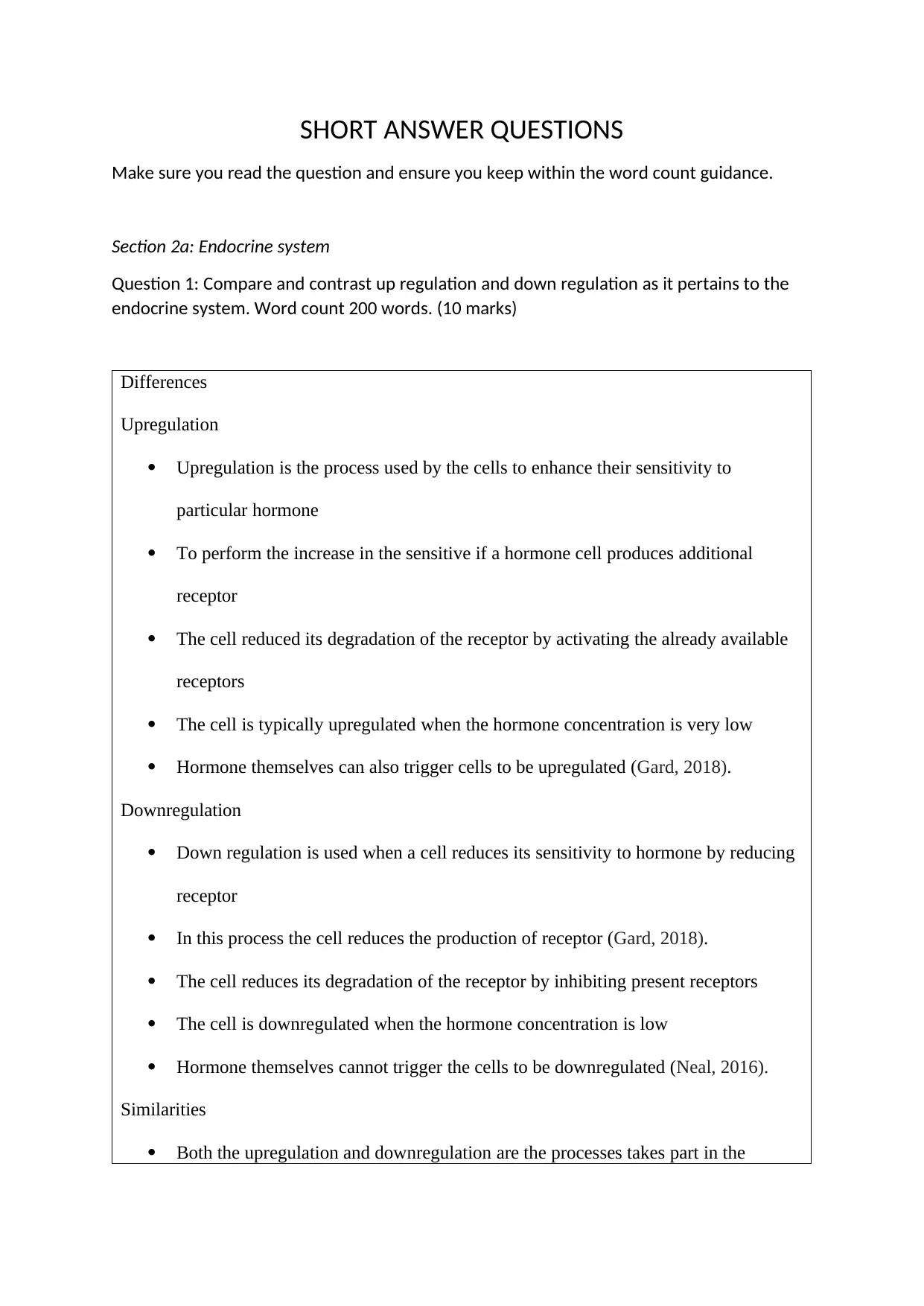
Differences
Upregulation
Upregulation is the process used by the cells to enhance their sensitivity to
particular hormone
To perform the increase in the sensitive if a hormone cell produces additional
receptor
The cell reduced its degradation of the receptor by activating the already available
receptors
The cell is typically upregulated when the hormone concentration is very low
Hormone themselves can also trigger cells to be upregulated (Gard, 2018).
Downregulation
Down regulation is used when a cell reduces its sensitivity to hormone by reducing
receptor
In this process the cell reduces the production of receptor (Gard, 2018).
The cell reduces its degradation of the receptor by inhibiting present receptors
The cell is downregulated when the hormone concentration is low
Hormone themselves cannot trigger the cells to be downregulated (Neal, 2016).
Similarities
Both the upregulation and downregulation are the processes takes part in the
Make sure you read the question and ensure you keep within the word count guidance.
Section 2a: Endocrine system
Question 1: Compare and contrast up regulation and down regulation as it pertains to the
endocrine system. Word count 200 words. (10 marks)
Differences
Upregulation
Upregulation is the process used by the cells to enhance their sensitivity to
particular hormone
To perform the increase in the sensitive if a hormone cell produces additional
receptor
The cell reduced its degradation of the receptor by activating the already available
receptors
The cell is typically upregulated when the hormone concentration is very low
Hormone themselves can also trigger cells to be upregulated (Gard, 2018).
Downregulation
Down regulation is used when a cell reduces its sensitivity to hormone by reducing
receptor
In this process the cell reduces the production of receptor (Gard, 2018).
The cell reduces its degradation of the receptor by inhibiting present receptors
The cell is downregulated when the hormone concentration is low
Hormone themselves cannot trigger the cells to be downregulated (Neal, 2016).
Similarities
Both the upregulation and downregulation are the processes takes part in the

Paraphrase This Document
Need a fresh take? Get an instant paraphrase of this document with our AI Paraphraser
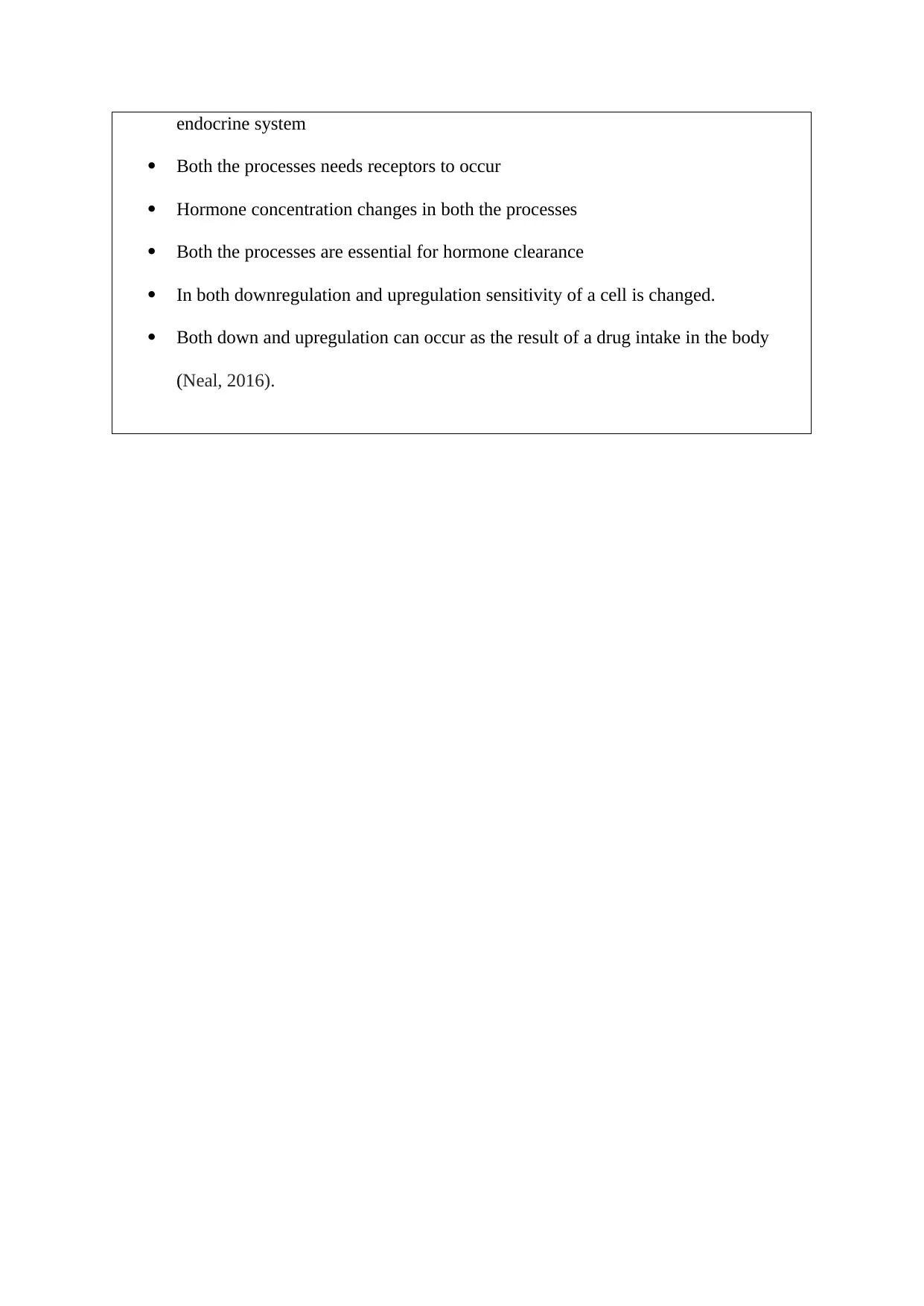
endocrine system
Both the processes needs receptors to occur
Hormone concentration changes in both the processes
Both the processes are essential for hormone clearance
In both downregulation and upregulation sensitivity of a cell is changed.
Both down and upregulation can occur as the result of a drug intake in the body
(Neal, 2016).
Both the processes needs receptors to occur
Hormone concentration changes in both the processes
Both the processes are essential for hormone clearance
In both downregulation and upregulation sensitivity of a cell is changed.
Both down and upregulation can occur as the result of a drug intake in the body
(Neal, 2016).
Question 2: Giving examples, explore the 3 types of stimulus for the release of hormones.
Word count 200 words. (10 marks).
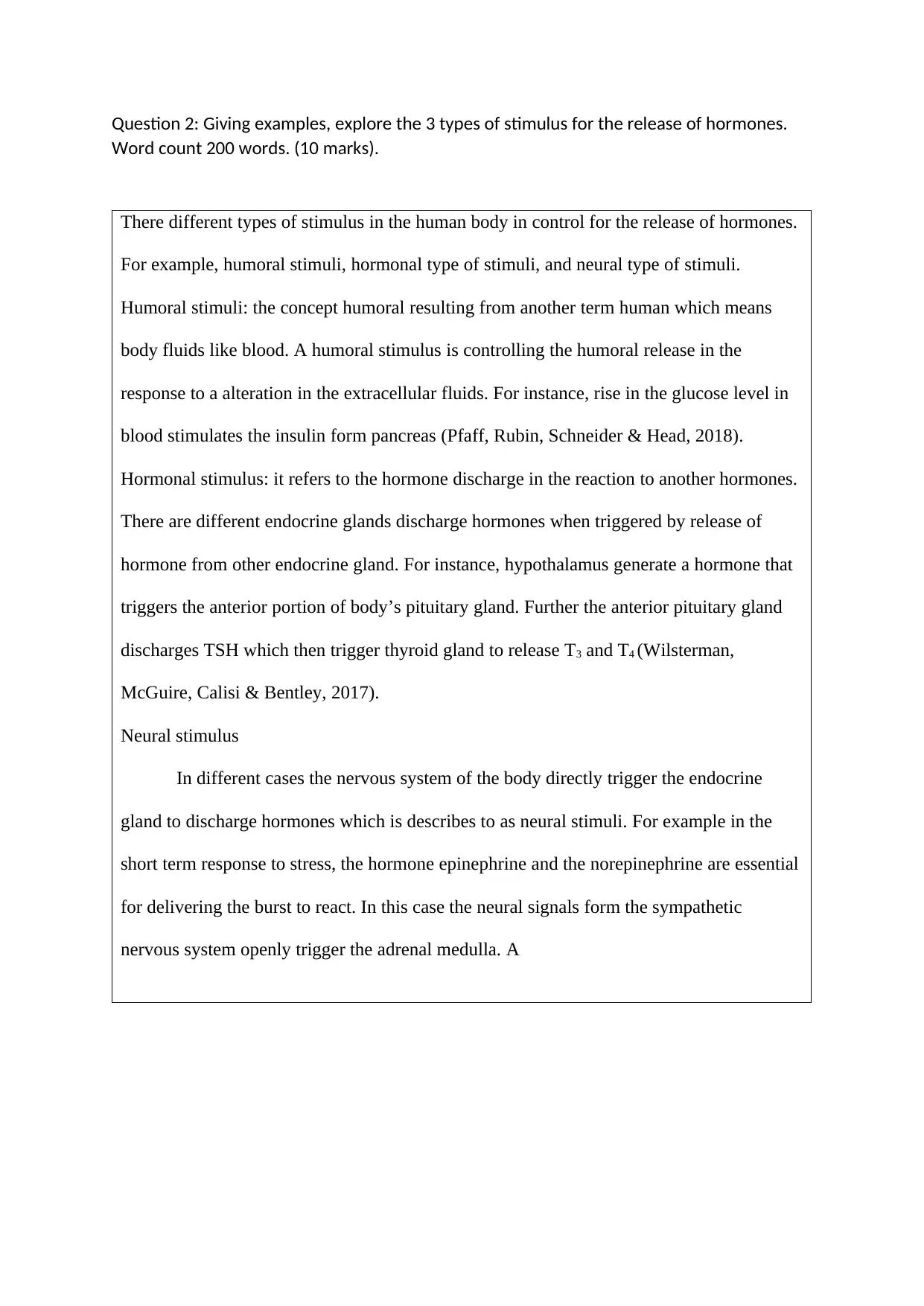
There different types of stimulus in the human body in control for the release of hormones.
For example, humoral stimuli, hormonal type of stimuli, and neural type of stimuli.
Humoral stimuli: the concept humoral resulting from another term human which means
body fluids like blood. A humoral stimulus is controlling the humoral release in the
response to a alteration in the extracellular fluids. For instance, rise in the glucose level in
blood stimulates the insulin form pancreas (Pfaff, Rubin, Schneider & Head, 2018).
Hormonal stimulus: it refers to the hormone discharge in the reaction to another hormones.
There are different endocrine glands discharge hormones when triggered by release of
hormone from other endocrine gland. For instance, hypothalamus generate a hormone that
triggers the anterior portion of body’s pituitary gland. Further the anterior pituitary gland
discharges TSH which then trigger thyroid gland to release T3 and T4 (Wilsterman,
McGuire, Calisi & Bentley, 2017).
Neural stimulus
In different cases the nervous system of the body directly trigger the endocrine
gland to discharge hormones which is describes to as neural stimuli. For example in the
short term response to stress, the hormone epinephrine and the norepinephrine are essential
for delivering the burst to react. In this case the neural signals form the sympathetic
nervous system openly trigger the adrenal medulla. A
Word count 200 words. (10 marks).
There different types of stimulus in the human body in control for the release of hormones.
For example, humoral stimuli, hormonal type of stimuli, and neural type of stimuli.
Humoral stimuli: the concept humoral resulting from another term human which means
body fluids like blood. A humoral stimulus is controlling the humoral release in the
response to a alteration in the extracellular fluids. For instance, rise in the glucose level in
blood stimulates the insulin form pancreas (Pfaff, Rubin, Schneider & Head, 2018).
Hormonal stimulus: it refers to the hormone discharge in the reaction to another hormones.
There are different endocrine glands discharge hormones when triggered by release of
hormone from other endocrine gland. For instance, hypothalamus generate a hormone that
triggers the anterior portion of body’s pituitary gland. Further the anterior pituitary gland
discharges TSH which then trigger thyroid gland to release T3 and T4 (Wilsterman,
McGuire, Calisi & Bentley, 2017).
Neural stimulus
In different cases the nervous system of the body directly trigger the endocrine
gland to discharge hormones which is describes to as neural stimuli. For example in the
short term response to stress, the hormone epinephrine and the norepinephrine are essential
for delivering the burst to react. In this case the neural signals form the sympathetic
nervous system openly trigger the adrenal medulla. A
⊘ This is a preview!⊘
Do you want full access?
Subscribe today to unlock all pages.

Trusted by 1+ million students worldwide
Section 2b. Renal system
1. Discuss the role of the kidneys and associated hormones in the maintenance of fluid
balance in the healthy adult. Word count 500 words (25 marks).
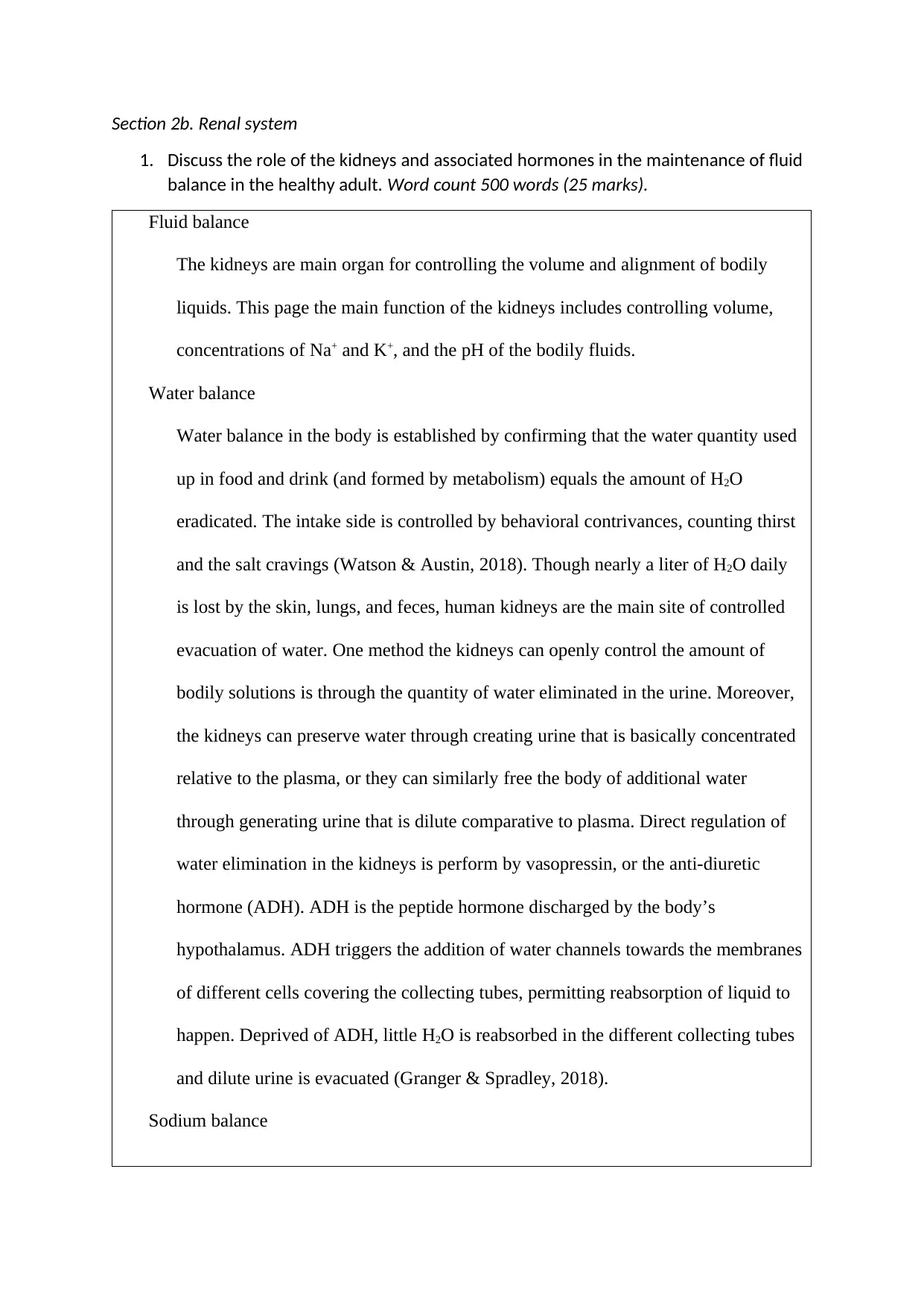
Fluid balance
The kidneys are main organ for controlling the volume and alignment of bodily
liquids. This page the main function of the kidneys includes controlling volume,
concentrations of Na+ and K+, and the pH of the bodily fluids.
Water balance
Water balance in the body is established by confirming that the water quantity used
up in food and drink (and formed by metabolism) equals the amount of H2O
eradicated. The intake side is controlled by behavioral contrivances, counting thirst
and the salt cravings (Watson & Austin, 2018). Though nearly a liter of H2O daily
is lost by the skin, lungs, and feces, human kidneys are the main site of controlled
evacuation of water. One method the kidneys can openly control the amount of
bodily solutions is through the quantity of water eliminated in the urine. Moreover,
the kidneys can preserve water through creating urine that is basically concentrated
relative to the plasma, or they can similarly free the body of additional water
through generating urine that is dilute comparative to plasma. Direct regulation of
water elimination in the kidneys is perform by vasopressin, or the anti-diuretic
hormone (ADH). ADH is the peptide hormone discharged by the body’s
hypothalamus. ADH triggers the addition of water channels towards the membranes
of different cells covering the collecting tubes, permitting reabsorption of liquid to
happen. Deprived of ADH, little H2O is reabsorbed in the different collecting tubes
and dilute urine is evacuated (Granger & Spradley, 2018).
Sodium balance
1. Discuss the role of the kidneys and associated hormones in the maintenance of fluid
balance in the healthy adult. Word count 500 words (25 marks).
Fluid balance
The kidneys are main organ for controlling the volume and alignment of bodily
liquids. This page the main function of the kidneys includes controlling volume,
concentrations of Na+ and K+, and the pH of the bodily fluids.
Water balance
Water balance in the body is established by confirming that the water quantity used
up in food and drink (and formed by metabolism) equals the amount of H2O
eradicated. The intake side is controlled by behavioral contrivances, counting thirst
and the salt cravings (Watson & Austin, 2018). Though nearly a liter of H2O daily
is lost by the skin, lungs, and feces, human kidneys are the main site of controlled
evacuation of water. One method the kidneys can openly control the amount of
bodily solutions is through the quantity of water eliminated in the urine. Moreover,
the kidneys can preserve water through creating urine that is basically concentrated
relative to the plasma, or they can similarly free the body of additional water
through generating urine that is dilute comparative to plasma. Direct regulation of
water elimination in the kidneys is perform by vasopressin, or the anti-diuretic
hormone (ADH). ADH is the peptide hormone discharged by the body’s
hypothalamus. ADH triggers the addition of water channels towards the membranes
of different cells covering the collecting tubes, permitting reabsorption of liquid to
happen. Deprived of ADH, little H2O is reabsorbed in the different collecting tubes
and dilute urine is evacuated (Granger & Spradley, 2018).
Sodium balance
Paraphrase This Document
Need a fresh take? Get an instant paraphrase of this document with our AI Paraphraser
Additionally, to controlling total capacity, the osmolarity (the solute quantity each
unit volume) of bodily liquids is also strongly controlled. Great discrepancy in
osmolarity sources shrinking or swelling of cells, damaging or terminating cellular
shape and disrupting usual cellular function. Controlling of osmolarity is
established by balancing the consumption and elimination of Na+ with that of H2O.
(Sodium is through far the main solute in ECFs, so it proficiently controls the
osmolarity of the body’s extracellular fluids. An essential concept is that control of
osmolarity should be united with volume regulation, since alterations in H2O
volume alone possess diluting or concentrating impacts on the bodily liquids
(Rundgren & Svensen, 2018). For example, when an individual become
dehydrated, he or she lose proportionally additional water than solute (sodium),
hence the osmolarity of the bodily liquid upsurges. In this condition the body must
preserve water but not the sodium, therefore stopping the increase in osmolarity. If
the person loses a large quantity of blood due to trauma or operation, however, he
or she loses of sodium and H2O are proportional to the composition of bodily
liquids (Dolomatov & Zukow, 2019). In this condition the body must conserve both
H2O and sodium. The human kidneys feel reduced blood pressure (which outcomes
in lower rates of filtration and lower flow via the tubule). This initiates a complex
response to increase BP and preserve volume. The kidneys possess a renin-
angiotensin related hormonal system that upsurges the creation of the active form of
the hormone angiotensin II, that supports stimulate thirst, however also triggers the
discharge of a hormone termed aldosterone from body’s adrenal glands. The
Aldosterone upsurges the reabsorption of NA in the distal tubules many nephrons in
the human kidneys, and H2O follows this reabsorbed NA back into the bloodstream
(Armstrong & Johnson, 2018).
unit volume) of bodily liquids is also strongly controlled. Great discrepancy in
osmolarity sources shrinking or swelling of cells, damaging or terminating cellular
shape and disrupting usual cellular function. Controlling of osmolarity is
established by balancing the consumption and elimination of Na+ with that of H2O.
(Sodium is through far the main solute in ECFs, so it proficiently controls the
osmolarity of the body’s extracellular fluids. An essential concept is that control of
osmolarity should be united with volume regulation, since alterations in H2O
volume alone possess diluting or concentrating impacts on the bodily liquids
(Rundgren & Svensen, 2018). For example, when an individual become
dehydrated, he or she lose proportionally additional water than solute (sodium),
hence the osmolarity of the bodily liquid upsurges. In this condition the body must
preserve water but not the sodium, therefore stopping the increase in osmolarity. If
the person loses a large quantity of blood due to trauma or operation, however, he
or she loses of sodium and H2O are proportional to the composition of bodily
liquids (Dolomatov & Zukow, 2019). In this condition the body must conserve both
H2O and sodium. The human kidneys feel reduced blood pressure (which outcomes
in lower rates of filtration and lower flow via the tubule). This initiates a complex
response to increase BP and preserve volume. The kidneys possess a renin-
angiotensin related hormonal system that upsurges the creation of the active form of
the hormone angiotensin II, that supports stimulate thirst, however also triggers the
discharge of a hormone termed aldosterone from body’s adrenal glands. The
Aldosterone upsurges the reabsorption of NA in the distal tubules many nephrons in
the human kidneys, and H2O follows this reabsorbed NA back into the bloodstream
(Armstrong & Johnson, 2018).
Section 2c. Neurological system
1. What are the structural and functional divisions of the Autonomic Nervous System?
Word count 500 words (25 marks).
All the procedures that take place in the human body are regulated by the nervous
system. An individual has control over only a restricted body functions for example
movements, talking, sight, thinking, etc. Maximum of the purposes of the human
body that are not under people’s voluntary type of control are regulated through the
autonomic nervous system. The ANS is a portion of the peripheral nervous system
which is not under the voluntary control. It is frequently regarded as a self-
controlling system. It regulates the functions of interior body organs for example
stomach, heart, the lungs, urinary bladder, etc. (Sheng & Zhu, 2018).
Structure
The ANS is a division of the PNS. It indicates that it is the structure by which
centrally positioned brain and the spinal cord regulate the organs positioned at the
periphery. Therefore, it contains of the nerves (packages of axons) that instigate
from or result the brain and the spinal cord (CNS). It also contains of groups of the
neuronal cell bodies situated outside the CNS. These groups of cell bodies are
named ganglia (Cardinali, 2017).
Divisions
The ANS is further separated into three parts:
Sympathetic Nervous System: This particular division of ANS is accountable for
regulating fight or flight reaction. It regulates the involuntary reactions of the body
when an individual is in some severe situation. The sympathetic reactions prepare
the human body to address some fight or flight circumstances (Svorc, 2018).
Parasympathetic Nervous System: This part regulates the body tasks in a relaxed
state. The involuntary reactions of the human body under calm circumstances are
1. What are the structural and functional divisions of the Autonomic Nervous System?
Word count 500 words (25 marks).
All the procedures that take place in the human body are regulated by the nervous
system. An individual has control over only a restricted body functions for example
movements, talking, sight, thinking, etc. Maximum of the purposes of the human
body that are not under people’s voluntary type of control are regulated through the
autonomic nervous system. The ANS is a portion of the peripheral nervous system
which is not under the voluntary control. It is frequently regarded as a self-
controlling system. It regulates the functions of interior body organs for example
stomach, heart, the lungs, urinary bladder, etc. (Sheng & Zhu, 2018).
Structure
The ANS is a division of the PNS. It indicates that it is the structure by which
centrally positioned brain and the spinal cord regulate the organs positioned at the
periphery. Therefore, it contains of the nerves (packages of axons) that instigate
from or result the brain and the spinal cord (CNS). It also contains of groups of the
neuronal cell bodies situated outside the CNS. These groups of cell bodies are
named ganglia (Cardinali, 2017).
Divisions
The ANS is further separated into three parts:
Sympathetic Nervous System: This particular division of ANS is accountable for
regulating fight or flight reaction. It regulates the involuntary reactions of the body
when an individual is in some severe situation. The sympathetic reactions prepare
the human body to address some fight or flight circumstances (Svorc, 2018).
Parasympathetic Nervous System: This part regulates the body tasks in a relaxed
state. The involuntary reactions of the human body under calm circumstances are
⊘ This is a preview!⊘
Do you want full access?
Subscribe today to unlock all pages.
Trusted by 1+ million students worldwide
regulated by the parasympathetic nervous system. It is in control for controlling
body tasks under normal circumstances.
Enteric Nervous System: It is recognized as the third part of the ANS. It is limited
to the regulation of the gut. It comprises subdivisions from both sympathetic and
the parasympathetic type of nervous systems and is accountable for regulating the
tasks of gastrointestinal tract or GI tratct (Waxenbaum & Varacallo, 2019).
Functions
Maximum of the functions of the human body essential for retaining life are under
the regulation of the ANS. The autonomic nervous system regulates the blood
pressure of an individual and keeps it inside the limits. Heart rate is similarly
controlled by the ANS (Waxenbaum & Varacallo, 2019). It not simply regulates the
heart rate however also regulates the force of contraction. It similarly controls the
blood movement to a specific organ, takes part in digestion, metabolism,
respiration, Pupillary response, Urination regulating the tone of the body’s bladder
muscles, Sexual responses such as erection and ejaculation, maintain the body
temperature, and Discharges of different glands of the body for example sweat
glands, the salivary glands, glands in the breathing system. It regulates the loss of
temperature from body by controlling the blood movement to the skin. The
secretion of sweat also plays an essential role in controlling the body heat which is
under the regulation of the autonomic nervous system (Svorc, 2018).
body tasks under normal circumstances.
Enteric Nervous System: It is recognized as the third part of the ANS. It is limited
to the regulation of the gut. It comprises subdivisions from both sympathetic and
the parasympathetic type of nervous systems and is accountable for regulating the
tasks of gastrointestinal tract or GI tratct (Waxenbaum & Varacallo, 2019).
Functions
Maximum of the functions of the human body essential for retaining life are under
the regulation of the ANS. The autonomic nervous system regulates the blood
pressure of an individual and keeps it inside the limits. Heart rate is similarly
controlled by the ANS (Waxenbaum & Varacallo, 2019). It not simply regulates the
heart rate however also regulates the force of contraction. It similarly controls the
blood movement to a specific organ, takes part in digestion, metabolism,
respiration, Pupillary response, Urination regulating the tone of the body’s bladder
muscles, Sexual responses such as erection and ejaculation, maintain the body
temperature, and Discharges of different glands of the body for example sweat
glands, the salivary glands, glands in the breathing system. It regulates the loss of
temperature from body by controlling the blood movement to the skin. The
secretion of sweat also plays an essential role in controlling the body heat which is
under the regulation of the autonomic nervous system (Svorc, 2018).
Paraphrase This Document
Need a fresh take? Get an instant paraphrase of this document with our AI Paraphraser
References
Armstrong, L., & Johnson, E. (2018). Water intake, water balance, and the elusive daily
water requirement. Nutrients, 10(12), 1928.
Cardinali, D. P. (2017). Autonomic Nervous System: Basic and Clinical Aspects. Springer.
Dolomatov, S., & Zukow, W. (2019). Epigenetic Mechanisms in the Control System of the
Kidney Function in Norm.
Gard, P. R. (2018). Human endocrinology. CRC Press.
Granger, J. P., & Spradley, F. T. (2018). The Kidneys, Volume and Blood Pressure
Regulation, and Hypertension. In Disorders of Blood Pressure Regulation (pp. 47-66).
Springer, Cham.
Neal, J. M. (2016). How the endocrine system works. John Wiley & Sons.
Pfaff, D. W., Rubin, R. T., Schneider, J. E., & Head, G. (2018). Principles of
hormone/behavior relations. Academic Press
Rundgren, M., & Svensen, C. H. (2018). Fluid balance, regulatory mechanisms, and
electrolytes. Fluid Therapy for the Surgical Patient, 1, 15-44.
Sheng, Y., & Zhu, L. (2018). The crosstalk between autonomic nervous system and blood
vessels. International journal of physiology, pathophysiology and pharmacology,
10(1), 17.
Svorc, P. (2018). Introductory Chapter: Autonomic Nervous System-What We Know About
It. In Autonomic Nervous System. IntechOpen.
Watson, F., & Austin, P. (2018). Physiology of human fluid balance. Anaesthesia & Intensive
Care Medicine.
Armstrong, L., & Johnson, E. (2018). Water intake, water balance, and the elusive daily
water requirement. Nutrients, 10(12), 1928.
Cardinali, D. P. (2017). Autonomic Nervous System: Basic and Clinical Aspects. Springer.
Dolomatov, S., & Zukow, W. (2019). Epigenetic Mechanisms in the Control System of the
Kidney Function in Norm.
Gard, P. R. (2018). Human endocrinology. CRC Press.
Granger, J. P., & Spradley, F. T. (2018). The Kidneys, Volume and Blood Pressure
Regulation, and Hypertension. In Disorders of Blood Pressure Regulation (pp. 47-66).
Springer, Cham.
Neal, J. M. (2016). How the endocrine system works. John Wiley & Sons.
Pfaff, D. W., Rubin, R. T., Schneider, J. E., & Head, G. (2018). Principles of
hormone/behavior relations. Academic Press
Rundgren, M., & Svensen, C. H. (2018). Fluid balance, regulatory mechanisms, and
electrolytes. Fluid Therapy for the Surgical Patient, 1, 15-44.
Sheng, Y., & Zhu, L. (2018). The crosstalk between autonomic nervous system and blood
vessels. International journal of physiology, pathophysiology and pharmacology,
10(1), 17.
Svorc, P. (2018). Introductory Chapter: Autonomic Nervous System-What We Know About
It. In Autonomic Nervous System. IntechOpen.
Watson, F., & Austin, P. (2018). Physiology of human fluid balance. Anaesthesia & Intensive
Care Medicine.
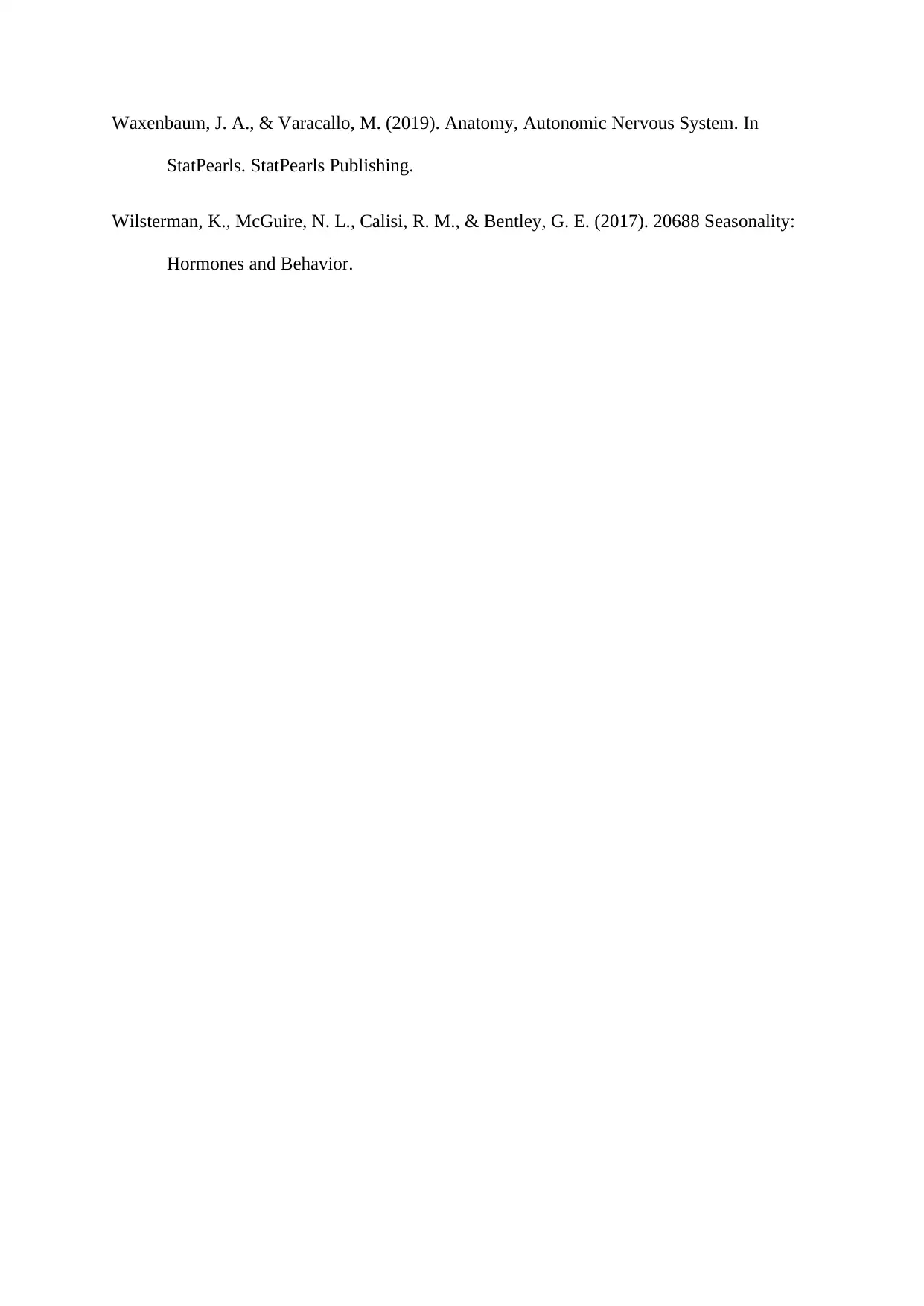
Waxenbaum, J. A., & Varacallo, M. (2019). Anatomy, Autonomic Nervous System. In
StatPearls. StatPearls Publishing.
Wilsterman, K., McGuire, N. L., Calisi, R. M., & Bentley, G. E. (2017). 20688 Seasonality:
Hormones and Behavior.
StatPearls. StatPearls Publishing.
Wilsterman, K., McGuire, N. L., Calisi, R. M., & Bentley, G. E. (2017). 20688 Seasonality:
Hormones and Behavior.
⊘ This is a preview!⊘
Do you want full access?
Subscribe today to unlock all pages.
Trusted by 1+ million students worldwide

1 out of 9


Related Documents


Your All-in-One AI-Powered Toolkit for Academic Success.
+13062052269
info@desklib.com
Available 24*7 on WhatsApp / Email
![[object Object]](/_next/static/media/star-bottom.7253800d.svg)
Unlock your academic potential
Copyright © 2020–2026 A2Z Services. All Rights Reserved. Developed and managed by ZUCOL.