Corporate Law 1: Arbitration and Foreign Awards in the UAE
VerifiedAdded on 2022/08/19
|15
|3839
|13
Report
AI Summary
This report delves into the intricacies of arbitration within the United Arab Emirates, focusing on the recognition and enforcement of foreign arbitral awards. It begins with an introduction to arbitration as a dispute resolution method, highlighting its efficiency and cost-effectiveness compared to traditional court proceedings. The report then outlines the legal framework for arbitration in the UAE, including the Federal Arbitration Act (FAA) of 2016, which is based on the UNCITRAL model law. It explores the roles of various arbitration institutes, such as the Dubai International Arbitration Centre (DIAC) and the DIFC-LCIA Arbitration Centre. The report discusses the requirements for recognizing arbitral awards, including the need for written documentation, proper signatures, and specific information within the award. It also covers the timeframes for issuing awards, interim measures, and other specifics related to the award, such as interest rates. Overall, the report provides a comprehensive analysis of arbitration in the UAE, offering valuable insights into the legal processes and procedures involved in resolving disputes through arbitration.
University
Arbitration
Recognition and Enforcement of Foreign Arbitral Awards in UAE
Student Credentials
2/8/2020
Arbitration
Recognition and Enforcement of Foreign Arbitral Awards in UAE
Student Credentials
2/8/2020

Paraphrase This Document
Need a fresh take? Get an instant paraphrase of this document with our AI Paraphraser
Corporate Law 1
Recognition and Enforcement of Foreign Arbitral Awards in UAE
Introduction
Arbitration in general sense is a way to resolve disputes. There are various other ways as well
to do so, but most of the corporates and other people prefer opting for it whenever disputes
arise. Since, this procedure is quite easier to go ahead with and also cost efficient when
finances are concerned. Since, the regular court proceedings are quite long and consume a lot
of time and energy, people tend to find ways to reduce that time and which is why arbitration
is beginning to gain popularity amongst people1.
In the country of UAE or the United Arab Emirates, the Act in relation with Arbitration came
into existence in the year 2016, 16th June. Though there were prior laws related to arbitration
as well according to which the arbitration in UAE was carried out before the introduction of
this Act. There has been a rise in the arbitral practices throughout the world which is why; the
government of UAE felt the need for introducing an Act related to arbitration in order to
facilitate the citizens as well as lower the pressure on the courts of UAE2. The Federal
Arbitration Act or which is widely known as the FAA has been long –awaited or being
planned upon. It is basically based upon the idea of the known model law which is the
UNCITRAL. This ensures the application and effectiveness of the Act as most of the
countries have already adopted it; this law is applied in more than 111 jurisdictions
throughout the world3. This discussion below talks about the need for arbitration in the
country and the way international arbitration has influenced the markets of UAE. The
enforcement procedures and all the recognition everything has been covered in this
1 Tony Cole and Pietro Ortolani, Understanding International Arbitration (Routledge 2019).
2 Soraya Corm-Bakhos and Gordon Blanke, 'Recognition And Enforcement Of Foreign Arbitral Awards In The
UAE: Practice And Procedure' (2014) 1 BCDR International Arbitration Review.
3 Stephenson Harwood, 'Effect On The Enforcement Of Arbitral Awards In The UAE' (Shlegal.com, 2019)
<https://www.shlegal.com/news/effect-on-the-enforcement-of-foreign-arbitral-awards> accessed 14 February
2020.
Recognition and Enforcement of Foreign Arbitral Awards in UAE
Introduction
Arbitration in general sense is a way to resolve disputes. There are various other ways as well
to do so, but most of the corporates and other people prefer opting for it whenever disputes
arise. Since, this procedure is quite easier to go ahead with and also cost efficient when
finances are concerned. Since, the regular court proceedings are quite long and consume a lot
of time and energy, people tend to find ways to reduce that time and which is why arbitration
is beginning to gain popularity amongst people1.
In the country of UAE or the United Arab Emirates, the Act in relation with Arbitration came
into existence in the year 2016, 16th June. Though there were prior laws related to arbitration
as well according to which the arbitration in UAE was carried out before the introduction of
this Act. There has been a rise in the arbitral practices throughout the world which is why; the
government of UAE felt the need for introducing an Act related to arbitration in order to
facilitate the citizens as well as lower the pressure on the courts of UAE2. The Federal
Arbitration Act or which is widely known as the FAA has been long –awaited or being
planned upon. It is basically based upon the idea of the known model law which is the
UNCITRAL. This ensures the application and effectiveness of the Act as most of the
countries have already adopted it; this law is applied in more than 111 jurisdictions
throughout the world3. This discussion below talks about the need for arbitration in the
country and the way international arbitration has influenced the markets of UAE. The
enforcement procedures and all the recognition everything has been covered in this
1 Tony Cole and Pietro Ortolani, Understanding International Arbitration (Routledge 2019).
2 Soraya Corm-Bakhos and Gordon Blanke, 'Recognition And Enforcement Of Foreign Arbitral Awards In The
UAE: Practice And Procedure' (2014) 1 BCDR International Arbitration Review.
3 Stephenson Harwood, 'Effect On The Enforcement Of Arbitral Awards In The UAE' (Shlegal.com, 2019)
<https://www.shlegal.com/news/effect-on-the-enforcement-of-foreign-arbitral-awards> accessed 14 February
2020.
Corporate Law 2
discussion. Small details relating to the kinds of awards and even the arbitration institutes are
being covered under this. Alongside the enforcement and the recognition as well have been
talked about also4.
What is Arbitration
Arbitration is a procedure that works according to the convenience of parties involved.
Instead of going to the court with the dispute, the parties opt to proceed with arbitration as it
is much more convenient and efficient than the long and tedious trial at a court. In this
procedure, the submission of dispute is done to an arbitrator or the set of arbitrators by the
agreement of parties. These arbitrators then decide upon the matter and this decision is then
binding on both the parties5. The main characteristics of arbitration include; consent of both
the parties, the arbitrator that is going to take decision in their dispute is also decided upon by
the parties themselves, the process of arbitration is neutral and not biased towards any
particular party, It is a confidential procedure, hence, no important information is leaked
especially in cases where trade secrets are involved, also one of another very important
element in this case is that the arbitration procedure is final and easily enforceable by the
authorities. These decisions given by the arbitrators that are also known as the Awards are
legally binding to both the parties6.
Arbitration Institutes in UAE
There are several governmental institutes in UAE that facilitate the arbitration procedure so
as to make things easy for the citizens. One such major Institutes is the Dubai International
Arbitration Centre or widely known as the DIAC. This institute is one of the busiest centres
for arbitration in the Gulf area and the default language here is English. It has been working
4 At 1
5 David Horton, 'Arbitration About Arbitration' (2018) 70 Stanford Law Review.
6 Margaret L Moses, The Principles And Practice Of International Commercial Arbitration (Cambridge
University Press 2017).
discussion. Small details relating to the kinds of awards and even the arbitration institutes are
being covered under this. Alongside the enforcement and the recognition as well have been
talked about also4.
What is Arbitration
Arbitration is a procedure that works according to the convenience of parties involved.
Instead of going to the court with the dispute, the parties opt to proceed with arbitration as it
is much more convenient and efficient than the long and tedious trial at a court. In this
procedure, the submission of dispute is done to an arbitrator or the set of arbitrators by the
agreement of parties. These arbitrators then decide upon the matter and this decision is then
binding on both the parties5. The main characteristics of arbitration include; consent of both
the parties, the arbitrator that is going to take decision in their dispute is also decided upon by
the parties themselves, the process of arbitration is neutral and not biased towards any
particular party, It is a confidential procedure, hence, no important information is leaked
especially in cases where trade secrets are involved, also one of another very important
element in this case is that the arbitration procedure is final and easily enforceable by the
authorities. These decisions given by the arbitrators that are also known as the Awards are
legally binding to both the parties6.
Arbitration Institutes in UAE
There are several governmental institutes in UAE that facilitate the arbitration procedure so
as to make things easy for the citizens. One such major Institutes is the Dubai International
Arbitration Centre or widely known as the DIAC. This institute is one of the busiest centres
for arbitration in the Gulf area and the default language here is English. It has been working
4 At 1
5 David Horton, 'Arbitration About Arbitration' (2018) 70 Stanford Law Review.
6 Margaret L Moses, The Principles And Practice Of International Commercial Arbitration (Cambridge
University Press 2017).
⊘ This is a preview!⊘
Do you want full access?
Subscribe today to unlock all pages.

Trusted by 1+ million students worldwide
Corporate Law 3
based upon the DIAC Arbitration Rules 20077. Most of the Arbitration Centres have been
resolving cases according to these rules throughout the years as well. Another major
arbitration institute that needs to be discussed here is the DIFC- LCIA Arbitration Centre.
This arbitration centre was established in association with the LCIA or the London Court of
International Arbitration in the year 2008. Here in this court, the rules that are being used are
the 2016 introduced, DIFC –LCIA Arbitration Rules. These rules are majorly based upon the
Rules of Arbitration by the LCIA or the London Court of International Arbitration. This
Arbitration Centre is quite independent of the Dubai International Financial Centre Court,
though all the awards declared here are confirmed or enforced through the court of DIFC
only8. Though another institution that here needs recognition is the ‘Sharjah Tahkeem’ or the
Sharjah International Commercial Arbitration Centre which was established in the year 2009.
This arbitration centre came into existence with the help of the Sharjah Chamber of
Commerce and Industry and currently holds its place in the Emirate of Sharjah. Here the
Arbitration rules used are currently in its second edition. Apart from all these Institutions
there are various other arbitration centres in the country which help or assist with the whole
procedure of arbitration9.
Arbitration in UAE
Currently, the new law in UAE which is the ‘FAA’ has replaced certain Articles of the UAE
Civil Procedure Code or the CPC. Specifically, when this replacement is talked about,
7'Idias - Rules Of Commercial Conciliation And Arbitration' (Diac.ae, 2020) <http://www.diac.ae/idias/rules/>
accessed 12 February 2020.
8 Saakidhya Manohara, Susie Abdel-Nabi and Salma Hajhusein, 'Enforcement Of Judgments And Arbitral
Awards In The United Arab Emirates: Overview' (Content.next.westlaw.com, 2019)
<https://content.next.westlaw.com/Document/I0511e76274da11e598dc8b09b4f043e0/View/FullText.html?
contextData=(sc.Default)&transitionType=Default&firstPage=true&bhcp=1> accessed 14 February 2020.
9 Daniel Brawn and Maria Palmou, 'International Legal Business Solutions - Global Legal Insights' (GLI -
Global Legal InsightsInternational legal business solutions, 2019)
<https://www.globallegalinsights.com/practice-areas/international-arbitration-laws-and-regulations/united-arab-
emirates> accessed 11 February 2020.
based upon the DIAC Arbitration Rules 20077. Most of the Arbitration Centres have been
resolving cases according to these rules throughout the years as well. Another major
arbitration institute that needs to be discussed here is the DIFC- LCIA Arbitration Centre.
This arbitration centre was established in association with the LCIA or the London Court of
International Arbitration in the year 2008. Here in this court, the rules that are being used are
the 2016 introduced, DIFC –LCIA Arbitration Rules. These rules are majorly based upon the
Rules of Arbitration by the LCIA or the London Court of International Arbitration. This
Arbitration Centre is quite independent of the Dubai International Financial Centre Court,
though all the awards declared here are confirmed or enforced through the court of DIFC
only8. Though another institution that here needs recognition is the ‘Sharjah Tahkeem’ or the
Sharjah International Commercial Arbitration Centre which was established in the year 2009.
This arbitration centre came into existence with the help of the Sharjah Chamber of
Commerce and Industry and currently holds its place in the Emirate of Sharjah. Here the
Arbitration rules used are currently in its second edition. Apart from all these Institutions
there are various other arbitration centres in the country which help or assist with the whole
procedure of arbitration9.
Arbitration in UAE
Currently, the new law in UAE which is the ‘FAA’ has replaced certain Articles of the UAE
Civil Procedure Code or the CPC. Specifically, when this replacement is talked about,
7'Idias - Rules Of Commercial Conciliation And Arbitration' (Diac.ae, 2020) <http://www.diac.ae/idias/rules/>
accessed 12 February 2020.
8 Saakidhya Manohara, Susie Abdel-Nabi and Salma Hajhusein, 'Enforcement Of Judgments And Arbitral
Awards In The United Arab Emirates: Overview' (Content.next.westlaw.com, 2019)
<https://content.next.westlaw.com/Document/I0511e76274da11e598dc8b09b4f043e0/View/FullText.html?
contextData=(sc.Default)&transitionType=Default&firstPage=true&bhcp=1> accessed 14 February 2020.
9 Daniel Brawn and Maria Palmou, 'International Legal Business Solutions - Global Legal Insights' (GLI -
Global Legal InsightsInternational legal business solutions, 2019)
<https://www.globallegalinsights.com/practice-areas/international-arbitration-laws-and-regulations/united-arab-
emirates> accessed 11 February 2020.
Paraphrase This Document
Need a fresh take? Get an instant paraphrase of this document with our AI Paraphraser
Corporate Law 4
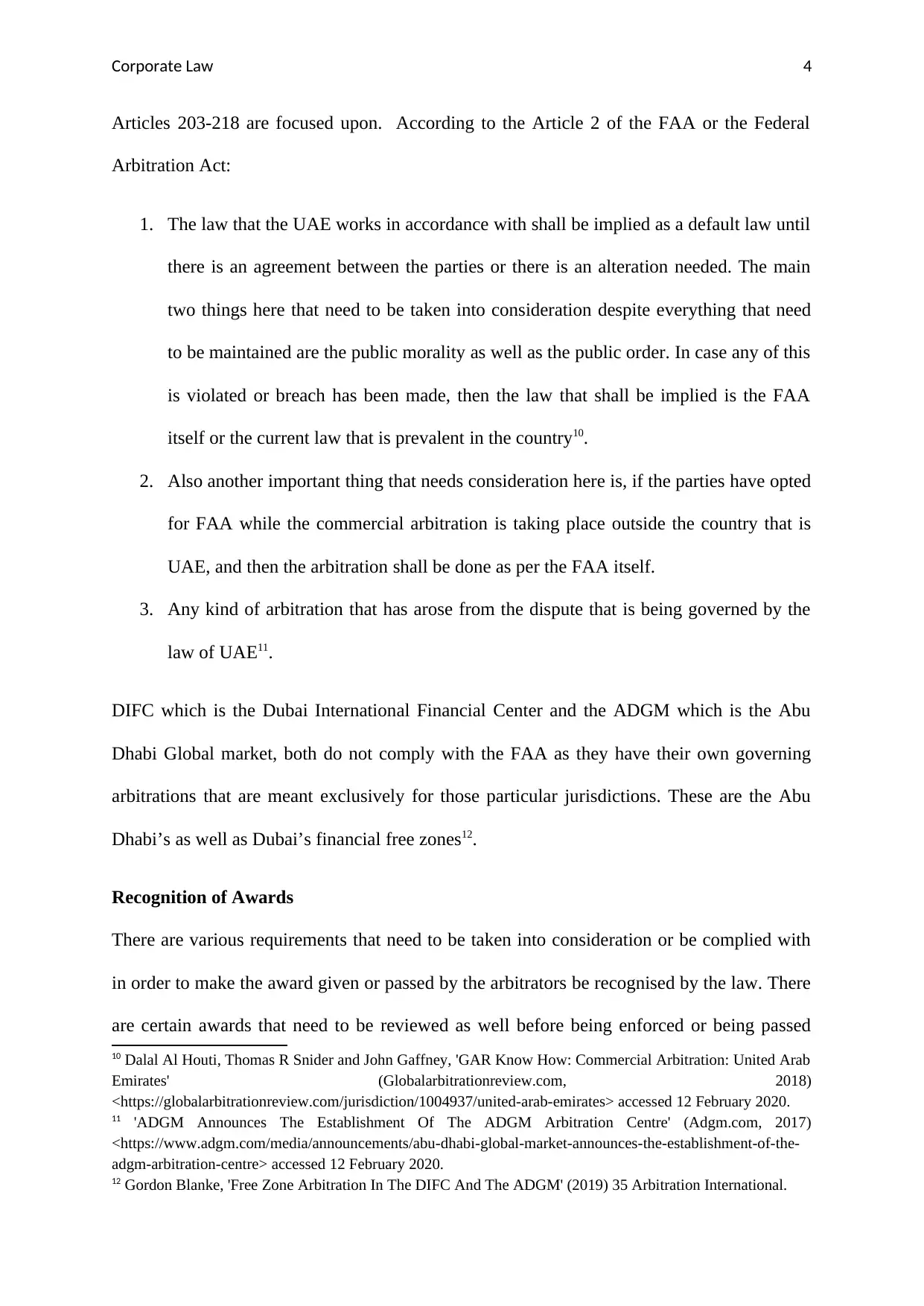
Articles 203-218 are focused upon. According to the Article 2 of the FAA or the Federal
Arbitration Act:
1. The law that the UAE works in accordance with shall be implied as a default law until
there is an agreement between the parties or there is an alteration needed. The main
two things here that need to be taken into consideration despite everything that need
to be maintained are the public morality as well as the public order. In case any of this
is violated or breach has been made, then the law that shall be implied is the FAA
itself or the current law that is prevalent in the country10.
2. Also another important thing that needs consideration here is, if the parties have opted
for FAA while the commercial arbitration is taking place outside the country that is
UAE, and then the arbitration shall be done as per the FAA itself.
3. Any kind of arbitration that has arose from the dispute that is being governed by the
law of UAE11.
DIFC which is the Dubai International Financial Center and the ADGM which is the Abu
Dhabi Global market, both do not comply with the FAA as they have their own governing
arbitrations that are meant exclusively for those particular jurisdictions. These are the Abu
Dhabi’s as well as Dubai’s financial free zones12.
Recognition of Awards
There are various requirements that need to be taken into consideration or be complied with
in order to make the award given or passed by the arbitrators be recognised by the law. There
are certain awards that need to be reviewed as well before being enforced or being passed
10 Dalal Al Houti, Thomas R Snider and John Gaffney, 'GAR Know How: Commercial Arbitration: United Arab
Emirates' (Globalarbitrationreview.com, 2018)
<https://globalarbitrationreview.com/jurisdiction/1004937/united-arab-emirates> accessed 12 February 2020.
11 'ADGM Announces The Establishment Of The ADGM Arbitration Centre' (Adgm.com, 2017)
<https://www.adgm.com/media/announcements/abu-dhabi-global-market-announces-the-establishment-of-the-
adgm-arbitration-centre> accessed 12 February 2020.
12 Gordon Blanke, 'Free Zone Arbitration In The DIFC And The ADGM' (2019) 35 Arbitration International.
Articles 203-218 are focused upon. According to the Article 2 of the FAA or the Federal
Arbitration Act:
1. The law that the UAE works in accordance with shall be implied as a default law until
there is an agreement between the parties or there is an alteration needed. The main
two things here that need to be taken into consideration despite everything that need
to be maintained are the public morality as well as the public order. In case any of this
is violated or breach has been made, then the law that shall be implied is the FAA
itself or the current law that is prevalent in the country10.
2. Also another important thing that needs consideration here is, if the parties have opted
for FAA while the commercial arbitration is taking place outside the country that is
UAE, and then the arbitration shall be done as per the FAA itself.
3. Any kind of arbitration that has arose from the dispute that is being governed by the
law of UAE11.
DIFC which is the Dubai International Financial Center and the ADGM which is the Abu
Dhabi Global market, both do not comply with the FAA as they have their own governing
arbitrations that are meant exclusively for those particular jurisdictions. These are the Abu
Dhabi’s as well as Dubai’s financial free zones12.
Recognition of Awards
There are various requirements that need to be taken into consideration or be complied with
in order to make the award given or passed by the arbitrators be recognised by the law. There
are certain awards that need to be reviewed as well before being enforced or being passed
10 Dalal Al Houti, Thomas R Snider and John Gaffney, 'GAR Know How: Commercial Arbitration: United Arab
Emirates' (Globalarbitrationreview.com, 2018)
<https://globalarbitrationreview.com/jurisdiction/1004937/united-arab-emirates> accessed 12 February 2020.
11 'ADGM Announces The Establishment Of The ADGM Arbitration Centre' (Adgm.com, 2017)
<https://www.adgm.com/media/announcements/abu-dhabi-global-market-announces-the-establishment-of-the-
adgm-arbitration-centre> accessed 12 February 2020.
12 Gordon Blanke, 'Free Zone Arbitration In The DIFC And The ADGM' (2019) 35 Arbitration International.
Corporate Law 5
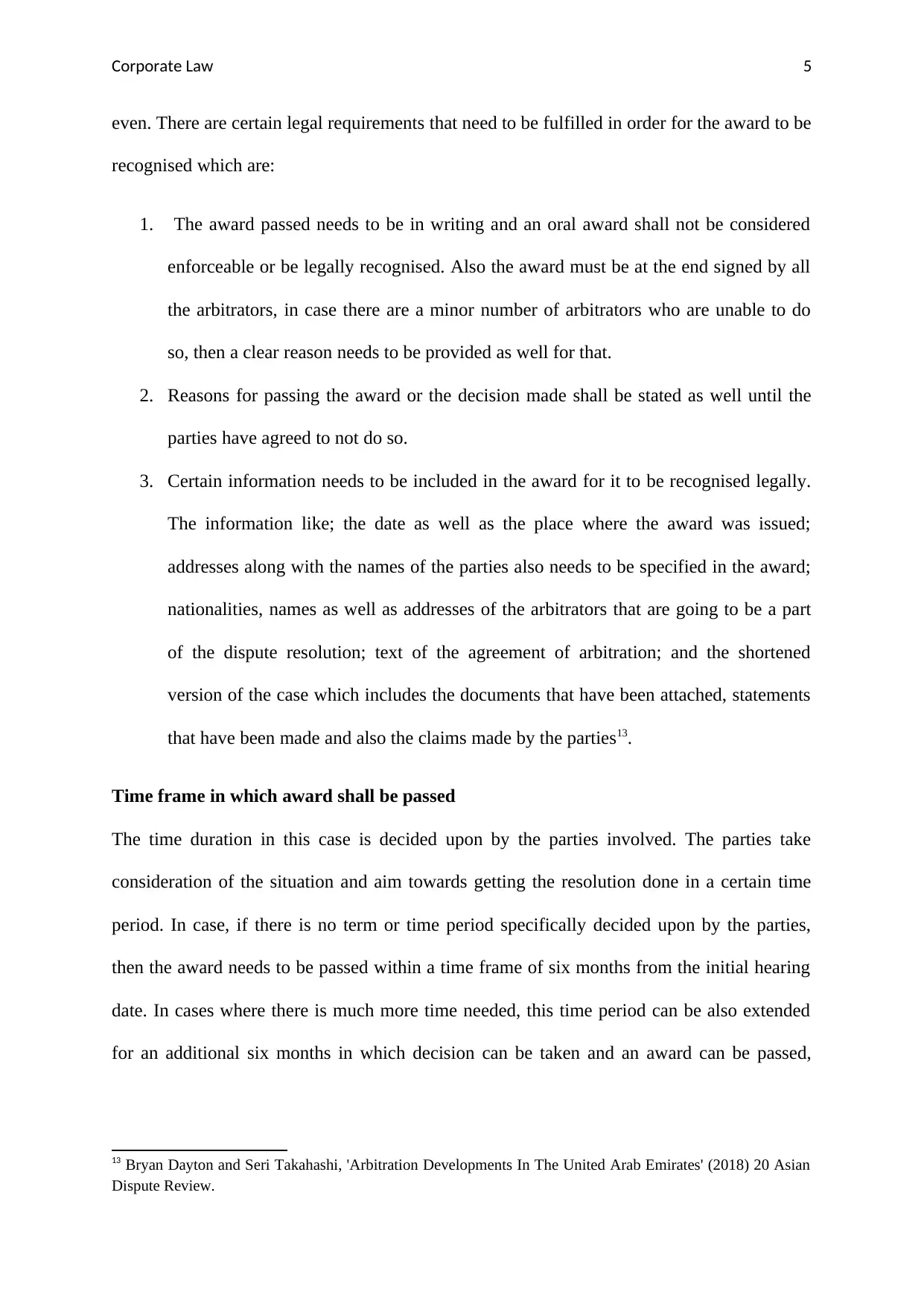
even. There are certain legal requirements that need to be fulfilled in order for the award to be
recognised which are:
1. The award passed needs to be in writing and an oral award shall not be considered
enforceable or be legally recognised. Also the award must be at the end signed by all
the arbitrators, in case there are a minor number of arbitrators who are unable to do
so, then a clear reason needs to be provided as well for that.
2. Reasons for passing the award or the decision made shall be stated as well until the
parties have agreed to not do so.
3. Certain information needs to be included in the award for it to be recognised legally.
The information like; the date as well as the place where the award was issued;
addresses along with the names of the parties also needs to be specified in the award;
nationalities, names as well as addresses of the arbitrators that are going to be a part
of the dispute resolution; text of the agreement of arbitration; and the shortened
version of the case which includes the documents that have been attached, statements
that have been made and also the claims made by the parties13.
Time frame in which award shall be passed
The time duration in this case is decided upon by the parties involved. The parties take
consideration of the situation and aim towards getting the resolution done in a certain time
period. In case, if there is no term or time period specifically decided upon by the parties,
then the award needs to be passed within a time frame of six months from the initial hearing
date. In cases where there is much more time needed, this time period can be also extended
for an additional six months in which decision can be taken and an award can be passed,
13 Bryan Dayton and Seri Takahashi, 'Arbitration Developments In The United Arab Emirates' (2018) 20 Asian
Dispute Review.
even. There are certain legal requirements that need to be fulfilled in order for the award to be
recognised which are:
1. The award passed needs to be in writing and an oral award shall not be considered
enforceable or be legally recognised. Also the award must be at the end signed by all
the arbitrators, in case there are a minor number of arbitrators who are unable to do
so, then a clear reason needs to be provided as well for that.
2. Reasons for passing the award or the decision made shall be stated as well until the
parties have agreed to not do so.
3. Certain information needs to be included in the award for it to be recognised legally.
The information like; the date as well as the place where the award was issued;
addresses along with the names of the parties also needs to be specified in the award;
nationalities, names as well as addresses of the arbitrators that are going to be a part
of the dispute resolution; text of the agreement of arbitration; and the shortened
version of the case which includes the documents that have been attached, statements
that have been made and also the claims made by the parties13.
Time frame in which award shall be passed
The time duration in this case is decided upon by the parties involved. The parties take
consideration of the situation and aim towards getting the resolution done in a certain time
period. In case, if there is no term or time period specifically decided upon by the parties,
then the award needs to be passed within a time frame of six months from the initial hearing
date. In cases where there is much more time needed, this time period can be also extended
for an additional six months in which decision can be taken and an award can be passed,
13 Bryan Dayton and Seri Takahashi, 'Arbitration Developments In The United Arab Emirates' (2018) 20 Asian
Dispute Review.
⊘ This is a preview!⊘
Do you want full access?
Subscribe today to unlock all pages.
Trusted by 1+ million students worldwide
Corporate Law 6
while in situations where parties have decided upon a much longer time, then the extension
can be done for a longer time period as well.
The law cannot impose certain limitations upon the certain applicable legislation upon the
case. But, in certain scenarios, Declaratory Relief is imposed so as to declare a fact or
interpretation if required by the arbitrators, while the national courts cannot do so or are not
authorised to do so.
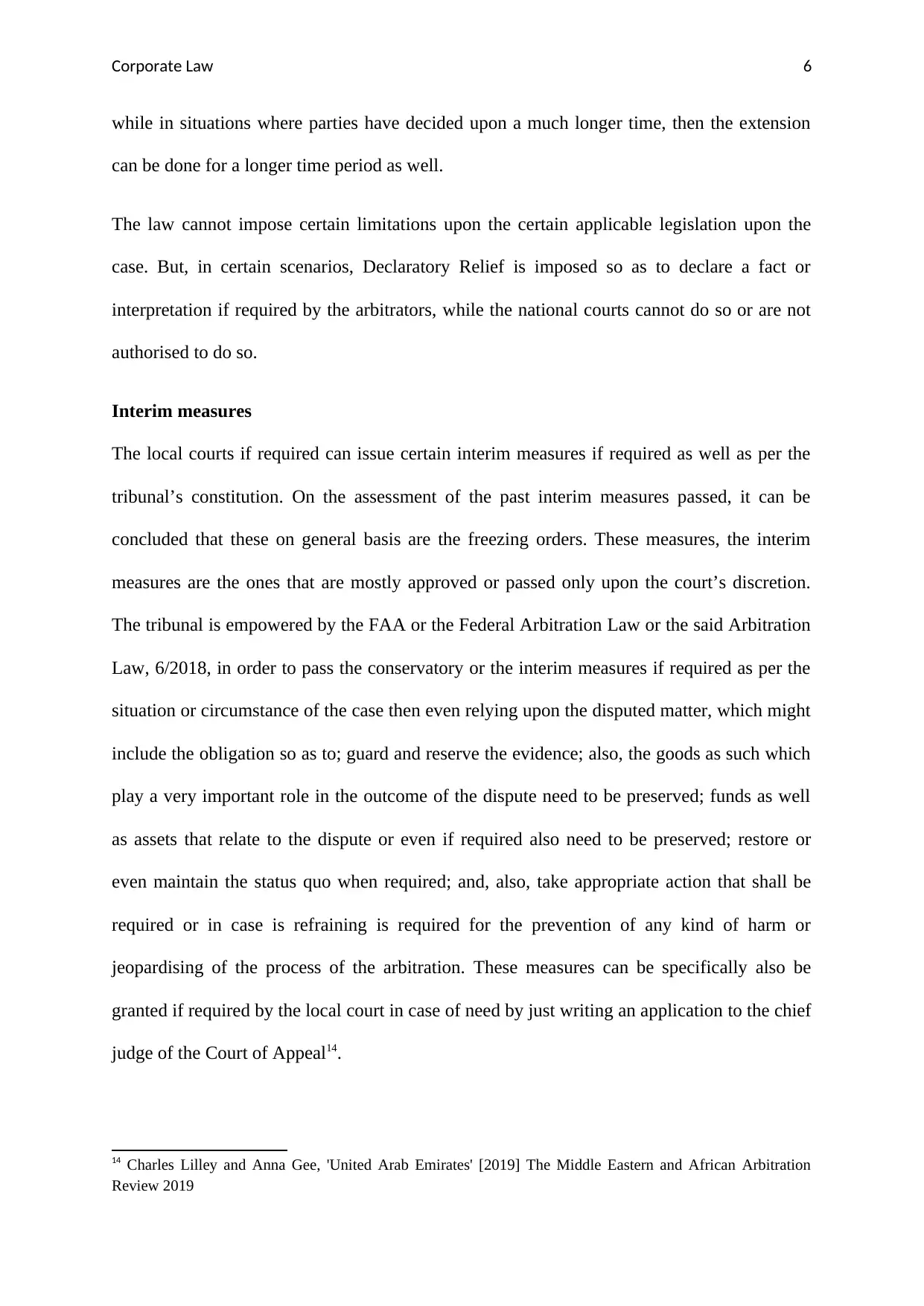
Interim measures
The local courts if required can issue certain interim measures if required as well as per the
tribunal’s constitution. On the assessment of the past interim measures passed, it can be
concluded that these on general basis are the freezing orders. These measures, the interim
measures are the ones that are mostly approved or passed only upon the court’s discretion.
The tribunal is empowered by the FAA or the Federal Arbitration Law or the said Arbitration
Law, 6/2018, in order to pass the conservatory or the interim measures if required as per the
situation or circumstance of the case then even relying upon the disputed matter, which might
include the obligation so as to; guard and reserve the evidence; also, the goods as such which
play a very important role in the outcome of the dispute need to be preserved; funds as well
as assets that relate to the dispute or even if required also need to be preserved; restore or
even maintain the status quo when required; and, also, take appropriate action that shall be
required or in case is refraining is required for the prevention of any kind of harm or
jeopardising of the process of the arbitration. These measures can be specifically also be
granted if required by the local court in case of need by just writing an application to the chief
judge of the Court of Appeal14.
14 Charles Lilley and Anna Gee, 'United Arab Emirates' [2019] The Middle Eastern and African Arbitration
Review 2019
while in situations where parties have decided upon a much longer time, then the extension
can be done for a longer time period as well.
The law cannot impose certain limitations upon the certain applicable legislation upon the
case. But, in certain scenarios, Declaratory Relief is imposed so as to declare a fact or
interpretation if required by the arbitrators, while the national courts cannot do so or are not
authorised to do so.
Interim measures
The local courts if required can issue certain interim measures if required as well as per the
tribunal’s constitution. On the assessment of the past interim measures passed, it can be
concluded that these on general basis are the freezing orders. These measures, the interim
measures are the ones that are mostly approved or passed only upon the court’s discretion.
The tribunal is empowered by the FAA or the Federal Arbitration Law or the said Arbitration
Law, 6/2018, in order to pass the conservatory or the interim measures if required as per the
situation or circumstance of the case then even relying upon the disputed matter, which might
include the obligation so as to; guard and reserve the evidence; also, the goods as such which
play a very important role in the outcome of the dispute need to be preserved; funds as well
as assets that relate to the dispute or even if required also need to be preserved; restore or
even maintain the status quo when required; and, also, take appropriate action that shall be
required or in case is refraining is required for the prevention of any kind of harm or
jeopardising of the process of the arbitration. These measures can be specifically also be
granted if required by the local court in case of need by just writing an application to the chief
judge of the Court of Appeal14.
14 Charles Lilley and Anna Gee, 'United Arab Emirates' [2019] The Middle Eastern and African Arbitration
Review 2019
Paraphrase This Document
Need a fresh take? Get an instant paraphrase of this document with our AI Paraphraser
Corporate Law 7
Other specifics related to the Award
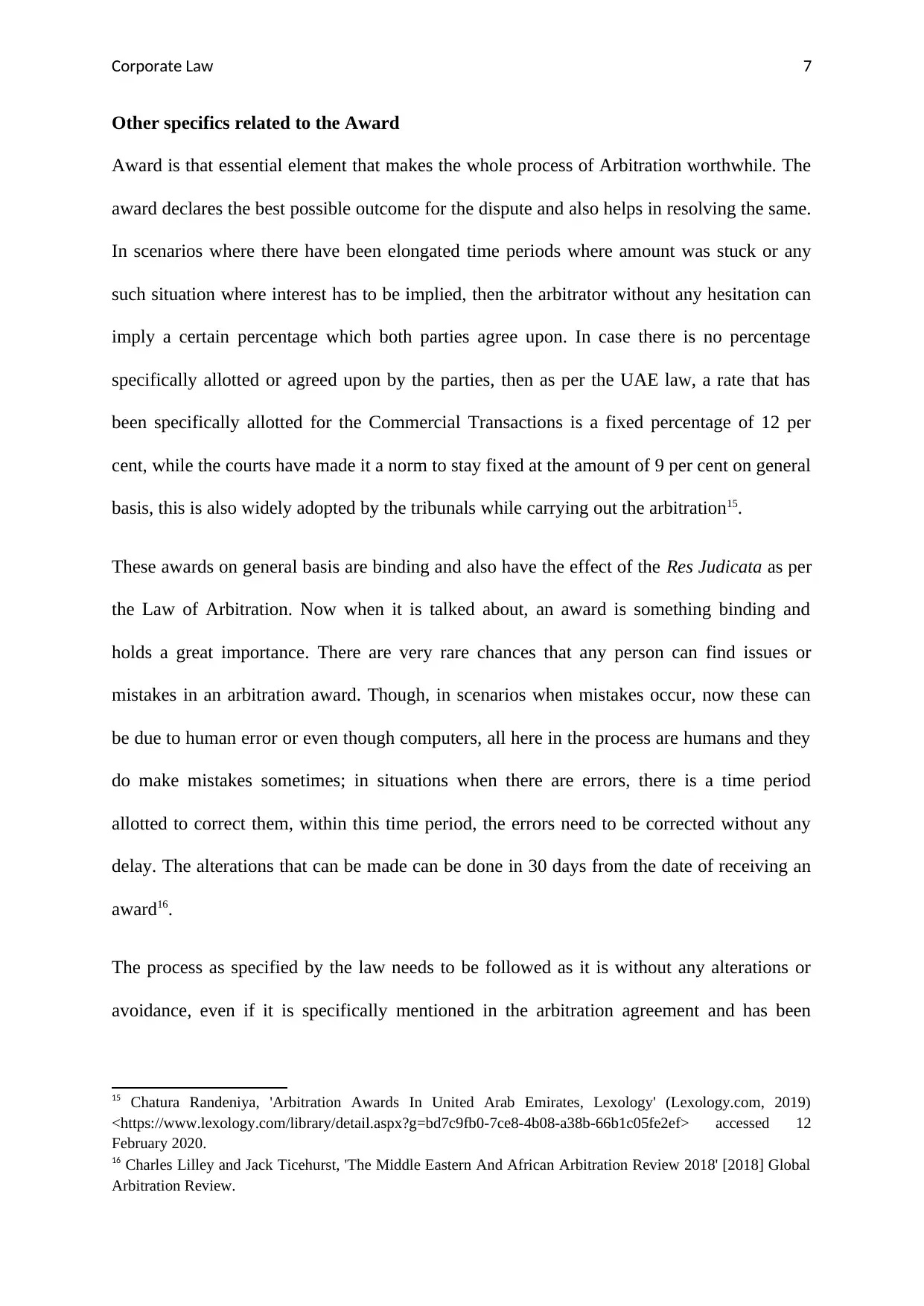
Award is that essential element that makes the whole process of Arbitration worthwhile. The
award declares the best possible outcome for the dispute and also helps in resolving the same.
In scenarios where there have been elongated time periods where amount was stuck or any
such situation where interest has to be implied, then the arbitrator without any hesitation can
imply a certain percentage which both parties agree upon. In case there is no percentage
specifically allotted or agreed upon by the parties, then as per the UAE law, a rate that has
been specifically allotted for the Commercial Transactions is a fixed percentage of 12 per
cent, while the courts have made it a norm to stay fixed at the amount of 9 per cent on general
basis, this is also widely adopted by the tribunals while carrying out the arbitration15.
These awards on general basis are binding and also have the effect of the Res Judicata as per
the Law of Arbitration. Now when it is talked about, an award is something binding and
holds a great importance. There are very rare chances that any person can find issues or
mistakes in an arbitration award. Though, in scenarios when mistakes occur, now these can
be due to human error or even though computers, all here in the process are humans and they
do make mistakes sometimes; in situations when there are errors, there is a time period
allotted to correct them, within this time period, the errors need to be corrected without any
delay. The alterations that can be made can be done in 30 days from the date of receiving an
award16.
The process as specified by the law needs to be followed as it is without any alterations or
avoidance, even if it is specifically mentioned in the arbitration agreement and has been
15 Chatura Randeniya, 'Arbitration Awards In United Arab Emirates, Lexology' (Lexology.com, 2019)
<https://www.lexology.com/library/detail.aspx?g=bd7c9fb0-7ce8-4b08-a38b-66b1c05fe2ef> accessed 12
February 2020.
16 Charles Lilley and Jack Ticehurst, 'The Middle Eastern And African Arbitration Review 2018' [2018] Global
Arbitration Review.
Other specifics related to the Award
Award is that essential element that makes the whole process of Arbitration worthwhile. The
award declares the best possible outcome for the dispute and also helps in resolving the same.
In scenarios where there have been elongated time periods where amount was stuck or any
such situation where interest has to be implied, then the arbitrator without any hesitation can
imply a certain percentage which both parties agree upon. In case there is no percentage
specifically allotted or agreed upon by the parties, then as per the UAE law, a rate that has
been specifically allotted for the Commercial Transactions is a fixed percentage of 12 per
cent, while the courts have made it a norm to stay fixed at the amount of 9 per cent on general
basis, this is also widely adopted by the tribunals while carrying out the arbitration15.
These awards on general basis are binding and also have the effect of the Res Judicata as per
the Law of Arbitration. Now when it is talked about, an award is something binding and
holds a great importance. There are very rare chances that any person can find issues or
mistakes in an arbitration award. Though, in scenarios when mistakes occur, now these can
be due to human error or even though computers, all here in the process are humans and they
do make mistakes sometimes; in situations when there are errors, there is a time period
allotted to correct them, within this time period, the errors need to be corrected without any
delay. The alterations that can be made can be done in 30 days from the date of receiving an
award16.
The process as specified by the law needs to be followed as it is without any alterations or
avoidance, even if it is specifically mentioned in the arbitration agreement and has been
15 Chatura Randeniya, 'Arbitration Awards In United Arab Emirates, Lexology' (Lexology.com, 2019)
<https://www.lexology.com/library/detail.aspx?g=bd7c9fb0-7ce8-4b08-a38b-66b1c05fe2ef> accessed 12
February 2020.
16 Charles Lilley and Jack Ticehurst, 'The Middle Eastern And African Arbitration Review 2018' [2018] Global
Arbitration Review.
Corporate Law 8
thoroughly read and agreed upon between them. There is a certain course of business that
needs to be followed at every cost.
Enforcement of a Foreign Arbitral Award specifically in UAE
One of the major improvements made by the introduction of FAA in the Arbitration Law of
UAE was strict law implementation relating to the enforcement of Arbitral Awards. A strict
process was made according to which the enforcement was to be done. There is very easy
procedure to follow through with the enforcement of Awards under UAE Arbitration Law
Article 55 in this law allows a petition under the Chief Justice of the Court of Appeal being
filed. The chief Justice then passes the order based upon the petition of ratification within a
certain number of days of filing the application which is around 60 days. This enforcement or
the ratification order itself issued by the chief justice then or the person is done17.
The order of enforcement or ratification when once approved by the Chief Justice, and not
just him but also whomever he/she appoints, is with prompt impact be enforceable and shall
empower the creditor of the award to get their award being stepped as such as per the
execution structure and take all the said execution techniques against the debtor of the award.
This is on the grounds that the endorsement request is regarded a 'Request on Petition' which
is promptly enforceable by the law. The said law of the UAE as such in relation with the
Arbitration was reappealed and it was strongly found that the changes here were made in the
Chapter III, the Articles here discussed were the 203-218 of the UAE Civil Procedure Law.
Though no changes were made in the Chapter IV which was entirely based upon the Foreign
Judgements being executed, Instruments as well as the awards or to be specifically talked
about are the articles 235-238 of the renowned UAE Civil Procedure Law18.
17 Al Tamimi, Enforcement Of Foreign Arbitral Awards In The UAE: Paving The Way For A New Enforcement
Regime (Al Tamimi & Company 2019) <https://www.lexology.com/library/detail.aspx?g=799dbd47-4075-
409a-a503-a2f2d88f2f80> accessed 12 February 2020.
18 Federal Law No. (6) Of 2018 On Arbitration (6th edn, 2018)
<https://www.tamimi.com/crm-media-uploader/fileupload/server/php/files/UAE%20Arbitration%20Law%20-
thoroughly read and agreed upon between them. There is a certain course of business that
needs to be followed at every cost.
Enforcement of a Foreign Arbitral Award specifically in UAE
One of the major improvements made by the introduction of FAA in the Arbitration Law of
UAE was strict law implementation relating to the enforcement of Arbitral Awards. A strict
process was made according to which the enforcement was to be done. There is very easy
procedure to follow through with the enforcement of Awards under UAE Arbitration Law
Article 55 in this law allows a petition under the Chief Justice of the Court of Appeal being
filed. The chief Justice then passes the order based upon the petition of ratification within a
certain number of days of filing the application which is around 60 days. This enforcement or
the ratification order itself issued by the chief justice then or the person is done17.
The order of enforcement or ratification when once approved by the Chief Justice, and not
just him but also whomever he/she appoints, is with prompt impact be enforceable and shall
empower the creditor of the award to get their award being stepped as such as per the
execution structure and take all the said execution techniques against the debtor of the award.
This is on the grounds that the endorsement request is regarded a 'Request on Petition' which
is promptly enforceable by the law. The said law of the UAE as such in relation with the
Arbitration was reappealed and it was strongly found that the changes here were made in the
Chapter III, the Articles here discussed were the 203-218 of the UAE Civil Procedure Law.
Though no changes were made in the Chapter IV which was entirely based upon the Foreign
Judgements being executed, Instruments as well as the awards or to be specifically talked
about are the articles 235-238 of the renowned UAE Civil Procedure Law18.
17 Al Tamimi, Enforcement Of Foreign Arbitral Awards In The UAE: Paving The Way For A New Enforcement
Regime (Al Tamimi & Company 2019) <https://www.lexology.com/library/detail.aspx?g=799dbd47-4075-
409a-a503-a2f2d88f2f80> accessed 12 February 2020.
18 Federal Law No. (6) Of 2018 On Arbitration (6th edn, 2018)
<https://www.tamimi.com/crm-media-uploader/fileupload/server/php/files/UAE%20Arbitration%20Law%20-
⊘ This is a preview!⊘
Do you want full access?
Subscribe today to unlock all pages.
Trusted by 1+ million students worldwide
Corporate Law 9
As issued on the date 28th September 2017, the so called the 10th Federal Decree, specifically
the Article, 5 to 19, 42 to 54, 70 to 83, 125 to 136, 140 to 149 and 219 to 331 all of these
were kept in force and all the others were either amended or removed until the time it could
be repealed through the order by decision of cabinet which in general deals with the said or
respective sections as such of the Civil Procedure Law19. The said Cabinet Decision currently
provides another efficient set of rules that assists with the enforcement of the Foreign Arbitral
Awards20. In common language, this new law or the new set of rules basically replaces as
well as repeals the already established set of rules under the UAE Civil Procedure Law,
specifically the Articles 235 to 23821. Cabinet Decision has definitely assisted with the better
and efficient enforcement of the whole process of the Foreign Arbitral Awards by making it
quite cost –effective as well as time –efficient as well by:
1. In the above procedure of enforcement, the application submitted for the process to
initiate the Foreign Arbitration includes filing for a petition directly with the
execution judge that is within a time period of three days at maximum shall issue the
order.
2. As well as, the said order by the Execution Judge be deemed as an enforceable one
with immediate effect as it shall be considered as the one ‘Order on Petition’ which
according to the Article 78 of the Cabinet Decision is considered as the one that is
enforceable with an immediate effect by the law22.
%20Federal%20Law%20No%20%206%20of%202018.pdf> accessed 12 February 2020.
19 'Arbitration In The UAE' (Fenwick Elliott, 2018) <https://www.fenwickelliott.com/research-insight/annual-
review/2018/arbitration-uae> accessed 12 February 2020.
20 'The New Enforcement Regime: A Further Step In The Right Direction, JD Supra (JD Supra, 2019)
<https://www.jdsupra.com/legalnews/the-new-enforcement-regime-a-further-46205/> accessed 12 February
2020.
21 'UAE Federal Law On Arbitration - The Official Portal Of The UAE Government' (Government.ae, 2020)
<https://government.ae/en/information-and-services/justice-safety-and-the-law/litigation-procedures/alternative-
methods-to-settle-disputes-/uae-federal-law-on-arbitration> accessed 12 February 2020.
22 Dr Gordon Blanke, 'The UAE Federal Arbitration Law One Year In: Taking Stock' (Arbitration Blog, 2019)
<http://arbitrationblog.practicallaw.com/the-uae-federal-arbitration-law-one-year-in-taking-stock/> accessed 12
February 2020.
As issued on the date 28th September 2017, the so called the 10th Federal Decree, specifically
the Article, 5 to 19, 42 to 54, 70 to 83, 125 to 136, 140 to 149 and 219 to 331 all of these
were kept in force and all the others were either amended or removed until the time it could
be repealed through the order by decision of cabinet which in general deals with the said or
respective sections as such of the Civil Procedure Law19. The said Cabinet Decision currently
provides another efficient set of rules that assists with the enforcement of the Foreign Arbitral
Awards20. In common language, this new law or the new set of rules basically replaces as
well as repeals the already established set of rules under the UAE Civil Procedure Law,
specifically the Articles 235 to 23821. Cabinet Decision has definitely assisted with the better
and efficient enforcement of the whole process of the Foreign Arbitral Awards by making it
quite cost –effective as well as time –efficient as well by:
1. In the above procedure of enforcement, the application submitted for the process to
initiate the Foreign Arbitration includes filing for a petition directly with the
execution judge that is within a time period of three days at maximum shall issue the
order.
2. As well as, the said order by the Execution Judge be deemed as an enforceable one
with immediate effect as it shall be considered as the one ‘Order on Petition’ which
according to the Article 78 of the Cabinet Decision is considered as the one that is
enforceable with an immediate effect by the law22.
%20Federal%20Law%20No%20%206%20of%202018.pdf> accessed 12 February 2020.
19 'Arbitration In The UAE' (Fenwick Elliott, 2018) <https://www.fenwickelliott.com/research-insight/annual-
review/2018/arbitration-uae> accessed 12 February 2020.
20 'The New Enforcement Regime: A Further Step In The Right Direction, JD Supra (JD Supra, 2019)
<https://www.jdsupra.com/legalnews/the-new-enforcement-regime-a-further-46205/> accessed 12 February
2020.
21 'UAE Federal Law On Arbitration - The Official Portal Of The UAE Government' (Government.ae, 2020)
<https://government.ae/en/information-and-services/justice-safety-and-the-law/litigation-procedures/alternative-
methods-to-settle-disputes-/uae-federal-law-on-arbitration> accessed 12 February 2020.
22 Dr Gordon Blanke, 'The UAE Federal Arbitration Law One Year In: Taking Stock' (Arbitration Blog, 2019)
<http://arbitrationblog.practicallaw.com/the-uae-federal-arbitration-law-one-year-in-taking-stock/> accessed 12
February 2020.
Paraphrase This Document
Need a fresh take? Get an instant paraphrase of this document with our AI Paraphraser
Corporate Law 10
Also, another aspect that needs attention here is that, though, the procedural rules are being
specified upon by the Cabinet Decision relating to the enforcement as such of the foreign
arbitral awards but, the major substantive conditions that are required for the enforcement in
this case are majorly taken care of or specifically governed through the New York
Convention. Specifically, the Article IV of the above mentioned convention in the cases as
such where required, shall have supremacy over the decisions made by the Cabinet23.
Conclusion
The proceedings as such those relate with the enforcement as well as the recognition of the
arbitral awards specifically the ones that are foreign, were once considered inapt and non –
compliable. UAE arbitration law was in past considered an inapt option in regards with the
foreign arbitration awards as the foreign arbitration required certain specifics that UAE did
not deal with earlier through their rules and regulations as such. The introduction of FAA led
to so many changes and dealings with the international market quite easy. This made things
easier for the corporates as well as other people along with the country as well to deal with
situations or disputes that arose from these transactions.
Also, strict and specific rules in relation with the recognition as well as enforcement have
also played a very crucial part in it. The Cabinet Decision as such has helped or assisted with
the UAE’s process of dealing with the enforcement of the foreign arbitral awards
significantly. There was a desperate need for an order or a process or even a regime to be
established to make things symmetrical and working along these certain lines led to finally
resolving the issues related to the enforcement of these awards passed in foreign cases. Since,
it is being used on regular basis, now the difference is quite evident to the people involved.
23 Allen Overy, 'United Arab Emirates: Enforcement Of Foreign Arbitral Awards Back On Track – But Risk Of
Inconsistent Judgments Remains - Allen & Overy' (Allen Overy, 2019)
<https://www.allenovery.com/en-gb/global/news-and-insights/legal-and-regulatory-risks-for-the-finance-
sector/middle-east/enforcement-of-foreign-arbitral-awards-back-on-track-but-risk-of-inconsistent-judgments-
remain> accessed 12 February 2020.
Also, another aspect that needs attention here is that, though, the procedural rules are being
specified upon by the Cabinet Decision relating to the enforcement as such of the foreign
arbitral awards but, the major substantive conditions that are required for the enforcement in
this case are majorly taken care of or specifically governed through the New York
Convention. Specifically, the Article IV of the above mentioned convention in the cases as
such where required, shall have supremacy over the decisions made by the Cabinet23.
Conclusion
The proceedings as such those relate with the enforcement as well as the recognition of the
arbitral awards specifically the ones that are foreign, were once considered inapt and non –
compliable. UAE arbitration law was in past considered an inapt option in regards with the
foreign arbitration awards as the foreign arbitration required certain specifics that UAE did
not deal with earlier through their rules and regulations as such. The introduction of FAA led
to so many changes and dealings with the international market quite easy. This made things
easier for the corporates as well as other people along with the country as well to deal with
situations or disputes that arose from these transactions.
Also, strict and specific rules in relation with the recognition as well as enforcement have
also played a very crucial part in it. The Cabinet Decision as such has helped or assisted with
the UAE’s process of dealing with the enforcement of the foreign arbitral awards
significantly. There was a desperate need for an order or a process or even a regime to be
established to make things symmetrical and working along these certain lines led to finally
resolving the issues related to the enforcement of these awards passed in foreign cases. Since,
it is being used on regular basis, now the difference is quite evident to the people involved.
23 Allen Overy, 'United Arab Emirates: Enforcement Of Foreign Arbitral Awards Back On Track – But Risk Of
Inconsistent Judgments Remains - Allen & Overy' (Allen Overy, 2019)
<https://www.allenovery.com/en-gb/global/news-and-insights/legal-and-regulatory-risks-for-the-finance-
sector/middle-east/enforcement-of-foreign-arbitral-awards-back-on-track-but-risk-of-inconsistent-judgments-
remain> accessed 12 February 2020.
Corporate Law 11
This in relation with the Arbitration law in UAE has played a very key role and has also led
to positive impact on the system as well.
Bibliography
Secondary Sources
Book
Cole T, and Ortolani P, Understanding International Arbitration (Routledge 2019)
This in relation with the Arbitration law in UAE has played a very key role and has also led
to positive impact on the system as well.
Bibliography
Secondary Sources
Book
Cole T, and Ortolani P, Understanding International Arbitration (Routledge 2019)
⊘ This is a preview!⊘
Do you want full access?
Subscribe today to unlock all pages.
Trusted by 1+ million students worldwide

1 out of 15


Related Documents


Your All-in-One AI-Powered Toolkit for Academic Success.
+13062052269
info@desklib.com
Available 24*7 on WhatsApp / Email
![[object Object]](/_next/static/media/star-bottom.7253800d.svg)
Unlock your academic potential
Copyright © 2020–2026 A2Z Services. All Rights Reserved. Developed and managed by ZUCOL.