Evaluating Engineering Design Controls: An OHS Case Study Portfolio
VerifiedAdded on 2023/06/09
|12
|3780
|431
Case Study
AI Summary
This assignment presents a comprehensive OHS case study analyzing design standards across various engineering applications. It examines lawn mower and forklift design standards, road design specifications, and the implications of housing proximity to overhead electric transmission lines. For each case, the study identifies existing design standards, the organizations responsible for their development, and whether these standards are informed by reactive and proactive methods. It also explores the societal mechanisms used to promote, encourage, or enforce these standards. The study further includes observations on the scope, inclusion of good controls, strengths, weaknesses, effectiveness, and review processes following technological changes, all informed by relevant lectures and discussions. The analysis uses suitable references to identify information sources and presents key findings in a tabulated format.

Running head: OHS 0
OHS Case study
8/10/2018
OHS Case study
8/10/2018

Paraphrase This Document
Need a fresh take? Get an instant paraphrase of this document with our AI Paraphraser
OHS 1
CASE 1: LAWN MOWER DESIGN STANDARDS
Lawn mower is a mechanical device used for cutting the grass of lawn; it is a machine that
has revolving blades to cut a grass (Sears parts direct, 2018). Maintenance of beautiful lawn
can be easily done with the use of proper lawn mower. There are two types of lawn mower
explained below:
Rotary mowers: These types of mowers are very common and find in in the form of electric
or gasoline powered. These mowers cut and chop the top of the grass with horizontal blades.
Rotary mowers have also bag for collecting the clippings of the chopped grass. Blades of the
rotary mower are very sharp, as dull blades can’t chopped the edges of grass properly.
Reel mowers: Reel mowers are less common, as they are not electric powered. Reel mowers
can work only when pushed forward by the person. When blades of this mower keep sharp, it
can chop the grass properly with excellent quality of cutting. Reel mowers are inexpensive
so, this feature of reel mower makes it popular among people.
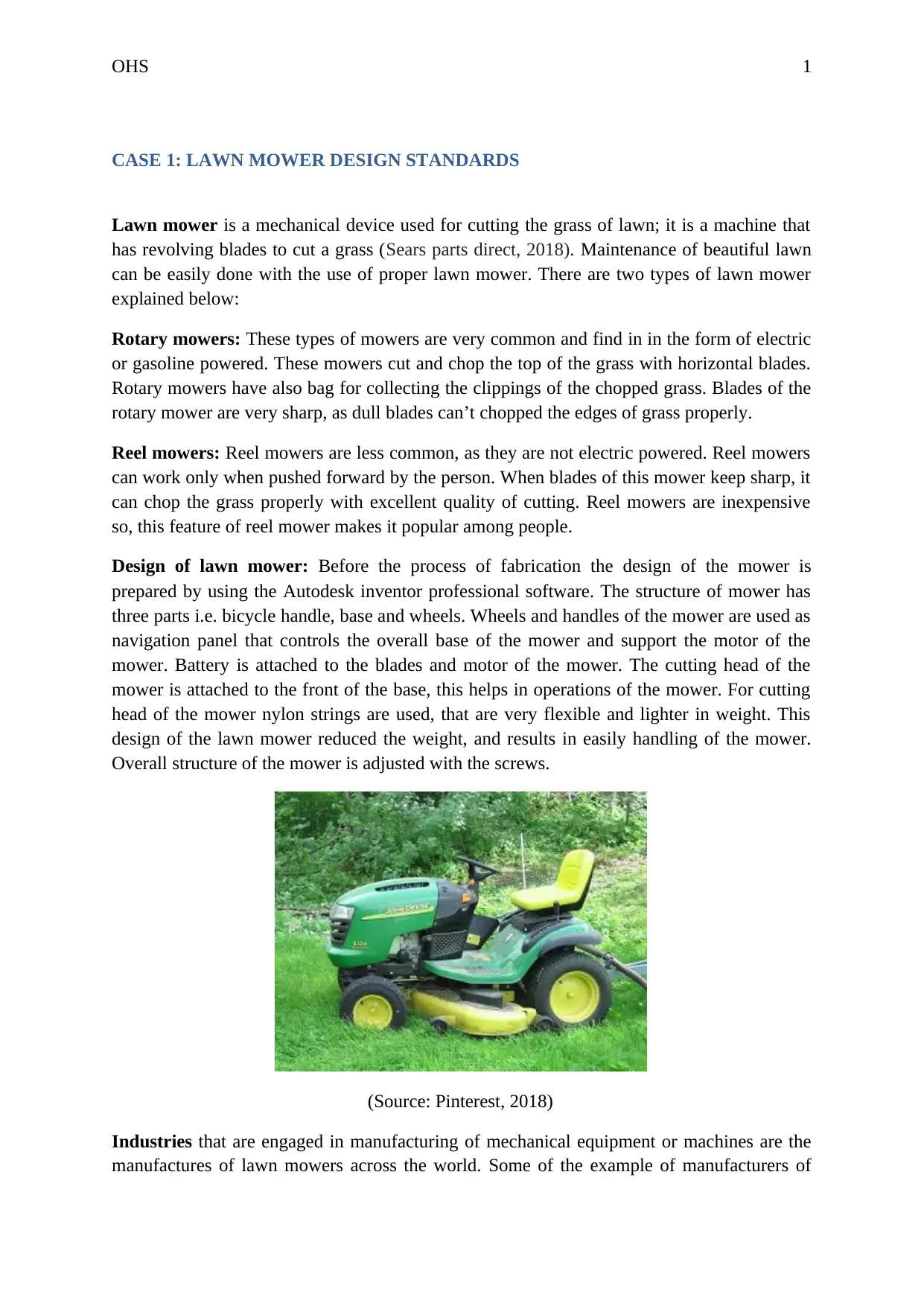
Design of lawn mower: Before the process of fabrication the design of the mower is
prepared by using the Autodesk inventor professional software. The structure of mower has
three parts i.e. bicycle handle, base and wheels. Wheels and handles of the mower are used as
navigation panel that controls the overall base of the mower and support the motor of the
mower. Battery is attached to the blades and motor of the mower. The cutting head of the
mower is attached to the front of the base, this helps in operations of the mower. For cutting
head of the mower nylon strings are used, that are very flexible and lighter in weight. This
design of the lawn mower reduced the weight, and results in easily handling of the mower.
Overall structure of the mower is adjusted with the screws.
(Source: Pinterest, 2018)
Industries that are engaged in manufacturing of mechanical equipment or machines are the
manufactures of lawn mowers across the world. Some of the example of manufacturers of
CASE 1: LAWN MOWER DESIGN STANDARDS
Lawn mower is a mechanical device used for cutting the grass of lawn; it is a machine that
has revolving blades to cut a grass (Sears parts direct, 2018). Maintenance of beautiful lawn
can be easily done with the use of proper lawn mower. There are two types of lawn mower
explained below:
Rotary mowers: These types of mowers are very common and find in in the form of electric
or gasoline powered. These mowers cut and chop the top of the grass with horizontal blades.
Rotary mowers have also bag for collecting the clippings of the chopped grass. Blades of the
rotary mower are very sharp, as dull blades can’t chopped the edges of grass properly.
Reel mowers: Reel mowers are less common, as they are not electric powered. Reel mowers
can work only when pushed forward by the person. When blades of this mower keep sharp, it
can chop the grass properly with excellent quality of cutting. Reel mowers are inexpensive
so, this feature of reel mower makes it popular among people.
Design of lawn mower: Before the process of fabrication the design of the mower is
prepared by using the Autodesk inventor professional software. The structure of mower has
three parts i.e. bicycle handle, base and wheels. Wheels and handles of the mower are used as
navigation panel that controls the overall base of the mower and support the motor of the
mower. Battery is attached to the blades and motor of the mower. The cutting head of the
mower is attached to the front of the base, this helps in operations of the mower. For cutting
head of the mower nylon strings are used, that are very flexible and lighter in weight. This
design of the lawn mower reduced the weight, and results in easily handling of the mower.
Overall structure of the mower is adjusted with the screws.
(Source: Pinterest, 2018)
Industries that are engaged in manufacturing of mechanical equipment or machines are the
manufactures of lawn mowers across the world. Some of the example of manufacturers of
OHS 2
lawn mower is Victa an Australian firm, Honda Motor Company Ltd., Toro, Husqvarna
Group, and many more (Ryobi landscapes, 2018).
Benefits of mower that encourage the public to use it:
There are many benefits of lawn mowing. Having a ride with lawn mowing machine has very
significant effect on the body of the human. Riding with lawn mowing machine helps those
who has the problem in standing properly, they can stand and move the lawn mower
machine. Riding with lawn mower machine eliminates the problem of pull cord. So, it is very
useful for health of the person as well for cutting of grass. These machines keep the lawn
clean and chopped. People should go for the use of this machine.
Strength and weaknesses of mower:
Use of this lawn mower machine has strengths as well as weaknesses or we can say that pros
and cons of using this machine. Safety is the main concern everywhere, so here safety is also
very important while riding with the lawn mower machine in the lawn. If not handled
properly lead to the damage of lawn and blades of the machine cause any injury. There are
different types of lawn mower machines in the market; some of the models of the machines
help in reducing the emissions of the environment. Mowers are best for environmental
sustainability. One of the biggest weaknesses of mower is its repair cost; people are hesitating
to buy just because of its repair cost. Gas mower is bit more time consuming as well as
costly. But gas mower is good for those who are looking for convenience.
CASE 2: FORKLIFT DESIGN STANDARDS
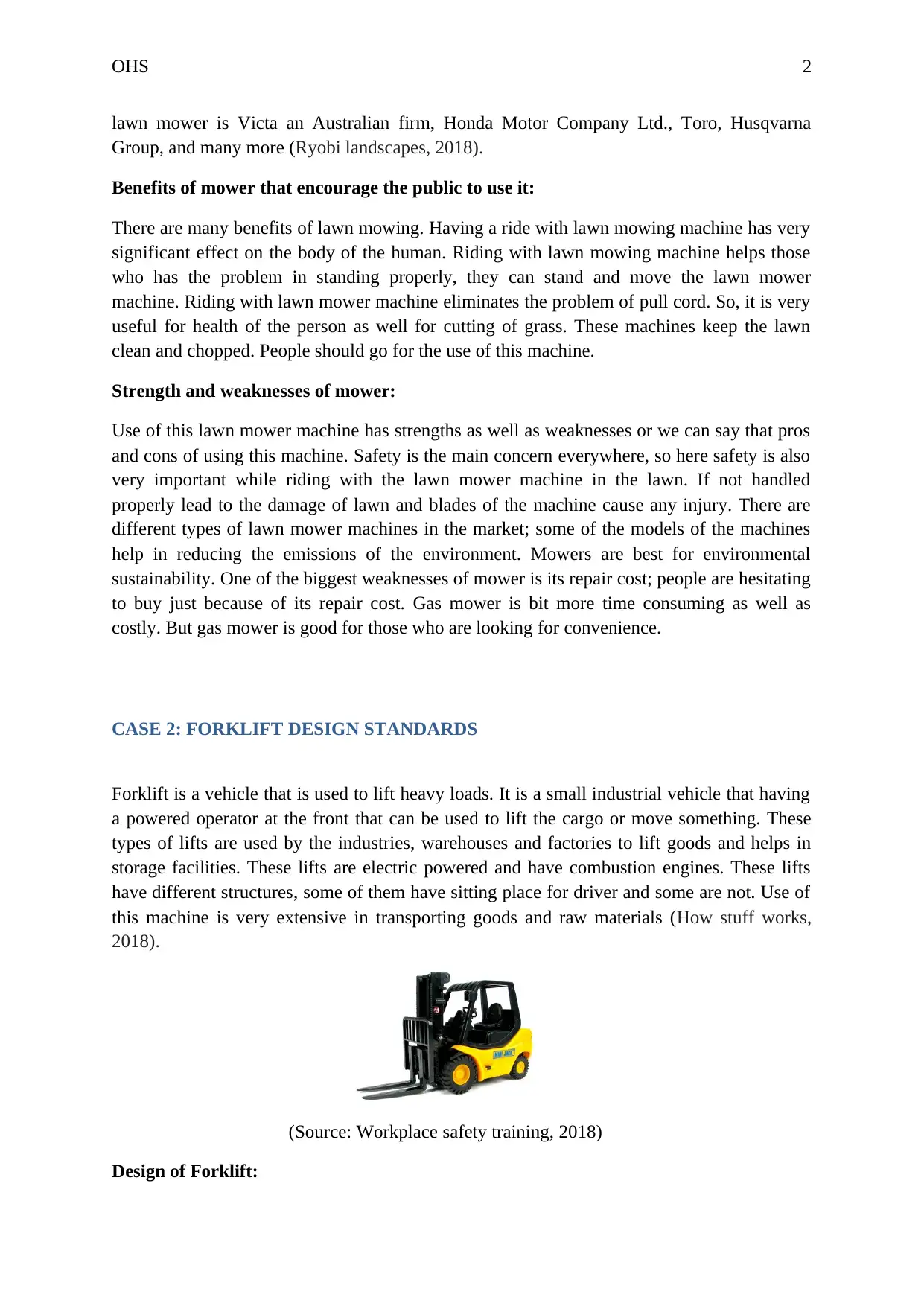
Forklift is a vehicle that is used to lift heavy loads. It is a small industrial vehicle that having
a powered operator at the front that can be used to lift the cargo or move something. These
types of lifts are used by the industries, warehouses and factories to lift goods and helps in
storage facilities. These lifts are electric powered and have combustion engines. These lifts
have different structures, some of them have sitting place for driver and some are not. Use of
this machine is very extensive in transporting goods and raw materials (How stuff works,
2018).
(Source: Workplace safety training, 2018)
Design of Forklift:
lawn mower is Victa an Australian firm, Honda Motor Company Ltd., Toro, Husqvarna
Group, and many more (Ryobi landscapes, 2018).
Benefits of mower that encourage the public to use it:
There are many benefits of lawn mowing. Having a ride with lawn mowing machine has very
significant effect on the body of the human. Riding with lawn mowing machine helps those
who has the problem in standing properly, they can stand and move the lawn mower
machine. Riding with lawn mower machine eliminates the problem of pull cord. So, it is very
useful for health of the person as well for cutting of grass. These machines keep the lawn
clean and chopped. People should go for the use of this machine.
Strength and weaknesses of mower:
Use of this lawn mower machine has strengths as well as weaknesses or we can say that pros
and cons of using this machine. Safety is the main concern everywhere, so here safety is also
very important while riding with the lawn mower machine in the lawn. If not handled
properly lead to the damage of lawn and blades of the machine cause any injury. There are
different types of lawn mower machines in the market; some of the models of the machines
help in reducing the emissions of the environment. Mowers are best for environmental
sustainability. One of the biggest weaknesses of mower is its repair cost; people are hesitating
to buy just because of its repair cost. Gas mower is bit more time consuming as well as
costly. But gas mower is good for those who are looking for convenience.
CASE 2: FORKLIFT DESIGN STANDARDS
Forklift is a vehicle that is used to lift heavy loads. It is a small industrial vehicle that having
a powered operator at the front that can be used to lift the cargo or move something. These
types of lifts are used by the industries, warehouses and factories to lift goods and helps in
storage facilities. These lifts are electric powered and have combustion engines. These lifts
have different structures, some of them have sitting place for driver and some are not. Use of
this machine is very extensive in transporting goods and raw materials (How stuff works,
2018).
(Source: Workplace safety training, 2018)
Design of Forklift:
⊘ This is a preview!⊘
Do you want full access?
Subscribe today to unlock all pages.

Trusted by 1+ million students worldwide
OHS 3
Truck frame: It is the most important component of the forklift which constitutes the base of
the lift. Remaining components of the forklift are attached to the truck frame of the lift.
Counterweight: It is the iron weight attached to the rear part of the forklift. Counterweight is
used to maintain the balance of the goods or raw material when lifted by the forklift. Battery
is attached to the counterweight (NMC, 2017).
Power source: Combustion engine is used as a power source for forklift. Fuel of this engine
is LPG gas, CNG gas and natural gas.
Carriage: Base of the forklift is its carriage. Carriage of the forklift is fixed on mast rails,
which help it in moving upward and downward.
Mast: It is a vertical part of the lift that pushes the lift up and down while loading goods.
Components of Mast are consisted of rails that give support to the lift.
Companies that are engaged in manufacturing of Forklift are, Toyota Industries Corporation,
KION Group, Crown Equipment Corp., Lonking Forklift Co., Ltd., Hyundai Heavy
Industries and many more (Nit co, 2018).
There are many reasons for using Forklift in a business. It is used in warehouses and storage
facilities for good reason. Some of its uses are explained below:
Fuel efficient: Nowadays Forklifts are electric, which means these machines are fuel
efficient. Earlier there were gas machines which were not fuel efficient.
Having high load capacity: Design of the forklift is prepared according to the need of the
business. Every business has different requirements, so they need forklift according to their
need. They have the capacity to lift high loads, that’s why they are used in warehouses.
Affordable: These machines are easily affordable in different sizes (Resource library, 2018).
Safer: Before the invention of Forklift, people were used to rely on the very less safe means
of loading goods. Forklift is very safe in loading goods from one place to another in
warehouses (Nimankar, Mahale, Mestry, Morankar and Nille, 2018).
Safe and less time consuming features of Forklift attract people, to use this in their business
for loading and unloading of goods in warehouses.
Strengths and weaknesses of Forklift:
Strengths:
There is less operating cost in using combustion model of Forklift
Electric Forklift is most prevalent in the market, because charges for electricity are less in
comparison to charges of fuel.
Less noisy in nature, but it can produce little noise during back-up alarm.
Truck frame: It is the most important component of the forklift which constitutes the base of
the lift. Remaining components of the forklift are attached to the truck frame of the lift.
Counterweight: It is the iron weight attached to the rear part of the forklift. Counterweight is
used to maintain the balance of the goods or raw material when lifted by the forklift. Battery
is attached to the counterweight (NMC, 2017).
Power source: Combustion engine is used as a power source for forklift. Fuel of this engine
is LPG gas, CNG gas and natural gas.
Carriage: Base of the forklift is its carriage. Carriage of the forklift is fixed on mast rails,
which help it in moving upward and downward.
Mast: It is a vertical part of the lift that pushes the lift up and down while loading goods.
Components of Mast are consisted of rails that give support to the lift.
Companies that are engaged in manufacturing of Forklift are, Toyota Industries Corporation,
KION Group, Crown Equipment Corp., Lonking Forklift Co., Ltd., Hyundai Heavy
Industries and many more (Nit co, 2018).
There are many reasons for using Forklift in a business. It is used in warehouses and storage
facilities for good reason. Some of its uses are explained below:
Fuel efficient: Nowadays Forklifts are electric, which means these machines are fuel
efficient. Earlier there were gas machines which were not fuel efficient.
Having high load capacity: Design of the forklift is prepared according to the need of the
business. Every business has different requirements, so they need forklift according to their
need. They have the capacity to lift high loads, that’s why they are used in warehouses.
Affordable: These machines are easily affordable in different sizes (Resource library, 2018).
Safer: Before the invention of Forklift, people were used to rely on the very less safe means
of loading goods. Forklift is very safe in loading goods from one place to another in
warehouses (Nimankar, Mahale, Mestry, Morankar and Nille, 2018).
Safe and less time consuming features of Forklift attract people, to use this in their business
for loading and unloading of goods in warehouses.
Strengths and weaknesses of Forklift:
Strengths:
There is less operating cost in using combustion model of Forklift
Electric Forklift is most prevalent in the market, because charges for electricity are less in
comparison to charges of fuel.
Less noisy in nature, but it can produce little noise during back-up alarm.
Paraphrase This Document
Need a fresh take? Get an instant paraphrase of this document with our AI Paraphraser
OHS 4
Automatic process of Forklift reduces the wear and tear and fatigue of the operator.
It does not require early maintenance.
Weaknesses: There are some weaknesses of using Forklift in one’s business; some of the
weaknesses are given below:
Stations for battery charging are needed in one’s business.
Regular supply of electricity should be needed in one’s business, and higher voltage is also
needed for Forklift.
There is higher upfront cost in Forklift.
Electric Forklifts are only limited to lift 12000 lbs.
CASE 3: ROAD DESIGN STANDARDS
The specifications of Highway are developed by the Department for Transport for the Trunk
Road Network. Design Manual for Roads and Bridges provides the best manual for the
standards of the roads and bridges (Gibreel, Easa, Hassan and El-Dimeery, 2008).
Geometric design of the road is comprises of alignment of roads, profile of the roads,
cross section of the roads.
Alignment: Alignment of the road is the horizontal tangents or curves of the roads.
Profile: Profile is the vertical aspect of the road, which includes crest, sag curves and the
straight lines connecting them to the road.
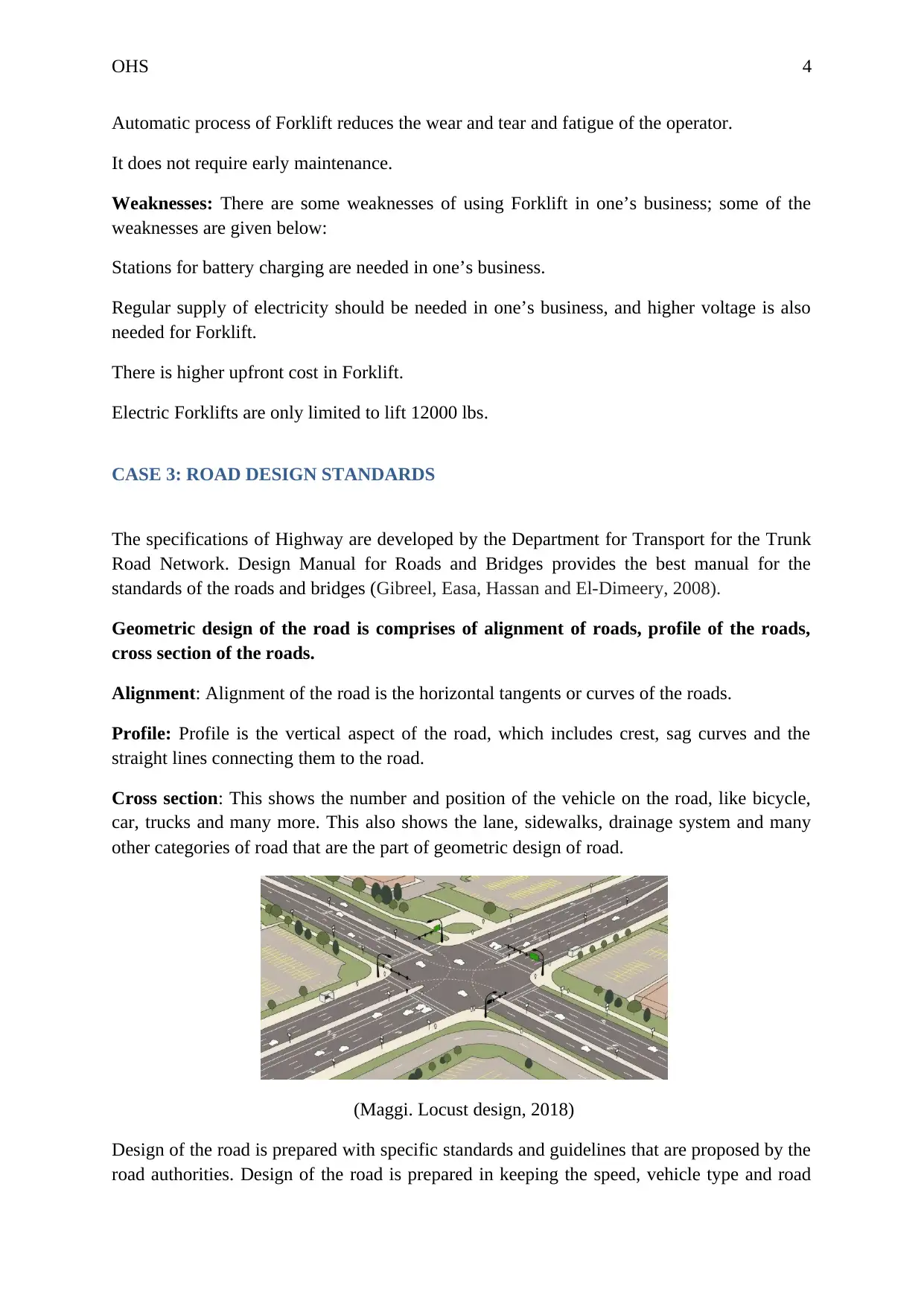
Cross section: This shows the number and position of the vehicle on the road, like bicycle,
car, trucks and many more. This also shows the lane, sidewalks, drainage system and many
other categories of road that are the part of geometric design of road.
(Maggi. Locust design, 2018)
Design of the road is prepared with specific standards and guidelines that are proposed by the
road authorities. Design of the road is prepared in keeping the speed, vehicle type and road
Automatic process of Forklift reduces the wear and tear and fatigue of the operator.
It does not require early maintenance.
Weaknesses: There are some weaknesses of using Forklift in one’s business; some of the
weaknesses are given below:
Stations for battery charging are needed in one’s business.
Regular supply of electricity should be needed in one’s business, and higher voltage is also
needed for Forklift.
There is higher upfront cost in Forklift.
Electric Forklifts are only limited to lift 12000 lbs.
CASE 3: ROAD DESIGN STANDARDS
The specifications of Highway are developed by the Department for Transport for the Trunk
Road Network. Design Manual for Roads and Bridges provides the best manual for the
standards of the roads and bridges (Gibreel, Easa, Hassan and El-Dimeery, 2008).
Geometric design of the road is comprises of alignment of roads, profile of the roads,
cross section of the roads.
Alignment: Alignment of the road is the horizontal tangents or curves of the roads.
Profile: Profile is the vertical aspect of the road, which includes crest, sag curves and the
straight lines connecting them to the road.
Cross section: This shows the number and position of the vehicle on the road, like bicycle,
car, trucks and many more. This also shows the lane, sidewalks, drainage system and many
other categories of road that are the part of geometric design of road.
(Maggi. Locust design, 2018)
Design of the road is prepared with specific standards and guidelines that are proposed by the
road authorities. Design of the road is prepared in keeping the speed, vehicle type and road
OHS 5
grade in to consideration. Proper application of the guidelines implemented by good engineer
will results in construction of safe and comfortable road (ADOT, 2018).
National authorities of roads and transports are responsible for construction of roads and
highways in their own native nations.
There are strengths and weaknesses of Highways and roads. Some of them are discussed
below:
Strengths:
Best designing standards of road, and best guidelines will results in perfect construction of
roads, if followed by needed concrete. Various techniques are used in construction of roads
like earthquake prevention techniques, drainage system of road, if all these applied in
construction of road, will definitely results in best road construction (Mohan, 2008).
Weaknesses:
Construction of roads without keeping all the requirements in consideration will results in
damage to the roads, or may led to the danger to the life of the people.
Bad structure of drainage system led to the water logging on the road.
Improper design of the road led to the short life of the road
Improper design of the road will cause disruption of breeding areas and routes of migratory
species.
CASE 4: HOUSING PROXIMITY TO OVERHEAD ELECTRIC TRANMISSION
LINES
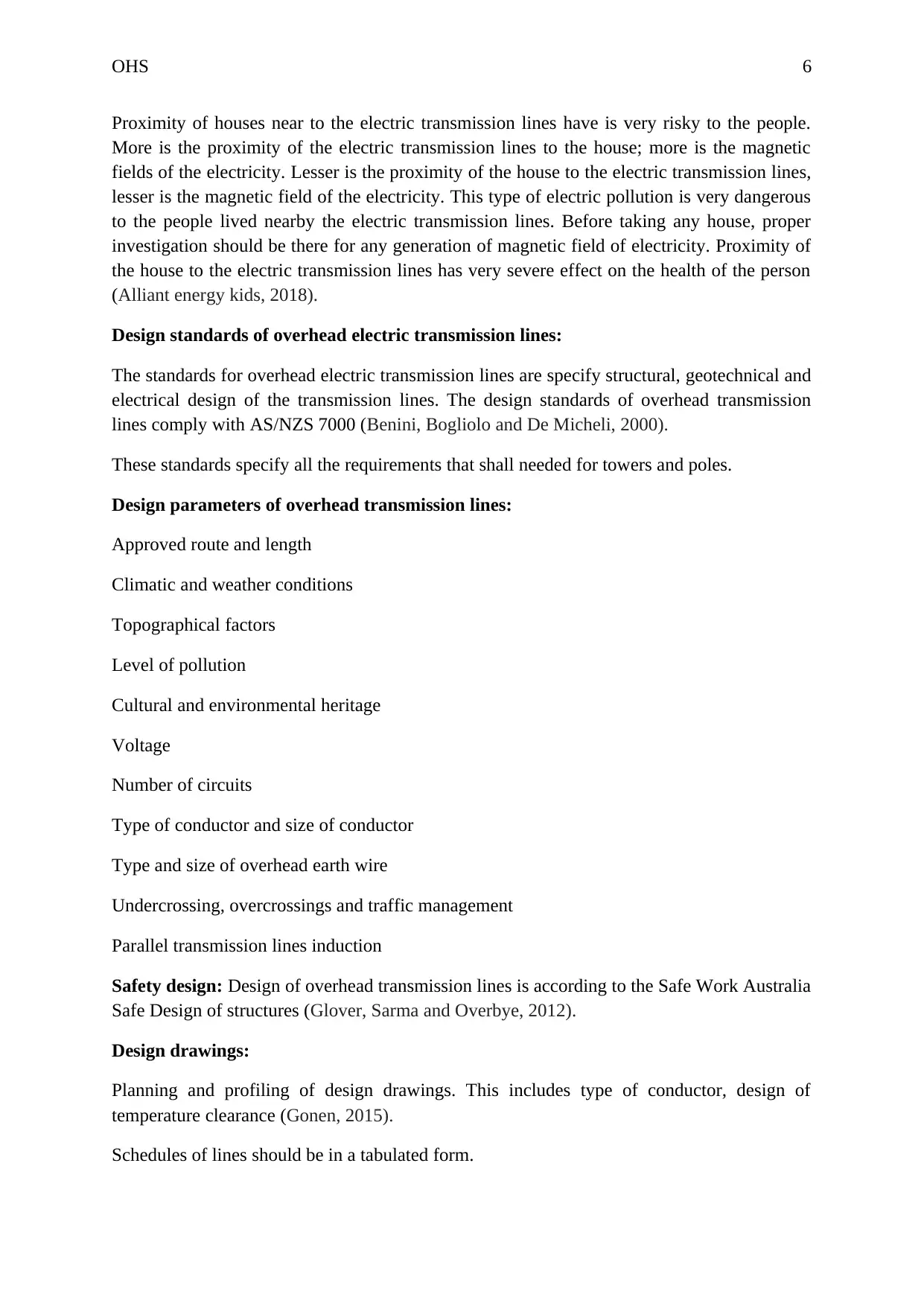
Electric transmission lines are used to transmit electrical energy from one place to another.
Transmission of electrical energy is transmitted with the use of two or more conductors, and
with towers and poles (Abd-Elaal, Mills and Ma 2018).
(Source: Alliant Energy Kids, 2018)
grade in to consideration. Proper application of the guidelines implemented by good engineer
will results in construction of safe and comfortable road (ADOT, 2018).
National authorities of roads and transports are responsible for construction of roads and
highways in their own native nations.
There are strengths and weaknesses of Highways and roads. Some of them are discussed
below:
Strengths:
Best designing standards of road, and best guidelines will results in perfect construction of
roads, if followed by needed concrete. Various techniques are used in construction of roads
like earthquake prevention techniques, drainage system of road, if all these applied in
construction of road, will definitely results in best road construction (Mohan, 2008).
Weaknesses:
Construction of roads without keeping all the requirements in consideration will results in
damage to the roads, or may led to the danger to the life of the people.
Bad structure of drainage system led to the water logging on the road.
Improper design of the road led to the short life of the road
Improper design of the road will cause disruption of breeding areas and routes of migratory
species.
CASE 4: HOUSING PROXIMITY TO OVERHEAD ELECTRIC TRANMISSION
LINES
Electric transmission lines are used to transmit electrical energy from one place to another.
Transmission of electrical energy is transmitted with the use of two or more conductors, and
with towers and poles (Abd-Elaal, Mills and Ma 2018).
(Source: Alliant Energy Kids, 2018)
⊘ This is a preview!⊘
Do you want full access?
Subscribe today to unlock all pages.
Trusted by 1+ million students worldwide
OHS 6
Proximity of houses near to the electric transmission lines have is very risky to the people.
More is the proximity of the electric transmission lines to the house; more is the magnetic
fields of the electricity. Lesser is the proximity of the house to the electric transmission lines,
lesser is the magnetic field of the electricity. This type of electric pollution is very dangerous
to the people lived nearby the electric transmission lines. Before taking any house, proper
investigation should be there for any generation of magnetic field of electricity. Proximity of
the house to the electric transmission lines has very severe effect on the health of the person
(Alliant energy kids, 2018).
Design standards of overhead electric transmission lines:
The standards for overhead electric transmission lines are specify structural, geotechnical and
electrical design of the transmission lines. The design standards of overhead transmission
lines comply with AS/NZS 7000 (Benini, Bogliolo and De Micheli, 2000).
These standards specify all the requirements that shall needed for towers and poles.
Design parameters of overhead transmission lines:
Approved route and length
Climatic and weather conditions
Topographical factors
Level of pollution
Cultural and environmental heritage
Voltage
Number of circuits
Type of conductor and size of conductor
Type and size of overhead earth wire
Undercrossing, overcrossings and traffic management
Parallel transmission lines induction
Safety design: Design of overhead transmission lines is according to the Safe Work Australia
Safe Design of structures (Glover, Sarma and Overbye, 2012).
Design drawings:
Planning and profiling of design drawings. This includes type of conductor, design of
temperature clearance (Gonen, 2015).
Schedules of lines should be in a tabulated form.
Proximity of houses near to the electric transmission lines have is very risky to the people.
More is the proximity of the electric transmission lines to the house; more is the magnetic
fields of the electricity. Lesser is the proximity of the house to the electric transmission lines,
lesser is the magnetic field of the electricity. This type of electric pollution is very dangerous
to the people lived nearby the electric transmission lines. Before taking any house, proper
investigation should be there for any generation of magnetic field of electricity. Proximity of
the house to the electric transmission lines has very severe effect on the health of the person
(Alliant energy kids, 2018).
Design standards of overhead electric transmission lines:
The standards for overhead electric transmission lines are specify structural, geotechnical and
electrical design of the transmission lines. The design standards of overhead transmission
lines comply with AS/NZS 7000 (Benini, Bogliolo and De Micheli, 2000).
These standards specify all the requirements that shall needed for towers and poles.
Design parameters of overhead transmission lines:
Approved route and length
Climatic and weather conditions
Topographical factors
Level of pollution
Cultural and environmental heritage
Voltage
Number of circuits
Type of conductor and size of conductor
Type and size of overhead earth wire
Undercrossing, overcrossings and traffic management
Parallel transmission lines induction
Safety design: Design of overhead transmission lines is according to the Safe Work Australia
Safe Design of structures (Glover, Sarma and Overbye, 2012).
Design drawings:
Planning and profiling of design drawings. This includes type of conductor, design of
temperature clearance (Gonen, 2015).
Schedules of lines should be in a tabulated form.
Paraphrase This Document
Need a fresh take? Get an instant paraphrase of this document with our AI Paraphraser
OHS 7
Dimensions and schedule of vibration damper
Construction tables
Railway crossings
Other crossings like, power lines and many more
Navigable Waterways crossings
Landing span for non-standard structures
Proximity with the electric transmission lines can cause serious injuries to the people.
Proximity of the agricultural land to the electric wires can cause damage to the crops.
Close proximity to the overhead lines of the electricity can result in flashover that may kill
lives.
Safety measures publications by Electricity Networks Association (ENA).
Suggest farmers to reduce the use of Polytunnels that will be damage by the electric
radiations (Kiessling, Nefzger, Nolasco and Kaintzyk, (2014).
How to eliminate the danger of overhead electric transmission lines:
Avoidance:If work is conducted under any high voltage area, then it can be carried out
somewhere else i.e. far from electric transmission lines. Do not place any material near to the
structures of the electric poles, transformers and many more.
Diversion: There should be proper arrangement for diversion of overhead lines.
CASE 4: DESIGN OF STRUCTURAL STEELWORK
Structural steel is the type of steel which is used for making construction materials in
different shapes. Structural shapes take the form of elongated beam. The size, composition,
storage and strengths are regulated by standards in countries. There are many shapes in which
steel structures can be prepares, most commonly used structure is I-beams (Designing
building, 2018).
Dimensions and schedule of vibration damper
Construction tables
Railway crossings
Other crossings like, power lines and many more
Navigable Waterways crossings
Landing span for non-standard structures
Proximity with the electric transmission lines can cause serious injuries to the people.
Proximity of the agricultural land to the electric wires can cause damage to the crops.
Close proximity to the overhead lines of the electricity can result in flashover that may kill
lives.
Safety measures publications by Electricity Networks Association (ENA).
Suggest farmers to reduce the use of Polytunnels that will be damage by the electric
radiations (Kiessling, Nefzger, Nolasco and Kaintzyk, (2014).
How to eliminate the danger of overhead electric transmission lines:
Avoidance:If work is conducted under any high voltage area, then it can be carried out
somewhere else i.e. far from electric transmission lines. Do not place any material near to the
structures of the electric poles, transformers and many more.
Diversion: There should be proper arrangement for diversion of overhead lines.
CASE 4: DESIGN OF STRUCTURAL STEELWORK
Structural steel is the type of steel which is used for making construction materials in
different shapes. Structural shapes take the form of elongated beam. The size, composition,
storage and strengths are regulated by standards in countries. There are many shapes in which
steel structures can be prepares, most commonly used structure is I-beams (Designing
building, 2018).
OHS 8
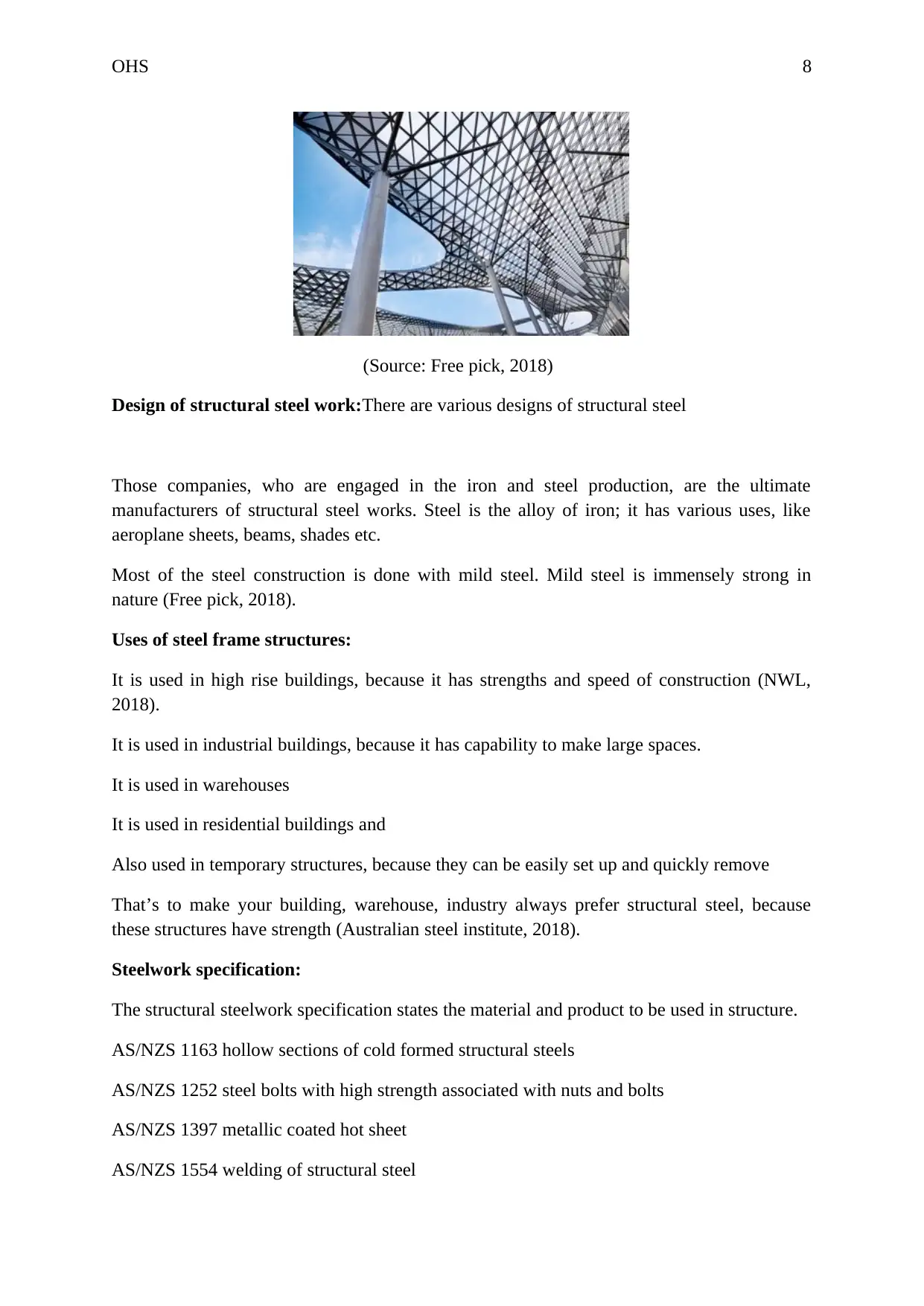
(Source: Free pick, 2018)
Design of structural steel work:There are various designs of structural steel
Those companies, who are engaged in the iron and steel production, are the ultimate
manufacturers of structural steel works. Steel is the alloy of iron; it has various uses, like
aeroplane sheets, beams, shades etc.
Most of the steel construction is done with mild steel. Mild steel is immensely strong in
nature (Free pick, 2018).
Uses of steel frame structures:
It is used in high rise buildings, because it has strengths and speed of construction (NWL,
2018).
It is used in industrial buildings, because it has capability to make large spaces.
It is used in warehouses
It is used in residential buildings and
Also used in temporary structures, because they can be easily set up and quickly remove
That’s to make your building, warehouse, industry always prefer structural steel, because
these structures have strength (Australian steel institute, 2018).
Steelwork specification:
The structural steelwork specification states the material and product to be used in structure.
AS/NZS 1163 hollow sections of cold formed structural steels
AS/NZS 1252 steel bolts with high strength associated with nuts and bolts
AS/NZS 1397 metallic coated hot sheet
AS/NZS 1554 welding of structural steel
(Source: Free pick, 2018)
Design of structural steel work:There are various designs of structural steel
Those companies, who are engaged in the iron and steel production, are the ultimate
manufacturers of structural steel works. Steel is the alloy of iron; it has various uses, like
aeroplane sheets, beams, shades etc.
Most of the steel construction is done with mild steel. Mild steel is immensely strong in
nature (Free pick, 2018).
Uses of steel frame structures:
It is used in high rise buildings, because it has strengths and speed of construction (NWL,
2018).
It is used in industrial buildings, because it has capability to make large spaces.
It is used in warehouses
It is used in residential buildings and
Also used in temporary structures, because they can be easily set up and quickly remove
That’s to make your building, warehouse, industry always prefer structural steel, because
these structures have strength (Australian steel institute, 2018).
Steelwork specification:
The structural steelwork specification states the material and product to be used in structure.
AS/NZS 1163 hollow sections of cold formed structural steels
AS/NZS 1252 steel bolts with high strength associated with nuts and bolts
AS/NZS 1397 metallic coated hot sheet
AS/NZS 1554 welding of structural steel
⊘ This is a preview!⊘
Do you want full access?
Subscribe today to unlock all pages.
Trusted by 1+ million students worldwide
OHS 9
AS/NZS 3678 rolled plates and slabs
AS/NZS 3679.1 rolled sections and bars
AS/NZS 3679.2 welded sections of steel
Strengths and weaknesses of structural steel framework:
All of the organizations or industries have major use of structural steel work structures.
Structural steel is used everywhere in industries like in big projects, finished products and
many more. Warehouses, buildings and high rise buildings all have the use of structural steel.
The experts from industries prefer to use structural steel over the use of any other building
material; this can be preferred only because of numerous benefits of structural steel work. But
everything in this world has some advantages and some disadvantages, so structural steel
work has also the advantages and disadvantages.
Advantages:
Steel is tensile in nature: Steel has a high strength, so it can be used in every shape and size of
the requirements. Structural steelwork is light in weight in comparison to other steel work.
Steel can be easily fabricated; the structures of steel are produced at shop floors and
assembled at onsite, this process of production and assembling saves the time and also
increases the efficiency of the building.
Structural steel is flexible inn nature; it can be mould in any form and shape. Steel can be
easily converted in to sheets, wires and many other shapes as required by industries.
Steel is not so expensive; structural steel is cheaper in comparison to material
Durability of the steel is its one of the best strength. Steel structures have capacity to
withstand external forces like, earthquake, landslide etc.
Disadvantages:
As we all know that steel is the alloy of iron. So is has susceptibility to corrosion. This
problem of corrosion can be solved by using anti-corrosion applications on structural steel.
Huge fire proofing cost in incurred, as steel is not fireproof. When there is high temperature
steel loses its properties.
Structural steel has high maintenance cost, as it has to be painted with corrosion-resistant.
Steel also has high expansion rate.
All the advantages led to the high use of structural steel work in buildings, warehouses and at
many more places. It can be concluded from the from the above advantages and
disadvantages that steel has various use, structural steel has strength to be used at various
places.
AS/NZS 3678 rolled plates and slabs
AS/NZS 3679.1 rolled sections and bars
AS/NZS 3679.2 welded sections of steel
Strengths and weaknesses of structural steel framework:
All of the organizations or industries have major use of structural steel work structures.
Structural steel is used everywhere in industries like in big projects, finished products and
many more. Warehouses, buildings and high rise buildings all have the use of structural steel.
The experts from industries prefer to use structural steel over the use of any other building
material; this can be preferred only because of numerous benefits of structural steel work. But
everything in this world has some advantages and some disadvantages, so structural steel
work has also the advantages and disadvantages.
Advantages:
Steel is tensile in nature: Steel has a high strength, so it can be used in every shape and size of
the requirements. Structural steelwork is light in weight in comparison to other steel work.
Steel can be easily fabricated; the structures of steel are produced at shop floors and
assembled at onsite, this process of production and assembling saves the time and also
increases the efficiency of the building.
Structural steel is flexible inn nature; it can be mould in any form and shape. Steel can be
easily converted in to sheets, wires and many other shapes as required by industries.
Steel is not so expensive; structural steel is cheaper in comparison to material
Durability of the steel is its one of the best strength. Steel structures have capacity to
withstand external forces like, earthquake, landslide etc.
Disadvantages:
As we all know that steel is the alloy of iron. So is has susceptibility to corrosion. This
problem of corrosion can be solved by using anti-corrosion applications on structural steel.
Huge fire proofing cost in incurred, as steel is not fireproof. When there is high temperature
steel loses its properties.
Structural steel has high maintenance cost, as it has to be painted with corrosion-resistant.
Steel also has high expansion rate.
All the advantages led to the high use of structural steel work in buildings, warehouses and at
many more places. It can be concluded from the from the above advantages and
disadvantages that steel has various use, structural steel has strength to be used at various
places.
Paraphrase This Document
Need a fresh take? Get an instant paraphrase of this document with our AI Paraphraser
OHS 10
REFERENCES
Abd-Elaal, E.S., Mills, J.E. and Ma, X., (2018). A review of transmission line systems under
downburst wind loads. Journal of Wind Engineering and Industrial Aerodynamics
ADOT. (2018). Roadway design standards [online] Available from:
https://www.azdot.gov/business/engineering-and-construction/roadway-engineering/
roadway-design/standards-and-guidelines [Accessed 11/08/2018]
Alliant energy kids. (2018). Overhead transmission lines [online] Available from:
http://www.alliantenergykids.com/EnergyBasics/AllAboutElectricity/000416 [Accessed
11/08/2018]
Australian steel institute. (2018). Standards and design of structural steel work [online]
Available from: http://steel.org.au/key-issues/compliance/standards-and-design/ [Accessed
11/08/2018]
Australian steel institute. (2018). Structural steel design engineer [online] Available from:
teel.org.au/structural-steel-design-engineer/ [Accessed 11/08/2018]
Benini, L., Bogliolo, A. and De Micheli, G., (2000). A survey of design techniques for
system-level dynamic power management. IEEE transactions on very large scale integration
(VLSI) systems, 8(3), pp.299-316
Designing building. (2018). Structural steelwork [online] Available from:
https://www.designingbuildings.co.uk/wiki/Structural_steelwork [Accessed 11/08/2018]
Free pick. (2018). Structure of steel framework [online] Available from:
https://www.freepik.com/ [Accessed 11/05/2018]
Gibreel, G.M., Easa, S.M., Hassan, Y. and El-Dimeery, I.A., (2008). State of the art of
highway geometric design consistency. Journal of transportation engineering, 125(4),
pp.305-313.
REFERENCES
Abd-Elaal, E.S., Mills, J.E. and Ma, X., (2018). A review of transmission line systems under
downburst wind loads. Journal of Wind Engineering and Industrial Aerodynamics
ADOT. (2018). Roadway design standards [online] Available from:
https://www.azdot.gov/business/engineering-and-construction/roadway-engineering/
roadway-design/standards-and-guidelines [Accessed 11/08/2018]
Alliant energy kids. (2018). Overhead transmission lines [online] Available from:
http://www.alliantenergykids.com/EnergyBasics/AllAboutElectricity/000416 [Accessed
11/08/2018]
Australian steel institute. (2018). Standards and design of structural steel work [online]
Available from: http://steel.org.au/key-issues/compliance/standards-and-design/ [Accessed
11/08/2018]
Australian steel institute. (2018). Structural steel design engineer [online] Available from:
teel.org.au/structural-steel-design-engineer/ [Accessed 11/08/2018]
Benini, L., Bogliolo, A. and De Micheli, G., (2000). A survey of design techniques for
system-level dynamic power management. IEEE transactions on very large scale integration
(VLSI) systems, 8(3), pp.299-316
Designing building. (2018). Structural steelwork [online] Available from:
https://www.designingbuildings.co.uk/wiki/Structural_steelwork [Accessed 11/08/2018]
Free pick. (2018). Structure of steel framework [online] Available from:
https://www.freepik.com/ [Accessed 11/05/2018]
Gibreel, G.M., Easa, S.M., Hassan, Y. and El-Dimeery, I.A., (2008). State of the art of
highway geometric design consistency. Journal of transportation engineering, 125(4),
pp.305-313.
OHS 11
Glover, J.D., Sarma, M.S. and Overbye, T., (2012). Power System Analysis & Design, SI
Version. Cengage Learning.
Gonen, T., (2015). Electrical power transmission system engineering: analysis and design.
CRC press
How stuff works. (2018). How forklifts work [online] Available from:
https://science.howstuffworks.com/transport/engines-equipment/forklift2.htm [Accessed
11/08/2018]
Kiessling, F., Nefzger, P., Nolasco, J.F. and Kaintzyk, U., (2014). Overhead power lines:
planning, design, construction. Springer
Maggi locust design. (2018). Road design [online] Available from:
http://black.dgfitness.co/road-designe/to-the-future-what-do-driverless-cars-mean-for-road-
design-seh.html [Accessed 11/08/2018]
Mohan, D. ( 2008). Road safety in less-motorized environments: future
concerns. International journal of epidemiology, 31(3), pp.527-532.
Nimankar, S., Mahale, N., Mestry, A., Morankar, A. and Nille, S., (2018). Human Powered
Forklift. transfer, 5(04).
Nit co. (2018). Types of forklifts [online] Available from:
https://www.nitco-lift.com/blog/types-of-forklifts/ [Accessed 11/08/2018]
NMC. (2017). The advantages of an electric forklift [online] Available from:
http://www.nmc-corp.com/lift-truck/advantages-of-an-electric-forklift/ [Accessed
11/08/2018]
NWL. ( 2018). Advantages and disadvantages of structural steel framework [online]
Available from: http://northern-weldarc.com/advantages-disadvantages-structural-steel-
structures/ [Accessed 11/08/2018]
Pinterest. (2018). Lawn mower [online] Available from:
https://in.pinterest.com/sportystoolshop/lawn-mower/ [Accessed 11/08/2018]
Resource library. (2018). Benefits of forklifts [online] Available from:
https://www.toyotaforklift.com/resource-library/material-handling-solutions/products/7274
[Accessed 11/08/2018]
Ryobi landscapes. (2018). Reasons to use lawn mower [online] Available from:
https://www.ryobitools.com/landscapes/articles/5-Reasons-You-Should-Mow-Your-Own-
Lawn [Accessed 11/08/2018]
Sears parts direct. (2018). Lawn mower components [online] Available from:
https://www.searspartsdirect.com/walk-behind-lawn-mower-repair/walk-behind-lawn-
mower-common-parts.html [Accessed 11/08/2018]
Work place safety training. (2018). Fork lift [online] Available from:
https://www.safetyfirsttraining.ca/blog/forklift-use-in-the-workplace/ [Accessed 11/08/2018]
Glover, J.D., Sarma, M.S. and Overbye, T., (2012). Power System Analysis & Design, SI
Version. Cengage Learning.
Gonen, T., (2015). Electrical power transmission system engineering: analysis and design.
CRC press
How stuff works. (2018). How forklifts work [online] Available from:
https://science.howstuffworks.com/transport/engines-equipment/forklift2.htm [Accessed
11/08/2018]
Kiessling, F., Nefzger, P., Nolasco, J.F. and Kaintzyk, U., (2014). Overhead power lines:
planning, design, construction. Springer
Maggi locust design. (2018). Road design [online] Available from:
http://black.dgfitness.co/road-designe/to-the-future-what-do-driverless-cars-mean-for-road-
design-seh.html [Accessed 11/08/2018]
Mohan, D. ( 2008). Road safety in less-motorized environments: future
concerns. International journal of epidemiology, 31(3), pp.527-532.
Nimankar, S., Mahale, N., Mestry, A., Morankar, A. and Nille, S., (2018). Human Powered
Forklift. transfer, 5(04).
Nit co. (2018). Types of forklifts [online] Available from:
https://www.nitco-lift.com/blog/types-of-forklifts/ [Accessed 11/08/2018]
NMC. (2017). The advantages of an electric forklift [online] Available from:
http://www.nmc-corp.com/lift-truck/advantages-of-an-electric-forklift/ [Accessed
11/08/2018]
NWL. ( 2018). Advantages and disadvantages of structural steel framework [online]
Available from: http://northern-weldarc.com/advantages-disadvantages-structural-steel-
structures/ [Accessed 11/08/2018]
Pinterest. (2018). Lawn mower [online] Available from:
https://in.pinterest.com/sportystoolshop/lawn-mower/ [Accessed 11/08/2018]
Resource library. (2018). Benefits of forklifts [online] Available from:
https://www.toyotaforklift.com/resource-library/material-handling-solutions/products/7274
[Accessed 11/08/2018]
Ryobi landscapes. (2018). Reasons to use lawn mower [online] Available from:
https://www.ryobitools.com/landscapes/articles/5-Reasons-You-Should-Mow-Your-Own-
Lawn [Accessed 11/08/2018]
Sears parts direct. (2018). Lawn mower components [online] Available from:
https://www.searspartsdirect.com/walk-behind-lawn-mower-repair/walk-behind-lawn-
mower-common-parts.html [Accessed 11/08/2018]
Work place safety training. (2018). Fork lift [online] Available from:
https://www.safetyfirsttraining.ca/blog/forklift-use-in-the-workplace/ [Accessed 11/08/2018]
⊘ This is a preview!⊘
Do you want full access?
Subscribe today to unlock all pages.
Trusted by 1+ million students worldwide

1 out of 12


Your All-in-One AI-Powered Toolkit for Academic Success.
+13062052269
info@desklib.com
Available 24*7 on WhatsApp / Email
![[object Object]](/_next/static/media/star-bottom.7253800d.svg)
Unlock your academic potential
Copyright © 2020–2026 A2Z Services. All Rights Reserved. Developed and managed by ZUCOL.