BTEC L3 Extended Diploma in Engineering: Unit 8 Mathematics Assignment
VerifiedAdded on 2022/08/22
|11
|821
|16
Homework Assignment
AI Summary
This document presents a complete solution to a BTEC Level 3 Extended Diploma in Engineering assignment, specifically focusing on Unit 8: Further Engineering Mathematics. The assignment covers a range of mathematical concepts including arithmetic and geometric progressions, binomial expansion, and Maclaurin series. The solution demonstrates the application of these concepts to solve engineering problems, such as calculating drilling costs, analyzing the speed of a tunneling machine, and determining the value of an asset with depreciation. The document also includes detailed explanations and calculations for each problem, providing a comprehensive understanding of the mathematical principles involved. The assignment further explores the Pascal triangle, binomial theorem, and the use of Maclaurin series to approximate the value of functions, offering a thorough guide to the subject matter.
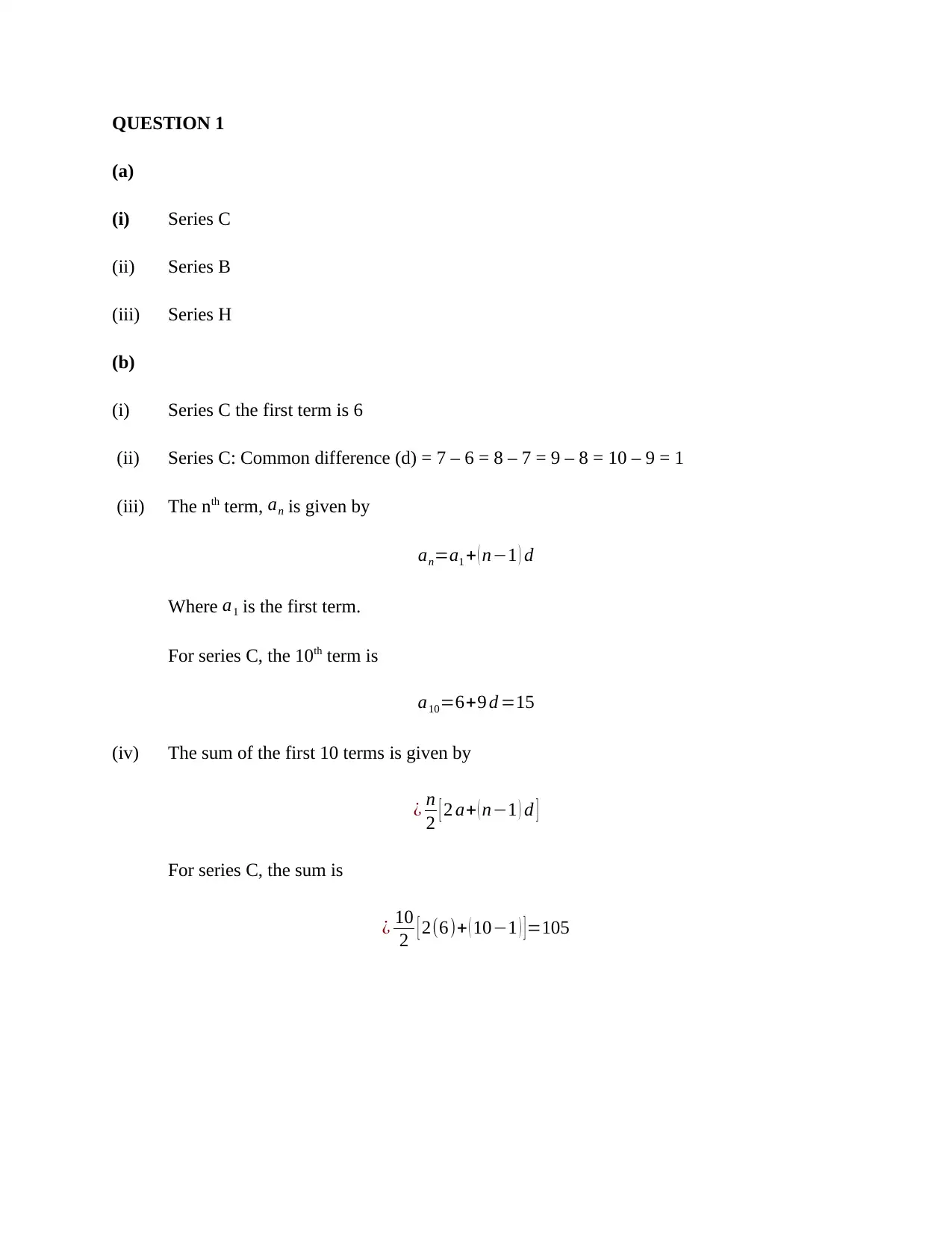
QUESTION 1
(a)
(i) Series C
(ii) Series B
(iii) Series H
(b)
(i) Series C the first term is 6
(ii) Series C: Common difference (d) = 7 – 6 = 8 – 7 = 9 – 8 = 10 – 9 = 1
(iii) The nth term, an is given by
an=a1 + ( n−1 ) d
Where a1 is the first term.
For series C, the 10th term is
a10=6+9 d =15
(iv) The sum of the first 10 terms is given by
¿ n
2 [ 2 a+ ( n−1 ) d ]
For series C, the sum is
¿ 10
2 [ 2(6)+ ( 10−1 ) ]=105
(a)
(i) Series C
(ii) Series B
(iii) Series H
(b)
(i) Series C the first term is 6
(ii) Series C: Common difference (d) = 7 – 6 = 8 – 7 = 9 – 8 = 10 – 9 = 1
(iii) The nth term, an is given by
an=a1 + ( n−1 ) d
Where a1 is the first term.
For series C, the 10th term is
a10=6+9 d =15
(iv) The sum of the first 10 terms is given by
¿ n
2 [ 2 a+ ( n−1 ) d ]
For series C, the sum is
¿ 10
2 [ 2(6)+ ( 10−1 ) ]=105
Paraphrase This Document
Need a fresh take? Get an instant paraphrase of this document with our AI Paraphraser

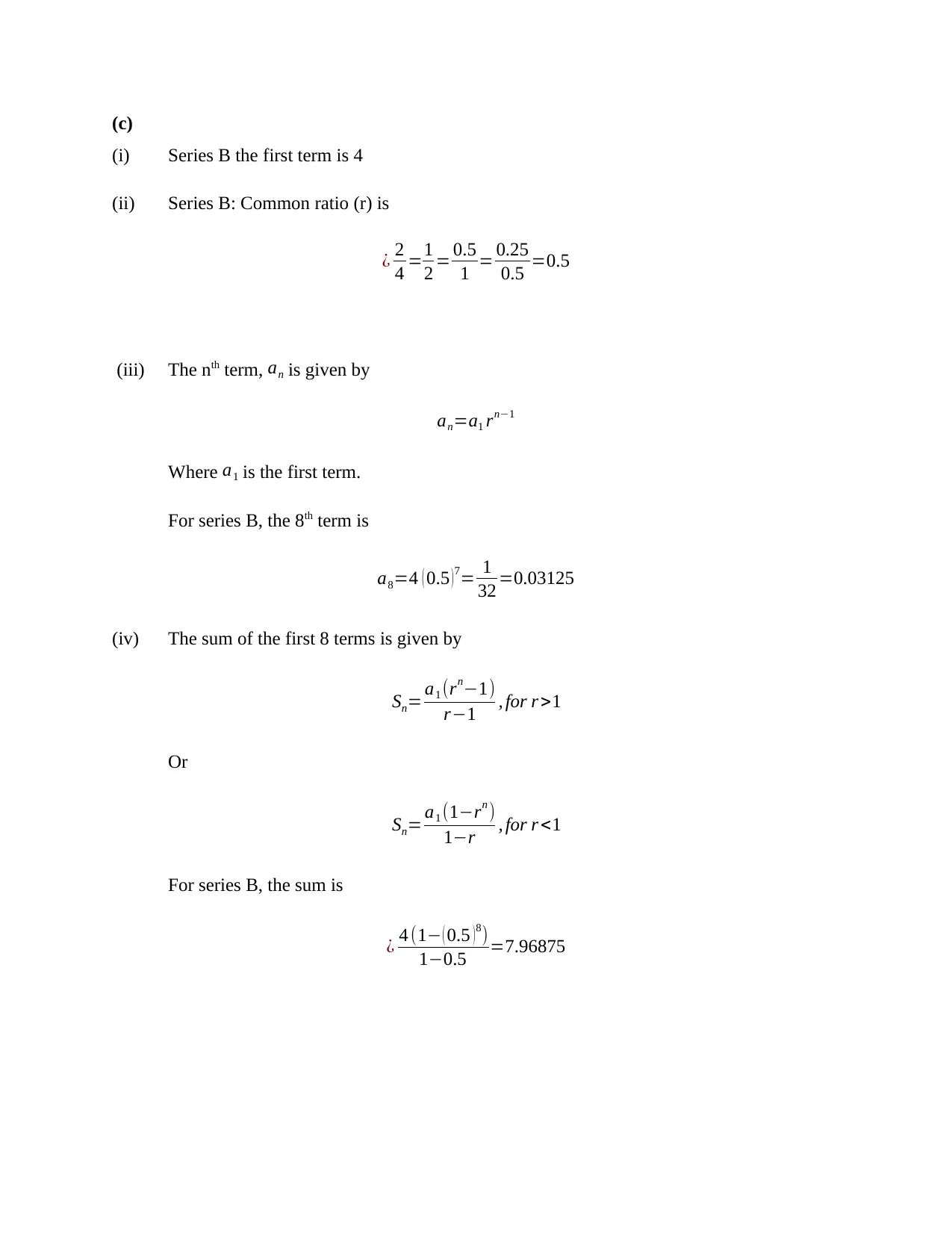
(c)
(i) Series B the first term is 4
(ii) Series B: Common ratio (r) is
¿ 2
4 =1
2 = 0.5
1 = 0.25
0.5 =0.5
(iii) The nth term, an is given by
an=a1 rn−1
Where a1 is the first term.
For series B, the 8th term is
a8=4 ( 0.5 )7= 1
32 =0.03125
(iv) The sum of the first 8 terms is given by
Sn= a1 (rn−1)
r−1 , for r >1
Or
Sn= a1 (1−rn )
1−r , for r <1
For series B, the sum is
¿ 4 (1− ( 0.5 ) 8)
1−0.5 =7.96875
(i) Series B the first term is 4
(ii) Series B: Common ratio (r) is
¿ 2
4 =1
2 = 0.5
1 = 0.25
0.5 =0.5
(iii) The nth term, an is given by
an=a1 rn−1
Where a1 is the first term.
For series B, the 8th term is
a8=4 ( 0.5 )7= 1
32 =0.03125
(iv) The sum of the first 8 terms is given by
Sn= a1 (rn−1)
r−1 , for r >1
Or
Sn= a1 (1−rn )
1−r , for r <1
For series B, the sum is
¿ 4 (1− ( 0.5 ) 8)
1−0.5 =7.96875

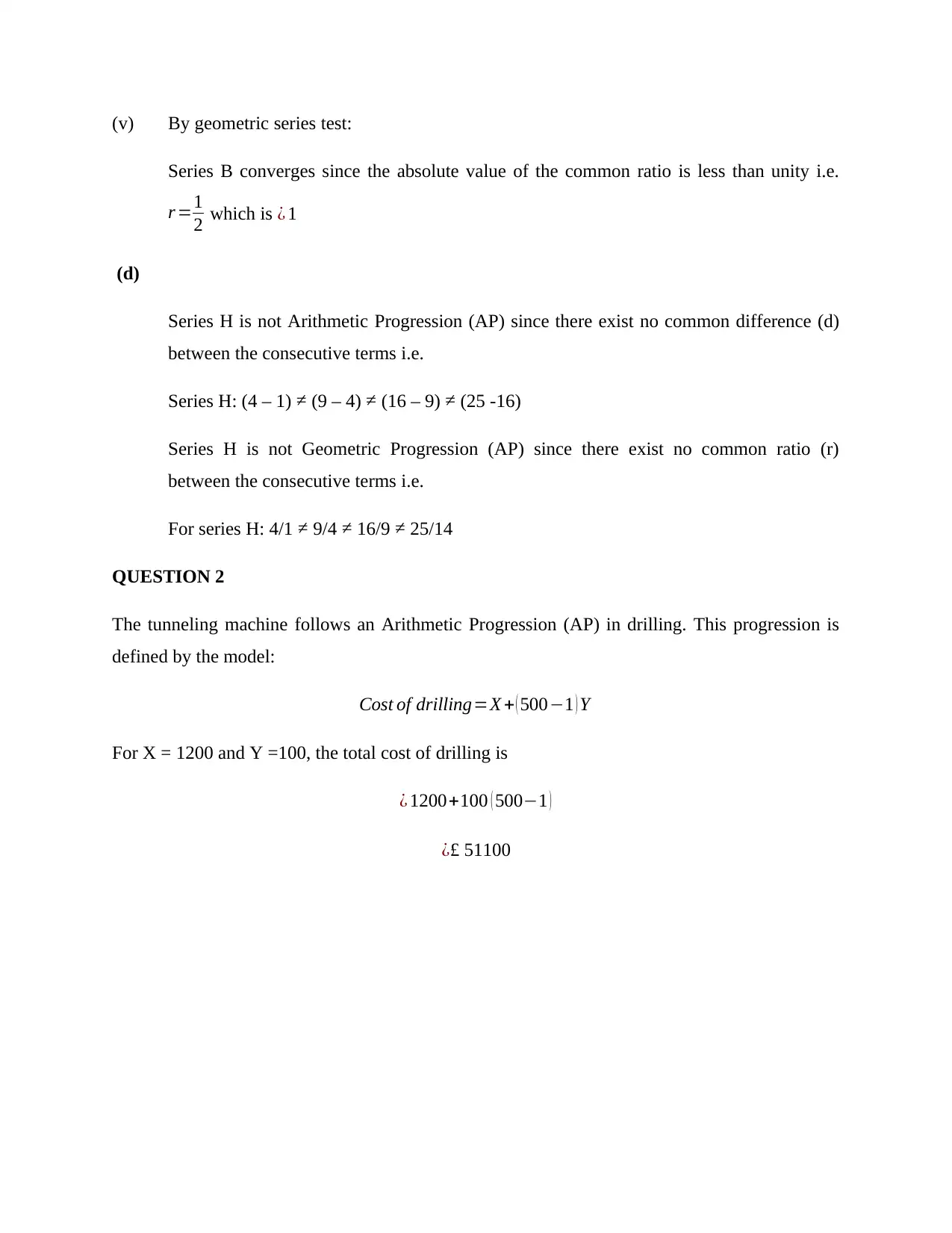
(v) By geometric series test:
Series B converges since the absolute value of the common ratio is less than unity i.e.
r =1
2 which is ¿ 1
(d)
Series H is not Arithmetic Progression (AP) since there exist no common difference (d)
between the consecutive terms i.e.
Series H: (4 – 1) ≠ (9 – 4) ≠ (16 – 9) ≠ (25 -16)
Series H is not Geometric Progression (AP) since there exist no common ratio (r)
between the consecutive terms i.e.
For series H: 4/1 ≠ 9/4 ≠ 16/9 ≠ 25/14
QUESTION 2
The tunneling machine follows an Arithmetic Progression (AP) in drilling. This progression is
defined by the model:
Cost of drilling=X + ( 500−1 ) Y
For X = 1200 and Y =100, the total cost of drilling is
¿ 1200+100 ( 500−1 )
¿£ 51100
Series B converges since the absolute value of the common ratio is less than unity i.e.
r =1
2 which is ¿ 1
(d)
Series H is not Arithmetic Progression (AP) since there exist no common difference (d)
between the consecutive terms i.e.
Series H: (4 – 1) ≠ (9 – 4) ≠ (16 – 9) ≠ (25 -16)
Series H is not Geometric Progression (AP) since there exist no common ratio (r)
between the consecutive terms i.e.
For series H: 4/1 ≠ 9/4 ≠ 16/9 ≠ 25/14
QUESTION 2
The tunneling machine follows an Arithmetic Progression (AP) in drilling. This progression is
defined by the model:
Cost of drilling=X + ( 500−1 ) Y
For X = 1200 and Y =100, the total cost of drilling is
¿ 1200+100 ( 500−1 )
¿£ 51100
⊘ This is a preview!⊘
Do you want full access?
Subscribe today to unlock all pages.

Trusted by 1+ million students worldwide

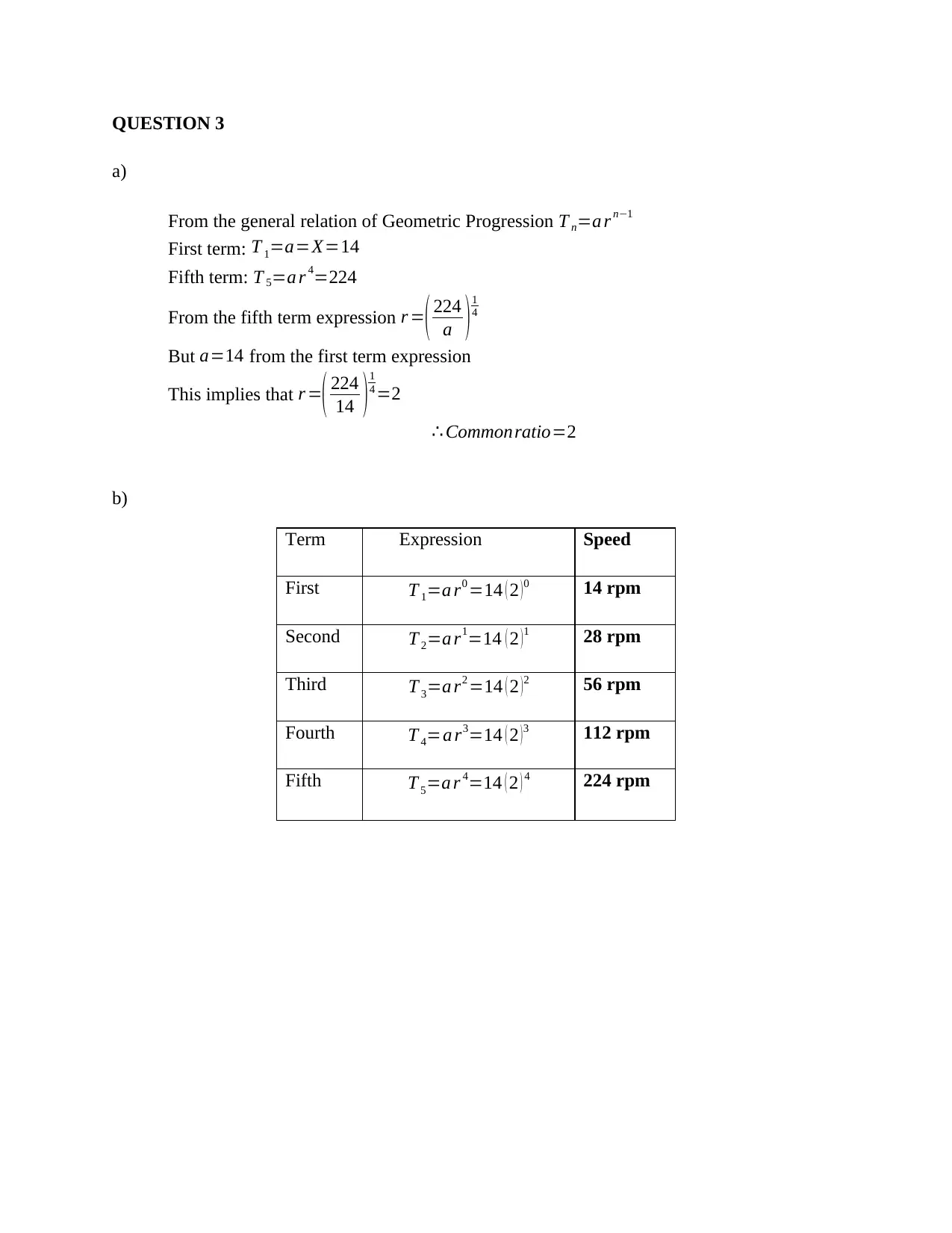
QUESTION 3
a)
From the general relation of Geometric Progression T n=a r n−1
First term: T 1=a=X=14
Fifth term: T 5=a r 4=224
From the fifth term expression r =( 224
a ) 1
4
But a=14 from the first term expression
This implies that r =( 224
14 )1
4 =2
∴ Commonratio=2
b)
Term Expression Speed
First T 1=a r0 =14 ( 2 )0 14 rpm
Second T 2=a r1=14 ( 2 )1 28 rpm
Third T 3=a r2 =14 ( 2 )2 56 rpm
Fourth T 4=a r3=14 ( 2 )3 112 rpm
Fifth T 5=a r 4=14 ( 2 ) 4 224 rpm
a)
From the general relation of Geometric Progression T n=a r n−1
First term: T 1=a=X=14
Fifth term: T 5=a r 4=224
From the fifth term expression r =( 224
a ) 1
4
But a=14 from the first term expression
This implies that r =( 224
14 )1
4 =2
∴ Commonratio=2
b)
Term Expression Speed
First T 1=a r0 =14 ( 2 )0 14 rpm
Second T 2=a r1=14 ( 2 )1 28 rpm
Third T 3=a r2 =14 ( 2 )2 56 rpm
Fourth T 4=a r3=14 ( 2 )3 112 rpm
Fifth T 5=a r 4=14 ( 2 ) 4 224 rpm
Paraphrase This Document
Need a fresh take? Get an instant paraphrase of this document with our AI Paraphraser

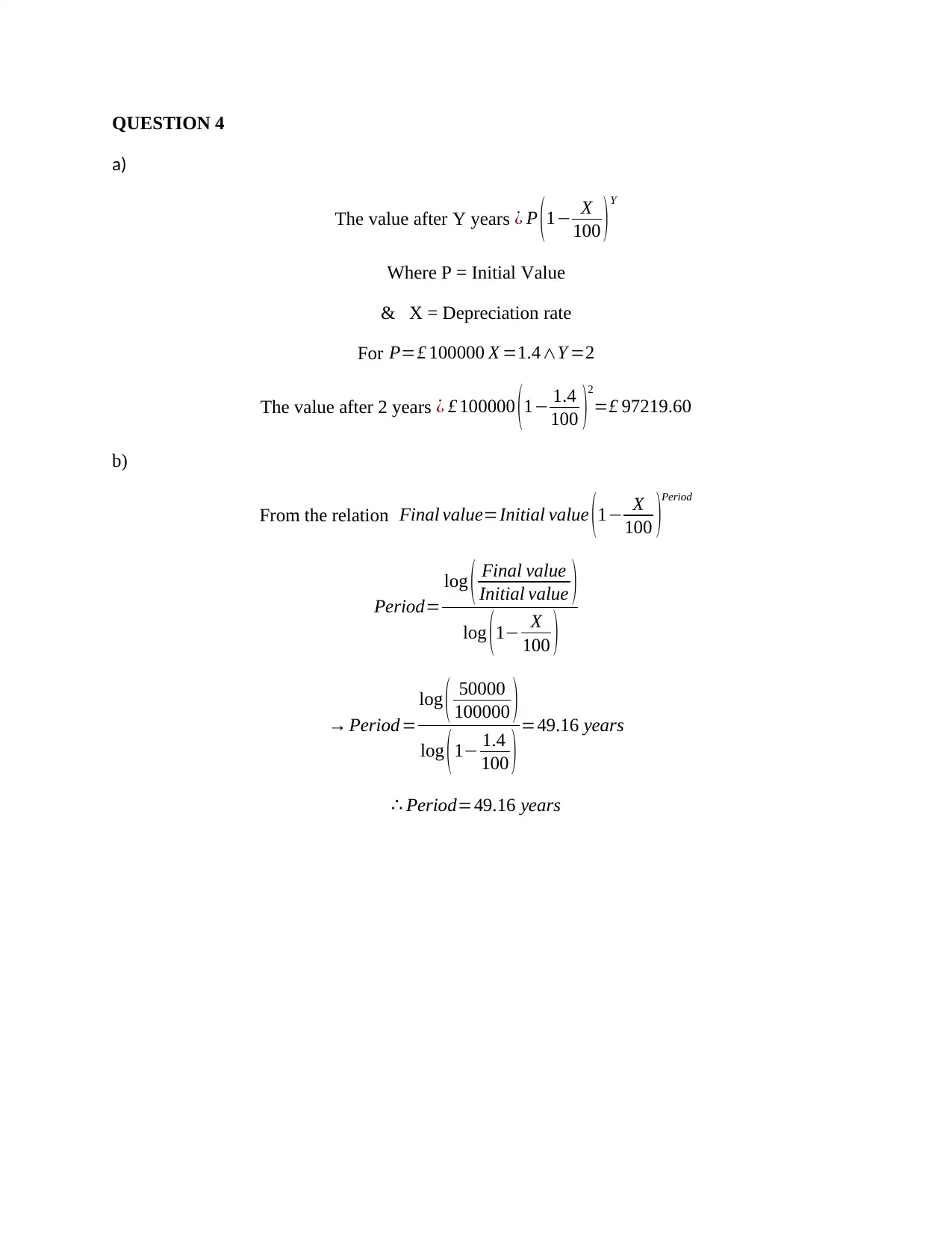
QUESTION 4
a)
The value after Y years ¿ P (1− X
100 )Y
Where P = Initial Value
& X = Depreciation rate
For P=£ 100000 X =1.4∧Y =2
The value after 2 years ¿ £ 100000 ( 1− 1.4
100 )
2
=£ 97219.60
b)
From the relation Final value=Initial value ( 1− X
100 )
Period
Period=
log ( Final value
Initial value )
log (1− X
100 )
→ Period=
log ( 50000
100000 )
log (1− 1.4
100 ) =49.16 years
∴ Period=49.16 years
a)
The value after Y years ¿ P (1− X
100 )Y
Where P = Initial Value
& X = Depreciation rate
For P=£ 100000 X =1.4∧Y =2
The value after 2 years ¿ £ 100000 ( 1− 1.4
100 )
2
=£ 97219.60
b)
From the relation Final value=Initial value ( 1− X
100 )
Period
Period=
log ( Final value
Initial value )
log (1− X
100 )
→ Period=
log ( 50000
100000 )
log (1− 1.4
100 ) =49.16 years
∴ Period=49.16 years

QUESTION 5
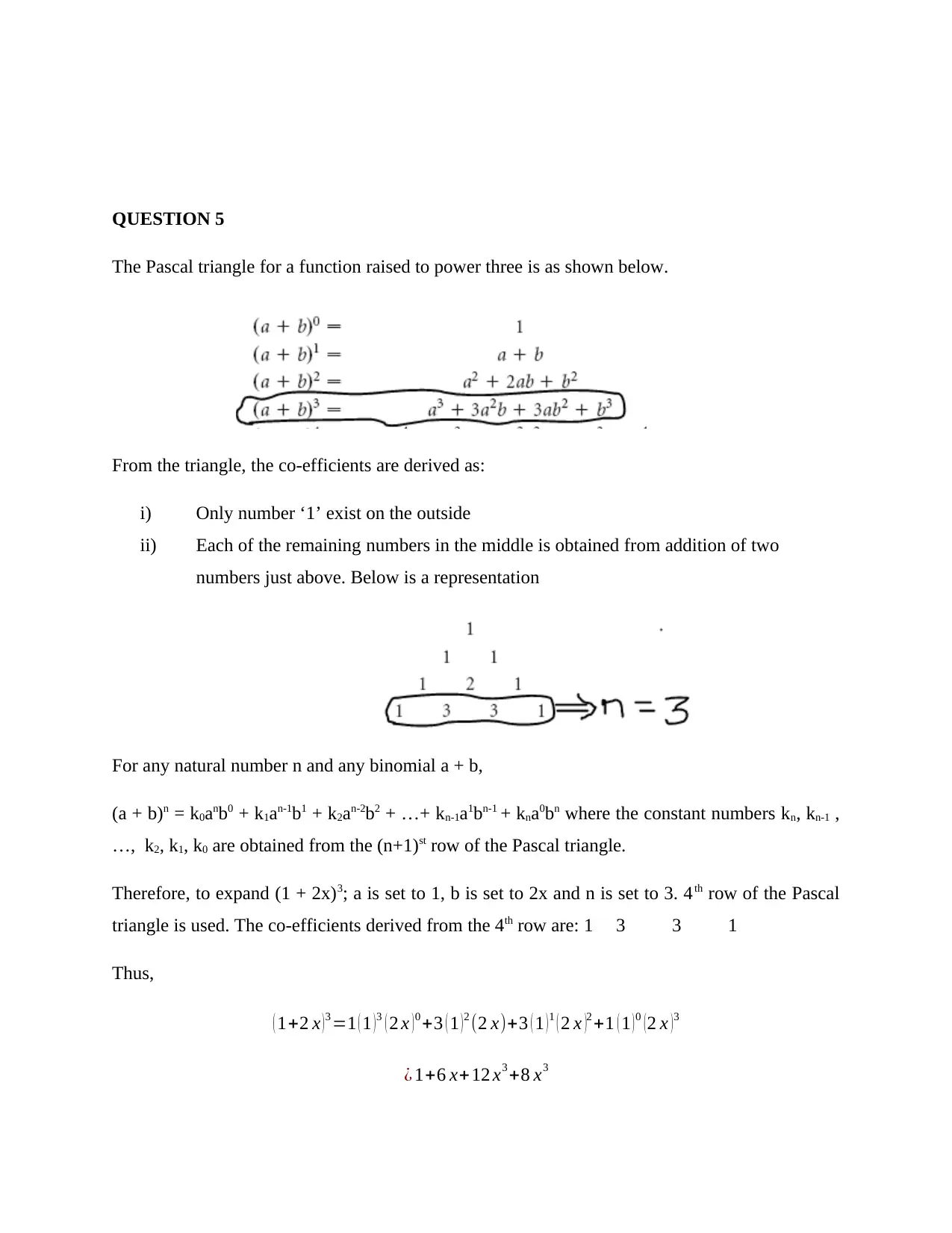
The Pascal triangle for a function raised to power three is as shown below.
From the triangle, the co-efficients are derived as:
i) Only number ‘1’ exist on the outside
ii) Each of the remaining numbers in the middle is obtained from addition of two
numbers just above. Below is a representation
For any natural number n and any binomial a + b,
(a + b)n = k0anb0 + k1an-1b1 + k2an-2b2 + …+ kn-1a1bn-1 + kna0bn where the constant numbers kn, kn-1 ,
…, k2, k1, k0 are obtained from the (n+1)st row of the Pascal triangle.
Therefore, to expand (1 + 2x)3; a is set to 1, b is set to 2x and n is set to 3. 4th row of the Pascal
triangle is used. The co-efficients derived from the 4th row are: 1 3 3 1
Thus,
( 1+2 x ) 3 =1 ( 1 ) 3 ( 2 x ) 0 +3 ( 1 ) 2 (2 x)+3 ( 1 ) 1 ( 2 x )2 +1 ( 1 ) 0 ( 2 x ) 3
¿ 1+6 x+12 x3 +8 x3
The Pascal triangle for a function raised to power three is as shown below.
From the triangle, the co-efficients are derived as:
i) Only number ‘1’ exist on the outside
ii) Each of the remaining numbers in the middle is obtained from addition of two
numbers just above. Below is a representation
For any natural number n and any binomial a + b,
(a + b)n = k0anb0 + k1an-1b1 + k2an-2b2 + …+ kn-1a1bn-1 + kna0bn where the constant numbers kn, kn-1 ,
…, k2, k1, k0 are obtained from the (n+1)st row of the Pascal triangle.
Therefore, to expand (1 + 2x)3; a is set to 1, b is set to 2x and n is set to 3. 4th row of the Pascal
triangle is used. The co-efficients derived from the 4th row are: 1 3 3 1
Thus,
( 1+2 x ) 3 =1 ( 1 ) 3 ( 2 x ) 0 +3 ( 1 ) 2 (2 x)+3 ( 1 ) 1 ( 2 x )2 +1 ( 1 ) 0 ( 2 x ) 3
¿ 1+6 x+12 x3 +8 x3
⊘ This is a preview!⊘
Do you want full access?
Subscribe today to unlock all pages.

Trusted by 1+ million students worldwide

QUESTION 6
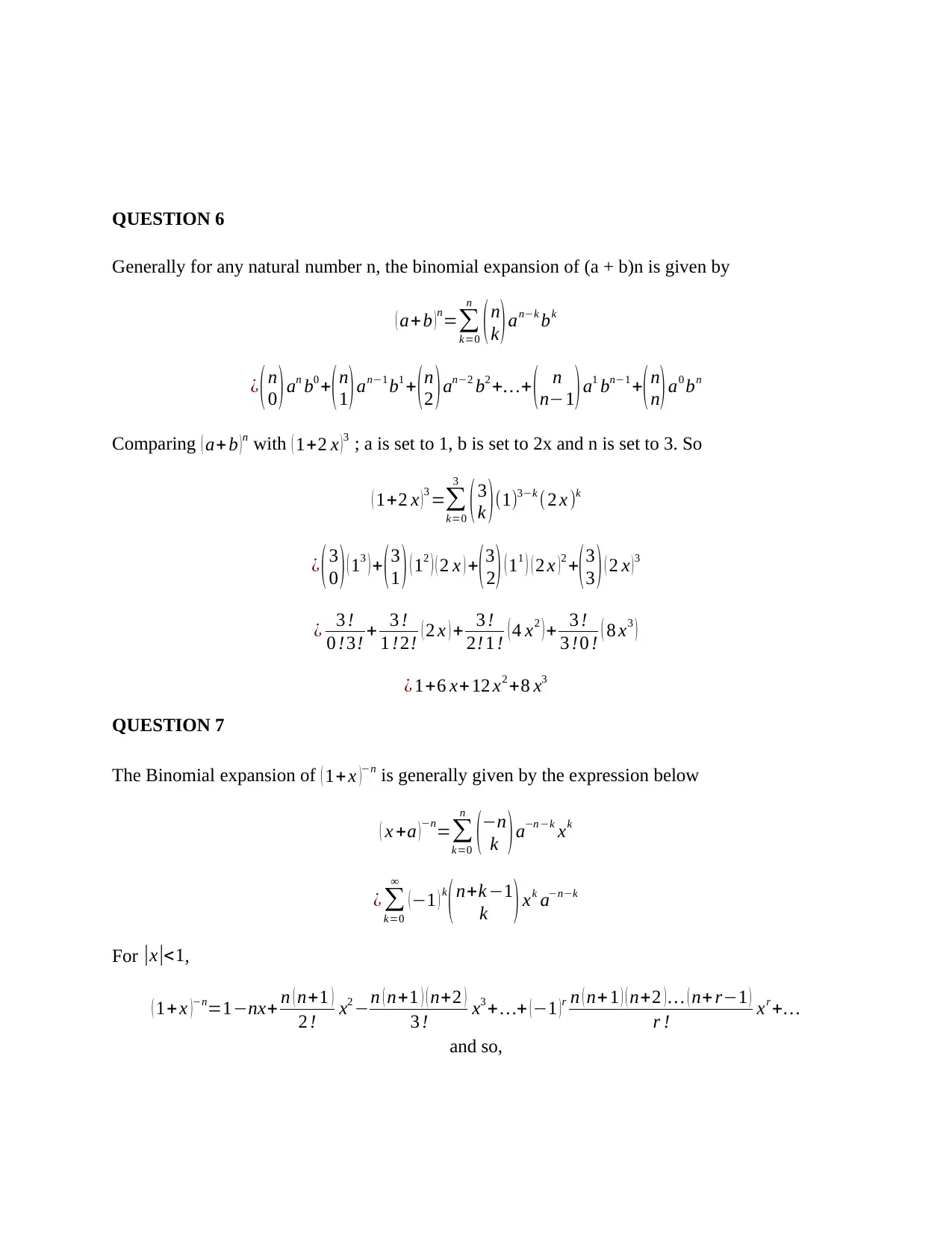
Generally for any natural number n, the binomial expansion of (a + b)n is given by
( a+ b )n=∑
k=0
n
(n
k )an−k bk
¿ (n
0 )an b0 +(n
1)an−1 b1 + (n
2 )an−2 b2 +…+ ( n
n−1 )a1 bn−1 +(n
n)a0 bn
Comparing ( a+ b ) n with ( 1+2 x ) 3 ; a is set to 1, b is set to 2x and n is set to 3. So
( 1+2 x ) 3 =∑
k=0
3
( 3
k ) (1)3−k (2 x )k
¿ ( 3
0 ) ( 13 ) + ( 3
1 ) ( 12 ) ( 2 x ) +( 3
2 ) ( 11 ) ( 2 x ) 2 +( 3
3 ) ( 2 x ) 3
¿ 3 !
0 !3! + 3 !
1 !2! ( 2 x ) + 3 !
2! 1 ! ( 4 x2 ) + 3 !
3 !0 ! ( 8 x3 )
¿ 1+6 x+ 12 x2 +8 x3
QUESTION 7
The Binomial expansion of ( 1+ x )−n is generally given by the expression below
( x +a )−n=∑
k=0
n
(−n
k )a−n −k xk
¿ ∑
k=0
∞
( −1 ) k
( n+k −1
k ) xk a−n−k
For |x|<1,
( 1+ x )−n=1−nx+ n ( n+1 )
2 ! x2 −n ( n+1 ) ( n+2 )
3 ! x3 + …+ ( −1 ) r n ( n+ 1 ) ( n+2 ) … ( n+ r−1 )
r ! xr +…
and so,
Generally for any natural number n, the binomial expansion of (a + b)n is given by
( a+ b )n=∑
k=0
n
(n
k )an−k bk
¿ (n
0 )an b0 +(n
1)an−1 b1 + (n
2 )an−2 b2 +…+ ( n
n−1 )a1 bn−1 +(n
n)a0 bn
Comparing ( a+ b ) n with ( 1+2 x ) 3 ; a is set to 1, b is set to 2x and n is set to 3. So
( 1+2 x ) 3 =∑
k=0
3
( 3
k ) (1)3−k (2 x )k
¿ ( 3
0 ) ( 13 ) + ( 3
1 ) ( 12 ) ( 2 x ) +( 3
2 ) ( 11 ) ( 2 x ) 2 +( 3
3 ) ( 2 x ) 3
¿ 3 !
0 !3! + 3 !
1 !2! ( 2 x ) + 3 !
2! 1 ! ( 4 x2 ) + 3 !
3 !0 ! ( 8 x3 )
¿ 1+6 x+ 12 x2 +8 x3
QUESTION 7
The Binomial expansion of ( 1+ x )−n is generally given by the expression below
( x +a )−n=∑
k=0
n
(−n
k )a−n −k xk
¿ ∑
k=0
∞
( −1 ) k
( n+k −1
k ) xk a−n−k
For |x|<1,
( 1+ x )−n=1−nx+ n ( n+1 )
2 ! x2 −n ( n+1 ) ( n+2 )
3 ! x3 + …+ ( −1 ) r n ( n+ 1 ) ( n+2 ) … ( n+ r−1 )
r ! xr +…
and so,
Paraphrase This Document
Need a fresh take? Get an instant paraphrase of this document with our AI Paraphraser

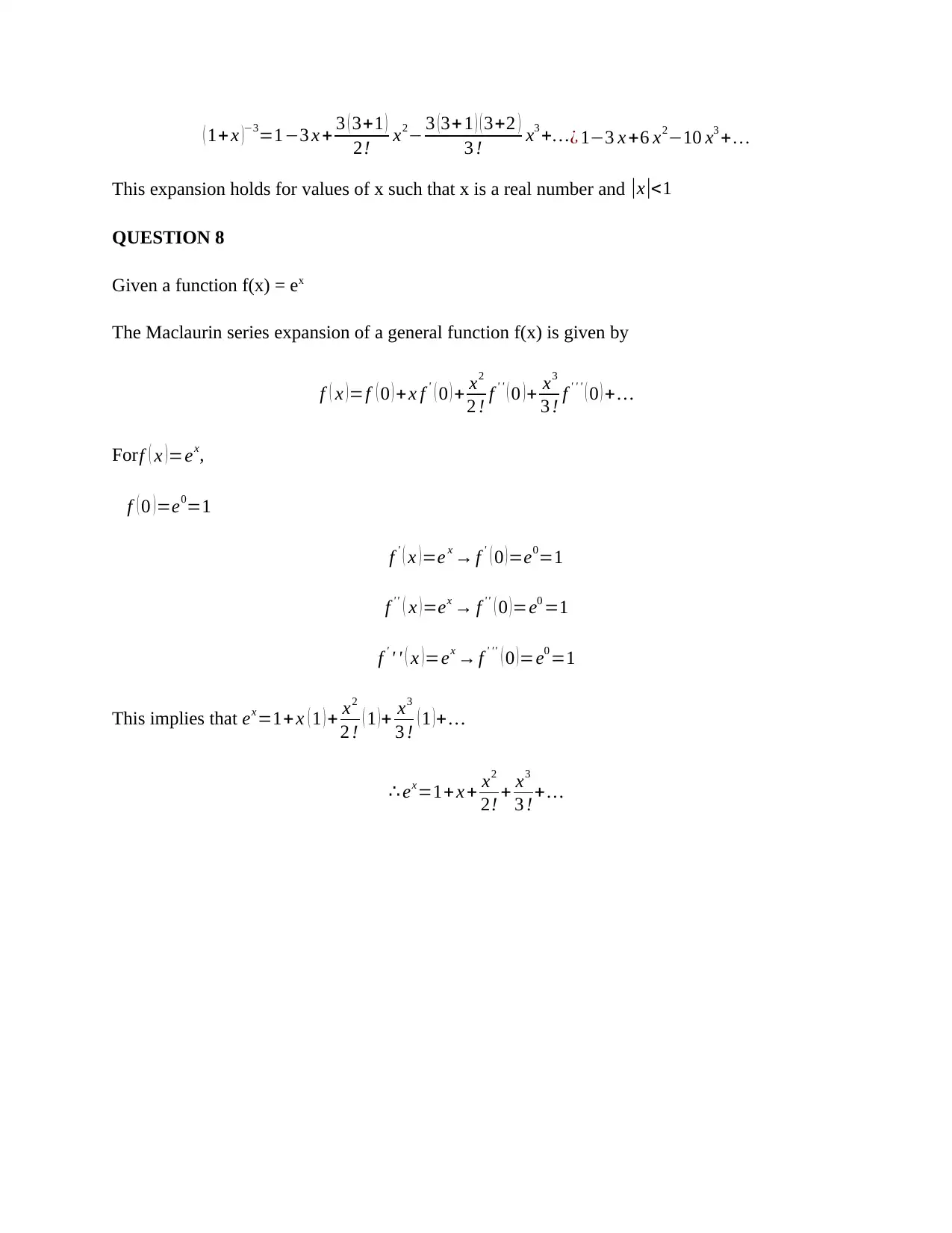
( 1+ x )−3=1−3 x + 3 ( 3+1 )
2! x2− 3 ( 3+1 ) ( 3+2 )
3 ! x3 +…¿ 1−3 x +6 x2−10 x3 +…
This expansion holds for values of x such that x is a real number and |x|<1
QUESTION 8
Given a function f(x) = ex
The Maclaurin series expansion of a general function f(x) is given by
f ( x )=f ( 0 ) +x f ' ( 0 ) + x2
2 ! f ' ' ( 0 )+ x3
3 ! f ' ' ' ( 0 ) + …
For f ( x ) =ex,
f ( 0 )=e0=1
f ' ( x )=e x → f ' ( 0 )=e0=1
f ' ' ( x ) =ex → f '' ( 0 ) =e0 =1
f ' ' ' ( x )=ex → f ' '' ( 0 )=e0 =1
This implies that ex=1+x ( 1 ) + x2
2 ! ( 1 )+ x3
3 ! ( 1 )+ …
∴ ex=1+x + x2
2! + x3
3 !+ …
2! x2− 3 ( 3+1 ) ( 3+2 )
3 ! x3 +…¿ 1−3 x +6 x2−10 x3 +…
This expansion holds for values of x such that x is a real number and |x|<1
QUESTION 8
Given a function f(x) = ex
The Maclaurin series expansion of a general function f(x) is given by
f ( x )=f ( 0 ) +x f ' ( 0 ) + x2
2 ! f ' ' ( 0 )+ x3
3 ! f ' ' ' ( 0 ) + …
For f ( x ) =ex,
f ( 0 )=e0=1
f ' ( x )=e x → f ' ( 0 )=e0=1
f ' ' ( x ) =ex → f '' ( 0 ) =e0 =1
f ' ' ' ( x )=ex → f ' '' ( 0 )=e0 =1
This implies that ex=1+x ( 1 ) + x2
2 ! ( 1 )+ x3
3 ! ( 1 )+ …
∴ ex=1+x + x2
2! + x3
3 !+ …

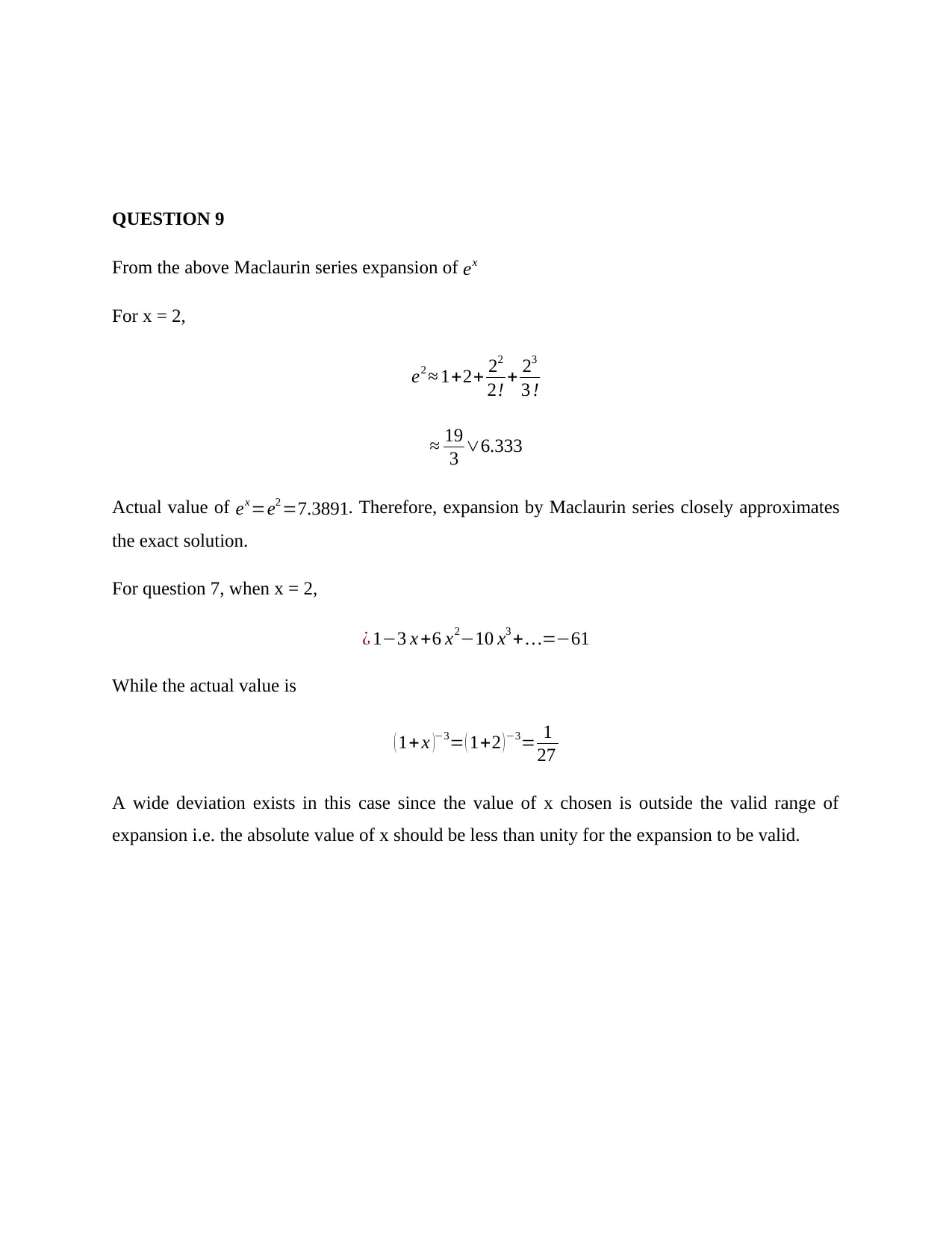
QUESTION 9
From the above Maclaurin series expansion of ex
For x = 2,
e2 ≈ 1+2+ 22
2! + 23
3 !
≈ 19
3 ∨6.333
Actual value of ex=e2 =7.3891. Therefore, expansion by Maclaurin series closely approximates
the exact solution.
For question 7, when x = 2,
¿ 1−3 x +6 x2−10 x3 +…=−61
While the actual value is
( 1+x )−3= ( 1+2 ) −3= 1
27
A wide deviation exists in this case since the value of x chosen is outside the valid range of
expansion i.e. the absolute value of x should be less than unity for the expansion to be valid.
From the above Maclaurin series expansion of ex
For x = 2,
e2 ≈ 1+2+ 22
2! + 23
3 !
≈ 19
3 ∨6.333
Actual value of ex=e2 =7.3891. Therefore, expansion by Maclaurin series closely approximates
the exact solution.
For question 7, when x = 2,
¿ 1−3 x +6 x2−10 x3 +…=−61
While the actual value is
( 1+x )−3= ( 1+2 ) −3= 1
27
A wide deviation exists in this case since the value of x chosen is outside the valid range of
expansion i.e. the absolute value of x should be less than unity for the expansion to be valid.
⊘ This is a preview!⊘
Do you want full access?
Subscribe today to unlock all pages.

Trusted by 1+ million students worldwide

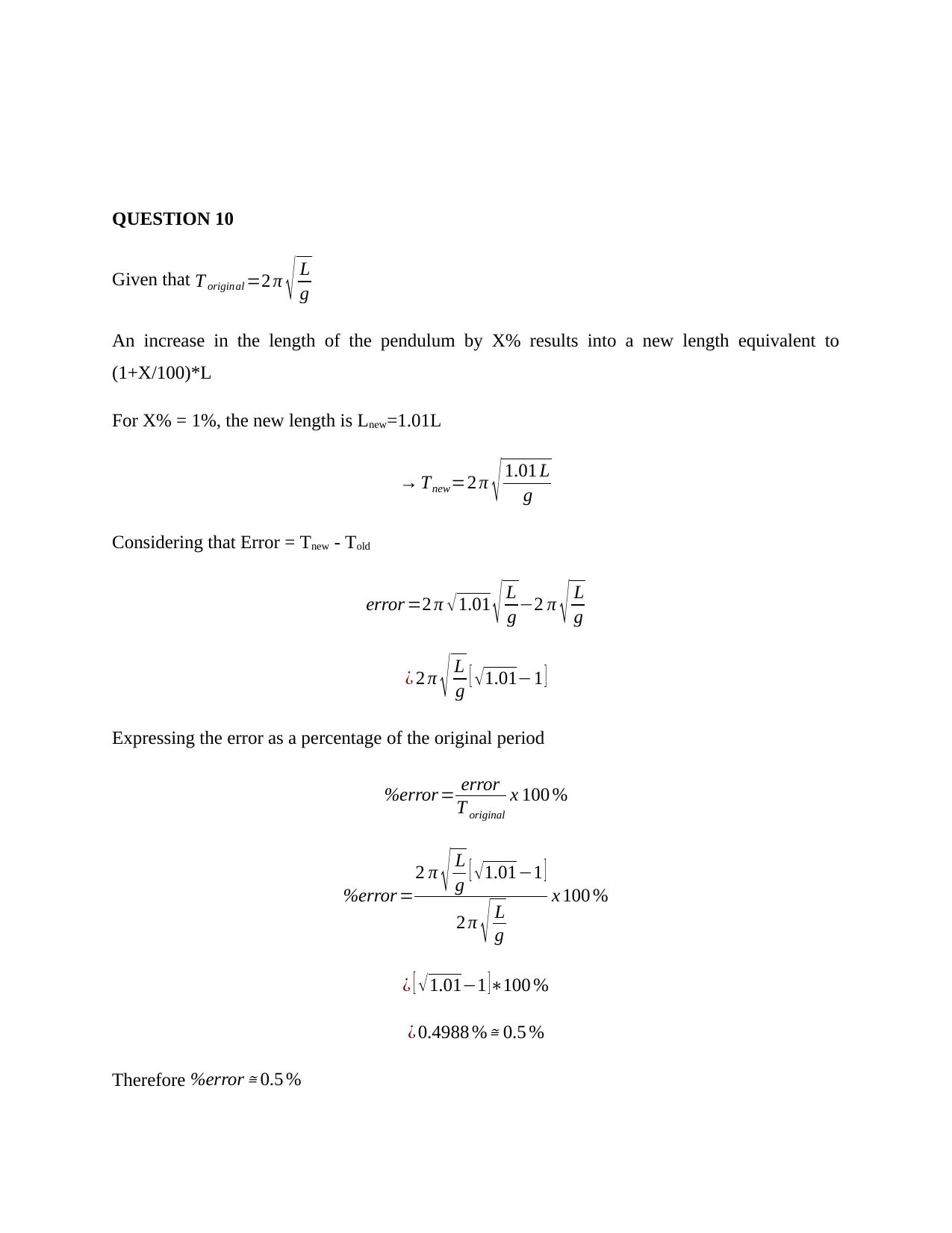
QUESTION 10
Given that T original =2 π √ L
g
An increase in the length of the pendulum by X% results into a new length equivalent to
(1+X/100)*L
For X% = 1%, the new length is Lnew=1.01L
→ Tnew=2 π √ 1.01 L
g
Considering that Error = Tnew - Told
error =2 π √ 1.01 √ L
g −2 π √ L
g
¿ 2 π √ L
g [ √ 1.01−1 ]
Expressing the error as a percentage of the original period
%error = error
T original
x 100 %
%error =
2 π √ L
g [ √1.01−1 ]
2 π √ L
g
x 100 %
¿ [ √1.01−1 ]∗100 %
¿ 0.4988 %≅ 0.5 %
Therefore %error ≅ 0.5 %
Given that T original =2 π √ L
g
An increase in the length of the pendulum by X% results into a new length equivalent to
(1+X/100)*L
For X% = 1%, the new length is Lnew=1.01L
→ Tnew=2 π √ 1.01 L
g
Considering that Error = Tnew - Told
error =2 π √ 1.01 √ L
g −2 π √ L
g
¿ 2 π √ L
g [ √ 1.01−1 ]
Expressing the error as a percentage of the original period
%error = error
T original
x 100 %
%error =
2 π √ L
g [ √1.01−1 ]
2 π √ L
g
x 100 %
¿ [ √1.01−1 ]∗100 %
¿ 0.4988 %≅ 0.5 %
Therefore %error ≅ 0.5 %
Paraphrase This Document
Need a fresh take? Get an instant paraphrase of this document with our AI Paraphraser

1 out of 11
Related Documents
Your All-in-One AI-Powered Toolkit for Academic Success.
+13062052269
info@desklib.com
Available 24*7 on WhatsApp / Email
Unlock your academic potential
Copyright © 2020–2025 A2Z Services. All Rights Reserved. Developed and managed by ZUCOL.