VEN1102 Engineering Physics 1 PBL: Galaxy Spectrum and Doppler Effect
VerifiedAdded on 2020/04/21
|6
|1368
|349
Project
AI Summary
This PBL assignment focuses on analyzing the optical spectrum of a newly discovered galaxy relative to the sun. The solution details the application of optical absorption spectroscopy to identify Fraunhofer lines and understand the galaxy's composition and motion. The assignment includes the use of the Doppler formula to calculate the galaxy's velocity, and Hubble's Law to determine its distance from Earth. The solution also provides a graph illustrating Hubble's Law and discusses the limitations of the law. The assignment covers key concepts such as the electromagnetic spectrum, atomic physics, and the relationship between the redshift of spectral lines and the galaxy's recession velocity. The final solution includes the calculated velocity, distance, and a discussion of the findings.
PBL Assignment Sheet
VEN1102 Engineering Physics 1
Problem Title: ________________________________________________________ Date: ______________
Team members
Name 1: ID:
Name 2: ID:
Name 3: ID:
Name 4: ID:
Name 5: ID:
Name 6: ID:
Instructions
1. Complete the following Assignment sheet filling in all sections.
2. Write your solution in Section 4, adding more pages as required. The page length of your solution should be
reflective of the number of members of the team.
3. All steps in solving the problem must be clearly explained.
4. All formulas and physics concepts must be clearly explained.
5. Where applicable, errors and uncertainties must be included in measurements and calculations.
5. All sources of information must be properly acknowledged or referenced using either the Harvard, APA or IEEE
referencing format.
6. The report must be type-written in proper English and not hand-written. Graphs created using plotting software
such as MS Excel and must have correct axes and labels. Pages are numbered.
7. The report must be eligible and have no or little spelling/grammar errors.
8. This assignment will be subject to plagiarism checking. Penalties apply for plagiarism and collusion.
9. Submit your group assignment via the VU Collaborate Dropbox. Only one submission per team is required.
Assignment submissions are due at the end of the week. Late submissions will not be accepted.
Section 1: Problem Statement (Step 1 in PBL cycle)
Write in your own words what you think the problem that needs solving is and how this can be achieved)
Use of optical absorption spectroscopy to compare the optical spectrum of a galaxy relative to the sun as
well as the speed of the galaxy relative to the Earth.
PBL Assignment Sheet Version 3. Last updated 09/08/2016 Page 1
VEN1102 Engineering Physics 1
Problem Title: ________________________________________________________ Date: ______________
Team members
Name 1: ID:
Name 2: ID:
Name 3: ID:
Name 4: ID:
Name 5: ID:
Name 6: ID:
Instructions
1. Complete the following Assignment sheet filling in all sections.
2. Write your solution in Section 4, adding more pages as required. The page length of your solution should be
reflective of the number of members of the team.
3. All steps in solving the problem must be clearly explained.
4. All formulas and physics concepts must be clearly explained.
5. Where applicable, errors and uncertainties must be included in measurements and calculations.
5. All sources of information must be properly acknowledged or referenced using either the Harvard, APA or IEEE
referencing format.
6. The report must be type-written in proper English and not hand-written. Graphs created using plotting software
such as MS Excel and must have correct axes and labels. Pages are numbered.
7. The report must be eligible and have no or little spelling/grammar errors.
8. This assignment will be subject to plagiarism checking. Penalties apply for plagiarism and collusion.
9. Submit your group assignment via the VU Collaborate Dropbox. Only one submission per team is required.
Assignment submissions are due at the end of the week. Late submissions will not be accepted.
Section 1: Problem Statement (Step 1 in PBL cycle)
Write in your own words what you think the problem that needs solving is and how this can be achieved)
Use of optical absorption spectroscopy to compare the optical spectrum of a galaxy relative to the sun as
well as the speed of the galaxy relative to the Earth.
PBL Assignment Sheet Version 3. Last updated 09/08/2016 Page 1
Paraphrase This Document
Need a fresh take? Get an instant paraphrase of this document with our AI Paraphraser

PBL Assignment Sheet
VEN1102 Engineering Physics 1
Section 2: What do you know? (Step 2 in PBL cycle)
List everything that you know or understand the problem. What facts are presented in the problem statement? What facts, or knowledge, do
you already know about the problem or context in which the problem is set?
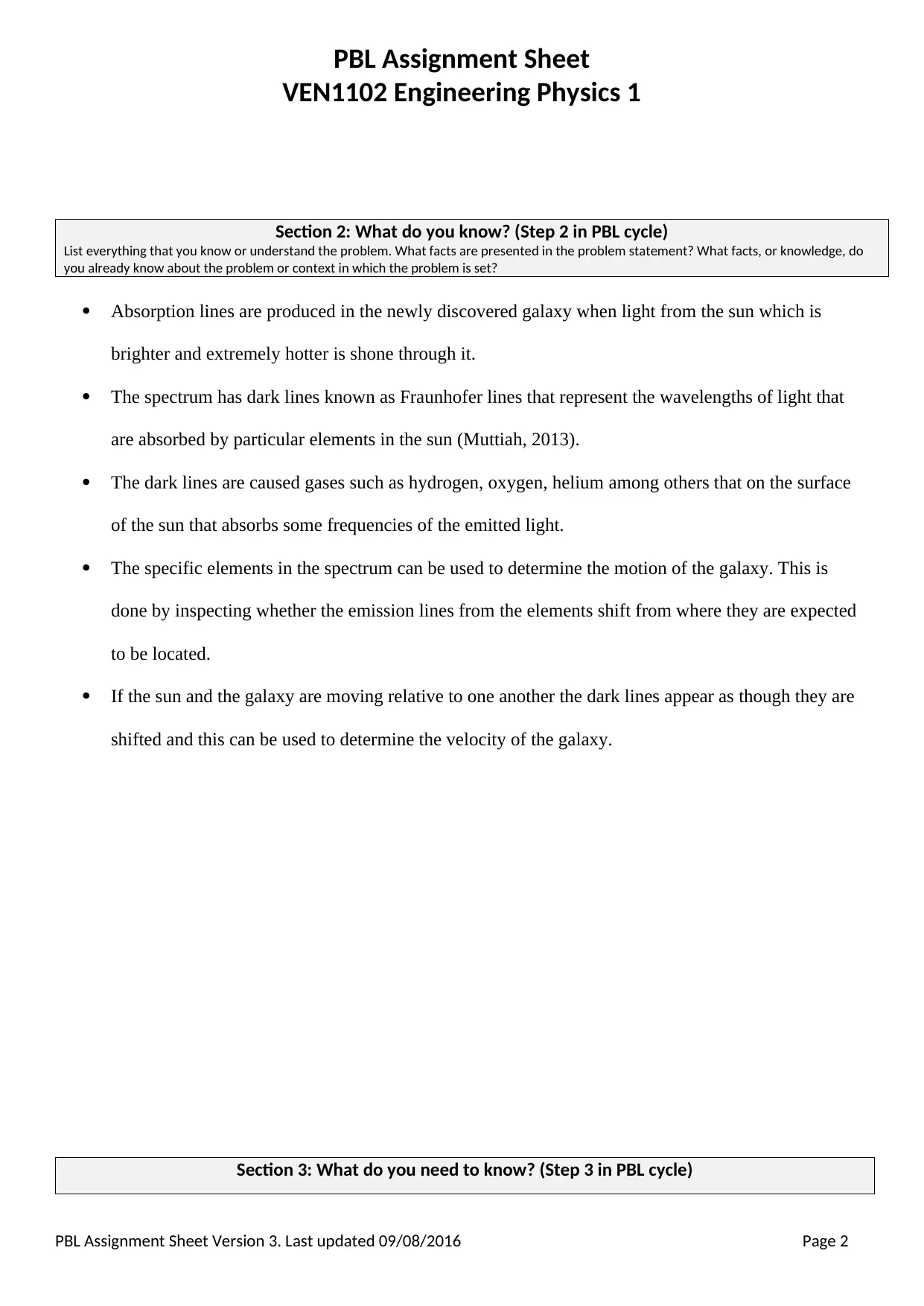
Absorption lines are produced in the newly discovered galaxy when light from the sun which is
brighter and extremely hotter is shone through it.
The spectrum has dark lines known as Fraunhofer lines that represent the wavelengths of light that
are absorbed by particular elements in the sun (Muttiah, 2013).
The dark lines are caused gases such as hydrogen, oxygen, helium among others that on the surface
of the sun that absorbs some frequencies of the emitted light.
The specific elements in the spectrum can be used to determine the motion of the galaxy. This is
done by inspecting whether the emission lines from the elements shift from where they are expected
to be located.
If the sun and the galaxy are moving relative to one another the dark lines appear as though they are
shifted and this can be used to determine the velocity of the galaxy.
Section 3: What do you need to know? (Step 3 in PBL cycle)
PBL Assignment Sheet Version 3. Last updated 09/08/2016 Page 2
VEN1102 Engineering Physics 1
Section 2: What do you know? (Step 2 in PBL cycle)
List everything that you know or understand the problem. What facts are presented in the problem statement? What facts, or knowledge, do
you already know about the problem or context in which the problem is set?
Absorption lines are produced in the newly discovered galaxy when light from the sun which is
brighter and extremely hotter is shone through it.
The spectrum has dark lines known as Fraunhofer lines that represent the wavelengths of light that
are absorbed by particular elements in the sun (Muttiah, 2013).
The dark lines are caused gases such as hydrogen, oxygen, helium among others that on the surface
of the sun that absorbs some frequencies of the emitted light.
The specific elements in the spectrum can be used to determine the motion of the galaxy. This is
done by inspecting whether the emission lines from the elements shift from where they are expected
to be located.
If the sun and the galaxy are moving relative to one another the dark lines appear as though they are
shifted and this can be used to determine the velocity of the galaxy.
Section 3: What do you need to know? (Step 3 in PBL cycle)
PBL Assignment Sheet Version 3. Last updated 09/08/2016 Page 2

PBL Assignment Sheet
VEN1102 Engineering Physics 1
Determine what information/knowledge is needed in order to solve the problem. This may be information or data as well as physics concepts
or other knowledge that may help to analyse or solve the problem. What assumptions are you making? Who will research what? The work
should be shared equally amongst the team members. PBL is a group activity where students teach and learn from each other. This can only
work when everyone in the team participates.
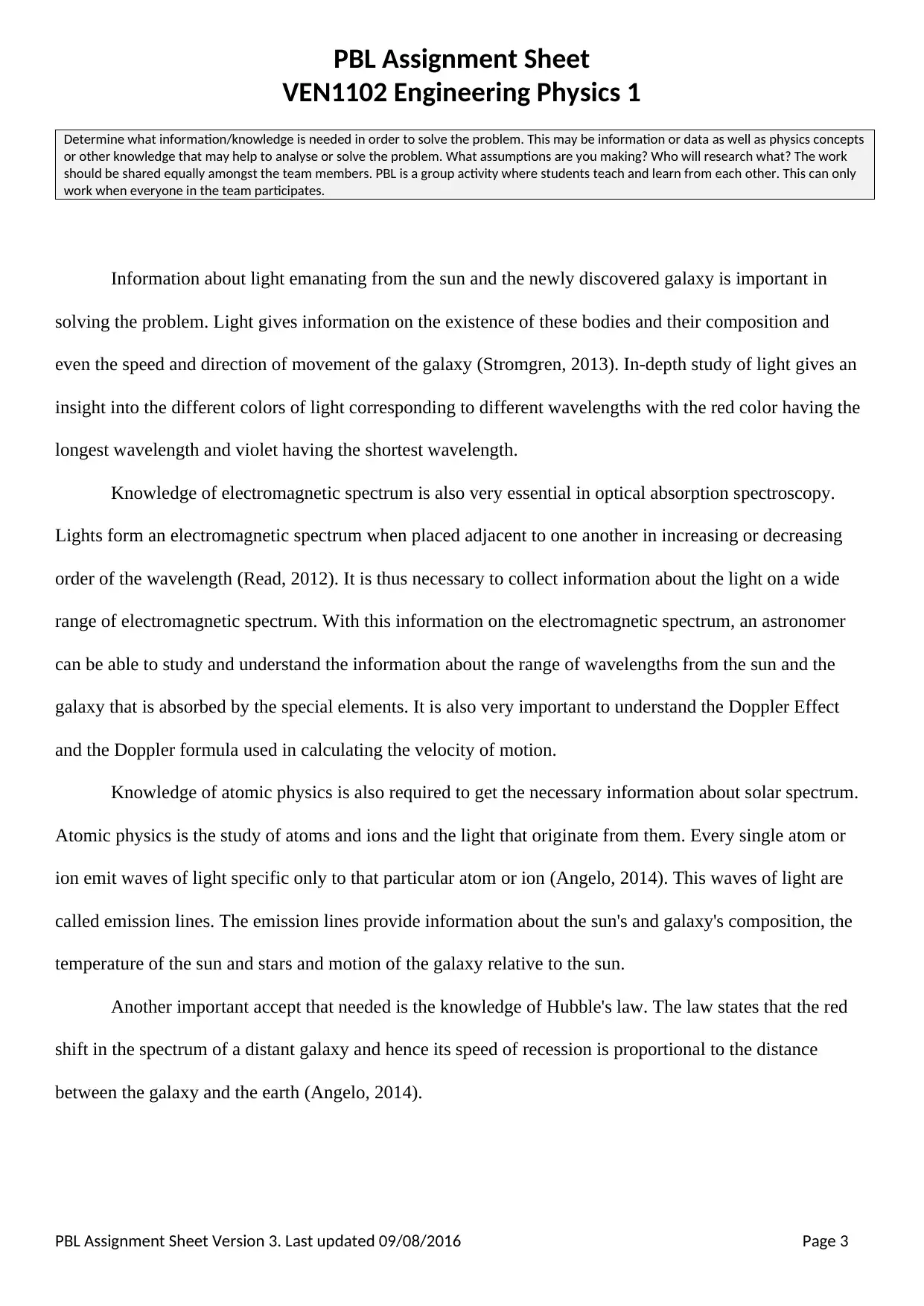
Information about light emanating from the sun and the newly discovered galaxy is important in
solving the problem. Light gives information on the existence of these bodies and their composition and
even the speed and direction of movement of the galaxy (Stromgren, 2013). In-depth study of light gives an
insight into the different colors of light corresponding to different wavelengths with the red color having the
longest wavelength and violet having the shortest wavelength.
Knowledge of electromagnetic spectrum is also very essential in optical absorption spectroscopy.
Lights form an electromagnetic spectrum when placed adjacent to one another in increasing or decreasing
order of the wavelength (Read, 2012). It is thus necessary to collect information about the light on a wide
range of electromagnetic spectrum. With this information on the electromagnetic spectrum, an astronomer
can be able to study and understand the information about the range of wavelengths from the sun and the
galaxy that is absorbed by the special elements. It is also very important to understand the Doppler Effect
and the Doppler formula used in calculating the velocity of motion.
Knowledge of atomic physics is also required to get the necessary information about solar spectrum.
Atomic physics is the study of atoms and ions and the light that originate from them. Every single atom or
ion emit waves of light specific only to that particular atom or ion (Angelo, 2014). This waves of light are
called emission lines. The emission lines provide information about the sun's and galaxy's composition, the
temperature of the sun and stars and motion of the galaxy relative to the sun.
Another important accept that needed is the knowledge of Hubble's law. The law states that the red
shift in the spectrum of a distant galaxy and hence its speed of recession is proportional to the distance
between the galaxy and the earth (Angelo, 2014).
PBL Assignment Sheet Version 3. Last updated 09/08/2016 Page 3
VEN1102 Engineering Physics 1
Determine what information/knowledge is needed in order to solve the problem. This may be information or data as well as physics concepts
or other knowledge that may help to analyse or solve the problem. What assumptions are you making? Who will research what? The work
should be shared equally amongst the team members. PBL is a group activity where students teach and learn from each other. This can only
work when everyone in the team participates.
Information about light emanating from the sun and the newly discovered galaxy is important in
solving the problem. Light gives information on the existence of these bodies and their composition and
even the speed and direction of movement of the galaxy (Stromgren, 2013). In-depth study of light gives an
insight into the different colors of light corresponding to different wavelengths with the red color having the
longest wavelength and violet having the shortest wavelength.
Knowledge of electromagnetic spectrum is also very essential in optical absorption spectroscopy.
Lights form an electromagnetic spectrum when placed adjacent to one another in increasing or decreasing
order of the wavelength (Read, 2012). It is thus necessary to collect information about the light on a wide
range of electromagnetic spectrum. With this information on the electromagnetic spectrum, an astronomer
can be able to study and understand the information about the range of wavelengths from the sun and the
galaxy that is absorbed by the special elements. It is also very important to understand the Doppler Effect
and the Doppler formula used in calculating the velocity of motion.
Knowledge of atomic physics is also required to get the necessary information about solar spectrum.
Atomic physics is the study of atoms and ions and the light that originate from them. Every single atom or
ion emit waves of light specific only to that particular atom or ion (Angelo, 2014). This waves of light are
called emission lines. The emission lines provide information about the sun's and galaxy's composition, the
temperature of the sun and stars and motion of the galaxy relative to the sun.
Another important accept that needed is the knowledge of Hubble's law. The law states that the red
shift in the spectrum of a distant galaxy and hence its speed of recession is proportional to the distance
between the galaxy and the earth (Angelo, 2014).
PBL Assignment Sheet Version 3. Last updated 09/08/2016 Page 3
⊘ This is a preview!⊘
Do you want full access?
Subscribe today to unlock all pages.

Trusted by 1+ million students worldwide

PBL Assignment Sheet
VEN1102 Engineering Physics 1
Section 4: Solution. How did you solve the problem? (Step 6 in PBL cycle)
Use this section to report on your findings and your solutions to the problem. Attach additional pages as required.
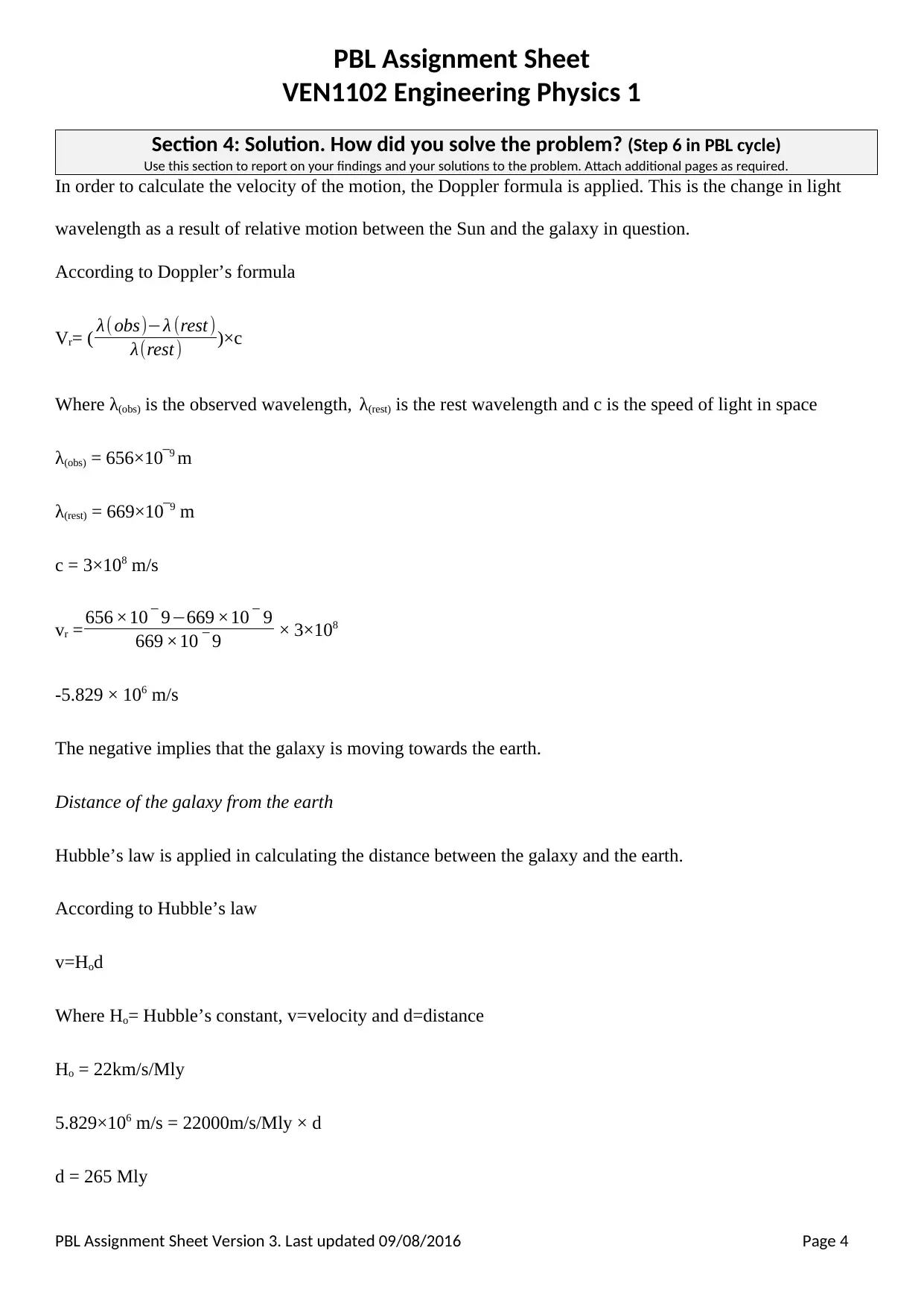
In order to calculate the velocity of the motion, the Doppler formula is applied. This is the change in light
wavelength as a result of relative motion between the Sun and the galaxy in question.
According to Doppler’s formula
Vr= ( λ(obs)−λ (rest )
λ(rest ) )×c
Where λ(obs) is the observed wavelength, λ(rest) is the rest wavelength and c is the speed of light in space
λ(obs) = 656×10‾9 m
λ(rest) = 669×10‾9 m
c = 3×10⁸ m/s
vr = 656 ×10 ‾ 9−669 ×10 ‾ 9
669 ×10 ‾ 9 × 3×108
-5.829 × 10⁶ m/s
The negative implies that the galaxy is moving towards the earth.
Distance of the galaxy from the earth
Hubble’s law is applied in calculating the distance between the galaxy and the earth.
According to Hubble’s law
v=Hod
Where Ho= Hubble’s constant, v=velocity and d=distance
Ho = 22km/s/Mly
5.829×10⁶ m/s = 22000m/s/Mly × d
d = 265 Mly
PBL Assignment Sheet Version 3. Last updated 09/08/2016 Page 4
VEN1102 Engineering Physics 1
Section 4: Solution. How did you solve the problem? (Step 6 in PBL cycle)
Use this section to report on your findings and your solutions to the problem. Attach additional pages as required.
In order to calculate the velocity of the motion, the Doppler formula is applied. This is the change in light
wavelength as a result of relative motion between the Sun and the galaxy in question.
According to Doppler’s formula
Vr= ( λ(obs)−λ (rest )
λ(rest ) )×c
Where λ(obs) is the observed wavelength, λ(rest) is the rest wavelength and c is the speed of light in space
λ(obs) = 656×10‾9 m
λ(rest) = 669×10‾9 m
c = 3×10⁸ m/s
vr = 656 ×10 ‾ 9−669 ×10 ‾ 9
669 ×10 ‾ 9 × 3×108
-5.829 × 10⁶ m/s
The negative implies that the galaxy is moving towards the earth.
Distance of the galaxy from the earth
Hubble’s law is applied in calculating the distance between the galaxy and the earth.
According to Hubble’s law
v=Hod
Where Ho= Hubble’s constant, v=velocity and d=distance
Ho = 22km/s/Mly
5.829×10⁶ m/s = 22000m/s/Mly × d
d = 265 Mly
PBL Assignment Sheet Version 3. Last updated 09/08/2016 Page 4
Paraphrase This Document
Need a fresh take? Get an instant paraphrase of this document with our AI Paraphraser

PBL Assignment Sheet
VEN1102 Engineering Physics 1
Therefore the distance is 265 million light years
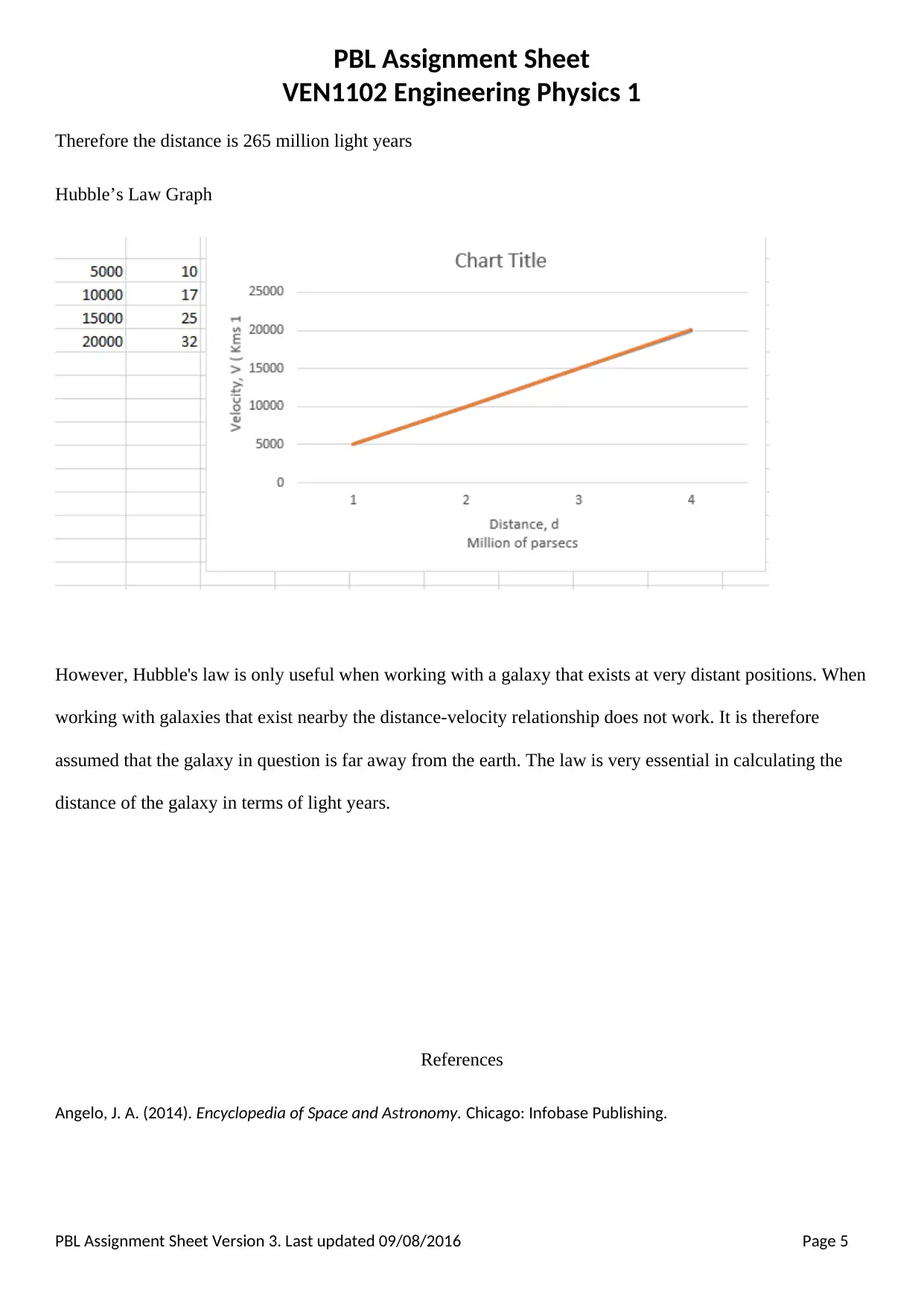
Hubble’s Law Graph
However, Hubble's law is only useful when working with a galaxy that exists at very distant positions. When
working with galaxies that exist nearby the distance-velocity relationship does not work. It is therefore
assumed that the galaxy in question is far away from the earth. The law is very essential in calculating the
distance of the galaxy in terms of light years.
References
Angelo, J. A. (2014). Encyclopedia of Space and Astronomy. Chicago: Infobase Publishing.
PBL Assignment Sheet Version 3. Last updated 09/08/2016 Page 5
VEN1102 Engineering Physics 1
Therefore the distance is 265 million light years
Hubble’s Law Graph
However, Hubble's law is only useful when working with a galaxy that exists at very distant positions. When
working with galaxies that exist nearby the distance-velocity relationship does not work. It is therefore
assumed that the galaxy in question is far away from the earth. The law is very essential in calculating the
distance of the galaxy in terms of light years.
References
Angelo, J. A. (2014). Encyclopedia of Space and Astronomy. Chicago: Infobase Publishing.
PBL Assignment Sheet Version 3. Last updated 09/08/2016 Page 5

PBL Assignment Sheet
VEN1102 Engineering Physics 1
Muttiah, R. S. (2013). From Laboratory Spectroscopy to Remotely Sensed Spectra of Terrestrial Ecosystems. New York:
Springer Science & Business Media.
Read, P. (2012). Gemmology. Berlin: Routledge.
Stromgren, B. (2013). The Influence of Electron Capture on the Contours of Fraunhofer Lines. London: Springer.
PBL Assignment Sheet Version 3. Last updated 09/08/2016 Page 6
VEN1102 Engineering Physics 1
Muttiah, R. S. (2013). From Laboratory Spectroscopy to Remotely Sensed Spectra of Terrestrial Ecosystems. New York:
Springer Science & Business Media.
Read, P. (2012). Gemmology. Berlin: Routledge.
Stromgren, B. (2013). The Influence of Electron Capture on the Contours of Fraunhofer Lines. London: Springer.
PBL Assignment Sheet Version 3. Last updated 09/08/2016 Page 6
⊘ This is a preview!⊘
Do you want full access?
Subscribe today to unlock all pages.

Trusted by 1+ million students worldwide
1 out of 6
Related Documents
Your All-in-One AI-Powered Toolkit for Academic Success.
+13062052269
info@desklib.com
Available 24*7 on WhatsApp / Email
Unlock your academic potential
Copyright © 2020–2026 A2Z Services. All Rights Reserved. Developed and managed by ZUCOL.