Enhancing Concrete Durability & Resistance: Engineering Project
VerifiedAdded on 2023/06/03
|18
|3734
|140
Report
AI Summary
This engineering report investigates methods to improve the durability and resistance of concrete materials, essential for applications like reinforced concrete construction, slabs, columns, and bridges. It addresses research questions regarding ways to achieve concrete durability and their importance, while also examining hypotheses related to concrete treatments, cost-effectiveness, and safety. The report delves into material selection, mixing ratios, chemical admixtures, and techniques such as construction joints, mix design optimization, permeability reduction, steel fiber usage, and proper curing methods. It further highlights the significance of reinforced concrete compressive strength tests and discusses the advantages of enhancing concrete's resistance and durability, ultimately aiming to extend the lifespan and improve the safety of concrete structures. Desklib provides access to similar solved assignments and past papers for students.
Engineering Project Preparation 1
ENGINEERING PROJECT PREPARATION
By Name
Course
Instructor
Institution
Location
Date
ENGINEERING PROJECT PREPARATION
By Name
Course
Instructor
Institution
Location
Date

Paraphrase This Document
Need a fresh take? Get an instant paraphrase of this document with our AI Paraphraser
Engineering Project Preparation 2
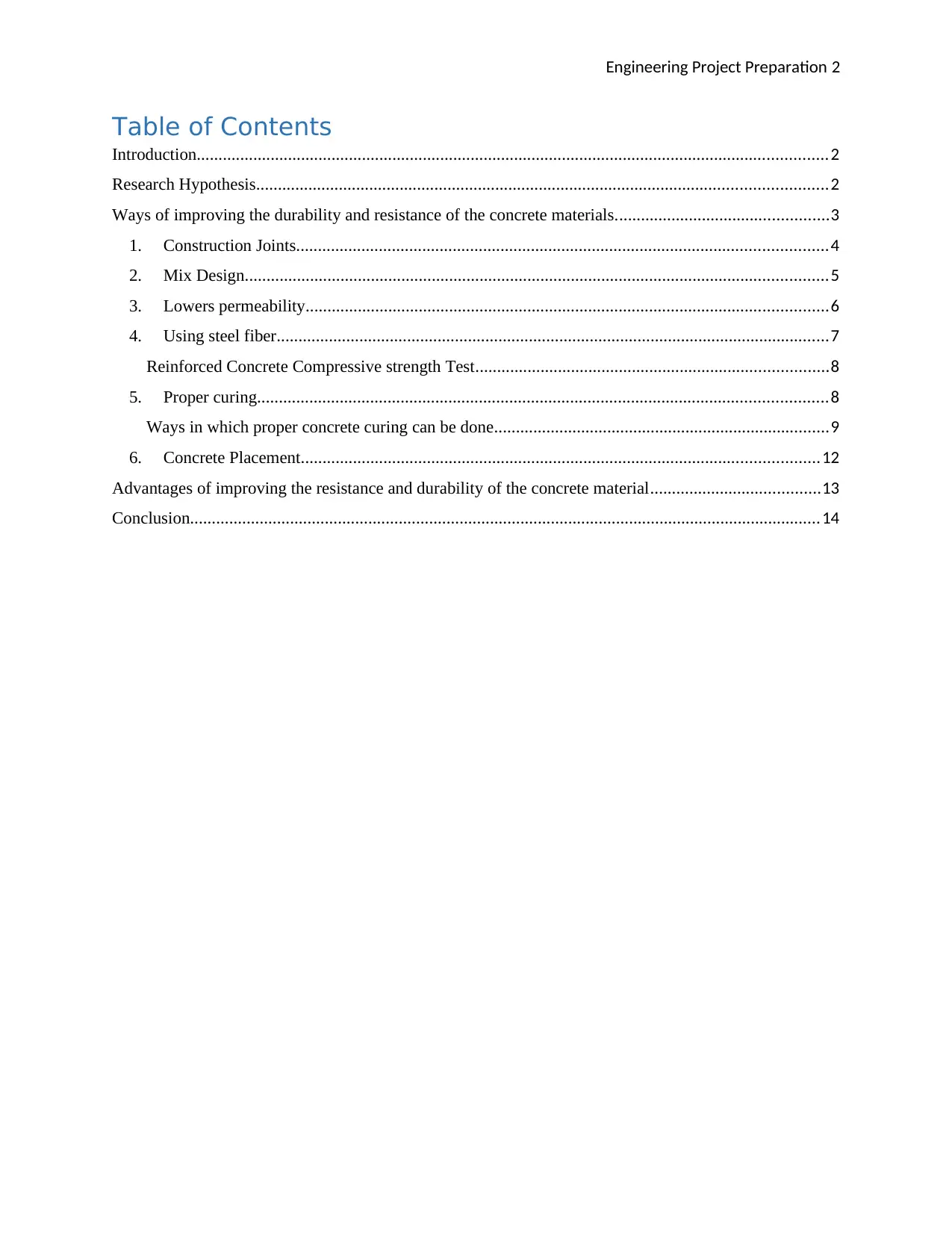
Table of Contents
Introduction.................................................................................................................................................2
Research Hypothesis...................................................................................................................................2
Ways of improving the durability and resistance of the concrete materials.................................................3
1. Construction Joints..........................................................................................................................4
2. Mix Design......................................................................................................................................5
3. Lowers permeability........................................................................................................................6
4. Using steel fiber...............................................................................................................................7
Reinforced Concrete Compressive strength Test.................................................................................8
5. Proper curing...................................................................................................................................8
Ways in which proper concrete curing can be done.............................................................................9
6. Concrete Placement.......................................................................................................................12
Advantages of improving the resistance and durability of the concrete material.......................................13
Conclusion.................................................................................................................................................14
Table of Contents
Introduction.................................................................................................................................................2
Research Hypothesis...................................................................................................................................2
Ways of improving the durability and resistance of the concrete materials.................................................3
1. Construction Joints..........................................................................................................................4
2. Mix Design......................................................................................................................................5
3. Lowers permeability........................................................................................................................6
4. Using steel fiber...............................................................................................................................7
Reinforced Concrete Compressive strength Test.................................................................................8
5. Proper curing...................................................................................................................................8
Ways in which proper concrete curing can be done.............................................................................9
6. Concrete Placement.......................................................................................................................12
Advantages of improving the resistance and durability of the concrete material.......................................13
Conclusion.................................................................................................................................................14
Engineering Project Preparation 3
Introduction
Concrete material’s durability and resistance are very important since in most cases, the
products of the concrete are basically employed where resistance and durability are key. In some
basic cases where such are employed includes the construction of Reinforced concrete (RCC),
the building of slabs and columns in house construction, building of bridges as well as other
sites. The research questions in this research are what some ways of archiving concrete durability
and resistance and why are that important (Dyer, 2014). This report will hence address the above
research questions and this will hence make the report to be well understood.
Research Hypothesis
In this paper also addresses some of the hypothesis of the research paper. These are;
- All types of concrete treatments are very appropriate in enhancing resistance and
durability of concrete.
- Improving resistance and durability of concrete are cost-effective (cheap in long run).
- Improving concrete durability and resistance has highly promoted the safety of the people
in the society (reduces the chances of accidents).
Selection of the material plays a very important role in improving the resistance as well
as the durability of the concrete materials employed in the building and construction (Wei,
2010). The mixing ratio of cement to water (w/cm) will also help in realizing a strong material
which will ensure the concrete material is both durable and resistant to breakage. The selection
of the chemical admixture, w/cm, cementitious material (like silica fumes, GGBFS, Portland
cement and natural pozzolans) will depend on the amount of strength needed, exposure of the
structure constructed (whether the structure will be covered or left bare), need to reduce the
Introduction
Concrete material’s durability and resistance are very important since in most cases, the
products of the concrete are basically employed where resistance and durability are key. In some
basic cases where such are employed includes the construction of Reinforced concrete (RCC),
the building of slabs and columns in house construction, building of bridges as well as other
sites. The research questions in this research are what some ways of archiving concrete durability
and resistance and why are that important (Dyer, 2014). This report will hence address the above
research questions and this will hence make the report to be well understood.
Research Hypothesis
In this paper also addresses some of the hypothesis of the research paper. These are;
- All types of concrete treatments are very appropriate in enhancing resistance and
durability of concrete.
- Improving resistance and durability of concrete are cost-effective (cheap in long run).
- Improving concrete durability and resistance has highly promoted the safety of the people
in the society (reduces the chances of accidents).
Selection of the material plays a very important role in improving the resistance as well
as the durability of the concrete materials employed in the building and construction (Wei,
2010). The mixing ratio of cement to water (w/cm) will also help in realizing a strong material
which will ensure the concrete material is both durable and resistant to breakage. The selection
of the chemical admixture, w/cm, cementitious material (like silica fumes, GGBFS, Portland
cement and natural pozzolans) will depend on the amount of strength needed, exposure of the
structure constructed (whether the structure will be covered or left bare), need to reduce the
⊘ This is a preview!⊘
Do you want full access?
Subscribe today to unlock all pages.

Trusted by 1+ million students worldwide
Engineering Project Preparation 4
thermal gradient (Engineers, 2016). Chemical admixture will enhance resistant and durability of
the materials (concrete). Air-entraining admixture will offer resistance to thawing and freezing
will lower the w/cm. The W/Cm can be reduced also through using high range water reducing
admixtures. All these will lower the chances of shrinkage cracking and this reduces the
permeability of the concrete hence high resistance of the concrete material (King Wong, 2014).
Concrete´s resistance and durability can be improved through several ways some of the most
common ways which can be employed to help realized this is discussed below;
Ways of improving the durability and resistance of the concrete materials.
Most of the concrete materials are designed by the structural engineer to last for a period
of 50-100 years. The difference in years will thus depend on the treatment done to ensure that
the concrete is more resistance and durable (Kropp, 2014). But in this period of time is contrary
to what is happening in most constructions since there is no or inadequate treatment to ensure the
improvement of the durability and resistance of the materials. It is very true to say that
everything which occurs to the concrete happens due to water, Water conveys chemical
contaminant into the concrete materials, therefore, water is capable to erode the surface,
contributes to the disruptive and expansive reactions, corrosion of the steel reinforcement
(Chengula, 2018).
1. Construction Joints
These joints are unavoided in any construction structure, they are also the common points in
a concrete structure where through which water will always find its way through. If water
penetrates through these construction joints, it can deteriorate the structure in several ways. But
the most common one is water moving and reaching the reinforcing steels which lead to their
corrosion, therefore, lowering the durability and resistance (Shi, 2010). These construction joints
thermal gradient (Engineers, 2016). Chemical admixture will enhance resistant and durability of
the materials (concrete). Air-entraining admixture will offer resistance to thawing and freezing
will lower the w/cm. The W/Cm can be reduced also through using high range water reducing
admixtures. All these will lower the chances of shrinkage cracking and this reduces the
permeability of the concrete hence high resistance of the concrete material (King Wong, 2014).
Concrete´s resistance and durability can be improved through several ways some of the most
common ways which can be employed to help realized this is discussed below;
Ways of improving the durability and resistance of the concrete materials.
Most of the concrete materials are designed by the structural engineer to last for a period
of 50-100 years. The difference in years will thus depend on the treatment done to ensure that
the concrete is more resistance and durable (Kropp, 2014). But in this period of time is contrary
to what is happening in most constructions since there is no or inadequate treatment to ensure the
improvement of the durability and resistance of the materials. It is very true to say that
everything which occurs to the concrete happens due to water, Water conveys chemical
contaminant into the concrete materials, therefore, water is capable to erode the surface,
contributes to the disruptive and expansive reactions, corrosion of the steel reinforcement
(Chengula, 2018).
1. Construction Joints
These joints are unavoided in any construction structure, they are also the common points in
a concrete structure where through which water will always find its way through. If water
penetrates through these construction joints, it can deteriorate the structure in several ways. But
the most common one is water moving and reaching the reinforcing steels which lead to their
corrosion, therefore, lowering the durability and resistance (Shi, 2010). These construction joints
Paraphrase This Document
Need a fresh take? Get an instant paraphrase of this document with our AI Paraphraser
Engineering Project Preparation 5
will highly help in directing the movement of water in a structure since when water is not
directed it can move anyway in the structure which will result in corrosion of the reinforcing
steels. And when these joints are not there, there will be unplanned joints known as cracks. The
construction joints should use a waterproof system to help to avoid water into the structure.
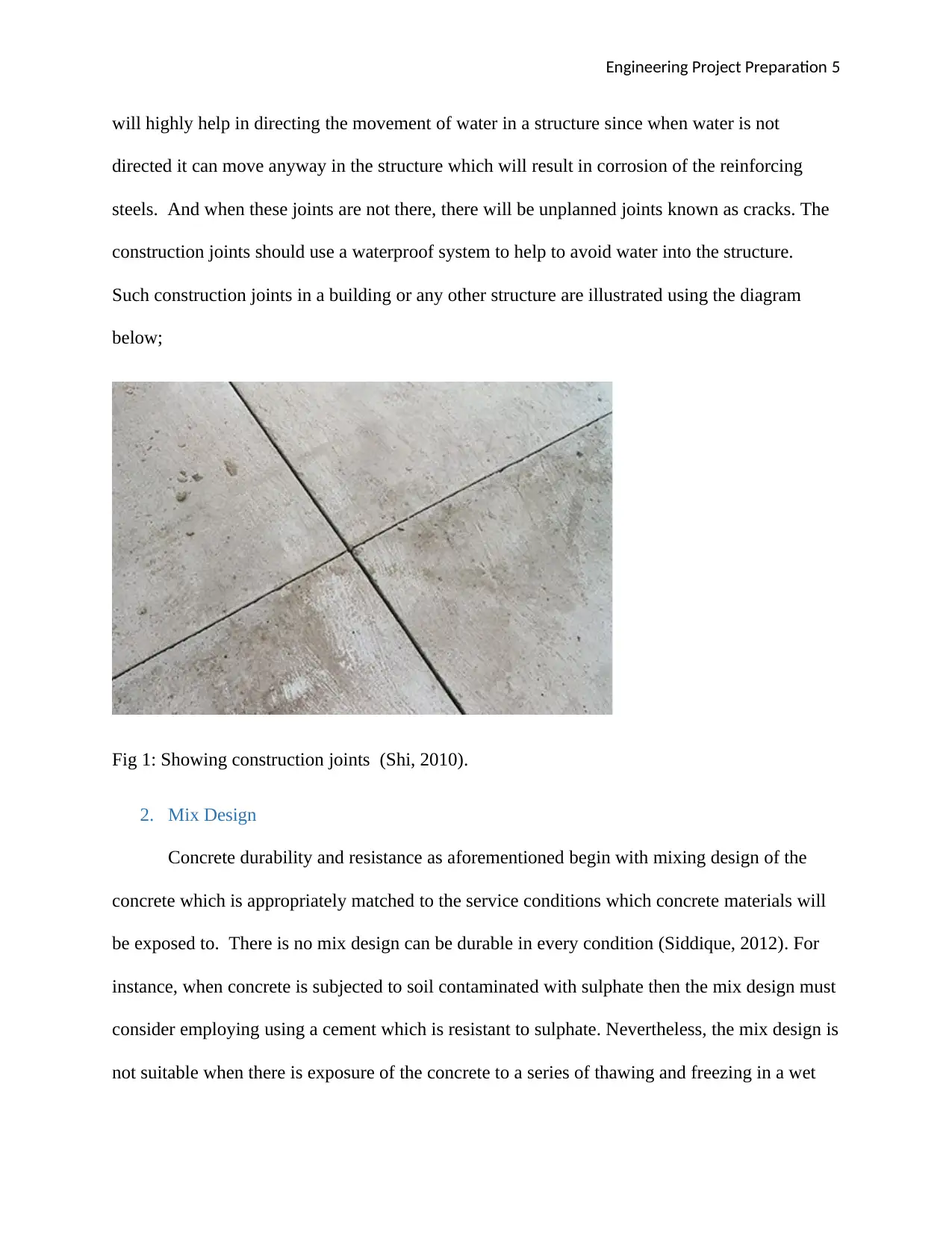
Such construction joints in a building or any other structure are illustrated using the diagram
below;
Fig 1: Showing construction joints (Shi, 2010).
2. Mix Design
Concrete durability and resistance as aforementioned begin with mixing design of the
concrete which is appropriately matched to the service conditions which concrete materials will
be exposed to. There is no mix design can be durable in every condition (Siddique, 2012). For
instance, when concrete is subjected to soil contaminated with sulphate then the mix design must
consider employing using a cement which is resistant to sulphate. Nevertheless, the mix design is
not suitable when there is exposure of the concrete to a series of thawing and freezing in a wet
will highly help in directing the movement of water in a structure since when water is not
directed it can move anyway in the structure which will result in corrosion of the reinforcing
steels. And when these joints are not there, there will be unplanned joints known as cracks. The
construction joints should use a waterproof system to help to avoid water into the structure.
Such construction joints in a building or any other structure are illustrated using the diagram
below;
Fig 1: Showing construction joints (Shi, 2010).
2. Mix Design
Concrete durability and resistance as aforementioned begin with mixing design of the
concrete which is appropriately matched to the service conditions which concrete materials will
be exposed to. There is no mix design can be durable in every condition (Siddique, 2012). For
instance, when concrete is subjected to soil contaminated with sulphate then the mix design must
consider employing using a cement which is resistant to sulphate. Nevertheless, the mix design is
not suitable when there is exposure of the concrete to a series of thawing and freezing in a wet
Engineering Project Preparation 6
environment. If by any means the mix design needs to include an air-entrain admixture because
air entrained will aid to guard the concrete in such conditions. Some companies like Portland
cement publishes control and design of mixing concrete which has a perfect guide in the concrete
mix design.
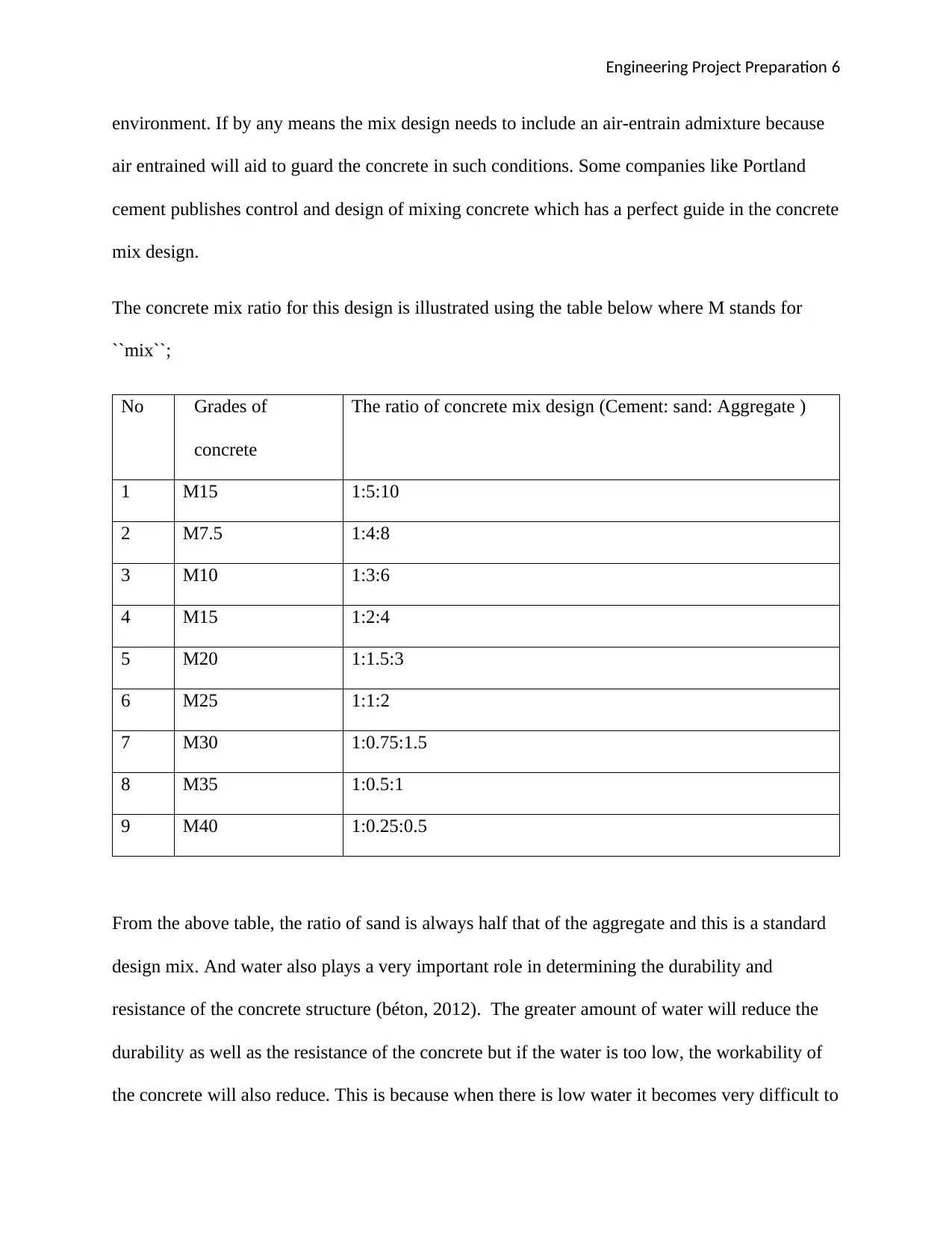
The concrete mix ratio for this design is illustrated using the table below where M stands for
``mix``;
No Grades of
concrete
The ratio of concrete mix design (Cement: sand: Aggregate )
1 M15 1:5:10
2 M7.5 1:4:8
3 M10 1:3:6
4 M15 1:2:4
5 M20 1:1.5:3
6 M25 1:1:2
7 M30 1:0.75:1.5
8 M35 1:0.5:1
9 M40 1:0.25:0.5
From the above table, the ratio of sand is always half that of the aggregate and this is a standard
design mix. And water also plays a very important role in determining the durability and
resistance of the concrete structure (béton, 2012). The greater amount of water will reduce the
durability as well as the resistance of the concrete but if the water is too low, the workability of
the concrete will also reduce. This is because when there is low water it becomes very difficult to
environment. If by any means the mix design needs to include an air-entrain admixture because
air entrained will aid to guard the concrete in such conditions. Some companies like Portland
cement publishes control and design of mixing concrete which has a perfect guide in the concrete
mix design.
The concrete mix ratio for this design is illustrated using the table below where M stands for
``mix``;
No Grades of
concrete
The ratio of concrete mix design (Cement: sand: Aggregate )
1 M15 1:5:10
2 M7.5 1:4:8
3 M10 1:3:6
4 M15 1:2:4
5 M20 1:1.5:3
6 M25 1:1:2
7 M30 1:0.75:1.5
8 M35 1:0.5:1
9 M40 1:0.25:0.5
From the above table, the ratio of sand is always half that of the aggregate and this is a standard
design mix. And water also plays a very important role in determining the durability and
resistance of the concrete structure (béton, 2012). The greater amount of water will reduce the
durability as well as the resistance of the concrete but if the water is too low, the workability of
the concrete will also reduce. This is because when there is low water it becomes very difficult to
⊘ This is a preview!⊘
Do you want full access?
Subscribe today to unlock all pages.
Trusted by 1+ million students worldwide
Engineering Project Preparation 7
place concrete, therefore, the structure becomes less resistant as well as less durable ( since the
concrete will not stick).
3. Lowers permeability
Albeit mix design should vary to match the situations in the concrete, but there is one factor
which common to all perfect concrete materials and that factor is to ensure that the permeability
is kept as low as possible (Nawy, 2012). It is very vital that water should be kept out of the
concrete structure (Ludwig, 2012). When lowering the permeability is done through a perfect
mix proportioning as well as lowering quantity of free water in the concrete mix through using
the plasticizers or through using water reducing admixtures. Concrete material which is
subjected to water must use a waterproofing system (Huang, 2014). When the permeability is
highly reduced, the durability and residence of the concrete are highly increased.
4. Using steel fiber
Due to the increasing demand to attain high resistance and durability of a concrete material, new
techniques to achieve this has also landed on the addition of the steel fiber on the cement to make
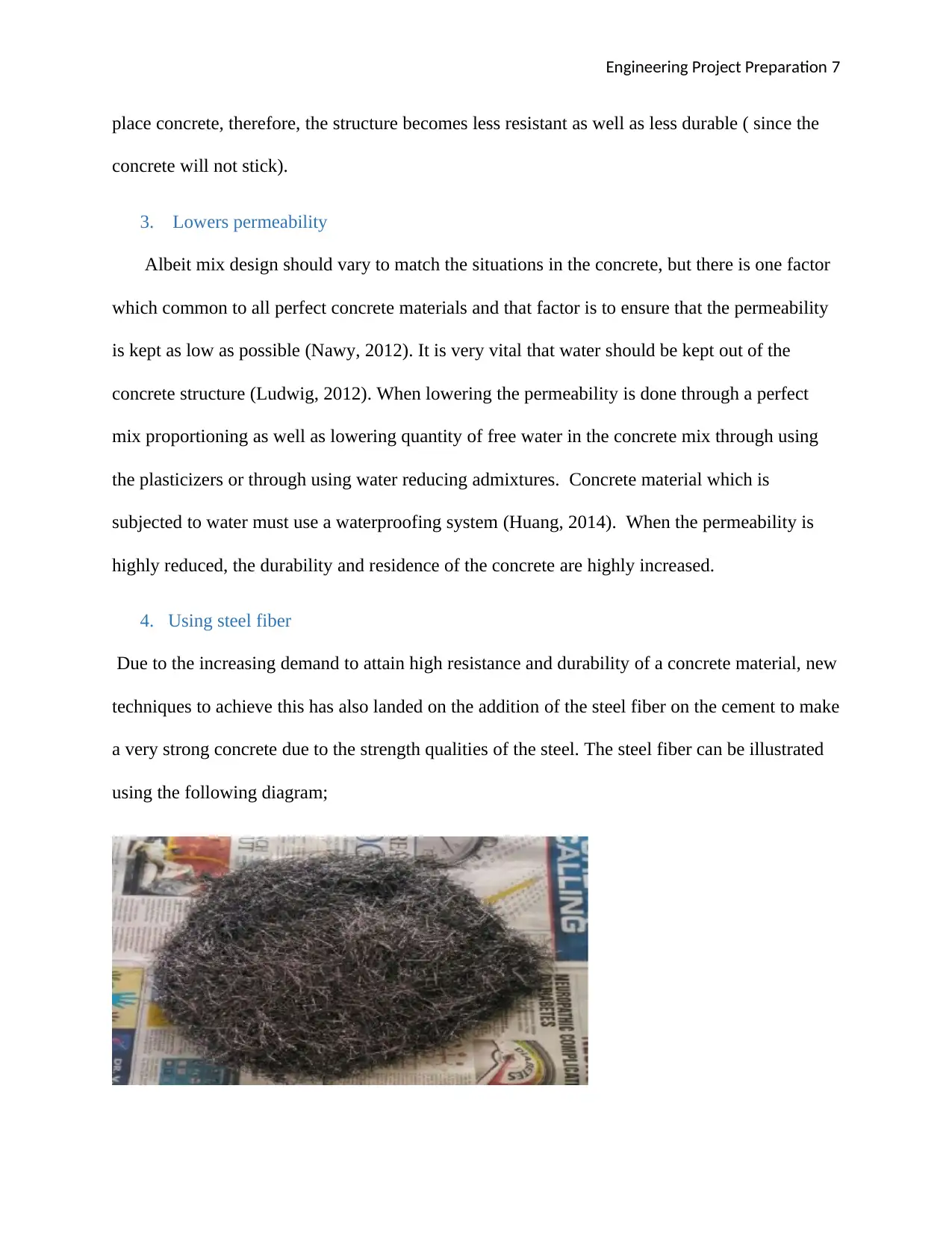
a very strong concrete due to the strength qualities of the steel. The steel fiber can be illustrated
using the following diagram;
place concrete, therefore, the structure becomes less resistant as well as less durable ( since the
concrete will not stick).
3. Lowers permeability
Albeit mix design should vary to match the situations in the concrete, but there is one factor
which common to all perfect concrete materials and that factor is to ensure that the permeability
is kept as low as possible (Nawy, 2012). It is very vital that water should be kept out of the
concrete structure (Ludwig, 2012). When lowering the permeability is done through a perfect
mix proportioning as well as lowering quantity of free water in the concrete mix through using
the plasticizers or through using water reducing admixtures. Concrete material which is
subjected to water must use a waterproofing system (Huang, 2014). When the permeability is
highly reduced, the durability and residence of the concrete are highly increased.
4. Using steel fiber
Due to the increasing demand to attain high resistance and durability of a concrete material, new
techniques to achieve this has also landed on the addition of the steel fiber on the cement to make
a very strong concrete due to the strength qualities of the steel. The steel fiber can be illustrated
using the following diagram;
Paraphrase This Document
Need a fresh take? Get an instant paraphrase of this document with our AI Paraphraser
Engineering Project Preparation 8
Fig 3: Showing the steel fiber (Caldarone, 2014).
The application of steel fiber has resulted in the improvement of some key mechanical
properties in a concrete. Some of these properties include durability and toughness in tension
which results in the high resistance of a concrete. The irregular fibers which are distributed in the
concrete help in filling the cracks which are in the composite (Caldarone, 2014). The steel fiber
in the concrete material allows the steal fiber reinforcing material to withstand significant
stresses in the post-cracking point in a concrete. The reinforced steel concrete will remain in its
fresh conditions from the point the steel is mixed to a point its set. At this point, the concrete is
handled, conveyed, put and compacted (Nikolov, 2015). The nature of the concrete at this point
is at a fresh condition are very vital since it influences the quality of the reinforced concrete.
Reinforced Concrete Compressive strength Test
There are several tests which can be employed to obtain the strength of the concrete after its
treatments (Setzer, 2014). But the most important test is the Reinforced concrete compressive
strength test since it provides the idea about all the characteristics of the concrete. This type of
test is based on several factors like cement strength, water-cement ratio, and quality control
during the time of production of concrete. This type of test is done either in a cylinder or in a
cube. And this type of test should be as per the International Standard (IS516:1959). This type
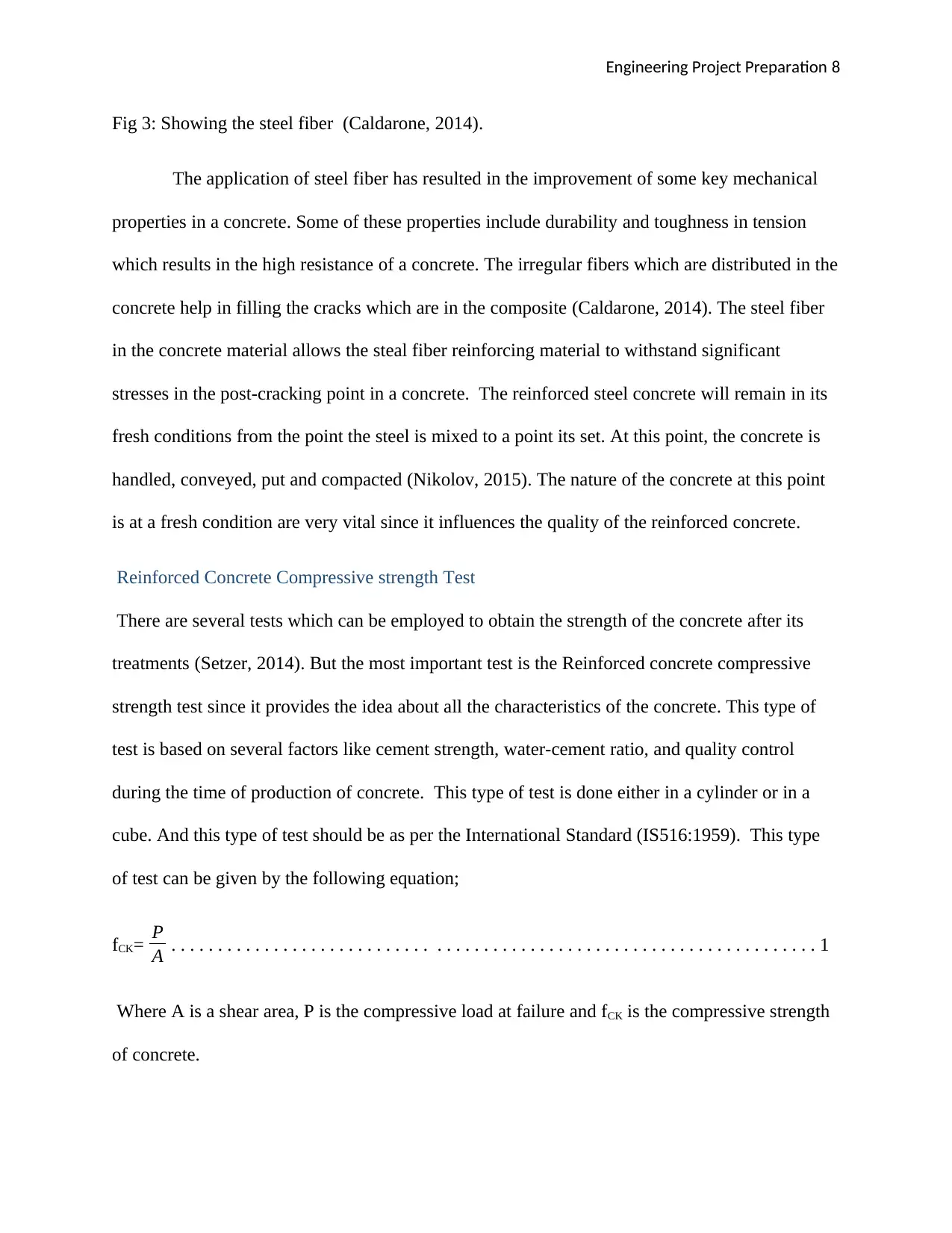
of test can be given by the following equation;
fCK= P
A . . . . . . . . . . . . . . . . . . . . . . . . . . . . . . . . . . . . . . . . . . . . . . . . . . . . . . . . . . . . . . . . . . . . . 1
Where A is a shear area, P is the compressive load at failure and fCK is the compressive strength
of concrete.
Fig 3: Showing the steel fiber (Caldarone, 2014).
The application of steel fiber has resulted in the improvement of some key mechanical
properties in a concrete. Some of these properties include durability and toughness in tension
which results in the high resistance of a concrete. The irregular fibers which are distributed in the
concrete help in filling the cracks which are in the composite (Caldarone, 2014). The steel fiber
in the concrete material allows the steal fiber reinforcing material to withstand significant
stresses in the post-cracking point in a concrete. The reinforced steel concrete will remain in its
fresh conditions from the point the steel is mixed to a point its set. At this point, the concrete is
handled, conveyed, put and compacted (Nikolov, 2015). The nature of the concrete at this point
is at a fresh condition are very vital since it influences the quality of the reinforced concrete.
Reinforced Concrete Compressive strength Test
There are several tests which can be employed to obtain the strength of the concrete after its
treatments (Setzer, 2014). But the most important test is the Reinforced concrete compressive
strength test since it provides the idea about all the characteristics of the concrete. This type of
test is based on several factors like cement strength, water-cement ratio, and quality control
during the time of production of concrete. This type of test is done either in a cylinder or in a
cube. And this type of test should be as per the International Standard (IS516:1959). This type
of test can be given by the following equation;
fCK= P
A . . . . . . . . . . . . . . . . . . . . . . . . . . . . . . . . . . . . . . . . . . . . . . . . . . . . . . . . . . . . . . . . . . . . . 1
Where A is a shear area, P is the compressive load at failure and fCK is the compressive strength
of concrete.
Engineering Project Preparation 9
5. Proper curing
Suitably the most common overlooked way to realize the durability and resistance of the
concrete is through having a proper curing of the concrete material. Proper curing of the
concrete, therefore, means maintaining conditions which enable the concrete to strengthen and
attain optimal durability (Wesche, 2016). Proper humidity and temperature are the most
important parameter in proper curing of the concrete. Therefore the temperature should be above
100 C for the resistance of the concrete to proceed at a suitable pace (James, 2013). The humidity
of the concrete must as well be maintained more so in first few days to help boost the hydration
of the cement and this help in keeping the concrete from drying, shrinking and finally cracking
( this will lower the resistance and durability of the concrete) (Mihashi, 2018). Proper curing of
the concrete will efficacy reduce the permeability, therefore, increasing resistance and durability,
therefore, the concrete´s life expectancy will be really more.
Ways in which proper concrete curing can be done
Concrete proper curing can be done using the following steps
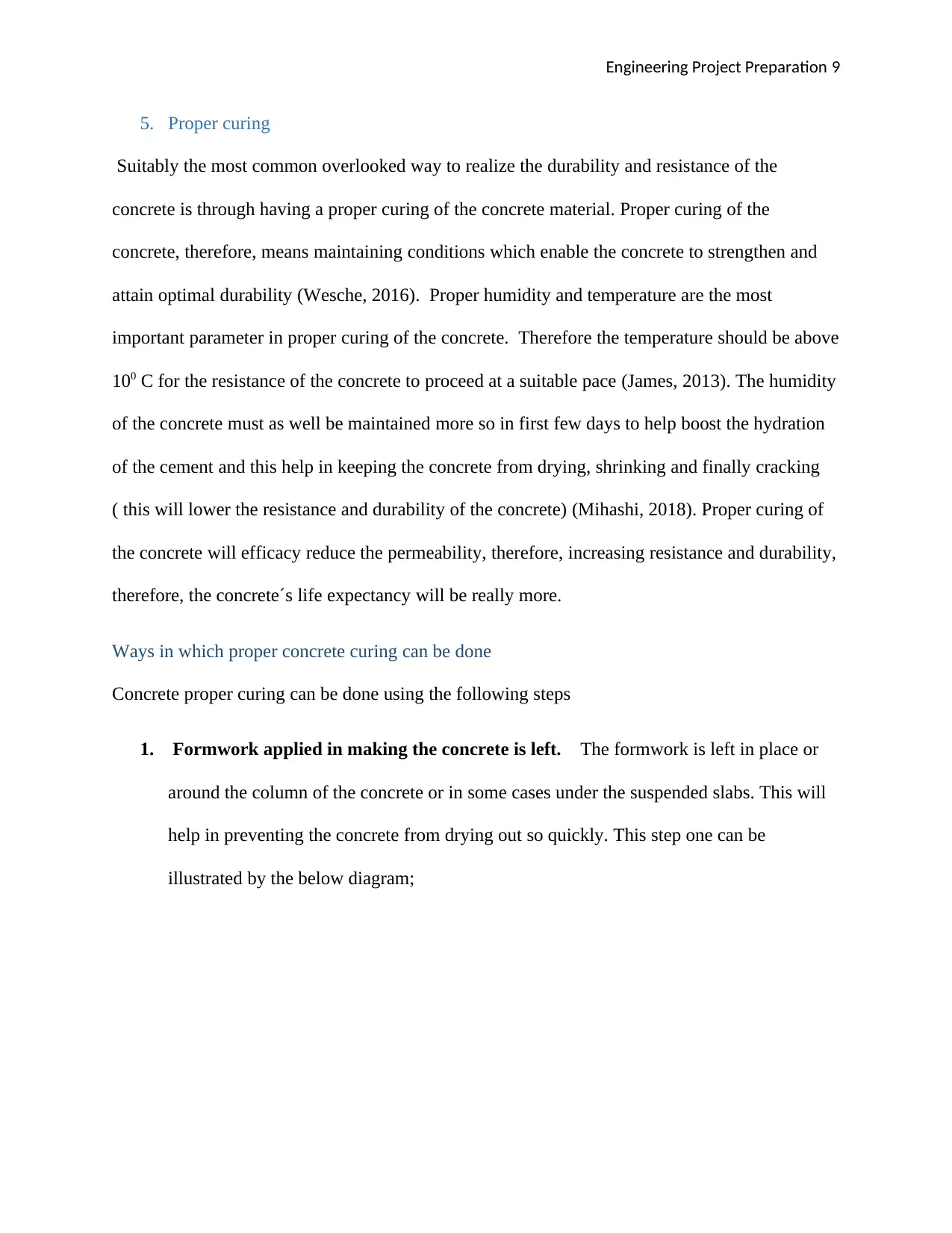
1. Formwork applied in making the concrete is left. The formwork is left in place or
around the column of the concrete or in some cases under the suspended slabs. This will
help in preventing the concrete from drying out so quickly. This step one can be
illustrated by the below diagram;
5. Proper curing
Suitably the most common overlooked way to realize the durability and resistance of the
concrete is through having a proper curing of the concrete material. Proper curing of the
concrete, therefore, means maintaining conditions which enable the concrete to strengthen and
attain optimal durability (Wesche, 2016). Proper humidity and temperature are the most
important parameter in proper curing of the concrete. Therefore the temperature should be above
100 C for the resistance of the concrete to proceed at a suitable pace (James, 2013). The humidity
of the concrete must as well be maintained more so in first few days to help boost the hydration
of the cement and this help in keeping the concrete from drying, shrinking and finally cracking
( this will lower the resistance and durability of the concrete) (Mihashi, 2018). Proper curing of
the concrete will efficacy reduce the permeability, therefore, increasing resistance and durability,
therefore, the concrete´s life expectancy will be really more.
Ways in which proper concrete curing can be done
Concrete proper curing can be done using the following steps
1. Formwork applied in making the concrete is left. The formwork is left in place or
around the column of the concrete or in some cases under the suspended slabs. This will
help in preventing the concrete from drying out so quickly. This step one can be
illustrated by the below diagram;
⊘ This is a preview!⊘
Do you want full access?
Subscribe today to unlock all pages.
Trusted by 1+ million students worldwide
Engineering Project Preparation 10
Fig 4: Showing concrete left on a formwork as a way of concrete curing (Mindess,
2014).
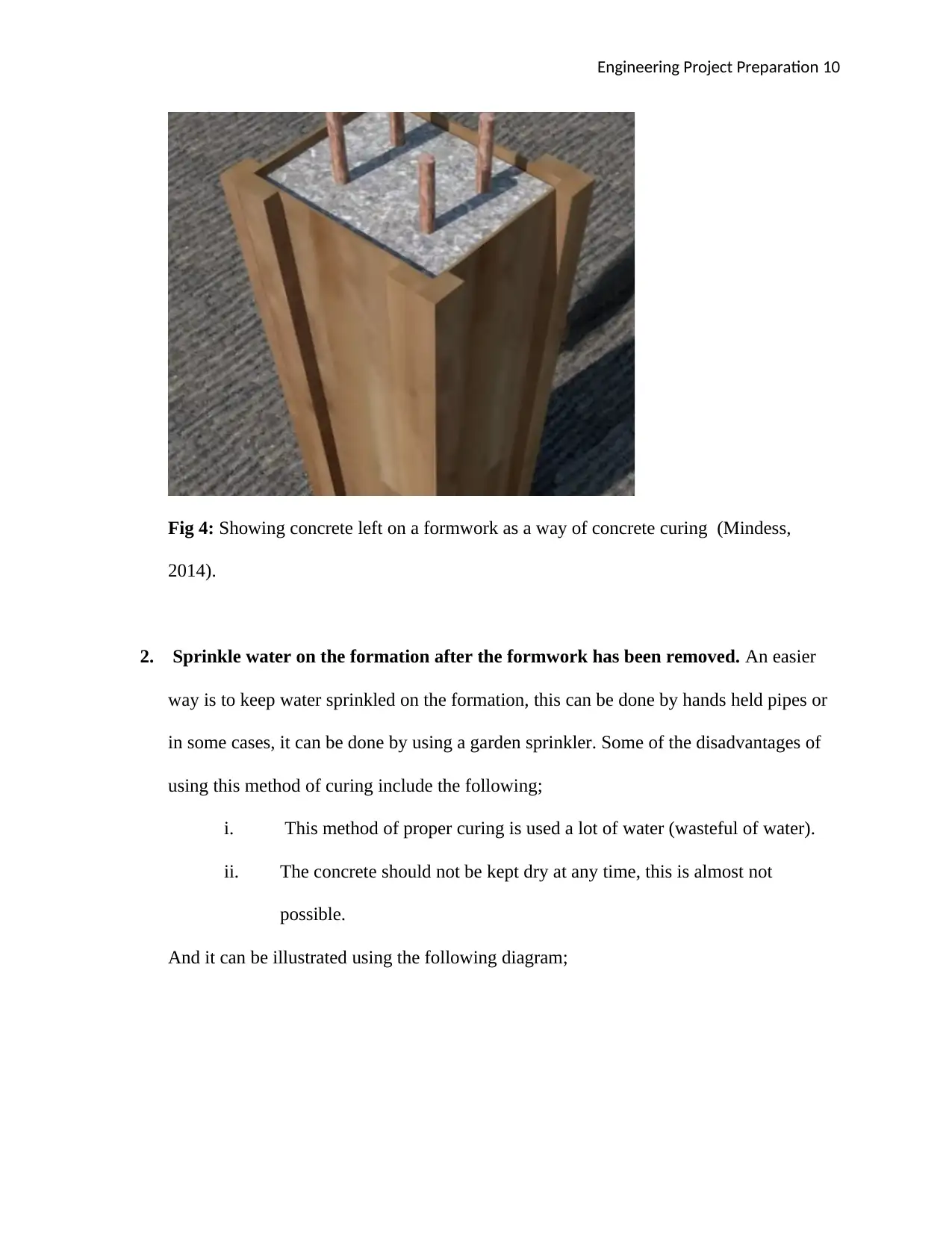
2. Sprinkle water on the formation after the formwork has been removed. An easier
way is to keep water sprinkled on the formation, this can be done by hands held pipes or
in some cases, it can be done by using a garden sprinkler. Some of the disadvantages of
using this method of curing include the following;
i. This method of proper curing is used a lot of water (wasteful of water).
ii. The concrete should not be kept dry at any time, this is almost not
possible.
And it can be illustrated using the following diagram;
Fig 4: Showing concrete left on a formwork as a way of concrete curing (Mindess,
2014).
2. Sprinkle water on the formation after the formwork has been removed. An easier
way is to keep water sprinkled on the formation, this can be done by hands held pipes or
in some cases, it can be done by using a garden sprinkler. Some of the disadvantages of
using this method of curing include the following;
i. This method of proper curing is used a lot of water (wasteful of water).
ii. The concrete should not be kept dry at any time, this is almost not
possible.
And it can be illustrated using the following diagram;
Paraphrase This Document
Need a fresh take? Get an instant paraphrase of this document with our AI Paraphraser
Engineering Project Preparation 11
Fig 5: Showing water sprinkled on the concrete as a way of concrete curing (Mindess,
2014).
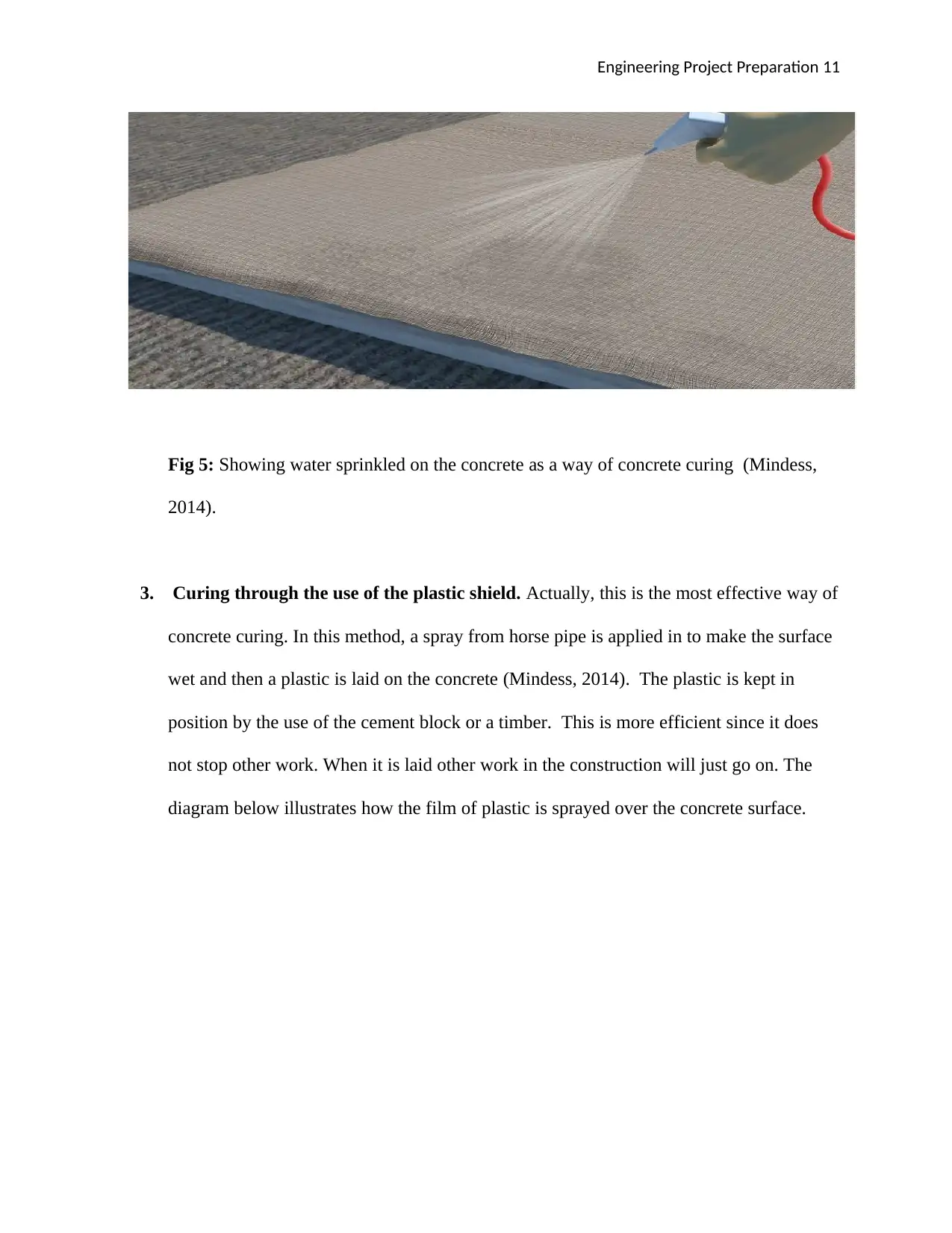
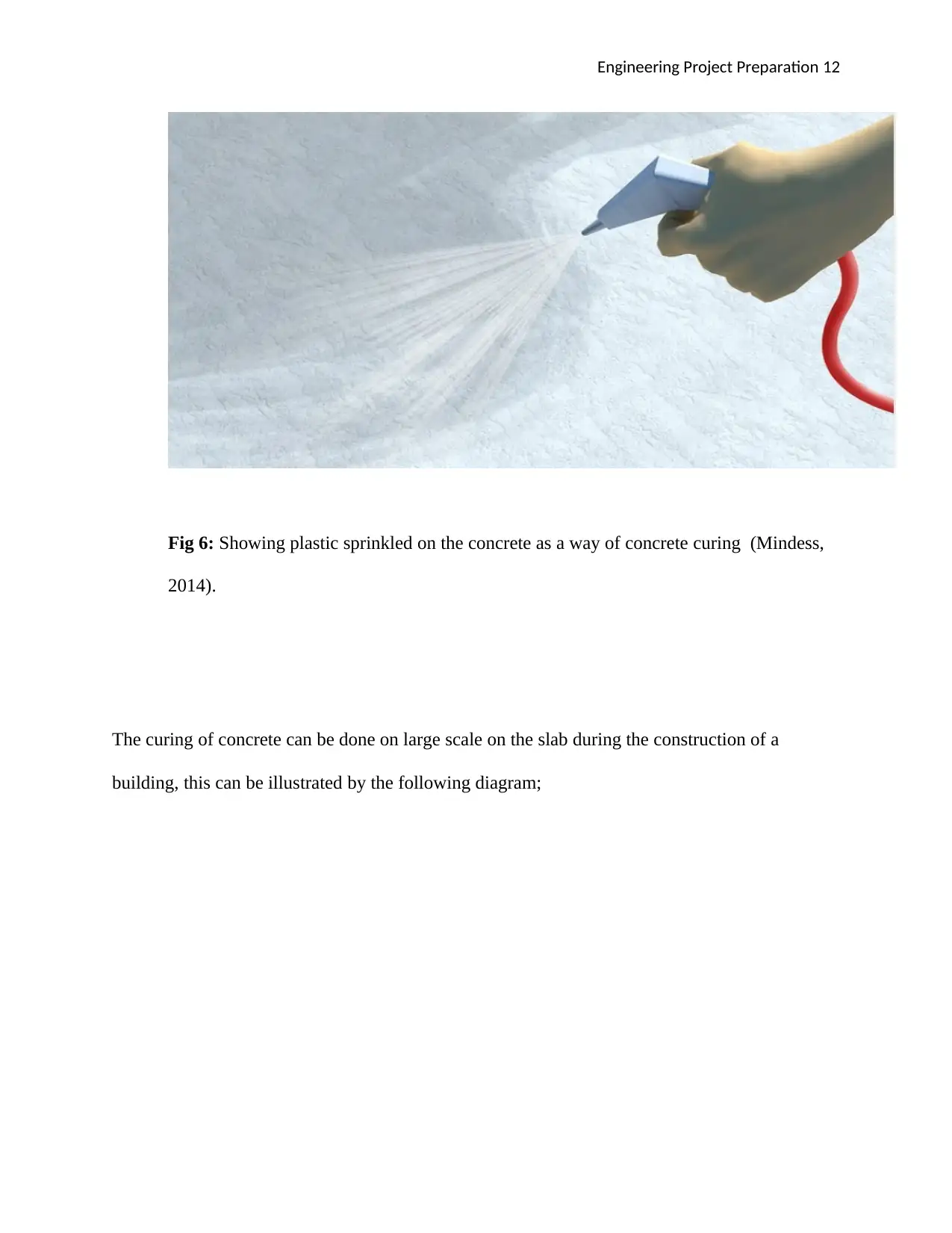
3. Curing through the use of the plastic shield. Actually, this is the most effective way of
concrete curing. In this method, a spray from horse pipe is applied in to make the surface
wet and then a plastic is laid on the concrete (Mindess, 2014). The plastic is kept in
position by the use of the cement block or a timber. This is more efficient since it does
not stop other work. When it is laid other work in the construction will just go on. The
diagram below illustrates how the film of plastic is sprayed over the concrete surface.
Fig 5: Showing water sprinkled on the concrete as a way of concrete curing (Mindess,
2014).
3. Curing through the use of the plastic shield. Actually, this is the most effective way of
concrete curing. In this method, a spray from horse pipe is applied in to make the surface
wet and then a plastic is laid on the concrete (Mindess, 2014). The plastic is kept in
position by the use of the cement block or a timber. This is more efficient since it does
not stop other work. When it is laid other work in the construction will just go on. The
diagram below illustrates how the film of plastic is sprayed over the concrete surface.
Engineering Project Preparation 12
Fig 6: Showing plastic sprinkled on the concrete as a way of concrete curing (Mindess,
2014).
The curing of concrete can be done on large scale on the slab during the construction of a
building, this can be illustrated by the following diagram;
Fig 6: Showing plastic sprinkled on the concrete as a way of concrete curing (Mindess,
2014).
The curing of concrete can be done on large scale on the slab during the construction of a
building, this can be illustrated by the following diagram;
⊘ This is a preview!⊘
Do you want full access?
Subscribe today to unlock all pages.
Trusted by 1+ million students worldwide

1 out of 18


Related Documents


Your All-in-One AI-Powered Toolkit for Academic Success.
+13062052269
info@desklib.com
Available 24*7 on WhatsApp / Email
![[object Object]](/_next/static/media/star-bottom.7253800d.svg)
Unlock your academic potential
Copyright © 2020–2025 A2Z Services. All Rights Reserved. Developed and managed by ZUCOL.