Implementing Quality Management in Engineering Tooling Company
VerifiedAdded on 2021/05/31
|18
|4414
|68
Report
AI Summary
This report examines the quality improvement strategy for Engineering Tooling Company, a manufacturer of medical equipment. It delves into three key elements: Total Quality Management (TQM), Quality Assurance (QA), and Quality Control (QC). The TQM section emphasizes consumer focus, employee involvement, process-centered approaches, integrated systems, strategic planning, continuous improvement, fact-based decision-making, effective communication, and quality improvement initiatives. The QA segment details the importance of technical requirements, supplier certification, input compliance, proper documentation, and audits of final equipment, covering technical aspects, reliability, maintenance, and performance standards. The QC section focuses on employee-based standards, competency, organizational elements, and inspection processes. The report aims to provide a comprehensive overview of quality management strategies, offering recommendations for the ETC to enhance product quality and customer satisfaction.
Running head: Quality Management 1
QUALITY MANAGEMENT
Student Name
Institution
QUALITY MANAGEMENT
Student Name
Institution

Paraphrase This Document
Need a fresh take? Get an instant paraphrase of this document with our AI Paraphraser
Quality Management 2
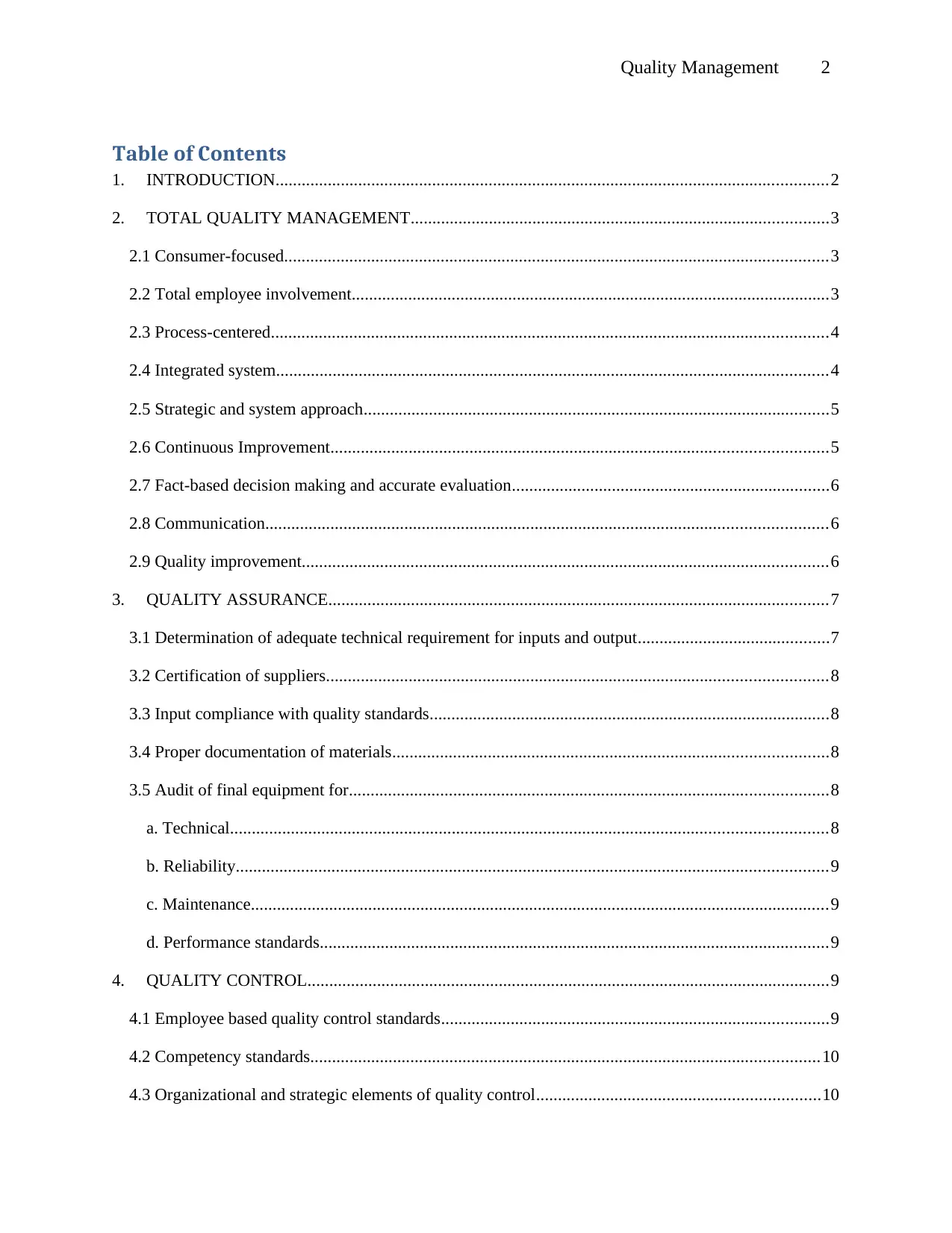
Table of Contents
1. INTRODUCTION...............................................................................................................................2
2. TOTAL QUALITY MANAGEMENT................................................................................................3
2.1 Consumer-focused.............................................................................................................................3
2.2 Total employee involvement..............................................................................................................3
2.3 Process-centered................................................................................................................................4
2.4 Integrated system...............................................................................................................................4
2.5 Strategic and system approach...........................................................................................................5
2.6 Continuous Improvement..................................................................................................................5
2.7 Fact-based decision making and accurate evaluation.........................................................................6
2.8 Communication.................................................................................................................................6
2.9 Quality improvement.........................................................................................................................6
3. QUALITY ASSURANCE...................................................................................................................7
3.1 Determination of adequate technical requirement for inputs and output............................................7
3.2 Certification of suppliers...................................................................................................................8
3.3 Input compliance with quality standards............................................................................................8
3.4 Proper documentation of materials....................................................................................................8
3.5 Audit of final equipment for..............................................................................................................8
a. Technical.........................................................................................................................................8
b. Reliability........................................................................................................................................9
c. Maintenance.....................................................................................................................................9
d. Performance standards.....................................................................................................................9
4. QUALITY CONTROL........................................................................................................................9
4.1 Employee based quality control standards.........................................................................................9
4.2 Competency standards.....................................................................................................................10
4.3 Organizational and strategic elements of quality control.................................................................10
Table of Contents
1. INTRODUCTION...............................................................................................................................2
2. TOTAL QUALITY MANAGEMENT................................................................................................3
2.1 Consumer-focused.............................................................................................................................3
2.2 Total employee involvement..............................................................................................................3
2.3 Process-centered................................................................................................................................4
2.4 Integrated system...............................................................................................................................4
2.5 Strategic and system approach...........................................................................................................5
2.6 Continuous Improvement..................................................................................................................5
2.7 Fact-based decision making and accurate evaluation.........................................................................6
2.8 Communication.................................................................................................................................6
2.9 Quality improvement.........................................................................................................................6
3. QUALITY ASSURANCE...................................................................................................................7
3.1 Determination of adequate technical requirement for inputs and output............................................7
3.2 Certification of suppliers...................................................................................................................8
3.3 Input compliance with quality standards............................................................................................8
3.4 Proper documentation of materials....................................................................................................8
3.5 Audit of final equipment for..............................................................................................................8
a. Technical.........................................................................................................................................8
b. Reliability........................................................................................................................................9
c. Maintenance.....................................................................................................................................9
d. Performance standards.....................................................................................................................9
4. QUALITY CONTROL........................................................................................................................9
4.1 Employee based quality control standards.........................................................................................9
4.2 Competency standards.....................................................................................................................10
4.3 Organizational and strategic elements of quality control.................................................................10
Quality Management 3
4.4 Inspection........................................................................................................................................11
5. CONCLUSION.................................................................................................................................11
6. RECOMMENDATIONS...................................................................................................................12
7. References.........................................................................................................................................14
1. INTRODUCTION
Quality of medical equipment ensures that the health care services meet the set standards
of practice. Engineering Tooling Company is a manufacturer and supplier of medical equipment
is subjected to maintain the highest possible quality of equipment. This requires development
and implementation of quality improvement strategy within the company manufacturing process.
Quality in health care system works following medical standards, ethical practices, and integrity.
This attributes integrated together forms the basis of a good quality improvement strategy that
Engineering Tooling Company can develop and implement. A good quality improvement
strategy has three major elements and these include Total Quality Management (TQM), Quality
Assurance (QA) and Quality Control (QC) (Praxiom Research Group Limited 2017). Total
quality management can be described as the managerial approach to the delivery of quality
products. Quality assurance refers the strategy to maintain the desired level of quality in service
or product through paying attention various stages of manufacturing. Finally, quality control, on
the other hand, is the process of ensuring the quality is maintained or improved without
manufacturing errors. Some of the recommendations that therefore by advanced include: quality
goal as part of the strategic objective, development of quality standards of products, development
and implement modern automated quality control system and use quality tools in evaluating the
4.4 Inspection........................................................................................................................................11
5. CONCLUSION.................................................................................................................................11
6. RECOMMENDATIONS...................................................................................................................12
7. References.........................................................................................................................................14
1. INTRODUCTION
Quality of medical equipment ensures that the health care services meet the set standards
of practice. Engineering Tooling Company is a manufacturer and supplier of medical equipment
is subjected to maintain the highest possible quality of equipment. This requires development
and implementation of quality improvement strategy within the company manufacturing process.
Quality in health care system works following medical standards, ethical practices, and integrity.
This attributes integrated together forms the basis of a good quality improvement strategy that
Engineering Tooling Company can develop and implement. A good quality improvement
strategy has three major elements and these include Total Quality Management (TQM), Quality
Assurance (QA) and Quality Control (QC) (Praxiom Research Group Limited 2017). Total
quality management can be described as the managerial approach to the delivery of quality
products. Quality assurance refers the strategy to maintain the desired level of quality in service
or product through paying attention various stages of manufacturing. Finally, quality control, on
the other hand, is the process of ensuring the quality is maintained or improved without
manufacturing errors. Some of the recommendations that therefore by advanced include: quality
goal as part of the strategic objective, development of quality standards of products, development
and implement modern automated quality control system and use quality tools in evaluating the
⊘ This is a preview!⊘
Do you want full access?
Subscribe today to unlock all pages.

Trusted by 1+ million students worldwide
Quality Management 4
quality management and improvement strategy. The aim of this report is to introduce quality
improvement strategy baring exploring quality elements such as Total Quality Management,
Quality Assurance, and Quality Control.
2. TOTAL QUALITY MANAGEMENT
Total quality management can be described as the management approach of ensuring
customer satisfaction through delivery of quality products and services. Development,
introduction, and implementation of the total quality management follow some principles.
Principles of quality management strategy include consumer focus, process centered, employee
involvement, integrated system, fact-based decision making, quality improvement, and
communication.
2.1 Consumer-focused
The consumer is the central stakeholder in every business and customer focus quality
management is the main objective of total quality management. Under the customer focus quality
management, the company will need to conduct a number of initiatives. Firstly, training of
employees of the company on the value of customers in the company quality management
system is the core of the quality management. Secondly, having a customer in the mind, the
company can integrate quality of the medical equipment into the designing process to achieve a
product that can suit the end user. At the end of manufacturing of medical equipment, the
company needs to understand that the medical industry will determine the worth of products.
This implies that the main determinant of the quality of engineering products is the end customer
(Papp s2014, p. 372).
quality management and improvement strategy. The aim of this report is to introduce quality
improvement strategy baring exploring quality elements such as Total Quality Management,
Quality Assurance, and Quality Control.
2. TOTAL QUALITY MANAGEMENT
Total quality management can be described as the management approach of ensuring
customer satisfaction through delivery of quality products and services. Development,
introduction, and implementation of the total quality management follow some principles.
Principles of quality management strategy include consumer focus, process centered, employee
involvement, integrated system, fact-based decision making, quality improvement, and
communication.
2.1 Consumer-focused
The consumer is the central stakeholder in every business and customer focus quality
management is the main objective of total quality management. Under the customer focus quality
management, the company will need to conduct a number of initiatives. Firstly, training of
employees of the company on the value of customers in the company quality management
system is the core of the quality management. Secondly, having a customer in the mind, the
company can integrate quality of the medical equipment into the designing process to achieve a
product that can suit the end user. At the end of manufacturing of medical equipment, the
company needs to understand that the medical industry will determine the worth of products.
This implies that the main determinant of the quality of engineering products is the end customer
(Papp s2014, p. 372).
Paraphrase This Document
Need a fresh take? Get an instant paraphrase of this document with our AI Paraphraser
Quality Management 5
2.2 Total employee involvement
Quality management works under the principle of total employee involvement since the
success of total quality management strategy lies on the employees of the company. The quality
of the product is a responsibility of all employee weather from the management or employees of
the lowest rank. In addition, the company needs to realize the leadership with the capability to
bring all employees for the purpose of implementing quality management. Employee's
commitment, integrity, and high empowerment have an upper-hand in the high performance
during manufacturing of equipment. For instance, the involvement of all employees will ensure
that all employee are geared towards the realization of company' objectives, mission, and vision
(Craig & Glascoff 2014, pp.50-62).
2.3 Process-centered
Another fundamental focus of TQM is the manufacturing and other processes within the
ETC. the company use various inputs to manufacture equipment and other medical engineering
tools. Moreover, the ETC has clear defined process of manufacturing products and
manufacturing process has various checks to ensure there are minimal errors or variations.
Measuring the performance and monitoring of this process ensures that the quality of products is
assured. Quality management, therefore, needs to focus on the process and process monitoring to
ensure the quality of equipment is high as per the vision of the company. Process-centered total
quality management has the scope of cross-checking every step of production up to the output
stage (Chen 2012, pp. 187–212).
2.4 Integrated system
The integrated system as an aspect of TQM articulates various functions within the
organization manufacturing process for better quality. For integration of micro-processes with
2.2 Total employee involvement
Quality management works under the principle of total employee involvement since the
success of total quality management strategy lies on the employees of the company. The quality
of the product is a responsibility of all employee weather from the management or employees of
the lowest rank. In addition, the company needs to realize the leadership with the capability to
bring all employees for the purpose of implementing quality management. Employee's
commitment, integrity, and high empowerment have an upper-hand in the high performance
during manufacturing of equipment. For instance, the involvement of all employees will ensure
that all employee are geared towards the realization of company' objectives, mission, and vision
(Craig & Glascoff 2014, pp.50-62).
2.3 Process-centered
Another fundamental focus of TQM is the manufacturing and other processes within the
ETC. the company use various inputs to manufacture equipment and other medical engineering
tools. Moreover, the ETC has clear defined process of manufacturing products and
manufacturing process has various checks to ensure there are minimal errors or variations.
Measuring the performance and monitoring of this process ensures that the quality of products is
assured. Quality management, therefore, needs to focus on the process and process monitoring to
ensure the quality of equipment is high as per the vision of the company. Process-centered total
quality management has the scope of cross-checking every step of production up to the output
stage (Chen 2012, pp. 187–212).
2.4 Integrated system
The integrated system as an aspect of TQM articulates various functions within the
organization manufacturing process for better quality. For integration of micro-processes with
Quality Management 6
larger business processes such as manufacturing process requires a clear understanding of the
strategic plan of the ETC. this integration needs to include quality policies and quality culture as
this will be the vehicle leading to attainment of TQM. Business improvement elements are
therefore connected through this integration with nearly all players such as customers,
stakeholders and employees being knitted together. The overall output of this system is the
delivery of quality equipment or tools to customers (Cokins 2009).
2.5 Strategic and system approach
The quality of products of the ETC lies on the strategic and systematic achievement of
company's strategic plan. The company vision, mission, and objectives form the driving force
that gives the direction for reaching quality manufacturing. Total quality management, therefore,
articulates this strategic view of the company into ensuring the quality of equipment
manufactured. Strategic planning and strategic management integrate quality management
system into the strategic plan hence quality monitoring. The systematic approach, on the other
hand, has a role that leads to the achievement of this quality strategic plan in a progressive
manner (Bergman 2008, pp 86–93).
2.6 Continuous Improvement
The manufacturing process needs continuous improvement and this is consistent with the
dynamic manufacturing environment. This incorporates new findings in manufacturing research
in order to be competitive. Continuous improvement of the company’s manufacturing has the
potential of ensuring that the quality of the products is high and meets the requirement of the
hospitals. Continuous improvement also considers new standards of practice that are developed
either in engineering or medical sector of the country. Therefore, TQM framework functions
larger business processes such as manufacturing process requires a clear understanding of the
strategic plan of the ETC. this integration needs to include quality policies and quality culture as
this will be the vehicle leading to attainment of TQM. Business improvement elements are
therefore connected through this integration with nearly all players such as customers,
stakeholders and employees being knitted together. The overall output of this system is the
delivery of quality equipment or tools to customers (Cokins 2009).
2.5 Strategic and system approach
The quality of products of the ETC lies on the strategic and systematic achievement of
company's strategic plan. The company vision, mission, and objectives form the driving force
that gives the direction for reaching quality manufacturing. Total quality management, therefore,
articulates this strategic view of the company into ensuring the quality of equipment
manufactured. Strategic planning and strategic management integrate quality management
system into the strategic plan hence quality monitoring. The systematic approach, on the other
hand, has a role that leads to the achievement of this quality strategic plan in a progressive
manner (Bergman 2008, pp 86–93).
2.6 Continuous Improvement
The manufacturing process needs continuous improvement and this is consistent with the
dynamic manufacturing environment. This incorporates new findings in manufacturing research
in order to be competitive. Continuous improvement of the company’s manufacturing has the
potential of ensuring that the quality of the products is high and meets the requirement of the
hospitals. Continuous improvement also considers new standards of practice that are developed
either in engineering or medical sector of the country. Therefore, TQM framework functions
⊘ This is a preview!⊘
Do you want full access?
Subscribe today to unlock all pages.
Trusted by 1+ million students worldwide
Quality Management 7
through continuous manufacturing process improvement. The view of various stakeholders in the
medical and health sector are the recipe for improving production as their opinion speaks for
itself (Madden 2014, p. 99).
2.7 Fact-based decision making and accurate evaluation
Fact-based on data is the basis for performance evaluation or decision-making process.
Data on the performance of various departments within the organization forms a major element
of quality evaluation. TQM requires that ETC continuously collects data on performance and
customer feedback to make a decision on the quality of products manufactured. This data are
analyzed and results used for making an accurate decision. In addition, the company uses
accurate data to forecast the quality of the products as a basis for ensuring the quality of products
is guaranteed. The end of TQM is the evaluation of the quality management system as this
ensures that the company is on the path of quality control. According to Prause, Bibus, Dietrich
and Jobi (2016, pp744–761), TQM views the accurate evaluation of the quality system as critical
to the success of the quality management strategy.
2.8 Communication
Company communication determines the quality of products that are produced by this
company. Changes within the organization especially management changes as occurred in ETC,
effective communication ensures that the company remains or maintains focus on its goals. The
organizational communication that forms the basis of organizational culture plays an important
role in maintaining the quality of products. As an organization, ETC's TQM can define
communication format, principles and core values that are required in communication. The
through continuous manufacturing process improvement. The view of various stakeholders in the
medical and health sector are the recipe for improving production as their opinion speaks for
itself (Madden 2014, p. 99).
2.7 Fact-based decision making and accurate evaluation
Fact-based on data is the basis for performance evaluation or decision-making process.
Data on the performance of various departments within the organization forms a major element
of quality evaluation. TQM requires that ETC continuously collects data on performance and
customer feedback to make a decision on the quality of products manufactured. This data are
analyzed and results used for making an accurate decision. In addition, the company uses
accurate data to forecast the quality of the products as a basis for ensuring the quality of products
is guaranteed. The end of TQM is the evaluation of the quality management system as this
ensures that the company is on the path of quality control. According to Prause, Bibus, Dietrich
and Jobi (2016, pp744–761), TQM views the accurate evaluation of the quality system as critical
to the success of the quality management strategy.
2.8 Communication
Company communication determines the quality of products that are produced by this
company. Changes within the organization especially management changes as occurred in ETC,
effective communication ensures that the company remains or maintains focus on its goals. The
organizational communication that forms the basis of organizational culture plays an important
role in maintaining the quality of products. As an organization, ETC's TQM can define
communication format, principles and core values that are required in communication. The
Paraphrase This Document
Need a fresh take? Get an instant paraphrase of this document with our AI Paraphraser
Quality Management 8
communication method used within the organization make the core values of the organization
aligned towards quality process (Rose 2014, p. 224).
2.9 Quality improvement
The final quality management element is the quality improvement that ensures that
strategies are put in place for quality improvement. The ultimate goal of the quality management
system to continuous improves the quality of products. In addition, the TQM need to factor
within the strategy various ways to improve the quality of equipment delivered to customers.
Some of the ways that the company can improve quality of its products are through
implementing evaluation results. Data from derived from consumers and sales can be used to
improve the quality of products. Therefore, using this data ensures that TQM works to improve
quality of products (Hoyle 2007, p. 200).
3. QUALITY ASSURANCE
Quality assurance refers to the maintenance of the best-desired level of quality in service
or product through paying attention various stages of manufacturing. From the perspective of the
ETC being a manufacturer, quality assurance framework composes of various activities aim to
make the quality of equipment guaranteed.
3.1 Determination of adequate technical requirement for inputs and output
The quality assurance involves the determination of the company technical requirement
for the input and output. Within the QA framework, the ETC needs to develop the standards that
are required for the input and standards on the outputs. This implies that the company focusing
on the standard of quality ensures that the quality of the products is maintained at the highest
level possible. In addition, the company coming up with the quality standards in terms of the
communication method used within the organization make the core values of the organization
aligned towards quality process (Rose 2014, p. 224).
2.9 Quality improvement
The final quality management element is the quality improvement that ensures that
strategies are put in place for quality improvement. The ultimate goal of the quality management
system to continuous improves the quality of products. In addition, the TQM need to factor
within the strategy various ways to improve the quality of equipment delivered to customers.
Some of the ways that the company can improve quality of its products are through
implementing evaluation results. Data from derived from consumers and sales can be used to
improve the quality of products. Therefore, using this data ensures that TQM works to improve
quality of products (Hoyle 2007, p. 200).
3. QUALITY ASSURANCE
Quality assurance refers to the maintenance of the best-desired level of quality in service
or product through paying attention various stages of manufacturing. From the perspective of the
ETC being a manufacturer, quality assurance framework composes of various activities aim to
make the quality of equipment guaranteed.
3.1 Determination of adequate technical requirement for inputs and output
The quality assurance involves the determination of the company technical requirement
for the input and output. Within the QA framework, the ETC needs to develop the standards that
are required for the input and standards on the outputs. This implies that the company focusing
on the standard of quality ensures that the quality of the products is maintained at the highest
level possible. In addition, the company coming up with the quality standards in terms of the
Quality Management 9
technical requirement will ensure that all technical specification of machines is conformed to the
standards (Gerrish 2015, pp 48–66).
3.2 Certification of suppliers
Certification of the suppliers and their rating in terms of quality is another important
quality assurance framework that can help the company reach its quality goal. Under the input
quality scope, the supplier credibility plays an important role and this can be achieved through
the certified supplier. In addition, certification of the supplier based on their rating and quality
standards ensures that there are minimal defects on inputs used to produce equipment. Suppliers
certification as a quality assurance aspect lay down the process of certifying suppliers and the
rating standards (Phillips 2008).
3.3 Input compliance with quality standards
The inputs are the basic foundation of quality products and focusing on inputs will make
the quality of equipment high. Inputs need to comply with quality standards of the company and
this lays the ground for any quality comparisons. The company needs to certifies the inputs based
on the quality standards (Bergman 2008, pp 86–93).
3.4 Proper documentation of materials
Proper documentation of the inputs and outputs in terms of receipts, storage records, and
issue documents are some of the quality assurance elements. As a quality measure, the
organization needs to focus on proper documentation of every aspect that is used in the
manufacturing process (Majcen & Taylor 2010).
technical requirement will ensure that all technical specification of machines is conformed to the
standards (Gerrish 2015, pp 48–66).
3.2 Certification of suppliers
Certification of the suppliers and their rating in terms of quality is another important
quality assurance framework that can help the company reach its quality goal. Under the input
quality scope, the supplier credibility plays an important role and this can be achieved through
the certified supplier. In addition, certification of the supplier based on their rating and quality
standards ensures that there are minimal defects on inputs used to produce equipment. Suppliers
certification as a quality assurance aspect lay down the process of certifying suppliers and the
rating standards (Phillips 2008).
3.3 Input compliance with quality standards
The inputs are the basic foundation of quality products and focusing on inputs will make
the quality of equipment high. Inputs need to comply with quality standards of the company and
this lays the ground for any quality comparisons. The company needs to certifies the inputs based
on the quality standards (Bergman 2008, pp 86–93).
3.4 Proper documentation of materials
Proper documentation of the inputs and outputs in terms of receipts, storage records, and
issue documents are some of the quality assurance elements. As a quality measure, the
organization needs to focus on proper documentation of every aspect that is used in the
manufacturing process (Majcen & Taylor 2010).
⊘ This is a preview!⊘
Do you want full access?
Subscribe today to unlock all pages.
Trusted by 1+ million students worldwide
Quality Management 10
3.5 Audit of final equipment for
a. Technical
The technical compliance with the quality standards is another area that needs an audit to
ensure that the equipment has complied with quality standards of the company (Shirouzu 2017).
b. Reliability
The reliability of the products as the audit may reveal is important quality assurance
element that can assist the company to achieve its quality goals.
c. Maintenance
The company needs to conduct an audit determines the maintenance of the quality at the
product's level and this ensures that these standards are maintained (Majcen & Taylor 2010).
d. Performance standards
The audit on the performance of the company's manufacture system in compliance with
the set standards is critical for continuous quality management (Nielsen 2014, pp 431–458).
4. QUALITY CONTROL
Quality control refers to the process of ensuring the quality is maintained or improved
without manufacturing errors. The quality control framework requires that the ETC has an
environment with a spirit of perfection. The quality control system is based on various elements
that ensure that this quality objective is achieved. These elements define the quality standard for
the company (Phillips 2008).
4.1 Employee based quality control standards
Proper management of the employees has helped in controlling the quality of their
performance within the organization. Employee performance and management is an aspect of
3.5 Audit of final equipment for
a. Technical
The technical compliance with the quality standards is another area that needs an audit to
ensure that the equipment has complied with quality standards of the company (Shirouzu 2017).
b. Reliability
The reliability of the products as the audit may reveal is important quality assurance
element that can assist the company to achieve its quality goals.
c. Maintenance
The company needs to conduct an audit determines the maintenance of the quality at the
product's level and this ensures that these standards are maintained (Majcen & Taylor 2010).
d. Performance standards
The audit on the performance of the company's manufacture system in compliance with
the set standards is critical for continuous quality management (Nielsen 2014, pp 431–458).
4. QUALITY CONTROL
Quality control refers to the process of ensuring the quality is maintained or improved
without manufacturing errors. The quality control framework requires that the ETC has an
environment with a spirit of perfection. The quality control system is based on various elements
that ensure that this quality objective is achieved. These elements define the quality standard for
the company (Phillips 2008).
4.1 Employee based quality control standards
Proper management of the employees has helped in controlling the quality of their
performance within the organization. Employee performance and management is an aspect of
Paraphrase This Document
Need a fresh take? Get an instant paraphrase of this document with our AI Paraphraser
Quality Management 11
quality control that ensures that workers deliver service as expected. This implies that to control
the quality of the products ETC manufactures, the performance of employees, their job
management, and integrity criteria need to uphold. This can also work with set standards for
managing employees within the organization such as identification records (Warzecha 2017).
4.2 Competency standards
The competency as an aspect of quality control ensures that errors within the
manufacturing process are reduced or eliminated. Some key pillars of competency include
knowledge, skills, and qualifications. Many errors that result in the production of substandard
product originate from employees working within the manufacturing process. This is due to lack
of specialized training or lack of qualification in manufacturing. The basis of quality control for
ETC will focus on employing qualified staffs, training employees on specific skills to build a
knowledge-based workforce. The overall result will be better workforce capable of delivering
high-quality products. In addition, the competency control systems start at the recruitment to
ensure that at every level of the organization quality result and minimal errors are reduced
(Mettler & Rohner 2009, pp. 699–708).
4.3 Organizational and strategic elements of quality control
Organizational elements are used to control the quality of products that are manufactured.
Some of these include organizational culture, core values, integrity, ethics, teamwork, and
motivation. An organizational culture that is based on values especially those that are directed at
delivery of quality products will help ETC to improve quality of equipment. For instance,
motivated employee delivers products with minimal defects as their morale to work is boosted.
In order to control the quality of ETC equipment, the company needs to design and develop these
quality control that ensures that workers deliver service as expected. This implies that to control
the quality of the products ETC manufactures, the performance of employees, their job
management, and integrity criteria need to uphold. This can also work with set standards for
managing employees within the organization such as identification records (Warzecha 2017).
4.2 Competency standards
The competency as an aspect of quality control ensures that errors within the
manufacturing process are reduced or eliminated. Some key pillars of competency include
knowledge, skills, and qualifications. Many errors that result in the production of substandard
product originate from employees working within the manufacturing process. This is due to lack
of specialized training or lack of qualification in manufacturing. The basis of quality control for
ETC will focus on employing qualified staffs, training employees on specific skills to build a
knowledge-based workforce. The overall result will be better workforce capable of delivering
high-quality products. In addition, the competency control systems start at the recruitment to
ensure that at every level of the organization quality result and minimal errors are reduced
(Mettler & Rohner 2009, pp. 699–708).
4.3 Organizational and strategic elements of quality control
Organizational elements are used to control the quality of products that are manufactured.
Some of these include organizational culture, core values, integrity, ethics, teamwork, and
motivation. An organizational culture that is based on values especially those that are directed at
delivery of quality products will help ETC to improve quality of equipment. For instance,
motivated employee delivers products with minimal defects as their morale to work is boosted.
In order to control the quality of ETC equipment, the company needs to design and develop these
Quality Management 12
products with uttermost care, integrity and following the ethical codes. Moreover, teamwork has
been observed as quality control principle that is grounded on working for a common goal
(Malakooti 2013).
4.4 Inspection
Inspection and installation of quality inspectors is another basic aspect of quality control
within the manufacturing process. As a company committed to the production of quality
equipment and meet health requirements, the organization needs to inspect its manufacturing
process. Equipment manufacturing process is complex with many sub-processes, for continuous
quality products there is a need for installation of inspectors that can also utilize modern
automated technologies to monitor the process (Rausch, Sheta & Ayesh 2013). Inspection can be
done at the input level, process level and at the product's level. Firstly, a good quality control
system has an inspection done on inputs and raw materials to ensure the raw materials are of
high quality. Secondly, the process is also fitted with quality inspectors that evaluate and monitor
defects or errors within the system. Lastly, inspection of equipment also ensures that their quality
is guaranteed before delivery to hospitals (Bettina 2017).
5. CONCLUSION
In conclusion, quality improvement strategy is important for continuous customer
satisfaction. The quality improvement strategy involves three key quality aspects and these
include Total Quality Management (TQM), Quality Assurance (QA) and Quality Control (QC).
These three quality improvement strategy works to deliver customer expected quality and
beyond. There are different elements of these quality management aspects that ensure
development and application quality system in manufacturing. In light of this quality
products with uttermost care, integrity and following the ethical codes. Moreover, teamwork has
been observed as quality control principle that is grounded on working for a common goal
(Malakooti 2013).
4.4 Inspection
Inspection and installation of quality inspectors is another basic aspect of quality control
within the manufacturing process. As a company committed to the production of quality
equipment and meet health requirements, the organization needs to inspect its manufacturing
process. Equipment manufacturing process is complex with many sub-processes, for continuous
quality products there is a need for installation of inspectors that can also utilize modern
automated technologies to monitor the process (Rausch, Sheta & Ayesh 2013). Inspection can be
done at the input level, process level and at the product's level. Firstly, a good quality control
system has an inspection done on inputs and raw materials to ensure the raw materials are of
high quality. Secondly, the process is also fitted with quality inspectors that evaluate and monitor
defects or errors within the system. Lastly, inspection of equipment also ensures that their quality
is guaranteed before delivery to hospitals (Bettina 2017).
5. CONCLUSION
In conclusion, quality improvement strategy is important for continuous customer
satisfaction. The quality improvement strategy involves three key quality aspects and these
include Total Quality Management (TQM), Quality Assurance (QA) and Quality Control (QC).
These three quality improvement strategy works to deliver customer expected quality and
beyond. There are different elements of these quality management aspects that ensure
development and application quality system in manufacturing. In light of this quality
⊘ This is a preview!⊘
Do you want full access?
Subscribe today to unlock all pages.
Trusted by 1+ million students worldwide

1 out of 18


Related Documents


Your All-in-One AI-Powered Toolkit for Academic Success.
+13062052269
info@desklib.com
Available 24*7 on WhatsApp / Email
![[object Object]](/_next/static/media/star-bottom.7253800d.svg)
Unlock your academic potential
Copyright © 2020–2026 A2Z Services. All Rights Reserved. Developed and managed by ZUCOL.