Engineering Case Study: Domino Effects, Risk and Stakeholder Impact
VerifiedAdded on 2023/06/07
|19
|4418
|201
Case Study
AI Summary
This assignment presents a detailed case study analysis of domino effects in engineering, focusing on risk management principles. It examines two distinct cases: the BP America Refinery Explosion in Texas City and the Sonat Exploration Co. vessel over-pressurization incident. For each case, the analysis includes a description of the event, stakeholder analysis (including the impact on Indigenous communities), inherent risk determination, and causal chain analysis. The BP Texas City case highlights failures in safety culture and training, leading to a catastrophic explosion. The Sonat Exploration case explores the consequences of increased oil demands and operational failures, resulting in a vessel failure and fatalities. The study emphasizes the importance of identifying and mitigating risks to prevent domino effects and protect stakeholders, and it underscores the critical role of effective risk management in engineering practices.
Assessment Task 1 Case
Study Analysis
Study Analysis

Paraphrase This Document
Need a fresh take? Get an instant paraphrase of this document with our AI Paraphraser
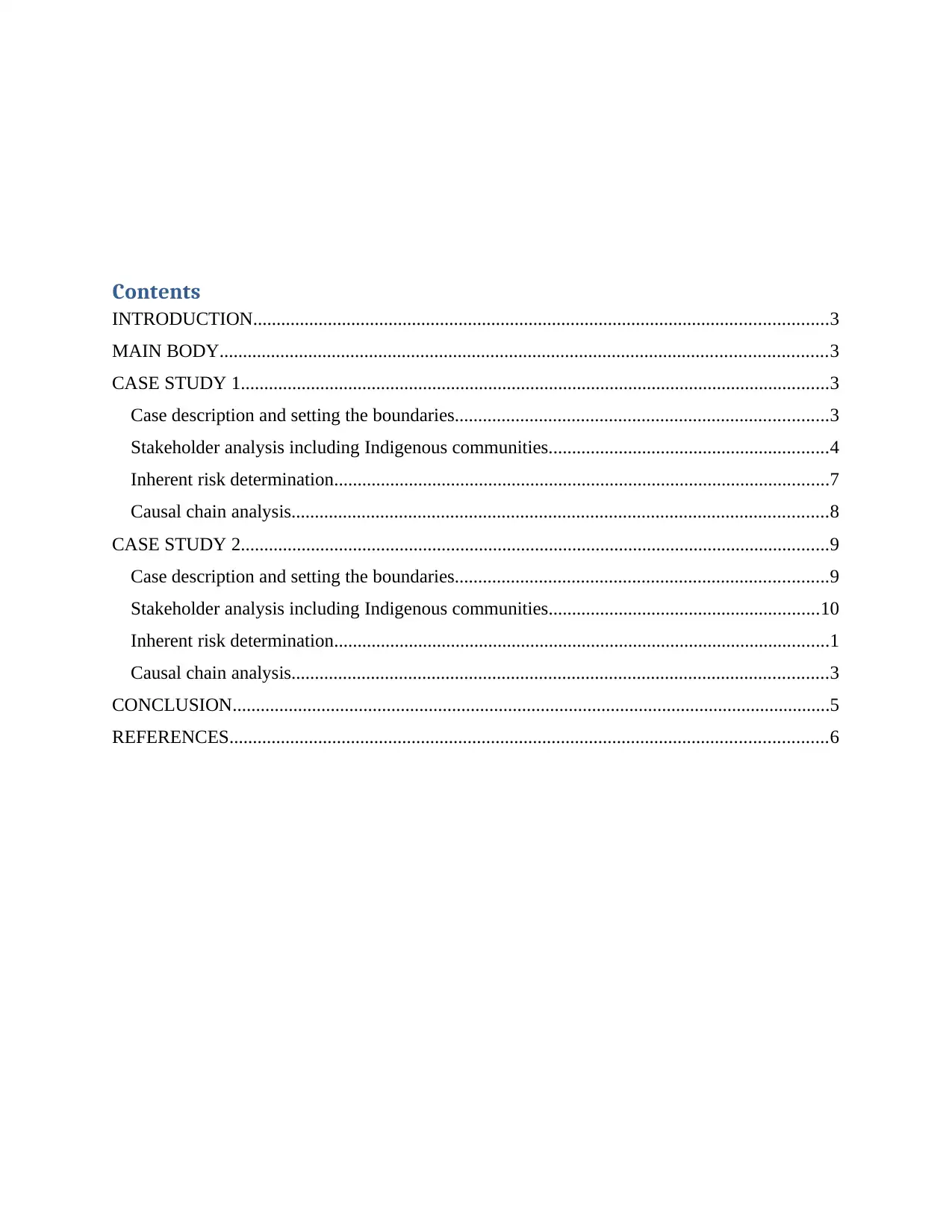
Contents
INTRODUCTION...........................................................................................................................3
MAIN BODY..................................................................................................................................3
CASE STUDY 1..............................................................................................................................3
Case description and setting the boundaries................................................................................3
Stakeholder analysis including Indigenous communities............................................................4
Inherent risk determination..........................................................................................................7
Causal chain analysis...................................................................................................................8
CASE STUDY 2..............................................................................................................................9
Case description and setting the boundaries................................................................................9
Stakeholder analysis including Indigenous communities..........................................................10
Inherent risk determination..........................................................................................................1
Causal chain analysis...................................................................................................................3
CONCLUSION................................................................................................................................5
REFERENCES................................................................................................................................6
INTRODUCTION...........................................................................................................................3
MAIN BODY..................................................................................................................................3
CASE STUDY 1..............................................................................................................................3
Case description and setting the boundaries................................................................................3
Stakeholder analysis including Indigenous communities............................................................4
Inherent risk determination..........................................................................................................7
Causal chain analysis...................................................................................................................8
CASE STUDY 2..............................................................................................................................9
Case description and setting the boundaries................................................................................9
Stakeholder analysis including Indigenous communities..........................................................10
Inherent risk determination..........................................................................................................1
Causal chain analysis...................................................................................................................3
CONCLUSION................................................................................................................................5
REFERENCES................................................................................................................................6
INTRODUCTION
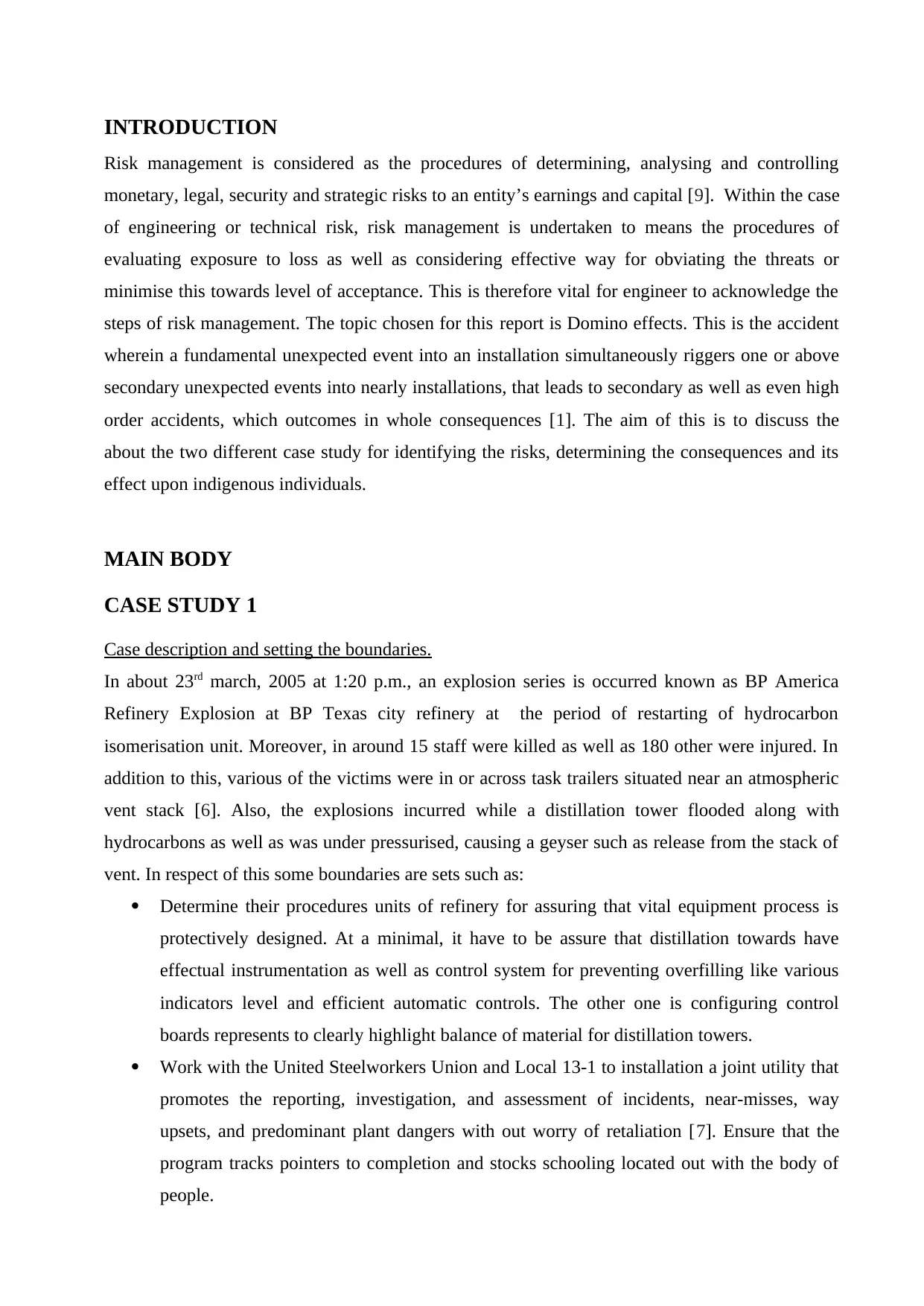
Risk management is considered as the procedures of determining, analysing and controlling
monetary, legal, security and strategic risks to an entity’s earnings and capital [9]. Within the case
of engineering or technical risk, risk management is undertaken to means the procedures of
evaluating exposure to loss as well as considering effective way for obviating the threats or
minimise this towards level of acceptance. This is therefore vital for engineer to acknowledge the
steps of risk management. The topic chosen for this report is Domino effects. This is the accident
wherein a fundamental unexpected event into an installation simultaneously riggers one or above
secondary unexpected events into nearly installations, that leads to secondary as well as even high
order accidents, which outcomes in whole consequences [1]. The aim of this is to discuss the
about the two different case study for identifying the risks, determining the consequences and its
effect upon indigenous individuals.
MAIN BODY
CASE STUDY 1
Case description and setting the boundaries.
In about 23rd march, 2005 at 1:20 p.m., an explosion series is occurred known as BP America
Refinery Explosion at BP Texas city refinery at the period of restarting of hydrocarbon
isomerisation unit. Moreover, in around 15 staff were killed as well as 180 other were injured. In
addition to this, various of the victims were in or across task trailers situated near an atmospheric
vent stack [6]. Also, the explosions incurred while a distillation tower flooded along with
hydrocarbons as well as was under pressurised, causing a geyser such as release from the stack of
vent. In respect of this some boundaries are sets such as:
Determine their procedures units of refinery for assuring that vital equipment process is
protectively designed. At a minimal, it have to be assure that distillation towards have
effectual instrumentation as well as control system for preventing overfilling like various
indicators level and efficient automatic controls. The other one is configuring control
boards represents to clearly highlight balance of material for distillation towers.
Work with the United Steelworkers Union and Local 13-1 to installation a joint utility that
promotes the reporting, investigation, and assessment of incidents, near-misses, way
upsets, and predominant plant dangers with out worry of retaliation [7]. Ensure that the
program tracks pointers to completion and stocks schooling located out with the body of
people.
Risk management is considered as the procedures of determining, analysing and controlling
monetary, legal, security and strategic risks to an entity’s earnings and capital [9]. Within the case
of engineering or technical risk, risk management is undertaken to means the procedures of
evaluating exposure to loss as well as considering effective way for obviating the threats or
minimise this towards level of acceptance. This is therefore vital for engineer to acknowledge the
steps of risk management. The topic chosen for this report is Domino effects. This is the accident
wherein a fundamental unexpected event into an installation simultaneously riggers one or above
secondary unexpected events into nearly installations, that leads to secondary as well as even high
order accidents, which outcomes in whole consequences [1]. The aim of this is to discuss the
about the two different case study for identifying the risks, determining the consequences and its
effect upon indigenous individuals.
MAIN BODY
CASE STUDY 1
Case description and setting the boundaries.
In about 23rd march, 2005 at 1:20 p.m., an explosion series is occurred known as BP America
Refinery Explosion at BP Texas city refinery at the period of restarting of hydrocarbon
isomerisation unit. Moreover, in around 15 staff were killed as well as 180 other were injured. In
addition to this, various of the victims were in or across task trailers situated near an atmospheric
vent stack [6]. Also, the explosions incurred while a distillation tower flooded along with
hydrocarbons as well as was under pressurised, causing a geyser such as release from the stack of
vent. In respect of this some boundaries are sets such as:
Determine their procedures units of refinery for assuring that vital equipment process is
protectively designed. At a minimal, it have to be assure that distillation towards have
effectual instrumentation as well as control system for preventing overfilling like various
indicators level and efficient automatic controls. The other one is configuring control
boards represents to clearly highlight balance of material for distillation towers.
Work with the United Steelworkers Union and Local 13-1 to installation a joint utility that
promotes the reporting, investigation, and assessment of incidents, near-misses, way
upsets, and predominant plant dangers with out worry of retaliation [7]. Ensure that the
program tracks pointers to completion and stocks schooling located out with the body of
people.
⊘ This is a preview!⊘
Do you want full access?
Subscribe today to unlock all pages.

Trusted by 1+ million students worldwide
Ensure that instrumentation and technique machine vital for comfy operation is nicely
maintained and examined. At a minimal, a. Establish a gadget database that captures the
records of trying out, inspections, restore, and successful artwork order crowning glory.
Analyse repair trends and adjust protection and attempting out periods to save breakdowns
[2]. Require repair of broken technique device preceding to unit start-ups.
Improve the operator training software. It is essential for offering operators effective
training so that safety procedures are appropriate followed [17.]. At a minimal, Face-to-
face schooling performed thru personnel with approach-specific understanding and revel in
who will have a observe trainee competency, and Schooling on spotting and coping with
normal conditions which embody using simulators or comparable training machine.
Require extra board operator staffing inside the path of the startup of method gadgets.
Ensure that danger reviews cope with staffing ranges in the direction of uncommon
conditions which incorporates startups, shutdowns, and unit upsets.
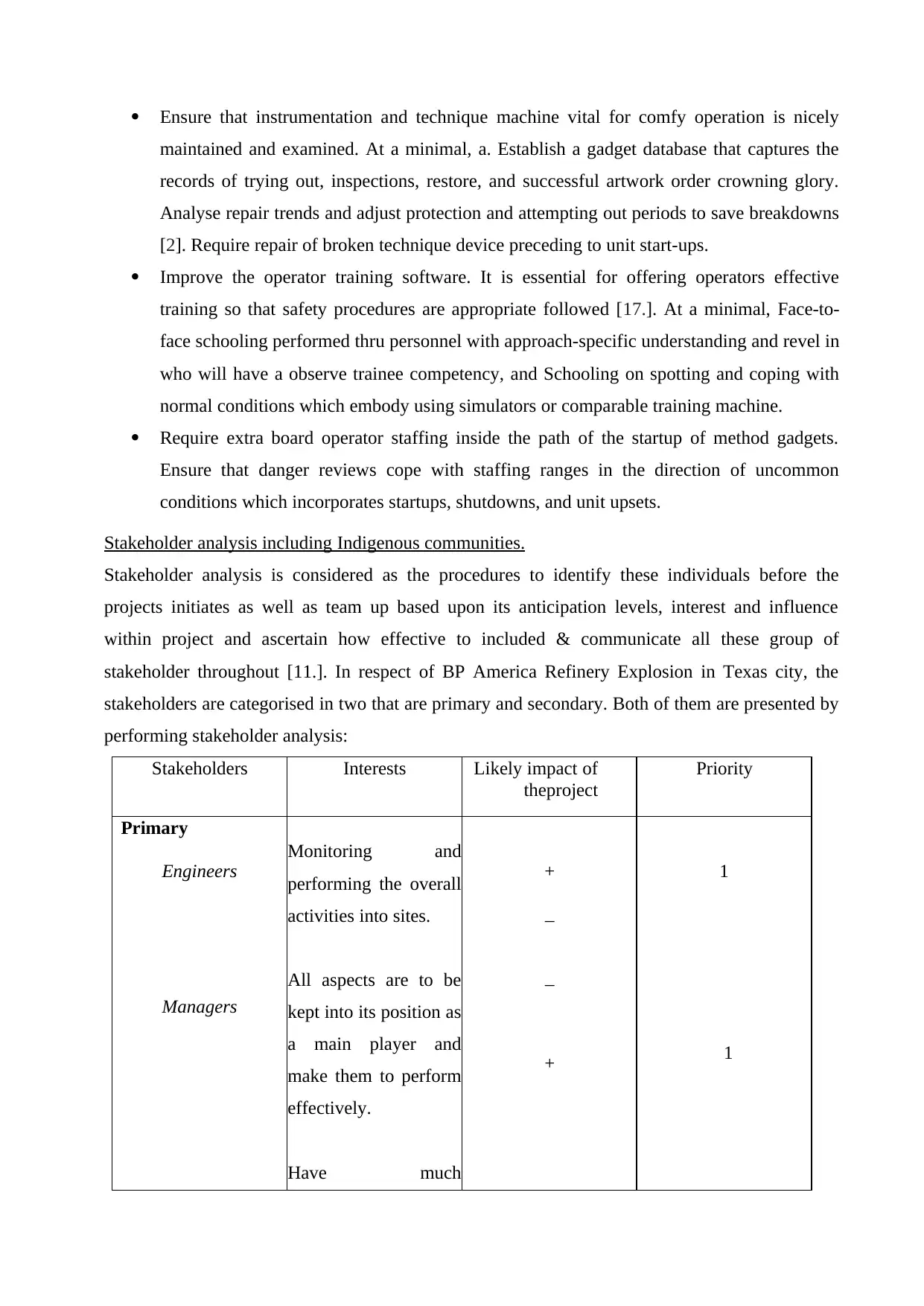
Stakeholder analysis including Indigenous communities.
Stakeholder analysis is considered as the procedures to identify these individuals before the
projects initiates as well as team up based upon its anticipation levels, interest and influence
within project and ascertain how effective to included & communicate all these group of
stakeholder throughout [11.]. In respect of BP America Refinery Explosion in Texas city, the
stakeholders are categorised in two that are primary and secondary. Both of them are presented by
performing stakeholder analysis:
Stakeholders Interests Likely impact of
theproject
Priority
Primary
Engineers
Managers
Monitoring and
performing the overall
activities into sites.
All aspects are to be
kept into its position as
a main player and
make them to perform
effectively.
Have much
+
_
_
+
1
1
maintained and examined. At a minimal, a. Establish a gadget database that captures the
records of trying out, inspections, restore, and successful artwork order crowning glory.
Analyse repair trends and adjust protection and attempting out periods to save breakdowns
[2]. Require repair of broken technique device preceding to unit start-ups.
Improve the operator training software. It is essential for offering operators effective
training so that safety procedures are appropriate followed [17.]. At a minimal, Face-to-
face schooling performed thru personnel with approach-specific understanding and revel in
who will have a observe trainee competency, and Schooling on spotting and coping with
normal conditions which embody using simulators or comparable training machine.
Require extra board operator staffing inside the path of the startup of method gadgets.
Ensure that danger reviews cope with staffing ranges in the direction of uncommon
conditions which incorporates startups, shutdowns, and unit upsets.
Stakeholder analysis including Indigenous communities.
Stakeholder analysis is considered as the procedures to identify these individuals before the
projects initiates as well as team up based upon its anticipation levels, interest and influence
within project and ascertain how effective to included & communicate all these group of
stakeholder throughout [11.]. In respect of BP America Refinery Explosion in Texas city, the
stakeholders are categorised in two that are primary and secondary. Both of them are presented by
performing stakeholder analysis:
Stakeholders Interests Likely impact of
theproject
Priority
Primary
Engineers
Managers
Monitoring and
performing the overall
activities into sites.
All aspects are to be
kept into its position as
a main player and
make them to perform
effectively.
Have much
+
_
_
+
1
1
Paraphrase This Document
Need a fresh take? Get an instant paraphrase of this document with our AI Paraphraser
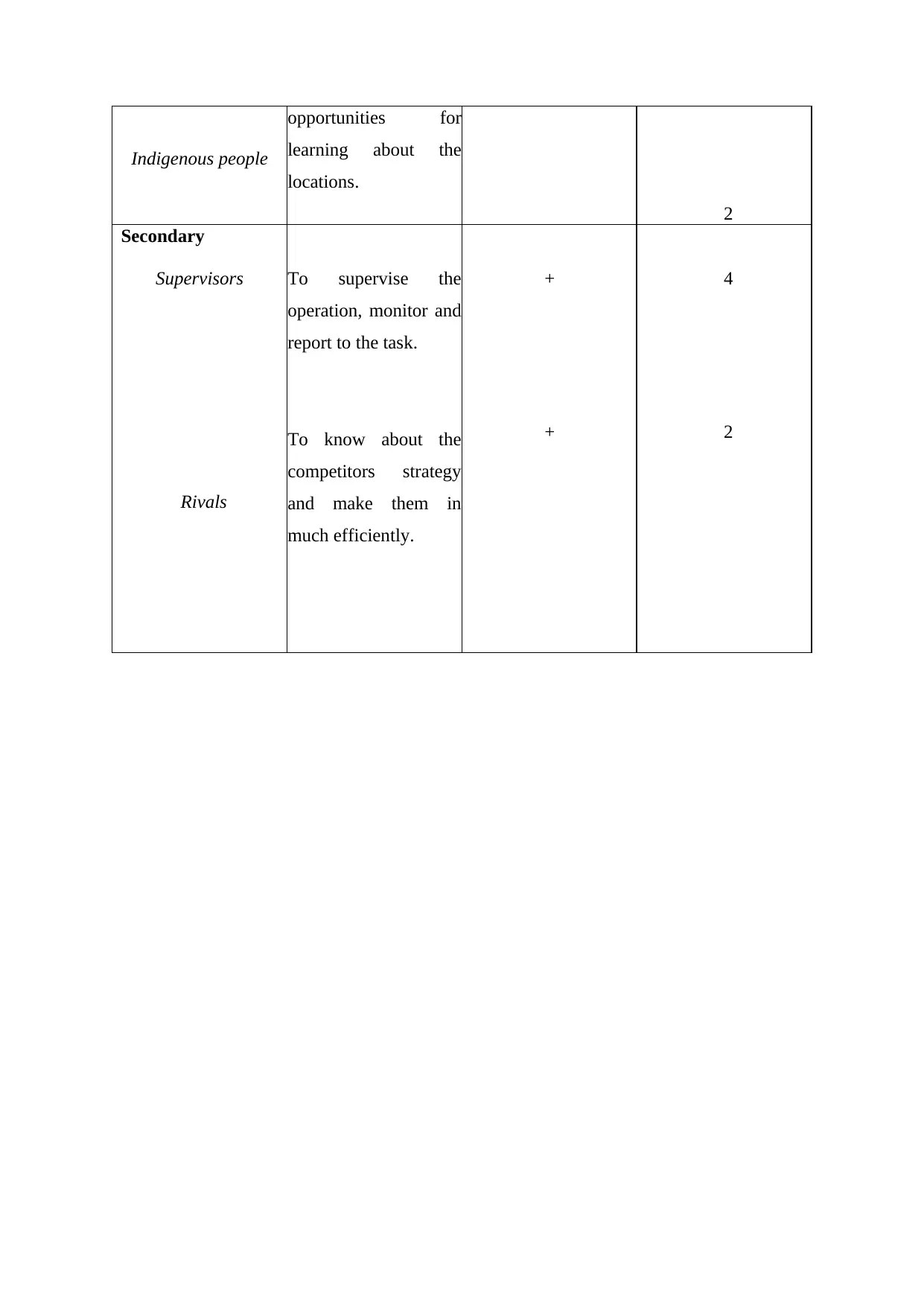
Indigenous people
opportunities for
learning about the
locations.
2
Secondary
Supervisors
Rivals
To supervise the
operation, monitor and
report to the task.
To know about the
competitors strategy
and make them in
much efficiently.
+
+
4
2
opportunities for
learning about the
locations.
2
Secondary
Supervisors
Rivals
To supervise the
operation, monitor and
report to the task.
To know about the
competitors strategy
and make them in
much efficiently.
+
+
4
2
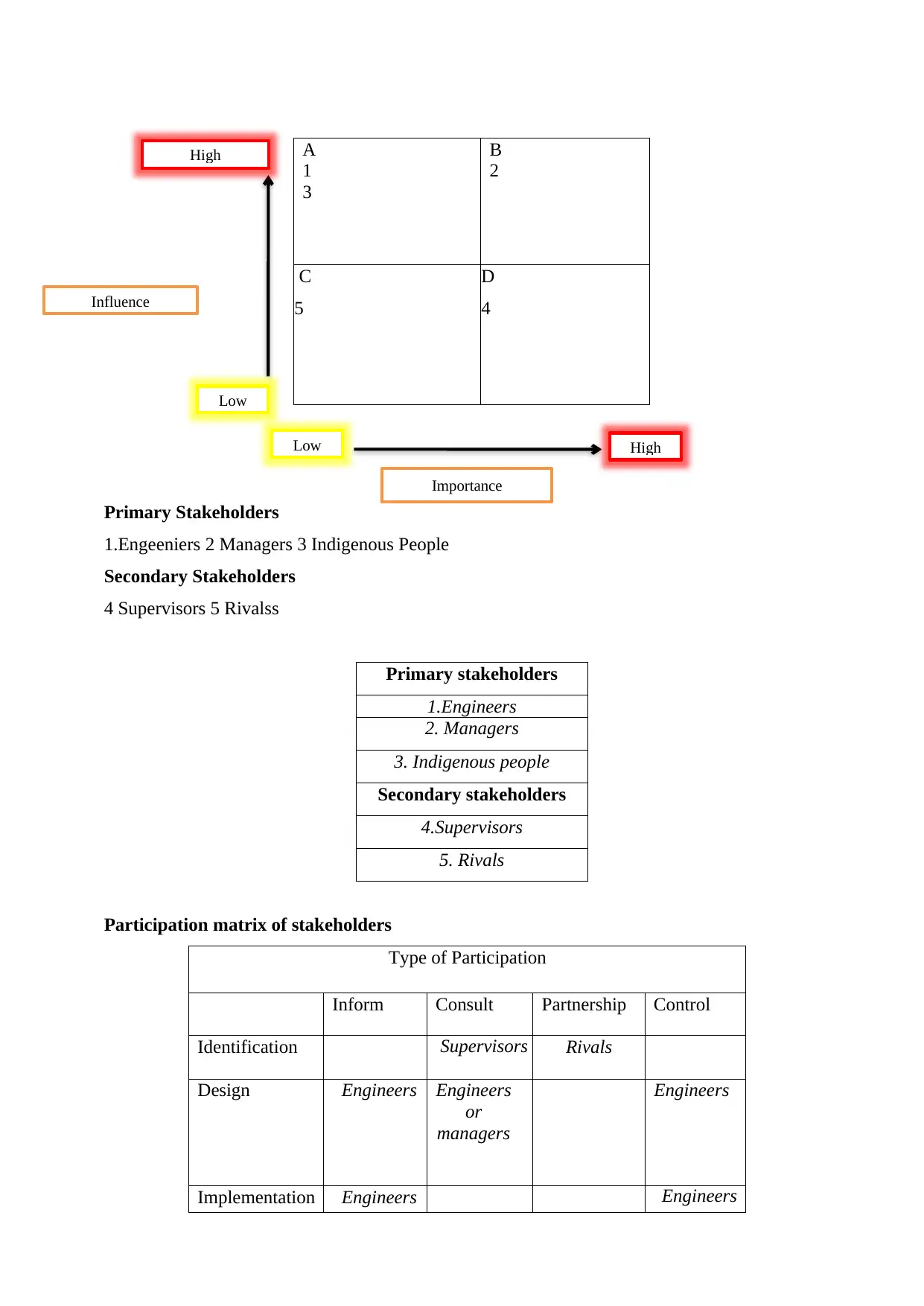
A
1
3
B
2
C
5
D
4
Primary Stakeholders
1.Engeeniers 2 Managers 3 Indigenous People
Secondary Stakeholders
4 Supervisors 5 Rivalss
Primary stakeholders
1.Engineers
2. Managers
3. Indigenous people
Secondary stakeholders
4.Supervisors
5. Rivals
Participation matrix of stakeholders
Type of Participation
Inform Consult Partnership Control
Identification Supervisors Rivals
Design Engineers Engineers
or
managers
Engineers
Implementation Engineers Engineers
Importance
High
Influence
High
Low
Low
1
3
B
2
C
5
D
4
Primary Stakeholders
1.Engeeniers 2 Managers 3 Indigenous People
Secondary Stakeholders
4 Supervisors 5 Rivalss
Primary stakeholders
1.Engineers
2. Managers
3. Indigenous people
Secondary stakeholders
4.Supervisors
5. Rivals
Participation matrix of stakeholders
Type of Participation
Inform Consult Partnership Control
Identification Supervisors Rivals
Design Engineers Engineers
or
managers
Engineers
Implementation Engineers Engineers
Importance
High
Influence
High
Low
Low
⊘ This is a preview!⊘
Do you want full access?
Subscribe today to unlock all pages.
Trusted by 1+ million students worldwide
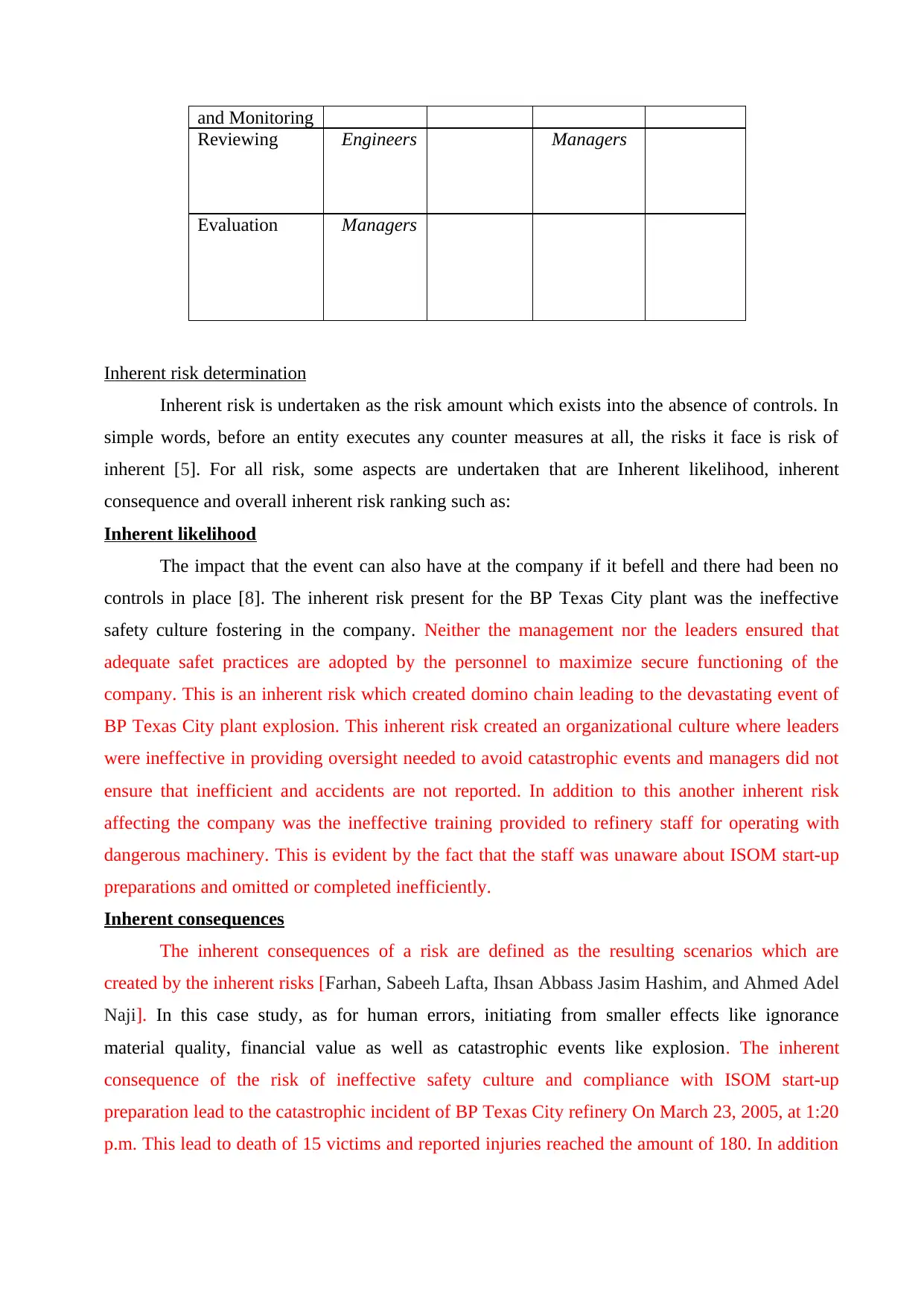
and Monitoring
Reviewing Engineers Managers
Evaluation Managers
Inherent risk determination
Inherent risk is undertaken as the risk amount which exists into the absence of controls. In
simple words, before an entity executes any counter measures at all, the risks it face is risk of
inherent [5]. For all risk, some aspects are undertaken that are Inherent likelihood, inherent
consequence and overall inherent risk ranking such as:
Inherent likelihood
The impact that the event can also have at the company if it befell and there had been no
controls in place [8]. The inherent risk present for the BP Texas City plant was the ineffective
safety culture fostering in the company. Neither the management nor the leaders ensured that
adequate safet practices are adopted by the personnel to maximize secure functioning of the
company. This is an inherent risk which created domino chain leading to the devastating event of
BP Texas City plant explosion. This inherent risk created an organizational culture where leaders
were ineffective in providing oversight needed to avoid catastrophic events and managers did not
ensure that inefficient and accidents are not reported. In addition to this another inherent risk
affecting the company was the ineffective training provided to refinery staff for operating with
dangerous machinery. This is evident by the fact that the staff was unaware about ISOM start-up
preparations and omitted or completed inefficiently.
Inherent consequences
The inherent consequences of a risk are defined as the resulting scenarios which are
created by the inherent risks [Farhan, Sabeeh Lafta, Ihsan Abbass Jasim Hashim, and Ahmed Adel
Naji]. In this case study, as for human errors, initiating from smaller effects like ignorance
material quality, financial value as well as catastrophic events like explosion. The inherent
consequence of the risk of ineffective safety culture and compliance with ISOM start-up
preparation lead to the catastrophic incident of BP Texas City refinery On March 23, 2005, at 1:20
p.m. This lead to death of 15 victims and reported injuries reached the amount of 180. In addition
Reviewing Engineers Managers
Evaluation Managers
Inherent risk determination
Inherent risk is undertaken as the risk amount which exists into the absence of controls. In
simple words, before an entity executes any counter measures at all, the risks it face is risk of
inherent [5]. For all risk, some aspects are undertaken that are Inherent likelihood, inherent
consequence and overall inherent risk ranking such as:
Inherent likelihood
The impact that the event can also have at the company if it befell and there had been no
controls in place [8]. The inherent risk present for the BP Texas City plant was the ineffective
safety culture fostering in the company. Neither the management nor the leaders ensured that
adequate safet practices are adopted by the personnel to maximize secure functioning of the
company. This is an inherent risk which created domino chain leading to the devastating event of
BP Texas City plant explosion. This inherent risk created an organizational culture where leaders
were ineffective in providing oversight needed to avoid catastrophic events and managers did not
ensure that inefficient and accidents are not reported. In addition to this another inherent risk
affecting the company was the ineffective training provided to refinery staff for operating with
dangerous machinery. This is evident by the fact that the staff was unaware about ISOM start-up
preparations and omitted or completed inefficiently.
Inherent consequences
The inherent consequences of a risk are defined as the resulting scenarios which are
created by the inherent risks [Farhan, Sabeeh Lafta, Ihsan Abbass Jasim Hashim, and Ahmed Adel
Naji]. In this case study, as for human errors, initiating from smaller effects like ignorance
material quality, financial value as well as catastrophic events like explosion. The inherent
consequence of the risk of ineffective safety culture and compliance with ISOM start-up
preparation lead to the catastrophic incident of BP Texas City refinery On March 23, 2005, at 1:20
p.m. This lead to death of 15 victims and reported injuries reached the amount of 180. In addition
Paraphrase This Document
Need a fresh take? Get an instant paraphrase of this document with our AI Paraphraser
to this the company suffered financial losses exceeding $1.5 billion and also faced reputation
damage because of its mismanagement of the plant.
Overall inherent risk ranking
Ranking inherent risk is essential for its mitigation and effective management because it helps
identify the priority for various types of risk so that highest ranking risk can be eliminated on an
immediate basis [3]. The highest level of risk identified at the company was lack of safety culture
because it created a management and leadership which was ineffective in supervising safe and
secure operations at the plant. The intensity of the risk can be understood by examining the
disadvantage of organizational culture which does not value safety, specifically for large scale
refineries and hazardous workplaces.
The primary disadvantage of ineffective safety culture is that it creates an environment of
carelessness and inattention as both managers and leaders avoid resolving cases of accidents and
reporting such cases is also avoided [16]. This is major disadvantage as it can lead to tragic events
such as explosions and also affect the quality of work being done at the company. Finally the
second rank is given to the ineffective compliance with ISOM preparations because it affects
singular part of the refinery facility instead of having damaging impact on evry operation of the
company along with its future.
Causal chain analysis
Causal Chain Analysis (CCA), often moreover known as Root Cause Analysis (RCA), is
cautiously associated with structures questioning and the DPSIR method. At its most number one,
a causal chain is an ordered series of activities linking the reasons of a problem with its outcomes.
Additionally, a clean schematic displaying the fundamental additives of a CCA [18]. In addition to
this, CCA is based at the belief that troubles are great solved via on the lookout for to address,
accurate or get rid of root reasons, in area of really addressing the straight away apparent
symptoms. By directing corrective measures at root motives, it is much more likely that a
recurrence of the trouble may be averted. However, it's far diagnosed that whole prevention of
recurrence with the useful resource of one corrective motion is not normally viable.
damage because of its mismanagement of the plant.
Overall inherent risk ranking
Ranking inherent risk is essential for its mitigation and effective management because it helps
identify the priority for various types of risk so that highest ranking risk can be eliminated on an
immediate basis [3]. The highest level of risk identified at the company was lack of safety culture
because it created a management and leadership which was ineffective in supervising safe and
secure operations at the plant. The intensity of the risk can be understood by examining the
disadvantage of organizational culture which does not value safety, specifically for large scale
refineries and hazardous workplaces.
The primary disadvantage of ineffective safety culture is that it creates an environment of
carelessness and inattention as both managers and leaders avoid resolving cases of accidents and
reporting such cases is also avoided [16]. This is major disadvantage as it can lead to tragic events
such as explosions and also affect the quality of work being done at the company. Finally the
second rank is given to the ineffective compliance with ISOM preparations because it affects
singular part of the refinery facility instead of having damaging impact on evry operation of the
company along with its future.
Causal chain analysis
Causal Chain Analysis (CCA), often moreover known as Root Cause Analysis (RCA), is
cautiously associated with structures questioning and the DPSIR method. At its most number one,
a causal chain is an ordered series of activities linking the reasons of a problem with its outcomes.
Additionally, a clean schematic displaying the fundamental additives of a CCA [18]. In addition to
this, CCA is based at the belief that troubles are great solved via on the lookout for to address,
accurate or get rid of root reasons, in area of really addressing the straight away apparent
symptoms. By directing corrective measures at root motives, it is much more likely that a
recurrence of the trouble may be averted. However, it's far diagnosed that whole prevention of
recurrence with the useful resource of one corrective motion is not normally viable.
CASE STUDY 2
Case description and setting the boundaries
Sonat Exploration Co. Catastrophic Vessel Over pressurization
On March 4 1998 at 6:15 in the evening a catastrophic vessel failure fire occurred at the
temple 22 one common point separation facility off the sonar exploration company in Louisiana
where four workers were killed and the company suffered high damage. The actions leading to
the incident include The start of production from temple 24 one well by using the recently
constructed by separation train. Before the oil was to be drawn from temple 24 one the bulk train
needed to be purged so that air could be removed. The purging operation was to be completed in
two stages which involved using the well fluid from the close by temple 22 one well so that the
two mile pipeline joining the temple 24 one well to the facility could be burst by also using the
24th one fluids.
The purging operation involved usage of specific alignment of wolves and the first one
was completed uneventfully in the afternoon of March 4 1998.This involves manually
repositioning the walls along with automation operations which helped open walls for the vessel.
During the second purging at approximately 6:15 PM the bulk train third state separator face a
gorgeous traffic failure ask yes from this replicator ignited leading to creation of a large fireball at
the centre of the separator which further ignited additional fires because of natural gas leaking.
the four operators who were near the separator were killed at once because of blast injuries.
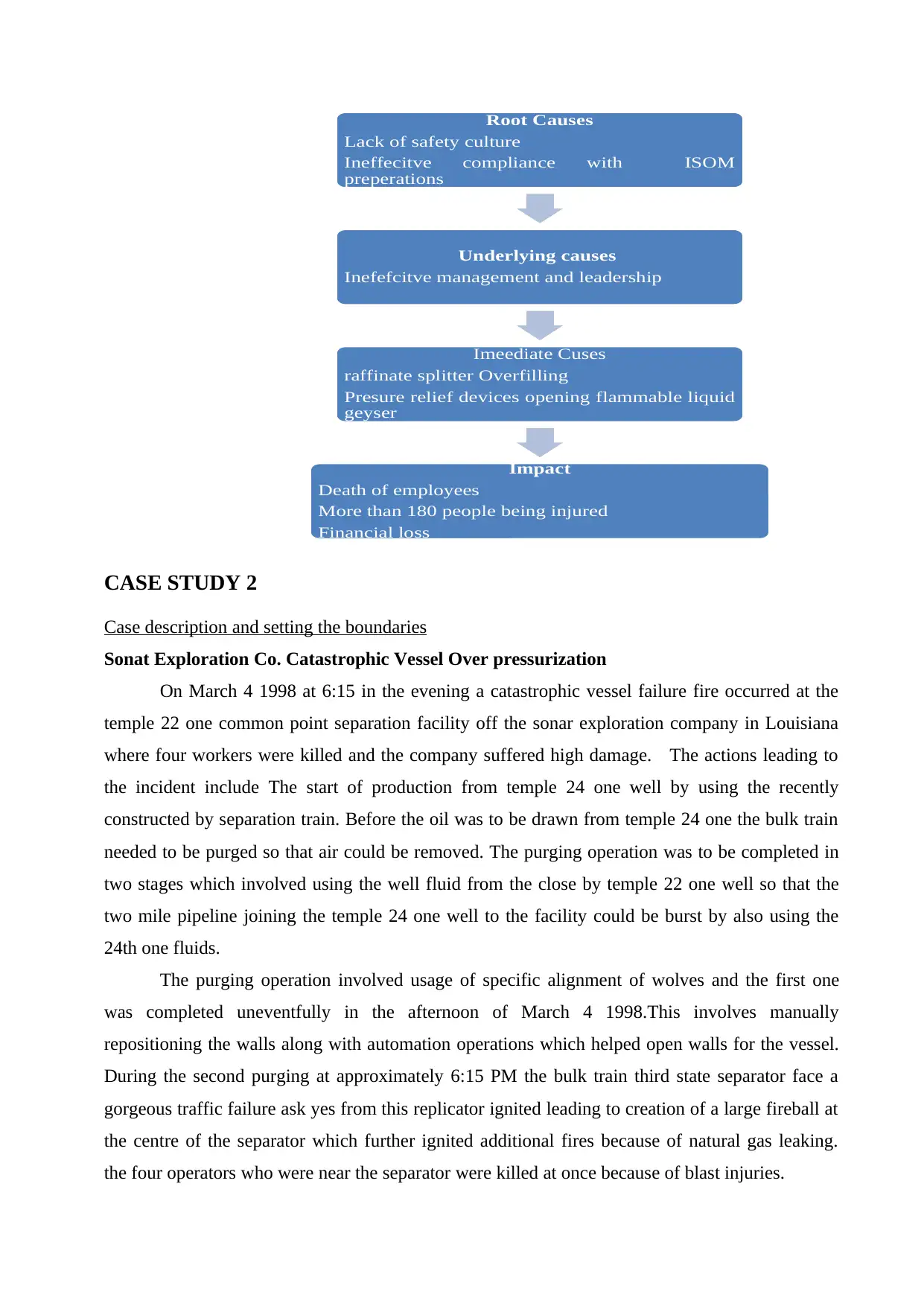
Root Causes
Lack of safety culture
Ineffecitve compliance with ISOM
preperations
Underlying causes
Inefefcitve management and leadership
Imeediate Cuses
raffinate splitter Overfilling
Presure relief devices opening flammable liquid
geyser
Impact
Death of employees
More than 180 people being injured
Financial loss
Case description and setting the boundaries
Sonat Exploration Co. Catastrophic Vessel Over pressurization
On March 4 1998 at 6:15 in the evening a catastrophic vessel failure fire occurred at the
temple 22 one common point separation facility off the sonar exploration company in Louisiana
where four workers were killed and the company suffered high damage. The actions leading to
the incident include The start of production from temple 24 one well by using the recently
constructed by separation train. Before the oil was to be drawn from temple 24 one the bulk train
needed to be purged so that air could be removed. The purging operation was to be completed in
two stages which involved using the well fluid from the close by temple 22 one well so that the
two mile pipeline joining the temple 24 one well to the facility could be burst by also using the
24th one fluids.
The purging operation involved usage of specific alignment of wolves and the first one
was completed uneventfully in the afternoon of March 4 1998.This involves manually
repositioning the walls along with automation operations which helped open walls for the vessel.
During the second purging at approximately 6:15 PM the bulk train third state separator face a
gorgeous traffic failure ask yes from this replicator ignited leading to creation of a large fireball at
the centre of the separator which further ignited additional fires because of natural gas leaking.
the four operators who were near the separator were killed at once because of blast injuries.
Root Causes
Lack of safety culture
Ineffecitve compliance with ISOM
preperations
Underlying causes
Inefefcitve management and leadership
Imeediate Cuses
raffinate splitter Overfilling
Presure relief devices opening flammable liquid
geyser
Impact
Death of employees
More than 180 people being injured
Financial loss
⊘ This is a preview!⊘
Do you want full access?
Subscribe today to unlock all pages.
Trusted by 1+ million students worldwide
Stakeholder analysis including Indigenous communities
For this case the manager’s supervisor contract operator and engineers of the facility are
considered as the internal of the boundary which also includes the relationship which exists
between the stakeholder [4]. The external environment which led to this catastrophic event is the
oil crisis in the 1990s which increased demands of oil in America as Iraq invasion of Kuwait
affected the supply of oil from Middle Eastern countries. Even though the system can be
considered a close system there are specific factors which lead to interaction an impact from the
outsiders of the system and influencing the behaviour of the system. It can also be stated that the
oil crisis of the 1990s created uncertainty and increase demand of oil specifically in America [13].
As a result, The respective organisation Sonat exploration company increasing their oil extraction
and exploration and starting many new well to get profit amid uncertain oil prices.
The user groups in this case includes safety engineers on site engineers as well as
technicians. In addition to this supervisors and contract operators which also includes the victims
affected by the blast are the user groups for this specific event. The interest groups in this event
are the investors of sonat exploration company along with the indigenous people who benefit from
better supply of oil which brings stability to the oil market of the 1990s. The decision makers for
this case include the senior leadership and investors of sonat exploration company. The division
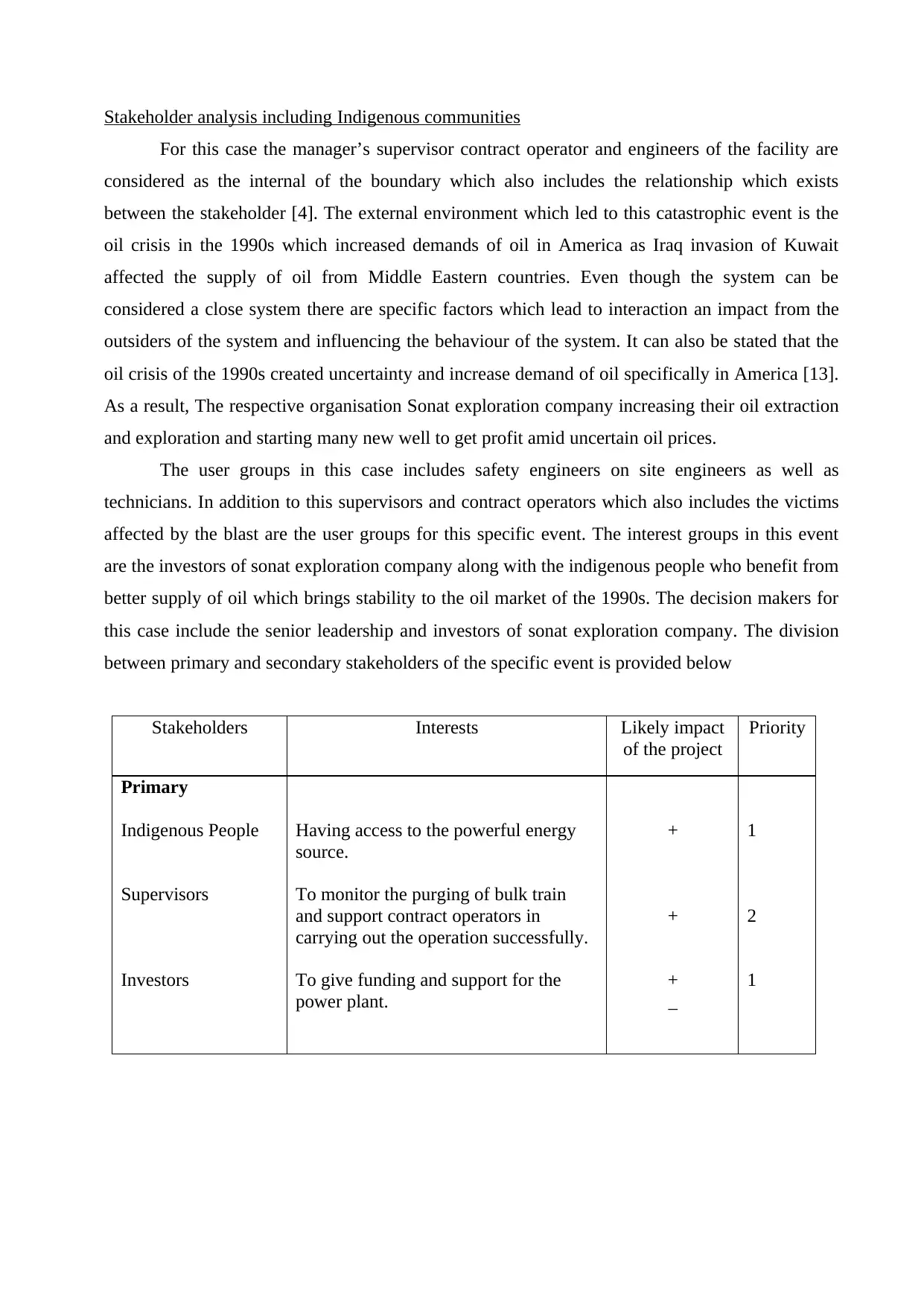
between primary and secondary stakeholders of the specific event is provided below
Stakeholders Interests Likely impact
of the project
Priority
Primary
Indigenous People
Supervisors
Investors
Having access to the powerful energy
source.
To monitor the purging of bulk train
and support contract operators in
carrying out the operation successfully.
To give funding and support for the
power plant.
+
+
+
_
1
2
1
For this case the manager’s supervisor contract operator and engineers of the facility are
considered as the internal of the boundary which also includes the relationship which exists
between the stakeholder [4]. The external environment which led to this catastrophic event is the
oil crisis in the 1990s which increased demands of oil in America as Iraq invasion of Kuwait
affected the supply of oil from Middle Eastern countries. Even though the system can be
considered a close system there are specific factors which lead to interaction an impact from the
outsiders of the system and influencing the behaviour of the system. It can also be stated that the
oil crisis of the 1990s created uncertainty and increase demand of oil specifically in America [13].
As a result, The respective organisation Sonat exploration company increasing their oil extraction
and exploration and starting many new well to get profit amid uncertain oil prices.
The user groups in this case includes safety engineers on site engineers as well as
technicians. In addition to this supervisors and contract operators which also includes the victims
affected by the blast are the user groups for this specific event. The interest groups in this event
are the investors of sonat exploration company along with the indigenous people who benefit from
better supply of oil which brings stability to the oil market of the 1990s. The decision makers for
this case include the senior leadership and investors of sonat exploration company. The division
between primary and secondary stakeholders of the specific event is provided below
Stakeholders Interests Likely impact
of the project
Priority
Primary
Indigenous People
Supervisors
Investors
Having access to the powerful energy
source.
To monitor the purging of bulk train
and support contract operators in
carrying out the operation successfully.
To give funding and support for the
power plant.
+
+
+
_
1
2
1
Paraphrase This Document
Need a fresh take? Get an instant paraphrase of this document with our AI Paraphraser
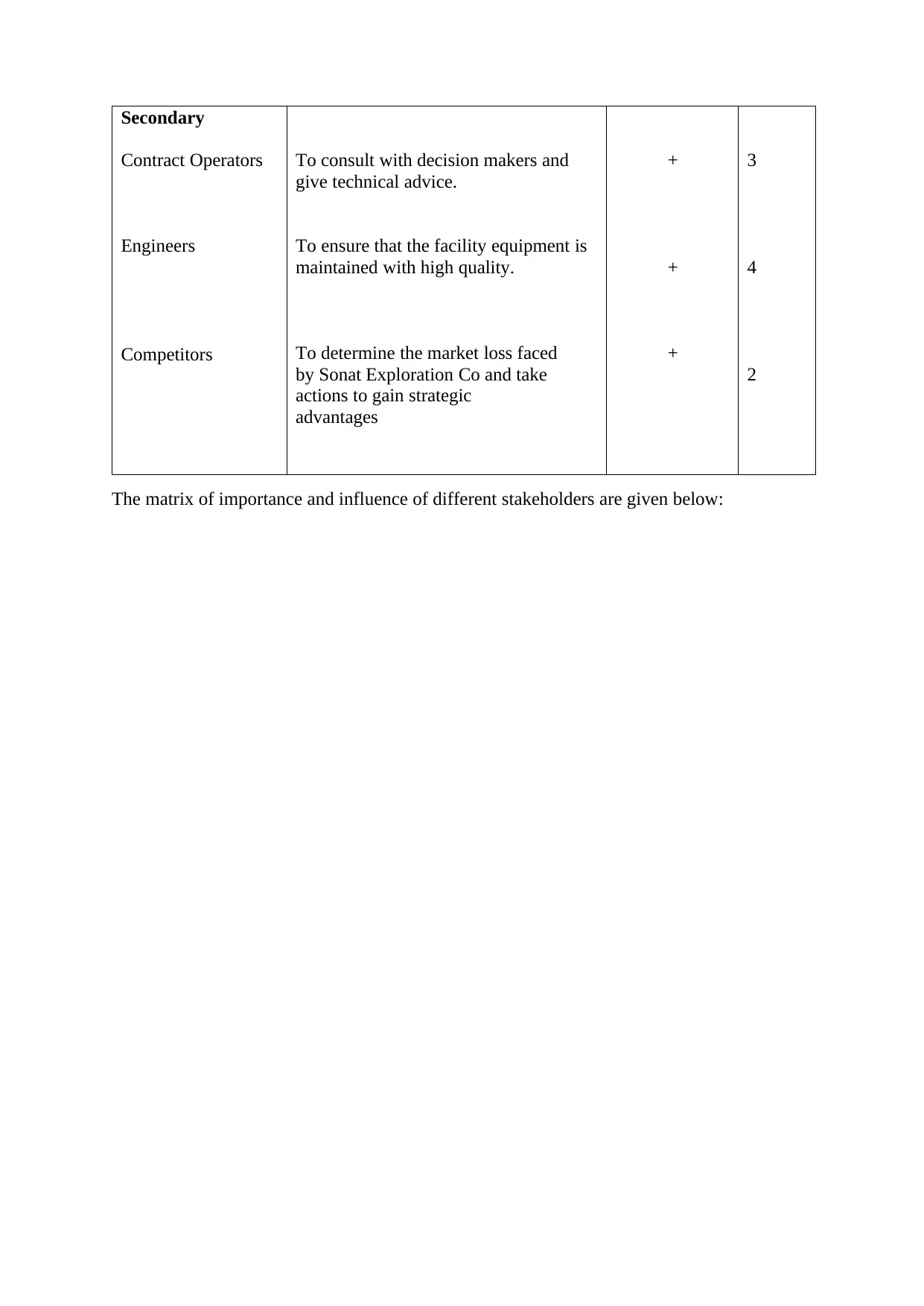
Secondary
Contract Operators
Engineers
Competitors
To consult with decision makers and
give technical advice.
To ensure that the facility equipment is
maintained with high quality.
To determine the market loss faced
by Sonat Exploration Co and take
actions to gain strategic
advantages
+
+
+
3
4
2
The matrix of importance and influence of different stakeholders are given below:
Contract Operators
Engineers
Competitors
To consult with decision makers and
give technical advice.
To ensure that the facility equipment is
maintained with high quality.
To determine the market loss faced
by Sonat Exploration Co and take
actions to gain strategic
advantages
+
+
+
3
4
2
The matrix of importance and influence of different stakeholders are given below:
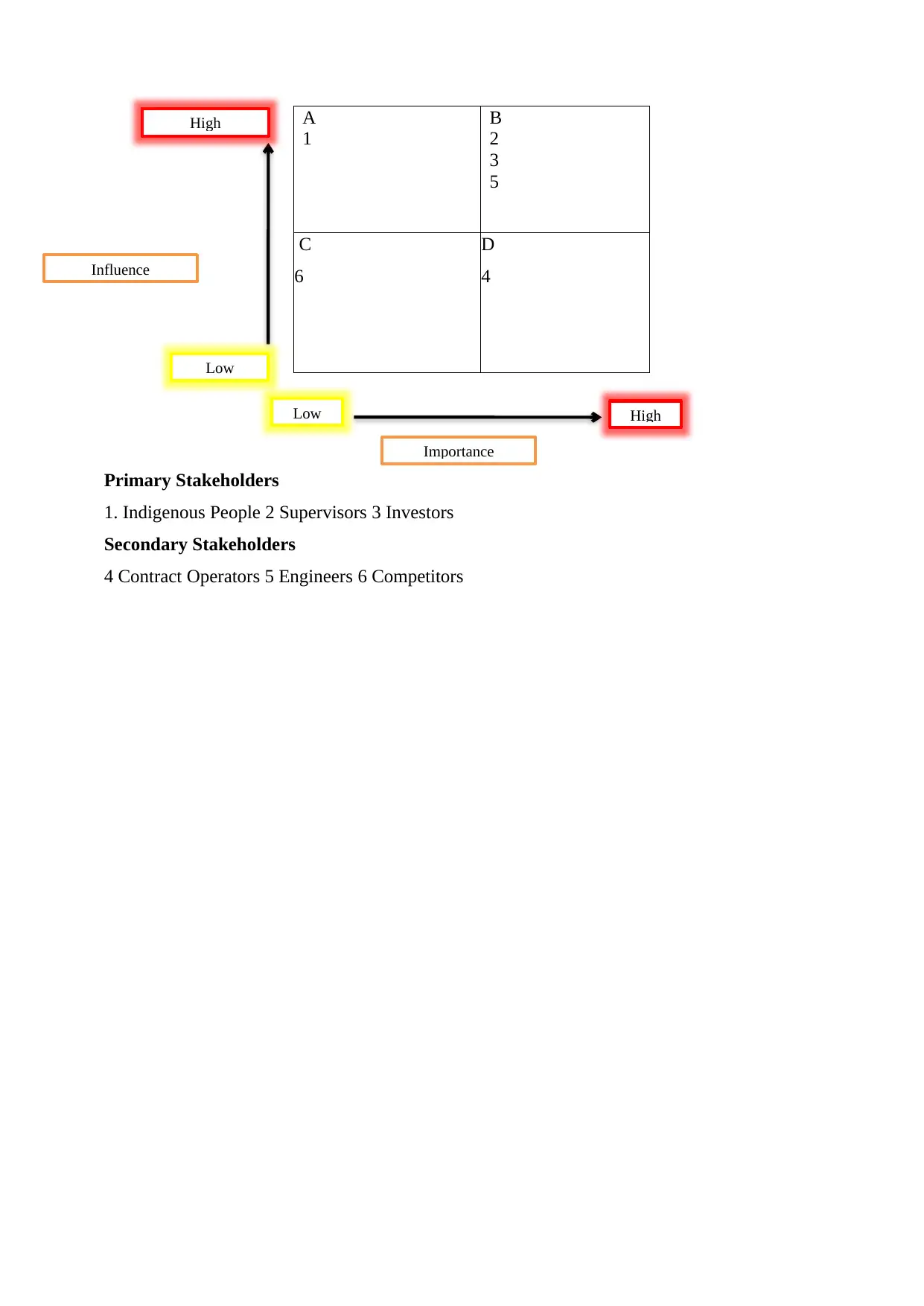
A
1
B
2
3
5
C
6
D
4
Primary Stakeholders
1. Indigenous People 2 Supervisors 3 Investors
Secondary Stakeholders
4 Contract Operators 5 Engineers 6 Competitors
Importance
High
Influence
High
Low
Low
1
B
2
3
5
C
6
D
4
Primary Stakeholders
1. Indigenous People 2 Supervisors 3 Investors
Secondary Stakeholders
4 Contract Operators 5 Engineers 6 Competitors
Importance
High
Influence
High
Low
Low
⊘ This is a preview!⊘
Do you want full access?
Subscribe today to unlock all pages.
Trusted by 1+ million students worldwide

1 out of 19


Your All-in-One AI-Powered Toolkit for Academic Success.
+13062052269
info@desklib.com
Available 24*7 on WhatsApp / Email
![[object Object]](/_next/static/media/star-bottom.7253800d.svg)
Unlock your academic potential
Copyright © 2020–2026 A2Z Services. All Rights Reserved. Developed and managed by ZUCOL.