Engineering Risk Management Report: Tianjin Explosion Case Study
VerifiedAdded on 2021/06/16
|21
|4822
|19
Report
AI Summary
This report delves into the critical aspects of engineering risk management, utilizing the 2015 Tianjin explosion as a comprehensive case study. It begins by outlining the core principles of risk management, including identification, characterization, and analysis, with specific attention to the factors contributing to the Tianjin incident, such as lax inspection, chemical flammability, and lack of preparedness. The report then proceeds to analyze the financial, environmental, legal, and human resource implications of the explosion, drawing comparisons with similar incidents like the Kaohsiung gas explosion and the West Fertilizer Company explosion. A significant portion is dedicated to risk assessment, discussing its usefulness, applicability, and limitations in decision-making, as well as exploring the concept of risk perception. The report concludes with proposed risk mitigation strategies and a discussion of risk communication, emphasizing the importance of preparedness, response, and recovery plans. This comprehensive analysis provides valuable insights into effective risk management practices within the engineering field.
Running head: ENGINEERING RISK MANAGEMENT 1
Engineering Risk Management
Student Name
Institution
Engineering Risk Management
Student Name
Institution

Paraphrase This Document
Need a fresh take? Get an instant paraphrase of this document with our AI Paraphraser
ENGINEERING RISK MANAGEMENT 2
Table of Contents
Introduction.................................................................................................................................................3
1. RISK MANAGEMENT......................................................................................................................3
1.2 Identification and analysis of risk......................................................................................................3
1.2.1 Issues in with significant impact on explosion............................................................................3
1.2.2 The identified risk at the Tianjin explosion.................................................................................4
1.3 Risk analysis......................................................................................................................................5
1.3.1 The financial risk analysis..........................................................................................................5
1.3.2 Environmental analysis of risk....................................................................................................5
1.3.3.Legal analysis of the risk............................................................................................................6
1.3.4 Human resources........................................................................................................................6
2. RISK ASSESSMENT..........................................................................................................................6
2.1 Usefulness of risk assessment............................................................................................................6
2.2 Applicability of the risk assessment...................................................................................................7
2.3 Limitations of risk assessment in decision making............................................................................7
2.4 Risk perception..................................................................................................................................8
3. RISK MITIGATION PLANS..............................................................................................................8
3.1 Proposed Risk management strategies for Tianjin explosion.............................................................9
4. RISK COMMUNICATION..............................................................................................................11
4.1 Risk communication phase..............................................................................................................12
4.2 Phases of risk communication plan..................................................................................................12
4.3 Components of risk communication plan.........................................................................................13
Conclusion.................................................................................................................................................14
Reference...................................................................................................................................................15
Table of Contents
Introduction.................................................................................................................................................3
1. RISK MANAGEMENT......................................................................................................................3
1.2 Identification and analysis of risk......................................................................................................3
1.2.1 Issues in with significant impact on explosion............................................................................3
1.2.2 The identified risk at the Tianjin explosion.................................................................................4
1.3 Risk analysis......................................................................................................................................5
1.3.1 The financial risk analysis..........................................................................................................5
1.3.2 Environmental analysis of risk....................................................................................................5
1.3.3.Legal analysis of the risk............................................................................................................6
1.3.4 Human resources........................................................................................................................6
2. RISK ASSESSMENT..........................................................................................................................6
2.1 Usefulness of risk assessment............................................................................................................6
2.2 Applicability of the risk assessment...................................................................................................7
2.3 Limitations of risk assessment in decision making............................................................................7
2.4 Risk perception..................................................................................................................................8
3. RISK MITIGATION PLANS..............................................................................................................8
3.1 Proposed Risk management strategies for Tianjin explosion.............................................................9
4. RISK COMMUNICATION..............................................................................................................11
4.1 Risk communication phase..............................................................................................................12
4.2 Phases of risk communication plan..................................................................................................12
4.3 Components of risk communication plan.........................................................................................13
Conclusion.................................................................................................................................................14
Reference...................................................................................................................................................15
ENGINEERING RISK MANAGEMENT 3
Introduction
Engineering risk stands as an important business management risk owing to the
magnitude of the risk. Engineering risk results from various engineering operations or
engineering products. This can also be described based on the area of risk and the potential
factors of the risk occurring within the organization. An example of engineering risk that
occurred was Tianjin explosion that occurred in 2015 killing a number of people, massive injury,
and destruction of property. The accident resulted from fire explosion caused by chemicals
within the containers handled with the warehouse at the Tianjin port. Such accidents require risk
management strategy that includes risk identification, characterization and risk management
strategies. In addition, the risk assessment is an important risk management procedure that is
useful for the decision-making process in an organization. The risk communication is another
risk management component that involves communicating the risk preparedness, response
strategy and risk recovery. The following report explores the engineering risk management
components with reference to Tianjin accident case study.
1. RISK MANAGEMENT
Risk management entails a various process that can be used to identify, characterize,
analyze and manage the risk. Risk management works to identify and analyze the risk of the
accident that occurred at Tianjin, China in 2015.
1.2 Identification and analysis of risk
1.2.1 Issues in with significant impact on explosion
There are some key issues that are important in identification of the risk that lead to the
explosion. Identification of risk is the first step in risk management process and include continue
Introduction
Engineering risk stands as an important business management risk owing to the
magnitude of the risk. Engineering risk results from various engineering operations or
engineering products. This can also be described based on the area of risk and the potential
factors of the risk occurring within the organization. An example of engineering risk that
occurred was Tianjin explosion that occurred in 2015 killing a number of people, massive injury,
and destruction of property. The accident resulted from fire explosion caused by chemicals
within the containers handled with the warehouse at the Tianjin port. Such accidents require risk
management strategy that includes risk identification, characterization and risk management
strategies. In addition, the risk assessment is an important risk management procedure that is
useful for the decision-making process in an organization. The risk communication is another
risk management component that involves communicating the risk preparedness, response
strategy and risk recovery. The following report explores the engineering risk management
components with reference to Tianjin accident case study.
1. RISK MANAGEMENT
Risk management entails a various process that can be used to identify, characterize,
analyze and manage the risk. Risk management works to identify and analyze the risk of the
accident that occurred at Tianjin, China in 2015.
1.2 Identification and analysis of risk
1.2.1 Issues in with significant impact on explosion
There are some key issues that are important in identification of the risk that lead to the
explosion. Identification of risk is the first step in risk management process and include continue
⊘ This is a preview!⊘
Do you want full access?
Subscribe today to unlock all pages.

Trusted by 1+ million students worldwide
ENGINEERING RISK MANAGEMENT 4
risk identification within and outside the business as an effort to manage to reduce the likelihood
of the risk occurring within an organization. Some of the issues that can be observed on the
accident and gives the general nature of the engineering risk at the time of accident (Leveson,
2011). Firstly, the root cause of the risk is one of the identification steps that have impact on the
explosion forms the basis of the risk management. For instance, the case of explosion, the root
cause of the explosion can be viewed as laxity on inspection. Other causal factors for the risk
may have been on the flammability of the chemicals that were involved in the explosion.
Chemicals such as calcium carbide, potassium nitrate and ammonium nitrate are very reactive
and easily catch fire. Moreover, the capability of the facility to handle these chemicals may have
been comprised at the time of the risk. Secondly, risk characterization is another aspect of risk
management that focuses on risk classification and analysis to bring a better understanding of the
risk. At the time of the accident fires was the main observable injury factor that killed many
people and destroyed property. Lastly, risk planning is another aspect of risk where planning for
the risk assessment, response and risk recovery. The company shows limited planning and
preparedness as response team was among those casualties (Chapman & Ward, 2008).
1.2.2 The identified risk
The Tianjin explosion
According to various analysis there are some identified risk factor that can be deduce
from the accident. Firstly, according to Huang and Zhang (2015), lax inspection leading to high
amount of chemicals that was specified by the operation license is one cause of the accident. The
high amount of chemical was evidenced by the magnitude of the explosion that was witnessed
during the accident. Secondly, limited monitoring of the facility than expected was another factor
that contributed to the accident that occurred at the Tianjin, China. The monitory of the facility
risk identification within and outside the business as an effort to manage to reduce the likelihood
of the risk occurring within an organization. Some of the issues that can be observed on the
accident and gives the general nature of the engineering risk at the time of accident (Leveson,
2011). Firstly, the root cause of the risk is one of the identification steps that have impact on the
explosion forms the basis of the risk management. For instance, the case of explosion, the root
cause of the explosion can be viewed as laxity on inspection. Other causal factors for the risk
may have been on the flammability of the chemicals that were involved in the explosion.
Chemicals such as calcium carbide, potassium nitrate and ammonium nitrate are very reactive
and easily catch fire. Moreover, the capability of the facility to handle these chemicals may have
been comprised at the time of the risk. Secondly, risk characterization is another aspect of risk
management that focuses on risk classification and analysis to bring a better understanding of the
risk. At the time of the accident fires was the main observable injury factor that killed many
people and destroyed property. Lastly, risk planning is another aspect of risk where planning for
the risk assessment, response and risk recovery. The company shows limited planning and
preparedness as response team was among those casualties (Chapman & Ward, 2008).
1.2.2 The identified risk
The Tianjin explosion
According to various analysis there are some identified risk factor that can be deduce
from the accident. Firstly, according to Huang and Zhang (2015), lax inspection leading to high
amount of chemicals that was specified by the operation license is one cause of the accident. The
high amount of chemical was evidenced by the magnitude of the explosion that was witnessed
during the accident. Secondly, limited monitoring of the facility than expected was another factor
that contributed to the accident that occurred at the Tianjin, China. The monitory of the facility
Paraphrase This Document
Need a fresh take? Get an instant paraphrase of this document with our AI Paraphraser
ENGINEERING RISK MANAGEMENT 5
would have resulted in identification of potential risk especially given that the explosive
chemicals were highly flammable and require monitoring of fire sources (Rostami, 2016).
Thirdly, lack of preparedness within the warehouse was another aspect of the casual factor that
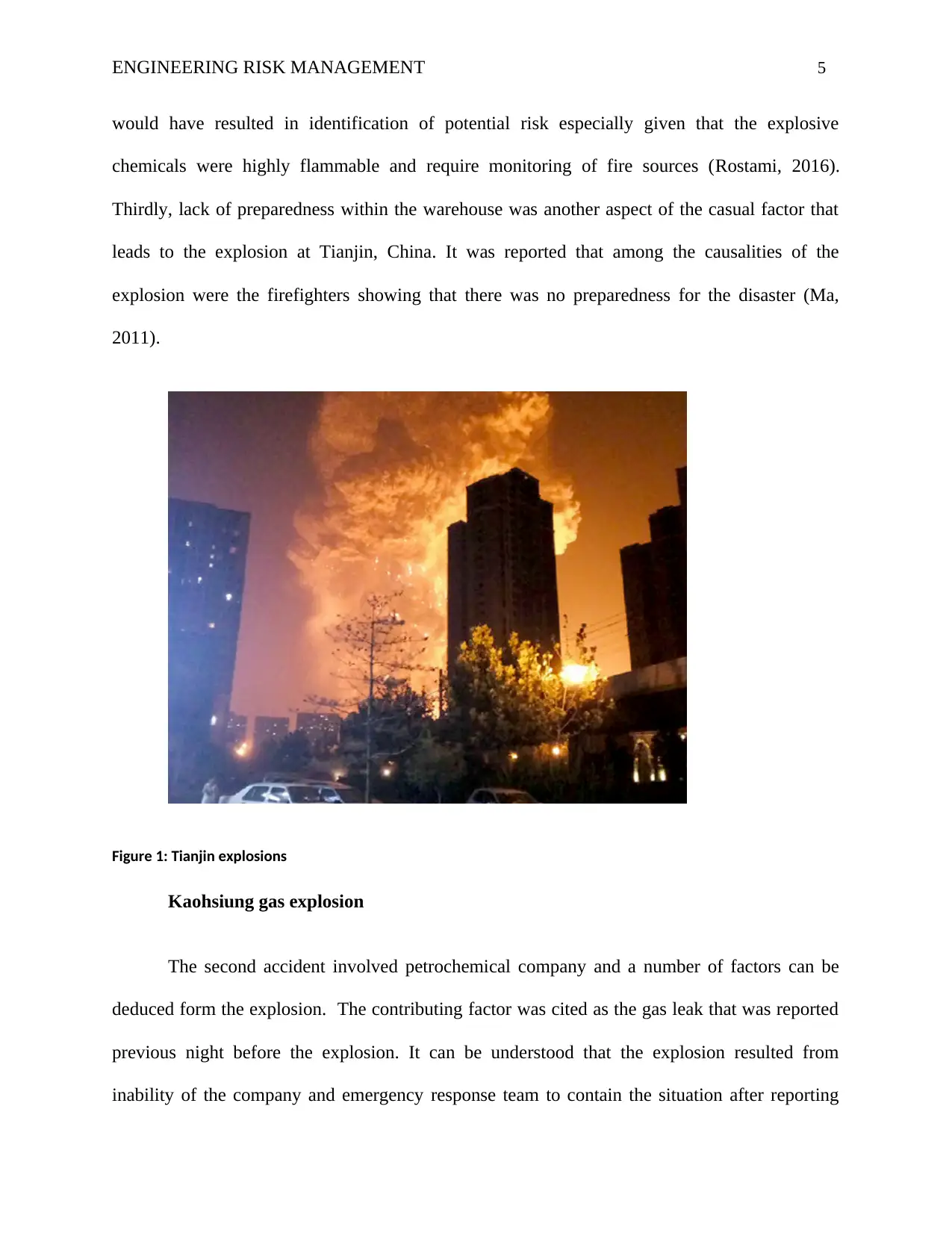
leads to the explosion at Tianjin, China. It was reported that among the causalities of the
explosion were the firefighters showing that there was no preparedness for the disaster (Ma,
2011).
Figure 1: Tianjin explosions
Kaohsiung gas explosion
The second accident involved petrochemical company and a number of factors can be
deduced form the explosion. The contributing factor was cited as the gas leak that was reported
previous night before the explosion. It can be understood that the explosion resulted from
inability of the company and emergency response team to contain the situation after reporting
would have resulted in identification of potential risk especially given that the explosive
chemicals were highly flammable and require monitoring of fire sources (Rostami, 2016).
Thirdly, lack of preparedness within the warehouse was another aspect of the casual factor that
leads to the explosion at Tianjin, China. It was reported that among the causalities of the
explosion were the firefighters showing that there was no preparedness for the disaster (Ma,
2011).
Figure 1: Tianjin explosions
Kaohsiung gas explosion
The second accident involved petrochemical company and a number of factors can be
deduced form the explosion. The contributing factor was cited as the gas leak that was reported
previous night before the explosion. It can be understood that the explosion resulted from
inability of the company and emergency response team to contain the situation after reporting
ENGINEERING RISK MANAGEMENT 6
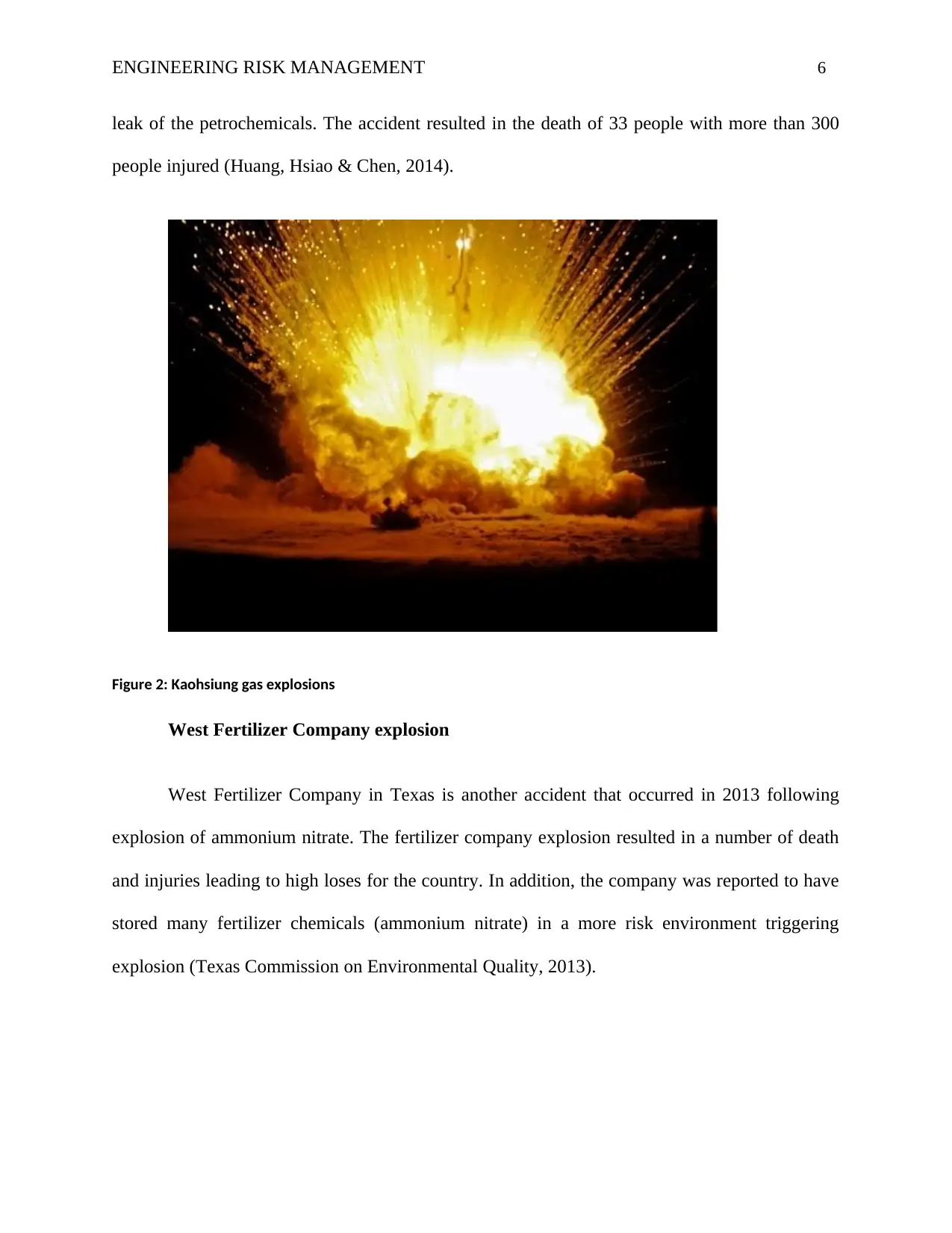
leak of the petrochemicals. The accident resulted in the death of 33 people with more than 300
people injured (Huang, Hsiao & Chen, 2014).
Figure 2: Kaohsiung gas explosions
West Fertilizer Company explosion
West Fertilizer Company in Texas is another accident that occurred in 2013 following
explosion of ammonium nitrate. The fertilizer company explosion resulted in a number of death
and injuries leading to high loses for the country. In addition, the company was reported to have
stored many fertilizer chemicals (ammonium nitrate) in a more risk environment triggering
explosion (Texas Commission on Environmental Quality, 2013).
leak of the petrochemicals. The accident resulted in the death of 33 people with more than 300
people injured (Huang, Hsiao & Chen, 2014).
Figure 2: Kaohsiung gas explosions
West Fertilizer Company explosion
West Fertilizer Company in Texas is another accident that occurred in 2013 following
explosion of ammonium nitrate. The fertilizer company explosion resulted in a number of death
and injuries leading to high loses for the country. In addition, the company was reported to have
stored many fertilizer chemicals (ammonium nitrate) in a more risk environment triggering
explosion (Texas Commission on Environmental Quality, 2013).
⊘ This is a preview!⊘
Do you want full access?
Subscribe today to unlock all pages.
Trusted by 1+ million students worldwide
ENGINEERING RISK MANAGEMENT 7
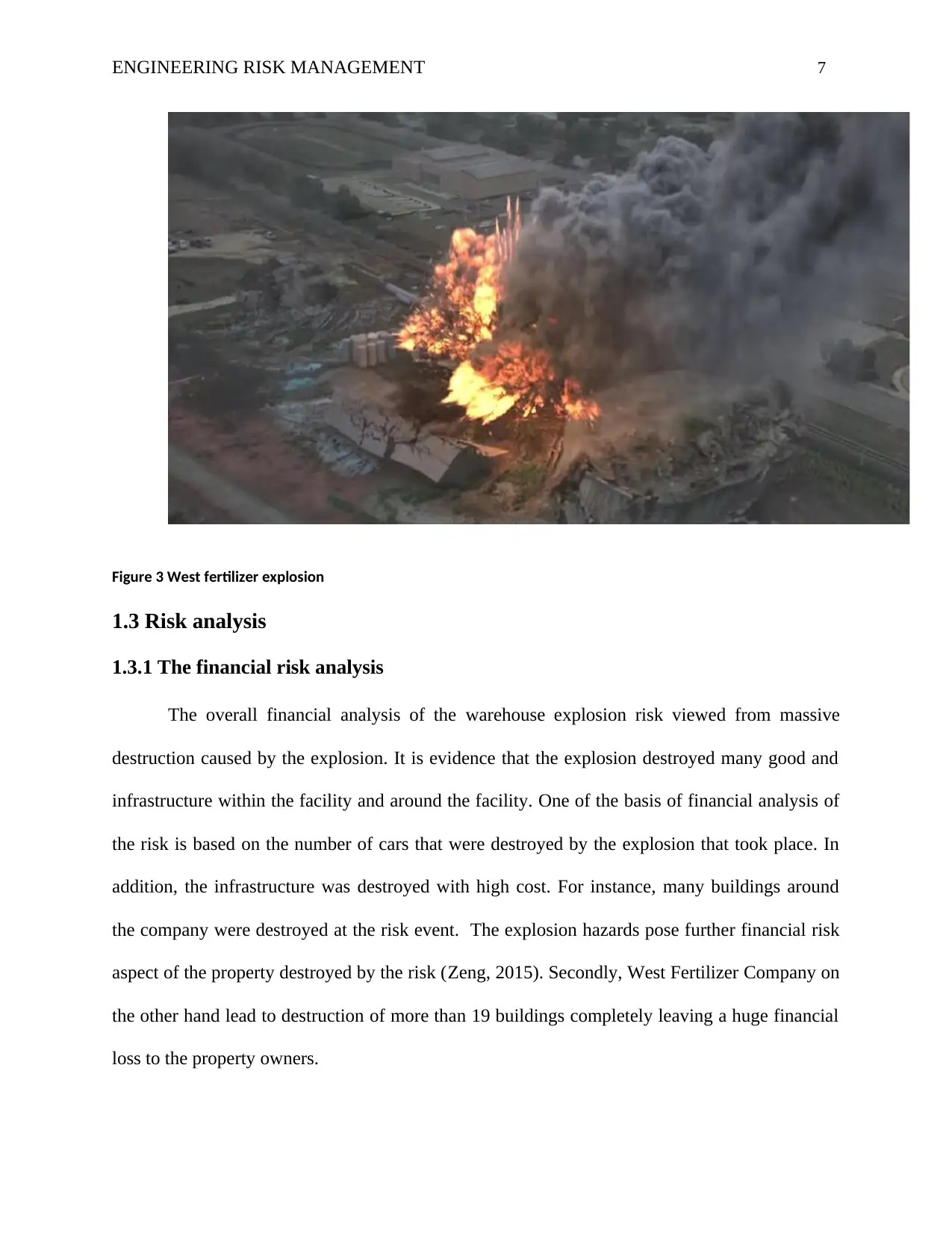
Figure 3 West fertilizer explosion
1.3 Risk analysis
1.3.1 The financial risk analysis
The overall financial analysis of the warehouse explosion risk viewed from massive
destruction caused by the explosion. It is evidence that the explosion destroyed many good and
infrastructure within the facility and around the facility. One of the basis of financial analysis of
the risk is based on the number of cars that were destroyed by the explosion that took place. In
addition, the infrastructure was destroyed with high cost. For instance, many buildings around
the company were destroyed at the risk event. The explosion hazards pose further financial risk
aspect of the property destroyed by the risk (Zeng, 2015). Secondly, West Fertilizer Company on
the other hand lead to destruction of more than 19 buildings completely leaving a huge financial
loss to the property owners.
Figure 3 West fertilizer explosion
1.3 Risk analysis
1.3.1 The financial risk analysis
The overall financial analysis of the warehouse explosion risk viewed from massive
destruction caused by the explosion. It is evidence that the explosion destroyed many good and
infrastructure within the facility and around the facility. One of the basis of financial analysis of
the risk is based on the number of cars that were destroyed by the explosion that took place. In
addition, the infrastructure was destroyed with high cost. For instance, many buildings around
the company were destroyed at the risk event. The explosion hazards pose further financial risk
aspect of the property destroyed by the risk (Zeng, 2015). Secondly, West Fertilizer Company on
the other hand lead to destruction of more than 19 buildings completely leaving a huge financial
loss to the property owners.
Paraphrase This Document
Need a fresh take? Get an instant paraphrase of this document with our AI Paraphraser
ENGINEERING RISK MANAGEMENT 8
1.3.2 Environmental analysis of risk
Secondly, environmental risk associated by the explosion can be analyzed base on the
extent of the pollution that resulted from the explosion. The explosion has impact on the
environment due to release of pollutants or chemicals into the atmosphere. Engineering risk of
explosion as was the case of the China’s warehouse explosion involved chemical that has high
amount of pollution into the environment. Moreover, these chemicals are threat to both life of
living things and environment (Koger & Deborah, 2010).
1.3.3. Legal analysis of the risk
Lastly, analysis of the legal basis of the risk can be viewed from the perspective of legal
framework that minimizes the risk. For instance, health and safety workplace framework gives
the requirement for various engineering construction of facilities with minimal risk. This also
includes the qualifications that are required for those staffs working on the facilities since they
need to be trained on potential risk associated with the warehouse facilities. In addition, the legal
basis of the risk analysis is also based on the emergency strategy of the company that can
minimize risk such as explosion (Ryan, 2015).
1.3.4 Human resources
The magnitude of the risk can also be felt on the casualties that occurred at the time of the
explosion. It was reported that more than 800 injuries were sustained during the event. In
addition, many people died as a result of the accident with more than 50 people reported dead at
the time of the explosion. This indicates that there was a massive loss of human resources within
the company and many people also died outside the facility (BBC News, 2015). Secondly, the
petrochemical factory resulted in death and injury that reduces the number of human resources.
1.3.2 Environmental analysis of risk
Secondly, environmental risk associated by the explosion can be analyzed base on the
extent of the pollution that resulted from the explosion. The explosion has impact on the
environment due to release of pollutants or chemicals into the atmosphere. Engineering risk of
explosion as was the case of the China’s warehouse explosion involved chemical that has high
amount of pollution into the environment. Moreover, these chemicals are threat to both life of
living things and environment (Koger & Deborah, 2010).
1.3.3. Legal analysis of the risk
Lastly, analysis of the legal basis of the risk can be viewed from the perspective of legal
framework that minimizes the risk. For instance, health and safety workplace framework gives
the requirement for various engineering construction of facilities with minimal risk. This also
includes the qualifications that are required for those staffs working on the facilities since they
need to be trained on potential risk associated with the warehouse facilities. In addition, the legal
basis of the risk analysis is also based on the emergency strategy of the company that can
minimize risk such as explosion (Ryan, 2015).
1.3.4 Human resources
The magnitude of the risk can also be felt on the casualties that occurred at the time of the
explosion. It was reported that more than 800 injuries were sustained during the event. In
addition, many people died as a result of the accident with more than 50 people reported dead at
the time of the explosion. This indicates that there was a massive loss of human resources within
the company and many people also died outside the facility (BBC News, 2015). Secondly, the
petrochemical factory resulted in death and injury that reduces the number of human resources.
ENGINEERING RISK MANAGEMENT 9
The human resources analysis shows the casualties and death was mostly drawn from both
workers and people living around the factory (Huang, Hsiao & Chen 2014). Thirdly, West
Fertilizer Company explosion also killed 19 people and many injuries. This is viewed in terms of
the human resources that were lost particularly on the company employees and injuries (Texas
Commission on Environmental Quality 2013).
2. RISK ASSESSMENT
Risk assessment refers to the process of determining the magnitude, and probability
based on qualitative and quantitative analysis of the risk. Risk assessment can be explored base
on its usefulness, applicability, and limitation in the decision-making process.
2.1 Usefulness of risk assessment
Risk assessment is useful in ensuring safe and healthy work environment, useful in legal
compliance. The risk assessment ensures that accidents are prevented or there are minimal
accidents. For instance, risk assessment allows the company to identify potential health risks like
the explosion. Minimal risk environment is an ideal working place that ensures that workers are
protected from any potential risk. Secondly, risk assessment enables the company to comply with
the legal requirement for operation of the company. This, therefore, is required by the regulatory
agencies to approve the operation of the company (Jianwei, Xixi & Apurna, 2016).
2.2 Applicability of the risk assessment
Risk assessment is used in the organization for the various decision-making process. The
management uses the data from the risk assessment department for analysis of the state of the
emergency of the company. In addition, the company applies risk assessment procedures to
The human resources analysis shows the casualties and death was mostly drawn from both
workers and people living around the factory (Huang, Hsiao & Chen 2014). Thirdly, West
Fertilizer Company explosion also killed 19 people and many injuries. This is viewed in terms of
the human resources that were lost particularly on the company employees and injuries (Texas
Commission on Environmental Quality 2013).
2. RISK ASSESSMENT
Risk assessment refers to the process of determining the magnitude, and probability
based on qualitative and quantitative analysis of the risk. Risk assessment can be explored base
on its usefulness, applicability, and limitation in the decision-making process.
2.1 Usefulness of risk assessment
Risk assessment is useful in ensuring safe and healthy work environment, useful in legal
compliance. The risk assessment ensures that accidents are prevented or there are minimal
accidents. For instance, risk assessment allows the company to identify potential health risks like
the explosion. Minimal risk environment is an ideal working place that ensures that workers are
protected from any potential risk. Secondly, risk assessment enables the company to comply with
the legal requirement for operation of the company. This, therefore, is required by the regulatory
agencies to approve the operation of the company (Jianwei, Xixi & Apurna, 2016).
2.2 Applicability of the risk assessment
Risk assessment is used in the organization for the various decision-making process. The
management uses the data from the risk assessment department for analysis of the state of the
emergency of the company. In addition, the company applies risk assessment procedures to
⊘ This is a preview!⊘
Do you want full access?
Subscribe today to unlock all pages.
Trusted by 1+ million students worldwide
ENGINEERING RISK MANAGEMENT 10
improve the company risk management strategies. Risk assessment enables the company
management to respond in the event of risk within the organization. This is an important aspect
of company risk management that also allows the company to recover from the impact of the
risk. For instance, the chemical explosion requires the companies involved to recover both
financially and in terms of infrastructure (Lisi, Milazzo & Giuseppe, 2010).
2.3 Limitations of risk assessment in decision making
Despite the usefulness of the risk assessment in the decision-making process, the risk
assessment has some limitation. Firstly, determination of the magnitude of risk is not easy in
some risk parameters such as the extent of environmental pollution and contamination. This is
based on the complication of some risk assessment procedures that make it difficult to manage
the risk. Secondly, lack of necessary data is another difficulty that limits the application of the
risk assessment within an organization (Mumtaz, Hansen & Pohl, 2011). Risk assessment
usefulness in the determination of magnitude and probabilities of the risk requires some complex
data sets that are not easy to obtain. In addition, the necessary equipment and machines that can
be used to determine the risk severity or magnitude are limited. Thirdly, the legal requirement
framework is another limitation of the risk assessment tool. Lastly, insufficient expertise that
specializes in the risk assessment is another limitation that makes risk assessment not useful
decision support tool. Despite the importance of risk assessment within an organization, risk
assessment still lack the expertise that can provide necessary and accurate data on the exact risk
magnitude and probability (Hubbard, 2009).
improve the company risk management strategies. Risk assessment enables the company
management to respond in the event of risk within the organization. This is an important aspect
of company risk management that also allows the company to recover from the impact of the
risk. For instance, the chemical explosion requires the companies involved to recover both
financially and in terms of infrastructure (Lisi, Milazzo & Giuseppe, 2010).
2.3 Limitations of risk assessment in decision making
Despite the usefulness of the risk assessment in the decision-making process, the risk
assessment has some limitation. Firstly, determination of the magnitude of risk is not easy in
some risk parameters such as the extent of environmental pollution and contamination. This is
based on the complication of some risk assessment procedures that make it difficult to manage
the risk. Secondly, lack of necessary data is another difficulty that limits the application of the
risk assessment within an organization (Mumtaz, Hansen & Pohl, 2011). Risk assessment
usefulness in the determination of magnitude and probabilities of the risk requires some complex
data sets that are not easy to obtain. In addition, the necessary equipment and machines that can
be used to determine the risk severity or magnitude are limited. Thirdly, the legal requirement
framework is another limitation of the risk assessment tool. Lastly, insufficient expertise that
specializes in the risk assessment is another limitation that makes risk assessment not useful
decision support tool. Despite the importance of risk assessment within an organization, risk
assessment still lack the expertise that can provide necessary and accurate data on the exact risk
magnitude and probability (Hubbard, 2009).
Paraphrase This Document
Need a fresh take? Get an instant paraphrase of this document with our AI Paraphraser
ENGINEERING RISK MANAGEMENT 11
2.4 Risk perception
Risk perception can be described as the general judgment and severity of risk by the
people. There are many different approaches to the perception of people about the risk especially
when it occurs. Firstly, some people view risk perceives the risk based on the cognitive approach
to risk management (Megan, 2015). This implies that majority rely on the scientific community
for the assessment of risk to recommend management strategy. Secondly, another perception
approach of people on the risk can also be categorized as a psychological approach. This
approach view risk based on some factors such as dread, stigma, and newness of the risk. This
defines the impact of the risk on the mind of individuals making a judgment on the risk. Thirdly,
interdisciplinary approach to risk perception that built the risk perception based on various
approach and this is also connected to risk communication (Chileshe & Kikwasi, 2013).
3. RISK MITIGATION PLANS
The risk management can be described as those risk management strategies that aim to
assess the situation of the risk, impact and the likelihood of a similar event occurring in future.
There are many principles that can assist the business to reduce risk associated with warehouse
explosions (Mihaela, Sorin, Mihai & Moldovan, 2017). Firstly, structural risk mitigation plan
involves developing the facility with safety standards as this help in meeting the risk
requirement. For instance, there are standard of the facility construction that needs to be applied
when constructing the facility to reduce the likelihood and impact of the risk associated with the
explosive. Warehouses that handle chemicals should be constructed with a plan that allows
loading and offloading of chemicals containers without risk of explosion from chemicals
(Conformance Ltd, 2018).
2.4 Risk perception
Risk perception can be described as the general judgment and severity of risk by the
people. There are many different approaches to the perception of people about the risk especially
when it occurs. Firstly, some people view risk perceives the risk based on the cognitive approach
to risk management (Megan, 2015). This implies that majority rely on the scientific community
for the assessment of risk to recommend management strategy. Secondly, another perception
approach of people on the risk can also be categorized as a psychological approach. This
approach view risk based on some factors such as dread, stigma, and newness of the risk. This
defines the impact of the risk on the mind of individuals making a judgment on the risk. Thirdly,
interdisciplinary approach to risk perception that built the risk perception based on various
approach and this is also connected to risk communication (Chileshe & Kikwasi, 2013).
3. RISK MITIGATION PLANS
The risk management can be described as those risk management strategies that aim to
assess the situation of the risk, impact and the likelihood of a similar event occurring in future.
There are many principles that can assist the business to reduce risk associated with warehouse
explosions (Mihaela, Sorin, Mihai & Moldovan, 2017). Firstly, structural risk mitigation plan
involves developing the facility with safety standards as this help in meeting the risk
requirement. For instance, there are standard of the facility construction that needs to be applied
when constructing the facility to reduce the likelihood and impact of the risk associated with the
explosive. Warehouses that handle chemicals should be constructed with a plan that allows
loading and offloading of chemicals containers without risk of explosion from chemicals
(Conformance Ltd, 2018).
ENGINEERING RISK MANAGEMENT 12
Secondly, the facility risk inspection is another risk mitigation plan. The risk inspection
of the facility needs to be conducted periodically by risk assessment trained staff to ensure that
any potential risk factors are address before the occurrence. Moreover, the inspection will give
the risk assessment department of the company areas with potential risk for faster risk
management plan. According to Cheng and Yang (2011), risk inspection plan has the time frame
that allows periodic inspection of the facility. This implies that inspection needs to be done
following a specific period of time like twice a month to ensures that risk status of the
organization is up to date (House and Safety Executive, 2018).
3.1 Proposed Risk management strategies explosions
Based on the risk that has been identified within the case study, there are some risk
management strategies that can help manage the explosion risk. Risk management strategies
include risk avoidance, risk control, risk transfer and spread exposure.
a) Avoidance
Avoidance is risk management strategy involves avoiding a high amount of chemicals
and other dangerous goods. This strategy reduces the likelihood of the risk occurring given the
effect of the high amount of these goods. The company can handle a limited amount of chemical
that is within government requirement. This is also important for various warehouse operations
that require specific materials for loading and offloading containers with these chemicals
(Jianwei, Xixi & Apurna, 2016).
b) Risk Control
Secondly, the facility risk inspection is another risk mitigation plan. The risk inspection
of the facility needs to be conducted periodically by risk assessment trained staff to ensure that
any potential risk factors are address before the occurrence. Moreover, the inspection will give
the risk assessment department of the company areas with potential risk for faster risk
management plan. According to Cheng and Yang (2011), risk inspection plan has the time frame
that allows periodic inspection of the facility. This implies that inspection needs to be done
following a specific period of time like twice a month to ensures that risk status of the
organization is up to date (House and Safety Executive, 2018).
3.1 Proposed Risk management strategies explosions
Based on the risk that has been identified within the case study, there are some risk
management strategies that can help manage the explosion risk. Risk management strategies
include risk avoidance, risk control, risk transfer and spread exposure.
a) Avoidance
Avoidance is risk management strategy involves avoiding a high amount of chemicals
and other dangerous goods. This strategy reduces the likelihood of the risk occurring given the
effect of the high amount of these goods. The company can handle a limited amount of chemical
that is within government requirement. This is also important for various warehouse operations
that require specific materials for loading and offloading containers with these chemicals
(Jianwei, Xixi & Apurna, 2016).
b) Risk Control
⊘ This is a preview!⊘
Do you want full access?
Subscribe today to unlock all pages.
Trusted by 1+ million students worldwide

1 out of 21


Related Documents


Your All-in-One AI-Powered Toolkit for Academic Success.
+13062052269
info@desklib.com
Available 24*7 on WhatsApp / Email
![[object Object]](/_next/static/media/star-bottom.7253800d.svg)
Unlock your academic potential
Copyright © 2020–2026 A2Z Services. All Rights Reserved. Developed and managed by ZUCOL.