An Analysis of the Role of Engineers in Sustainable Development
VerifiedAdded on 2022/01/06
|10
|3545
|30
Essay
AI Summary
This essay delves into the multifaceted role of engineers in fostering sustainable development, a concept that has gained significant importance since the 1980s. It begins by defining sustainable development, drawing from various sources, including the American Society of Civil Engineers and the Brundtland Commission report. The essay then explores how engineers, particularly mechanical engineers, are instrumental in promoting economic, social, and environmental sustainability through efficient resource utilization and pollution reduction. It highlights the importance of engineering education in addressing broader systems and emphasizes the need for a holistic approach that considers technological advancements, behavioral changes, and cultural factors. The essay further examines the interplay between innovation, competitiveness, and corporate performance in the context of sustainable development, emphasizing the role of external sources of innovation and the need for effective strategies to manage them. The essay concludes by underscoring the critical role of engineers in balancing economic, social, and environmental considerations to ensure the well-being of current and future generations, emphasizing the need for proper resource management and the adoption of environmental stewardship in all engineering activities. This essay emphasizes the importance of engineers in creating a sustainable future.
SUSTAINABLE DEVELOPMENT 1
THE ROLE OF ENGINNERS IN SUSTAINABLE DEVELOPMENT
Name of the class
Professor
Name of the school
The city where it is located
The date
THE ROLE OF ENGINNERS IN SUSTAINABLE DEVELOPMENT
Name of the class
Professor
Name of the school
The city where it is located
The date

Paraphrase This Document
Need a fresh take? Get an instant paraphrase of this document with our AI Paraphraser
SUSTAINABLE DEVELOPMENT 2
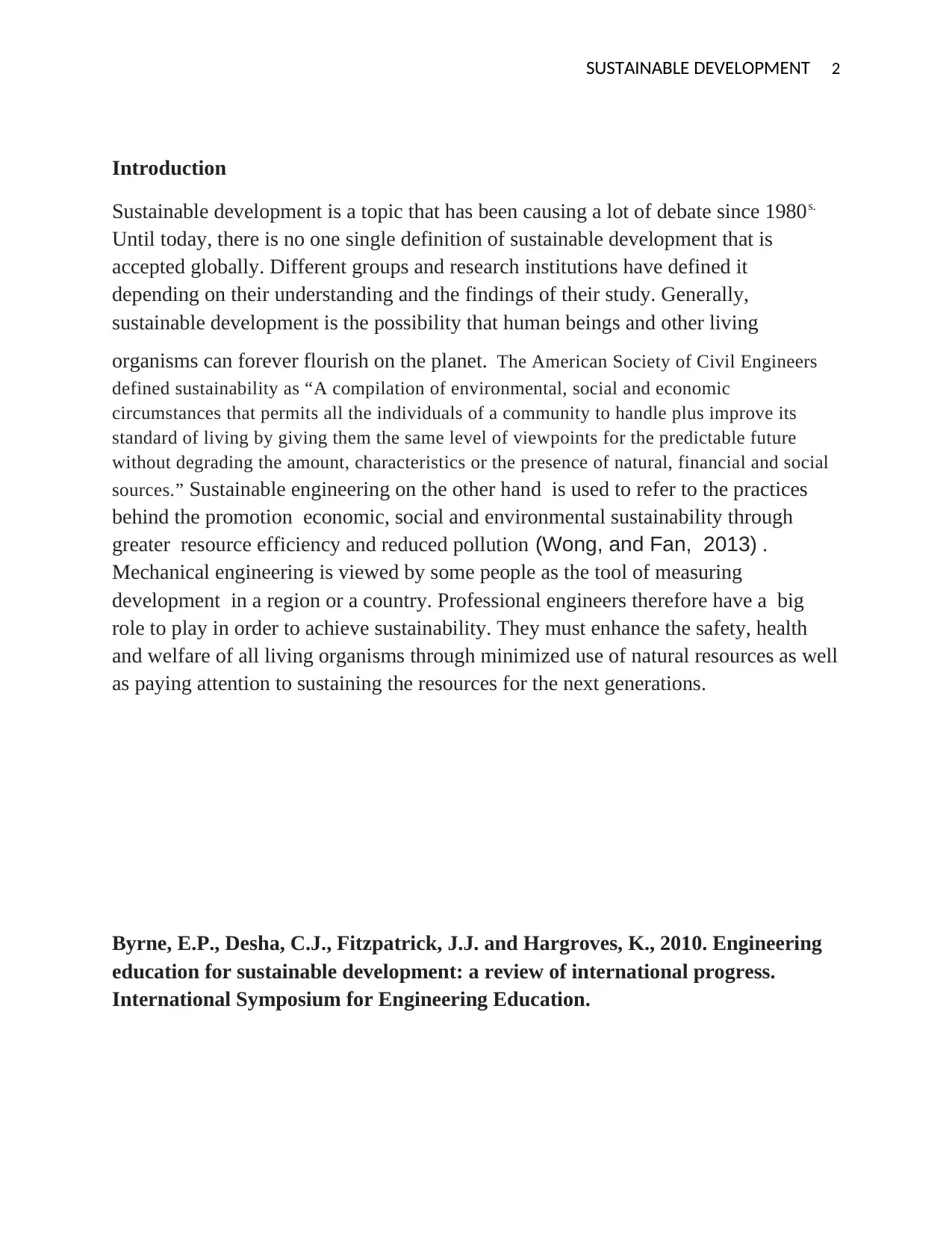
Introduction
Sustainable development is a topic that has been causing a lot of debate since 1980s.
Until today, there is no one single definition of sustainable development that is
accepted globally. Different groups and research institutions have defined it
depending on their understanding and the findings of their study. Generally,
sustainable development is the possibility that human beings and other living
organisms can forever flourish on the planet. The American Society of Civil Engineers
defined sustainability as “A compilation of environmental, social and economic
circumstances that permits all the individuals of a community to handle plus improve its
standard of living by giving them the same level of viewpoints for the predictable future
without degrading the amount, characteristics or the presence of natural, financial and social
sources.” Sustainable engineering on the other hand is used to refer to the practices
behind the promotion economic, social and environmental sustainability through
greater resource efficiency and reduced pollution (Wong, and Fan, 2013) .
Mechanical engineering is viewed by some people as the tool of measuring
development in a region or a country. Professional engineers therefore have a big
role to play in order to achieve sustainability. They must enhance the safety, health
and welfare of all living organisms through minimized use of natural resources as well
as paying attention to sustaining the resources for the next generations.
Byrne, E.P., Desha, C.J., Fitzpatrick, J.J. and Hargroves, K., 2010. Engineering
education for sustainable development: a review of international progress.
International Symposium for Engineering Education.
Introduction
Sustainable development is a topic that has been causing a lot of debate since 1980s.
Until today, there is no one single definition of sustainable development that is
accepted globally. Different groups and research institutions have defined it
depending on their understanding and the findings of their study. Generally,
sustainable development is the possibility that human beings and other living
organisms can forever flourish on the planet. The American Society of Civil Engineers
defined sustainability as “A compilation of environmental, social and economic
circumstances that permits all the individuals of a community to handle plus improve its
standard of living by giving them the same level of viewpoints for the predictable future
without degrading the amount, characteristics or the presence of natural, financial and social
sources.” Sustainable engineering on the other hand is used to refer to the practices
behind the promotion economic, social and environmental sustainability through
greater resource efficiency and reduced pollution (Wong, and Fan, 2013) .
Mechanical engineering is viewed by some people as the tool of measuring
development in a region or a country. Professional engineers therefore have a big
role to play in order to achieve sustainability. They must enhance the safety, health
and welfare of all living organisms through minimized use of natural resources as well
as paying attention to sustaining the resources for the next generations.
Byrne, E.P., Desha, C.J., Fitzpatrick, J.J. and Hargroves, K., 2010. Engineering
education for sustainable development: a review of international progress.
International Symposium for Engineering Education.
SUSTAINABLE DEVELOPMENT 3
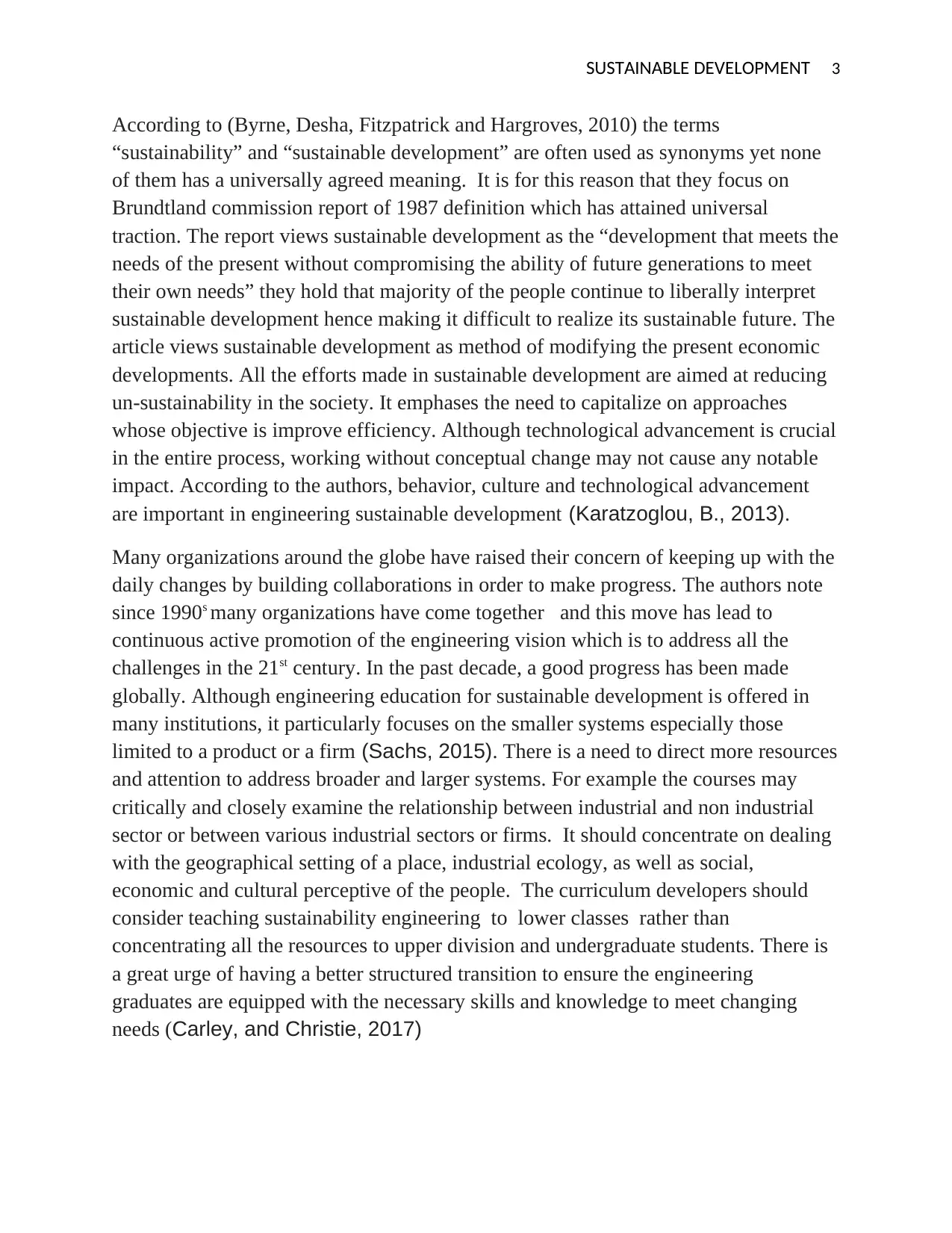
According to (Byrne, Desha, Fitzpatrick and Hargroves, 2010) the terms
“sustainability” and “sustainable development” are often used as synonyms yet none
of them has a universally agreed meaning. It is for this reason that they focus on
Brundtland commission report of 1987 definition which has attained universal
traction. The report views sustainable development as the “development that meets the
needs of the present without compromising the ability of future generations to meet
their own needs” they hold that majority of the people continue to liberally interpret
sustainable development hence making it difficult to realize its sustainable future. The
article views sustainable development as method of modifying the present economic
developments. All the efforts made in sustainable development are aimed at reducing
un-sustainability in the society. It emphases the need to capitalize on approaches
whose objective is improve efficiency. Although technological advancement is crucial
in the entire process, working without conceptual change may not cause any notable
impact. According to the authors, behavior, culture and technological advancement
are important in engineering sustainable development (Karatzoglou, B., 2013).
Many organizations around the globe have raised their concern of keeping up with the
daily changes by building collaborations in order to make progress. The authors note
since 1990s many organizations have come together and this move has lead to
continuous active promotion of the engineering vision which is to address all the
challenges in the 21st century. In the past decade, a good progress has been made
globally. Although engineering education for sustainable development is offered in
many institutions, it particularly focuses on the smaller systems especially those
limited to a product or a firm (Sachs, 2015). There is a need to direct more resources
and attention to address broader and larger systems. For example the courses may
critically and closely examine the relationship between industrial and non industrial
sector or between various industrial sectors or firms. It should concentrate on dealing
with the geographical setting of a place, industrial ecology, as well as social,
economic and cultural perceptive of the people. The curriculum developers should
consider teaching sustainability engineering to lower classes rather than
concentrating all the resources to upper division and undergraduate students. There is
a great urge of having a better structured transition to ensure the engineering
graduates are equipped with the necessary skills and knowledge to meet changing
needs (Carley, and Christie, 2017)
According to (Byrne, Desha, Fitzpatrick and Hargroves, 2010) the terms
“sustainability” and “sustainable development” are often used as synonyms yet none
of them has a universally agreed meaning. It is for this reason that they focus on
Brundtland commission report of 1987 definition which has attained universal
traction. The report views sustainable development as the “development that meets the
needs of the present without compromising the ability of future generations to meet
their own needs” they hold that majority of the people continue to liberally interpret
sustainable development hence making it difficult to realize its sustainable future. The
article views sustainable development as method of modifying the present economic
developments. All the efforts made in sustainable development are aimed at reducing
un-sustainability in the society. It emphases the need to capitalize on approaches
whose objective is improve efficiency. Although technological advancement is crucial
in the entire process, working without conceptual change may not cause any notable
impact. According to the authors, behavior, culture and technological advancement
are important in engineering sustainable development (Karatzoglou, B., 2013).
Many organizations around the globe have raised their concern of keeping up with the
daily changes by building collaborations in order to make progress. The authors note
since 1990s many organizations have come together and this move has lead to
continuous active promotion of the engineering vision which is to address all the
challenges in the 21st century. In the past decade, a good progress has been made
globally. Although engineering education for sustainable development is offered in
many institutions, it particularly focuses on the smaller systems especially those
limited to a product or a firm (Sachs, 2015). There is a need to direct more resources
and attention to address broader and larger systems. For example the courses may
critically and closely examine the relationship between industrial and non industrial
sector or between various industrial sectors or firms. It should concentrate on dealing
with the geographical setting of a place, industrial ecology, as well as social,
economic and cultural perceptive of the people. The curriculum developers should
consider teaching sustainability engineering to lower classes rather than
concentrating all the resources to upper division and undergraduate students. There is
a great urge of having a better structured transition to ensure the engineering
graduates are equipped with the necessary skills and knowledge to meet changing
needs (Carley, and Christie, 2017)
⊘ This is a preview!⊘
Do you want full access?
Subscribe today to unlock all pages.

Trusted by 1+ million students worldwide
SUSTAINABLE DEVELOPMENT 4
Gomes, C.M., Kruglianskas, I. and Scherer, F.L., 2011. Innovation management
for sustainable development practices in the internalization context. Journal of
technology management & innovation, 6(2), pp.111-127.
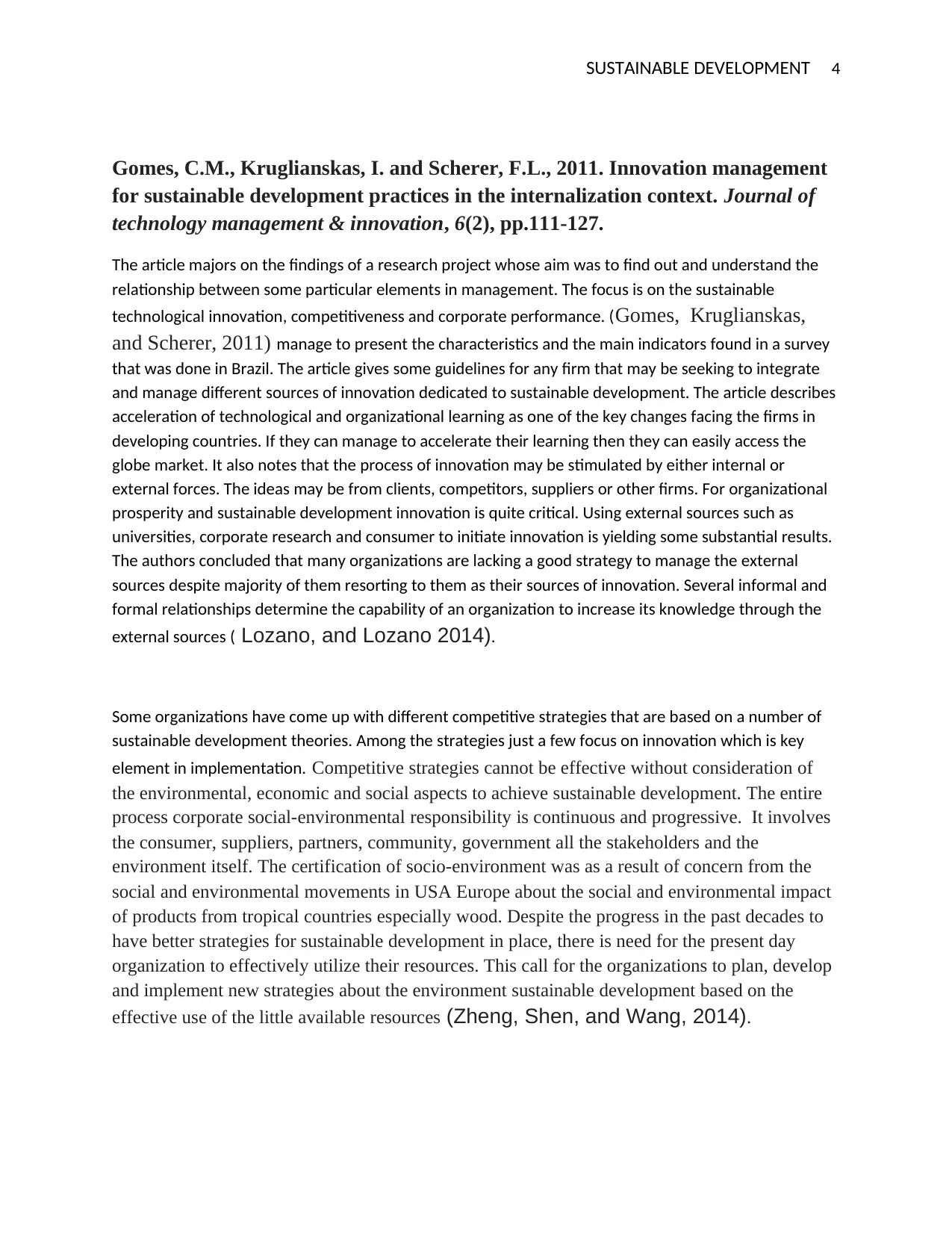
The article majors on the findings of a research project whose aim was to find out and understand the
relationship between some particular elements in management. The focus is on the sustainable
technological innovation, competitiveness and corporate performance. (Gomes, Kruglianskas,
and Scherer, 2011) manage to present the characteristics and the main indicators found in a survey
that was done in Brazil. The article gives some guidelines for any firm that may be seeking to integrate
and manage different sources of innovation dedicated to sustainable development. The article describes
acceleration of technological and organizational learning as one of the key changes facing the firms in
developing countries. If they can manage to accelerate their learning then they can easily access the
globe market. It also notes that the process of innovation may be stimulated by either internal or
external forces. The ideas may be from clients, competitors, suppliers or other firms. For organizational
prosperity and sustainable development innovation is quite critical. Using external sources such as
universities, corporate research and consumer to initiate innovation is yielding some substantial results.
The authors concluded that many organizations are lacking a good strategy to manage the external
sources despite majority of them resorting to them as their sources of innovation. Several informal and
formal relationships determine the capability of an organization to increase its knowledge through the
external sources ( Lozano, and Lozano 2014).
Some organizations have come up with different competitive strategies that are based on a number of
sustainable development theories. Among the strategies just a few focus on innovation which is key
element in implementation. Competitive strategies cannot be effective without consideration of
the environmental, economic and social aspects to achieve sustainable development. The entire
process corporate social-environmental responsibility is continuous and progressive. It involves
the consumer, suppliers, partners, community, government all the stakeholders and the
environment itself. The certification of socio-environment was as a result of concern from the
social and environmental movements in USA Europe about the social and environmental impact
of products from tropical countries especially wood. Despite the progress in the past decades to
have better strategies for sustainable development in place, there is need for the present day
organization to effectively utilize their resources. This call for the organizations to plan, develop
and implement new strategies about the environment sustainable development based on the
effective use of the little available resources (Zheng, Shen, and Wang, 2014).
Gomes, C.M., Kruglianskas, I. and Scherer, F.L., 2011. Innovation management
for sustainable development practices in the internalization context. Journal of
technology management & innovation, 6(2), pp.111-127.
The article majors on the findings of a research project whose aim was to find out and understand the
relationship between some particular elements in management. The focus is on the sustainable
technological innovation, competitiveness and corporate performance. (Gomes, Kruglianskas,
and Scherer, 2011) manage to present the characteristics and the main indicators found in a survey
that was done in Brazil. The article gives some guidelines for any firm that may be seeking to integrate
and manage different sources of innovation dedicated to sustainable development. The article describes
acceleration of technological and organizational learning as one of the key changes facing the firms in
developing countries. If they can manage to accelerate their learning then they can easily access the
globe market. It also notes that the process of innovation may be stimulated by either internal or
external forces. The ideas may be from clients, competitors, suppliers or other firms. For organizational
prosperity and sustainable development innovation is quite critical. Using external sources such as
universities, corporate research and consumer to initiate innovation is yielding some substantial results.
The authors concluded that many organizations are lacking a good strategy to manage the external
sources despite majority of them resorting to them as their sources of innovation. Several informal and
formal relationships determine the capability of an organization to increase its knowledge through the
external sources ( Lozano, and Lozano 2014).
Some organizations have come up with different competitive strategies that are based on a number of
sustainable development theories. Among the strategies just a few focus on innovation which is key
element in implementation. Competitive strategies cannot be effective without consideration of
the environmental, economic and social aspects to achieve sustainable development. The entire
process corporate social-environmental responsibility is continuous and progressive. It involves
the consumer, suppliers, partners, community, government all the stakeholders and the
environment itself. The certification of socio-environment was as a result of concern from the
social and environmental movements in USA Europe about the social and environmental impact
of products from tropical countries especially wood. Despite the progress in the past decades to
have better strategies for sustainable development in place, there is need for the present day
organization to effectively utilize their resources. This call for the organizations to plan, develop
and implement new strategies about the environment sustainable development based on the
effective use of the little available resources (Zheng, Shen, and Wang, 2014).
Paraphrase This Document
Need a fresh take? Get an instant paraphrase of this document with our AI Paraphraser
SUSTAINABLE DEVELOPMENT 5
Rahman, M., (2013) TYPE ROLE OF MECHANICAL ENGINEERS IN SUSTAINABLE
DEVELOPMENT. Journal of Mechanical Engineering, 42(1), pp.1-8.
For the sustainability of a development to work effectively, it must be in a position to meet the
present needs without interfering with the ability of the future generation to meet their needs. If a
development pays very little or no attention to the social, economic and environmental effects
then it is considered unsustainable. Development is derived by growth and it must linked to the
production of a community or a country. In case the production is done within a sustainable path,
the sustainability can be easily maintained. In most cases engineering is viewed tool of
measuring development in a country. tries to highlight the (Rahman,2013) responsibilities roles
and what the engineers need to achieve sustainable development. He points out that sustainability
is critical in order to ensure that the next generations have enough resources to meet there own
needs. Balance must be achieved to ensure the living standards of the future generation are not
jeopardized hence threatening their survival. The paper discusses the three major components
of sustainability; economic, social and environmental sustainability. It looks at what each of
them means and how important it is to work towards them. Rahma holds that mechanical
engineers play the most important role in achieving the desired sustainable development.
In order to achieve economic sustainability economic development is a prerequisite therefore the
need for growth is paramount. Poverty is main barrier that slows down economic growth of most
countries. Poverty causes individuals to have low levels of income therefore the banks and other
organizations invests little to the economy which consequently leads to slow economic growth.
The paper has highlighted some effects of low income to development. People who have low
income don’t have enough to spend for their family’s healthcare or even on the education of their
children. This leads to low human capital due to the small number of health workforce. It results
in low productivity in the economy hence low wages (Mulder, 2017). .
It is generally not possible to totally separate the economic and environmental issues because
they are very much interlinked. Every production is aimed at meeting some human needs and
therefore they must come at a cost. It is the environment that gives room for everything to be
produced. We end to sacrifice the environment in so many ways such as releasing the carbon
emission to the atmosphere, deforestation etc. Every year the rate of deforestation has been
increasing hence disrupting the carbon cycle hence leading to global warming which is a
calamity (Mihelcic, Zimmerman, and Auer, 2014) .
Social sustainability means the country is peaceful, healthy and running smoothly. It is the
responsibilities of the administrators to ensure a balance between the social and economic
sustainability. There is a great urge for the government to ensure all people are given the
necessary resources such as good health care facilities, good means of transport and education
to reduce the cases of poor living standards. Such initiatives increase the productivity levels
hence improving g the economy.
Rahman, M., (2013) TYPE ROLE OF MECHANICAL ENGINEERS IN SUSTAINABLE
DEVELOPMENT. Journal of Mechanical Engineering, 42(1), pp.1-8.
For the sustainability of a development to work effectively, it must be in a position to meet the
present needs without interfering with the ability of the future generation to meet their needs. If a
development pays very little or no attention to the social, economic and environmental effects
then it is considered unsustainable. Development is derived by growth and it must linked to the
production of a community or a country. In case the production is done within a sustainable path,
the sustainability can be easily maintained. In most cases engineering is viewed tool of
measuring development in a country. tries to highlight the (Rahman,2013) responsibilities roles
and what the engineers need to achieve sustainable development. He points out that sustainability
is critical in order to ensure that the next generations have enough resources to meet there own
needs. Balance must be achieved to ensure the living standards of the future generation are not
jeopardized hence threatening their survival. The paper discusses the three major components
of sustainability; economic, social and environmental sustainability. It looks at what each of
them means and how important it is to work towards them. Rahma holds that mechanical
engineers play the most important role in achieving the desired sustainable development.
In order to achieve economic sustainability economic development is a prerequisite therefore the
need for growth is paramount. Poverty is main barrier that slows down economic growth of most
countries. Poverty causes individuals to have low levels of income therefore the banks and other
organizations invests little to the economy which consequently leads to slow economic growth.
The paper has highlighted some effects of low income to development. People who have low
income don’t have enough to spend for their family’s healthcare or even on the education of their
children. This leads to low human capital due to the small number of health workforce. It results
in low productivity in the economy hence low wages (Mulder, 2017). .
It is generally not possible to totally separate the economic and environmental issues because
they are very much interlinked. Every production is aimed at meeting some human needs and
therefore they must come at a cost. It is the environment that gives room for everything to be
produced. We end to sacrifice the environment in so many ways such as releasing the carbon
emission to the atmosphere, deforestation etc. Every year the rate of deforestation has been
increasing hence disrupting the carbon cycle hence leading to global warming which is a
calamity (Mihelcic, Zimmerman, and Auer, 2014) .
Social sustainability means the country is peaceful, healthy and running smoothly. It is the
responsibilities of the administrators to ensure a balance between the social and economic
sustainability. There is a great urge for the government to ensure all people are given the
necessary resources such as good health care facilities, good means of transport and education
to reduce the cases of poor living standards. Such initiatives increase the productivity levels
hence improving g the economy.
SUSTAINABLE DEVELOPMENT 6
Rosen, M.A., 2012. Engineering sustainability: A technical approach to
sustainability. Sustainability, 4(9), pp.2270-2292.
In all human activities and development sustainability is one of the most
important and critical issues. Engineering is crucial for the general
sustainability since it involves economic and social activities, living standards
as well as their impact to the environment. The article discusses some of the
factors should be considered to ensuring sustainability. They include; adopting
environmental stewardship in all the activities of engineering, enhance the
proper use of resources and efficient engineering processes and selecting the
resources appropriately bearing in mind the criteria of sustainability (Charles
Schmidheiny, and Watts, 2017)
According to (Rosen, 2012) engineering is an important sector that plays a role in
determining the well being of a society, living standards of people, economic
development, cultural development and environment. As sustainable
development continues to become a concern in many countries, engineering
is continuously evolving to address ll the modern human needs. Overall
sustainability is defined in three major distinct components which are social
sustainability, economic sustainability and environmental sustainability
(Keesstra, et al 2016). Rosen argues that if the three are conserved different
entities they take the society to different directions. In other words he holds
that economic sustainability should not be achieved at the expense of either
the social or environmental sustainability. Sustainable development around
the world can only be achieved if enough and proper resources are
simultaneously direct to achieve economic, environmental and social
sustainability (Li, Yang, and Lam, 2013). It is important to note engineering is
not one of the three distinct components of sustainability but it is indirectly
linked to them all. It uses resources to run most of the world’s economic
activities in transportation, industry, commercial etc. the resources used
engineering such as water, fuels and minerals are derived from environment
while the waste products from its activities in most cases get released to the
environment (Singh, 2015). Engineering allows people to have a good living
standards as well as social and cultural development. It is a fact that all
countries use engineering services which must use resources. This continues
Rosen, M.A., 2012. Engineering sustainability: A technical approach to
sustainability. Sustainability, 4(9), pp.2270-2292.
In all human activities and development sustainability is one of the most
important and critical issues. Engineering is crucial for the general
sustainability since it involves economic and social activities, living standards
as well as their impact to the environment. The article discusses some of the
factors should be considered to ensuring sustainability. They include; adopting
environmental stewardship in all the activities of engineering, enhance the
proper use of resources and efficient engineering processes and selecting the
resources appropriately bearing in mind the criteria of sustainability (Charles
Schmidheiny, and Watts, 2017)
According to (Rosen, 2012) engineering is an important sector that plays a role in
determining the well being of a society, living standards of people, economic
development, cultural development and environment. As sustainable
development continues to become a concern in many countries, engineering
is continuously evolving to address ll the modern human needs. Overall
sustainability is defined in three major distinct components which are social
sustainability, economic sustainability and environmental sustainability
(Keesstra, et al 2016). Rosen argues that if the three are conserved different
entities they take the society to different directions. In other words he holds
that economic sustainability should not be achieved at the expense of either
the social or environmental sustainability. Sustainable development around
the world can only be achieved if enough and proper resources are
simultaneously direct to achieve economic, environmental and social
sustainability (Li, Yang, and Lam, 2013). It is important to note engineering is
not one of the three distinct components of sustainability but it is indirectly
linked to them all. It uses resources to run most of the world’s economic
activities in transportation, industry, commercial etc. the resources used
engineering such as water, fuels and minerals are derived from environment
while the waste products from its activities in most cases get released to the
environment (Singh, 2015). Engineering allows people to have a good living
standards as well as social and cultural development. It is a fact that all
countries use engineering services which must use resources. This continues
⊘ This is a preview!⊘
Do you want full access?
Subscribe today to unlock all pages.
Trusted by 1+ million students worldwide

SUSTAINABLE DEVELOPMENT 7
to increase the need to have a stable sustainable development (Spangenberg,
2013).
Although engineering sustainability is important, it has not been well
understood. It’s good to understand how the sustainability concept works with
the profession. The article examines some of the main factors that must be
dealt with to achieve sustainability in engineering. The author illustrates the
need for the engineering activities to be looked at more closely to ensure the
evolution in the profession matches the changes in other human activities
Clark et al (2016).
Chaharbaghi, K. and Willis, R., 1999. The study and practice of sustainable
development. Engineering Management Journal, 9(1), pp.41-48.
The human race exists in a society where thierlife matters to them more than anything else under
the sun. people are much concerned about their health and give a lot of attention to the air they
breathe, the water they drink the type and condition of food that they eat as well as their peace
and security. Their livelihoods give room for enjoying live and bringing up healthy children.
Parents focus at building and gathering much wealth both natural and manmade assets for the
generations to come. The concern about the increasing levels of poverty, the environment, the
resources and the general long-term future continues to grow. This concerns area a result of
social unrest, spread of diseases environmental degradation and population growth. Chaharbaghi,
and Willis,(1999) views sustainable development as a bridge to fill the gap between the real and
the ideal world. They reveal sustainable development in terms of the limitations, risks as well
as the opportunities of the modern variables images to make it a valid idea. More emphases
should be directed to making sustainable development a reality rather than a mere idea. People
must ensure sustainability in three major sectors of human life. This is because all that a human
being is concerned about revolves around economic stability, environmental stability and social
stability. Despite the efforts and resources directed at evaluating the social, economic and
environmental sustainability for the last two decades much is yet to be achieved. One of the
major challenges is coming up with the globally accepted definition for sustainable development
in order to help the stakeholders to effectively address all the issues effectively (Lozano
2013). There is every need for more attention, studies and resources to be direct to
sustainability in order to explore its full potential.
Conclusion
It is clear that sustainability involves various disciplines therefore its achievement requires a lot
of cooperation from all the stakeholders. Social, economic and environmental aspects of
to increase the need to have a stable sustainable development (Spangenberg,
2013).
Although engineering sustainability is important, it has not been well
understood. It’s good to understand how the sustainability concept works with
the profession. The article examines some of the main factors that must be
dealt with to achieve sustainability in engineering. The author illustrates the
need for the engineering activities to be looked at more closely to ensure the
evolution in the profession matches the changes in other human activities
Clark et al (2016).
Chaharbaghi, K. and Willis, R., 1999. The study and practice of sustainable
development. Engineering Management Journal, 9(1), pp.41-48.
The human race exists in a society where thierlife matters to them more than anything else under
the sun. people are much concerned about their health and give a lot of attention to the air they
breathe, the water they drink the type and condition of food that they eat as well as their peace
and security. Their livelihoods give room for enjoying live and bringing up healthy children.
Parents focus at building and gathering much wealth both natural and manmade assets for the
generations to come. The concern about the increasing levels of poverty, the environment, the
resources and the general long-term future continues to grow. This concerns area a result of
social unrest, spread of diseases environmental degradation and population growth. Chaharbaghi,
and Willis,(1999) views sustainable development as a bridge to fill the gap between the real and
the ideal world. They reveal sustainable development in terms of the limitations, risks as well
as the opportunities of the modern variables images to make it a valid idea. More emphases
should be directed to making sustainable development a reality rather than a mere idea. People
must ensure sustainability in three major sectors of human life. This is because all that a human
being is concerned about revolves around economic stability, environmental stability and social
stability. Despite the efforts and resources directed at evaluating the social, economic and
environmental sustainability for the last two decades much is yet to be achieved. One of the
major challenges is coming up with the globally accepted definition for sustainable development
in order to help the stakeholders to effectively address all the issues effectively (Lozano
2013). There is every need for more attention, studies and resources to be direct to
sustainability in order to explore its full potential.
Conclusion
It is clear that sustainability involves various disciplines therefore its achievement requires a lot
of cooperation from all the stakeholders. Social, economic and environmental aspects of
Paraphrase This Document
Need a fresh take? Get an instant paraphrase of this document with our AI Paraphraser
SUSTAINABLE DEVELOPMENT 8
sustainability must be carefully handled in order to be effective. Sustainability is a quite broad
and wide ranging concept therefore more research has to be done. The stakeholders must also
agree on its definition and application for easier implementation. Despite the progress made in
sustainability, a standard frame work to assess its progress is still lacking hence more efforts
have to be put.
The main driving force for engineers is industrial development. Mechanical engineers therefore
play a central role in economic growth. They must get involved more in economic and
industrial development of their countries through helping the government in planning for
sustainable development. The curriculum for mechanical engineers should be occasionally
revised and updated to ensure the innovative minds of the future engineers are well inculcated.
Engineers should always be inspired to be creative and innovative every day in order to
adequately meet the needs and solve the new emerging challenges in the society. Once the see
the fruits of being innovative, it becomes interesting to them hence the engineering enthusiasm
raises in them to drive the economy. Engineers must remain creative, innovative and vigilant in
order to achieve more in the path sustainable development.
References
Byrne, E.P., Desha, C.J., Fitzpatrick, J.J. and Hargroves, K., 2010. Engineering
education for sustainable development: a review of international progress.
International Symposium for Engineering Education.
Carley, M. and Christie, I., 2017. Managing sustainable development.
Routledge.
Chaharbaghi, K. and Willis, R., 1999. The study and practice of sustainable
development. Engineering Management Journal, 9(1), pp.41-48.
Clark, W.C., van Kerkhoff, L., Lebel, L. and Gallopin, G.C., 2016. Crafting
usable knowledge for sustainable development. Proceedings of the National
Academy of Sciences, 113(17), pp.4570-4578.
Charles Jr, O.H., Schmidheiny, S. and Watts, P., 2017. Walking the talk: The
business case for sustainable development. Routledge.
Gomes, C.M., Kruglianskas, I. and Scherer, F.L., 2011. Innovation management for
sustainable development practices in the internalization context. Journal of technology
management & innovation, 6(2), pp.111-127.
sustainability must be carefully handled in order to be effective. Sustainability is a quite broad
and wide ranging concept therefore more research has to be done. The stakeholders must also
agree on its definition and application for easier implementation. Despite the progress made in
sustainability, a standard frame work to assess its progress is still lacking hence more efforts
have to be put.
The main driving force for engineers is industrial development. Mechanical engineers therefore
play a central role in economic growth. They must get involved more in economic and
industrial development of their countries through helping the government in planning for
sustainable development. The curriculum for mechanical engineers should be occasionally
revised and updated to ensure the innovative minds of the future engineers are well inculcated.
Engineers should always be inspired to be creative and innovative every day in order to
adequately meet the needs and solve the new emerging challenges in the society. Once the see
the fruits of being innovative, it becomes interesting to them hence the engineering enthusiasm
raises in them to drive the economy. Engineers must remain creative, innovative and vigilant in
order to achieve more in the path sustainable development.
References
Byrne, E.P., Desha, C.J., Fitzpatrick, J.J. and Hargroves, K., 2010. Engineering
education for sustainable development: a review of international progress.
International Symposium for Engineering Education.
Carley, M. and Christie, I., 2017. Managing sustainable development.
Routledge.
Chaharbaghi, K. and Willis, R., 1999. The study and practice of sustainable
development. Engineering Management Journal, 9(1), pp.41-48.
Clark, W.C., van Kerkhoff, L., Lebel, L. and Gallopin, G.C., 2016. Crafting
usable knowledge for sustainable development. Proceedings of the National
Academy of Sciences, 113(17), pp.4570-4578.
Charles Jr, O.H., Schmidheiny, S. and Watts, P., 2017. Walking the talk: The
business case for sustainable development. Routledge.
Gomes, C.M., Kruglianskas, I. and Scherer, F.L., 2011. Innovation management for
sustainable development practices in the internalization context. Journal of technology
management & innovation, 6(2), pp.111-127.

SUSTAINABLE DEVELOPMENT 9
Karatzoglou, B., 2013. An in-depth literature review of the evolving roles and
contributions of universities to education for sustainable development. Journal
of Cleaner Production, 49, pp.44-53.
Keesstra, S.D., Bouma, J., Wallinga, J., Tittonell, P., Smith, P., Cerdà, A.,
Montanarella, L., Quinton, J.N., Pachepsky, Y., van der Putten, W.H. and
Bardgett, R.D., 2016. The significance of soils and soil science towards
realization of the United Nations Sustainable Development Goals. Soil, 2(2),
pp.111-128.
Li, D.H., Yang, L. and Lam, J.C., 2013. Zero energy buildings and sustainable
development implications–A review. Energy, 54, pp.1-10.
Lozano, F.J. and Lozano, R., 2014. Developing the curriculum for a new
Bachelor's degree in Engineering for Sustainable Development. Journal of
Cleaner Production, 64, pp.136-146.
Lozano, R., Lozano, F.J., Mulder, K., Huisingh, D. and Waas, T., 2013.
Advancing higher education for sustainable development: international
insights and critical reflections.
Mihelcic, J.R., Zimmerman, J.B. and Auer, M.T., 2014. Environmental
engineering: Fundamentals, sustainability, design (Vol. 1). Hoboken: Wiley.
Mulder, K. ed., 2017. Sustainable development for engineers: A handbook
and resource guide. Routledge.
Rahman, M., (2013) TYPE ROLE OF MECHANICAL ENGINEERS IN SUSTAINABLE
DEVELOPMENT. Journal of Mechanical Engineering, 42(1), pp.1-8.
Rosen, M.A., 2012. Engineering sustainability: A technical approach to
sustainability. Sustainability, 4(9), pp.2270-2292.
Sachs, J.D., 2015. The age of sustainable development. Columbia University
Press.
Singh, J.S., 2015. Microbes: the chief ecological engineers in reinstating
equilibrium in degraded ecosystems. Agriculture, Ecosystems &
Environment, 203, pp.80-82.
Karatzoglou, B., 2013. An in-depth literature review of the evolving roles and
contributions of universities to education for sustainable development. Journal
of Cleaner Production, 49, pp.44-53.
Keesstra, S.D., Bouma, J., Wallinga, J., Tittonell, P., Smith, P., Cerdà, A.,
Montanarella, L., Quinton, J.N., Pachepsky, Y., van der Putten, W.H. and
Bardgett, R.D., 2016. The significance of soils and soil science towards
realization of the United Nations Sustainable Development Goals. Soil, 2(2),
pp.111-128.
Li, D.H., Yang, L. and Lam, J.C., 2013. Zero energy buildings and sustainable
development implications–A review. Energy, 54, pp.1-10.
Lozano, F.J. and Lozano, R., 2014. Developing the curriculum for a new
Bachelor's degree in Engineering for Sustainable Development. Journal of
Cleaner Production, 64, pp.136-146.
Lozano, R., Lozano, F.J., Mulder, K., Huisingh, D. and Waas, T., 2013.
Advancing higher education for sustainable development: international
insights and critical reflections.
Mihelcic, J.R., Zimmerman, J.B. and Auer, M.T., 2014. Environmental
engineering: Fundamentals, sustainability, design (Vol. 1). Hoboken: Wiley.
Mulder, K. ed., 2017. Sustainable development for engineers: A handbook
and resource guide. Routledge.
Rahman, M., (2013) TYPE ROLE OF MECHANICAL ENGINEERS IN SUSTAINABLE
DEVELOPMENT. Journal of Mechanical Engineering, 42(1), pp.1-8.
Rosen, M.A., 2012. Engineering sustainability: A technical approach to
sustainability. Sustainability, 4(9), pp.2270-2292.
Sachs, J.D., 2015. The age of sustainable development. Columbia University
Press.
Singh, J.S., 2015. Microbes: the chief ecological engineers in reinstating
equilibrium in degraded ecosystems. Agriculture, Ecosystems &
Environment, 203, pp.80-82.
⊘ This is a preview!⊘
Do you want full access?
Subscribe today to unlock all pages.
Trusted by 1+ million students worldwide
SUSTAINABLE DEVELOPMENT 10
Spangenberg, J.H., 2013. Design for sustainability (DfS): Interface of
sustainable production and consumption. In Handbook of sustainable
engineering (pp. 575-595). Springer, Dordrecht.
Wong, K.D. and Fan, Q., 2013. Building information modelling (BIM) for
sustainable building design. Facilities, 31(3/4), pp.138-157.
Zheng, H.W., Shen, G.Q. and Wang, H., 2014. A review of recent studies on
sustainable urban renewal. Habitat International, 41, pp.272-279.
Spangenberg, J.H., 2013. Design for sustainability (DfS): Interface of
sustainable production and consumption. In Handbook of sustainable
engineering (pp. 575-595). Springer, Dordrecht.
Wong, K.D. and Fan, Q., 2013. Building information modelling (BIM) for
sustainable building design. Facilities, 31(3/4), pp.138-157.
Zheng, H.W., Shen, G.Q. and Wang, H., 2014. A review of recent studies on
sustainable urban renewal. Habitat International, 41, pp.272-279.

1 out of 10


Related Documents


Your All-in-One AI-Powered Toolkit for Academic Success.
+13062052269
info@desklib.com
Available 24*7 on WhatsApp / Email
![[object Object]](/_next/static/media/star-bottom.7253800d.svg)
Unlock your academic potential
Copyright © 2020–2026 A2Z Services. All Rights Reserved. Developed and managed by ZUCOL.