Enginuity Competition: Analysis of Group Project and HRM
VerifiedAdded on 2021/08/30
|13
|3540
|113
Report
AI Summary
This report details a student's experience in the Enginuity competition, a virtual simulation of the construction industry. Part A focuses on communication, motivation, group work supervision, and lessons learned from the project, including the importance of communication, equal opportunities, and decision-making within a team. Part B explores job progression, the role of human resource management (HRM), and its functions in a construction company, including recruitment, training, compensation, worker safety, and employee satisfaction. The report also examines the financial role of HRM and its relationship with other departments, emphasizing the importance of efficient labor management for cost reduction and increased profitability. The student reflects on the social interactions and the realistic environment provided by the Enginuity competition, highlighting the application of theoretical knowledge in a practical setting.

Title page to be added

Paraphrase This Document
Need a fresh take? Get an instant paraphrase of this document with our AI Paraphraser
Part A
Communication
Communication plays an essential role in the successful completion of projects. It is also referred
to like the interactions to help each other. Communication skills are critically required in the
group members to ensure the smooth progress of a project (Zulch, 2014). Communication can
include helping others with issues, introducing a new concept, or having a conversation
regarding anything in particular. The group's overall efficiency critically depends on the degree
of communication among the group members. If the group members fail to communicate and
communication barriers, it will cause severe disruptions in the group working. Moreover, if an
individual feels cut out from the group communication and any communication that discomforts
any particular group member can also cause barriers to efficient communication (Ziek and
Anderson, 2015). As a consequence, these barriers can prove to have a severe negative impact on
the outcomes.
Firstly, we laid out a communication plan to make it easy for the group members to discuss and
coordinate. It was decided that the communication will be done through WhatsApp group chat.
The group decided to use the zoom conference feature to arrange meetings to discuss their
thinking and findings. Any form of conflict was dealt with a discussing and sorting out the
issues. Moreover, the individuals with a lack of confidence to speak were provided with an
opportunity to talk. This made it easy for everyone to learn how to communicate professionally.
The motivation of group members
The motivation of group members is an essential factor that contributes towards the successful
outcomes for the group. According to Herzberg's two-factor theory, the motivating factors
include the following;
Growth
Achievement
Responsibility
Recognition
Advancement
The work itself
Communication
Communication plays an essential role in the successful completion of projects. It is also referred
to like the interactions to help each other. Communication skills are critically required in the
group members to ensure the smooth progress of a project (Zulch, 2014). Communication can
include helping others with issues, introducing a new concept, or having a conversation
regarding anything in particular. The group's overall efficiency critically depends on the degree
of communication among the group members. If the group members fail to communicate and
communication barriers, it will cause severe disruptions in the group working. Moreover, if an
individual feels cut out from the group communication and any communication that discomforts
any particular group member can also cause barriers to efficient communication (Ziek and
Anderson, 2015). As a consequence, these barriers can prove to have a severe negative impact on
the outcomes.
Firstly, we laid out a communication plan to make it easy for the group members to discuss and
coordinate. It was decided that the communication will be done through WhatsApp group chat.
The group decided to use the zoom conference feature to arrange meetings to discuss their
thinking and findings. Any form of conflict was dealt with a discussing and sorting out the
issues. Moreover, the individuals with a lack of confidence to speak were provided with an
opportunity to talk. This made it easy for everyone to learn how to communicate professionally.
The motivation of group members
The motivation of group members is an essential factor that contributes towards the successful
outcomes for the group. According to Herzberg's two-factor theory, the motivating factors
include the following;
Growth
Achievement
Responsibility
Recognition
Advancement
The work itself
These motivating factors were focused while the group work and every member were required to
provide feedback for each other's work. This helped the group to recognize the efforts of each
member of the group. Every member's personal growth was achieved as everyone was told to put
their opinions on the table. Every member shared the knowledge and information with others.
Hence, everyone was aware of the latest developments and the practical procedures of a project.
Equal opportunities and responsibilities were distributed to ensure equality in the group work.
Group work supervision
A group leader must supervise the team performance to ensure that the group members are
putting maximum effort in the right direction (Smith, 1999). We decided on a group leader after
a voting session on an online zoom meeting. The leader was not given authority over others.
However, the leader's responsibility was to develop schedules and distribute work equally. The
leader was also responsible for planning the meetings of group members. The leader was given a
relatively more minor amount of work to ensure that the group remains organized. As every
group member participated in the competition for personal growth, everyone was motivated to
put in their maximum effort. For instance, there was a conflict between two of the group
members. The dispute was resolved by themselves as they were aware that the conflict would
only negatively affect their work.
Learnings
I learned many lessons from the group project. The learning process also helped me to develop
my skills and to polish my traits. The group working enabled me to develop communication
skills and helped me to build confidence. I was hesitant to speak on the initial day of work, but I
got comfortable with the members within two to three days. However, the rate of development
critically depends on the nature and behaviour of the group members. Due to the rest of the
members' cooperative behaviour, I felt motivated and comfortable working and providing my
views regarding different issues. The team members were supportive and showed appreciation
which motivated everyone to work efficiently. The group work also helped me to realize the
importance of multiple perceptions in a project. These perceptions help to assess and evaluate
specific issues with multiple opinions and schools of thought. Decision-taking is one of the most
critical elements of teamwork. Efficient decision-making is only possible if every member
provide feedback for each other's work. This helped the group to recognize the efforts of each
member of the group. Every member's personal growth was achieved as everyone was told to put
their opinions on the table. Every member shared the knowledge and information with others.
Hence, everyone was aware of the latest developments and the practical procedures of a project.
Equal opportunities and responsibilities were distributed to ensure equality in the group work.
Group work supervision
A group leader must supervise the team performance to ensure that the group members are
putting maximum effort in the right direction (Smith, 1999). We decided on a group leader after
a voting session on an online zoom meeting. The leader was not given authority over others.
However, the leader's responsibility was to develop schedules and distribute work equally. The
leader was also responsible for planning the meetings of group members. The leader was given a
relatively more minor amount of work to ensure that the group remains organized. As every
group member participated in the competition for personal growth, everyone was motivated to
put in their maximum effort. For instance, there was a conflict between two of the group
members. The dispute was resolved by themselves as they were aware that the conflict would
only negatively affect their work.
Learnings
I learned many lessons from the group project. The learning process also helped me to develop
my skills and to polish my traits. The group working enabled me to develop communication
skills and helped me to build confidence. I was hesitant to speak on the initial day of work, but I
got comfortable with the members within two to three days. However, the rate of development
critically depends on the nature and behaviour of the group members. Due to the rest of the
members' cooperative behaviour, I felt motivated and comfortable working and providing my
views regarding different issues. The team members were supportive and showed appreciation
which motivated everyone to work efficiently. The group work also helped me to realize the
importance of multiple perceptions in a project. These perceptions help to assess and evaluate
specific issues with multiple opinions and schools of thought. Decision-taking is one of the most
critical elements of teamwork. Efficient decision-making is only possible if every member
⊘ This is a preview!⊘
Do you want full access?
Subscribe today to unlock all pages.

Trusted by 1+ million students worldwide
critically reviews every part of the decision. This helps to identify the weaknesses in a decision,
and there are low chances of errors if the decision is made after all the members agreeing to it.
The software used was complicated and required sufficient knowledge to operate. The learning
was made easy with every member helping each other. The team members cooperated and
participated equally in the meetings. Teamwork enabled us to achieve the successful completion
of the project. Enginuity competition was an excellent opportunity to learn and know about the
realistic environment of the construction industry of the U.K. It helped to identify the issues and
problems that may arise in the construction industry. It also helped me learn to work in a group
or a team and work for collective interests.
Reflection on Enginuity competition
Social interactions are one of the essential elements of a professional career. These interactions
are based on one's communication skills. Enguinity competition is based on a virtual competition
in a realistic environment to help students learn about worldwide economies and construction
frameworks. The competition allows the students to assess and evaluate the market structure and
analyze their skills.
Our task was to develop and plan a virtual construction company. The group project included
forming group and group collaboration to research and design a construction business with
realistic approaches and procedures. The group members were motivated for the project, and
everyone presented their idea for the vision of the company and its name and logo designing.
There were several points to discuss and plan collaboratively. As the project required a detailed
business overview, therefore, efficient teamwork was necessary. Communication played an
integral part in the working of the project. To achieve the completion of the project, adequate
communication and coordination were required. The project's initial phases were rough, and it
took time for members to learn teamwork and collaboration practically
and there are low chances of errors if the decision is made after all the members agreeing to it.
The software used was complicated and required sufficient knowledge to operate. The learning
was made easy with every member helping each other. The team members cooperated and
participated equally in the meetings. Teamwork enabled us to achieve the successful completion
of the project. Enginuity competition was an excellent opportunity to learn and know about the
realistic environment of the construction industry of the U.K. It helped to identify the issues and
problems that may arise in the construction industry. It also helped me learn to work in a group
or a team and work for collective interests.
Reflection on Enginuity competition
Social interactions are one of the essential elements of a professional career. These interactions
are based on one's communication skills. Enguinity competition is based on a virtual competition
in a realistic environment to help students learn about worldwide economies and construction
frameworks. The competition allows the students to assess and evaluate the market structure and
analyze their skills.
Our task was to develop and plan a virtual construction company. The group project included
forming group and group collaboration to research and design a construction business with
realistic approaches and procedures. The group members were motivated for the project, and
everyone presented their idea for the vision of the company and its name and logo designing.
There were several points to discuss and plan collaboratively. As the project required a detailed
business overview, therefore, efficient teamwork was necessary. Communication played an
integral part in the working of the project. To achieve the completion of the project, adequate
communication and coordination were required. The project's initial phases were rough, and it
took time for members to learn teamwork and collaboration practically
Paraphrase This Document
Need a fresh take? Get an instant paraphrase of this document with our AI Paraphraser
Part B
Job Progression
Job progression is an essential sector of a company and is essentially critical in the construction
industry. The purpose of labour management to ensure adequate allocation of human resources
and to monitor performance. For this reason, a Human Resource department is established in our
company. H.R. department must focus on labour management and yield maximum output from
the labour. However, the main task of the labour-management department is to manage the
labour schedule and utilize labour efficiently. The human resource department plays an essential
role in the operations of a business. The H.R. department of the company supervises and plans
the organizational behaviour and culture. It is responsible for the employer-employee relations in
a company (Storey, 2016). The business requires good relations with workers as they are the
ones who will perform the work. The performance of a business entirely depends on the
employees. Therefore, H.R. plays an essential role in a successful campaign of a business. Below
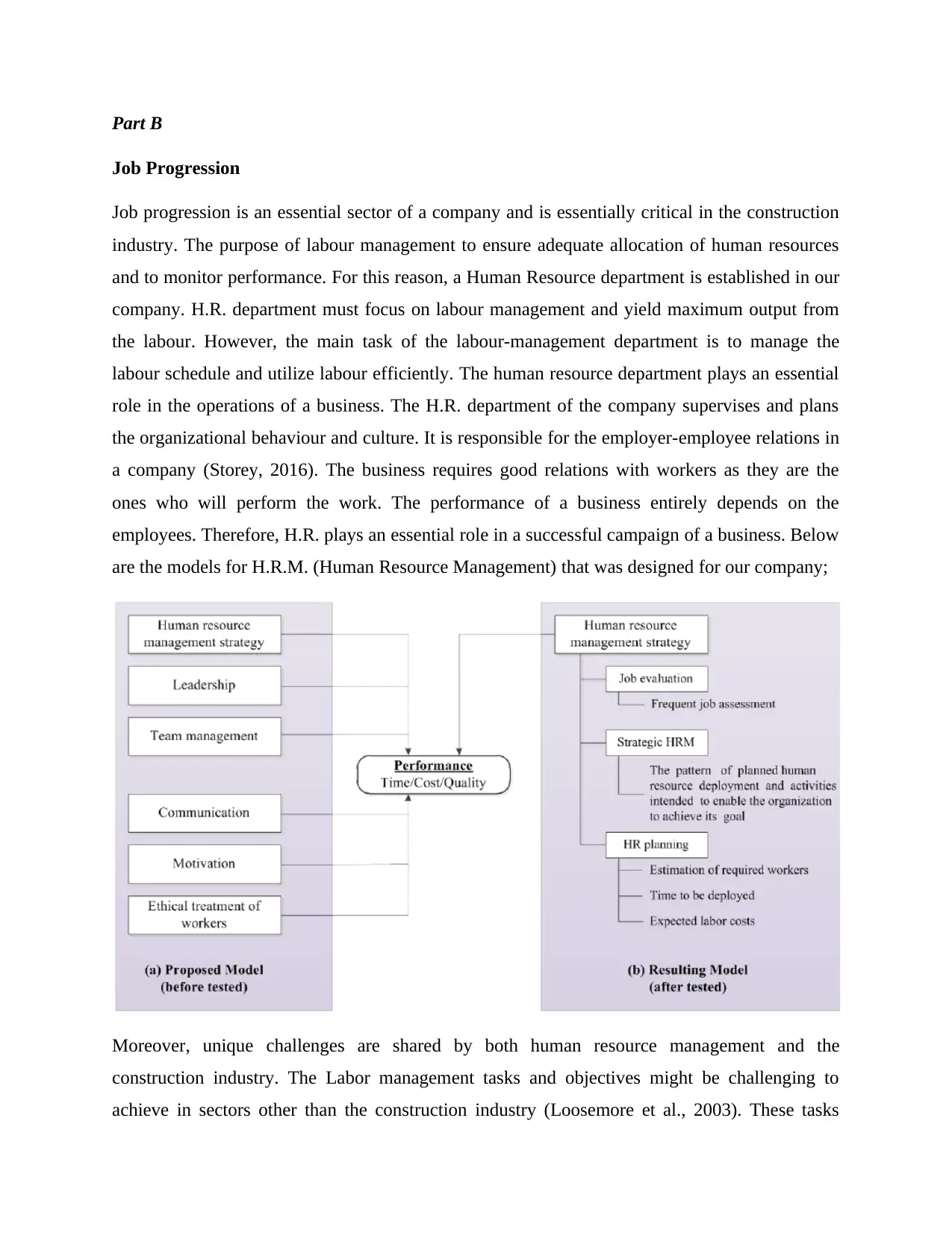
are the models for H.R.M. (Human Resource Management) that was designed for our company;
Moreover, unique challenges are shared by both human resource management and the
construction industry. The Labor management tasks and objectives might be challenging to
achieve in sectors other than the construction industry (Loosemore et al., 2003). These tasks
Job Progression
Job progression is an essential sector of a company and is essentially critical in the construction
industry. The purpose of labour management to ensure adequate allocation of human resources
and to monitor performance. For this reason, a Human Resource department is established in our
company. H.R. department must focus on labour management and yield maximum output from
the labour. However, the main task of the labour-management department is to manage the
labour schedule and utilize labour efficiently. The human resource department plays an essential
role in the operations of a business. The H.R. department of the company supervises and plans
the organizational behaviour and culture. It is responsible for the employer-employee relations in
a company (Storey, 2016). The business requires good relations with workers as they are the
ones who will perform the work. The performance of a business entirely depends on the
employees. Therefore, H.R. plays an essential role in a successful campaign of a business. Below
are the models for H.R.M. (Human Resource Management) that was designed for our company;
Moreover, unique challenges are shared by both human resource management and the
construction industry. The Labor management tasks and objectives might be challenging to
achieve in sectors other than the construction industry (Loosemore et al., 2003). These tasks
include developing and enforcement of human resources policies, keeping track of employees'
performance, hiring and firing employees, and a communication bridge between employer and
employee. The roles and responsibilities of the H.R. department for the business developed at
Enguinity competition is thoroughly discussed below;
Roles and Responsibilities related to Labor Management
Recruitment and termination of workers
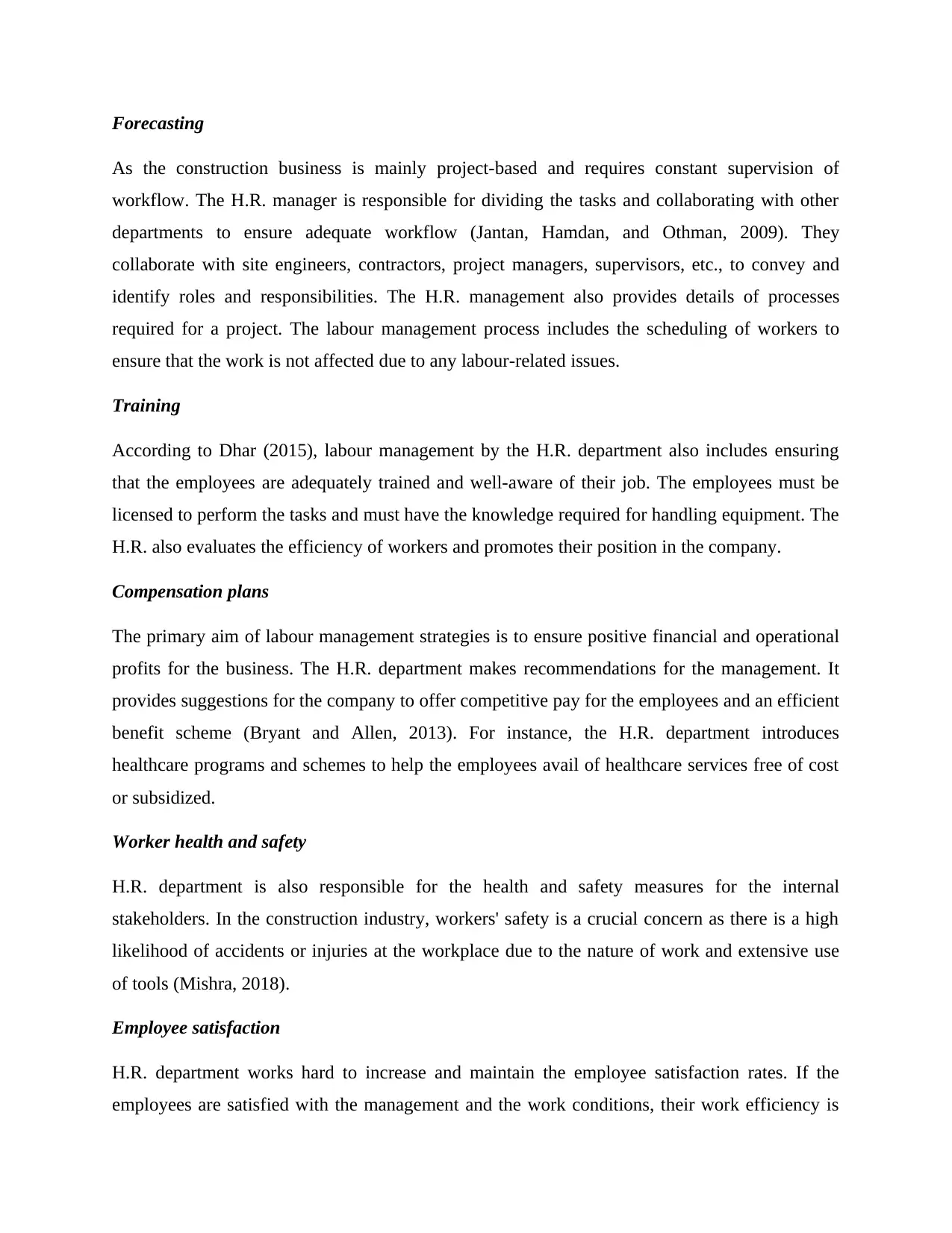
The H.R. department is responsible for recruitment procedures of the business. As for adequate
labour management, it is necessary to have sufficient workers for the project. The H.R.
department puts out employment advertisements and is responsible for arranging meetings with
the candidates. These candidates are also interviewed and assess these candidates for
employment. The H.R. department hires the workers and recommends them for specific work
areas according to their capabilities (Compton, 2009). H.R. is also responsible for the
documentation of employment contracts and negotiation of wages. The workers always concern
with the H.R. department for their queries or issues (Ordanini and Silvestri, 2008). Below
provided are an H.R.M. framework for recruiting and selection protocol;
performance, hiring and firing employees, and a communication bridge between employer and
employee. The roles and responsibilities of the H.R. department for the business developed at
Enguinity competition is thoroughly discussed below;
Roles and Responsibilities related to Labor Management
Recruitment and termination of workers
The H.R. department is responsible for recruitment procedures of the business. As for adequate
labour management, it is necessary to have sufficient workers for the project. The H.R.
department puts out employment advertisements and is responsible for arranging meetings with
the candidates. These candidates are also interviewed and assess these candidates for
employment. The H.R. department hires the workers and recommends them for specific work
areas according to their capabilities (Compton, 2009). H.R. is also responsible for the
documentation of employment contracts and negotiation of wages. The workers always concern
with the H.R. department for their queries or issues (Ordanini and Silvestri, 2008). Below
provided are an H.R.M. framework for recruiting and selection protocol;
⊘ This is a preview!⊘
Do you want full access?
Subscribe today to unlock all pages.
Trusted by 1+ million students worldwide
Forecasting
As the construction business is mainly project-based and requires constant supervision of
workflow. The H.R. manager is responsible for dividing the tasks and collaborating with other
departments to ensure adequate workflow (Jantan, Hamdan, and Othman, 2009). They
collaborate with site engineers, contractors, project managers, supervisors, etc., to convey and
identify roles and responsibilities. The H.R. management also provides details of processes
required for a project. The labour management process includes the scheduling of workers to
ensure that the work is not affected due to any labour-related issues.
Training
According to Dhar (2015), labour management by the H.R. department also includes ensuring
that the employees are adequately trained and well-aware of their job. The employees must be
licensed to perform the tasks and must have the knowledge required for handling equipment. The
H.R. also evaluates the efficiency of workers and promotes their position in the company.
Compensation plans
The primary aim of labour management strategies is to ensure positive financial and operational
profits for the business. The H.R. department makes recommendations for the management. It
provides suggestions for the company to offer competitive pay for the employees and an efficient
benefit scheme (Bryant and Allen, 2013). For instance, the H.R. department introduces
healthcare programs and schemes to help the employees avail of healthcare services free of cost
or subsidized.
Worker health and safety
H.R. department is also responsible for the health and safety measures for the internal
stakeholders. In the construction industry, workers' safety is a crucial concern as there is a high
likelihood of accidents or injuries at the workplace due to the nature of work and extensive use
of tools (Mishra, 2018).
Employee satisfaction
H.R. department works hard to increase and maintain the employee satisfaction rates. If the
employees are satisfied with the management and the work conditions, their work efficiency is
As the construction business is mainly project-based and requires constant supervision of
workflow. The H.R. manager is responsible for dividing the tasks and collaborating with other
departments to ensure adequate workflow (Jantan, Hamdan, and Othman, 2009). They
collaborate with site engineers, contractors, project managers, supervisors, etc., to convey and
identify roles and responsibilities. The H.R. management also provides details of processes
required for a project. The labour management process includes the scheduling of workers to
ensure that the work is not affected due to any labour-related issues.
Training
According to Dhar (2015), labour management by the H.R. department also includes ensuring
that the employees are adequately trained and well-aware of their job. The employees must be
licensed to perform the tasks and must have the knowledge required for handling equipment. The
H.R. also evaluates the efficiency of workers and promotes their position in the company.
Compensation plans
The primary aim of labour management strategies is to ensure positive financial and operational
profits for the business. The H.R. department makes recommendations for the management. It
provides suggestions for the company to offer competitive pay for the employees and an efficient
benefit scheme (Bryant and Allen, 2013). For instance, the H.R. department introduces
healthcare programs and schemes to help the employees avail of healthcare services free of cost
or subsidized.
Worker health and safety
H.R. department is also responsible for the health and safety measures for the internal
stakeholders. In the construction industry, workers' safety is a crucial concern as there is a high
likelihood of accidents or injuries at the workplace due to the nature of work and extensive use
of tools (Mishra, 2018).
Employee satisfaction
H.R. department works hard to increase and maintain the employee satisfaction rates. If the
employees are satisfied with the management and the work conditions, their work efficiency is
Paraphrase This Document
Need a fresh take? Get an instant paraphrase of this document with our AI Paraphraser
increased (Yankov and Kleiner, 2001). Increased productivity and efficiency of employees help
get positive outcomes for the employees.
Employee retention and turnover rates
The H.R. department is also responsible for increasing and decreasing the retention and turnover
rates, respectively. Skilled workers are an asset of the business, and the company has already
invested in the employee. H.R. department is responsible for developing incentives and bonuses
for the employees to keep them motivated.
In the Enginuity competition, the responsibility of a labour manager was to implement strategies
for better labour management and increase the output of the labour. Allocation of tasks was also
an important step in the simulation with scheduling and allocating different tasks for workers. An
H.R. manager mostly handles the labour-management department.
Relation with rest of the departments
Finance department
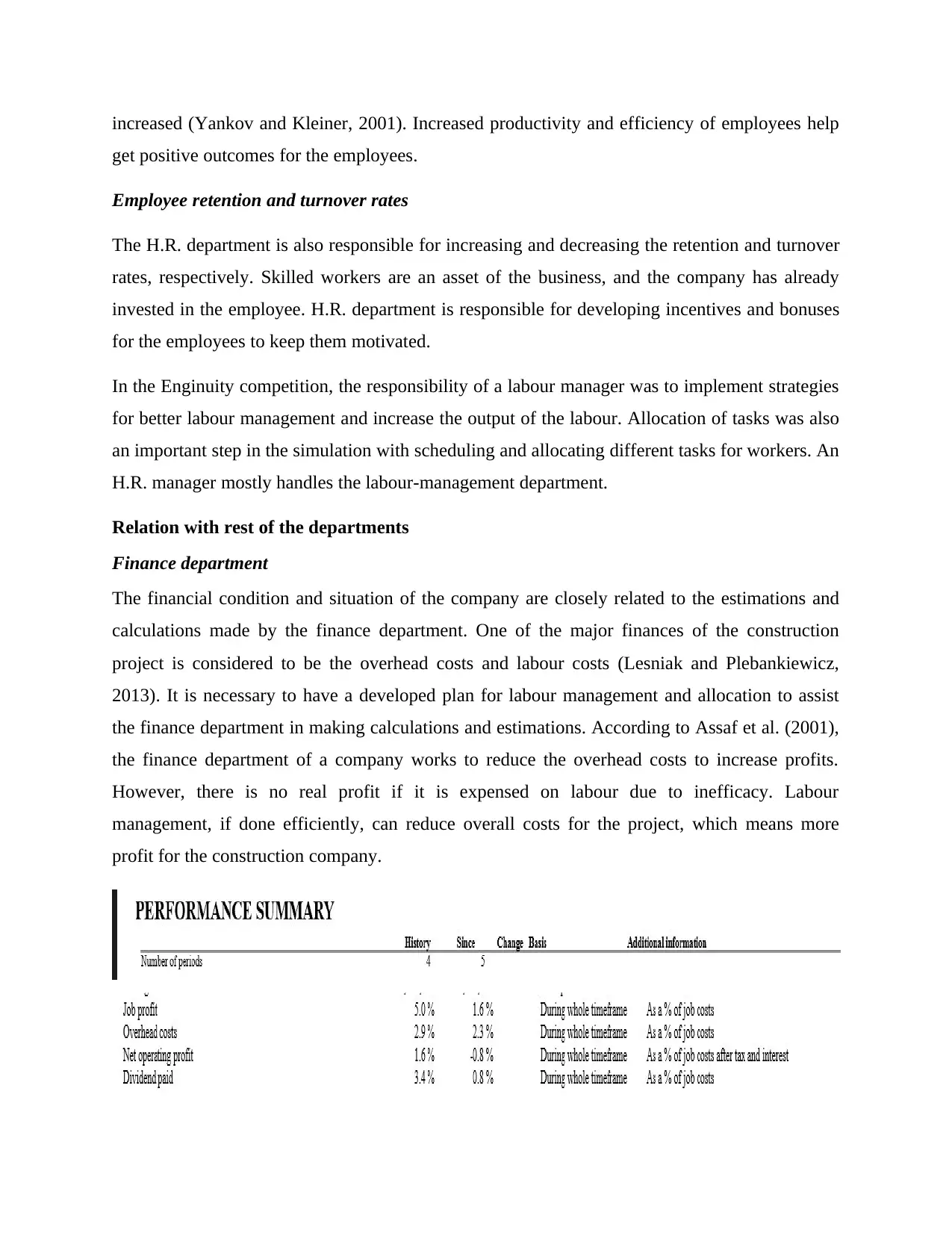
The financial condition and situation of the company are closely related to the estimations and
calculations made by the finance department. One of the major finances of the construction
project is considered to be the overhead costs and labour costs (Lesniak and Plebankiewicz,
2013). It is necessary to have a developed plan for labour management and allocation to assist
the finance department in making calculations and estimations. According to Assaf et al. (2001),
the finance department of a company works to reduce the overhead costs to increase profits.
However, there is no real profit if it is expensed on labour due to inefficacy. Labour
management, if done efficiently, can reduce overall costs for the project, which means more
profit for the construction company.
get positive outcomes for the employees.
Employee retention and turnover rates
The H.R. department is also responsible for increasing and decreasing the retention and turnover
rates, respectively. Skilled workers are an asset of the business, and the company has already
invested in the employee. H.R. department is responsible for developing incentives and bonuses
for the employees to keep them motivated.
In the Enginuity competition, the responsibility of a labour manager was to implement strategies
for better labour management and increase the output of the labour. Allocation of tasks was also
an important step in the simulation with scheduling and allocating different tasks for workers. An
H.R. manager mostly handles the labour-management department.
Relation with rest of the departments
Finance department
The financial condition and situation of the company are closely related to the estimations and
calculations made by the finance department. One of the major finances of the construction
project is considered to be the overhead costs and labour costs (Lesniak and Plebankiewicz,
2013). It is necessary to have a developed plan for labour management and allocation to assist
the finance department in making calculations and estimations. According to Assaf et al. (2001),
the finance department of a company works to reduce the overhead costs to increase profits.
However, there is no real profit if it is expensed on labour due to inefficacy. Labour
management, if done efficiently, can reduce overall costs for the project, which means more
profit for the construction company.
Financial role of human resource management
The financial role of human resource management is critically important to increase the financial
gains for the company. Labour management will help to increase and improvise the efficiency of
the workforce. Human resource management utilizes labour management systems to analyze and
evaluate the labour structure and identify the unnecessary vacancies and any necessary openings
for new positions in labour. Adequate labour management will also help to increase workers
output rate and yield maximum output. However, the collaboration of the human resource
management department and finance department is also necessary to ensure that the planning is
efficient for labour management and the project's financial aspect.
Human Resource methods and labour management
Human resource management plays a critical role in the construction industry. As the nature of
business is purely dependent on the satisfaction of internal and external stakeholders. Therefore,
an H.R. department can ensure that the other departments work efficiently (Loosemore et al.,
2003). The H.R. department also helps the workers to communicate with the higher management
and reduce the communication gap between the employee and employer. It also helps to improve
the workplace conditions and manage employees' behaviour at the workplace (Wilkinson, 2012).
They develop a specific code of conduct to have documentation that clears the employees'
expectations and how they can comply with the business's social and ethical values.
This department is most closely related to labour management as the department is responsible
for scheduling, recruiting, terminating, training and allocating labour for the project. A1
Construction Company focuses on having a good H.R. department that will allow the company
to have an efficient labour management program. The H.R. department is a critical department
for a construction business. A company always wants to have a positive workforce with
motivated minds putting their maximum efforts into completing the project and achieving the
organization's goals (Raidén and Dainty, 2006). . In the construction industry, a significant part
of the workforce works on a daily wage basis. In such a case, the H.R. department is responsible
for negotiating the labour costs to have maximum profit margins for the construction company.
The financial role of human resource management is critically important to increase the financial
gains for the company. Labour management will help to increase and improvise the efficiency of
the workforce. Human resource management utilizes labour management systems to analyze and
evaluate the labour structure and identify the unnecessary vacancies and any necessary openings
for new positions in labour. Adequate labour management will also help to increase workers
output rate and yield maximum output. However, the collaboration of the human resource
management department and finance department is also necessary to ensure that the planning is
efficient for labour management and the project's financial aspect.
Human Resource methods and labour management
Human resource management plays a critical role in the construction industry. As the nature of
business is purely dependent on the satisfaction of internal and external stakeholders. Therefore,
an H.R. department can ensure that the other departments work efficiently (Loosemore et al.,
2003). The H.R. department also helps the workers to communicate with the higher management
and reduce the communication gap between the employee and employer. It also helps to improve
the workplace conditions and manage employees' behaviour at the workplace (Wilkinson, 2012).
They develop a specific code of conduct to have documentation that clears the employees'
expectations and how they can comply with the business's social and ethical values.
This department is most closely related to labour management as the department is responsible
for scheduling, recruiting, terminating, training and allocating labour for the project. A1
Construction Company focuses on having a good H.R. department that will allow the company
to have an efficient labour management program. The H.R. department is a critical department
for a construction business. A company always wants to have a positive workforce with
motivated minds putting their maximum efforts into completing the project and achieving the
organization's goals (Raidén and Dainty, 2006). . In the construction industry, a significant part
of the workforce works on a daily wage basis. In such a case, the H.R. department is responsible
for negotiating the labour costs to have maximum profit margins for the construction company.
⊘ This is a preview!⊘
Do you want full access?
Subscribe today to unlock all pages.
Trusted by 1+ million students worldwide
Procurement strategies
Procurement strategies are developed by companies to establish a framework regarding the
acquisition of supplies required for the business. In the construction context, it refers to the
acquisition of services and material required to complete the construction projects (Cox and
Townsend, 2008). Procurement strategies are helpful to increase the efficiency of the project
management. Therefore, it is necessary to develop a strategic plan for procurement operations for
a construction company for the projects (Carrillo, 2005). The factors taken into considerations
while developing procurement strategies may include the project budget, timeline, and quality.
The measures we took for developing the procurement strategies include budget, quality,
constraints and identification of risks related to the construction project.
In the Enginuity competition’s project, the design and build procurement was based on single-
stage tender and it was assumed that a tender is issued for the project with a fixed lump-sum
cost. All the material and service related contracts were signed after a practice based on the
procurement management strategy develop by the strategic management department of our
company.
Overhead management
Overheads are considered to be the expenses that are covered by the company itself in a
consecutive manner. In some cases, it is fixed costs which are to be paid by the company
monthly such as rents. However, these costs can also fluctuate and are mainly dependent on the
business activities (Chan, 2007). Our company dealt with the site overhead costs which included
insurance, site accumulative, and other primary costs related to the company. A lump-sum was
estimated after a negotiation to adjust the actual cost. The prime cost of the construction project
was adjusted according to any change made in the scope of the project and the percentage
decided of the primary cost of the project.
Conclusion
Labour management is an essential part of construction project management and has connections
with the project's financial aspect. The human resource management department is thus
important for the construction business. The above discussion reflects how we identified the
importance of the H.R. department for our business and how it will affect the business. The
Procurement strategies are developed by companies to establish a framework regarding the
acquisition of supplies required for the business. In the construction context, it refers to the
acquisition of services and material required to complete the construction projects (Cox and
Townsend, 2008). Procurement strategies are helpful to increase the efficiency of the project
management. Therefore, it is necessary to develop a strategic plan for procurement operations for
a construction company for the projects (Carrillo, 2005). The factors taken into considerations
while developing procurement strategies may include the project budget, timeline, and quality.
The measures we took for developing the procurement strategies include budget, quality,
constraints and identification of risks related to the construction project.
In the Enginuity competition’s project, the design and build procurement was based on single-
stage tender and it was assumed that a tender is issued for the project with a fixed lump-sum
cost. All the material and service related contracts were signed after a practice based on the
procurement management strategy develop by the strategic management department of our
company.
Overhead management
Overheads are considered to be the expenses that are covered by the company itself in a
consecutive manner. In some cases, it is fixed costs which are to be paid by the company
monthly such as rents. However, these costs can also fluctuate and are mainly dependent on the
business activities (Chan, 2007). Our company dealt with the site overhead costs which included
insurance, site accumulative, and other primary costs related to the company. A lump-sum was
estimated after a negotiation to adjust the actual cost. The prime cost of the construction project
was adjusted according to any change made in the scope of the project and the percentage
decided of the primary cost of the project.
Conclusion
Labour management is an essential part of construction project management and has connections
with the project's financial aspect. The human resource management department is thus
important for the construction business. The above discussion reflects how we identified the
importance of the H.R. department for our business and how it will affect the business. The
Paraphrase This Document
Need a fresh take? Get an instant paraphrase of this document with our AI Paraphraser
findings supported the acquisition of an adequate H.R. department for the construction business.
It will also allow the senior management to expand the business rather than be tangled up with
the company's internal matters.
The H.R. department will be responsible for all the relevant operations, including the
documentation, making policies and strategies, future planning, employment issues, introducing
practical techniques to improve business productivity, and developing the workforce's skills. It
will also be responsible for ensuring a healthy working environment and building rapport with
the clients and suppliers.
It will also allow the senior management to expand the business rather than be tangled up with
the company's internal matters.
The H.R. department will be responsible for all the relevant operations, including the
documentation, making policies and strategies, future planning, employment issues, introducing
practical techniques to improve business productivity, and developing the workforce's skills. It
will also be responsible for ensuring a healthy working environment and building rapport with
the clients and suppliers.
References
Bryant, P.C. and Allen, D.G., 2013. Compensation, benefits and employee turnover: H.R.
strategies for retaining top talent. Compensation & Benefits Review, 45(3), pp.171-175.
Carrillo, P., 2005. Lessons learned practices in the engineering, procurement and construction
sector. Engineering, construction and architectural management.
Chan, T.W., 2007. Improving the estimation of project overheads in construction companies in
Hong Kong (Doctoral dissertation, Loughborough University).
Cox, A. and Townsend, M., 2008. Strategic procurement in construction: towards better practice
in the management of construction supply chains. London: Thomas Telford.
Compton, R.L., 2009. Effective recruitment and selection practices. C.C.H. Australia Limited.
Dhar, R.L., 2015. Service quality and the training of employees: The mediating role of
organizational commitment. Tourism Management, 46, pp.419-430.
Jantan, H., Hamdan, A.R. and Othman, Z.A., 2009. Knowledge discovery techniques for talent
forecasting in human resource application. World Academy of Science, Engineering and
Technology, 50, pp.775-783.
Loosemore, M., Dainty, A. and Lingard, H., 2003. Human resource management in construction
projects: strategic and operational approaches. Taylor & Francis.
Mishra, A.K., 2018. Assessment of human resource capacity of construction companies in
Nepal. J Adv Res Jour Mass Comm, 5(4), pp.14-25.
Ordanini, A. and Silvestri, G., 2008. Recruitment and selection services: Efficiency and
competitive reasons in the outsourcing of H.R. practices. The International Journal of
Human Resource Management, 19(2), pp.372-391.
Raidén, A.B. and Dainty, A.R., 2006. Human resource development in construction
organizations. The learning organization.
Smith, G.R., 1999. Project leadership: why project management alone doesn't work. Hospital
materiel management quarterly, 21(1), pp.88-92.
Storey, J., 2016. Human resource management. Edward Elgar Publishing Limited.
Bryant, P.C. and Allen, D.G., 2013. Compensation, benefits and employee turnover: H.R.
strategies for retaining top talent. Compensation & Benefits Review, 45(3), pp.171-175.
Carrillo, P., 2005. Lessons learned practices in the engineering, procurement and construction
sector. Engineering, construction and architectural management.
Chan, T.W., 2007. Improving the estimation of project overheads in construction companies in
Hong Kong (Doctoral dissertation, Loughborough University).
Cox, A. and Townsend, M., 2008. Strategic procurement in construction: towards better practice
in the management of construction supply chains. London: Thomas Telford.
Compton, R.L., 2009. Effective recruitment and selection practices. C.C.H. Australia Limited.
Dhar, R.L., 2015. Service quality and the training of employees: The mediating role of
organizational commitment. Tourism Management, 46, pp.419-430.
Jantan, H., Hamdan, A.R. and Othman, Z.A., 2009. Knowledge discovery techniques for talent
forecasting in human resource application. World Academy of Science, Engineering and
Technology, 50, pp.775-783.
Loosemore, M., Dainty, A. and Lingard, H., 2003. Human resource management in construction
projects: strategic and operational approaches. Taylor & Francis.
Mishra, A.K., 2018. Assessment of human resource capacity of construction companies in
Nepal. J Adv Res Jour Mass Comm, 5(4), pp.14-25.
Ordanini, A. and Silvestri, G., 2008. Recruitment and selection services: Efficiency and
competitive reasons in the outsourcing of H.R. practices. The International Journal of
Human Resource Management, 19(2), pp.372-391.
Raidén, A.B. and Dainty, A.R., 2006. Human resource development in construction
organizations. The learning organization.
Smith, G.R., 1999. Project leadership: why project management alone doesn't work. Hospital
materiel management quarterly, 21(1), pp.88-92.
Storey, J., 2016. Human resource management. Edward Elgar Publishing Limited.
⊘ This is a preview!⊘
Do you want full access?
Subscribe today to unlock all pages.
Trusted by 1+ million students worldwide

1 out of 13


Related Documents


Your All-in-One AI-Powered Toolkit for Academic Success.
+13062052269
info@desklib.com
Available 24*7 on WhatsApp / Email
![[object Object]](/_next/static/media/star-bottom.7253800d.svg)
Unlock your academic potential
Copyright © 2020–2026 A2Z Services. All Rights Reserved. Developed and managed by ZUCOL.