English Language Awareness Project 3: Basic Public Service Terminology

Verified

Added on  2022/12/27

|6
|1562
|38
Report
AI Summary
This report delves into the difficulties encountered when interpreting English language, particularly for non-native speakers. The author identifies challenges such as grammatical structure, idioms, compound words, and multiple meanings of terms. The report explores strategies to overcome these hurdles, including seeking guidance from tutors, understanding the context of the language, and conducting a SWOT analysis of the project. The author emphasizes the importance of pre-project preparation, active participation during the project, and post-project evaluation for continuous improvement in language interpretation skills. The report also provides insights into the importance of vocabulary expansion and seeking personalized guidance from tutors to improve interpreting skills.
Document Page
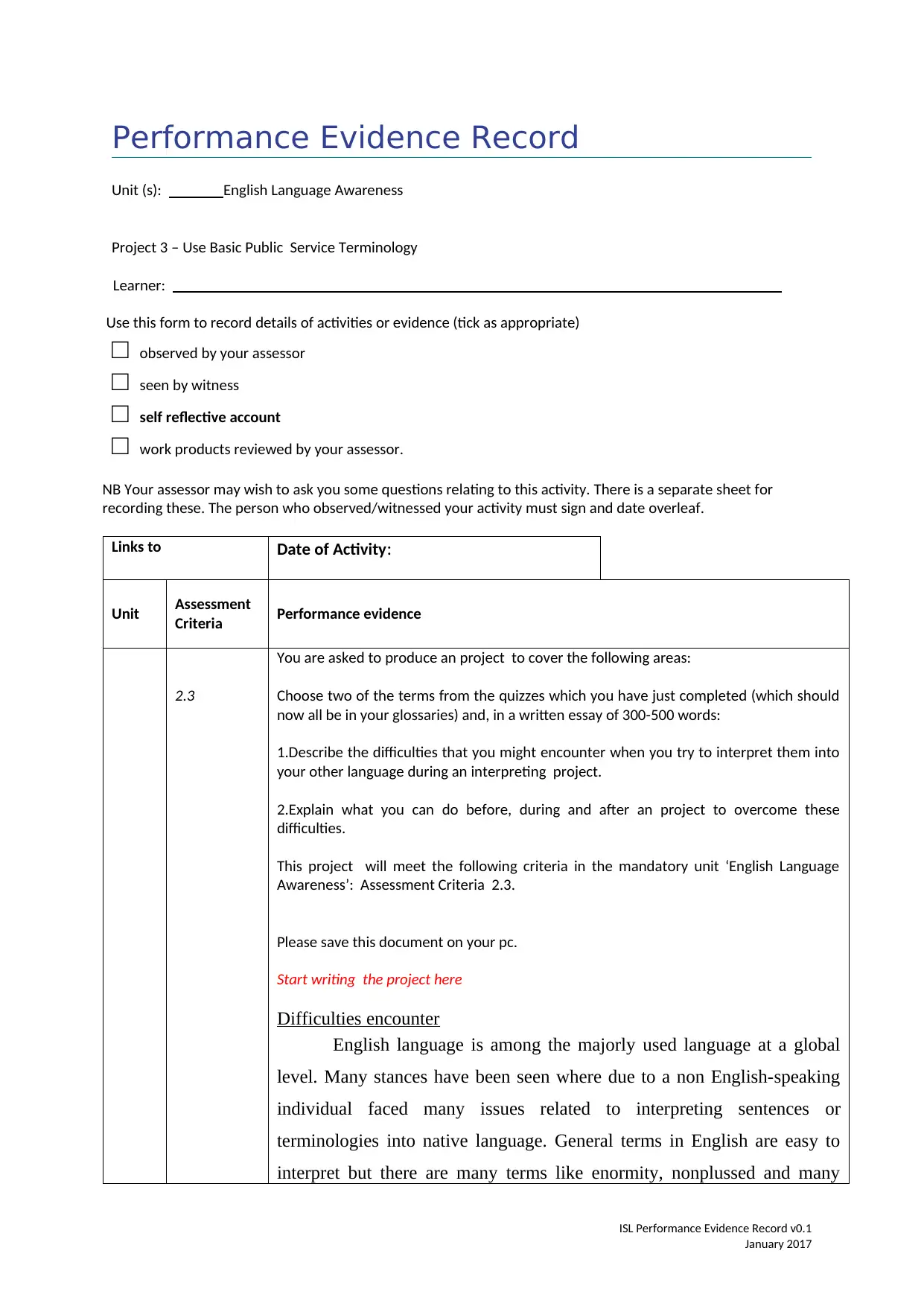
Performance Evidence Record
Unit (s): English Language Awareness
Project 3 – Use Basic Public Service Terminology
Learner:
Use this form to record details of activities or evidence (tick as appropriate)
observed by your assessor
seen by witness
self reflective account
work products reviewed by your assessor.
NB Your assessor may wish to ask you some questions relating to this activity. There is a separate sheet for
recording these. The person who observed/witnessed your activity must sign and date overleaf.
Links to Date of Activity:
Unit Assessment
Criteria Performance evidence
2.3
You are asked to produce an project to cover the following areas:
Choose two of the terms from the quizzes which you have just completed (which should
now all be in your glossaries) and, in a written essay of 300-500 words:
1.Describe the difficulties that you might encounter when you try to interpret them into
your other language during an interpreting project.
2.Explain what you can do before, during and after an project to overcome these
difficulties.
This project will meet the following criteria in the mandatory unit ‘English Language
Awareness’: Assessment Criteria 2.3.
Please save this document on your pc.
Start writing the project here
Difficulties encounter
English language is among the majorly used language at a global
level. Many stances have been seen where due to a non English-speaking
individual faced many issues related to interpreting sentences or
terminologies into native language. General terms in English are easy to
interpret but there are many terms like enormity, nonplussed and many
ISL Performance Evidence Record v0.1
January 2017
tabler-icon-diamond-filled.svg

Paraphrase This Document

Need a fresh take? Get an instant paraphrase of this document with our AI Paraphraser
Document Page
such terms were really hard to interpret. It becomes really difficult for a
non English speaking individual to successfully interpret the language in
native language. Every language take some amount of time to learn and
understand. It requires quality efforts and time to achieve a command over
a language.
In process of interpreting language in to the native language several
difficulties I faced. Grammatically correct language structure was among
the major challenge which faced during the process of interpretation.
Idioms and expressions were also really hard to interpret. The key
challenge faced during interpretation was also to translating compound
words into the regional language. Many times I missed names while
interpreting the language or terminologies. Every time I get to know about
new terminology like enormity, nonplussed or any other the first step is to
search such terms over internet or dictionary. There are many terms present
in English that contain more than one meaning which create confusion in
the mind of reader. Specially at the initial stage when learner started to
learn new language there are several confusions that just roam around the
brain of the reader (Ahrari and et.al., 2019). To resolve al the doubts and
confusion is also a major challenge individual face at the initial stage of
learning language. In context to all such terminologies in English language
that contain more than one word or meaning this issue is massive. Reader
get confused while using such terms in a certain situation. Many times
readers usage the words in wrong manner which further causes to
confusions in the mind of other people or the individual listening such
statements (Bajaj and Bartlett, 2017). Apart from all these direct challenges
there are many indirect challenges related to the topic. Due to not having a
proper command over English language they needed to face issue in
communicating with other peoples and individuals. Due to
misunderstanding several fights they required to face for using the wrong
phrases and terminologies. It also affects the confidence level of such
individuals and peoples. Misunderstanding in respect to understand the
language also influence pronunciation. This issue is faced not only in
respect to all the known words or terminologies bout also for such words
ISL Performance Evidence Record v0.1
January 2017
Document Page
that are clear. I get to face many issues while speaking such words.
What can be done
Every problem or issue contain a specific solution that can allow or
favour the individual to addresses its issue. Following are the steps that can
be taken before, during and after the project is completed to overcome
these challenges or issues.
Before the project
In order to entertain the interpreting project proper knowledge and
guidance of tutor about the words that are needed to interpret can be taken.
This will allow the student or learner to understand the true meaning of
words that that needed to interpret. This will motivate the student to gain
proper information about terms that needed to interpret by the student in
project (Ching and et.al., 2017). The major problem or issue student face is
related to misinterpretation in context to the terminologies. This can be
addressed only if the student understand the proper meaning of
terminologies that are used in project. This is an effective strategy which
can be used b y the student. Teacher can also contribute in this technique
where they can have a meeting with student at persona level and solve all
the doubts of students in respect to terminologies. Students can also take
guidance in respect to proper resources that will guide and support student
in achieving the best level of academic standards in project. Every project
can successfully delivered only if the resources used are effective enough
and optimum.
During the project
Student can take regular guidance from tutors and professionals to
achieve best grade in any interpretation project. During the project student
can also establish constant communication with tutors so that all doubts of
students can resolve by tutors. This will improve the quality of the project.
Students can also solve all the doubts that arises during the project is
completed by student this will allow the learner to use the same meaning
which terminology actually contain (Fernández-Sanjurjo, Fernández-
Costales and Arias Blanco, 2019). During the project on the basis of the set
ISL Performance Evidence Record v0.1
January 2017
Document Page
time line student must try to complete the project. It is also necessary to
proof read the entire project. This will favour the student to solve all the
errors con ducted by student.
After the project
Once the project is submitted student can conduct a SWOT analysis
of the project. This will involve critical evaluation of the project that is
conducted by student. Under this process student get to know about all the
strong areas, weak areas, opportunities and threat involve in project.
Student should also focus over learning new terminologies every day and
recall the previous learnt terns. This technique will also favour the student
to expand its vocabulary or dictionary. Student should also concern with
tutor at a personal level (Medeiros, Ramalho and Falcão, 2018). This will
be an effective practice to follow as a learner. Tutor will highlight all the
problems or issues student could entertain in the spam of project. This will
further support and guide student to understand what errors it could
entertain and also not to repeat the same in future when delivering the same
project. It is always important to critically evaluate whatever project or test
student has performed to achieve the best level of academic excellency.
REFERENCES
Books and Journals
Ahrari, S. and et.al., 2019. A stranger in a strange land: Experiences of
adjustment among international postgraduate students in
Malaysia. Issues in Educational Research. 29(3). p.611.
Bajaj, M. and Bartlett, L., 2017. Critical transnational curriculum for
immigrant and refugee students. Curriculum Inquiry. 47(1).
pp.25-35.
Ching, Y. and et.al., 2017. Challenges facing Chinese international
students studying in the United States. Educational Research
and Reviews. 12(8). pp.473-482.
Fernández-Sanjurjo, J., Fernández-Costales, A. and Arias Blanco, J. M.,
2019. Analysing students’ content-learning in science in
CLIL vs. non-CLIL programmes: Empirical evidence from
Spain. International Journal of Bilingual Education and
Bilingualism. 22(6). pp.661-674.
ISL Performance Evidence Record v0.1
January 2017
tabler-icon-diamond-filled.svg

Paraphrase This Document

Need a fresh take? Get an instant paraphrase of this document with our AI Paraphraser
Document Page
Medeiros, R. P., Ramalho, G. L. and Falcão, T. P., 2018. A systematic
literature review on teaching and learning introductory
programming in higher education. IEEE Transactions on
Education. 62(2). pp.77-90.
ISL Performance Evidence Record v0.1
January 2017
Document Page
Performance Evidence Record (cont’d)
Unit Assessment
Criteria Performance evidence
I confirm that the evidence listed is
my own work and was carried out
under the conditions and context
specified in the standards.
Candidate signature: Date
Assessor/Expert Witness* signature: Date
*delete as appropriate
Internal Verifier signature (if sampled): Date
ISL Performance Evidence Record v0.1
January 2017
chevron_up_icon
1 out of 6
circle_padding
hide_on_mobile
zoom_out_icon
[object Object]