Sunderland College: Formal Academic Report English Language Studies
VerifiedAdded on 2022/11/25
|10
|3182
|446
Report
AI Summary
This report provides a comprehensive analysis of English Language Studies, addressing historical changes in the English language from the 1950s to 2020, including shifts in phonology, lexicon, and grammar. It examines generational differences in spoken discourse, highlighting the impact of technology and social influences on vocabulary and register. The report delves into the features of spoken discourse, differentiating between monologues and dialogues, and analyzing conversational features such as turn-taking, adjacency pairs, discourse markers, and fillers. Furthermore, it offers a detailed analysis of Martin Luther King Jr.'s 'I Have a Dream' speech, evaluating its rhetorical strengths, including the use of repetition, metaphors, and the expression of power. The report also considers the impact of the speech on the civil rights movement, examining how King's words emphasized the need for equality and justice for African Americans. The report concludes by summarising the key findings on language evolution and the impact of speech in society.

ENGLISH LANGUAGE
STUDIES
STUDIES

Paraphrase This Document
Need a fresh take? Get an instant paraphrase of this document with our AI Paraphraser
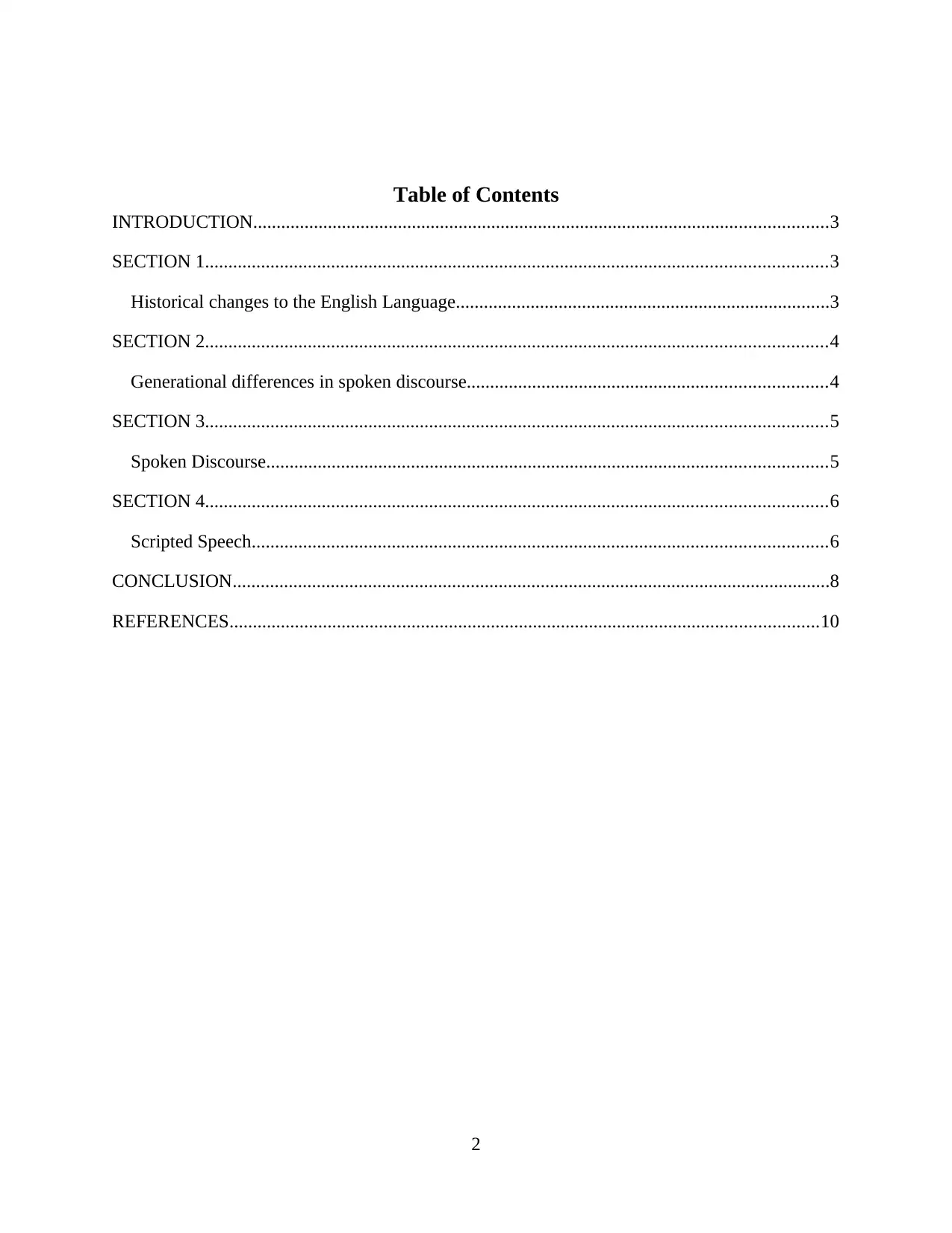
Table of Contents
INTRODUCTION...........................................................................................................................3
SECTION 1.....................................................................................................................................3
Historical changes to the English Language................................................................................3
SECTION 2.....................................................................................................................................4
Generational differences in spoken discourse.............................................................................4
SECTION 3.....................................................................................................................................5
Spoken Discourse........................................................................................................................5
SECTION 4.....................................................................................................................................6
Scripted Speech...........................................................................................................................6
CONCLUSION................................................................................................................................8
REFERENCES..............................................................................................................................10
2
INTRODUCTION...........................................................................................................................3
SECTION 1.....................................................................................................................................3
Historical changes to the English Language................................................................................3
SECTION 2.....................................................................................................................................4
Generational differences in spoken discourse.............................................................................4
SECTION 3.....................................................................................................................................5
Spoken Discourse........................................................................................................................5
SECTION 4.....................................................................................................................................6
Scripted Speech...........................................................................................................................6
CONCLUSION................................................................................................................................8
REFERENCES..............................................................................................................................10
2
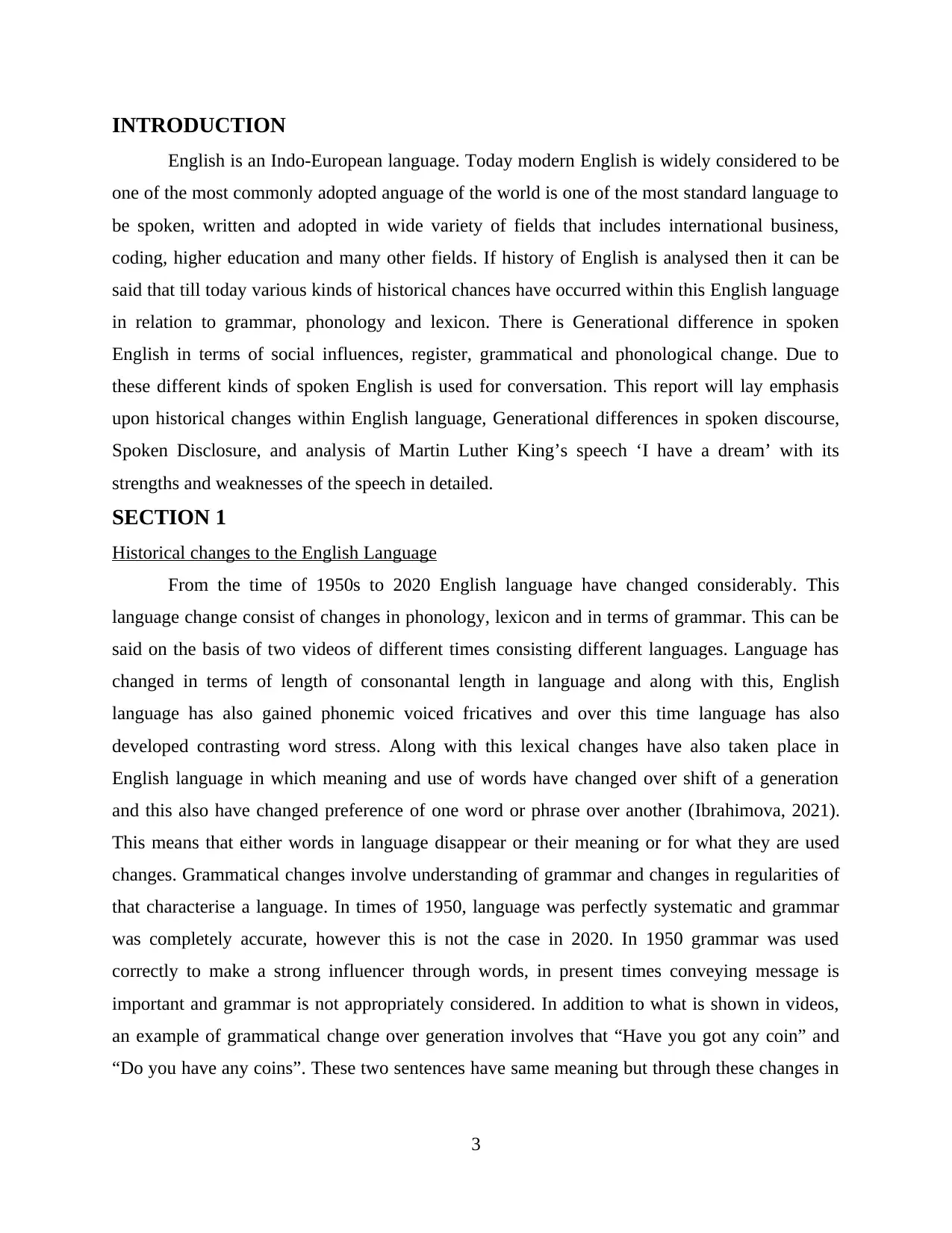
INTRODUCTION
English is an Indo-European language. Today modern English is widely considered to be
one of the most commonly adopted anguage of the world is one of the most standard language to
be spoken, written and adopted in wide variety of fields that includes international business,
coding, higher education and many other fields. If history of English is analysed then it can be
said that till today various kinds of historical chances have occurred within this English language
in relation to grammar, phonology and lexicon. There is Generational difference in spoken
English in terms of social influences, register, grammatical and phonological change. Due to
these different kinds of spoken English is used for conversation. This report will lay emphasis
upon historical changes within English language, Generational differences in spoken discourse,
Spoken Disclosure, and analysis of Martin Luther King’s speech ‘I have a dream’ with its
strengths and weaknesses of the speech in detailed.
SECTION 1
Historical changes to the English Language
From the time of 1950s to 2020 English language have changed considerably. This
language change consist of changes in phonology, lexicon and in terms of grammar. This can be
said on the basis of two videos of different times consisting different languages. Language has
changed in terms of length of consonantal length in language and along with this, English
language has also gained phonemic voiced fricatives and over this time language has also
developed contrasting word stress. Along with this lexical changes have also taken place in
English language in which meaning and use of words have changed over shift of a generation
and this also have changed preference of one word or phrase over another (Ibrahimova, 2021).
This means that either words in language disappear or their meaning or for what they are used
changes. Grammatical changes involve understanding of grammar and changes in regularities of
that characterise a language. In times of 1950, language was perfectly systematic and grammar
was completely accurate, however this is not the case in 2020. In 1950 grammar was used
correctly to make a strong influencer through words, in present times conveying message is
important and grammar is not appropriately considered. In addition to what is shown in videos,
an example of grammatical change over generation involves that “Have you got any coin” and
“Do you have any coins”. These two sentences have same meaning but through these changes in
3
English is an Indo-European language. Today modern English is widely considered to be
one of the most commonly adopted anguage of the world is one of the most standard language to
be spoken, written and adopted in wide variety of fields that includes international business,
coding, higher education and many other fields. If history of English is analysed then it can be
said that till today various kinds of historical chances have occurred within this English language
in relation to grammar, phonology and lexicon. There is Generational difference in spoken
English in terms of social influences, register, grammatical and phonological change. Due to
these different kinds of spoken English is used for conversation. This report will lay emphasis
upon historical changes within English language, Generational differences in spoken discourse,
Spoken Disclosure, and analysis of Martin Luther King’s speech ‘I have a dream’ with its
strengths and weaknesses of the speech in detailed.
SECTION 1
Historical changes to the English Language
From the time of 1950s to 2020 English language have changed considerably. This
language change consist of changes in phonology, lexicon and in terms of grammar. This can be
said on the basis of two videos of different times consisting different languages. Language has
changed in terms of length of consonantal length in language and along with this, English
language has also gained phonemic voiced fricatives and over this time language has also
developed contrasting word stress. Along with this lexical changes have also taken place in
English language in which meaning and use of words have changed over shift of a generation
and this also have changed preference of one word or phrase over another (Ibrahimova, 2021).
This means that either words in language disappear or their meaning or for what they are used
changes. Grammatical changes involve understanding of grammar and changes in regularities of
that characterise a language. In times of 1950, language was perfectly systematic and grammar
was completely accurate, however this is not the case in 2020. In 1950 grammar was used
correctly to make a strong influencer through words, in present times conveying message is
important and grammar is not appropriately considered. In addition to what is shown in videos,
an example of grammatical change over generation involves that “Have you got any coin” and
“Do you have any coins”. These two sentences have same meaning but through these changes in
3
⊘ This is a preview!⊘
Do you want full access?
Subscribe today to unlock all pages.

Trusted by 1+ million students worldwide
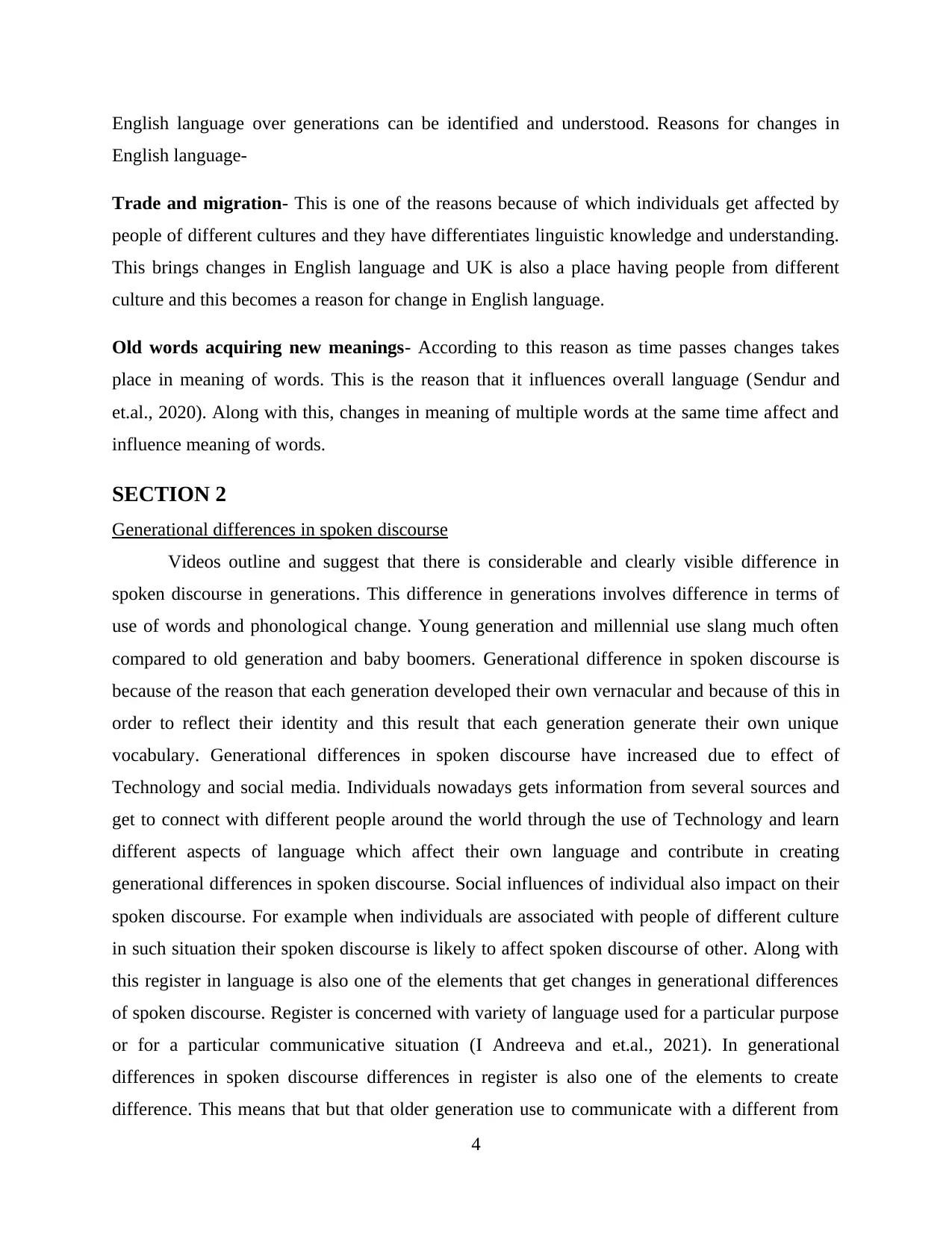
English language over generations can be identified and understood. Reasons for changes in
English language-
Trade and migration- This is one of the reasons because of which individuals get affected by
people of different cultures and they have differentiates linguistic knowledge and understanding.
This brings changes in English language and UK is also a place having people from different
culture and this becomes a reason for change in English language.
Old words acquiring new meanings- According to this reason as time passes changes takes
place in meaning of words. This is the reason that it influences overall language (Sendur and
et.al., 2020). Along with this, changes in meaning of multiple words at the same time affect and
influence meaning of words.
SECTION 2
Generational differences in spoken discourse
Videos outline and suggest that there is considerable and clearly visible difference in
spoken discourse in generations. This difference in generations involves difference in terms of
use of words and phonological change. Young generation and millennial use slang much often
compared to old generation and baby boomers. Generational difference in spoken discourse is
because of the reason that each generation developed their own vernacular and because of this in
order to reflect their identity and this result that each generation generate their own unique
vocabulary. Generational differences in spoken discourse have increased due to effect of
Technology and social media. Individuals nowadays gets information from several sources and
get to connect with different people around the world through the use of Technology and learn
different aspects of language which affect their own language and contribute in creating
generational differences in spoken discourse. Social influences of individual also impact on their
spoken discourse. For example when individuals are associated with people of different culture
in such situation their spoken discourse is likely to affect spoken discourse of other. Along with
this register in language is also one of the elements that get changes in generational differences
of spoken discourse. Register is concerned with variety of language used for a particular purpose
or for a particular communicative situation (I Andreeva and et.al., 2021). In generational
differences in spoken discourse differences in register is also one of the elements to create
difference. This means that but that older generation use to communicate with a different from
4
English language-
Trade and migration- This is one of the reasons because of which individuals get affected by
people of different cultures and they have differentiates linguistic knowledge and understanding.
This brings changes in English language and UK is also a place having people from different
culture and this becomes a reason for change in English language.
Old words acquiring new meanings- According to this reason as time passes changes takes
place in meaning of words. This is the reason that it influences overall language (Sendur and
et.al., 2020). Along with this, changes in meaning of multiple words at the same time affect and
influence meaning of words.
SECTION 2
Generational differences in spoken discourse
Videos outline and suggest that there is considerable and clearly visible difference in
spoken discourse in generations. This difference in generations involves difference in terms of
use of words and phonological change. Young generation and millennial use slang much often
compared to old generation and baby boomers. Generational difference in spoken discourse is
because of the reason that each generation developed their own vernacular and because of this in
order to reflect their identity and this result that each generation generate their own unique
vocabulary. Generational differences in spoken discourse have increased due to effect of
Technology and social media. Individuals nowadays gets information from several sources and
get to connect with different people around the world through the use of Technology and learn
different aspects of language which affect their own language and contribute in creating
generational differences in spoken discourse. Social influences of individual also impact on their
spoken discourse. For example when individuals are associated with people of different culture
in such situation their spoken discourse is likely to affect spoken discourse of other. Along with
this register in language is also one of the elements that get changes in generational differences
of spoken discourse. Register is concerned with variety of language used for a particular purpose
or for a particular communicative situation (I Andreeva and et.al., 2021). In generational
differences in spoken discourse differences in register is also one of the elements to create
difference. This means that but that older generation use to communicate with a different from
4
Paraphrase This Document
Need a fresh take? Get an instant paraphrase of this document with our AI Paraphraser
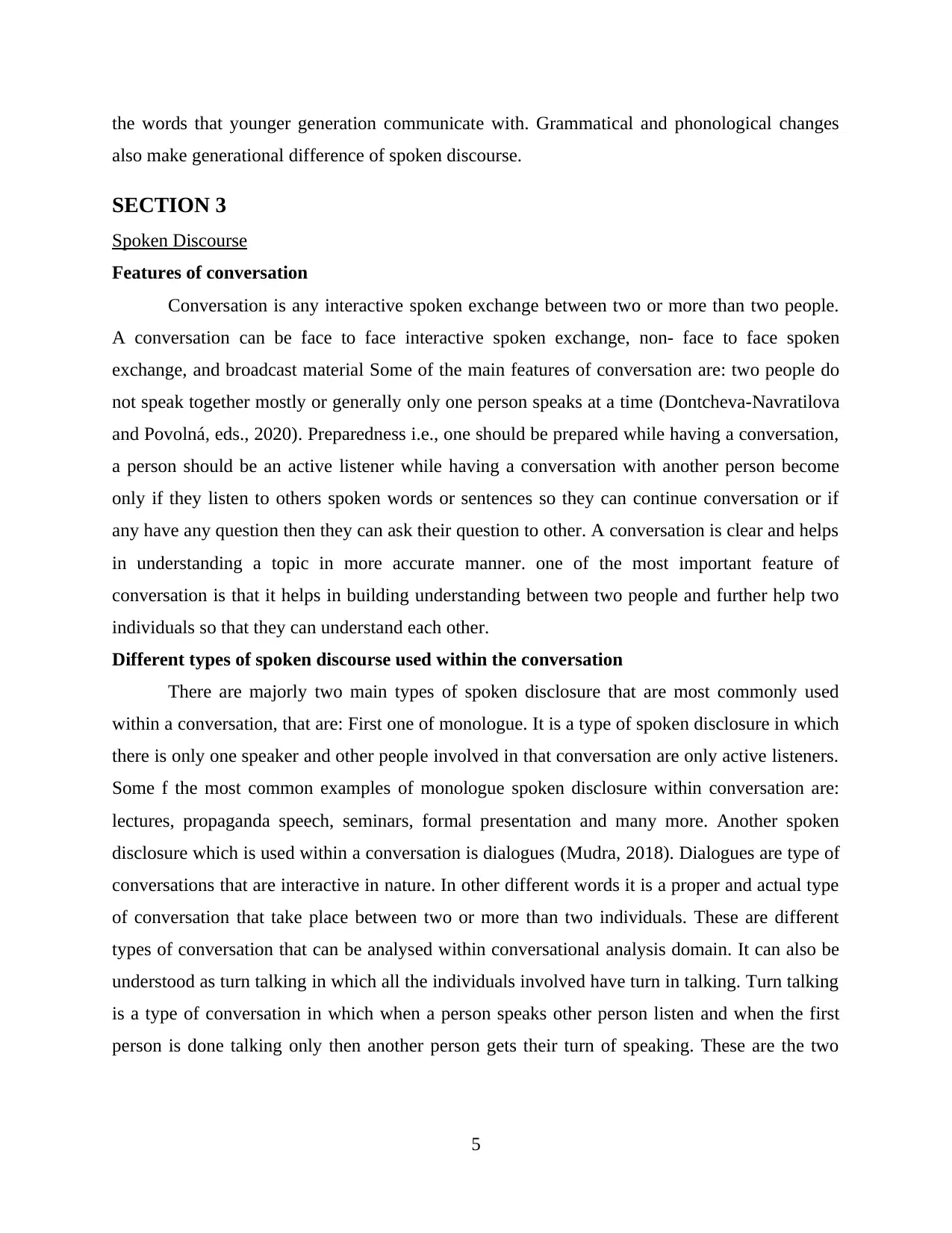
the words that younger generation communicate with. Grammatical and phonological changes
also make generational difference of spoken discourse.
SECTION 3
Spoken Discourse
Features of conversation
Conversation is any interactive spoken exchange between two or more than two people.
A conversation can be face to face interactive spoken exchange, non- face to face spoken
exchange, and broadcast material Some of the main features of conversation are: two people do
not speak together mostly or generally only one person speaks at a time (Dontcheva-Navratilova
and Povolná, eds., 2020). Preparedness i.e., one should be prepared while having a conversation,
a person should be an active listener while having a conversation with another person become
only if they listen to others spoken words or sentences so they can continue conversation or if
any have any question then they can ask their question to other. A conversation is clear and helps
in understanding a topic in more accurate manner. one of the most important feature of
conversation is that it helps in building understanding between two people and further help two
individuals so that they can understand each other.
Different types of spoken discourse used within the conversation
There are majorly two main types of spoken disclosure that are most commonly used
within a conversation, that are: First one of monologue. It is a type of spoken disclosure in which
there is only one speaker and other people involved in that conversation are only active listeners.
Some f the most common examples of monologue spoken disclosure within conversation are:
lectures, propaganda speech, seminars, formal presentation and many more. Another spoken
disclosure which is used within a conversation is dialogues (Mudra, 2018). Dialogues are type of
conversations that are interactive in nature. In other different words it is a proper and actual type
of conversation that take place between two or more than two individuals. These are different
types of conversation that can be analysed within conversational analysis domain. It can also be
understood as turn talking in which all the individuals involved have turn in talking. Turn talking
is a type of conversation in which when a person speaks other person listen and when the first
person is done talking only then another person gets their turn of speaking. These are the two
5
also make generational difference of spoken discourse.
SECTION 3
Spoken Discourse
Features of conversation
Conversation is any interactive spoken exchange between two or more than two people.
A conversation can be face to face interactive spoken exchange, non- face to face spoken
exchange, and broadcast material Some of the main features of conversation are: two people do
not speak together mostly or generally only one person speaks at a time (Dontcheva-Navratilova
and Povolná, eds., 2020). Preparedness i.e., one should be prepared while having a conversation,
a person should be an active listener while having a conversation with another person become
only if they listen to others spoken words or sentences so they can continue conversation or if
any have any question then they can ask their question to other. A conversation is clear and helps
in understanding a topic in more accurate manner. one of the most important feature of
conversation is that it helps in building understanding between two people and further help two
individuals so that they can understand each other.
Different types of spoken discourse used within the conversation
There are majorly two main types of spoken disclosure that are most commonly used
within a conversation, that are: First one of monologue. It is a type of spoken disclosure in which
there is only one speaker and other people involved in that conversation are only active listeners.
Some f the most common examples of monologue spoken disclosure within conversation are:
lectures, propaganda speech, seminars, formal presentation and many more. Another spoken
disclosure which is used within a conversation is dialogues (Mudra, 2018). Dialogues are type of
conversations that are interactive in nature. In other different words it is a proper and actual type
of conversation that take place between two or more than two individuals. These are different
types of conversation that can be analysed within conversational analysis domain. It can also be
understood as turn talking in which all the individuals involved have turn in talking. Turn talking
is a type of conversation in which when a person speaks other person listen and when the first
person is done talking only then another person gets their turn of speaking. These are the two
5
main types of spoken disclosure that are used within a conversation but out of both the types of
spoken disclosure only dialogues are actual type of conversation.
Analysis of features of a conversation between participants
In order to analyse features of conversation between two participants conversational
analysis can take place. conversational can be done with the help of turn talking, adjacency pairs,
discourse markers, fillers etc.
Turn talking: When two or more than two people take turn for speaking and only speak when ne
person is done talking then this type of conversation is known as turn talking (Davlatova, 2020).
Some of the typical features of this type of conversation are: one person speaks at a time, usually
silence is avoided, if two people talk simultaneously then one of them stops talking.
Adjacency pairs: it consists of two turns which is produced by different speakers who are placed
adjacently in which utterance of second person is related to first. Type of conversation that this
type that can be explained with adjacency pairs are: question/answers, offer/accept, complaint/
rejection etc.
Disclosure makers: It is a kind of a phrase or word that functions primarily as a structuring unit
of spoken language. It helps in signalling intention of speaker for making boundaries in
disclosure. If features of conversation are analysed then it is used to mark beginning of a new
part of conversation.
Fillers: Fillers are a kind of sound or words that are spoken to fill gap within a sentence spoken
by another person. It can include disclosure makers, and filled pauses.
SECTION 4
Scripted Speech
Speech “I Have a Dream” by Martin Luther King Jr. is one of the very popular speeches
ever given. This speech was given by Martin Luther King Jr. in which he called for civil rights
and economic rights and called to end racism in United States. Rights of Negro were called in
speech and in this speech there were several repetitions, such as initially hundred years, this was
to emphasis about time. In this speech Martin Luther King, Jr. effectively justified his rhetorical
abilities and also used different metaphors to place emphasis on what he wish to convey. An
example is to compare justice system with bank and funds (Haq, Indrayani and Soemantri,
2020). Along with this, his comparison about justice and inequality with sand and rock are also
considerable. Speech shows that in his speech Martin Luther King Jr. almost every line was
6
spoken disclosure only dialogues are actual type of conversation.
Analysis of features of a conversation between participants
In order to analyse features of conversation between two participants conversational
analysis can take place. conversational can be done with the help of turn talking, adjacency pairs,
discourse markers, fillers etc.
Turn talking: When two or more than two people take turn for speaking and only speak when ne
person is done talking then this type of conversation is known as turn talking (Davlatova, 2020).
Some of the typical features of this type of conversation are: one person speaks at a time, usually
silence is avoided, if two people talk simultaneously then one of them stops talking.
Adjacency pairs: it consists of two turns which is produced by different speakers who are placed
adjacently in which utterance of second person is related to first. Type of conversation that this
type that can be explained with adjacency pairs are: question/answers, offer/accept, complaint/
rejection etc.
Disclosure makers: It is a kind of a phrase or word that functions primarily as a structuring unit
of spoken language. It helps in signalling intention of speaker for making boundaries in
disclosure. If features of conversation are analysed then it is used to mark beginning of a new
part of conversation.
Fillers: Fillers are a kind of sound or words that are spoken to fill gap within a sentence spoken
by another person. It can include disclosure makers, and filled pauses.
SECTION 4
Scripted Speech
Speech “I Have a Dream” by Martin Luther King Jr. is one of the very popular speeches
ever given. This speech was given by Martin Luther King Jr. in which he called for civil rights
and economic rights and called to end racism in United States. Rights of Negro were called in
speech and in this speech there were several repetitions, such as initially hundred years, this was
to emphasis about time. In this speech Martin Luther King, Jr. effectively justified his rhetorical
abilities and also used different metaphors to place emphasis on what he wish to convey. An
example is to compare justice system with bank and funds (Haq, Indrayani and Soemantri,
2020). Along with this, his comparison about justice and inequality with sand and rock are also
considerable. Speech shows that in his speech Martin Luther King Jr. almost every line was
6
⊘ This is a preview!⊘
Do you want full access?
Subscribe today to unlock all pages.
Trusted by 1+ million students worldwide
based on effective use of metaphor and this attracted attention and kept audiences focused. In
addition to repetition of words, repetition of intention through different words and sentences is
also there in speech. His words and use of vocabulary also outlines that whatever he is saying, he
is saying in imperative mood. He seems not to wait any longer for citizenship rights for Negro.
Expression and exercise of power in the speech by Martin Luther King, Jr. is also commendable
as he says “In the process of gaining our rightful place we must not be guilty of wrongful deeds”
and this suggests that he is not affected by any wrongdoings by Negro people in order to gain
freedom and equal rights for citizenship (Rocker, 2018). However, as the speech continues it
states “We must forever conduct our struggle on the high plane of dignity and discipline”, this
suggests that wrongdoings and physical violence are not encouraged by him. This suggests that
he is adequately using his power in relation to how it should be exercised and expressed to
public. By saying both things that not to feel guilty of wrongdoings and also to consider dignity
and discipline, he expresses that for him dignity and discipline is important but he does not want
people to feel bad about the things they do in order to gain freedom and equal citizenship rights.
Expression and exercise of power also has been done rightly by him by considering presence of
white people and by stating that they have to realise that their freedom is bound to freedom of
Negro (Rocker, 2018). Repetition made by Martin Luther King, Jr. about satisfaction of Negro,
are also very effective in expressing intentions about what are thing going wrong with Negro and
what changes are needed satisfy them. Several repetitions throughout the speech placing
emphasis on different aspects of freedom for Negros, speech suggests that only intention of
Martin Luther King Jr. to get freedom and equality like every white man and women in America.
Speech of Martin Luther King Jr. suggests that in his speech he has considered most of all
aspects in which discrimination and inequality is doing injustice with Negros and how it is
wrong to do so. Expression and exercise of power shows is firm intention with regard to his
dream where he wish that everywhere in America, there is equality and fair treatment with what
he states “God’s Children”. His speech expresses that freedom of Negros is not a choice but their
right that they are treated equally and creative suffering for Negros is reduced and mitigated. He
is firm in intention and expresses power in speech discourse through repetition and use of strong
words as metaphor and at the same time clarity is also there (Card, 2018). Expressing power in
speech discourse also involve firmly expressing disagreement and there are several instances
during the speech where, Martin Luther King Jr firmly expressed disagreement and resentment
7
addition to repetition of words, repetition of intention through different words and sentences is
also there in speech. His words and use of vocabulary also outlines that whatever he is saying, he
is saying in imperative mood. He seems not to wait any longer for citizenship rights for Negro.
Expression and exercise of power in the speech by Martin Luther King, Jr. is also commendable
as he says “In the process of gaining our rightful place we must not be guilty of wrongful deeds”
and this suggests that he is not affected by any wrongdoings by Negro people in order to gain
freedom and equal rights for citizenship (Rocker, 2018). However, as the speech continues it
states “We must forever conduct our struggle on the high plane of dignity and discipline”, this
suggests that wrongdoings and physical violence are not encouraged by him. This suggests that
he is adequately using his power in relation to how it should be exercised and expressed to
public. By saying both things that not to feel guilty of wrongdoings and also to consider dignity
and discipline, he expresses that for him dignity and discipline is important but he does not want
people to feel bad about the things they do in order to gain freedom and equal citizenship rights.
Expression and exercise of power also has been done rightly by him by considering presence of
white people and by stating that they have to realise that their freedom is bound to freedom of
Negro (Rocker, 2018). Repetition made by Martin Luther King, Jr. about satisfaction of Negro,
are also very effective in expressing intentions about what are thing going wrong with Negro and
what changes are needed satisfy them. Several repetitions throughout the speech placing
emphasis on different aspects of freedom for Negros, speech suggests that only intention of
Martin Luther King Jr. to get freedom and equality like every white man and women in America.
Speech of Martin Luther King Jr. suggests that in his speech he has considered most of all
aspects in which discrimination and inequality is doing injustice with Negros and how it is
wrong to do so. Expression and exercise of power shows is firm intention with regard to his
dream where he wish that everywhere in America, there is equality and fair treatment with what
he states “God’s Children”. His speech expresses that freedom of Negros is not a choice but their
right that they are treated equally and creative suffering for Negros is reduced and mitigated. He
is firm in intention and expresses power in speech discourse through repetition and use of strong
words as metaphor and at the same time clarity is also there (Card, 2018). Expressing power in
speech discourse also involve firmly expressing disagreement and there are several instances
during the speech where, Martin Luther King Jr firmly expressed disagreement and resentment
7
Paraphrase This Document
Need a fresh take? Get an instant paraphrase of this document with our AI Paraphraser
over wrongdoing of police and other that victimise Negros and their interest and their freedom in
united states.
Strength and weakness of Martin Luther King’s speech ‘I have a dream’ have been
explained below:
Strengths of speech are: one of the main strengths of speech of Martin Luther King’s ‘I have a
dream’ is that in this he has a well- organized and powerful voice. He was confident in his
speech, powerful and forceful within his speech. At the beginning of his speech, he used history
story in order to gain attention of audience that helped him in raising interest of audience. Topic
of his speech was quite clear and examples used by him supported his arguments. He had also
used many repetitions within his speech that helped him in highlighting main theme of his
speech. He had used different kinds of gestures and emphasised on individual words that were
required to be highlighted within his speech. At the end of his speech ‘I have a dream’, he had
said a slogan that helped him in arousing resonance and attention of all the audience that further
helped him in pushing the atmosphere of the speech to its highest point.
Weakness of speech are: It was one of the most perfect and important speeches that were
delivered in American History so it would be difficult to identify weakness of this speech but
still, one of the main weakness of speech of Martin Luther King’s ‘I have a dream’ is that in the
first half of the speech, he was too focused upon delivering his speech and explaining or
delivering history story due to which he lacked eye contact with his audience. Most of the time
while delivering his speech he was too focused upon his words and information that he wanted to
deliver rather than maintaining eye contact with his audience.
CONCLUSION
From the above report it has been summarized that there are various kinds of historical
changes that have occurred within English language that has helped in moulding modern English
language in terms of grammar, phonology and lexicon. After examination of Spoken English
language, it has been identified that there is spoken English language difference between one
generation and another. If features of a conversation between participants, then it can be
understood that there is huge difference between spoken English. This analysis further helps in
summarizing that there are various kinds of difference between Spoken English language and
these differences differ from people from different generation and location. It has further been
8
united states.
Strength and weakness of Martin Luther King’s speech ‘I have a dream’ have been
explained below:
Strengths of speech are: one of the main strengths of speech of Martin Luther King’s ‘I have a
dream’ is that in this he has a well- organized and powerful voice. He was confident in his
speech, powerful and forceful within his speech. At the beginning of his speech, he used history
story in order to gain attention of audience that helped him in raising interest of audience. Topic
of his speech was quite clear and examples used by him supported his arguments. He had also
used many repetitions within his speech that helped him in highlighting main theme of his
speech. He had used different kinds of gestures and emphasised on individual words that were
required to be highlighted within his speech. At the end of his speech ‘I have a dream’, he had
said a slogan that helped him in arousing resonance and attention of all the audience that further
helped him in pushing the atmosphere of the speech to its highest point.
Weakness of speech are: It was one of the most perfect and important speeches that were
delivered in American History so it would be difficult to identify weakness of this speech but
still, one of the main weakness of speech of Martin Luther King’s ‘I have a dream’ is that in the
first half of the speech, he was too focused upon delivering his speech and explaining or
delivering history story due to which he lacked eye contact with his audience. Most of the time
while delivering his speech he was too focused upon his words and information that he wanted to
deliver rather than maintaining eye contact with his audience.
CONCLUSION
From the above report it has been summarized that there are various kinds of historical
changes that have occurred within English language that has helped in moulding modern English
language in terms of grammar, phonology and lexicon. After examination of Spoken English
language, it has been identified that there is spoken English language difference between one
generation and another. If features of a conversation between participants, then it can be
understood that there is huge difference between spoken English. This analysis further helps in
summarizing that there are various kinds of difference between Spoken English language and
these differences differ from people from different generation and location. It has further been
8
summarized that there are English language is used most commonly in international business,
coding, international speeches and for many other purposes and at different platforms. It has
further been summarized that Martin Luthur King’s speech ‘I have a dream’ one of the most
important and perfect speech delivered in American History.
9
coding, international speeches and for many other purposes and at different platforms. It has
further been summarized that Martin Luthur King’s speech ‘I have a dream’ one of the most
important and perfect speech delivered in American History.
9
⊘ This is a preview!⊘
Do you want full access?
Subscribe today to unlock all pages.
Trusted by 1+ million students worldwide
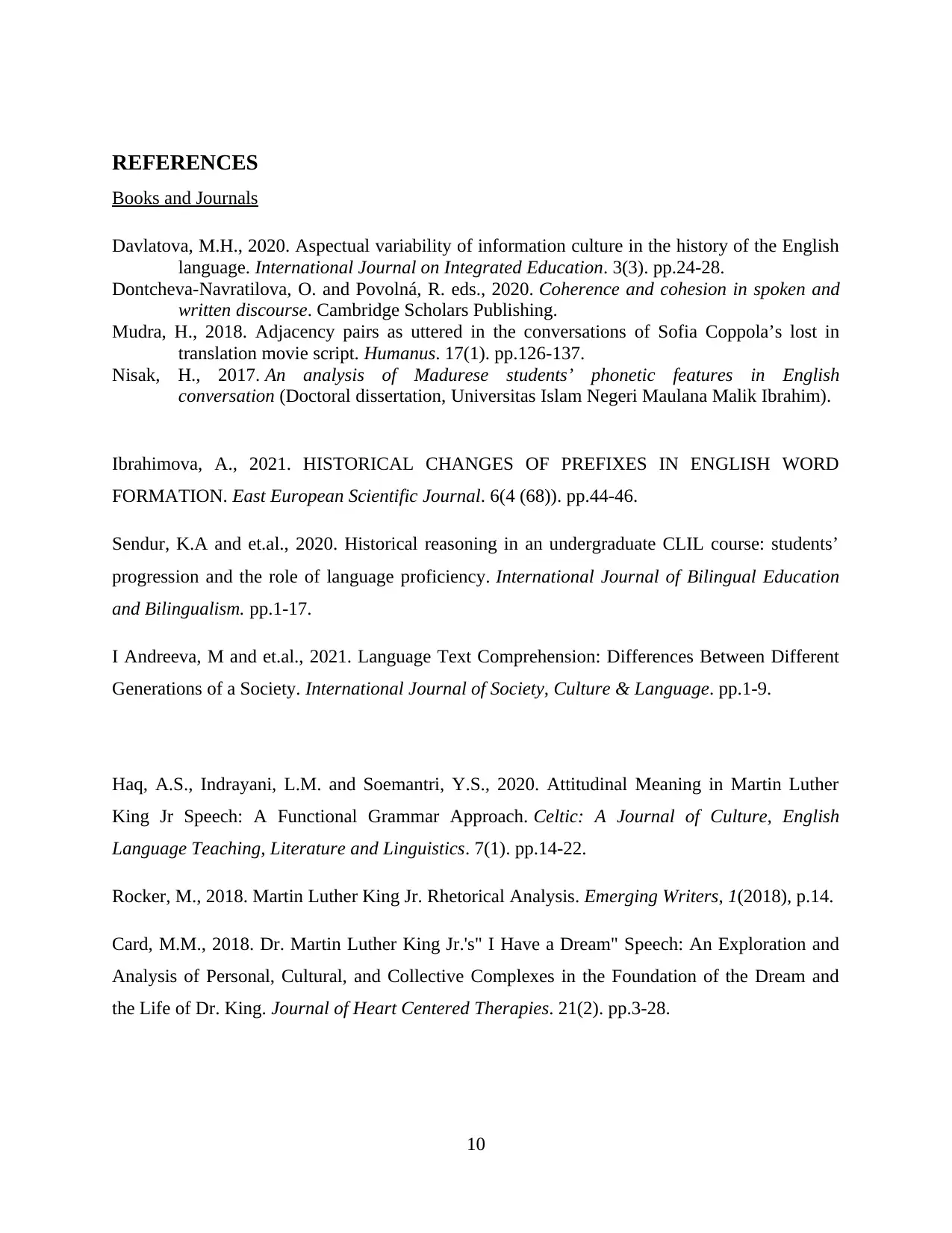
REFERENCES
Books and Journals
Davlatova, M.H., 2020. Aspectual variability of information culture in the history of the English
language. International Journal on Integrated Education. 3(3). pp.24-28.
Dontcheva-Navratilova, O. and Povolná, R. eds., 2020. Coherence and cohesion in spoken and
written discourse. Cambridge Scholars Publishing.
Mudra, H., 2018. Adjacency pairs as uttered in the conversations of Sofia Coppola’s lost in
translation movie script. Humanus. 17(1). pp.126-137.
Nisak, H., 2017. An analysis of Madurese students’ phonetic features in English
conversation (Doctoral dissertation, Universitas Islam Negeri Maulana Malik Ibrahim).
Ibrahimova, A., 2021. HISTORICAL CHANGES OF PREFIXES IN ENGLISH WORD
FORMATION. East European Scientific Journal. 6(4 (68)). pp.44-46.
Sendur, K.A and et.al., 2020. Historical reasoning in an undergraduate CLIL course: students’
progression and the role of language proficiency. International Journal of Bilingual Education
and Bilingualism. pp.1-17.
I Andreeva, M and et.al., 2021. Language Text Comprehension: Differences Between Different
Generations of a Society. International Journal of Society, Culture & Language. pp.1-9.
Haq, A.S., Indrayani, L.M. and Soemantri, Y.S., 2020. Attitudinal Meaning in Martin Luther
King Jr Speech: A Functional Grammar Approach. Celtic: A Journal of Culture, English
Language Teaching, Literature and Linguistics. 7(1). pp.14-22.
Rocker, M., 2018. Martin Luther King Jr. Rhetorical Analysis. Emerging Writers, 1(2018), p.14.
Card, M.M., 2018. Dr. Martin Luther King Jr.'s" I Have a Dream" Speech: An Exploration and
Analysis of Personal, Cultural, and Collective Complexes in the Foundation of the Dream and
the Life of Dr. King. Journal of Heart Centered Therapies. 21(2). pp.3-28.
10
Books and Journals
Davlatova, M.H., 2020. Aspectual variability of information culture in the history of the English
language. International Journal on Integrated Education. 3(3). pp.24-28.
Dontcheva-Navratilova, O. and Povolná, R. eds., 2020. Coherence and cohesion in spoken and
written discourse. Cambridge Scholars Publishing.
Mudra, H., 2018. Adjacency pairs as uttered in the conversations of Sofia Coppola’s lost in
translation movie script. Humanus. 17(1). pp.126-137.
Nisak, H., 2017. An analysis of Madurese students’ phonetic features in English
conversation (Doctoral dissertation, Universitas Islam Negeri Maulana Malik Ibrahim).
Ibrahimova, A., 2021. HISTORICAL CHANGES OF PREFIXES IN ENGLISH WORD
FORMATION. East European Scientific Journal. 6(4 (68)). pp.44-46.
Sendur, K.A and et.al., 2020. Historical reasoning in an undergraduate CLIL course: students’
progression and the role of language proficiency. International Journal of Bilingual Education
and Bilingualism. pp.1-17.
I Andreeva, M and et.al., 2021. Language Text Comprehension: Differences Between Different
Generations of a Society. International Journal of Society, Culture & Language. pp.1-9.
Haq, A.S., Indrayani, L.M. and Soemantri, Y.S., 2020. Attitudinal Meaning in Martin Luther
King Jr Speech: A Functional Grammar Approach. Celtic: A Journal of Culture, English
Language Teaching, Literature and Linguistics. 7(1). pp.14-22.
Rocker, M., 2018. Martin Luther King Jr. Rhetorical Analysis. Emerging Writers, 1(2018), p.14.
Card, M.M., 2018. Dr. Martin Luther King Jr.'s" I Have a Dream" Speech: An Exploration and
Analysis of Personal, Cultural, and Collective Complexes in the Foundation of the Dream and
the Life of Dr. King. Journal of Heart Centered Therapies. 21(2). pp.3-28.
10

1 out of 10


Related Documents


Your All-in-One AI-Powered Toolkit for Academic Success.
+13062052269
info@desklib.com
Available 24*7 on WhatsApp / Email
![[object Object]](/_next/static/media/star-bottom.7253800d.svg)
Unlock your academic potential
Copyright © 2020–2026 A2Z Services. All Rights Reserved. Developed and managed by ZUCOL.