Comprehensive Analysis: English 'Take Home' Exam - Language Study
VerifiedAdded on 2023/06/04
|8
|1949
|84
Homework Assignment
AI Summary
This document presents a student's completed 'Take Home' exam focusing on various aspects of the English language. Section 1 addresses ambiguity in sentences, lexical relations such as homonymy and hypernymy/hyponymy, the concept of scripts in discourse analysis, the differences between accents and dialects, and the significance of culture in language study. Section 2 analyzes a video presentation on politeness in language, discussing its strengths and weaknesses, and how it could be used in a classroom setting. It also explores the value of teaching Standard English, arguing for its importance as a foundation for further language learning. The exam references several academic sources to support its analysis and arguments. Desklib provides this document as a resource for students studying linguistics, pragmatics, and related fields, offering access to a wide range of solved assignments and past papers.

1
Running head: ENGLISH ‘TAKE HOME’ EXAM
How English Works- ‘Take Home’ Exam
Student name
Course
Date
Running head: ENGLISH ‘TAKE HOME’ EXAM
How English Works- ‘Take Home’ Exam
Student name
Course
Date

Paraphrase This Document
Need a fresh take? Get an instant paraphrase of this document with our AI Paraphraser
2
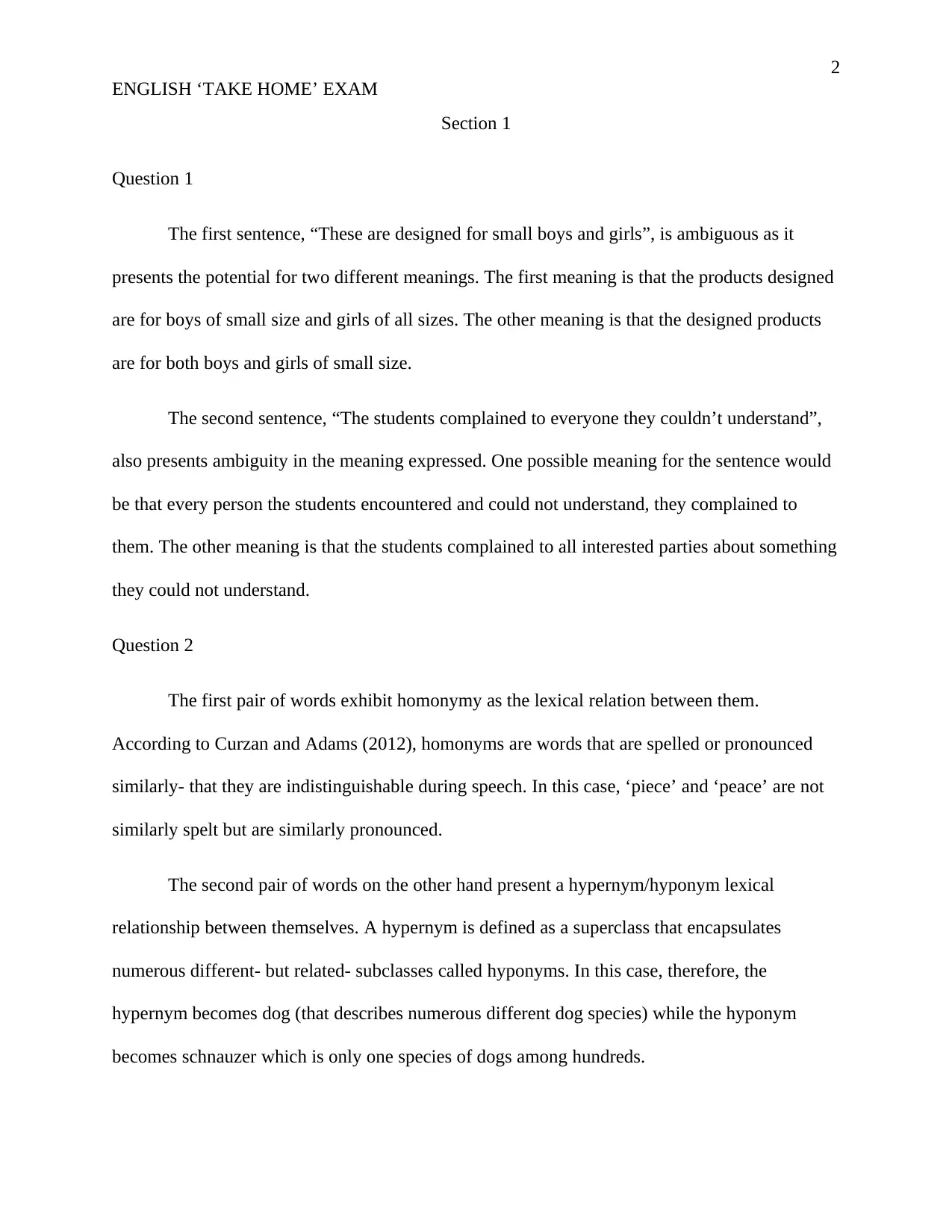
ENGLISH ‘TAKE HOME’ EXAM
Section 1
Question 1
The first sentence, “These are designed for small boys and girls”, is ambiguous as it
presents the potential for two different meanings. The first meaning is that the products designed
are for boys of small size and girls of all sizes. The other meaning is that the designed products
are for both boys and girls of small size.
The second sentence, “The students complained to everyone they couldn’t understand”,
also presents ambiguity in the meaning expressed. One possible meaning for the sentence would
be that every person the students encountered and could not understand, they complained to
them. The other meaning is that the students complained to all interested parties about something
they could not understand.
Question 2
The first pair of words exhibit homonymy as the lexical relation between them.
According to Curzan and Adams (2012), homonyms are words that are spelled or pronounced
similarly- that they are indistinguishable during speech. In this case, ‘piece’ and ‘peace’ are not
similarly spelt but are similarly pronounced.
The second pair of words on the other hand present a hypernym/hyponym lexical
relationship between themselves. A hypernym is defined as a superclass that encapsulates
numerous different- but related- subclasses called hyponyms. In this case, therefore, the
hypernym becomes dog (that describes numerous different dog species) while the hyponym
becomes schnauzer which is only one species of dogs among hundreds.
ENGLISH ‘TAKE HOME’ EXAM
Section 1
Question 1
The first sentence, “These are designed for small boys and girls”, is ambiguous as it
presents the potential for two different meanings. The first meaning is that the products designed
are for boys of small size and girls of all sizes. The other meaning is that the designed products
are for both boys and girls of small size.
The second sentence, “The students complained to everyone they couldn’t understand”,
also presents ambiguity in the meaning expressed. One possible meaning for the sentence would
be that every person the students encountered and could not understand, they complained to
them. The other meaning is that the students complained to all interested parties about something
they could not understand.
Question 2
The first pair of words exhibit homonymy as the lexical relation between them.
According to Curzan and Adams (2012), homonyms are words that are spelled or pronounced
similarly- that they are indistinguishable during speech. In this case, ‘piece’ and ‘peace’ are not
similarly spelt but are similarly pronounced.
The second pair of words on the other hand present a hypernym/hyponym lexical
relationship between themselves. A hypernym is defined as a superclass that encapsulates
numerous different- but related- subclasses called hyponyms. In this case, therefore, the
hypernym becomes dog (that describes numerous different dog species) while the hyponym
becomes schnauzer which is only one species of dogs among hundreds.
3
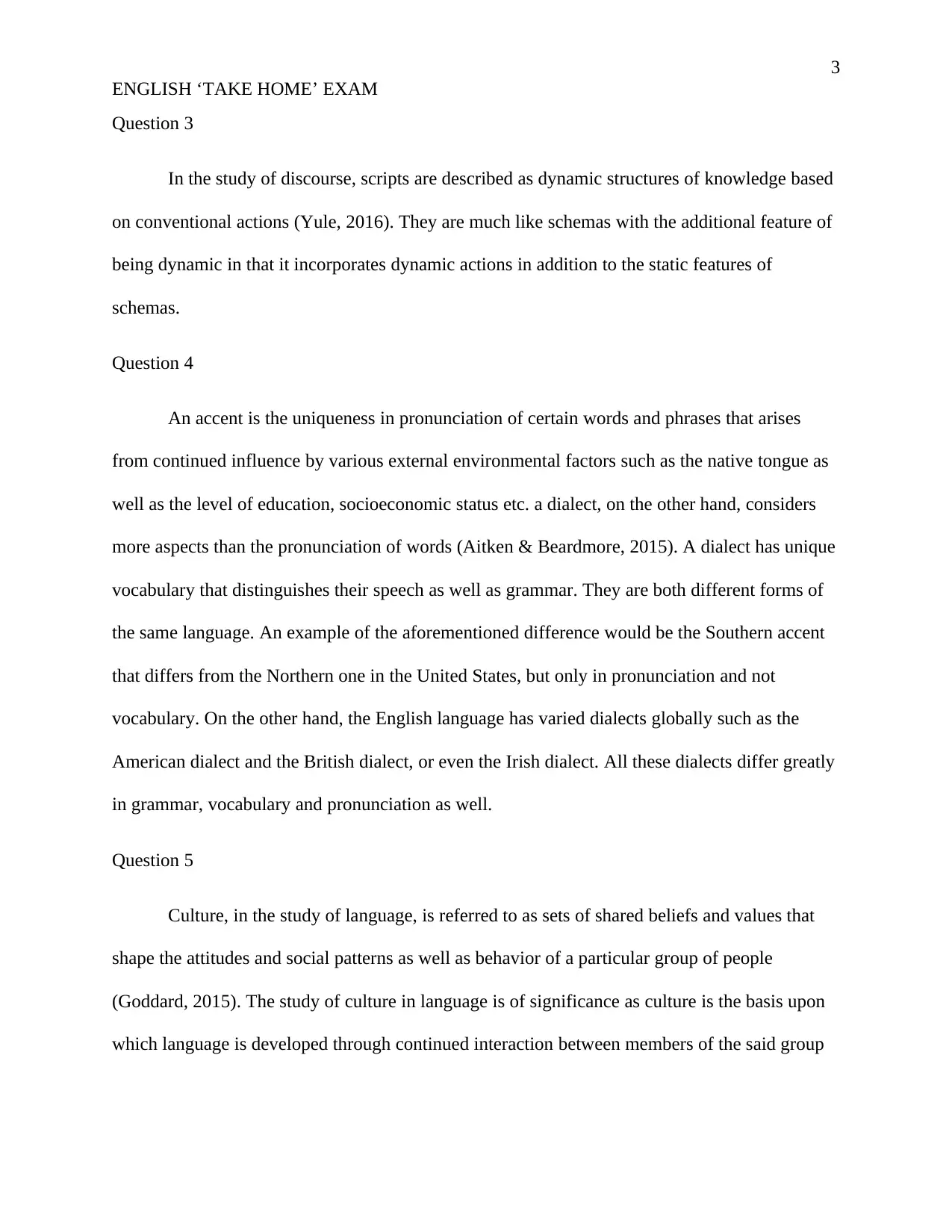
ENGLISH ‘TAKE HOME’ EXAM
Question 3
In the study of discourse, scripts are described as dynamic structures of knowledge based
on conventional actions (Yule, 2016). They are much like schemas with the additional feature of
being dynamic in that it incorporates dynamic actions in addition to the static features of
schemas.
Question 4
An accent is the uniqueness in pronunciation of certain words and phrases that arises
from continued influence by various external environmental factors such as the native tongue as
well as the level of education, socioeconomic status etc. a dialect, on the other hand, considers
more aspects than the pronunciation of words (Aitken & Beardmore, 2015). A dialect has unique
vocabulary that distinguishes their speech as well as grammar. They are both different forms of
the same language. An example of the aforementioned difference would be the Southern accent
that differs from the Northern one in the United States, but only in pronunciation and not
vocabulary. On the other hand, the English language has varied dialects globally such as the
American dialect and the British dialect, or even the Irish dialect. All these dialects differ greatly
in grammar, vocabulary and pronunciation as well.
Question 5
Culture, in the study of language, is referred to as sets of shared beliefs and values that
shape the attitudes and social patterns as well as behavior of a particular group of people
(Goddard, 2015). The study of culture in language is of significance as culture is the basis upon
which language is developed through continued interaction between members of the said group
ENGLISH ‘TAKE HOME’ EXAM
Question 3
In the study of discourse, scripts are described as dynamic structures of knowledge based
on conventional actions (Yule, 2016). They are much like schemas with the additional feature of
being dynamic in that it incorporates dynamic actions in addition to the static features of
schemas.
Question 4
An accent is the uniqueness in pronunciation of certain words and phrases that arises
from continued influence by various external environmental factors such as the native tongue as
well as the level of education, socioeconomic status etc. a dialect, on the other hand, considers
more aspects than the pronunciation of words (Aitken & Beardmore, 2015). A dialect has unique
vocabulary that distinguishes their speech as well as grammar. They are both different forms of
the same language. An example of the aforementioned difference would be the Southern accent
that differs from the Northern one in the United States, but only in pronunciation and not
vocabulary. On the other hand, the English language has varied dialects globally such as the
American dialect and the British dialect, or even the Irish dialect. All these dialects differ greatly
in grammar, vocabulary and pronunciation as well.
Question 5
Culture, in the study of language, is referred to as sets of shared beliefs and values that
shape the attitudes and social patterns as well as behavior of a particular group of people
(Goddard, 2015). The study of culture in language is of significance as culture is the basis upon
which language is developed through continued interaction between members of the said group
⊘ This is a preview!⊘
Do you want full access?
Subscribe today to unlock all pages.

Trusted by 1+ million students worldwide
4
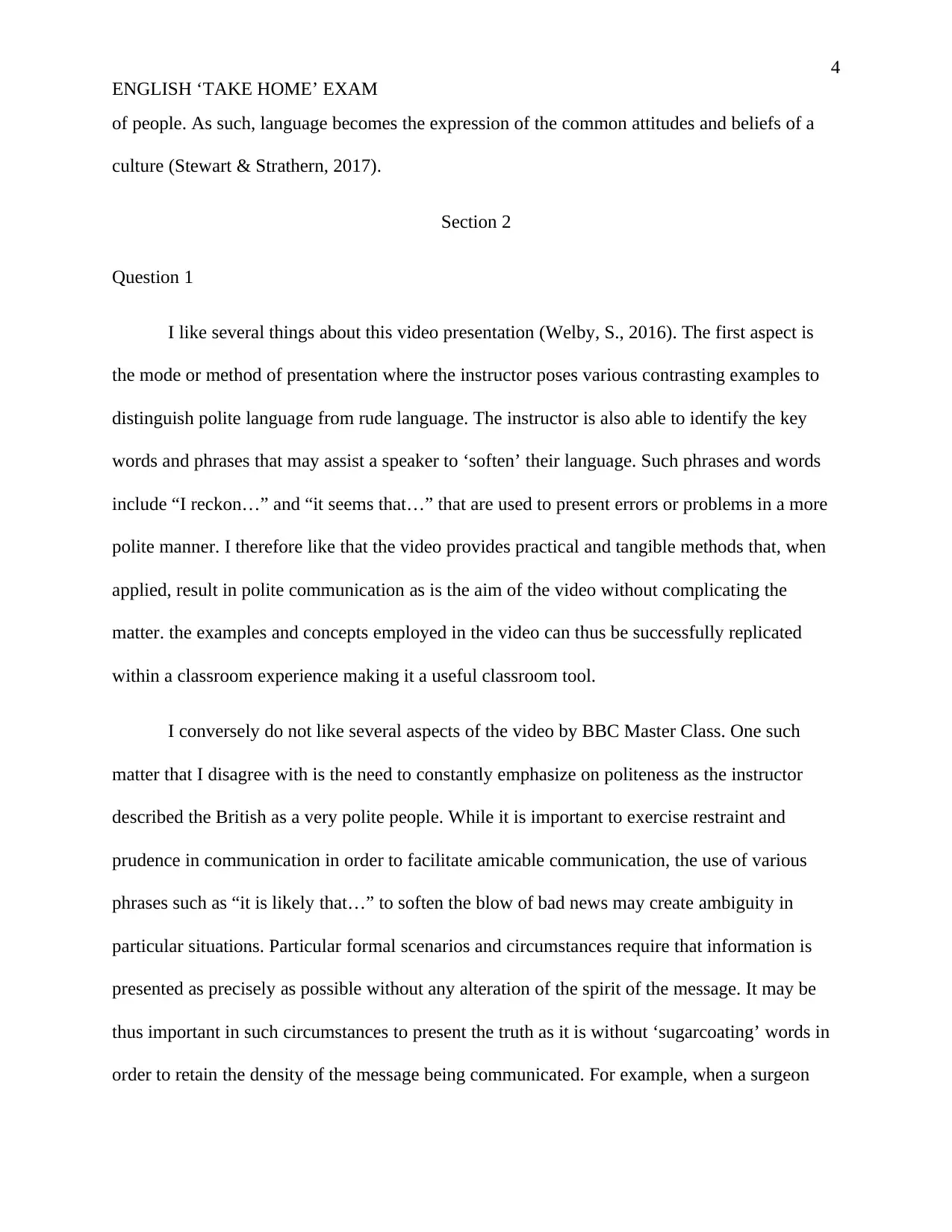
ENGLISH ‘TAKE HOME’ EXAM
of people. As such, language becomes the expression of the common attitudes and beliefs of a
culture (Stewart & Strathern, 2017).
Section 2
Question 1
I like several things about this video presentation (Welby, S., 2016). The first aspect is
the mode or method of presentation where the instructor poses various contrasting examples to
distinguish polite language from rude language. The instructor is also able to identify the key
words and phrases that may assist a speaker to ‘soften’ their language. Such phrases and words
include “I reckon…” and “it seems that…” that are used to present errors or problems in a more
polite manner. I therefore like that the video provides practical and tangible methods that, when
applied, result in polite communication as is the aim of the video without complicating the
matter. the examples and concepts employed in the video can thus be successfully replicated
within a classroom experience making it a useful classroom tool.
I conversely do not like several aspects of the video by BBC Master Class. One such
matter that I disagree with is the need to constantly emphasize on politeness as the instructor
described the British as a very polite people. While it is important to exercise restraint and
prudence in communication in order to facilitate amicable communication, the use of various
phrases such as “it is likely that…” to soften the blow of bad news may create ambiguity in
particular situations. Particular formal scenarios and circumstances require that information is
presented as precisely as possible without any alteration of the spirit of the message. It may be
thus important in such circumstances to present the truth as it is without ‘sugarcoating’ words in
order to retain the density of the message being communicated. For example, when a surgeon
ENGLISH ‘TAKE HOME’ EXAM
of people. As such, language becomes the expression of the common attitudes and beliefs of a
culture (Stewart & Strathern, 2017).
Section 2
Question 1
I like several things about this video presentation (Welby, S., 2016). The first aspect is
the mode or method of presentation where the instructor poses various contrasting examples to
distinguish polite language from rude language. The instructor is also able to identify the key
words and phrases that may assist a speaker to ‘soften’ their language. Such phrases and words
include “I reckon…” and “it seems that…” that are used to present errors or problems in a more
polite manner. I therefore like that the video provides practical and tangible methods that, when
applied, result in polite communication as is the aim of the video without complicating the
matter. the examples and concepts employed in the video can thus be successfully replicated
within a classroom experience making it a useful classroom tool.
I conversely do not like several aspects of the video by BBC Master Class. One such
matter that I disagree with is the need to constantly emphasize on politeness as the instructor
described the British as a very polite people. While it is important to exercise restraint and
prudence in communication in order to facilitate amicable communication, the use of various
phrases such as “it is likely that…” to soften the blow of bad news may create ambiguity in
particular situations. Particular formal scenarios and circumstances require that information is
presented as precisely as possible without any alteration of the spirit of the message. It may be
thus important in such circumstances to present the truth as it is without ‘sugarcoating’ words in
order to retain the density of the message being communicated. For example, when a surgeon
Paraphrase This Document
Need a fresh take? Get an instant paraphrase of this document with our AI Paraphraser
5
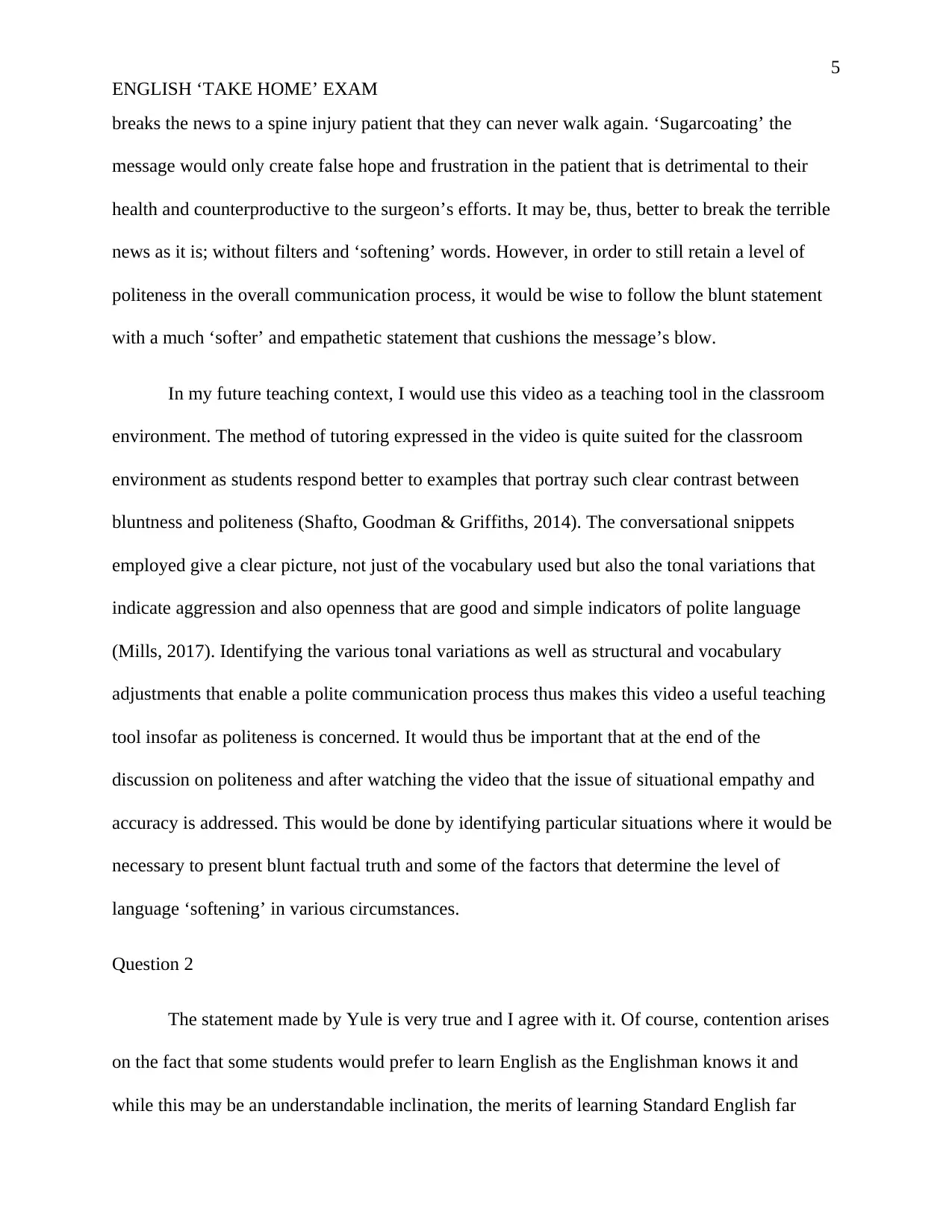
ENGLISH ‘TAKE HOME’ EXAM
breaks the news to a spine injury patient that they can never walk again. ‘Sugarcoating’ the
message would only create false hope and frustration in the patient that is detrimental to their
health and counterproductive to the surgeon’s efforts. It may be, thus, better to break the terrible
news as it is; without filters and ‘softening’ words. However, in order to still retain a level of
politeness in the overall communication process, it would be wise to follow the blunt statement
with a much ‘softer’ and empathetic statement that cushions the message’s blow.
In my future teaching context, I would use this video as a teaching tool in the classroom
environment. The method of tutoring expressed in the video is quite suited for the classroom
environment as students respond better to examples that portray such clear contrast between
bluntness and politeness (Shafto, Goodman & Griffiths, 2014). The conversational snippets
employed give a clear picture, not just of the vocabulary used but also the tonal variations that
indicate aggression and also openness that are good and simple indicators of polite language
(Mills, 2017). Identifying the various tonal variations as well as structural and vocabulary
adjustments that enable a polite communication process thus makes this video a useful teaching
tool insofar as politeness is concerned. It would thus be important that at the end of the
discussion on politeness and after watching the video that the issue of situational empathy and
accuracy is addressed. This would be done by identifying particular situations where it would be
necessary to present blunt factual truth and some of the factors that determine the level of
language ‘softening’ in various circumstances.
Question 2
The statement made by Yule is very true and I agree with it. Of course, contention arises
on the fact that some students would prefer to learn English as the Englishman knows it and
while this may be an understandable inclination, the merits of learning Standard English far
ENGLISH ‘TAKE HOME’ EXAM
breaks the news to a spine injury patient that they can never walk again. ‘Sugarcoating’ the
message would only create false hope and frustration in the patient that is detrimental to their
health and counterproductive to the surgeon’s efforts. It may be, thus, better to break the terrible
news as it is; without filters and ‘softening’ words. However, in order to still retain a level of
politeness in the overall communication process, it would be wise to follow the blunt statement
with a much ‘softer’ and empathetic statement that cushions the message’s blow.
In my future teaching context, I would use this video as a teaching tool in the classroom
environment. The method of tutoring expressed in the video is quite suited for the classroom
environment as students respond better to examples that portray such clear contrast between
bluntness and politeness (Shafto, Goodman & Griffiths, 2014). The conversational snippets
employed give a clear picture, not just of the vocabulary used but also the tonal variations that
indicate aggression and also openness that are good and simple indicators of polite language
(Mills, 2017). Identifying the various tonal variations as well as structural and vocabulary
adjustments that enable a polite communication process thus makes this video a useful teaching
tool insofar as politeness is concerned. It would thus be important that at the end of the
discussion on politeness and after watching the video that the issue of situational empathy and
accuracy is addressed. This would be done by identifying particular situations where it would be
necessary to present blunt factual truth and some of the factors that determine the level of
language ‘softening’ in various circumstances.
Question 2
The statement made by Yule is very true and I agree with it. Of course, contention arises
on the fact that some students would prefer to learn English as the Englishman knows it and
while this may be an understandable inclination, the merits of learning Standard English far
6
ENGLISH ‘TAKE HOME’ EXAM
outweigh the limitations imposed by not learning the ‘Englishman’s English’. The reason for the
existence of Standard English is to simplify the rigorous grammar impositions of Elizabethan or
any other form of English to terms that are understandable both to the native English speakers as
well as learners of the language as a second language and thus facilitating communication
between them (Seidlhofer, 2017). While it may be limited in scope and cultural richness
compared to other forms of English (including the implied ‘superior English’ by Yule, 2017),
Standard English equips all students with sufficient tools to delve deeper into other richer or
more exciting forms of the English language (Trudgill & Hannah, 2017). It may also become
exceedingly difficult to successfully teach other advanced varieties of the language that may
have different structural, lexical and grammatical rules since these rules and conventions also
change periodically and do not enable effective communication (Pennycook, 2017). These
varieties of the English language are also vast in number which compounds the difficulty of
teaching all of them in the classroom. A learner may, however, choose to study these varieties in
a deeper manner, but only once they have mastered and understood Standard English.
ENGLISH ‘TAKE HOME’ EXAM
outweigh the limitations imposed by not learning the ‘Englishman’s English’. The reason for the
existence of Standard English is to simplify the rigorous grammar impositions of Elizabethan or
any other form of English to terms that are understandable both to the native English speakers as
well as learners of the language as a second language and thus facilitating communication
between them (Seidlhofer, 2017). While it may be limited in scope and cultural richness
compared to other forms of English (including the implied ‘superior English’ by Yule, 2017),
Standard English equips all students with sufficient tools to delve deeper into other richer or
more exciting forms of the English language (Trudgill & Hannah, 2017). It may also become
exceedingly difficult to successfully teach other advanced varieties of the language that may
have different structural, lexical and grammatical rules since these rules and conventions also
change periodically and do not enable effective communication (Pennycook, 2017). These
varieties of the English language are also vast in number which compounds the difficulty of
teaching all of them in the classroom. A learner may, however, choose to study these varieties in
a deeper manner, but only once they have mastered and understood Standard English.
⊘ This is a preview!⊘
Do you want full access?
Subscribe today to unlock all pages.
Trusted by 1+ million students worldwide
7
ENGLISH ‘TAKE HOME’ EXAM
References
Aitken, S., & Beardmore, K. (2015). Accent, Dialect and Phonics. Inclusion and Early Years
Practice, 4(14). 56-73.
Culpeper, J., & Haugh, M. (2014). Pragmatics and the English language. (2nd ed.) Sydney,
Australia: Macmillan International Higher Education.
Curzan, Anne. & Adams, Michael. (2012). How English works: a linguistic introduction. (2nd
ed.)Boston: Pearson Longman.
Goddard, C. (2015-06-25). Words as Carriers of Cultural Meaning. In (Ed.), The Oxford
Handbook of the Word. : Oxford University Press,. Retrieved 29 Oct. 2018, from
http://www.oxfordhandbooks.com/view/10.1093/oxfordhb/9780199641604.001.0001/
oxfordhb-9780199641604-e-027.
Mills, S. (2017). English politeness and class. (2nd ed) Cambridge: Cambridge University Press.
Pennycook, A. (2017). The cultural politics of English as an international language. (!st ed.)
London: Routledge.
Seidlhofer, B. (2017). Standard English and the dynamics of ELF variation. In The Routledge
handbook of English as a lingua franca (pp. 85-100) (1st ed.). London. Routledge.
Shafto, P., Goodman, N. D., & Griffiths, T. L. (2014). A rational account of pedagogical
reasoning: Teaching by, and learning from, examples. Cognitive psychology, 71, 55-89.
Stewart, P. J., & Strathern, A. J. (2017). Language and culture. In Breaking the Frames (pp. 69-
78). (3rd ed.) London: Palgrave Macmillan, Cham.
ENGLISH ‘TAKE HOME’ EXAM
References
Aitken, S., & Beardmore, K. (2015). Accent, Dialect and Phonics. Inclusion and Early Years
Practice, 4(14). 56-73.
Culpeper, J., & Haugh, M. (2014). Pragmatics and the English language. (2nd ed.) Sydney,
Australia: Macmillan International Higher Education.
Curzan, Anne. & Adams, Michael. (2012). How English works: a linguistic introduction. (2nd
ed.)Boston: Pearson Longman.
Goddard, C. (2015-06-25). Words as Carriers of Cultural Meaning. In (Ed.), The Oxford
Handbook of the Word. : Oxford University Press,. Retrieved 29 Oct. 2018, from
http://www.oxfordhandbooks.com/view/10.1093/oxfordhb/9780199641604.001.0001/
oxfordhb-9780199641604-e-027.
Mills, S. (2017). English politeness and class. (2nd ed) Cambridge: Cambridge University Press.
Pennycook, A. (2017). The cultural politics of English as an international language. (!st ed.)
London: Routledge.
Seidlhofer, B. (2017). Standard English and the dynamics of ELF variation. In The Routledge
handbook of English as a lingua franca (pp. 85-100) (1st ed.). London. Routledge.
Shafto, P., Goodman, N. D., & Griffiths, T. L. (2014). A rational account of pedagogical
reasoning: Teaching by, and learning from, examples. Cognitive psychology, 71, 55-89.
Stewart, P. J., & Strathern, A. J. (2017). Language and culture. In Breaking the Frames (pp. 69-
78). (3rd ed.) London: Palgrave Macmillan, Cham.
Paraphrase This Document
Need a fresh take? Get an instant paraphrase of this document with our AI Paraphraser
8
ENGLISH ‘TAKE HOME’ EXAM
Trudgill, P., & Hannah, J. (2017). International English: A guide to varieties of English around
the world. (6th ed.) London: Routledge.
Welby, S. (Reporter) (2016, December 12) BBC Learning English: Be Polite- How to soften
your language. Retrieved October 28, 2018, from https://www.youtube.com/watch?
v=rQN4-l5AXE0
Yule, G. (2017). (6th ed.) The study of language. London. Cambridge university press.
ENGLISH ‘TAKE HOME’ EXAM
Trudgill, P., & Hannah, J. (2017). International English: A guide to varieties of English around
the world. (6th ed.) London: Routledge.
Welby, S. (Reporter) (2016, December 12) BBC Learning English: Be Polite- How to soften
your language. Retrieved October 28, 2018, from https://www.youtube.com/watch?
v=rQN4-l5AXE0
Yule, G. (2017). (6th ed.) The study of language. London. Cambridge university press.

1 out of 8


Your All-in-One AI-Powered Toolkit for Academic Success.
+13062052269
info@desklib.com
Available 24*7 on WhatsApp / Email
![[object Object]](/_next/static/media/star-bottom.7253800d.svg)
Unlock your academic potential
Copyright © 2020–2026 A2Z Services. All Rights Reserved. Developed and managed by ZUCOL.