Report: English Legal Systems and Skills - Statutory Interpretation
VerifiedAdded on 2020/06/04
|13
|3346
|373
Report
AI Summary
This report provides a comprehensive overview of the English legal system, with a specific focus on statutory interpretation. It begins by explaining the significance of law in the smooth operation of a country and the need for regulatory oversight. The report then delves into the rules of statutory interpretation, including the literal, golden, and mischief rules, providing detailed explanations and examples of their application. It also explores the significance of case law, particularly the case of Pepper v Hart, and its impact on the interpretation of statutes. Furthermore, the report assesses the purposive approach to statutory interpretation and its relationship to the other rules. The report concludes with a discussion of the methods of interpretation used in a given case scenario and provides a summary of the key concepts discussed.

English legal systems and
skills
skills

Paraphrase This Document
Need a fresh take? Get an instant paraphrase of this document with our AI Paraphraser
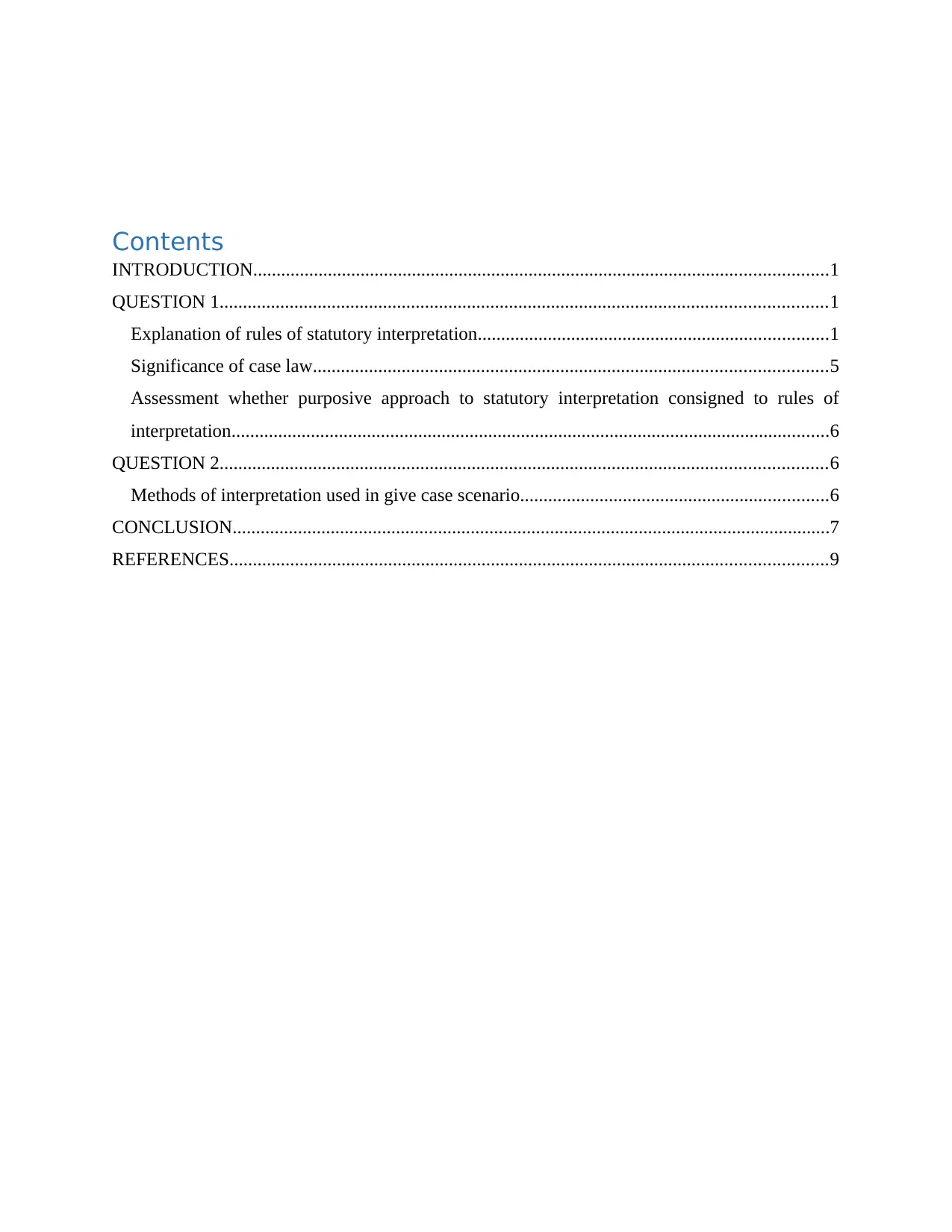
Contents
INTRODUCTION...........................................................................................................................1
QUESTION 1..................................................................................................................................1
Explanation of rules of statutory interpretation...........................................................................1
Significance of case law..............................................................................................................5
Assessment whether purposive approach to statutory interpretation consigned to rules of
interpretation................................................................................................................................6
QUESTION 2..................................................................................................................................6
Methods of interpretation used in give case scenario..................................................................6
CONCLUSION................................................................................................................................7
REFERENCES................................................................................................................................9
INTRODUCTION...........................................................................................................................1
QUESTION 1..................................................................................................................................1
Explanation of rules of statutory interpretation...........................................................................1
Significance of case law..............................................................................................................5
Assessment whether purposive approach to statutory interpretation consigned to rules of
interpretation................................................................................................................................6
QUESTION 2..................................................................................................................................6
Methods of interpretation used in give case scenario..................................................................6
CONCLUSION................................................................................................................................7
REFERENCES................................................................................................................................9
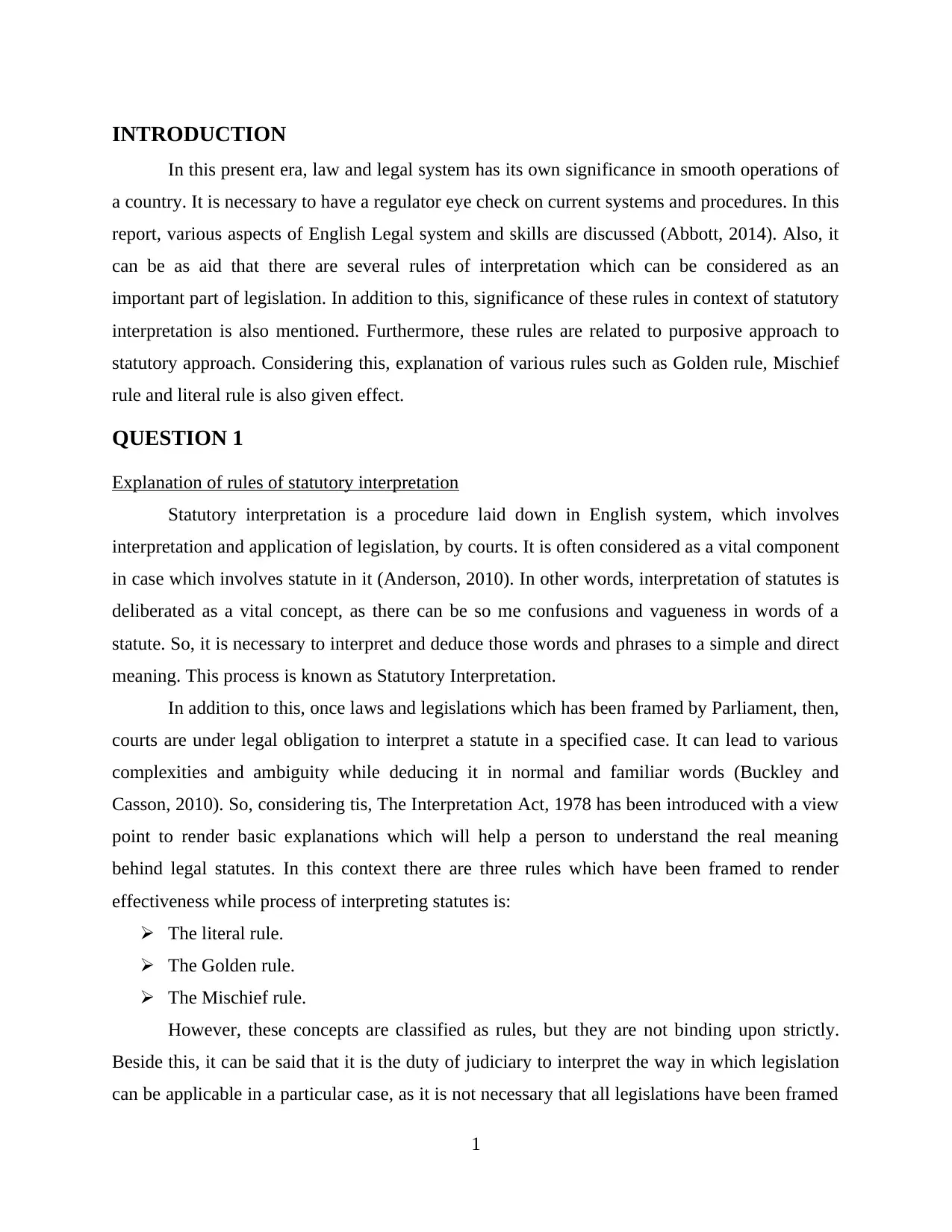
INTRODUCTION
In this present era, law and legal system has its own significance in smooth operations of
a country. It is necessary to have a regulator eye check on current systems and procedures. In this
report, various aspects of English Legal system and skills are discussed (Abbott, 2014). Also, it
can be as aid that there are several rules of interpretation which can be considered as an
important part of legislation. In addition to this, significance of these rules in context of statutory
interpretation is also mentioned. Furthermore, these rules are related to purposive approach to
statutory approach. Considering this, explanation of various rules such as Golden rule, Mischief
rule and literal rule is also given effect.
QUESTION 1
Explanation of rules of statutory interpretation
Statutory interpretation is a procedure laid down in English system, which involves
interpretation and application of legislation, by courts. It is often considered as a vital component
in case which involves statute in it (Anderson, 2010). In other words, interpretation of statutes is
deliberated as a vital concept, as there can be so me confusions and vagueness in words of a
statute. So, it is necessary to interpret and deduce those words and phrases to a simple and direct
meaning. This process is known as Statutory Interpretation.
In addition to this, once laws and legislations which has been framed by Parliament, then,
courts are under legal obligation to interpret a statute in a specified case. It can lead to various
complexities and ambiguity while deducing it in normal and familiar words (Buckley and
Casson, 2010). So, considering tis, The Interpretation Act, 1978 has been introduced with a view
point to render basic explanations which will help a person to understand the real meaning
behind legal statutes. In this context there are three rules which have been framed to render
effectiveness while process of interpreting statutes is:
The literal rule.
The Golden rule.
The Mischief rule.
However, these concepts are classified as rules, but they are not binding upon strictly.
Beside this, it can be said that it is the duty of judiciary to interpret the way in which legislation
can be applicable in a particular case, as it is not necessary that all legislations have been framed
1
In this present era, law and legal system has its own significance in smooth operations of
a country. It is necessary to have a regulator eye check on current systems and procedures. In this
report, various aspects of English Legal system and skills are discussed (Abbott, 2014). Also, it
can be as aid that there are several rules of interpretation which can be considered as an
important part of legislation. In addition to this, significance of these rules in context of statutory
interpretation is also mentioned. Furthermore, these rules are related to purposive approach to
statutory approach. Considering this, explanation of various rules such as Golden rule, Mischief
rule and literal rule is also given effect.
QUESTION 1
Explanation of rules of statutory interpretation
Statutory interpretation is a procedure laid down in English system, which involves
interpretation and application of legislation, by courts. It is often considered as a vital component
in case which involves statute in it (Anderson, 2010). In other words, interpretation of statutes is
deliberated as a vital concept, as there can be so me confusions and vagueness in words of a
statute. So, it is necessary to interpret and deduce those words and phrases to a simple and direct
meaning. This process is known as Statutory Interpretation.
In addition to this, once laws and legislations which has been framed by Parliament, then,
courts are under legal obligation to interpret a statute in a specified case. It can lead to various
complexities and ambiguity while deducing it in normal and familiar words (Buckley and
Casson, 2010). So, considering tis, The Interpretation Act, 1978 has been introduced with a view
point to render basic explanations which will help a person to understand the real meaning
behind legal statutes. In this context there are three rules which have been framed to render
effectiveness while process of interpreting statutes is:
The literal rule.
The Golden rule.
The Mischief rule.
However, these concepts are classified as rules, but they are not binding upon strictly.
Beside this, it can be said that it is the duty of judiciary to interpret the way in which legislation
can be applicable in a particular case, as it is not necessary that all legislations have been framed
1
⊘ This is a preview!⊘
Do you want full access?
Subscribe today to unlock all pages.

Trusted by 1+ million students worldwide
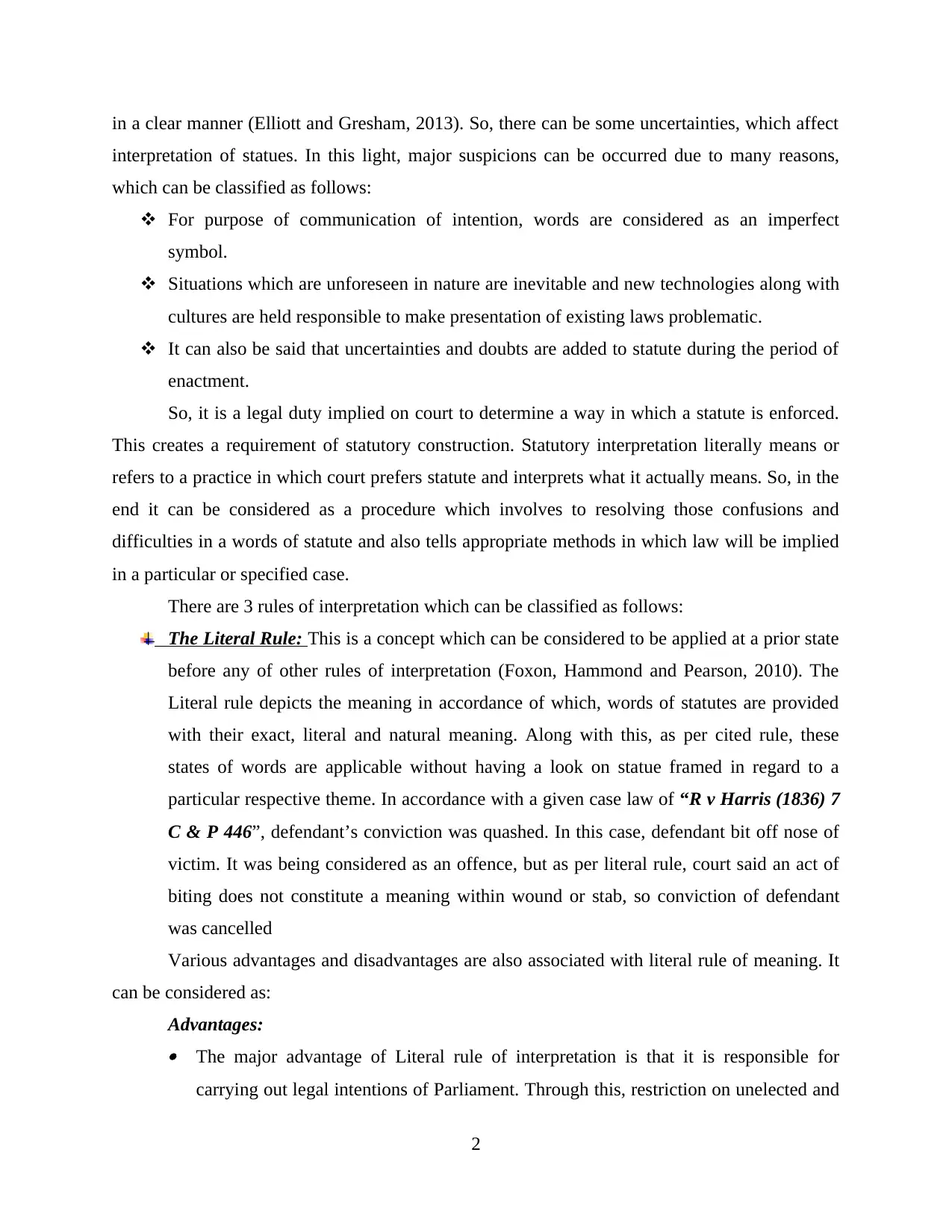
in a clear manner (Elliott and Gresham, 2013). So, there can be some uncertainties, which affect
interpretation of statues. In this light, major suspicions can be occurred due to many reasons,
which can be classified as follows:
For purpose of communication of intention, words are considered as an imperfect
symbol.
Situations which are unforeseen in nature are inevitable and new technologies along with
cultures are held responsible to make presentation of existing laws problematic.
It can also be said that uncertainties and doubts are added to statute during the period of
enactment.
So, it is a legal duty implied on court to determine a way in which a statute is enforced.
This creates a requirement of statutory construction. Statutory interpretation literally means or
refers to a practice in which court prefers statute and interprets what it actually means. So, in the
end it can be considered as a procedure which involves to resolving those confusions and
difficulties in a words of statute and also tells appropriate methods in which law will be implied
in a particular or specified case.
There are 3 rules of interpretation which can be classified as follows:
The Literal Rule: This is a concept which can be considered to be applied at a prior state
before any of other rules of interpretation (Foxon, Hammond and Pearson, 2010). The
Literal rule depicts the meaning in accordance of which, words of statutes are provided
with their exact, literal and natural meaning. Along with this, as per cited rule, these
states of words are applicable without having a look on statue framed in regard to a
particular respective theme. In accordance with a given case law of “R v Harris (1836) 7
C & P 446”, defendant’s conviction was quashed. In this case, defendant bit off nose of
victim. It was being considered as an offence, but as per literal rule, court said an act of
biting does not constitute a meaning within wound or stab, so conviction of defendant
was cancelled
Various advantages and disadvantages are also associated with literal rule of meaning. It
can be considered as:
Advantages:
The major advantage of Literal rule of interpretation is that it is responsible for
carrying out legal intentions of Parliament. Through this, restriction on unelected and
2
interpretation of statues. In this light, major suspicions can be occurred due to many reasons,
which can be classified as follows:
For purpose of communication of intention, words are considered as an imperfect
symbol.
Situations which are unforeseen in nature are inevitable and new technologies along with
cultures are held responsible to make presentation of existing laws problematic.
It can also be said that uncertainties and doubts are added to statute during the period of
enactment.
So, it is a legal duty implied on court to determine a way in which a statute is enforced.
This creates a requirement of statutory construction. Statutory interpretation literally means or
refers to a practice in which court prefers statute and interprets what it actually means. So, in the
end it can be considered as a procedure which involves to resolving those confusions and
difficulties in a words of statute and also tells appropriate methods in which law will be implied
in a particular or specified case.
There are 3 rules of interpretation which can be classified as follows:
The Literal Rule: This is a concept which can be considered to be applied at a prior state
before any of other rules of interpretation (Foxon, Hammond and Pearson, 2010). The
Literal rule depicts the meaning in accordance of which, words of statutes are provided
with their exact, literal and natural meaning. Along with this, as per cited rule, these
states of words are applicable without having a look on statue framed in regard to a
particular respective theme. In accordance with a given case law of “R v Harris (1836) 7
C & P 446”, defendant’s conviction was quashed. In this case, defendant bit off nose of
victim. It was being considered as an offence, but as per literal rule, court said an act of
biting does not constitute a meaning within wound or stab, so conviction of defendant
was cancelled
Various advantages and disadvantages are also associated with literal rule of meaning. It
can be considered as:
Advantages:
The major advantage of Literal rule of interpretation is that it is responsible for
carrying out legal intentions of Parliament. Through this, restriction on unelected and
2
Paraphrase This Document
Need a fresh take? Get an instant paraphrase of this document with our AI Paraphraser
appointed judges is imposed from formation of laws, which has been in contradiction
with Doctrine of Separation of Powers ().
In addition to this, it also contributes to render certainty in laws and legislations.
Disadvantages:
The main issue associated with literal rule of interpretation is that it undertakes
perfect drafting of legislations by Parliament.
Sometimes, it can also lead to harsh and absurd decisions.
In the words of, Jan Michiel, (2016), this rule can be considered as mechanical.
It facilitates creation of loopholes in law. Along with this, it leads to injustice among
parties to a transaction.
So, Literal rule let the court interpret the respective statutes and other lawful things in a
most common and ordinary meaning. It makes it easy for a person who is desirous to deduce
words of statute in a literal meaning. Also, in case law of “Fisher v Bell [1961] 1 QB 394”,
court interprets and form decision by application of literal rule of meaning.
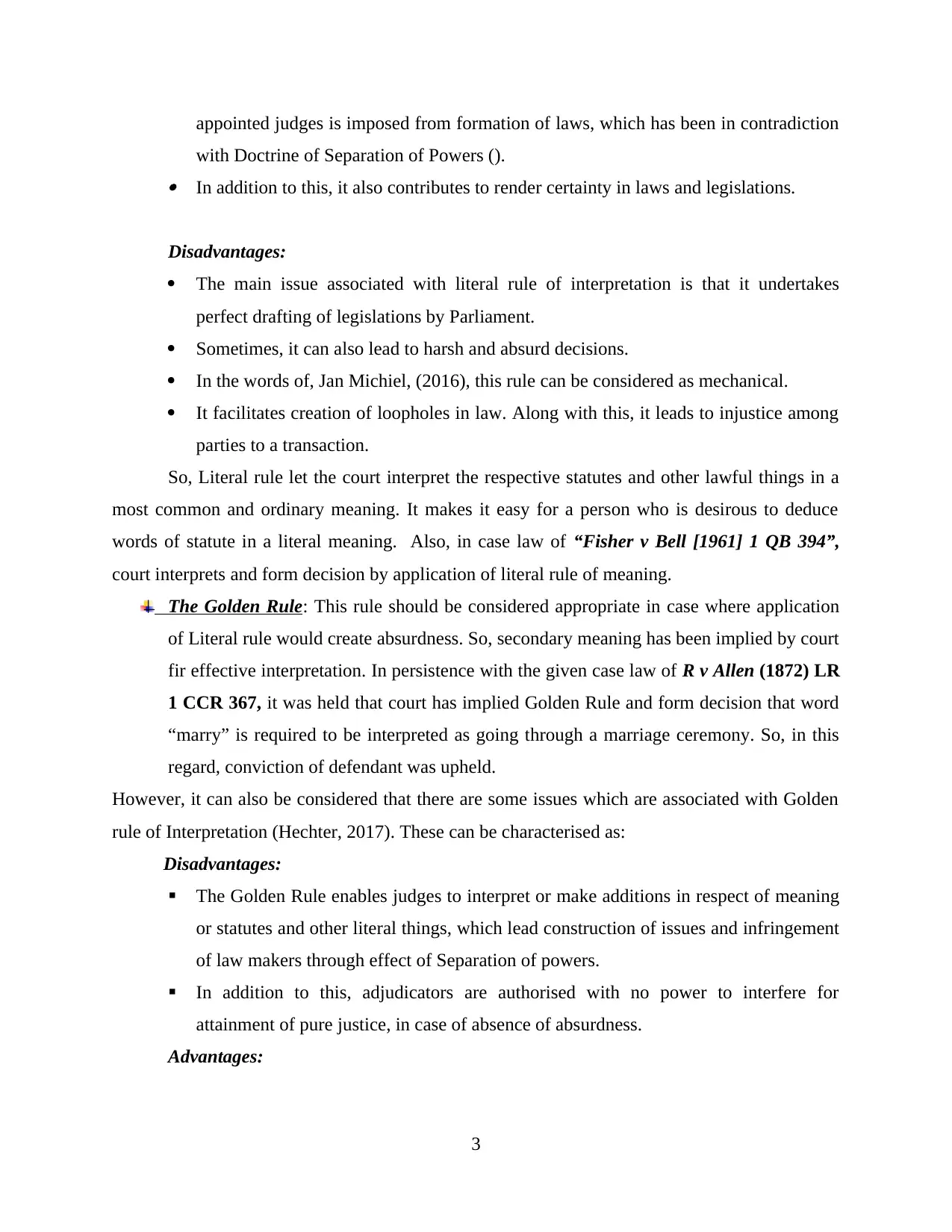
The Golden Rule: This rule should be considered appropriate in case where application
of Literal rule would create absurdness. So, secondary meaning has been implied by court
fir effective interpretation. In persistence with the given case law of R v Allen (1872) LR
1 CCR 367, it was held that court has implied Golden Rule and form decision that word
“marry” is required to be interpreted as going through a marriage ceremony. So, in this
regard, conviction of defendant was upheld.
However, it can also be considered that there are some issues which are associated with Golden
rule of Interpretation (Hechter, 2017). These can be characterised as:
Disadvantages:
The Golden Rule enables judges to interpret or make additions in respect of meaning
or statutes and other literal things, which lead construction of issues and infringement
of law makers through effect of Separation of powers.
In addition to this, adjudicators are authorised with no power to interfere for
attainment of pure justice, in case of absence of absurdness.
Advantages:
3
with Doctrine of Separation of Powers ().
In addition to this, it also contributes to render certainty in laws and legislations.
Disadvantages:
The main issue associated with literal rule of interpretation is that it undertakes
perfect drafting of legislations by Parliament.
Sometimes, it can also lead to harsh and absurd decisions.
In the words of, Jan Michiel, (2016), this rule can be considered as mechanical.
It facilitates creation of loopholes in law. Along with this, it leads to injustice among
parties to a transaction.
So, Literal rule let the court interpret the respective statutes and other lawful things in a
most common and ordinary meaning. It makes it easy for a person who is desirous to deduce
words of statute in a literal meaning. Also, in case law of “Fisher v Bell [1961] 1 QB 394”,
court interprets and form decision by application of literal rule of meaning.
The Golden Rule: This rule should be considered appropriate in case where application
of Literal rule would create absurdness. So, secondary meaning has been implied by court
fir effective interpretation. In persistence with the given case law of R v Allen (1872) LR
1 CCR 367, it was held that court has implied Golden Rule and form decision that word
“marry” is required to be interpreted as going through a marriage ceremony. So, in this
regard, conviction of defendant was upheld.
However, it can also be considered that there are some issues which are associated with Golden
rule of Interpretation (Hechter, 2017). These can be characterised as:
Disadvantages:
The Golden Rule enables judges to interpret or make additions in respect of meaning
or statutes and other literal things, which lead construction of issues and infringement
of law makers through effect of Separation of powers.
In addition to this, adjudicators are authorised with no power to interfere for
attainment of pure justice, in case of absence of absurdness.
Advantages:
3
Through this cited rule, it can be sad that errors or any other omissions can be
rectified.
Also, it mainly focuses on to reduce or close loopholes.
In addition to this, through this concept, decisions are made with effect of intention
of parliament.
So, in other words, it can be comprehended that one should consider ordinary and
grammatical sense of interpretation until and unless it would create any absurdness or
illogicalness, while interpreting any statute. In this regard court should interpret an instrument
which enable modification of words so as to avoid and absurdity and inconsistency (Jan Michiel,
2016). Also, the golden rule serves no basis to examine extent or survival of any sort of
absurdity. Nonetheless, it renders an advantage of reducing and ignoring absurdities.
The Mischief Rule: This is another rule which is framed so as to provide judges and
judiciaries of court, more choices other than literal and golden rule of interpretation. This
rule serves an obligation on court to get an overview in regard to law before passage of
statute so as to have a check what changes statute desires to cover up. In addition to this,
the court has an authority to deduce words of statute in such a manner which assures that
the said deviation has been covered. In the case law of “Smith v Hughes [1960] 1 WLR
830”, it was held that with effect of application of Mischief rule, activities and operations
of defendants fell within an act of Mischief and it was being focussed on interpretation
through literal meaning.
Likewise, there are certain benefits and weaknesses that are associated with application
of Mischief rule. These can be featured as follows:
Advantages:
It aims to reduce an effect of loopholes and issues while interpretation of statutes.
In addition to this, it can be said that it allows law and legal clarifications to create and
adopt with changing requirements (Lawrence and Tar, 2010).
Disadvantages:
It renders adjudication power to evolve their own values and views along with sense of
morality.
Considering this, crime is created just after happening of an event. For an instance, in
case of Smith v Hughes.
4
rectified.
Also, it mainly focuses on to reduce or close loopholes.
In addition to this, through this concept, decisions are made with effect of intention
of parliament.
So, in other words, it can be comprehended that one should consider ordinary and
grammatical sense of interpretation until and unless it would create any absurdness or
illogicalness, while interpreting any statute. In this regard court should interpret an instrument
which enable modification of words so as to avoid and absurdity and inconsistency (Jan Michiel,
2016). Also, the golden rule serves no basis to examine extent or survival of any sort of
absurdity. Nonetheless, it renders an advantage of reducing and ignoring absurdities.
The Mischief Rule: This is another rule which is framed so as to provide judges and
judiciaries of court, more choices other than literal and golden rule of interpretation. This
rule serves an obligation on court to get an overview in regard to law before passage of
statute so as to have a check what changes statute desires to cover up. In addition to this,
the court has an authority to deduce words of statute in such a manner which assures that
the said deviation has been covered. In the case law of “Smith v Hughes [1960] 1 WLR
830”, it was held that with effect of application of Mischief rule, activities and operations
of defendants fell within an act of Mischief and it was being focussed on interpretation
through literal meaning.
Likewise, there are certain benefits and weaknesses that are associated with application
of Mischief rule. These can be featured as follows:
Advantages:
It aims to reduce an effect of loopholes and issues while interpretation of statutes.
In addition to this, it can be said that it allows law and legal clarifications to create and
adopt with changing requirements (Lawrence and Tar, 2010).
Disadvantages:
It renders adjudication power to evolve their own values and views along with sense of
morality.
Considering this, crime is created just after happening of an event. For an instance, in
case of Smith v Hughes.
4
⊘ This is a preview!⊘
Do you want full access?
Subscribe today to unlock all pages.
Trusted by 1+ million students worldwide
It can be noted that there is another approach which can be categorised as The Purposive
Approach. It is a concept in which court does not require to see the deviation in old law. Rather
than this, it signifies a decision which is related to need of parliament because of which it has
form laws (Lim and et.al 2010). In other words, it is an approach related to statutory and
constitutional interpretation within which, law in common sense interpret a representation within
a framework of purpose of law.
It can be held that purposive approach is an idea which can be considered as a deviation
to Mischief rule of interpretation. The main motive of the cited approach is to replace plain
meaning rule, golden rule and mischief rule of elucidation. This approach is utilised when the
courts practice unnecessary materials and legal aspects from pre-enactment of legislation, which
includes reports of committee, Hansards and white papers.
In accordance with a view point of, MacKinnon, (2011), Purposive approach is a legal
concept which enables the combination of objective and subjective elements. According to him,
subjective components involves intention of a particular author. On other hand, objective
approach comprises of intent of rational author and fundamental values of legal structure or
system.
However, there are certain limitations which are related to utilisation of purposive
approach.
Significance of case law
With reference to the case law of Pepper (Inspector of Taxes) v Hart [1993]AC 593,
which has been established with a perspective of utilisation of history of legislation while
process of interpretation of statues. In this case, court has established a principle which conveys
that in case of ambiguity in primary legislation, in certain circumstances, then the court has an
authority to refer to statements and beliefs which are formed in House of Commons in an order
to interpret meaning of legislation. Also, if there is an action is performed before this ruling m it
would be considered as a breach of Parliamentary Privilege. In this case, the court held that there
are certain reasons which are associated to form limited modification to the existing rule. Also,
while framing decision in regard to cited case, Reference to Parliamentary material has been
taken.
5
Approach. It is a concept in which court does not require to see the deviation in old law. Rather
than this, it signifies a decision which is related to need of parliament because of which it has
form laws (Lim and et.al 2010). In other words, it is an approach related to statutory and
constitutional interpretation within which, law in common sense interpret a representation within
a framework of purpose of law.
It can be held that purposive approach is an idea which can be considered as a deviation
to Mischief rule of interpretation. The main motive of the cited approach is to replace plain
meaning rule, golden rule and mischief rule of elucidation. This approach is utilised when the
courts practice unnecessary materials and legal aspects from pre-enactment of legislation, which
includes reports of committee, Hansards and white papers.
In accordance with a view point of, MacKinnon, (2011), Purposive approach is a legal
concept which enables the combination of objective and subjective elements. According to him,
subjective components involves intention of a particular author. On other hand, objective
approach comprises of intent of rational author and fundamental values of legal structure or
system.
However, there are certain limitations which are related to utilisation of purposive
approach.
Significance of case law
With reference to the case law of Pepper (Inspector of Taxes) v Hart [1993]AC 593,
which has been established with a perspective of utilisation of history of legislation while
process of interpretation of statues. In this case, court has established a principle which conveys
that in case of ambiguity in primary legislation, in certain circumstances, then the court has an
authority to refer to statements and beliefs which are formed in House of Commons in an order
to interpret meaning of legislation. Also, if there is an action is performed before this ruling m it
would be considered as a breach of Parliamentary Privilege. In this case, the court held that there
are certain reasons which are associated to form limited modification to the existing rule. Also,
while framing decision in regard to cited case, Reference to Parliamentary material has been
taken.
5
Paraphrase This Document
Need a fresh take? Get an instant paraphrase of this document with our AI Paraphraser
In this direction, it can be held that there are some significances which has arisen due to
enactment or decision formation in aspect of a given case law of Pepper (Inspector of Taxes) v
Hart [1993]AC 593. These can be elaborated as:
Variation in law: Before the depiction of the cited case law, it was not easy to utilise
Parliamentary discussions as an evidences in courts. Also, through decision and
legislation that has been formed in aspect of the respective case of Pepper and Hart, court
has also become lenient (Noordegraaf, 2011).
Convenience: By application of the said principle, it can be held that it was not easy to
refer Hansards while interpretation of statutes.
Gradual withdrawal from this rule: The courts are now permitted to submit Hansard
material for effective determination of objective of legislation.
Include Hansard: In this direction, it can be concluded that importance of case of
Pepper, can be realised by involving Hansards in acceptable materials.
It is also considered as vital as it will change the method or technique in which legislation
has been drafted.
Assessment whether purposive approach to statutory interpretation consigned to rules of
interpretation
There are several rules and regulations which are framed with a view point to effective
and efficient interpretation of Statutes created by Parliament. Purposive approach is a concept
which focuses at reduction of effects of literal, golden and mischief rules of explanation of
statutes (Popova and et.al 2011). The purposive approach has influenced the legal system of UK
since earlier times. It can be realised that the judiciaries of UK are obligated to accept that since
1973, the said approach has been used by courts for objective of formation of decisions in aspect
of EU matters.
QUESTION 2
Methods of interpretation used in give case scenario
With reference to the given case, Victor is a patient which has been recognised as an ill
patient. His parents have died. However, his step mother was still alive and also she has some of
her relatives. Paul is a best friend of Victor. So, in accordance with the given case, following
persons may be and may not be treated as nearest relative of Victor:
6
enactment or decision formation in aspect of a given case law of Pepper (Inspector of Taxes) v
Hart [1993]AC 593. These can be elaborated as:
Variation in law: Before the depiction of the cited case law, it was not easy to utilise
Parliamentary discussions as an evidences in courts. Also, through decision and
legislation that has been formed in aspect of the respective case of Pepper and Hart, court
has also become lenient (Noordegraaf, 2011).
Convenience: By application of the said principle, it can be held that it was not easy to
refer Hansards while interpretation of statutes.
Gradual withdrawal from this rule: The courts are now permitted to submit Hansard
material for effective determination of objective of legislation.
Include Hansard: In this direction, it can be concluded that importance of case of
Pepper, can be realised by involving Hansards in acceptable materials.
It is also considered as vital as it will change the method or technique in which legislation
has been drafted.
Assessment whether purposive approach to statutory interpretation consigned to rules of
interpretation
There are several rules and regulations which are framed with a view point to effective
and efficient interpretation of Statutes created by Parliament. Purposive approach is a concept
which focuses at reduction of effects of literal, golden and mischief rules of explanation of
statutes (Popova and et.al 2011). The purposive approach has influenced the legal system of UK
since earlier times. It can be realised that the judiciaries of UK are obligated to accept that since
1973, the said approach has been used by courts for objective of formation of decisions in aspect
of EU matters.
QUESTION 2
Methods of interpretation used in give case scenario
With reference to the given case, Victor is a patient which has been recognised as an ill
patient. His parents have died. However, his step mother was still alive and also she has some of
her relatives. Paul is a best friend of Victor. So, in accordance with the given case, following
persons may be and may not be treated as nearest relative of Victor:
6
Paul: In accordance with the relevant section of Mental Health Act,1983, he is not
considered as a nearest relative of Victor. In accordance with the relevant sections of
cited act, relative or nearest relative is a person which is:
o Husband or wife.
o Son or daughter.
o Father or mother.
o Brother or sister.
o Grandparent.
o Grandchild.
o Uncle or aunt.
o Nephew or niece.
So, it can be concluded that there Paul is not considered as an immediate relative of
Victor.
Shila: She can be considered as an immediate relative of Paul. As defined in subsection
(2) of section 26 of Mental Health Act, 1983, any half-blood relationship can be treated
as whole blooded relationship and also illegitimate person can also be treated as a
legitimate person of:
o His mother, and also,
o If father has been assigned with a parental responsibility for a person (Reynolds,
Kamphaus and Vannest, 2011).
So, in accordance with this provision, it can be concluded that Shila can be
considered as a nearest relative of Victor.
Frank: He can also be considered as a relative of Victor. As he is a relative of Shila,
which is an immediate relative of Victor. This is due to reason as specified in subsection
(3) of Mental health act, 1983. It is due to the reason that a person who is long term
surviving and relatives of whole blood which has been specified in subsection 1 above,
can be considered as an immediate relative.
CONCLUSION
From the above report, it can be concluded that there are certain legislations and rules
which are framed with a view point of statutory interpretation. In this light, it can be said that
7
considered as a nearest relative of Victor. In accordance with the relevant sections of
cited act, relative or nearest relative is a person which is:
o Husband or wife.
o Son or daughter.
o Father or mother.
o Brother or sister.
o Grandparent.
o Grandchild.
o Uncle or aunt.
o Nephew or niece.
So, it can be concluded that there Paul is not considered as an immediate relative of
Victor.
Shila: She can be considered as an immediate relative of Paul. As defined in subsection
(2) of section 26 of Mental Health Act, 1983, any half-blood relationship can be treated
as whole blooded relationship and also illegitimate person can also be treated as a
legitimate person of:
o His mother, and also,
o If father has been assigned with a parental responsibility for a person (Reynolds,
Kamphaus and Vannest, 2011).
So, in accordance with this provision, it can be concluded that Shila can be
considered as a nearest relative of Victor.
Frank: He can also be considered as a relative of Victor. As he is a relative of Shila,
which is an immediate relative of Victor. This is due to reason as specified in subsection
(3) of Mental health act, 1983. It is due to the reason that a person who is long term
surviving and relatives of whole blood which has been specified in subsection 1 above,
can be considered as an immediate relative.
CONCLUSION
From the above report, it can be concluded that there are certain legislations and rules
which are framed with a view point of statutory interpretation. In this light, it can be said that
7
⊘ This is a preview!⊘
Do you want full access?
Subscribe today to unlock all pages.
Trusted by 1+ million students worldwide

there are certain rules which can be classified as literal rule of interpretation, Mischief rule of
interpretation and golden rule. Also, in this report, a concept of purposive approach has also been
discussed. In this light, its importance in terms of case of Pepper V Hart has also been
elaborated.
8
interpretation and golden rule. Also, in this report, a concept of purposive approach has also been
discussed. In this light, its importance in terms of case of Pepper V Hart has also been
elaborated.
8
Paraphrase This Document
Need a fresh take? Get an instant paraphrase of this document with our AI Paraphraser
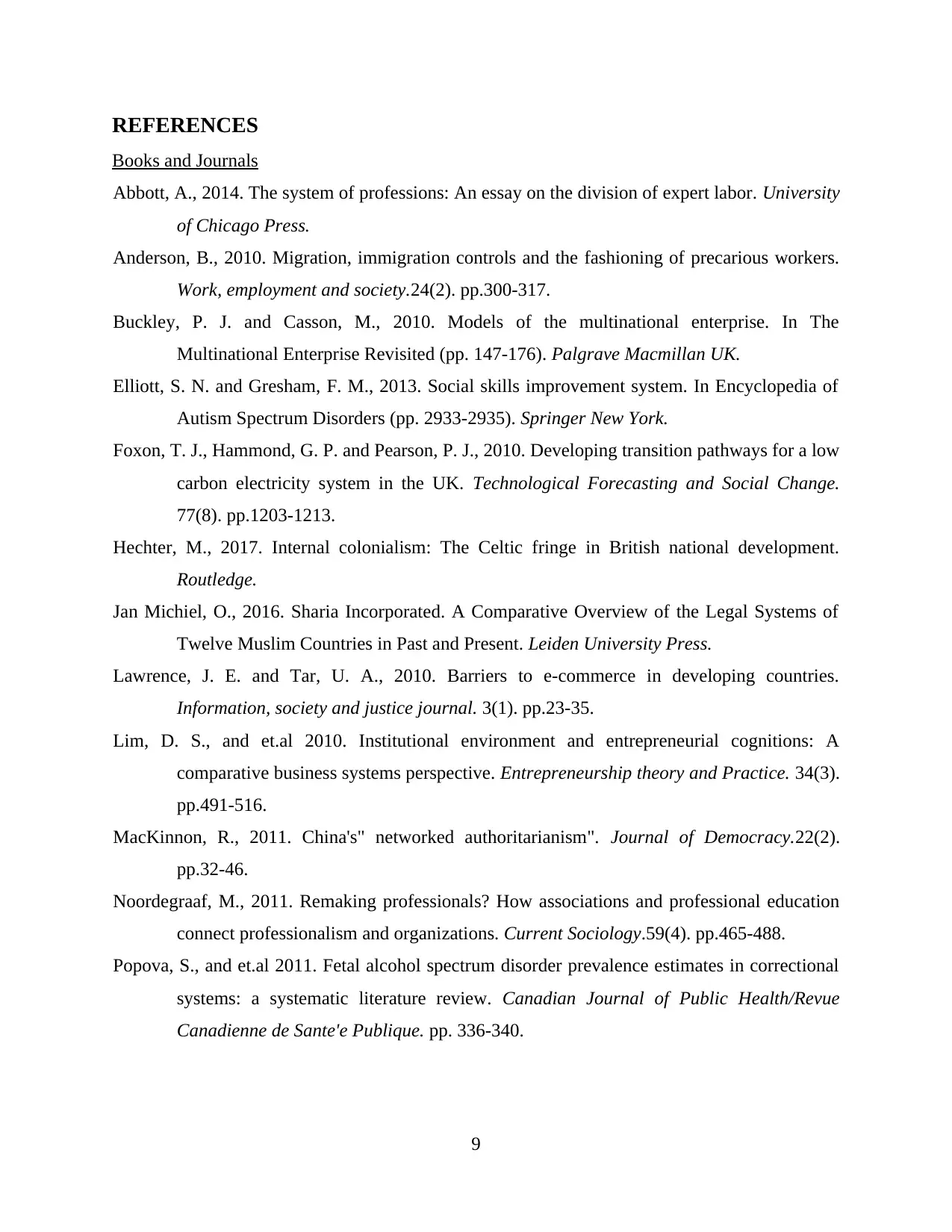
REFERENCES
Books and Journals
Abbott, A., 2014. The system of professions: An essay on the division of expert labor. University
of Chicago Press.
Anderson, B., 2010. Migration, immigration controls and the fashioning of precarious workers.
Work, employment and society.24(2). pp.300-317.
Buckley, P. J. and Casson, M., 2010. Models of the multinational enterprise. In The
Multinational Enterprise Revisited (pp. 147-176). Palgrave Macmillan UK.
Elliott, S. N. and Gresham, F. M., 2013. Social skills improvement system. In Encyclopedia of
Autism Spectrum Disorders (pp. 2933-2935). Springer New York.
Foxon, T. J., Hammond, G. P. and Pearson, P. J., 2010. Developing transition pathways for a low
carbon electricity system in the UK. Technological Forecasting and Social Change.
77(8). pp.1203-1213.
Hechter, M., 2017. Internal colonialism: The Celtic fringe in British national development.
Routledge.
Jan Michiel, O., 2016. Sharia Incorporated. A Comparative Overview of the Legal Systems of
Twelve Muslim Countries in Past and Present. Leiden University Press.
Lawrence, J. E. and Tar, U. A., 2010. Barriers to e-commerce in developing countries.
Information, society and justice journal. 3(1). pp.23-35.
Lim, D. S., and et.al 2010. Institutional environment and entrepreneurial cognitions: A
comparative business systems perspective. Entrepreneurship theory and Practice. 34(3).
pp.491-516.
MacKinnon, R., 2011. China's" networked authoritarianism". Journal of Democracy.22(2).
pp.32-46.
Noordegraaf, M., 2011. Remaking professionals? How associations and professional education
connect professionalism and organizations. Current Sociology.59(4). pp.465-488.
Popova, S., and et.al 2011. Fetal alcohol spectrum disorder prevalence estimates in correctional
systems: a systematic literature review. Canadian Journal of Public Health/Revue
Canadienne de Sante'e Publique. pp. 336-340.
9
Books and Journals
Abbott, A., 2014. The system of professions: An essay on the division of expert labor. University
of Chicago Press.
Anderson, B., 2010. Migration, immigration controls and the fashioning of precarious workers.
Work, employment and society.24(2). pp.300-317.
Buckley, P. J. and Casson, M., 2010. Models of the multinational enterprise. In The
Multinational Enterprise Revisited (pp. 147-176). Palgrave Macmillan UK.
Elliott, S. N. and Gresham, F. M., 2013. Social skills improvement system. In Encyclopedia of
Autism Spectrum Disorders (pp. 2933-2935). Springer New York.
Foxon, T. J., Hammond, G. P. and Pearson, P. J., 2010. Developing transition pathways for a low
carbon electricity system in the UK. Technological Forecasting and Social Change.
77(8). pp.1203-1213.
Hechter, M., 2017. Internal colonialism: The Celtic fringe in British national development.
Routledge.
Jan Michiel, O., 2016. Sharia Incorporated. A Comparative Overview of the Legal Systems of
Twelve Muslim Countries in Past and Present. Leiden University Press.
Lawrence, J. E. and Tar, U. A., 2010. Barriers to e-commerce in developing countries.
Information, society and justice journal. 3(1). pp.23-35.
Lim, D. S., and et.al 2010. Institutional environment and entrepreneurial cognitions: A
comparative business systems perspective. Entrepreneurship theory and Practice. 34(3).
pp.491-516.
MacKinnon, R., 2011. China's" networked authoritarianism". Journal of Democracy.22(2).
pp.32-46.
Noordegraaf, M., 2011. Remaking professionals? How associations and professional education
connect professionalism and organizations. Current Sociology.59(4). pp.465-488.
Popova, S., and et.al 2011. Fetal alcohol spectrum disorder prevalence estimates in correctional
systems: a systematic literature review. Canadian Journal of Public Health/Revue
Canadienne de Sante'e Publique. pp. 336-340.
9

Reynolds, C. R., Kamphaus, R. W. and Vannest, K. J., 2011. Behavior assessment system for
children (BASC). In Encyclopedia of clinical neuropsychology (pp. 366-371). Springer
New York.
10
children (BASC). In Encyclopedia of clinical neuropsychology (pp. 366-371). Springer
New York.
10
⊘ This is a preview!⊘
Do you want full access?
Subscribe today to unlock all pages.
Trusted by 1+ million students worldwide

1 out of 13


Related Documents


Your All-in-One AI-Powered Toolkit for Academic Success.
+13062052269
info@desklib.com
Available 24*7 on WhatsApp / Email
![[object Object]](/_next/static/media/star-bottom.7253800d.svg)
Unlock your academic potential
Copyright © 2020–2026 A2Z Services. All Rights Reserved. Developed and managed by ZUCOL.