A Report on the Use of English on Social Networking Sites by Students
VerifiedAdded on 2020/04/07
|20
|4486
|171
Report
AI Summary
This report presents the findings of a questionnaire survey conducted with 400 respondents to analyze the use of English on social networking sites by students. The study reveals that smartphones and platforms like Facebook, WhatsApp, and Instagram are prevalent among students. The research investigates the extent of English usage for communication, news consumption, and interaction. It explores the integration of social media in classrooms, highlighting its role in accessing learning materials, fostering discussions, and encouraging practice. Correlation analysis indicates a positive, albeit weak, relationship between communicating in English and activities like reading, emailing, and commenting on social networking sites. The report concludes by discussing the potential of social media applications, such as Facebook, WhatsApp, and blogging, as effective tools for EFL pedagogy.
Running head: USE OF ENGLISH ON SOCIAL NETWORKING SITES
Use of English on Social Networking Sites
Student Name
Course Name and Number
Professor Name
Institution
Paper Due Date
Page | 1
Use of English on Social Networking Sites
Student Name
Course Name and Number
Professor Name
Institution
Paper Due Date
Page | 1

Paraphrase This Document
Need a fresh take? Get an instant paraphrase of this document with our AI Paraphraser
Use of English on Social Networking Sites
Findings
General Information
In order to analyse the research subject, the questionnaire survey has been taken with
400 respondents. Among the 400 respondents, about 66.8% are female. Besides, majority of
the respondents (284 out of 400) are belonging to age group of 18 to 21 years. About 103
respondents fall within age group of 22 to 25 years. Concerning academic year, majority of
the respondents (144 out of 400) have completed first year. About 94 respondents have
completed the second year. The number of respondents who are in first year and fourth year
are 67 and 70 respectively. With respect to the major taken by the respondents, it can be
observed that 228 have science major and the rest 172 respondents has human as major in the
college.
Social Networking
In order to understand about the social networking activities of respondents, they are
asked about the primary method of using internet. From the findings it can be observed that
about 87.5% of respondents use smartphone to access internet. Only 10.8% and 1.8% have
found to use laptop and PCs for accessing internet, indicating the prevalence of smartphone
usage among the college students.
For understanding the popularity of social networking, the respondents are asked
about the mots used social networking sites. Expectedly Facebook has obtained highest
ranking where 75% of respondents have found to use this site. Apart from WhatsApp and
Snap Chat is also used by considerable number of respondents (70% and 55% respectively).
About 50% respondents have found to use Instagram. This signifies that Facebook is the most
influencing social media for the purpose of communication and hence learning English
language.
Page | 2
Findings
General Information
In order to analyse the research subject, the questionnaire survey has been taken with
400 respondents. Among the 400 respondents, about 66.8% are female. Besides, majority of
the respondents (284 out of 400) are belonging to age group of 18 to 21 years. About 103
respondents fall within age group of 22 to 25 years. Concerning academic year, majority of
the respondents (144 out of 400) have completed first year. About 94 respondents have
completed the second year. The number of respondents who are in first year and fourth year
are 67 and 70 respectively. With respect to the major taken by the respondents, it can be
observed that 228 have science major and the rest 172 respondents has human as major in the
college.
Social Networking
In order to understand about the social networking activities of respondents, they are
asked about the primary method of using internet. From the findings it can be observed that
about 87.5% of respondents use smartphone to access internet. Only 10.8% and 1.8% have
found to use laptop and PCs for accessing internet, indicating the prevalence of smartphone
usage among the college students.
For understanding the popularity of social networking, the respondents are asked
about the mots used social networking sites. Expectedly Facebook has obtained highest
ranking where 75% of respondents have found to use this site. Apart from WhatsApp and
Snap Chat is also used by considerable number of respondents (70% and 55% respectively).
About 50% respondents have found to use Instagram. This signifies that Facebook is the most
influencing social media for the purpose of communication and hence learning English
language.
Page | 2
Use of English on Social Networking Sites
Most of the respondents (about 37%) have also mentioned that they spend about two
to four hours on social networking sites every day. Besides, 22% and 21% respondents have
stated that they spend about five to six hours and more than six hours respectively in the
social networking sites. This indicates that social networking sites play vital part to learn and
use English language as considerable amount of time is spent on them. Female respondents
have found to use the social networking sites more in comparison with the male. This
indicates that social networking sites have more influence on language capability of female
than male.
From the findings, it can be observed that majority of respondents (265 out of 400)
are using social networking sites for more than three years. About 97 respondents have found
to use the social networking sites for one to three years. This indicate that the respondents
have become habituated for using social networking for so long and therefore social
networking has become a part of regular routine for them for communication.
English Usage on Social Networking Sites
With respect to the use of languages on social networking sites, 74% of respondents
mentioned that they use both English and Arabic. Since, social networking is used by people
throughout the world and English is the most prevalent language among most of the world
people and also accepted worldwide, the respondents are bound to use English apart from
their native language. Only 15% have found to use only Arabic language in social
networking. Besides, it can also be observed that the use of English in social networking sites
is higher among the female (267 out of 400) than male (133 out of 400).
In order to understand to what extent English is used for communication or
commenting or interacting in English in social networking, series of question has been asked
to the respondents. On the basis of findings, it can be observed that the mean value is more
Page | 3
Most of the respondents (about 37%) have also mentioned that they spend about two
to four hours on social networking sites every day. Besides, 22% and 21% respondents have
stated that they spend about five to six hours and more than six hours respectively in the
social networking sites. This indicates that social networking sites play vital part to learn and
use English language as considerable amount of time is spent on them. Female respondents
have found to use the social networking sites more in comparison with the male. This
indicates that social networking sites have more influence on language capability of female
than male.
From the findings, it can be observed that majority of respondents (265 out of 400)
are using social networking sites for more than three years. About 97 respondents have found
to use the social networking sites for one to three years. This indicate that the respondents
have become habituated for using social networking for so long and therefore social
networking has become a part of regular routine for them for communication.
English Usage on Social Networking Sites
With respect to the use of languages on social networking sites, 74% of respondents
mentioned that they use both English and Arabic. Since, social networking is used by people
throughout the world and English is the most prevalent language among most of the world
people and also accepted worldwide, the respondents are bound to use English apart from
their native language. Only 15% have found to use only Arabic language in social
networking. Besides, it can also be observed that the use of English in social networking sites
is higher among the female (267 out of 400) than male (133 out of 400).
In order to understand to what extent English is used for communication or
commenting or interacting in English in social networking, series of question has been asked
to the respondents. On the basis of findings, it can be observed that the mean value is more
Page | 3
⊘ This is a preview!⊘
Do you want full access?
Subscribe today to unlock all pages.

Trusted by 1+ million students worldwide
Use of English on Social Networking Sites
than 3 for respondents who communicate with English speakers. This signifies the fact that
social media gives opportunity for the respondents to study the speaking style of native
speakers and therefore can learn from them. The mean value of respondents who read news
and other information in English is observed as 4.04. This indicates that social media gives
the opportunity to understand the reporting style and use of language used in various online
news articles. This is huge benefit for the students to learn more about how to write in
English. The mean value of respondents who comment on posts in English is observed as
3.94. Thus, it also indicates that through social media they can fearlessly express their
viewpoints on any issue in English language. This can generate confidence among them to
use English for communication.
Furthermore, the mean value of respondents who communicate with companies and
business in English is observed as 3.81. This signifies that organisations can also interact with
the people through English and social media gives the respondents to understand more about
formal and official communication pattern and use of language in professional environment.
To a large extent respondents agreed to use English in social media website, specifically in
Facebook and WhatsApp. The value of σ is observed as more than 0.80 for each variable,
which indicate that there is much difference between the reactions of respondents.
Integration of Social Media in Classroom
The next question was asked in order to understand how and in what context tertiary
EFL students in Jordan use English and social networking. The mean value of the analysis is
observed as more than 4 which indicate that majority of respondents have agreed behaviour
on the statements. In this context, most of the respondents (μ = 4.40) have stated that
Facebook and WhatsApp have made it simpler to access the instructional materials in the
internet. This indicates that social media can be utilised by the teachers in contemporary
Page | 4
than 3 for respondents who communicate with English speakers. This signifies the fact that
social media gives opportunity for the respondents to study the speaking style of native
speakers and therefore can learn from them. The mean value of respondents who read news
and other information in English is observed as 4.04. This indicates that social media gives
the opportunity to understand the reporting style and use of language used in various online
news articles. This is huge benefit for the students to learn more about how to write in
English. The mean value of respondents who comment on posts in English is observed as
3.94. Thus, it also indicates that through social media they can fearlessly express their
viewpoints on any issue in English language. This can generate confidence among them to
use English for communication.
Furthermore, the mean value of respondents who communicate with companies and
business in English is observed as 3.81. This signifies that organisations can also interact with
the people through English and social media gives the respondents to understand more about
formal and official communication pattern and use of language in professional environment.
To a large extent respondents agreed to use English in social media website, specifically in
Facebook and WhatsApp. The value of σ is observed as more than 0.80 for each variable,
which indicate that there is much difference between the reactions of respondents.
Integration of Social Media in Classroom
The next question was asked in order to understand how and in what context tertiary
EFL students in Jordan use English and social networking. The mean value of the analysis is
observed as more than 4 which indicate that majority of respondents have agreed behaviour
on the statements. In this context, most of the respondents (μ = 4.40) have stated that
Facebook and WhatsApp have made it simpler to access the instructional materials in the
internet. This indicates that social media can be utilised by the teachers in contemporary
Page | 4
Paraphrase This Document
Need a fresh take? Get an instant paraphrase of this document with our AI Paraphraser
Use of English on Social Networking Sites
classroom to better share the English language materials and also to clarify any queries of
students easily. Besides majority of the respondents (μ = 4.36) have agreed with the fact that
these applications also helps to strengthen discussion between the learners and the teachers in
English (Ynuus, 2016). This signifies that some students feel nervous to speak in English face
to face with the teachers with the fear of embarrassment from other native students. However,
through social media, students are able to interact with the teachers without such worries of
embarrassment as the conversation cannot be seen by other students.
Social media provides certain amount of privacy between the teachers and students to
ask anything that bothers them and hence encourage interaction and learning. The students
are able to openly ask questions through these applications and exchange knowledge and
expertise (Mansor, 2014). The mean value of respondents who stated that social media help
to encourage group discussion in chat room particularly with native speakers is 4.25. This
finding specifies that social media gives the chance to provide properly thought out answers
to discussion. Since, the students are not physically present; this reduces the chance for
negative influence of the fear of discomfiture, particularly for students who are introvert in
nature. In this way, social media inspire group discussion in English with the native speakers.
Facebook and WhatsApp also help to establish specific educational network. Students can
easily create a group through social media with likeminded people where they can exchange
knowledge and encourage educational discussion (Kalasi, 2014). Facebook also has tools
such as like and comment which assist in obtaining the feedback of students regarding
English Curriculum. Therefore, through these applications, the teachers are able to
understand the requirements and effectiveness of students learning about English language
(Brick, 2012).
Finally, most of the respondents (μ = 4.03) have also mentioned that through
Facebook and WhatsApp, the teachers can share their blog post to the students. The blog post
Page | 5
classroom to better share the English language materials and also to clarify any queries of
students easily. Besides majority of the respondents (μ = 4.36) have agreed with the fact that
these applications also helps to strengthen discussion between the learners and the teachers in
English (Ynuus, 2016). This signifies that some students feel nervous to speak in English face
to face with the teachers with the fear of embarrassment from other native students. However,
through social media, students are able to interact with the teachers without such worries of
embarrassment as the conversation cannot be seen by other students.
Social media provides certain amount of privacy between the teachers and students to
ask anything that bothers them and hence encourage interaction and learning. The students
are able to openly ask questions through these applications and exchange knowledge and
expertise (Mansor, 2014). The mean value of respondents who stated that social media help
to encourage group discussion in chat room particularly with native speakers is 4.25. This
finding specifies that social media gives the chance to provide properly thought out answers
to discussion. Since, the students are not physically present; this reduces the chance for
negative influence of the fear of discomfiture, particularly for students who are introvert in
nature. In this way, social media inspire group discussion in English with the native speakers.
Facebook and WhatsApp also help to establish specific educational network. Students can
easily create a group through social media with likeminded people where they can exchange
knowledge and encourage educational discussion (Kalasi, 2014). Facebook also has tools
such as like and comment which assist in obtaining the feedback of students regarding
English Curriculum. Therefore, through these applications, the teachers are able to
understand the requirements and effectiveness of students learning about English language
(Brick, 2012).
Finally, most of the respondents (μ = 4.03) have also mentioned that through
Facebook and WhatsApp, the teachers can share their blog post to the students. The blog post
Page | 5
Use of English on Social Networking Sites
can be accessed by the students at any time. This function acts as a key aspect of English
learning procedure (Facer, 2011). The σ of the analysis is observed as more than 0.70 which
indicate that there is low level of similarity between the reactions of respondents.
Practicing English through Social Media
The fourteenth question was asked in order to understand the attitudes and beliefs of
students in using English as foreign language in the social networking sites. The mean value
of the reactions is observed as more than 3.5, signifying agreeing attitudes among the
respondents. In this context, most of the respondents are agreed with the fact that they
practice writing, reading, listening, and speaking in English via social networking sites. This
signifies that social networking sites are great communication tools for increasing the
proficiency in English (Chartrand, 2012). Majority of the respondents have also agreed with
the fact that social networking sites have enhanced the English communication abilities and
motivation to read English materials. Through constant communication with different
students, the social networking sites also assisted in correcting the mistakes of using English
language. Most of the respondents (μ = 4.31) also stated that communication with different
people also assisted in learning new words and therefore social media also enhanced the
English vocabulary of people (Dhanya, 2016).
Through social media, students are able to communicate with native students who
have much experience in English language. Therefore, they can use more words which
provide learning opportunities for foreign students to understand English (Rogers, 2007). The
respondents also agreed with the fact that using social networking enhanced the confidence to
communicate by using English. This finding signifies that with continuous exposure of using
English, the students’ knowledge on English has increased; they have understood their
mistakes and lacking which makes them more self-assured to talk in English with others
Page | 6
can be accessed by the students at any time. This function acts as a key aspect of English
learning procedure (Facer, 2011). The σ of the analysis is observed as more than 0.70 which
indicate that there is low level of similarity between the reactions of respondents.
Practicing English through Social Media
The fourteenth question was asked in order to understand the attitudes and beliefs of
students in using English as foreign language in the social networking sites. The mean value
of the reactions is observed as more than 3.5, signifying agreeing attitudes among the
respondents. In this context, most of the respondents are agreed with the fact that they
practice writing, reading, listening, and speaking in English via social networking sites. This
signifies that social networking sites are great communication tools for increasing the
proficiency in English (Chartrand, 2012). Majority of the respondents have also agreed with
the fact that social networking sites have enhanced the English communication abilities and
motivation to read English materials. Through constant communication with different
students, the social networking sites also assisted in correcting the mistakes of using English
language. Most of the respondents (μ = 4.31) also stated that communication with different
people also assisted in learning new words and therefore social media also enhanced the
English vocabulary of people (Dhanya, 2016).
Through social media, students are able to communicate with native students who
have much experience in English language. Therefore, they can use more words which
provide learning opportunities for foreign students to understand English (Rogers, 2007). The
respondents also agreed with the fact that using social networking enhanced the confidence to
communicate by using English. This finding signifies that with continuous exposure of using
English, the students’ knowledge on English has increased; they have understood their
mistakes and lacking which makes them more self-assured to talk in English with others
Page | 6
⊘ This is a preview!⊘
Do you want full access?
Subscribe today to unlock all pages.
Trusted by 1+ million students worldwide
Use of English on Social Networking Sites
(Yunus, 2013). The respondents have also mentioned that social networking sites have made
English language learning much interesting, collaborating and coexistent. The value of σ is
observed as more than 0.7, indicating that most of the respondents’ reaction differs from
mean value.
Use of Social Media Application in English Language Classroom
The fifteenth question was asked in order to understand the opinion of students and
teachers regarding the utilisation of social networking sites as teaching instruments for EFL
pedagogy (Recker, 2004). Most of the respondents (μ =3.97) have mentioned that the social
networking sites such as Facebook should be used for learning purpose. Facebook is the most
popular site for social media and it gives maximum reach to the students. Teachers can use
this media to share any post and to obtain the opinions of the students along with their
English learning abilities. The mean value of students who mentioned to use WhatsApp for
learning purpose is 3.90. In this context, it can be stated that through WhatsApp teacher can
create group for sharing learning materials and also for conversing with the students in
English, WhatsApp is also helpful for encouraging discussion on given topic in English
thereby inspiring language learning (Monica, 2014).
Apart from majority of the respondents (μ = 3.91) also agreed that blogging should be
used for learning English language. Through blogging, teachers can easily create blog post
with useful information which can assist English language learning or remove any kind of
misunderstanding regarding use of English. Twitter, Snap Chat, Google+ and Instagram
among others also serve similar purposes and should be utilised for learning purposes in
English language classroom. These tools have proven to be effective in learning in better way
than the traditional methods (Yang, 2009). It provides motivation and confidence to the
students in learning English in positive manner.
Page | 7
(Yunus, 2013). The respondents have also mentioned that social networking sites have made
English language learning much interesting, collaborating and coexistent. The value of σ is
observed as more than 0.7, indicating that most of the respondents’ reaction differs from
mean value.
Use of Social Media Application in English Language Classroom
The fifteenth question was asked in order to understand the opinion of students and
teachers regarding the utilisation of social networking sites as teaching instruments for EFL
pedagogy (Recker, 2004). Most of the respondents (μ =3.97) have mentioned that the social
networking sites such as Facebook should be used for learning purpose. Facebook is the most
popular site for social media and it gives maximum reach to the students. Teachers can use
this media to share any post and to obtain the opinions of the students along with their
English learning abilities. The mean value of students who mentioned to use WhatsApp for
learning purpose is 3.90. In this context, it can be stated that through WhatsApp teacher can
create group for sharing learning materials and also for conversing with the students in
English, WhatsApp is also helpful for encouraging discussion on given topic in English
thereby inspiring language learning (Monica, 2014).
Apart from majority of the respondents (μ = 3.91) also agreed that blogging should be
used for learning English language. Through blogging, teachers can easily create blog post
with useful information which can assist English language learning or remove any kind of
misunderstanding regarding use of English. Twitter, Snap Chat, Google+ and Instagram
among others also serve similar purposes and should be utilised for learning purposes in
English language classroom. These tools have proven to be effective in learning in better way
than the traditional methods (Yang, 2009). It provides motivation and confidence to the
students in learning English in positive manner.
Page | 7
Paraphrase This Document
Need a fresh take? Get an instant paraphrase of this document with our AI Paraphraser
Use of English on Social Networking Sites
Correlation Analysis
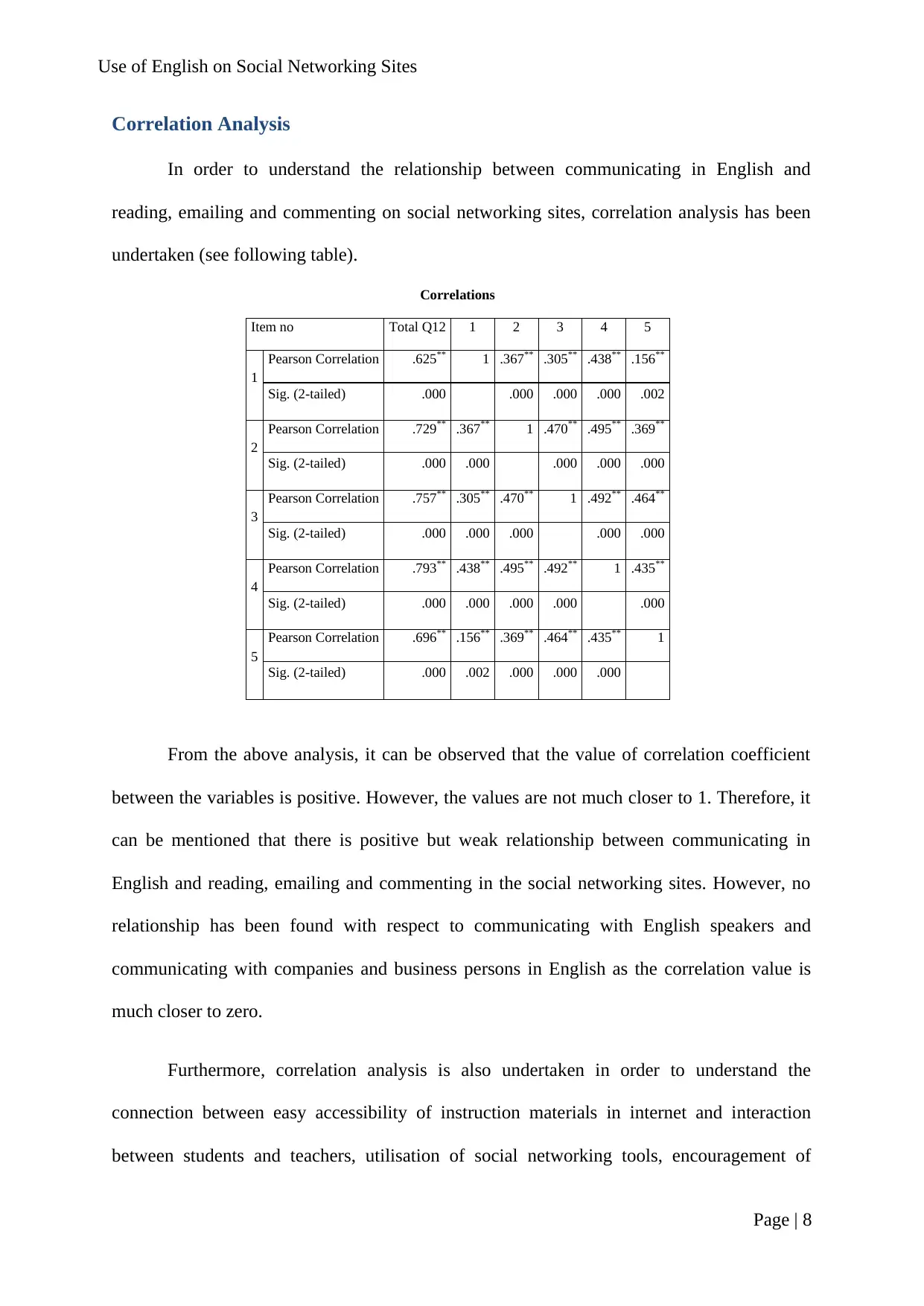
In order to understand the relationship between communicating in English and
reading, emailing and commenting on social networking sites, correlation analysis has been
undertaken (see following table).
Correlations
Item no Total Q12 1 2 3 4 5
1
Pearson Correlation .625** 1 .367** .305** .438** .156**
Sig. (2-tailed) .000 .000 .000 .000 .002
2
Pearson Correlation .729** .367** 1 .470** .495** .369**
Sig. (2-tailed) .000 .000 .000 .000 .000
3
Pearson Correlation .757** .305** .470** 1 .492** .464**
Sig. (2-tailed) .000 .000 .000 .000 .000
4
Pearson Correlation .793** .438** .495** .492** 1 .435**
Sig. (2-tailed) .000 .000 .000 .000 .000
5
Pearson Correlation .696** .156** .369** .464** .435** 1
Sig. (2-tailed) .000 .002 .000 .000 .000
From the above analysis, it can be observed that the value of correlation coefficient
between the variables is positive. However, the values are not much closer to 1. Therefore, it
can be mentioned that there is positive but weak relationship between communicating in
English and reading, emailing and commenting in the social networking sites. However, no
relationship has been found with respect to communicating with English speakers and
communicating with companies and business persons in English as the correlation value is
much closer to zero.
Furthermore, correlation analysis is also undertaken in order to understand the
connection between easy accessibility of instruction materials in internet and interaction
between students and teachers, utilisation of social networking tools, encouragement of
Page | 8
Correlation Analysis
In order to understand the relationship between communicating in English and
reading, emailing and commenting on social networking sites, correlation analysis has been
undertaken (see following table).
Correlations
Item no Total Q12 1 2 3 4 5
1
Pearson Correlation .625** 1 .367** .305** .438** .156**
Sig. (2-tailed) .000 .000 .000 .000 .002
2
Pearson Correlation .729** .367** 1 .470** .495** .369**
Sig. (2-tailed) .000 .000 .000 .000 .000
3
Pearson Correlation .757** .305** .470** 1 .492** .464**
Sig. (2-tailed) .000 .000 .000 .000 .000
4
Pearson Correlation .793** .438** .495** .492** 1 .435**
Sig. (2-tailed) .000 .000 .000 .000 .000
5
Pearson Correlation .696** .156** .369** .464** .435** 1
Sig. (2-tailed) .000 .002 .000 .000 .000
From the above analysis, it can be observed that the value of correlation coefficient
between the variables is positive. However, the values are not much closer to 1. Therefore, it
can be mentioned that there is positive but weak relationship between communicating in
English and reading, emailing and commenting in the social networking sites. However, no
relationship has been found with respect to communicating with English speakers and
communicating with companies and business persons in English as the correlation value is
much closer to zero.
Furthermore, correlation analysis is also undertaken in order to understand the
connection between easy accessibility of instruction materials in internet and interaction
between students and teachers, utilisation of social networking tools, encouragement of
Page | 8
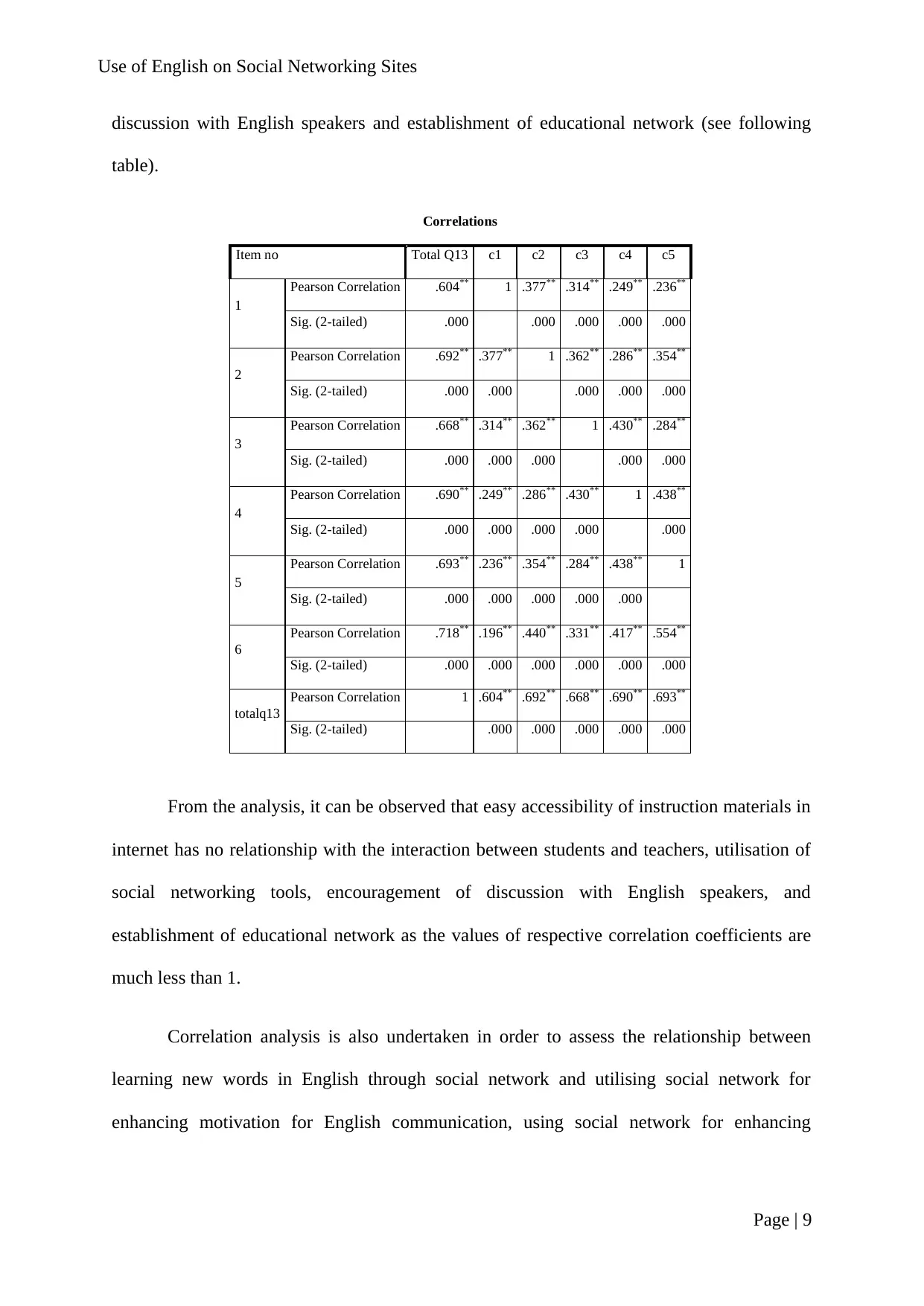
Use of English on Social Networking Sites
discussion with English speakers and establishment of educational network (see following
table).
Correlations
Item no Total Q13 c1 c2 c3 c4 c5
1
Pearson Correlation .604 ** 1 .377 ** .314 ** .249 ** .236**
Sig. (2-tailed) .000 .000 .000 .000 .000
2
Pearson Correlation .692 ** .377 ** 1 .362 ** .286 ** .354**
Sig. (2-tailed) .000 .000 .000 .000 .000
3
Pearson Correlation .668 ** .314 ** .362 ** 1 .430 ** .284**
Sig. (2-tailed) .000 .000 .000 .000 .000
4
Pearson Correlation .690 ** .249 ** .286 ** .430 ** 1 .438**
Sig. (2-tailed) .000 .000 .000 .000 .000
5
Pearson Correlation .693 ** .236 ** .354 ** .284 ** .438 ** 1
Sig. (2-tailed) .000 .000 .000 .000 .000
6
Pearson Correlation .718 ** .196 ** .440 ** .331 ** .417 ** .554**
Sig. (2-tailed) .000 .000 .000 .000 .000 .000
totalq13
Pearson Correlation 1 .604 ** .692 ** .668 ** .690 ** .693**
Sig. (2-tailed) .000 .000 .000 .000 .000
From the analysis, it can be observed that easy accessibility of instruction materials in
internet has no relationship with the interaction between students and teachers, utilisation of
social networking tools, encouragement of discussion with English speakers, and
establishment of educational network as the values of respective correlation coefficients are
much less than 1.
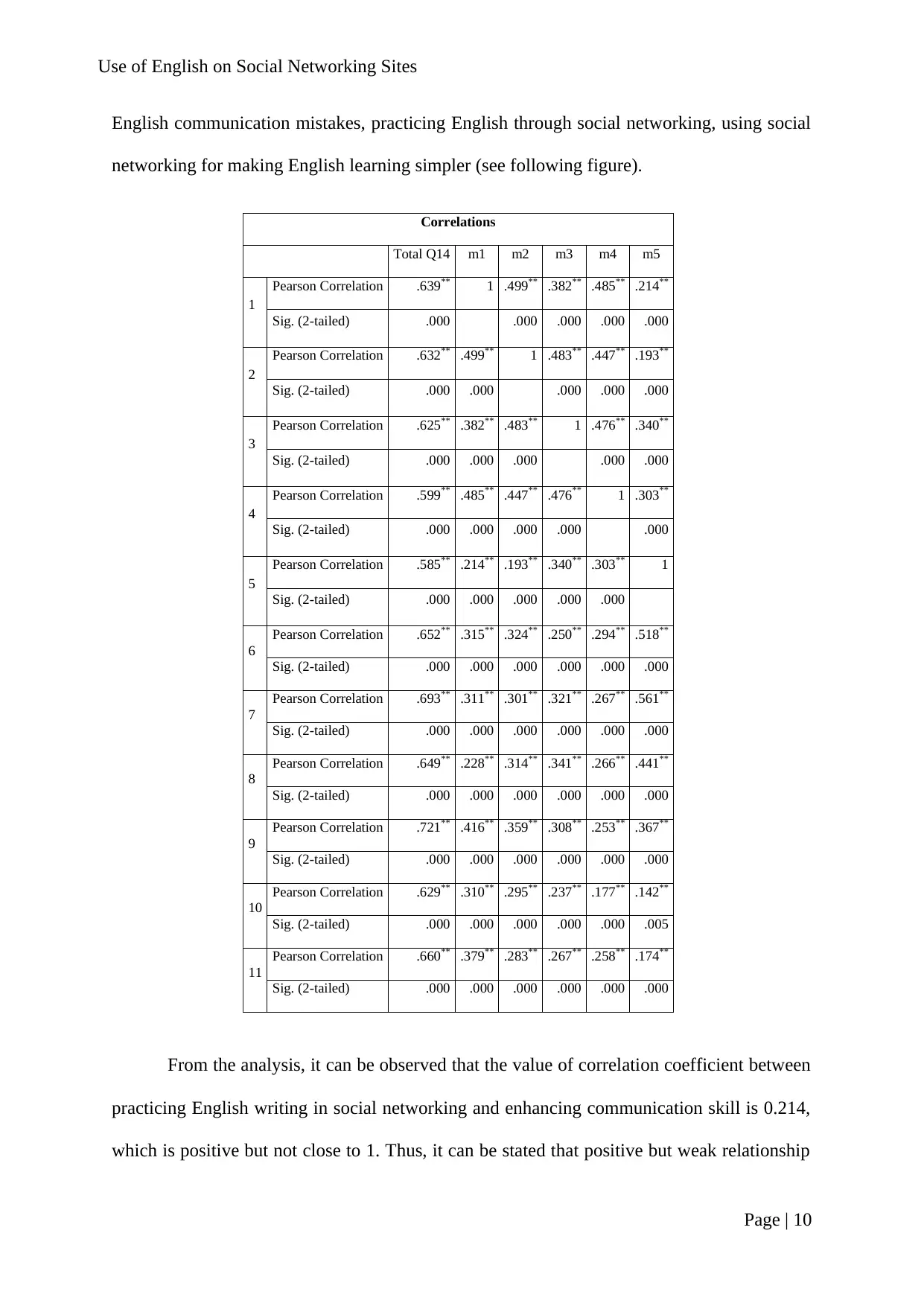
Correlation analysis is also undertaken in order to assess the relationship between
learning new words in English through social network and utilising social network for
enhancing motivation for English communication, using social network for enhancing
Page | 9
discussion with English speakers and establishment of educational network (see following
table).
Correlations
Item no Total Q13 c1 c2 c3 c4 c5
1
Pearson Correlation .604 ** 1 .377 ** .314 ** .249 ** .236**
Sig. (2-tailed) .000 .000 .000 .000 .000
2
Pearson Correlation .692 ** .377 ** 1 .362 ** .286 ** .354**
Sig. (2-tailed) .000 .000 .000 .000 .000
3
Pearson Correlation .668 ** .314 ** .362 ** 1 .430 ** .284**
Sig. (2-tailed) .000 .000 .000 .000 .000
4
Pearson Correlation .690 ** .249 ** .286 ** .430 ** 1 .438**
Sig. (2-tailed) .000 .000 .000 .000 .000
5
Pearson Correlation .693 ** .236 ** .354 ** .284 ** .438 ** 1
Sig. (2-tailed) .000 .000 .000 .000 .000
6
Pearson Correlation .718 ** .196 ** .440 ** .331 ** .417 ** .554**
Sig. (2-tailed) .000 .000 .000 .000 .000 .000
totalq13
Pearson Correlation 1 .604 ** .692 ** .668 ** .690 ** .693**
Sig. (2-tailed) .000 .000 .000 .000 .000
From the analysis, it can be observed that easy accessibility of instruction materials in
internet has no relationship with the interaction between students and teachers, utilisation of
social networking tools, encouragement of discussion with English speakers, and
establishment of educational network as the values of respective correlation coefficients are
much less than 1.
Correlation analysis is also undertaken in order to assess the relationship between
learning new words in English through social network and utilising social network for
enhancing motivation for English communication, using social network for enhancing
Page | 9
⊘ This is a preview!⊘
Do you want full access?
Subscribe today to unlock all pages.
Trusted by 1+ million students worldwide
Use of English on Social Networking Sites
English communication mistakes, practicing English through social networking, using social
networking for making English learning simpler (see following figure).
Correlations
Total Q14 m1 m2 m3 m4 m5
1
Pearson Correlation .639** 1 .499** .382** .485** .214**
Sig. (2-tailed) .000 .000 .000 .000 .000
2
Pearson Correlation .632** .499** 1 .483** .447** .193**
Sig. (2-tailed) .000 .000 .000 .000 .000
3
Pearson Correlation .625** .382** .483** 1 .476** .340**
Sig. (2-tailed) .000 .000 .000 .000 .000
4
Pearson Correlation .599** .485** .447** .476** 1 .303**
Sig. (2-tailed) .000 .000 .000 .000 .000
5
Pearson Correlation .585** .214** .193** .340** .303** 1
Sig. (2-tailed) .000 .000 .000 .000 .000
6
Pearson Correlation .652** .315** .324** .250** .294** .518**
Sig. (2-tailed) .000 .000 .000 .000 .000 .000
7
Pearson Correlation .693** .311** .301** .321** .267** .561**
Sig. (2-tailed) .000 .000 .000 .000 .000 .000
8
Pearson Correlation .649** .228** .314** .341** .266** .441**
Sig. (2-tailed) .000 .000 .000 .000 .000 .000
9
Pearson Correlation .721** .416** .359** .308** .253** .367**
Sig. (2-tailed) .000 .000 .000 .000 .000 .000
10
Pearson Correlation .629** .310** .295** .237** .177** .142**
Sig. (2-tailed) .000 .000 .000 .000 .000 .005
11
Pearson Correlation .660** .379** .283** .267** .258** .174**
Sig. (2-tailed) .000 .000 .000 .000 .000 .000
From the analysis, it can be observed that the value of correlation coefficient between
practicing English writing in social networking and enhancing communication skill is 0.214,
which is positive but not close to 1. Thus, it can be stated that positive but weak relationship
Page | 10
English communication mistakes, practicing English through social networking, using social
networking for making English learning simpler (see following figure).
Correlations
Total Q14 m1 m2 m3 m4 m5
1
Pearson Correlation .639** 1 .499** .382** .485** .214**
Sig. (2-tailed) .000 .000 .000 .000 .000
2
Pearson Correlation .632** .499** 1 .483** .447** .193**
Sig. (2-tailed) .000 .000 .000 .000 .000
3
Pearson Correlation .625** .382** .483** 1 .476** .340**
Sig. (2-tailed) .000 .000 .000 .000 .000
4
Pearson Correlation .599** .485** .447** .476** 1 .303**
Sig. (2-tailed) .000 .000 .000 .000 .000
5
Pearson Correlation .585** .214** .193** .340** .303** 1
Sig. (2-tailed) .000 .000 .000 .000 .000
6
Pearson Correlation .652** .315** .324** .250** .294** .518**
Sig. (2-tailed) .000 .000 .000 .000 .000 .000
7
Pearson Correlation .693** .311** .301** .321** .267** .561**
Sig. (2-tailed) .000 .000 .000 .000 .000 .000
8
Pearson Correlation .649** .228** .314** .341** .266** .441**
Sig. (2-tailed) .000 .000 .000 .000 .000 .000
9
Pearson Correlation .721** .416** .359** .308** .253** .367**
Sig. (2-tailed) .000 .000 .000 .000 .000 .000
10
Pearson Correlation .629** .310** .295** .237** .177** .142**
Sig. (2-tailed) .000 .000 .000 .000 .000 .005
11
Pearson Correlation .660** .379** .283** .267** .258** .174**
Sig. (2-tailed) .000 .000 .000 .000 .000 .000
From the analysis, it can be observed that the value of correlation coefficient between
practicing English writing in social networking and enhancing communication skill is 0.214,
which is positive but not close to 1. Thus, it can be stated that positive but weak relationship
Page | 10
Paraphrase This Document
Need a fresh take? Get an instant paraphrase of this document with our AI Paraphraser
Use of English on Social Networking Sites
exists between practicing English writing in social networking and enhancement of
communication skill. The value of correlation coefficient between practicing English writing
and motivation to learn English is 0.652 which is positive. Thus, it can be stated that strong
positive relationship exists between these two variables. Then again, the value of correlation
coefficient between practicing English writing and enhancing language mistakes is 0.693
which is positive and much closer to 1. Thus, it can be mentioned higher writing practice in
social networking is related with higher development of language mistakes correction.
In similar context, the correlation coefficient between practicing English writing in
social networking and learning new words in English is observed as 0.649, which is positive
and closer to 1. Thus, it can also be stated that high writing practice of English in social
networking is related with better learning of new words in English. The value of correlation
coefficient between practicing English writing in social media and enhancing motivation in
communicating in English is 0.721 which is positive and much higher. Thus, it can be stated
that strong positive relationship exist between the variables, i.e. more writing practice in
English in social networking is related with high motivation to communicate in English.
The value of correlation coefficient between English writing practice in social media
and making English learning easier is 0.629, signifying strong positive relationship between
the variables. Finally, the correlation value of English writing practice and making learning
more interesting is observed as 0.660, which signify that strong positive connection between
the variables.
In order to understand the pattern of relationship between social media usage and
learning English correlation analysis has been undertaken with the variables of twelfth to
fifteenth question.
Page | 11
exists between practicing English writing in social networking and enhancement of
communication skill. The value of correlation coefficient between practicing English writing
and motivation to learn English is 0.652 which is positive. Thus, it can be stated that strong
positive relationship exists between these two variables. Then again, the value of correlation
coefficient between practicing English writing and enhancing language mistakes is 0.693
which is positive and much closer to 1. Thus, it can be mentioned higher writing practice in
social networking is related with higher development of language mistakes correction.
In similar context, the correlation coefficient between practicing English writing in
social networking and learning new words in English is observed as 0.649, which is positive
and closer to 1. Thus, it can also be stated that high writing practice of English in social
networking is related with better learning of new words in English. The value of correlation
coefficient between practicing English writing in social media and enhancing motivation in
communicating in English is 0.721 which is positive and much higher. Thus, it can be stated
that strong positive relationship exist between the variables, i.e. more writing practice in
English in social networking is related with high motivation to communicate in English.
The value of correlation coefficient between English writing practice in social media
and making English learning easier is 0.629, signifying strong positive relationship between
the variables. Finally, the correlation value of English writing practice and making learning
more interesting is observed as 0.660, which signify that strong positive connection between
the variables.
In order to understand the pattern of relationship between social media usage and
learning English correlation analysis has been undertaken with the variables of twelfth to
fifteenth question.
Page | 11
Use of English on Social Networking Sites
Descriptive Statistics
Mean Std. Deviation N
Total Q12 3.9350 .66293 400
Total Q13 4.2696 .51356 400
Total Q14 4.1139 .51830 400
Total Q15 3.7508 .69479 400
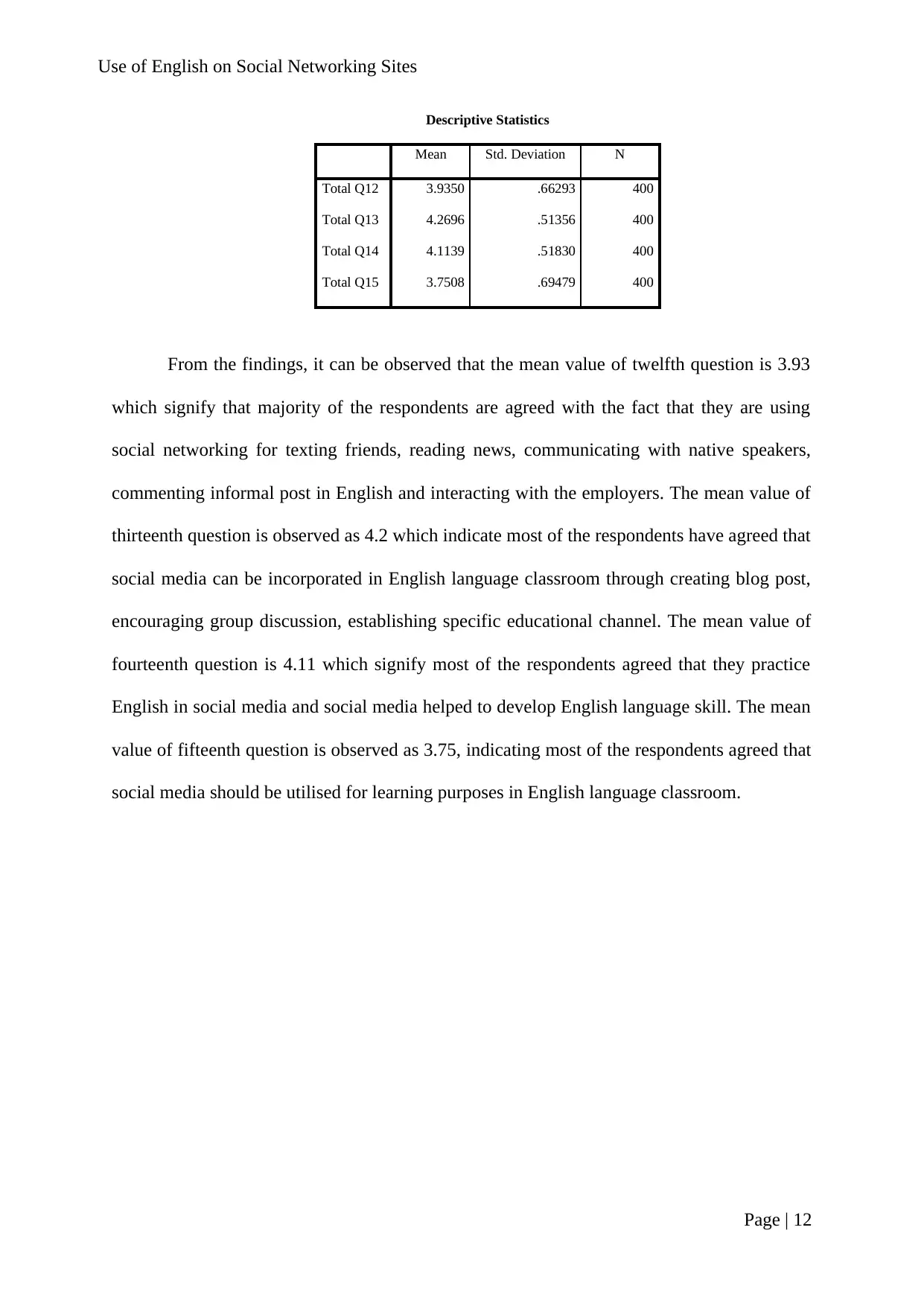
From the findings, it can be observed that the mean value of twelfth question is 3.93
which signify that majority of the respondents are agreed with the fact that they are using
social networking for texting friends, reading news, communicating with native speakers,
commenting informal post in English and interacting with the employers. The mean value of
thirteenth question is observed as 4.2 which indicate most of the respondents have agreed that
social media can be incorporated in English language classroom through creating blog post,
encouraging group discussion, establishing specific educational channel. The mean value of
fourteenth question is 4.11 which signify most of the respondents agreed that they practice
English in social media and social media helped to develop English language skill. The mean
value of fifteenth question is observed as 3.75, indicating most of the respondents agreed that
social media should be utilised for learning purposes in English language classroom.
Page | 12
Descriptive Statistics
Mean Std. Deviation N
Total Q12 3.9350 .66293 400
Total Q13 4.2696 .51356 400
Total Q14 4.1139 .51830 400
Total Q15 3.7508 .69479 400
From the findings, it can be observed that the mean value of twelfth question is 3.93
which signify that majority of the respondents are agreed with the fact that they are using
social networking for texting friends, reading news, communicating with native speakers,
commenting informal post in English and interacting with the employers. The mean value of
thirteenth question is observed as 4.2 which indicate most of the respondents have agreed that
social media can be incorporated in English language classroom through creating blog post,
encouraging group discussion, establishing specific educational channel. The mean value of
fourteenth question is 4.11 which signify most of the respondents agreed that they practice
English in social media and social media helped to develop English language skill. The mean
value of fifteenth question is observed as 3.75, indicating most of the respondents agreed that
social media should be utilised for learning purposes in English language classroom.
Page | 12
⊘ This is a preview!⊘
Do you want full access?
Subscribe today to unlock all pages.
Trusted by 1+ million students worldwide

1 out of 20


Related Documents


Your All-in-One AI-Powered Toolkit for Academic Success.
+13062052269
info@desklib.com
Available 24*7 on WhatsApp / Email
![[object Object]](/_next/static/media/star-bottom.7253800d.svg)
Unlock your academic potential
Copyright © 2020–2026 A2Z Services. All Rights Reserved. Developed and managed by ZUCOL.