Globalisation, English, and Singapore: A Comprehensive Essay Analysis
VerifiedAdded on 2022/08/23
|10
|2659
|19
Essay
AI Summary
This essay delves into the influence of globalisation on the proliferation of the English language, with a specific focus on its impact within the context of Singapore. The essay begins by defining globalisation and its role in fueling the spread of English, followed by an examination of the benefits of knowing English at both individual and societal levels in Singapore. It further critiques the negative effects of the growing use of English on individuals and societies, particularly in Singapore, and evaluates the role of English in the Singaporean school system, discussing both the positive and negative impacts of its use as a medium of instruction. The analysis includes references to academic articles and course readings, providing a comprehensive overview of the subject.
ENGLISH ASSIGNMENTS

Paraphrase This Document
Need a fresh take? Get an instant paraphrase of this document with our AI Paraphraser
Introduction
The essay brings out a discussion on the Impact of globalisation in spreading English and
understanding the role of globalisation in fuelling its spread. English has created greater
impact on other native languages of nations. The influence can be either positive or negative
on society and individual with specific focus in Singapore. Further, there is an analysis of
Singaporean school system discussing positive and negative impact in using English. Living
in global community differ from cultures and blend where there are nearly more than 6500
languages in the world. When people decide to learn English, which is quite popular language
in the language of media, internet, aviation, academia, and science. Sociology is the
relationship between language and society as everyone speak differently in varied social
contexts with the identification of social functions (McKay, & Brown, 2016).
Impact of English in global world
a. Here is the deeper understanding of how globalisation is important in spreading
English-
While moving towards globalisation, it is seen that several skills are required to acquire
global competencies. It is the workable knowledge regarding global leadership skills, which
is needed to work in global environment where students will take advantage of studying in
abroad. Best practise is to become proficient in English whereas, it is common proficient in
language in Europe. Globalisation is through the dynamic procedure, which has been caused
through pulling and pushing two forces of culture identity and diversity between, global and
local (Matsuda, 2012). People can no longer communicate in their homogenous cultures.
They will have to understand dynamic long distance collaboration and their effect of cultures,
which directly influence speaking and body language. Globalisation has further led to
introduction of social procedure inculcated with integration of cultural and communication.
The essay brings out a discussion on the Impact of globalisation in spreading English and
understanding the role of globalisation in fuelling its spread. English has created greater
impact on other native languages of nations. The influence can be either positive or negative
on society and individual with specific focus in Singapore. Further, there is an analysis of
Singaporean school system discussing positive and negative impact in using English. Living
in global community differ from cultures and blend where there are nearly more than 6500
languages in the world. When people decide to learn English, which is quite popular language
in the language of media, internet, aviation, academia, and science. Sociology is the
relationship between language and society as everyone speak differently in varied social
contexts with the identification of social functions (McKay, & Brown, 2016).
Impact of English in global world
a. Here is the deeper understanding of how globalisation is important in spreading
English-
While moving towards globalisation, it is seen that several skills are required to acquire
global competencies. It is the workable knowledge regarding global leadership skills, which
is needed to work in global environment where students will take advantage of studying in
abroad. Best practise is to become proficient in English whereas, it is common proficient in
language in Europe. Globalisation is through the dynamic procedure, which has been caused
through pulling and pushing two forces of culture identity and diversity between, global and
local (Matsuda, 2012). People can no longer communicate in their homogenous cultures.
They will have to understand dynamic long distance collaboration and their effect of cultures,
which directly influence speaking and body language. Globalisation has further led to
introduction of social procedure inculcated with integration of cultural and communication.
According to the research reports, English has further established itself as international
language of commerce and business (Ahmad, 2016). Adequate communication competency
in English avails managerial staff with opportunity to have best quality in professional
training. Globalisation has significant influence on language, which is either positive or
negative, which allow some language and culture to dominate global scale.
b. Benefits of knowing English on individual and social level in Singapore
There are several benefits of knowing English on individual and societal level in specific to
Singapore. While seeing the importance of English in Singapore, it is seen that majority of
Singaporeans understand English alone. Furthermore, to maintain social life, it is important to
understand local language of Singapore by learning it with time. On individual level, English
improves international job opportunities, which often stick to their native language
hampering their career prospects. It enhances productivity, higher salary, and communication.
For political and social reasons, English has emerged working language. English avails a
platform to communicate and work for all the races in Singapore. On individual level, a good
knowledge of English language allows them to communicate with international clients
assisting them to trust and maintain strong business relationships. Learning a new language
improves the structure of mind (Yousef, 2017). It affects the part of your brain, which is
responsible. Many people have started English courses in Singapore because it adds
certifications as bonus, which increases international job opportunities in advancing and
creating resume with internationally recognised language English. There are plenty of
organisations in globe where English is the official language. Undoubtedly, English is a
secret for higher productivity after globalisation because concept of integrating economies
has prioritised language to communicate with different clients. Speaking English fluency with
utmost confidence serves to the improvement in careers. Once you have good grip on English
language of commerce and business (Ahmad, 2016). Adequate communication competency
in English avails managerial staff with opportunity to have best quality in professional
training. Globalisation has significant influence on language, which is either positive or
negative, which allow some language and culture to dominate global scale.
b. Benefits of knowing English on individual and social level in Singapore
There are several benefits of knowing English on individual and societal level in specific to
Singapore. While seeing the importance of English in Singapore, it is seen that majority of
Singaporeans understand English alone. Furthermore, to maintain social life, it is important to
understand local language of Singapore by learning it with time. On individual level, English
improves international job opportunities, which often stick to their native language
hampering their career prospects. It enhances productivity, higher salary, and communication.
For political and social reasons, English has emerged working language. English avails a
platform to communicate and work for all the races in Singapore. On individual level, a good
knowledge of English language allows them to communicate with international clients
assisting them to trust and maintain strong business relationships. Learning a new language
improves the structure of mind (Yousef, 2017). It affects the part of your brain, which is
responsible. Many people have started English courses in Singapore because it adds
certifications as bonus, which increases international job opportunities in advancing and
creating resume with internationally recognised language English. There are plenty of
organisations in globe where English is the official language. Undoubtedly, English is a
secret for higher productivity after globalisation because concept of integrating economies
has prioritised language to communicate with different clients. Speaking English fluency with
utmost confidence serves to the improvement in careers. Once you have good grip on English
⊘ This is a preview!⊘
Do you want full access?
Subscribe today to unlock all pages.

Trusted by 1+ million students worldwide
language, one can fulfil the dreams of working at local and abroad in English trending nation
(Yousef, 2017).
Learning English helps to expand social reach especially in severe competition have become
most important asset. Here are the five ways through which English expands social reach-
reaching more people through internet where it can share ideas and opinions with English
speakers. It connects with huge range of niche communities where people are of same interest
and have similar things to practise, which may not be accessible. English classes enables to
practise words as well as grammar. One has to develop some important social skills with the
range of situations starting from small talk to the business meetings.
Negative effects of the spread of English on individuals and societies in relation to
Singapore
Most obvious impact of globalisation has diminished the minority languages, disregard of the
other language forms, diversity, style richness, loss of uniformity, and declining of the other
foreign language among the English speakers. Good communicators will have to devise their
skills and learn English related negotiation skills so that they can become more interactive
and collaborative to develop one`s efficiency to strategize language negotiation (Lum, 2018).
This proficiency includes crossing, code switching, accommodation, interpersonal strategies,
consensus orientation, and mutual support (Ushioda, & Dörnyei, 2017). The negative impact
is quite visible that there is a shift in emphasis from language-based systems to the language
as its social practise. For instance- it should be changed from attitude to proficiency,
competence to performance, grammar to pragmatics (Smith, Humphreys, & Walkinshaw,
2017).
While relating it to globalisation, it is seen that it can afford underdeveloped nations with the
opportunity to ride of traditional stage of economic growth. English is still the second
(Yousef, 2017).
Learning English helps to expand social reach especially in severe competition have become
most important asset. Here are the five ways through which English expands social reach-
reaching more people through internet where it can share ideas and opinions with English
speakers. It connects with huge range of niche communities where people are of same interest
and have similar things to practise, which may not be accessible. English classes enables to
practise words as well as grammar. One has to develop some important social skills with the
range of situations starting from small talk to the business meetings.
Negative effects of the spread of English on individuals and societies in relation to
Singapore
Most obvious impact of globalisation has diminished the minority languages, disregard of the
other language forms, diversity, style richness, loss of uniformity, and declining of the other
foreign language among the English speakers. Good communicators will have to devise their
skills and learn English related negotiation skills so that they can become more interactive
and collaborative to develop one`s efficiency to strategize language negotiation (Lum, 2018).
This proficiency includes crossing, code switching, accommodation, interpersonal strategies,
consensus orientation, and mutual support (Ushioda, & Dörnyei, 2017). The negative impact
is quite visible that there is a shift in emphasis from language-based systems to the language
as its social practise. For instance- it should be changed from attitude to proficiency,
competence to performance, grammar to pragmatics (Smith, Humphreys, & Walkinshaw,
2017).
While relating it to globalisation, it is seen that it can afford underdeveloped nations with the
opportunity to ride of traditional stage of economic growth. English is still the second
Paraphrase This Document
Need a fresh take? Get an instant paraphrase of this document with our AI Paraphraser
language for Singaporeans because of unequal economic conditions, poverty and depending
on the non-indigenous languages. Negative effect of spreading English as the global language
can be death of other languages (Lum, 2018). This creates the situation where minority
languages are perceived as unnecessary language in the existence of international language.
For example- lack of English speaking skills, it is seen that failure of communication skills
stem to several cultural shortcuts. Owner of America lecture a group of colleagues from
varied nations who can find difficult to pass data due to unconscious use of expressions
(Ushioda, & Dörnyei, 2017). At individual level, people with extreme intelligence and talent
are being judged on the basis of how efficiently they can speak English. Moreover, skills of
communication is not only linked to English language but it is a way through which messages
can be effectively and clearly communicated to another party. This leads to downplaying the
role of other languages at all in educating the children and reducing the linguistic diversity.
Parents do not inculcate and focus on other languages while educating their kids.
On the social level, language natively spoken by nations does not finally qualify as good
communication skills. It creates gap between the societies in Singapore such as auxiliary
language defeats political aspects of the global era. Numerous students feel dropped and
embarrassed, which is a real shame. Study of other languages not only offers work
opportunities but also helps them to joins them to another culture (Weir, & Sullivan, 2017).
The society feels the language English “language of rich and educated people,” which do not
force people to learn other culture and language. Furthermore, some elite schools put stress
on teaching English so that people would consider them cultured, cosmopolitan, civilised,
and impressed. On social level in Singapore, English has fully become globalised with other
languages because people have become culturally ignorant to the business transaction (Weir,
& Sullivan, 2017).
d. Role of English in the Singaporean school system
on the non-indigenous languages. Negative effect of spreading English as the global language
can be death of other languages (Lum, 2018). This creates the situation where minority
languages are perceived as unnecessary language in the existence of international language.
For example- lack of English speaking skills, it is seen that failure of communication skills
stem to several cultural shortcuts. Owner of America lecture a group of colleagues from
varied nations who can find difficult to pass data due to unconscious use of expressions
(Ushioda, & Dörnyei, 2017). At individual level, people with extreme intelligence and talent
are being judged on the basis of how efficiently they can speak English. Moreover, skills of
communication is not only linked to English language but it is a way through which messages
can be effectively and clearly communicated to another party. This leads to downplaying the
role of other languages at all in educating the children and reducing the linguistic diversity.
Parents do not inculcate and focus on other languages while educating their kids.
On the social level, language natively spoken by nations does not finally qualify as good
communication skills. It creates gap between the societies in Singapore such as auxiliary
language defeats political aspects of the global era. Numerous students feel dropped and
embarrassed, which is a real shame. Study of other languages not only offers work
opportunities but also helps them to joins them to another culture (Weir, & Sullivan, 2017).
The society feels the language English “language of rich and educated people,” which do not
force people to learn other culture and language. Furthermore, some elite schools put stress
on teaching English so that people would consider them cultured, cosmopolitan, civilised,
and impressed. On social level in Singapore, English has fully become globalised with other
languages because people have become culturally ignorant to the business transaction (Weir,
& Sullivan, 2017).
d. Role of English in the Singaporean school system
Introduction to the education system in Singapore has incurred the era of development in
education. It has been adding features to the ability driven, efficiency driven and survival
driven. English has fostered the inter-disciplinary study with the changing role of teachers,
which has also created the development of workforce through technical skills and linguistic
skills. Bilingualism in nation has inculcated proficient skills in two languages, which will be
recognised as the first language “English language” and other preferred language is mother
Tongue language (Ushioda, & Dörnyei, 2017). The English was chosen after bring motivated
by the pragmatic consideration of language of commerce, technology, science, and
international intercourse. Ministry of education in Singapore has initiated employment
opportunities in Asia and accessing it to science and technology of western countries.
The negative aspect of English in Singapore come up with several challenges. Due to
complex language environment related to Singapore society, there is high demand on
students to learn two major languages (Smith, Humphreys, & Walkinshaw, 2017). Ministry
of education has conducted several revisions to syllabus in mother tongue and English when
ensuring desired learning goals can be achieved. When more and more people adopts English
as their first language, Singaporean English has transformed. For example- rather than saying
“”where are you going? In standard language (Silver, & Heng, 2016). As English is one of
the Singaporean official language, Singlish has spoiled the grammar and knowledge of
English language. The Singapore English will pose greater emphasis on “You go where ah?”.
This is current declaration of speaking English with growing advocates of Singlish in
Singaporean society. Singlish seems to be heavily accented, sloppy English and stronger
impact from Chinese (Bridgeman, Cho, & DiPietro, 2016). The biggest challenge is the use
of Singlish in the schools of Singapore so that they can acquire the skills of good English for
the effective development of students through literacy rate and also the quality of all-over
current education system of Singapore (Silver, & Heng, 2016). English learnings institutes in
education. It has been adding features to the ability driven, efficiency driven and survival
driven. English has fostered the inter-disciplinary study with the changing role of teachers,
which has also created the development of workforce through technical skills and linguistic
skills. Bilingualism in nation has inculcated proficient skills in two languages, which will be
recognised as the first language “English language” and other preferred language is mother
Tongue language (Ushioda, & Dörnyei, 2017). The English was chosen after bring motivated
by the pragmatic consideration of language of commerce, technology, science, and
international intercourse. Ministry of education in Singapore has initiated employment
opportunities in Asia and accessing it to science and technology of western countries.
The negative aspect of English in Singapore come up with several challenges. Due to
complex language environment related to Singapore society, there is high demand on
students to learn two major languages (Smith, Humphreys, & Walkinshaw, 2017). Ministry
of education has conducted several revisions to syllabus in mother tongue and English when
ensuring desired learning goals can be achieved. When more and more people adopts English
as their first language, Singaporean English has transformed. For example- rather than saying
“”where are you going? In standard language (Silver, & Heng, 2016). As English is one of
the Singaporean official language, Singlish has spoiled the grammar and knowledge of
English language. The Singapore English will pose greater emphasis on “You go where ah?”.
This is current declaration of speaking English with growing advocates of Singlish in
Singaporean society. Singlish seems to be heavily accented, sloppy English and stronger
impact from Chinese (Bridgeman, Cho, & DiPietro, 2016). The biggest challenge is the use
of Singlish in the schools of Singapore so that they can acquire the skills of good English for
the effective development of students through literacy rate and also the quality of all-over
current education system of Singapore (Silver, & Heng, 2016). English learnings institutes in
⊘ This is a preview!⊘
Do you want full access?
Subscribe today to unlock all pages.
Trusted by 1+ million students worldwide
Singapore has introduced and tasked in the promotion of effective communication that will
work for the school leadership and avail environment conducting to promote good English in
class (Zein, 2018). From the data as per the Singaporean market reports, it is seen that during
1970s-80s, the issue of inefficient labour and workforce was due to lack of knowledge of
both the languages (Dearden, 2018). The government has discouraged the use of Singlish so
that they can promote Standard English. The report has greater efficiency with the
introduction of ability-based streams to educate people (especially weaker students). Students
are analysed on the basis of language and mathematics in different streams at primary and
secondary schools. Current educational system in Singapore has transformed where preschool
children enrolled in numeracy skills are viewed as English as first language and Tamil, Malay
and Chinese as second languages (Bridgeman, Cho, & DiPietro, 2016). The ministry has
implemented several measures to incur challenges such as resources to support the educators
in designing the quality learnings aged between 4 to 6 years availed affordable education
system.
Conclusion
From the above discussion, it is seen that learning English has become one of the major
language used at the global level. With the integration of the economies, it is seen that
English is an official language while conducting business transaction. Spreading the learning
of English will definitely improve the business conditions by communicating in an effective
way. It is tasked with the promotion of effective communication in English by launching
whole school approach when working to provide leadership skills and conducting voluntary
programs. The concept of singlish has affected and spoiled the language education in
Singapore. The globalization has transformed culture by spreading English on individual and
societal level. The government wish to eradicate the use of singlish. The ministry of
education of Singapore has created an effective communicator in English as being the
work for the school leadership and avail environment conducting to promote good English in
class (Zein, 2018). From the data as per the Singaporean market reports, it is seen that during
1970s-80s, the issue of inefficient labour and workforce was due to lack of knowledge of
both the languages (Dearden, 2018). The government has discouraged the use of Singlish so
that they can promote Standard English. The report has greater efficiency with the
introduction of ability-based streams to educate people (especially weaker students). Students
are analysed on the basis of language and mathematics in different streams at primary and
secondary schools. Current educational system in Singapore has transformed where preschool
children enrolled in numeracy skills are viewed as English as first language and Tamil, Malay
and Chinese as second languages (Bridgeman, Cho, & DiPietro, 2016). The ministry has
implemented several measures to incur challenges such as resources to support the educators
in designing the quality learnings aged between 4 to 6 years availed affordable education
system.
Conclusion
From the above discussion, it is seen that learning English has become one of the major
language used at the global level. With the integration of the economies, it is seen that
English is an official language while conducting business transaction. Spreading the learning
of English will definitely improve the business conditions by communicating in an effective
way. It is tasked with the promotion of effective communication in English by launching
whole school approach when working to provide leadership skills and conducting voluntary
programs. The concept of singlish has affected and spoiled the language education in
Singapore. The globalization has transformed culture by spreading English on individual and
societal level. The government wish to eradicate the use of singlish. The ministry of
education of Singapore has created an effective communicator in English as being the
Paraphrase This Document
Need a fresh take? Get an instant paraphrase of this document with our AI Paraphraser
reflection of higher aspirations for future as Singaporeans will continue to thrive the global
world. Currently, story of the English in Singapore has changed to commit by government in
investing in the current education system by ensuring it to continue the competitive
advantage in English. Integration of economies have not only affected GDP of the nations of
working through it but it has also integrated different cultures and different languages.
world. Currently, story of the English in Singapore has changed to commit by government in
investing in the current education system by ensuring it to continue the competitive
advantage in English. Integration of economies have not only affected GDP of the nations of
working through it but it has also integrated different cultures and different languages.
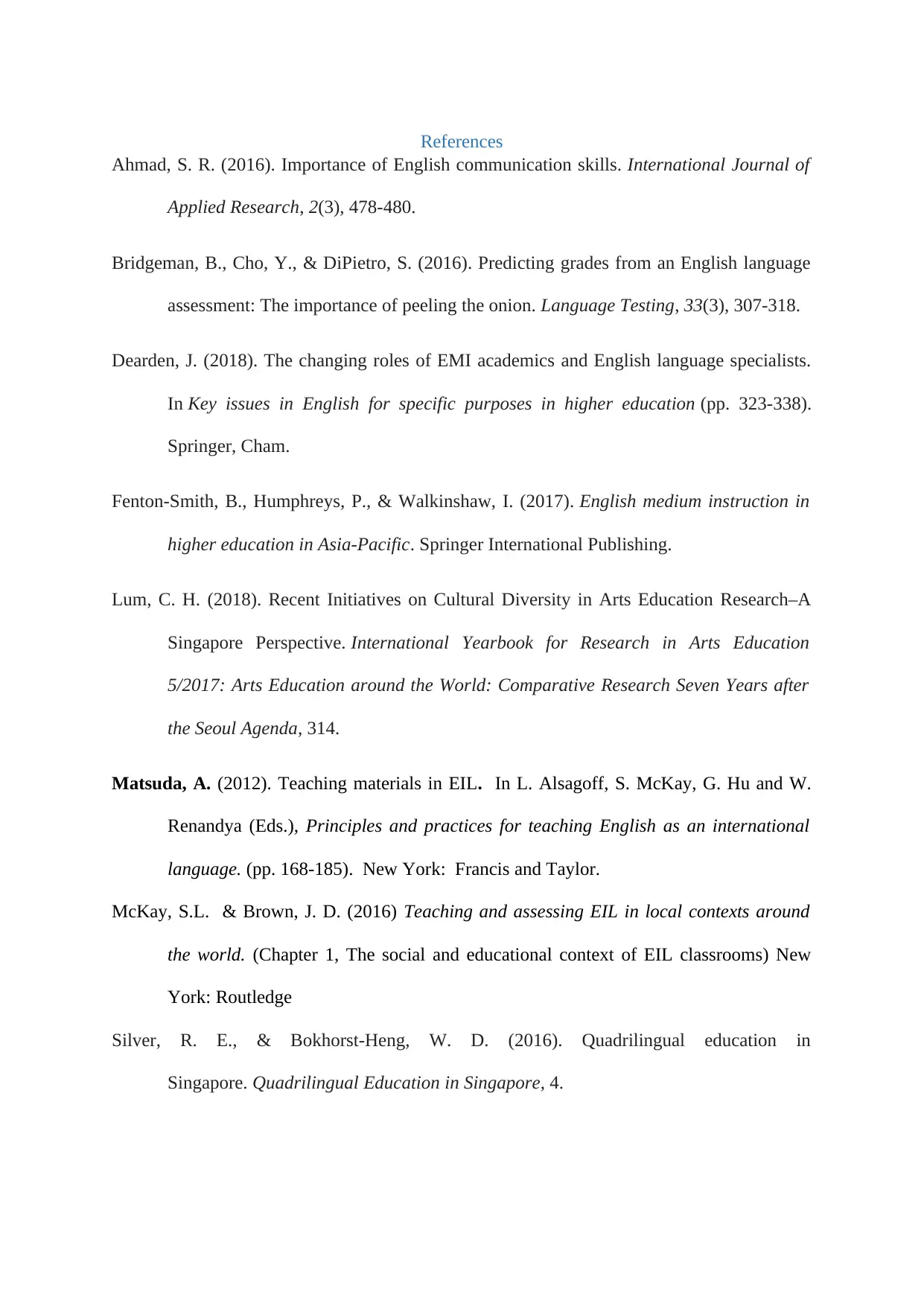
References
Ahmad, S. R. (2016). Importance of English communication skills. International Journal of
Applied Research, 2(3), 478-480.
Bridgeman, B., Cho, Y., & DiPietro, S. (2016). Predicting grades from an English language
assessment: The importance of peeling the onion. Language Testing, 33(3), 307-318.
Dearden, J. (2018). The changing roles of EMI academics and English language specialists.
In Key issues in English for specific purposes in higher education (pp. 323-338).
Springer, Cham.
Fenton-Smith, B., Humphreys, P., & Walkinshaw, I. (2017). English medium instruction in
higher education in Asia-Pacific. Springer International Publishing.
Lum, C. H. (2018). Recent Initiatives on Cultural Diversity in Arts Education Research–A
Singapore Perspective. International Yearbook for Research in Arts Education
5/2017: Arts Education around the World: Comparative Research Seven Years after
the Seoul Agenda, 314.
Matsuda, A. (2012). Teaching materials in EIL. In L. Alsagoff, S. McKay, G. Hu and W.
Renandya (Eds.), Principles and practices for teaching English as an international
language. (pp. 168-185). New York: Francis and Taylor.
McKay, S.L. & Brown, J. D. (2016) Teaching and assessing EIL in local contexts around
the world. (Chapter 1, The social and educational context of EIL classrooms) New
York: Routledge
Silver, R. E., & Bokhorst-Heng, W. D. (2016). Quadrilingual education in
Singapore. Quadrilingual Education in Singapore, 4.
Ahmad, S. R. (2016). Importance of English communication skills. International Journal of
Applied Research, 2(3), 478-480.
Bridgeman, B., Cho, Y., & DiPietro, S. (2016). Predicting grades from an English language
assessment: The importance of peeling the onion. Language Testing, 33(3), 307-318.
Dearden, J. (2018). The changing roles of EMI academics and English language specialists.
In Key issues in English for specific purposes in higher education (pp. 323-338).
Springer, Cham.
Fenton-Smith, B., Humphreys, P., & Walkinshaw, I. (2017). English medium instruction in
higher education in Asia-Pacific. Springer International Publishing.
Lum, C. H. (2018). Recent Initiatives on Cultural Diversity in Arts Education Research–A
Singapore Perspective. International Yearbook for Research in Arts Education
5/2017: Arts Education around the World: Comparative Research Seven Years after
the Seoul Agenda, 314.
Matsuda, A. (2012). Teaching materials in EIL. In L. Alsagoff, S. McKay, G. Hu and W.
Renandya (Eds.), Principles and practices for teaching English as an international
language. (pp. 168-185). New York: Francis and Taylor.
McKay, S.L. & Brown, J. D. (2016) Teaching and assessing EIL in local contexts around
the world. (Chapter 1, The social and educational context of EIL classrooms) New
York: Routledge
Silver, R. E., & Bokhorst-Heng, W. D. (2016). Quadrilingual education in
Singapore. Quadrilingual Education in Singapore, 4.
⊘ This is a preview!⊘
Do you want full access?
Subscribe today to unlock all pages.
Trusted by 1+ million students worldwide
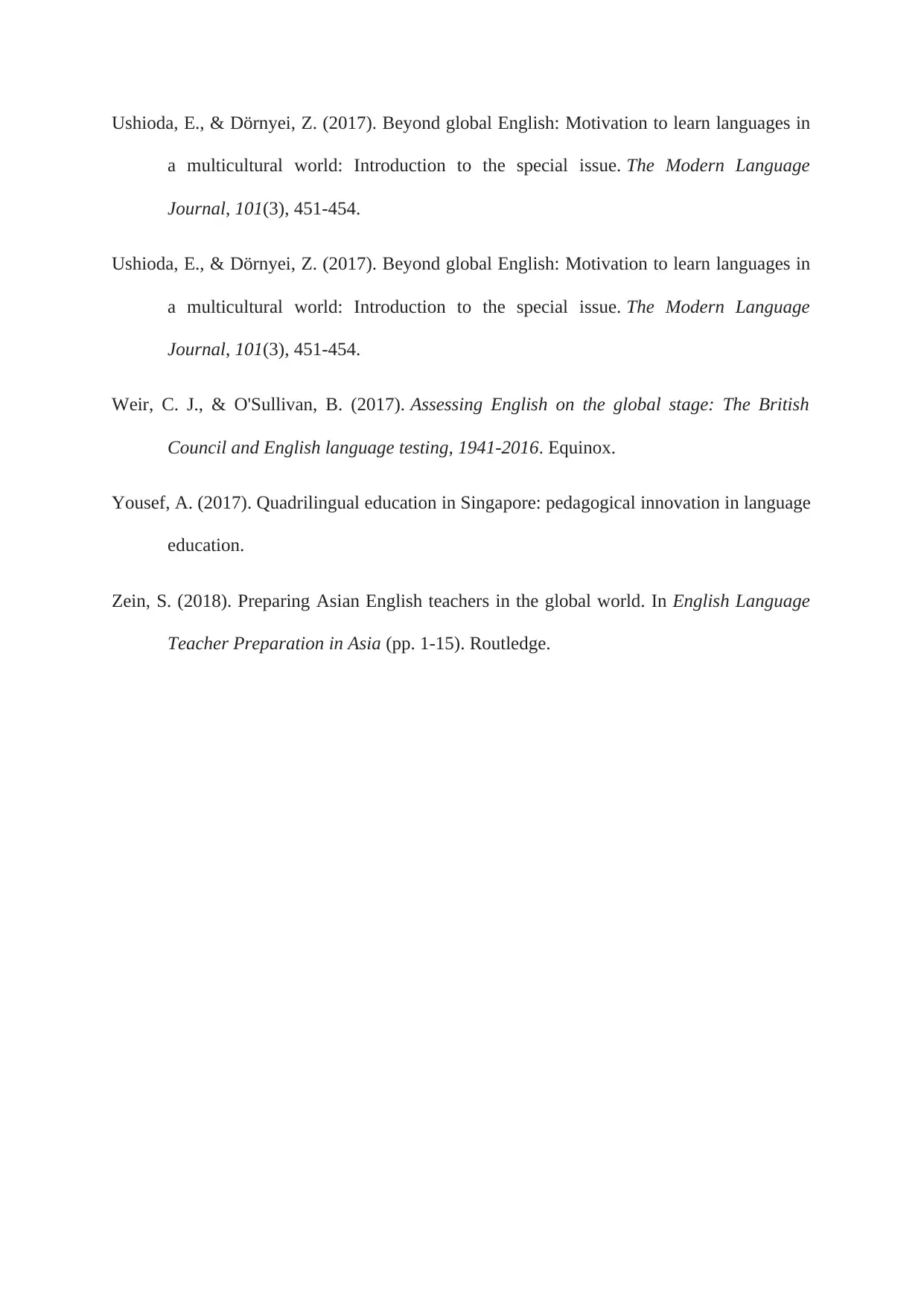
Ushioda, E., & Dörnyei, Z. (2017). Beyond global English: Motivation to learn languages in
a multicultural world: Introduction to the special issue. The Modern Language
Journal, 101(3), 451-454.
Ushioda, E., & Dörnyei, Z. (2017). Beyond global English: Motivation to learn languages in
a multicultural world: Introduction to the special issue. The Modern Language
Journal, 101(3), 451-454.
Weir, C. J., & O'Sullivan, B. (2017). Assessing English on the global stage: The British
Council and English language testing, 1941-2016. Equinox.
Yousef, A. (2017). Quadrilingual education in Singapore: pedagogical innovation in language
education.
Zein, S. (2018). Preparing Asian English teachers in the global world. In English Language
Teacher Preparation in Asia (pp. 1-15). Routledge.
a multicultural world: Introduction to the special issue. The Modern Language
Journal, 101(3), 451-454.
Ushioda, E., & Dörnyei, Z. (2017). Beyond global English: Motivation to learn languages in
a multicultural world: Introduction to the special issue. The Modern Language
Journal, 101(3), 451-454.
Weir, C. J., & O'Sullivan, B. (2017). Assessing English on the global stage: The British
Council and English language testing, 1941-2016. Equinox.
Yousef, A. (2017). Quadrilingual education in Singapore: pedagogical innovation in language
education.
Zein, S. (2018). Preparing Asian English teachers in the global world. In English Language
Teacher Preparation in Asia (pp. 1-15). Routledge.

1 out of 10


Related Documents


Your All-in-One AI-Powered Toolkit for Academic Success.
+13062052269
info@desklib.com
Available 24*7 on WhatsApp / Email
![[object Object]](/_next/static/media/star-bottom.7253800d.svg)
Unlock your academic potential
Copyright © 2020–2026 A2Z Services. All Rights Reserved. Developed and managed by ZUCOL.