Improving Communication within Chocolate Mortality's Virtual Teams
VerifiedAdded on 2020/03/15
|9
|2181
|46
Report
AI Summary
This report examines the communication dynamics within virtual teams, specifically focusing on the context of Chocolate Mortality Company. It delves into the opportunities and challenges inherent in virtual team structures, including ethical and intercultural communication implications. The report highlights deficiencies in non-verbal interactions, the impact of rigid time constraints, and the complexities arising from cultural disparities. It offers several recommendations for improvement, such as establishing clear team constitutions, promoting face-to-face meetings, fostering social interaction, constructing a common dialect, and mitigating the negative impacts of cultural differences. The report concludes by emphasizing the importance of clear communication and leadership in ensuring effective virtual team operations and organizational productivity.
qwertyuiopasdfghjklzxcvbnmqwertyui
opasdfghjklzxcvbnmqwertyuiopasdfgh
jklzxcvbnmqwertyuiopasdfghjklzxcvb
nmqwertyuiopasdfghjklzxcvbnmqwer
tyuiopasdfghjklzxcvbnmqwertyuiopas
dfghjklzxcvbnmqwertyuiopasdfghjklzx
cvbnmqwertyuiopasdfghjklzxcvbnmq
wertyuiopasdfghjklzxcvbnmqwertyuio
pasdfghjklzxcvbnmqwertyuiopasdfghj
klzxcvbnmqwertyuiopasdfghjklzxcvbn
mqwertyuiopasdfghjklzxcvbnmqwerty
uiopasdfghjklzxcvbnmqwertyuiopasdf
ghjklzxcvbnmqwertyuiopasdfghjklzxc
vbnmqwertyuiopasdfghjklzxcvbnmrty
uiopasdfghjklzxcvbnmqwertyuiopasdf
ghjklzxcvbnmqwertyuiopasdfghjklzxc
Business Report for Enhancing Virtual team Communications
opasdfghjklzxcvbnmqwertyuiopasdfgh
jklzxcvbnmqwertyuiopasdfghjklzxcvb
nmqwertyuiopasdfghjklzxcvbnmqwer
tyuiopasdfghjklzxcvbnmqwertyuiopas
dfghjklzxcvbnmqwertyuiopasdfghjklzx
cvbnmqwertyuiopasdfghjklzxcvbnmq
wertyuiopasdfghjklzxcvbnmqwertyuio
pasdfghjklzxcvbnmqwertyuiopasdfghj
klzxcvbnmqwertyuiopasdfghjklzxcvbn
mqwertyuiopasdfghjklzxcvbnmqwerty
uiopasdfghjklzxcvbnmqwertyuiopasdf
ghjklzxcvbnmqwertyuiopasdfghjklzxc
vbnmqwertyuiopasdfghjklzxcvbnmrty
uiopasdfghjklzxcvbnmqwertyuiopasdf
ghjklzxcvbnmqwertyuiopasdfghjklzxc
Business Report for Enhancing Virtual team Communications

Paraphrase This Document
Need a fresh take? Get an instant paraphrase of this document with our AI Paraphraser
Table of Contents
1. Introduction3
2. Communication Context 3
2.1. Opportunities and Burden of Virtual Teams 4
3. Ethical Communication Implications 5
3.1. Deficiency in non-verbal interaction 5
3.2. Rigid time limit and Conviction 5
4. Intercultural Communication Implications 6
5. Recommendations 6
5.1. Institute obvious team constitution and Mutual Standards 6
5.2. Scamper face-to-face conferences regularly 6
5.3. Promote Social Interaction 7
5.4. Construct a general dialect 7
5.5. Alleviate the unenthusiastic impacts of cultural disparities 7
6. Conclusion 8
7. Reference 8
2
1. Introduction3
2. Communication Context 3
2.1. Opportunities and Burden of Virtual Teams 4
3. Ethical Communication Implications 5
3.1. Deficiency in non-verbal interaction 5
3.2. Rigid time limit and Conviction 5
4. Intercultural Communication Implications 6
5. Recommendations 6
5.1. Institute obvious team constitution and Mutual Standards 6
5.2. Scamper face-to-face conferences regularly 6
5.3. Promote Social Interaction 7
5.4. Construct a general dialect 7
5.5. Alleviate the unenthusiastic impacts of cultural disparities 7
6. Conclusion 8
7. Reference 8
2
1. Introduction
The prime component of achievement for any organization is “communication”. The expanded
trust, shared skills, and eventually enhanced execution are the important effects related with
robust communication. The unrestrained rapport in the midst of the teams inside the
organization is associated with the enterprise management, since the propagation of crucial
information and soaring recital skills are aided by these affiliation.
Virtual teams are an essential organizational source in the contradictory worldwide business. The
employment of the virtual teams can lead to reduction of task accomplishment time, adaptation,
and journey costs.
This report illustrates the interpersonal and cultural disparities between the virtual teams ranging
from sales, marketing, to system admin incorporated in Chocolate Mortality Company.
Moreover, recommendations are proffered for improving the organization’s communication so as
to improve the productivity.
2. Communication Context
The lion’s share of specialized communicators in Chocolate Mortality organization works in a
virtual group eventually in their own team, because of the expanded utilization of virtual groups.
For speaking with teams from different societies and crosswise over time zones, the specialized
communicators must possess linguistic expertise. The imperative factor in virtual groups is the
intercultural correspondence that should be clear and exact to be caught on (Bhappu, Griffith and
Northcraft, 1997).
All the more particularly, a specialized learning of the collaborative tools is not only enough for
working in virtual groups but also the capacity to convey viably over different societies.
For making eye to eye communications, the afore-mentioned capacities are crucial and should be
exchanged to perform virtual work too. The ways to cooperate in virtual groups are figured out
by the people from numerous disciplines. The terms of "correspondence, administration, brain
research, and different controls" are essential for the joint effort in worldwide virtual groups. For
instance, Johnston and Rosin were a part of a virtual Network Admin and Database Admin team
3
The prime component of achievement for any organization is “communication”. The expanded
trust, shared skills, and eventually enhanced execution are the important effects related with
robust communication. The unrestrained rapport in the midst of the teams inside the
organization is associated with the enterprise management, since the propagation of crucial
information and soaring recital skills are aided by these affiliation.
Virtual teams are an essential organizational source in the contradictory worldwide business. The
employment of the virtual teams can lead to reduction of task accomplishment time, adaptation,
and journey costs.
This report illustrates the interpersonal and cultural disparities between the virtual teams ranging
from sales, marketing, to system admin incorporated in Chocolate Mortality Company.
Moreover, recommendations are proffered for improving the organization’s communication so as
to improve the productivity.
2. Communication Context
The lion’s share of specialized communicators in Chocolate Mortality organization works in a
virtual group eventually in their own team, because of the expanded utilization of virtual groups.
For speaking with teams from different societies and crosswise over time zones, the specialized
communicators must possess linguistic expertise. The imperative factor in virtual groups is the
intercultural correspondence that should be clear and exact to be caught on (Bhappu, Griffith and
Northcraft, 1997).
All the more particularly, a specialized learning of the collaborative tools is not only enough for
working in virtual groups but also the capacity to convey viably over different societies.
For making eye to eye communications, the afore-mentioned capacities are crucial and should be
exchanged to perform virtual work too. The ways to cooperate in virtual groups are figured out
by the people from numerous disciplines. The terms of "correspondence, administration, brain
research, and different controls" are essential for the joint effort in worldwide virtual groups. For
instance, Johnston and Rosin were a part of a virtual Network Admin and Database Admin team
3
⊘ This is a preview!⊘
Do you want full access?
Subscribe today to unlock all pages.

Trusted by 1+ million students worldwide
respectively made out of "frameworks support and database managers" with individuals in three
separate nations. This is only one case of a multidisciplinary virtual group, yet numerous
working environment groups are made out of individuals from various disciplines. Also, virtual
groups finish various assignments including administration, purchasing, distribution, tech
support, sales, recommendations, etc.
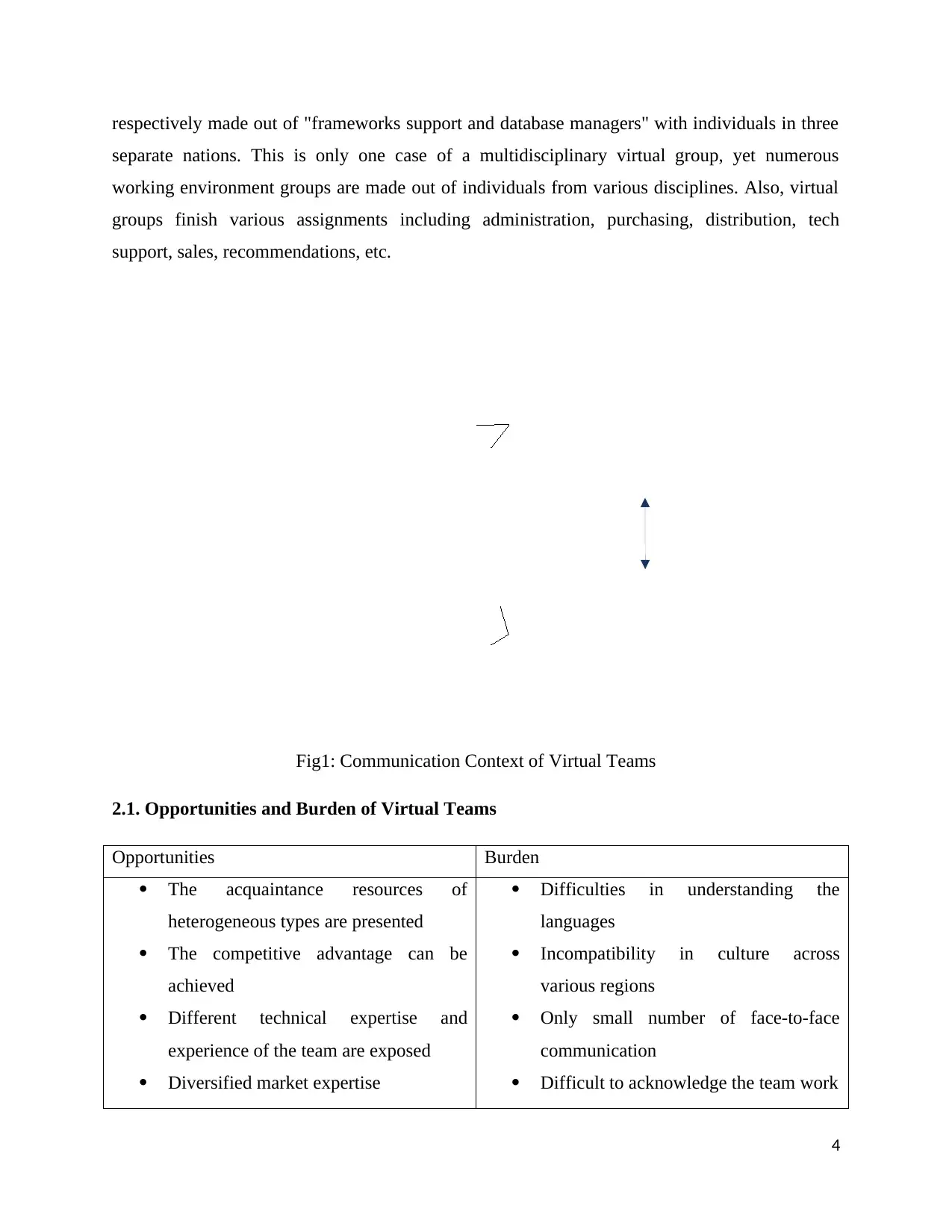
Fig1: Communication Context of Virtual Teams
2.1. Opportunities and Burden of Virtual Teams
Opportunities Burden
The acquaintance resources of
heterogeneous types are presented
The competitive advantage can be
achieved
Different technical expertise and
experience of the team are exposed
Diversified market expertise
Difficulties in understanding the
languages
Incompatibility in culture across
various regions
Only small number of face-to-face
communication
Difficult to acknowledge the team work
4
separate nations. This is only one case of a multidisciplinary virtual group, yet numerous
working environment groups are made out of individuals from various disciplines. Also, virtual
groups finish various assignments including administration, purchasing, distribution, tech
support, sales, recommendations, etc.
Fig1: Communication Context of Virtual Teams
2.1. Opportunities and Burden of Virtual Teams
Opportunities Burden
The acquaintance resources of
heterogeneous types are presented
The competitive advantage can be
achieved
Different technical expertise and
experience of the team are exposed
Diversified market expertise
Difficulties in understanding the
languages
Incompatibility in culture across
various regions
Only small number of face-to-face
communication
Difficult to acknowledge the team work
4
Paraphrase This Document
Need a fresh take? Get an instant paraphrase of this document with our AI Paraphraser
Table 1: Opportunities and Burdens in Virtual Team
3. Ethical Communication Implications
In all the virtual teams of the organization, conflicts are unavoidable. After the consideration of
virtual group intricate elements, the assessment turns into a major test. The inconsistency
between the teams can be either positive or ruinous. A positive clash will be prompted at the
point when the individuals from the group introduce diverse perspectives regarding an
assignment and the team leadership (Baron, 1991).
Behind the confrontation of contrast in assessments, the damaging clash arises when the bunch
of virtual team members questions each other expectations. An irony situation will be
encountered if one group of virtual group associates mainly focuses on work alone and not any
personal issues and the conflicts associated with the work will be transformed into relationship
issues. Thereby, the cooperative inputs are affected and the organizational productivity will be
decreased.
The main communication challenges are described below:
3.1. Deficiency in non-verbal interaction
The technology interceded platform is used by the virtual teams to attend face to face
conferences partially. Most of the effective communications are made by gestures like waving
the hands, face manifestations, voice, periods, breaks, etc. So, the deficiency in non-verbal
communication transforms the team interaction as a complicated process (Boutellier, Gassmann,
Macho, and Roux, 1998).
The real environment expressions should be translated into the virtual terms by the virtual teams.
For example, the expressions can be denoted by using emoticons in virtual environment.
The deficiency in non-verbal interaction results in the misinterpretations, annoyance, and
production of discords between the team members.
3.2. Rigid time limit and Conviction
5
3. Ethical Communication Implications
In all the virtual teams of the organization, conflicts are unavoidable. After the consideration of
virtual group intricate elements, the assessment turns into a major test. The inconsistency
between the teams can be either positive or ruinous. A positive clash will be prompted at the
point when the individuals from the group introduce diverse perspectives regarding an
assignment and the team leadership (Baron, 1991).
Behind the confrontation of contrast in assessments, the damaging clash arises when the bunch
of virtual team members questions each other expectations. An irony situation will be
encountered if one group of virtual group associates mainly focuses on work alone and not any
personal issues and the conflicts associated with the work will be transformed into relationship
issues. Thereby, the cooperative inputs are affected and the organizational productivity will be
decreased.
The main communication challenges are described below:
3.1. Deficiency in non-verbal interaction
The technology interceded platform is used by the virtual teams to attend face to face
conferences partially. Most of the effective communications are made by gestures like waving
the hands, face manifestations, voice, periods, breaks, etc. So, the deficiency in non-verbal
communication transforms the team interaction as a complicated process (Boutellier, Gassmann,
Macho, and Roux, 1998).
The real environment expressions should be translated into the virtual terms by the virtual teams.
For example, the expressions can be denoted by using emoticons in virtual environment.
The deficiency in non-verbal interaction results in the misinterpretations, annoyance, and
production of discords between the team members.
3.2. Rigid time limit and Conviction
5
The conventional form of the team member’s interrogators will be taken by the team members if
they are not provided adequate periods for building their own virtual team.
The interrogator impact implementation produces disturbing impacts for constructing the
confidence on other team members. The loss of conviction finally results in the ambiguity.
4. Intercultural Communication Implications
The virtual groups in “Chocolate Mortality” company comprise of employees belonging to
various regions and cultures and are normally biologically distributed. The interpersonal issues
and inadequate confidence level are experienced by the absence of similarity in intercultural
aspects.
Due to the globalizations increase in organizations and the introduction of new network
technologies and collaboration tools, the multi-cultural virtual teams are eminent these days
(Carlson and Zmud, 1999). The responsive time delay, group members of diverse culture,
synergy loss midst the group members, and communication failures results in the loss of
productivity in organizations.
5. Recommendations
Following are the recommendations to “Chocolate Mortality” company to improve the
communications within the virtual teams for increasing their productivity.
5.1. Institute obvious team constitution and Mutual Standards
Uncertainty is the main drawback of the communication failure within the virtual teams. If the
team members are not aware of the liability, interrogators, perception level of their
accomplishments, and sharing of the workloads between them, they are subjected to ambiguity.
So you should institute the obvious team and mutual standards. 74% of the team members had
training on the team constitution and mutual standards(Baron, 1991).
Therefore with obvious team constitution and mutual standards adoption, the team members can
adapt themselves with their own flaws and potency.
5.2. Scamper face-to-face conferences regularly
6
they are not provided adequate periods for building their own virtual team.
The interrogator impact implementation produces disturbing impacts for constructing the
confidence on other team members. The loss of conviction finally results in the ambiguity.
4. Intercultural Communication Implications
The virtual groups in “Chocolate Mortality” company comprise of employees belonging to
various regions and cultures and are normally biologically distributed. The interpersonal issues
and inadequate confidence level are experienced by the absence of similarity in intercultural
aspects.
Due to the globalizations increase in organizations and the introduction of new network
technologies and collaboration tools, the multi-cultural virtual teams are eminent these days
(Carlson and Zmud, 1999). The responsive time delay, group members of diverse culture,
synergy loss midst the group members, and communication failures results in the loss of
productivity in organizations.
5. Recommendations
Following are the recommendations to “Chocolate Mortality” company to improve the
communications within the virtual teams for increasing their productivity.
5.1. Institute obvious team constitution and Mutual Standards
Uncertainty is the main drawback of the communication failure within the virtual teams. If the
team members are not aware of the liability, interrogators, perception level of their
accomplishments, and sharing of the workloads between them, they are subjected to ambiguity.
So you should institute the obvious team and mutual standards. 74% of the team members had
training on the team constitution and mutual standards(Baron, 1991).
Therefore with obvious team constitution and mutual standards adoption, the team members can
adapt themselves with their own flaws and potency.
5.2. Scamper face-to-face conferences regularly
6
⊘ This is a preview!⊘
Do you want full access?
Subscribe today to unlock all pages.
Trusted by 1+ million students worldwide
During the initiation stage of virtual groups, the face to face conferences will assist the teams to
acquire the liability, elucidate the project description, and to know about the tasks. Frequent face
to face meetings enhances the efficient communication. For once a year, 41% of the team
members will not meet personally, 28% of team members meet once in a year, and 30% of team
members meet twice in a year(Powell, Piccoli and Ives, 2004). So, the team members are
encouraged to defend against the persuasion of attending face to face meetings regularly.
5.3. Promote Social Interaction
Since the non-vocal messages are filtered out by the technical tools, the leader of the virtual team
must cheer up the team associates to participate in the communal interaction through chatting,
discussing, and sharing their opinions on the tasks. And the feelings can be interpersonal too.
The lack of social interactions influence the productivity in the subsequent areas: 48% for
administering the challenges, 28% acquisition of member’s communication, and 40% of building
confidence (Burk and Chidambaram, 1995). In a fully virtual environment, the chat sessions can
be organized by the virtual team leader for lightening the dispositions, thereby improving the
productivity.
5.4. Construct a general dialect
The uncertainties of non-vocal interaction can be resolved by the development of communication
rules and dialects. For example, the misinterpretation between silence and retorting can be
avoided.
The general dialect comprising the general glossary, modalities, and interaction modes can assist
in reducing the work annoyance and delusions. 18% of the team members are aware of the
productivity loss due to the misinterpretation in communications (Kaywoth and Leidner, 2002).
Thus more number of brainstorming sessions should be conducted by the virtual team leader for
constructing the general dialect without aiming for immediate outcomes.
5.5. Alleviate the unenthusiastic impacts of cultural disparities
The team coordination and efficient interaction impact the cultural disparities in virtual teams.
The team associates employed from various regions in the same country is fair enough to build
7
acquire the liability, elucidate the project description, and to know about the tasks. Frequent face
to face meetings enhances the efficient communication. For once a year, 41% of the team
members will not meet personally, 28% of team members meet once in a year, and 30% of team
members meet twice in a year(Powell, Piccoli and Ives, 2004). So, the team members are
encouraged to defend against the persuasion of attending face to face meetings regularly.
5.3. Promote Social Interaction
Since the non-vocal messages are filtered out by the technical tools, the leader of the virtual team
must cheer up the team associates to participate in the communal interaction through chatting,
discussing, and sharing their opinions on the tasks. And the feelings can be interpersonal too.
The lack of social interactions influence the productivity in the subsequent areas: 48% for
administering the challenges, 28% acquisition of member’s communication, and 40% of building
confidence (Burk and Chidambaram, 1995). In a fully virtual environment, the chat sessions can
be organized by the virtual team leader for lightening the dispositions, thereby improving the
productivity.
5.4. Construct a general dialect
The uncertainties of non-vocal interaction can be resolved by the development of communication
rules and dialects. For example, the misinterpretation between silence and retorting can be
avoided.
The general dialect comprising the general glossary, modalities, and interaction modes can assist
in reducing the work annoyance and delusions. 18% of the team members are aware of the
productivity loss due to the misinterpretation in communications (Kaywoth and Leidner, 2002).
Thus more number of brainstorming sessions should be conducted by the virtual team leader for
constructing the general dialect without aiming for immediate outcomes.
5.5. Alleviate the unenthusiastic impacts of cultural disparities
The team coordination and efficient interaction impact the cultural disparities in virtual teams.
The team associates employed from various regions in the same country is fair enough to build
7
Paraphrase This Document
Need a fresh take? Get an instant paraphrase of this document with our AI Paraphraser
up the cultural disparity in a virtual environment. The associates possessing work experience in
multiple cultural environments can explain their acceptability of cultural disparities to other team
members for building the relationships and confidence.
Almost one quarter (24%) of the virtual associates is not successful in taking advantage of the
cultural disparities (Crampton, 2001). Moreover, in the recent years, 95% of the virtual team
leaders are rated as successful or highly effectual to manage the multicultural and multiregional
virtual teams.
According to a research on cultural disparities in virtual teams, the acquired resemblance
amongst the team associates can be alleviated by the use of technical collaboration tools. Various
body dialects and expressions play a major role in video conferencing but not with the written
interaction.
6. Conclusion:
Level of retorting is the crucial aspect for building the relationships and confidence between the
virtual team associates. From this perspective, the retort is about to take the jeopardy for
explaining the other person’s view in an interaction to avoid the misinterpretation of that team
member’s message and to make other members to interpret that message.
Hence, the associates in virtual team must consign to providing reply or reaction and criticism.
The intrinsic communication regulations are set by the team associates to make ensure that there
is no contribution without any reply or criticism. Moreover, the virtual team leader must be
apparent that “the excellence and inevitable communication are more crucial for the effective
operation of the virtual team and thereby the organizational productivity”.
7. Reference:
Crampton, C. (2001). The Mutual Knowledge Problem and it Consequences for Dispersed
Collaboration. Organization Science, 12(3), pp. 250-340.
Kaywoth, T.R. and Leidner, D.E. (2002). Leadership Effectiveness in Global Virtual Teams.
Journal of Management Information Systems, 18(3), pp.140-178..
8
multiple cultural environments can explain their acceptability of cultural disparities to other team
members for building the relationships and confidence.
Almost one quarter (24%) of the virtual associates is not successful in taking advantage of the
cultural disparities (Crampton, 2001). Moreover, in the recent years, 95% of the virtual team
leaders are rated as successful or highly effectual to manage the multicultural and multiregional
virtual teams.
According to a research on cultural disparities in virtual teams, the acquired resemblance
amongst the team associates can be alleviated by the use of technical collaboration tools. Various
body dialects and expressions play a major role in video conferencing but not with the written
interaction.
6. Conclusion:
Level of retorting is the crucial aspect for building the relationships and confidence between the
virtual team associates. From this perspective, the retort is about to take the jeopardy for
explaining the other person’s view in an interaction to avoid the misinterpretation of that team
member’s message and to make other members to interpret that message.
Hence, the associates in virtual team must consign to providing reply or reaction and criticism.
The intrinsic communication regulations are set by the team associates to make ensure that there
is no contribution without any reply or criticism. Moreover, the virtual team leader must be
apparent that “the excellence and inevitable communication are more crucial for the effective
operation of the virtual team and thereby the organizational productivity”.
7. Reference:
Crampton, C. (2001). The Mutual Knowledge Problem and it Consequences for Dispersed
Collaboration. Organization Science, 12(3), pp. 250-340.
Kaywoth, T.R. and Leidner, D.E. (2002). Leadership Effectiveness in Global Virtual Teams.
Journal of Management Information Systems, 18(3), pp.140-178..
8
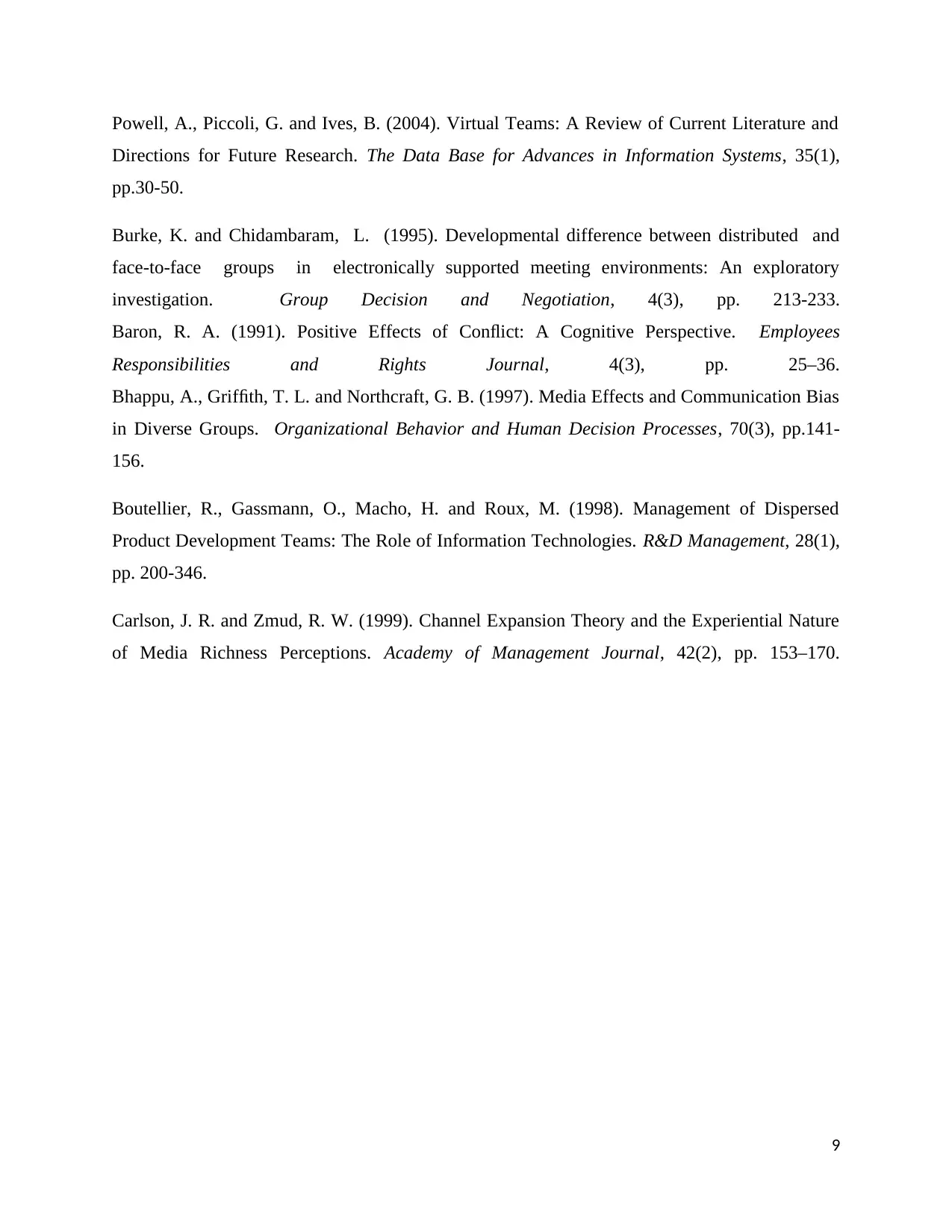
Powell, A., Piccoli, G. and Ives, B. (2004). Virtual Teams: A Review of Current Literature and
Directions for Future Research. The Data Base for Advances in Information Systems, 35(1),
pp.30-50.
Burke, K. and Chidambaram, L. (1995). Developmental difference between distributed and
face-to-face groups in electronically supported meeting environments: An exploratory
investigation. Group Decision and Negotiation, 4(3), pp. 213-233.
Baron, R. A. (1991). Positive Effects of Conflict: A Cognitive Perspective. Employees
Responsibilities and Rights Journal, 4(3), pp. 25–36.
Bhappu, A., Griffith, T. L. and Northcraft, G. B. (1997). Media Effects and Communication Bias
in Diverse Groups. Organizational Behavior and Human Decision Processes, 70(3), pp.141-
156.
Boutellier, R., Gassmann, O., Macho, H. and Roux, M. (1998). Management of Dispersed
Product Development Teams: The Role of Information Technologies. R&D Management, 28(1),
pp. 200-346.
Carlson, J. R. and Zmud, R. W. (1999). Channel Expansion Theory and the Experiential Nature
of Media Richness Perceptions. Academy of Management Journal, 42(2), pp. 153–170.
9
Directions for Future Research. The Data Base for Advances in Information Systems, 35(1),
pp.30-50.
Burke, K. and Chidambaram, L. (1995). Developmental difference between distributed and
face-to-face groups in electronically supported meeting environments: An exploratory
investigation. Group Decision and Negotiation, 4(3), pp. 213-233.
Baron, R. A. (1991). Positive Effects of Conflict: A Cognitive Perspective. Employees
Responsibilities and Rights Journal, 4(3), pp. 25–36.
Bhappu, A., Griffith, T. L. and Northcraft, G. B. (1997). Media Effects and Communication Bias
in Diverse Groups. Organizational Behavior and Human Decision Processes, 70(3), pp.141-
156.
Boutellier, R., Gassmann, O., Macho, H. and Roux, M. (1998). Management of Dispersed
Product Development Teams: The Role of Information Technologies. R&D Management, 28(1),
pp. 200-346.
Carlson, J. R. and Zmud, R. W. (1999). Channel Expansion Theory and the Experiential Nature
of Media Richness Perceptions. Academy of Management Journal, 42(2), pp. 153–170.
9
⊘ This is a preview!⊘
Do you want full access?
Subscribe today to unlock all pages.
Trusted by 1+ million students worldwide

1 out of 9


Your All-in-One AI-Powered Toolkit for Academic Success.
+13062052269
info@desklib.com
Available 24*7 on WhatsApp / Email
![[object Object]](/_next/static/media/star-bottom.7253800d.svg)
Unlock your academic potential
Copyright © 2020–2026 A2Z Services. All Rights Reserved. Developed and managed by ZUCOL.