Enterprise Architecture: Analysis, Design, and Implementation
VerifiedAdded on 2021/06/15
|12
|3055
|108
Report
AI Summary
This report provides a detailed analysis of enterprise architecture, exploring its core concepts, implementation strategies, and governance frameworks. It examines the role of enterprise architects in aligning business strategies with IT, emphasizing the importance of stakeholder management and service orientation. The report discusses various dimensions of enterprise architecture, including corporate, IT, technology, and architecture governance, highlighting the characteristics and benefits of each. It also reviews the challenges in software development and the need for effective technological supervision. Furthermore, the report explores the evolution of enterprise architecture, its impact on organizational structures, and the benefits of its systematic approach. Finally, it emphasizes the importance of training and development for enterprise architects to ensure effective implementation and management within organizations, drawing on various research articles and frameworks to support its findings.
Running head: ENTERPRISE ARCHITECTURE
Enterprise architecture
Name of the student:
Name of the university:
Author note
Enterprise architecture
Name of the student:
Name of the university:
Author note

Paraphrase This Document
Need a fresh take? Get an instant paraphrase of this document with our AI Paraphraser
1ENTERPRISE ARCHITECTURE
Introduction
Enterprise architecture is the practice of carrying out a detailed analysis of designing,
planning and implementation by utilizing a realistic approach. It is effective in successfully
developing and executing the strategies of the enterprise. This process takes into consideration
relevant theories and practices of architecture to direct the businesses of the enterprise (Steen et
al. 2005). It is associated with the conveying of information, required processes and the
modifications in technology to incorporate the strategies properly in the enterprise. The practices
of enterprise architecture consider different activities in order to recognize, encourage and attain
the objectives of the enterprise through change implementation.
The individuals who practice enterprise architecture are known as enterprise architects.
They are responsible for conducting the analysis process in the business structure and often help
in deriving conclusion as per the information received. The goal of enterprise architecture
includes effectiveness, durability, agility and efficiency (Rozanski and Woods 2012). In
association with the literature and community of architecture enterprise, several viewpoints exist
which are relevant to the term of enterprise architecture. The meaning of the term varies from
one organization to another and there is no standard definition. However, most of the definitions
associated with this term are balancing, while others are only hint and the rest are contradictory.
Description
According to Steen et al. (2005), the dimension of service orientation is new for the
enterprise architecture. In this article, the broader concept was discussed to find out about the
relevance and effect of service concept along with service orientation in the field of enterprise
Introduction
Enterprise architecture is the practice of carrying out a detailed analysis of designing,
planning and implementation by utilizing a realistic approach. It is effective in successfully
developing and executing the strategies of the enterprise. This process takes into consideration
relevant theories and practices of architecture to direct the businesses of the enterprise (Steen et
al. 2005). It is associated with the conveying of information, required processes and the
modifications in technology to incorporate the strategies properly in the enterprise. The practices
of enterprise architecture consider different activities in order to recognize, encourage and attain
the objectives of the enterprise through change implementation.
The individuals who practice enterprise architecture are known as enterprise architects.
They are responsible for conducting the analysis process in the business structure and often help
in deriving conclusion as per the information received. The goal of enterprise architecture
includes effectiveness, durability, agility and efficiency (Rozanski and Woods 2012). In
association with the literature and community of architecture enterprise, several viewpoints exist
which are relevant to the term of enterprise architecture. The meaning of the term varies from
one organization to another and there is no standard definition. However, most of the definitions
associated with this term are balancing, while others are only hint and the rest are contradictory.
Description
According to Steen et al. (2005), the dimension of service orientation is new for the
enterprise architecture. In this article, the broader concept was discussed to find out about the
relevance and effect of service concept along with service orientation in the field of enterprise
2ENTERPRISE ARCHITECTURE
architecture. The authors have provided ideas regarding the set- up of service- based enterprise
architecture. It is often countered that the service- based approach to enterprise architecture is
better in dealing with the architecture- directed and IT- directed business. The practice of
enterprise architecture provides a way for the enterprise architects to manage and control the
enterprise at a wider range. The authors have found out that there is no solitary presence of
architecture; rather it is always present within a hierarchy of government. The process is mainly
followed in larger enterprises and there are certain factors on which it is focused. These factors
include corporate governance, IT governance, technology governance and Architecture
governance (Bui, Markus and Newell 2015). Each factor in particular varies based on their
geographic location, either international or regional and domestic.
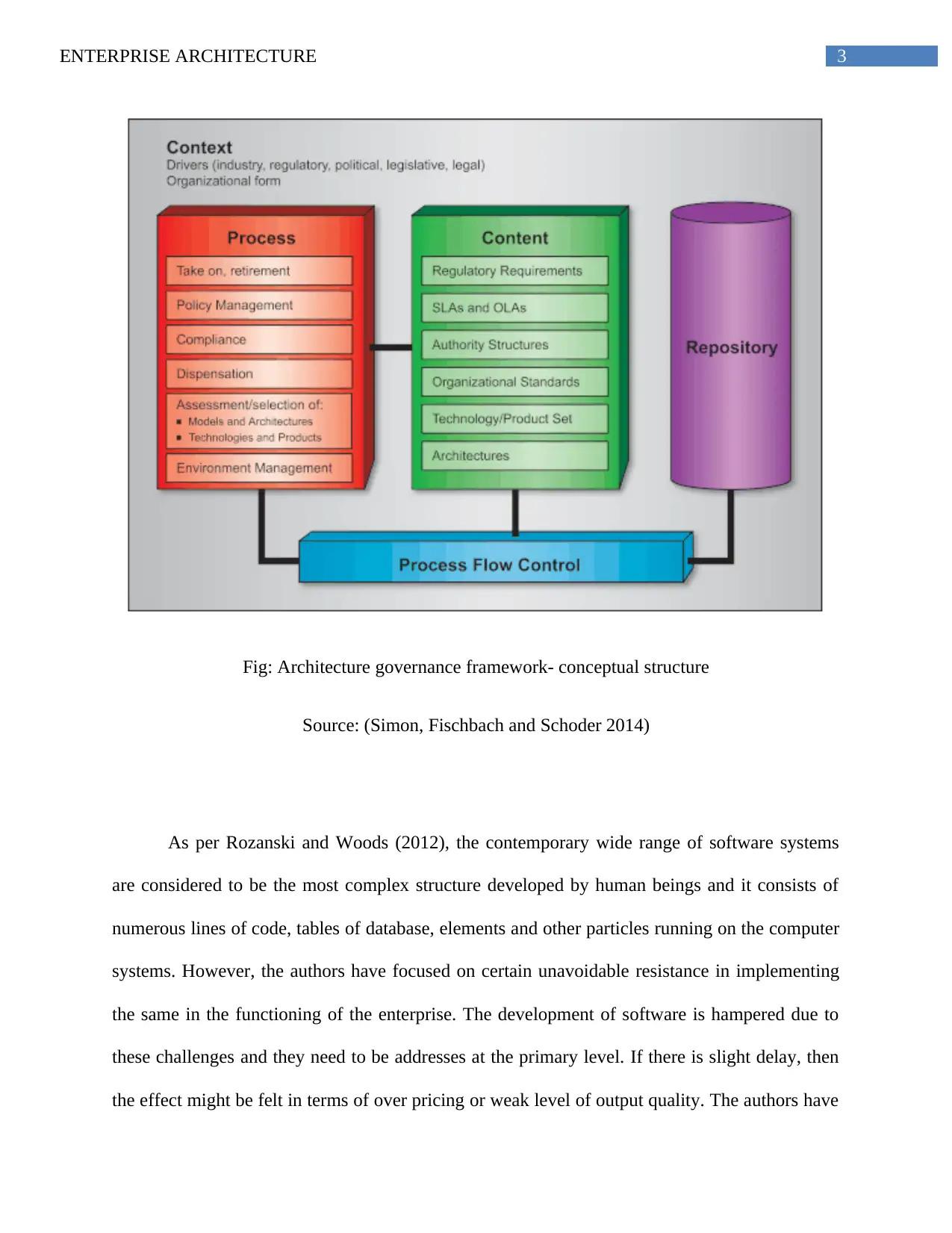
There are different characteristics of architecture governance in enterprise. It was found
out by the authors that if a system of control is implemented within the enterprise then there will
be creative and monitoring processes of the entire architectural elements along with the activities
carried out within the enterprise. This is done in order to incorporate significant introduction,
evolution and implementation of architectures within the enterprise. Again, an important
characteristic include a proper system for incorporating regulations in accordance with the
internal and external norms and policies. The third characteristic includes building up of the
processes that provide a supportive framework for effective management of the described
processes within the set standards. Finally, the characteristic of creating such practice will be
helpful in building responsibility to recognize the stakeholders for the enterprise, which
consisted of both internal and external stakeholders (Lange, Mendling and Recker 2016).
architecture. The authors have provided ideas regarding the set- up of service- based enterprise
architecture. It is often countered that the service- based approach to enterprise architecture is
better in dealing with the architecture- directed and IT- directed business. The practice of
enterprise architecture provides a way for the enterprise architects to manage and control the
enterprise at a wider range. The authors have found out that there is no solitary presence of
architecture; rather it is always present within a hierarchy of government. The process is mainly
followed in larger enterprises and there are certain factors on which it is focused. These factors
include corporate governance, IT governance, technology governance and Architecture
governance (Bui, Markus and Newell 2015). Each factor in particular varies based on their
geographic location, either international or regional and domestic.
There are different characteristics of architecture governance in enterprise. It was found
out by the authors that if a system of control is implemented within the enterprise then there will
be creative and monitoring processes of the entire architectural elements along with the activities
carried out within the enterprise. This is done in order to incorporate significant introduction,
evolution and implementation of architectures within the enterprise. Again, an important
characteristic include a proper system for incorporating regulations in accordance with the
internal and external norms and policies. The third characteristic includes building up of the
processes that provide a supportive framework for effective management of the described
processes within the set standards. Finally, the characteristic of creating such practice will be
helpful in building responsibility to recognize the stakeholders for the enterprise, which
consisted of both internal and external stakeholders (Lange, Mendling and Recker 2016).
⊘ This is a preview!⊘
Do you want full access?
Subscribe today to unlock all pages.

Trusted by 1+ million students worldwide
3ENTERPRISE ARCHITECTURE
Fig: Architecture governance framework- conceptual structure
Source: (Simon, Fischbach and Schoder 2014)
As per Rozanski and Woods (2012), the contemporary wide range of software systems
are considered to be the most complex structure developed by human beings and it consists of
numerous lines of code, tables of database, elements and other particles running on the computer
systems. However, the authors have focused on certain unavoidable resistance in implementing
the same in the functioning of the enterprise. The development of software is hampered due to
these challenges and they need to be addresses at the primary level. If there is slight delay, then
the effect might be felt in terms of over pricing or weak level of output quality. The authors have
Fig: Architecture governance framework- conceptual structure
Source: (Simon, Fischbach and Schoder 2014)
As per Rozanski and Woods (2012), the contemporary wide range of software systems
are considered to be the most complex structure developed by human beings and it consists of
numerous lines of code, tables of database, elements and other particles running on the computer
systems. However, the authors have focused on certain unavoidable resistance in implementing
the same in the functioning of the enterprise. The development of software is hampered due to
these challenges and they need to be addresses at the primary level. If there is slight delay, then
the effect might be felt in terms of over pricing or weak level of output quality. The authors have
Paraphrase This Document
Need a fresh take? Get an instant paraphrase of this document with our AI Paraphraser
4ENTERPRISE ARCHITECTURE
mentioned that that the business projects in the recent days determine the significance of
assigning an enterprise architect or a group of software engineers for fulfilling the responsibility
of technological supervision and direct others by guiding in the right way. As there is no
standard definitions of enterprise architecture, therefore the underlying meaning is only
associated with delivering service as per expectation (Zarvić and Wieringa 2014).
In order to throw light on the relationship between the architects and the stakeholder, the
authors of this book have used the book as a practical form of guidance. It is applicable for both
the novice architects as well as the experienced ones. The three basic concepts of stakeholders,
their perspectives and viewpoints are considered in relevance with this specific topic (Plataniotis,
De Kinderen and Proper 2014). In order to analyze the importance of the ideas and concepts, a
suitable example can be stated. Jennifer is an enterprise architect working in a large MNC. She is
a senior staff of the IT department and she has indulged in a number of activities. Her primary
responsibility was to lead the designing team of the company in terms of the information system
of the enterprise. Therefore, she was asked to take responsibility for finding out required
alternatives for the stock management system. She took the approach of interviewing people and
started facing challenge due to the conflicting necessity. She was not sure if all the people were
interviewed or she might have missed someone important (Bui, Markus and Newell 2015).
In relevance to the instance of Jennifer, it can be mentioned as per Chorafas (2016) that
the approach of the architect was not based on a wide range. The intention of the architects is to
work as per the requirements of the end consumers, but the approach taken by Jennifer was not
suitable for satisfying everyone. The people who are affected by the system and policies of the
enterprise are known as stakeholders. The aim of the enterprise is to develop the system in
accordance with the needs of the stakeholders. Gradually, it becomes the duty of the architects to
mentioned that that the business projects in the recent days determine the significance of
assigning an enterprise architect or a group of software engineers for fulfilling the responsibility
of technological supervision and direct others by guiding in the right way. As there is no
standard definitions of enterprise architecture, therefore the underlying meaning is only
associated with delivering service as per expectation (Zarvić and Wieringa 2014).
In order to throw light on the relationship between the architects and the stakeholder, the
authors of this book have used the book as a practical form of guidance. It is applicable for both
the novice architects as well as the experienced ones. The three basic concepts of stakeholders,
their perspectives and viewpoints are considered in relevance with this specific topic (Plataniotis,
De Kinderen and Proper 2014). In order to analyze the importance of the ideas and concepts, a
suitable example can be stated. Jennifer is an enterprise architect working in a large MNC. She is
a senior staff of the IT department and she has indulged in a number of activities. Her primary
responsibility was to lead the designing team of the company in terms of the information system
of the enterprise. Therefore, she was asked to take responsibility for finding out required
alternatives for the stock management system. She took the approach of interviewing people and
started facing challenge due to the conflicting necessity. She was not sure if all the people were
interviewed or she might have missed someone important (Bui, Markus and Newell 2015).
In relevance to the instance of Jennifer, it can be mentioned as per Chorafas (2016) that
the approach of the architect was not based on a wide range. The intention of the architects is to
work as per the requirements of the end consumers, but the approach taken by Jennifer was not
suitable for satisfying everyone. The people who are affected by the system and policies of the
enterprise are known as stakeholders. The aim of the enterprise is to develop the system in
accordance with the needs of the stakeholders. Gradually, it becomes the duty of the architects to
5ENTERPRISE ARCHITECTURE
meet the demands of the stakeholders of the enterprise. For properly fulfilling the task, it is
required to point out the appropriate stakeholders and work with them in order to find out their
concerns. It helps the enterprise architects to measure the conflicting priorities and create a
suitable architectural design for fulfilling the requirements as clearly as possible.
The instance of Jennifer, which was used in the course of this paper, is similar to the
problems faced by many other architects in the enterprise. It is a major problem faced by the
software engineers and need a quick resolution (Rouhamni et al. 2015). However, architectural
concept of designing was primarily introduced by the software engineers. As several views are
considered in designing the enterprise architecture, it becomes easy to explain and convey a
complex structure in an appropriate manner. It helps in evading the excitement of the readers due
to an entire complex structure of enterprise architecture. The instances of enterprise architecture
were helpful in involving the functional structure of the enterprise by considering the
information of organization and deployment environment (Burégio, Maamar Z. and Meira 2015).
As the case of Jennifer was used as an instance in this paper, it was found out that she
has realized the working of enterprise in relation with architecture by providing such services,
which affects the perceptions of the stakeholders. The selection of the architects are dependent
on th functioning of the enterprise by looking into its security factors, availability, easy
modification, and other non- significant factors which are known as quality properties. The key
role of an architect is to create a system within the enterprise, which will consist of the
acceptable factors (Iacob et al. 2014). Apart from that, it is important to achieve the essential
objectives for highlighting the cross- cultural dimensions within the enterprise. the enterprise
architect needs to consider that attaining the objectives will influence different viewpoints of the
architectural description.
meet the demands of the stakeholders of the enterprise. For properly fulfilling the task, it is
required to point out the appropriate stakeholders and work with them in order to find out their
concerns. It helps the enterprise architects to measure the conflicting priorities and create a
suitable architectural design for fulfilling the requirements as clearly as possible.
The instance of Jennifer, which was used in the course of this paper, is similar to the
problems faced by many other architects in the enterprise. It is a major problem faced by the
software engineers and need a quick resolution (Rouhamni et al. 2015). However, architectural
concept of designing was primarily introduced by the software engineers. As several views are
considered in designing the enterprise architecture, it becomes easy to explain and convey a
complex structure in an appropriate manner. It helps in evading the excitement of the readers due
to an entire complex structure of enterprise architecture. The instances of enterprise architecture
were helpful in involving the functional structure of the enterprise by considering the
information of organization and deployment environment (Burégio, Maamar Z. and Meira 2015).
As the case of Jennifer was used as an instance in this paper, it was found out that she
has realized the working of enterprise in relation with architecture by providing such services,
which affects the perceptions of the stakeholders. The selection of the architects are dependent
on th functioning of the enterprise by looking into its security factors, availability, easy
modification, and other non- significant factors which are known as quality properties. The key
role of an architect is to create a system within the enterprise, which will consist of the
acceptable factors (Iacob et al. 2014). Apart from that, it is important to achieve the essential
objectives for highlighting the cross- cultural dimensions within the enterprise. the enterprise
architect needs to consider that attaining the objectives will influence different viewpoints of the
architectural description.
⊘ This is a preview!⊘
Do you want full access?
Subscribe today to unlock all pages.
Trusted by 1+ million students worldwide
6ENTERPRISE ARCHITECTURE
As per Simon, Fischbach and Schoder (2013), enterprise architecture management is
gaining momentum and identified as a major factor in the business and IT sector. However, there
is a gap in the development of simple comprehension and procedural reliability. In this article,
the authors have mentioned about the role played by research study in the development process.
Different bibliographic methods were used in this article along with a wide range of qualitative
understanding of the research sector. It is effective in providing an extraordinary approach of the
literature related to enterprise architecture. A set of research questions were outlined for
gathering response regarding collaboration via co- authorships, the brilliant structure of the
research topic and the most effective works along with the major themes of research. In order to
provide an opportunity for further research on this topic, an agenda was proposed by considering
the findings from the data analysis and comparing experimental knowledge from the specific
literature (Zimmermann et al. 2015). In this article, the focus was put on a reasonable degree of
co- authorship and the positive effect on the spreading of work in among the architects of the
enterprise. Additionally, this article was helpful in recognizing three various streams of research
to evaluate that the research has grown around particular themes. In the course of this process,
there was no relevance to high practice and did not receive required attention. Therefore, the
value of the findings of this article increased rapidly to provide support to the researchers and
practitioners. The system of enterprise architecture has evolved through years and the approaches
that were taken for the same have gained increasing popularity (Santana et al. 2016).
In an organization, the effect of enterprise architecture is felt in terms of the combined
structure of processes, conveying of information and the technological infrastructure. The
structure of enterprise architecture is positioned in between the strategies of business and
information technology in one side and implementation of project- based solutions in another
As per Simon, Fischbach and Schoder (2013), enterprise architecture management is
gaining momentum and identified as a major factor in the business and IT sector. However, there
is a gap in the development of simple comprehension and procedural reliability. In this article,
the authors have mentioned about the role played by research study in the development process.
Different bibliographic methods were used in this article along with a wide range of qualitative
understanding of the research sector. It is effective in providing an extraordinary approach of the
literature related to enterprise architecture. A set of research questions were outlined for
gathering response regarding collaboration via co- authorships, the brilliant structure of the
research topic and the most effective works along with the major themes of research. In order to
provide an opportunity for further research on this topic, an agenda was proposed by considering
the findings from the data analysis and comparing experimental knowledge from the specific
literature (Zimmermann et al. 2015). In this article, the focus was put on a reasonable degree of
co- authorship and the positive effect on the spreading of work in among the architects of the
enterprise. Additionally, this article was helpful in recognizing three various streams of research
to evaluate that the research has grown around particular themes. In the course of this process,
there was no relevance to high practice and did not receive required attention. Therefore, the
value of the findings of this article increased rapidly to provide support to the researchers and
practitioners. The system of enterprise architecture has evolved through years and the approaches
that were taken for the same have gained increasing popularity (Santana et al. 2016).
In an organization, the effect of enterprise architecture is felt in terms of the combined
structure of processes, conveying of information and the technological infrastructure. The
structure of enterprise architecture is positioned in between the strategies of business and
information technology in one side and implementation of project- based solutions in another
Paraphrase This Document
Need a fresh take? Get an instant paraphrase of this document with our AI Paraphraser
7ENTERPRISE ARCHITECTURE
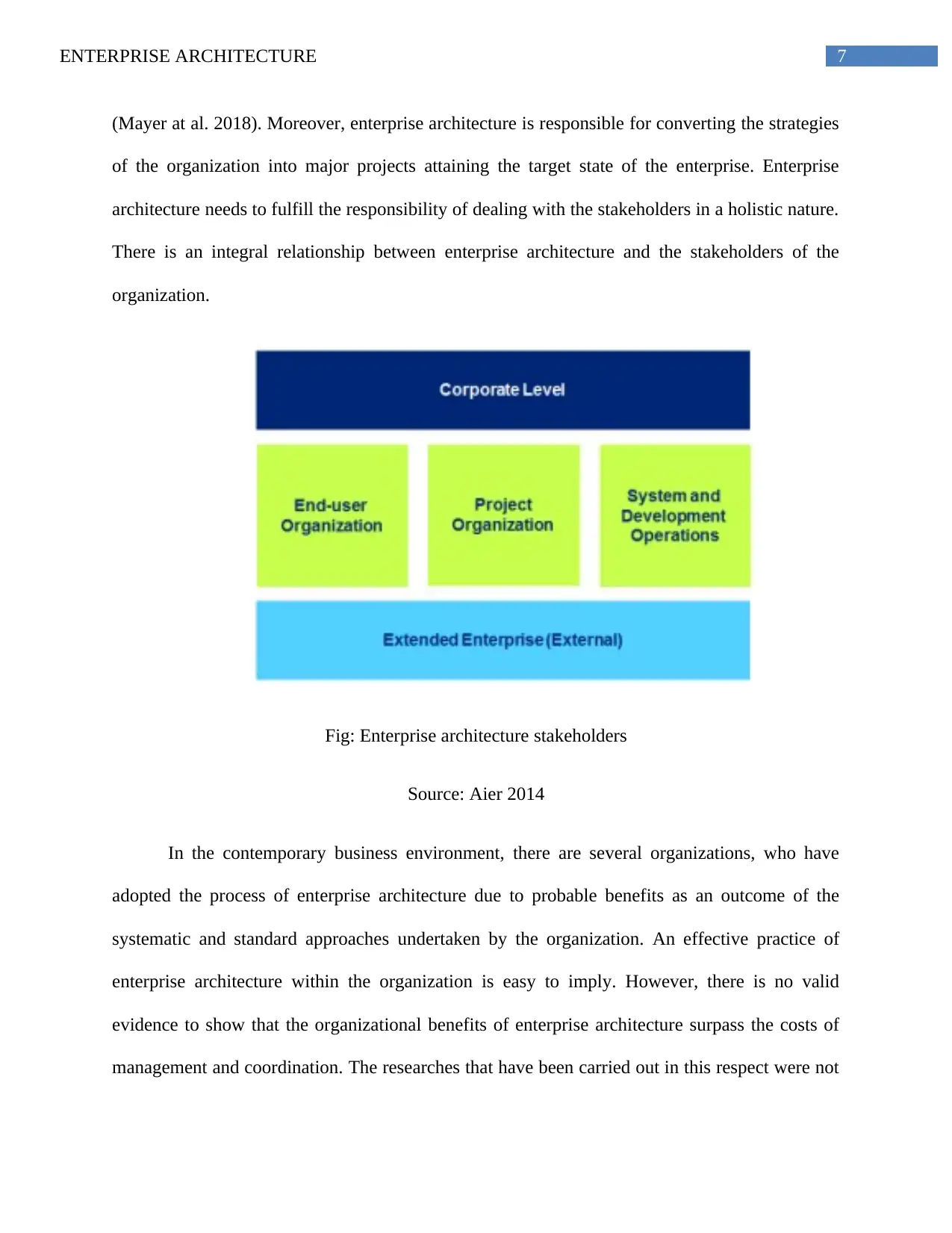
(Mayer at al. 2018). Moreover, enterprise architecture is responsible for converting the strategies
of the organization into major projects attaining the target state of the enterprise. Enterprise
architecture needs to fulfill the responsibility of dealing with the stakeholders in a holistic nature.
There is an integral relationship between enterprise architecture and the stakeholders of the
organization.
Fig: Enterprise architecture stakeholders
Source: Aier 2014
In the contemporary business environment, there are several organizations, who have
adopted the process of enterprise architecture due to probable benefits as an outcome of the
systematic and standard approaches undertaken by the organization. An effective practice of
enterprise architecture within the organization is easy to imply. However, there is no valid
evidence to show that the organizational benefits of enterprise architecture surpass the costs of
management and coordination. The researches that have been carried out in this respect were not
(Mayer at al. 2018). Moreover, enterprise architecture is responsible for converting the strategies
of the organization into major projects attaining the target state of the enterprise. Enterprise
architecture needs to fulfill the responsibility of dealing with the stakeholders in a holistic nature.
There is an integral relationship between enterprise architecture and the stakeholders of the
organization.
Fig: Enterprise architecture stakeholders
Source: Aier 2014
In the contemporary business environment, there are several organizations, who have
adopted the process of enterprise architecture due to probable benefits as an outcome of the
systematic and standard approaches undertaken by the organization. An effective practice of
enterprise architecture within the organization is easy to imply. However, there is no valid
evidence to show that the organizational benefits of enterprise architecture surpass the costs of
management and coordination. The researches that have been carried out in this respect were not
8ENTERPRISE ARCHITECTURE
successful in outlining the potential benefits or the benchmarks for the feasible impact in the
organization (Vargas et al. 2016).
Moreover, the profession of enterprise architect is relatively new in organizations and the
professional environment. With the increasing adoption of the enterprise architecture practices,
there is rapid popularity and demand among the architects to incorporate and manage the
activities. This requires efficient training and development among the young professionals to
implement the activities in a systematic manner. According to Foorthuis et al. (2016), the
enterprise architect can make use of a suitable framework to implement the practice within
organization. It will also be helpful in understanding the roles and responsibilities and the
training methods can be designed accordingly. With proper training and development of the
young professionals, they will be able to gather sound knowledge and implement the same in the
organizational activities. This will help in improving the functions of the organization. The
current trend in the professional environment was helpful in directing the management towards
the implication of this effective practice for improving employee performance and organizational
efficiency (Niemi and Pekkola 2017). The effectiveness can be experienced not only in the
business but also in the technological environment.
successful in outlining the potential benefits or the benchmarks for the feasible impact in the
organization (Vargas et al. 2016).
Moreover, the profession of enterprise architect is relatively new in organizations and the
professional environment. With the increasing adoption of the enterprise architecture practices,
there is rapid popularity and demand among the architects to incorporate and manage the
activities. This requires efficient training and development among the young professionals to
implement the activities in a systematic manner. According to Foorthuis et al. (2016), the
enterprise architect can make use of a suitable framework to implement the practice within
organization. It will also be helpful in understanding the roles and responsibilities and the
training methods can be designed accordingly. With proper training and development of the
young professionals, they will be able to gather sound knowledge and implement the same in the
organizational activities. This will help in improving the functions of the organization. The
current trend in the professional environment was helpful in directing the management towards
the implication of this effective practice for improving employee performance and organizational
efficiency (Niemi and Pekkola 2017). The effectiveness can be experienced not only in the
business but also in the technological environment.
⊘ This is a preview!⊘
Do you want full access?
Subscribe today to unlock all pages.
Trusted by 1+ million students worldwide
9ENTERPRISE ARCHITECTURE
References
Aier, S., 2014. The role of organizational culture for grounding, management, guidance and
effectiveness of enterprise architecture principles. Information Systems and e-Business
Management, 12(1), pp.43-70.
Bui, Q., Markus, M.L. and Newell, S., 2015. Magnitude in innovation change: adaptation and
reinvention in Enterprise Architecture implementation. In Academy of Management
Proceedings (Vol. 2015, No. 1, p. 19056). Briarcliff Manor, NY 10510: Academy of
Management.
Bui, Q.N., Markus, M. and Newell, S., 2015. Alternative Designs in Widespread Innovation
Adoption: Empirical Evidence from Enterprise Architecture Implementation in US State
Governments.
Burégio, V., Maamar, Z. and Meira, S., 2015. An architecture and guiding framework for the
social enterprise. IEEE Internet Computing, 19(1), pp.64-68.
Chorafas, D.N., 2016. Enterprise architecture and new generation information systems. CRC
Press.
Foorthuis, R., Van Steenbergen, M., Brinkkemper, S. and Bruls, W.A., 2016. A theory building
study of enterprise architecture practices and benefits. Information Systems Frontiers, 18(3),
pp.541-564.
References
Aier, S., 2014. The role of organizational culture for grounding, management, guidance and
effectiveness of enterprise architecture principles. Information Systems and e-Business
Management, 12(1), pp.43-70.
Bui, Q., Markus, M.L. and Newell, S., 2015. Magnitude in innovation change: adaptation and
reinvention in Enterprise Architecture implementation. In Academy of Management
Proceedings (Vol. 2015, No. 1, p. 19056). Briarcliff Manor, NY 10510: Academy of
Management.
Bui, Q.N., Markus, M. and Newell, S., 2015. Alternative Designs in Widespread Innovation
Adoption: Empirical Evidence from Enterprise Architecture Implementation in US State
Governments.
Burégio, V., Maamar, Z. and Meira, S., 2015. An architecture and guiding framework for the
social enterprise. IEEE Internet Computing, 19(1), pp.64-68.
Chorafas, D.N., 2016. Enterprise architecture and new generation information systems. CRC
Press.
Foorthuis, R., Van Steenbergen, M., Brinkkemper, S. and Bruls, W.A., 2016. A theory building
study of enterprise architecture practices and benefits. Information Systems Frontiers, 18(3),
pp.541-564.
Paraphrase This Document
Need a fresh take? Get an instant paraphrase of this document with our AI Paraphraser
10ENTERPRISE ARCHITECTURE
Iacob, M.E., Meertens, L.O., Jonkers, H., Quartel, D.A., Nieuwenhuis, L.J. and van Sinderen,
M.J., 2014. From enterprise architecture to business models and back. Software & Systems
Modeling, 13(3), pp.1059-1083.
Lange, M., Mendling, J. and Recker, J., 2016. An empirical analysis of the factors and measures
of Enterprise Architecture Management success. European Journal of Information
Systems, 25(5), pp.411-431.
Mayer, N., Aubert, J., Grandry, E., Feltus, C., Goettelmann, E. and Wieringa, R., 2018. An
integrated conceptual model for information system security risk management supported by
enterprise architecture management. Software & Systems Modeling, pp.1-28.
Niemi, E. and Pekkola, S., 2017. Using enterprise architecture artefacts in an
organisation. Enterprise Information Systems, 11(3), pp.313-338.
Plataniotis, G., De Kinderen, S. and Proper, H.A., 2014. Ea anamnesis: An approach for decision
making analysis in enterprise architecture. International Journal of Information System Modeling
and Design (IJISMD), 5(3), pp.75-95.
Rouhani, B.D., Mahrin, M.N.R., Nikpay, F., Ahmad, R.B. and Nikfard, P., 2015. A systematic
literature review on Enterprise Architecture Implementation Methodologies. Information and
Software Technology, 62, pp.1-20.
Rozanski, N. and Woods, E., 2012. Software systems architecture: working with stakeholders
using viewpoints and perspectives. Addison-Wesley.
Santana, A., Simon, D., Fischbach, K. and de Moura, H., 2016, September. Combining Network
Measures and Expert Knowledge to Analyze Enterprise Architecture at the Component Level.
Iacob, M.E., Meertens, L.O., Jonkers, H., Quartel, D.A., Nieuwenhuis, L.J. and van Sinderen,
M.J., 2014. From enterprise architecture to business models and back. Software & Systems
Modeling, 13(3), pp.1059-1083.
Lange, M., Mendling, J. and Recker, J., 2016. An empirical analysis of the factors and measures
of Enterprise Architecture Management success. European Journal of Information
Systems, 25(5), pp.411-431.
Mayer, N., Aubert, J., Grandry, E., Feltus, C., Goettelmann, E. and Wieringa, R., 2018. An
integrated conceptual model for information system security risk management supported by
enterprise architecture management. Software & Systems Modeling, pp.1-28.
Niemi, E. and Pekkola, S., 2017. Using enterprise architecture artefacts in an
organisation. Enterprise Information Systems, 11(3), pp.313-338.
Plataniotis, G., De Kinderen, S. and Proper, H.A., 2014. Ea anamnesis: An approach for decision
making analysis in enterprise architecture. International Journal of Information System Modeling
and Design (IJISMD), 5(3), pp.75-95.
Rouhani, B.D., Mahrin, M.N.R., Nikpay, F., Ahmad, R.B. and Nikfard, P., 2015. A systematic
literature review on Enterprise Architecture Implementation Methodologies. Information and
Software Technology, 62, pp.1-20.
Rozanski, N. and Woods, E., 2012. Software systems architecture: working with stakeholders
using viewpoints and perspectives. Addison-Wesley.
Santana, A., Simon, D., Fischbach, K. and de Moura, H., 2016, September. Combining Network
Measures and Expert Knowledge to Analyze Enterprise Architecture at the Component Level.
11ENTERPRISE ARCHITECTURE
In Enterprise Distributed Object Computing Conference (EDOC), 2016 IEEE 20th
International (pp. 1-10). IEEE.
Simon, D., Fischbach, K. and Schoder, D., 2013. An exploration of enterprise architecture
research. CAIS, 32, p.1.
Simon, D., Fischbach, K. and Schoder, D., 2014. Enterprise architecture management and its role
in corporate strategic management. Information Systems and e-Business Management, 12(1),
pp.5-42.
Steen, M.W., Strating, P., Lankhorst, M.M., ter Doest, H.W. and Iacob, M.E., 2005. Service-
oriented enterprise architecture. In Service-oriented software system engineering: challenges and
practices (pp. 132-154). IGI Global.
Vargas, A., Cuenca, L., Boza, A., Sacala, I. and Moisescu, M., 2016. Towards the development
of the framework for inter sensing enterprise architecture. Journal of Intelligent
Manufacturing, 27(1), pp.55-72.
Zarvić, N. and Wieringa, R., 2014. An integrated enterprise architecture framework for business-
IT alignment. Designing Enterprise Architecture Frameworks: Integrating Business Processes
with IT Infrastructure, 63, p.9.
Zimmermann, A., Schmidt, R., Sandkuhl, K., Wißotzki, M., Jugel, D. and Möhring, M., 2015,
September. Digital enterprise architecture-transformation for the internet of things. In Enterprise
Distributed Object Computing Workshop (EDOCW), 2015 IEEE 19th International (pp. 130-
138). IEEE.
In Enterprise Distributed Object Computing Conference (EDOC), 2016 IEEE 20th
International (pp. 1-10). IEEE.
Simon, D., Fischbach, K. and Schoder, D., 2013. An exploration of enterprise architecture
research. CAIS, 32, p.1.
Simon, D., Fischbach, K. and Schoder, D., 2014. Enterprise architecture management and its role
in corporate strategic management. Information Systems and e-Business Management, 12(1),
pp.5-42.
Steen, M.W., Strating, P., Lankhorst, M.M., ter Doest, H.W. and Iacob, M.E., 2005. Service-
oriented enterprise architecture. In Service-oriented software system engineering: challenges and
practices (pp. 132-154). IGI Global.
Vargas, A., Cuenca, L., Boza, A., Sacala, I. and Moisescu, M., 2016. Towards the development
of the framework for inter sensing enterprise architecture. Journal of Intelligent
Manufacturing, 27(1), pp.55-72.
Zarvić, N. and Wieringa, R., 2014. An integrated enterprise architecture framework for business-
IT alignment. Designing Enterprise Architecture Frameworks: Integrating Business Processes
with IT Infrastructure, 63, p.9.
Zimmermann, A., Schmidt, R., Sandkuhl, K., Wißotzki, M., Jugel, D. and Möhring, M., 2015,
September. Digital enterprise architecture-transformation for the internet of things. In Enterprise
Distributed Object Computing Workshop (EDOCW), 2015 IEEE 19th International (pp. 130-
138). IEEE.
⊘ This is a preview!⊘
Do you want full access?
Subscribe today to unlock all pages.
Trusted by 1+ million students worldwide

1 out of 12


Related Documents


Your All-in-One AI-Powered Toolkit for Academic Success.
+13062052269
info@desklib.com
Available 24*7 on WhatsApp / Email
![[object Object]](/_next/static/media/star-bottom.7253800d.svg)
Unlock your academic potential
Copyright © 2020–2026 A2Z Services. All Rights Reserved. Developed and managed by ZUCOL.