ENT301: Enterprise Culture in Facebook and UBER - Report
VerifiedAdded on 2020/05/04
|11
|2703
|52
Report
AI Summary
This report provides a detailed analysis of the enterprise and entrepreneurial cultures within Facebook and UBER. It begins with an introduction defining enterprise and entrepreneurship, followed by a literature review exploring the concepts of organizational culture and its impact on business success. The core of the report consists of two case studies, examining the histories, sectors, and turnovers of Facebook and UBER. An in-depth analysis of each company's organizational culture is provided, highlighting the characteristics, values, and employee management practices. The report compares and contrasts the enterprise cultures of both companies, drawing conclusions about their effectiveness and impact on innovation, leadership, and employee engagement. The analysis reveals that Facebook aligns with an enterprise culture, while UBER faces cultural challenges. The report concludes with a summary of findings and provides references for further study. This report is a valuable resource for students seeking insights into enterprise culture, available on Desklib.

BUSINESS CULTURE

Paraphrase This Document
Need a fresh take? Get an instant paraphrase of this document with our AI Paraphraser
Executive summary:
Enterprise can be defined as the organisation that aims at serving the market and that operates in
an industry for earning profit. Entrepreneurship can be referred to as the business activities and
the business culture that has been followed in the enterprise by the entrepreneur who conduct the
business activities. It is the report that discusses about the enterprise culture in the companies
called UBER and Facebook.
Enterprise can be defined as the organisation that aims at serving the market and that operates in
an industry for earning profit. Entrepreneurship can be referred to as the business activities and
the business culture that has been followed in the enterprise by the entrepreneur who conduct the
business activities. It is the report that discusses about the enterprise culture in the companies
called UBER and Facebook.
Table of Contents
Introduction:................................................................................................................................................1
Literature review:........................................................................................................................................1
Case study 1: FACEBOOK.........................................................................................................................2
Case study 2: UBER....................................................................................................................................3
Analysis:......................................................................................................................................................4
Findings and analysis:.................................................................................................................................5
Findings:......................................................................................................................................................6
Conclusion:.................................................................................................................................................6
References:..................................................................................................................................................7
Introduction:................................................................................................................................................1
Literature review:........................................................................................................................................1
Case study 1: FACEBOOK.........................................................................................................................2
Case study 2: UBER....................................................................................................................................3
Analysis:......................................................................................................................................................4
Findings and analysis:.................................................................................................................................5
Findings:......................................................................................................................................................6
Conclusion:.................................................................................................................................................6
References:..................................................................................................................................................7
⊘ This is a preview!⊘
Do you want full access?
Subscribe today to unlock all pages.

Trusted by 1+ million students worldwide
Introduction:
Enterprise can be defined as the for-profit organisation that operates in an industry for earning
profit and serving the customers. Entrepreneurship can be referred to as the business activities
and the business culture that has been followed in the enterprise by the entrepreneur who conduct
the business activities. This report describes the various aspects of entrepreneurial and enterprise
culture in concern with two of the companies called Facebook and UBER. The discussion of the
enterprise and entrepreneurial culture focuses on its importance in the organisation and the
differences and similarities between entrepreneurial and enterprise.
Literature review:
An enterprise can be defined differently by different authors. Enterprise is considered as the
organisation that operates in the industry for earning profits. Another definition of enterprise
suggests that it is the business organisation that serves the market with goods and services and
also develops and creates different jobs for the people and contributes in the income of the
country along with earning profits from the market (Burrows, 2015). In a concise way, the
enterprise can be defined as a business venture that conducted all the business activities (Waters
and Lo, 2012). To conduct the study on enterprise, it is required to understand the concept of
entrepreneur and entrepreneurship. Entrepreneur is the one who conduct the business functions
and activities while entrepreneurship is defined as the process of applying the enterprise skills in
action to grow the business.
Every organisation follows a particular culture in the company that supports the company to take
some of the organisational decision d develop the organisational strategies. The organisation
culture is defined as the beliefs and values of the organisation that is followed in a standard way
in the organisational functions (Williams, 2010). Implementing an enterprising culture means the
organisation needs to be prepared for taking all the risks in the market and the business. An
organisation that follows the enterprise culture is the one in which all the people at the
organisation are creative and imaginative in nature. Most of the companies these days are
implementing the enterprise culture in their organisation to be successful. It is the type of culture
that helps the employees of the company to be independent (Williams and Nadin, 2013). An
enterprise culture argues about the skills that are required to be implementing the company in
Enterprise can be defined as the for-profit organisation that operates in an industry for earning
profit and serving the customers. Entrepreneurship can be referred to as the business activities
and the business culture that has been followed in the enterprise by the entrepreneur who conduct
the business activities. This report describes the various aspects of entrepreneurial and enterprise
culture in concern with two of the companies called Facebook and UBER. The discussion of the
enterprise and entrepreneurial culture focuses on its importance in the organisation and the
differences and similarities between entrepreneurial and enterprise.
Literature review:
An enterprise can be defined differently by different authors. Enterprise is considered as the
organisation that operates in the industry for earning profits. Another definition of enterprise
suggests that it is the business organisation that serves the market with goods and services and
also develops and creates different jobs for the people and contributes in the income of the
country along with earning profits from the market (Burrows, 2015). In a concise way, the
enterprise can be defined as a business venture that conducted all the business activities (Waters
and Lo, 2012). To conduct the study on enterprise, it is required to understand the concept of
entrepreneur and entrepreneurship. Entrepreneur is the one who conduct the business functions
and activities while entrepreneurship is defined as the process of applying the enterprise skills in
action to grow the business.
Every organisation follows a particular culture in the company that supports the company to take
some of the organisational decision d develop the organisational strategies. The organisation
culture is defined as the beliefs and values of the organisation that is followed in a standard way
in the organisational functions (Williams, 2010). Implementing an enterprising culture means the
organisation needs to be prepared for taking all the risks in the market and the business. An
organisation that follows the enterprise culture is the one in which all the people at the
organisation are creative and imaginative in nature. Most of the companies these days are
implementing the enterprise culture in their organisation to be successful. It is the type of culture
that helps the employees of the company to be independent (Williams and Nadin, 2013). An
enterprise culture argues about the skills that are required to be implementing the company in
Paraphrase This Document
Need a fresh take? Get an instant paraphrase of this document with our AI Paraphraser
order to develop the entrepreneurship behaviour and thus both the culture has similar attributes.
The entrepreneurial culture is not just about turning and idea into enterprise but it is more than
that. It is about implementing the skills of imaginative thinking, innovation and risk taking in
order to grow the business.
Case study 1:FACEBOOK
History:
Facebook is the social networking company that was launched in the year of 2004. The company
was founded by Mark Zuckerberg. Facebook was launched in order to aid the students of
Harvard University to connect with each other. The registration and membership of this website
was restricted to the Harvard university students only but after some time Mark realised to make
improvements in the website so that it can be accessed by all (Ritchie, 2015). He took help from
his fellow mates to do the same. After getting the investors, Mark has launched Facebook for
entire population and still earning a large amount of profits from the market.
Sector:
Facebook operates in the sector of social networking industry. It has been analysed that these
days, this industry is very much competitive and expected to grow by 18% during the forecast
period. It has been analysed that the competition in the industry is rising because of the
increasing use of the social networking sites these days (Mason, 2015). The most important use
of these sites for businesses is advertising and thus more and more companies are entering the
industry.
Turnover: as far as the turnover of Facebook is considered, it has been analysed that the
company is experiencing continuous growth in the revenue and net income.
The entrepreneurial culture is not just about turning and idea into enterprise but it is more than
that. It is about implementing the skills of imaginative thinking, innovation and risk taking in
order to grow the business.
Case study 1:FACEBOOK
History:
Facebook is the social networking company that was launched in the year of 2004. The company
was founded by Mark Zuckerberg. Facebook was launched in order to aid the students of
Harvard University to connect with each other. The registration and membership of this website
was restricted to the Harvard university students only but after some time Mark realised to make
improvements in the website so that it can be accessed by all (Ritchie, 2015). He took help from
his fellow mates to do the same. After getting the investors, Mark has launched Facebook for
entire population and still earning a large amount of profits from the market.
Sector:
Facebook operates in the sector of social networking industry. It has been analysed that these
days, this industry is very much competitive and expected to grow by 18% during the forecast
period. It has been analysed that the competition in the industry is rising because of the
increasing use of the social networking sites these days (Mason, 2015). The most important use
of these sites for businesses is advertising and thus more and more companies are entering the
industry.
Turnover: as far as the turnover of Facebook is considered, it has been analysed that the
company is experiencing continuous growth in the revenue and net income.
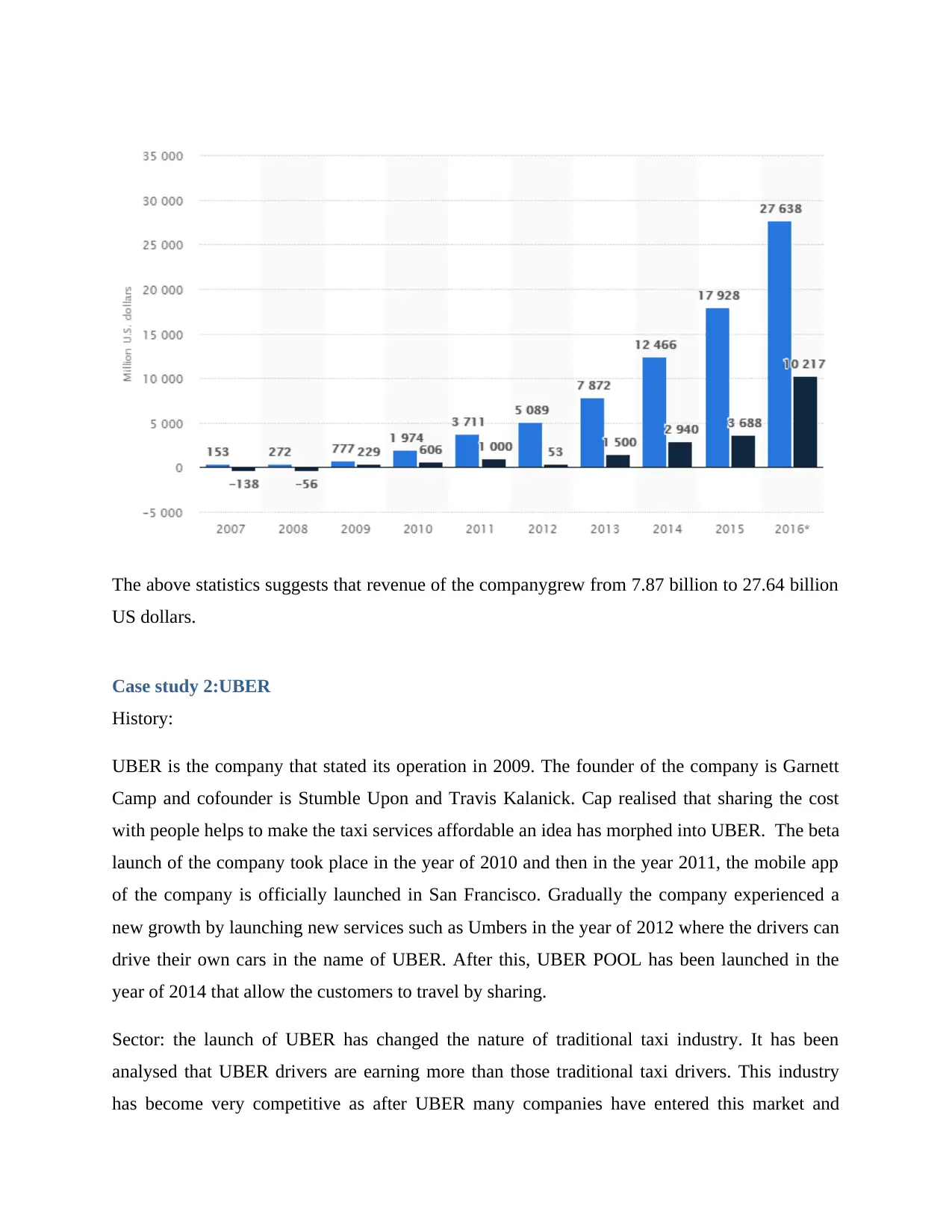
The above statistics suggests that revenue of the companygrew from 7.87 billion to 27.64 billion
US dollars.
Case study 2:UBER
History:
UBER is the company that stated its operation in 2009. The founder of the company is Garnett
Camp and cofounder is Stumble Upon and Travis Kalanick. Cap realised that sharing the cost
with people helps to make the taxi services affordable an idea has morphed into UBER. The beta
launch of the company took place in the year of 2010 and then in the year 2011, the mobile app
of the company is officially launched in San Francisco. Gradually the company experienced a
new growth by launching new services such as Umbers in the year of 2012 where the drivers can
drive their own cars in the name of UBER. After this, UBER POOL has been launched in the
year of 2014 that allow the customers to travel by sharing.
Sector: the launch of UBER has changed the nature of traditional taxi industry. It has been
analysed that UBER drivers are earning more than those traditional taxi drivers. This industry
has become very competitive as after UBER many companies have entered this market and
US dollars.
Case study 2:UBER
History:
UBER is the company that stated its operation in 2009. The founder of the company is Garnett
Camp and cofounder is Stumble Upon and Travis Kalanick. Cap realised that sharing the cost
with people helps to make the taxi services affordable an idea has morphed into UBER. The beta
launch of the company took place in the year of 2010 and then in the year 2011, the mobile app
of the company is officially launched in San Francisco. Gradually the company experienced a
new growth by launching new services such as Umbers in the year of 2012 where the drivers can
drive their own cars in the name of UBER. After this, UBER POOL has been launched in the
year of 2014 that allow the customers to travel by sharing.
Sector: the launch of UBER has changed the nature of traditional taxi industry. It has been
analysed that UBER drivers are earning more than those traditional taxi drivers. This industry
has become very competitive as after UBER many companies have entered this market and
⊘ This is a preview!⊘
Do you want full access?
Subscribe today to unlock all pages.
Trusted by 1+ million students worldwide
innovated their business of traditional taxi such as OLA in India, MERU cabs etc (Martins and
Terblanche, 2003).
Turnover:
UBER technologies are the company that has generated around $6.5 billion revenue in the year
of 2016. The gross bookings of the company have also doubled to $20 billion.
Analysis:
Analysis of Facebook organisational culture:
As far as the organisational culture of Facebook is considered, it has been analysed that the
culture of Facebook is terms as hacker culture. It is the company that believes in making
continuous improvements with creative thinking. The culture of Facebook emphasizes on being
innovative and creative in order to resolve the issues. There are various characteristics of
organisational culture of Facebook (Ahmed, 1998). The first characteristic is resolution of
problem with creativity. This suggests that the company allow the employees to be creative and
take their own decisions. Boldness, openness, speed and continuous improvements are other
characteristics of the company’s culture. It has been analysed that the company is majorly
dependent on its human sources and thus provides them training so that the employees become
skilled enough to provide efficient performance the company also believes in motivating the
employees by giving time rewards (Martins and Martins, 2002).
Analysis of UBER organisational culture:
The organisational culture of UBER is very much criticized now and then and the company itself
is making efforts to change its culture. This is because the culture of the company is not at all
favourable for the employees as well as for the company’s growth. It has been analysed that the
most important reason for the company’s bad organisation culture is the ineffective Human
resources. The company never focuses on managing the employees properly and thus hire
ineffective workers that ruin the workplace environment. Trainingsare not at all given to the
Terblanche, 2003).
Turnover:
UBER technologies are the company that has generated around $6.5 billion revenue in the year
of 2016. The gross bookings of the company have also doubled to $20 billion.
Analysis:
Analysis of Facebook organisational culture:
As far as the organisational culture of Facebook is considered, it has been analysed that the
culture of Facebook is terms as hacker culture. It is the company that believes in making
continuous improvements with creative thinking. The culture of Facebook emphasizes on being
innovative and creative in order to resolve the issues. There are various characteristics of
organisational culture of Facebook (Ahmed, 1998). The first characteristic is resolution of
problem with creativity. This suggests that the company allow the employees to be creative and
take their own decisions. Boldness, openness, speed and continuous improvements are other
characteristics of the company’s culture. It has been analysed that the company is majorly
dependent on its human sources and thus provides them training so that the employees become
skilled enough to provide efficient performance the company also believes in motivating the
employees by giving time rewards (Martins and Martins, 2002).
Analysis of UBER organisational culture:
The organisational culture of UBER is very much criticized now and then and the company itself
is making efforts to change its culture. This is because the culture of the company is not at all
favourable for the employees as well as for the company’s growth. It has been analysed that the
most important reason for the company’s bad organisation culture is the ineffective Human
resources. The company never focuses on managing the employees properly and thus hire
ineffective workers that ruin the workplace environment. Trainingsare not at all given to the
Paraphrase This Document
Need a fresh take? Get an instant paraphrase of this document with our AI Paraphraser
employees at UBER and thus face many issues (Auernhammer and Hall, 2014). The leadership
at the company is autocratic in nature. That is, the employees are not engaged in any of the major
activities of the colony. This result is very poor working environment and demotivates the
employees working at the company. As far as the values of the company are considered, it has
been analysed that there are 14 company values that sounds very vague. There are many empty
gestures between the employees and the executives and thus widen the gap between the higher
and the lower level of employees. This also creates issues in communication.
Findings and analysis:
Analysis of Facebook suggests that Facebook is the company that follows the
enterprise/entrepreneurial organisational culture. This is because the company has the attributes
inits culture that matches with the entrepreneurial culture (Büschgens, Bausch and Balkin, 2013).
As per the literature, the enterprise or entrepreneurial culture is such that believes in creative and
innovative thinking of the employees. Facebook also believes in the similar values. The company
has the culture of resolving issues in creative manner and supports the employees to think out of
the box and make innovations in the services. Facebook is the company that provides training to
its employees to make them skilled (Liñán and Fernandez-Serrano, 2014). These services of the
company suggest that it follows the enterprise culture in the company.
Analysis of UBER’s organisational culture suggests that it is the company that is not at all
focusing on maintaining the efficient workplace environment. The employees of the company
are not being focused upon and the company focuses only its operations and business activities.
There are many issues that the company is facing and being criticized for (Škerlavaj, Song and
Lee, 2010). Autocratic type of leadership in the company suggests that this company does not
allow the employees to engage within the company’s activities and there are no training sessions
for the employees as well. These results in ineffective human resources and thus the image of the
company get affected because of the severe cultural issues. The company is not at all following
the entrepreneurial or enterprise culture because it does not have any of the characteristics that
support the enterprise culture.
at the company is autocratic in nature. That is, the employees are not engaged in any of the major
activities of the colony. This result is very poor working environment and demotivates the
employees working at the company. As far as the values of the company are considered, it has
been analysed that there are 14 company values that sounds very vague. There are many empty
gestures between the employees and the executives and thus widen the gap between the higher
and the lower level of employees. This also creates issues in communication.
Findings and analysis:
Analysis of Facebook suggests that Facebook is the company that follows the
enterprise/entrepreneurial organisational culture. This is because the company has the attributes
inits culture that matches with the entrepreneurial culture (Büschgens, Bausch and Balkin, 2013).
As per the literature, the enterprise or entrepreneurial culture is such that believes in creative and
innovative thinking of the employees. Facebook also believes in the similar values. The company
has the culture of resolving issues in creative manner and supports the employees to think out of
the box and make innovations in the services. Facebook is the company that provides training to
its employees to make them skilled (Liñán and Fernandez-Serrano, 2014). These services of the
company suggest that it follows the enterprise culture in the company.
Analysis of UBER’s organisational culture suggests that it is the company that is not at all
focusing on maintaining the efficient workplace environment. The employees of the company
are not being focused upon and the company focuses only its operations and business activities.
There are many issues that the company is facing and being criticized for (Škerlavaj, Song and
Lee, 2010). Autocratic type of leadership in the company suggests that this company does not
allow the employees to engage within the company’s activities and there are no training sessions
for the employees as well. These results in ineffective human resources and thus the image of the
company get affected because of the severe cultural issues. The company is not at all following
the entrepreneurial or enterprise culture because it does not have any of the characteristics that
support the enterprise culture.
Findings:
It has been analysed that as far as enterprise culture is considered, it has been analysed that
Facebook is following this culture but UBER has a contrasting viewpoints in terms of
organisational culture (Shinnar, Giacomin and Janssen, 2012). This is because Facebook believes
in creativity and innovation while UBER believes in autocratic way of leadership. Facebook
allow its employees to engage in the activities and also provides them training by some of the
programs like Facebook Boot camps but UBER does not focus on providing training to its
employees. It has been analysed from the study that even the agreement of UBER is looking for
implementing changes in its own culture because so much of criticism has been faced by them.
Facebook is having the enterprise culture but the intensity is still not enough. The company has
the scope to implement some of the enterprise practices such as provisos of practical trainings to
the employees and allow them to take their own decisions (Stephan and Uhlaner, 2010).
Enterprise organisation is the one were the employees are very much focused on their work but
also have the flexibility to work in their own way.
Conclusion:
It has been concluded from the report that enterprise is the for profit organization that operates in
an industry for earning profit and serving the customers. Enterprise is also linked with two more
elements that are entrepreneurs and entrepreneurship (Pinillos and Reyes, 2011). It has been
analysed that most of the companies these days are adopting the enterprise culture in their
functions because it is observed to be the key to success of the companies. It has been analysed
that Facebook is the firm that follows the enterprise or entrepreneurial culture. This is because
the company focuses on providing training to the employees and also allow them to implement
their creative thinking and make innovations in the process.
It has been analysed that as far as enterprise culture is considered, it has been analysed that
Facebook is following this culture but UBER has a contrasting viewpoints in terms of
organisational culture (Shinnar, Giacomin and Janssen, 2012). This is because Facebook believes
in creativity and innovation while UBER believes in autocratic way of leadership. Facebook
allow its employees to engage in the activities and also provides them training by some of the
programs like Facebook Boot camps but UBER does not focus on providing training to its
employees. It has been analysed from the study that even the agreement of UBER is looking for
implementing changes in its own culture because so much of criticism has been faced by them.
Facebook is having the enterprise culture but the intensity is still not enough. The company has
the scope to implement some of the enterprise practices such as provisos of practical trainings to
the employees and allow them to take their own decisions (Stephan and Uhlaner, 2010).
Enterprise organisation is the one were the employees are very much focused on their work but
also have the flexibility to work in their own way.
Conclusion:
It has been concluded from the report that enterprise is the for profit organization that operates in
an industry for earning profit and serving the customers. Enterprise is also linked with two more
elements that are entrepreneurs and entrepreneurship (Pinillos and Reyes, 2011). It has been
analysed that most of the companies these days are adopting the enterprise culture in their
functions because it is observed to be the key to success of the companies. It has been analysed
that Facebook is the firm that follows the enterprise or entrepreneurial culture. This is because
the company focuses on providing training to the employees and also allow them to implement
their creative thinking and make innovations in the process.
⊘ This is a preview!⊘
Do you want full access?
Subscribe today to unlock all pages.
Trusted by 1+ million students worldwide
References:
Ahmed, P.K., 1998. Culture and climate for innovation. European journal of innovation
management, 1(1), pp.30-43.
Auernhammer, J. and Hall, H., 2014. Organizational culture in knowledge creation, creativity
and innovation: Towards the Freiraum model. Journal of Information Science, 40(2), pp.154-
166.
Burrows, R. ed., 2015. Deciphering the Enterprise Culture (Routledge Revivals):
Entrepreneurship, Petty Capitalism and the Restructuring of Britain. Routledge.
Büschgens, T., Bausch, A. and Balkin, D.B., 2013. Organizational culture and innovation: A
meta‐analytic review. Journal of product innovation management, 30(4), pp.763-781.
Liñán, F. and Fernandez-Serrano, J., 2014. National culture, entrepreneurship and economic
development: different patterns across the European Union. Small Business Economics, 42(4),
pp.685-701.
Martins, E. and Martins, N., 2002. An organisational culture model to promote creativity and
innovation. SA Journal of Industrial Psychology, 28(4), pp.58-65.
Martins, E.C. and Terblanche, F., 2003. Building organisational culture that stimulates creativity
and innovation. European journal of innovation management, 6(1), pp.64-74.
Mason, C.M., 2015. Spatial variations in enterprise: the geography of new firm
formation. Deciphering the Enterprise Culture: Entrepreneurship, Petty Capitalism, and the
Restructuring of Britain.–1991,–Р, pp.74-107.
Pinillos, M.J. and Reyes, L., 2011. Relationship between individualist–collectivist culture and
entrepreneurial activity: evidence from Global Entrepreneurship Monitor data. Small Business
Economics, 37(1), pp.23-37.
Ritchie, J., 2015. Enterprise cultures. Deciphering the Enterprise Culture (Routledge Revivals):
Entrepreneurship, Petty Capitalism and the Restructuring of Britain, p.17.
Ahmed, P.K., 1998. Culture and climate for innovation. European journal of innovation
management, 1(1), pp.30-43.
Auernhammer, J. and Hall, H., 2014. Organizational culture in knowledge creation, creativity
and innovation: Towards the Freiraum model. Journal of Information Science, 40(2), pp.154-
166.
Burrows, R. ed., 2015. Deciphering the Enterprise Culture (Routledge Revivals):
Entrepreneurship, Petty Capitalism and the Restructuring of Britain. Routledge.
Büschgens, T., Bausch, A. and Balkin, D.B., 2013. Organizational culture and innovation: A
meta‐analytic review. Journal of product innovation management, 30(4), pp.763-781.
Liñán, F. and Fernandez-Serrano, J., 2014. National culture, entrepreneurship and economic
development: different patterns across the European Union. Small Business Economics, 42(4),
pp.685-701.
Martins, E. and Martins, N., 2002. An organisational culture model to promote creativity and
innovation. SA Journal of Industrial Psychology, 28(4), pp.58-65.
Martins, E.C. and Terblanche, F., 2003. Building organisational culture that stimulates creativity
and innovation. European journal of innovation management, 6(1), pp.64-74.
Mason, C.M., 2015. Spatial variations in enterprise: the geography of new firm
formation. Deciphering the Enterprise Culture: Entrepreneurship, Petty Capitalism, and the
Restructuring of Britain.–1991,–Р, pp.74-107.
Pinillos, M.J. and Reyes, L., 2011. Relationship between individualist–collectivist culture and
entrepreneurial activity: evidence from Global Entrepreneurship Monitor data. Small Business
Economics, 37(1), pp.23-37.
Ritchie, J., 2015. Enterprise cultures. Deciphering the Enterprise Culture (Routledge Revivals):
Entrepreneurship, Petty Capitalism and the Restructuring of Britain, p.17.
Paraphrase This Document
Need a fresh take? Get an instant paraphrase of this document with our AI Paraphraser
Shinnar, R.S., Giacomin, O. and Janssen, F., 2012. Entrepreneurial perceptions and intentions:
The role of gender and culture. Entrepreneurship Theory and practice, 36(3), pp.465-493.
Škerlavaj, M., Song, J.H. and Lee, Y., 2010. Organizational learning culture, innovative culture
and innovations in South Korean firms. Expert systems with applications, 37(9), pp.6390-6403.
Stephan, U. and Uhlaner, L.M., 2010. Performance-based vs socially supportive culture: A cross-
national study of descriptive norms and entrepreneurship. Journal of International Business
Studies, 41(8), pp.1347-1364.
Waters, R.D. and Lo, K.D., 2012. Exploring the impact of culture in the social media sphere: A
content analysis of nonprofit organizations’ use of Facebook. Journal of Intercultural
Communication Research, 41(3), pp.297-319.
Williams, C.C. and Nadin, S., 2013. Harnessing the hidden enterprise culture: Supporting the
formalisation of off-the-books business start-ups. Journal of Small Business and Enterprise
Development, 20(2), pp.434-447.
Williams, C.C., 2010. Spatial variations in the hidden enterprise culture: some lessons from
England. Entrepreneurship & Regional Development, 22(5), pp.403-423.
The role of gender and culture. Entrepreneurship Theory and practice, 36(3), pp.465-493.
Škerlavaj, M., Song, J.H. and Lee, Y., 2010. Organizational learning culture, innovative culture
and innovations in South Korean firms. Expert systems with applications, 37(9), pp.6390-6403.
Stephan, U. and Uhlaner, L.M., 2010. Performance-based vs socially supportive culture: A cross-
national study of descriptive norms and entrepreneurship. Journal of International Business
Studies, 41(8), pp.1347-1364.
Waters, R.D. and Lo, K.D., 2012. Exploring the impact of culture in the social media sphere: A
content analysis of nonprofit organizations’ use of Facebook. Journal of Intercultural
Communication Research, 41(3), pp.297-319.
Williams, C.C. and Nadin, S., 2013. Harnessing the hidden enterprise culture: Supporting the
formalisation of off-the-books business start-ups. Journal of Small Business and Enterprise
Development, 20(2), pp.434-447.
Williams, C.C., 2010. Spatial variations in the hidden enterprise culture: some lessons from
England. Entrepreneurship & Regional Development, 22(5), pp.403-423.

1 out of 11


Related Documents


Your All-in-One AI-Powered Toolkit for Academic Success.
+13062052269
info@desklib.com
Available 24*7 on WhatsApp / Email
![[object Object]](/_next/static/media/star-bottom.7253800d.svg)
Unlock your academic potential
Copyright © 2020–2026 A2Z Services. All Rights Reserved. Developed and managed by ZUCOL.