Enterprise Information Systems: MIS, KMS, and Porter's Model Analysis
VerifiedAdded on 2023/01/24
|11
|3594
|36
Report
AI Summary
This report provides a comprehensive analysis of Enterprise Information Systems (EIS), focusing on Management Information Systems (MIS) and Knowledge Management Systems (KMS). It begins by differentiating between MIS and KMS, highlighting their key differences in data and knowledge management, and illustrating their application with Amazon as a case study. The report then outlines an MIS solution for a medium to large company, covering organizational strategy, functionalities, and applications. Finally, the report applies Porter's Competitive Forces model to the banking sector, assessing the impact of current Information Systems (IS), online collaboration, Web 2.0, social networks, and mobile devices. The analysis includes a detailed discussion of the security implications of these technologies for both banks and their customers, offering valuable insights into the strategic use and risks associated with EIS in the banking industry.

Running head: ENTERPRISE INFORMATION SYSTEMS
Enterprise Information Systems
Name of the student:
Name of the university:
Author Note:
Enterprise Information Systems
Name of the student:
Name of the university:
Author Note:

Paraphrase This Document
Need a fresh take? Get an instant paraphrase of this document with our AI Paraphraser
1ENTERPRISE INFORMATION SYSTEMS
Question 1
Explain the differences and focus of MIS systems and KMS systems. Research online,
present a specific company that most benefits from each type of system, analyse how each
company uses the system and explain the benefits that each system provides for the specific
company.
A Management Information Systems is said to be a system of information that are
used for making decisions as well as for the coordination, analysis as well as control and
visualization of the organization’s information systems whereas a knowledge information
systems is said to be the probable system that stores as well as retrieves the knowledge,
leading the system to improve the collaboration between its different levels (Laudon and
Laudon, 2016). A MIS is said to be a hierarchical subset regarding the information systems
while the KMS is said to be vague in terms of capturing knowledge and storing them. The
key differences between MIS as well as KMS are stated below:
The MIS focuses on information and data whereas the KMS entirely and specifically
focuses on the knowledge, wisdom and understanding of the management systems.
The MIS deals with the structured as well as unstructured figures and figures. In this
context, the KMS deals with both the codified as well as un-codified data.
The specific focus of the MIS deals with the analysis, organizing as well as retrieve of the
data whereas the specific focus of the KMS systems depends on the location, understand
ability as well as encouragement of the knowledge regarding the processes or culture in the
sectors where the creation and sharing of data is done (Al Shobaki and Naser, 2016). The
technology of the KMS is very useful for the management of the data for an organization.
In this context, an organisation can use both of the stated management systems to have a
better execution of their business. An example of such kind of organization that uses both of
the management systems is AMAZON. This organization uses the management information
systems as an effective tool that can enhance the organization to gain a competitive benefit
via the efficient management and collection of the information present in the organization.
It can be reviewed that the business model that is followed by this organization mostly
reflects the management information systems (Ogiela and Ogiela, 2015). The management of
various and huge amount of accounts and the section of shopping is said to the most
important pillars of the management information systems present at Amazon. The exclusive
Question 1
Explain the differences and focus of MIS systems and KMS systems. Research online,
present a specific company that most benefits from each type of system, analyse how each
company uses the system and explain the benefits that each system provides for the specific
company.
A Management Information Systems is said to be a system of information that are
used for making decisions as well as for the coordination, analysis as well as control and
visualization of the organization’s information systems whereas a knowledge information
systems is said to be the probable system that stores as well as retrieves the knowledge,
leading the system to improve the collaboration between its different levels (Laudon and
Laudon, 2016). A MIS is said to be a hierarchical subset regarding the information systems
while the KMS is said to be vague in terms of capturing knowledge and storing them. The
key differences between MIS as well as KMS are stated below:
The MIS focuses on information and data whereas the KMS entirely and specifically
focuses on the knowledge, wisdom and understanding of the management systems.
The MIS deals with the structured as well as unstructured figures and figures. In this
context, the KMS deals with both the codified as well as un-codified data.
The specific focus of the MIS deals with the analysis, organizing as well as retrieve of the
data whereas the specific focus of the KMS systems depends on the location, understand
ability as well as encouragement of the knowledge regarding the processes or culture in the
sectors where the creation and sharing of data is done (Al Shobaki and Naser, 2016). The
technology of the KMS is very useful for the management of the data for an organization.
In this context, an organisation can use both of the stated management systems to have a
better execution of their business. An example of such kind of organization that uses both of
the management systems is AMAZON. This organization uses the management information
systems as an effective tool that can enhance the organization to gain a competitive benefit
via the efficient management and collection of the information present in the organization.
It can be reviewed that the business model that is followed by this organization mostly
reflects the management information systems (Ogiela and Ogiela, 2015). The management of
various and huge amount of accounts and the section of shopping is said to the most
important pillars of the management information systems present at Amazon. The exclusive
2ENTERPRISE INFORMATION SYSTEMS
MIS technology adapted by the organization helps them to effectively manage the whole
amount of data present at the organization. The primary objective of the organisation is to
provide the clients as well as the distributors associated with the organization. With the help
of the enhanced management information systems the organization is tend to keep a complete
control in the overall business execution procedure. The organization often for the
enhancement of the business implements some customizations in the management
information systems adapted by the organization. These customizations will be very useful
for managing the services of the organization.
Moreover, the organization also uses the Knowledge Management Systems effectively for
the reason of enhancing the customer experiences while going through the website of the
organization (Hislop, Bosua and Helms, 2018). The organization strictly follows the
Knowledge Management principles that ar4e set by the organization itself to achieve the
goals as targeted by the managerial department of Amazon. This organization follows the
Knowledge Management principles in order to provide benefits towards its customers. This
includes the important criteria of “One Portal One Interface”. This is explained as the fact
that every customer that uses the website of the organization to shop or to do business with
Amazon will be using the same portal. There will be no separate webpages or websites
regarding the different categories of the items that are present in the website. This single
portal will be very helpful for the employees as well as the clients or customers that are
associated with the business in respect to Amazon. Moreover, the consistent presentation of
the layout of the website that describes the specifications of the products as well as their
reviews are effectively managed by the knowledge management systems (Inkinen, Kianto
and Vanhala, 2015). These systems also provides an added benefit to the organization such
that it provides the tracking facility as every information is archived by the KMS for
Amazon. However, the modular content of the Amazon provides an enhanced support to the
customers associated with this organization. The KMS also provides distributed content
creation with the effective usage of management information systems present in the network.
The advantages that are reflected in Amazon by the use of Management Information
Systems are stated as follows:
1. Improved the operational efficiency of Amazon towards its clients.
2. Adds an improved value to the products that are currently present in the organization.
MIS technology adapted by the organization helps them to effectively manage the whole
amount of data present at the organization. The primary objective of the organisation is to
provide the clients as well as the distributors associated with the organization. With the help
of the enhanced management information systems the organization is tend to keep a complete
control in the overall business execution procedure. The organization often for the
enhancement of the business implements some customizations in the management
information systems adapted by the organization. These customizations will be very useful
for managing the services of the organization.
Moreover, the organization also uses the Knowledge Management Systems effectively for
the reason of enhancing the customer experiences while going through the website of the
organization (Hislop, Bosua and Helms, 2018). The organization strictly follows the
Knowledge Management principles that ar4e set by the organization itself to achieve the
goals as targeted by the managerial department of Amazon. This organization follows the
Knowledge Management principles in order to provide benefits towards its customers. This
includes the important criteria of “One Portal One Interface”. This is explained as the fact
that every customer that uses the website of the organization to shop or to do business with
Amazon will be using the same portal. There will be no separate webpages or websites
regarding the different categories of the items that are present in the website. This single
portal will be very helpful for the employees as well as the clients or customers that are
associated with the business in respect to Amazon. Moreover, the consistent presentation of
the layout of the website that describes the specifications of the products as well as their
reviews are effectively managed by the knowledge management systems (Inkinen, Kianto
and Vanhala, 2015). These systems also provides an added benefit to the organization such
that it provides the tracking facility as every information is archived by the KMS for
Amazon. However, the modular content of the Amazon provides an enhanced support to the
customers associated with this organization. The KMS also provides distributed content
creation with the effective usage of management information systems present in the network.
The advantages that are reflected in Amazon by the use of Management Information
Systems are stated as follows:
1. Improved the operational efficiency of Amazon towards its clients.
2. Adds an improved value to the products that are currently present in the organization.
⊘ This is a preview!⊘
Do you want full access?
Subscribe today to unlock all pages.

Trusted by 1+ million students worldwide
3ENTERPRISE INFORMATION SYSTEMS
3. Provides the organization an improved way of implementing innovation as well as
development of new products.
4. Helps the manager to come up with effective decisions that can enhance the future of
the organization.
5. The implementation of MIS has helped Amazon in achieving a competitive advantage
amongst the other organizations present in the market.
6. The effective decision making capability can help in the reduction of time that are
required for taking actions.
7. The effective management information systems can help in the promotional activities
as well as in marketing directly for the products or services that are provided by the
organization.
The advantages that the Knowledge Information Systems provides amazon are stated as
follows:
1. The effective implementation of the Knowledge Information Systems helps Amazon
in sharing the knowledge resources present in the organization.
2. This system helps in the effective architecture as well as the proximity of the
knowledge resources.
3. This management system helps in the mapping of the knowledge resources present in
the organizational resources (Soto-Acosta and Cegarra-Navarro, 2016).
4. With the effective implementation of KMS, the competence of managing resources
for the organization is effectively considered.
5. These systems effectively helps the organizations to keep a track as well as to
measure the capital invested in the maintenance of the organizational resources.
6. This system also enhances the organization for achieving smaller expansion cycles.
3. Provides the organization an improved way of implementing innovation as well as
development of new products.
4. Helps the manager to come up with effective decisions that can enhance the future of
the organization.
5. The implementation of MIS has helped Amazon in achieving a competitive advantage
amongst the other organizations present in the market.
6. The effective decision making capability can help in the reduction of time that are
required for taking actions.
7. The effective management information systems can help in the promotional activities
as well as in marketing directly for the products or services that are provided by the
organization.
The advantages that the Knowledge Information Systems provides amazon are stated as
follows:
1. The effective implementation of the Knowledge Information Systems helps Amazon
in sharing the knowledge resources present in the organization.
2. This system helps in the effective architecture as well as the proximity of the
knowledge resources.
3. This management system helps in the mapping of the knowledge resources present in
the organizational resources (Soto-Acosta and Cegarra-Navarro, 2016).
4. With the effective implementation of KMS, the competence of managing resources
for the organization is effectively considered.
5. These systems effectively helps the organizations to keep a track as well as to
measure the capital invested in the maintenance of the organizational resources.
6. This system also enhances the organization for achieving smaller expansion cycles.
Paraphrase This Document
Need a fresh take? Get an instant paraphrase of this document with our AI Paraphraser
4ENTERPRISE INFORMATION SYSTEMS
Question 2
Based on the theory presented in the course and other research on IS, present an outline
of an MIS solution for a medium to large company that offers either products or services
to its clients. Consider the organizational strategy, the functionalities and the applications.
The Management Information System is said to be an integrated user-machine system,
which provides information for supporting the management, making decisions as well as
operations that are carried out in an organization. This system uses both software as well as
hardware components of the server as well as analysis models, procedures of manual for the
database of the specific organizations (Webb, 2017). This system is said to be an effective
combination of the employees as well as equipment that are required for the enhancement of
the organization. These combinations further enhances the supply chain management of the
organization and thus helps enhances the procedure of the decision making for the
management of the selected organization. The concept of MIS is explained with the figure
below:
(Image: Concept of MIS)
(Source: (Cook, 2017))
From the above stated figure, it can be well determined that the Management Information
System enhances an organization to supply all the necessary materials that are required for
the proper execution of the processes in the organization. These systems provides accurate as
well as relevant information in a timely basis to the managerial committee of the
organization. This enhances the capabilities of the manager for making more valuable
Question 2
Based on the theory presented in the course and other research on IS, present an outline
of an MIS solution for a medium to large company that offers either products or services
to its clients. Consider the organizational strategy, the functionalities and the applications.
The Management Information System is said to be an integrated user-machine system,
which provides information for supporting the management, making decisions as well as
operations that are carried out in an organization. This system uses both software as well as
hardware components of the server as well as analysis models, procedures of manual for the
database of the specific organizations (Webb, 2017). This system is said to be an effective
combination of the employees as well as equipment that are required for the enhancement of
the organization. These combinations further enhances the supply chain management of the
organization and thus helps enhances the procedure of the decision making for the
management of the selected organization. The concept of MIS is explained with the figure
below:
(Image: Concept of MIS)
(Source: (Cook, 2017))
From the above stated figure, it can be well determined that the Management Information
System enhances an organization to supply all the necessary materials that are required for
the proper execution of the processes in the organization. These systems provides accurate as
well as relevant information in a timely basis to the managerial committee of the
organization. This enhances the capabilities of the manager for making more valuable
5ENTERPRISE INFORMATION SYSTEMS
decisions in the areas of marketing, production, planning, finance, production as well as
control of the various products and services provided by the organization.
Moreover, it can be said that the understanding of the MIS lies in the fact of usage and
acceptance in many small as well as medium to large-scale enterprises. However, this section
of the assignment will be dealing with the implementation of the MIS in medium to large-
scale enterprises. The usage of this type of systems in a medium to large-scale enterprises can
enhance the process execution of the projects in the organization (Liebowitz and Frank,
2016). The percentage of the present medium to large-scale enterprises that uses MIS in their
systems are said to be 80 %. Thus is due to the fact as it enhances an organization to deal
with the effective decision making procedure. The reasons for which MIS has become an
extensively used system among most of the medium to large-scale enterprises are as follows:
If there is absence of any computerization methodologies within the organization,
MIS can enhance the usage of these methodologies for the enhancement of the
organization’s execution procedure.
If an organization lacks the potential to use computer systems. The MIS can enhance
the usage of this kind of lacks (Moran and Morner, 2017).
Many organizations does not uses MIS as they think that it cannot cope with the
financial constraints related to the organization.
The use of MIS can enhance the usage of the trained computer professionals in the
organization, which can increase the productivity of the organization.
The benefits that the MIS provides to an organization helps the management to make
effective decisions regarding the flow of the project within the organization (Denolf
et al., 2015).
Thus from the above identified benefits it can be deduced that the usage of MIS can
enhance the company’s growth in respect to the other organizations present in the market.
With the implementation of the MIS, organizations can effectively strategize the goals that
are used for the enhancement of the organization’s position in the global market. The MIS
helps the various management levels as well as provides greater interaction methods for the
information that are collected, stored, processed as well as retrieval of these data for making
future decisions (Land, 2018). The making of decisions is said to be an important necessity
for any organization, as these implies the various types of the data that are obtained from
different functional prospects of the organization such as marketing of products, financial
decisions in the areas of marketing, production, planning, finance, production as well as
control of the various products and services provided by the organization.
Moreover, it can be said that the understanding of the MIS lies in the fact of usage and
acceptance in many small as well as medium to large-scale enterprises. However, this section
of the assignment will be dealing with the implementation of the MIS in medium to large-
scale enterprises. The usage of this type of systems in a medium to large-scale enterprises can
enhance the process execution of the projects in the organization (Liebowitz and Frank,
2016). The percentage of the present medium to large-scale enterprises that uses MIS in their
systems are said to be 80 %. Thus is due to the fact as it enhances an organization to deal
with the effective decision making procedure. The reasons for which MIS has become an
extensively used system among most of the medium to large-scale enterprises are as follows:
If there is absence of any computerization methodologies within the organization,
MIS can enhance the usage of these methodologies for the enhancement of the
organization’s execution procedure.
If an organization lacks the potential to use computer systems. The MIS can enhance
the usage of this kind of lacks (Moran and Morner, 2017).
Many organizations does not uses MIS as they think that it cannot cope with the
financial constraints related to the organization.
The use of MIS can enhance the usage of the trained computer professionals in the
organization, which can increase the productivity of the organization.
The benefits that the MIS provides to an organization helps the management to make
effective decisions regarding the flow of the project within the organization (Denolf
et al., 2015).
Thus from the above identified benefits it can be deduced that the usage of MIS can
enhance the company’s growth in respect to the other organizations present in the market.
With the implementation of the MIS, organizations can effectively strategize the goals that
are used for the enhancement of the organization’s position in the global market. The MIS
helps the various management levels as well as provides greater interaction methods for the
information that are collected, stored, processed as well as retrieval of these data for making
future decisions (Land, 2018). The making of decisions is said to be an important necessity
for any organization, as these implies the various types of the data that are obtained from
different functional prospects of the organization such as marketing of products, financial
⊘ This is a preview!⊘
Do you want full access?
Subscribe today to unlock all pages.
Trusted by 1+ million students worldwide
6ENTERPRISE INFORMATION SYSTEMS
constraints related to the organization, production of products, the individual decisions, the
planning for the enhancement of the organization as well as control of the decisions provided
in the organization (Aaron Rivadeneyra and Sohal, 2017). This systems tends to improve the
industry’s productivity with the implementation of the Management Information Systems.
Question 3
Apply Porter’s competitive forces model in a bank. Make recommendations on how
current IS, online collaboration, Web 2.0, Social Networks and the increasing popularity
of mobile devices could benefit the bank and its customers. In your analysis have a
separate section that discusses the security implications of the above technologies for the
bank and for the customers of the bank.
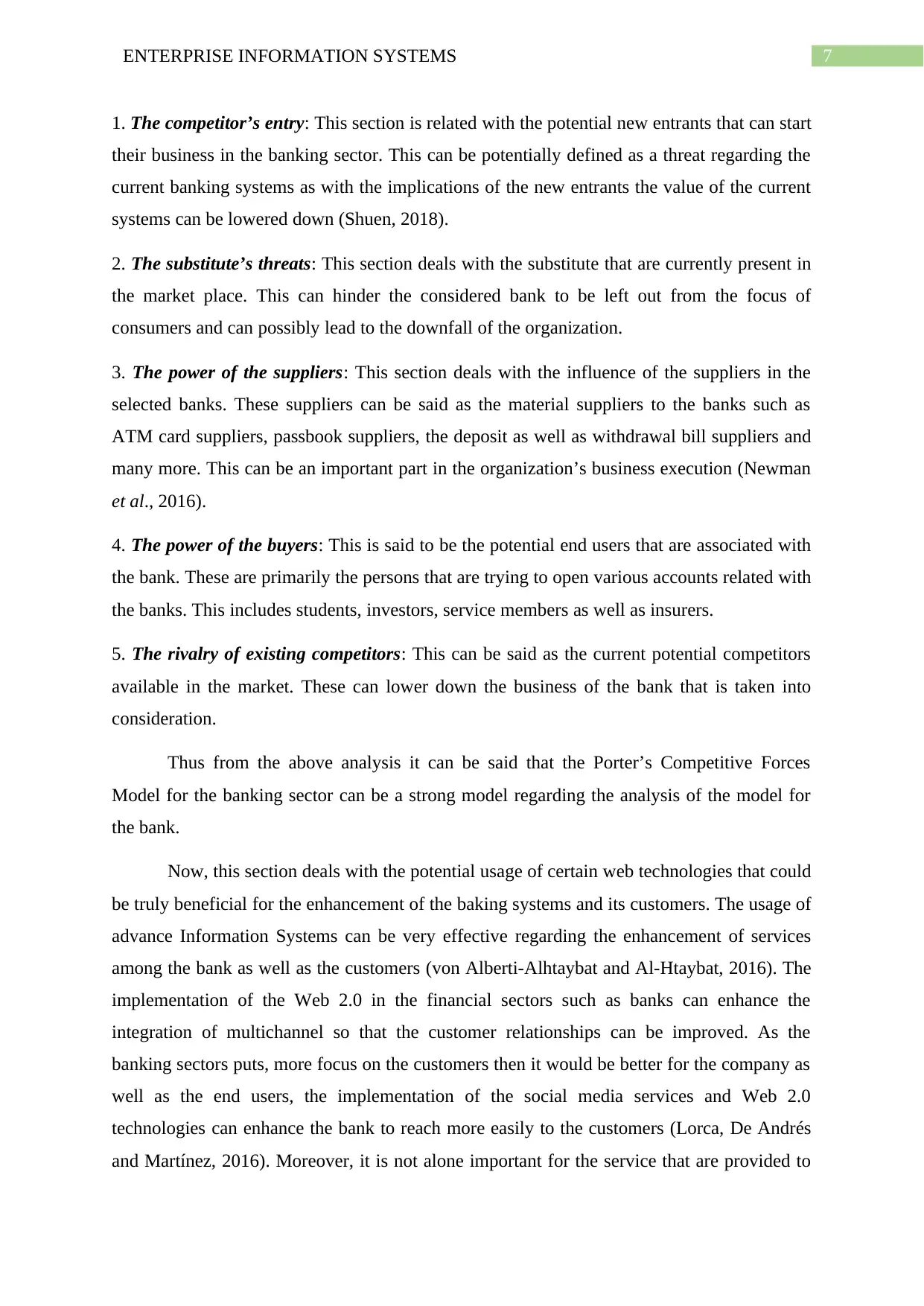
The Porter’s Competitive Forces Model is said to be a model that identifies as well as
analyses the five competitive forces that are used to shape the industry as well as help the
organization to determine the selected industry’s strengths as well as weaknesses (Turban,
Volonino and Wood, 2015). In this section, the Porter’s Competitive Forces Model is applied
in the sector of banks to determine the profitability as well as attractiveness of the selected
sector.
The complete analysis of the Porter’s Competitive Forces Model for the bank sector is
provided as follows:
constraints related to the organization, production of products, the individual decisions, the
planning for the enhancement of the organization as well as control of the decisions provided
in the organization (Aaron Rivadeneyra and Sohal, 2017). This systems tends to improve the
industry’s productivity with the implementation of the Management Information Systems.
Question 3
Apply Porter’s competitive forces model in a bank. Make recommendations on how
current IS, online collaboration, Web 2.0, Social Networks and the increasing popularity
of mobile devices could benefit the bank and its customers. In your analysis have a
separate section that discusses the security implications of the above technologies for the
bank and for the customers of the bank.
The Porter’s Competitive Forces Model is said to be a model that identifies as well as
analyses the five competitive forces that are used to shape the industry as well as help the
organization to determine the selected industry’s strengths as well as weaknesses (Turban,
Volonino and Wood, 2015). In this section, the Porter’s Competitive Forces Model is applied
in the sector of banks to determine the profitability as well as attractiveness of the selected
sector.
The complete analysis of the Porter’s Competitive Forces Model for the bank sector is
provided as follows:
Paraphrase This Document
Need a fresh take? Get an instant paraphrase of this document with our AI Paraphraser
7ENTERPRISE INFORMATION SYSTEMS
1. The competitor’s entry: This section is related with the potential new entrants that can start
their business in the banking sector. This can be potentially defined as a threat regarding the
current banking systems as with the implications of the new entrants the value of the current
systems can be lowered down (Shuen, 2018).
2. The substitute’s threats: This section deals with the substitute that are currently present in
the market place. This can hinder the considered bank to be left out from the focus of
consumers and can possibly lead to the downfall of the organization.
3. The power of the suppliers: This section deals with the influence of the suppliers in the
selected banks. These suppliers can be said as the material suppliers to the banks such as
ATM card suppliers, passbook suppliers, the deposit as well as withdrawal bill suppliers and
many more. This can be an important part in the organization’s business execution (Newman
et al., 2016).
4. The power of the buyers: This is said to be the potential end users that are associated with
the bank. These are primarily the persons that are trying to open various accounts related with
the banks. This includes students, investors, service members as well as insurers.
5. The rivalry of existing competitors: This can be said as the current potential competitors
available in the market. These can lower down the business of the bank that is taken into
consideration.
Thus from the above analysis it can be said that the Porter’s Competitive Forces
Model for the banking sector can be a strong model regarding the analysis of the model for
the bank.
Now, this section deals with the potential usage of certain web technologies that could
be truly beneficial for the enhancement of the baking systems and its customers. The usage of
advance Information Systems can be very effective regarding the enhancement of services
among the bank as well as the customers (von Alberti-Alhtaybat and Al-Htaybat, 2016). The
implementation of the Web 2.0 in the financial sectors such as banks can enhance the
integration of multichannel so that the customer relationships can be improved. As the
banking sectors puts, more focus on the customers then it would be better for the company as
well as the end users, the implementation of the social media services and Web 2.0
technologies can enhance the bank to reach more easily to the customers (Lorca, De Andrés
and Martínez, 2016). Moreover, it is not alone important for the service that are provided to
1. The competitor’s entry: This section is related with the potential new entrants that can start
their business in the banking sector. This can be potentially defined as a threat regarding the
current banking systems as with the implications of the new entrants the value of the current
systems can be lowered down (Shuen, 2018).
2. The substitute’s threats: This section deals with the substitute that are currently present in
the market place. This can hinder the considered bank to be left out from the focus of
consumers and can possibly lead to the downfall of the organization.
3. The power of the suppliers: This section deals with the influence of the suppliers in the
selected banks. These suppliers can be said as the material suppliers to the banks such as
ATM card suppliers, passbook suppliers, the deposit as well as withdrawal bill suppliers and
many more. This can be an important part in the organization’s business execution (Newman
et al., 2016).
4. The power of the buyers: This is said to be the potential end users that are associated with
the bank. These are primarily the persons that are trying to open various accounts related with
the banks. This includes students, investors, service members as well as insurers.
5. The rivalry of existing competitors: This can be said as the current potential competitors
available in the market. These can lower down the business of the bank that is taken into
consideration.
Thus from the above analysis it can be said that the Porter’s Competitive Forces
Model for the banking sector can be a strong model regarding the analysis of the model for
the bank.
Now, this section deals with the potential usage of certain web technologies that could
be truly beneficial for the enhancement of the baking systems and its customers. The usage of
advance Information Systems can be very effective regarding the enhancement of services
among the bank as well as the customers (von Alberti-Alhtaybat and Al-Htaybat, 2016). The
implementation of the Web 2.0 in the financial sectors such as banks can enhance the
integration of multichannel so that the customer relationships can be improved. As the
banking sectors puts, more focus on the customers then it would be better for the company as
well as the end users, the implementation of the social media services and Web 2.0
technologies can enhance the bank to reach more easily to the customers (Lorca, De Andrés
and Martínez, 2016). Moreover, it is not alone important for the service that are provided to
8ENTERPRISE INFORMATION SYSTEMS
the customer by the banks. Hence, the implementation of the services like Web 2.0 or
implementation of the advanced information systems can help the bank for reaching out to
more consumers and thus effectively enhance their banking services. The Web 2.0 is said to
provide enhanced facilities to the customers for which the customers will be facilitated by the
applications of the banks. The customers very well use the applications of the banks to use
better services.
The above services can be provided to the customers but there are certain
disadvantages with respect to the implementation. These potential drawbacks can be
identified as the financial crisis for the implementation of these advanced services, the
maintenance of these type of systems, the competitiveness of the systems that are already
present in the current system. The server network is also an issue when the customer is trying
to initiate a transaction from the remote systems available with them (Grant, 2015). The
application installed in the remote devices of the customers are also supported by the server
systems, hence it is mandatory for the banking service providers to have a continuous track
regarding the maintenance of the systems that are provided by the banking sectors. There are
higher risks present in the applications with respect to the banking systems. The server time
out can also be expressed as an important flaw in the working of the remote applications. The
remote applications are subjected due to the present of the networks that are associated with
the execution of these applications (Davis and Yen, 2018). These new technologies can be
very useful in terms of providing the services of the banks to the customers but the network
service providers are well associated with the smooth execution of the services provided by
the banks. Thus it can be said that the technologies can be implemented for the enhancement
of the customer services that are provided by the banks.
the customer by the banks. Hence, the implementation of the services like Web 2.0 or
implementation of the advanced information systems can help the bank for reaching out to
more consumers and thus effectively enhance their banking services. The Web 2.0 is said to
provide enhanced facilities to the customers for which the customers will be facilitated by the
applications of the banks. The customers very well use the applications of the banks to use
better services.
The above services can be provided to the customers but there are certain
disadvantages with respect to the implementation. These potential drawbacks can be
identified as the financial crisis for the implementation of these advanced services, the
maintenance of these type of systems, the competitiveness of the systems that are already
present in the current system. The server network is also an issue when the customer is trying
to initiate a transaction from the remote systems available with them (Grant, 2015). The
application installed in the remote devices of the customers are also supported by the server
systems, hence it is mandatory for the banking service providers to have a continuous track
regarding the maintenance of the systems that are provided by the banking sectors. There are
higher risks present in the applications with respect to the banking systems. The server time
out can also be expressed as an important flaw in the working of the remote applications. The
remote applications are subjected due to the present of the networks that are associated with
the execution of these applications (Davis and Yen, 2018). These new technologies can be
very useful in terms of providing the services of the banks to the customers but the network
service providers are well associated with the smooth execution of the services provided by
the banks. Thus it can be said that the technologies can be implemented for the enhancement
of the customer services that are provided by the banks.
⊘ This is a preview!⊘
Do you want full access?
Subscribe today to unlock all pages.
Trusted by 1+ million students worldwide
9ENTERPRISE INFORMATION SYSTEMS
References
Aaron, M., Rivadeneyra, F. and Sohal, S., 2017. Fintech: Is This Time Different?: A
Framework for Assessing Risks and Opportunities for Central Banks. Bank of Canada.
Al Shobaki, M.J. and Naser, S.S.A., 2016. Performance development and its relationship to
demographic variables among users of computerized management information systems in
Gaza electricity Distribution Company.
Cook, N., 2017. Enterprise 2.0: How social software will change the future of work.
Routledge.
Davis, W.S. and Yen, D.C., 2018. The information system consultant's handbook: Systems
analysis and design. CRC press.
Denolf, J.M., Trienekens, J.H., Wognum, P.N., van der Vorst, J.G. and Omta, S.O., 2015.
Towards a framework of critical success factors for implementing supply chain information
systems. Computers in industry, 68, pp.16-26.
Grant, R.M., 2015. Five Forces of Competition. Wiley Encyclopedia of Management, pp.1-4.
Hislop, D., Bosua, R. and Helms, R., 2018. Knowledge management in organizations: A
critical introduction. Oxford University Press.
Inkinen, H.T., Kianto, A. and Vanhala, M., 2015. Knowledge management practices and
innovation performance in Finland. Baltic Journal of Management, 10(4), pp.432-455.
Land, F., 2018. Social aspects of information systems. In Management Information Systems:
The Technology Challenge (pp. 11-57). Routledge.
Laudon, K.C. and Laudon, J.P., 2016. Management information system. Pearson Education
India.
Liebowitz, J. and Frank, M. eds., 2016. Knowledge management and e-learning. CRC press.
Lorca, P., De Andrés, J. and Martínez, A.B., 2016. Does Web accessibility differ among
banks?. World Wide Web, 19(3), pp.351-373.
Moran, B.B. and Morner, C.J., 2017. Library and information center management. ABC-
CLIO.
References
Aaron, M., Rivadeneyra, F. and Sohal, S., 2017. Fintech: Is This Time Different?: A
Framework for Assessing Risks and Opportunities for Central Banks. Bank of Canada.
Al Shobaki, M.J. and Naser, S.S.A., 2016. Performance development and its relationship to
demographic variables among users of computerized management information systems in
Gaza electricity Distribution Company.
Cook, N., 2017. Enterprise 2.0: How social software will change the future of work.
Routledge.
Davis, W.S. and Yen, D.C., 2018. The information system consultant's handbook: Systems
analysis and design. CRC press.
Denolf, J.M., Trienekens, J.H., Wognum, P.N., van der Vorst, J.G. and Omta, S.O., 2015.
Towards a framework of critical success factors for implementing supply chain information
systems. Computers in industry, 68, pp.16-26.
Grant, R.M., 2015. Five Forces of Competition. Wiley Encyclopedia of Management, pp.1-4.
Hislop, D., Bosua, R. and Helms, R., 2018. Knowledge management in organizations: A
critical introduction. Oxford University Press.
Inkinen, H.T., Kianto, A. and Vanhala, M., 2015. Knowledge management practices and
innovation performance in Finland. Baltic Journal of Management, 10(4), pp.432-455.
Land, F., 2018. Social aspects of information systems. In Management Information Systems:
The Technology Challenge (pp. 11-57). Routledge.
Laudon, K.C. and Laudon, J.P., 2016. Management information system. Pearson Education
India.
Liebowitz, J. and Frank, M. eds., 2016. Knowledge management and e-learning. CRC press.
Lorca, P., De Andrés, J. and Martínez, A.B., 2016. Does Web accessibility differ among
banks?. World Wide Web, 19(3), pp.351-373.
Moran, B.B. and Morner, C.J., 2017. Library and information center management. ABC-
CLIO.
Paraphrase This Document
Need a fresh take? Get an instant paraphrase of this document with our AI Paraphraser
10ENTERPRISE INFORMATION SYSTEMS
Newman, R., Chang, V., Walters, R.J. and Wills, G.B., 2016. Web 2.0—The past and the
future. International Journal of Information Management, 36(4), pp.591-598.
Ogiela, L. and Ogiela, M.R., 2015. Management information systems. In Ubiquitous
Computing Application and Wireless Sensor (pp. 449-456). Springer, Dordrecht.
Shuen, A., 2018. Web 2.0: A Strategy Guide: Business thinking and strategies behind
successful Web 2.0 implementations. O'Reilly Media.
Soto-Acosta, P. and Cegarra-Navarro, J.G., 2016. New ICTs for knowledge management in
organizations. Journal of Knowledge Management, 20(3), pp.417-422.
Turban, E., Volonino, L. and Wood, G.R., 2015. Information technology for management:
Digital strategies for insight, action, and sustainable performance. Wiley Publishing.
von Alberti-Alhtaybat, L. and Al-Htaybat, K., 2016. Investor relations via Web 2.0 social
media channels: a qualitative study of Middle Eastern corporations and investors. Aslib
Journal of Information Management, 68(1), pp.33-56.
Webb, S.P., 2017. Knowledge management: Linchpin of change. Routledge.
Newman, R., Chang, V., Walters, R.J. and Wills, G.B., 2016. Web 2.0—The past and the
future. International Journal of Information Management, 36(4), pp.591-598.
Ogiela, L. and Ogiela, M.R., 2015. Management information systems. In Ubiquitous
Computing Application and Wireless Sensor (pp. 449-456). Springer, Dordrecht.
Shuen, A., 2018. Web 2.0: A Strategy Guide: Business thinking and strategies behind
successful Web 2.0 implementations. O'Reilly Media.
Soto-Acosta, P. and Cegarra-Navarro, J.G., 2016. New ICTs for knowledge management in
organizations. Journal of Knowledge Management, 20(3), pp.417-422.
Turban, E., Volonino, L. and Wood, G.R., 2015. Information technology for management:
Digital strategies for insight, action, and sustainable performance. Wiley Publishing.
von Alberti-Alhtaybat, L. and Al-Htaybat, K., 2016. Investor relations via Web 2.0 social
media channels: a qualitative study of Middle Eastern corporations and investors. Aslib
Journal of Information Management, 68(1), pp.33-56.
Webb, S.P., 2017. Knowledge management: Linchpin of change. Routledge.

1 out of 11


Related Documents


Your All-in-One AI-Powered Toolkit for Academic Success.
+13062052269
info@desklib.com
Available 24*7 on WhatsApp / Email
![[object Object]](/_next/static/media/star-bottom.7253800d.svg)
Unlock your academic potential
Copyright © 2020–2026 A2Z Services. All Rights Reserved. Developed and managed by ZUCOL.