Enterprise Law 200909 Mid-session Exam: Negligence and Liability

Verified

Added on  2023/06/07

|9
|1972
|465
Homework Assignment
AI Summary
This document presents a comprehensive solution to an Enterprise Law mid-session exam, addressing two key questions related to negligence and duty of care. The first question examines a scenario involving Australia Post employees and the resulting injuries to pedestrians, analyzing the elements of negligence, vicarious liability, and the duty of care owed by both the employees and the employer. The solution references key legal precedents such as Donoghue v Stevenson and Re Polemis & Furness Withy & Company Ltd. The second question explores a case involving financial advice, assessing the duty of care owed by a financial advisor (Merlin) to a couple and the potential liability of the financial institution (BNQ) under vicarious liability. The analysis applies the principles outlined in Caparo Industries Plc v Dickman. The solution thoroughly explains the relevant legal rules, applies them to the facts of each case, and arrives at well-supported conclusions regarding liability.
Document Page
Running Head: Enterprise Law 0
Enterprise Law
200909
Student’s Name
9/9/2018
tabler-icon-diamond-filled.svg

Paraphrase This Document

Need a fresh take? Get an instant paraphrase of this document with our AI Paraphraser
Document Page
ENTERPRISE LAW
1
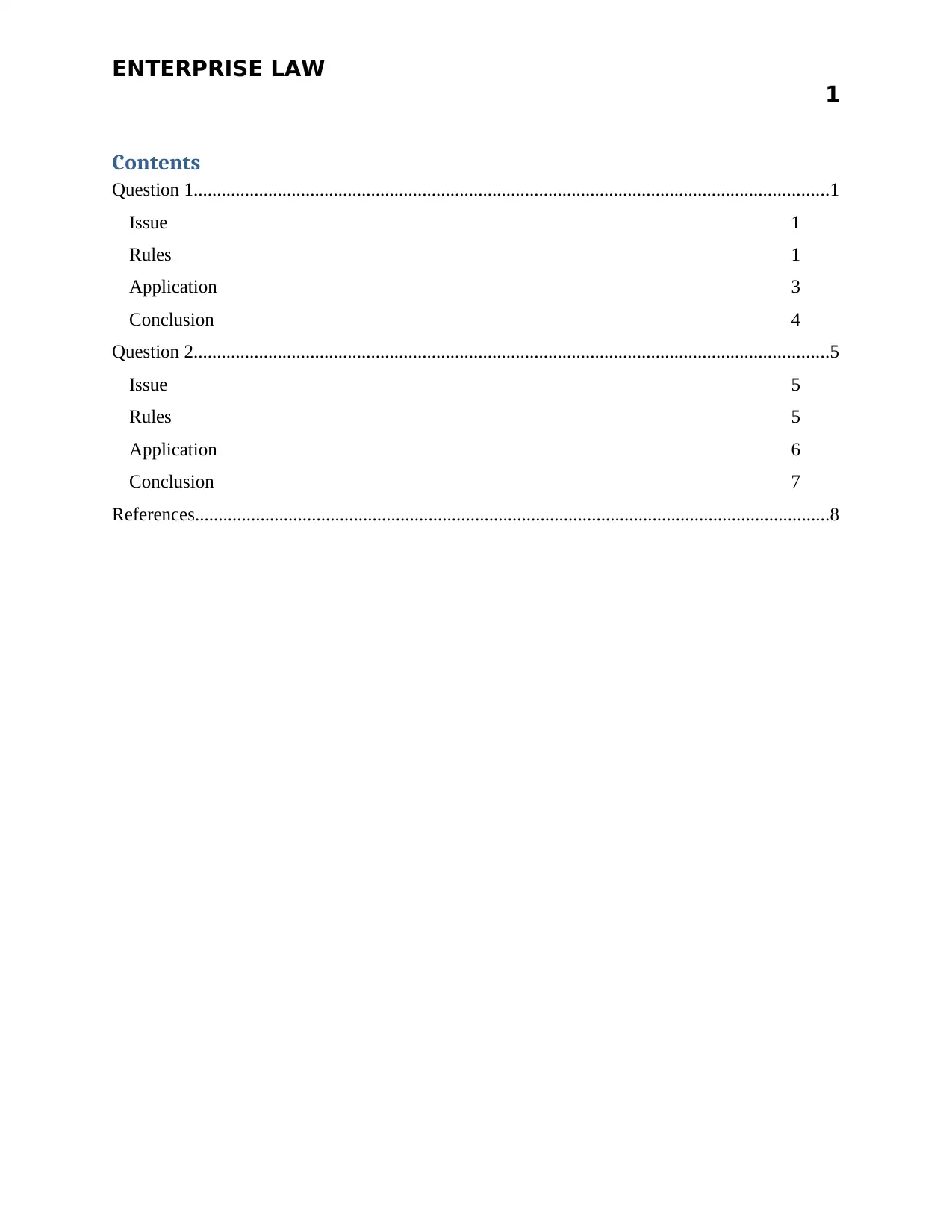
Contents
Question 1........................................................................................................................................1
Issue 1
Rules 1
Application 3
Conclusion 4
Question 2........................................................................................................................................5
Issue 5
Rules 5
Application 6
Conclusion 7
References........................................................................................................................................8
Document Page
ENTERPRISE LAW
2
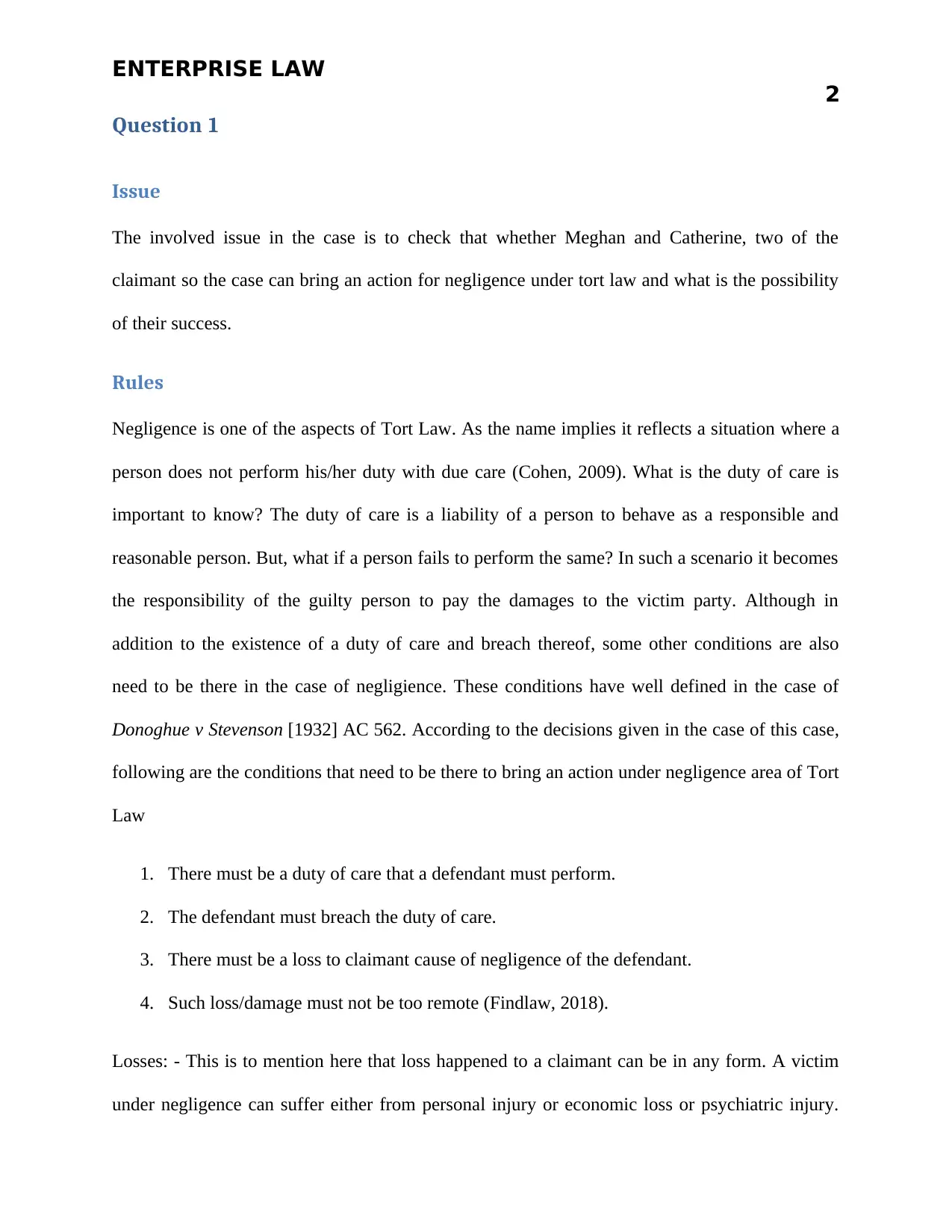
Question 1
Issue
The involved issue in the case is to check that whether Meghan and Catherine, two of the
claimant so the case can bring an action for negligence under tort law and what is the possibility
of their success.
Rules
Negligence is one of the aspects of Tort Law. As the name implies it reflects a situation where a
person does not perform his/her duty with due care (Cohen, 2009). What is the duty of care is
important to know? The duty of care is a liability of a person to behave as a responsible and
reasonable person. But, what if a person fails to perform the same? In such a scenario it becomes
the responsibility of the guilty person to pay the damages to the victim party. Although in
addition to the existence of a duty of care and breach thereof, some other conditions are also
need to be there in the case of negligience. These conditions have well defined in the case of
Donoghue v Stevenson [1932] AC 562. According to the decisions given in the case of this case,
following are the conditions that need to be there to bring an action under negligence area of Tort
Law
1. There must be a duty of care that a defendant must perform.
2. The defendant must breach the duty of care.
3. There must be a loss to claimant cause of negligence of the defendant.
4. Such loss/damage must not be too remote (Findlaw, 2018).
Losses: - This is to mention here that loss happened to a claimant can be in any form. A victim
under negligence can suffer either from personal injury or economic loss or psychiatric injury.
Document Page
ENTERPRISE LAW
3
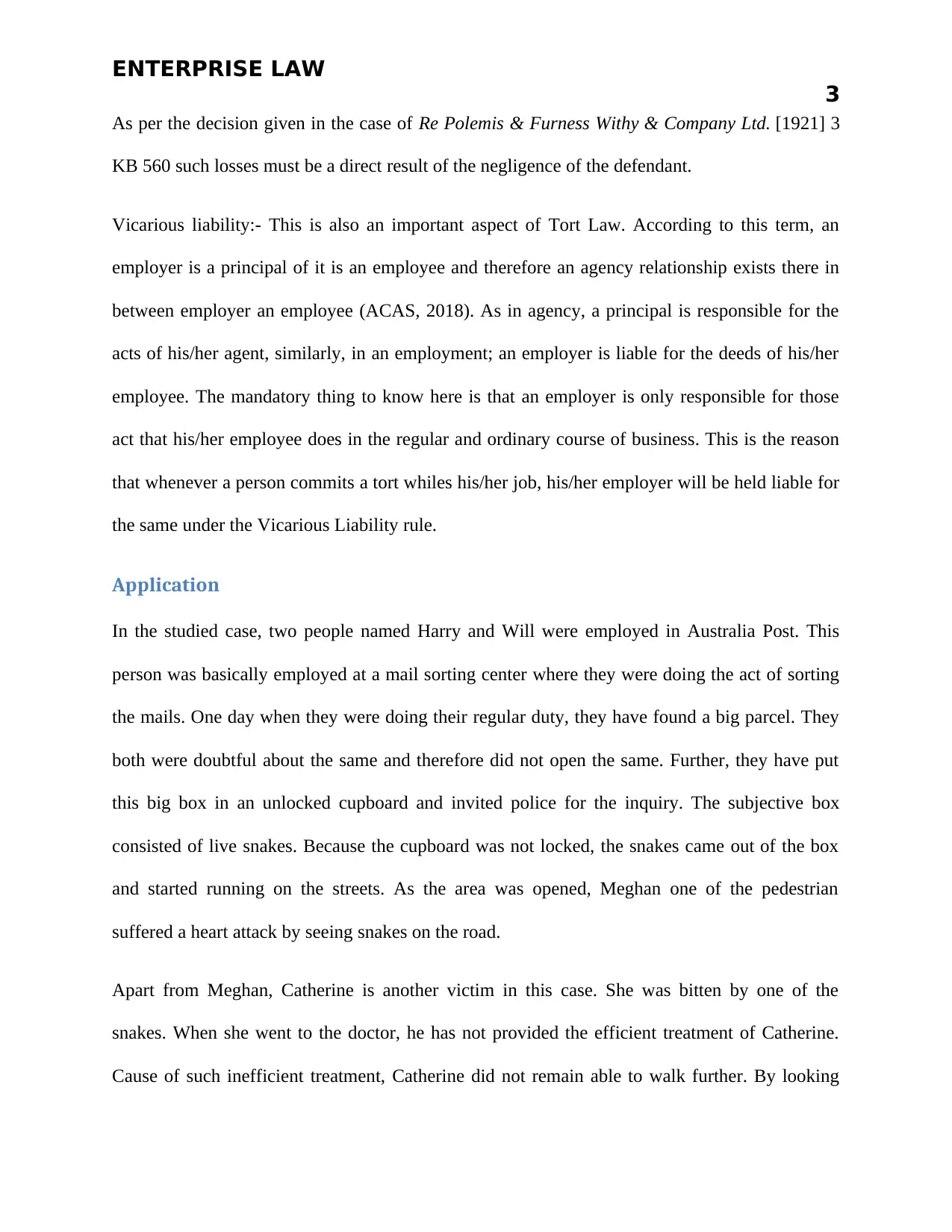
As per the decision given in the case of Re Polemis & Furness Withy & Company Ltd. [1921] 3
KB 560 such losses must be a direct result of the negligence of the defendant.
Vicarious liability:- This is also an important aspect of Tort Law. According to this term, an
employer is a principal of it is an employee and therefore an agency relationship exists there in
between employer an employee (ACAS, 2018). As in agency, a principal is responsible for the
acts of his/her agent, similarly, in an employment; an employer is liable for the deeds of his/her
employee. The mandatory thing to know here is that an employer is only responsible for those
act that his/her employee does in the regular and ordinary course of business. This is the reason
that whenever a person commits a tort whiles his/her job, his/her employer will be held liable for
the same under the Vicarious Liability rule.
Application
In the studied case, two people named Harry and Will were employed in Australia Post. This
person was basically employed at a mail sorting center where they were doing the act of sorting
the mails. One day when they were doing their regular duty, they have found a big parcel. They
both were doubtful about the same and therefore did not open the same. Further, they have put
this big box in an unlocked cupboard and invited police for the inquiry. The subjective box
consisted of live snakes. Because the cupboard was not locked, the snakes came out of the box
and started running on the streets. As the area was opened, Meghan one of the pedestrian
suffered a heart attack by seeing snakes on the road.
Apart from Meghan, Catherine is another victim in this case. She was bitten by one of the
snakes. When she went to the doctor, he has not provided the efficient treatment of Catherine.
Cause of such inefficient treatment, Catherine did not remain able to walk further. By looking
tabler-icon-diamond-filled.svg

Paraphrase This Document

Need a fresh take? Get an instant paraphrase of this document with our AI Paraphraser
Document Page
ENTERPRISE LAW
4
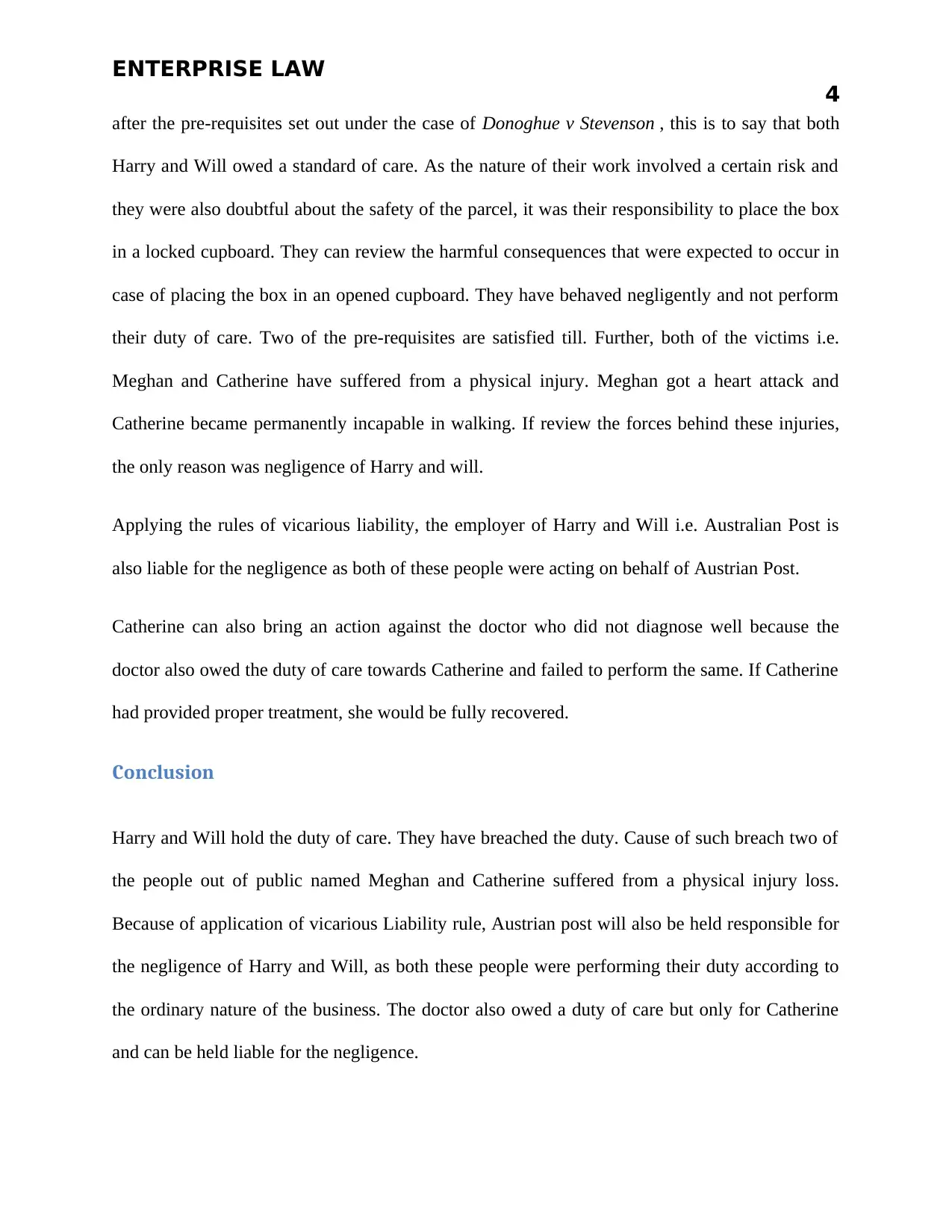
after the pre-requisites set out under the case of Donoghue v Stevenson , this is to say that both
Harry and Will owed a standard of care. As the nature of their work involved a certain risk and
they were also doubtful about the safety of the parcel, it was their responsibility to place the box
in a locked cupboard. They can review the harmful consequences that were expected to occur in
case of placing the box in an opened cupboard. They have behaved negligently and not perform
their duty of care. Two of the pre-requisites are satisfied till. Further, both of the victims i.e.
Meghan and Catherine have suffered from a physical injury. Meghan got a heart attack and
Catherine became permanently incapable in walking. If review the forces behind these injuries,
the only reason was negligence of Harry and will.
Applying the rules of vicarious liability, the employer of Harry and Will i.e. Australian Post is
also liable for the negligence as both of these people were acting on behalf of Austrian Post.
Catherine can also bring an action against the doctor who did not diagnose well because the
doctor also owed the duty of care towards Catherine and failed to perform the same. If Catherine
had provided proper treatment, she would be fully recovered.
Conclusion
Harry and Will hold the duty of care. They have breached the duty. Cause of such breach two of
the people out of public named Meghan and Catherine suffered from a physical injury loss.
Because of application of vicarious Liability rule, Austrian post will also be held responsible for
the negligence of Harry and Will, as both these people were performing their duty according to
the ordinary nature of the business. The doctor also owed a duty of care but only for Catherine
and can be held liable for the negligence.
Document Page
ENTERPRISE LAW
5
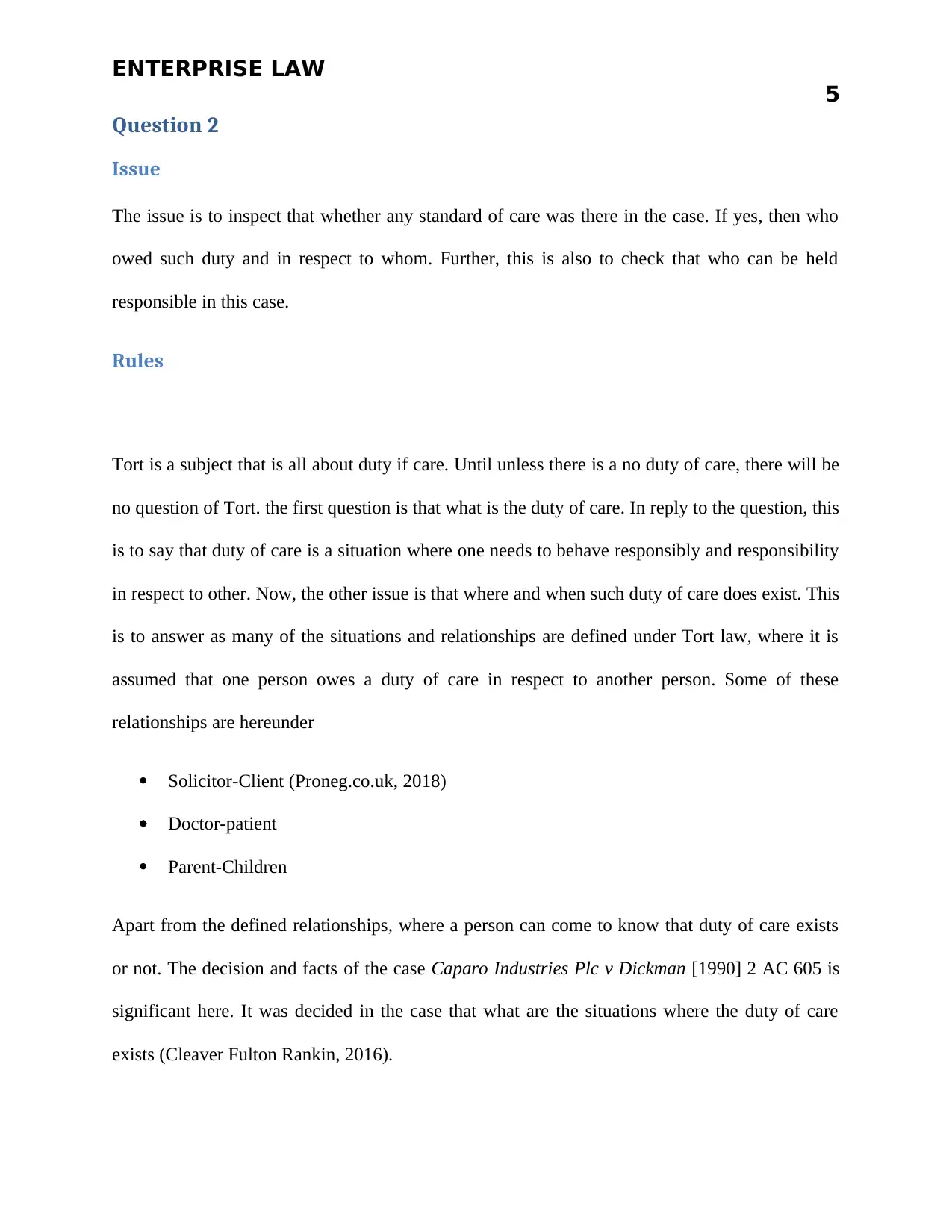
Question 2
Issue
The issue is to inspect that whether any standard of care was there in the case. If yes, then who
owed such duty and in respect to whom. Further, this is also to check that who can be held
responsible in this case.
Rules
Tort is a subject that is all about duty if care. Until unless there is a no duty of care, there will be
no question of Tort. the first question is that what is the duty of care. In reply to the question, this
is to say that duty of care is a situation where one needs to behave responsibly and responsibility
in respect to other. Now, the other issue is that where and when such duty of care does exist. This
is to answer as many of the situations and relationships are defined under Tort law, where it is
assumed that one person owes a duty of care in respect to another person. Some of these
relationships are hereunder
Solicitor-Client (Proneg.co.uk, 2018)
Doctor-patient
Parent-Children
Apart from the defined relationships, where a person can come to know that duty of care exists
or not. The decision and facts of the case Caparo Industries Plc v Dickman [1990] 2 AC 605 is
significant here. It was decided in the case that what are the situations where the duty of care
exists (Cleaver Fulton Rankin, 2016).
Document Page
ENTERPRISE LAW
6
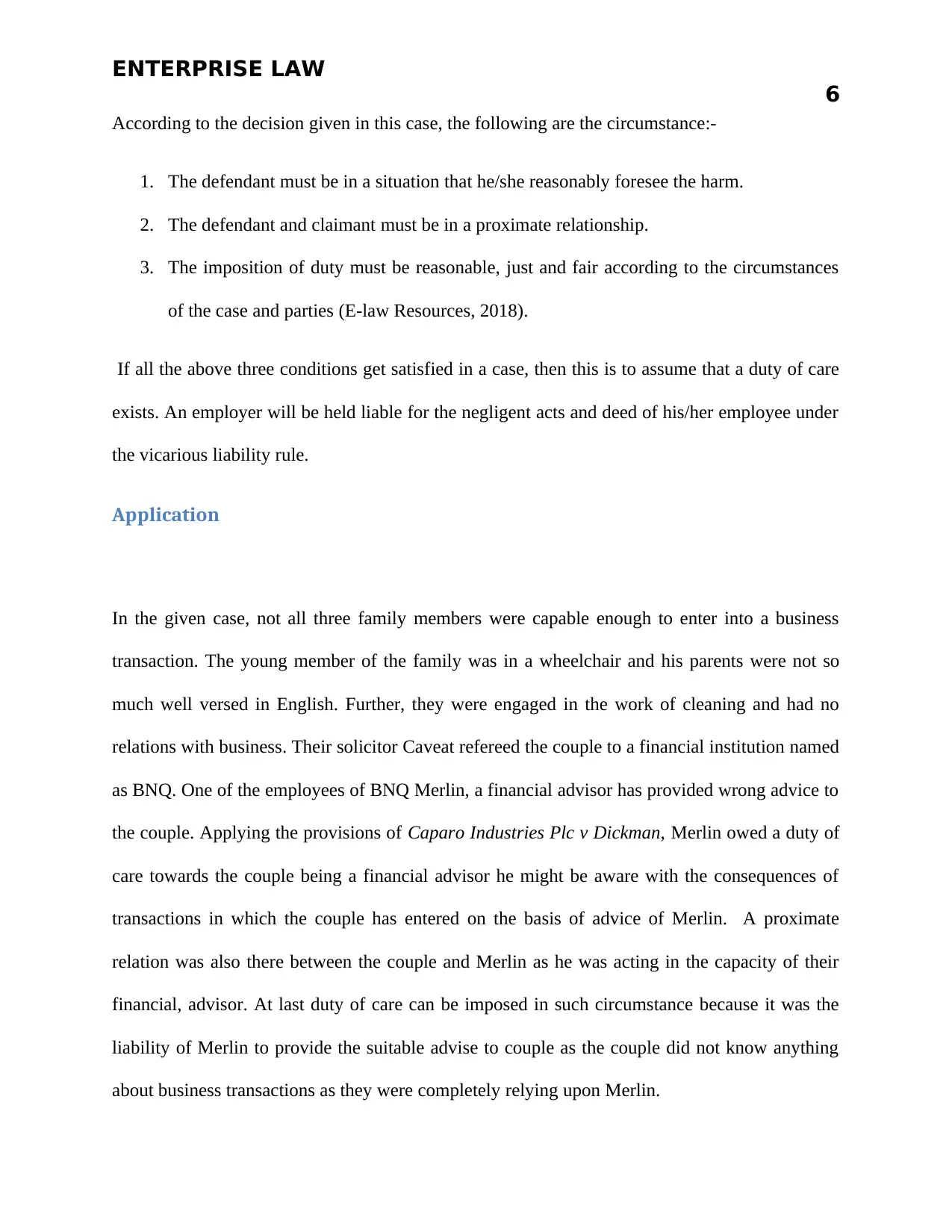
According to the decision given in this case, the following are the circumstance:-
1. The defendant must be in a situation that he/she reasonably foresee the harm.
2. The defendant and claimant must be in a proximate relationship.
3. The imposition of duty must be reasonable, just and fair according to the circumstances
of the case and parties (E-law Resources, 2018).
If all the above three conditions get satisfied in a case, then this is to assume that a duty of care
exists. An employer will be held liable for the negligent acts and deed of his/her employee under
the vicarious liability rule.
Application
In the given case, not all three family members were capable enough to enter into a business
transaction. The young member of the family was in a wheelchair and his parents were not so
much well versed in English. Further, they were engaged in the work of cleaning and had no
relations with business. Their solicitor Caveat refereed the couple to a financial institution named
as BNQ. One of the employees of BNQ Merlin, a financial advisor has provided wrong advice to
the couple. Applying the provisions of Caparo Industries Plc v Dickman, Merlin owed a duty of
care towards the couple being a financial advisor he might be aware with the consequences of
transactions in which the couple has entered on the basis of advice of Merlin. A proximate
relation was also there between the couple and Merlin as he was acting in the capacity of their
financial, advisor. At last duty of care can be imposed in such circumstance because it was the
liability of Merlin to provide the suitable advise to couple as the couple did not know anything
about business transactions as they were completely relying upon Merlin.
tabler-icon-diamond-filled.svg

Paraphrase This Document

Need a fresh take? Get an instant paraphrase of this document with our AI Paraphraser
Document Page
ENTERPRISE LAW
7
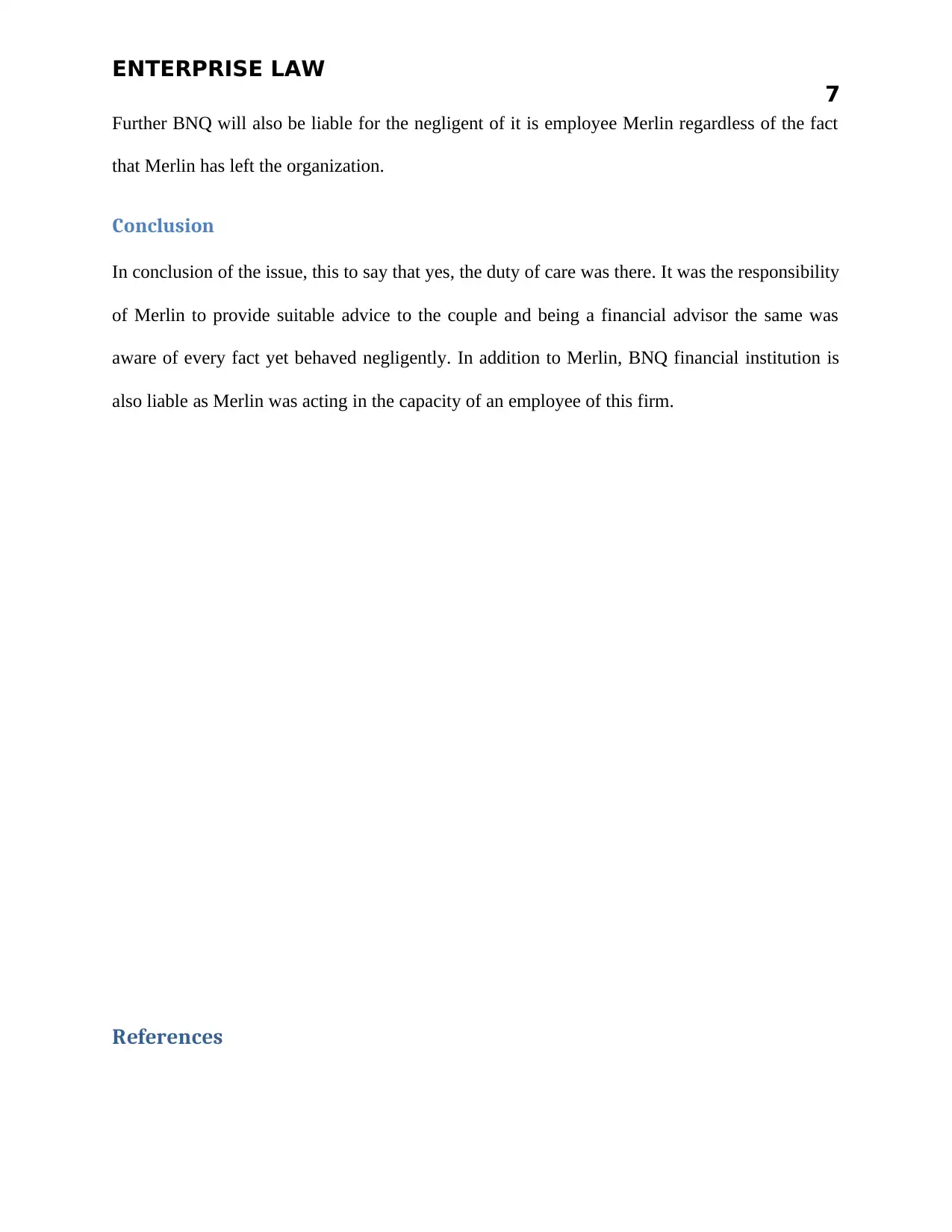
Further BNQ will also be liable for the negligent of it is employee Merlin regardless of the fact
that Merlin has left the organization.
Conclusion
In conclusion of the issue, this to say that yes, the duty of care was there. It was the responsibility
of Merlin to provide suitable advice to the couple and being a financial advisor the same was
aware of every fact yet behaved negligently. In addition to Merlin, BNQ financial institution is
also liable as Merlin was acting in the capacity of an employee of this firm.
References
Document Page
ENTERPRISE LAW
8
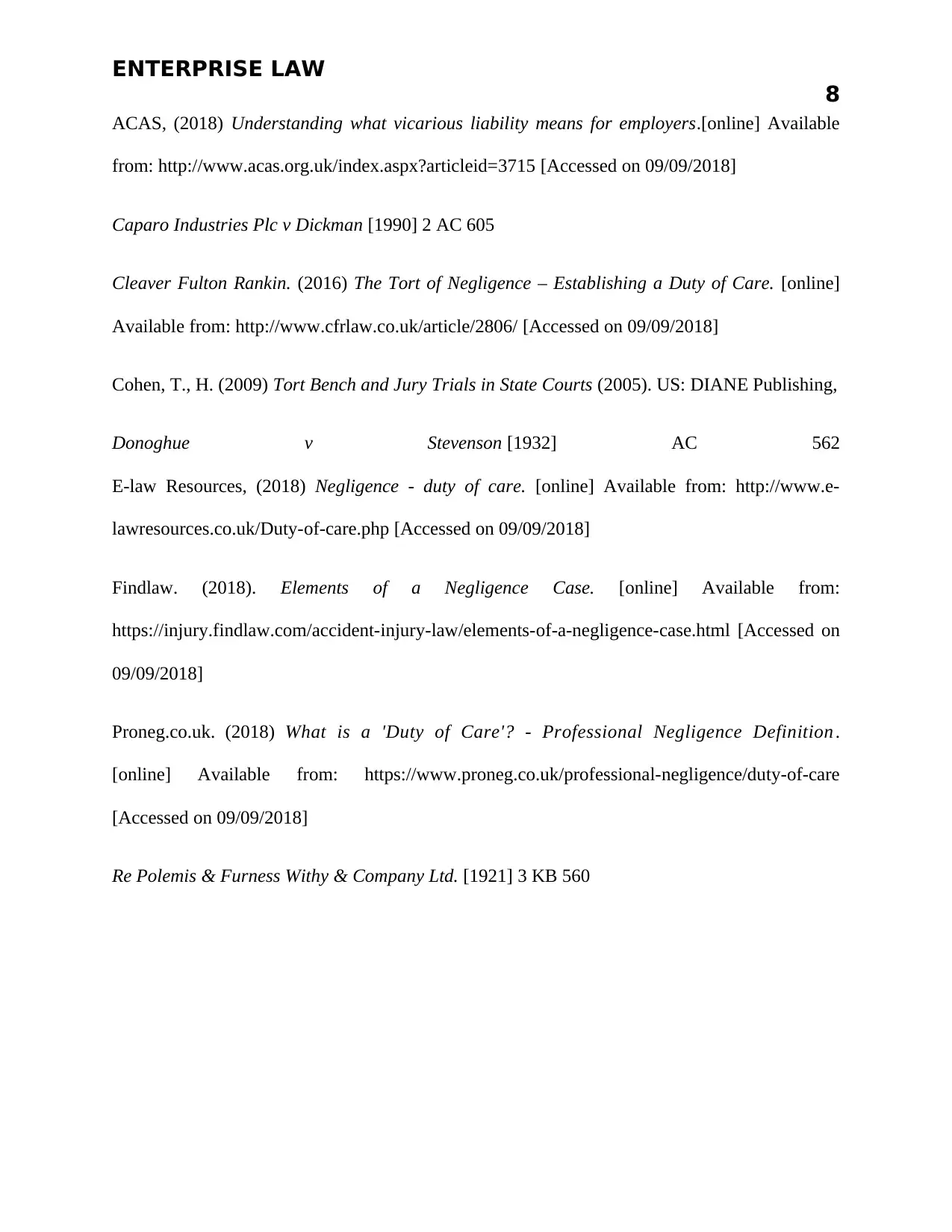
ACAS, (2018) Understanding what vicarious liability means for employers.[online] Available
from: http://www.acas.org.uk/index.aspx?articleid=3715 [Accessed on 09/09/2018]
Caparo Industries Plc v Dickman [1990] 2 AC 605
Cleaver Fulton Rankin. (2016) The Tort of Negligence – Establishing a Duty of Care. [online]
Available from: http://www.cfrlaw.co.uk/article/2806/ [Accessed on 09/09/2018]
Cohen, T., H. (2009) Tort Bench and Jury Trials in State Courts (2005). US: DIANE Publishing,
Donoghue v Stevenson [1932] AC 562
E-law Resources, (2018) Negligence - duty of care. [online] Available from: http://www.e-
lawresources.co.uk/Duty-of-care.php [Accessed on 09/09/2018]
Findlaw. (2018). Elements of a Negligence Case. [online] Available from:
https://injury.findlaw.com/accident-injury-law/elements-of-a-negligence-case.html [Accessed on
09/09/2018]
Proneg.co.uk. (2018) What is a 'Duty of Care'? - Professional Negligence Definition .
[online] Available from: https://www.proneg.co.uk/professional-negligence/duty-of-care
[Accessed on 09/09/2018]
Re Polemis & Furness Withy & Company Ltd. [1921] 3 KB 560
chevron_up_icon
1 out of 9
circle_padding
hide_on_mobile
zoom_out_icon
[object Object]