Enterprise Risk Management Report: Tianjin Explosion Case Study
VerifiedAdded on 2021/06/17
|20
|4566
|4
Report
AI Summary
This report provides a comprehensive risk assessment of the Tianjin explosion, a disaster that occurred in China due to an explosion at a warehouse storing dangerous chemicals. It examines the incident's impact, focusing on safety and environmental management systems. The report delves into various risk factors associated with the disaster and analyzes the effectiveness of control procedures. It explores the importance of hazard identification, risk assessment methodologies, and the application of risk management tools. The report also discusses the usefulness, applicability, and limitations of risk assessment, along with risk perception and communication strategies. By comparing the case study with relevant literature, the report aims to provide insights into effective enterprise risk management practices, emphasizing the need for robust safety protocols and environmental considerations in handling hazardous materials. The report concludes with a summary of the findings and their implications for future risk mitigation efforts.
Running head: ENTERPRISE RISK MANAGEMENT
Enterprise Risk Management
Name of Student-
Name of University-
Author’s Note-
Enterprise Risk Management
Name of Student-
Name of University-
Author’s Note-

Paraphrase This Document
Need a fresh take? Get an instant paraphrase of this document with our AI Paraphraser
1ENTERPRISE RISK MANAGEMENT
Executive Summary
This report is about the risk assessment of the disaster affected the Northern city of
Tianjin in China where 17 people died and hundreds of people were left injured. The main
reason behind the disaster was an explosion in a warehouse “Ruihai Logistics” that was used to
for storing dangerous chemical goods. The report discussed about the different types of the risk
factors associated with the disaster and the analysis of the controlling procedure. This report
consists of main issues that impact the risks associated with the explosion. This report also
includes safety and the environmental; management systems related to the case.
Executive Summary
This report is about the risk assessment of the disaster affected the Northern city of
Tianjin in China where 17 people died and hundreds of people were left injured. The main
reason behind the disaster was an explosion in a warehouse “Ruihai Logistics” that was used to
for storing dangerous chemical goods. The report discussed about the different types of the risk
factors associated with the disaster and the analysis of the controlling procedure. This report
consists of main issues that impact the risks associated with the explosion. This report also
includes safety and the environmental; management systems related to the case.
2ENTERPRISE RISK MANAGEMENT
Table of Contents
Introduction..........................................................................................................................2
Impact of Risks....................................................................................................................3
Identification and Risk Management Tools.........................................................................8
Usefulness, Applicability, and Limitations of Risk Assessment.......................................12
Risk Perception and Risk Communication........................................................................13
Conclusion.........................................................................................................................15
Bibliography......................................................................................................................16
Table of Contents
Introduction..........................................................................................................................2
Impact of Risks....................................................................................................................3
Identification and Risk Management Tools.........................................................................8
Usefulness, Applicability, and Limitations of Risk Assessment.......................................12
Risk Perception and Risk Communication........................................................................13
Conclusion.........................................................................................................................15
Bibliography......................................................................................................................16
⊘ This is a preview!⊘
Do you want full access?
Subscribe today to unlock all pages.

Trusted by 1+ million students worldwide
3ENTERPRISE RISK MANAGEMENT
Introduction
Risk assessment refers to the overall activities for identifying, managing or controlling
the risk factors associated with an event. The process is associated with the identification of all
the different types of risk factors associated with the concerned event, which is the finding,
listing, and characterizing the risk factors. After that, there are other three steps such as analysis
of the risk factors, evaluation of those factors and control of the risks. In this report, the risks
assessment has been done based on a case study of a disaster. The concerned disaster affected the
Northern city of Tianjin in China where 17 people died and hundreds of people were left injured.
The main reason behind the disaster was an explosion in a warehouse “Ruihai Logistics”. The
warehouse was used to for storing dangerous chemical goods. In this report, the different types
of the risks factors associated with the incident, there impact over the whole situation have been
analysed. In order to identifying the risk controlling process have been discussed and analysed
by comparing the case study with relevant literature sources.
Impact of Risks
Safety Management System
The risks that are associated with the safety management system generally consists of
hazard identification and risk assessment. There are number of steps that are to be followed to
reduce the risks that are not accepted. The sequential steps that can be followed are hazard
identification, frequency assessment, hazard consequences, risk estimation that mainly controls
as well as recommends to reduce risks (Titman, Keown & Martin, 2017). The Ruihai Logistics
that dealt with hazardous chemicals should have introduced safety management system in the
company in order to have mitigated such big explosion.
Introduction
Risk assessment refers to the overall activities for identifying, managing or controlling
the risk factors associated with an event. The process is associated with the identification of all
the different types of risk factors associated with the concerned event, which is the finding,
listing, and characterizing the risk factors. After that, there are other three steps such as analysis
of the risk factors, evaluation of those factors and control of the risks. In this report, the risks
assessment has been done based on a case study of a disaster. The concerned disaster affected the
Northern city of Tianjin in China where 17 people died and hundreds of people were left injured.
The main reason behind the disaster was an explosion in a warehouse “Ruihai Logistics”. The
warehouse was used to for storing dangerous chemical goods. In this report, the different types
of the risks factors associated with the incident, there impact over the whole situation have been
analysed. In order to identifying the risk controlling process have been discussed and analysed
by comparing the case study with relevant literature sources.
Impact of Risks
Safety Management System
The risks that are associated with the safety management system generally consists of
hazard identification and risk assessment. There are number of steps that are to be followed to
reduce the risks that are not accepted. The sequential steps that can be followed are hazard
identification, frequency assessment, hazard consequences, risk estimation that mainly controls
as well as recommends to reduce risks (Titman, Keown & Martin, 2017). The Ruihai Logistics
that dealt with hazardous chemicals should have introduced safety management system in the
company in order to have mitigated such big explosion.
Paraphrase This Document
Need a fresh take? Get an instant paraphrase of this document with our AI Paraphraser
4ENTERPRISE RISK MANAGEMENT
There are many objective that hazard identification and risk assessment management can
provide. There can be systematic way of carrying out potential hazards and critical appraisal that
involves personnel, services, operation methods, and plants. The hazard identification is also
capable to identifying the safeguards that are available so that they can control the hazard related
risks. Hazard identification also suggests control measures so that they can reduce the level of
risk within the company (Rahman et al., 2016). A risk register is also prepared by the
management group of hazard identification so that the risks can be monitored, any changes can
be detected and the control measures that are taken should be effective. If Ruihai Logistics have
maintained all such hazardous identification management and risk assessment management, then
this big explosion would have not taken place.
There are many areas that Hazard Identification and Risk Assessment can focus into.
First of all the plant operations should be identified. The area that is prone to risk should be
identified. There must be identification of all the individual tasks that are involved in carrying
out the planting operation. There must also be a scope that identifies a potential health as well as
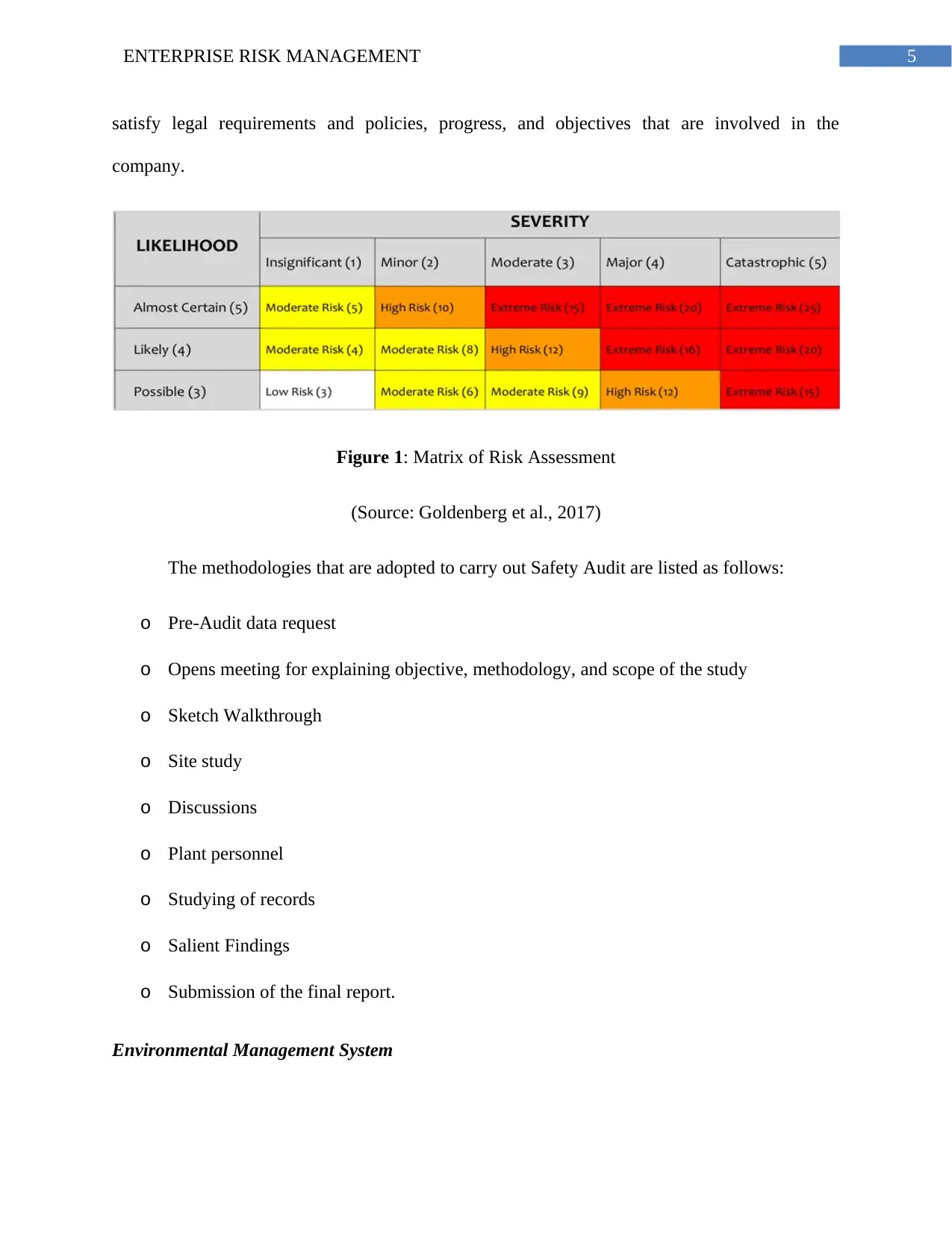
safety hazard that are occurred with risk matrix (Imperiale et al., 2017). There should also
analyzing of control measures that are available for the risk control. The scope of hazard
identification also should recommends additional risks measure of controlling so that the risk can
be mitigated to an acceptable level. There should also be a risk register for compilation.
While maintaining the safety management system, there should be scope of safety audit.
The Ruihai Logistics should have maintained the scope of comprehensive safety audit within the
company. The company should have carried out some systematic as well as critical appraisal for
the potential hazards that involves services personnel, services, operation methods, and plants.
The company should also have ensured occupational safety as well as health system that would
There are many objective that hazard identification and risk assessment management can
provide. There can be systematic way of carrying out potential hazards and critical appraisal that
involves personnel, services, operation methods, and plants. The hazard identification is also
capable to identifying the safeguards that are available so that they can control the hazard related
risks. Hazard identification also suggests control measures so that they can reduce the level of
risk within the company (Rahman et al., 2016). A risk register is also prepared by the
management group of hazard identification so that the risks can be monitored, any changes can
be detected and the control measures that are taken should be effective. If Ruihai Logistics have
maintained all such hazardous identification management and risk assessment management, then
this big explosion would have not taken place.
There are many areas that Hazard Identification and Risk Assessment can focus into.
First of all the plant operations should be identified. The area that is prone to risk should be
identified. There must be identification of all the individual tasks that are involved in carrying
out the planting operation. There must also be a scope that identifies a potential health as well as
safety hazard that are occurred with risk matrix (Imperiale et al., 2017). There should also
analyzing of control measures that are available for the risk control. The scope of hazard
identification also should recommends additional risks measure of controlling so that the risk can
be mitigated to an acceptable level. There should also be a risk register for compilation.
While maintaining the safety management system, there should be scope of safety audit.
The Ruihai Logistics should have maintained the scope of comprehensive safety audit within the
company. The company should have carried out some systematic as well as critical appraisal for
the potential hazards that involves services personnel, services, operation methods, and plants.
The company should also have ensured occupational safety as well as health system that would
5ENTERPRISE RISK MANAGEMENT
satisfy legal requirements and policies, progress, and objectives that are involved in the
company.
Figure 1: Matrix of Risk Assessment
(Source: Goldenberg et al., 2017)
The methodologies that are adopted to carry out Safety Audit are listed as follows:
o Pre-Audit data request
o Opens meeting for explaining objective, methodology, and scope of the study
o Sketch Walkthrough
o Site study
o Discussions
o Plant personnel
o Studying of records
o Salient Findings
o Submission of the final report.
Environmental Management System
satisfy legal requirements and policies, progress, and objectives that are involved in the
company.
Figure 1: Matrix of Risk Assessment
(Source: Goldenberg et al., 2017)
The methodologies that are adopted to carry out Safety Audit are listed as follows:
o Pre-Audit data request
o Opens meeting for explaining objective, methodology, and scope of the study
o Sketch Walkthrough
o Site study
o Discussions
o Plant personnel
o Studying of records
o Salient Findings
o Submission of the final report.
Environmental Management System
⊘ This is a preview!⊘
Do you want full access?
Subscribe today to unlock all pages.
Trusted by 1+ million students worldwide
6ENTERPRISE RISK MANAGEMENT
The risk management is considered as a process that decides management of risks. Risk
management involves how the risks are managed and whether the risk can be managed or not.
There should be consideration of economic, behavioral factors, legal factors, as well as human
health, welfare effects, as well as ecological effects of risk management. There may be
involvement of regulatory as well as non-regulatory responses in the company. Risk assessment
is a process that evaluates the protection of public health (Kit et al., 2014). There are many
examples of risk management that includes how to handle hazardous chemicals, how to store
them, or how to transport them. The risk management also involves standards for maintaining the
air quality and lessen the contamination of drinking water. The company of Ruihai Logistics
should have implemented the risk management to provide the information regarding potential or
the ecological risks that rea involved in storing the dangerous chemicals.
The risk management is an action that is taken on consideration based as well as other
information as well. The risk management involves scientific factors that provide the risk
assessment such as information taken from toxicology, epidemiology, statistics, ecology, and
chemistry. There should also be economic factors that informs the manager on risks cost and the
benefits for reducing them (Fernandez & Garcia, 2016). The cost involved in risk mitigation or
on remediation and distributional effects are also calculated in risk management. There are
factors of law as well as legal decisions that are defined in risk assessment, management
decisions, and the level of schedule or methods of risk reduction. Social factors includes income
level, ethnic background, use of lands, community values, life styles, as well as psychological
conditions for affected populations that may affect the susceptibility of individual or some
defined risks group.
The risk management is considered as a process that decides management of risks. Risk
management involves how the risks are managed and whether the risk can be managed or not.
There should be consideration of economic, behavioral factors, legal factors, as well as human
health, welfare effects, as well as ecological effects of risk management. There may be
involvement of regulatory as well as non-regulatory responses in the company. Risk assessment
is a process that evaluates the protection of public health (Kit et al., 2014). There are many
examples of risk management that includes how to handle hazardous chemicals, how to store
them, or how to transport them. The risk management also involves standards for maintaining the
air quality and lessen the contamination of drinking water. The company of Ruihai Logistics
should have implemented the risk management to provide the information regarding potential or
the ecological risks that rea involved in storing the dangerous chemicals.
The risk management is an action that is taken on consideration based as well as other
information as well. The risk management involves scientific factors that provide the risk
assessment such as information taken from toxicology, epidemiology, statistics, ecology, and
chemistry. There should also be economic factors that informs the manager on risks cost and the
benefits for reducing them (Fernandez & Garcia, 2016). The cost involved in risk mitigation or
on remediation and distributional effects are also calculated in risk management. There are
factors of law as well as legal decisions that are defined in risk assessment, management
decisions, and the level of schedule or methods of risk reduction. Social factors includes income
level, ethnic background, use of lands, community values, life styles, as well as psychological
conditions for affected populations that may affect the susceptibility of individual or some
defined risks group.
Paraphrase This Document
Need a fresh take? Get an instant paraphrase of this document with our AI Paraphraser
7ENTERPRISE RISK MANAGEMENT
There are also technological factors that are involved in feasibility, range of risk, and
impacts that are related with the management. There are political factors involved that are based
on interactions in between all the branches of Federal Government, with some other Federal,
local as well as state government. There may be public values included in risk assessment
regarding the attitudes of the society related to environmental risks and the risk management.
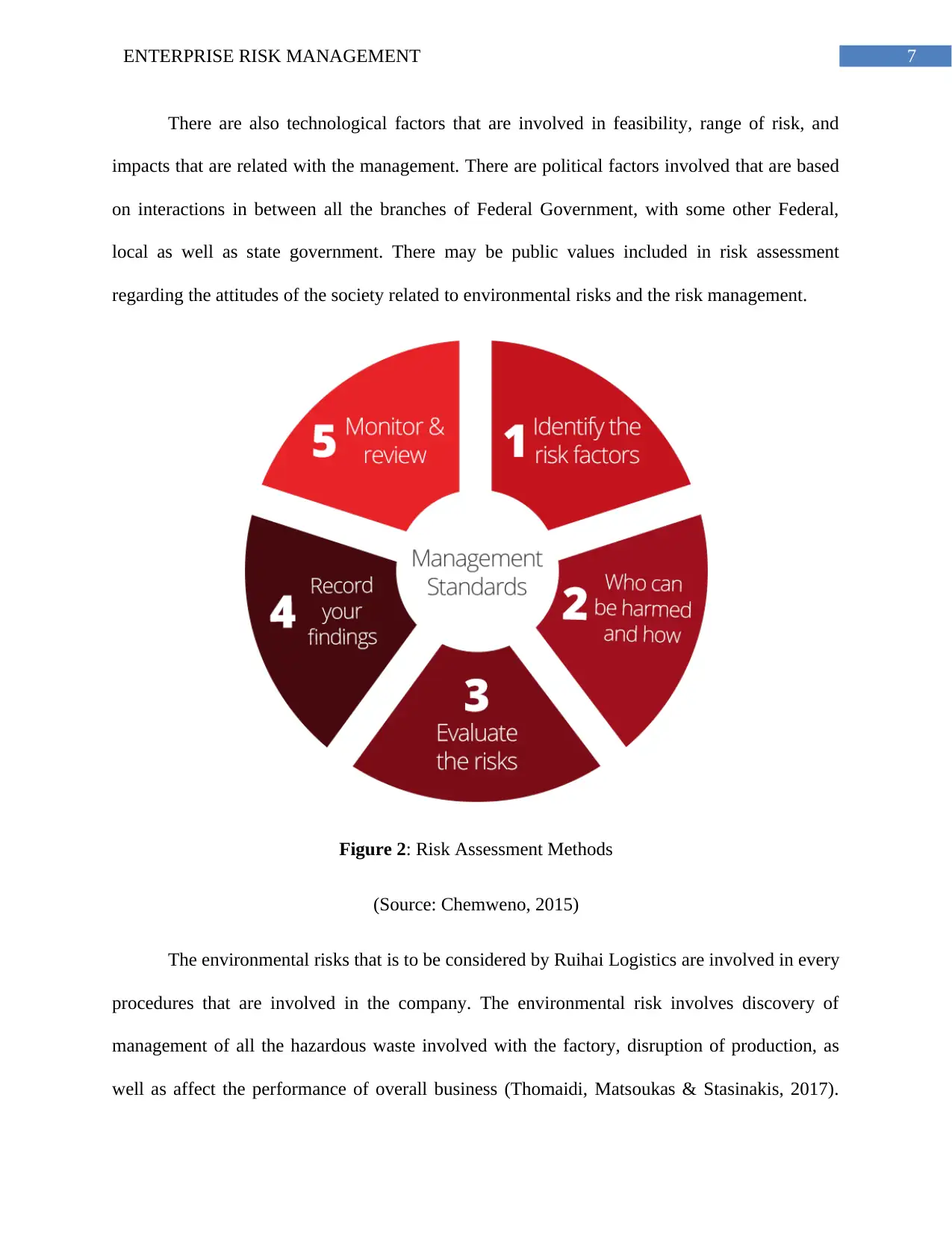
Figure 2: Risk Assessment Methods
(Source: Chemweno, 2015)
The environmental risks that is to be considered by Ruihai Logistics are involved in every
procedures that are involved in the company. The environmental risk involves discovery of
management of all the hazardous waste involved with the factory, disruption of production, as
well as affect the performance of overall business (Thomaidi, Matsoukas & Stasinakis, 2017).
There are also technological factors that are involved in feasibility, range of risk, and
impacts that are related with the management. There are political factors involved that are based
on interactions in between all the branches of Federal Government, with some other Federal,
local as well as state government. There may be public values included in risk assessment
regarding the attitudes of the society related to environmental risks and the risk management.
Figure 2: Risk Assessment Methods
(Source: Chemweno, 2015)
The environmental risks that is to be considered by Ruihai Logistics are involved in every
procedures that are involved in the company. The environmental risk involves discovery of
management of all the hazardous waste involved with the factory, disruption of production, as
well as affect the performance of overall business (Thomaidi, Matsoukas & Stasinakis, 2017).
8ENTERPRISE RISK MANAGEMENT
Ruihai Logistics should have implemented different types of strategies to manage the
environmental risks that have occurred in Tianjin China explosion of 13 August 2015. The
environmental risks that Ruihai Logistics needed to address was operational risks and the
strategic levers. There are mainly four steps for managing the environmental risks related to its
products.
Step 1- Defining what the company means by speaking about environment within the company.
There are different types of environmental risks that a company many deal with.
Environmental risks related to health as well as safety including the personal protective of the
equipment, chemical management, fire safety, waste water management and many more
(Gollenia, 2016). Environment also involves compliance that includes hazardous waste, air
emissions, wastewater effluent and nuisance. Environment risks also involves sustainability that
involves events of extreme weather, land use, bio diversity, and watershed management. With
the definition of environment, the environmental risks would have been mitigated in Ruihai
Logistics.
Step 2- Accessing the environmental risk within the company
To know the environmental risk of a company, the company should be aware of the
types of chemicals and products that are used by them. The environmental risk assessment of
Ruihai Logistics could have been identified by prioritizing the suppliers who were engaged with
the company and up to how much extent. If there is high probability of risks, then the company
should have taken immediate steps to mitigate those risks.
Ruihai Logistics should have implemented different types of strategies to manage the
environmental risks that have occurred in Tianjin China explosion of 13 August 2015. The
environmental risks that Ruihai Logistics needed to address was operational risks and the
strategic levers. There are mainly four steps for managing the environmental risks related to its
products.
Step 1- Defining what the company means by speaking about environment within the company.
There are different types of environmental risks that a company many deal with.
Environmental risks related to health as well as safety including the personal protective of the
equipment, chemical management, fire safety, waste water management and many more
(Gollenia, 2016). Environment also involves compliance that includes hazardous waste, air
emissions, wastewater effluent and nuisance. Environment risks also involves sustainability that
involves events of extreme weather, land use, bio diversity, and watershed management. With
the definition of environment, the environmental risks would have been mitigated in Ruihai
Logistics.
Step 2- Accessing the environmental risk within the company
To know the environmental risk of a company, the company should be aware of the
types of chemicals and products that are used by them. The environmental risk assessment of
Ruihai Logistics could have been identified by prioritizing the suppliers who were engaged with
the company and up to how much extent. If there is high probability of risks, then the company
should have taken immediate steps to mitigate those risks.
⊘ This is a preview!⊘
Do you want full access?
Subscribe today to unlock all pages.
Trusted by 1+ million students worldwide
9ENTERPRISE RISK MANAGEMENT
Identification and Risk Management Tools
From the definition of risk management tool, it can be defined that the tools of risk
management supports implementation as well as execution of the program risk management in
engineering program systems. There are many risk management tools and risk identification
tools that Ruihai Logistics could have used to mitigate the explosion in Tianjin China.
Risk analysis and risk management tools are used for several different purposes and can
come in many different shapes as well as sizes. The risk analysis and the tools that are used for
management includes the following:
o Strategic and capability of risk analysis: The main focus is on identifying, analyzing, as
well as prioritizing the risks so that they may achieve goals, capabilities, and objectives
related with the company. If Ruihai Logistics would have followed the strategic as well
as have analyzed the risk, such explosion would have not taken place.
o Threat Analysis: The focus should be mainly on identifying the threats, analyzing the
threats as well as prioritizing the threats that are involved with the company so that the
impact of national security is minimized.
o Investment analysis and portfolio risk analysis: The focus should be increasing the
investments of the company and the alternatives that are related to the risk assessment.
o Program of Risk Management: The risks that are involved in the company should be
identified, prioritized, managed, and analyzed so that the impact on the program’s
objective and the probability of the success rate is minimized or eliminated.
o Cost risk Analysis: The main focus is on quantifying the economic as well as
technological risks that can affect the cost of the system. The probability of applies
Identification and Risk Management Tools
From the definition of risk management tool, it can be defined that the tools of risk
management supports implementation as well as execution of the program risk management in
engineering program systems. There are many risk management tools and risk identification
tools that Ruihai Logistics could have used to mitigate the explosion in Tianjin China.
Risk analysis and risk management tools are used for several different purposes and can
come in many different shapes as well as sizes. The risk analysis and the tools that are used for
management includes the following:
o Strategic and capability of risk analysis: The main focus is on identifying, analyzing, as
well as prioritizing the risks so that they may achieve goals, capabilities, and objectives
related with the company. If Ruihai Logistics would have followed the strategic as well
as have analyzed the risk, such explosion would have not taken place.
o Threat Analysis: The focus should be mainly on identifying the threats, analyzing the
threats as well as prioritizing the threats that are involved with the company so that the
impact of national security is minimized.
o Investment analysis and portfolio risk analysis: The focus should be increasing the
investments of the company and the alternatives that are related to the risk assessment.
o Program of Risk Management: The risks that are involved in the company should be
identified, prioritized, managed, and analyzed so that the impact on the program’s
objective and the probability of the success rate is minimized or eliminated.
o Cost risk Analysis: The main focus is on quantifying the economic as well as
technological risks that can affect the cost of the system. The probability of applies
Paraphrase This Document
Need a fresh take? Get an instant paraphrase of this document with our AI Paraphraser
10ENTERPRISE RISK MANAGEMENT
method to model, manage, and measure the risk is cost of engineering in advanced
systems.
All the risk analysis and the management area involves developed tools for supporting
the objectives of the company with different maturity levels (Taylan et al., 2014). The tools that
are involved in supporting the execution and implementation of the management of program risk
are discussed below.
There are many tools that provides risk analysis and risk management. Selecting the right
tool for the right risk analysis within the company is the main thing. The tool must be selected as
per risk analysis and the process of management accordingly. All the processes that are involved
within the system must be supported by the tools that is selected for risk assessment. The criteria
that are to be kept in mind for selecting a risk assessment tool are:
Aligned to objective of risk analysis: Before finalizing a tool, it should be noted weather
the tools supports the objectives that the company wants to achieve. In the case of Ruihai
Logistics with the Tianjin China Explosion should have firstly studied about a tool that
could be capable of mitigating the risks that was faced by the company (McNeil, Frey &
Embrechts, 2015). While selecting tool, it is also to be kept in mind that the tool will be
used to mitigate the ongoing process of risk assessment or conduct risk analysis only one
time.
Supports decision making: It must be also kept in mind that weather the tool is capable to
providing necessary information for supporting the decision making of the company.
Accessibility: The tools that is selected by the company should be accessible to all the
users and all the stakeholders of the company. The tool should have the facility so that all
the employees can use it from different locations.
method to model, manage, and measure the risk is cost of engineering in advanced
systems.
All the risk analysis and the management area involves developed tools for supporting
the objectives of the company with different maturity levels (Taylan et al., 2014). The tools that
are involved in supporting the execution and implementation of the management of program risk
are discussed below.
There are many tools that provides risk analysis and risk management. Selecting the right
tool for the right risk analysis within the company is the main thing. The tool must be selected as
per risk analysis and the process of management accordingly. All the processes that are involved
within the system must be supported by the tools that is selected for risk assessment. The criteria
that are to be kept in mind for selecting a risk assessment tool are:
Aligned to objective of risk analysis: Before finalizing a tool, it should be noted weather
the tools supports the objectives that the company wants to achieve. In the case of Ruihai
Logistics with the Tianjin China Explosion should have firstly studied about a tool that
could be capable of mitigating the risks that was faced by the company (McNeil, Frey &
Embrechts, 2015). While selecting tool, it is also to be kept in mind that the tool will be
used to mitigate the ongoing process of risk assessment or conduct risk analysis only one
time.
Supports decision making: It must be also kept in mind that weather the tool is capable to
providing necessary information for supporting the decision making of the company.
Accessibility: The tools that is selected by the company should be accessible to all the
users and all the stakeholders of the company. The tool should have the facility so that all
the employees can use it from different locations.
11ENTERPRISE RISK MANAGEMENT
Availability of data: The data that is to be involved in the company should be analyzed by
the tools that is used.
Level of detail: The tool that is to be selected should support the decision making of the
system.
Integration with other program management or with system engineering processes: The
tool should be capable of supporting integration with other management or some other
system of engineering processes.
Program Risk Management Tool: The tool that is to be selected for maintaining the risk
management is to be selected very carefully. There are many tools that are used as a tool for
mitigating the risk in a company. There are many program risk implementation available in
many different tools that are available. Many tools helps to support management of enterprise,
projects, and risks involved in the system.
The tool that could be used by Ruihai Logistics to maintain the risk assessment is the tool
invented by MITRE Corporation. The tool is known as a RiskNAV tool that is registered by
the MITRE Corporation (Burtonshaw-Gunn, 2017). This tool facilitate the risk process and
also helps the program manager to handle their space of risk. RiskNav tool is used to collect,
prioritize, visualize, and monitor the information risk that comes to the company in a
collective way. To save China from this explosion, Ruihai Logistics could have introduced
this tool of risk assessment to provide three dimension of information that includes risk
priority, mitigation as well as management status, and probability.
The tool for analyzing risk is produced by the government of U.S., which is designed to
analyze, capture as well as display the risks involved in a project or at an enterprise level. The
tool of RiskNav is deployed over different as well as MITRE sponsors. The technology of
Availability of data: The data that is to be involved in the company should be analyzed by
the tools that is used.
Level of detail: The tool that is to be selected should support the decision making of the
system.
Integration with other program management or with system engineering processes: The
tool should be capable of supporting integration with other management or some other
system of engineering processes.
Program Risk Management Tool: The tool that is to be selected for maintaining the risk
management is to be selected very carefully. There are many tools that are used as a tool for
mitigating the risk in a company. There are many program risk implementation available in
many different tools that are available. Many tools helps to support management of enterprise,
projects, and risks involved in the system.
The tool that could be used by Ruihai Logistics to maintain the risk assessment is the tool
invented by MITRE Corporation. The tool is known as a RiskNAV tool that is registered by
the MITRE Corporation (Burtonshaw-Gunn, 2017). This tool facilitate the risk process and
also helps the program manager to handle their space of risk. RiskNav tool is used to collect,
prioritize, visualize, and monitor the information risk that comes to the company in a
collective way. To save China from this explosion, Ruihai Logistics could have introduced
this tool of risk assessment to provide three dimension of information that includes risk
priority, mitigation as well as management status, and probability.
The tool for analyzing risk is produced by the government of U.S., which is designed to
analyze, capture as well as display the risks involved in a project or at an enterprise level. The
tool of RiskNav is deployed over different as well as MITRE sponsors. The technology of
⊘ This is a preview!⊘
Do you want full access?
Subscribe today to unlock all pages.
Trusted by 1+ million students worldwide

1 out of 20


Related Documents


Your All-in-One AI-Powered Toolkit for Academic Success.
+13062052269
info@desklib.com
Available 24*7 on WhatsApp / Email
![[object Object]](/_next/static/media/star-bottom.7253800d.svg)
Unlock your academic potential
Copyright © 2020–2026 A2Z Services. All Rights Reserved. Developed and managed by ZUCOL.