Enterprise Systems and ERP Implementation in Higher Education: Review
VerifiedAdded on 2022/11/22
|12
|1504
|297
Report
AI Summary
This report provides a comprehensive literature review on Enterprise Resource Planning (ERP) systems in higher education. It examines the current state of ERP implementation, challenges, and future directions. The review covers various aspects, including the need for rigorous evaluation of ERP systems, the shift towards user perspectives, and the maturity model of ERP in education. It also explores new directions and challenges, such as affordability, faster implementation methodologies, and the importance of automation in learning activities. The report includes case studies from San Diego City Schools and Saudi Arabia, highlighting critical success factors, return on investment, and the role of learning analytics. The document analyzes the impact of ERP systems on various components of higher education institutions, such as staff, tasks, quality of services, and outcomes, along with the importance of leadership and student ownership in technological transformation. The report also includes references from various journals and proceedings.

ENTERPRISE SYSTEMS IN
HIGHER EDDUCATION
ENTER YOUR NAME HERE
HIGHER EDDUCATION
ENTER YOUR NAME HERE
Paraphrase This Document
Need a fresh take? Get an instant paraphrase of this document with our AI Paraphraser

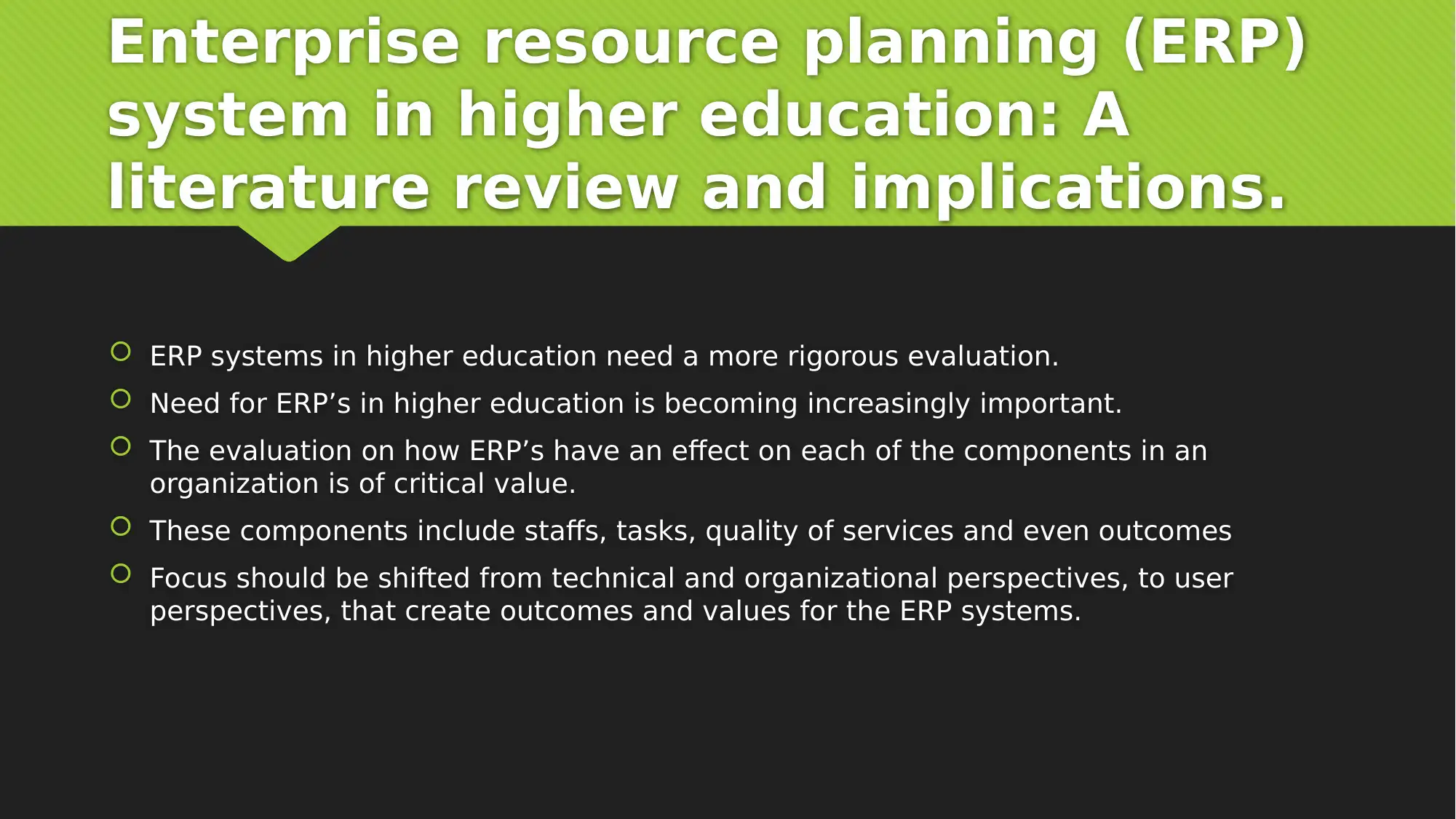
Enterprise resource planning (ERP)
system in higher education: A
literature review and implications.
ERP systems in higher education need a more rigorous evaluation.
Need for ERP’s in higher education is becoming increasingly important.
The evaluation on how ERP’s have an effect on each of the components in an
organization is of critical value.
These components include staffs, tasks, quality of services and even outcomes
Focus should be shifted from technical and organizational perspectives, to user
perspectives, that create outcomes and values for the ERP systems.
system in higher education: A
literature review and implications.
ERP systems in higher education need a more rigorous evaluation.
Need for ERP’s in higher education is becoming increasingly important.
The evaluation on how ERP’s have an effect on each of the components in an
organization is of critical value.
These components include staffs, tasks, quality of services and even outcomes
Focus should be shifted from technical and organizational perspectives, to user
perspectives, that create outcomes and values for the ERP systems.

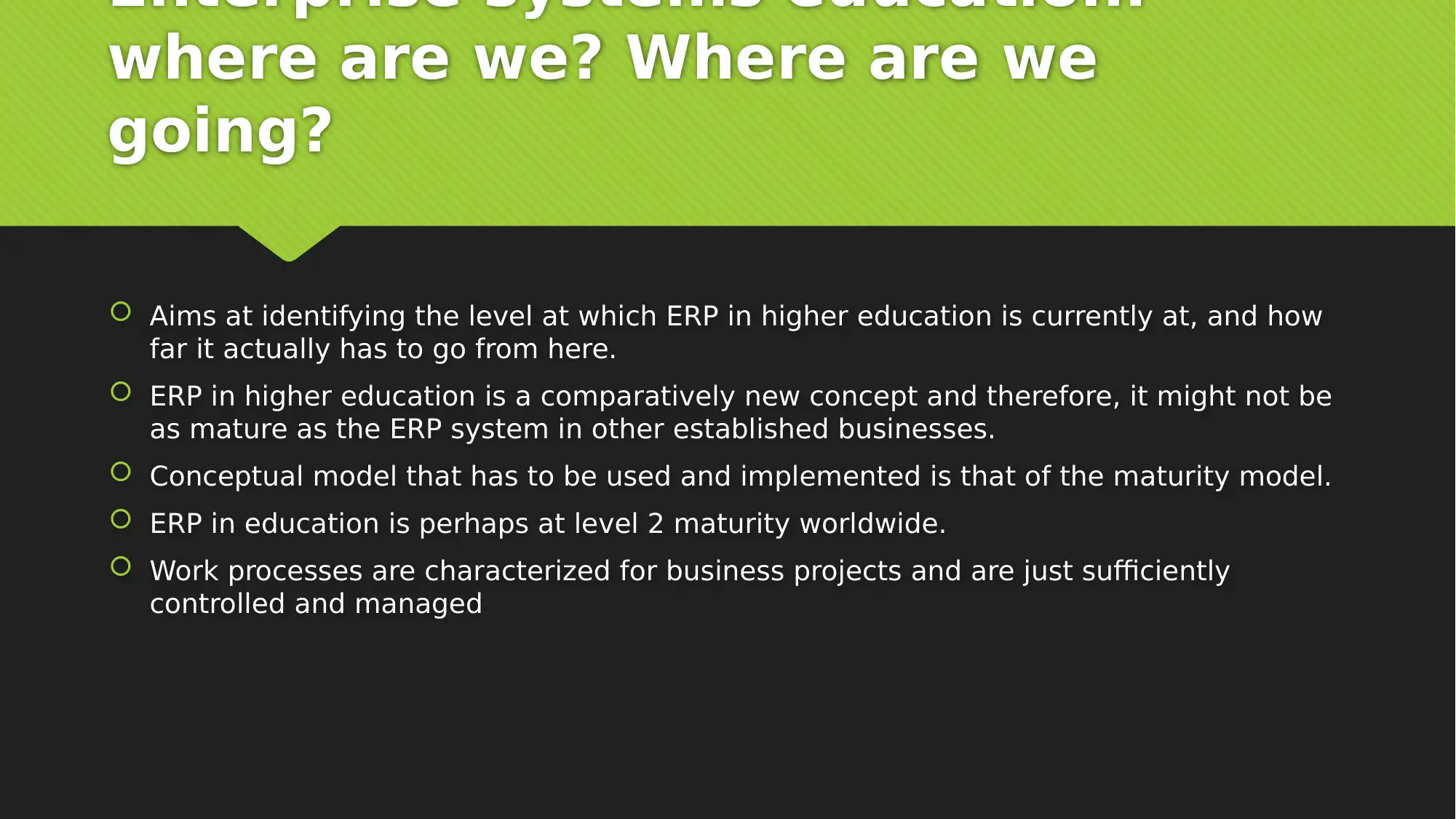
Enterprise systems education:
where are we? Where are we
going?
Aims at identifying the level at which ERP in higher education is currently at, and how
far it actually has to go from here.
ERP in higher education is a comparatively new concept and therefore, it might not be
as mature as the ERP system in other established businesses.
Conceptual model that has to be used and implemented is that of the maturity model.
ERP in education is perhaps at level 2 maturity worldwide.
Work processes are characterized for business projects and are just sufficiently
controlled and managed
where are we? Where are we
going?
Aims at identifying the level at which ERP in higher education is currently at, and how
far it actually has to go from here.
ERP in higher education is a comparatively new concept and therefore, it might not be
as mature as the ERP system in other established businesses.
Conceptual model that has to be used and implemented is that of the maturity model.
ERP in education is perhaps at level 2 maturity worldwide.
Work processes are characterized for business projects and are just sufficiently
controlled and managed
⊘ This is a preview!⊘
Do you want full access?
Subscribe today to unlock all pages.

Trusted by 1+ million students worldwide

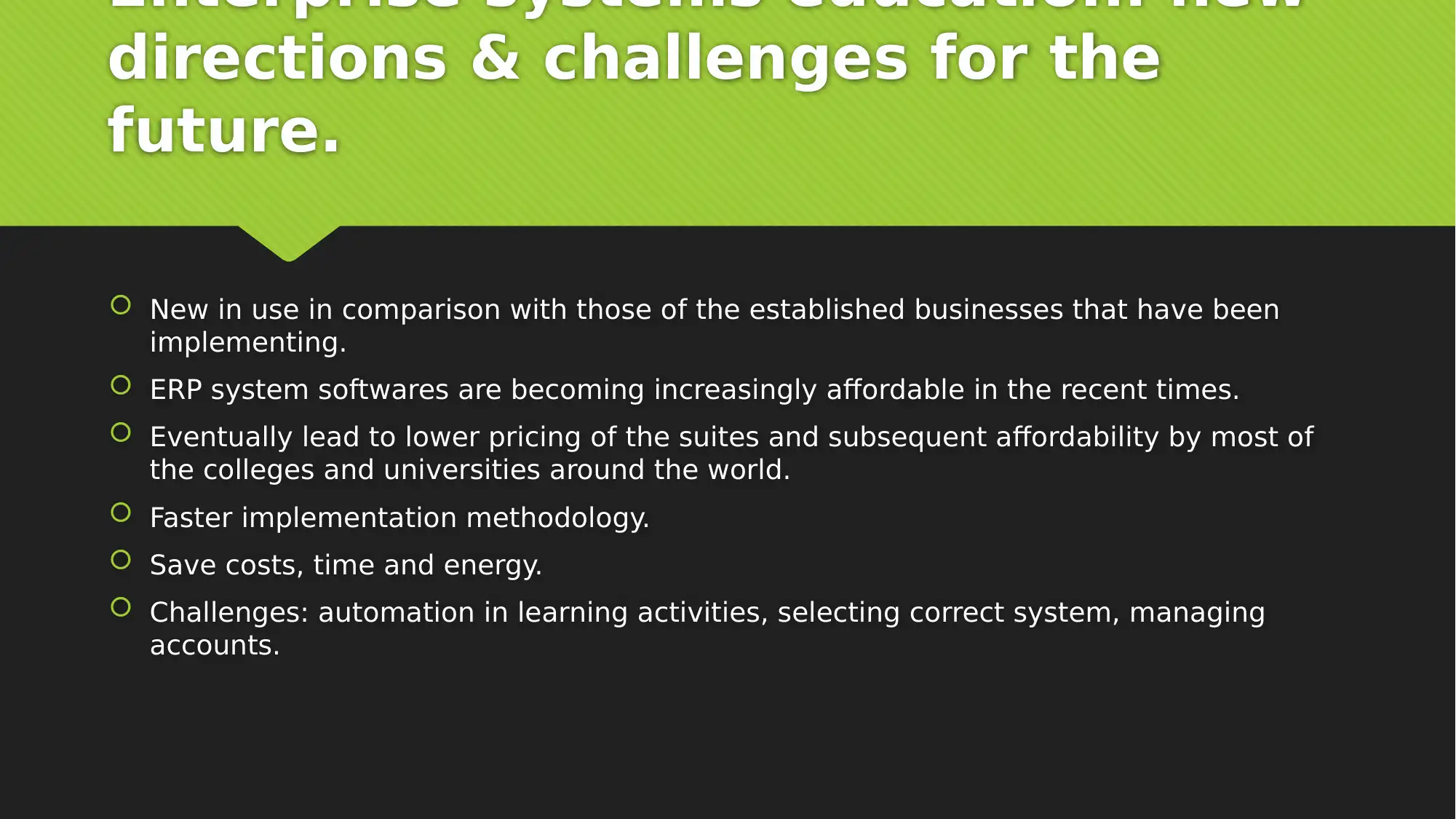
Enterprise systems education: new
directions & challenges for the
future.
New in use in comparison with those of the established businesses that have been
implementing.
ERP system softwares are becoming increasingly affordable in the recent times.
Eventually lead to lower pricing of the suites and subsequent affordability by most of
the colleges and universities around the world.
Faster implementation methodology.
Save costs, time and energy.
Challenges: automation in learning activities, selecting correct system, managing
accounts.
directions & challenges for the
future.
New in use in comparison with those of the established businesses that have been
implementing.
ERP system softwares are becoming increasingly affordable in the recent times.
Eventually lead to lower pricing of the suites and subsequent affordability by most of
the colleges and universities around the world.
Faster implementation methodology.
Save costs, time and energy.
Challenges: automation in learning activities, selecting correct system, managing
accounts.
Paraphrase This Document
Need a fresh take? Get an instant paraphrase of this document with our AI Paraphraser

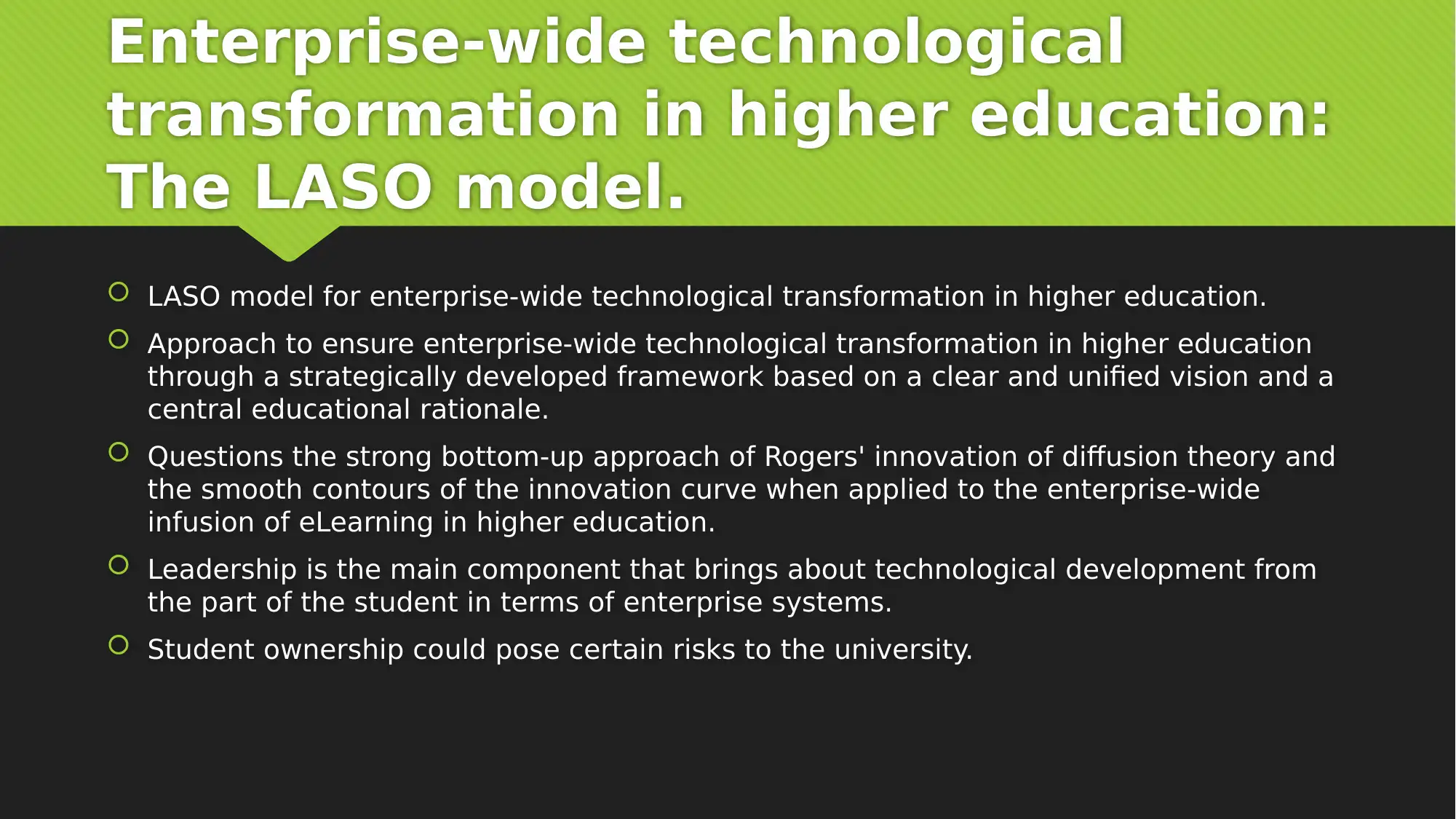
Enterprise-wide technological
transformation in higher education:
The LASO model.
LASO model for enterprise‐wide technological transformation in higher education.
Approach to ensure enterprise‐wide technological transformation in higher education
through a strategically developed framework based on a clear and unified vision and a
central educational rationale.
Questions the strong bottom‐up approach of Rogers' innovation of diffusion theory and
the smooth contours of the innovation curve when applied to the enterprise‐wide
infusion of eLearning in higher education.
Leadership is the main component that brings about technological development from
the part of the student in terms of enterprise systems.
Student ownership could pose certain risks to the university.
transformation in higher education:
The LASO model.
LASO model for enterprise‐wide technological transformation in higher education.
Approach to ensure enterprise‐wide technological transformation in higher education
through a strategically developed framework based on a clear and unified vision and a
central educational rationale.
Questions the strong bottom‐up approach of Rogers' innovation of diffusion theory and
the smooth contours of the innovation curve when applied to the enterprise‐wide
infusion of eLearning in higher education.
Leadership is the main component that brings about technological development from
the part of the student in terms of enterprise systems.
Student ownership could pose certain risks to the university.

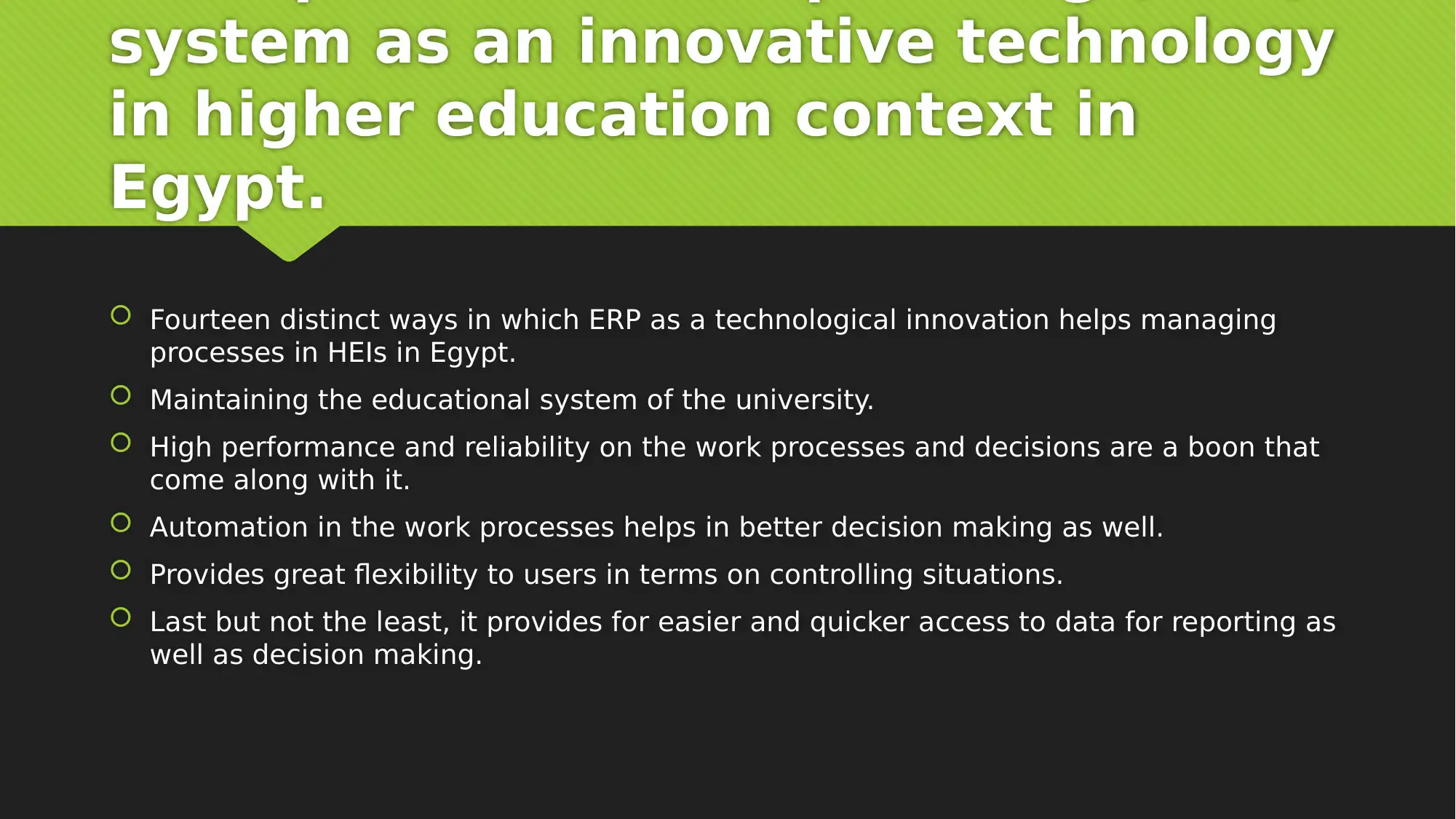
system as an innovative technology
in higher education context in
Egypt.
Fourteen distinct ways in which ERP as a technological innovation helps managing
processes in HEIs in Egypt.
Maintaining the educational system of the university.
High performance and reliability on the work processes and decisions are a boon that
come along with it.
Automation in the work processes helps in better decision making as well.
Provides great flexibility to users in terms on controlling situations.
Last but not the least, it provides for easier and quicker access to data for reporting as
well as decision making.
in higher education context in
Egypt.
Fourteen distinct ways in which ERP as a technological innovation helps managing
processes in HEIs in Egypt.
Maintaining the educational system of the university.
High performance and reliability on the work processes and decisions are a boon that
come along with it.
Automation in the work processes helps in better decision making as well.
Provides great flexibility to users in terms on controlling situations.
Last but not the least, it provides for easier and quicker access to data for reporting as
well as decision making.
⊘ This is a preview!⊘
Do you want full access?
Subscribe today to unlock all pages.

Trusted by 1+ million students worldwide

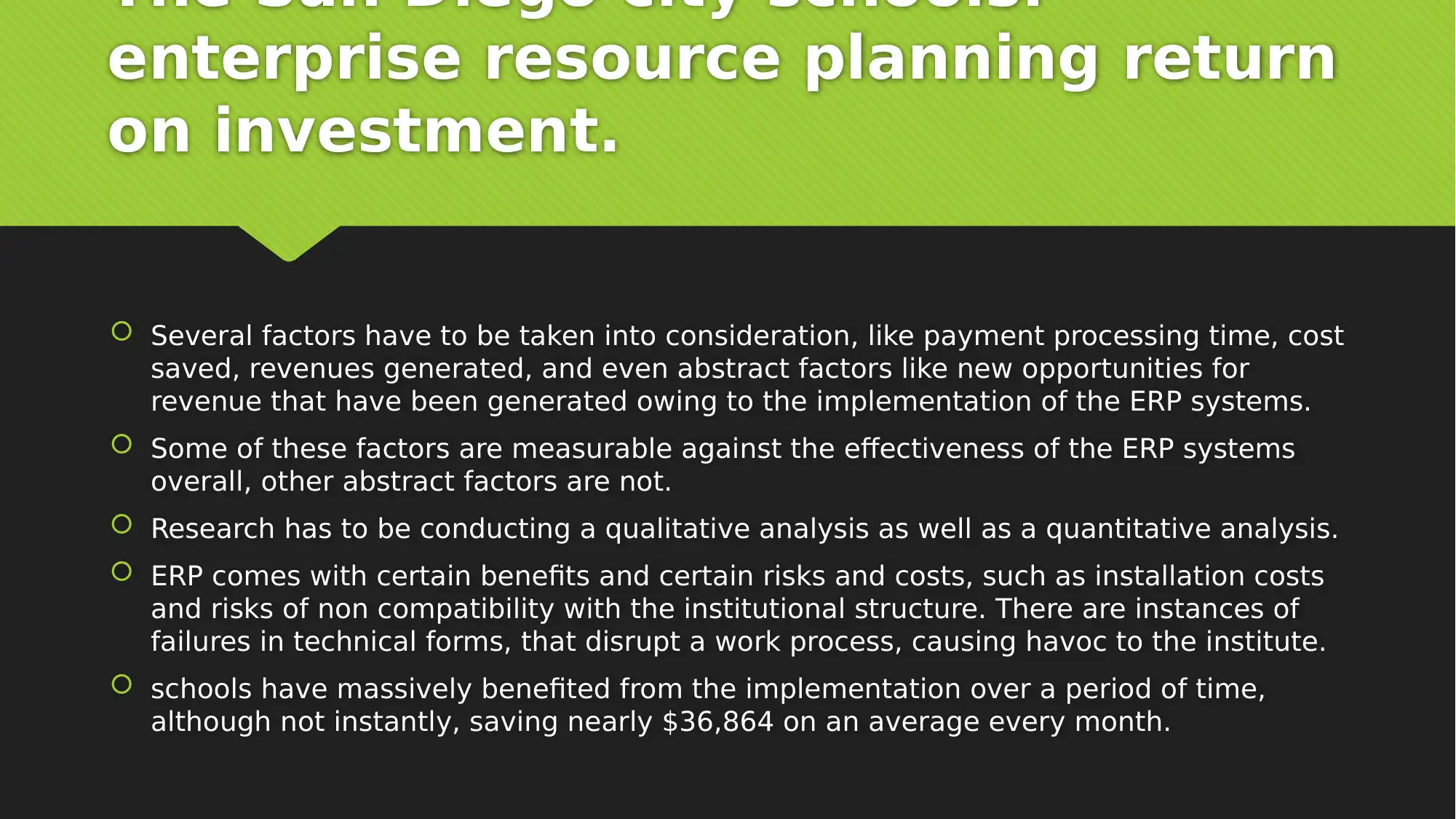
The San Diego city schools:
enterprise resource planning return
on investment.
Several factors have to be taken into consideration, like payment processing time, cost
saved, revenues generated, and even abstract factors like new opportunities for
revenue that have been generated owing to the implementation of the ERP systems.
Some of these factors are measurable against the effectiveness of the ERP systems
overall, other abstract factors are not.
Research has to be conducting a qualitative analysis as well as a quantitative analysis.
ERP comes with certain benefits and certain risks and costs, such as installation costs
and risks of non compatibility with the institutional structure. There are instances of
failures in technical forms, that disrupt a work process, causing havoc to the institute.
schools have massively benefited from the implementation over a period of time,
although not instantly, saving nearly $36,864 on an average every month.
enterprise resource planning return
on investment.
Several factors have to be taken into consideration, like payment processing time, cost
saved, revenues generated, and even abstract factors like new opportunities for
revenue that have been generated owing to the implementation of the ERP systems.
Some of these factors are measurable against the effectiveness of the ERP systems
overall, other abstract factors are not.
Research has to be conducting a qualitative analysis as well as a quantitative analysis.
ERP comes with certain benefits and certain risks and costs, such as installation costs
and risks of non compatibility with the institutional structure. There are instances of
failures in technical forms, that disrupt a work process, causing havoc to the institute.
schools have massively benefited from the implementation over a period of time,
although not instantly, saving nearly $36,864 on an average every month.
Paraphrase This Document
Need a fresh take? Get an instant paraphrase of this document with our AI Paraphraser

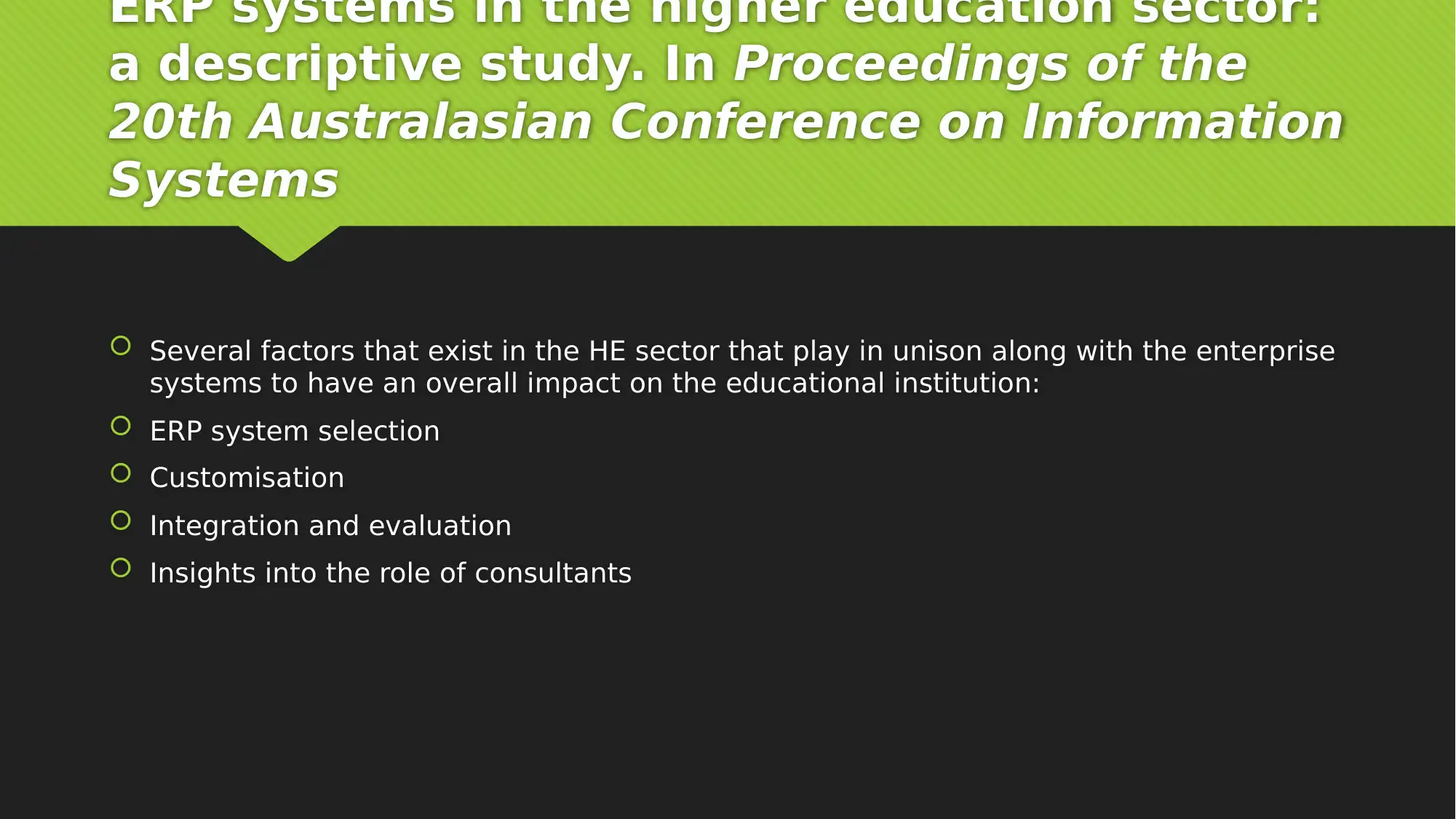
ERP systems in the higher education sector:
a descriptive study. In Proceedings of the
20th Australasian Conference on Information
Systems
Several factors that exist in the HE sector that play in unison along with the enterprise
systems to have an overall impact on the educational institution:
ERP system selection
Customisation
Integration and evaluation
Insights into the role of consultants
a descriptive study. In Proceedings of the
20th Australasian Conference on Information
Systems
Several factors that exist in the HE sector that play in unison along with the enterprise
systems to have an overall impact on the educational institution:
ERP system selection
Customisation
Integration and evaluation
Insights into the role of consultants

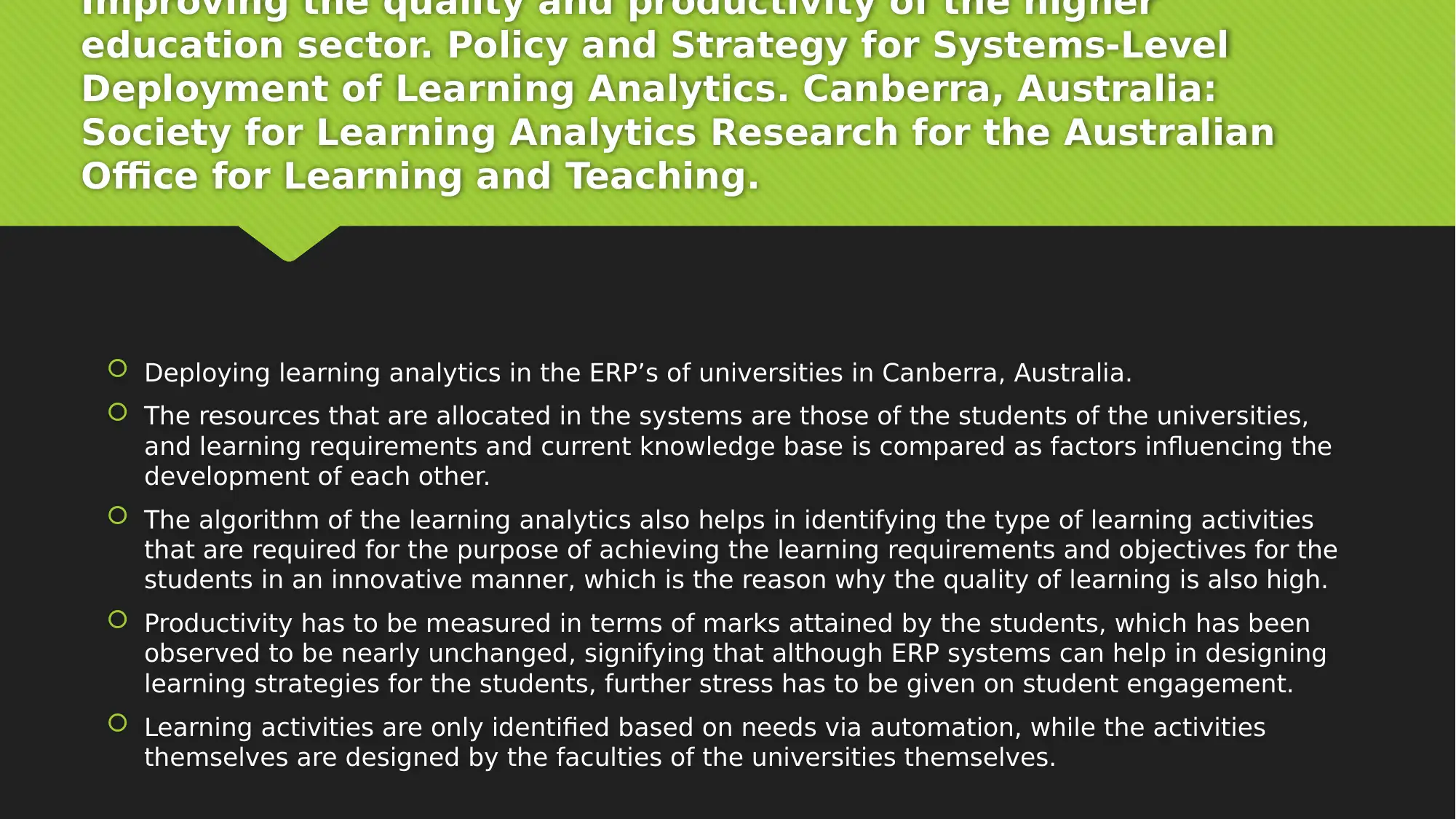
Improving the quality and productivity of the higher
education sector. Policy and Strategy for Systems-Level
Deployment of Learning Analytics. Canberra, Australia:
Society for Learning Analytics Research for the Australian
Office for Learning and Teaching.
Deploying learning analytics in the ERP’s of universities in Canberra, Australia.
The resources that are allocated in the systems are those of the students of the universities,
and learning requirements and current knowledge base is compared as factors influencing the
development of each other.
The algorithm of the learning analytics also helps in identifying the type of learning activities
that are required for the purpose of achieving the learning requirements and objectives for the
students in an innovative manner, which is the reason why the quality of learning is also high.
Productivity has to be measured in terms of marks attained by the students, which has been
observed to be nearly unchanged, signifying that although ERP systems can help in designing
learning strategies for the students, further stress has to be given on student engagement.
Learning activities are only identified based on needs via automation, while the activities
themselves are designed by the faculties of the universities themselves.
education sector. Policy and Strategy for Systems-Level
Deployment of Learning Analytics. Canberra, Australia:
Society for Learning Analytics Research for the Australian
Office for Learning and Teaching.
Deploying learning analytics in the ERP’s of universities in Canberra, Australia.
The resources that are allocated in the systems are those of the students of the universities,
and learning requirements and current knowledge base is compared as factors influencing the
development of each other.
The algorithm of the learning analytics also helps in identifying the type of learning activities
that are required for the purpose of achieving the learning requirements and objectives for the
students in an innovative manner, which is the reason why the quality of learning is also high.
Productivity has to be measured in terms of marks attained by the students, which has been
observed to be nearly unchanged, signifying that although ERP systems can help in designing
learning strategies for the students, further stress has to be given on student engagement.
Learning activities are only identified based on needs via automation, while the activities
themselves are designed by the faculties of the universities themselves.
⊘ This is a preview!⊘
Do you want full access?
Subscribe today to unlock all pages.

Trusted by 1+ million students worldwide

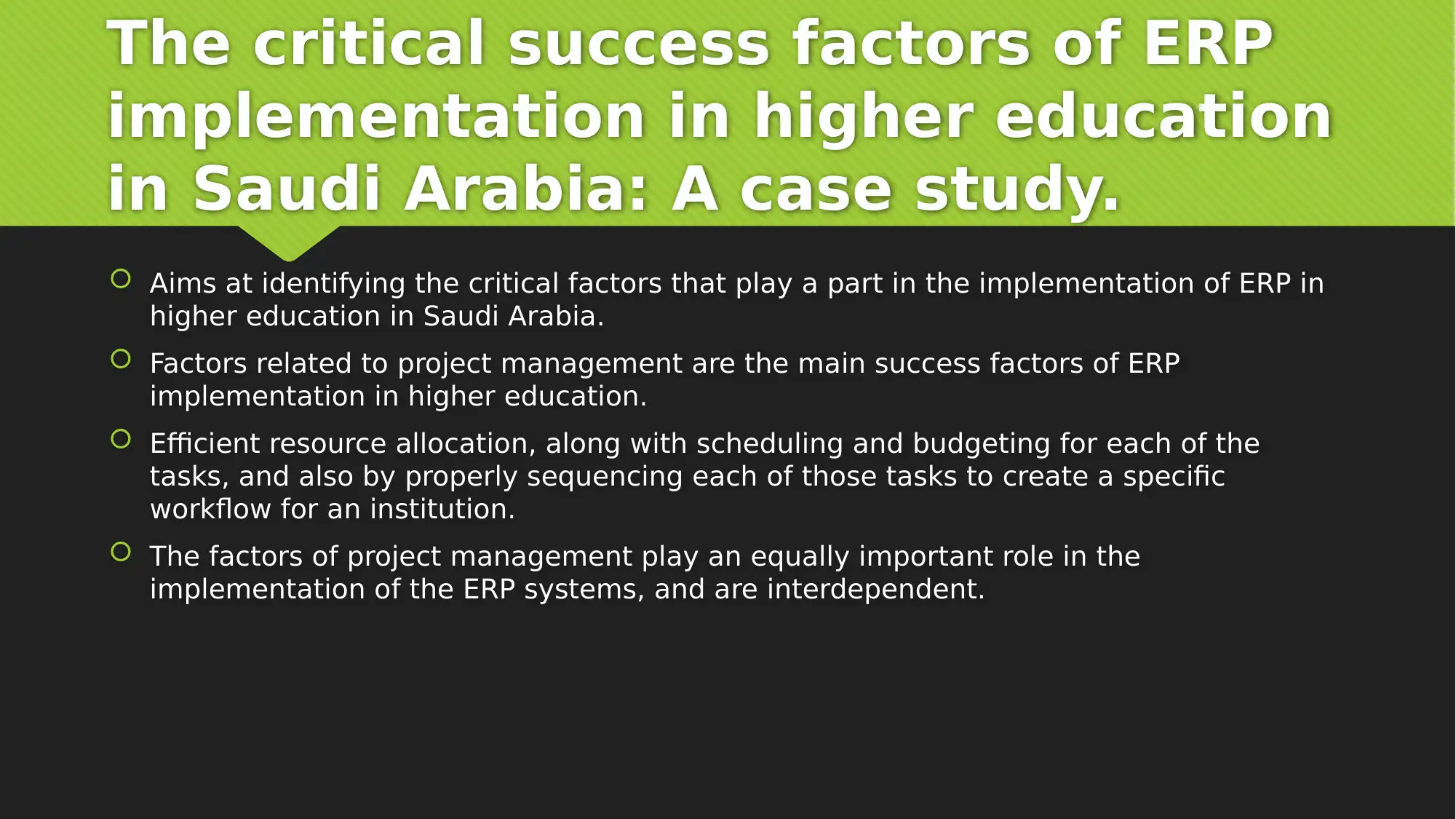
The critical success factors of ERP
implementation in higher education
in Saudi Arabia: A case study.
Aims at identifying the critical factors that play a part in the implementation of ERP in
higher education in Saudi Arabia.
Factors related to project management are the main success factors of ERP
implementation in higher education.
Efficient resource allocation, along with scheduling and budgeting for each of the
tasks, and also by properly sequencing each of those tasks to create a specific
workflow for an institution.
The factors of project management play an equally important role in the
implementation of the ERP systems, and are interdependent.
implementation in higher education
in Saudi Arabia: A case study.
Aims at identifying the critical factors that play a part in the implementation of ERP in
higher education in Saudi Arabia.
Factors related to project management are the main success factors of ERP
implementation in higher education.
Efficient resource allocation, along with scheduling and budgeting for each of the
tasks, and also by properly sequencing each of those tasks to create a specific
workflow for an institution.
The factors of project management play an equally important role in the
implementation of the ERP systems, and are interdependent.
Paraphrase This Document
Need a fresh take? Get an instant paraphrase of this document with our AI Paraphraser

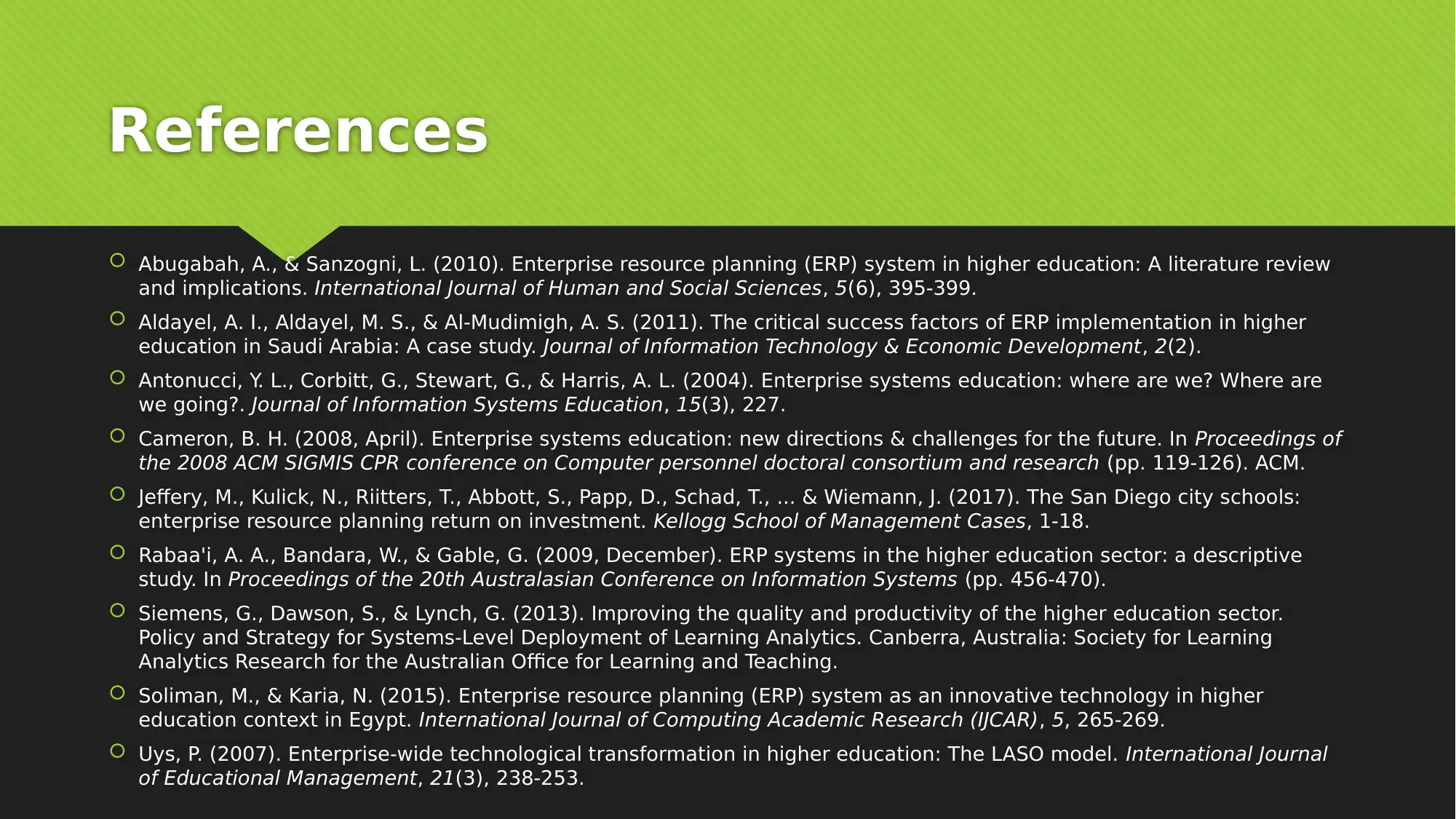
References
Abugabah, A., & Sanzogni, L. (2010). Enterprise resource planning (ERP) system in higher education: A literature review
and implications. International Journal of Human and Social Sciences, 5(6), 395-399.
Aldayel, A. I., Aldayel, M. S., & Al-Mudimigh, A. S. (2011). The critical success factors of ERP implementation in higher
education in Saudi Arabia: A case study. Journal of Information Technology & Economic Development, 2(2).
Antonucci, Y. L., Corbitt, G., Stewart, G., & Harris, A. L. (2004). Enterprise systems education: where are we? Where are
we going?. Journal of Information Systems Education, 15(3), 227.
Cameron, B. H. (2008, April). Enterprise systems education: new directions & challenges for the future. In Proceedings of
the 2008 ACM SIGMIS CPR conference on Computer personnel doctoral consortium and research (pp. 119-126). ACM.
Jeffery, M., Kulick, N., Riitters, T., Abbott, S., Papp, D., Schad, T., ... & Wiemann, J. (2017). The San Diego city schools:
enterprise resource planning return on investment. Kellogg School of Management Cases, 1-18.
Rabaa'i, A. A., Bandara, W., & Gable, G. (2009, December). ERP systems in the higher education sector: a descriptive
study. In Proceedings of the 20th Australasian Conference on Information Systems (pp. 456-470).
Siemens, G., Dawson, S., & Lynch, G. (2013). Improving the quality and productivity of the higher education sector.
Policy and Strategy for Systems-Level Deployment of Learning Analytics. Canberra, Australia: Society for Learning
Analytics Research for the Australian Office for Learning and Teaching.
Soliman, M., & Karia, N. (2015). Enterprise resource planning (ERP) system as an innovative technology in higher
education context in Egypt. International Journal of Computing Academic Research (IJCAR), 5, 265-269.
Uys, P. (2007). Enterprise-wide technological transformation in higher education: The LASO model. International Journal
of Educational Management, 21(3), 238-253.
Abugabah, A., & Sanzogni, L. (2010). Enterprise resource planning (ERP) system in higher education: A literature review
and implications. International Journal of Human and Social Sciences, 5(6), 395-399.
Aldayel, A. I., Aldayel, M. S., & Al-Mudimigh, A. S. (2011). The critical success factors of ERP implementation in higher
education in Saudi Arabia: A case study. Journal of Information Technology & Economic Development, 2(2).
Antonucci, Y. L., Corbitt, G., Stewart, G., & Harris, A. L. (2004). Enterprise systems education: where are we? Where are
we going?. Journal of Information Systems Education, 15(3), 227.
Cameron, B. H. (2008, April). Enterprise systems education: new directions & challenges for the future. In Proceedings of
the 2008 ACM SIGMIS CPR conference on Computer personnel doctoral consortium and research (pp. 119-126). ACM.
Jeffery, M., Kulick, N., Riitters, T., Abbott, S., Papp, D., Schad, T., ... & Wiemann, J. (2017). The San Diego city schools:
enterprise resource planning return on investment. Kellogg School of Management Cases, 1-18.
Rabaa'i, A. A., Bandara, W., & Gable, G. (2009, December). ERP systems in the higher education sector: a descriptive
study. In Proceedings of the 20th Australasian Conference on Information Systems (pp. 456-470).
Siemens, G., Dawson, S., & Lynch, G. (2013). Improving the quality and productivity of the higher education sector.
Policy and Strategy for Systems-Level Deployment of Learning Analytics. Canberra, Australia: Society for Learning
Analytics Research for the Australian Office for Learning and Teaching.
Soliman, M., & Karia, N. (2015). Enterprise resource planning (ERP) system as an innovative technology in higher
education context in Egypt. International Journal of Computing Academic Research (IJCAR), 5, 265-269.
Uys, P. (2007). Enterprise-wide technological transformation in higher education: The LASO model. International Journal
of Educational Management, 21(3), 238-253.

THANK YOU!
⊘ This is a preview!⊘
Do you want full access?
Subscribe today to unlock all pages.

Trusted by 1+ million students worldwide
1 out of 12
Related Documents
Your All-in-One AI-Powered Toolkit for Academic Success.
+13062052269
info@desklib.com
Available 24*7 on WhatsApp / Email
Unlock your academic potential
Copyright © 2020–2026 A2Z Services. All Rights Reserved. Developed and managed by ZUCOL.