ISY2005 Enterprise Systems: Organizational Performance & Adoption
VerifiedAdded on 2023/06/14
|12
|2675
|484
Report
AI Summary
This report provides a comprehensive analysis of enterprise systems and their contributions to organizational performance. It explores how ES supports increased production, operational speed, and accurate employee compensation. The report also examines the key drivers behind businesses adopting supply chain management systems, emphasizing the importance of maximizing responsiveness. Furthermore, it highlights critical change management considerations for successful enterprise system implementation, such as employee training and communication to mitigate resistance. The analysis incorporates real-world examples and academic research to provide a holistic understanding of the strategic role of enterprise systems in contemporary organizations. Desklib offers a wealth of similar resources for students seeking to deepen their understanding of enterprise systems and related topics.

Running head: ENTERPRISE SYSTEM
Enterprise System
Name of the Student
Name of the University
Author Note
Enterprise System
Name of the Student
Name of the University
Author Note

Paraphrase This Document
Need a fresh take? Get an instant paraphrase of this document with our AI Paraphraser
1ENTERPRISE SYSTEM
Executive Summary
The following essay presents a review of organizational processes, where the discussion is built
upon how enterprise system is contributing to an effective organizational performance. The essay
provides a detailed review of how ES is backing up the organization in increasing production,
increasing speed of operation; ensuring employees are paid based on their recorded payable days.
Likewise, drivers behind the businesses that adopt supply chain are another key theme of the
essay, which indicates that organizations can maximize the responsiveness of supply chain
drivers. Eventually, the essay also sheds light on the major change management considerations,
which the organizations should make when implementing Enterprise System successfully.
Executive Summary
The following essay presents a review of organizational processes, where the discussion is built
upon how enterprise system is contributing to an effective organizational performance. The essay
provides a detailed review of how ES is backing up the organization in increasing production,
increasing speed of operation; ensuring employees are paid based on their recorded payable days.
Likewise, drivers behind the businesses that adopt supply chain are another key theme of the
essay, which indicates that organizations can maximize the responsiveness of supply chain
drivers. Eventually, the essay also sheds light on the major change management considerations,
which the organizations should make when implementing Enterprise System successfully.
2ENTERPRISE SYSTEM
Table of Content
Introduction......................................................................................................................................3
Enterprise system contributing to organizational performance.......................................................3
Techniques of measuring the contributors...................................................................................5
Drivers behind the businesses adopting supply chain management................................................5
Organizational change management consideration.....................................................................8
Conclusion.......................................................................................................................................9
References......................................................................................................................................10
Table of Content
Introduction......................................................................................................................................3
Enterprise system contributing to organizational performance.......................................................3
Techniques of measuring the contributors...................................................................................5
Drivers behind the businesses adopting supply chain management................................................5
Organizational change management consideration.....................................................................8
Conclusion.......................................................................................................................................9
References......................................................................................................................................10
⊘ This is a preview!⊘
Do you want full access?
Subscribe today to unlock all pages.

Trusted by 1+ million students worldwide
3ENTERPRISE SYSTEM
Introduction
This essay includes a detailed assessment of how organizations in today’s dynamic
market field shape their organizational performance. The essay also sheds light on the major
market drivers in the businesses that are usually considered when applying supply chain
management system. In addition, the essay also includes a relevant discussion on the change
management considerations for an effective implementation of enterprise management system.
The purpose of the report is to evaluate the current business practices, which includes three
relevant aspects –enterprise contributing to organizational performance, market drivers for
adopting supply chain and change management consideration.
Enterprise system contributing to organizational performance
Enterprise systems are implemented in several organizations to support the major process
such as finance, supply chain, production, distribution, material management and other relevant
aspects. Several organization have applied ES technology to enhance inter-business unit
integration and develop operational efficiencies and maximize organizational effectiveness1.
Enterprise system helps to necessitate implementation or the alignment of different work streams
across the organizational boundaries to gain a seamless integration2. It is also identified that
collaborative tools of enterprise system play a very significant role in processing the business
activities as well as translating the business objectives of the organization.
1 Sykes, Tracy Ann, Viswanath Venkatesh, and Jonathan L. Johnson. "Enterprise system implementation and
employee job performance: Understanding the role of advice networks." MIS quarterly 38, no. 1 (2014).
2 Chen, Yang, Yi Wang, Saggi Nevo, Jiafei Jin, Luning Wang, and Wing S. Chow. "IT capability and organizational
performance: the roles of business process agility and environmental factors." European Journal of Information
Systems 23, no. 3 (2014): 326-342.
Introduction
This essay includes a detailed assessment of how organizations in today’s dynamic
market field shape their organizational performance. The essay also sheds light on the major
market drivers in the businesses that are usually considered when applying supply chain
management system. In addition, the essay also includes a relevant discussion on the change
management considerations for an effective implementation of enterprise management system.
The purpose of the report is to evaluate the current business practices, which includes three
relevant aspects –enterprise contributing to organizational performance, market drivers for
adopting supply chain and change management consideration.
Enterprise system contributing to organizational performance
Enterprise systems are implemented in several organizations to support the major process
such as finance, supply chain, production, distribution, material management and other relevant
aspects. Several organization have applied ES technology to enhance inter-business unit
integration and develop operational efficiencies and maximize organizational effectiveness1.
Enterprise system helps to necessitate implementation or the alignment of different work streams
across the organizational boundaries to gain a seamless integration2. It is also identified that
collaborative tools of enterprise system play a very significant role in processing the business
activities as well as translating the business objectives of the organization.
1 Sykes, Tracy Ann, Viswanath Venkatesh, and Jonathan L. Johnson. "Enterprise system implementation and
employee job performance: Understanding the role of advice networks." MIS quarterly 38, no. 1 (2014).
2 Chen, Yang, Yi Wang, Saggi Nevo, Jiafei Jin, Luning Wang, and Wing S. Chow. "IT capability and organizational
performance: the roles of business process agility and environmental factors." European Journal of Information
Systems 23, no. 3 (2014): 326-342.
Paraphrase This Document
Need a fresh take? Get an instant paraphrase of this document with our AI Paraphraser
4ENTERPRISE SYSTEM
Enterprise Systems remain as the integral substance, monetary and information that flows
through a set of integrated implementation method3. So, these are implemented to support
organization in an integrated manner; thereby, ERPs are called managerial tools, which are
linked to organization’s process of operating and managing. Particularly, ERP helps to store or
keep business data in a usable format; this helps the organization to enhance customer experience
by having a data stored in a way that can be easily used and analyzed. In addition, ES also helps
to automate customer service process for employees; thereby, by implementing this ES, the
organization can gain major benefits by streamlining their customer service experience.
Particularly, ERP system enable the businesses to create an automated their customer
service process, which ensures that each organizational member is providing a consistent
experience to customer and this also ensures that back office function that are streamlined as
possible. ERP helps to increase the reliability of IT infrastructure required for customer service4.
This means that the implementation of ES, the overall organizational system will have a larger
uptime, which ensures that IT functions are gather data appropriately and running properly. For
example, in the case of Apple, ERP implementation such as SAP required a proper and solid
corporate strategy effectively deal with the competitive pressure. So, Apple paid attention to the
intersection IT as well as business strategy. Hence, IT, ERP and SAP strategies intersect to
enable corporate strategy.
3 Ram, J., Corkindale, D., & Wu, M. L. (2013). Implementation critical success factors (CSFs) for ERP: Do they
contribute to implementation success and post-implementation performance?. International Journal of Production
Economics, 144(1), 157-174.
4 Seethamraju, R. (2015). Adoption of software as a service (SaaS) enterprise resource planning (ERP) systems in
small and medium sized enterprises (SMEs). Information systems frontiers, 17(3), 475-492.
Enterprise Systems remain as the integral substance, monetary and information that flows
through a set of integrated implementation method3. So, these are implemented to support
organization in an integrated manner; thereby, ERPs are called managerial tools, which are
linked to organization’s process of operating and managing. Particularly, ERP helps to store or
keep business data in a usable format; this helps the organization to enhance customer experience
by having a data stored in a way that can be easily used and analyzed. In addition, ES also helps
to automate customer service process for employees; thereby, by implementing this ES, the
organization can gain major benefits by streamlining their customer service experience.
Particularly, ERP system enable the businesses to create an automated their customer
service process, which ensures that each organizational member is providing a consistent
experience to customer and this also ensures that back office function that are streamlined as
possible. ERP helps to increase the reliability of IT infrastructure required for customer service4.
This means that the implementation of ES, the overall organizational system will have a larger
uptime, which ensures that IT functions are gather data appropriately and running properly. For
example, in the case of Apple, ERP implementation such as SAP required a proper and solid
corporate strategy effectively deal with the competitive pressure. So, Apple paid attention to the
intersection IT as well as business strategy. Hence, IT, ERP and SAP strategies intersect to
enable corporate strategy.
3 Ram, J., Corkindale, D., & Wu, M. L. (2013). Implementation critical success factors (CSFs) for ERP: Do they
contribute to implementation success and post-implementation performance?. International Journal of Production
Economics, 144(1), 157-174.
4 Seethamraju, R. (2015). Adoption of software as a service (SaaS) enterprise resource planning (ERP) systems in
small and medium sized enterprises (SMEs). Information systems frontiers, 17(3), 475-492.
5ENTERPRISE SYSTEM
Techniques of measuring the contributors
For measuring the contribution of ES, it is essential for the organizations to assess the
performance after the implementation. The organizations should focus on some key areas such
as reduction of operation cost; this means the firms should check where the ERP system
eventually is able to reduce the cost of operation. The firms should have more of its budget free
to maximize customer service capability. It should measure the performance of customer service
department with the performance reported by traditional services before. Likewise, organization
also needs to monitor whether the employees are receiving data or information from the usable
format and the employees have the access to retrieve the information quickly when answering
customer queries. On the other side, if ARS (Attendance Recording System) is installed to
measure and monitor employee attendance; thereby to measure the results here, organization
needs to check whether employee attendance is accurately checked and recorded for the
calculation of payable days.
Drivers behind the businesses adopting supply chain management
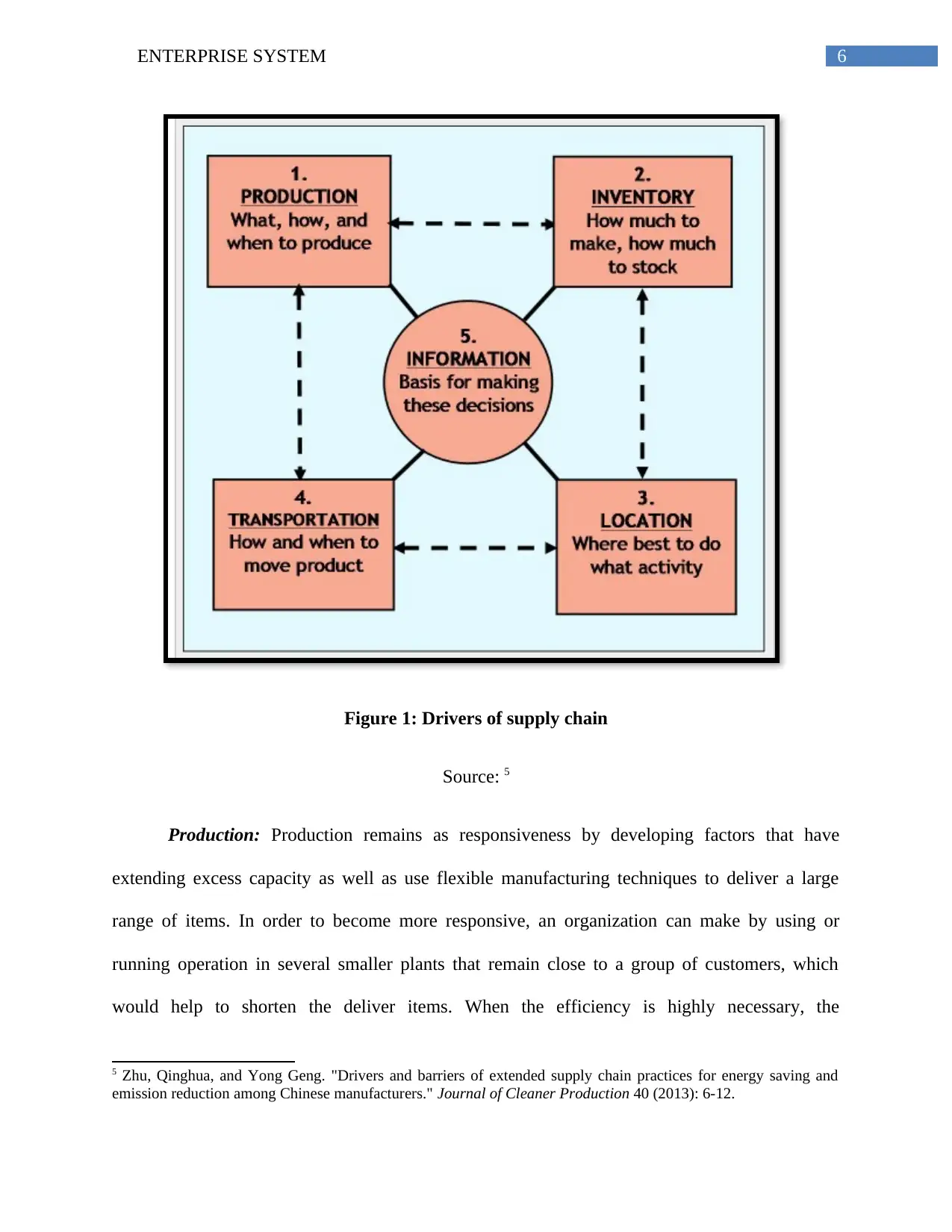
Among the several drivers, there are major drivers such as production inventory, transportation,
facilities and location. Supply chain capabilities are usually guided by the decision the
businesses make about the five drivers mentioned. The decision made about how each driver will
run or influence will determine the blend of responsive and efficacy, which the supply chain has
to achieve the business goals. The following framework is formed by integrating the supply
chain drivers to identify the supply chain capabilities.
Techniques of measuring the contributors
For measuring the contribution of ES, it is essential for the organizations to assess the
performance after the implementation. The organizations should focus on some key areas such
as reduction of operation cost; this means the firms should check where the ERP system
eventually is able to reduce the cost of operation. The firms should have more of its budget free
to maximize customer service capability. It should measure the performance of customer service
department with the performance reported by traditional services before. Likewise, organization
also needs to monitor whether the employees are receiving data or information from the usable
format and the employees have the access to retrieve the information quickly when answering
customer queries. On the other side, if ARS (Attendance Recording System) is installed to
measure and monitor employee attendance; thereby to measure the results here, organization
needs to check whether employee attendance is accurately checked and recorded for the
calculation of payable days.
Drivers behind the businesses adopting supply chain management
Among the several drivers, there are major drivers such as production inventory, transportation,
facilities and location. Supply chain capabilities are usually guided by the decision the
businesses make about the five drivers mentioned. The decision made about how each driver will
run or influence will determine the blend of responsive and efficacy, which the supply chain has
to achieve the business goals. The following framework is formed by integrating the supply
chain drivers to identify the supply chain capabilities.
⊘ This is a preview!⊘
Do you want full access?
Subscribe today to unlock all pages.
Trusted by 1+ million students worldwide
6ENTERPRISE SYSTEM
Figure 1: Drivers of supply chain
Source: 5
Production: Production remains as responsiveness by developing factors that have
extending excess capacity as well as use flexible manufacturing techniques to deliver a large
range of items. In order to become more responsive, an organization can make by using or
running operation in several smaller plants that remain close to a group of customers, which
would help to shorten the deliver items. When the efficiency is highly necessary, the
5 Zhu, Qinghua, and Yong Geng. "Drivers and barriers of extended supply chain practices for energy saving and
emission reduction among Chinese manufacturers." Journal of Cleaner Production 40 (2013): 6-12.
Figure 1: Drivers of supply chain
Source: 5
Production: Production remains as responsiveness by developing factors that have
extending excess capacity as well as use flexible manufacturing techniques to deliver a large
range of items. In order to become more responsive, an organization can make by using or
running operation in several smaller plants that remain close to a group of customers, which
would help to shorten the deliver items. When the efficiency is highly necessary, the
5 Zhu, Qinghua, and Yong Geng. "Drivers and barriers of extended supply chain practices for energy saving and
emission reduction among Chinese manufacturers." Journal of Cleaner Production 40 (2013): 6-12.
Paraphrase This Document
Need a fresh take? Get an instant paraphrase of this document with our AI Paraphraser
7ENTERPRISE SYSTEM
organizations can develop factories with limited capacity and make those factories customized
for delivering a constrained range of items6.
Inventory- Responsiveness in this driver can be brought about by bringing or stocking a
high range of inventory for a large range of products. Hence, the extending responsiveness can
be obtained by stocking products at many locations just to have inventory close to customers.
Efficiency in inventory management may call for a minimization in the inventory levels of all
goods7. It is also identified that economies of scale and cost savings can be kept in place by
increasing or stocking inventory in few central locations such as in a regional distribution centre.
Location: The decision of an appropriate location must emphasize on the responsiveness,
which should be done when an organization develops or builds several locations that are close its
customer base. For example, the organization Dell, for each market, it builds a separate location
but this production location is in the market only, where it operates. Dell runs its operation in
Texas city, and thereby, it has developed its production location in the Texas, which is near to
their customer base. Hence, Dell operating from a few locations nd centralizing the activities in
the cpmmon location achieves the efficiency.
Transformation: Effectiveness of this driver is usually achieved with the help of a
proper transportation mode that is flexible and fast such as airplanes for global market and trucks
for the regional areas8. On the other side, it is also observed that many organizations that sell
6 Serdarasan, Seyda. "A review of supply chain complexity drivers." Computers & Industrial Engineering 66, no. 3
(2013): 533-540.
7 Brandenburg, Marcus, Kannan Govindan, Joseph Sarkis, and Stefan Seuring. "Quantitative models for sustainable
supply chain management: Developments and directions." European Journal of Operational Research 233, no. 2
(2014): 299-312.
8 Hsu, Chin-Chun, Keah Choon Tan, Suhaiza Hanim Mohamad Zailani, and Vaidyanathan Jayaraman. "Supply
chain drivers that foster the development of green initiatives in an emerging economy." International Journal of
Operations & Production Management 33, no. 6 (2013): 656-688.
organizations can develop factories with limited capacity and make those factories customized
for delivering a constrained range of items6.
Inventory- Responsiveness in this driver can be brought about by bringing or stocking a
high range of inventory for a large range of products. Hence, the extending responsiveness can
be obtained by stocking products at many locations just to have inventory close to customers.
Efficiency in inventory management may call for a minimization in the inventory levels of all
goods7. It is also identified that economies of scale and cost savings can be kept in place by
increasing or stocking inventory in few central locations such as in a regional distribution centre.
Location: The decision of an appropriate location must emphasize on the responsiveness,
which should be done when an organization develops or builds several locations that are close its
customer base. For example, the organization Dell, for each market, it builds a separate location
but this production location is in the market only, where it operates. Dell runs its operation in
Texas city, and thereby, it has developed its production location in the Texas, which is near to
their customer base. Hence, Dell operating from a few locations nd centralizing the activities in
the cpmmon location achieves the efficiency.
Transformation: Effectiveness of this driver is usually achieved with the help of a
proper transportation mode that is flexible and fast such as airplanes for global market and trucks
for the regional areas8. On the other side, it is also observed that many organizations that sell
6 Serdarasan, Seyda. "A review of supply chain complexity drivers." Computers & Industrial Engineering 66, no. 3
(2013): 533-540.
7 Brandenburg, Marcus, Kannan Govindan, Joseph Sarkis, and Stefan Seuring. "Quantitative models for sustainable
supply chain management: Developments and directions." European Journal of Operational Research 233, no. 2
(2014): 299-312.
8 Hsu, Chin-Chun, Keah Choon Tan, Suhaiza Hanim Mohamad Zailani, and Vaidyanathan Jayaraman. "Supply
chain drivers that foster the development of green initiatives in an emerging economy." International Journal of
Operations & Production Management 33, no. 6 (2013): 656-688.
8ENTERPRISE SYSTEM
products the through catalogs or on the Internet are having the ability to deliver high levels of
responsiveness through a transportation mode within 24 hours. Hence, FedEx and UPS are the
major third party organizations that provide responsive transportation services.
Information: The capability of this driver grows stronger with time because the
technology for gathering and sharing information becomes easier and they wide spread.
Information like money is very relevant commodity and it can be implemented to improve the
performance of other supply chain drivers9. In addition, a high level of responsiveness is
achieved when the organizations start collecting and sharing timely data with the operation of
other four drivers.
Organizational change management consideration
When adopting an enterprise system, it is necessary for the organizations to prepare the
base for a change management consideration. According to the principle of system theory of
change management, applying change to one particular sector of the organization can change the
other functions. For example, a furniture manufacturing company buys 100 pieces of glasses
from its supplier and now the supplier increases the price, the manufacturing company’s cost
structure will be changed. Hence, to resolve the issue, the either organization have to switch to
another supplier or change the entire cost structure before and then buys the glasses with newly
increased price.
Therefore, for a successful implementation of enterprise system, the organizations have
to make pre-considerations. For example, if an organization wants to install Attendance
recording system as the part of ERP implementation, the organization mist have to inform and
9 Kuipers, Ben S., Malcolm Higgs, Walter Kickert, Lars Tummers, Jolien Grandia, and Joris Van der Voet. "The
management of change in public organizations: A literature review." Public administration 92, no. 1 (2014): 1-20.
products the through catalogs or on the Internet are having the ability to deliver high levels of
responsiveness through a transportation mode within 24 hours. Hence, FedEx and UPS are the
major third party organizations that provide responsive transportation services.
Information: The capability of this driver grows stronger with time because the
technology for gathering and sharing information becomes easier and they wide spread.
Information like money is very relevant commodity and it can be implemented to improve the
performance of other supply chain drivers9. In addition, a high level of responsiveness is
achieved when the organizations start collecting and sharing timely data with the operation of
other four drivers.
Organizational change management consideration
When adopting an enterprise system, it is necessary for the organizations to prepare the
base for a change management consideration. According to the principle of system theory of
change management, applying change to one particular sector of the organization can change the
other functions. For example, a furniture manufacturing company buys 100 pieces of glasses
from its supplier and now the supplier increases the price, the manufacturing company’s cost
structure will be changed. Hence, to resolve the issue, the either organization have to switch to
another supplier or change the entire cost structure before and then buys the glasses with newly
increased price.
Therefore, for a successful implementation of enterprise system, the organizations have
to make pre-considerations. For example, if an organization wants to install Attendance
recording system as the part of ERP implementation, the organization mist have to inform and
9 Kuipers, Ben S., Malcolm Higgs, Walter Kickert, Lars Tummers, Jolien Grandia, and Joris Van der Voet. "The
management of change in public organizations: A literature review." Public administration 92, no. 1 (2014): 1-20.
⊘ This is a preview!⊘
Do you want full access?
Subscribe today to unlock all pages.
Trusted by 1+ million students worldwide
9ENTERPRISE SYSTEM
train its employees about the use of the system to avoid failure in the process. However,
resistance to change is a common incident that happens in the internal organizational
environment10. Thus, before implementing ES, organizational leaders must have to communicate
with the employees of each level of management to gain employee coordination and to make the
change happen. The organizational members should know each piece of information about the
ERP installation such as the purpose of ERP adoption, its use and benefits. Thereby, the
organization can obtain positive result from adoption of enterprise system.
Conclusion
In conclusion, it can be ascertained that enterprise system is emerged from the changing
business environment, where technology plays a great role. In order to speed up the operation
and production, the organizations are relying on new trends like Enterprise System but this ES is
a part of this changing business environment. Appropriate implementation of this system
certainly provides a desired outcome to thee organization.
10 Behnia, Kia, and Douglas Mueller. "Bi-directional communication between change management tool and
implementation tools." U.S. Patent 8,887,133, issued November 11, 2014.
train its employees about the use of the system to avoid failure in the process. However,
resistance to change is a common incident that happens in the internal organizational
environment10. Thus, before implementing ES, organizational leaders must have to communicate
with the employees of each level of management to gain employee coordination and to make the
change happen. The organizational members should know each piece of information about the
ERP installation such as the purpose of ERP adoption, its use and benefits. Thereby, the
organization can obtain positive result from adoption of enterprise system.
Conclusion
In conclusion, it can be ascertained that enterprise system is emerged from the changing
business environment, where technology plays a great role. In order to speed up the operation
and production, the organizations are relying on new trends like Enterprise System but this ES is
a part of this changing business environment. Appropriate implementation of this system
certainly provides a desired outcome to thee organization.
10 Behnia, Kia, and Douglas Mueller. "Bi-directional communication between change management tool and
implementation tools." U.S. Patent 8,887,133, issued November 11, 2014.
Paraphrase This Document
Need a fresh take? Get an instant paraphrase of this document with our AI Paraphraser
10ENTERPRISE SYSTEM
References
Behnia, Kia, and Douglas Mueller. "Bi-directional communication between change management
tool and implementation tools." U.S. Patent 8,887,133, issued November 11, 2014.
Brandenburg, Marcus, Kannan Govindan, Joseph Sarkis, and Stefan Seuring. "Quantitative
models for sustainable supply chain management: Developments and directions." European
Journal of Operational Research 233, no. 2 (2014): 299-312.
Chen, Yang, Yi Wang, Saggi Nevo, Jiafei Jin, Luning Wang, and Wing S. Chow. "IT capability
and organizational performance: the roles of business process agility and environmental
factors." European Journal of Information Systems 23, no. 3 (2014): 326-342.
Hsu, Chin-Chun, Keah Choon Tan, Suhaiza Hanim Mohamad Zailani, and Vaidyanathan
Jayaraman. "Supply chain drivers that foster the development of green initiatives in an emerging
economy." International Journal of Operations & Production Management 33, no. 6 (2013):
656-688.
Kuipers, Ben S., Malcolm Higgs, Walter Kickert, Lars Tummers, Jolien Grandia, and Joris Van
der Voet. "The management of change in public organizations: A literature review." Public
administration 92, no. 1 (2014): 1-20.
Ram, J., Corkindale, D., & Wu, M. L. (2013). Implementation critical success factors (CSFs) for
ERP: Do they contribute to implementation success and post-implementation
performance?. International Journal of Production Economics, 144(1), 157-174.
References
Behnia, Kia, and Douglas Mueller. "Bi-directional communication between change management
tool and implementation tools." U.S. Patent 8,887,133, issued November 11, 2014.
Brandenburg, Marcus, Kannan Govindan, Joseph Sarkis, and Stefan Seuring. "Quantitative
models for sustainable supply chain management: Developments and directions." European
Journal of Operational Research 233, no. 2 (2014): 299-312.
Chen, Yang, Yi Wang, Saggi Nevo, Jiafei Jin, Luning Wang, and Wing S. Chow. "IT capability
and organizational performance: the roles of business process agility and environmental
factors." European Journal of Information Systems 23, no. 3 (2014): 326-342.
Hsu, Chin-Chun, Keah Choon Tan, Suhaiza Hanim Mohamad Zailani, and Vaidyanathan
Jayaraman. "Supply chain drivers that foster the development of green initiatives in an emerging
economy." International Journal of Operations & Production Management 33, no. 6 (2013):
656-688.
Kuipers, Ben S., Malcolm Higgs, Walter Kickert, Lars Tummers, Jolien Grandia, and Joris Van
der Voet. "The management of change in public organizations: A literature review." Public
administration 92, no. 1 (2014): 1-20.
Ram, J., Corkindale, D., & Wu, M. L. (2013). Implementation critical success factors (CSFs) for
ERP: Do they contribute to implementation success and post-implementation
performance?. International Journal of Production Economics, 144(1), 157-174.
11ENTERPRISE SYSTEM
Seethamraju, R. (2015). Adoption of software as a service (SaaS) enterprise resource planning
(ERP) systems in small and medium sized enterprises (SMEs). Information systems
frontiers, 17(3), 475-492.
Serdarasan, Seyda. "A review of supply chain complexity drivers." Computers & Industrial
Engineering 66, no. 3 (2013): 533-540.
Sykes, Tracy Ann, Viswanath Venkatesh, and Jonathan L. Johnson. "Enterprise system
implementation and employee job performance: Understanding the role of advice
networks." MIS quarterly 38, no. 1 (2014).
Zhu, Qinghua, and Yong Geng. "Drivers and barriers of extended supply chain practices for
energy saving and emission reduction among Chinese manufacturers." Journal of Cleaner
Production 40 (2013): 6-12.
Seethamraju, R. (2015). Adoption of software as a service (SaaS) enterprise resource planning
(ERP) systems in small and medium sized enterprises (SMEs). Information systems
frontiers, 17(3), 475-492.
Serdarasan, Seyda. "A review of supply chain complexity drivers." Computers & Industrial
Engineering 66, no. 3 (2013): 533-540.
Sykes, Tracy Ann, Viswanath Venkatesh, and Jonathan L. Johnson. "Enterprise system
implementation and employee job performance: Understanding the role of advice
networks." MIS quarterly 38, no. 1 (2014).
Zhu, Qinghua, and Yong Geng. "Drivers and barriers of extended supply chain practices for
energy saving and emission reduction among Chinese manufacturers." Journal of Cleaner
Production 40 (2013): 6-12.
⊘ This is a preview!⊘
Do you want full access?
Subscribe today to unlock all pages.
Trusted by 1+ million students worldwide

1 out of 12


Related Documents


Your All-in-One AI-Powered Toolkit for Academic Success.
+13062052269
info@desklib.com
Available 24*7 on WhatsApp / Email
![[object Object]](/_next/static/media/star-bottom.7253800d.svg)
Unlock your academic potential
Copyright © 2020–2026 A2Z Services. All Rights Reserved. Developed and managed by ZUCOL.