Entrepreneurship: Ventures, Typologies, and Economic Development
VerifiedAdded on 2020/11/12
|30
|7450
|250
Report
AI Summary
This report delves into the multifaceted world of entrepreneurship, encompassing the design, launch, and development of new business projects. It provides a comprehensive overview of various entrepreneurial ventures, categorizing them based on their typologies, including small-scale social ventures, established organizations, and public sector initiatives. The report further explores the role and importance of small and micro-businesses in economic development, supported by relevant data and statistics. It analyzes the key characteristics, skills, and motivational drivers of successful entrepreneurs, along with the impact of personal background and experience. The report also highlights the similarities and differences among various entrepreneurial ventures, examining aspects like economic motives, technological investments, and driving forces, while also touching upon the distinctions between serial entrepreneurs, intrapreneurs, and owner-managers. Finally, the report offers insights into the influence of gender on entrepreneurship.

ENTREPRENERUSHIP

Paraphrase This Document
Need a fresh take? Get an instant paraphrase of this document with our AI Paraphraser
EXECUTIVE SUMMARY
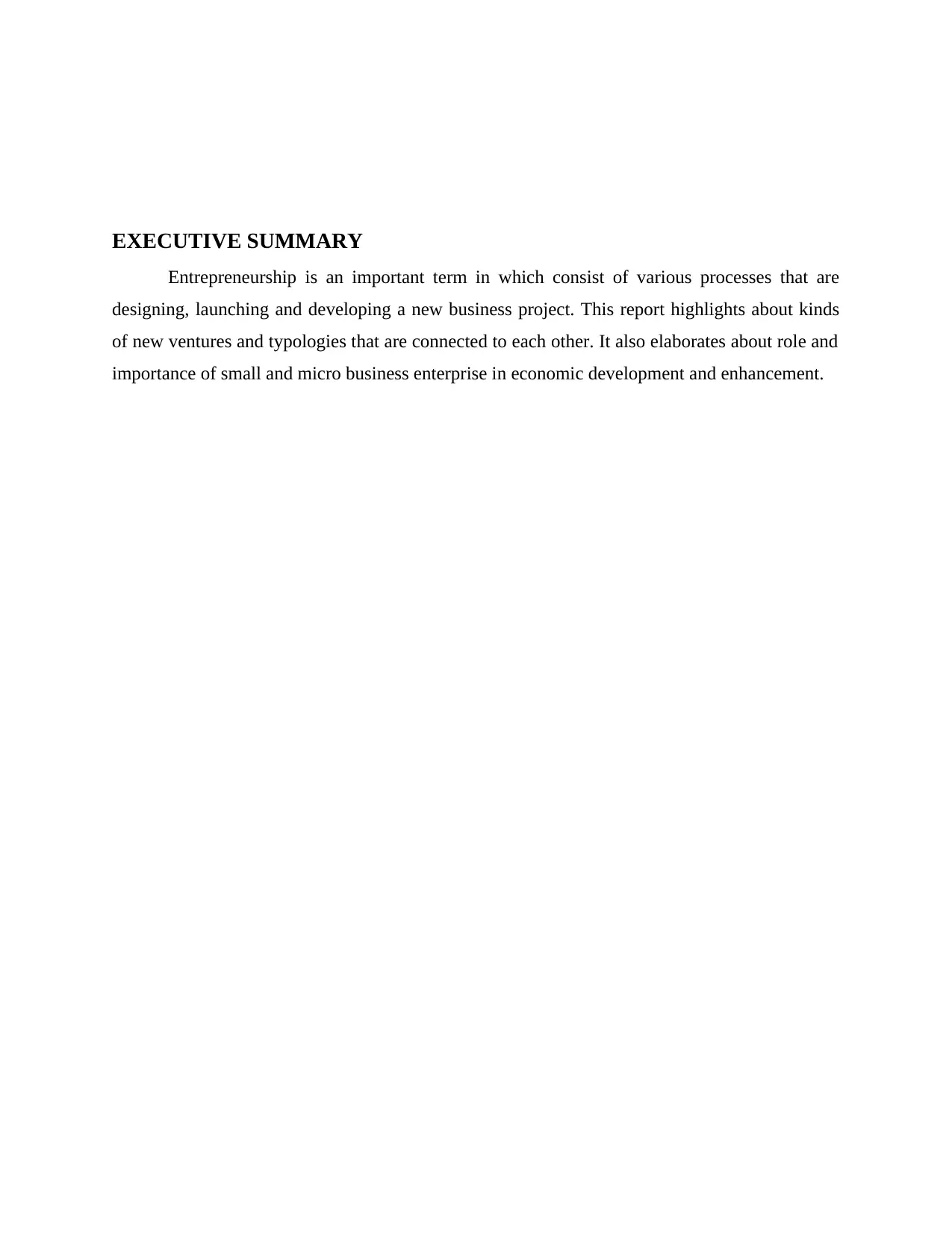
Entrepreneurship is an important term in which consist of various processes that are
designing, launching and developing a new business project. This report highlights about kinds
of new ventures and typologies that are connected to each other. It also elaborates about role and
importance of small and micro business enterprise in economic development and enhancement.
Entrepreneurship is an important term in which consist of various processes that are
designing, launching and developing a new business project. This report highlights about kinds
of new ventures and typologies that are connected to each other. It also elaborates about role and
importance of small and micro business enterprise in economic development and enhancement.
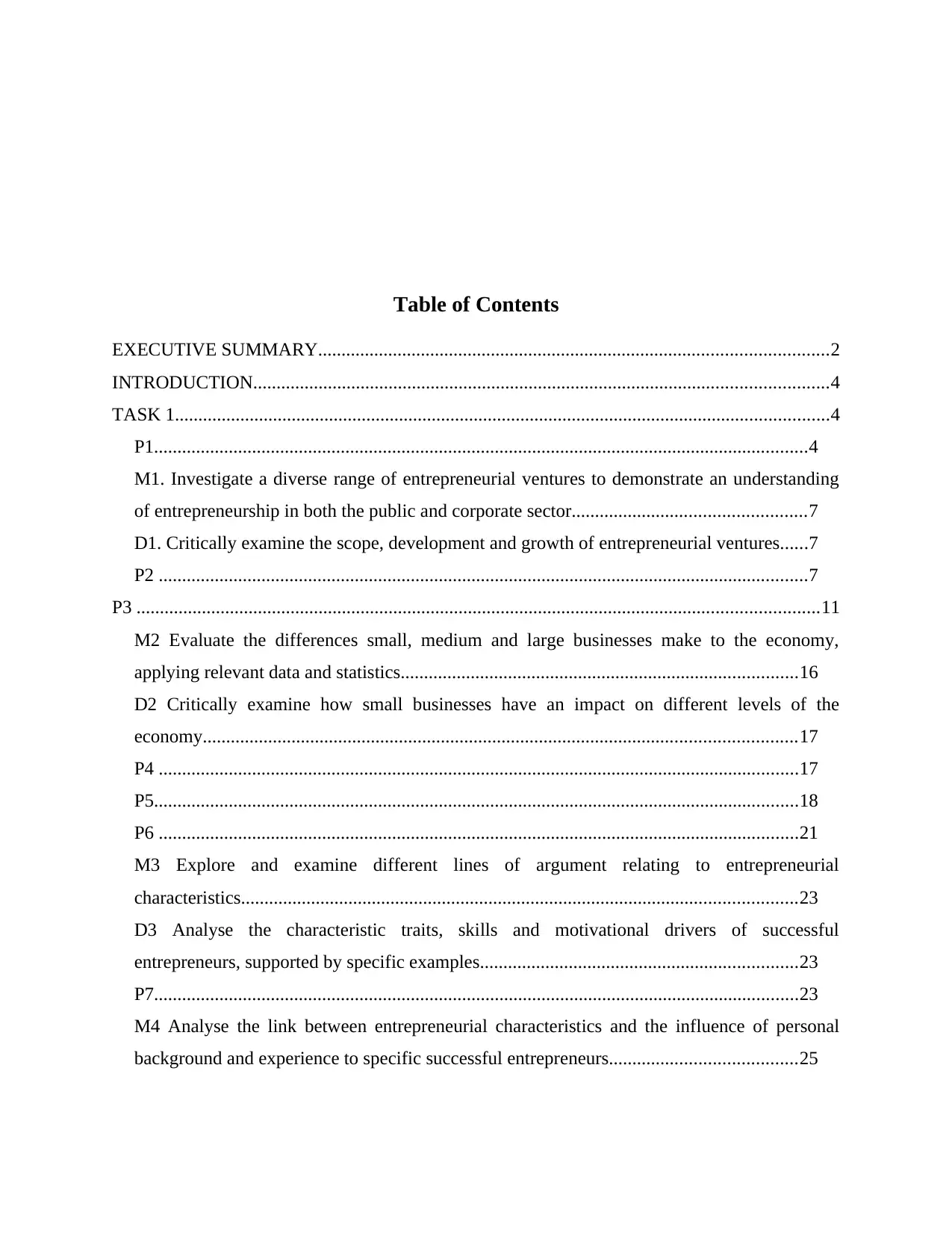
Table of Contents
EXECUTIVE SUMMARY.............................................................................................................2
INTRODUCTION...........................................................................................................................4
TASK 1............................................................................................................................................4
P1............................................................................................................................................4
M1. Investigate a diverse range of entrepreneurial ventures to demonstrate an understanding
of entrepreneurship in both the public and corporate sector..................................................7
D1. Critically examine the scope, development and growth of entrepreneurial ventures......7
P2 ...........................................................................................................................................7
P3 ..................................................................................................................................................11
M2 Evaluate the differences small, medium and large businesses make to the economy,
applying relevant data and statistics.....................................................................................16
D2 Critically examine how small businesses have an impact on different levels of the
economy...............................................................................................................................17
P4 .........................................................................................................................................17
P5..........................................................................................................................................18
P6 .........................................................................................................................................21
M3 Explore and examine different lines of argument relating to entrepreneurial
characteristics.......................................................................................................................23
D3 Analyse the characteristic traits, skills and motivational drivers of successful
entrepreneurs, supported by specific examples....................................................................23
P7..........................................................................................................................................23
M4 Analyse the link between entrepreneurial characteristics and the influence of personal
background and experience to specific successful entrepreneurs........................................25
EXECUTIVE SUMMARY.............................................................................................................2
INTRODUCTION...........................................................................................................................4
TASK 1............................................................................................................................................4
P1............................................................................................................................................4
M1. Investigate a diverse range of entrepreneurial ventures to demonstrate an understanding
of entrepreneurship in both the public and corporate sector..................................................7
D1. Critically examine the scope, development and growth of entrepreneurial ventures......7
P2 ...........................................................................................................................................7
P3 ..................................................................................................................................................11
M2 Evaluate the differences small, medium and large businesses make to the economy,
applying relevant data and statistics.....................................................................................16
D2 Critically examine how small businesses have an impact on different levels of the
economy...............................................................................................................................17
P4 .........................................................................................................................................17
P5..........................................................................................................................................18
P6 .........................................................................................................................................21
M3 Explore and examine different lines of argument relating to entrepreneurial
characteristics.......................................................................................................................23
D3 Analyse the characteristic traits, skills and motivational drivers of successful
entrepreneurs, supported by specific examples....................................................................23
P7..........................................................................................................................................23
M4 Analyse the link between entrepreneurial characteristics and the influence of personal
background and experience to specific successful entrepreneurs........................................25
⊘ This is a preview!⊘
Do you want full access?
Subscribe today to unlock all pages.

Trusted by 1+ million students worldwide

D4 Critically evaluate how background and experience influences entrepreneurs, both
positively and negatively......................................................................................................26
CONCLUSION..............................................................................................................................26
positively and negatively......................................................................................................26
CONCLUSION..............................................................................................................................26
Paraphrase This Document
Need a fresh take? Get an instant paraphrase of this document with our AI Paraphraser
INTRODUCTION
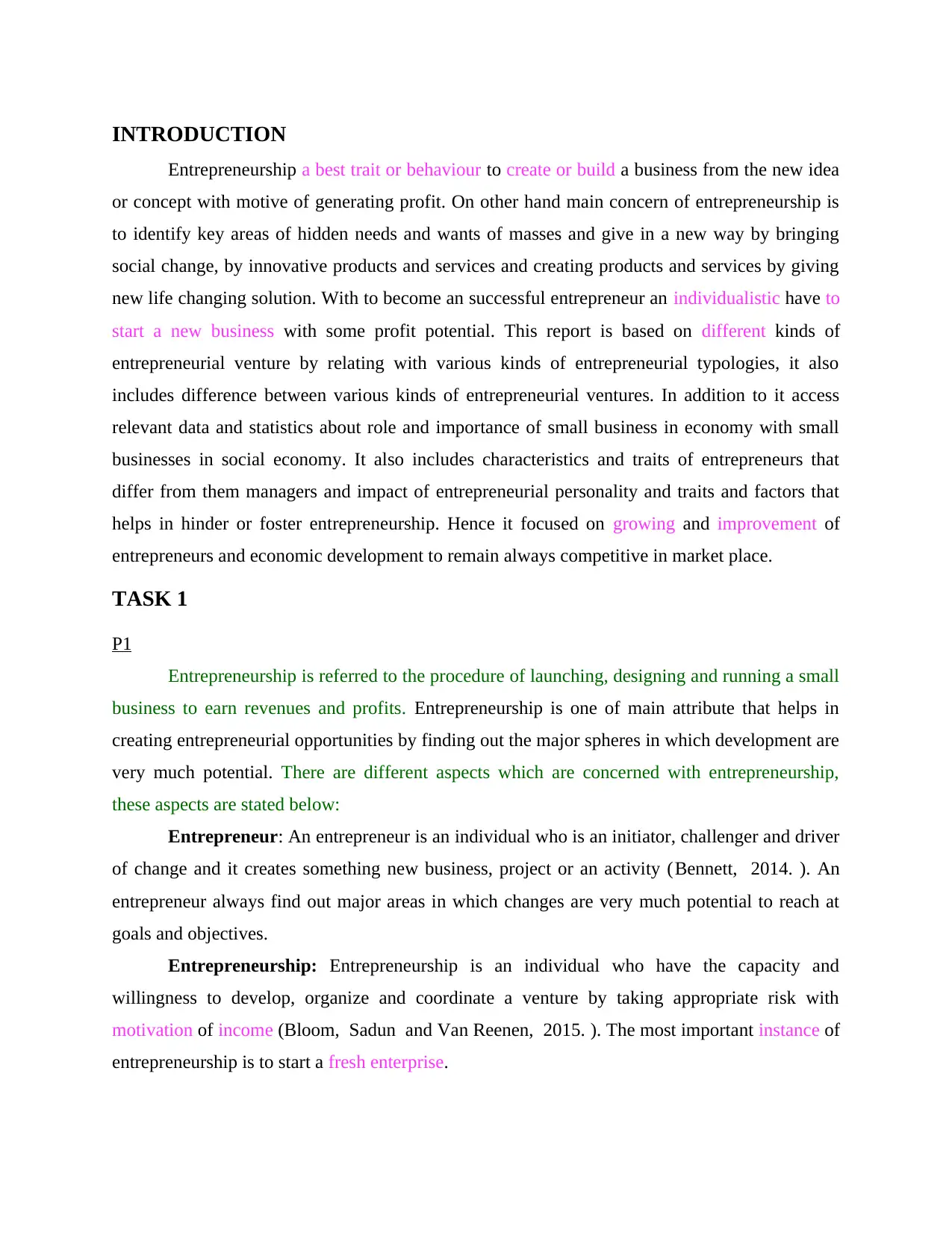
Entrepreneurship a best trait or behaviour to create or build a business from the new idea
or concept with motive of generating profit. On other hand main concern of entrepreneurship is
to identify key areas of hidden needs and wants of masses and give in a new way by bringing
social change, by innovative products and services and creating products and services by giving
new life changing solution. With to become an successful entrepreneur an individualistic have to
start a new business with some profit potential. This report is based on different kinds of
entrepreneurial venture by relating with various kinds of entrepreneurial typologies, it also
includes difference between various kinds of entrepreneurial ventures. In addition to it access
relevant data and statistics about role and importance of small business in economy with small
businesses in social economy. It also includes characteristics and traits of entrepreneurs that
differ from them managers and impact of entrepreneurial personality and traits and factors that
helps in hinder or foster entrepreneurship. Hence it focused on growing and improvement of
entrepreneurs and economic development to remain always competitive in market place.
TASK 1
P1
Entrepreneurship is referred to the procedure of launching, designing and running a small
business to earn revenues and profits. Entrepreneurship is one of main attribute that helps in
creating entrepreneurial opportunities by finding out the major spheres in which development are
very much potential. There are different aspects which are concerned with entrepreneurship,
these aspects are stated below:
Entrepreneur: An entrepreneur is an individual who is an initiator, challenger and driver
of change and it creates something new business, project or an activity (Bennett, 2014. ). An
entrepreneur always find out major areas in which changes are very much potential to reach at
goals and objectives.
Entrepreneurship: Entrepreneurship is an individual who have the capacity and
willingness to develop, organize and coordinate a venture by taking appropriate risk with
motivation of income (Bloom, Sadun and Van Reenen, 2015. ). The most important instance of
entrepreneurship is to start a fresh enterprise.
Entrepreneurship a best trait or behaviour to create or build a business from the new idea
or concept with motive of generating profit. On other hand main concern of entrepreneurship is
to identify key areas of hidden needs and wants of masses and give in a new way by bringing
social change, by innovative products and services and creating products and services by giving
new life changing solution. With to become an successful entrepreneur an individualistic have to
start a new business with some profit potential. This report is based on different kinds of
entrepreneurial venture by relating with various kinds of entrepreneurial typologies, it also
includes difference between various kinds of entrepreneurial ventures. In addition to it access
relevant data and statistics about role and importance of small business in economy with small
businesses in social economy. It also includes characteristics and traits of entrepreneurs that
differ from them managers and impact of entrepreneurial personality and traits and factors that
helps in hinder or foster entrepreneurship. Hence it focused on growing and improvement of
entrepreneurs and economic development to remain always competitive in market place.
TASK 1
P1
Entrepreneurship is referred to the procedure of launching, designing and running a small
business to earn revenues and profits. Entrepreneurship is one of main attribute that helps in
creating entrepreneurial opportunities by finding out the major spheres in which development are
very much potential. There are different aspects which are concerned with entrepreneurship,
these aspects are stated below:
Entrepreneur: An entrepreneur is an individual who is an initiator, challenger and driver
of change and it creates something new business, project or an activity (Bennett, 2014. ). An
entrepreneur always find out major areas in which changes are very much potential to reach at
goals and objectives.
Entrepreneurship: Entrepreneurship is an individual who have the capacity and
willingness to develop, organize and coordinate a venture by taking appropriate risk with
motivation of income (Bloom, Sadun and Van Reenen, 2015. ). The most important instance of
entrepreneurship is to start a fresh enterprise.
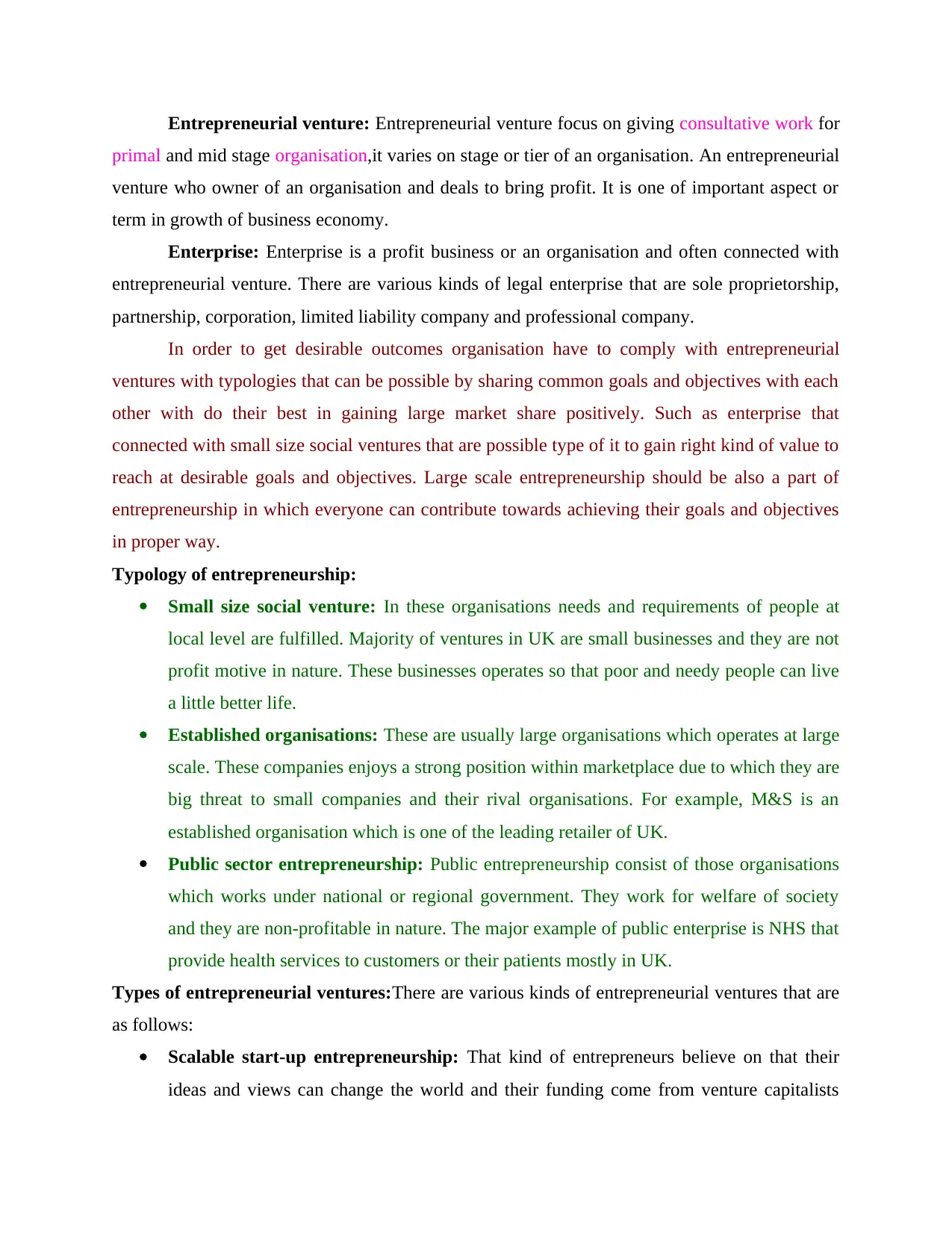
Entrepreneurial venture: Entrepreneurial venture focus on giving consultative work for
primal and mid stage organisation,it varies on stage or tier of an organisation. An entrepreneurial
venture who owner of an organisation and deals to bring profit. It is one of important aspect or
term in growth of business economy.
Enterprise: Enterprise is a profit business or an organisation and often connected with
entrepreneurial venture. There are various kinds of legal enterprise that are sole proprietorship,
partnership, corporation, limited liability company and professional company.
In order to get desirable outcomes organisation have to comply with entrepreneurial
ventures with typologies that can be possible by sharing common goals and objectives with each
other with do their best in gaining large market share positively. Such as enterprise that
connected with small size social ventures that are possible type of it to gain right kind of value to
reach at desirable goals and objectives. Large scale entrepreneurship should be also a part of
entrepreneurship in which everyone can contribute towards achieving their goals and objectives
in proper way.
Typology of entrepreneurship:
Small size social venture: In these organisations needs and requirements of people at
local level are fulfilled. Majority of ventures in UK are small businesses and they are not
profit motive in nature. These businesses operates so that poor and needy people can live
a little better life.
Established organisations: These are usually large organisations which operates at large
scale. These companies enjoys a strong position within marketplace due to which they are
big threat to small companies and their rival organisations. For example, M&S is an
established organisation which is one of the leading retailer of UK.
Public sector entrepreneurship: Public entrepreneurship consist of those organisations
which works under national or regional government. They work for welfare of society
and they are non-profitable in nature. The major example of public enterprise is NHS that
provide health services to customers or their patients mostly in UK.
Types of entrepreneurial ventures:There are various kinds of entrepreneurial ventures that are
as follows:
Scalable start-up entrepreneurship: That kind of entrepreneurs believe on that their
ideas and views can change the world and their funding come from venture capitalists
primal and mid stage organisation,it varies on stage or tier of an organisation. An entrepreneurial
venture who owner of an organisation and deals to bring profit. It is one of important aspect or
term in growth of business economy.
Enterprise: Enterprise is a profit business or an organisation and often connected with
entrepreneurial venture. There are various kinds of legal enterprise that are sole proprietorship,
partnership, corporation, limited liability company and professional company.
In order to get desirable outcomes organisation have to comply with entrepreneurial
ventures with typologies that can be possible by sharing common goals and objectives with each
other with do their best in gaining large market share positively. Such as enterprise that
connected with small size social ventures that are possible type of it to gain right kind of value to
reach at desirable goals and objectives. Large scale entrepreneurship should be also a part of
entrepreneurship in which everyone can contribute towards achieving their goals and objectives
in proper way.
Typology of entrepreneurship:
Small size social venture: In these organisations needs and requirements of people at
local level are fulfilled. Majority of ventures in UK are small businesses and they are not
profit motive in nature. These businesses operates so that poor and needy people can live
a little better life.
Established organisations: These are usually large organisations which operates at large
scale. These companies enjoys a strong position within marketplace due to which they are
big threat to small companies and their rival organisations. For example, M&S is an
established organisation which is one of the leading retailer of UK.
Public sector entrepreneurship: Public entrepreneurship consist of those organisations
which works under national or regional government. They work for welfare of society
and they are non-profitable in nature. The major example of public enterprise is NHS that
provide health services to customers or their patients mostly in UK.
Types of entrepreneurial ventures:There are various kinds of entrepreneurial ventures that are
as follows:
Scalable start-up entrepreneurship: That kind of entrepreneurs believe on that their
ideas and views can change the world and their funding come from venture capitalists
⊘ This is a preview!⊘
Do you want full access?
Subscribe today to unlock all pages.
Trusted by 1+ million students worldwide
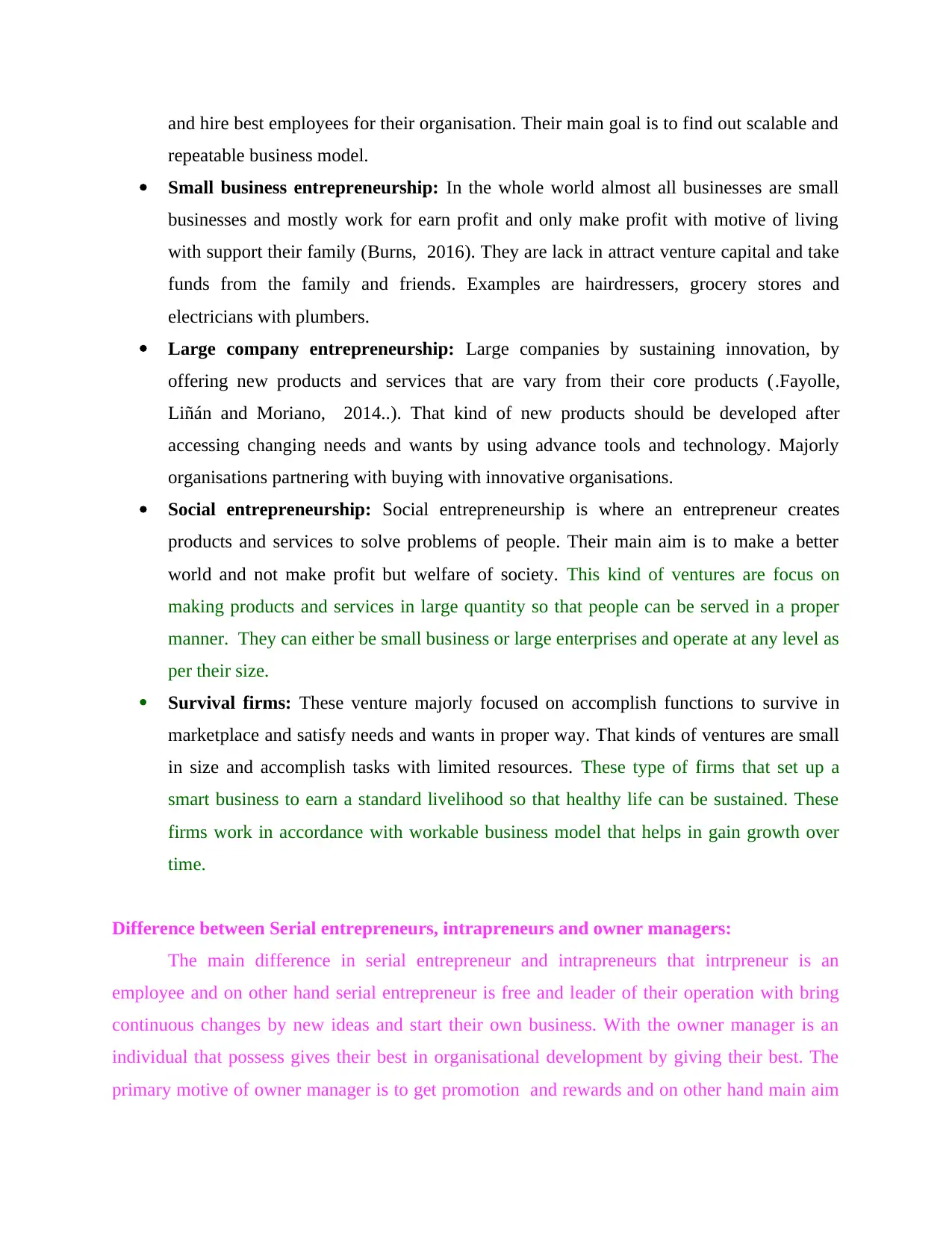
and hire best employees for their organisation. Their main goal is to find out scalable and
repeatable business model.
Small business entrepreneurship: In the whole world almost all businesses are small
businesses and mostly work for earn profit and only make profit with motive of living
with support their family (Burns, 2016). They are lack in attract venture capital and take
funds from the family and friends. Examples are hairdressers, grocery stores and
electricians with plumbers.
Large company entrepreneurship: Large companies by sustaining innovation, by
offering new products and services that are vary from their core products (.Fayolle,
Liñán and Moriano, 2014..). That kind of new products should be developed after
accessing changing needs and wants by using advance tools and technology. Majorly
organisations partnering with buying with innovative organisations.
Social entrepreneurship: Social entrepreneurship is where an entrepreneur creates
products and services to solve problems of people. Their main aim is to make a better
world and not make profit but welfare of society. This kind of ventures are focus on
making products and services in large quantity so that people can be served in a proper
manner. They can either be small business or large enterprises and operate at any level as
per their size.
Survival firms: These venture majorly focused on accomplish functions to survive in
marketplace and satisfy needs and wants in proper way. That kinds of ventures are small
in size and accomplish tasks with limited resources. These type of firms that set up a
smart business to earn a standard livelihood so that healthy life can be sustained. These
firms work in accordance with workable business model that helps in gain growth over
time.
Difference between Serial entrepreneurs, intrapreneurs and owner managers:
The main difference in serial entrepreneur and intrapreneurs that intrpreneur is an
employee and on other hand serial entrepreneur is free and leader of their operation with bring
continuous changes by new ideas and start their own business. With the owner manager is an
individual that possess gives their best in organisational development by giving their best. The
primary motive of owner manager is to get promotion and rewards and on other hand main aim
repeatable business model.
Small business entrepreneurship: In the whole world almost all businesses are small
businesses and mostly work for earn profit and only make profit with motive of living
with support their family (Burns, 2016). They are lack in attract venture capital and take
funds from the family and friends. Examples are hairdressers, grocery stores and
electricians with plumbers.
Large company entrepreneurship: Large companies by sustaining innovation, by
offering new products and services that are vary from their core products (.Fayolle,
Liñán and Moriano, 2014..). That kind of new products should be developed after
accessing changing needs and wants by using advance tools and technology. Majorly
organisations partnering with buying with innovative organisations.
Social entrepreneurship: Social entrepreneurship is where an entrepreneur creates
products and services to solve problems of people. Their main aim is to make a better
world and not make profit but welfare of society. This kind of ventures are focus on
making products and services in large quantity so that people can be served in a proper
manner. They can either be small business or large enterprises and operate at any level as
per their size.
Survival firms: These venture majorly focused on accomplish functions to survive in
marketplace and satisfy needs and wants in proper way. That kinds of ventures are small
in size and accomplish tasks with limited resources. These type of firms that set up a
smart business to earn a standard livelihood so that healthy life can be sustained. These
firms work in accordance with workable business model that helps in gain growth over
time.
Difference between Serial entrepreneurs, intrapreneurs and owner managers:
The main difference in serial entrepreneur and intrapreneurs that intrpreneur is an
employee and on other hand serial entrepreneur is free and leader of their operation with bring
continuous changes by new ideas and start their own business. With the owner manager is an
individual that possess gives their best in organisational development by giving their best. The
primary motive of owner manager is to get promotion and rewards and on other hand main aim
Paraphrase This Document
Need a fresh take? Get an instant paraphrase of this document with our AI Paraphraser
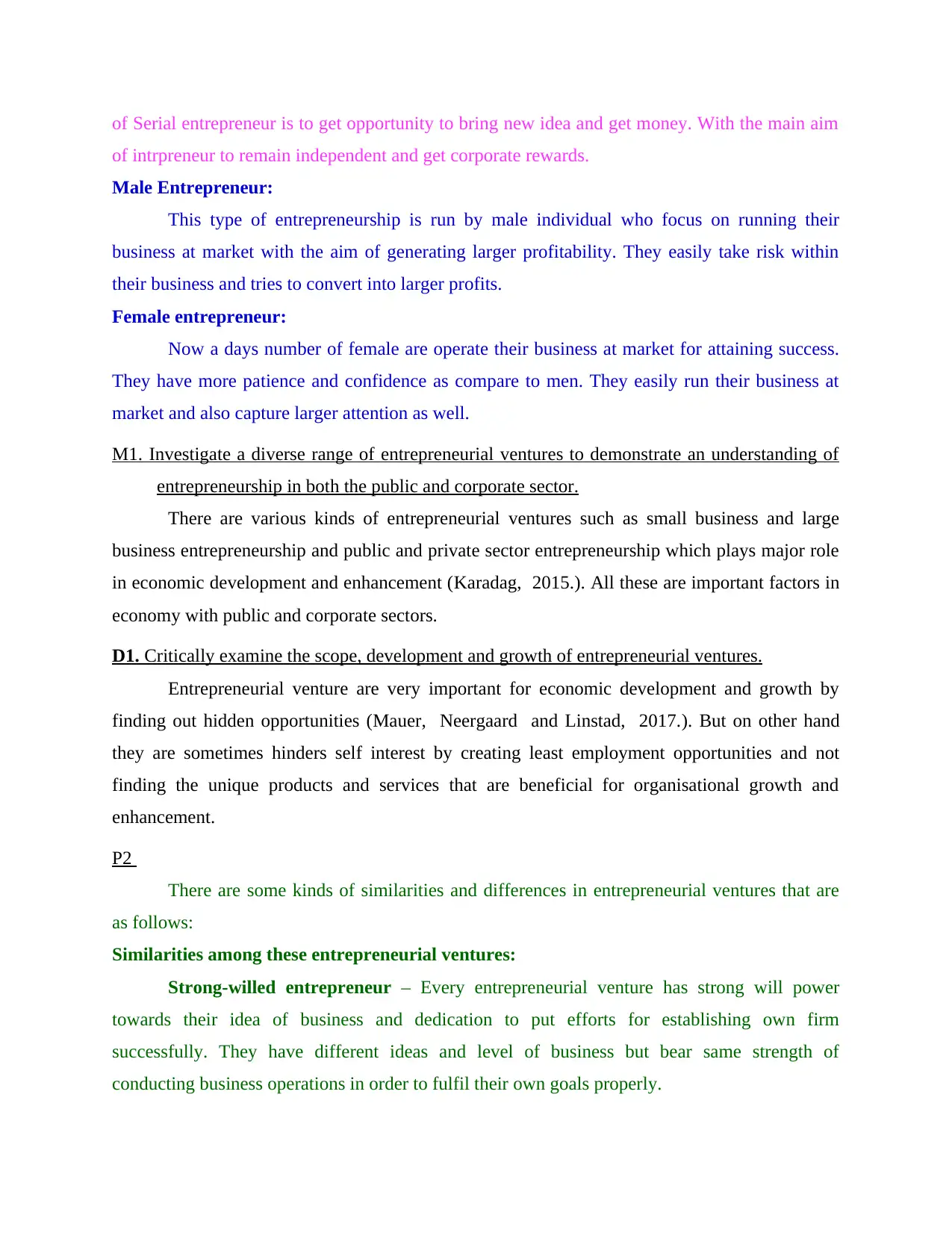
of Serial entrepreneur is to get opportunity to bring new idea and get money. With the main aim
of intrpreneur to remain independent and get corporate rewards.
Male Entrepreneur:
This type of entrepreneurship is run by male individual who focus on running their
business at market with the aim of generating larger profitability. They easily take risk within
their business and tries to convert into larger profits.
Female entrepreneur:
Now a days number of female are operate their business at market for attaining success.
They have more patience and confidence as compare to men. They easily run their business at
market and also capture larger attention as well.
M1. Investigate a diverse range of entrepreneurial ventures to demonstrate an understanding of
entrepreneurship in both the public and corporate sector.
There are various kinds of entrepreneurial ventures such as small business and large
business entrepreneurship and public and private sector entrepreneurship which plays major role
in economic development and enhancement (Karadag, 2015.). All these are important factors in
economy with public and corporate sectors.
D1. Critically examine the scope, development and growth of entrepreneurial ventures.
Entrepreneurial venture are very important for economic development and growth by
finding out hidden opportunities (Mauer, Neergaard and Linstad, 2017.). But on other hand
they are sometimes hinders self interest by creating least employment opportunities and not
finding the unique products and services that are beneficial for organisational growth and
enhancement.
P2
There are some kinds of similarities and differences in entrepreneurial ventures that are
as follows:
Similarities among these entrepreneurial ventures:
Strong-willed entrepreneur – Every entrepreneurial venture has strong will power
towards their idea of business and dedication to put efforts for establishing own firm
successfully. They have different ideas and level of business but bear same strength of
conducting business operations in order to fulfil their own goals properly.
of intrpreneur to remain independent and get corporate rewards.
Male Entrepreneur:
This type of entrepreneurship is run by male individual who focus on running their
business at market with the aim of generating larger profitability. They easily take risk within
their business and tries to convert into larger profits.
Female entrepreneur:
Now a days number of female are operate their business at market for attaining success.
They have more patience and confidence as compare to men. They easily run their business at
market and also capture larger attention as well.
M1. Investigate a diverse range of entrepreneurial ventures to demonstrate an understanding of
entrepreneurship in both the public and corporate sector.
There are various kinds of entrepreneurial ventures such as small business and large
business entrepreneurship and public and private sector entrepreneurship which plays major role
in economic development and enhancement (Karadag, 2015.). All these are important factors in
economy with public and corporate sectors.
D1. Critically examine the scope, development and growth of entrepreneurial ventures.
Entrepreneurial venture are very important for economic development and growth by
finding out hidden opportunities (Mauer, Neergaard and Linstad, 2017.). But on other hand
they are sometimes hinders self interest by creating least employment opportunities and not
finding the unique products and services that are beneficial for organisational growth and
enhancement.
P2
There are some kinds of similarities and differences in entrepreneurial ventures that are
as follows:
Similarities among these entrepreneurial ventures:
Strong-willed entrepreneur – Every entrepreneurial venture has strong will power
towards their idea of business and dedication to put efforts for establishing own firm
successfully. They have different ideas and level of business but bear same strength of
conducting business operations in order to fulfil their own goals properly.
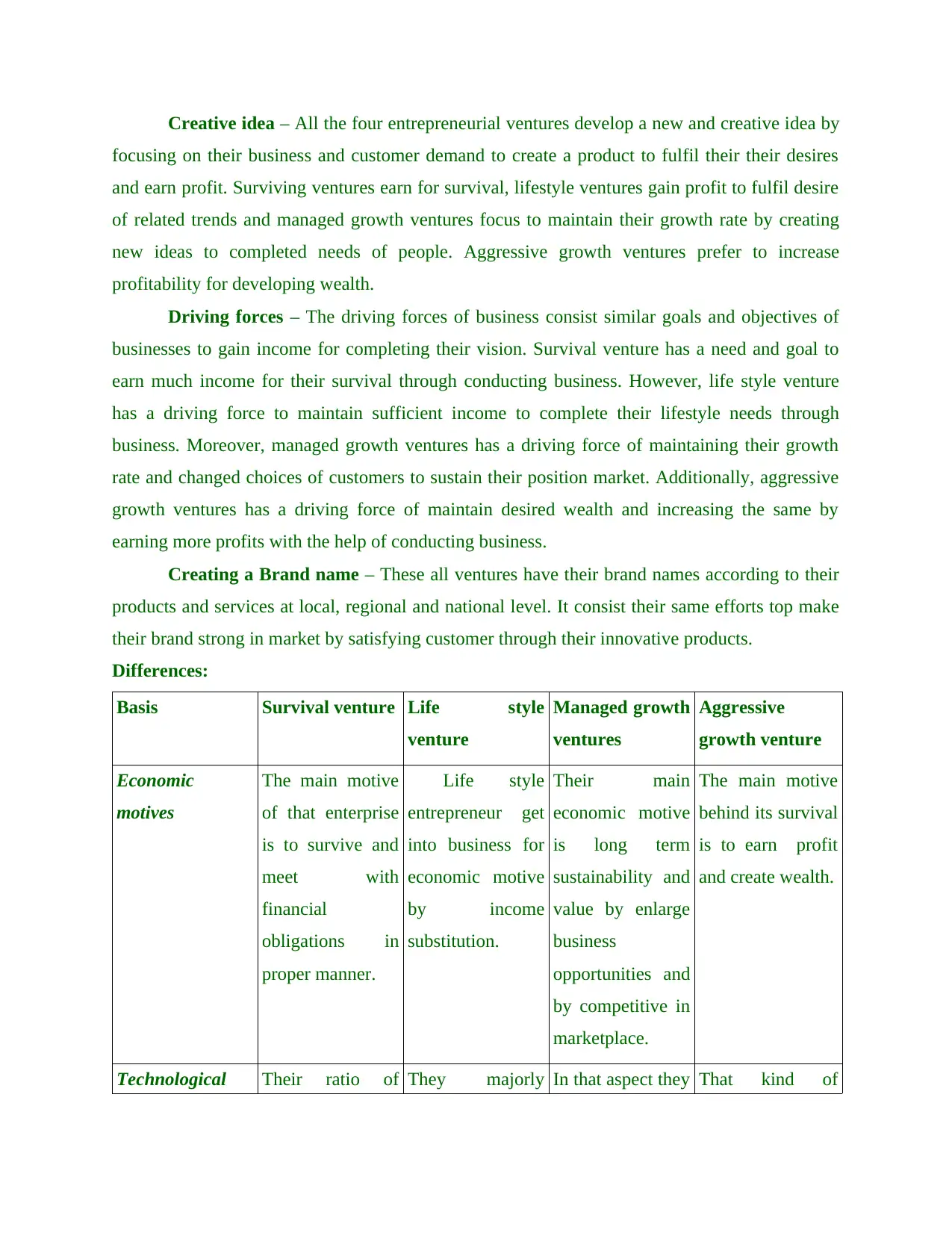
Creative idea – All the four entrepreneurial ventures develop a new and creative idea by
focusing on their business and customer demand to create a product to fulfil their their desires
and earn profit. Surviving ventures earn for survival, lifestyle ventures gain profit to fulfil desire
of related trends and managed growth ventures focus to maintain their growth rate by creating
new ideas to completed needs of people. Aggressive growth ventures prefer to increase
profitability for developing wealth.
Driving forces – The driving forces of business consist similar goals and objectives of
businesses to gain income for completing their vision. Survival venture has a need and goal to
earn much income for their survival through conducting business. However, life style venture
has a driving force to maintain sufficient income to complete their lifestyle needs through
business. Moreover, managed growth ventures has a driving force of maintaining their growth
rate and changed choices of customers to sustain their position market. Additionally, aggressive
growth ventures has a driving force of maintain desired wealth and increasing the same by
earning more profits with the help of conducting business.
Creating a Brand name – These all ventures have their brand names according to their
products and services at local, regional and national level. It consist their same efforts top make
their brand strong in market by satisfying customer through their innovative products.
Differences:
Basis Survival venture Life style
venture
Managed growth
ventures
Aggressive
growth venture
Economic
motives
The main motive
of that enterprise
is to survive and
meet with
financial
obligations in
proper manner.
Life style
entrepreneur get
into business for
economic motive
by income
substitution.
Their main
economic motive
is long term
sustainability and
value by enlarge
business
opportunities and
by competitive in
marketplace.
The main motive
behind its survival
is to earn profit
and create wealth.
Technological Their ratio of They majorly In that aspect they That kind of
focusing on their business and customer demand to create a product to fulfil their their desires
and earn profit. Surviving ventures earn for survival, lifestyle ventures gain profit to fulfil desire
of related trends and managed growth ventures focus to maintain their growth rate by creating
new ideas to completed needs of people. Aggressive growth ventures prefer to increase
profitability for developing wealth.
Driving forces – The driving forces of business consist similar goals and objectives of
businesses to gain income for completing their vision. Survival venture has a need and goal to
earn much income for their survival through conducting business. However, life style venture
has a driving force to maintain sufficient income to complete their lifestyle needs through
business. Moreover, managed growth ventures has a driving force of maintaining their growth
rate and changed choices of customers to sustain their position market. Additionally, aggressive
growth ventures has a driving force of maintain desired wealth and increasing the same by
earning more profits with the help of conducting business.
Creating a Brand name – These all ventures have their brand names according to their
products and services at local, regional and national level. It consist their same efforts top make
their brand strong in market by satisfying customer through their innovative products.
Differences:
Basis Survival venture Life style
venture
Managed growth
ventures
Aggressive
growth venture
Economic
motives
The main motive
of that enterprise
is to survive and
meet with
financial
obligations in
proper manner.
Life style
entrepreneur get
into business for
economic motive
by income
substitution.
Their main
economic motive
is long term
sustainability and
value by enlarge
business
opportunities and
by competitive in
marketplace.
The main motive
behind its survival
is to earn profit
and create wealth.
Technological Their ratio of They majorly In that aspect they That kind of
⊘ This is a preview!⊘
Do you want full access?
Subscribe today to unlock all pages.
Trusted by 1+ million students worldwide
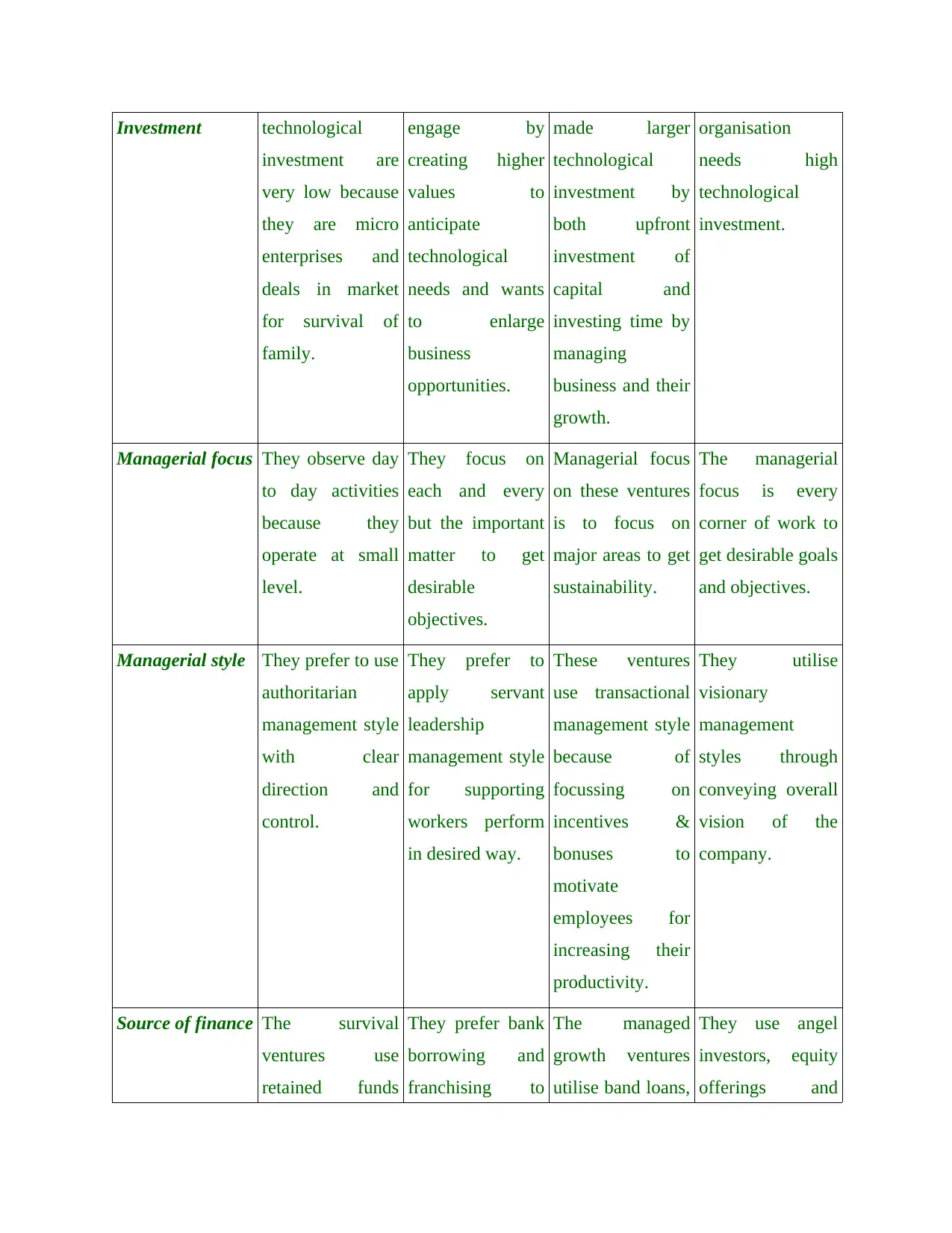
Investment technological
investment are
very low because
they are micro
enterprises and
deals in market
for survival of
family.
engage by
creating higher
values to
anticipate
technological
needs and wants
to enlarge
business
opportunities.
made larger
technological
investment by
both upfront
investment of
capital and
investing time by
managing
business and their
growth.
organisation
needs high
technological
investment.
Managerial focus They observe day
to day activities
because they
operate at small
level.
They focus on
each and every
but the important
matter to get
desirable
objectives.
Managerial focus
on these ventures
is to focus on
major areas to get
sustainability.
The managerial
focus is every
corner of work to
get desirable goals
and objectives.
Managerial style They prefer to use
authoritarian
management style
with clear
direction and
control.
They prefer to
apply servant
leadership
management style
for supporting
workers perform
in desired way.
These ventures
use transactional
management style
because of
focussing on
incentives &
bonuses to
motivate
employees for
increasing their
productivity.
They utilise
visionary
management
styles through
conveying overall
vision of the
company.
Source of finance The survival
ventures use
retained funds
They prefer bank
borrowing and
franchising to
The managed
growth ventures
utilise band loans,
They use angel
investors, equity
offerings and
investment are
very low because
they are micro
enterprises and
deals in market
for survival of
family.
engage by
creating higher
values to
anticipate
technological
needs and wants
to enlarge
business
opportunities.
made larger
technological
investment by
both upfront
investment of
capital and
investing time by
managing
business and their
growth.
organisation
needs high
technological
investment.
Managerial focus They observe day
to day activities
because they
operate at small
level.
They focus on
each and every
but the important
matter to get
desirable
objectives.
Managerial focus
on these ventures
is to focus on
major areas to get
sustainability.
The managerial
focus is every
corner of work to
get desirable goals
and objectives.
Managerial style They prefer to use
authoritarian
management style
with clear
direction and
control.
They prefer to
apply servant
leadership
management style
for supporting
workers perform
in desired way.
These ventures
use transactional
management style
because of
focussing on
incentives &
bonuses to
motivate
employees for
increasing their
productivity.
They utilise
visionary
management
styles through
conveying overall
vision of the
company.
Source of finance The survival
ventures use
retained funds
They prefer bank
borrowing and
franchising to
The managed
growth ventures
utilise band loans,
They use angel
investors, equity
offerings and
Paraphrase This Document
Need a fresh take? Get an instant paraphrase of this document with our AI Paraphraser
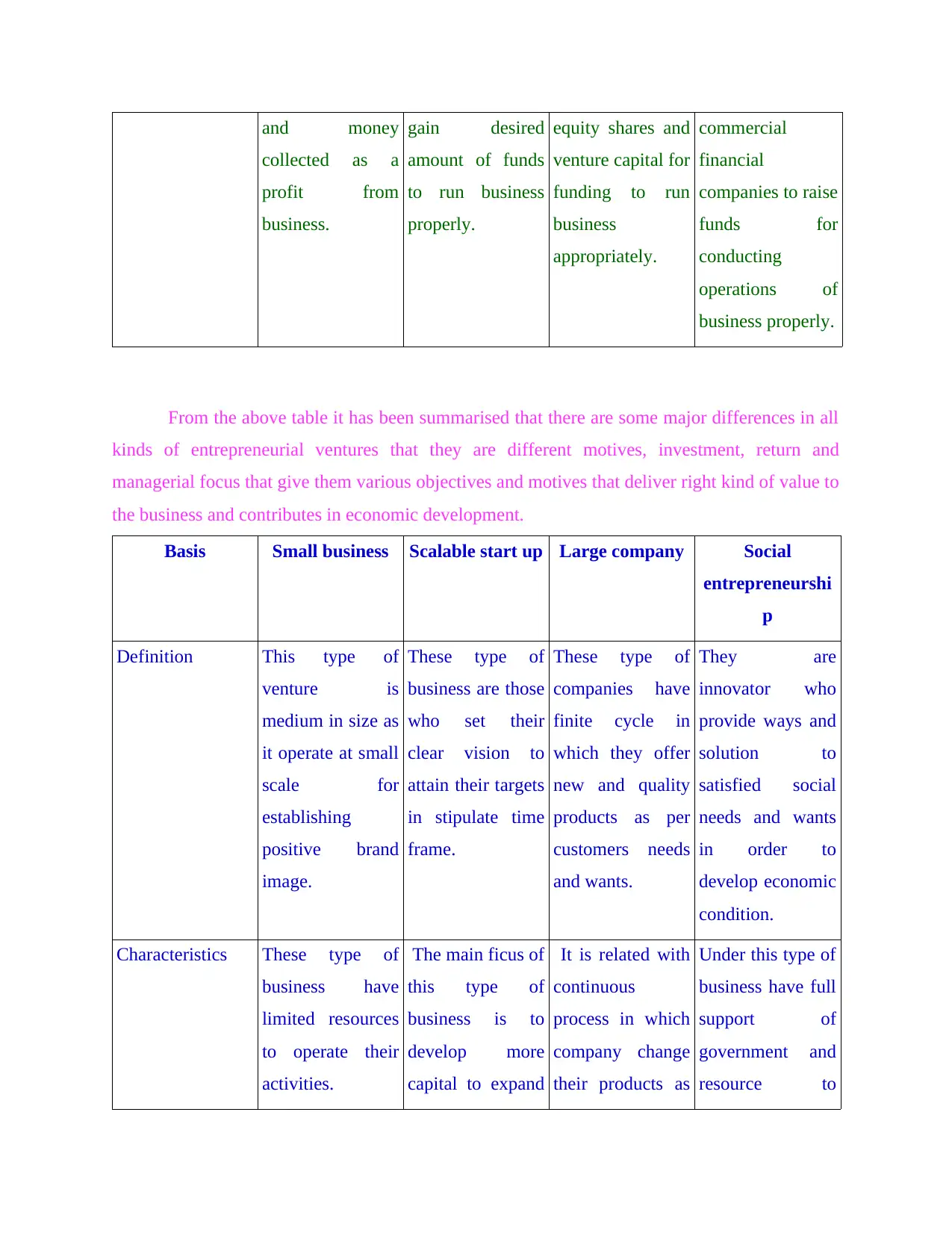
and money
collected as a
profit from
business.
gain desired
amount of funds
to run business
properly.
equity shares and
venture capital for
funding to run
business
appropriately.
commercial
financial
companies to raise
funds for
conducting
operations of
business properly.
From the above table it has been summarised that there are some major differences in all
kinds of entrepreneurial ventures that they are different motives, investment, return and
managerial focus that give them various objectives and motives that deliver right kind of value to
the business and contributes in economic development.
Basis Small business Scalable start up Large company Social
entrepreneurshi
p
Definition This type of
venture is
medium in size as
it operate at small
scale for
establishing
positive brand
image.
These type of
business are those
who set their
clear vision to
attain their targets
in stipulate time
frame.
These type of
companies have
finite cycle in
which they offer
new and quality
products as per
customers needs
and wants.
They are
innovator who
provide ways and
solution to
satisfied social
needs and wants
in order to
develop economic
condition.
Characteristics These type of
business have
limited resources
to operate their
activities.
The main ficus of
this type of
business is to
develop more
capital to expand
It is related with
continuous
process in which
company change
their products as
Under this type of
business have full
support of
government and
resource to
collected as a
profit from
business.
gain desired
amount of funds
to run business
properly.
equity shares and
venture capital for
funding to run
business
appropriately.
commercial
financial
companies to raise
funds for
conducting
operations of
business properly.
From the above table it has been summarised that there are some major differences in all
kinds of entrepreneurial ventures that they are different motives, investment, return and
managerial focus that give them various objectives and motives that deliver right kind of value to
the business and contributes in economic development.
Basis Small business Scalable start up Large company Social
entrepreneurshi
p
Definition This type of
venture is
medium in size as
it operate at small
scale for
establishing
positive brand
image.
These type of
business are those
who set their
clear vision to
attain their targets
in stipulate time
frame.
These type of
companies have
finite cycle in
which they offer
new and quality
products as per
customers needs
and wants.
They are
innovator who
provide ways and
solution to
satisfied social
needs and wants
in order to
develop economic
condition.
Characteristics These type of
business have
limited resources
to operate their
activities.
The main ficus of
this type of
business is to
develop more
capital to expand
It is related with
continuous
process in which
company change
their products as
Under this type of
business have full
support of
government and
resource to
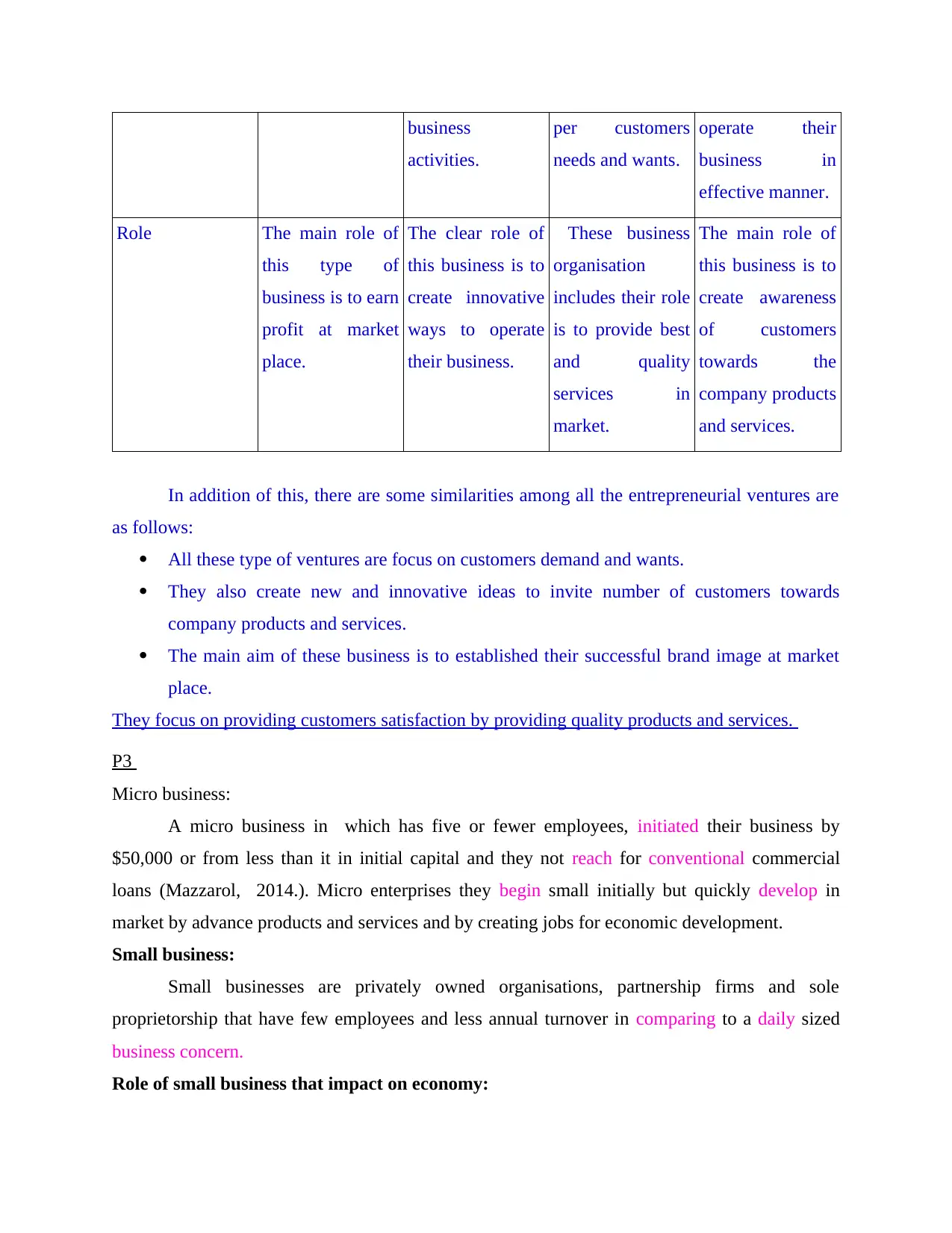
business
activities.
per customers
needs and wants.
operate their
business in
effective manner.
Role The main role of
this type of
business is to earn
profit at market
place.
The clear role of
this business is to
create innovative
ways to operate
their business.
These business
organisation
includes their role
is to provide best
and quality
services in
market.
The main role of
this business is to
create awareness
of customers
towards the
company products
and services.
In addition of this, there are some similarities among all the entrepreneurial ventures are
as follows:
All these type of ventures are focus on customers demand and wants.
They also create new and innovative ideas to invite number of customers towards
company products and services.
The main aim of these business is to established their successful brand image at market
place.
They focus on providing customers satisfaction by providing quality products and services.
P3
Micro business:
A micro business in which has five or fewer employees, initiated their business by
$50,000 or from less than it in initial capital and they not reach for conventional commercial
loans (Mazzarol, 2014.). Micro enterprises they begin small initially but quickly develop in
market by advance products and services and by creating jobs for economic development.
Small business:
Small businesses are privately owned organisations, partnership firms and sole
proprietorship that have few employees and less annual turnover in comparing to a daily sized
business concern.
Role of small business that impact on economy:
activities.
per customers
needs and wants.
operate their
business in
effective manner.
Role The main role of
this type of
business is to earn
profit at market
place.
The clear role of
this business is to
create innovative
ways to operate
their business.
These business
organisation
includes their role
is to provide best
and quality
services in
market.
The main role of
this business is to
create awareness
of customers
towards the
company products
and services.
In addition of this, there are some similarities among all the entrepreneurial ventures are
as follows:
All these type of ventures are focus on customers demand and wants.
They also create new and innovative ideas to invite number of customers towards
company products and services.
The main aim of these business is to established their successful brand image at market
place.
They focus on providing customers satisfaction by providing quality products and services.
P3
Micro business:
A micro business in which has five or fewer employees, initiated their business by
$50,000 or from less than it in initial capital and they not reach for conventional commercial
loans (Mazzarol, 2014.). Micro enterprises they begin small initially but quickly develop in
market by advance products and services and by creating jobs for economic development.
Small business:
Small businesses are privately owned organisations, partnership firms and sole
proprietorship that have few employees and less annual turnover in comparing to a daily sized
business concern.
Role of small business that impact on economy:
⊘ This is a preview!⊘
Do you want full access?
Subscribe today to unlock all pages.
Trusted by 1+ million students worldwide

1 out of 30


Related Documents


Your All-in-One AI-Powered Toolkit for Academic Success.
+13062052269
info@desklib.com
Available 24*7 on WhatsApp / Email
![[object Object]](/_next/static/media/star-bottom.7253800d.svg)
Unlock your academic potential
Copyright © 2020–2026 A2Z Services. All Rights Reserved. Developed and managed by ZUCOL.