Entrepreneurial Capital Sources and Sustainability: Method Home Essay
VerifiedAdded on 2020/01/21
|11
|4525
|32
Essay
AI Summary
This essay delves into the meaning of entrepreneurship, differentiating between manufacturing and innovative entrepreneurs, and highlighting their role in identifying market opportunities. It uses Method Home as a case study, analyzing its approach to sustainable practices and environmental awareness, including its product life cycle and eco-friendly initiatives. The essay contrasts Method Home's approach with conventional business practices, focusing on the company's founders, philosophy, and contributions to its success through its brand name and commitment to sustainability. The discussion covers the company's use of green materials, efficient resource utilization, and eco-friendly product design, emphasizing its commitment to environmental responsibility and market success.
Capital Sources
1ed on form
1ed on form

Paraphrase This Document
Need a fresh take? Get an instant paraphrase of this document with our AI Paraphraser
ESSAY
Meaning of entrepreneurs
Entrepreneurs are the person who contributes their risky capital to exercise initiative by
operating a venture. They take risk to conduct business activities and regularly monitor it so as to
establish effective control to run organization successfully. Along with this, different author’s gives
define entrepreneurs in different manner. According to Baumol (2008), private entrepreneurs are the
person who set up their business in the market and bears the entire risk involved to assure regular
business functioning without any hazards. They view business profits as a standard of measuring
business success or achievement. On contrary, as per the view point of Koellinger (2008) innovative
entrepreneurs are those who produce innovative goods, use new production ways and techniques,
identify new market and reorganise the business accordingly. However, as per Ahuja, and Khamba
(2008) manufacturing entrepreneurs are those who are engaging in the manufacturing functions.
They assess customer requirement and then explore diverse resources and technology as well to
produce goods to meet customer demand.
Method home was established in the year 2001 and headquartered in San Francisco,
California, United States. It produces various non-toxic and biodegradable natural cleaning supplies
to large number of consumers. Hence, the owner is involved in production functions to manufacture
different types of products such as body lotions, home cleaners, hand wash products, laundry and
air care and dish cleaner as well. Therefore, as per the view point of Sinha, (2013), it can be said
that Method home's owner is manufacturing entrepreneur who use convert raw material into
finished goods and sell it into the market so as to get high turnover. Moreover, Method home
regularly keep focus on changing customer need so as to bring innovations in their product
portfolio. It represent that owner is innovative entrepreneur as he produce innovated cleaners such
as anti bacteria cleaners, bathroom cleaners, speciality cleaner, different hand washers, multiple
flavours of air fresheners etc.
Identified opportunities by the entrepreneurs
Looking at the present era, market is highly competitive and becomes tougher day by day.
Henceforth, it becomes essential for all the entrepreneurs to consider their market changes to
determine future opportunities and threats as well. According to Sharma (2014) conducting an in-
depth analysis of market changes helps ventures to minimize their risk and take maximum benefits
of identified opportunities. Manufacturing and innovative entrepreneurs assess market changes to
identify potential opportunities and thereby implement changes in the Method home company. Both
the entrepreneurs track market environment to accept challenges and satisfy customer need so as to
2ed on form
Meaning of entrepreneurs
Entrepreneurs are the person who contributes their risky capital to exercise initiative by
operating a venture. They take risk to conduct business activities and regularly monitor it so as to
establish effective control to run organization successfully. Along with this, different author’s gives
define entrepreneurs in different manner. According to Baumol (2008), private entrepreneurs are the
person who set up their business in the market and bears the entire risk involved to assure regular
business functioning without any hazards. They view business profits as a standard of measuring
business success or achievement. On contrary, as per the view point of Koellinger (2008) innovative
entrepreneurs are those who produce innovative goods, use new production ways and techniques,
identify new market and reorganise the business accordingly. However, as per Ahuja, and Khamba
(2008) manufacturing entrepreneurs are those who are engaging in the manufacturing functions.
They assess customer requirement and then explore diverse resources and technology as well to
produce goods to meet customer demand.
Method home was established in the year 2001 and headquartered in San Francisco,
California, United States. It produces various non-toxic and biodegradable natural cleaning supplies
to large number of consumers. Hence, the owner is involved in production functions to manufacture
different types of products such as body lotions, home cleaners, hand wash products, laundry and
air care and dish cleaner as well. Therefore, as per the view point of Sinha, (2013), it can be said
that Method home's owner is manufacturing entrepreneur who use convert raw material into
finished goods and sell it into the market so as to get high turnover. Moreover, Method home
regularly keep focus on changing customer need so as to bring innovations in their product
portfolio. It represent that owner is innovative entrepreneur as he produce innovated cleaners such
as anti bacteria cleaners, bathroom cleaners, speciality cleaner, different hand washers, multiple
flavours of air fresheners etc.
Identified opportunities by the entrepreneurs
Looking at the present era, market is highly competitive and becomes tougher day by day.
Henceforth, it becomes essential for all the entrepreneurs to consider their market changes to
determine future opportunities and threats as well. According to Sharma (2014) conducting an in-
depth analysis of market changes helps ventures to minimize their risk and take maximum benefits
of identified opportunities. Manufacturing and innovative entrepreneurs assess market changes to
identify potential opportunities and thereby implement changes in the Method home company. Both
the entrepreneurs track market environment to accept challenges and satisfy customer need so as to
2ed on form
establish a good position. As per the view point of Ahuja, and Khamba (2008) manufacturing
entrepreneurs buy material today and combined it into the production process to achieve desired
production output which will be sell in future at high prices than current cost. Hence, they
determine opportunities to ensure effective allocation of resources so as to minimise production cost
and maximise return. Moreover, they ensure timely production so as to fulfil customer demand
timely otherwise, Method home can lose their customer base. Further, they found suppliers whose
prices are comparatively less than their competitors to reduce material costs. Hiring skilled labour at
less piece rate also helps firm to maintain their labour costs. All this helps to maintain overall
production costs as per targets and results in high profitability. According to Sinha, (2013)
innovative entrepreneurs search opportunities regarding advanced manufacturing techniques such as
technologies, new product development and may be for some innovative features in current product
and services. Method home is offering innovated products for home cleaning, body moisturisers,
hand cleaners and air fresheners with different flavours. is designing green products to provide safe
environment to the community. It developed its products through emphasizing environmental
aspects of the household cleaners. Further, according to Baumol (2008), its material scorecard is
designed by Dr. Michael Braungart's team of Environmental Protection and Encouragement Agency
(EPEA) which assure material sustainability. Founders of company are engaging in searching for
new ways to produce safe and effective cleaning products. Its chemical engineers (Adam Lowry) ,
cutting edge designers and worldwide distribution power greatly assist firm to accomplish their
strategic goals. Moreover, natural products, safe processing, minimum climate effects, efficient use
of energy, reduction in material waste and recycled material are the factors through which Method
home is fulfilling their responsibility. Along with this, it use greenest bottle for product packaging
so as to ensure long term sustainability at high competitive strength. Both the entrepreneurs
identified market opportunities by introducing new and future products, processes, services and
advanced technologies, markets and alternatives ways of doing business. Method home company
uses different alternatives so as to run business operational successfully and for longer duration.
Sustainability and environment awareness meaning
As per the view point of Hutchins and Sutherland, (2008) sustainability refers to the
endurance of business systems and processes with having the objective to ensure sustainable
development. Likewise, Barnea and Rubin (2010) said that it is the ability or capability to maintain
sustainability for longer duration. In other words, it is the ability to continue a specified behaviour
for indefinite period of time. On contrary to it, Kassoy (2010) said that sustainability means the
quality of not harming the environment or depletion of natural resources which helps to maintain
ecological balance. Furthermore, according to Bebbington, Unerman and O'Dwyer (2014), there are
3ed on form
entrepreneurs buy material today and combined it into the production process to achieve desired
production output which will be sell in future at high prices than current cost. Hence, they
determine opportunities to ensure effective allocation of resources so as to minimise production cost
and maximise return. Moreover, they ensure timely production so as to fulfil customer demand
timely otherwise, Method home can lose their customer base. Further, they found suppliers whose
prices are comparatively less than their competitors to reduce material costs. Hiring skilled labour at
less piece rate also helps firm to maintain their labour costs. All this helps to maintain overall
production costs as per targets and results in high profitability. According to Sinha, (2013)
innovative entrepreneurs search opportunities regarding advanced manufacturing techniques such as
technologies, new product development and may be for some innovative features in current product
and services. Method home is offering innovated products for home cleaning, body moisturisers,
hand cleaners and air fresheners with different flavours. is designing green products to provide safe
environment to the community. It developed its products through emphasizing environmental
aspects of the household cleaners. Further, according to Baumol (2008), its material scorecard is
designed by Dr. Michael Braungart's team of Environmental Protection and Encouragement Agency
(EPEA) which assure material sustainability. Founders of company are engaging in searching for
new ways to produce safe and effective cleaning products. Its chemical engineers (Adam Lowry) ,
cutting edge designers and worldwide distribution power greatly assist firm to accomplish their
strategic goals. Moreover, natural products, safe processing, minimum climate effects, efficient use
of energy, reduction in material waste and recycled material are the factors through which Method
home is fulfilling their responsibility. Along with this, it use greenest bottle for product packaging
so as to ensure long term sustainability at high competitive strength. Both the entrepreneurs
identified market opportunities by introducing new and future products, processes, services and
advanced technologies, markets and alternatives ways of doing business. Method home company
uses different alternatives so as to run business operational successfully and for longer duration.
Sustainability and environment awareness meaning
As per the view point of Hutchins and Sutherland, (2008) sustainability refers to the
endurance of business systems and processes with having the objective to ensure sustainable
development. Likewise, Barnea and Rubin (2010) said that it is the ability or capability to maintain
sustainability for longer duration. In other words, it is the ability to continue a specified behaviour
for indefinite period of time. On contrary to it, Kassoy (2010) said that sustainability means the
quality of not harming the environment or depletion of natural resources which helps to maintain
ecological balance. Furthermore, according to Bebbington, Unerman and O'Dwyer (2014), there are
3ed on form
⊘ This is a preview!⊘
Do you want full access?
Subscribe today to unlock all pages.

Trusted by 1+ million students worldwide
three pillars of sustainability that are environmental, economic and social. In such respect,
environment sustainability is the process or actions to maintain effective use of renewable
resources, control pollution, reduce scrap and wastage etc. Contrary, Amin, Razmi and Zhang
(2011) demonstrated that economic sustainability is the ability to ensure definite production for
indefinite period. However, as per Lee (2008) ability to operate business functions in various
countries of the world is known as social sustainability.
From the above discussion, it is clear that it is essential for the organizations to ensure
sustainability so that it can run business operations for a longer duration. All the companies are the
part of society as they establish in the society, use resources such as human capital and offer
services to the community. Henceforth, it is necessary for them to ensure environmental safety for
the public by accomplishing their environmental duties. All the firms incorporate environmental
objectives in their corporate strategy to bring awareness and assure sustainability as well. Method
Home products Inc, aims at providing environmentally friendly products. Hence, primary focus of
the company is to use greenest material from green companies. Its corporate strategy is to
manufacture climate conscious products by using responsible ingredients.
Environment awareness and sustainability at each stage of product life cycle
According to Ayres, Ayres and Råde (2013), every products progress in the market through a
sequence of stages which are known as product life cycle. The stages comprises introduction stage,
growth stage, maturity stage and decline stage. All the stages are greatly affected by the market
fluctuations and thereby impact Method home's marketing strategy and marketing mix to a great
extent. In context to Method Home Products Inc, it aims at offering eco-friendly products at each
and every stage of product life cycle. Method home offers products which have been produced
through using green material and effective utilization of resources. It used pin shaped and teardrop
bottles which are made from 100% recyclable plastic to decline their environmental footprint.
Unlike this, competitors are using plastic material which is harmful for the society. Moreover,
company is recycling their products to utilize resources in an optimum manner.
Its product packaging is very effective hence; customers can use packed containers for some
other purpose. Chemical is also using in less quantity and natural resources are using comparatively
in high proportion to ensure environmental safety. In addition to it, company has been certified by
B. Corporation and rated the score of 128.5 which indicates that Method home is fulfilling their
environment responsibilities. In accordance with Polanyi (2015), it designs green card program in
which packaging is designed by considering recyclability, weight and reusability as well. In
addition, its wind and solar energy system helps to reduce carbon footprint. In addition, on-site
renewable energy generation and uses on energy efficient equipment is very effective sustainable
4ed on form
environment sustainability is the process or actions to maintain effective use of renewable
resources, control pollution, reduce scrap and wastage etc. Contrary, Amin, Razmi and Zhang
(2011) demonstrated that economic sustainability is the ability to ensure definite production for
indefinite period. However, as per Lee (2008) ability to operate business functions in various
countries of the world is known as social sustainability.
From the above discussion, it is clear that it is essential for the organizations to ensure
sustainability so that it can run business operations for a longer duration. All the companies are the
part of society as they establish in the society, use resources such as human capital and offer
services to the community. Henceforth, it is necessary for them to ensure environmental safety for
the public by accomplishing their environmental duties. All the firms incorporate environmental
objectives in their corporate strategy to bring awareness and assure sustainability as well. Method
Home products Inc, aims at providing environmentally friendly products. Hence, primary focus of
the company is to use greenest material from green companies. Its corporate strategy is to
manufacture climate conscious products by using responsible ingredients.
Environment awareness and sustainability at each stage of product life cycle
According to Ayres, Ayres and Råde (2013), every products progress in the market through a
sequence of stages which are known as product life cycle. The stages comprises introduction stage,
growth stage, maturity stage and decline stage. All the stages are greatly affected by the market
fluctuations and thereby impact Method home's marketing strategy and marketing mix to a great
extent. In context to Method Home Products Inc, it aims at offering eco-friendly products at each
and every stage of product life cycle. Method home offers products which have been produced
through using green material and effective utilization of resources. It used pin shaped and teardrop
bottles which are made from 100% recyclable plastic to decline their environmental footprint.
Unlike this, competitors are using plastic material which is harmful for the society. Moreover,
company is recycling their products to utilize resources in an optimum manner.
Its product packaging is very effective hence; customers can use packed containers for some
other purpose. Chemical is also using in less quantity and natural resources are using comparatively
in high proportion to ensure environmental safety. In addition to it, company has been certified by
B. Corporation and rated the score of 128.5 which indicates that Method home is fulfilling their
environment responsibilities. In accordance with Polanyi (2015), it designs green card program in
which packaging is designed by considering recyclability, weight and reusability as well. In
addition, its wind and solar energy system helps to reduce carbon footprint. In addition, on-site
renewable energy generation and uses on energy efficient equipment is very effective sustainable
4ed on form
Paraphrase This Document
Need a fresh take? Get an instant paraphrase of this document with our AI Paraphraser
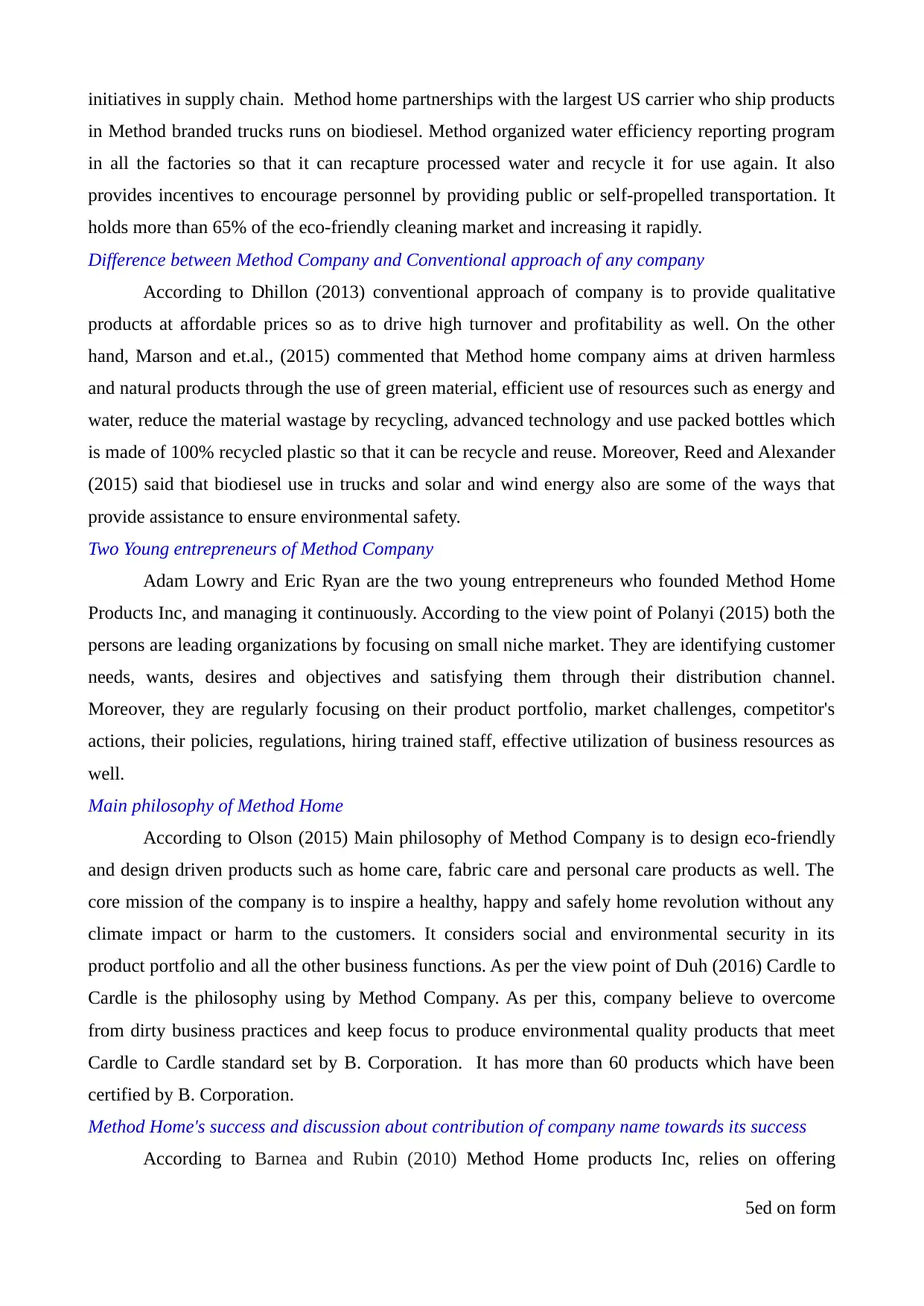
initiatives in supply chain. Method home partnerships with the largest US carrier who ship products
in Method branded trucks runs on biodiesel. Method organized water efficiency reporting program
in all the factories so that it can recapture processed water and recycle it for use again. It also
provides incentives to encourage personnel by providing public or self-propelled transportation. It
holds more than 65% of the eco-friendly cleaning market and increasing it rapidly.
Difference between Method Company and Conventional approach of any company
According to Dhillon (2013) conventional approach of company is to provide qualitative
products at affordable prices so as to drive high turnover and profitability as well. On the other
hand, Marson and et.al., (2015) commented that Method home company aims at driven harmless
and natural products through the use of green material, efficient use of resources such as energy and
water, reduce the material wastage by recycling, advanced technology and use packed bottles which
is made of 100% recycled plastic so that it can be recycle and reuse. Moreover, Reed and Alexander
(2015) said that biodiesel use in trucks and solar and wind energy also are some of the ways that
provide assistance to ensure environmental safety.
Two Young entrepreneurs of Method Company
Adam Lowry and Eric Ryan are the two young entrepreneurs who founded Method Home
Products Inc, and managing it continuously. According to the view point of Polanyi (2015) both the
persons are leading organizations by focusing on small niche market. They are identifying customer
needs, wants, desires and objectives and satisfying them through their distribution channel.
Moreover, they are regularly focusing on their product portfolio, market challenges, competitor's
actions, their policies, regulations, hiring trained staff, effective utilization of business resources as
well.
Main philosophy of Method Home
According to Olson (2015) Main philosophy of Method Company is to design eco-friendly
and design driven products such as home care, fabric care and personal care products as well. The
core mission of the company is to inspire a healthy, happy and safely home revolution without any
climate impact or harm to the customers. It considers social and environmental security in its
product portfolio and all the other business functions. As per the view point of Duh (2016) Cardle to
Cardle is the philosophy using by Method Company. As per this, company believe to overcome
from dirty business practices and keep focus to produce environmental quality products that meet
Cardle to Cardle standard set by B. Corporation. It has more than 60 products which have been
certified by B. Corporation.
Method Home's success and discussion about contribution of company name towards its success
According to Barnea and Rubin (2010) Method Home products Inc, relies on offering
5ed on form
in Method branded trucks runs on biodiesel. Method organized water efficiency reporting program
in all the factories so that it can recapture processed water and recycle it for use again. It also
provides incentives to encourage personnel by providing public or self-propelled transportation. It
holds more than 65% of the eco-friendly cleaning market and increasing it rapidly.
Difference between Method Company and Conventional approach of any company
According to Dhillon (2013) conventional approach of company is to provide qualitative
products at affordable prices so as to drive high turnover and profitability as well. On the other
hand, Marson and et.al., (2015) commented that Method home company aims at driven harmless
and natural products through the use of green material, efficient use of resources such as energy and
water, reduce the material wastage by recycling, advanced technology and use packed bottles which
is made of 100% recycled plastic so that it can be recycle and reuse. Moreover, Reed and Alexander
(2015) said that biodiesel use in trucks and solar and wind energy also are some of the ways that
provide assistance to ensure environmental safety.
Two Young entrepreneurs of Method Company
Adam Lowry and Eric Ryan are the two young entrepreneurs who founded Method Home
Products Inc, and managing it continuously. According to the view point of Polanyi (2015) both the
persons are leading organizations by focusing on small niche market. They are identifying customer
needs, wants, desires and objectives and satisfying them through their distribution channel.
Moreover, they are regularly focusing on their product portfolio, market challenges, competitor's
actions, their policies, regulations, hiring trained staff, effective utilization of business resources as
well.
Main philosophy of Method Home
According to Olson (2015) Main philosophy of Method Company is to design eco-friendly
and design driven products such as home care, fabric care and personal care products as well. The
core mission of the company is to inspire a healthy, happy and safely home revolution without any
climate impact or harm to the customers. It considers social and environmental security in its
product portfolio and all the other business functions. As per the view point of Duh (2016) Cardle to
Cardle is the philosophy using by Method Company. As per this, company believe to overcome
from dirty business practices and keep focus to produce environmental quality products that meet
Cardle to Cardle standard set by B. Corporation. It has more than 60 products which have been
certified by B. Corporation.
Method Home's success and discussion about contribution of company name towards its success
According to Barnea and Rubin (2010) Method Home products Inc, relies on offering
5ed on form
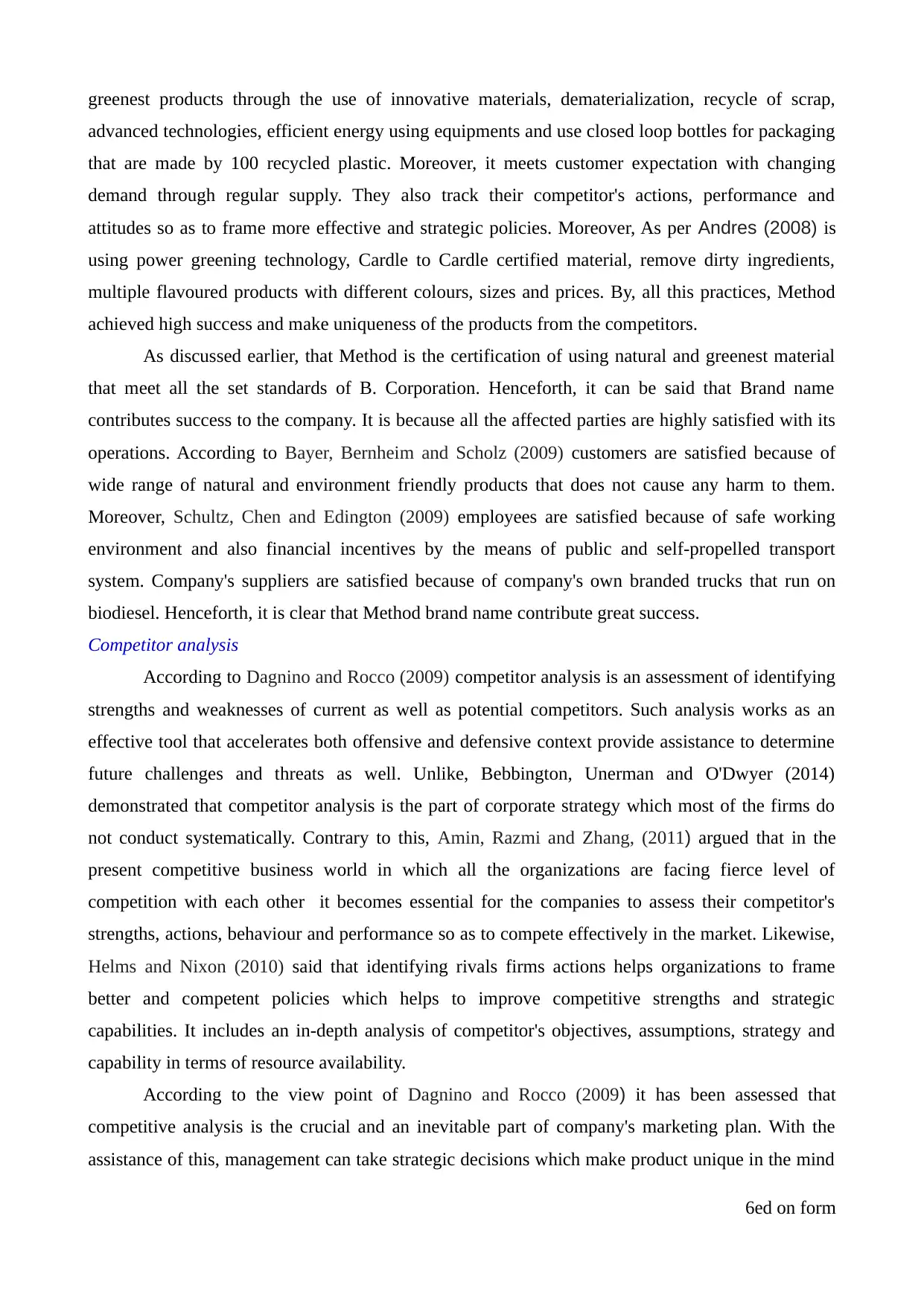
greenest products through the use of innovative materials, dematerialization, recycle of scrap,
advanced technologies, efficient energy using equipments and use closed loop bottles for packaging
that are made by 100 recycled plastic. Moreover, it meets customer expectation with changing
demand through regular supply. They also track their competitor's actions, performance and
attitudes so as to frame more effective and strategic policies. Moreover, As per Andres (2008) is
using power greening technology, Cardle to Cardle certified material, remove dirty ingredients,
multiple flavoured products with different colours, sizes and prices. By, all this practices, Method
achieved high success and make uniqueness of the products from the competitors.
As discussed earlier, that Method is the certification of using natural and greenest material
that meet all the set standards of B. Corporation. Henceforth, it can be said that Brand name
contributes success to the company. It is because all the affected parties are highly satisfied with its
operations. According to Bayer, Bernheim and Scholz (2009) customers are satisfied because of
wide range of natural and environment friendly products that does not cause any harm to them.
Moreover, Schultz, Chen and Edington (2009) employees are satisfied because of safe working
environment and also financial incentives by the means of public and self-propelled transport
system. Company's suppliers are satisfied because of company's own branded trucks that run on
biodiesel. Henceforth, it is clear that Method brand name contribute great success.
Competitor analysis
According to Dagnino and Rocco (2009) competitor analysis is an assessment of identifying
strengths and weaknesses of current as well as potential competitors. Such analysis works as an
effective tool that accelerates both offensive and defensive context provide assistance to determine
future challenges and threats as well. Unlike, Bebbington, Unerman and O'Dwyer (2014)
demonstrated that competitor analysis is the part of corporate strategy which most of the firms do
not conduct systematically. Contrary to this, Amin, Razmi and Zhang, (2011) argued that in the
present competitive business world in which all the organizations are facing fierce level of
competition with each other it becomes essential for the companies to assess their competitor's
strengths, actions, behaviour and performance so as to compete effectively in the market. Likewise,
Helms and Nixon (2010) said that identifying rivals firms actions helps organizations to frame
better and competent policies which helps to improve competitive strengths and strategic
capabilities. It includes an in-depth analysis of competitor's objectives, assumptions, strategy and
capability in terms of resource availability.
According to the view point of Dagnino and Rocco (2009) it has been assessed that
competitive analysis is the crucial and an inevitable part of company's marketing plan. With the
assistance of this, management can take strategic decisions which make product unique in the mind
6ed on form
advanced technologies, efficient energy using equipments and use closed loop bottles for packaging
that are made by 100 recycled plastic. Moreover, it meets customer expectation with changing
demand through regular supply. They also track their competitor's actions, performance and
attitudes so as to frame more effective and strategic policies. Moreover, As per Andres (2008) is
using power greening technology, Cardle to Cardle certified material, remove dirty ingredients,
multiple flavoured products with different colours, sizes and prices. By, all this practices, Method
achieved high success and make uniqueness of the products from the competitors.
As discussed earlier, that Method is the certification of using natural and greenest material
that meet all the set standards of B. Corporation. Henceforth, it can be said that Brand name
contributes success to the company. It is because all the affected parties are highly satisfied with its
operations. According to Bayer, Bernheim and Scholz (2009) customers are satisfied because of
wide range of natural and environment friendly products that does not cause any harm to them.
Moreover, Schultz, Chen and Edington (2009) employees are satisfied because of safe working
environment and also financial incentives by the means of public and self-propelled transport
system. Company's suppliers are satisfied because of company's own branded trucks that run on
biodiesel. Henceforth, it is clear that Method brand name contribute great success.
Competitor analysis
According to Dagnino and Rocco (2009) competitor analysis is an assessment of identifying
strengths and weaknesses of current as well as potential competitors. Such analysis works as an
effective tool that accelerates both offensive and defensive context provide assistance to determine
future challenges and threats as well. Unlike, Bebbington, Unerman and O'Dwyer (2014)
demonstrated that competitor analysis is the part of corporate strategy which most of the firms do
not conduct systematically. Contrary to this, Amin, Razmi and Zhang, (2011) argued that in the
present competitive business world in which all the organizations are facing fierce level of
competition with each other it becomes essential for the companies to assess their competitor's
strengths, actions, behaviour and performance so as to compete effectively in the market. Likewise,
Helms and Nixon (2010) said that identifying rivals firms actions helps organizations to frame
better and competent policies which helps to improve competitive strengths and strategic
capabilities. It includes an in-depth analysis of competitor's objectives, assumptions, strategy and
capability in terms of resource availability.
According to the view point of Dagnino and Rocco (2009) it has been assessed that
competitive analysis is the crucial and an inevitable part of company's marketing plan. With the
assistance of this, management can take strategic decisions which make product unique in the mind
6ed on form
⊘ This is a preview!⊘
Do you want full access?
Subscribe today to unlock all pages.
Trusted by 1+ million students worldwide
of consumers and make organization different from the competitors. According to Helms and Nixon
(2010) porter analysis is an effective tool to study competitor's strategies, products, assumptions,
actions, decisions and their capabilities. It takes into consideration the threat of entry and available
substitute, power of buyers and suppliers and competitive rivalry. However, Swayne, Duncan and
Ginter (2012) critically evaluated that SWOT analysis is comparatively far superior to Porter's Five
Forces model. It is a type of competitive analysis which helps to assess strengths, opportunities,
weaknesses and threats.
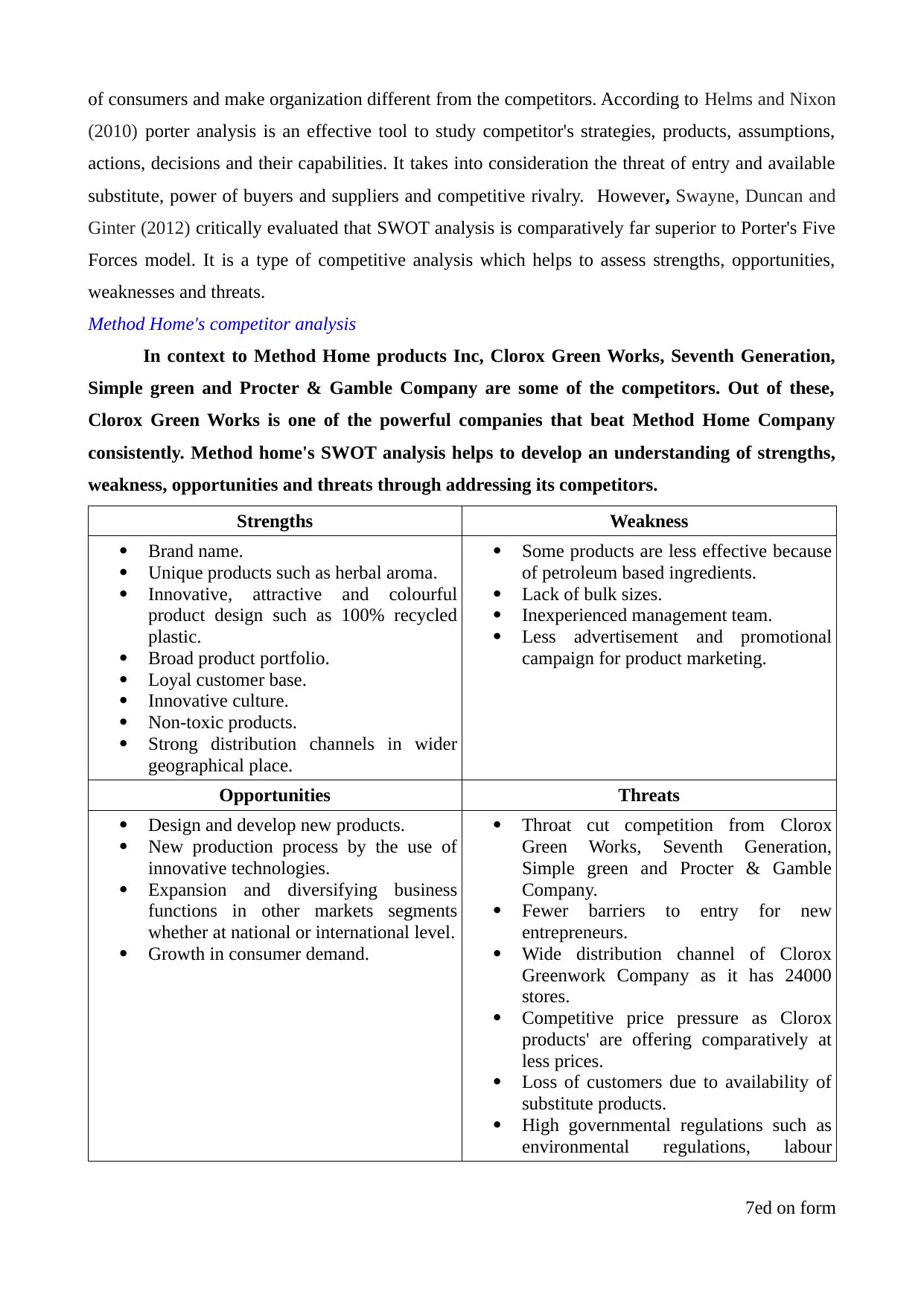
Method Home's competitor analysis
In context to Method Home products Inc, Clorox Green Works, Seventh Generation,
Simple green and Procter & Gamble Company are some of the competitors. Out of these,
Clorox Green Works is one of the powerful companies that beat Method Home Company
consistently. Method home's SWOT analysis helps to develop an understanding of strengths,
weakness, opportunities and threats through addressing its competitors.
Strengths Weakness
Brand name.
Unique products such as herbal aroma.
Innovative, attractive and colourful
product design such as 100% recycled
plastic.
Broad product portfolio.
Loyal customer base.
Innovative culture.
Non-toxic products.
Strong distribution channels in wider
geographical place.
Some products are less effective because
of petroleum based ingredients.
Lack of bulk sizes.
Inexperienced management team.
Less advertisement and promotional
campaign for product marketing.
Opportunities Threats
Design and develop new products.
New production process by the use of
innovative technologies.
Expansion and diversifying business
functions in other markets segments
whether at national or international level.
Growth in consumer demand.
Throat cut competition from Clorox
Green Works, Seventh Generation,
Simple green and Procter & Gamble
Company.
Fewer barriers to entry for new
entrepreneurs.
Wide distribution channel of Clorox
Greenwork Company as it has 24000
stores.
Competitive price pressure as Clorox
products' are offering comparatively at
less prices.
Loss of customers due to availability of
substitute products.
High governmental regulations such as
environmental regulations, labour
7ed on form
(2010) porter analysis is an effective tool to study competitor's strategies, products, assumptions,
actions, decisions and their capabilities. It takes into consideration the threat of entry and available
substitute, power of buyers and suppliers and competitive rivalry. However, Swayne, Duncan and
Ginter (2012) critically evaluated that SWOT analysis is comparatively far superior to Porter's Five
Forces model. It is a type of competitive analysis which helps to assess strengths, opportunities,
weaknesses and threats.
Method Home's competitor analysis
In context to Method Home products Inc, Clorox Green Works, Seventh Generation,
Simple green and Procter & Gamble Company are some of the competitors. Out of these,
Clorox Green Works is one of the powerful companies that beat Method Home Company
consistently. Method home's SWOT analysis helps to develop an understanding of strengths,
weakness, opportunities and threats through addressing its competitors.
Strengths Weakness
Brand name.
Unique products such as herbal aroma.
Innovative, attractive and colourful
product design such as 100% recycled
plastic.
Broad product portfolio.
Loyal customer base.
Innovative culture.
Non-toxic products.
Strong distribution channels in wider
geographical place.
Some products are less effective because
of petroleum based ingredients.
Lack of bulk sizes.
Inexperienced management team.
Less advertisement and promotional
campaign for product marketing.
Opportunities Threats
Design and develop new products.
New production process by the use of
innovative technologies.
Expansion and diversifying business
functions in other markets segments
whether at national or international level.
Growth in consumer demand.
Throat cut competition from Clorox
Green Works, Seventh Generation,
Simple green and Procter & Gamble
Company.
Fewer barriers to entry for new
entrepreneurs.
Wide distribution channel of Clorox
Greenwork Company as it has 24000
stores.
Competitive price pressure as Clorox
products' are offering comparatively at
less prices.
Loss of customers due to availability of
substitute products.
High governmental regulations such as
environmental regulations, labour
7ed on form
Paraphrase This Document
Need a fresh take? Get an instant paraphrase of this document with our AI Paraphraser
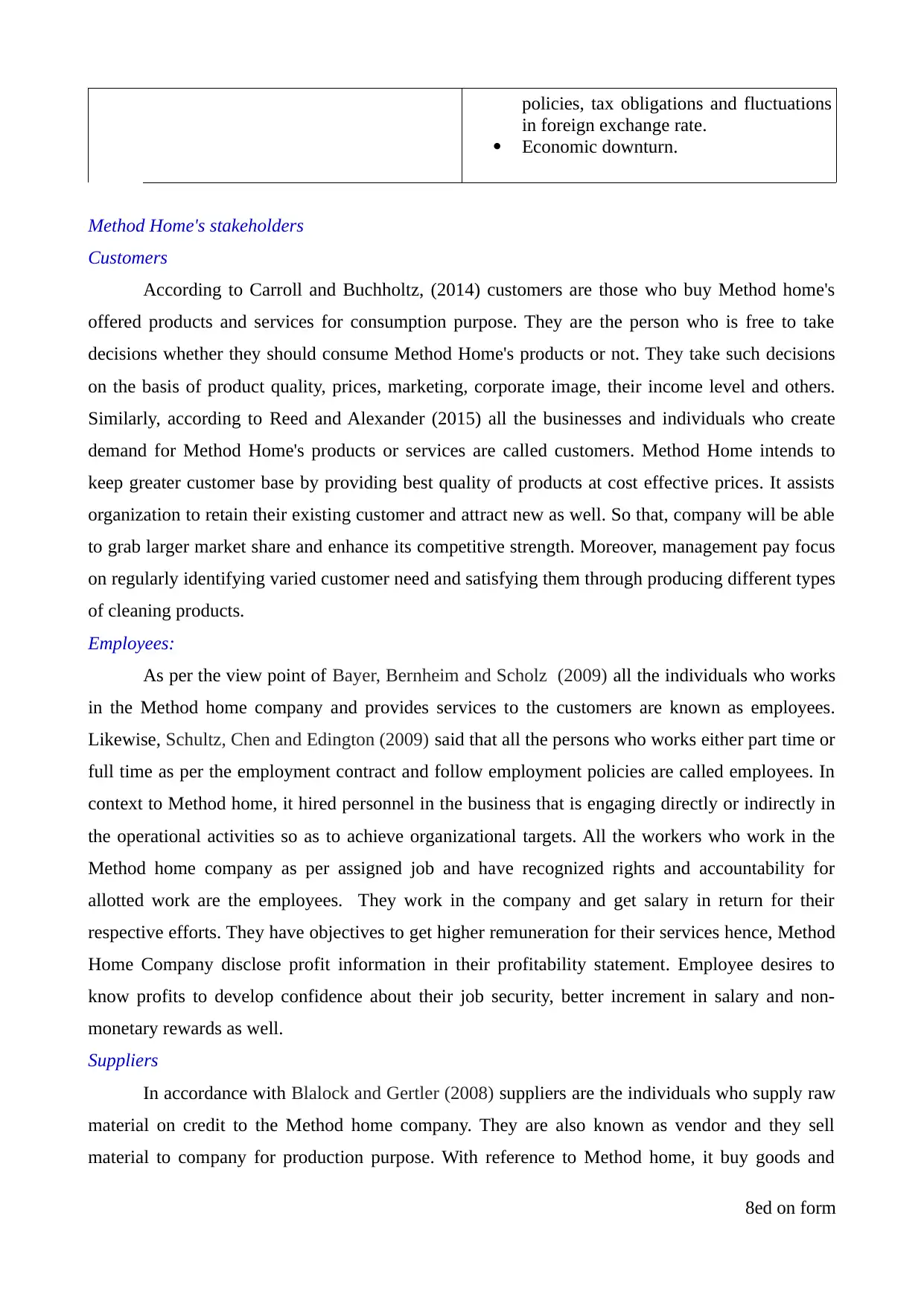
policies, tax obligations and fluctuations
in foreign exchange rate.
Economic downturn.
Method Home's stakeholders
Customers
According to Carroll and Buchholtz, (2014) customers are those who buy Method home's
offered products and services for consumption purpose. They are the person who is free to take
decisions whether they should consume Method Home's products or not. They take such decisions
on the basis of product quality, prices, marketing, corporate image, their income level and others.
Similarly, according to Reed and Alexander (2015) all the businesses and individuals who create
demand for Method Home's products or services are called customers. Method Home intends to
keep greater customer base by providing best quality of products at cost effective prices. It assists
organization to retain their existing customer and attract new as well. So that, company will be able
to grab larger market share and enhance its competitive strength. Moreover, management pay focus
on regularly identifying varied customer need and satisfying them through producing different types
of cleaning products.
Employees:
As per the view point of Bayer, Bernheim and Scholz (2009) all the individuals who works
in the Method home company and provides services to the customers are known as employees.
Likewise, Schultz, Chen and Edington (2009) said that all the persons who works either part time or
full time as per the employment contract and follow employment policies are called employees. In
context to Method home, it hired personnel in the business that is engaging directly or indirectly in
the operational activities so as to achieve organizational targets. All the workers who work in the
Method home company as per assigned job and have recognized rights and accountability for
allotted work are the employees. They work in the company and get salary in return for their
respective efforts. They have objectives to get higher remuneration for their services hence, Method
Home Company disclose profit information in their profitability statement. Employee desires to
know profits to develop confidence about their job security, better increment in salary and non-
monetary rewards as well.
Suppliers
In accordance with Blalock and Gertler (2008) suppliers are the individuals who supply raw
material on credit to the Method home company. They are also known as vendor and they sell
material to company for production purpose. With reference to Method home, it buy goods and
8ed on form
in foreign exchange rate.
Economic downturn.
Method Home's stakeholders
Customers
According to Carroll and Buchholtz, (2014) customers are those who buy Method home's
offered products and services for consumption purpose. They are the person who is free to take
decisions whether they should consume Method Home's products or not. They take such decisions
on the basis of product quality, prices, marketing, corporate image, their income level and others.
Similarly, according to Reed and Alexander (2015) all the businesses and individuals who create
demand for Method Home's products or services are called customers. Method Home intends to
keep greater customer base by providing best quality of products at cost effective prices. It assists
organization to retain their existing customer and attract new as well. So that, company will be able
to grab larger market share and enhance its competitive strength. Moreover, management pay focus
on regularly identifying varied customer need and satisfying them through producing different types
of cleaning products.
Employees:
As per the view point of Bayer, Bernheim and Scholz (2009) all the individuals who works
in the Method home company and provides services to the customers are known as employees.
Likewise, Schultz, Chen and Edington (2009) said that all the persons who works either part time or
full time as per the employment contract and follow employment policies are called employees. In
context to Method home, it hired personnel in the business that is engaging directly or indirectly in
the operational activities so as to achieve organizational targets. All the workers who work in the
Method home company as per assigned job and have recognized rights and accountability for
allotted work are the employees. They work in the company and get salary in return for their
respective efforts. They have objectives to get higher remuneration for their services hence, Method
Home Company disclose profit information in their profitability statement. Employee desires to
know profits to develop confidence about their job security, better increment in salary and non-
monetary rewards as well.
Suppliers
In accordance with Blalock and Gertler (2008) suppliers are the individuals who supply raw
material on credit to the Method home company. They are also known as vendor and they sell
material to company for production purpose. With reference to Method home, it buy goods and
8ed on form
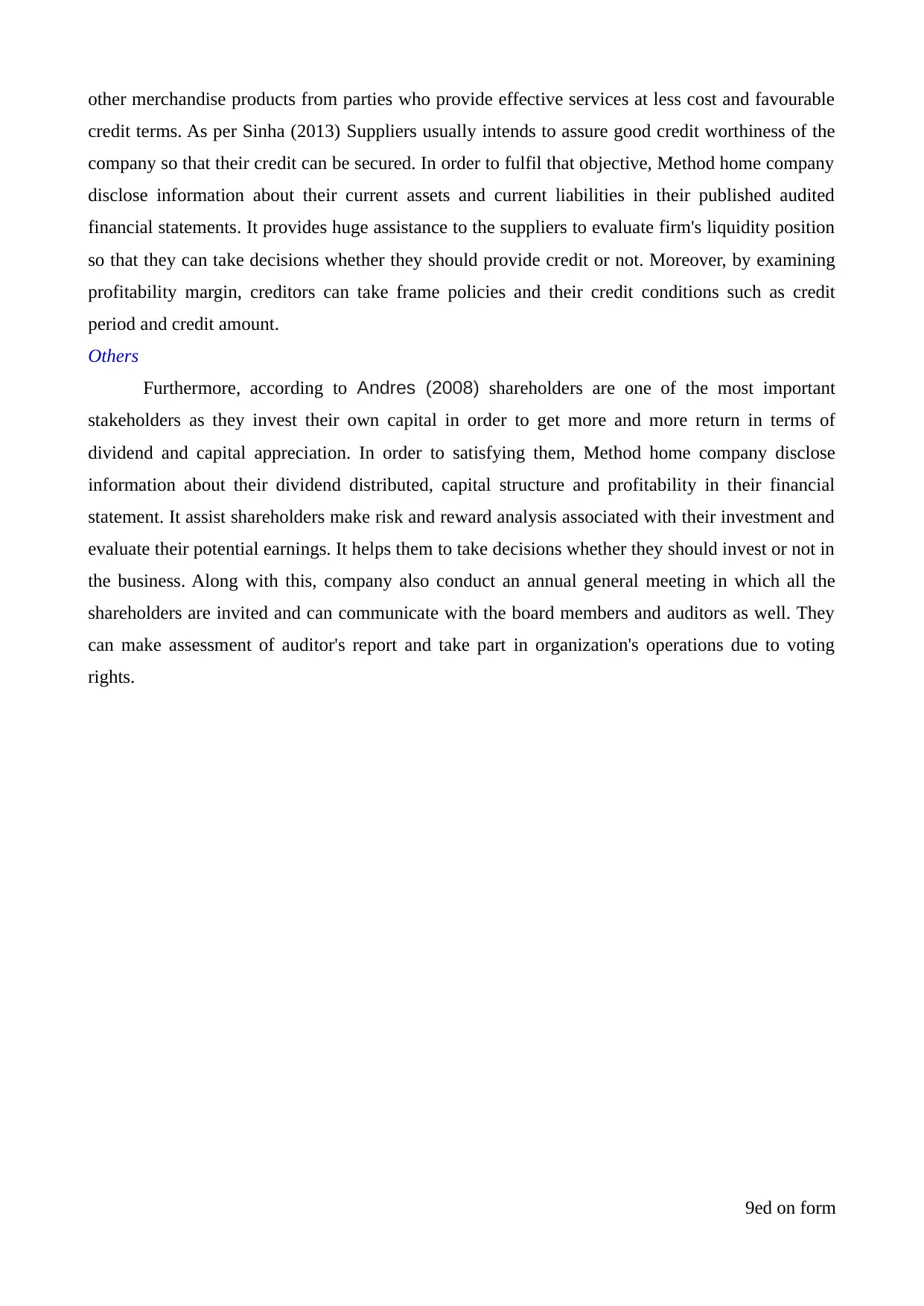
other merchandise products from parties who provide effective services at less cost and favourable
credit terms. As per Sinha (2013) Suppliers usually intends to assure good credit worthiness of the
company so that their credit can be secured. In order to fulfil that objective, Method home company
disclose information about their current assets and current liabilities in their published audited
financial statements. It provides huge assistance to the suppliers to evaluate firm's liquidity position
so that they can take decisions whether they should provide credit or not. Moreover, by examining
profitability margin, creditors can take frame policies and their credit conditions such as credit
period and credit amount.
Others
Furthermore, according to Andres (2008) shareholders are one of the most important
stakeholders as they invest their own capital in order to get more and more return in terms of
dividend and capital appreciation. In order to satisfying them, Method home company disclose
information about their dividend distributed, capital structure and profitability in their financial
statement. It assist shareholders make risk and reward analysis associated with their investment and
evaluate their potential earnings. It helps them to take decisions whether they should invest or not in
the business. Along with this, company also conduct an annual general meeting in which all the
shareholders are invited and can communicate with the board members and auditors as well. They
can make assessment of auditor's report and take part in organization's operations due to voting
rights.
9ed on form
credit terms. As per Sinha (2013) Suppliers usually intends to assure good credit worthiness of the
company so that their credit can be secured. In order to fulfil that objective, Method home company
disclose information about their current assets and current liabilities in their published audited
financial statements. It provides huge assistance to the suppliers to evaluate firm's liquidity position
so that they can take decisions whether they should provide credit or not. Moreover, by examining
profitability margin, creditors can take frame policies and their credit conditions such as credit
period and credit amount.
Others
Furthermore, according to Andres (2008) shareholders are one of the most important
stakeholders as they invest their own capital in order to get more and more return in terms of
dividend and capital appreciation. In order to satisfying them, Method home company disclose
information about their dividend distributed, capital structure and profitability in their financial
statement. It assist shareholders make risk and reward analysis associated with their investment and
evaluate their potential earnings. It helps them to take decisions whether they should invest or not in
the business. Along with this, company also conduct an annual general meeting in which all the
shareholders are invited and can communicate with the board members and auditors as well. They
can make assessment of auditor's report and take part in organization's operations due to voting
rights.
9ed on form
⊘ This is a preview!⊘
Do you want full access?
Subscribe today to unlock all pages.
Trusted by 1+ million students worldwide
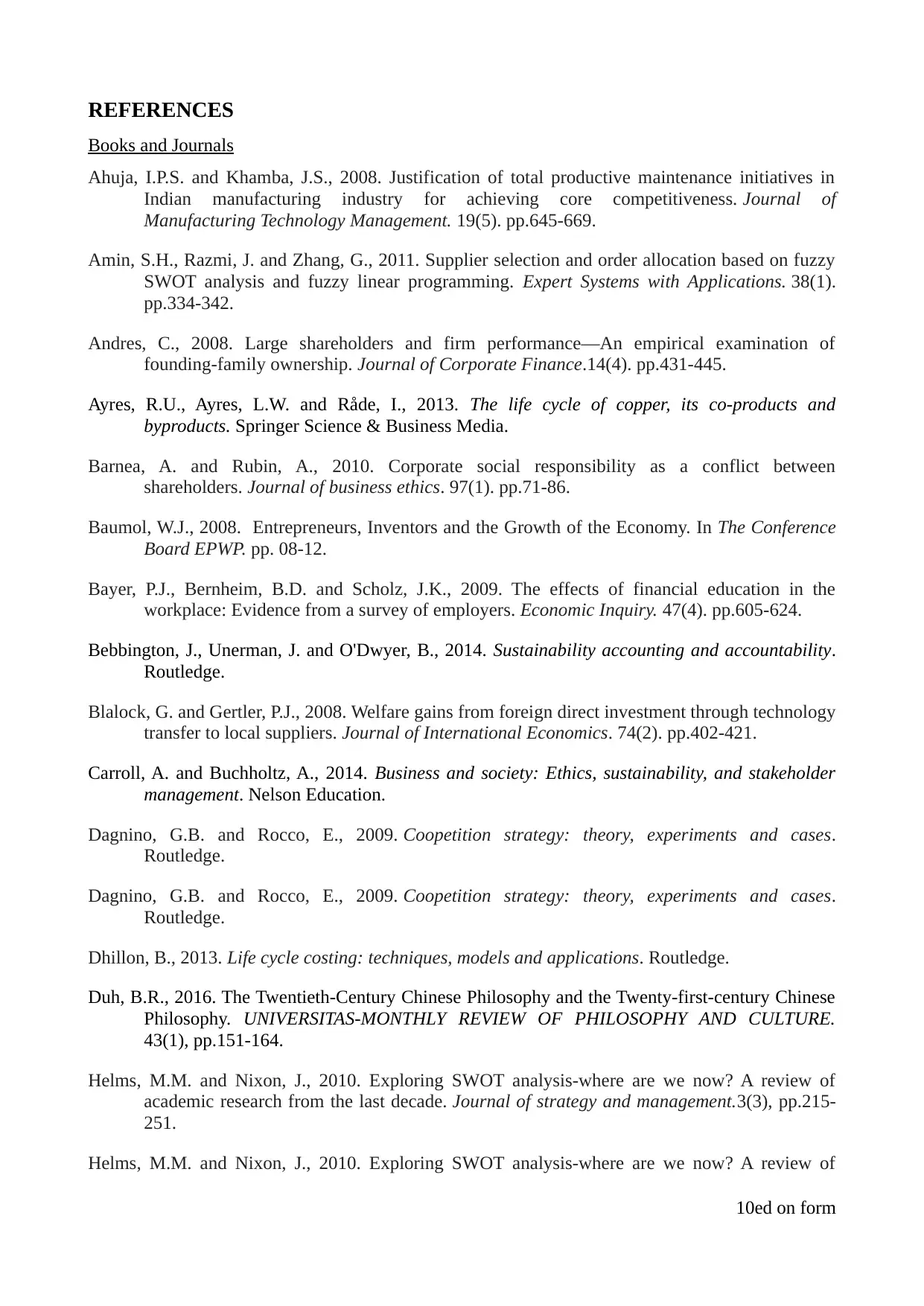
REFERENCES
Books and Journals
Ahuja, I.P.S. and Khamba, J.S., 2008. Justification of total productive maintenance initiatives in
Indian manufacturing industry for achieving core competitiveness. Journal of
Manufacturing Technology Management. 19(5). pp.645-669.
Amin, S.H., Razmi, J. and Zhang, G., 2011. Supplier selection and order allocation based on fuzzy
SWOT analysis and fuzzy linear programming. Expert Systems with Applications. 38(1).
pp.334-342.
Andres, C., 2008. Large shareholders and firm performance—An empirical examination of
founding-family ownership. Journal of Corporate Finance.14(4). pp.431-445.
Ayres, R.U., Ayres, L.W. and Råde, I., 2013. The life cycle of copper, its co-products and
byproducts. Springer Science & Business Media.
Barnea, A. and Rubin, A., 2010. Corporate social responsibility as a conflict between
shareholders. Journal of business ethics. 97(1). pp.71-86.
Baumol, W.J., 2008. Entrepreneurs, Inventors and the Growth of the Economy. In The Conference
Board EPWP. pp. 08-12.
Bayer, P.J., Bernheim, B.D. and Scholz, J.K., 2009. The effects of financial education in the
workplace: Evidence from a survey of employers. Economic Inquiry. 47(4). pp.605-624.
Bebbington, J., Unerman, J. and O'Dwyer, B., 2014. Sustainability accounting and accountability.
Routledge.
Blalock, G. and Gertler, P.J., 2008. Welfare gains from foreign direct investment through technology
transfer to local suppliers. Journal of International Economics. 74(2). pp.402-421.
Carroll, A. and Buchholtz, A., 2014. Business and society: Ethics, sustainability, and stakeholder
management. Nelson Education.
Dagnino, G.B. and Rocco, E., 2009. Coopetition strategy: theory, experiments and cases.
Routledge.
Dagnino, G.B. and Rocco, E., 2009. Coopetition strategy: theory, experiments and cases.
Routledge.
Dhillon, B., 2013. Life cycle costing: techniques, models and applications. Routledge.
Duh, B.R., 2016. The Twentieth-Century Chinese Philosophy and the Twenty-first-century Chinese
Philosophy. UNIVERSITAS-MONTHLY REVIEW OF PHILOSOPHY AND CULTURE.
43(1), pp.151-164.
Helms, M.M. and Nixon, J., 2010. Exploring SWOT analysis-where are we now? A review of
academic research from the last decade. Journal of strategy and management.3(3), pp.215-
251.
Helms, M.M. and Nixon, J., 2010. Exploring SWOT analysis-where are we now? A review of
10ed on form
Books and Journals
Ahuja, I.P.S. and Khamba, J.S., 2008. Justification of total productive maintenance initiatives in
Indian manufacturing industry for achieving core competitiveness. Journal of
Manufacturing Technology Management. 19(5). pp.645-669.
Amin, S.H., Razmi, J. and Zhang, G., 2011. Supplier selection and order allocation based on fuzzy
SWOT analysis and fuzzy linear programming. Expert Systems with Applications. 38(1).
pp.334-342.
Andres, C., 2008. Large shareholders and firm performance—An empirical examination of
founding-family ownership. Journal of Corporate Finance.14(4). pp.431-445.
Ayres, R.U., Ayres, L.W. and Råde, I., 2013. The life cycle of copper, its co-products and
byproducts. Springer Science & Business Media.
Barnea, A. and Rubin, A., 2010. Corporate social responsibility as a conflict between
shareholders. Journal of business ethics. 97(1). pp.71-86.
Baumol, W.J., 2008. Entrepreneurs, Inventors and the Growth of the Economy. In The Conference
Board EPWP. pp. 08-12.
Bayer, P.J., Bernheim, B.D. and Scholz, J.K., 2009. The effects of financial education in the
workplace: Evidence from a survey of employers. Economic Inquiry. 47(4). pp.605-624.
Bebbington, J., Unerman, J. and O'Dwyer, B., 2014. Sustainability accounting and accountability.
Routledge.
Blalock, G. and Gertler, P.J., 2008. Welfare gains from foreign direct investment through technology
transfer to local suppliers. Journal of International Economics. 74(2). pp.402-421.
Carroll, A. and Buchholtz, A., 2014. Business and society: Ethics, sustainability, and stakeholder
management. Nelson Education.
Dagnino, G.B. and Rocco, E., 2009. Coopetition strategy: theory, experiments and cases.
Routledge.
Dagnino, G.B. and Rocco, E., 2009. Coopetition strategy: theory, experiments and cases.
Routledge.
Dhillon, B., 2013. Life cycle costing: techniques, models and applications. Routledge.
Duh, B.R., 2016. The Twentieth-Century Chinese Philosophy and the Twenty-first-century Chinese
Philosophy. UNIVERSITAS-MONTHLY REVIEW OF PHILOSOPHY AND CULTURE.
43(1), pp.151-164.
Helms, M.M. and Nixon, J., 2010. Exploring SWOT analysis-where are we now? A review of
academic research from the last decade. Journal of strategy and management.3(3), pp.215-
251.
Helms, M.M. and Nixon, J., 2010. Exploring SWOT analysis-where are we now? A review of
10ed on form
Paraphrase This Document
Need a fresh take? Get an instant paraphrase of this document with our AI Paraphraser
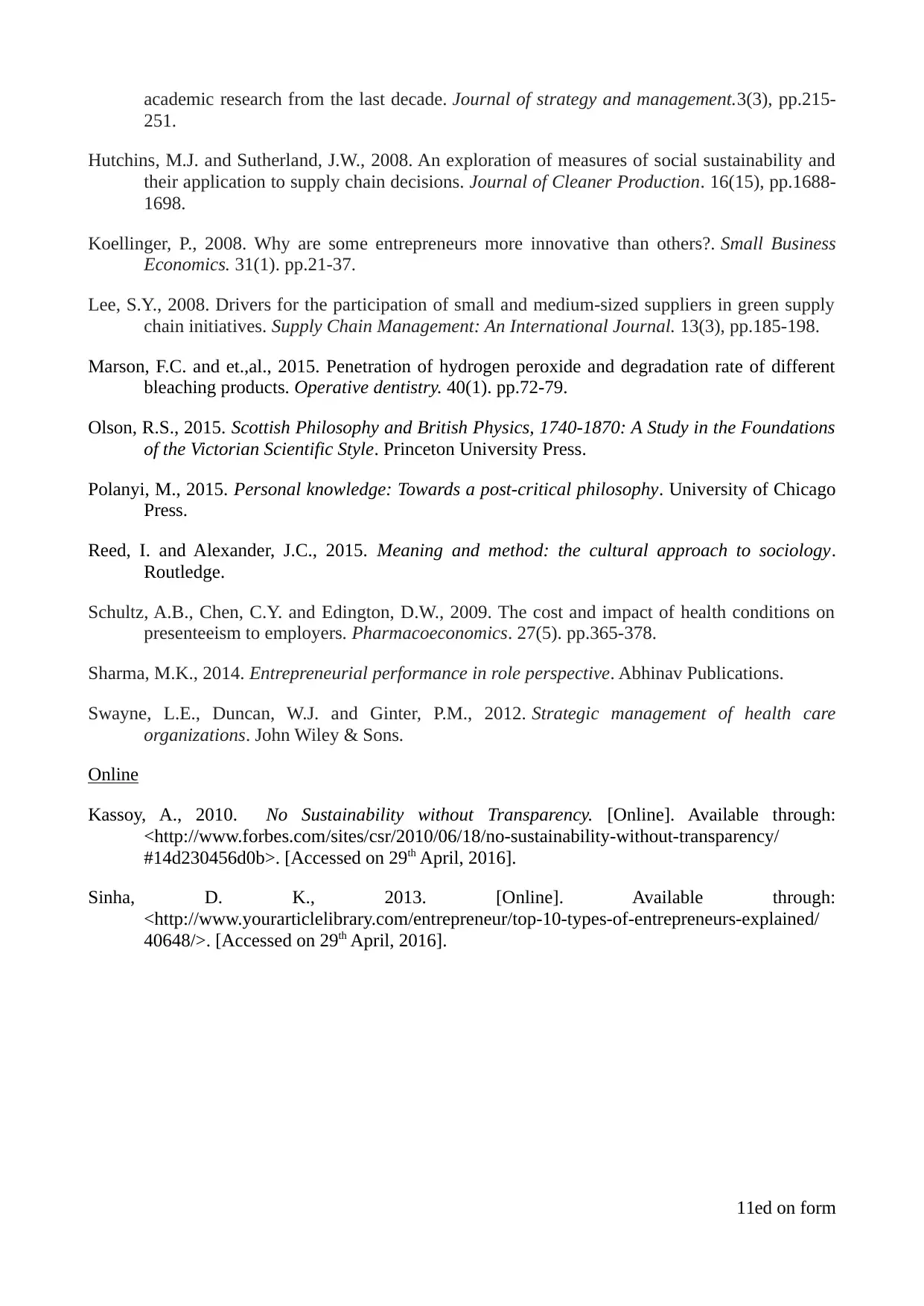
academic research from the last decade. Journal of strategy and management.3(3), pp.215-
251.
Hutchins, M.J. and Sutherland, J.W., 2008. An exploration of measures of social sustainability and
their application to supply chain decisions. Journal of Cleaner Production. 16(15), pp.1688-
1698.
Koellinger, P., 2008. Why are some entrepreneurs more innovative than others?. Small Business
Economics. 31(1). pp.21-37.
Lee, S.Y., 2008. Drivers for the participation of small and medium-sized suppliers in green supply
chain initiatives. Supply Chain Management: An International Journal. 13(3), pp.185-198.
Marson, F.C. and et.,al., 2015. Penetration of hydrogen peroxide and degradation rate of different
bleaching products. Operative dentistry. 40(1). pp.72-79.
Olson, R.S., 2015. Scottish Philosophy and British Physics, 1740-1870: A Study in the Foundations
of the Victorian Scientific Style. Princeton University Press.
Polanyi, M., 2015. Personal knowledge: Towards a post-critical philosophy. University of Chicago
Press.
Reed, I. and Alexander, J.C., 2015. Meaning and method: the cultural approach to sociology.
Routledge.
Schultz, A.B., Chen, C.Y. and Edington, D.W., 2009. The cost and impact of health conditions on
presenteeism to employers. Pharmacoeconomics. 27(5). pp.365-378.
Sharma, M.K., 2014. Entrepreneurial performance in role perspective. Abhinav Publications.
Swayne, L.E., Duncan, W.J. and Ginter, P.M., 2012. Strategic management of health care
organizations. John Wiley & Sons.
Online
Kassoy, A., 2010. No Sustainability without Transparency. [Online]. Available through:
<http://www.forbes.com/sites/csr/2010/06/18/no-sustainability-without-transparency/
#14d230456d0b>. [Accessed on 29th April, 2016].
Sinha, D. K., 2013. [Online]. Available through:
<http://www.yourarticlelibrary.com/entrepreneur/top-10-types-of-entrepreneurs-explained/
40648/>. [Accessed on 29th April, 2016].
11ed on form
251.
Hutchins, M.J. and Sutherland, J.W., 2008. An exploration of measures of social sustainability and
their application to supply chain decisions. Journal of Cleaner Production. 16(15), pp.1688-
1698.
Koellinger, P., 2008. Why are some entrepreneurs more innovative than others?. Small Business
Economics. 31(1). pp.21-37.
Lee, S.Y., 2008. Drivers for the participation of small and medium-sized suppliers in green supply
chain initiatives. Supply Chain Management: An International Journal. 13(3), pp.185-198.
Marson, F.C. and et.,al., 2015. Penetration of hydrogen peroxide and degradation rate of different
bleaching products. Operative dentistry. 40(1). pp.72-79.
Olson, R.S., 2015. Scottish Philosophy and British Physics, 1740-1870: A Study in the Foundations
of the Victorian Scientific Style. Princeton University Press.
Polanyi, M., 2015. Personal knowledge: Towards a post-critical philosophy. University of Chicago
Press.
Reed, I. and Alexander, J.C., 2015. Meaning and method: the cultural approach to sociology.
Routledge.
Schultz, A.B., Chen, C.Y. and Edington, D.W., 2009. The cost and impact of health conditions on
presenteeism to employers. Pharmacoeconomics. 27(5). pp.365-378.
Sharma, M.K., 2014. Entrepreneurial performance in role perspective. Abhinav Publications.
Swayne, L.E., Duncan, W.J. and Ginter, P.M., 2012. Strategic management of health care
organizations. John Wiley & Sons.
Online
Kassoy, A., 2010. No Sustainability without Transparency. [Online]. Available through:
<http://www.forbes.com/sites/csr/2010/06/18/no-sustainability-without-transparency/
#14d230456d0b>. [Accessed on 29th April, 2016].
Sinha, D. K., 2013. [Online]. Available through:
<http://www.yourarticlelibrary.com/entrepreneur/top-10-types-of-entrepreneurs-explained/
40648/>. [Accessed on 29th April, 2016].
11ed on form

1 out of 11


Related Documents


Your All-in-One AI-Powered Toolkit for Academic Success.
+13062052269
info@desklib.com
Available 24*7 on WhatsApp / Email
![[object Object]](/_next/static/media/star-bottom.7253800d.svg)
Unlock your academic potential
Copyright © 2020–2026 A2Z Services. All Rights Reserved. Developed and managed by ZUCOL.