Entrepreneurial Ventures: Exploration and Analysis - BTEC

Verified

Added on  2023/01/11

|7
|1389
|23
Report
AI Summary
This report examines various entrepreneurial ventures, including small businesses, large business ventures, social entrepreneurship, public ventures, and private ventures. It explores the typologies of these ventures, such as lifestyle and scalable models, and analyzes the similarities and differences between them. The report further discusses the contribution of small businesses to the economy and their importance to the social economy. It also delves into the traits, skills, and personality of entrepreneurs, including their background and experiences. The study emphasizes the role of entrepreneurs in transforming ideas into successful businesses and highlights the importance of risk-taking and resource management. The report concludes by summarizing the key findings and referencing relevant sources. This report is a comprehensive analysis of entrepreneurial ventures, providing valuable insights for students of business management.

Document Page
ENTREPRENEURIAL VENTURES AND
EXPLORATION OF THE
ENTREPRENEURIAL MINDSET
tabler-icon-diamond-filled.svg

Paraphrase This Document

Need a fresh take? Get an instant paraphrase of this document with our AI Paraphraser
Document Page
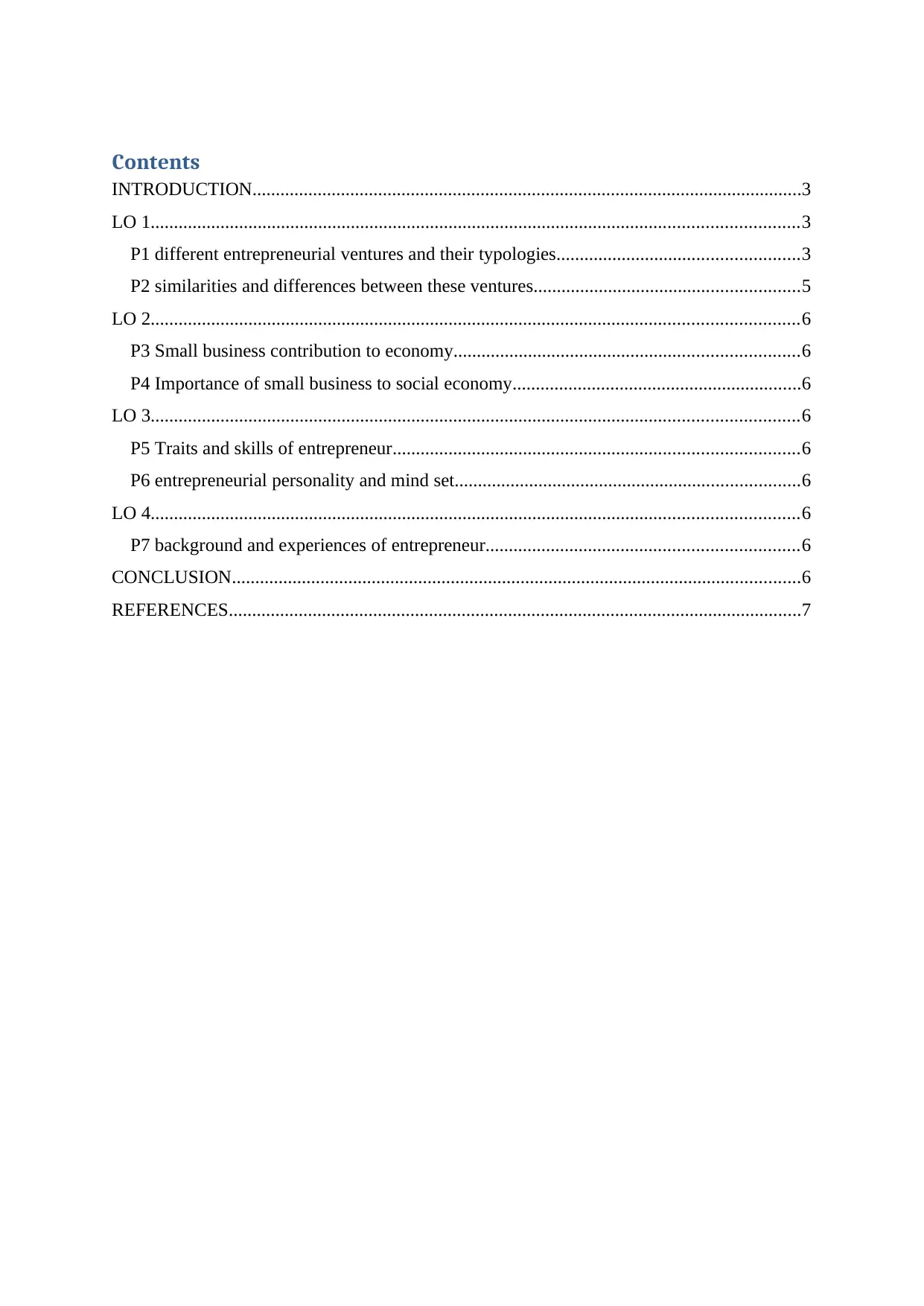
Contents
INTRODUCTION......................................................................................................................3
LO 1...........................................................................................................................................3
P1 different entrepreneurial ventures and their typologies....................................................3
P2 similarities and differences between these ventures.........................................................5
LO 2...........................................................................................................................................6
P3 Small business contribution to economy..........................................................................6
P4 Importance of small business to social economy..............................................................6
LO 3...........................................................................................................................................6
P5 Traits and skills of entrepreneur.......................................................................................6
P6 entrepreneurial personality and mind set..........................................................................6
LO 4...........................................................................................................................................6
P7 background and experiences of entrepreneur...................................................................6
CONCLUSION..........................................................................................................................6
REFERENCES...........................................................................................................................7
Document Page
INTRODUCTION
Entrepreneurship is the art and skill of person to develop new business and scaling it
for generating profit for longer duration (Jones and Sakong, 2020). Entrepreneurs are the big
transformer those who have ability to turn small idea into successful business. An
entrepreneur takes challenge and utilise existing resources in adequate manner so that firm
can sustain in market. Present study will examine various entrepreneurial ventures. It will
evaluate similarities and differences between these ventures. Furthermore report will
describe impact of micro small business on economic growth of country. In addition,
importance of small business to social economy will be explained. Experience and back
ground of entrepreneur will be illustrated. Skills of entrepreneur will be discussed in this
assignment.
LO 1
P1 different entrepreneurial ventures and their typologies
Entrepreneurship can be described as systematic process of managing and developing
a new business by taking risk to gain more opportunities in market (Sarasvathy, Dew and
Venkataraman, 2020). These are various ventures:
Small business
This can also be known as start-up firms, owner runs this business in which less
number of employees work. The main agenda of company is to generate reasonable amount
of profit and to attract more consumers so that it can sustain in market for longer duration.
Such kinds of small business are managed or handled by family members or friends only
(Wang and Tan, 2020). This small business focuses on offering quick services to buyers so
that they come to the place again and again. Small grosser shops,
Large business ventures
These are big and leading firms that have finite lifecycle. These companies
continuously work to improve products quality so that customer satisfaction can be raised.
Agenda of such big firms is to gain competitive advantage and become the global brand
name. As these firms have strong brand reputation hence people trust on such brand and like
Document Page
to buy goods and services. These organisations have adequate financial resources and are
able to generate profit to great extent. Hilton hotel is working is large business venture (Blaug
and Towse, 2020).
Social entrepreneurship
This is another kind of venture that works for improving wellbeing of people in
society. Social welfare is the main agenda of these firms. They hire fewer employees but
people can work as volunteers in such organisation.
Public venture
These are the ventures where firm is run under guidelines of government. Board of
director and stakeholders makes decision on behalf of company. The main purpose of public
companies is to provide quality goods at affordable rates to consumers (Ahmad and et.al.,
2020). For example BBC is working as public company.
Private ventures
These are the ventures that work for profit maximization. These are run and control
over board of directors and owner takes decision on behalf of company. They work to serve
consumers well but to earn more profit. For example: Hilton hotel is working as private
company (Jones and Sakong, 2020).
Typologies
Each venture has different way to manage and run its business.
Lifestyle typology is adopted by small business ventures where owner run entire business.
Individual has full control over entire firm and its profit. Passion of entrepreneur help the
firm in gaining success, if owner has no ability to generate profit then these small business
may get fail to sustain in market for longer duration (Sarasvathy, Dew and Venkataraman,
2020).
Scalable typology is another kind of system that pays more attention on creativity and
involvement of person. This kind of typology is adopted by large business organisation those
which work for offering best quality goods and services to large consumers.
tabler-icon-diamond-filled.svg

Paraphrase This Document

Need a fresh take? Get an instant paraphrase of this document with our AI Paraphraser
Document Page
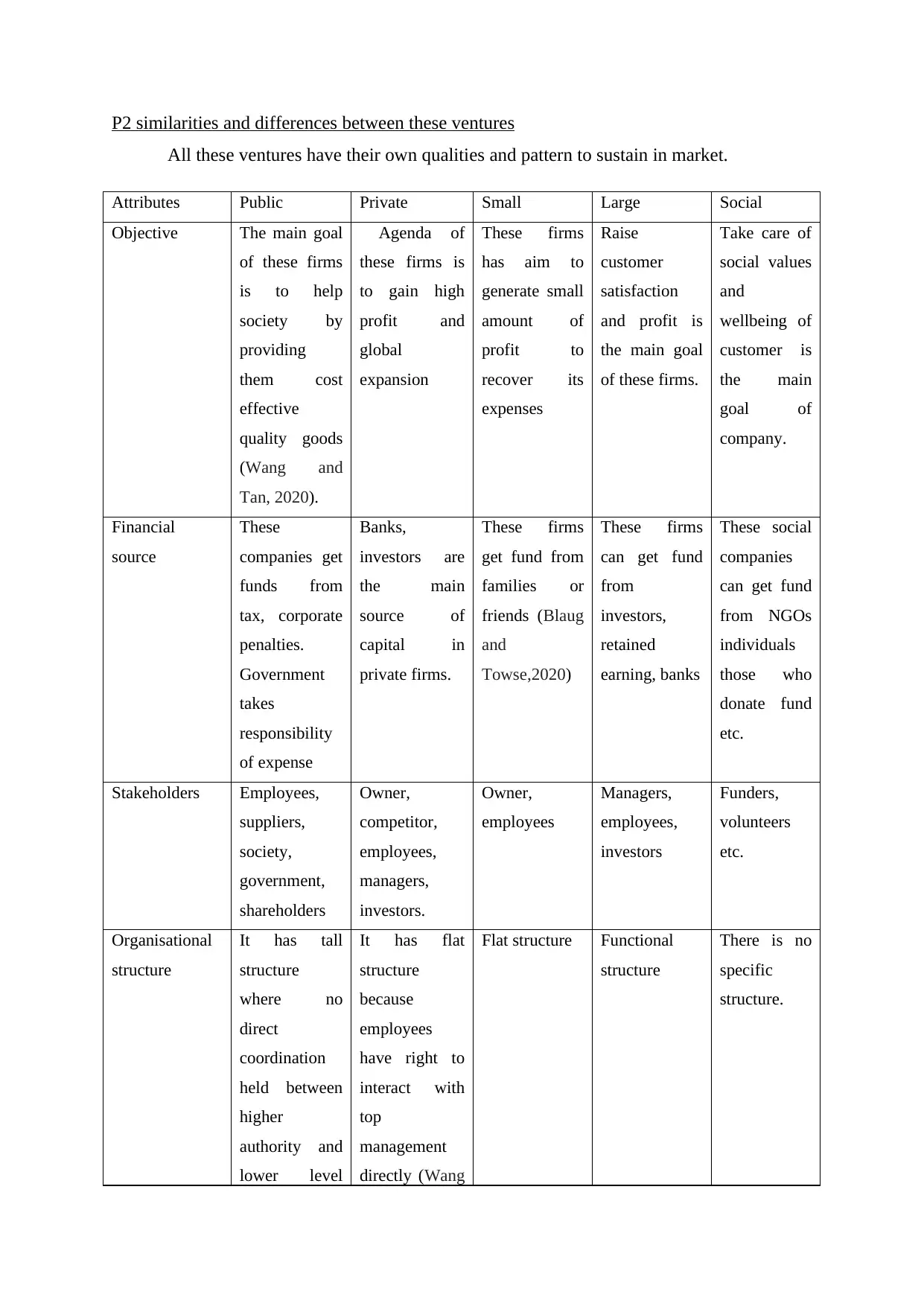
P2 similarities and differences between these ventures
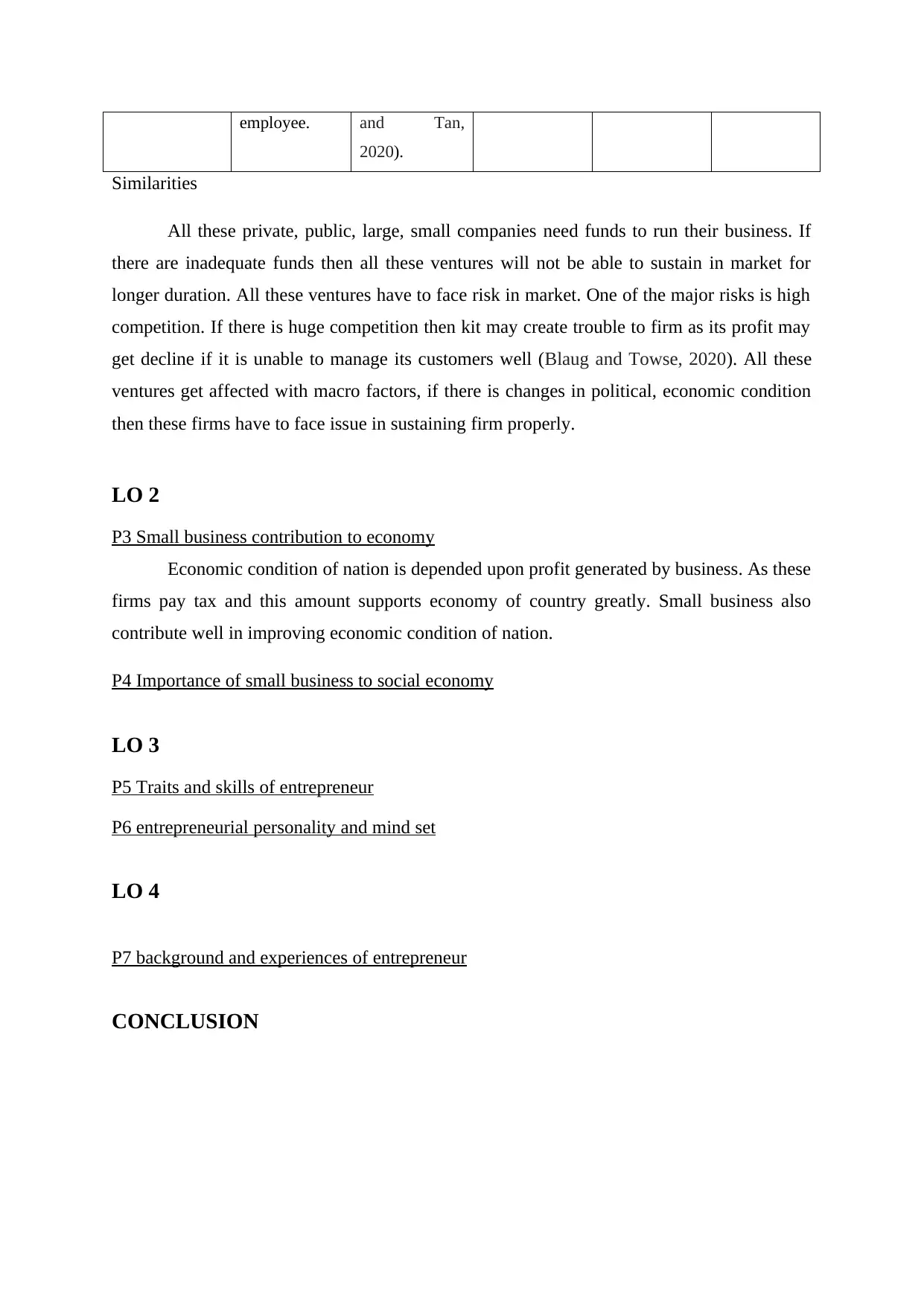
All these ventures have their own qualities and pattern to sustain in market.
Attributes Public Private Small Large Social
Objective The main goal
of these firms
is to help
society by
providing
them cost
effective
quality goods
(Wang and
Tan, 2020).
Agenda of
these firms is
to gain high
profit and
global
expansion
These firms
has aim to
generate small
amount of
profit to
recover its
expenses
Raise
customer
satisfaction
and profit is
the main goal
of these firms.
Take care of
social values
and
wellbeing of
customer is
the main
goal of
company.
Financial
source
These
companies get
funds from
tax, corporate
penalties.
Government
takes
responsibility
of expense
Banks,
investors are
the main
source of
capital in
private firms.
These firms
get fund from
families or
friends (Blaug
and
Towse,2020)
These firms
can get fund
from
investors,
retained
earning, banks
These social
companies
can get fund
from NGOs
individuals
those who
donate fund
etc.
Stakeholders Employees,
suppliers,
society,
government,
shareholders
Owner,
competitor,
employees,
managers,
investors.
Owner,
employees
Managers,
employees,
investors
Funders,
volunteers
etc.
Organisational
structure
It has tall
structure
where no
direct
coordination
held between
higher
authority and
lower level
It has flat
structure
because
employees
have right to
interact with
top
management
directly (Wang
Flat structure Functional
structure
There is no
specific
structure.
Document Page
employee. and Tan,
2020).
Similarities
All these private, public, large, small companies need funds to run their business. If
there are inadequate funds then all these ventures will not be able to sustain in market for
longer duration. All these ventures have to face risk in market. One of the major risks is high
competition. If there is huge competition then kit may create trouble to firm as its profit may
get decline if it is unable to manage its customers well (Blaug and Towse, 2020). All these
ventures get affected with macro factors, if there is changes in political, economic condition
then these firms have to face issue in sustaining firm properly.
LO 2
P3 Small business contribution to economy
Economic condition of nation is depended upon profit generated by business. As these
firms pay tax and this amount supports economy of country greatly. Small business also
contribute well in improving economic condition of nation.
P4 Importance of small business to social economy
LO 3
P5 Traits and skills of entrepreneur
P6 entrepreneurial personality and mind set
LO 4
P7 background and experiences of entrepreneur
CONCLUSION
Document Page
REFERENCES
Books and Journals
Ahmad, N.H. and et.al., 2020. Sustainable entrepreneurship practices in Malaysian
manufacturing SMEs: the role of individual, organisational and institutional
factors. World Review of Entrepreneurship, Management and Sustainable
Development. 16(2). pp.153-171.
Blaug, M. and Towse, R., 2020. Cultural entrepreneurship. In Handbook of Cultural
Economics, Third Edition. Edward Elgar Publishing.
Jones, L.P. and Sakong, I., 2020. Government, business, and entrepreneurship in economic
development: The Korean case. Brill.
Sarasvathy, S.D., Dew, N. and Venkataraman, S., 2020. Shaping Entrepreneurship Research:
Made, as Well as Found. Routledge.
Wang, J. and Tan, Y., 2020. Social factory as prosaic state space: Redefining labour in
China’s mass innovation/mass entrepreneurship campaign. Environment and Planning
A: Economy and Space. 52(3). pp.510-531.
chevron_up_icon
1 out of 7
circle_padding
hide_on_mobile
zoom_out_icon
[object Object]