Report on Entrepreneurship and Small Business Management - Unit 9
VerifiedAdded on 2021/01/02
|9
|2335
|490
Report
AI Summary
This report provides a comprehensive analysis of entrepreneurship and small business management, focusing on the scope, development, and growth of entrepreneurial ventures. It examines various types of ventures, including lifestyle enterprises, growth firms, and social enterprises, highlighting their similarities and differences. The report also critically assesses the impact of small businesses on the economy, using relevant data and statistics to illustrate their contributions. Furthermore, it explores the characteristics, traits, and skills of successful entrepreneurs, as well as the background and experiences that influence their ventures. The report analyzes the entrepreneurial landscape in Stamford, discussing the impact of small businesses on employment, societal welfare, and economic growth. It also includes comparisons between different business sizes (micro, small, medium, and large) and provides insights into their operational characteristics. Finally, the report concludes with a summary of the key findings and their implications for the field of entrepreneurship.
Entrepreneurship and Small
Business Management
Business Management

Paraphrase This Document
Need a fresh take? Get an instant paraphrase of this document with our AI Paraphraser
Table of Contents
INTRODUCTION...........................................................................................................................3
TASK 1............................................................................................................................................3
(a)Critically examining the scope, development and growth of entrepreneurial ventures..........3
These various entrepreneur ventures have various similarities which are discussed below-..........5
(b)Critically examining how small businesses have impacted on the economy making
reference to relevant
data and statistics.........................................................................................................................6
TASK 2 ...........................................................................................................................................8
CONCLUSION................................................................................................................................8
REFERENCES................................................................................................................................9
INTRODUCTION...........................................................................................................................3
TASK 1............................................................................................................................................3
(a)Critically examining the scope, development and growth of entrepreneurial ventures..........3
These various entrepreneur ventures have various similarities which are discussed below-..........5
(b)Critically examining how small businesses have impacted on the economy making
reference to relevant
data and statistics.........................................................................................................................6
TASK 2 ...........................................................................................................................................8
CONCLUSION................................................................................................................................8
REFERENCES................................................................................................................................9
INTRODUCTION
Entrepreneurship is described as the capacity and willingness to develop, organise and
manage a business venture taking all the risk and profits alone by a single individual. It is
therefore described as the process of creating and generating new innovative ideas, launching
and running a business accordingly (Bae and et. al., 2014). It plays an essential role in the
economy of the country by contributing a higher amount of national income. The enterprises of
Stamford, Lincolnshire, London are defined in the report. The report is based on the the critical
examining the scope, development and growth of entrepreneurial ventures in Stamford. The
impact of small business is defined as how they affected the economy and the importance of
small business to economy and the growth of social economy. Characteristics, traits and skills
are also described of successful British entrepreneurs. Background and experience of
entrepreneurs are also explained which influences them positively and negatively.
TASK 1
(a)Critically examining the scope, development and growth of entrepreneurial ventures
Entrepreneurship is the process of launching and running a new business. It is undertaken
by the individual who has creative ideas and his willing to take risks in the business in order to
earn huge and more profits. Their are different types of entrepreneurial ventures which arfe
discussed below-
Different types of entrepreneurial ventures
Life style enterprises- This type of business is set and run primarily by its founder only
with the aim of earning particular level of income which can support personal requirements
rather than maximising revenue. Main purpose of this business is to earn sustainable level of
income to support personal needs. Their are various kinds of business running in Stamford such
as restaurants, clothing, housing and others. Construction is well established business there
which contributes in the social economy of the country as well as creates employment
opportunities for the individuals which helps in growth of society.
Growth firms- These types of ventures generates high amount of earnings at a
significantly faster rate(Barringer, 2015). In this firms they have an increased annual revenue by
more than industry's average over a sustainable period. These firms are already achieving growth
which makes business start up a success one. For increasing growth, scope and development of
Entrepreneurship is described as the capacity and willingness to develop, organise and
manage a business venture taking all the risk and profits alone by a single individual. It is
therefore described as the process of creating and generating new innovative ideas, launching
and running a business accordingly (Bae and et. al., 2014). It plays an essential role in the
economy of the country by contributing a higher amount of national income. The enterprises of
Stamford, Lincolnshire, London are defined in the report. The report is based on the the critical
examining the scope, development and growth of entrepreneurial ventures in Stamford. The
impact of small business is defined as how they affected the economy and the importance of
small business to economy and the growth of social economy. Characteristics, traits and skills
are also described of successful British entrepreneurs. Background and experience of
entrepreneurs are also explained which influences them positively and negatively.
TASK 1
(a)Critically examining the scope, development and growth of entrepreneurial ventures
Entrepreneurship is the process of launching and running a new business. It is undertaken
by the individual who has creative ideas and his willing to take risks in the business in order to
earn huge and more profits. Their are different types of entrepreneurial ventures which arfe
discussed below-
Different types of entrepreneurial ventures
Life style enterprises- This type of business is set and run primarily by its founder only
with the aim of earning particular level of income which can support personal requirements
rather than maximising revenue. Main purpose of this business is to earn sustainable level of
income to support personal needs. Their are various kinds of business running in Stamford such
as restaurants, clothing, housing and others. Construction is well established business there
which contributes in the social economy of the country as well as creates employment
opportunities for the individuals which helps in growth of society.
Growth firms- These types of ventures generates high amount of earnings at a
significantly faster rate(Barringer, 2015). In this firms they have an increased annual revenue by
more than industry's average over a sustainable period. These firms are already achieving growth
which makes business start up a success one. For increasing growth, scope and development of
⊘ This is a preview!⊘
Do you want full access?
Subscribe today to unlock all pages.

Trusted by 1+ million students worldwide
Stamford business, these firms helps in creating websites to develop villages, towns and business
of others. Growth of these firms greatly helps in the development of social economy.
Social enterprises- These type of business are established to tackle social problems
related to society. These enterprises have social aims such as job creation, training and
maintaining ethical value. Their are various kinds of social business which helps in growth and
development of economy, thereby generating employment opportunities for the individuals. This
helps them to improve their standard of living.
Private and public sector enterprises
Private sector- These kind of enterprises are established with the intention of earning
huge profits as well as they operated and run by an individual but in case of large business there
may be many employees involved for successful operations of business.
Public sector- These are the organisations which is owned by the government of the
country . These are mainly established to work for society welfare as well as creation of
employment opportunities. The main purpose of public sector is to serve the individuals of the
society. There are some other organisation of public and private sector which are divided into
profit and non profit enterprises (Cooper and Folta, 2017).
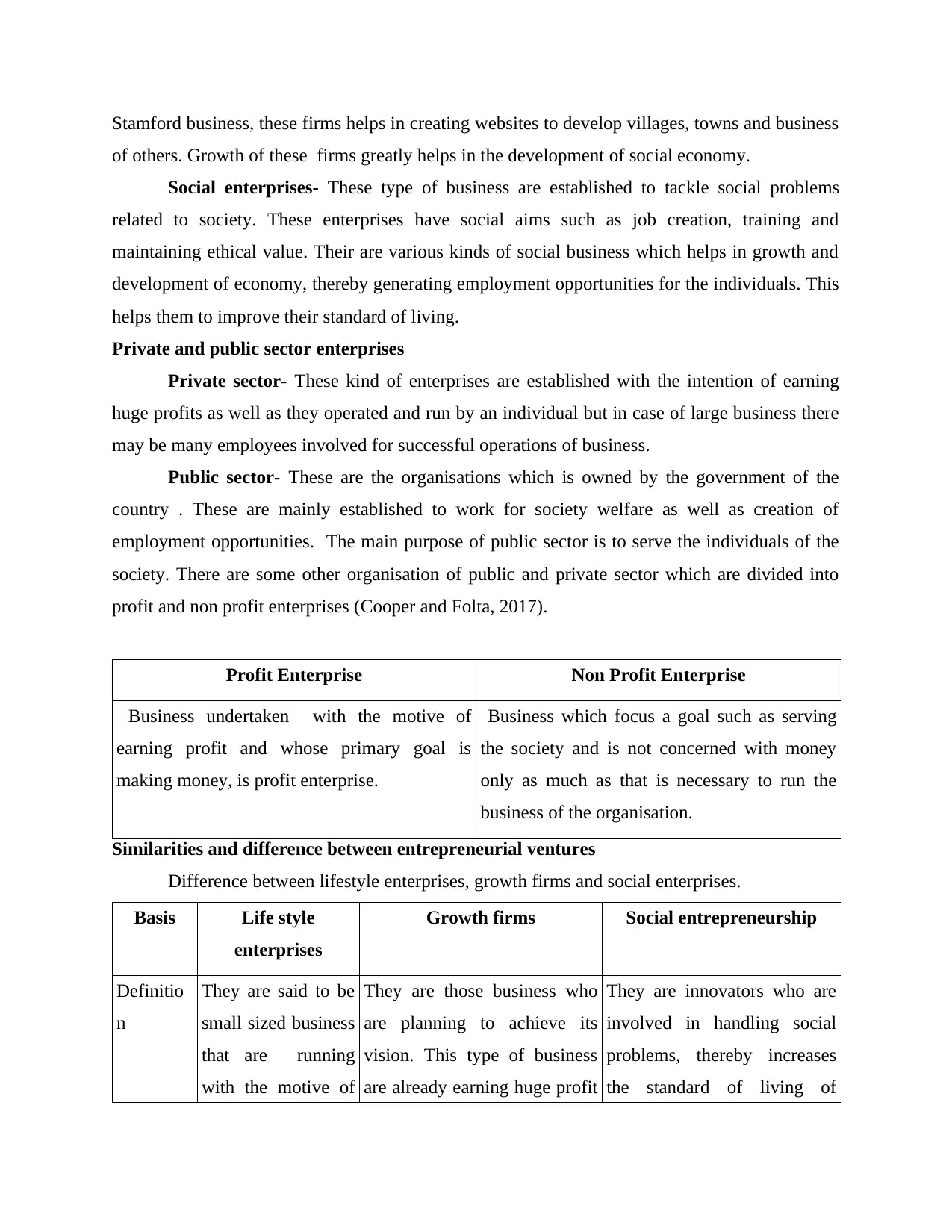
Profit Enterprise Non Profit Enterprise
Business undertaken with the motive of
earning profit and whose primary goal is
making money, is profit enterprise.
Business which focus a goal such as serving
the society and is not concerned with money
only as much as that is necessary to run the
business of the organisation.
Similarities and difference between entrepreneurial ventures
Difference between lifestyle enterprises, growth firms and social enterprises.
Basis Life style
enterprises
Growth firms Social entrepreneurship
Definitio
n
They are said to be
small sized business
that are running
with the motive of
They are those business who
are planning to achieve its
vision. This type of business
are already earning huge profit
They are innovators who are
involved in handling social
problems, thereby increases
the standard of living of
of others. Growth of these firms greatly helps in the development of social economy.
Social enterprises- These type of business are established to tackle social problems
related to society. These enterprises have social aims such as job creation, training and
maintaining ethical value. Their are various kinds of social business which helps in growth and
development of economy, thereby generating employment opportunities for the individuals. This
helps them to improve their standard of living.
Private and public sector enterprises
Private sector- These kind of enterprises are established with the intention of earning
huge profits as well as they operated and run by an individual but in case of large business there
may be many employees involved for successful operations of business.
Public sector- These are the organisations which is owned by the government of the
country . These are mainly established to work for society welfare as well as creation of
employment opportunities. The main purpose of public sector is to serve the individuals of the
society. There are some other organisation of public and private sector which are divided into
profit and non profit enterprises (Cooper and Folta, 2017).
Profit Enterprise Non Profit Enterprise
Business undertaken with the motive of
earning profit and whose primary goal is
making money, is profit enterprise.
Business which focus a goal such as serving
the society and is not concerned with money
only as much as that is necessary to run the
business of the organisation.
Similarities and difference between entrepreneurial ventures
Difference between lifestyle enterprises, growth firms and social enterprises.
Basis Life style
enterprises
Growth firms Social entrepreneurship
Definitio
n
They are said to be
small sized business
that are running
with the motive of
They are those business who
are planning to achieve its
vision. This type of business
are already earning huge profit
They are innovators who are
involved in handling social
problems, thereby increases
the standard of living of
Paraphrase This Document
Need a fresh take? Get an instant paraphrase of this document with our AI Paraphraser
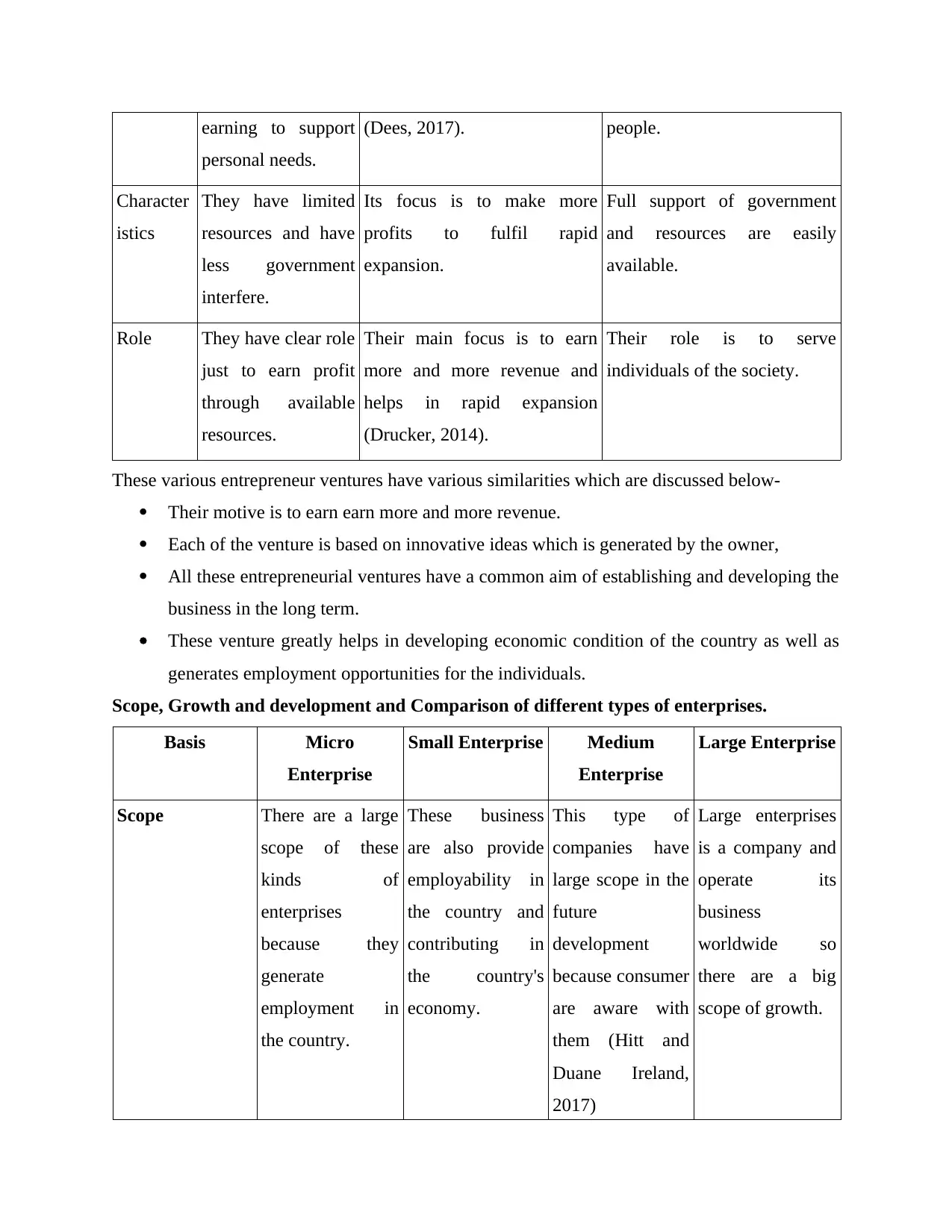
earning to support
personal needs.
(Dees, 2017). people.
Character
istics
They have limited
resources and have
less government
interfere.
Its focus is to make more
profits to fulfil rapid
expansion.
Full support of government
and resources are easily
available.
Role They have clear role
just to earn profit
through available
resources.
Their main focus is to earn
more and more revenue and
helps in rapid expansion
(Drucker, 2014).
Their role is to serve
individuals of the society.
These various entrepreneur ventures have various similarities which are discussed below-
Their motive is to earn earn more and more revenue.
Each of the venture is based on innovative ideas which is generated by the owner,
All these entrepreneurial ventures have a common aim of establishing and developing the
business in the long term.
These venture greatly helps in developing economic condition of the country as well as
generates employment opportunities for the individuals.
Scope, Growth and development and Comparison of different types of enterprises.
Basis Micro
Enterprise
Small Enterprise Medium
Enterprise
Large Enterprise
Scope There are a large
scope of these
kinds of
enterprises
because they
generate
employment in
the country.
These business
are also provide
employability in
the country and
contributing in
the country's
economy.
This type of
companies have
large scope in the
future
development
because consumer
are aware with
them (Hitt and
Duane Ireland,
2017)
Large enterprises
is a company and
operate its
business
worldwide so
there are a big
scope of growth.
personal needs.
(Dees, 2017). people.
Character
istics
They have limited
resources and have
less government
interfere.
Its focus is to make more
profits to fulfil rapid
expansion.
Full support of government
and resources are easily
available.
Role They have clear role
just to earn profit
through available
resources.
Their main focus is to earn
more and more revenue and
helps in rapid expansion
(Drucker, 2014).
Their role is to serve
individuals of the society.
These various entrepreneur ventures have various similarities which are discussed below-
Their motive is to earn earn more and more revenue.
Each of the venture is based on innovative ideas which is generated by the owner,
All these entrepreneurial ventures have a common aim of establishing and developing the
business in the long term.
These venture greatly helps in developing economic condition of the country as well as
generates employment opportunities for the individuals.
Scope, Growth and development and Comparison of different types of enterprises.
Basis Micro
Enterprise
Small Enterprise Medium
Enterprise
Large Enterprise
Scope There are a large
scope of these
kinds of
enterprises
because they
generate
employment in
the country.
These business
are also provide
employability in
the country and
contributing in
the country's
economy.
This type of
companies have
large scope in the
future
development
because consumer
are aware with
them (Hitt and
Duane Ireland,
2017)
Large enterprises
is a company and
operate its
business
worldwide so
there are a big
scope of growth.
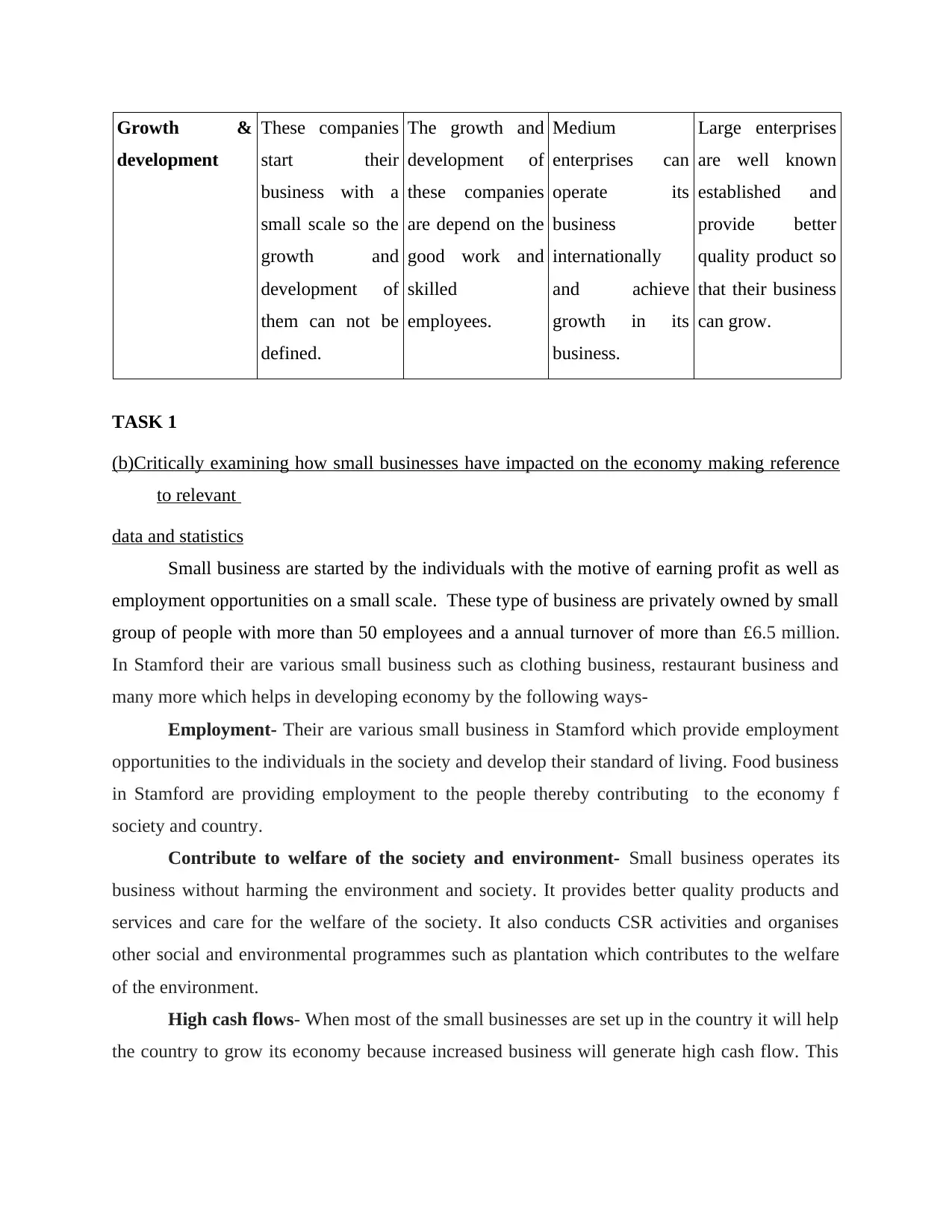
Growth &
development
These companies
start their
business with a
small scale so the
growth and
development of
them can not be
defined.
The growth and
development of
these companies
are depend on the
good work and
skilled
employees.
Medium
enterprises can
operate its
business
internationally
and achieve
growth in its
business.
Large enterprises
are well known
established and
provide better
quality product so
that their business
can grow.
TASK 1
(b)Critically examining how small businesses have impacted on the economy making reference
to relevant
data and statistics
Small business are started by the individuals with the motive of earning profit as well as
employment opportunities on a small scale. These type of business are privately owned by small
group of people with more than 50 employees and a annual turnover of more than £6.5 million.
In Stamford their are various small business such as clothing business, restaurant business and
many more which helps in developing economy by the following ways-
Employment- Their are various small business in Stamford which provide employment
opportunities to the individuals in the society and develop their standard of living. Food business
in Stamford are providing employment to the people thereby contributing to the economy f
society and country.
Contribute to welfare of the society and environment- Small business operates its
business without harming the environment and society. It provides better quality products and
services and care for the welfare of the society. It also conducts CSR activities and organises
other social and environmental programmes such as plantation which contributes to the welfare
of the environment.
High cash flows- When most of the small businesses are set up in the country it will help
the country to grow its economy because increased business will generate high cash flow. This
development
These companies
start their
business with a
small scale so the
growth and
development of
them can not be
defined.
The growth and
development of
these companies
are depend on the
good work and
skilled
employees.
Medium
enterprises can
operate its
business
internationally
and achieve
growth in its
business.
Large enterprises
are well known
established and
provide better
quality product so
that their business
can grow.
TASK 1
(b)Critically examining how small businesses have impacted on the economy making reference
to relevant
data and statistics
Small business are started by the individuals with the motive of earning profit as well as
employment opportunities on a small scale. These type of business are privately owned by small
group of people with more than 50 employees and a annual turnover of more than £6.5 million.
In Stamford their are various small business such as clothing business, restaurant business and
many more which helps in developing economy by the following ways-
Employment- Their are various small business in Stamford which provide employment
opportunities to the individuals in the society and develop their standard of living. Food business
in Stamford are providing employment to the people thereby contributing to the economy f
society and country.
Contribute to welfare of the society and environment- Small business operates its
business without harming the environment and society. It provides better quality products and
services and care for the welfare of the society. It also conducts CSR activities and organises
other social and environmental programmes such as plantation which contributes to the welfare
of the environment.
High cash flows- When most of the small businesses are set up in the country it will help
the country to grow its economy because increased business will generate high cash flow. This
⊘ This is a preview!⊘
Do you want full access?
Subscribe today to unlock all pages.
Trusted by 1+ million students worldwide
will help the government of the country to use the funds and help in the development of
economy (Kelley Singer and Herrington, 2012).
Small business in Stamford achieve growth in its business as well as contributes to social
economy as there are 5.6 million small business at start of 2018 in the UK and the growth
increased to 0.5% in comparison to last year. This creates employment opportunities for the
individuals in the society. These small business provide 16. 3 million and 60% of all private
sector employment in UK, thereby contributing the social economy of the country(Small
Businesses).
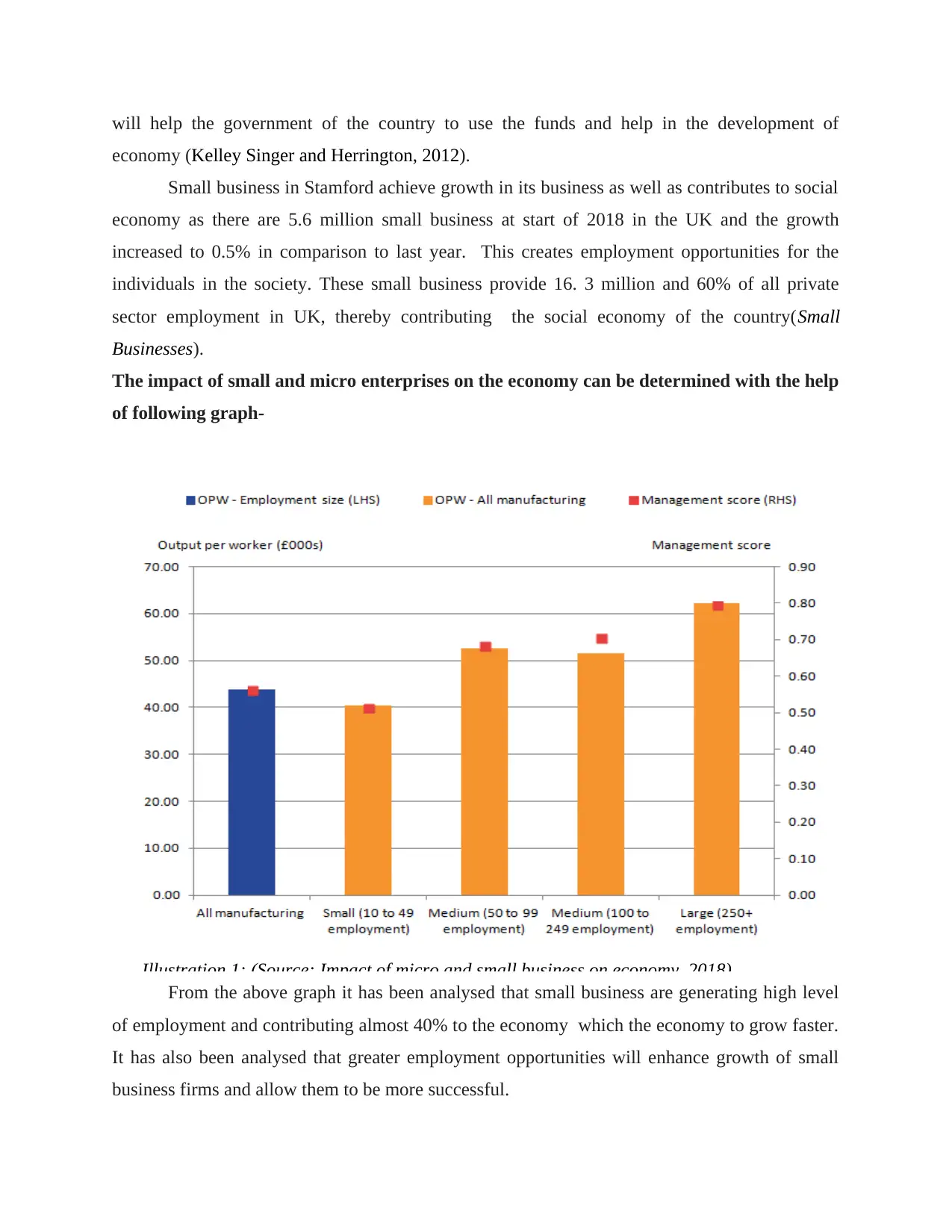
The impact of small and micro enterprises on the economy can be determined with the help
of following graph-
From the above graph it has been analysed that small business are generating high level
of employment and contributing almost 40% to the economy which the economy to grow faster.
It has also been analysed that greater employment opportunities will enhance growth of small
business firms and allow them to be more successful.
Illustration 1: (Source: Impact of micro and small business on economy, 2018)
economy (Kelley Singer and Herrington, 2012).
Small business in Stamford achieve growth in its business as well as contributes to social
economy as there are 5.6 million small business at start of 2018 in the UK and the growth
increased to 0.5% in comparison to last year. This creates employment opportunities for the
individuals in the society. These small business provide 16. 3 million and 60% of all private
sector employment in UK, thereby contributing the social economy of the country(Small
Businesses).
The impact of small and micro enterprises on the economy can be determined with the help
of following graph-
From the above graph it has been analysed that small business are generating high level
of employment and contributing almost 40% to the economy which the economy to grow faster.
It has also been analysed that greater employment opportunities will enhance growth of small
business firms and allow them to be more successful.
Illustration 1: (Source: Impact of micro and small business on economy, 2018)
Paraphrase This Document
Need a fresh take? Get an instant paraphrase of this document with our AI Paraphraser
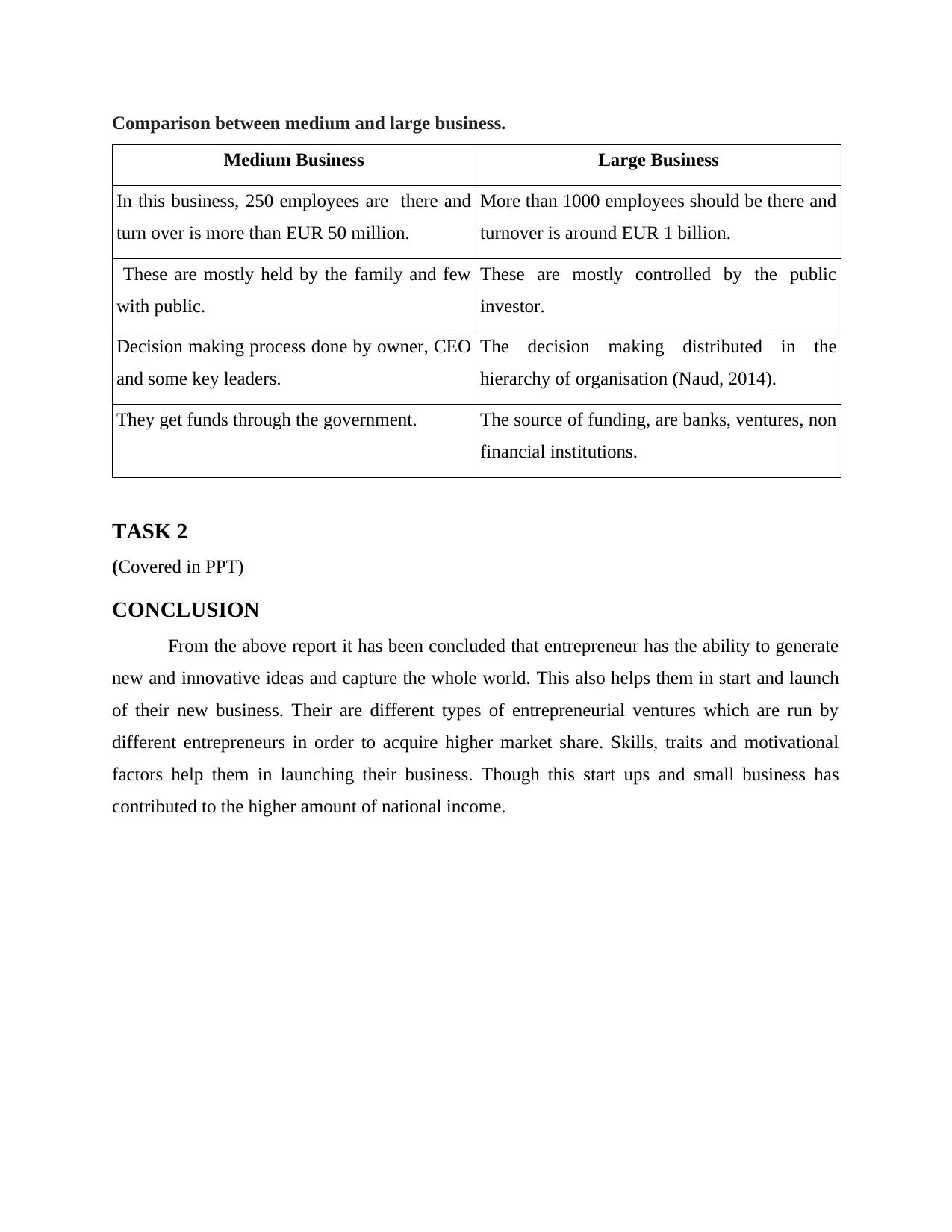
Comparison between medium and large business.
Medium Business Large Business
In this business, 250 employees are there and
turn over is more than EUR 50 million.
More than 1000 employees should be there and
turnover is around EUR 1 billion.
These are mostly held by the family and few
with public.
These are mostly controlled by the public
investor.
Decision making process done by owner, CEO
and some key leaders.
The decision making distributed in the
hierarchy of organisation (Naud, 2014).
They get funds through the government. The source of funding, are banks, ventures, non
financial institutions.
TASK 2
(Covered in PPT)
CONCLUSION
From the above report it has been concluded that entrepreneur has the ability to generate
new and innovative ideas and capture the whole world. This also helps them in start and launch
of their new business. Their are different types of entrepreneurial ventures which are run by
different entrepreneurs in order to acquire higher market share. Skills, traits and motivational
factors help them in launching their business. Though this start ups and small business has
contributed to the higher amount of national income.
Medium Business Large Business
In this business, 250 employees are there and
turn over is more than EUR 50 million.
More than 1000 employees should be there and
turnover is around EUR 1 billion.
These are mostly held by the family and few
with public.
These are mostly controlled by the public
investor.
Decision making process done by owner, CEO
and some key leaders.
The decision making distributed in the
hierarchy of organisation (Naud, 2014).
They get funds through the government. The source of funding, are banks, ventures, non
financial institutions.
TASK 2
(Covered in PPT)
CONCLUSION
From the above report it has been concluded that entrepreneur has the ability to generate
new and innovative ideas and capture the whole world. This also helps them in start and launch
of their new business. Their are different types of entrepreneurial ventures which are run by
different entrepreneurs in order to acquire higher market share. Skills, traits and motivational
factors help them in launching their business. Though this start ups and small business has
contributed to the higher amount of national income.
REFERENCES
Books and Journals:
Bae, T. J. and et. al., 2014. The Relationship between Entrepreneurship Education and
Entrepreneurial Intentions: A Meta–Analytic Review. Entrepreneurship theory and
practice. 38(2). pp.217-254.
Barringer, B. R., 2015. Entrepreneurship: Successfully launching new ventures. Pearson
Education India.
Cooper, A. and Folta, T., 2017. Entrepreneurship and high‐technology clusters. The Blackwell
handbook of entrepreneurship, pp.348-367.
Dees, J. G., 2017. 1 The Meaning of Social Entrepreneurship. In Case Studies in Social
Entrepreneurship and Sustainability(pp. 34-42). Routledge.
Drucker, P., 2014. Innovation and entrepreneurship. Routledge.
Hitt, M. and Duane Ireland, R., 2017. The intersection of entrepreneurship and strategic
management research. The Blackwell handbook of entrepreneurship, pp.45-63.
Kelley, D. J., Singer, S. and Herrington, M., 2012. Global entrepreneurship monitor 2011 global
report. Global Entrepreneurship Research Association, London Business School.
Kirzner, I. M., 2015. Competition and entrepreneurship. University of Chicago press.
Naudé, W., 2014. Entrepreneurship and economic development. International Development.
Ideas, Experiences and Prospects.
Parker, S. C., 2018. The economics of entrepreneurship. Cambridge University Press.
Santos, F. M., 2012. A positive theory of social entrepreneurship. Journal of business ethics.
111(3). pp.335-351.
Scarborough, N. M., 2016. Essentials of entrepreneurship and small business management.
Pearson.
Schaper, M. T. and et. al., 2014. Entrepreneurship and small business.
Shane, S., 2012. Reflections on the 2010 AMR decade award: Delivering on the promise of
entrepreneurship as a field of research. Academy of Management Review. 37(1). pp.10-20.
Online
Impact of micro and small business on economy. 2018. [Online]. Available through:
<https://www.ons.gov.uk/economy/nationalaccounts/uksectoraccounts/articles/
economicreview/apr2017>
Books and Journals:
Bae, T. J. and et. al., 2014. The Relationship between Entrepreneurship Education and
Entrepreneurial Intentions: A Meta–Analytic Review. Entrepreneurship theory and
practice. 38(2). pp.217-254.
Barringer, B. R., 2015. Entrepreneurship: Successfully launching new ventures. Pearson
Education India.
Cooper, A. and Folta, T., 2017. Entrepreneurship and high‐technology clusters. The Blackwell
handbook of entrepreneurship, pp.348-367.
Dees, J. G., 2017. 1 The Meaning of Social Entrepreneurship. In Case Studies in Social
Entrepreneurship and Sustainability(pp. 34-42). Routledge.
Drucker, P., 2014. Innovation and entrepreneurship. Routledge.
Hitt, M. and Duane Ireland, R., 2017. The intersection of entrepreneurship and strategic
management research. The Blackwell handbook of entrepreneurship, pp.45-63.
Kelley, D. J., Singer, S. and Herrington, M., 2012. Global entrepreneurship monitor 2011 global
report. Global Entrepreneurship Research Association, London Business School.
Kirzner, I. M., 2015. Competition and entrepreneurship. University of Chicago press.
Naudé, W., 2014. Entrepreneurship and economic development. International Development.
Ideas, Experiences and Prospects.
Parker, S. C., 2018. The economics of entrepreneurship. Cambridge University Press.
Santos, F. M., 2012. A positive theory of social entrepreneurship. Journal of business ethics.
111(3). pp.335-351.
Scarborough, N. M., 2016. Essentials of entrepreneurship and small business management.
Pearson.
Schaper, M. T. and et. al., 2014. Entrepreneurship and small business.
Shane, S., 2012. Reflections on the 2010 AMR decade award: Delivering on the promise of
entrepreneurship as a field of research. Academy of Management Review. 37(1). pp.10-20.
Online
Impact of micro and small business on economy. 2018. [Online]. Available through:
<https://www.ons.gov.uk/economy/nationalaccounts/uksectoraccounts/articles/
economicreview/apr2017>
⊘ This is a preview!⊘
Do you want full access?
Subscribe today to unlock all pages.
Trusted by 1+ million students worldwide

1 out of 9


Related Documents


Your All-in-One AI-Powered Toolkit for Academic Success.
+13062052269
info@desklib.com
Available 24*7 on WhatsApp / Email
![[object Object]](/_next/static/media/star-bottom.7253800d.svg)
Unlock your academic potential
Copyright © 2020–2026 A2Z Services. All Rights Reserved. Developed and managed by ZUCOL.