Entrepreneurship: Types of Ventures, Traits and Business Impact Report
VerifiedAdded on 2023/01/13
|18
|5801
|73
Report
AI Summary
This report provides a comprehensive overview of entrepreneurship and small business management. It begins by defining entrepreneurship and exploring different types of entrepreneurial ventures, including public, private, social, and high-growth ventures, along with the typology of entrepreneurship such as lifestyle, survival, and aggressive approaches. The report then delves into the impact of micro and small businesses on the UK economy, highlighting their contribution to turnover and growth. It also examines the characteristics, traits, and skills of successful entrepreneurs, as well as the entrepreneurial personality, motivation, and mindset. Furthermore, the report discusses factors that hinder or foster entrepreneurship. The document also covers the differences and similarities between entrepreneurial ventures. The report provides a detailed analysis of the concepts, offering valuable insights into the world of entrepreneurship and small business.
Entrepreneurship and Small
Business Management
Business Management

Paraphrase This Document
Need a fresh take? Get an instant paraphrase of this document with our AI Paraphraser
TABLE OF CONTENTS
INTRODUCTION...........................................................................................................................1
LO1..................................................................................................................................................1
P1: Types of Entrepreneurial Ventures........................................................................................1
P2: Differences and Similarities..................................................................................................3
LO2..................................................................................................................................................6
P3: Impact of Micro and Small Businesses.................................................................................6
P4: Importance of Small Business and Start-ups.........................................................................7
LO3..................................................................................................................................................8
P5: Characteristics Traits and Skills of Successful Entrepreneurs..............................................8
P6: Enterpurial Personality Reflect Motivation and Mindset....................................................10
LO4................................................................................................................................................12
P7: Hinder or Foster Entrepreneurship......................................................................................12
CONCLUSION..............................................................................................................................13
REFERENCES..............................................................................................................................14
INTRODUCTION...........................................................................................................................1
LO1..................................................................................................................................................1
P1: Types of Entrepreneurial Ventures........................................................................................1
P2: Differences and Similarities..................................................................................................3
LO2..................................................................................................................................................6
P3: Impact of Micro and Small Businesses.................................................................................6
P4: Importance of Small Business and Start-ups.........................................................................7
LO3..................................................................................................................................................8
P5: Characteristics Traits and Skills of Successful Entrepreneurs..............................................8
P6: Enterpurial Personality Reflect Motivation and Mindset....................................................10
LO4................................................................................................................................................12
P7: Hinder or Foster Entrepreneurship......................................................................................12
CONCLUSION..............................................................................................................................13
REFERENCES..............................................................................................................................14
INTRODUCTION
Entrepreneurship is generally a process which conducted by an entrepreneur. When a
person finds any business opportunity in the market and then start to run their new venture, this
process is known as entrepreneurship. Under this, an entrepreneur plan, organize, and manage a
venture to gain high results in respective market. Entrepreneurship's beginning point is, a person
who realize there is something is empty in current market, like a product or service. Then it tries
to develop product or service to fulfil that emptiness of market. This type of situations mainly
covert a person into an entrepreneur. At the end, that entrepreneur's work is become
entrepreneurship. This report discusses various aspects of entrepreneur and entrepreneurship. It
discusses small business management as well. There are different types of entrepreneurial
ventures has been described in this report. Typology of entrepreneurship also has been
mentioned in it. Some differences and similarities between entrepreneurial ventures includes in it
too. Some other major topics like; importance of small business, characteristic & skills of a
successful entrepreneur and motivation & mindset of an entrepreneur etc. has been discussed in
this report as well.
LO1
P1: Types of Entrepreneurial Ventures
Entrepreneurship is a term where a person starts a venture to achieve its decided goals or
objectives (HAYES, 2020). Mainly there are three types of entrepreneurial ventures called
public, private and social ventures existing in markets. These all different types of ventures have
been explained below;
Public Ventures: These ventures are mainly working at the large scale. These are able to earn
the highest profit in the markets in comparison of other ventures. Employment generating ratio is
also very high in public ventures. Currently these ventures have provided great job opportunities
to people. Expansion process is always too effective in this type of ventures. British Petroleum is
one of the best examples of public venture. This venture is work at huge scale in the United
Kingdom.
Private Ventures: Private ventures are something smaller than public ventures. In this type of
ventures, all share are only own by company's owner (Bonin-Rodriguez and Vakharia, 2019).
Iceland Food ltd is an excellent example of private venture. Expansion process of private
ventures is not much fast as public ventures. Shareholder's role is completely zero in this type of
1
Entrepreneurship is generally a process which conducted by an entrepreneur. When a
person finds any business opportunity in the market and then start to run their new venture, this
process is known as entrepreneurship. Under this, an entrepreneur plan, organize, and manage a
venture to gain high results in respective market. Entrepreneurship's beginning point is, a person
who realize there is something is empty in current market, like a product or service. Then it tries
to develop product or service to fulfil that emptiness of market. This type of situations mainly
covert a person into an entrepreneur. At the end, that entrepreneur's work is become
entrepreneurship. This report discusses various aspects of entrepreneur and entrepreneurship. It
discusses small business management as well. There are different types of entrepreneurial
ventures has been described in this report. Typology of entrepreneurship also has been
mentioned in it. Some differences and similarities between entrepreneurial ventures includes in it
too. Some other major topics like; importance of small business, characteristic & skills of a
successful entrepreneur and motivation & mindset of an entrepreneur etc. has been discussed in
this report as well.
LO1
P1: Types of Entrepreneurial Ventures
Entrepreneurship is a term where a person starts a venture to achieve its decided goals or
objectives (HAYES, 2020). Mainly there are three types of entrepreneurial ventures called
public, private and social ventures existing in markets. These all different types of ventures have
been explained below;
Public Ventures: These ventures are mainly working at the large scale. These are able to earn
the highest profit in the markets in comparison of other ventures. Employment generating ratio is
also very high in public ventures. Currently these ventures have provided great job opportunities
to people. Expansion process is always too effective in this type of ventures. British Petroleum is
one of the best examples of public venture. This venture is work at huge scale in the United
Kingdom.
Private Ventures: Private ventures are something smaller than public ventures. In this type of
ventures, all share are only own by company's owner (Bonin-Rodriguez and Vakharia, 2019).
Iceland Food ltd is an excellent example of private venture. Expansion process of private
ventures is not much fast as public ventures. Shareholder's role is completely zero in this type of
1
⊘ This is a preview!⊘
Do you want full access?
Subscribe today to unlock all pages.

Trusted by 1+ million students worldwide
ventures, because these ventures are not offering any share in public sale. Most small businesses
are also coming under private ventures. Private companies always earn a limited profit in a
market. Its growth is increase in those condition when it launches any productive or exclusive
range of products.
Social Ventures: Social ventures generally includes those organizations which only work for
social welfare, like non-profit organizations. The children's society is a great example of social
ventures. It is a charity organization which works for child caring. The main aim of these
ventures is, improve current standards of society, increase morality and humanity in people etc.
Charity, donations, gifts etc. are main sources of earning for social ventures. Many times, public
and private ventures also give a specific fund to social ventures to run its operations in
progressive way.
High Growth Ventures: This also a type of entrepreneurial ventures. Earn high profit is the first
motive of high growth ventures (Eckblad, Gutmann and Lindener, 2019). Such public and
private companies are also comes under these ventures, if they have only motive to earn the
greatest profit in respective market. Revenue generation capacity is also has too higher in this
type of ventures.
Typology of Entrepreneurship
Life style, survival and aggressive are three major types of entrepreneurship and these are
completely relating with different types of entrepreneurial ventures. This typology is generally
shows nature of an entrepreneur.
Life Style: An entrepreneur who like to do thing related to business is always comes under life
style entrepreneurship. Entrepreneurs who have life style entrepreneurship background mostly
run big sized ventures and large companies, like; Public and private. These entrepreneurs are
always been highly motivated and passionate about their work. Earn profit by serving quality
products and services is the main objective or aim of this entrepreneurship. In this case, both
public and private ventures are related to this life style entrepreneurship, because earn high profit
is main objective of these ventures as well.
Survival: Those entrepreneurs are comes under survival entrepreneurship who have aim to do
something good and positive to entire society (Sayers and Hodges, 2016). Social ventures only
relating with this type of entrepreneurship. Earn profit is not main aim of this entrepreneurship.
2
are also coming under private ventures. Private companies always earn a limited profit in a
market. Its growth is increase in those condition when it launches any productive or exclusive
range of products.
Social Ventures: Social ventures generally includes those organizations which only work for
social welfare, like non-profit organizations. The children's society is a great example of social
ventures. It is a charity organization which works for child caring. The main aim of these
ventures is, improve current standards of society, increase morality and humanity in people etc.
Charity, donations, gifts etc. are main sources of earning for social ventures. Many times, public
and private ventures also give a specific fund to social ventures to run its operations in
progressive way.
High Growth Ventures: This also a type of entrepreneurial ventures. Earn high profit is the first
motive of high growth ventures (Eckblad, Gutmann and Lindener, 2019). Such public and
private companies are also comes under these ventures, if they have only motive to earn the
greatest profit in respective market. Revenue generation capacity is also has too higher in this
type of ventures.
Typology of Entrepreneurship
Life style, survival and aggressive are three major types of entrepreneurship and these are
completely relating with different types of entrepreneurial ventures. This typology is generally
shows nature of an entrepreneur.
Life Style: An entrepreneur who like to do thing related to business is always comes under life
style entrepreneurship. Entrepreneurs who have life style entrepreneurship background mostly
run big sized ventures and large companies, like; Public and private. These entrepreneurs are
always been highly motivated and passionate about their work. Earn profit by serving quality
products and services is the main objective or aim of this entrepreneurship. In this case, both
public and private ventures are related to this life style entrepreneurship, because earn high profit
is main objective of these ventures as well.
Survival: Those entrepreneurs are comes under survival entrepreneurship who have aim to do
something good and positive to entire society (Sayers and Hodges, 2016). Social ventures only
relating with this type of entrepreneurship. Earn profit is not main aim of this entrepreneurship.
2
Paraphrase This Document
Need a fresh take? Get an instant paraphrase of this document with our AI Paraphraser
A person who want to do something in social welfare is able to run social ventures. This process
is completely known as survival entrepreneurship.
Aggressive: Both public and private ventures are relating with aggressive typology of
entrepreneurship, because those ventures comes under this typology which has aim to earn high
profit by using technology. Both ventures always try to implement new and latest technology in
their workplace to increase current performance. Then once they increased their performance,
they will automatically gain high profit (Yevtukh, 2016). In short, ventures which work in an
aggressive form are comes under this typology.
Micro, Small and Medium-Sized Organisations
Micro: A business which has 0 to 9 employees, and also has up to €2 million turnover.
Small: A business which has less than 50 employees, and has up to €10 million turnover.
Medium-Sized: A business which has less than 250 employees, and has €50 million turnover.
Social Enterprise, Social Entrepreneurs and Social Economy
Social enterprise is completely known as social venture. Social entrepreneurs are those
people who freely work for social welfare. On the other side, social economy of the United
Kingdom continuously growing, because existing businesses are giving great contribution in this
growth.
Entrepreneurial Activity: Entrepreneurial activity is a set of actions which conducted by an
entrepreneur to achieve their objectives in selected market.
Enterprise: Enterprise is known as a venture or business which operating by an entrepreneur or
owner for achieving decided goals.
Small-business: Small-business is basically a business which runs their operations in small
market segment only.
Owner-Manager: Owner manager is mainly a person who owner of any business, and also take
whole responsibility to manage that business.
Differences Between Entrepreneurial Ventures
P2: Differences and Similarities
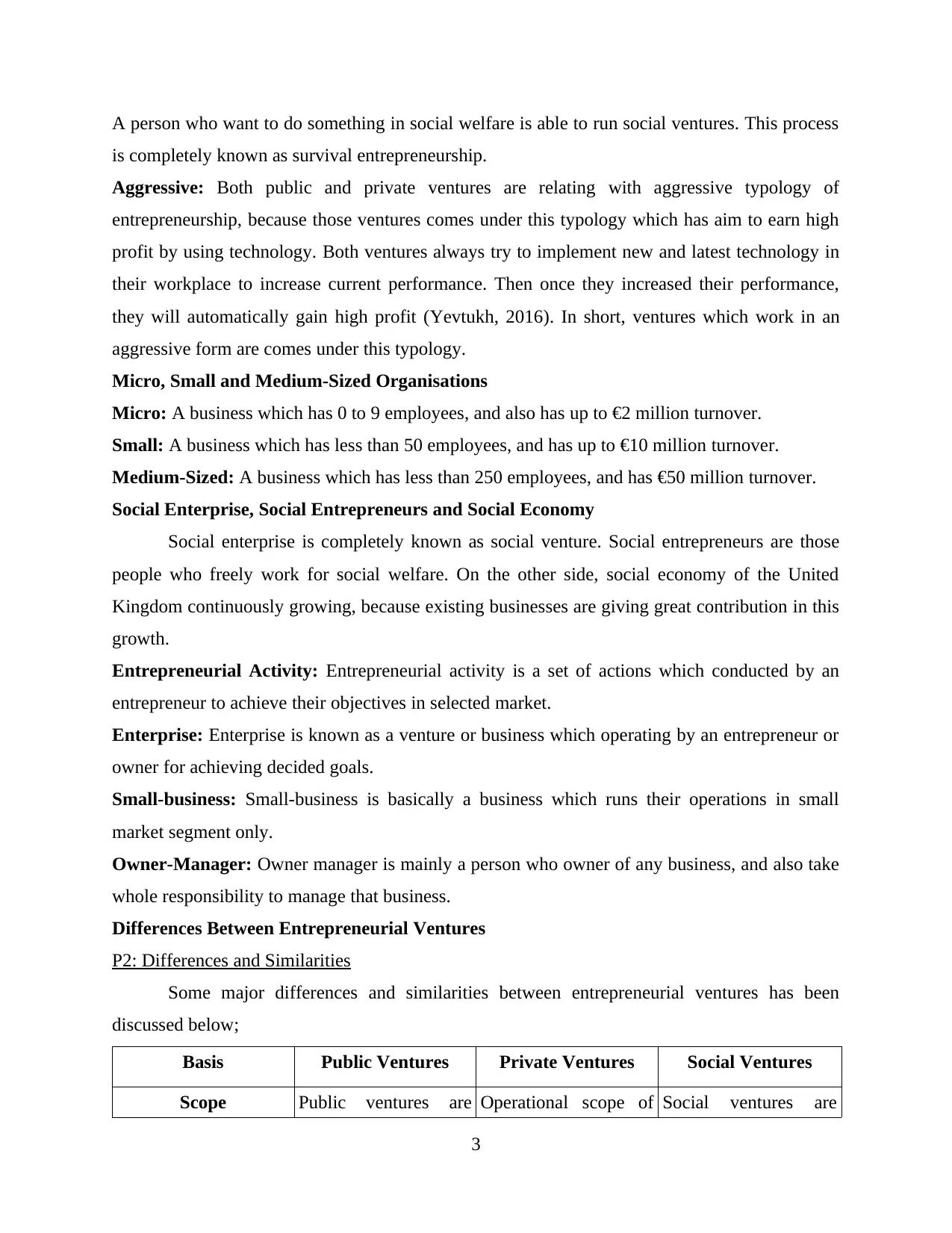
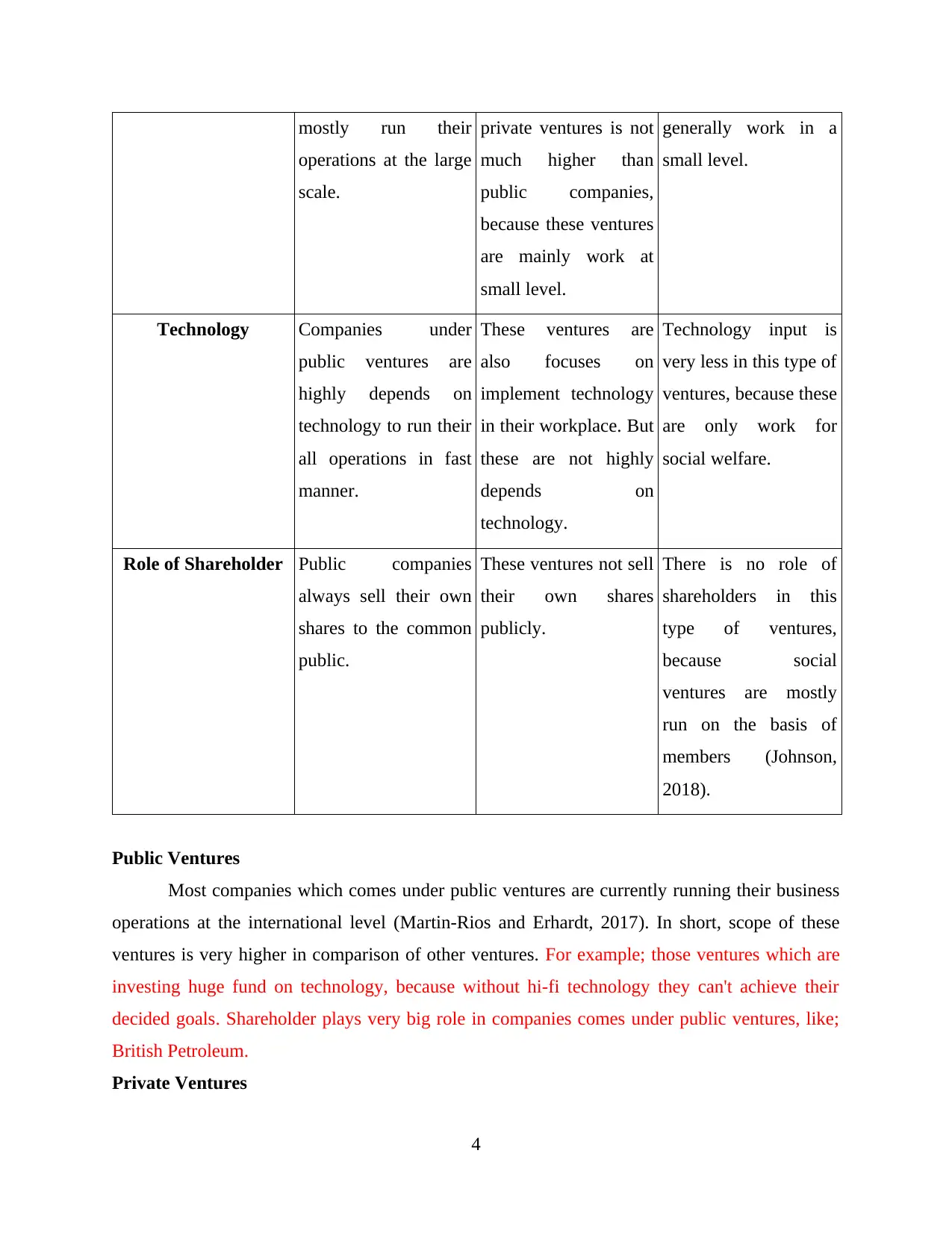
Some major differences and similarities between entrepreneurial ventures has been
discussed below;
Basis Public Ventures Private Ventures Social Ventures
Scope Public ventures are Operational scope of Social ventures are
3
is completely known as survival entrepreneurship.
Aggressive: Both public and private ventures are relating with aggressive typology of
entrepreneurship, because those ventures comes under this typology which has aim to earn high
profit by using technology. Both ventures always try to implement new and latest technology in
their workplace to increase current performance. Then once they increased their performance,
they will automatically gain high profit (Yevtukh, 2016). In short, ventures which work in an
aggressive form are comes under this typology.
Micro, Small and Medium-Sized Organisations
Micro: A business which has 0 to 9 employees, and also has up to €2 million turnover.
Small: A business which has less than 50 employees, and has up to €10 million turnover.
Medium-Sized: A business which has less than 250 employees, and has €50 million turnover.
Social Enterprise, Social Entrepreneurs and Social Economy
Social enterprise is completely known as social venture. Social entrepreneurs are those
people who freely work for social welfare. On the other side, social economy of the United
Kingdom continuously growing, because existing businesses are giving great contribution in this
growth.
Entrepreneurial Activity: Entrepreneurial activity is a set of actions which conducted by an
entrepreneur to achieve their objectives in selected market.
Enterprise: Enterprise is known as a venture or business which operating by an entrepreneur or
owner for achieving decided goals.
Small-business: Small-business is basically a business which runs their operations in small
market segment only.
Owner-Manager: Owner manager is mainly a person who owner of any business, and also take
whole responsibility to manage that business.
Differences Between Entrepreneurial Ventures
P2: Differences and Similarities
Some major differences and similarities between entrepreneurial ventures has been
discussed below;
Basis Public Ventures Private Ventures Social Ventures
Scope Public ventures are Operational scope of Social ventures are
3
mostly run their
operations at the large
scale.
private ventures is not
much higher than
public companies,
because these ventures
are mainly work at
small level.
generally work in a
small level.
Technology Companies under
public ventures are
highly depends on
technology to run their
all operations in fast
manner.
These ventures are
also focuses on
implement technology
in their workplace. But
these are not highly
depends on
technology.
Technology input is
very less in this type of
ventures, because these
are only work for
social welfare.
Role of Shareholder Public companies
always sell their own
shares to the common
public.
These ventures not sell
their own shares
publicly.
There is no role of
shareholders in this
type of ventures,
because social
ventures are mostly
run on the basis of
members (Johnson,
2018).
Public Ventures
Most companies which comes under public ventures are currently running their business
operations at the international level (Martin-Rios and Erhardt, 2017). In short, scope of these
ventures is very higher in comparison of other ventures. For example; those ventures which are
investing huge fund on technology, because without hi-fi technology they can't achieve their
decided goals. Shareholder plays very big role in companies comes under public ventures, like;
British Petroleum.
Private Ventures
4
operations at the large
scale.
private ventures is not
much higher than
public companies,
because these ventures
are mainly work at
small level.
generally work in a
small level.
Technology Companies under
public ventures are
highly depends on
technology to run their
all operations in fast
manner.
These ventures are
also focuses on
implement technology
in their workplace. But
these are not highly
depends on
technology.
Technology input is
very less in this type of
ventures, because these
are only work for
social welfare.
Role of Shareholder Public companies
always sell their own
shares to the common
public.
These ventures not sell
their own shares
publicly.
There is no role of
shareholders in this
type of ventures,
because social
ventures are mostly
run on the basis of
members (Johnson,
2018).
Public Ventures
Most companies which comes under public ventures are currently running their business
operations at the international level (Martin-Rios and Erhardt, 2017). In short, scope of these
ventures is very higher in comparison of other ventures. For example; those ventures which are
investing huge fund on technology, because without hi-fi technology they can't achieve their
decided goals. Shareholder plays very big role in companies comes under public ventures, like;
British Petroleum.
Private Ventures
4
⊘ This is a preview!⊘
Do you want full access?
Subscribe today to unlock all pages.
Trusted by 1+ million students worldwide
Companies or businesses which comes under private ventures are mostly run their
operations in only a city, region and state level. Owner of a private venture always hold all share
of its business. In some cases, it distributes some shares its family members or relatives like;
brother, so, daughter, close friends etc. For example: most companies or businesses under private
ventures are not able to afford hi-fi technology.
Social Ventures
Their scope is depending on charity or donation that they gain. If any social venture gets
huge charity and donation, then it'll raise its scope. But most of social ventures are working on
small operational scope. For example; The children's society is a social venture, so it no need to
produce products and services to sale in market. That's why these are not highly using
technology in their daily operations.
Differences between serial entrepreneurs, owner manager and entrepreneurs
Serial Entrepreneurs
Serial entrepreneurs always try to invent something new. Serial entrepreneurs mostly run
public ventures. For example; a person see business opportunity in the UK's coffee business,
because it knows how to make new exclusive flavours of coffee.
Owner Manager
Owner manager is mostly existing in private and public ventures. For example; an owner
of a retail company has taken the responsibility of managing its activities in their daily
operations.
Entrepreneurs
Entrepreneurs are related to all type of ventures, like; public, private and social, etc. For
example; a person has realized that there are great opportunities to gain high profit in retail
industry by providing quality products to customers. Then it has decided to start business in this
industry.
Similarities Between Entrepreneurial Ventures
Brand Image: All ventures public, private and social are day or nigh work for improving their
brand value in respective areas. These ventures always want to gain huge public attention
towards their brand. Each entrepreneurial venture always run such activities in their workplace
which will help in achieve effective goodwill.
5
operations in only a city, region and state level. Owner of a private venture always hold all share
of its business. In some cases, it distributes some shares its family members or relatives like;
brother, so, daughter, close friends etc. For example: most companies or businesses under private
ventures are not able to afford hi-fi technology.
Social Ventures
Their scope is depending on charity or donation that they gain. If any social venture gets
huge charity and donation, then it'll raise its scope. But most of social ventures are working on
small operational scope. For example; The children's society is a social venture, so it no need to
produce products and services to sale in market. That's why these are not highly using
technology in their daily operations.
Differences between serial entrepreneurs, owner manager and entrepreneurs
Serial Entrepreneurs
Serial entrepreneurs always try to invent something new. Serial entrepreneurs mostly run
public ventures. For example; a person see business opportunity in the UK's coffee business,
because it knows how to make new exclusive flavours of coffee.
Owner Manager
Owner manager is mostly existing in private and public ventures. For example; an owner
of a retail company has taken the responsibility of managing its activities in their daily
operations.
Entrepreneurs
Entrepreneurs are related to all type of ventures, like; public, private and social, etc. For
example; a person has realized that there are great opportunities to gain high profit in retail
industry by providing quality products to customers. Then it has decided to start business in this
industry.
Similarities Between Entrepreneurial Ventures
Brand Image: All ventures public, private and social are day or nigh work for improving their
brand value in respective areas. These ventures always want to gain huge public attention
towards their brand. Each entrepreneurial venture always run such activities in their workplace
which will help in achieve effective goodwill.
5
Paraphrase This Document
Need a fresh take? Get an instant paraphrase of this document with our AI Paraphraser
Growth: Each entrepreneurial venture always want to grow their enterprise in the market.
Public, private and social all ventures use various strategies in their workplace for growing their
brand in fast manner.
Fund Need: Each venture need a specific fund in their work environment to run its operations in
progressive path. Fund plays great role in these ventures. Without fund or funding sources
public, private and social venture can't achieve their targets in decided time period.
Government Formalities: These all ventures need to fulfil various government formalities to
smoothly run their all operations in selected areas (Wright and Westhead, 2016). Government
formalities includes; organization's registration, legislation, policies etc. which each one need to
employ in their workplace.
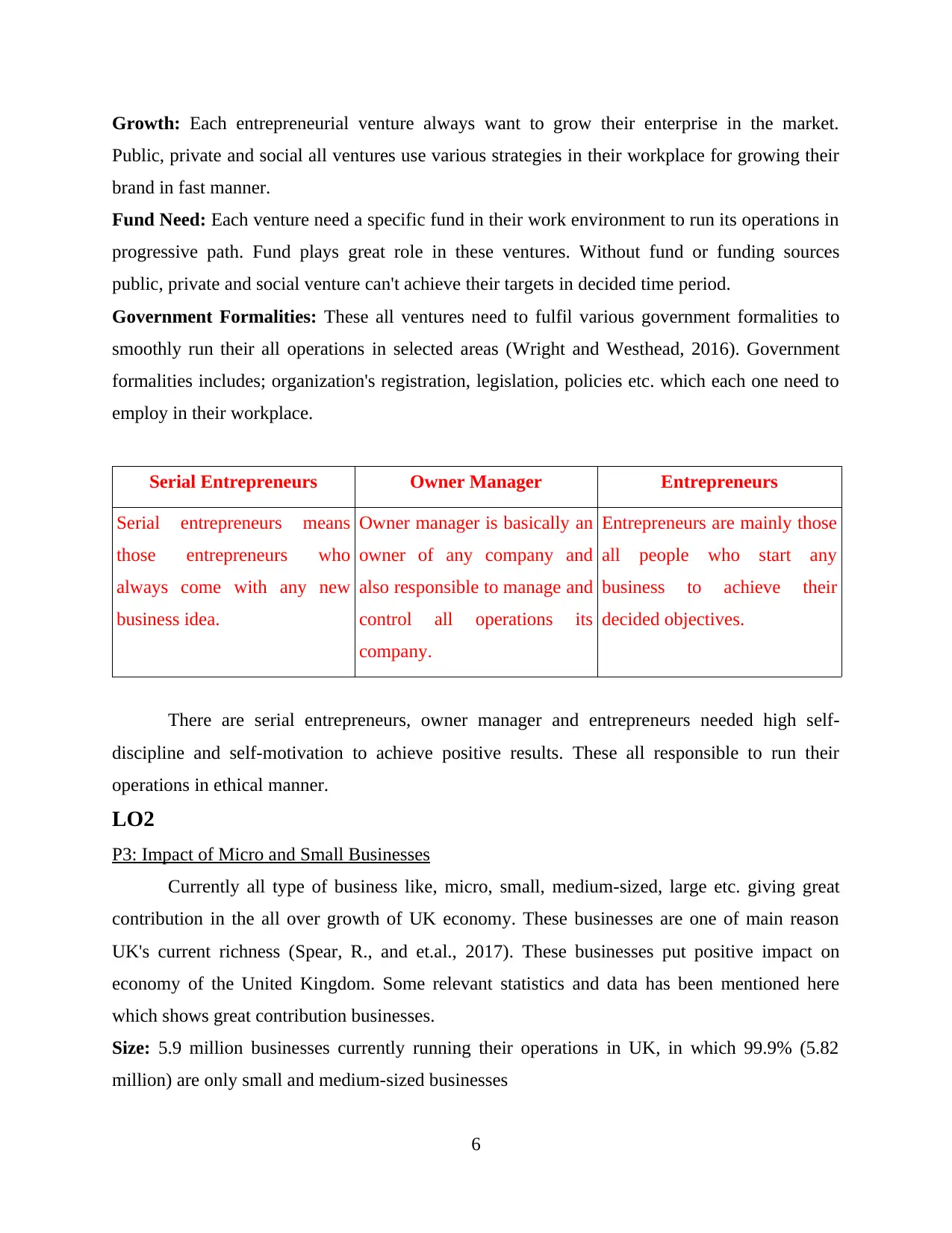
Serial Entrepreneurs Owner Manager Entrepreneurs
Serial entrepreneurs means
those entrepreneurs who
always come with any new
business idea.
Owner manager is basically an
owner of any company and
also responsible to manage and
control all operations its
company.
Entrepreneurs are mainly those
all people who start any
business to achieve their
decided objectives.
There are serial entrepreneurs, owner manager and entrepreneurs needed high self-
discipline and self-motivation to achieve positive results. These all responsible to run their
operations in ethical manner.
LO2
P3: Impact of Micro and Small Businesses
Currently all type of business like, micro, small, medium-sized, large etc. giving great
contribution in the all over growth of UK economy. These businesses are one of main reason
UK's current richness (Spear, R., and et.al., 2017). These businesses put positive impact on
economy of the United Kingdom. Some relevant statistics and data has been mentioned here
which shows great contribution businesses.
Size: 5.9 million businesses currently running their operations in UK, in which 99.9% (5.82
million) are only small and medium-sized businesses
6
Public, private and social all ventures use various strategies in their workplace for growing their
brand in fast manner.
Fund Need: Each venture need a specific fund in their work environment to run its operations in
progressive path. Fund plays great role in these ventures. Without fund or funding sources
public, private and social venture can't achieve their targets in decided time period.
Government Formalities: These all ventures need to fulfil various government formalities to
smoothly run their all operations in selected areas (Wright and Westhead, 2016). Government
formalities includes; organization's registration, legislation, policies etc. which each one need to
employ in their workplace.
Serial Entrepreneurs Owner Manager Entrepreneurs
Serial entrepreneurs means
those entrepreneurs who
always come with any new
business idea.
Owner manager is basically an
owner of any company and
also responsible to manage and
control all operations its
company.
Entrepreneurs are mainly those
all people who start any
business to achieve their
decided objectives.
There are serial entrepreneurs, owner manager and entrepreneurs needed high self-
discipline and self-motivation to achieve positive results. These all responsible to run their
operations in ethical manner.
LO2
P3: Impact of Micro and Small Businesses
Currently all type of business like, micro, small, medium-sized, large etc. giving great
contribution in the all over growth of UK economy. These businesses are one of main reason
UK's current richness (Spear, R., and et.al., 2017). These businesses put positive impact on
economy of the United Kingdom. Some relevant statistics and data has been mentioned here
which shows great contribution businesses.
Size: 5.9 million businesses currently running their operations in UK, in which 99.9% (5.82
million) are only small and medium-sized businesses
6
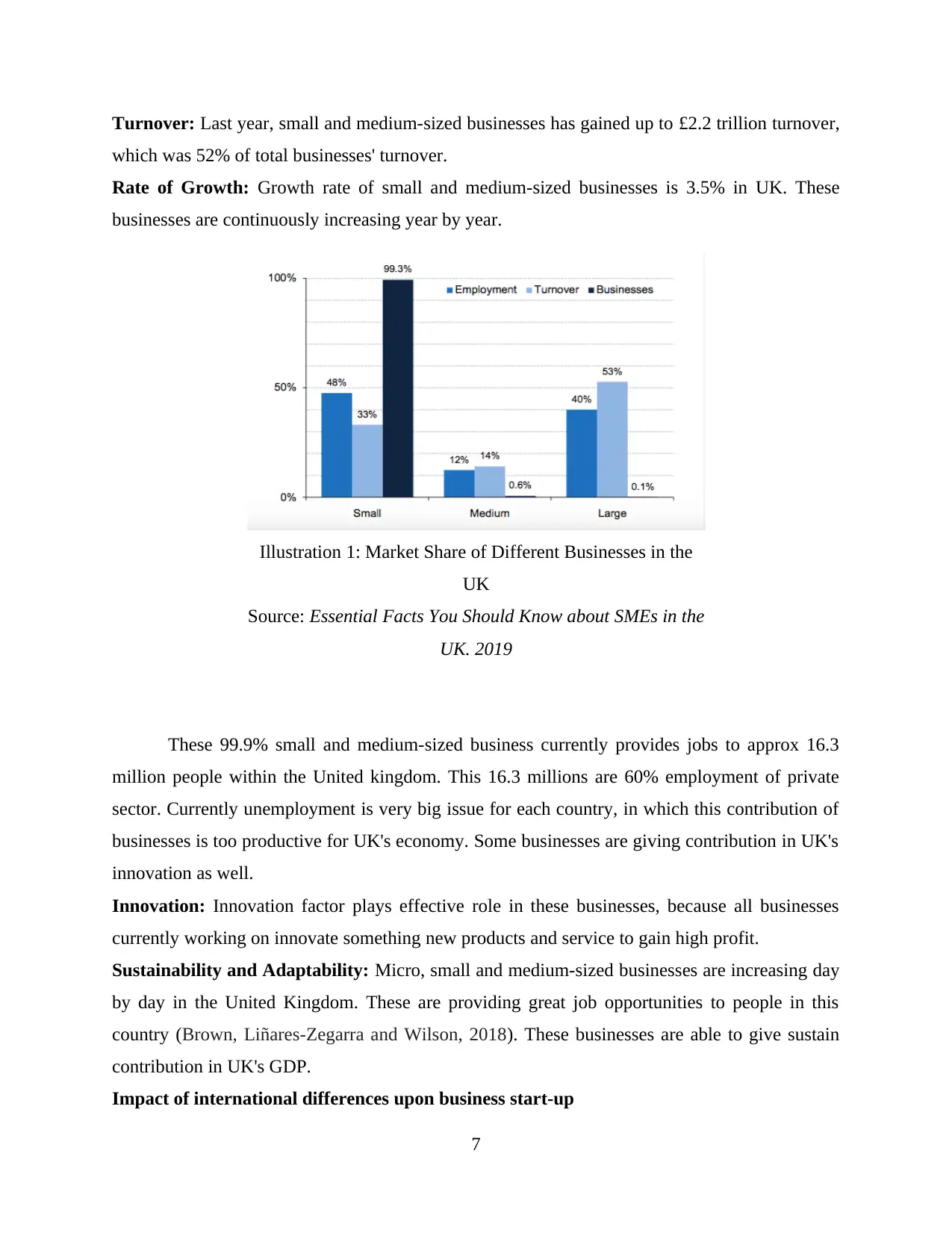
Turnover: Last year, small and medium-sized businesses has gained up to £2.2 trillion turnover,
which was 52% of total businesses' turnover.
Rate of Growth: Growth rate of small and medium-sized businesses is 3.5% in UK. These
businesses are continuously increasing year by year.
These 99.9% small and medium-sized business currently provides jobs to approx 16.3
million people within the United kingdom. This 16.3 millions are 60% employment of private
sector. Currently unemployment is very big issue for each country, in which this contribution of
businesses is too productive for UK's economy. Some businesses are giving contribution in UK's
innovation as well.
Innovation: Innovation factor plays effective role in these businesses, because all businesses
currently working on innovate something new products and service to gain high profit.
Sustainability and Adaptability: Micro, small and medium-sized businesses are increasing day
by day in the United Kingdom. These are providing great job opportunities to people in this
country (Brown, Liñares-Zegarra and Wilson, 2018). These businesses are able to give sustain
contribution in UK's GDP.
Impact of international differences upon business start-up
7
Illustration 1: Market Share of Different Businesses in the
UK
Source: Essential Facts You Should Know about SMEs in the
UK. 2019
which was 52% of total businesses' turnover.
Rate of Growth: Growth rate of small and medium-sized businesses is 3.5% in UK. These
businesses are continuously increasing year by year.
These 99.9% small and medium-sized business currently provides jobs to approx 16.3
million people within the United kingdom. This 16.3 millions are 60% employment of private
sector. Currently unemployment is very big issue for each country, in which this contribution of
businesses is too productive for UK's economy. Some businesses are giving contribution in UK's
innovation as well.
Innovation: Innovation factor plays effective role in these businesses, because all businesses
currently working on innovate something new products and service to gain high profit.
Sustainability and Adaptability: Micro, small and medium-sized businesses are increasing day
by day in the United Kingdom. These are providing great job opportunities to people in this
country (Brown, Liñares-Zegarra and Wilson, 2018). These businesses are able to give sustain
contribution in UK's GDP.
Impact of international differences upon business start-up
7
Illustration 1: Market Share of Different Businesses in the
UK
Source: Essential Facts You Should Know about SMEs in the
UK. 2019
⊘ This is a preview!⊘
Do you want full access?
Subscribe today to unlock all pages.
Trusted by 1+ million students worldwide
International differences are really impacting a business start-up. Suppose currently all
businesses in the world gives high priority to advance technology. If any entrepreneur plan to
start a business, then it'll also need to use advance technology to gain highly competitive
advantage in market.
There are micro, small, medium-sized and large businesses currently giving excellent
contribution in the growth of UK's economy. Specially, small and large-sized businesses,
because these are provided great employment opportunities to people in the United Kingdom.
P4: Importance of Small Business and Start-ups
Small businesses are an integral part of social economy as they provide opportunities for
entrepreneurs to utilize their skills and create meaningful jobs. They foster local economies by
keeping economy growing on extensive level through encouraging communities to take up small
businesses and ventures. Start ups are rooted in landscapes where they grow enabling their
business to give back vitality and sustenance to communities (Menon,2019).
Importance of small firms can be understood through various points which are as follows :
Encourage entrepreneurial spirit among the youth- Small businesses encourage
entrepreneurial growth among youth by guiding ways to initiate business decisions,
strategically implement steps to pool up the finance required. It allows people to generate
diversity and build competitive work environment in society, encouraging young
generation to build small firms. They are responsible to deliver enormous high diversity
with advanced skills among new generation, who look for desire of independence in
working styles (Al‐Jinini, Dahiyat and Bontis, 2019). Dynamic business culture enable
start-ups to cultivate new ideas into successful business firms through entrepreneur
ventures. Ethical standards are enhanced which allows individuals to uplift their
creativity,in working skills along with advanced competitive business knowledge.
Provides employment- Small businesses creates meaningful jobs for people and local
citizens in country which helps to generate large level employment and contributes to
increase the turnover of GDP. Growth in UK economy has largely increased because of
start-ups and small businesses coming up which has enabled economy to regain the
growing pace of enhancement and development. SME makes up around 99 percent of
business operating in UK economy (Covin and Wales,2019).There is large regional
8
businesses in the world gives high priority to advance technology. If any entrepreneur plan to
start a business, then it'll also need to use advance technology to gain highly competitive
advantage in market.
There are micro, small, medium-sized and large businesses currently giving excellent
contribution in the growth of UK's economy. Specially, small and large-sized businesses,
because these are provided great employment opportunities to people in the United Kingdom.
P4: Importance of Small Business and Start-ups
Small businesses are an integral part of social economy as they provide opportunities for
entrepreneurs to utilize their skills and create meaningful jobs. They foster local economies by
keeping economy growing on extensive level through encouraging communities to take up small
businesses and ventures. Start ups are rooted in landscapes where they grow enabling their
business to give back vitality and sustenance to communities (Menon,2019).
Importance of small firms can be understood through various points which are as follows :
Encourage entrepreneurial spirit among the youth- Small businesses encourage
entrepreneurial growth among youth by guiding ways to initiate business decisions,
strategically implement steps to pool up the finance required. It allows people to generate
diversity and build competitive work environment in society, encouraging young
generation to build small firms. They are responsible to deliver enormous high diversity
with advanced skills among new generation, who look for desire of independence in
working styles (Al‐Jinini, Dahiyat and Bontis, 2019). Dynamic business culture enable
start-ups to cultivate new ideas into successful business firms through entrepreneur
ventures. Ethical standards are enhanced which allows individuals to uplift their
creativity,in working skills along with advanced competitive business knowledge.
Provides employment- Small businesses creates meaningful jobs for people and local
citizens in country which helps to generate large level employment and contributes to
increase the turnover of GDP. Growth in UK economy has largely increased because of
start-ups and small businesses coming up which has enabled economy to regain the
growing pace of enhancement and development. SME makes up around 99 percent of
business operating in UK economy (Covin and Wales,2019).There is large regional
8
Paraphrase This Document
Need a fresh take? Get an instant paraphrase of this document with our AI Paraphraser
growth dependent on small firms business where it encourages business to provide large
employment and enrich younger generation to take startups.
Integral part of local economies-Small businesses and start-ups are increasingly
becoming an integral part of local economies. It encourages people to work with high
adaptiveness, dynamic business decisions which enable flexible working conditions and
high capabilities to meet competitive business world. Local economies are able to grow
with diversity due to small businesses and start-ups where employment is increased on
large scale and economy gets boost .SME contribute to local economies of country to
large extent as large percentage of population are highly dependent on their income
through small business firms.
Small business is the backbone of economy- Total employment in SME was 18.3
million in UK according to the latest research studies which has extensively encouraged
national economy with diverse skills and high employment scales ((Dufays,2019).Small-
business are considered backbone of economy where new start-ups foster growth and
deliver high productivity channels. It enables high satisfaction of citizens where people
encourage innovation along with high leverage to enhance their productivity levels of
growth. There is high productive growth in employment which leverages comparable
growth figure of economy and bring high investment opportunities for people .Small
businesses determine on what scale economy of country is growing, as large middle
income group of population of UK are operating in small business (Hameed and Irfan,
2019).
LO3
P5: Characteristics Traits and Skills of Successful Entrepreneurs
Entrepreneurs are individuals who start their own small business with high potentialities
and capabilities to initiate their own business with high skills and innovative ideas to bring in
competitive market share. Entrepreneurs with advanced competitive skills to take business
decisions with new ideas and continued growth differentiates them from other business
managers. There are various characteristics traits of successful entrepreneurs who have strong
mindset with inspirational working standards for their subordinates and team members to learn
from them which differentiates them from other business managers. Simon and Bobby Arora
entrepreneur of home ware chains B&M have built successful business structure into a billion
9
employment and enrich younger generation to take startups.
Integral part of local economies-Small businesses and start-ups are increasingly
becoming an integral part of local economies. It encourages people to work with high
adaptiveness, dynamic business decisions which enable flexible working conditions and
high capabilities to meet competitive business world. Local economies are able to grow
with diversity due to small businesses and start-ups where employment is increased on
large scale and economy gets boost .SME contribute to local economies of country to
large extent as large percentage of population are highly dependent on their income
through small business firms.
Small business is the backbone of economy- Total employment in SME was 18.3
million in UK according to the latest research studies which has extensively encouraged
national economy with diverse skills and high employment scales ((Dufays,2019).Small-
business are considered backbone of economy where new start-ups foster growth and
deliver high productivity channels. It enables high satisfaction of citizens where people
encourage innovation along with high leverage to enhance their productivity levels of
growth. There is high productive growth in employment which leverages comparable
growth figure of economy and bring high investment opportunities for people .Small
businesses determine on what scale economy of country is growing, as large middle
income group of population of UK are operating in small business (Hameed and Irfan,
2019).
LO3
P5: Characteristics Traits and Skills of Successful Entrepreneurs
Entrepreneurs are individuals who start their own small business with high potentialities
and capabilities to initiate their own business with high skills and innovative ideas to bring in
competitive market share. Entrepreneurs with advanced competitive skills to take business
decisions with new ideas and continued growth differentiates them from other business
managers. There are various characteristics traits of successful entrepreneurs who have strong
mindset with inspirational working standards for their subordinates and team members to learn
from them which differentiates them from other business managers. Simon and Bobby Arora
entrepreneur of home ware chains B&M have built successful business structure into a billion
9
pound operational firm due to their high entrepreneurial potentialities which can be understood
as follows:
Advanced competitive mind-set- Enterpenures with competitive mindset foster growth
and enable company to reach business targets with high efficiency and successful
completion of financial goals. This skill enhances their quick decision taking ability
along with high understanding of changing business trends allow them to reach
productive heights in their companies. The passion of hard work and creativity to build
ideas into successful business structure enable entrepreneurs to reach benchmark
performance levels, differentiating them from other business managers (Guerrero and
Urbano,2019).
Influential skills-Entrepreneurs need to have influential skills in their working standards
of company where the personality of entrepreneur influences all team members. This trait
differentiates them from other business managers as with strong influential personality
entrepreneur is able to cultivate strong dynamic culture in company and boost creativity
within subordinates. Charismatic skills allow them to inherit strong position in their
company by reaching goals successfully and harness creativity among other department
team members.
Risk taking ability- Successful entrepreneurs highly differentiates themselves from other
business managers because of high risk-taking ability in competitive business world.
Dynamic business culture has high risk standards where new brands and companies are
emerging with fast pace in world, especially in small entrepreneurial ventures. High risk
taking ability enable entrepreneurs to build competitive mindset to take quick decisions
regarding business strategies. Successful entrepreneurs inherit strong risk raking ability
where they possess strength and knowledge about graphics, statistics which determine
large growth potentialities.
High competency working standards- Successful entrepreneurs have high competency
in their working standards with deep knowledge of every field and how decisions can
affect their company performance levels (Irani,2019).This capability differentiates them
from other business managers where successful entrepreneurs build their start-ups with
deep analysis of market share and future potentialities for long term growth and
sustainability.
10
as follows:
Advanced competitive mind-set- Enterpenures with competitive mindset foster growth
and enable company to reach business targets with high efficiency and successful
completion of financial goals. This skill enhances their quick decision taking ability
along with high understanding of changing business trends allow them to reach
productive heights in their companies. The passion of hard work and creativity to build
ideas into successful business structure enable entrepreneurs to reach benchmark
performance levels, differentiating them from other business managers (Guerrero and
Urbano,2019).
Influential skills-Entrepreneurs need to have influential skills in their working standards
of company where the personality of entrepreneur influences all team members. This trait
differentiates them from other business managers as with strong influential personality
entrepreneur is able to cultivate strong dynamic culture in company and boost creativity
within subordinates. Charismatic skills allow them to inherit strong position in their
company by reaching goals successfully and harness creativity among other department
team members.
Risk taking ability- Successful entrepreneurs highly differentiates themselves from other
business managers because of high risk-taking ability in competitive business world.
Dynamic business culture has high risk standards where new brands and companies are
emerging with fast pace in world, especially in small entrepreneurial ventures. High risk
taking ability enable entrepreneurs to build competitive mindset to take quick decisions
regarding business strategies. Successful entrepreneurs inherit strong risk raking ability
where they possess strength and knowledge about graphics, statistics which determine
large growth potentialities.
High competency working standards- Successful entrepreneurs have high competency
in their working standards with deep knowledge of every field and how decisions can
affect their company performance levels (Irani,2019).This capability differentiates them
from other business managers where successful entrepreneurs build their start-ups with
deep analysis of market share and future potentialities for long term growth and
sustainability.
10
⊘ This is a preview!⊘
Do you want full access?
Subscribe today to unlock all pages.
Trusted by 1+ million students worldwide

1 out of 18


Related Documents


Your All-in-One AI-Powered Toolkit for Academic Success.
+13062052269
info@desklib.com
Available 24*7 on WhatsApp / Email
![[object Object]](/_next/static/media/star-bottom.7253800d.svg)
Unlock your academic potential
Copyright © 2020–2026 A2Z Services. All Rights Reserved. Developed and managed by ZUCOL.