Auckland International Campus CX660006 Entrepreneurship Report
VerifiedAdded on 2023/04/21
|10
|4207
|279
Report
AI Summary
This report, prepared by a student, examines entrepreneurship through the lens of two Chinese-owned businesses in New Zealand: a restaurant and a nail salon. The report delves into the background and characteristics of the entrepreneurs, including their motivations, goals, values, and risk-taking abilities. It analyzes their products, target markets, and the journey of starting their businesses, including the sources of their ideas and decision-making processes. The report highlights the key characteristics of successful entrepreneurs, such as the ability to identify opportunities, adapt to market needs, and demonstrate creativity and innovation. Through case studies of Mr. Ma's restaurant and Pinko's nail salon, the report provides insights into the challenges and strategies involved in establishing and growing a business in a new environment, particularly for immigrant entrepreneurs in New Zealand. The analysis covers aspects like market analysis, competitive strategies, and the role of personal values and goals in driving business success.
Auckland International Campus CX660006 Entrepreneurship
CX660006 Entrepreneurship
Assessment 1
Wang Weijia
(1000046927(
Page | 1
CX660006 Entrepreneurship
Assessment 1
Wang Weijia
(1000046927(
Page | 1

Paraphrase This Document
Need a fresh take? Get an instant paraphrase of this document with our AI Paraphraser
Auckland International Campus CX660006 Entrepreneurship
1 Introduction
Entrepreneurship is a concept of managing and developing a business venture for the purpose of
making profits by taking risks in the corporate world (Kuratko, 2016). New Zealand is currently seeing a
sharp rise in the increase of small enterprise that is contributing to economic development and
employment. There are several key characteristics of successful entrepreneurs and in New Zealand,
there is ease of setting up business. The Ministry of Business, Innovation, and Employment provide
guidelines which enable people to set up business in the country (Ministry of Business, Innovation &
Employment, 2019). The current scope of this report analyses a small Chinese restaurant established by
Mr. Ma and his wife Ms. Ma. They have recently migrated to New Zealand and established the business
for 1 year. The discussion also includes Pinko, who has set up recently a nail salon in Auckland. She is a
Chinese entrepreneur and has graduated from the University of Auckland. This discussion includes the
entrepreneur's key characteristics, values, goals, and learning are in life.
2 Characteristics of the entrepreneur /Background
2.1 Current Background of the Entrepreneur
Ma and his wife can be classified into a private entrepreneur and joint entrepreneur (Audretsch
and Keilbach, 2010). Mr. Ma is regarded as a private entrepreneur as he set up his own business
enterprise and he is the sole owner has to bear all the risks involved in his enterprise. Some good
characteristics possessed by Mr. Ma is the ability to observe, infer, analyze and predict. He jointly
operates the business with his wife and other staffs, hence he is a joint entrepreneur. Before he started on
with the business he was a successful corporate in Hong Kong. He started the business post observing
the presence of demand in Chinese food in his locality. He was also able to analyze the price at which
his food would sell easily. When he started his business, he could easily estimate and predict demand for
the amount of food. He and his wife worked in the finance market of Hong Kong. He saved enough
money to migrate and start a business in New Zealand, hence he immigrated (Citizen Advice Bureau,
2018). He and his wife always enjoyed cooking and had an authentic charisma in cooking Chinese food
items.
Pinko can be also regarded as a private entrepreneur. She graduated from the University of
Auckland, a post which she set up a clothing store. However, she was not able to run the store due to
high competition and got depressed. Later she set up a nail art salon from her hobby and now
successfully runs it. She got married after graduation and then set up a clothing store in New Zealand.
She possessed the knowledge of setting up a business that she learned from graduation. Pinko possessed
adequate innovative, conceptual and intuitive characteristics. Though her first venture did not mature in
an effective manner, she was capable to visualize the opportunity prevalent in Auckland in nail art.
Page | 2
1 Introduction
Entrepreneurship is a concept of managing and developing a business venture for the purpose of
making profits by taking risks in the corporate world (Kuratko, 2016). New Zealand is currently seeing a
sharp rise in the increase of small enterprise that is contributing to economic development and
employment. There are several key characteristics of successful entrepreneurs and in New Zealand,
there is ease of setting up business. The Ministry of Business, Innovation, and Employment provide
guidelines which enable people to set up business in the country (Ministry of Business, Innovation &
Employment, 2019). The current scope of this report analyses a small Chinese restaurant established by
Mr. Ma and his wife Ms. Ma. They have recently migrated to New Zealand and established the business
for 1 year. The discussion also includes Pinko, who has set up recently a nail salon in Auckland. She is a
Chinese entrepreneur and has graduated from the University of Auckland. This discussion includes the
entrepreneur's key characteristics, values, goals, and learning are in life.
2 Characteristics of the entrepreneur /Background
2.1 Current Background of the Entrepreneur
Ma and his wife can be classified into a private entrepreneur and joint entrepreneur (Audretsch
and Keilbach, 2010). Mr. Ma is regarded as a private entrepreneur as he set up his own business
enterprise and he is the sole owner has to bear all the risks involved in his enterprise. Some good
characteristics possessed by Mr. Ma is the ability to observe, infer, analyze and predict. He jointly
operates the business with his wife and other staffs, hence he is a joint entrepreneur. Before he started on
with the business he was a successful corporate in Hong Kong. He started the business post observing
the presence of demand in Chinese food in his locality. He was also able to analyze the price at which
his food would sell easily. When he started his business, he could easily estimate and predict demand for
the amount of food. He and his wife worked in the finance market of Hong Kong. He saved enough
money to migrate and start a business in New Zealand, hence he immigrated (Citizen Advice Bureau,
2018). He and his wife always enjoyed cooking and had an authentic charisma in cooking Chinese food
items.
Pinko can be also regarded as a private entrepreneur. She graduated from the University of
Auckland, a post which she set up a clothing store. However, she was not able to run the store due to
high competition and got depressed. Later she set up a nail art salon from her hobby and now
successfully runs it. She got married after graduation and then set up a clothing store in New Zealand.
She possessed the knowledge of setting up a business that she learned from graduation. Pinko possessed
adequate innovative, conceptual and intuitive characteristics. Though her first venture did not mature in
an effective manner, she was capable to visualize the opportunity prevalent in Auckland in nail art.
Page | 2
Auckland International Campus CX660006 Entrepreneurship
There are a number of a salon in Auckland however only a few of them specializes in nail art, with
Pinko’s being one of them.
2.2 Products or Services
Behind every successful business, there is an innovative product or service, Mr. Ma visualized
the need for an authentic Chinese cuisine restaurant in his area (Burns, 2016). He felt the presence of
enormous opportunities in the restaurant business, where he could serve local delicacies from his
homeland.
Pinko initially had an unsuccessful business initially and the clothing store was shut down. She
has recently set up a nail art salon. She has set up the salon from her hobby and is now successful.
2.3 Target Market
Mr. Ma had a greater advantage in his target market as he analyzed his potential customers
residing in Taupaki (Ministry of Business, Innovation & Employment, 2019). He was certain that he
could easily get regular walk-in customers with customers for home delivery from more than 50% of
residents in the area. He can adopt a marketing strategy to attract people to products that he will sell.
Pinko initially had failed in the clothing business and suffered losses. Currently, she has set up a
nail art salon, which she had established from her hobby. Currently, she aims to attract the young target
market-based in Auckland, New Zealand. She aims to target the female population from 10 years to 40
years of age.
2.4 Entrepreneur’s Background
Mr. Ma is a Chinese entrepreneur, who is very hard working and had been residing in New
Zeeland since the past 3 years. Back in his homeland, Hong Kong he had been a very successful
corporate with good records in finance background. Though he was employed for 10 years in the finance
market in Hong Kong, he had a knack for cooking and was a very good cook. He got married at the age
of 25 years and did not have children. He and his wife decided to pursue their passion for cooking and
set up a business. The business ambiance in Hong Kong is already saturated with restaurants. Hence
they decided to move onto New Zealand to pursue their business.
Pinko is a hardworking and innovative entrepreneur. She has in-depth knowledge and skills in
business. She had gained immense knowledge from graduation years. Her supportive husband helped
her recover from depression after her business failure. He helped set up the new salon after her failure in
the clothing business.
2.5 Entrepreneur’s Goals and Values
Mr. Ma is a private entrepreneur and his business goal is to make profits. He aims at attaining
break-even point before 3 years of the business. He will introduce several revenues earning model into
his business such that he is able to set up branches of his business at other places in New Zealand.
Page | 3
There are a number of a salon in Auckland however only a few of them specializes in nail art, with
Pinko’s being one of them.
2.2 Products or Services
Behind every successful business, there is an innovative product or service, Mr. Ma visualized
the need for an authentic Chinese cuisine restaurant in his area (Burns, 2016). He felt the presence of
enormous opportunities in the restaurant business, where he could serve local delicacies from his
homeland.
Pinko initially had an unsuccessful business initially and the clothing store was shut down. She
has recently set up a nail art salon. She has set up the salon from her hobby and is now successful.
2.3 Target Market
Mr. Ma had a greater advantage in his target market as he analyzed his potential customers
residing in Taupaki (Ministry of Business, Innovation & Employment, 2019). He was certain that he
could easily get regular walk-in customers with customers for home delivery from more than 50% of
residents in the area. He can adopt a marketing strategy to attract people to products that he will sell.
Pinko initially had failed in the clothing business and suffered losses. Currently, she has set up a
nail art salon, which she had established from her hobby. Currently, she aims to attract the young target
market-based in Auckland, New Zealand. She aims to target the female population from 10 years to 40
years of age.
2.4 Entrepreneur’s Background
Mr. Ma is a Chinese entrepreneur, who is very hard working and had been residing in New
Zeeland since the past 3 years. Back in his homeland, Hong Kong he had been a very successful
corporate with good records in finance background. Though he was employed for 10 years in the finance
market in Hong Kong, he had a knack for cooking and was a very good cook. He got married at the age
of 25 years and did not have children. He and his wife decided to pursue their passion for cooking and
set up a business. The business ambiance in Hong Kong is already saturated with restaurants. Hence
they decided to move onto New Zealand to pursue their business.
Pinko is a hardworking and innovative entrepreneur. She has in-depth knowledge and skills in
business. She had gained immense knowledge from graduation years. Her supportive husband helped
her recover from depression after her business failure. He helped set up the new salon after her failure in
the clothing business.
2.5 Entrepreneur’s Goals and Values
Mr. Ma is a private entrepreneur and his business goal is to make profits. He aims at attaining
break-even point before 3 years of the business. He will introduce several revenues earning model into
his business such that he is able to set up branches of his business at other places in New Zealand.
Page | 3
⊘ This is a preview!⊘
Do you want full access?
Subscribe today to unlock all pages.

Trusted by 1+ million students worldwide
Auckland International Campus CX660006 Entrepreneurship
Pinko’s goals and values are aimed at making profits. She aims to break-even within 5 years of
business. She is conservative now as she has suffered losses from her last business. She aims to conduct
online marketing strategy with her nail art designs and introduce branches of her business in other cities
in New Zealand.
2.6 Entrepreneur Characteristics
The word entrepreneur had been evolving ever since its existence and aims at implying a venture
undertaking by an individual with a certain amount of risks involvement (Morris, Kuratko and Covin,
2010). Traits or characteristics of an entrepreneur including Genetics, Identifying Opportunities, Risk
Taking and Make it Happen. Mr. Ma has an ideal combination of all these characteristics, as firstly he
has been able to identify opportunities in the area he is staying. He has been able to identify all types of
restaurants in the area apart from Chinese (Parker, 2018). His restaurant delicacies and plates are already
widely accepted and he receives a regular influx of customers. He is a proactive entrepreneur as he
introduces a new plate often and also has special menu items to appease customers. He provides gifts to
children visiting his restaurant for dining, to retain his customers. His immense cognitive capability with
deliberate and spontaneous thinking capability enables him to be spontaneous and deliberately creative
in introducing new menus.
Mr. Ma is a hardworking and dedicated individual, who devotes a lot of time in his business. He
and his wife initially struggled a lot to make their business venture happen (Drucker, 2014). They were
determined that they would succeed in their business. They went through a lot of lean times, where there
were almost no customers but they have managed to sail through smoothly in their business with their
determination and committed passion. Risk-taking capabilities of Mr. Ma is praiseworthy as being a
new immigrant he immediately started off with a business (Bridge and O'Neill, 2012). He took a prime
property on lease for his restaurant, which consumed a lot of his capital yet he was determined on the
location. He decorated the restaurant well and also introduced one item after the other which reflects his
risk-taking capability. He is innovative in nature as he has introduced several new menus and items at
his restaurants. His innovative blend of mind depicts his intuition. His intuitive spirit shows his
determination and courage for business. He is able to predict demand and sales for his restaurant
Pinko has business acumen and his ability to analyze the need of customers well. After her
closure of clothing business, she has become aware and has identified opportunity in Auckland well. She
has a strong bent of mind and is a proactive entrepreneur. In the new nail art salon, she has kept special
designs and offers that would be attractive to customers. She has the inferential capability as well, she is
able to predict customer demands. She has an appropriate conceptual understanding regarding the
business. She is extremely innovative and hard working to make her business happen. She has immense
risk-taking capability and courage to re-establish a business after the failure of the clothing business. She
Page | 4
Pinko’s goals and values are aimed at making profits. She aims to break-even within 5 years of
business. She is conservative now as she has suffered losses from her last business. She aims to conduct
online marketing strategy with her nail art designs and introduce branches of her business in other cities
in New Zealand.
2.6 Entrepreneur Characteristics
The word entrepreneur had been evolving ever since its existence and aims at implying a venture
undertaking by an individual with a certain amount of risks involvement (Morris, Kuratko and Covin,
2010). Traits or characteristics of an entrepreneur including Genetics, Identifying Opportunities, Risk
Taking and Make it Happen. Mr. Ma has an ideal combination of all these characteristics, as firstly he
has been able to identify opportunities in the area he is staying. He has been able to identify all types of
restaurants in the area apart from Chinese (Parker, 2018). His restaurant delicacies and plates are already
widely accepted and he receives a regular influx of customers. He is a proactive entrepreneur as he
introduces a new plate often and also has special menu items to appease customers. He provides gifts to
children visiting his restaurant for dining, to retain his customers. His immense cognitive capability with
deliberate and spontaneous thinking capability enables him to be spontaneous and deliberately creative
in introducing new menus.
Mr. Ma is a hardworking and dedicated individual, who devotes a lot of time in his business. He
and his wife initially struggled a lot to make their business venture happen (Drucker, 2014). They were
determined that they would succeed in their business. They went through a lot of lean times, where there
were almost no customers but they have managed to sail through smoothly in their business with their
determination and committed passion. Risk-taking capabilities of Mr. Ma is praiseworthy as being a
new immigrant he immediately started off with a business (Bridge and O'Neill, 2012). He took a prime
property on lease for his restaurant, which consumed a lot of his capital yet he was determined on the
location. He decorated the restaurant well and also introduced one item after the other which reflects his
risk-taking capability. He is innovative in nature as he has introduced several new menus and items at
his restaurants. His innovative blend of mind depicts his intuition. His intuitive spirit shows his
determination and courage for business. He is able to predict demand and sales for his restaurant
Pinko has business acumen and his ability to analyze the need of customers well. After her
closure of clothing business, she has become aware and has identified opportunity in Auckland well. She
has a strong bent of mind and is a proactive entrepreneur. In the new nail art salon, she has kept special
designs and offers that would be attractive to customers. She has the inferential capability as well, she is
able to predict customer demands. She has an appropriate conceptual understanding regarding the
business. She is extremely innovative and hard working to make her business happen. She has immense
risk-taking capability and courage to re-establish a business after the failure of the clothing business. She
Page | 4
Paraphrase This Document
Need a fresh take? Get an instant paraphrase of this document with our AI Paraphraser
Auckland International Campus CX660006 Entrepreneurship
is tremendously creative and spontaneous. She did not wait for much time after the failure of her first
venture, she immediately decided and started off with her new business.
3 Journey and creativity in starting the business
3.1 Motivations for starting up and where did the idea/s come from
People in their middle life years wish that they had their own business, as they are motivated to
do a job without having a superior telling them what needs to be done (Kirzner, 2015). Mr. Ma was not
only motivated to work without having a superior around him to dominate but also because he needed a
greater challenge in his life. The push motivates for Mr. Ma to set up this business was to get rid of these
regular office hours and create a stable source of income for him and his wife. He was tired from the
finance job that he did back in Hong Kong and he did not receive much raise in his salary, his job was
consuming his entire energy and he could not afford a decent living with his job. It was rather a push
motivate for Mr. Ma to create a source of income for the best part of his life. He also was pulled by his
motivation to pursue his passion for cooking. He possesses high deliberate creativity, which is reflected
in his business set-up capability.
Pinko depicts high emotional creativity, which is depicted in her nail art. Along with emotional
creativity, she possesses cognitive creativity capability as well.
3.2 Source of Idea
Business ideas are always present in the environment all around, one has to possess the vision to
view the opportunity (Schaper, Volery, Weber and Gibson, 2014). Mr. Ma's ideas came from the
analysis of the market and the needs of the consumers. He was doing some research on business
prospects back in Hong Kong and also after he immigrated to New Zealand. He had been interacting
with some local people and he felt that people in the locality often had to go out and drive a long
distance to reach a Chinese restaurant. He set up his business in the locality so that people could
regularly take parcels and eat at the restaurant when they craved for Chinese food. His source of the
business idea is from deliberate creativity. He is determined to establish the business and undertake the
risks to expand the same.
Pinko received the source of her idea from her emotional creativity. Her emotional creativity
enabled her to set up the nail art salon. She felt the absence of nail art salon in New Zealand and very
less competition. therefore, she decided to set up the shop in Auckland, as she felt the service could gain
high positive demand from varied types of customers.
3.3 Decision Making Process (Evaluation of the Ideas)
Page | 5
is tremendously creative and spontaneous. She did not wait for much time after the failure of her first
venture, she immediately decided and started off with her new business.
3 Journey and creativity in starting the business
3.1 Motivations for starting up and where did the idea/s come from
People in their middle life years wish that they had their own business, as they are motivated to
do a job without having a superior telling them what needs to be done (Kirzner, 2015). Mr. Ma was not
only motivated to work without having a superior around him to dominate but also because he needed a
greater challenge in his life. The push motivates for Mr. Ma to set up this business was to get rid of these
regular office hours and create a stable source of income for him and his wife. He was tired from the
finance job that he did back in Hong Kong and he did not receive much raise in his salary, his job was
consuming his entire energy and he could not afford a decent living with his job. It was rather a push
motivate for Mr. Ma to create a source of income for the best part of his life. He also was pulled by his
motivation to pursue his passion for cooking. He possesses high deliberate creativity, which is reflected
in his business set-up capability.
Pinko depicts high emotional creativity, which is depicted in her nail art. Along with emotional
creativity, she possesses cognitive creativity capability as well.
3.2 Source of Idea
Business ideas are always present in the environment all around, one has to possess the vision to
view the opportunity (Schaper, Volery, Weber and Gibson, 2014). Mr. Ma's ideas came from the
analysis of the market and the needs of the consumers. He was doing some research on business
prospects back in Hong Kong and also after he immigrated to New Zealand. He had been interacting
with some local people and he felt that people in the locality often had to go out and drive a long
distance to reach a Chinese restaurant. He set up his business in the locality so that people could
regularly take parcels and eat at the restaurant when they craved for Chinese food. His source of the
business idea is from deliberate creativity. He is determined to establish the business and undertake the
risks to expand the same.
Pinko received the source of her idea from her emotional creativity. Her emotional creativity
enabled her to set up the nail art salon. She felt the absence of nail art salon in New Zealand and very
less competition. therefore, she decided to set up the shop in Auckland, as she felt the service could gain
high positive demand from varied types of customers.
3.3 Decision Making Process (Evaluation of the Ideas)
Page | 5
Auckland International Campus CX660006 Entrepreneurship
Merely getting motivated based on an idea is not sufficient for setting up a successful revenue
earning venture in entrepreneurship. An idea of entrepreneurship can be evaluated through market,
competition and determining the key element of success (Welter, 2011). Mr. Ma successfully identified
his target market as integral for the qualification of his business idea. He undertook competitive
advantage as other Chinese restaurants were at a far off distance. Moreover, he possessed knowledge of
the attitude and psychology of the people living in the area. Hence, he selected that the location of the
business will have a unique selling proposition (USP) for the target customers. Most people living in the
area purchased packed food on their way back home from the city center. With a good authentic Chinese
restaurant nearby, these people would select purchasing or even dine at the facility. Affordable food
prices is another factor that added to the feasibility of the current business proposition.
Pinko saw the absence of a good nail art salon at Auckland hence she decided to set up the store.
Due to the failure of the earlier business idea, she undertook the decision very carefully. she evaluated
all possible pros and cons prior to making her decision.
4 Problem-solving and Journey
4.1 Challenges and issues faced
The development and growth of every business are faced by some challenges
(Oosterbeek, Van Praag and Ijsselstein, 2010). In the business established by Mr. Ma, there were certain
challenges as well. The first difficulty for Mr. Ma was to find a head chef, at an affordable cost who is
aware and can prepare authentic Chinese. Setting up the restaurant was one thing, then there was also a
challenge in regards to getting the set-up functional. In order to do so there was needed stable employees
and staffs who would be able to make positive contributions to the business. He had to run the restaurant
for a continuous period of 6 months prior to getting appropriate staffs. Often the faces lack of proper
chefs, who can prepare authentic Chinese food or cut vegetables appropriately for Chinese dishes.
However, the market for Chinese restaurant business is flourishing yet one needs to direct the business
appropriately. There was a lack of chefs and cook who could prepare Chinese preparations well, hence
Mr. Ma and his wife had to initially train some staffs to prepare the dishes. Secondly, the home delivery
model of the business needed staffs and vehicles on which they could commute. This model required
high investments with little returns, therefore, Mr. Ma had to initially not operate the home delivery
model. When resolving any problem or challenge faced in his business, he tried to arrive at the root of
the problem. Implying she applied root-cause analysis in resolving a challenge or problem faced while
conducting his business.
Page | 6
Merely getting motivated based on an idea is not sufficient for setting up a successful revenue
earning venture in entrepreneurship. An idea of entrepreneurship can be evaluated through market,
competition and determining the key element of success (Welter, 2011). Mr. Ma successfully identified
his target market as integral for the qualification of his business idea. He undertook competitive
advantage as other Chinese restaurants were at a far off distance. Moreover, he possessed knowledge of
the attitude and psychology of the people living in the area. Hence, he selected that the location of the
business will have a unique selling proposition (USP) for the target customers. Most people living in the
area purchased packed food on their way back home from the city center. With a good authentic Chinese
restaurant nearby, these people would select purchasing or even dine at the facility. Affordable food
prices is another factor that added to the feasibility of the current business proposition.
Pinko saw the absence of a good nail art salon at Auckland hence she decided to set up the store.
Due to the failure of the earlier business idea, she undertook the decision very carefully. she evaluated
all possible pros and cons prior to making her decision.
4 Problem-solving and Journey
4.1 Challenges and issues faced
The development and growth of every business are faced by some challenges
(Oosterbeek, Van Praag and Ijsselstein, 2010). In the business established by Mr. Ma, there were certain
challenges as well. The first difficulty for Mr. Ma was to find a head chef, at an affordable cost who is
aware and can prepare authentic Chinese. Setting up the restaurant was one thing, then there was also a
challenge in regards to getting the set-up functional. In order to do so there was needed stable employees
and staffs who would be able to make positive contributions to the business. He had to run the restaurant
for a continuous period of 6 months prior to getting appropriate staffs. Often the faces lack of proper
chefs, who can prepare authentic Chinese food or cut vegetables appropriately for Chinese dishes.
However, the market for Chinese restaurant business is flourishing yet one needs to direct the business
appropriately. There was a lack of chefs and cook who could prepare Chinese preparations well, hence
Mr. Ma and his wife had to initially train some staffs to prepare the dishes. Secondly, the home delivery
model of the business needed staffs and vehicles on which they could commute. This model required
high investments with little returns, therefore, Mr. Ma had to initially not operate the home delivery
model. When resolving any problem or challenge faced in his business, he tried to arrive at the root of
the problem. Implying she applied root-cause analysis in resolving a challenge or problem faced while
conducting his business.
Page | 6
⊘ This is a preview!⊘
Do you want full access?
Subscribe today to unlock all pages.
Trusted by 1+ million students worldwide
Auckland International Campus CX660006 Entrepreneurship
When Pinko started with her nail art salon she faced a lack of financial resources. She did
not have sufficient funds to hire staffs and employ them, As she had already suffered losses and had to
close her clothing business, she needed funds desperately. Pinko is a bit nervous type of lady, she earlier
resolved her problems in a rather haphazard manner, but recently she is applying more technical ways.
She is making use of her learning from her graduation days to resolve problems using fish-bone
analysis. This allowed her to resolve problems in an easy manner and arrive at a solution appropriately.
5 Critical thinking
Reflection by the entrepreneur
Mr. Ma during his interview shared that his journey as an entrepreneur has been self-
enlightening. I am very happy that I could pursue his passion to become an entrepreneur at the end, after
experiencing several ups and downs in my journey. I recall the process of setting up a business and
getting it functional was not at all an easy process and there was an entire learning curve involved.
Earlier I thought that I was aware of all the financial troubles and challenges I would face hence I had
prepared a contingency plan. But while actually carrying out the process of entrepreneurship opened
new financial challenges, which I had not considered. Hence, I feel in spite of all the homework, there is
no better teacher than practicality. From my journey, I realized that without my wife’s support I could
not have sailed through. I learned to be humble and realized that there are still many financial along with
another aspect of entrepreneurship, which I did not know. I thought taking one step at a time helped me,
rather than going all out initially. At first establishing take away counter, then providing home
deliveries of Chinese food, prior to setting up a full-fledged Chinese restaurant.
At the beginning of my venture, I made mistakes of launching several services and products all
at one go. This led to an immense constraint on my finances. Therefore, I had to retract on various
products and services, then again considering re-launching them again. Factors such as target market,
competitors, system and location might fail and one should not be over-confident, dependent upon these
factors. A business plan needs to be present which need to be revised often such that all new variable in
the business can be considered and pursued accordingly. I feel that the people whom I regarded would
become my regular customers never turned up and people whom I never considered to be favorable of
Chinese food, came regularly to his restaurant. Another factor which determined my business success
initially was an absence of competitors, but soon after my restaurant opened, there were four other
restaurants that were set up, which diminished the regular flow of customers into my restaurant. Thus,
one should devise the business model effectively to make sure the sustainability of the business. I felt
that these mistakes I should never commit again in the future and it should act as a learning curve for the
Page | 7
When Pinko started with her nail art salon she faced a lack of financial resources. She did
not have sufficient funds to hire staffs and employ them, As she had already suffered losses and had to
close her clothing business, she needed funds desperately. Pinko is a bit nervous type of lady, she earlier
resolved her problems in a rather haphazard manner, but recently she is applying more technical ways.
She is making use of her learning from her graduation days to resolve problems using fish-bone
analysis. This allowed her to resolve problems in an easy manner and arrive at a solution appropriately.
5 Critical thinking
Reflection by the entrepreneur
Mr. Ma during his interview shared that his journey as an entrepreneur has been self-
enlightening. I am very happy that I could pursue his passion to become an entrepreneur at the end, after
experiencing several ups and downs in my journey. I recall the process of setting up a business and
getting it functional was not at all an easy process and there was an entire learning curve involved.
Earlier I thought that I was aware of all the financial troubles and challenges I would face hence I had
prepared a contingency plan. But while actually carrying out the process of entrepreneurship opened
new financial challenges, which I had not considered. Hence, I feel in spite of all the homework, there is
no better teacher than practicality. From my journey, I realized that without my wife’s support I could
not have sailed through. I learned to be humble and realized that there are still many financial along with
another aspect of entrepreneurship, which I did not know. I thought taking one step at a time helped me,
rather than going all out initially. At first establishing take away counter, then providing home
deliveries of Chinese food, prior to setting up a full-fledged Chinese restaurant.
At the beginning of my venture, I made mistakes of launching several services and products all
at one go. This led to an immense constraint on my finances. Therefore, I had to retract on various
products and services, then again considering re-launching them again. Factors such as target market,
competitors, system and location might fail and one should not be over-confident, dependent upon these
factors. A business plan needs to be present which need to be revised often such that all new variable in
the business can be considered and pursued accordingly. I feel that the people whom I regarded would
become my regular customers never turned up and people whom I never considered to be favorable of
Chinese food, came regularly to his restaurant. Another factor which determined my business success
initially was an absence of competitors, but soon after my restaurant opened, there were four other
restaurants that were set up, which diminished the regular flow of customers into my restaurant. Thus,
one should devise the business model effectively to make sure the sustainability of the business. I felt
that these mistakes I should never commit again in the future and it should act as a learning curve for the
Page | 7
Paraphrase This Document
Need a fresh take? Get an instant paraphrase of this document with our AI Paraphraser
Auckland International Campus CX660006 Entrepreneurship
future of my business. Therefore, Mr. Ma reflected confidence, perseverance, and energy in conducting
his business. Interview with him reflected his ability to radiate energy amongst his staff members and
people he worked with. He acted with confidence and perseverance even in a situation where he could
be led down.
Pinko felt that she had a lot of learning experience from her entrepreneurship. I had a
challenging journey of entrepreneurship at first that gradually transformed to become a rewarding
experience. I have progressed a lot and have become a determined person, who can conduct business
operations appropriately. With the failure of my clothing business and immense competitive pressures
that I faced, I learned a lot of things. I felt that I needed to provide my customers something exclusive
such that they would want to visit my store again and again. In the current business, I am aiming to
utilize all my creative endeavors to provide something extraordinary to my customers. Pinko reflected
perseverance and confidence with her ability to start afresh in business. She possessed tremendous
energy in conducting her business and she radiated energy. She felt confident and was with full energy
in this new business and she aimed to achieve heights in her pursuit.
6 Conclusion
Entrepreneurship means to own a business, however, it does not guarantee a flow of profitability
into the business. An interview with a successful entrepreneur reflected a lot regarding the real purpose
behind entrepreneurship and the process a business venture is set up. Though there is a thrill of success,
there are various factors that stop entrepreneurs from pursuing their goals. As Mr. Ma and Pinko
believes that hard work and determinations are the platforms that provide success and to be unique.
Page | 8
future of my business. Therefore, Mr. Ma reflected confidence, perseverance, and energy in conducting
his business. Interview with him reflected his ability to radiate energy amongst his staff members and
people he worked with. He acted with confidence and perseverance even in a situation where he could
be led down.
Pinko felt that she had a lot of learning experience from her entrepreneurship. I had a
challenging journey of entrepreneurship at first that gradually transformed to become a rewarding
experience. I have progressed a lot and have become a determined person, who can conduct business
operations appropriately. With the failure of my clothing business and immense competitive pressures
that I faced, I learned a lot of things. I felt that I needed to provide my customers something exclusive
such that they would want to visit my store again and again. In the current business, I am aiming to
utilize all my creative endeavors to provide something extraordinary to my customers. Pinko reflected
perseverance and confidence with her ability to start afresh in business. She possessed tremendous
energy in conducting her business and she radiated energy. She felt confident and was with full energy
in this new business and she aimed to achieve heights in her pursuit.
6 Conclusion
Entrepreneurship means to own a business, however, it does not guarantee a flow of profitability
into the business. An interview with a successful entrepreneur reflected a lot regarding the real purpose
behind entrepreneurship and the process a business venture is set up. Though there is a thrill of success,
there are various factors that stop entrepreneurs from pursuing their goals. As Mr. Ma and Pinko
believes that hard work and determinations are the platforms that provide success and to be unique.
Page | 8
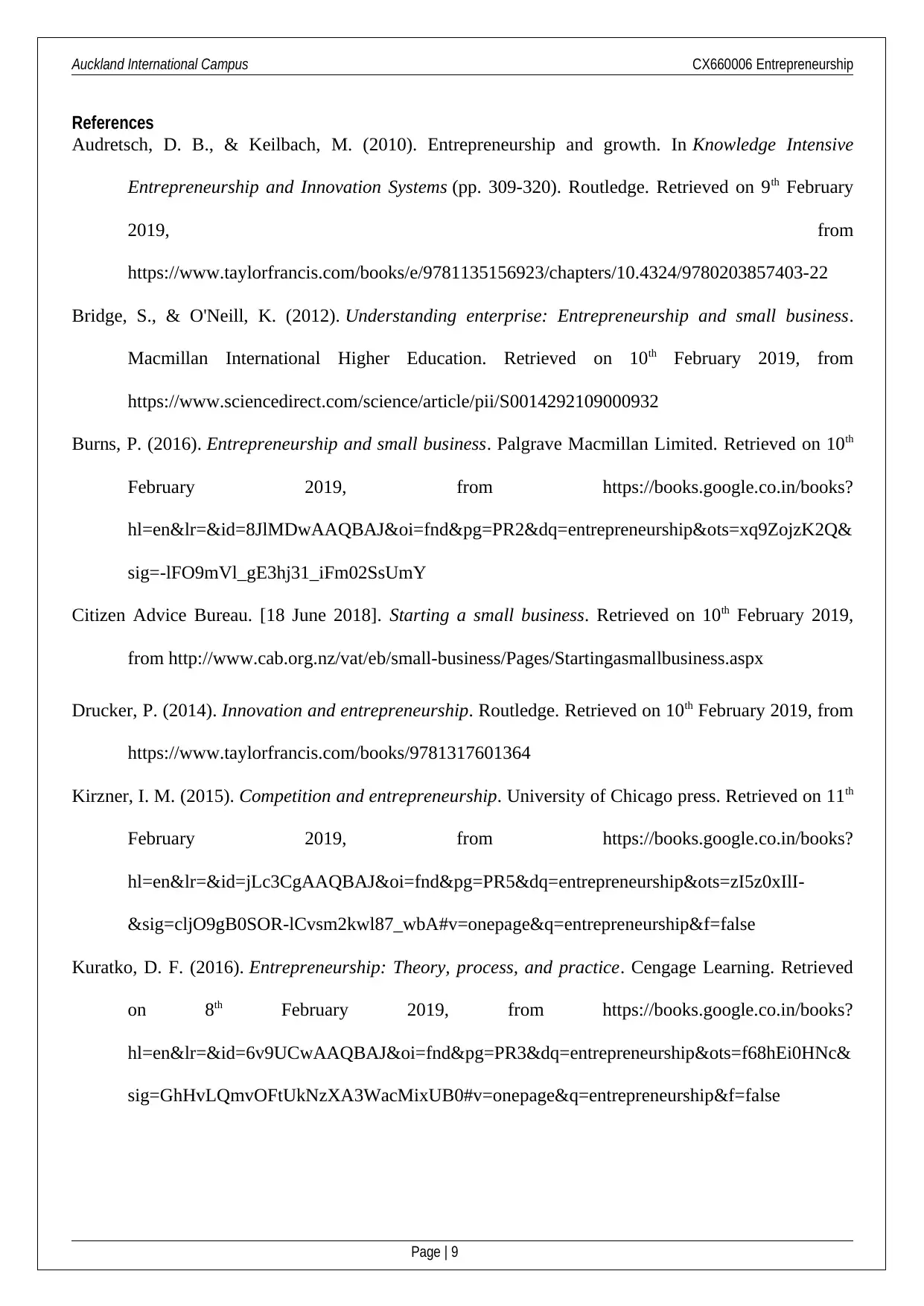
Auckland International Campus CX660006 Entrepreneurship
References
Audretsch, D. B., & Keilbach, M. (2010). Entrepreneurship and growth. In Knowledge Intensive
Entrepreneurship and Innovation Systems (pp. 309-320). Routledge. Retrieved on 9th February
2019, from
https://www.taylorfrancis.com/books/e/9781135156923/chapters/10.4324/9780203857403-22
Bridge, S., & O'Neill, K. (2012). Understanding enterprise: Entrepreneurship and small business.
Macmillan International Higher Education. Retrieved on 10th February 2019, from
https://www.sciencedirect.com/science/article/pii/S0014292109000932
Burns, P. (2016). Entrepreneurship and small business. Palgrave Macmillan Limited. Retrieved on 10th
February 2019, from https://books.google.co.in/books?
hl=en&lr=&id=8JlMDwAAQBAJ&oi=fnd&pg=PR2&dq=entrepreneurship&ots=xq9ZojzK2Q&
sig=-lFO9mVl_gE3hj31_iFm02SsUmY
Citizen Advice Bureau. [18 June 2018]. Starting a small business. Retrieved on 10th February 2019,
from http://www.cab.org.nz/vat/eb/small-business/Pages/Startingasmallbusiness.aspx
Drucker, P. (2014). Innovation and entrepreneurship. Routledge. Retrieved on 10th February 2019, from
https://www.taylorfrancis.com/books/9781317601364
Kirzner, I. M. (2015). Competition and entrepreneurship. University of Chicago press. Retrieved on 11th
February 2019, from https://books.google.co.in/books?
hl=en&lr=&id=jLc3CgAAQBAJ&oi=fnd&pg=PR5&dq=entrepreneurship&ots=zI5z0xIlI-
&sig=cljO9gB0SOR-lCvsm2kwl87_wbA#v=onepage&q=entrepreneurship&f=false
Kuratko, D. F. (2016). Entrepreneurship: Theory, process, and practice. Cengage Learning. Retrieved
on 8th February 2019, from https://books.google.co.in/books?
hl=en&lr=&id=6v9UCwAAQBAJ&oi=fnd&pg=PR3&dq=entrepreneurship&ots=f68hEi0HNc&
sig=GhHvLQmvOFtUkNzXA3WacMixUB0#v=onepage&q=entrepreneurship&f=false
Page | 9
References
Audretsch, D. B., & Keilbach, M. (2010). Entrepreneurship and growth. In Knowledge Intensive
Entrepreneurship and Innovation Systems (pp. 309-320). Routledge. Retrieved on 9th February
2019, from
https://www.taylorfrancis.com/books/e/9781135156923/chapters/10.4324/9780203857403-22
Bridge, S., & O'Neill, K. (2012). Understanding enterprise: Entrepreneurship and small business.
Macmillan International Higher Education. Retrieved on 10th February 2019, from
https://www.sciencedirect.com/science/article/pii/S0014292109000932
Burns, P. (2016). Entrepreneurship and small business. Palgrave Macmillan Limited. Retrieved on 10th
February 2019, from https://books.google.co.in/books?
hl=en&lr=&id=8JlMDwAAQBAJ&oi=fnd&pg=PR2&dq=entrepreneurship&ots=xq9ZojzK2Q&
sig=-lFO9mVl_gE3hj31_iFm02SsUmY
Citizen Advice Bureau. [18 June 2018]. Starting a small business. Retrieved on 10th February 2019,
from http://www.cab.org.nz/vat/eb/small-business/Pages/Startingasmallbusiness.aspx
Drucker, P. (2014). Innovation and entrepreneurship. Routledge. Retrieved on 10th February 2019, from
https://www.taylorfrancis.com/books/9781317601364
Kirzner, I. M. (2015). Competition and entrepreneurship. University of Chicago press. Retrieved on 11th
February 2019, from https://books.google.co.in/books?
hl=en&lr=&id=jLc3CgAAQBAJ&oi=fnd&pg=PR5&dq=entrepreneurship&ots=zI5z0xIlI-
&sig=cljO9gB0SOR-lCvsm2kwl87_wbA#v=onepage&q=entrepreneurship&f=false
Kuratko, D. F. (2016). Entrepreneurship: Theory, process, and practice. Cengage Learning. Retrieved
on 8th February 2019, from https://books.google.co.in/books?
hl=en&lr=&id=6v9UCwAAQBAJ&oi=fnd&pg=PR3&dq=entrepreneurship&ots=f68hEi0HNc&
sig=GhHvLQmvOFtUkNzXA3WacMixUB0#v=onepage&q=entrepreneurship&f=false
Page | 9
⊘ This is a preview!⊘
Do you want full access?
Subscribe today to unlock all pages.
Trusted by 1+ million students worldwide
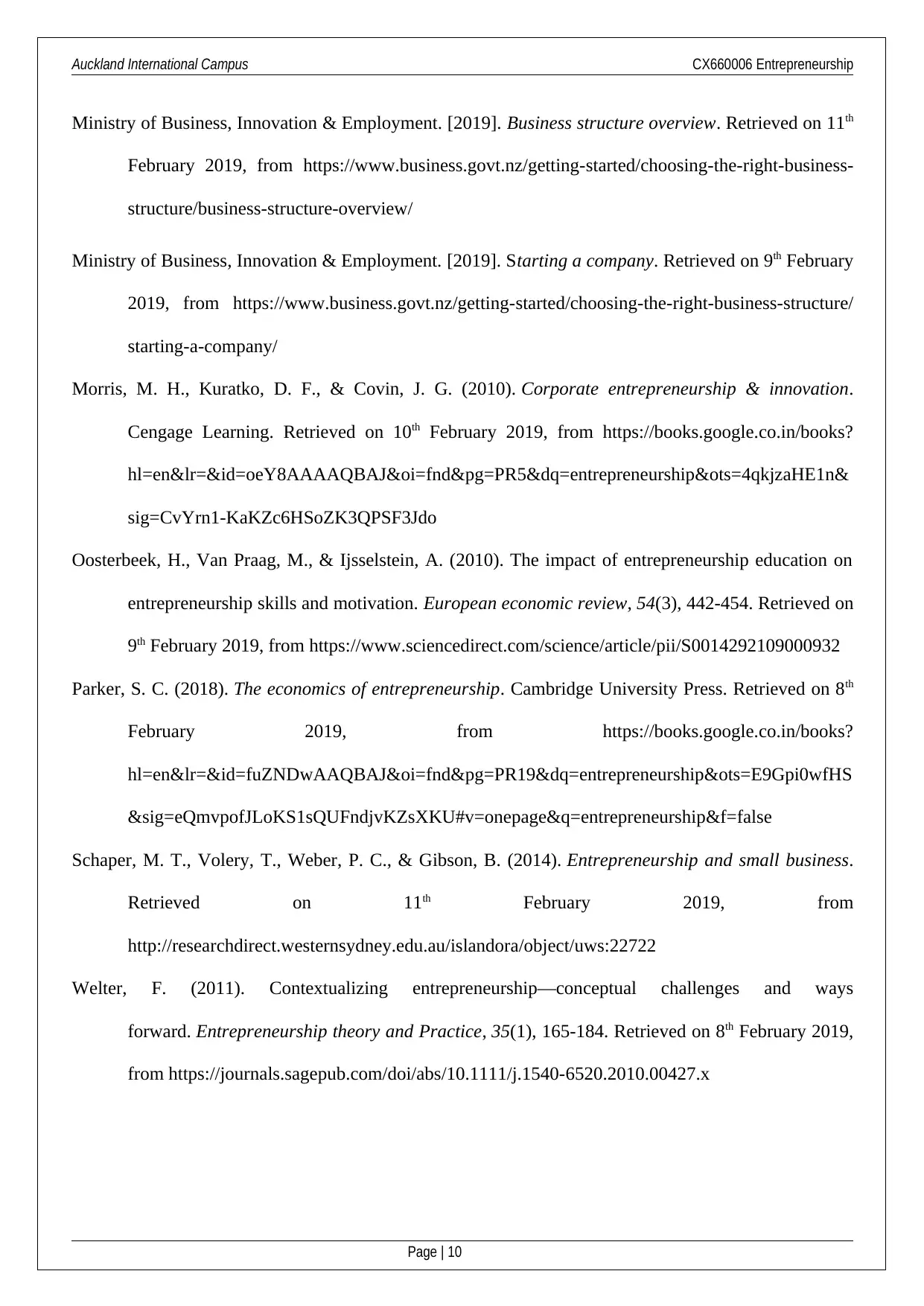
Auckland International Campus CX660006 Entrepreneurship
Ministry of Business, Innovation & Employment. [2019]. Business structure overview. Retrieved on 11th
February 2019, from https://www.business.govt.nz/getting-started/choosing-the-right-business-
structure/business-structure-overview/
Ministry of Business, Innovation & Employment. [2019]. Starting a company. Retrieved on 9th February
2019, from https://www.business.govt.nz/getting-started/choosing-the-right-business-structure/
starting-a-company/
Morris, M. H., Kuratko, D. F., & Covin, J. G. (2010). Corporate entrepreneurship & innovation.
Cengage Learning. Retrieved on 10th February 2019, from https://books.google.co.in/books?
hl=en&lr=&id=oeY8AAAAQBAJ&oi=fnd&pg=PR5&dq=entrepreneurship&ots=4qkjzaHE1n&
sig=CvYrn1-KaKZc6HSoZK3QPSF3Jdo
Oosterbeek, H., Van Praag, M., & Ijsselstein, A. (2010). The impact of entrepreneurship education on
entrepreneurship skills and motivation. European economic review, 54(3), 442-454. Retrieved on
9th February 2019, from https://www.sciencedirect.com/science/article/pii/S0014292109000932
Parker, S. C. (2018). The economics of entrepreneurship. Cambridge University Press. Retrieved on 8th
February 2019, from https://books.google.co.in/books?
hl=en&lr=&id=fuZNDwAAQBAJ&oi=fnd&pg=PR19&dq=entrepreneurship&ots=E9Gpi0wfHS
&sig=eQmvpofJLoKS1sQUFndjvKZsXKU#v=onepage&q=entrepreneurship&f=false
Schaper, M. T., Volery, T., Weber, P. C., & Gibson, B. (2014). Entrepreneurship and small business.
Retrieved on 11th February 2019, from
http://researchdirect.westernsydney.edu.au/islandora/object/uws:22722
Welter, F. (2011). Contextualizing entrepreneurship—conceptual challenges and ways
forward. Entrepreneurship theory and Practice, 35(1), 165-184. Retrieved on 8th February 2019,
from https://journals.sagepub.com/doi/abs/10.1111/j.1540-6520.2010.00427.x
Page | 10
Ministry of Business, Innovation & Employment. [2019]. Business structure overview. Retrieved on 11th
February 2019, from https://www.business.govt.nz/getting-started/choosing-the-right-business-
structure/business-structure-overview/
Ministry of Business, Innovation & Employment. [2019]. Starting a company. Retrieved on 9th February
2019, from https://www.business.govt.nz/getting-started/choosing-the-right-business-structure/
starting-a-company/
Morris, M. H., Kuratko, D. F., & Covin, J. G. (2010). Corporate entrepreneurship & innovation.
Cengage Learning. Retrieved on 10th February 2019, from https://books.google.co.in/books?
hl=en&lr=&id=oeY8AAAAQBAJ&oi=fnd&pg=PR5&dq=entrepreneurship&ots=4qkjzaHE1n&
sig=CvYrn1-KaKZc6HSoZK3QPSF3Jdo
Oosterbeek, H., Van Praag, M., & Ijsselstein, A. (2010). The impact of entrepreneurship education on
entrepreneurship skills and motivation. European economic review, 54(3), 442-454. Retrieved on
9th February 2019, from https://www.sciencedirect.com/science/article/pii/S0014292109000932
Parker, S. C. (2018). The economics of entrepreneurship. Cambridge University Press. Retrieved on 8th
February 2019, from https://books.google.co.in/books?
hl=en&lr=&id=fuZNDwAAQBAJ&oi=fnd&pg=PR19&dq=entrepreneurship&ots=E9Gpi0wfHS
&sig=eQmvpofJLoKS1sQUFndjvKZsXKU#v=onepage&q=entrepreneurship&f=false
Schaper, M. T., Volery, T., Weber, P. C., & Gibson, B. (2014). Entrepreneurship and small business.
Retrieved on 11th February 2019, from
http://researchdirect.westernsydney.edu.au/islandora/object/uws:22722
Welter, F. (2011). Contextualizing entrepreneurship—conceptual challenges and ways
forward. Entrepreneurship theory and Practice, 35(1), 165-184. Retrieved on 8th February 2019,
from https://journals.sagepub.com/doi/abs/10.1111/j.1540-6520.2010.00427.x
Page | 10

1 out of 10


Your All-in-One AI-Powered Toolkit for Academic Success.
+13062052269
info@desklib.com
Available 24*7 on WhatsApp / Email
![[object Object]](/_next/static/media/star-bottom.7253800d.svg)
Unlock your academic potential
Copyright © 2020–2026 A2Z Services. All Rights Reserved. Developed and managed by ZUCOL.