Entrepreneurship, Small Business & The Coffee Bag Co Analysis
VerifiedAdded on 2024/05/17
|27
|5264
|237
Report
AI Summary
This report provides a comprehensive analysis of entrepreneurship and small business management, focusing on the UK economy and the impact of micro and small businesses. It examines different types of entrepreneurial ventures, including lifestyle, high-growth, and social entrepreneurship, and their relation to the typology of entrepreneurship. The report also evaluates the differences between small, medium, and large businesses and their contributions to the economy, using relevant data and statistics. Furthermore, it explores the characteristics and skills of successful entrepreneurs, differentiating them from business managers, and assesses how entrepreneurial personality reflects motivation and mindset. The report uses the case study of The Coffee Bag Co to illustrate the concepts and influence of small entrepreneurial businesses and examines how background and experience can hinder or foster entrepreneurship.

ENTREPRENEURSHIP AND SMALL BUSINESS
MANAGEMENT
MANAGEMENT

Paraphrase This Document
Need a fresh take? Get an instant paraphrase of this document with our AI Paraphraser
Table of Contents
INTRODUCTION..........................................................................................................................3
TASK 1.........................................................................................................................................4
P1 EXAMINE DIFFERENT TYPES OF ENTREPRENEURIAL VENTURES AND EXPLAIN HOW
THEY RELATE TO THE TYPOLOGY OF ENTREPRENEURSHIP....................................................4
M1 DEMONSTRATION OF UNDERSTANDING THE ENTREPRENEURSHIP IN BOTH PUBLIC
AND CORPORATE SECTOR......................................................................................................6
P2 EXPLORE THE SIMILARITIES AND DIFFERENCES BETWEEN ENTREPRENEURIAL
VENTURES..............................................................................................................................7
TASK 2.........................................................................................................................................9
P3 INTERPRET AND ASSESS RELEVANT DATA AND STATISTICS TO ILLUSTRATE HOW MICRO
AND SMALL BUSINESS IMPACT ON THE ECONOMY..............................................................9
M2 EVALUATE THE DIFFERENCES SMALL, MEDIUM AND LARGE BUSINESSES MAKE TO THE
ECONOMY, APPLYING RELEVANT DATA AND STATISTICS....................................................11
P4 EXPLAIN THE IMPORTANCE OF SMALL BUSINESSES AND BUSINESS STARTS-UPS TO THE
GROWTH OF SOCIAL ECONOMY..........................................................................................13
TASK 3.......................................................................................................................................15
P5 DETERMINE THE CHARACTERISTIC TRAITS AND SKILLS OF SUCCESSFUL
ENTREPRENEURS THAT DIFFERENTIATE THEM FROM OTHER BUSINESS MANAGERS........15
M3 EXPLORE AND EXAMINE DIFFERENT LINES OF ARGUMENT RELATING TO
ENTREPRENEURIAL CHARACTERISTICS................................................................................17
P6 ASSESS HOW ASPECTS OF THE ENTREPRENEURIAL ASPECTS PERSONALITY REFLECT
ENTREPRENEURIAL MOTIVATION AND MINDSET................................................................18
TASK 4.......................................................................................................................................20
P7 EXAMINE, USING RELEVANT EXAMPLES, HOW BACKGROUND AND EXPERIENCE CAN
HINDER OR FOSTER ENTREPRENEURSHIP............................................................................20
1
INTRODUCTION..........................................................................................................................3
TASK 1.........................................................................................................................................4
P1 EXAMINE DIFFERENT TYPES OF ENTREPRENEURIAL VENTURES AND EXPLAIN HOW
THEY RELATE TO THE TYPOLOGY OF ENTREPRENEURSHIP....................................................4
M1 DEMONSTRATION OF UNDERSTANDING THE ENTREPRENEURSHIP IN BOTH PUBLIC
AND CORPORATE SECTOR......................................................................................................6
P2 EXPLORE THE SIMILARITIES AND DIFFERENCES BETWEEN ENTREPRENEURIAL
VENTURES..............................................................................................................................7
TASK 2.........................................................................................................................................9
P3 INTERPRET AND ASSESS RELEVANT DATA AND STATISTICS TO ILLUSTRATE HOW MICRO
AND SMALL BUSINESS IMPACT ON THE ECONOMY..............................................................9
M2 EVALUATE THE DIFFERENCES SMALL, MEDIUM AND LARGE BUSINESSES MAKE TO THE
ECONOMY, APPLYING RELEVANT DATA AND STATISTICS....................................................11
P4 EXPLAIN THE IMPORTANCE OF SMALL BUSINESSES AND BUSINESS STARTS-UPS TO THE
GROWTH OF SOCIAL ECONOMY..........................................................................................13
TASK 3.......................................................................................................................................15
P5 DETERMINE THE CHARACTERISTIC TRAITS AND SKILLS OF SUCCESSFUL
ENTREPRENEURS THAT DIFFERENTIATE THEM FROM OTHER BUSINESS MANAGERS........15
M3 EXPLORE AND EXAMINE DIFFERENT LINES OF ARGUMENT RELATING TO
ENTREPRENEURIAL CHARACTERISTICS................................................................................17
P6 ASSESS HOW ASPECTS OF THE ENTREPRENEURIAL ASPECTS PERSONALITY REFLECT
ENTREPRENEURIAL MOTIVATION AND MINDSET................................................................18
TASK 4.......................................................................................................................................20
P7 EXAMINE, USING RELEVANT EXAMPLES, HOW BACKGROUND AND EXPERIENCE CAN
HINDER OR FOSTER ENTREPRENEURSHIP............................................................................20
1

M4 ANALYSE THE LINK BETWEEN ENTREPRENEURIAL CHARACTERISTICS AND THE
INFLUENCE OF PERSONAL BACKGROUND AND EXPERIENCE TO SPECIFIC SUCCESSFUL
ENTREPRENEURS..................................................................................................................21
CONCLUSION............................................................................................................................22
REFERENCES.............................................................................................................................23
2
INFLUENCE OF PERSONAL BACKGROUND AND EXPERIENCE TO SPECIFIC SUCCESSFUL
ENTREPRENEURS..................................................................................................................21
CONCLUSION............................................................................................................................22
REFERENCES.............................................................................................................................23
2
⊘ This is a preview!⊘
Do you want full access?
Subscribe today to unlock all pages.

Trusted by 1+ million students worldwide
INTRODUCTION
The process of the structure as well as instigating the new business that is a small scale
business at initial level is referred as entrepreneurship. The growth and progress of the
country are dependent on this important factor that is Entrepreneurship (Hall, et al. 2010).
This small business is commenced by either an individual or group of people that is operated
on the limited resources that are obtainable.
Those businesses are operated by a limited number of people as well as have limited
resources are referred to a small business and generate low annual revenue. Growth and
prosperity in the country can be achieved through small business management which is
often run by individuals and group of individuals (Burns, 2016).
The aim of this assignment is to develop regarding the entrepreneurs, entrepreneurial
ventures. The roles of entrepreneurs are represented in the assignment along with the
typology of entrepreneurship. This assignment explains the significance of entrepreneurship
by taking the case study of The Coffee Bag Co a small entrepreneurial business and its
influence on the growth and progress of the UK. The role of entrepreneurship is significant
in public as well as private sector. It also includes the key aspects of the mindset of
entrepreneurs thereby differentiating from business managers.
3
The process of the structure as well as instigating the new business that is a small scale
business at initial level is referred as entrepreneurship. The growth and progress of the
country are dependent on this important factor that is Entrepreneurship (Hall, et al. 2010).
This small business is commenced by either an individual or group of people that is operated
on the limited resources that are obtainable.
Those businesses are operated by a limited number of people as well as have limited
resources are referred to a small business and generate low annual revenue. Growth and
prosperity in the country can be achieved through small business management which is
often run by individuals and group of individuals (Burns, 2016).
The aim of this assignment is to develop regarding the entrepreneurs, entrepreneurial
ventures. The roles of entrepreneurs are represented in the assignment along with the
typology of entrepreneurship. This assignment explains the significance of entrepreneurship
by taking the case study of The Coffee Bag Co a small entrepreneurial business and its
influence on the growth and progress of the UK. The role of entrepreneurship is significant
in public as well as private sector. It also includes the key aspects of the mindset of
entrepreneurs thereby differentiating from business managers.
3
Paraphrase This Document
Need a fresh take? Get an instant paraphrase of this document with our AI Paraphraser
TASK 1
P1 EXAMINE DIFFERENT TYPES OF ENTREPRENEURIAL VENTURES AND
EXPLAIN HOW THEY RELATE TO THE TYPOLOGY OF ENTREPRENEURSHIP
DEFINITION
Entrepreneurship is the course of action for instigating and operating the business which is
operated and managed by an entrepreneur who is either individual or groups (Storey,
2016). It requires proper planning as well as limited available resources. It is a creative idea
of developing new products and services instead of old existing models and plans.
CONCEPT OF ENTREPRENEURSHIP
The word entrepreneur is the derived from French word “entreprendre” which means to
undertake. An entrepreneur is referred to the individual who is responsible for setting the
business or any business enterprise. Various actions and activities are performed by the
entrepreneur in order to establish the business enterprise.
TYPOLOGY OF ENTREPRENEURSHIP
Her are different type so entrepreneur venture that can be connected with the company.
LIFESTYLE VENTURE: lifestyle forms are those small company in which the owner has an
autonomy, independence and control. It is the firm that is often run out of household
thereby aligning the personal interests as well as hobbies in order to generate the profit. It
allows flexibility and can be expanded through debt financing (Hall, et al. 2010).
SMALLER PROFIT VENTURE: smaller profit venture are those entrepreneur ventures whose
aim is not to anticipate in making profits and content with decent living. Mom and pop
stores are some of the common of smaller profit venture.
HIGH GROWTH VENTURE: the main goal of high growth ventures is to earn a maximum
profit as well as growth thereby focusing on innovation. The entrepreneurs of this ventures
aim to push the envelope and grow indefinitely (Kuratko, et al. 2015). This venture attracts a
4
P1 EXAMINE DIFFERENT TYPES OF ENTREPRENEURIAL VENTURES AND
EXPLAIN HOW THEY RELATE TO THE TYPOLOGY OF ENTREPRENEURSHIP
DEFINITION
Entrepreneurship is the course of action for instigating and operating the business which is
operated and managed by an entrepreneur who is either individual or groups (Storey,
2016). It requires proper planning as well as limited available resources. It is a creative idea
of developing new products and services instead of old existing models and plans.
CONCEPT OF ENTREPRENEURSHIP
The word entrepreneur is the derived from French word “entreprendre” which means to
undertake. An entrepreneur is referred to the individual who is responsible for setting the
business or any business enterprise. Various actions and activities are performed by the
entrepreneur in order to establish the business enterprise.
TYPOLOGY OF ENTREPRENEURSHIP
Her are different type so entrepreneur venture that can be connected with the company.
LIFESTYLE VENTURE: lifestyle forms are those small company in which the owner has an
autonomy, independence and control. It is the firm that is often run out of household
thereby aligning the personal interests as well as hobbies in order to generate the profit. It
allows flexibility and can be expanded through debt financing (Hall, et al. 2010).
SMALLER PROFIT VENTURE: smaller profit venture are those entrepreneur ventures whose
aim is not to anticipate in making profits and content with decent living. Mom and pop
stores are some of the common of smaller profit venture.
HIGH GROWTH VENTURE: the main goal of high growth ventures is to earn a maximum
profit as well as growth thereby focusing on innovation. The entrepreneurs of this ventures
aim to push the envelope and grow indefinitely (Kuratko, et al. 2015). This venture attracts a
4
large number of investors as compared to Lifestyle Company. High growth business creates
the products and services in such a way that it not only develops or improves the companies
but also focuses on the industrial development.
SOCIAL ENTREPRENEURSHIP: social entrepreneurs are those who work for the social
purposes. There are many forms of social enterprise that tackle social problems, improve
the lives of people, and improve the communities or tackling environmental problems
(Dacin, et al. 2010). Grants and investments are needed by the social enterprises. The
mission of the social enterprise is to work for the welfare of the society.
5
the products and services in such a way that it not only develops or improves the companies
but also focuses on the industrial development.
SOCIAL ENTREPRENEURSHIP: social entrepreneurs are those who work for the social
purposes. There are many forms of social enterprise that tackle social problems, improve
the lives of people, and improve the communities or tackling environmental problems
(Dacin, et al. 2010). Grants and investments are needed by the social enterprises. The
mission of the social enterprise is to work for the welfare of the society.
5
⊘ This is a preview!⊘
Do you want full access?
Subscribe today to unlock all pages.
Trusted by 1+ million students worldwide
M1 DEMONSTRATION OF UNDERSTANDING THE ENTREPRENEURSHIP IN
BOTH PUBLIC AND CORPORATE SECTOR
The concept of the corporate Intrapreneurs in the existing organization is to convert the
new ideas into the realities that are profitable to the business. In order to become
successful corporate Intrapreneurs, communication abilities, teamwork and well-developed
strategic actions are essential (Fisher, 2012). Corporate Intrapreneurs innovates the routine
activities of the business. It is very important for the company to follow Intrapreneurship in
a company such as The Coffee Bag Co.
The objectives of the corporate entrepreneurs need flexibility as well as freedom in pursuing
the projects and are goal oriented but are influenced by the corporate characteristics
(Storey, 2016). A major focus of the corporate entrepreneur is on the innovative activities or
various orientations such as the development of administrative techniques, new product or
service development, strategies thereby concentrating the internal as well as external
environment.
The emergence of entrepreneurship is due to the complexity as well as acuteness of the
society. The objective of public sector entrepreneur is to benefit the society without any
monetary consideration. The focus of the public sector organization is to create value in
order to provide benefits to the society and also bring the unique combinations of both
public as well as private resources to utilise the social opportunities.
The manager in the public sector entrepreneurial takes calculated risks with the biasness of
the opportunities towards the actions. They also overcome the different obstacles related to
bureaucratic as well as political in context to the innovation (Cowling, et al. 2012). Outside
political forces impose the vision and mission of the public sector whereas the mission of
the private sector is free from the signals of the economic market. The members in public
sectors desire to create an innovation culture in the context of the corporate or public
sector as similar to the private sector. The government personnel system is traditional rule-
bound, inflexible as well as complicated which is not beneficial to innovation in the public
sector.
6
BOTH PUBLIC AND CORPORATE SECTOR
The concept of the corporate Intrapreneurs in the existing organization is to convert the
new ideas into the realities that are profitable to the business. In order to become
successful corporate Intrapreneurs, communication abilities, teamwork and well-developed
strategic actions are essential (Fisher, 2012). Corporate Intrapreneurs innovates the routine
activities of the business. It is very important for the company to follow Intrapreneurship in
a company such as The Coffee Bag Co.
The objectives of the corporate entrepreneurs need flexibility as well as freedom in pursuing
the projects and are goal oriented but are influenced by the corporate characteristics
(Storey, 2016). A major focus of the corporate entrepreneur is on the innovative activities or
various orientations such as the development of administrative techniques, new product or
service development, strategies thereby concentrating the internal as well as external
environment.
The emergence of entrepreneurship is due to the complexity as well as acuteness of the
society. The objective of public sector entrepreneur is to benefit the society without any
monetary consideration. The focus of the public sector organization is to create value in
order to provide benefits to the society and also bring the unique combinations of both
public as well as private resources to utilise the social opportunities.
The manager in the public sector entrepreneurial takes calculated risks with the biasness of
the opportunities towards the actions. They also overcome the different obstacles related to
bureaucratic as well as political in context to the innovation (Cowling, et al. 2012). Outside
political forces impose the vision and mission of the public sector whereas the mission of
the private sector is free from the signals of the economic market. The members in public
sectors desire to create an innovation culture in the context of the corporate or public
sector as similar to the private sector. The government personnel system is traditional rule-
bound, inflexible as well as complicated which is not beneficial to innovation in the public
sector.
6
Paraphrase This Document
Need a fresh take? Get an instant paraphrase of this document with our AI Paraphraser
P2 EXPLORE THE SIMILARITIES AND DIFFERENCES BETWEEN
ENTREPRENEURIAL VENTURES
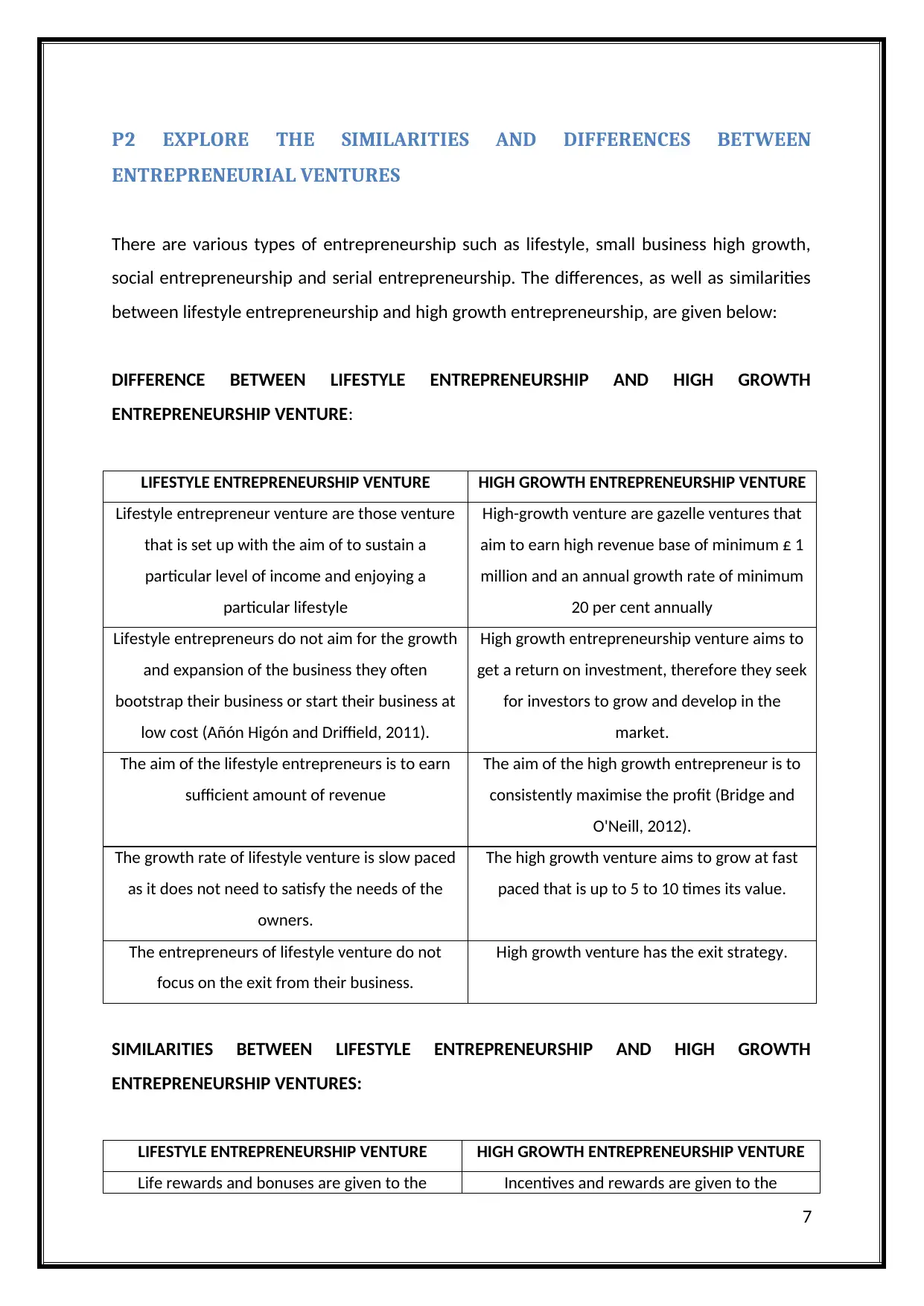
There are various types of entrepreneurship such as lifestyle, small business high growth,
social entrepreneurship and serial entrepreneurship. The differences, as well as similarities
between lifestyle entrepreneurship and high growth entrepreneurship, are given below:
DIFFERENCE BETWEEN LIFESTYLE ENTREPRENEURSHIP AND HIGH GROWTH
ENTREPRENEURSHIP VENTURE:
LIFESTYLE ENTREPRENEURSHIP VENTURE HIGH GROWTH ENTREPRENEURSHIP VENTURE
Lifestyle entrepreneur venture are those venture
that is set up with the aim of to sustain a
particular level of income and enjoying a
particular lifestyle
High-growth venture are gazelle ventures that
aim to earn high revenue base of minimum £ 1
million and an annual growth rate of minimum
20 per cent annually
Lifestyle entrepreneurs do not aim for the growth
and expansion of the business they often
bootstrap their business or start their business at
low cost (Añón Higón and Driffield, 2011).
High growth entrepreneurship venture aims to
get a return on investment, therefore they seek
for investors to grow and develop in the
market.
The aim of the lifestyle entrepreneurs is to earn
sufficient amount of revenue
The aim of the high growth entrepreneur is to
consistently maximise the profit (Bridge and
O'Neill, 2012).
The growth rate of lifestyle venture is slow paced
as it does not need to satisfy the needs of the
owners.
The high growth venture aims to grow at fast
paced that is up to 5 to 10 times its value.
The entrepreneurs of lifestyle venture do not
focus on the exit from their business.
High growth venture has the exit strategy.
SIMILARITIES BETWEEN LIFESTYLE ENTREPRENEURSHIP AND HIGH GROWTH
ENTREPRENEURSHIP VENTURES:
LIFESTYLE ENTREPRENEURSHIP VENTURE HIGH GROWTH ENTREPRENEURSHIP VENTURE
Life rewards and bonuses are given to the Incentives and rewards are given to the
7
ENTREPRENEURIAL VENTURES
There are various types of entrepreneurship such as lifestyle, small business high growth,
social entrepreneurship and serial entrepreneurship. The differences, as well as similarities
between lifestyle entrepreneurship and high growth entrepreneurship, are given below:
DIFFERENCE BETWEEN LIFESTYLE ENTREPRENEURSHIP AND HIGH GROWTH
ENTREPRENEURSHIP VENTURE:
LIFESTYLE ENTREPRENEURSHIP VENTURE HIGH GROWTH ENTREPRENEURSHIP VENTURE
Lifestyle entrepreneur venture are those venture
that is set up with the aim of to sustain a
particular level of income and enjoying a
particular lifestyle
High-growth venture are gazelle ventures that
aim to earn high revenue base of minimum £ 1
million and an annual growth rate of minimum
20 per cent annually
Lifestyle entrepreneurs do not aim for the growth
and expansion of the business they often
bootstrap their business or start their business at
low cost (Añón Higón and Driffield, 2011).
High growth entrepreneurship venture aims to
get a return on investment, therefore they seek
for investors to grow and develop in the
market.
The aim of the lifestyle entrepreneurs is to earn
sufficient amount of revenue
The aim of the high growth entrepreneur is to
consistently maximise the profit (Bridge and
O'Neill, 2012).
The growth rate of lifestyle venture is slow paced
as it does not need to satisfy the needs of the
owners.
The high growth venture aims to grow at fast
paced that is up to 5 to 10 times its value.
The entrepreneurs of lifestyle venture do not
focus on the exit from their business.
High growth venture has the exit strategy.
SIMILARITIES BETWEEN LIFESTYLE ENTREPRENEURSHIP AND HIGH GROWTH
ENTREPRENEURSHIP VENTURES:
LIFESTYLE ENTREPRENEURSHIP VENTURE HIGH GROWTH ENTREPRENEURSHIP VENTURE
Life rewards and bonuses are given to the Incentives and rewards are given to the
7
individuals who perform in the venture with a
passion.
employees thereby encouraging them to
increase productivity (Mitchelmore and Rowley,
2010).
The aim and objectives of lifestyle
entrepreneurship are to survive in the market by
taking the risk to earn a profit for the long term.
The aim and objective of high-growth
entrepreneurship are to earn a profit in order to
grow and progress in the market.
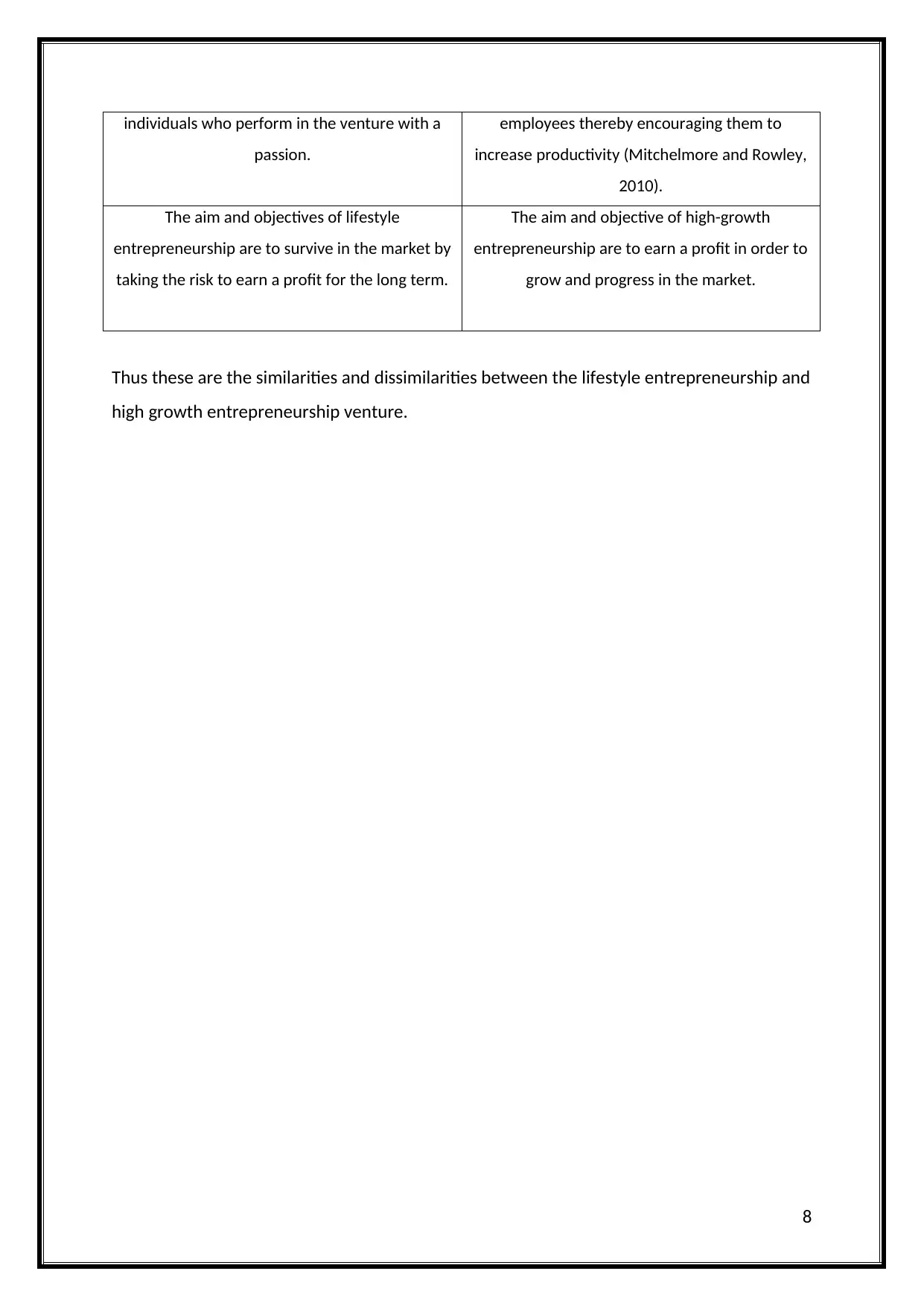
Thus these are the similarities and dissimilarities between the lifestyle entrepreneurship and
high growth entrepreneurship venture.
8
passion.
employees thereby encouraging them to
increase productivity (Mitchelmore and Rowley,
2010).
The aim and objectives of lifestyle
entrepreneurship are to survive in the market by
taking the risk to earn a profit for the long term.
The aim and objective of high-growth
entrepreneurship are to earn a profit in order to
grow and progress in the market.
Thus these are the similarities and dissimilarities between the lifestyle entrepreneurship and
high growth entrepreneurship venture.
8
⊘ This is a preview!⊘
Do you want full access?
Subscribe today to unlock all pages.
Trusted by 1+ million students worldwide
TASK 2
P3 INTERPRET AND ASSESS RELEVANT DATA AND STATISTICS TO
ILLUSTRATE HOW MICRO AND SMALL BUSINESS IMPACT ON THE ECONOMY
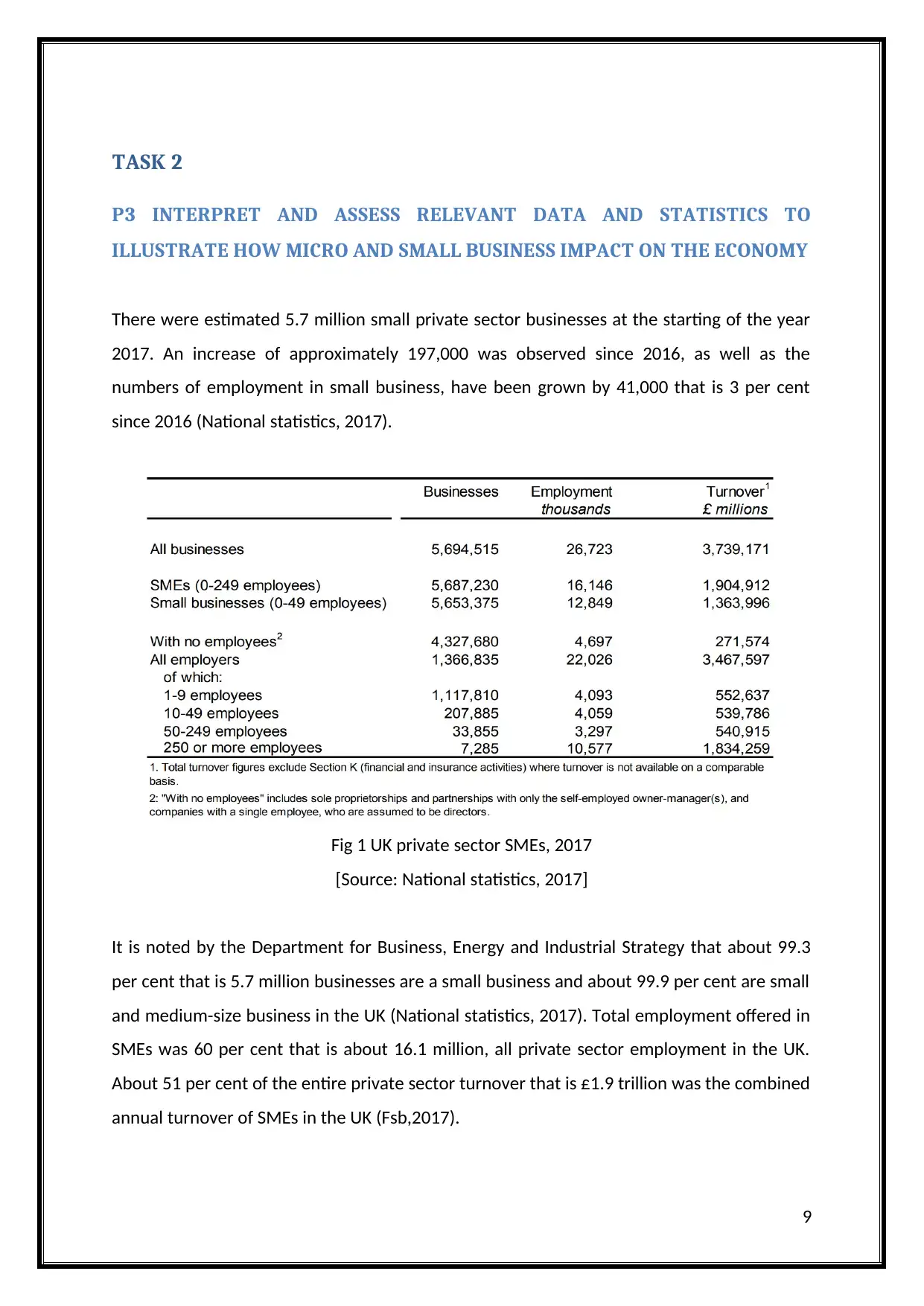
There were estimated 5.7 million small private sector businesses at the starting of the year
2017. An increase of approximately 197,000 was observed since 2016, as well as the
numbers of employment in small business, have been grown by 41,000 that is 3 per cent
since 2016 (National statistics, 2017).
Fig 1 UK private sector SMEs, 2017
[Source: National statistics, 2017]
It is noted by the Department for Business, Energy and Industrial Strategy that about 99.3
per cent that is 5.7 million businesses are a small business and about 99.9 per cent are small
and medium-size business in the UK (National statistics, 2017). Total employment offered in
SMEs was 60 per cent that is about 16.1 million, all private sector employment in the UK.
About 51 per cent of the entire private sector turnover that is £1.9 trillion was the combined
annual turnover of SMEs in the UK (Fsb,2017).
9
P3 INTERPRET AND ASSESS RELEVANT DATA AND STATISTICS TO
ILLUSTRATE HOW MICRO AND SMALL BUSINESS IMPACT ON THE ECONOMY
There were estimated 5.7 million small private sector businesses at the starting of the year
2017. An increase of approximately 197,000 was observed since 2016, as well as the
numbers of employment in small business, have been grown by 41,000 that is 3 per cent
since 2016 (National statistics, 2017).
Fig 1 UK private sector SMEs, 2017
[Source: National statistics, 2017]
It is noted by the Department for Business, Energy and Industrial Strategy that about 99.3
per cent that is 5.7 million businesses are a small business and about 99.9 per cent are small
and medium-size business in the UK (National statistics, 2017). Total employment offered in
SMEs was 60 per cent that is about 16.1 million, all private sector employment in the UK.
About 51 per cent of the entire private sector turnover that is £1.9 trillion was the combined
annual turnover of SMEs in the UK (Fsb,2017).
9
Paraphrase This Document
Need a fresh take? Get an instant paraphrase of this document with our AI Paraphraser

The small and medium-size enterprise plays a significant role in maintaining the economy of
the country that is the UK. It is observed by the Economic and Social Research Council that
small and medium-size business boost the productivity of the UK by contributing about 47
per cent of revenues to the UK economy. However, these business needs support to expand
their business as well as its economic impact.
10
the country that is the UK. It is observed by the Economic and Social Research Council that
small and medium-size business boost the productivity of the UK by contributing about 47
per cent of revenues to the UK economy. However, these business needs support to expand
their business as well as its economic impact.
10
M2 EVALUATE THE DIFFERENCES SMALL, MEDIUM AND LARGE BUSINESSES
MAKE TO THE ECONOMY, APPLYING RELEVANT DATA AND STATISTICS
The performance of the UK economy depends on the performance of small, medium and
large business enterprises. However, the Small business such as The Coffee Bag Co is
thriving the economy by being the backbone by contributing in opening a new market,
increased growth opportunities and job creations.
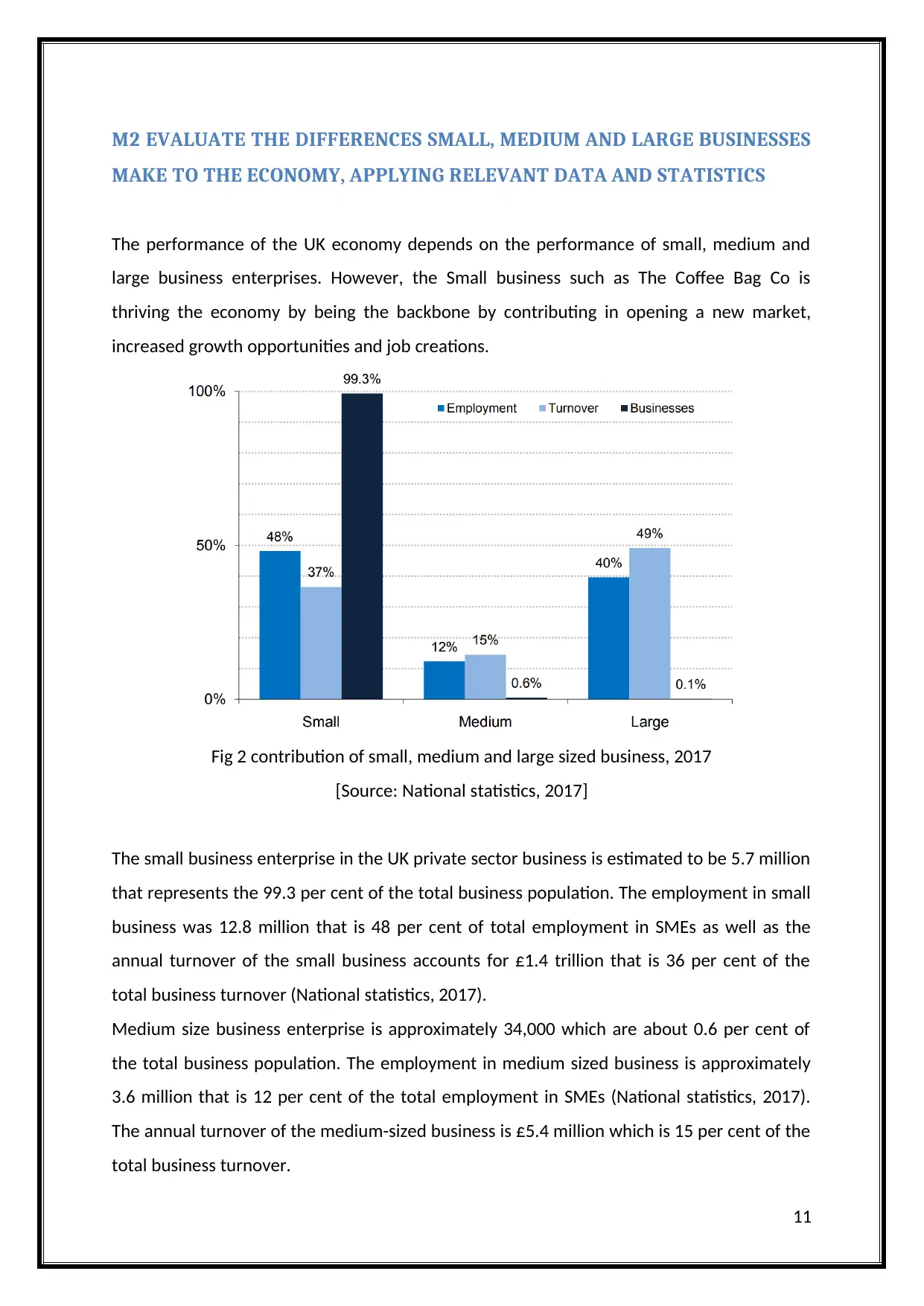
Fig 2 contribution of small, medium and large sized business, 2017
[Source: National statistics, 2017]
The small business enterprise in the UK private sector business is estimated to be 5.7 million
that represents the 99.3 per cent of the total business population. The employment in small
business was 12.8 million that is 48 per cent of total employment in SMEs as well as the
annual turnover of the small business accounts for £1.4 trillion that is 36 per cent of the
total business turnover (National statistics, 2017).
Medium size business enterprise is approximately 34,000 which are about 0.6 per cent of
the total business population. The employment in medium sized business is approximately
3.6 million that is 12 per cent of the total employment in SMEs (National statistics, 2017).
The annual turnover of the medium-sized business is £5.4 million which is 15 per cent of the
total business turnover.
11
MAKE TO THE ECONOMY, APPLYING RELEVANT DATA AND STATISTICS
The performance of the UK economy depends on the performance of small, medium and
large business enterprises. However, the Small business such as The Coffee Bag Co is
thriving the economy by being the backbone by contributing in opening a new market,
increased growth opportunities and job creations.
Fig 2 contribution of small, medium and large sized business, 2017
[Source: National statistics, 2017]
The small business enterprise in the UK private sector business is estimated to be 5.7 million
that represents the 99.3 per cent of the total business population. The employment in small
business was 12.8 million that is 48 per cent of total employment in SMEs as well as the
annual turnover of the small business accounts for £1.4 trillion that is 36 per cent of the
total business turnover (National statistics, 2017).
Medium size business enterprise is approximately 34,000 which are about 0.6 per cent of
the total business population. The employment in medium sized business is approximately
3.6 million that is 12 per cent of the total employment in SMEs (National statistics, 2017).
The annual turnover of the medium-sized business is £5.4 million which is 15 per cent of the
total business turnover.
11
⊘ This is a preview!⊘
Do you want full access?
Subscribe today to unlock all pages.
Trusted by 1+ million students worldwide

1 out of 27


Related Documents


Your All-in-One AI-Powered Toolkit for Academic Success.
+13062052269
info@desklib.com
Available 24*7 on WhatsApp / Email
![[object Object]](/_next/static/media/star-bottom.7253800d.svg)
Unlock your academic potential
Copyright © 2020–2026 A2Z Services. All Rights Reserved. Developed and managed by ZUCOL.