Entrepreneurship: Ventures, Characteristics, and Economic Impact
VerifiedAdded on 2020/10/22
|15
|4395
|212
Report
AI Summary
This report provides a comprehensive overview of entrepreneurship and small businesses, examining different types of entrepreneurial ventures, including start-ups, acquisitions, and franchises, while also comparing and contrasting lifestyle, small profit, and high-growth ventures. It investigates the impact of these ventures on economic growth, supported by relevant data and statistics, highlighting the creation of employment opportunities and the enhancement of living standards. Furthermore, the report delves into the characteristics and skills of successful entrepreneurs, such as the need for achievement, self-confidence, and effective communication and decision-making abilities, emphasizing their importance in navigating the complex business environment. The report also discusses the role of small and medium enterprises in social economy, corporate social responsibility and the importance of SMEs in contributing to GDP and employment generation.
Entrepreneurship and
Small Business
Small Business

Paraphrase This Document
Need a fresh take? Get an instant paraphrase of this document with our AI Paraphraser
Table of Contents
INTRODUCTION ..........................................................................................................................3
TASK 1............................................................................................................................................3
P1:...............................................................................................................................................3
P2:...............................................................................................................................................4
P3:...............................................................................................................................................5
P4:...............................................................................................................................................7
P5:...............................................................................................................................................8
P6:.............................................................................................................................................10
P7: ............................................................................................................................................12
CONCLUSION..............................................................................................................................13
RECOMMENDATIONS ..............................................................................................................13
REFERENCES..............................................................................................................................15
.......................................................................................................................................................16
INTRODUCTION ..........................................................................................................................3
TASK 1............................................................................................................................................3
P1:...............................................................................................................................................3
P2:...............................................................................................................................................4
P3:...............................................................................................................................................5
P4:...............................................................................................................................................7
P5:...............................................................................................................................................8
P6:.............................................................................................................................................10
P7: ............................................................................................................................................12
CONCLUSION..............................................................................................................................13
RECOMMENDATIONS ..............................................................................................................13
REFERENCES..............................................................................................................................15
.......................................................................................................................................................16
INTRODUCTION
Every large company is always started out as a small business, which is led by an
entrepreneur. Entrepreneur skills are greatly in demand by the large companies. In order to
remain competitive in the business environment businesses need effective entrepreneurship to
run their business. As the economy is becoming more volatile, there is effective requirement of
the skills and knowledge to start a new business. This report will throw lights on different
entrepreneurial ventures along with their similarities and differences. It also discusses various
characteristics and traits of the successful entrepreneurs as well as explains how micro and small
business impacts the growth of the economy with the use of relevant data and statistics.
TASK 1
P1:
Entrepreneurship is defined as an activity of setting up a business individuals by the
generation of its own idea and taking all the financial risks with an expectation of generating
profit. Whereas Entrepreneurs are the individuals who establishes and runs a small business and
bears all the risks and rewards. It the responsibility of the entrepreneurs to create a profitable
business and enhances the growth of the nations economy (Blackburn, Hart and Wainwright,
2013).
There are different typology of entrepreneurship which divides all the entrepreneurial into three
groups which are as follows-
Individual entrepreneurship- Individual entrepreneurship is carried out by one
individual independently and on the basis of the property owned by them on the basis of
obtaining the net income and assumes all the risks alone (Ungerand et. al., 2011).
Corporate Entrepreneurship- It is the process used for developing a new business,
products or service or introducing new ways of conducting business operation so as to
maintain growth and success of the business and also brings innovation in the existing
products and enhances brand image of the company.
Public Sector Entrepreneurship- This type of entrepreneurship refers to the advanced
way of performing business initiatives that generates greater economic prosperity and
provides innovative services to the general public with the higher risk associated with it.
Every large company is always started out as a small business, which is led by an
entrepreneur. Entrepreneur skills are greatly in demand by the large companies. In order to
remain competitive in the business environment businesses need effective entrepreneurship to
run their business. As the economy is becoming more volatile, there is effective requirement of
the skills and knowledge to start a new business. This report will throw lights on different
entrepreneurial ventures along with their similarities and differences. It also discusses various
characteristics and traits of the successful entrepreneurs as well as explains how micro and small
business impacts the growth of the economy with the use of relevant data and statistics.
TASK 1
P1:
Entrepreneurship is defined as an activity of setting up a business individuals by the
generation of its own idea and taking all the financial risks with an expectation of generating
profit. Whereas Entrepreneurs are the individuals who establishes and runs a small business and
bears all the risks and rewards. It the responsibility of the entrepreneurs to create a profitable
business and enhances the growth of the nations economy (Blackburn, Hart and Wainwright,
2013).
There are different typology of entrepreneurship which divides all the entrepreneurial into three
groups which are as follows-
Individual entrepreneurship- Individual entrepreneurship is carried out by one
individual independently and on the basis of the property owned by them on the basis of
obtaining the net income and assumes all the risks alone (Ungerand et. al., 2011).
Corporate Entrepreneurship- It is the process used for developing a new business,
products or service or introducing new ways of conducting business operation so as to
maintain growth and success of the business and also brings innovation in the existing
products and enhances brand image of the company.
Public Sector Entrepreneurship- This type of entrepreneurship refers to the advanced
way of performing business initiatives that generates greater economic prosperity and
provides innovative services to the general public with the higher risk associated with it.
⊘ This is a preview!⊘
Do you want full access?
Subscribe today to unlock all pages.

Trusted by 1+ million students worldwide
encompasses all the innovative ways of action and acting of public powers and their
agents and promote economic growth.
Typology of entrepreneurship ventures.
There are different types of entrepreneur ventures which the individuals can start and
expand their business. These are described as follows-
Start up Venture- It is the business or the company that is initiated by the individual
founders or the entrepreneur to search for a repeatable and a scalable business model.
Under this business entrepreneurs expand the venture with their own ideas and concepts.
Acquisition- Acquisition Ventures condition where a organisation purchase almost all
the shares of the company. This refers to a condition in which around 50% of the shares
are in control of target organisation. (Bridge and O'Neill, 2012).
Franchise- Franchise is a business agreement in which one party signs a contract with
the firm to sell the products or services using the firms name and image. Under such type
of entrepreneur ventures it becomes easy for the individuals to start their business.
Relation between the entrepreneur ventures and the typology of entrepreneurship.
From the above entrepreneur ventures and the typology of entrepreneurship there is
relation between the start up venture and the individual entrepreneurship. Because both are start
up by the individuals on their own by their own idea and individually faces all the risks and
profits.
From the above it can be said that various entrepreneurial ventures assist the individuals
to easily start up their own business effectively and efficiently.
P2:
There are many entrepreneurial ventures having common similarities and differences in
their structure and operations which are discussed as below-
Differences between Lifestyle venture, Small Profit and High Growth Venture.
Lifestyle venture Small Profit Venture High Growth
Venture.
This type of ventures is set up and
run by its founders primarily with
the aim of sustaining a particular
Under this form of venture,
individuals starts up the business
in order to run small business so
Under this growth
venture, entrepreneurs
main aim is to provide
agents and promote economic growth.
Typology of entrepreneurship ventures.
There are different types of entrepreneur ventures which the individuals can start and
expand their business. These are described as follows-
Start up Venture- It is the business or the company that is initiated by the individual
founders or the entrepreneur to search for a repeatable and a scalable business model.
Under this business entrepreneurs expand the venture with their own ideas and concepts.
Acquisition- Acquisition Ventures condition where a organisation purchase almost all
the shares of the company. This refers to a condition in which around 50% of the shares
are in control of target organisation. (Bridge and O'Neill, 2012).
Franchise- Franchise is a business agreement in which one party signs a contract with
the firm to sell the products or services using the firms name and image. Under such type
of entrepreneur ventures it becomes easy for the individuals to start their business.
Relation between the entrepreneur ventures and the typology of entrepreneurship.
From the above entrepreneur ventures and the typology of entrepreneurship there is
relation between the start up venture and the individual entrepreneurship. Because both are start
up by the individuals on their own by their own idea and individually faces all the risks and
profits.
From the above it can be said that various entrepreneurial ventures assist the individuals
to easily start up their own business effectively and efficiently.
P2:
There are many entrepreneurial ventures having common similarities and differences in
their structure and operations which are discussed as below-
Differences between Lifestyle venture, Small Profit and High Growth Venture.
Lifestyle venture Small Profit Venture High Growth
Venture.
This type of ventures is set up and
run by its founders primarily with
the aim of sustaining a particular
Under this form of venture,
individuals starts up the business
in order to run small business so
Under this growth
venture, entrepreneurs
main aim is to provide
Paraphrase This Document
Need a fresh take? Get an instant paraphrase of this document with our AI Paraphraser
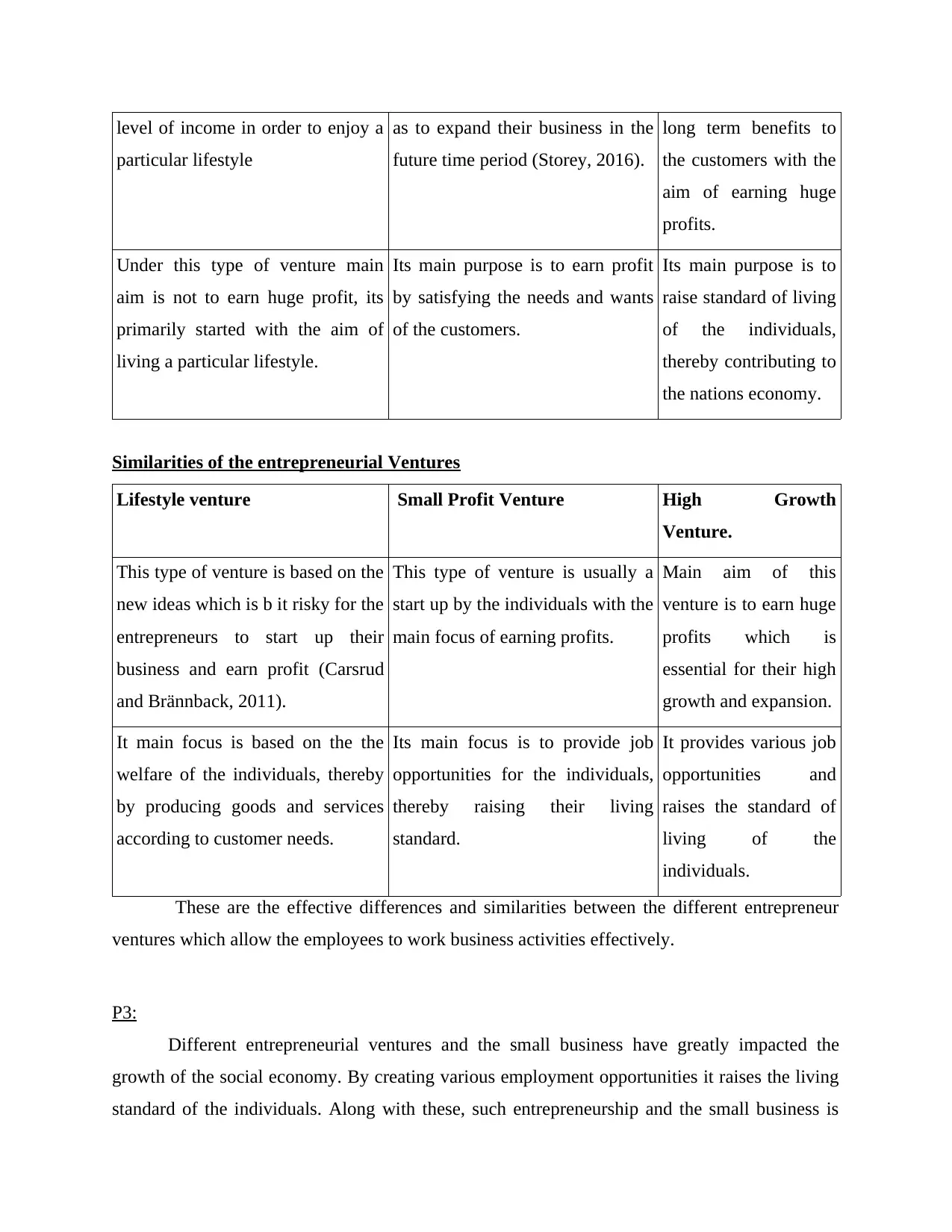
level of income in order to enjoy a
particular lifestyle
as to expand their business in the
future time period (Storey, 2016).
long term benefits to
the customers with the
aim of earning huge
profits.
Under this type of venture main
aim is not to earn huge profit, its
primarily started with the aim of
living a particular lifestyle.
Its main purpose is to earn profit
by satisfying the needs and wants
of the customers.
Its main purpose is to
raise standard of living
of the individuals,
thereby contributing to
the nations economy.
Similarities of the entrepreneurial Ventures
Lifestyle venture Small Profit Venture High Growth
Venture.
This type of venture is based on the
new ideas which is b it risky for the
entrepreneurs to start up their
business and earn profit (Carsrud
and Brännback, 2011).
This type of venture is usually a
start up by the individuals with the
main focus of earning profits.
Main aim of this
venture is to earn huge
profits which is
essential for their high
growth and expansion.
It main focus is based on the the
welfare of the individuals, thereby
by producing goods and services
according to customer needs.
Its main focus is to provide job
opportunities for the individuals,
thereby raising their living
standard.
It provides various job
opportunities and
raises the standard of
living of the
individuals.
These are the effective differences and similarities between the different entrepreneur
ventures which allow the employees to work business activities effectively.
P3:
Different entrepreneurial ventures and the small business have greatly impacted the
growth of the social economy. By creating various employment opportunities it raises the living
standard of the individuals. Along with these, such entrepreneurship and the small business is
particular lifestyle
as to expand their business in the
future time period (Storey, 2016).
long term benefits to
the customers with the
aim of earning huge
profits.
Under this type of venture main
aim is not to earn huge profit, its
primarily started with the aim of
living a particular lifestyle.
Its main purpose is to earn profit
by satisfying the needs and wants
of the customers.
Its main purpose is to
raise standard of living
of the individuals,
thereby contributing to
the nations economy.
Similarities of the entrepreneurial Ventures
Lifestyle venture Small Profit Venture High Growth
Venture.
This type of venture is based on the
new ideas which is b it risky for the
entrepreneurs to start up their
business and earn profit (Carsrud
and Brännback, 2011).
This type of venture is usually a
start up by the individuals with the
main focus of earning profits.
Main aim of this
venture is to earn huge
profits which is
essential for their high
growth and expansion.
It main focus is based on the the
welfare of the individuals, thereby
by producing goods and services
according to customer needs.
Its main focus is to provide job
opportunities for the individuals,
thereby raising their living
standard.
It provides various job
opportunities and
raises the standard of
living of the
individuals.
These are the effective differences and similarities between the different entrepreneur
ventures which allow the employees to work business activities effectively.
P3:
Different entrepreneurial ventures and the small business have greatly impacted the
growth of the social economy. By creating various employment opportunities it raises the living
standard of the individuals. Along with these, such entrepreneurship and the small business is
mainly engaged towards producing innovative products which directly contributes towards
attaining the competitive advantage.
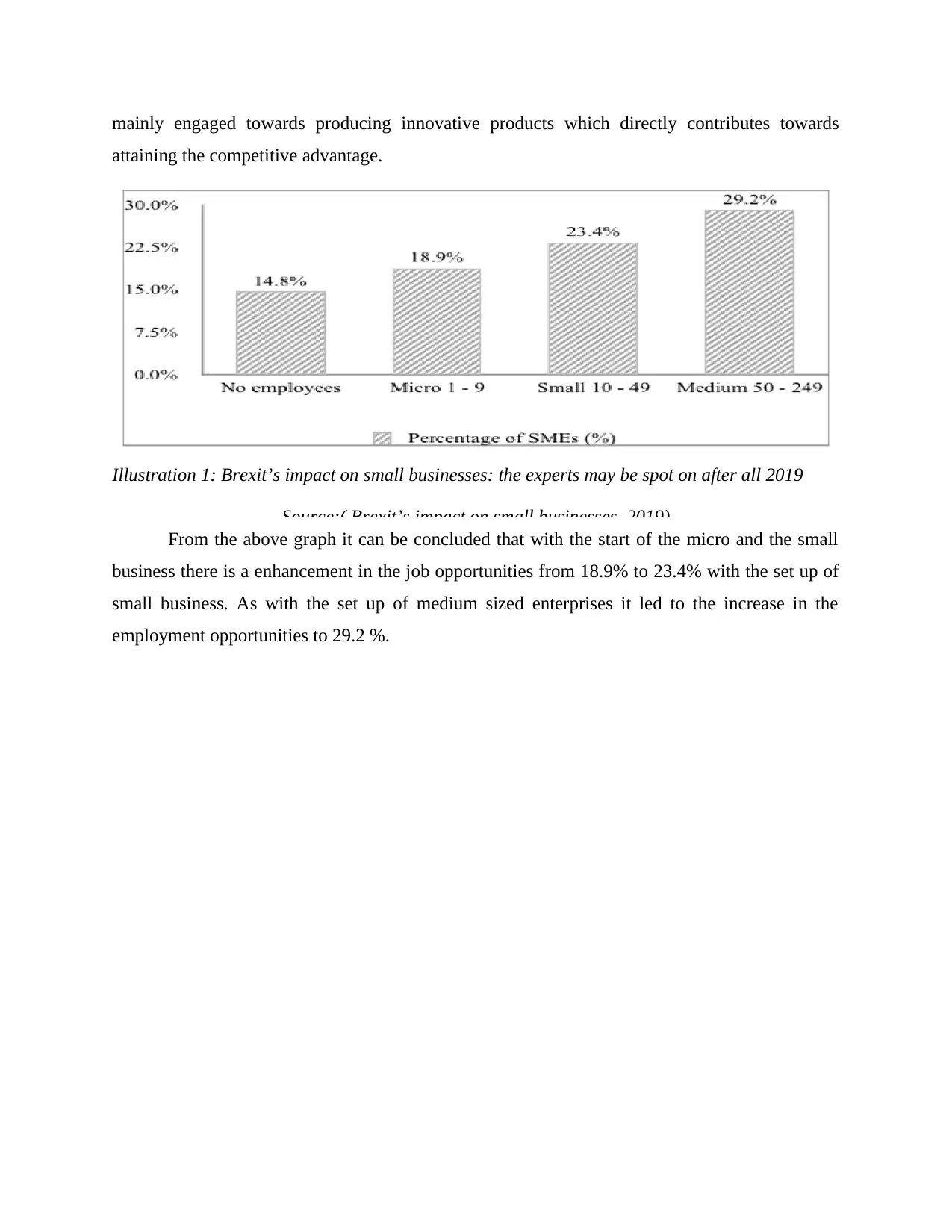
Illustration 1: Brexit’s impact on small businesses: the experts may be spot on after all 2019
Source:( Brexit’s impact on small businesses, 2019)
From the above graph it can be concluded that with the start of the micro and the small
business there is a enhancement in the job opportunities from 18.9% to 23.4% with the set up of
small business. As with the set up of medium sized enterprises it led to the increase in the
employment opportunities to 29.2 %.
attaining the competitive advantage.
Illustration 1: Brexit’s impact on small businesses: the experts may be spot on after all 2019
Source:( Brexit’s impact on small businesses, 2019)
From the above graph it can be concluded that with the start of the micro and the small
business there is a enhancement in the job opportunities from 18.9% to 23.4% with the set up of
small business. As with the set up of medium sized enterprises it led to the increase in the
employment opportunities to 29.2 %.
⊘ This is a preview!⊘
Do you want full access?
Subscribe today to unlock all pages.
Trusted by 1+ million students worldwide
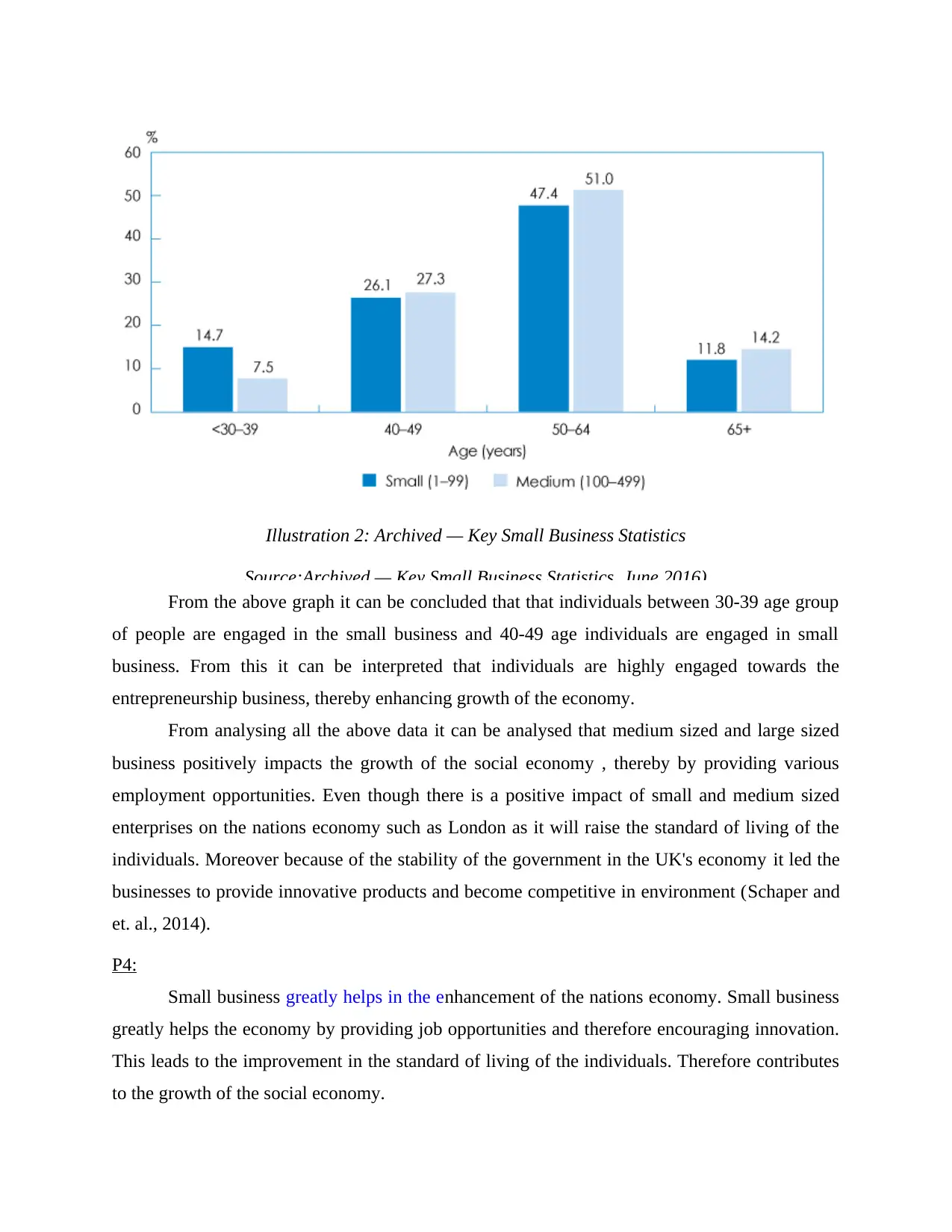
Illustration 2: Archived — Key Small Business Statistics
Source:Archived — Key Small Business Statistics June 2016)
From the above graph it can be concluded that that individuals between 30-39 age group
of people are engaged in the small business and 40-49 age individuals are engaged in small
business. From this it can be interpreted that individuals are highly engaged towards the
entrepreneurship business, thereby enhancing growth of the economy.
From analysing all the above data it can be analysed that medium sized and large sized
business positively impacts the growth of the social economy , thereby by providing various
employment opportunities. Even though there is a positive impact of small and medium sized
enterprises on the nations economy such as London as it will raise the standard of living of the
individuals. Moreover because of the stability of the government in the UK's economy it led the
businesses to provide innovative products and become competitive in environment (Schaper and
et. al., 2014).
P4:
Small business greatly helps in the enhancement of the nations economy. Small business
greatly helps the economy by providing job opportunities and therefore encouraging innovation.
This leads to the improvement in the standard of living of the individuals. Therefore contributes
to the growth of the social economy.
Source:Archived — Key Small Business Statistics June 2016)
From the above graph it can be concluded that that individuals between 30-39 age group
of people are engaged in the small business and 40-49 age individuals are engaged in small
business. From this it can be interpreted that individuals are highly engaged towards the
entrepreneurship business, thereby enhancing growth of the economy.
From analysing all the above data it can be analysed that medium sized and large sized
business positively impacts the growth of the social economy , thereby by providing various
employment opportunities. Even though there is a positive impact of small and medium sized
enterprises on the nations economy such as London as it will raise the standard of living of the
individuals. Moreover because of the stability of the government in the UK's economy it led the
businesses to provide innovative products and become competitive in environment (Schaper and
et. al., 2014).
P4:
Small business greatly helps in the enhancement of the nations economy. Small business
greatly helps the economy by providing job opportunities and therefore encouraging innovation.
This leads to the improvement in the standard of living of the individuals. Therefore contributes
to the growth of the social economy.
Paraphrase This Document
Need a fresh take? Get an instant paraphrase of this document with our AI Paraphraser
Social Economy is described as the the third sector of the mixed capital economies and is
formed by the diversity of the enterprises and the organisations such as cooperatives, mutuals,
associations. It majorly focuses on the relationship between social behaviour of the economies.
Social Enterprise is an organisation which majorly focuses on formulating and
implementing plans to expand improvements in social, environmental and financially. It includes
maximising social impact along with the profit for the external stakeholders (Chittithaworn and
et. al., 2011.).
Corporate Social Responsibility means performing or operating for the benefits of
society as a whole. This will done by SMEs by creating job opportunities to the local people of
operated nations as well as make tax payments to the government which indirectly invest in the
welfare of the society.
Importance of the SME's in the growth of the social economy.
Developing small and medium enterprises helps to achieve sustainable growth of the
social economy. There are many advantages of the SME's which are described below-
SMEs contributes maximum towards the growth of GDP by generating employment
opportunities which increases the standard of living of people.
Small businesses has an integral role at the regional level as by increasing the income
level of the employees, it enhances their standard of living and thereby provides
education and employment opportunities it helps in the development of economy of a
nation.
SME's improves the productivity at the national level and therefore improves the growth
of the private as well as public sector in the economy. This leads to the increase in the
GDP level of the country and thereby enhances the growth of the nations economy
(Chrisman and et. al., 2012).
SME's have an inclination to employ more labour intensive production process as
compared to large enterprises. This contributes to the high employment opportunities,
leading to generation of income and assist in the reduction of the poverty.
Therefore, the overall conclusion has been made that small medium enterprises leads to
the development of more innovative products and thereby providing employment opportunities,
hence contributing to the growth of the nations economy.
formed by the diversity of the enterprises and the organisations such as cooperatives, mutuals,
associations. It majorly focuses on the relationship between social behaviour of the economies.
Social Enterprise is an organisation which majorly focuses on formulating and
implementing plans to expand improvements in social, environmental and financially. It includes
maximising social impact along with the profit for the external stakeholders (Chittithaworn and
et. al., 2011.).
Corporate Social Responsibility means performing or operating for the benefits of
society as a whole. This will done by SMEs by creating job opportunities to the local people of
operated nations as well as make tax payments to the government which indirectly invest in the
welfare of the society.
Importance of the SME's in the growth of the social economy.
Developing small and medium enterprises helps to achieve sustainable growth of the
social economy. There are many advantages of the SME's which are described below-
SMEs contributes maximum towards the growth of GDP by generating employment
opportunities which increases the standard of living of people.
Small businesses has an integral role at the regional level as by increasing the income
level of the employees, it enhances their standard of living and thereby provides
education and employment opportunities it helps in the development of economy of a
nation.
SME's improves the productivity at the national level and therefore improves the growth
of the private as well as public sector in the economy. This leads to the increase in the
GDP level of the country and thereby enhances the growth of the nations economy
(Chrisman and et. al., 2012).
SME's have an inclination to employ more labour intensive production process as
compared to large enterprises. This contributes to the high employment opportunities,
leading to generation of income and assist in the reduction of the poverty.
Therefore, the overall conclusion has been made that small medium enterprises leads to
the development of more innovative products and thereby providing employment opportunities,
hence contributing to the growth of the nations economy.
P5:
Their are effective entrepreneur skills which is greatly demanded in this complex
environment in to run the business effectively. Personal Characteristics are the qualities of the
individual which makes them different from others and assist them to do their effectively. These
character tics helps the individual to get along with the new situation and without facing any
issues or problems. Skills refers to an ability to perform desired roles and responsibilities in
complex situations either creating new ideas or utilising available resources in optimum manner
(Welter, 2011).
Personal Characteristics of the successful entrepreneurs are discussed ads below-
Need for achievement- It refers to the individuals desire fort accomplishment of some
specific activities, with the help of their effective skills. It includes some intensive,
prolonged and repeated efforts to accomplish something difficult.
Self Confidence- It is the basic characteristic which every entrepreneur should have.
Self confidence. It is in perspective of having faith towards own ability and judgement.
It is usually a positive feeling entrepreneurs have one self.
Openness to Change- It states that entrepreneurs should be ready to accept changes and
able to bear heavy risk and should be open to change and work according to the change in
the market.
Highly Motivated- Motivation is the essential characteristic which initiates a desire
among the individual to perform their work with great dedication and thereby achieves
the specific business objectives.
Common Skills of the successful entrepreneur
Communication Skills- Successful entrepreneurs have effective communication skills
which assist them to communicate and interact effectively with others in order to
achieve business goals (Dennis, 2011).
Decision making Skills- Entrepreneurs have effective decision making skills so as avoid
any issues or problems and take decision promptly according to situation.
Problem solving skills- These skills help the entrepreneurs to effective solve the
problems as and when they arise in the business and conducts business activities
properly.
Their are effective entrepreneur skills which is greatly demanded in this complex
environment in to run the business effectively. Personal Characteristics are the qualities of the
individual which makes them different from others and assist them to do their effectively. These
character tics helps the individual to get along with the new situation and without facing any
issues or problems. Skills refers to an ability to perform desired roles and responsibilities in
complex situations either creating new ideas or utilising available resources in optimum manner
(Welter, 2011).
Personal Characteristics of the successful entrepreneurs are discussed ads below-
Need for achievement- It refers to the individuals desire fort accomplishment of some
specific activities, with the help of their effective skills. It includes some intensive,
prolonged and repeated efforts to accomplish something difficult.
Self Confidence- It is the basic characteristic which every entrepreneur should have.
Self confidence. It is in perspective of having faith towards own ability and judgement.
It is usually a positive feeling entrepreneurs have one self.
Openness to Change- It states that entrepreneurs should be ready to accept changes and
able to bear heavy risk and should be open to change and work according to the change in
the market.
Highly Motivated- Motivation is the essential characteristic which initiates a desire
among the individual to perform their work with great dedication and thereby achieves
the specific business objectives.
Common Skills of the successful entrepreneur
Communication Skills- Successful entrepreneurs have effective communication skills
which assist them to communicate and interact effectively with others in order to
achieve business goals (Dennis, 2011).
Decision making Skills- Entrepreneurs have effective decision making skills so as avoid
any issues or problems and take decision promptly according to situation.
Problem solving skills- These skills help the entrepreneurs to effective solve the
problems as and when they arise in the business and conducts business activities
properly.
⊘ This is a preview!⊘
Do you want full access?
Subscribe today to unlock all pages.
Trusted by 1+ million students worldwide
Technical Skills- These skills helps the entrepreneur to use different tools and
technology and work according to the change prevailing in the environment (Neck and
Greene, 2011).
Two successful entrepreneurs discussed here are Peter Jones and Joanne Rowling whose traits
and skills are discussed as below-
Peter Jones is a successful entrepreneur from British have dedication towards working in
mobile phones, television and retail sector. . He had a interest in business from his small age
which led him to start his own business.
Characteristics-
He was highly committed and motivated towards its work and makes continuous efforts
to conduct business activities which led to the discovery of many products. Even after
loosing 20, 000 euros he kept on working effectively (Drucker, 2014).
He was highly openness to change and a innovative thinker to provide updated products
such as mobile, television and under the retail sector.
Skills-
Time Management Skills- Peter Jones have effective time management skills as he
properly conducts business activities within the set time frame.
Technical Skills- By overseeing the operations in the television, mobile and the retail
sector, Peter Jones has a effective technical skills to conduct all the business operations
properly.
Simon Cowell
Simon Cowell is an entrepreneur, born in England in the year 1959. He is an English
television, music and a talent show judge. Moreover Simon is an executive, business man, talent
manager, television producer and a entrepreneur.
Characteristics-
Simon has a high self confidence on his abilities as he can effectively manages all the
business activities being a executive, entrepreneur, consultant and works with great
optimism towards being the leading entrepreneur of UK (FassinVan, Rossem and
Buelens, 2011).
Simon works according to the changes prevailing in the society and has the capability of
risk taking skills. This helps him in better functioning of all the business activities.
technology and work according to the change prevailing in the environment (Neck and
Greene, 2011).
Two successful entrepreneurs discussed here are Peter Jones and Joanne Rowling whose traits
and skills are discussed as below-
Peter Jones is a successful entrepreneur from British have dedication towards working in
mobile phones, television and retail sector. . He had a interest in business from his small age
which led him to start his own business.
Characteristics-
He was highly committed and motivated towards its work and makes continuous efforts
to conduct business activities which led to the discovery of many products. Even after
loosing 20, 000 euros he kept on working effectively (Drucker, 2014).
He was highly openness to change and a innovative thinker to provide updated products
such as mobile, television and under the retail sector.
Skills-
Time Management Skills- Peter Jones have effective time management skills as he
properly conducts business activities within the set time frame.
Technical Skills- By overseeing the operations in the television, mobile and the retail
sector, Peter Jones has a effective technical skills to conduct all the business operations
properly.
Simon Cowell
Simon Cowell is an entrepreneur, born in England in the year 1959. He is an English
television, music and a talent show judge. Moreover Simon is an executive, business man, talent
manager, television producer and a entrepreneur.
Characteristics-
Simon has a high self confidence on his abilities as he can effectively manages all the
business activities being a executive, entrepreneur, consultant and works with great
optimism towards being the leading entrepreneur of UK (FassinVan, Rossem and
Buelens, 2011).
Simon works according to the changes prevailing in the society and has the capability of
risk taking skills. This helps him in better functioning of all the business activities.
Paraphrase This Document
Need a fresh take? Get an instant paraphrase of this document with our AI Paraphraser
Skills-
Decision making Skills- Simon has effective decision making skills which assist him to
take fair judgements and work effectively being a judge.
Simon has effective communication and listening skills which assist him to listen and
interact with other employees effectively. This leads to effective functioning of the
business activities and motivate the employees to perform effectively.
P6:
Personality of the
entrepreneurs greatly reflect upon their motivation and mindset. Mindset of all the entrepreneurs
are different and they work according to various situational factors which results in shaping
entrepreneurial mindset.
Mindset- It is the individuals usual attitude which assist them to work according to the
situation prevailing in the market. Normally it is the collection of the thoughts and beliefs that
shape the thoughts of the entrepreneurs (George and Bock, 2011).
Different mindsets of the successful entrepreneurs are discussed as follows-
Wanting more than money- Entrepreneurs doesn't wants to earn money all the time.
They want more than the money such as expansion of their business, enhancement of
their brand image and many more.
Not Missing Opportunities- Entrepreneur doesn't wants to miss opportunities that is
being available in the market. Their mindset stays positively and provide product
according to the demand in the market and grabs all the available opportunities.
Positive Thought- Entrepreneurs have a positive thought regarding their work which
assist them to conduct business activities properly.
Staying Motivated- When the entrepreneur is highly motivated towards its work, it
creates a desire to work effectively and attain the desirable outcomes.
Their are different situational factors which shapes the entrepreneurial mindset which are
discussed as follows-
Unemployment- When there is unemployment prevailing in the economy, it led the
entrepreneur to start up their own business in hope of generating profit as well as
providing various job opportunities for the unemployed people. This set mindset for the
entrepreneur to start up their own business.
Decision making Skills- Simon has effective decision making skills which assist him to
take fair judgements and work effectively being a judge.
Simon has effective communication and listening skills which assist him to listen and
interact with other employees effectively. This leads to effective functioning of the
business activities and motivate the employees to perform effectively.
P6:
Personality of the
entrepreneurs greatly reflect upon their motivation and mindset. Mindset of all the entrepreneurs
are different and they work according to various situational factors which results in shaping
entrepreneurial mindset.
Mindset- It is the individuals usual attitude which assist them to work according to the
situation prevailing in the market. Normally it is the collection of the thoughts and beliefs that
shape the thoughts of the entrepreneurs (George and Bock, 2011).
Different mindsets of the successful entrepreneurs are discussed as follows-
Wanting more than money- Entrepreneurs doesn't wants to earn money all the time.
They want more than the money such as expansion of their business, enhancement of
their brand image and many more.
Not Missing Opportunities- Entrepreneur doesn't wants to miss opportunities that is
being available in the market. Their mindset stays positively and provide product
according to the demand in the market and grabs all the available opportunities.
Positive Thought- Entrepreneurs have a positive thought regarding their work which
assist them to conduct business activities properly.
Staying Motivated- When the entrepreneur is highly motivated towards its work, it
creates a desire to work effectively and attain the desirable outcomes.
Their are different situational factors which shapes the entrepreneurial mindset which are
discussed as follows-
Unemployment- When there is unemployment prevailing in the economy, it led the
entrepreneur to start up their own business in hope of generating profit as well as
providing various job opportunities for the unemployed people. This set mindset for the
entrepreneur to start up their own business.
Access to the resources- When the entrepreneurs have high access to the resources it can
carry the business task effectively and shapes the positive mindset of the entrepreneurs to
perform the task and carry the business functionally (Gorgievski, Ascalon and Stephan,
2011).
Cultural Differences- Entrepreneurs conducting businesses in different countries led to
the cultural differences which makes their business activities difficult and therefore
shapes the mindset of the entrepreneurs to provide products and services in the country
according to the demands.
Entrepreneurial Education- High education of the entrepreneurs accordingly shapes
their mindset and assist them to start and conduct their business accordingly.
These are the different mindset and the various situational factors which shapes the mind
of different entrepreneurs and assist them to start, conduct and expand their business. Ways
through which background and experience of entrepreneur can become foster and hinder.
Performance of entrepreneurship.
P7:
Entrepreneurship is the activity of running a small business by the individuals who generate their
own idea for starting up a new venture. Their are different ways through which background and
experience can hinder and foster the task of entrepreneurship. Under the present report two
successful entrepreneurs are taken such as Peter Jones and Simon Cowell.
Family Background- This factor greatly affects the performance of entrepreneurship. In
context to Simon Cowell he had grabbed the music quality from his mother as she is a ballet
performer. His father was a real estate agent and a music industry executive. From such
experiences from the background Simon started working on the television shows and effectively
developed working in the music industry. Further in context to Peter Jones father had a small
office and was an air conditioning engineer. From his tender age Peter was interested in
following his fathers footsteps and has great interest in wide range of industries which motivated
him start his own business and fosters the performance of entrepreneurship (Goss, 2015).
Education- Peter Jones has completed his higher education and has developed interest in
Economics as well as Tennis. As from the early childhood he had a interest in becoming a
businessman. He started working hardly and gained knowledge about phones, television and the
retail sector and led to the establishment of the successful business. While Simon Cowell
carry the business task effectively and shapes the positive mindset of the entrepreneurs to
perform the task and carry the business functionally (Gorgievski, Ascalon and Stephan,
2011).
Cultural Differences- Entrepreneurs conducting businesses in different countries led to
the cultural differences which makes their business activities difficult and therefore
shapes the mindset of the entrepreneurs to provide products and services in the country
according to the demands.
Entrepreneurial Education- High education of the entrepreneurs accordingly shapes
their mindset and assist them to start and conduct their business accordingly.
These are the different mindset and the various situational factors which shapes the mind
of different entrepreneurs and assist them to start, conduct and expand their business. Ways
through which background and experience of entrepreneur can become foster and hinder.
Performance of entrepreneurship.
P7:
Entrepreneurship is the activity of running a small business by the individuals who generate their
own idea for starting up a new venture. Their are different ways through which background and
experience can hinder and foster the task of entrepreneurship. Under the present report two
successful entrepreneurs are taken such as Peter Jones and Simon Cowell.
Family Background- This factor greatly affects the performance of entrepreneurship. In
context to Simon Cowell he had grabbed the music quality from his mother as she is a ballet
performer. His father was a real estate agent and a music industry executive. From such
experiences from the background Simon started working on the television shows and effectively
developed working in the music industry. Further in context to Peter Jones father had a small
office and was an air conditioning engineer. From his tender age Peter was interested in
following his fathers footsteps and has great interest in wide range of industries which motivated
him start his own business and fosters the performance of entrepreneurship (Goss, 2015).
Education- Peter Jones has completed his higher education and has developed interest in
Economics as well as Tennis. As from the early childhood he had a interest in becoming a
businessman. He started working hardly and gained knowledge about phones, television and the
retail sector and led to the establishment of the successful business. While Simon Cowell
⊘ This is a preview!⊘
Do you want full access?
Subscribe today to unlock all pages.
Trusted by 1+ million students worldwide

1 out of 15


Related Documents


Your All-in-One AI-Powered Toolkit for Academic Success.
+13062052269
info@desklib.com
Available 24*7 on WhatsApp / Email
![[object Object]](/_next/static/media/star-bottom.7253800d.svg)
Unlock your academic potential
Copyright © 2020–2026 A2Z Services. All Rights Reserved. Developed and managed by ZUCOL.