Entrepreneurship Report: Venture Types, Economic Impact After Brexit
VerifiedAdded on 2020/01/07
|14
|4721
|201
Report
AI Summary
This report provides an in-depth analysis of entrepreneurship, encompassing various venture types and their impact on the economy. It begins by defining entrepreneurship and its significance, then delves into the different types of entrepreneurial ventures, including serial, lifestyle, social, and women entrepreneurs, highlighting their characteristics, similarities, and differences. The report further examines the economic contributions of micro, medium, and large-sized enterprises, emphasizing their roles in employment creation, revenue generation, and GDP growth. It also explores the impact of small businesses and start-ups on the social economy, particularly in the context of Brexit. The report concludes by discussing the skills and motivational drives essential for entrepreneurial success, as well as factors that either hinder or foster entrepreneurship.
ENTREPRENEURSHIP

Paraphrase This Document
Need a fresh take? Get an instant paraphrase of this document with our AI Paraphraser
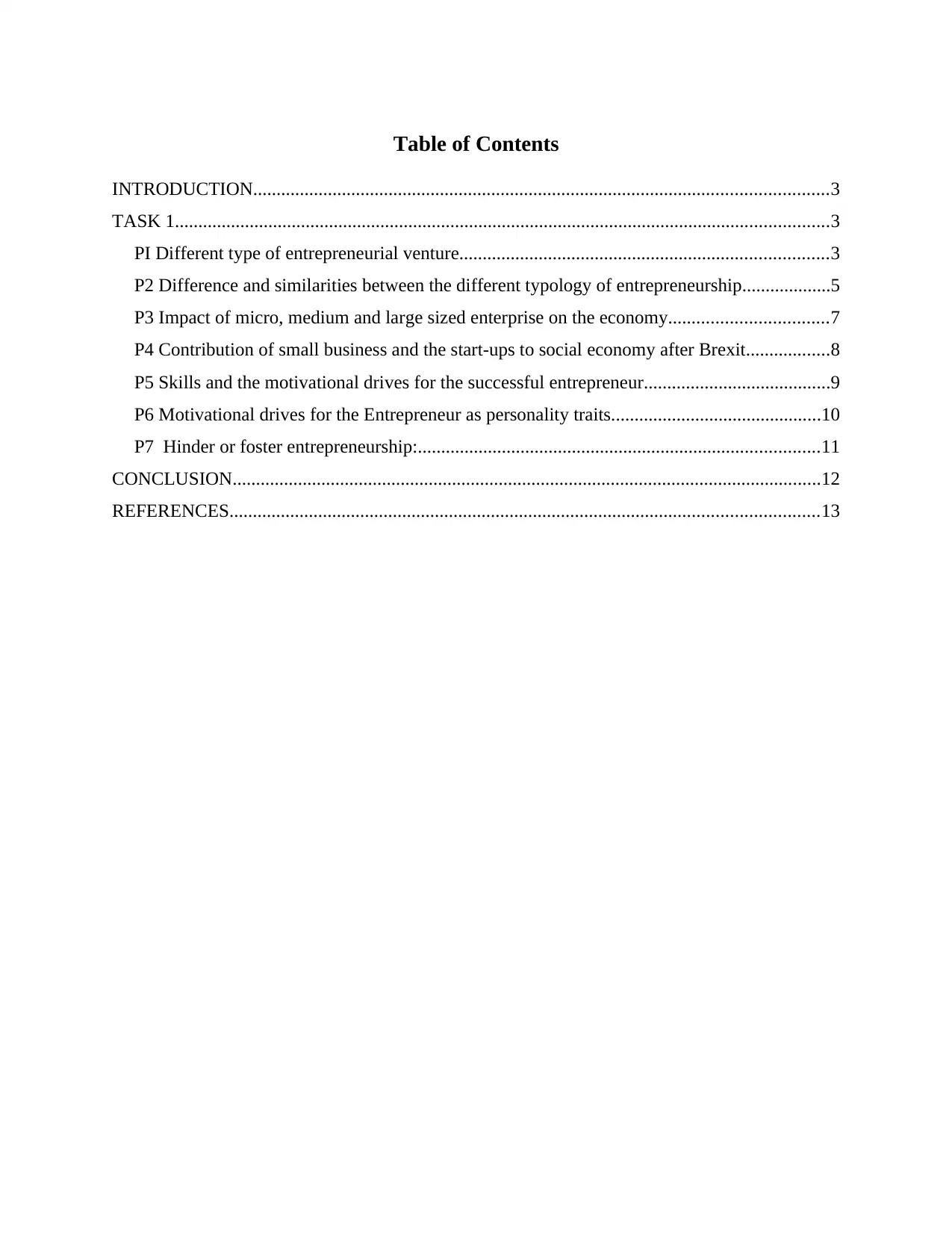
Table of Contents
INTRODUCTION...........................................................................................................................3
TASK 1............................................................................................................................................3
PI Different type of entrepreneurial venture...............................................................................3
P2 Difference and similarities between the different typology of entrepreneurship...................5
P3 Impact of micro, medium and large sized enterprise on the economy..................................7
P4 Contribution of small business and the start-ups to social economy after Brexit..................8
P5 Skills and the motivational drives for the successful entrepreneur........................................9
P6 Motivational drives for the Entrepreneur as personality traits.............................................10
P7 Hinder or foster entrepreneurship:......................................................................................11
CONCLUSION..............................................................................................................................12
REFERENCES..............................................................................................................................13
INTRODUCTION...........................................................................................................................3
TASK 1............................................................................................................................................3
PI Different type of entrepreneurial venture...............................................................................3
P2 Difference and similarities between the different typology of entrepreneurship...................5
P3 Impact of micro, medium and large sized enterprise on the economy..................................7
P4 Contribution of small business and the start-ups to social economy after Brexit..................8
P5 Skills and the motivational drives for the successful entrepreneur........................................9
P6 Motivational drives for the Entrepreneur as personality traits.............................................10
P7 Hinder or foster entrepreneurship:......................................................................................11
CONCLUSION..............................................................................................................................12
REFERENCES..............................................................................................................................13
INTRODUCTION
In this report, Entrepreneurship and its effect on the economy are defined. The different
types of entrepreneur and their entrepreneurial ventures are studied in this report.
Entrepreneurship is the use of available resources and labour with the introduction of a
new idea in willing to establishment of new venture. The entrepreneurship defined as the sort of
self employment. Traditional definition of Entrepreneurship is that it is refereed to as the running
and planning for a new business which is a small business in starting phase.
Entrepreneurship is the major source of funding the government institution by taxation
and major contribution towards the economy of the countries. Entrepreneurship provides
employment in the country hence influence the GDP of the country. Many countries like China
has built their economy with the help of development of entrepreneurial activities in the country
and now they capture the huge part of the word economy (Brooks and et. al., 2014).
After Brexit the economy of EU is at boom with the help of small and medium sized enterprise
which are developed in the country. Entrepreneurship is the major source of new innovation and
technological enhancement and the providing the simplified and better life to the people.
Entrepreneurship works with the application of science theories and giving them a new physical
existence with creative ideas.
TASK 1
PI Different type of entrepreneurial venture
Entrepreneurship refers to the self employment creates a new business with the
implementation of innovation with the combination of natural resources and the labour available
and the exploitation of the future growth aspects in the untouched market.
Entrepreneurs are the person or the group of persons who will develop the new enterprise
with help of their entrepreneurial capabilities and entrepreneurial activities (Breugst, N.,
Domurath, Patzelt and Klaukien, 2012). Entrepreneur is the individual who works for an new
innovative idea with confidence and his risk bearing capabilities to establish an profitable
empire.
There are many entrepreneurial ventures who works in corporate sector and the private
sector. The private sector entrepreneurial ventures are either government owned or government
In this report, Entrepreneurship and its effect on the economy are defined. The different
types of entrepreneur and their entrepreneurial ventures are studied in this report.
Entrepreneurship is the use of available resources and labour with the introduction of a
new idea in willing to establishment of new venture. The entrepreneurship defined as the sort of
self employment. Traditional definition of Entrepreneurship is that it is refereed to as the running
and planning for a new business which is a small business in starting phase.
Entrepreneurship is the major source of funding the government institution by taxation
and major contribution towards the economy of the countries. Entrepreneurship provides
employment in the country hence influence the GDP of the country. Many countries like China
has built their economy with the help of development of entrepreneurial activities in the country
and now they capture the huge part of the word economy (Brooks and et. al., 2014).
After Brexit the economy of EU is at boom with the help of small and medium sized enterprise
which are developed in the country. Entrepreneurship is the major source of new innovation and
technological enhancement and the providing the simplified and better life to the people.
Entrepreneurship works with the application of science theories and giving them a new physical
existence with creative ideas.
TASK 1
PI Different type of entrepreneurial venture
Entrepreneurship refers to the self employment creates a new business with the
implementation of innovation with the combination of natural resources and the labour available
and the exploitation of the future growth aspects in the untouched market.
Entrepreneurs are the person or the group of persons who will develop the new enterprise
with help of their entrepreneurial capabilities and entrepreneurial activities (Breugst, N.,
Domurath, Patzelt and Klaukien, 2012). Entrepreneur is the individual who works for an new
innovative idea with confidence and his risk bearing capabilities to establish an profitable
empire.
There are many entrepreneurial ventures who works in corporate sector and the private
sector. The private sector entrepreneurial ventures are either government owned or government
⊘ This is a preview!⊘
Do you want full access?
Subscribe today to unlock all pages.

Trusted by 1+ million students worldwide
funded. The public facility provided by government also assessed the need of entrepreneurial
activities to serve the public with new innovative ideas with support of government.
Serial Entrepreneur is the person who starts one business with new innovative idea and
less willing to operate the existing business he keeps on switching and moves forward to the new
enterprise with many new ideas (Baron and Tang, 2011). One of the Entrepreneurial venture of
serial entrepreneurship is founded by Sir Richard Branson. The business founded by him was
conglomerate Virgin group (1970) started a business of mail order record. Today Virgin group
owned more than different companies and controlling them. Some of the serial enterprise of
Virgin groups are Virgin vodka, virgin clothing, virgin cola etc.
Lifestyle Entrepreneur is related with the hobbies and the thing the person want to do in
life. Lifestyle Entrepreneur develop the product and the services related with their passion and
hobbies.
Social Entrepreneur defines the use of technology and new idea to solve the existing
problems in society and helping them to develop their lives with services provided. Social
enterprise can be non-profit organisation or it may be semi-profitable organisation. Ex. of social
entrepreneurial ventures is TOMS organisation (2006). Founder of TOMS is Mycoskie Black.
TOMS donate a pair of shoes to the person who does not have shoes and got injured and sick.
This organisation also started donating the pair of glasses on every single sold of sunglasses.
Women entrepreneurship refers to the women who is willing to establish their own
business with development of their own new idea and capable of taking risk and initiation with
confidence. One of the entrepreneurial venture is started by Tory Burch. She named is enterprise
also Tory Burch an clothing Company established in 2006. Today this venture is having
approximately 125 free-standing outlets (Armour and et. al., 2017).
Entrepreneurial ventures have to face many challenges for their growth like internal
management, capturing new market etc. The venture development for future growth can be
regulated with the help of internal organisation design, organisation culture. This leads to the
future development and growth of venture. There is a huge scope of growth of the
entrepreneurial development and growth in future the ventures with new ideas. This contribute to
high amount of economic growth of country.
activities to serve the public with new innovative ideas with support of government.
Serial Entrepreneur is the person who starts one business with new innovative idea and
less willing to operate the existing business he keeps on switching and moves forward to the new
enterprise with many new ideas (Baron and Tang, 2011). One of the Entrepreneurial venture of
serial entrepreneurship is founded by Sir Richard Branson. The business founded by him was
conglomerate Virgin group (1970) started a business of mail order record. Today Virgin group
owned more than different companies and controlling them. Some of the serial enterprise of
Virgin groups are Virgin vodka, virgin clothing, virgin cola etc.
Lifestyle Entrepreneur is related with the hobbies and the thing the person want to do in
life. Lifestyle Entrepreneur develop the product and the services related with their passion and
hobbies.
Social Entrepreneur defines the use of technology and new idea to solve the existing
problems in society and helping them to develop their lives with services provided. Social
enterprise can be non-profit organisation or it may be semi-profitable organisation. Ex. of social
entrepreneurial ventures is TOMS organisation (2006). Founder of TOMS is Mycoskie Black.
TOMS donate a pair of shoes to the person who does not have shoes and got injured and sick.
This organisation also started donating the pair of glasses on every single sold of sunglasses.
Women entrepreneurship refers to the women who is willing to establish their own
business with development of their own new idea and capable of taking risk and initiation with
confidence. One of the entrepreneurial venture is started by Tory Burch. She named is enterprise
also Tory Burch an clothing Company established in 2006. Today this venture is having
approximately 125 free-standing outlets (Armour and et. al., 2017).
Entrepreneurial ventures have to face many challenges for their growth like internal
management, capturing new market etc. The venture development for future growth can be
regulated with the help of internal organisation design, organisation culture. This leads to the
future development and growth of venture. There is a huge scope of growth of the
entrepreneurial development and growth in future the ventures with new ideas. This contribute to
high amount of economic growth of country.
Paraphrase This Document
Need a fresh take? Get an instant paraphrase of this document with our AI Paraphraser
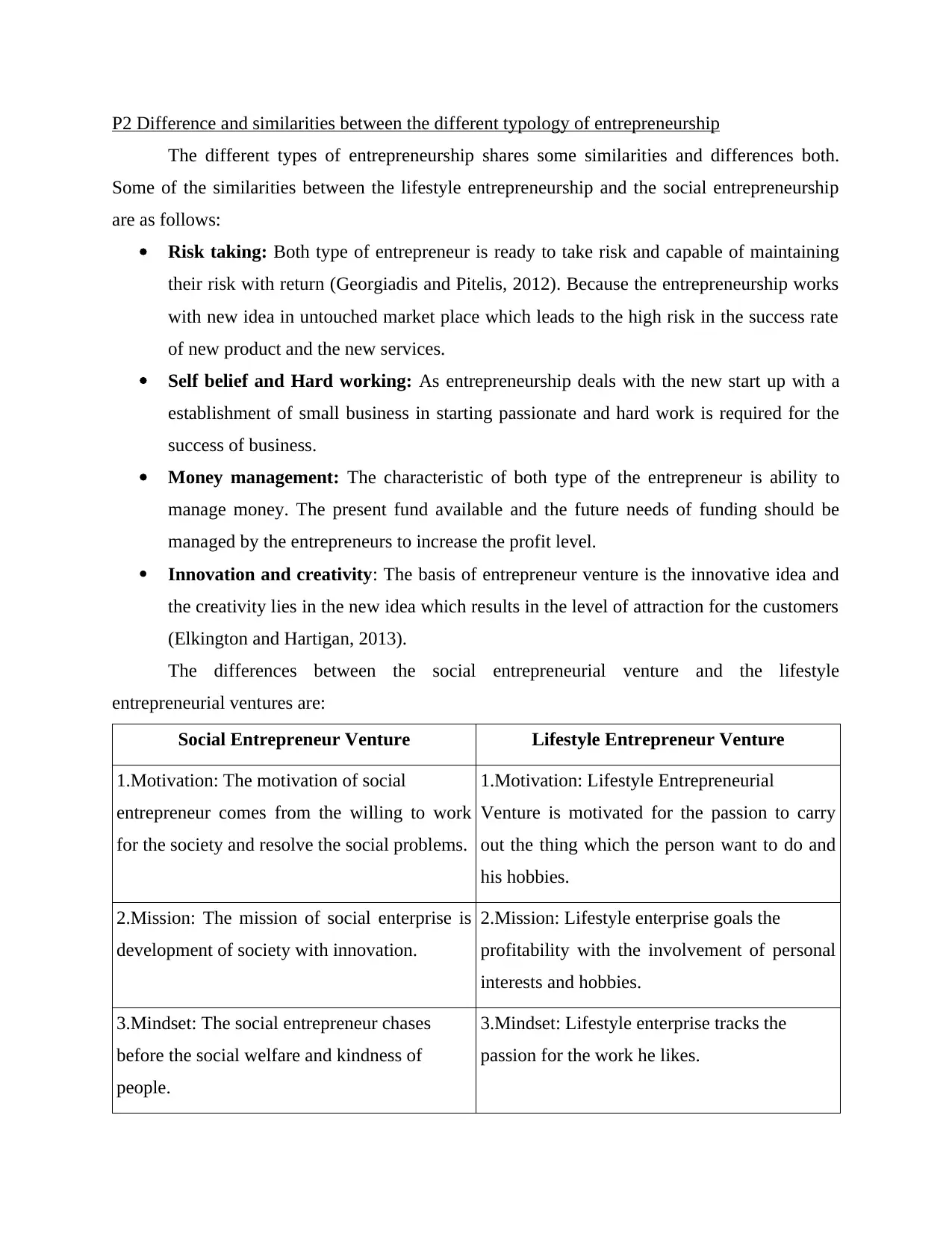
P2 Difference and similarities between the different typology of entrepreneurship
The different types of entrepreneurship shares some similarities and differences both.
Some of the similarities between the lifestyle entrepreneurship and the social entrepreneurship
are as follows:
Risk taking: Both type of entrepreneur is ready to take risk and capable of maintaining
their risk with return (Georgiadis and Pitelis, 2012). Because the entrepreneurship works
with new idea in untouched market place which leads to the high risk in the success rate
of new product and the new services.
Self belief and Hard working: As entrepreneurship deals with the new start up with a
establishment of small business in starting passionate and hard work is required for the
success of business.
Money management: The characteristic of both type of the entrepreneur is ability to
manage money. The present fund available and the future needs of funding should be
managed by the entrepreneurs to increase the profit level.
Innovation and creativity: The basis of entrepreneur venture is the innovative idea and
the creativity lies in the new idea which results in the level of attraction for the customers
(Elkington and Hartigan, 2013).
The differences between the social entrepreneurial venture and the lifestyle
entrepreneurial ventures are:
Social Entrepreneur Venture Lifestyle Entrepreneur Venture
1.Motivation: The motivation of social
entrepreneur comes from the willing to work
for the society and resolve the social problems.
1.Motivation: Lifestyle Entrepreneurial
Venture is motivated for the passion to carry
out the thing which the person want to do and
his hobbies.
2.Mission: The mission of social enterprise is
development of society with innovation.
2.Mission: Lifestyle enterprise goals the
profitability with the involvement of personal
interests and hobbies.
3.Mindset: The social entrepreneur chases
before the social welfare and kindness of
people.
3.Mindset: Lifestyle enterprise tracks the
passion for the work he likes.
The different types of entrepreneurship shares some similarities and differences both.
Some of the similarities between the lifestyle entrepreneurship and the social entrepreneurship
are as follows:
Risk taking: Both type of entrepreneur is ready to take risk and capable of maintaining
their risk with return (Georgiadis and Pitelis, 2012). Because the entrepreneurship works
with new idea in untouched market place which leads to the high risk in the success rate
of new product and the new services.
Self belief and Hard working: As entrepreneurship deals with the new start up with a
establishment of small business in starting passionate and hard work is required for the
success of business.
Money management: The characteristic of both type of the entrepreneur is ability to
manage money. The present fund available and the future needs of funding should be
managed by the entrepreneurs to increase the profit level.
Innovation and creativity: The basis of entrepreneur venture is the innovative idea and
the creativity lies in the new idea which results in the level of attraction for the customers
(Elkington and Hartigan, 2013).
The differences between the social entrepreneurial venture and the lifestyle
entrepreneurial ventures are:
Social Entrepreneur Venture Lifestyle Entrepreneur Venture
1.Motivation: The motivation of social
entrepreneur comes from the willing to work
for the society and resolve the social problems.
1.Motivation: Lifestyle Entrepreneurial
Venture is motivated for the passion to carry
out the thing which the person want to do and
his hobbies.
2.Mission: The mission of social enterprise is
development of society with innovation.
2.Mission: Lifestyle enterprise goals the
profitability with the involvement of personal
interests and hobbies.
3.Mindset: The social entrepreneur chases
before the social welfare and kindness of
people.
3.Mindset: Lifestyle enterprise tracks the
passion for the work he likes.
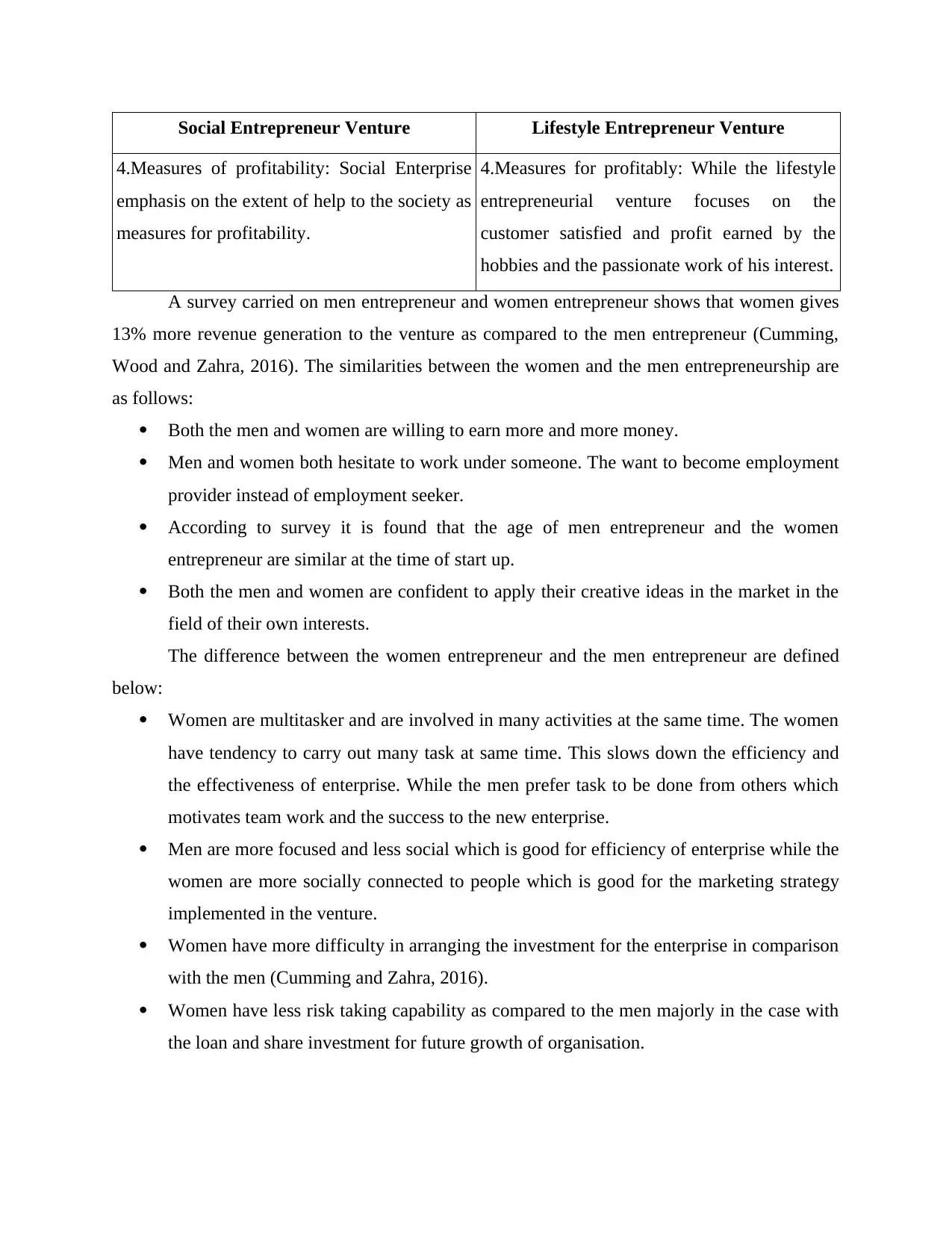
Social Entrepreneur Venture Lifestyle Entrepreneur Venture
4.Measures of profitability: Social Enterprise
emphasis on the extent of help to the society as
measures for profitability.
4.Measures for profitably: While the lifestyle
entrepreneurial venture focuses on the
customer satisfied and profit earned by the
hobbies and the passionate work of his interest.
A survey carried on men entrepreneur and women entrepreneur shows that women gives
13% more revenue generation to the venture as compared to the men entrepreneur (Cumming,
Wood and Zahra, 2016). The similarities between the women and the men entrepreneurship are
as follows:
Both the men and women are willing to earn more and more money.
Men and women both hesitate to work under someone. The want to become employment
provider instead of employment seeker.
According to survey it is found that the age of men entrepreneur and the women
entrepreneur are similar at the time of start up.
Both the men and women are confident to apply their creative ideas in the market in the
field of their own interests.
The difference between the women entrepreneur and the men entrepreneur are defined
below:
Women are multitasker and are involved in many activities at the same time. The women
have tendency to carry out many task at same time. This slows down the efficiency and
the effectiveness of enterprise. While the men prefer task to be done from others which
motivates team work and the success to the new enterprise.
Men are more focused and less social which is good for efficiency of enterprise while the
women are more socially connected to people which is good for the marketing strategy
implemented in the venture.
Women have more difficulty in arranging the investment for the enterprise in comparison
with the men (Cumming and Zahra, 2016).
Women have less risk taking capability as compared to the men majorly in the case with
the loan and share investment for future growth of organisation.
4.Measures of profitability: Social Enterprise
emphasis on the extent of help to the society as
measures for profitability.
4.Measures for profitably: While the lifestyle
entrepreneurial venture focuses on the
customer satisfied and profit earned by the
hobbies and the passionate work of his interest.
A survey carried on men entrepreneur and women entrepreneur shows that women gives
13% more revenue generation to the venture as compared to the men entrepreneur (Cumming,
Wood and Zahra, 2016). The similarities between the women and the men entrepreneurship are
as follows:
Both the men and women are willing to earn more and more money.
Men and women both hesitate to work under someone. The want to become employment
provider instead of employment seeker.
According to survey it is found that the age of men entrepreneur and the women
entrepreneur are similar at the time of start up.
Both the men and women are confident to apply their creative ideas in the market in the
field of their own interests.
The difference between the women entrepreneur and the men entrepreneur are defined
below:
Women are multitasker and are involved in many activities at the same time. The women
have tendency to carry out many task at same time. This slows down the efficiency and
the effectiveness of enterprise. While the men prefer task to be done from others which
motivates team work and the success to the new enterprise.
Men are more focused and less social which is good for efficiency of enterprise while the
women are more socially connected to people which is good for the marketing strategy
implemented in the venture.
Women have more difficulty in arranging the investment for the enterprise in comparison
with the men (Cumming and Zahra, 2016).
Women have less risk taking capability as compared to the men majorly in the case with
the loan and share investment for future growth of organisation.
⊘ This is a preview!⊘
Do you want full access?
Subscribe today to unlock all pages.
Trusted by 1+ million students worldwide
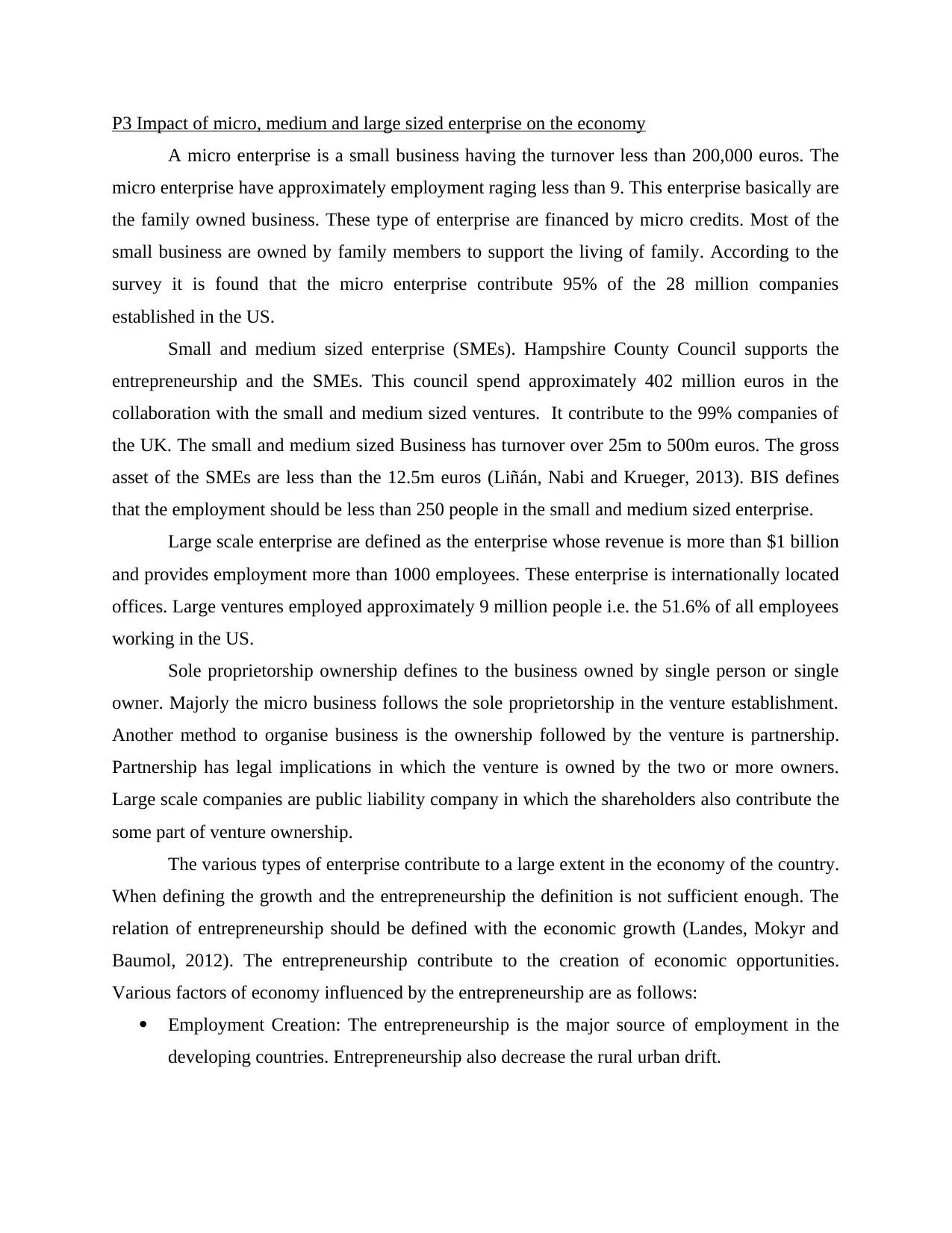
P3 Impact of micro, medium and large sized enterprise on the economy
A micro enterprise is a small business having the turnover less than 200,000 euros. The
micro enterprise have approximately employment raging less than 9. This enterprise basically are
the family owned business. These type of enterprise are financed by micro credits. Most of the
small business are owned by family members to support the living of family. According to the
survey it is found that the micro enterprise contribute 95% of the 28 million companies
established in the US.
Small and medium sized enterprise (SMEs). Hampshire County Council supports the
entrepreneurship and the SMEs. This council spend approximately 402 million euros in the
collaboration with the small and medium sized ventures. It contribute to the 99% companies of
the UK. The small and medium sized Business has turnover over 25m to 500m euros. The gross
asset of the SMEs are less than the 12.5m euros (Liñán, Nabi and Krueger, 2013). BIS defines
that the employment should be less than 250 people in the small and medium sized enterprise.
Large scale enterprise are defined as the enterprise whose revenue is more than $1 billion
and provides employment more than 1000 employees. These enterprise is internationally located
offices. Large ventures employed approximately 9 million people i.e. the 51.6% of all employees
working in the US.
Sole proprietorship ownership defines to the business owned by single person or single
owner. Majorly the micro business follows the sole proprietorship in the venture establishment.
Another method to organise business is the ownership followed by the venture is partnership.
Partnership has legal implications in which the venture is owned by the two or more owners.
Large scale companies are public liability company in which the shareholders also contribute the
some part of venture ownership.
The various types of enterprise contribute to a large extent in the economy of the country.
When defining the growth and the entrepreneurship the definition is not sufficient enough. The
relation of entrepreneurship should be defined with the economic growth (Landes, Mokyr and
Baumol, 2012). The entrepreneurship contribute to the creation of economic opportunities.
Various factors of economy influenced by the entrepreneurship are as follows:
Employment Creation: The entrepreneurship is the major source of employment in the
developing countries. Entrepreneurship also decrease the rural urban drift.
A micro enterprise is a small business having the turnover less than 200,000 euros. The
micro enterprise have approximately employment raging less than 9. This enterprise basically are
the family owned business. These type of enterprise are financed by micro credits. Most of the
small business are owned by family members to support the living of family. According to the
survey it is found that the micro enterprise contribute 95% of the 28 million companies
established in the US.
Small and medium sized enterprise (SMEs). Hampshire County Council supports the
entrepreneurship and the SMEs. This council spend approximately 402 million euros in the
collaboration with the small and medium sized ventures. It contribute to the 99% companies of
the UK. The small and medium sized Business has turnover over 25m to 500m euros. The gross
asset of the SMEs are less than the 12.5m euros (Liñán, Nabi and Krueger, 2013). BIS defines
that the employment should be less than 250 people in the small and medium sized enterprise.
Large scale enterprise are defined as the enterprise whose revenue is more than $1 billion
and provides employment more than 1000 employees. These enterprise is internationally located
offices. Large ventures employed approximately 9 million people i.e. the 51.6% of all employees
working in the US.
Sole proprietorship ownership defines to the business owned by single person or single
owner. Majorly the micro business follows the sole proprietorship in the venture establishment.
Another method to organise business is the ownership followed by the venture is partnership.
Partnership has legal implications in which the venture is owned by the two or more owners.
Large scale companies are public liability company in which the shareholders also contribute the
some part of venture ownership.
The various types of enterprise contribute to a large extent in the economy of the country.
When defining the growth and the entrepreneurship the definition is not sufficient enough. The
relation of entrepreneurship should be defined with the economic growth (Landes, Mokyr and
Baumol, 2012). The entrepreneurship contribute to the creation of economic opportunities.
Various factors of economy influenced by the entrepreneurship are as follows:
Employment Creation: The entrepreneurship is the major source of employment in the
developing countries. Entrepreneurship also decrease the rural urban drift.
Paraphrase This Document
Need a fresh take? Get an instant paraphrase of this document with our AI Paraphraser
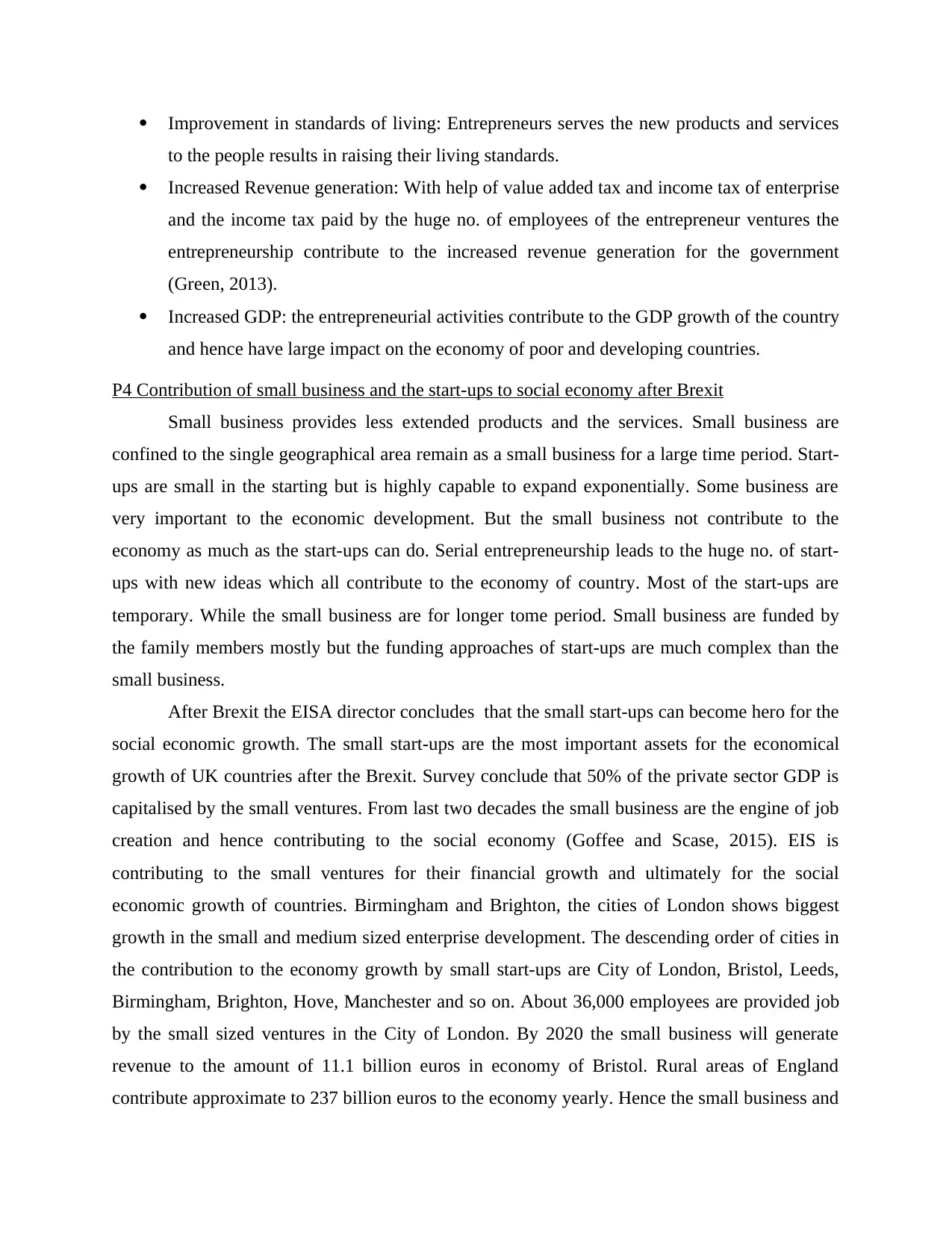
Improvement in standards of living: Entrepreneurs serves the new products and services
to the people results in raising their living standards.
Increased Revenue generation: With help of value added tax and income tax of enterprise
and the income tax paid by the huge no. of employees of the entrepreneur ventures the
entrepreneurship contribute to the increased revenue generation for the government
(Green, 2013).
Increased GDP: the entrepreneurial activities contribute to the GDP growth of the country
and hence have large impact on the economy of poor and developing countries.
P4 Contribution of small business and the start-ups to social economy after Brexit
Small business provides less extended products and the services. Small business are
confined to the single geographical area remain as a small business for a large time period. Start-
ups are small in the starting but is highly capable to expand exponentially. Some business are
very important to the economic development. But the small business not contribute to the
economy as much as the start-ups can do. Serial entrepreneurship leads to the huge no. of start-
ups with new ideas which all contribute to the economy of country. Most of the start-ups are
temporary. While the small business are for longer tome period. Small business are funded by
the family members mostly but the funding approaches of start-ups are much complex than the
small business.
After Brexit the EISA director concludes that the small start-ups can become hero for the
social economic growth. The small start-ups are the most important assets for the economical
growth of UK countries after the Brexit. Survey conclude that 50% of the private sector GDP is
capitalised by the small ventures. From last two decades the small business are the engine of job
creation and hence contributing to the social economy (Goffee and Scase, 2015). EIS is
contributing to the small ventures for their financial growth and ultimately for the social
economic growth of countries. Birmingham and Brighton, the cities of London shows biggest
growth in the small and medium sized enterprise development. The descending order of cities in
the contribution to the economy growth by small start-ups are City of London, Bristol, Leeds,
Birmingham, Brighton, Hove, Manchester and so on. About 36,000 employees are provided job
by the small sized ventures in the City of London. By 2020 the small business will generate
revenue to the amount of 11.1 billion euros in economy of Bristol. Rural areas of England
contribute approximate to 237 billion euros to the economy yearly. Hence the small business and
to the people results in raising their living standards.
Increased Revenue generation: With help of value added tax and income tax of enterprise
and the income tax paid by the huge no. of employees of the entrepreneur ventures the
entrepreneurship contribute to the increased revenue generation for the government
(Green, 2013).
Increased GDP: the entrepreneurial activities contribute to the GDP growth of the country
and hence have large impact on the economy of poor and developing countries.
P4 Contribution of small business and the start-ups to social economy after Brexit
Small business provides less extended products and the services. Small business are
confined to the single geographical area remain as a small business for a large time period. Start-
ups are small in the starting but is highly capable to expand exponentially. Some business are
very important to the economic development. But the small business not contribute to the
economy as much as the start-ups can do. Serial entrepreneurship leads to the huge no. of start-
ups with new ideas which all contribute to the economy of country. Most of the start-ups are
temporary. While the small business are for longer tome period. Small business are funded by
the family members mostly but the funding approaches of start-ups are much complex than the
small business.
After Brexit the EISA director concludes that the small start-ups can become hero for the
social economic growth. The small start-ups are the most important assets for the economical
growth of UK countries after the Brexit. Survey conclude that 50% of the private sector GDP is
capitalised by the small ventures. From last two decades the small business are the engine of job
creation and hence contributing to the social economy (Goffee and Scase, 2015). EIS is
contributing to the small ventures for their financial growth and ultimately for the social
economic growth of countries. Birmingham and Brighton, the cities of London shows biggest
growth in the small and medium sized enterprise development. The descending order of cities in
the contribution to the economy growth by small start-ups are City of London, Bristol, Leeds,
Birmingham, Brighton, Hove, Manchester and so on. About 36,000 employees are provided job
by the small sized ventures in the City of London. By 2020 the small business will generate
revenue to the amount of 11.1 billion euros in economy of Bristol. Rural areas of England
contribute approximate to 237 billion euros to the economy yearly. Hence the small business and
the venture start-ups will contribute to the countries economy to the large extent and leads to the
employment creation and the revenue generation for the country. Hence contribute in the
enhanced standard of living of the people and the purchasing capacity of the public (Mullins,,
2013).
P5 Skills and the motivational drives for the successful entrepreneur
Richard Branson and the Steve jobs are two successful entrepreneur. Richard is the
founder of the Virgin Unite the charitable group of Virgin group. He is the corporate
entrepreneur. Steve jobs if the founder of Apple (Mitchell, 2016). He is the serial entrepreneur
who continuously keep on going with new ideas. These entrepreneur shares some common
characteristics and traits. These traits are as follows:
Calculated Risk: These founders take a calculated risk for grab the future opportunities.
Learns from failure: The founder of Virgin group fails in many innovative ideas like
virgin vodka, virgin cola and he learns from the mistakes.
Set the bigger picture: Steve jobs always sees an bigger and huge growth in their ideas
and be with the ideas with confidence and become successful entrepreneur.
Effective communication: Steve jobs were very efficient in communicating their ideas to
the customers and to their employees.
Determination: To be a successful entrepreneur the high level of determination is
required. Both Richard and the Steve are detriment to their work (Loader, 2015).
Competitive: Entrepreneur have high amount of motivation and they knows that they can
do better than other competitors. Steve jobs says that he knows that he is best in the
market so he can charge his services at desired charges.
Creativity: The creativity trait of an entrepreneur leads to the success of enterprise.
Richard was very much creative in their ideas.
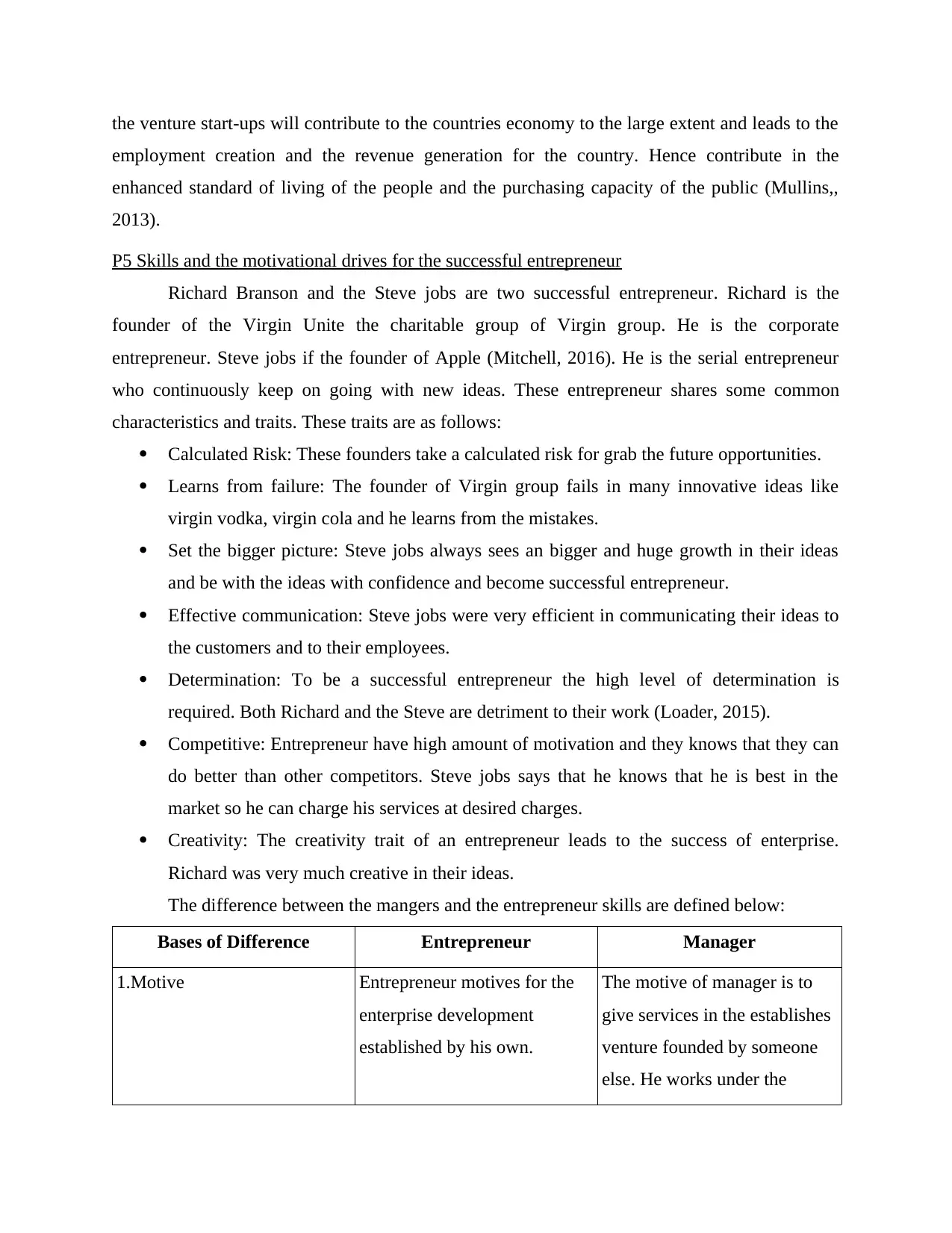
The difference between the mangers and the entrepreneur skills are defined below:
Bases of Difference Entrepreneur Manager
1.Motive Entrepreneur motives for the
enterprise development
established by his own.
The motive of manager is to
give services in the establishes
venture founded by someone
else. He works under the
employment creation and the revenue generation for the country. Hence contribute in the
enhanced standard of living of the people and the purchasing capacity of the public (Mullins,,
2013).
P5 Skills and the motivational drives for the successful entrepreneur
Richard Branson and the Steve jobs are two successful entrepreneur. Richard is the
founder of the Virgin Unite the charitable group of Virgin group. He is the corporate
entrepreneur. Steve jobs if the founder of Apple (Mitchell, 2016). He is the serial entrepreneur
who continuously keep on going with new ideas. These entrepreneur shares some common
characteristics and traits. These traits are as follows:
Calculated Risk: These founders take a calculated risk for grab the future opportunities.
Learns from failure: The founder of Virgin group fails in many innovative ideas like
virgin vodka, virgin cola and he learns from the mistakes.
Set the bigger picture: Steve jobs always sees an bigger and huge growth in their ideas
and be with the ideas with confidence and become successful entrepreneur.
Effective communication: Steve jobs were very efficient in communicating their ideas to
the customers and to their employees.
Determination: To be a successful entrepreneur the high level of determination is
required. Both Richard and the Steve are detriment to their work (Loader, 2015).
Competitive: Entrepreneur have high amount of motivation and they knows that they can
do better than other competitors. Steve jobs says that he knows that he is best in the
market so he can charge his services at desired charges.
Creativity: The creativity trait of an entrepreneur leads to the success of enterprise.
Richard was very much creative in their ideas.
The difference between the mangers and the entrepreneur skills are defined below:
Bases of Difference Entrepreneur Manager
1.Motive Entrepreneur motives for the
enterprise development
established by his own.
The motive of manager is to
give services in the establishes
venture founded by someone
else. He works under the
⊘ This is a preview!⊘
Do you want full access?
Subscribe today to unlock all pages.
Trusted by 1+ million students worldwide
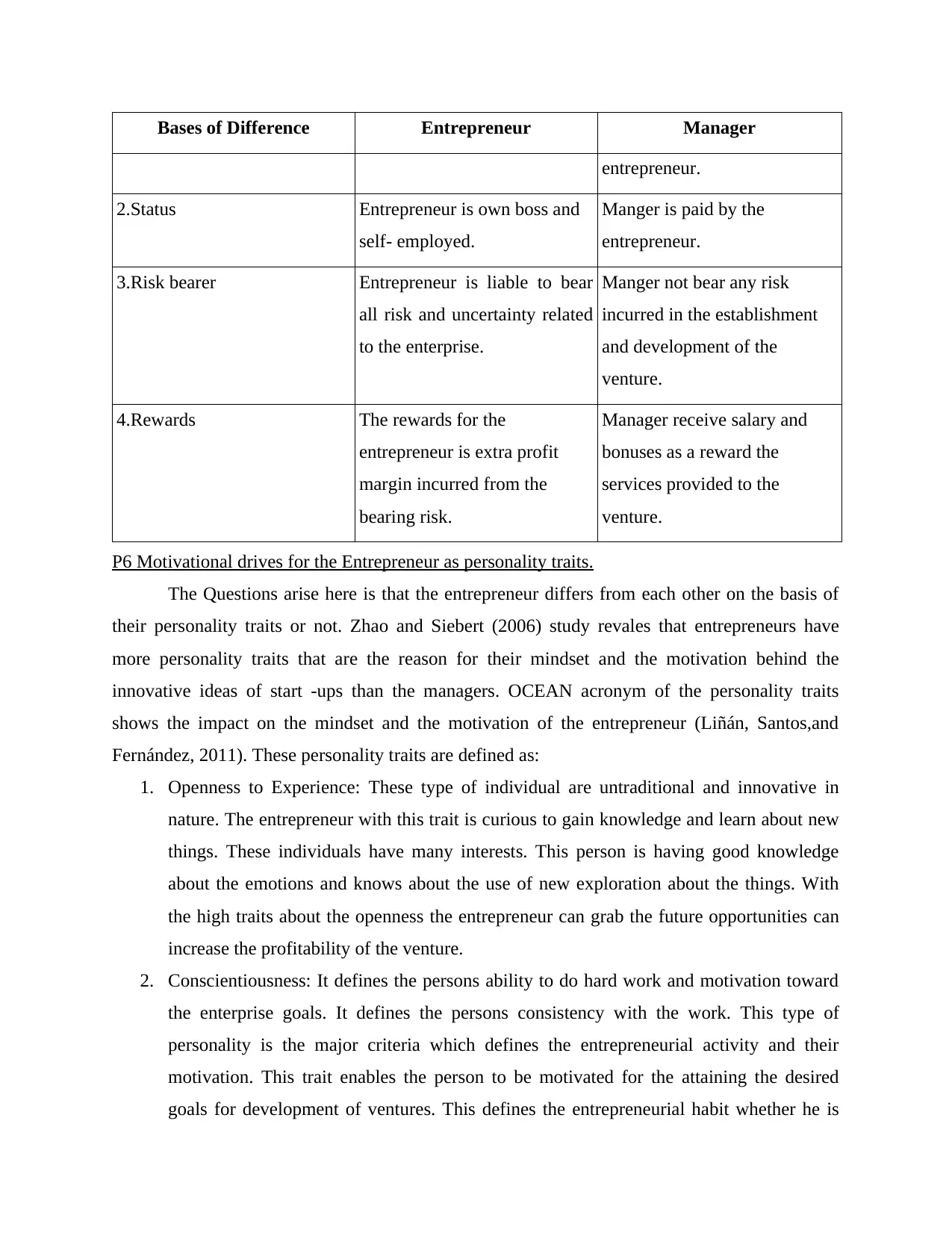
Bases of Difference Entrepreneur Manager
entrepreneur.
2.Status Entrepreneur is own boss and
self- employed.
Manger is paid by the
entrepreneur.
3.Risk bearer Entrepreneur is liable to bear
all risk and uncertainty related
to the enterprise.
Manger not bear any risk
incurred in the establishment
and development of the
venture.
4.Rewards The rewards for the
entrepreneur is extra profit
margin incurred from the
bearing risk.
Manager receive salary and
bonuses as a reward the
services provided to the
venture.
P6 Motivational drives for the Entrepreneur as personality traits.
The Questions arise here is that the entrepreneur differs from each other on the basis of
their personality traits or not. Zhao and Siebert (2006) study revales that entrepreneurs have
more personality traits that are the reason for their mindset and the motivation behind the
innovative ideas of start -ups than the managers. OCEAN acronym of the personality traits
shows the impact on the mindset and the motivation of the entrepreneur (Liñán, Santos,and
Fernández, 2011). These personality traits are defined as:
1. Openness to Experience: These type of individual are untraditional and innovative in
nature. The entrepreneur with this trait is curious to gain knowledge and learn about new
things. These individuals have many interests. This person is having good knowledge
about the emotions and knows about the use of new exploration about the things. With
the high traits about the openness the entrepreneur can grab the future opportunities can
increase the profitability of the venture.
2. Conscientiousness: It defines the persons ability to do hard work and motivation toward
the enterprise goals. It defines the persons consistency with the work. This type of
personality is the major criteria which defines the entrepreneurial activity and their
motivation. This trait enables the person to be motivated for the attaining the desired
goals for development of ventures. This defines the entrepreneurial habit whether he is
entrepreneur.
2.Status Entrepreneur is own boss and
self- employed.
Manger is paid by the
entrepreneur.
3.Risk bearer Entrepreneur is liable to bear
all risk and uncertainty related
to the enterprise.
Manger not bear any risk
incurred in the establishment
and development of the
venture.
4.Rewards The rewards for the
entrepreneur is extra profit
margin incurred from the
bearing risk.
Manager receive salary and
bonuses as a reward the
services provided to the
venture.
P6 Motivational drives for the Entrepreneur as personality traits.
The Questions arise here is that the entrepreneur differs from each other on the basis of
their personality traits or not. Zhao and Siebert (2006) study revales that entrepreneurs have
more personality traits that are the reason for their mindset and the motivation behind the
innovative ideas of start -ups than the managers. OCEAN acronym of the personality traits
shows the impact on the mindset and the motivation of the entrepreneur (Liñán, Santos,and
Fernández, 2011). These personality traits are defined as:
1. Openness to Experience: These type of individual are untraditional and innovative in
nature. The entrepreneur with this trait is curious to gain knowledge and learn about new
things. These individuals have many interests. This person is having good knowledge
about the emotions and knows about the use of new exploration about the things. With
the high traits about the openness the entrepreneur can grab the future opportunities can
increase the profitability of the venture.
2. Conscientiousness: It defines the persons ability to do hard work and motivation toward
the enterprise goals. It defines the persons consistency with the work. This type of
personality is the major criteria which defines the entrepreneurial activity and their
motivation. This trait enables the person to be motivated for the attaining the desired
goals for development of ventures. This defines the entrepreneurial habit whether he is
Paraphrase This Document
Need a fresh take? Get an instant paraphrase of this document with our AI Paraphraser
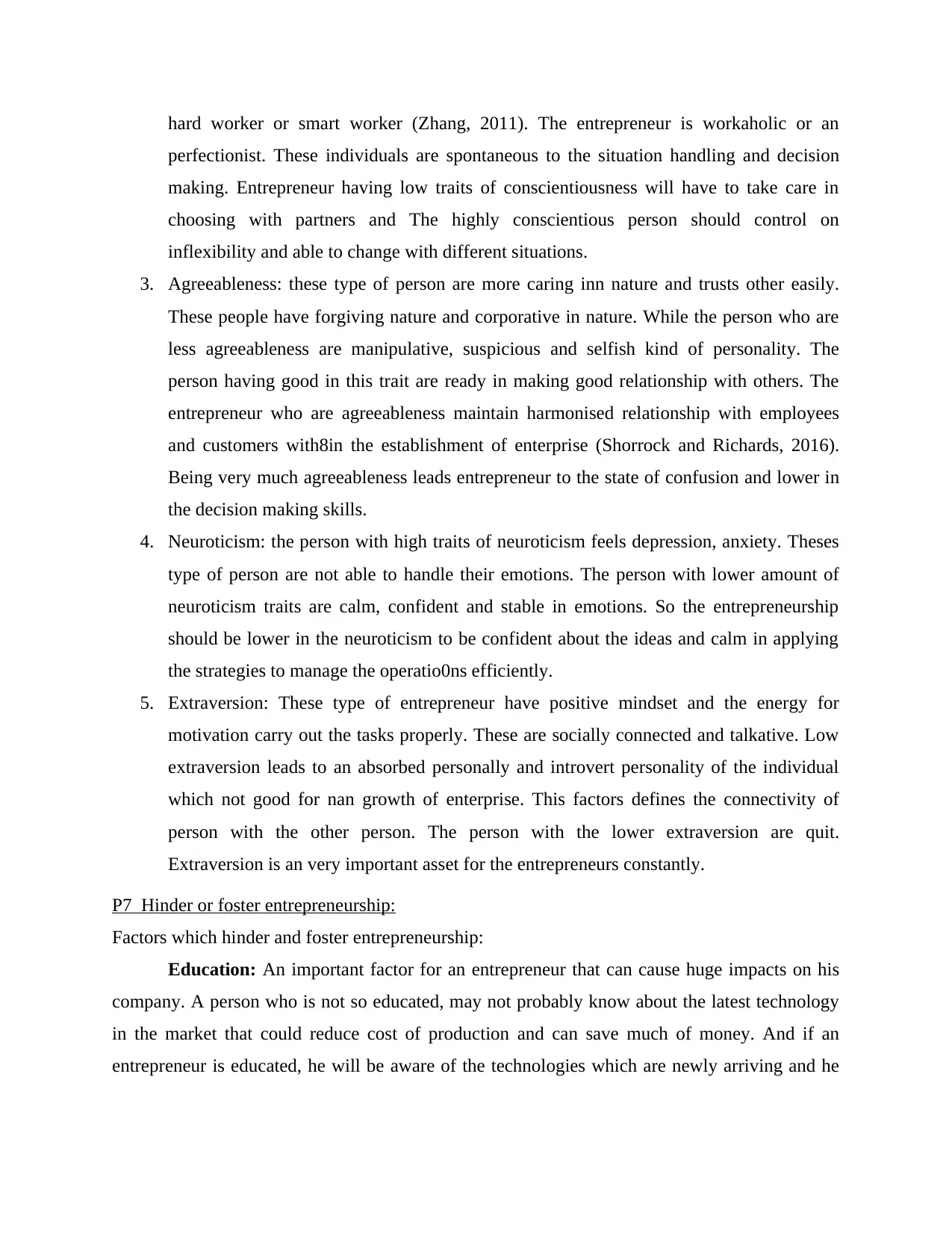
hard worker or smart worker (Zhang, 2011). The entrepreneur is workaholic or an
perfectionist. These individuals are spontaneous to the situation handling and decision
making. Entrepreneur having low traits of conscientiousness will have to take care in
choosing with partners and The highly conscientious person should control on
inflexibility and able to change with different situations.
3. Agreeableness: these type of person are more caring inn nature and trusts other easily.
These people have forgiving nature and corporative in nature. While the person who are
less agreeableness are manipulative, suspicious and selfish kind of personality. The
person having good in this trait are ready in making good relationship with others. The
entrepreneur who are agreeableness maintain harmonised relationship with employees
and customers with8in the establishment of enterprise (Shorrock and Richards, 2016).
Being very much agreeableness leads entrepreneur to the state of confusion and lower in
the decision making skills.
4. Neuroticism: the person with high traits of neuroticism feels depression, anxiety. Theses
type of person are not able to handle their emotions. The person with lower amount of
neuroticism traits are calm, confident and stable in emotions. So the entrepreneurship
should be lower in the neuroticism to be confident about the ideas and calm in applying
the strategies to manage the operatio0ns efficiently.
5. Extraversion: These type of entrepreneur have positive mindset and the energy for
motivation carry out the tasks properly. These are socially connected and talkative. Low
extraversion leads to an absorbed personally and introvert personality of the individual
which not good for nan growth of enterprise. This factors defines the connectivity of
person with the other person. The person with the lower extraversion are quit.
Extraversion is an very important asset for the entrepreneurs constantly.
P7 Hinder or foster entrepreneurship:
Factors which hinder and foster entrepreneurship:
Education: An important factor for an entrepreneur that can cause huge impacts on his
company. A person who is not so educated, may not probably know about the latest technology
in the market that could reduce cost of production and can save much of money. And if an
entrepreneur is educated, he will be aware of the technologies which are newly arriving and he
perfectionist. These individuals are spontaneous to the situation handling and decision
making. Entrepreneur having low traits of conscientiousness will have to take care in
choosing with partners and The highly conscientious person should control on
inflexibility and able to change with different situations.
3. Agreeableness: these type of person are more caring inn nature and trusts other easily.
These people have forgiving nature and corporative in nature. While the person who are
less agreeableness are manipulative, suspicious and selfish kind of personality. The
person having good in this trait are ready in making good relationship with others. The
entrepreneur who are agreeableness maintain harmonised relationship with employees
and customers with8in the establishment of enterprise (Shorrock and Richards, 2016).
Being very much agreeableness leads entrepreneur to the state of confusion and lower in
the decision making skills.
4. Neuroticism: the person with high traits of neuroticism feels depression, anxiety. Theses
type of person are not able to handle their emotions. The person with lower amount of
neuroticism traits are calm, confident and stable in emotions. So the entrepreneurship
should be lower in the neuroticism to be confident about the ideas and calm in applying
the strategies to manage the operatio0ns efficiently.
5. Extraversion: These type of entrepreneur have positive mindset and the energy for
motivation carry out the tasks properly. These are socially connected and talkative. Low
extraversion leads to an absorbed personally and introvert personality of the individual
which not good for nan growth of enterprise. This factors defines the connectivity of
person with the other person. The person with the lower extraversion are quit.
Extraversion is an very important asset for the entrepreneurs constantly.
P7 Hinder or foster entrepreneurship:
Factors which hinder and foster entrepreneurship:
Education: An important factor for an entrepreneur that can cause huge impacts on his
company. A person who is not so educated, may not probably know about the latest technology
in the market that could reduce cost of production and can save much of money. And if an
entrepreneur is educated, he will be aware of the technologies which are newly arriving and he
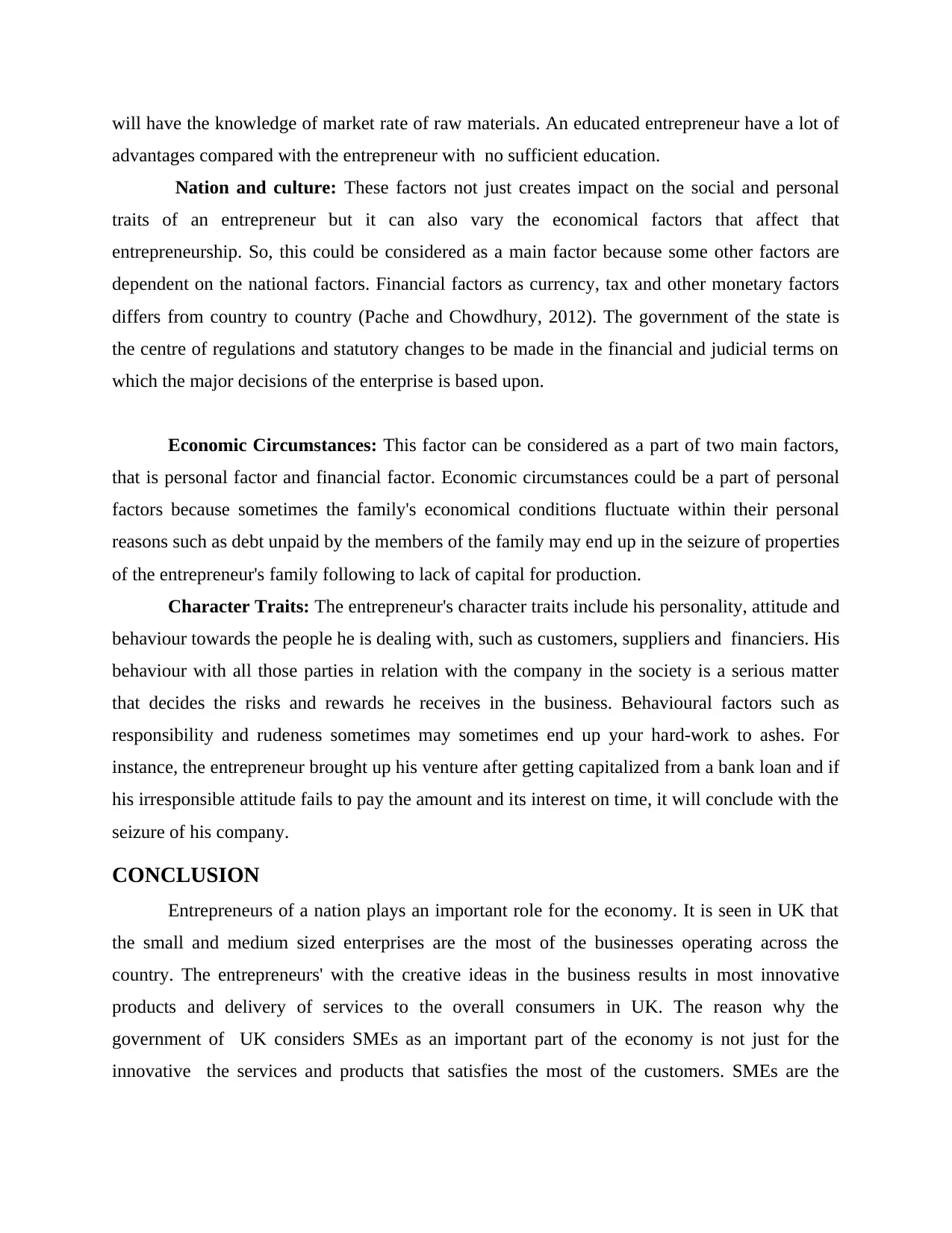
will have the knowledge of market rate of raw materials. An educated entrepreneur have a lot of
advantages compared with the entrepreneur with no sufficient education.
Nation and culture: These factors not just creates impact on the social and personal
traits of an entrepreneur but it can also vary the economical factors that affect that
entrepreneurship. So, this could be considered as a main factor because some other factors are
dependent on the national factors. Financial factors as currency, tax and other monetary factors
differs from country to country (Pache and Chowdhury, 2012). The government of the state is
the centre of regulations and statutory changes to be made in the financial and judicial terms on
which the major decisions of the enterprise is based upon.
Economic Circumstances: This factor can be considered as a part of two main factors,
that is personal factor and financial factor. Economic circumstances could be a part of personal
factors because sometimes the family's economical conditions fluctuate within their personal
reasons such as debt unpaid by the members of the family may end up in the seizure of properties
of the entrepreneur's family following to lack of capital for production.
Character Traits: The entrepreneur's character traits include his personality, attitude and
behaviour towards the people he is dealing with, such as customers, suppliers and financiers. His
behaviour with all those parties in relation with the company in the society is a serious matter
that decides the risks and rewards he receives in the business. Behavioural factors such as
responsibility and rudeness sometimes may sometimes end up your hard-work to ashes. For
instance, the entrepreneur brought up his venture after getting capitalized from a bank loan and if
his irresponsible attitude fails to pay the amount and its interest on time, it will conclude with the
seizure of his company.
CONCLUSION
Entrepreneurs of a nation plays an important role for the economy. It is seen in UK that
the small and medium sized enterprises are the most of the businesses operating across the
country. The entrepreneurs' with the creative ideas in the business results in most innovative
products and delivery of services to the overall consumers in UK. The reason why the
government of UK considers SMEs as an important part of the economy is not just for the
innovative the services and products that satisfies the most of the customers. SMEs are the
advantages compared with the entrepreneur with no sufficient education.
Nation and culture: These factors not just creates impact on the social and personal
traits of an entrepreneur but it can also vary the economical factors that affect that
entrepreneurship. So, this could be considered as a main factor because some other factors are
dependent on the national factors. Financial factors as currency, tax and other monetary factors
differs from country to country (Pache and Chowdhury, 2012). The government of the state is
the centre of regulations and statutory changes to be made in the financial and judicial terms on
which the major decisions of the enterprise is based upon.
Economic Circumstances: This factor can be considered as a part of two main factors,
that is personal factor and financial factor. Economic circumstances could be a part of personal
factors because sometimes the family's economical conditions fluctuate within their personal
reasons such as debt unpaid by the members of the family may end up in the seizure of properties
of the entrepreneur's family following to lack of capital for production.
Character Traits: The entrepreneur's character traits include his personality, attitude and
behaviour towards the people he is dealing with, such as customers, suppliers and financiers. His
behaviour with all those parties in relation with the company in the society is a serious matter
that decides the risks and rewards he receives in the business. Behavioural factors such as
responsibility and rudeness sometimes may sometimes end up your hard-work to ashes. For
instance, the entrepreneur brought up his venture after getting capitalized from a bank loan and if
his irresponsible attitude fails to pay the amount and its interest on time, it will conclude with the
seizure of his company.
CONCLUSION
Entrepreneurs of a nation plays an important role for the economy. It is seen in UK that
the small and medium sized enterprises are the most of the businesses operating across the
country. The entrepreneurs' with the creative ideas in the business results in most innovative
products and delivery of services to the overall consumers in UK. The reason why the
government of UK considers SMEs as an important part of the economy is not just for the
innovative the services and products that satisfies the most of the customers. SMEs are the
⊘ This is a preview!⊘
Do you want full access?
Subscribe today to unlock all pages.
Trusted by 1+ million students worldwide

1 out of 14


Related Documents


Your All-in-One AI-Powered Toolkit for Academic Success.
+13062052269
info@desklib.com
Available 24*7 on WhatsApp / Email
![[object Object]](/_next/static/media/star-bottom.7253800d.svg)
Unlock your academic potential
Copyright © 2020–2026 A2Z Services. All Rights Reserved. Developed and managed by ZUCOL.