Entrepreneurship: Small Business Management and Economic Impact
VerifiedAdded on 2023/01/19
|10
|3219
|58
Report
AI Summary
This report delves into the realm of entrepreneurship and small business management, exploring the dynamics of entrepreneurial ventures and their impact on the economy. It begins by defining entrepreneurship and the skills required for success, then differentiates between high-growth, middle, and small entrepreneurship ventures, highlighting their objectives, scope, and similarities. The report further analyzes the significant contributions of small businesses to the economy, including job creation, revenue generation, and their role in the social economy. It also identifies key characteristics of successful entrepreneurs, such as time management, strategic thinking, and communication skills, along with the importance of creativity, motivation, and passion. Finally, the report examines how background and experience can influence entrepreneurial success. The document is a comprehensive analysis of entrepreneurship, small business management, and their effects on the economy, which is a crucial area for economic growth.
ENTREPRENEURSHIP SMALL
BUSINESS MANAGEMENT
BUSINESS MANAGEMENT

Paraphrase This Document
Need a fresh take? Get an instant paraphrase of this document with our AI Paraphraser
INTRODUCTION
Entrepreneurs always try to grow their business and use new ideas to gain success in market.
In the highly competitive environment it is difficult for the owner to set up new business and
manage it. But they have great risk taking abilities which encourage them to take risk and gain
new opportunities in market (Jibir and et.al., 2018). To provide good platform to people, small
businesses recruits them for the development of their businesses. An entrepreneurial skills are
always in demand by both the small and big companies. They need innovative thinking and best
ideas for the growth of their businesses. The entrepreneurship is a way to set up the businesses
by taking many risks such as financial risks, market risks, or managerial risks. There are different
kinds of entrepreneurship ventures which effects the businesses of the entrepreneurs. Study will
explain skill of entrepreneurs which make them successful. It will also evaluate impact of
background and experience on success of entrepreneurship.
MAIN BODY
Entrepreneurial ventures and typologies
High Growth Entrepreneurship
In high growth entrepreneurship, major focus of these companies are on growth of sales.
purpose of such entrepreneurship is maximization of profit. There are many big companies that
are performing well in market and ensuring to gain success by sustaining in market for longer
duration. (Dennis Jr, 2017). These enterprises implement serial typologies which help them to
bring with innovative ideas so that they can get success in the market and can satisfy needs of
wide range of consumers.
Middle Entrepreneurship
In middle entrepreneurship major focus of firm in managing large production projects.
entrepreneurs do not take risk but they ensure using all the resources provided to them. Generally
they deals with the government projects. The purpose of the middle entrepreneurs is building
good image in market (Mamabolo, Kerrin and Kele, 2017). social typology is used by such
company that focus on working for people so that they make loyal. As the middle entrepreneur
works for the governments projects, the government provides all the projects which are related to
the environmental issues. companies such as corporate banks, are example of it.
Small Entrepreneurship
Entrepreneurs always try to grow their business and use new ideas to gain success in market.
In the highly competitive environment it is difficult for the owner to set up new business and
manage it. But they have great risk taking abilities which encourage them to take risk and gain
new opportunities in market (Jibir and et.al., 2018). To provide good platform to people, small
businesses recruits them for the development of their businesses. An entrepreneurial skills are
always in demand by both the small and big companies. They need innovative thinking and best
ideas for the growth of their businesses. The entrepreneurship is a way to set up the businesses
by taking many risks such as financial risks, market risks, or managerial risks. There are different
kinds of entrepreneurship ventures which effects the businesses of the entrepreneurs. Study will
explain skill of entrepreneurs which make them successful. It will also evaluate impact of
background and experience on success of entrepreneurship.
MAIN BODY
Entrepreneurial ventures and typologies
High Growth Entrepreneurship
In high growth entrepreneurship, major focus of these companies are on growth of sales.
purpose of such entrepreneurship is maximization of profit. There are many big companies that
are performing well in market and ensuring to gain success by sustaining in market for longer
duration. (Dennis Jr, 2017). These enterprises implement serial typologies which help them to
bring with innovative ideas so that they can get success in the market and can satisfy needs of
wide range of consumers.
Middle Entrepreneurship
In middle entrepreneurship major focus of firm in managing large production projects.
entrepreneurs do not take risk but they ensure using all the resources provided to them. Generally
they deals with the government projects. The purpose of the middle entrepreneurs is building
good image in market (Mamabolo, Kerrin and Kele, 2017). social typology is used by such
company that focus on working for people so that they make loyal. As the middle entrepreneur
works for the governments projects, the government provides all the projects which are related to
the environmental issues. companies such as corporate banks, are example of it.
Small Entrepreneurship
⊘ This is a preview!⊘
Do you want full access?
Subscribe today to unlock all pages.

Trusted by 1+ million students worldwide
Such entrepreneurship the major focus on satisfying needs and wants of customer. These
entrepreneurs wants their products and services are familiar with consumers. reason behind this
is that if the product will not be know by the customers, then how the demand met (Jones and
et.al., 2018). female entrepreneurship typology is used by such companies because in this the
female employees who wants employment for themselves will get a chance to show their talent
here.
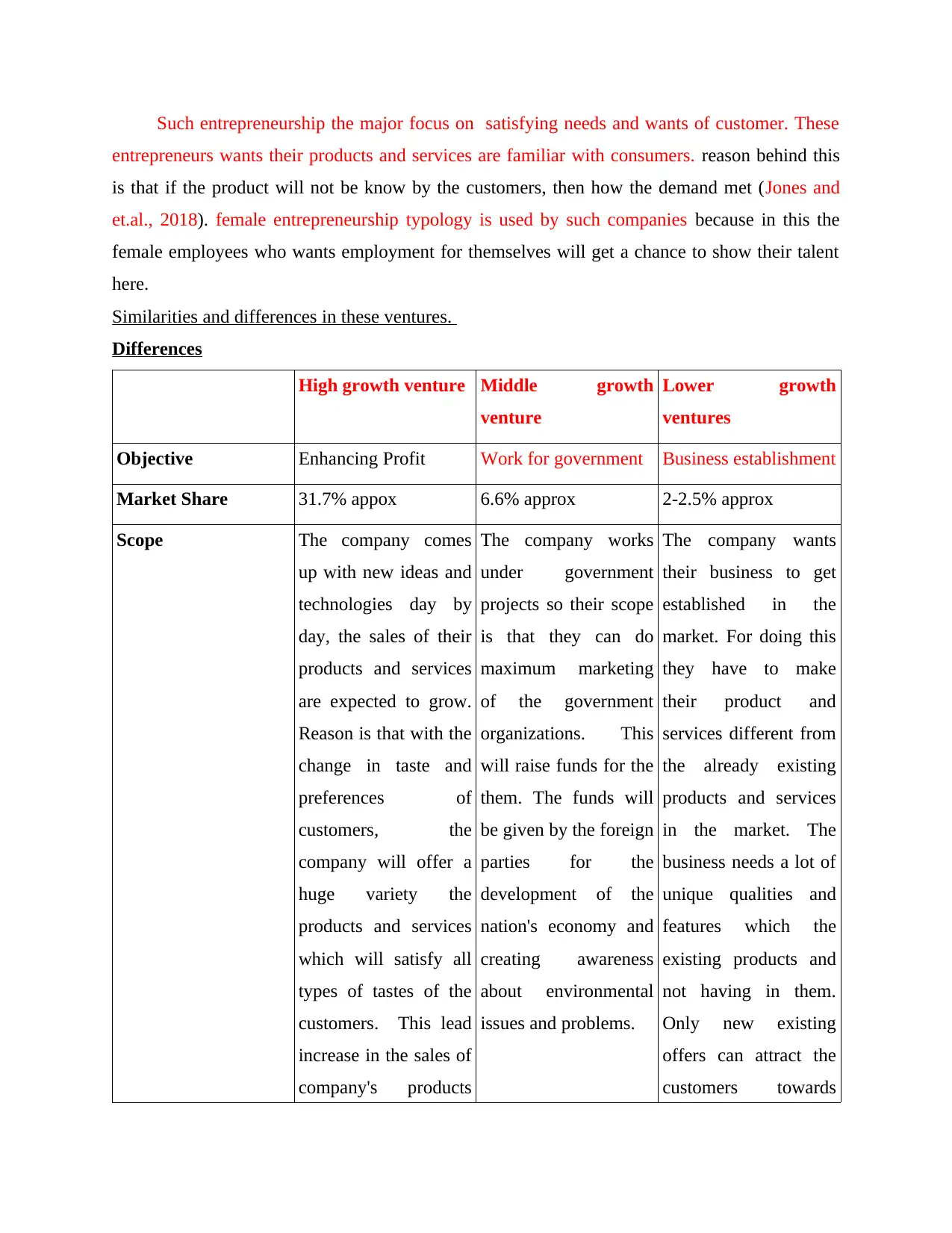
Similarities and differences in these ventures.
Differences
High growth venture Middle growth
venture
Lower growth
ventures
Objective Enhancing Profit Work for government Business establishment
Market Share 31.7% appox 6.6% approx 2-2.5% approx
Scope The company comes
up with new ideas and
technologies day by
day, the sales of their
products and services
are expected to grow.
Reason is that with the
change in taste and
preferences of
customers, the
company will offer a
huge variety the
products and services
which will satisfy all
types of tastes of the
customers. This lead
increase in the sales of
company's products
The company works
under government
projects so their scope
is that they can do
maximum marketing
of the government
organizations. This
will raise funds for the
them. The funds will
be given by the foreign
parties for the
development of the
nation's economy and
creating awareness
about environmental
issues and problems.
The company wants
their business to get
established in the
market. For doing this
they have to make
their product and
services different from
the already existing
products and services
in the market. The
business needs a lot of
unique qualities and
features which the
existing products and
not having in them.
Only new existing
offers can attract the
customers towards
entrepreneurs wants their products and services are familiar with consumers. reason behind this
is that if the product will not be know by the customers, then how the demand met (Jones and
et.al., 2018). female entrepreneurship typology is used by such companies because in this the
female employees who wants employment for themselves will get a chance to show their talent
here.
Similarities and differences in these ventures.
Differences
High growth venture Middle growth
venture
Lower growth
ventures
Objective Enhancing Profit Work for government Business establishment
Market Share 31.7% appox 6.6% approx 2-2.5% approx
Scope The company comes
up with new ideas and
technologies day by
day, the sales of their
products and services
are expected to grow.
Reason is that with the
change in taste and
preferences of
customers, the
company will offer a
huge variety the
products and services
which will satisfy all
types of tastes of the
customers. This lead
increase in the sales of
company's products
The company works
under government
projects so their scope
is that they can do
maximum marketing
of the government
organizations. This
will raise funds for the
them. The funds will
be given by the foreign
parties for the
development of the
nation's economy and
creating awareness
about environmental
issues and problems.
The company wants
their business to get
established in the
market. For doing this
they have to make
their product and
services different from
the already existing
products and services
in the market. The
business needs a lot of
unique qualities and
features which the
existing products and
not having in them.
Only new existing
offers can attract the
customers towards
Paraphrase This Document
Need a fresh take? Get an instant paraphrase of this document with our AI Paraphraser
and profits. them.s
Similarities
All the three entrepreneur ventures wants the increase companies wealth.
All the entrepreneur ventures wants to increase their market share.
All of them wants their organization to make an identity.
All of them wants funds from the foreign countries.
They do not have adequate in house resources.
All of these entrepreneur ventures have large competition in the market.
All entrepreneur ventures needs talented candidates in their organization.
All entrepreneur ventures wants their business to get expand in the world.
All of them wants to recruit more and more employees for their organizations,
Impact of small business on economy
There are many small companies that are running in market, though they are facing huge
difficulties towards sustainability but still they have capability to contribute well in economic
development of nation (Tsvetkova and Partridge, 2019). 30.2 million small businesses are
running in the market. The service industries accounts for 8.58 million out of 30.2 million small
business. The services provided to them are professional, technical, scientific etc. The public
administration are not included into it. In the year 2015, micro business provided 1.9 million job
opportunities. There are 70% contribution of micro business to economy (Kuratko and Morris,
2018). In 2015, annual payroll of micro businesses is around 2.5 trillion dollars that has covered
almost 40.7% of annual payroll. (Audretsch and et.al., 2020).
One of the major contribution of these business to UK economy is to generate
employment. There are many big firms that hire people by looking at their experience but they
do not recruit fresher’s. But small business hires such new comers so that they can get some
experience and money as well. Hence these small companies are offering income sources of
large number of audience which helps in improving GDP condition of nation. Small business can
get employees around 250 or less than these. But they have capability to generate huge profit.in
the year 2018 small and micro business have contributed well by generating 2.0 trillion turnovers
in UK. There are many private business that have covered 52% market which is very high.
Profit generated by these firms are able to contribute well in improving economic condition of
Similarities
All the three entrepreneur ventures wants the increase companies wealth.
All the entrepreneur ventures wants to increase their market share.
All of them wants their organization to make an identity.
All of them wants funds from the foreign countries.
They do not have adequate in house resources.
All of these entrepreneur ventures have large competition in the market.
All entrepreneur ventures needs talented candidates in their organization.
All entrepreneur ventures wants their business to get expand in the world.
All of them wants to recruit more and more employees for their organizations,
Impact of small business on economy
There are many small companies that are running in market, though they are facing huge
difficulties towards sustainability but still they have capability to contribute well in economic
development of nation (Tsvetkova and Partridge, 2019). 30.2 million small businesses are
running in the market. The service industries accounts for 8.58 million out of 30.2 million small
business. The services provided to them are professional, technical, scientific etc. The public
administration are not included into it. In the year 2015, micro business provided 1.9 million job
opportunities. There are 70% contribution of micro business to economy (Kuratko and Morris,
2018). In 2015, annual payroll of micro businesses is around 2.5 trillion dollars that has covered
almost 40.7% of annual payroll. (Audretsch and et.al., 2020).
One of the major contribution of these business to UK economy is to generate
employment. There are many big firms that hire people by looking at their experience but they
do not recruit fresher’s. But small business hires such new comers so that they can get some
experience and money as well. Hence these small companies are offering income sources of
large number of audience which helps in improving GDP condition of nation. Small business can
get employees around 250 or less than these. But they have capability to generate huge profit.in
the year 2018 small and micro business have contributed well by generating 2.0 trillion turnovers
in UK. There are many private business that have covered 52% market which is very high.
Profit generated by these firms are able to contribute well in improving economic condition of
United Kingdom. Statistical figures of 2018 reflects that 16.3 million people have got job
opportunities in such small business and private companies that means there is high contribution
of such micro firms to the UK economy. In the year 2018 there was 5.8 million such kind of
small business which was 3.5% high compare to last year.
Small business to social economy
The small businesses and start up businesses plays ,major role in the growth of this social
economy. The small business provides employment to the local workers in their firms. The local
workers who generally do not have any kind of work experience or who are new in their jobs and
when activities are delegated to them, they usually can have opportunity to enhance their
knowledge and skills. These organizations provides salaries and wages to these workers. The
small businesses gives an opportunity to the talented workers who generally are not recruited by
the big organizations(Belitski and Heron, 2017). This opportunity helps those talented candidates
to showcase their talent in the organisation and get a certificate of work experience from these
small businesses. This helps them a lot in near future. If they wants to join a big organization,
this certificate will have a lot importance in building their careers. The small businesses always
takes initiative to promote social economy(Ganbaatar and Douglas, 2019). These promotions are
done by participating in the social activities as well as corporate social responsibilities. The small
businesses makes their identity within market by participating in such activities. This helps
social economies within promotion of initiatives taken by them and these small business also
gets a chance to do marketing of their businesses. The small business easily adopts the changing
climates of the economy very quickly. The reason behind this is that these businesses are
customer oriented businesses who understands the needs of their customer and community(Yan
and Yan, 2017). There are many local customers who remains loyal with these small businesses.
The economic crises don't effect the taste and preferences of these customers. These are the small
start up companies with less amount of capital invested in it. So when the economic climate
changes, these companies can easily change their policies and procedures according to the
changes made in economy. All the big organisations cannot do this because they have many
policies and procedures which cannot be changed with the change in economies. The small
businesses do not always stay small for long. If these businesses generally gets well-through
supports of the local governments, that can help in the expansion their businesses. The social
economy plays a major role in this helping these small businesses(Al-shami and et.al., 2019).
opportunities in such small business and private companies that means there is high contribution
of such micro firms to the UK economy. In the year 2018 there was 5.8 million such kind of
small business which was 3.5% high compare to last year.
Small business to social economy
The small businesses and start up businesses plays ,major role in the growth of this social
economy. The small business provides employment to the local workers in their firms. The local
workers who generally do not have any kind of work experience or who are new in their jobs and
when activities are delegated to them, they usually can have opportunity to enhance their
knowledge and skills. These organizations provides salaries and wages to these workers. The
small businesses gives an opportunity to the talented workers who generally are not recruited by
the big organizations(Belitski and Heron, 2017). This opportunity helps those talented candidates
to showcase their talent in the organisation and get a certificate of work experience from these
small businesses. This helps them a lot in near future. If they wants to join a big organization,
this certificate will have a lot importance in building their careers. The small businesses always
takes initiative to promote social economy(Ganbaatar and Douglas, 2019). These promotions are
done by participating in the social activities as well as corporate social responsibilities. The small
businesses makes their identity within market by participating in such activities. This helps
social economies within promotion of initiatives taken by them and these small business also
gets a chance to do marketing of their businesses. The small business easily adopts the changing
climates of the economy very quickly. The reason behind this is that these businesses are
customer oriented businesses who understands the needs of their customer and community(Yan
and Yan, 2017). There are many local customers who remains loyal with these small businesses.
The economic crises don't effect the taste and preferences of these customers. These are the small
start up companies with less amount of capital invested in it. So when the economic climate
changes, these companies can easily change their policies and procedures according to the
changes made in economy. All the big organisations cannot do this because they have many
policies and procedures which cannot be changed with the change in economies. The small
businesses do not always stay small for long. If these businesses generally gets well-through
supports of the local governments, that can help in the expansion their businesses. The social
economy plays a major role in this helping these small businesses(Al-shami and et.al., 2019).
⊘ This is a preview!⊘
Do you want full access?
Subscribe today to unlock all pages.
Trusted by 1+ million students worldwide
They mention the name of the small businesses who helped and motivated them in doing the
social environmental activities. The contribution made by the small businesses are highlighted by
the government which helps the small business to get expand.
characteristic of entrepreneurs
The successful entrepreneur have many skills which differentiates them from the other business
managers. The 5 major skills are as follows:
Time Management
All task and activities of business are mainly performed under specific amount of time allotted to
their employees. It is duty of the manager to assign the work according to the time allotted to
them by supervisors.
Strategic Thinking
Making strategies for reduction of problems which might arise in future. The mangers who
thinks for long term profit of the organization makes various strategies at very initial stage of
their career. These strategies are regarding the profit maximization and employee satisfaction in
the organization.
Efficiency
The successful businesses motivated their employees to increase their work efficiencies. The
employees recruited for these firms have high performance in the roles and duties provided to
them. The employees of these businesses are excellent in solving the problems quickly.
Branding
The branding of these businesses are actually advertised before customers who will need their
products(Schillo, Persaud and Jin, 2016). When the business becomes famous in the eyes of their
targeted customers, the start expanding their business into new vertices.
Communication
These businesses have very strong communication with their employees, customers and partners.
This helps them a lot in making the growth of business very fast. The reason is that if all the
employees will get connected with each other, the possibility is that miscommunication will
dominate and will increase.
Entrepreneurial personality show their mindset.
The entrepreneur personality reflects the entrepreneurial motivation and mindset in many ways:
Creativity
social environmental activities. The contribution made by the small businesses are highlighted by
the government which helps the small business to get expand.
characteristic of entrepreneurs
The successful entrepreneur have many skills which differentiates them from the other business
managers. The 5 major skills are as follows:
Time Management
All task and activities of business are mainly performed under specific amount of time allotted to
their employees. It is duty of the manager to assign the work according to the time allotted to
them by supervisors.
Strategic Thinking
Making strategies for reduction of problems which might arise in future. The mangers who
thinks for long term profit of the organization makes various strategies at very initial stage of
their career. These strategies are regarding the profit maximization and employee satisfaction in
the organization.
Efficiency
The successful businesses motivated their employees to increase their work efficiencies. The
employees recruited for these firms have high performance in the roles and duties provided to
them. The employees of these businesses are excellent in solving the problems quickly.
Branding
The branding of these businesses are actually advertised before customers who will need their
products(Schillo, Persaud and Jin, 2016). When the business becomes famous in the eyes of their
targeted customers, the start expanding their business into new vertices.
Communication
These businesses have very strong communication with their employees, customers and partners.
This helps them a lot in making the growth of business very fast. The reason is that if all the
employees will get connected with each other, the possibility is that miscommunication will
dominate and will increase.
Entrepreneurial personality show their mindset.
The entrepreneur personality reflects the entrepreneurial motivation and mindset in many ways:
Creativity
Paraphrase This Document
Need a fresh take? Get an instant paraphrase of this document with our AI Paraphraser
The entrepreneur needs to think out of the box. All the entrepreneurs gives the ideas, but the
successful entrepreneur gives those ideas which are unique and which can be implemented in
practical life. The processes of giving the ideas and implementing it in practical life is generally
regarded as creativity.
Motivation
The entrepreneurs do not have any managers to motivate them for their work. They are self
motivated persons who motivates other employees for the work. The entrepreneur should never
forgot their goals and ambitions which they wants to achieve. This will be the only way to keep
the entrepreneur motivated for their work.
Optimism
The has to be very optimistic with their goals. A proper strategies should be made to achieve
these goals. The entrepreneur should makes a clear vision which will help in getting success for
making their ideas possible in the market (Rushworth and et.al., 2016).
Passion
Entrepreneurs are never afraid from the hard work. They work very hard to achieve their goals.
This is their passion towards the work. A passionate entrepreneur never gives up on the
challenges they are facing. They stick with their passion and achieve success by completing their
goals on time.
Background and experience and its impact on entrepreneurship
The background and experience can hinder or foster entrepreneurship in the following ways:
Support from family
Every entrepreneur needs a big support from the families, friends and neighbors. If the family is
supporting the entrepreneur, then they can secure funds and finance from the parents. The family
can understand the needs of their child and they have believe on that they can surely get success
in future. The support of friends also helps a lot in getting the information about the competitors
who are already existing within market(Thrane and et.al., 2016). The support always increases
the motivation and risk taking abilities of the entrepreneur. The family support is also needed in
the case of failure of ideas of businesses in the market. If the family and friends supports the
entrepreneur during their hard times, then it will be easy for the entrepreneur's to get over from
the depression and will get motivated towards the recovery of the losses made by them.
Personal Experience
successful entrepreneur gives those ideas which are unique and which can be implemented in
practical life. The processes of giving the ideas and implementing it in practical life is generally
regarded as creativity.
Motivation
The entrepreneurs do not have any managers to motivate them for their work. They are self
motivated persons who motivates other employees for the work. The entrepreneur should never
forgot their goals and ambitions which they wants to achieve. This will be the only way to keep
the entrepreneur motivated for their work.
Optimism
The has to be very optimistic with their goals. A proper strategies should be made to achieve
these goals. The entrepreneur should makes a clear vision which will help in getting success for
making their ideas possible in the market (Rushworth and et.al., 2016).
Passion
Entrepreneurs are never afraid from the hard work. They work very hard to achieve their goals.
This is their passion towards the work. A passionate entrepreneur never gives up on the
challenges they are facing. They stick with their passion and achieve success by completing their
goals on time.
Background and experience and its impact on entrepreneurship
The background and experience can hinder or foster entrepreneurship in the following ways:
Support from family
Every entrepreneur needs a big support from the families, friends and neighbors. If the family is
supporting the entrepreneur, then they can secure funds and finance from the parents. The family
can understand the needs of their child and they have believe on that they can surely get success
in future. The support of friends also helps a lot in getting the information about the competitors
who are already existing within market(Thrane and et.al., 2016). The support always increases
the motivation and risk taking abilities of the entrepreneur. The family support is also needed in
the case of failure of ideas of businesses in the market. If the family and friends supports the
entrepreneur during their hard times, then it will be easy for the entrepreneur's to get over from
the depression and will get motivated towards the recovery of the losses made by them.
Personal Experience
The personal experience is mainly secured and get by the entrepreneur in many ways. Firstly, if
the entrepreneur is having a family businesses, then they have observed the problems and losses
of the business very closely. They already have an idea that what problems might arise in future
when they will be working hard on the goals. Second is entrepreneur who was working as an
employee in an organisation & had left their job to start their own business, they also carries a
major experience. They know all the needs and wants of employees who are working under an
organisation. These entrepreneur knows how to earn the maximum output from the workers who
are going to work in their organizations. They have to focus on the employee's work satisfaction
and what will help them to achieve their desired goals as well as motivates(Mamabolo, Kerrin
and Kele, 2017). There are many times when the employees are not motivated towards work
provided to them and there is insufficiency of team member or talented employees in the
organisations. At this time the entrepreneur have ton take major actions (Tsvetkova and
Partridge, 2019). A proper performance appraisal should be made to motivate the employees
towards the work. The recruitment process should based on the practical tasks and activities
given to the candidates who have applied for the job. The best performer should be getting the
opportunity to do work with the company. All these strategies are generally made by
entrepreneur while starting up of new business.
CONCLUSION
From the above study it can be concluded that companies are performing their job well and
contributing in economic development of nation. There are many business that have different
objectives. All these business support towards development of nation. Though these firms are
different from each other but there are some similarities as well such as all these ventures work
to generate profit and also implement innovative ideas. Small business has high contribution in
economic development of nation. Entrepreneurs are having good communication and problem
solving skill. They have capability to take risk which makes them different from other business
owner. They learn from their past experience and apply to their future activities that may them
able to gain success in market.
REFERENCES
Books and Journal
the entrepreneur is having a family businesses, then they have observed the problems and losses
of the business very closely. They already have an idea that what problems might arise in future
when they will be working hard on the goals. Second is entrepreneur who was working as an
employee in an organisation & had left their job to start their own business, they also carries a
major experience. They know all the needs and wants of employees who are working under an
organisation. These entrepreneur knows how to earn the maximum output from the workers who
are going to work in their organizations. They have to focus on the employee's work satisfaction
and what will help them to achieve their desired goals as well as motivates(Mamabolo, Kerrin
and Kele, 2017). There are many times when the employees are not motivated towards work
provided to them and there is insufficiency of team member or talented employees in the
organisations. At this time the entrepreneur have ton take major actions (Tsvetkova and
Partridge, 2019). A proper performance appraisal should be made to motivate the employees
towards the work. The recruitment process should based on the practical tasks and activities
given to the candidates who have applied for the job. The best performer should be getting the
opportunity to do work with the company. All these strategies are generally made by
entrepreneur while starting up of new business.
CONCLUSION
From the above study it can be concluded that companies are performing their job well and
contributing in economic development of nation. There are many business that have different
objectives. All these business support towards development of nation. Though these firms are
different from each other but there are some similarities as well such as all these ventures work
to generate profit and also implement innovative ideas. Small business has high contribution in
economic development of nation. Entrepreneurs are having good communication and problem
solving skill. They have capability to take risk which makes them different from other business
owner. They learn from their past experience and apply to their future activities that may them
able to gain success in market.
REFERENCES
Books and Journal
⊘ This is a preview!⊘
Do you want full access?
Subscribe today to unlock all pages.
Trusted by 1+ million students worldwide
Al-shami, S.S.A. and et.al., 2019. Women's entrepreneurs' micro and small business
performance: insights from Malaysian microcredit. International Journal of
Entrepreneurship and Small Business. 38(3). pp.312-338.
Audretsch, D.B. and et.al., 2020. Knowledge management and entrepreneurship. International
Entrepreneurship and Management Journal. pp.1-13.
Belitski, M. and Heron, K., 2017. Expanding entrepreneurship education ecosystems. Journal of
Management Development.
Dennis Jr, W., 2017. Research mimicking policy: Entrepreneurship/small business policy
research in the United States. The Blackwell handbook of entrepreneurship. pp.64-82.
Ganbaatar, B. and Douglas, E.J., 2019. Developing a Valid and Reliable Measure of Product
Innovativeness for Entrepreneurship Research. Journal of Small Business
Management. 57(sup2), pp.530-554.
Jibir, A. and et.al., 2018. Mediating the Effect of Working Capital on the Relationship between
Entrepreneurship Education and Small Business Management in Gombe State. 19th
Conference on Postgraduate Research, International Postgraduate Research Conference
2018, Faculty of Graduate Studies, University of Kelaniya, Sri Lanka.
Jones, R. and et.al., 2018. Entrepreneurial marketing in small enterprises. In The SAGE
handbook of small business and entrepreneurship (pp. 297-320). SAGE Publications Ltd.
Mamabolo, M.A., Kerrin, M. and Kele, T., 2017. Entrepreneurship management skills
requirements in an emerging economy: A South African outlook. The Southern African
Journal of Entrepreneurship and Small Business Management. 9(1). pp.1-10.
Rushworth, S. and et.al., 2016. Applying entrepreneurial action to explore entrepreneurship
pedagogy: The entrepreneurship education project. Journal of Business and
Entrepreneurship. 27(2). p.1.
Schillo, R.S., Persaud, A. and Jin, M., 2016. Entrepreneurial readiness in the context of national
systems of entrepreneurship. Small Business Economics. 46(4). pp.619-637.
Thrane, C. and et.al., 2016. The promise of entrepreneurship education: Reconceptualizing the
individual–opportunity nexus as a conceptual framework for entrepreneurship
education. International Small Business Journal. 34(7). pp.905-924.
Tsvetkova, A. and Partridge, M., 2019. Knowledge-based service economy and firm entry: an
alternative to the knowledge spillover theory of entrepreneurship. Small Business
Economics. pp.1-21.
Yan, J. and Yan, L., 2017. Collective entrepreneurship, environmental uncertainty and small
business performance: A contingent examination. The Journal of
Entrepreneurship. 26(1). pp.1-26.
performance: insights from Malaysian microcredit. International Journal of
Entrepreneurship and Small Business. 38(3). pp.312-338.
Audretsch, D.B. and et.al., 2020. Knowledge management and entrepreneurship. International
Entrepreneurship and Management Journal. pp.1-13.
Belitski, M. and Heron, K., 2017. Expanding entrepreneurship education ecosystems. Journal of
Management Development.
Dennis Jr, W., 2017. Research mimicking policy: Entrepreneurship/small business policy
research in the United States. The Blackwell handbook of entrepreneurship. pp.64-82.
Ganbaatar, B. and Douglas, E.J., 2019. Developing a Valid and Reliable Measure of Product
Innovativeness for Entrepreneurship Research. Journal of Small Business
Management. 57(sup2), pp.530-554.
Jibir, A. and et.al., 2018. Mediating the Effect of Working Capital on the Relationship between
Entrepreneurship Education and Small Business Management in Gombe State. 19th
Conference on Postgraduate Research, International Postgraduate Research Conference
2018, Faculty of Graduate Studies, University of Kelaniya, Sri Lanka.
Jones, R. and et.al., 2018. Entrepreneurial marketing in small enterprises. In The SAGE
handbook of small business and entrepreneurship (pp. 297-320). SAGE Publications Ltd.
Mamabolo, M.A., Kerrin, M. and Kele, T., 2017. Entrepreneurship management skills
requirements in an emerging economy: A South African outlook. The Southern African
Journal of Entrepreneurship and Small Business Management. 9(1). pp.1-10.
Rushworth, S. and et.al., 2016. Applying entrepreneurial action to explore entrepreneurship
pedagogy: The entrepreneurship education project. Journal of Business and
Entrepreneurship. 27(2). p.1.
Schillo, R.S., Persaud, A. and Jin, M., 2016. Entrepreneurial readiness in the context of national
systems of entrepreneurship. Small Business Economics. 46(4). pp.619-637.
Thrane, C. and et.al., 2016. The promise of entrepreneurship education: Reconceptualizing the
individual–opportunity nexus as a conceptual framework for entrepreneurship
education. International Small Business Journal. 34(7). pp.905-924.
Tsvetkova, A. and Partridge, M., 2019. Knowledge-based service economy and firm entry: an
alternative to the knowledge spillover theory of entrepreneurship. Small Business
Economics. pp.1-21.
Yan, J. and Yan, L., 2017. Collective entrepreneurship, environmental uncertainty and small
business performance: A contingent examination. The Journal of
Entrepreneurship. 26(1). pp.1-26.

1 out of 10


Related Documents


Your All-in-One AI-Powered Toolkit for Academic Success.
+13062052269
info@desklib.com
Available 24*7 on WhatsApp / Email
![[object Object]](/_next/static/media/star-bottom.7253800d.svg)
Unlock your academic potential
Copyright © 2020–2026 A2Z Services. All Rights Reserved. Developed and managed by ZUCOL.