Entrepreneurship and Small Business: Ventures, Types, and Impact
VerifiedAdded on 2023/01/19
|19
|5462
|70
Report
AI Summary
This report provides a comprehensive overview of entrepreneurship and small business management. It begins by defining entrepreneurship and explores various types of entrepreneurial ventures, including small business, scalable start-up, large business, and social entrepreneurship, detailing their characteristics and interrelations. The report then examines the impact of micro and small businesses on the economy, supported by data and statistics from the UK in 2018, highlighting their crucial role in job creation and economic growth. Furthermore, it discusses the importance of small businesses in the social economy and the characteristics, traits, and skills of successful entrepreneurs, differentiating them from business managers. The report also delves into how personality traits, such as those described by the OCEAN model, reflect entrepreneurial motivation and mindset, and how background and experience influence entrepreneurial success, concluding with an evaluation of the key concepts covered.
Entrepreneurship and small
business management
business management

Paraphrase This Document
Need a fresh take? Get an instant paraphrase of this document with our AI Paraphraser
Table of Contents
INTRODUCTION ..........................................................................................................................3
LO1..................................................................................................................................................3
P1: Types of entrepreneurial ventures and its relation with typology....................................3
P2: Interrelation between Entrepreneurial Ventures..............................................................4
M1: Investigation of Entrepreneurial Ventures .....................................................................6
D1: Scope, development and growth of Entrepreneurial Ventures........................................6
LO2..................................................................................................................................................6
P3: Impact of Micro and Small businesses upon economy....................................................6
P4: Importance of small businesses in social economy..........................................................8
M2: Evaluation.......................................................................................................................9
D2: Impact of small businesses on different economic levels...............................................9
LO3................................................................................................................................................10
P5. Characteristics, traits and skills ....................................................................................10
P6. OCEAN Model..............................................................................................................12
M3, D3.Examination and Analysation ................................................................................13
LO4................................................................................................................................................13
M4, D4. Evaluation..............................................................................................................14
CONCLUSION .............................................................................................................................15
REFERENCES .............................................................................................................................16
INTRODUCTION ..........................................................................................................................3
LO1..................................................................................................................................................3
P1: Types of entrepreneurial ventures and its relation with typology....................................3
P2: Interrelation between Entrepreneurial Ventures..............................................................4
M1: Investigation of Entrepreneurial Ventures .....................................................................6
D1: Scope, development and growth of Entrepreneurial Ventures........................................6
LO2..................................................................................................................................................6
P3: Impact of Micro and Small businesses upon economy....................................................6
P4: Importance of small businesses in social economy..........................................................8
M2: Evaluation.......................................................................................................................9
D2: Impact of small businesses on different economic levels...............................................9
LO3................................................................................................................................................10
P5. Characteristics, traits and skills ....................................................................................10
P6. OCEAN Model..............................................................................................................12
M3, D3.Examination and Analysation ................................................................................13
LO4................................................................................................................................................13
M4, D4. Evaluation..............................................................................................................14
CONCLUSION .............................................................................................................................15
REFERENCES .............................................................................................................................16
INTRODUCTION
Entrepreneurship can be defined as a process to design, launch and run a new enterprise,
that is often a small business organisation. It is referred to a capacity and willingness to manage,
organise and develop a new business in order to attain profit (What is Entrepreneurship?, 2019).
Every kind of business whether large or small have to be entrepreneurial in order to survive in
market. This report covers different types of entrepreneurial ventures and their relation with
typology of entrepreneurship. It also highlights the similarities and differences between these
ventures. It also covers interpretation and assessment of data and statistics to illustrate impact of
micro and small business upon economy. Importance of small business and start up is also
covered in this report. It also covers characteristics, traits and skills of successful entrepreneurs
and their difference from business managers and how their personality reflect entrepreneurial
motivation and mindset. It also covers the way in which background and experience hinder or
foster entrepreneurship.
LO1
P1: Types of entrepreneurial ventures and its relation with typology
Entrepreneurial ventures can be referred as an venture that uses opportunities and
innovation for producing economic or social value (Brush and et. al., 2018). It includes all kinds
of activities of business from small organisations to large enterprises. There are certain types of
entrepreneurial ventures which can be discussed as follows-
Small Business Entrepreneurship- These kind of ventures are independent and it is
managed and owned by private sector. These sectors are limited in size and have limited
resources for conducting its operations. This type of enterprise has few number of workers and
its examples are a local salon with 10 or more employees, a small advertising firm with around
500 workers. Such ventures do not have wide scope in which they can operate its business at
large scale. Also, they have medium scope regarding development of a business. Such
enterprises have medium development scope to make importance of their business at country
level and in developing them at national level by giving employment to people at national level
extent. Such organisations have opportunity in enhancing its sales services instead of product
manufacturing. Due to this, small enterprises have large productivity, low turnover and great
efficiency.
Entrepreneurship can be defined as a process to design, launch and run a new enterprise,
that is often a small business organisation. It is referred to a capacity and willingness to manage,
organise and develop a new business in order to attain profit (What is Entrepreneurship?, 2019).
Every kind of business whether large or small have to be entrepreneurial in order to survive in
market. This report covers different types of entrepreneurial ventures and their relation with
typology of entrepreneurship. It also highlights the similarities and differences between these
ventures. It also covers interpretation and assessment of data and statistics to illustrate impact of
micro and small business upon economy. Importance of small business and start up is also
covered in this report. It also covers characteristics, traits and skills of successful entrepreneurs
and their difference from business managers and how their personality reflect entrepreneurial
motivation and mindset. It also covers the way in which background and experience hinder or
foster entrepreneurship.
LO1
P1: Types of entrepreneurial ventures and its relation with typology
Entrepreneurial ventures can be referred as an venture that uses opportunities and
innovation for producing economic or social value (Brush and et. al., 2018). It includes all kinds
of activities of business from small organisations to large enterprises. There are certain types of
entrepreneurial ventures which can be discussed as follows-
Small Business Entrepreneurship- These kind of ventures are independent and it is
managed and owned by private sector. These sectors are limited in size and have limited
resources for conducting its operations. This type of enterprise has few number of workers and
its examples are a local salon with 10 or more employees, a small advertising firm with around
500 workers. Such ventures do not have wide scope in which they can operate its business at
large scale. Also, they have medium scope regarding development of a business. Such
enterprises have medium development scope to make importance of their business at country
level and in developing them at national level by giving employment to people at national level
extent. Such organisations have opportunity in enhancing its sales services instead of product
manufacturing. Due to this, small enterprises have large productivity, low turnover and great
efficiency.
⊘ This is a preview!⊘
Do you want full access?
Subscribe today to unlock all pages.

Trusted by 1+ million students worldwide
Scalable start up Entrepreneurship- Entrepreneurs of these companies or firms are
young and innovative that has potential for developing a new market or by making changes to
present market with the help of innovative products and services. Some examples are IT
companies, software based businesses, etc. (Dana, 2018).
Large business entrepreneurship- Such type of organisations operates its activities at
high level and have finite life cycles. It includes large number of employees which are more than
500 and utilises more resources. Its examples are big industries like Google, Microsoft, Apple,
Amazon and so on.
Social entrepreneurship- Social entrepreneurship do not carry on its activities in order
to earn profit, instead it works for people and society they are living in (Dana Ratten and
Honyenuga, 2018). It produces goods and services that helps in solving social problems and
fulfilling needs of society. It includes educational programmes, banking services and so on.
Private sector- It determines those organisations which are owned privately and are
administrated at business concern. These are organised and managed by bunch of people who are
private persons. The basic aim of such organisations is to attain probability and helps in
considering high amount of threat and risks. For instance, Aviva, Vodafone, Google are some of
the examples of such enterprises.
Public sector- These business organisations are operated and are controlled by authorities
at national level of the country. Such enterprises are operated and run by state, central and local
government. The basic purpose of such firms is to provide employment opportunities to people
and offer services to public. For instance, banks, Hospitals, and banks which are public sectors.
Social organisation- It refers to such non government organisations that operates their
business activities for the welfare of society and in improving life style which helps in providing
job opportunities to people.
Typology
Typology can be defined as a group, set and category of entrepreneurship and objectives
towards which it works. There are some types of entrepreneurship which are discussed as
follows-
Lifestyle Entrepreneurship- It can be defined as a business that is introduced to attain
profit within a limited duration of time. It operates its activities alone without involving others. It
young and innovative that has potential for developing a new market or by making changes to
present market with the help of innovative products and services. Some examples are IT
companies, software based businesses, etc. (Dana, 2018).
Large business entrepreneurship- Such type of organisations operates its activities at
high level and have finite life cycles. It includes large number of employees which are more than
500 and utilises more resources. Its examples are big industries like Google, Microsoft, Apple,
Amazon and so on.
Social entrepreneurship- Social entrepreneurship do not carry on its activities in order
to earn profit, instead it works for people and society they are living in (Dana Ratten and
Honyenuga, 2018). It produces goods and services that helps in solving social problems and
fulfilling needs of society. It includes educational programmes, banking services and so on.
Private sector- It determines those organisations which are owned privately and are
administrated at business concern. These are organised and managed by bunch of people who are
private persons. The basic aim of such organisations is to attain probability and helps in
considering high amount of threat and risks. For instance, Aviva, Vodafone, Google are some of
the examples of such enterprises.
Public sector- These business organisations are operated and are controlled by authorities
at national level of the country. Such enterprises are operated and run by state, central and local
government. The basic purpose of such firms is to provide employment opportunities to people
and offer services to public. For instance, banks, Hospitals, and banks which are public sectors.
Social organisation- It refers to such non government organisations that operates their
business activities for the welfare of society and in improving life style which helps in providing
job opportunities to people.
Typology
Typology can be defined as a group, set and category of entrepreneurship and objectives
towards which it works. There are some types of entrepreneurship which are discussed as
follows-
Lifestyle Entrepreneurship- It can be defined as a business that is introduced to attain
profit within a limited duration of time. It operates its activities alone without involving others. It
Paraphrase This Document
Need a fresh take? Get an instant paraphrase of this document with our AI Paraphraser
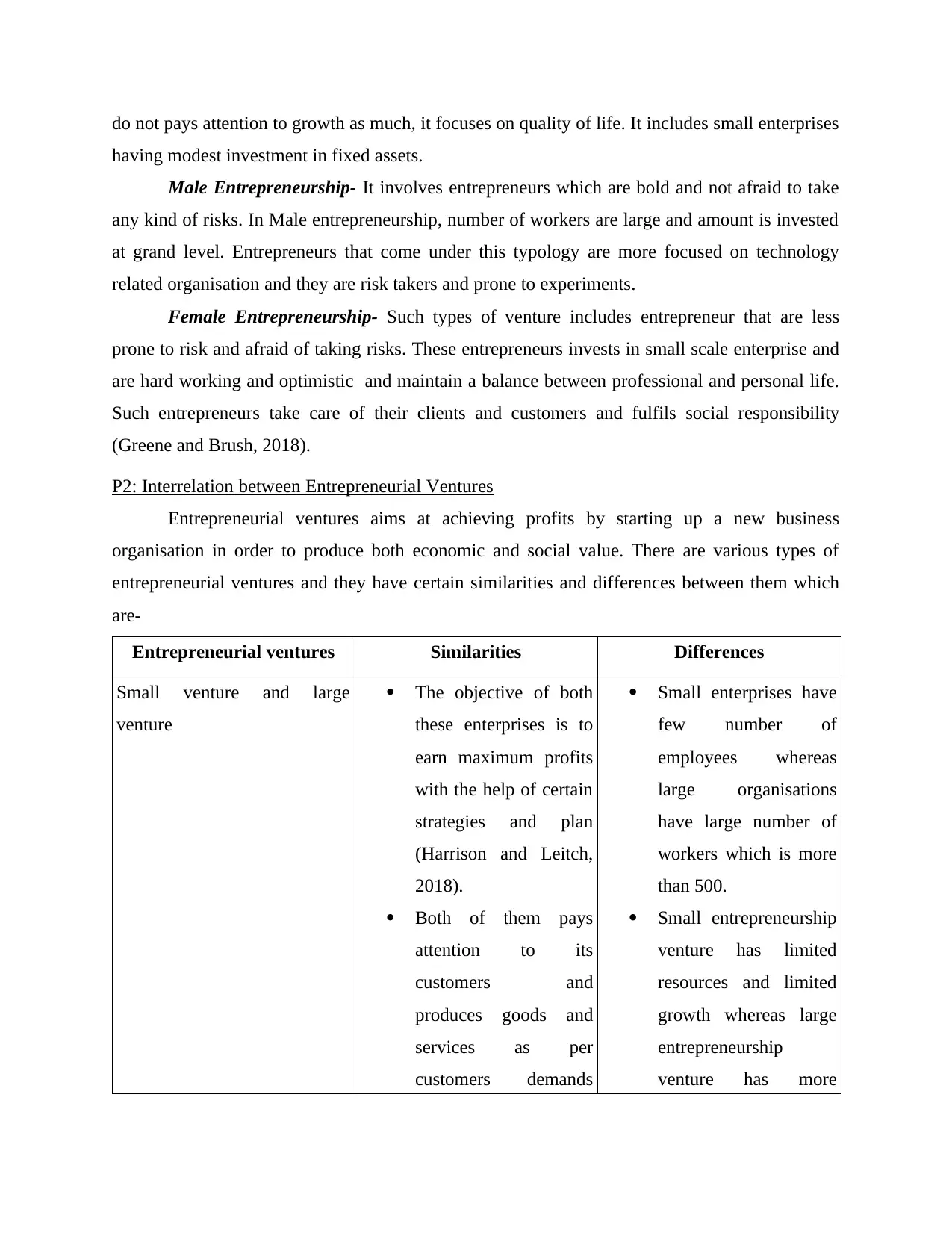
do not pays attention to growth as much, it focuses on quality of life. It includes small enterprises
having modest investment in fixed assets.
Male Entrepreneurship- It involves entrepreneurs which are bold and not afraid to take
any kind of risks. In Male entrepreneurship, number of workers are large and amount is invested
at grand level. Entrepreneurs that come under this typology are more focused on technology
related organisation and they are risk takers and prone to experiments.
Female Entrepreneurship- Such types of venture includes entrepreneur that are less
prone to risk and afraid of taking risks. These entrepreneurs invests in small scale enterprise and
are hard working and optimistic and maintain a balance between professional and personal life.
Such entrepreneurs take care of their clients and customers and fulfils social responsibility
(Greene and Brush, 2018).
P2: Interrelation between Entrepreneurial Ventures
Entrepreneurial ventures aims at achieving profits by starting up a new business
organisation in order to produce both economic and social value. There are various types of
entrepreneurial ventures and they have certain similarities and differences between them which
are-
Entrepreneurial ventures Similarities Differences
Small venture and large
venture
The objective of both
these enterprises is to
earn maximum profits
with the help of certain
strategies and plan
(Harrison and Leitch,
2018).
Both of them pays
attention to its
customers and
produces goods and
services as per
customers demands
Small enterprises have
few number of
employees whereas
large organisations
have large number of
workers which is more
than 500.
Small entrepreneurship
venture has limited
resources and limited
growth whereas large
entrepreneurship
venture has more
having modest investment in fixed assets.
Male Entrepreneurship- It involves entrepreneurs which are bold and not afraid to take
any kind of risks. In Male entrepreneurship, number of workers are large and amount is invested
at grand level. Entrepreneurs that come under this typology are more focused on technology
related organisation and they are risk takers and prone to experiments.
Female Entrepreneurship- Such types of venture includes entrepreneur that are less
prone to risk and afraid of taking risks. These entrepreneurs invests in small scale enterprise and
are hard working and optimistic and maintain a balance between professional and personal life.
Such entrepreneurs take care of their clients and customers and fulfils social responsibility
(Greene and Brush, 2018).
P2: Interrelation between Entrepreneurial Ventures
Entrepreneurial ventures aims at achieving profits by starting up a new business
organisation in order to produce both economic and social value. There are various types of
entrepreneurial ventures and they have certain similarities and differences between them which
are-
Entrepreneurial ventures Similarities Differences
Small venture and large
venture
The objective of both
these enterprises is to
earn maximum profits
with the help of certain
strategies and plan
(Harrison and Leitch,
2018).
Both of them pays
attention to its
customers and
produces goods and
services as per
customers demands
Small enterprises have
few number of
employees whereas
large organisations
have large number of
workers which is more
than 500.
Small entrepreneurship
venture has limited
resources and limited
growth whereas large
entrepreneurship
venture has more
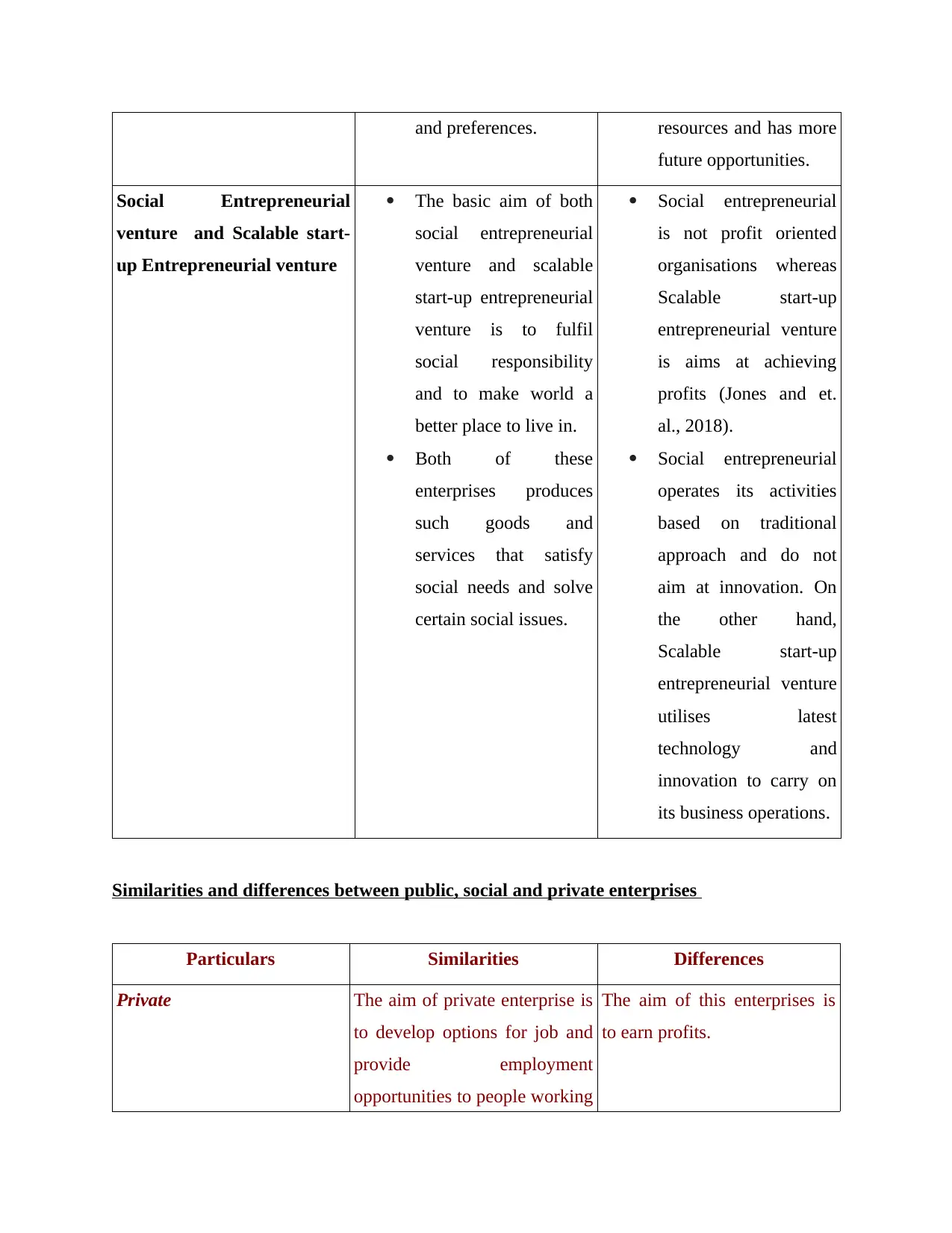
and preferences. resources and has more
future opportunities.
Social Entrepreneurial
venture and Scalable start-
up Entrepreneurial venture
The basic aim of both
social entrepreneurial
venture and scalable
start-up entrepreneurial
venture is to fulfil
social responsibility
and to make world a
better place to live in.
Both of these
enterprises produces
such goods and
services that satisfy
social needs and solve
certain social issues.
Social entrepreneurial
is not profit oriented
organisations whereas
Scalable start-up
entrepreneurial venture
is aims at achieving
profits (Jones and et.
al., 2018).
Social entrepreneurial
operates its activities
based on traditional
approach and do not
aim at innovation. On
the other hand,
Scalable start-up
entrepreneurial venture
utilises latest
technology and
innovation to carry on
its business operations.
Similarities and differences between public, social and private enterprises
Particulars Similarities Differences
Private The aim of private enterprise is
to develop options for job and
provide employment
opportunities to people working
The aim of this enterprises is
to earn profits.
future opportunities.
Social Entrepreneurial
venture and Scalable start-
up Entrepreneurial venture
The basic aim of both
social entrepreneurial
venture and scalable
start-up entrepreneurial
venture is to fulfil
social responsibility
and to make world a
better place to live in.
Both of these
enterprises produces
such goods and
services that satisfy
social needs and solve
certain social issues.
Social entrepreneurial
is not profit oriented
organisations whereas
Scalable start-up
entrepreneurial venture
is aims at achieving
profits (Jones and et.
al., 2018).
Social entrepreneurial
operates its activities
based on traditional
approach and do not
aim at innovation. On
the other hand,
Scalable start-up
entrepreneurial venture
utilises latest
technology and
innovation to carry on
its business operations.
Similarities and differences between public, social and private enterprises
Particulars Similarities Differences
Private The aim of private enterprise is
to develop options for job and
provide employment
opportunities to people working
The aim of this enterprises is
to earn profits.
⊘ This is a preview!⊘
Do you want full access?
Subscribe today to unlock all pages.
Trusted by 1+ million students worldwide
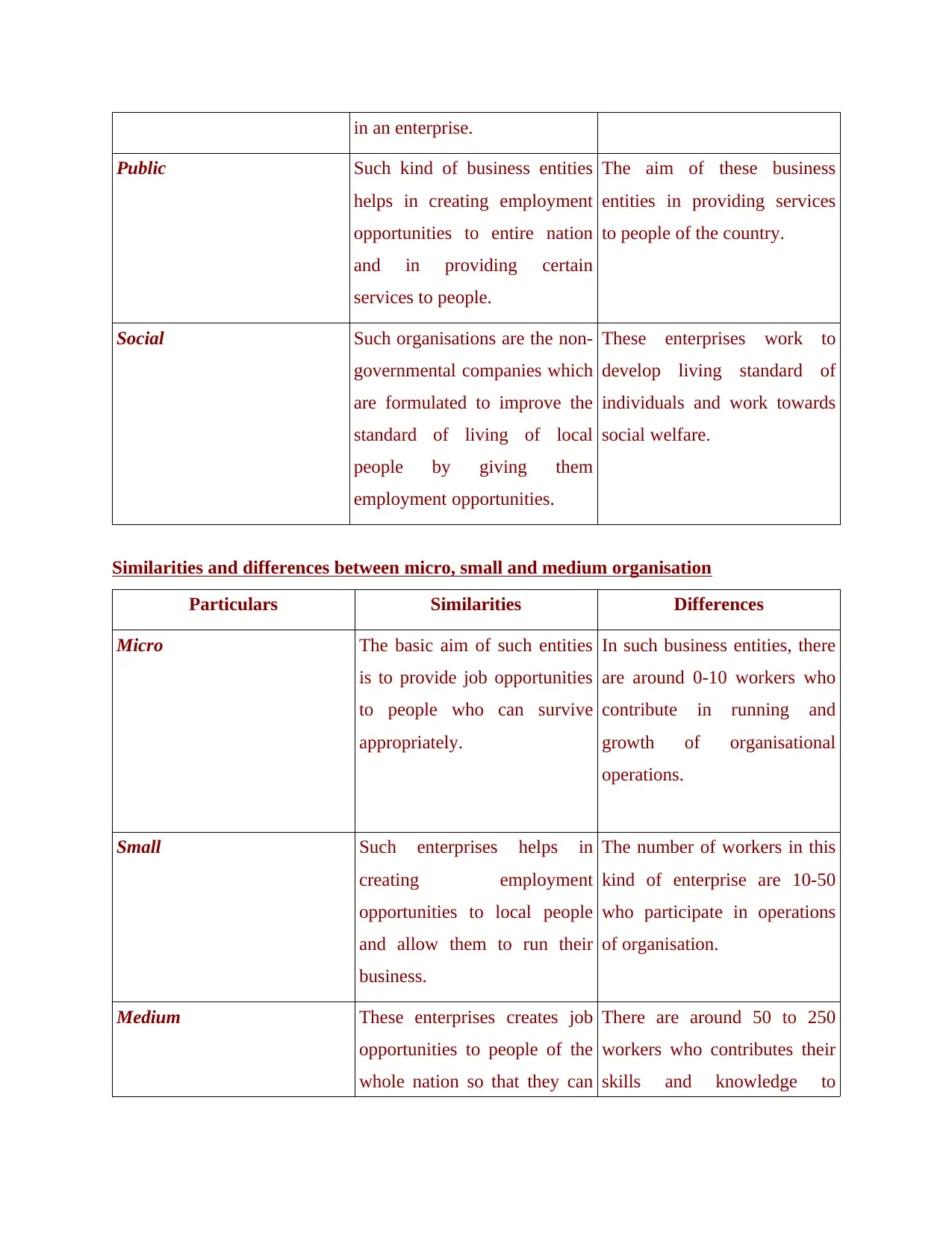
in an enterprise.
Public Such kind of business entities
helps in creating employment
opportunities to entire nation
and in providing certain
services to people.
The aim of these business
entities in providing services
to people of the country.
Social Such organisations are the non-
governmental companies which
are formulated to improve the
standard of living of local
people by giving them
employment opportunities.
These enterprises work to
develop living standard of
individuals and work towards
social welfare.
Similarities and differences between micro, small and medium organisation
Particulars Similarities Differences
Micro The basic aim of such entities
is to provide job opportunities
to people who can survive
appropriately.
In such business entities, there
are around 0-10 workers who
contribute in running and
growth of organisational
operations.
Small Such enterprises helps in
creating employment
opportunities to local people
and allow them to run their
business.
The number of workers in this
kind of enterprise are 10-50
who participate in operations
of organisation.
Medium These enterprises creates job
opportunities to people of the
whole nation so that they can
There are around 50 to 250
workers who contributes their
skills and knowledge to
Public Such kind of business entities
helps in creating employment
opportunities to entire nation
and in providing certain
services to people.
The aim of these business
entities in providing services
to people of the country.
Social Such organisations are the non-
governmental companies which
are formulated to improve the
standard of living of local
people by giving them
employment opportunities.
These enterprises work to
develop living standard of
individuals and work towards
social welfare.
Similarities and differences between micro, small and medium organisation
Particulars Similarities Differences
Micro The basic aim of such entities
is to provide job opportunities
to people who can survive
appropriately.
In such business entities, there
are around 0-10 workers who
contribute in running and
growth of organisational
operations.
Small Such enterprises helps in
creating employment
opportunities to local people
and allow them to run their
business.
The number of workers in this
kind of enterprise are 10-50
who participate in operations
of organisation.
Medium These enterprises creates job
opportunities to people of the
whole nation so that they can
There are around 50 to 250
workers who contributes their
skills and knowledge to
Paraphrase This Document
Need a fresh take? Get an instant paraphrase of this document with our AI Paraphraser
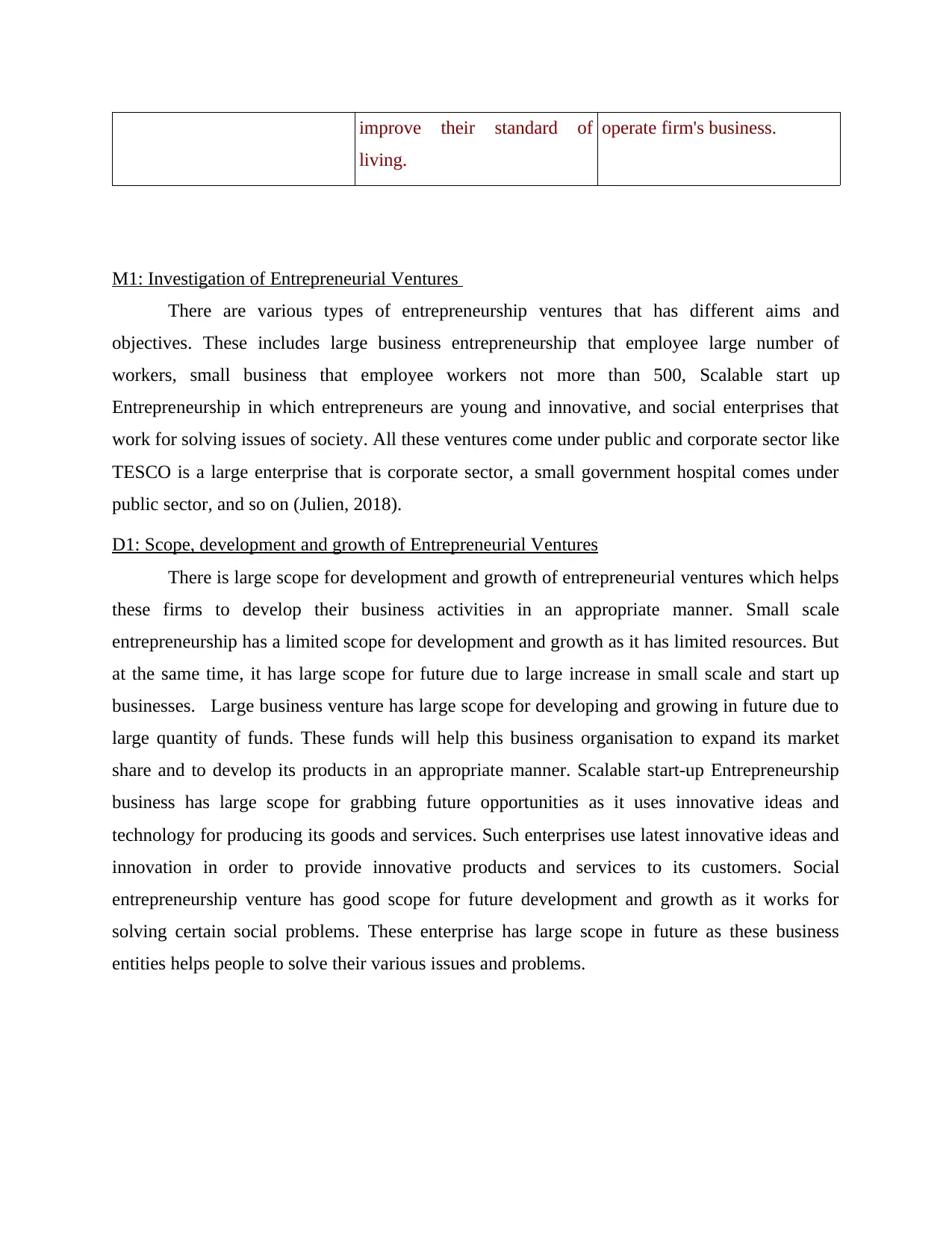
improve their standard of
living.
operate firm's business.
M1: Investigation of Entrepreneurial Ventures
There are various types of entrepreneurship ventures that has different aims and
objectives. These includes large business entrepreneurship that employee large number of
workers, small business that employee workers not more than 500, Scalable start up
Entrepreneurship in which entrepreneurs are young and innovative, and social enterprises that
work for solving issues of society. All these ventures come under public and corporate sector like
TESCO is a large enterprise that is corporate sector, a small government hospital comes under
public sector, and so on (Julien, 2018).
D1: Scope, development and growth of Entrepreneurial Ventures
There is large scope for development and growth of entrepreneurial ventures which helps
these firms to develop their business activities in an appropriate manner. Small scale
entrepreneurship has a limited scope for development and growth as it has limited resources. But
at the same time, it has large scope for future due to large increase in small scale and start up
businesses. Large business venture has large scope for developing and growing in future due to
large quantity of funds. These funds will help this business organisation to expand its market
share and to develop its products in an appropriate manner. Scalable start-up Entrepreneurship
business has large scope for grabbing future opportunities as it uses innovative ideas and
technology for producing its goods and services. Such enterprises use latest innovative ideas and
innovation in order to provide innovative products and services to its customers. Social
entrepreneurship venture has good scope for future development and growth as it works for
solving certain social problems. These enterprise has large scope in future as these business
entities helps people to solve their various issues and problems.
living.
operate firm's business.
M1: Investigation of Entrepreneurial Ventures
There are various types of entrepreneurship ventures that has different aims and
objectives. These includes large business entrepreneurship that employee large number of
workers, small business that employee workers not more than 500, Scalable start up
Entrepreneurship in which entrepreneurs are young and innovative, and social enterprises that
work for solving issues of society. All these ventures come under public and corporate sector like
TESCO is a large enterprise that is corporate sector, a small government hospital comes under
public sector, and so on (Julien, 2018).
D1: Scope, development and growth of Entrepreneurial Ventures
There is large scope for development and growth of entrepreneurial ventures which helps
these firms to develop their business activities in an appropriate manner. Small scale
entrepreneurship has a limited scope for development and growth as it has limited resources. But
at the same time, it has large scope for future due to large increase in small scale and start up
businesses. Large business venture has large scope for developing and growing in future due to
large quantity of funds. These funds will help this business organisation to expand its market
share and to develop its products in an appropriate manner. Scalable start-up Entrepreneurship
business has large scope for grabbing future opportunities as it uses innovative ideas and
technology for producing its goods and services. Such enterprises use latest innovative ideas and
innovation in order to provide innovative products and services to its customers. Social
entrepreneurship venture has good scope for future development and growth as it works for
solving certain social problems. These enterprise has large scope in future as these business
entities helps people to solve their various issues and problems.
LO2
P3: Impact of Micro and Small businesses upon economy
Small and Micro businesses plays an crucial role in contributing to economies of nation
by bringing up innovation and technology to a community and society in which they are
established (Business Population Estimates for the UK and regions in 2018, 2019). It also serves
to stimulate growth of an economy by providing employment opportunities to people of society
who are unemployed and not getting any job in large corporate sectors. It can be determined as a
search engine in development and growth of an enterprise.
The most important role of small and micro organisations is that it provides employment
to local workers and gives contribution to government by timely payment of taxes (Kuratko and
Morris, 2018). Impact of micro and small businesses over economy of United Kingdom can be
shown more clearly by interpreting and assessing relevant data and statistics. For this purpose, it
is demonstrated by a table given below that shows private sector business in British and number
of workers working under it in 2018-
P3: Impact of Micro and Small businesses upon economy
Small and Micro businesses plays an crucial role in contributing to economies of nation
by bringing up innovation and technology to a community and society in which they are
established (Business Population Estimates for the UK and regions in 2018, 2019). It also serves
to stimulate growth of an economy by providing employment opportunities to people of society
who are unemployed and not getting any job in large corporate sectors. It can be determined as a
search engine in development and growth of an enterprise.
The most important role of small and micro organisations is that it provides employment
to local workers and gives contribution to government by timely payment of taxes (Kuratko and
Morris, 2018). Impact of micro and small businesses over economy of United Kingdom can be
shown more clearly by interpreting and assessing relevant data and statistics. For this purpose, it
is demonstrated by a table given below that shows private sector business in British and number
of workers working under it in 2018-
⊘ This is a preview!⊘
Do you want full access?
Subscribe today to unlock all pages.
Trusted by 1+ million students worldwide
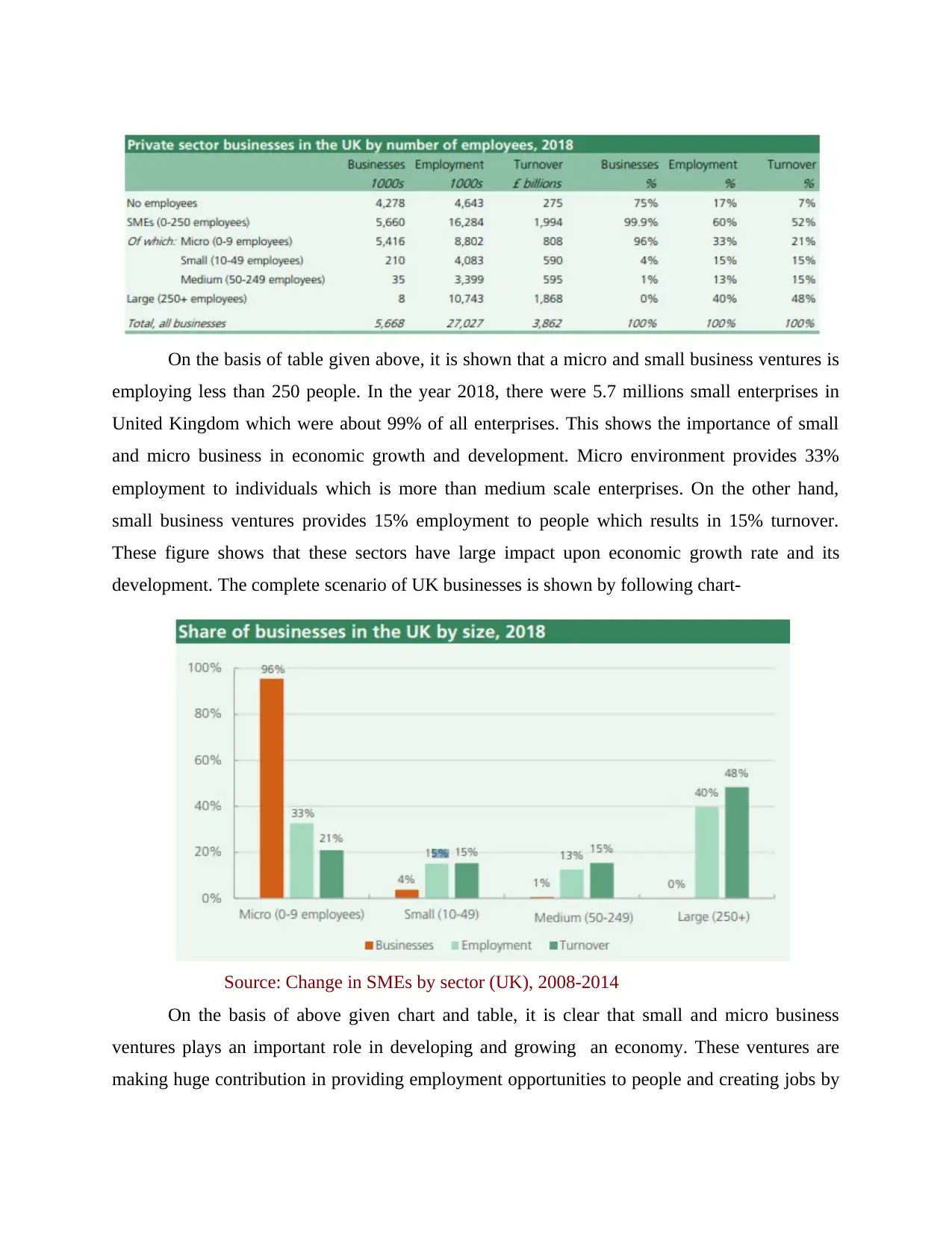
On the basis of table given above, it is shown that a micro and small business ventures is
employing less than 250 people. In the year 2018, there were 5.7 millions small enterprises in
United Kingdom which were about 99% of all enterprises. This shows the importance of small
and micro business in economic growth and development. Micro environment provides 33%
employment to individuals which is more than medium scale enterprises. On the other hand,
small business ventures provides 15% employment to people which results in 15% turnover.
These figure shows that these sectors have large impact upon economic growth rate and its
development. The complete scenario of UK businesses is shown by following chart-
Source: Change in SMEs by sector (UK), 2008-2014
On the basis of above given chart and table, it is clear that small and micro business
ventures plays an important role in developing and growing an economy. These ventures are
making huge contribution in providing employment opportunities to people and creating jobs by
employing less than 250 people. In the year 2018, there were 5.7 millions small enterprises in
United Kingdom which were about 99% of all enterprises. This shows the importance of small
and micro business in economic growth and development. Micro environment provides 33%
employment to individuals which is more than medium scale enterprises. On the other hand,
small business ventures provides 15% employment to people which results in 15% turnover.
These figure shows that these sectors have large impact upon economic growth rate and its
development. The complete scenario of UK businesses is shown by following chart-
Source: Change in SMEs by sector (UK), 2008-2014
On the basis of above given chart and table, it is clear that small and micro business
ventures plays an important role in developing and growing an economy. These ventures are
making huge contribution in providing employment opportunities to people and creating jobs by
Paraphrase This Document
Need a fresh take? Get an instant paraphrase of this document with our AI Paraphraser
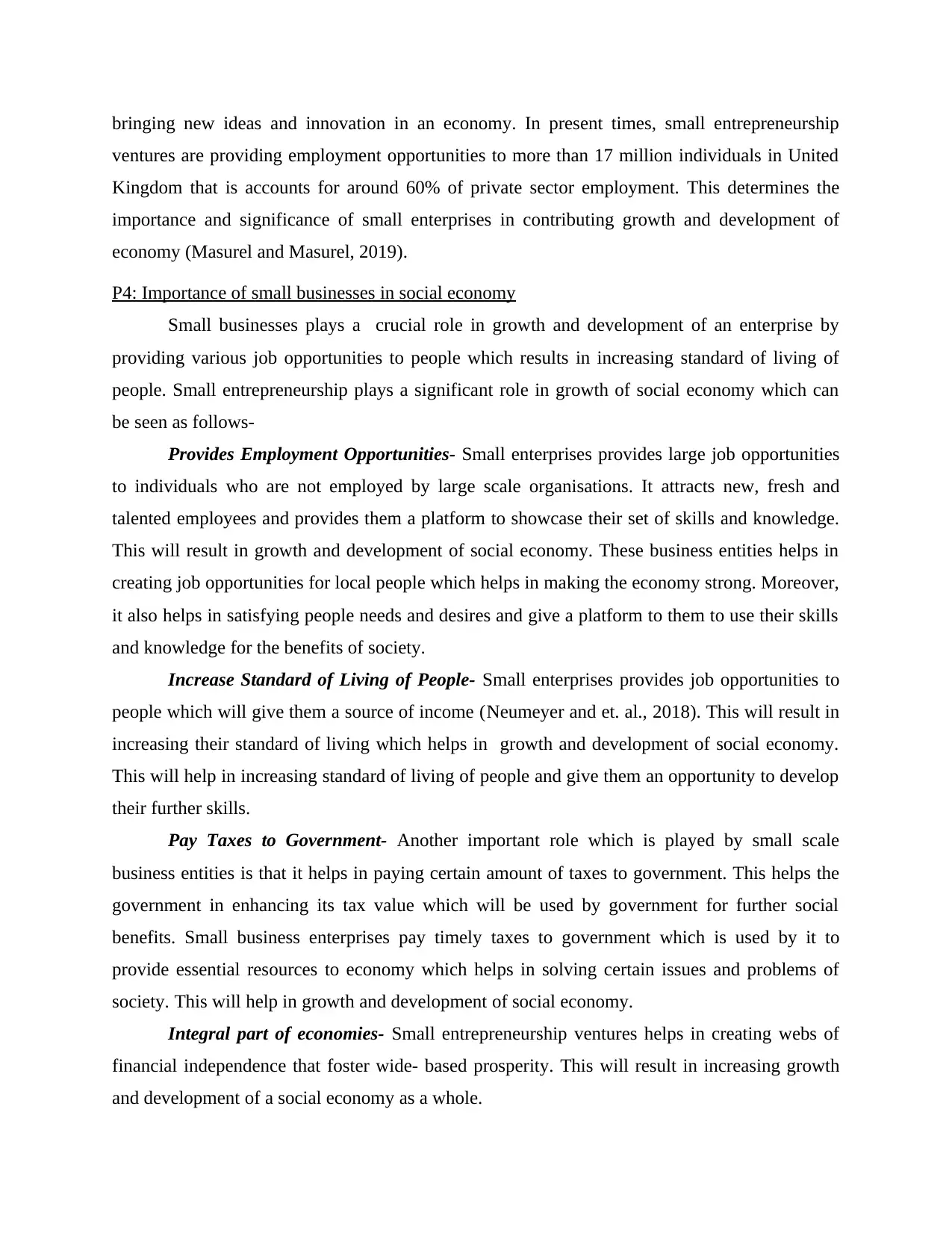
bringing new ideas and innovation in an economy. In present times, small entrepreneurship
ventures are providing employment opportunities to more than 17 million individuals in United
Kingdom that is accounts for around 60% of private sector employment. This determines the
importance and significance of small enterprises in contributing growth and development of
economy (Masurel and Masurel, 2019).
P4: Importance of small businesses in social economy
Small businesses plays a crucial role in growth and development of an enterprise by
providing various job opportunities to people which results in increasing standard of living of
people. Small entrepreneurship plays a significant role in growth of social economy which can
be seen as follows-
Provides Employment Opportunities- Small enterprises provides large job opportunities
to individuals who are not employed by large scale organisations. It attracts new, fresh and
talented employees and provides them a platform to showcase their set of skills and knowledge.
This will result in growth and development of social economy. These business entities helps in
creating job opportunities for local people which helps in making the economy strong. Moreover,
it also helps in satisfying people needs and desires and give a platform to them to use their skills
and knowledge for the benefits of society.
Increase Standard of Living of People- Small enterprises provides job opportunities to
people which will give them a source of income (Neumeyer and et. al., 2018). This will result in
increasing their standard of living which helps in growth and development of social economy.
This will help in increasing standard of living of people and give them an opportunity to develop
their further skills.
Pay Taxes to Government- Another important role which is played by small scale
business entities is that it helps in paying certain amount of taxes to government. This helps the
government in enhancing its tax value which will be used by government for further social
benefits. Small business enterprises pay timely taxes to government which is used by it to
provide essential resources to economy which helps in solving certain issues and problems of
society. This will help in growth and development of social economy.
Integral part of economies- Small entrepreneurship ventures helps in creating webs of
financial independence that foster wide- based prosperity. This will result in increasing growth
and development of a social economy as a whole.
ventures are providing employment opportunities to more than 17 million individuals in United
Kingdom that is accounts for around 60% of private sector employment. This determines the
importance and significance of small enterprises in contributing growth and development of
economy (Masurel and Masurel, 2019).
P4: Importance of small businesses in social economy
Small businesses plays a crucial role in growth and development of an enterprise by
providing various job opportunities to people which results in increasing standard of living of
people. Small entrepreneurship plays a significant role in growth of social economy which can
be seen as follows-
Provides Employment Opportunities- Small enterprises provides large job opportunities
to individuals who are not employed by large scale organisations. It attracts new, fresh and
talented employees and provides them a platform to showcase their set of skills and knowledge.
This will result in growth and development of social economy. These business entities helps in
creating job opportunities for local people which helps in making the economy strong. Moreover,
it also helps in satisfying people needs and desires and give a platform to them to use their skills
and knowledge for the benefits of society.
Increase Standard of Living of People- Small enterprises provides job opportunities to
people which will give them a source of income (Neumeyer and et. al., 2018). This will result in
increasing their standard of living which helps in growth and development of social economy.
This will help in increasing standard of living of people and give them an opportunity to develop
their further skills.
Pay Taxes to Government- Another important role which is played by small scale
business entities is that it helps in paying certain amount of taxes to government. This helps the
government in enhancing its tax value which will be used by government for further social
benefits. Small business enterprises pay timely taxes to government which is used by it to
provide essential resources to economy which helps in solving certain issues and problems of
society. This will help in growth and development of social economy.
Integral part of economies- Small entrepreneurship ventures helps in creating webs of
financial independence that foster wide- based prosperity. This will result in increasing growth
and development of a social economy as a whole.
M2: Evaluation
There are different types of enterprise based upon the size of an organisation which are
small, medium and large organisations. Small enterprises have small number of employees and
generate low revenue, Medium ventures employee comparatively more employees and generate
more revenue thereby. On the other hand, in large enterprises, large number of workers work
which results in generating high amount of revenue (Brush and et. al., 2018). All these sectors
provide employment importunities to individuals which will increase their standard of living.
This will increase in overall economic and social growth of a nation. According to the statistics
of Private sector businesses in UK, 2018, it is estimated that small enterprises are giving job
opportunities to more than 17 million individuals in UK which accounts for around 60% of
private sector employment.
D2: Impact of small businesses on different economic levels
Small businesses plays an significant role in different levels of an economy like local,
regional and national. These kind of enterprises provides employment opportunities to local
people of United Kingdom which has positive impact over local economy and regional economy.
It helps in increasing job opportunities to people, provides timely payment of necessary taxes to
government which will result in improving overall development of an organisation at national
and international level both (Dana, 2018).
LO3
P5. Characteristics, traits and skills
Entrepreneur is a person who sets up a new organisation in order to earn high margin of
profits by taking certain financial risks. To be a successful entrepreneur, a person needs to
possess certain characteristics, skills and traits that distinguished them from business managers.
A very basic difference between entrepreneur and business managers is that entrepreneur is an
owner of an organisation where as business managers are just an employee of same enterprise
(Brush and et. al., 2018).
Peter Jones
A British entrepreneur who operates in services like mobile phones, property, media, television,
leisure and retail. He started his business when he was a teenager, that is 16 years old. He has
certain skills and traits which differentiate him from business managers.
There are different types of enterprise based upon the size of an organisation which are
small, medium and large organisations. Small enterprises have small number of employees and
generate low revenue, Medium ventures employee comparatively more employees and generate
more revenue thereby. On the other hand, in large enterprises, large number of workers work
which results in generating high amount of revenue (Brush and et. al., 2018). All these sectors
provide employment importunities to individuals which will increase their standard of living.
This will increase in overall economic and social growth of a nation. According to the statistics
of Private sector businesses in UK, 2018, it is estimated that small enterprises are giving job
opportunities to more than 17 million individuals in UK which accounts for around 60% of
private sector employment.
D2: Impact of small businesses on different economic levels
Small businesses plays an significant role in different levels of an economy like local,
regional and national. These kind of enterprises provides employment opportunities to local
people of United Kingdom which has positive impact over local economy and regional economy.
It helps in increasing job opportunities to people, provides timely payment of necessary taxes to
government which will result in improving overall development of an organisation at national
and international level both (Dana, 2018).
LO3
P5. Characteristics, traits and skills
Entrepreneur is a person who sets up a new organisation in order to earn high margin of
profits by taking certain financial risks. To be a successful entrepreneur, a person needs to
possess certain characteristics, skills and traits that distinguished them from business managers.
A very basic difference between entrepreneur and business managers is that entrepreneur is an
owner of an organisation where as business managers are just an employee of same enterprise
(Brush and et. al., 2018).
Peter Jones
A British entrepreneur who operates in services like mobile phones, property, media, television,
leisure and retail. He started his business when he was a teenager, that is 16 years old. He has
certain skills and traits which differentiate him from business managers.
⊘ This is a preview!⊘
Do you want full access?
Subscribe today to unlock all pages.
Trusted by 1+ million students worldwide

1 out of 19


Related Documents


Your All-in-One AI-Powered Toolkit for Academic Success.
+13062052269
info@desklib.com
Available 24*7 on WhatsApp / Email
![[object Object]](/_next/static/media/star-bottom.7253800d.svg)
Unlock your academic potential
Copyright © 2020–2026 A2Z Services. All Rights Reserved. Developed and managed by ZUCOL.