Entrepreneurship Report: Legal, Ethical, and IP in Business
VerifiedAdded on 2019/10/09
|7
|1681
|379
Report
AI Summary
This report delves into critical aspects of entrepreneurship, covering founder's agreements, legal and ethical considerations, and intellectual property rights. It begins by defining founder's agreements and buyback clauses, emphasizing their role in structuring a business and managing member exits. The report then addresses legal disputes, suggesting strategies such as fulfilling contractual obligations, establishing standards, documenting agreements, and managing finances to mitigate risks. Furthermore, it explores building a strong ethical culture through codes of conduct, leadership by example, and ethics training programs. The report also examines piercing the corporate veil and its implications. The second part of the report focuses on intellectual property, including patents, trademarks, and copyrights, highlighting their importance for business reputation, competitive advantage, and market differentiation. It describes different patent types, the significance of trademarks for brand recognition, and the legal protection offered by copyright laws. The references section includes academic sources used in the research and writing of the report.
Running Head: Being an Entrepreneur
being an Entrepreneur
[Document subtitle]
being an Entrepreneur
[Document subtitle]
Paraphrase This Document
Need a fresh take? Get an instant paraphrase of this document with our AI Paraphraser

Being an Entrepreneur 1
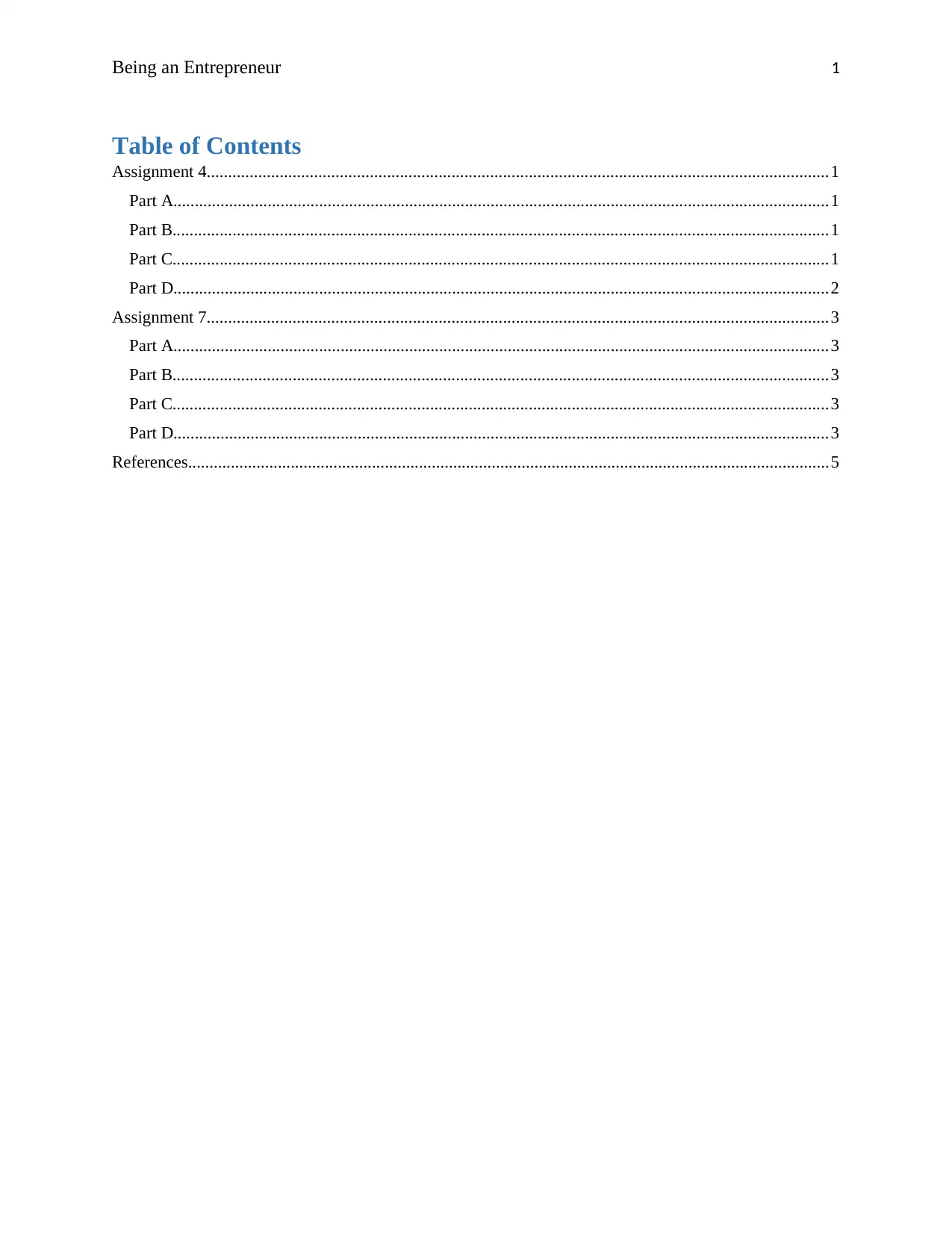
Table of Contents
Assignment 4.................................................................................................................................................1
Part A.........................................................................................................................................................1
Part B.........................................................................................................................................................1
Part C.........................................................................................................................................................1
Part D.........................................................................................................................................................2
Assignment 7.................................................................................................................................................3
Part A.........................................................................................................................................................3
Part B.........................................................................................................................................................3
Part C.........................................................................................................................................................3
Part D.........................................................................................................................................................3
References......................................................................................................................................................5
Table of Contents
Assignment 4.................................................................................................................................................1
Part A.........................................................................................................................................................1
Part B.........................................................................................................................................................1
Part C.........................................................................................................................................................1
Part D.........................................................................................................................................................2
Assignment 7.................................................................................................................................................3
Part A.........................................................................................................................................................3
Part B.........................................................................................................................................................3
Part C.........................................................................................................................................................3
Part D.........................................................................................................................................................3
References......................................................................................................................................................5

Being an Entrepreneur 2
Assignment 4
Part A
Founder's agreement is known as shareholders agreement. Furthermore, it is a document in
written which describes the nature of the business and general business plan with the obligations
and rights of founding members. On the other hand, it can be said that founder agreement serves
as a foundational structure and a workable precept on which the future decisions of the
organization are formulated. The main motive behind the founder's agreement is to avoid
confusions and future assumptions so that business can run smoothly.
Moreover, Buyback clause is considered as a statement that describes how to manage a particular
situation when a founding member decides to leave an organization; or how co-founders will
manage the demise of a founding member (Crawford, 2014). The significant purpose behind the
development of Buyback clause is to defense the interest of the members against possible
disruption in the organization functions and control of the company sequel to the exit of a
member. On the other hand, it can be said that Buyback clause has significant importance. It’s
not only important for defensive purpose but also important for the Founder's agreement. It is
because Buyback clause ensures continuity of the organization without any interference, and also
saves the organization against unpleasant take-over from an outsider.
Part B
Legal disputes in an organization arise due to ligations emanate from misunderstanding, lack of
legal law knowledge, and sloppiness. An entrepreneur can avoid all such legal disputes by
performing work hard. On the other hand, an entrepreneur can avoid the legal disputes by
following steps:
Fulfilling all contractual responsibilities: It can be said that companies have certain
responsibilities which are required to fulfill by them from time to time. Therefore, it is
the responsibility of an entrepreneur to fulfill such requirements in due time. This may
contain salaries and benefits of employees, paying contractors and vendors.
Establishing standards: An entrepreneur should establish standards, policies, and
procedures in their organization (Kubasek, 2016). This will help them in managing the
employee’s behavior which further helpful in solving the ethical problem, and customer
conflicts.
Getting Everything in Writing: It is the most effective way of avoiding legal disputes.
It is because disputes are easy to solve when there are written a statement to back up
claims.
Avoiding Undercapitalization: Entrepreneurs should work hard to generate powers
required to run the business, and financial resources. It can be said that an organization
mainly suffers more with the financial challenges and this can only solve by sourcing for
funds to bail out the organization.
Part C
A lot of organizations are suffering from the issue of building a strong ethical culture. Ethics are
more than laws, code of conducts, and regulations. An entrepreneurial organization can build a
strong ethical culture with the help of following steps:
Assignment 4
Part A
Founder's agreement is known as shareholders agreement. Furthermore, it is a document in
written which describes the nature of the business and general business plan with the obligations
and rights of founding members. On the other hand, it can be said that founder agreement serves
as a foundational structure and a workable precept on which the future decisions of the
organization are formulated. The main motive behind the founder's agreement is to avoid
confusions and future assumptions so that business can run smoothly.
Moreover, Buyback clause is considered as a statement that describes how to manage a particular
situation when a founding member decides to leave an organization; or how co-founders will
manage the demise of a founding member (Crawford, 2014). The significant purpose behind the
development of Buyback clause is to defense the interest of the members against possible
disruption in the organization functions and control of the company sequel to the exit of a
member. On the other hand, it can be said that Buyback clause has significant importance. It’s
not only important for defensive purpose but also important for the Founder's agreement. It is
because Buyback clause ensures continuity of the organization without any interference, and also
saves the organization against unpleasant take-over from an outsider.
Part B
Legal disputes in an organization arise due to ligations emanate from misunderstanding, lack of
legal law knowledge, and sloppiness. An entrepreneur can avoid all such legal disputes by
performing work hard. On the other hand, an entrepreneur can avoid the legal disputes by
following steps:
Fulfilling all contractual responsibilities: It can be said that companies have certain
responsibilities which are required to fulfill by them from time to time. Therefore, it is
the responsibility of an entrepreneur to fulfill such requirements in due time. This may
contain salaries and benefits of employees, paying contractors and vendors.
Establishing standards: An entrepreneur should establish standards, policies, and
procedures in their organization (Kubasek, 2016). This will help them in managing the
employee’s behavior which further helpful in solving the ethical problem, and customer
conflicts.
Getting Everything in Writing: It is the most effective way of avoiding legal disputes.
It is because disputes are easy to solve when there are written a statement to back up
claims.
Avoiding Undercapitalization: Entrepreneurs should work hard to generate powers
required to run the business, and financial resources. It can be said that an organization
mainly suffers more with the financial challenges and this can only solve by sourcing for
funds to bail out the organization.
Part C
A lot of organizations are suffering from the issue of building a strong ethical culture. Ethics are
more than laws, code of conducts, and regulations. An entrepreneurial organization can build a
strong ethical culture with the help of following steps:
⊘ This is a preview!⊘
Do you want full access?
Subscribe today to unlock all pages.

Trusted by 1+ million students worldwide

Being an Entrepreneur 3
Formulating a code of conduct: Code of conduct can define as a formal statement of
ethical and social values of an organization. Code of conduct offers certain guidelines
which prove helpful in building a strong ethical culture (Jenkins, 2013).
Leading by Example: It is the best method for entrepreneurs to build an ethical culture.
As per this method, entrepreneurs lead by example and intentionally make decisions and
good morale regarding their daily conversations.
Implementing training program of ethics: An entrepreneur can build a strong ethical
culture by implementing a training program in its organization. This not only enhances
their knowledge but also controls their work behavior.
Part D
Piercing the corporate veil is also known as lifting the corporate veil. It is considered as a legal
term courts utilize to make the owners of a corporation or a liability organization liable for the
business debts. When owners of an organization are not careful, and cash is tight, if an unpaid
creditor sues the other party for payment, a court might pierce the corporate veil and hold the
owners liable for the business debts of the organization.
As per the views of the Macey (2014) courts might impose personal liability on members,
directors, officers, or shareholders and pierce the corporate veil when there is no real separation
between owner and its organization, creditors of the organization suffered an unjust cost, and
actions of an organization were fraudulent and wrongful. On the other hand, if a court pierces an
organization corporate veil, the shareholders, owners, and the members of LLC or a corporation
can be held personally liable for debts of the corporate.
Formulating a code of conduct: Code of conduct can define as a formal statement of
ethical and social values of an organization. Code of conduct offers certain guidelines
which prove helpful in building a strong ethical culture (Jenkins, 2013).
Leading by Example: It is the best method for entrepreneurs to build an ethical culture.
As per this method, entrepreneurs lead by example and intentionally make decisions and
good morale regarding their daily conversations.
Implementing training program of ethics: An entrepreneur can build a strong ethical
culture by implementing a training program in its organization. This not only enhances
their knowledge but also controls their work behavior.
Part D
Piercing the corporate veil is also known as lifting the corporate veil. It is considered as a legal
term courts utilize to make the owners of a corporation or a liability organization liable for the
business debts. When owners of an organization are not careful, and cash is tight, if an unpaid
creditor sues the other party for payment, a court might pierce the corporate veil and hold the
owners liable for the business debts of the organization.
As per the views of the Macey (2014) courts might impose personal liability on members,
directors, officers, or shareholders and pierce the corporate veil when there is no real separation
between owner and its organization, creditors of the organization suffered an unjust cost, and
actions of an organization were fraudulent and wrongful. On the other hand, if a court pierces an
organization corporate veil, the shareholders, owners, and the members of LLC or a corporation
can be held personally liable for debts of the corporate.
Paraphrase This Document
Need a fresh take? Get an instant paraphrase of this document with our AI Paraphraser

Being an Entrepreneur 4
Assignment 7
Part A
Intellectual Property is considered as a human intellect product that is intangible in nature but
has a significant value in the marketplace. It is known as intellectual property because it is a
product of the creativity, human imagination, and inventiveness (Bently, 2014). Apart from
benefits, intellectual property also brings a lot of problems for business organizations. It is
considered a big issue for them. Most of the business organizations have thought that their
physical assets like equipment, buildings, and land as the most significant assets. But, the
intellectual assets are more important than physical assets. It is an important issue because of
reputation and competitive advantage of the organizations associated with it. A lot of
organization is there which have earned name and fame due to their intellectual property. Some
of them are Apple and Walmart which have their valuable names and logos.
Part B
The patent is considered as a government license that provides the holder a large number of
rights to a design, process, or a new invention for a particular period of time. Application of
patent handles by a government agency of the concerned country. The three important and
effective patient’s forms are Design, Utility, and Plant (Mgbeoji, 2014).
Design: Original, innovative and creative, ornamental designs for produced products.
Utility: Beneficial and innovative process, Machine, Production, or composition of the
material or any useful and new improvement thereof.
Plant: A new varieties of plants that can be reproduced.
Part C
Trademark is considered as a symbol, device, name, or word utilized to measure the originality
or source of a product or service or to differentiate those products from among available
alternatives. The importance of trademark can significantly judge by seeing its popularity. On the
other hand, the trademark is important because every organization want to achieve popularity
and use their logos, names and other product feature to increase their visibility (LaLonde, 2016).
With the help of trademark, they can significantly recognize in its marketplace which ultimately
brings growth opportunities for them. Apart of this, trademark also provides a large number of
customers with useful information. By serving a large number of customers, they can
significantly gain their confidence and place themselves in the eyes of customers. Trademark has
a rich history dating back 4,000 years ago.
Part D
Copyright is considered as a form of intellectual property protection which provides the owner a
legal authority to check how the work is utilized and to gain the economic benefits of the work.
But the work should be in the tangible form of magazine, article, book, architectural drawing,
computer software programs, and operating manual (Liu, 2016).
Assignment 7
Part A
Intellectual Property is considered as a human intellect product that is intangible in nature but
has a significant value in the marketplace. It is known as intellectual property because it is a
product of the creativity, human imagination, and inventiveness (Bently, 2014). Apart from
benefits, intellectual property also brings a lot of problems for business organizations. It is
considered a big issue for them. Most of the business organizations have thought that their
physical assets like equipment, buildings, and land as the most significant assets. But, the
intellectual assets are more important than physical assets. It is an important issue because of
reputation and competitive advantage of the organizations associated with it. A lot of
organization is there which have earned name and fame due to their intellectual property. Some
of them are Apple and Walmart which have their valuable names and logos.
Part B
The patent is considered as a government license that provides the holder a large number of
rights to a design, process, or a new invention for a particular period of time. Application of
patent handles by a government agency of the concerned country. The three important and
effective patient’s forms are Design, Utility, and Plant (Mgbeoji, 2014).
Design: Original, innovative and creative, ornamental designs for produced products.
Utility: Beneficial and innovative process, Machine, Production, or composition of the
material or any useful and new improvement thereof.
Plant: A new varieties of plants that can be reproduced.
Part C
Trademark is considered as a symbol, device, name, or word utilized to measure the originality
or source of a product or service or to differentiate those products from among available
alternatives. The importance of trademark can significantly judge by seeing its popularity. On the
other hand, the trademark is important because every organization want to achieve popularity
and use their logos, names and other product feature to increase their visibility (LaLonde, 2016).
With the help of trademark, they can significantly recognize in its marketplace which ultimately
brings growth opportunities for them. Apart of this, trademark also provides a large number of
customers with useful information. By serving a large number of customers, they can
significantly gain their confidence and place themselves in the eyes of customers. Trademark has
a rich history dating back 4,000 years ago.
Part D
Copyright is considered as a form of intellectual property protection which provides the owner a
legal authority to check how the work is utilized and to gain the economic benefits of the work.
But the work should be in the tangible form of magazine, article, book, architectural drawing,
computer software programs, and operating manual (Liu, 2016).

Being an Entrepreneur 5
With the help of copyright laws, one can protect "original works of authorship" that are in the
tangible form of numbers, colors, sounds, words, logos or designs, trade dresses, fragrances, or
shapes.
With the help of copyright laws, one can protect "original works of authorship" that are in the
tangible form of numbers, colors, sounds, words, logos or designs, trade dresses, fragrances, or
shapes.
⊘ This is a preview!⊘
Do you want full access?
Subscribe today to unlock all pages.

Trusted by 1+ million students worldwide

Being an Entrepreneur 6
References
Bently, L., & Sherman, B. (2014). Intellectual property law. Oxford University Press, USA.
Crawford, G. C., McKelvey, B., & Lichtenstein, B. B. (2014). The empirical reality of
entrepreneurship: How power law distributed outcomes call for new theory and method. Journal
of Business Venturing Insights, 1, 3-7.
Jenkins, H., Ford, S., & Green, J. (2013). Spreadable media: Creating value and meaning in a
networked culture. NYU press.
Kubasek, N. K., Brennan, B. A., & Browne, M. N. (2016). The legal environment of business: A
critical thinking approach. Pearson.
LaLonde, A. G., & Gilson, J. (2016). Foreign Trademark Protection (Vol. 3). Gilson on
Trademarks.
Liu, J. P. (2016). Regulatory Copyright and the Next Great Copyright Act.
Mgbeoji, I. (2014). Global biopiracy: patents, plants, and indigenous knowledge. UBC press.
Macey, J., & Mitts, J. (2014). The Three Justifications for Piercing the Corporate Veil. Yale Law
School, John M. Olin Center for Studies in Law, Economics, and Public Policy, (488), 1-77.
References
Bently, L., & Sherman, B. (2014). Intellectual property law. Oxford University Press, USA.
Crawford, G. C., McKelvey, B., & Lichtenstein, B. B. (2014). The empirical reality of
entrepreneurship: How power law distributed outcomes call for new theory and method. Journal
of Business Venturing Insights, 1, 3-7.
Jenkins, H., Ford, S., & Green, J. (2013). Spreadable media: Creating value and meaning in a
networked culture. NYU press.
Kubasek, N. K., Brennan, B. A., & Browne, M. N. (2016). The legal environment of business: A
critical thinking approach. Pearson.
LaLonde, A. G., & Gilson, J. (2016). Foreign Trademark Protection (Vol. 3). Gilson on
Trademarks.
Liu, J. P. (2016). Regulatory Copyright and the Next Great Copyright Act.
Mgbeoji, I. (2014). Global biopiracy: patents, plants, and indigenous knowledge. UBC press.
Macey, J., & Mitts, J. (2014). The Three Justifications for Piercing the Corporate Veil. Yale Law
School, John M. Olin Center for Studies in Law, Economics, and Public Policy, (488), 1-77.
1 out of 7
Your All-in-One AI-Powered Toolkit for Academic Success.
+13062052269
info@desklib.com
Available 24*7 on WhatsApp / Email
Unlock your academic potential
Copyright © 2020–2025 A2Z Services. All Rights Reserved. Developed and managed by ZUCOL.