Entrepreneurship, Small Business Management Report: Analysis
VerifiedAdded on 2023/01/19
|13
|3364
|346
Report
AI Summary
This report provides a comprehensive overview of entrepreneurship and small business management. It begins by defining entrepreneurship and exploring different types of entrepreneurial ventures, including survival, lifestyle, large, small, and social entrepreneurship. The report then analyzes various typologies and compares the similarities and differences between entrepreneurial ventures, contrasting public and corporate sectors based on growth and scope. The second part of the report focuses on the economic impact of micro and small businesses in the UK, using data and statistics to illustrate their contribution to revenue generation and employment. It highlights the importance of small businesses to the growth of the social economy, emphasizing their role in local economies, tax contributions, and job creation. The report concludes by emphasizing the crucial role small businesses play in economic development and overall societal progress.

Entrepreneurship and
Small Business
Management
Small Business
Management

Paraphrase This Document
Need a fresh take? Get an instant paraphrase of this document with our AI Paraphraser
INTRODUCTION
The courage and determination of starting and conducting business is known as
entrepreneurship that is the heart of all businesses. All the large size organizations carried out as
a small business, held by an entrepreneur. Entrepreneurship skills turn an idea or model into a
economic service or product (Allen and Truman, 2016). Every industry and business whether
small or large, required entrepreneurship just to endure.
This report is designed to cover features of entrepreneur and entrepreneurship in an
extended way. It will cover scope, development and growth of various entrepreneur ventures
within public and private sector along with their similarities and differences. It will also include
the detailed data interpretation so that the impacts and importance of entrepreneurship and small
businesses on the economy can be understood.
TASK 1
P1 Different types of entrepreneurial ventures
Entrepreneurial ventures can be defined as the business enterprises which places
innovation and opportunism at its heart in order to develop social and economic values.
Entrepreneurial ventures are different from regular business organizations as they are innovation
driven and always ready to challenge conventional business knowledge. The major three types of
entrepreneurship are:
Survival ventures: This type of ventures mainly aims to survive as well as meet the
financial obligations of business. Therefore, various startup ventures are engaged in such
survival entrepreneurship with goal to stay in business longer. Survival entrepreneurship
ventures can be characterized in terms of Cutting costs; Fear to commit for long-term future
plans; Laying off employees etc. The main purpose of this kind of entrepreneurial venture is to
fight as well as sustain in such an environment, where is a high competition present. In such
market, to address the needs of customers and survival of business, is only possible by laying off
employees and cutting the cost.
Lifestyle ventures: To achieve productivity activity level, which bring high profitability
of income in terms of return of investment, is the main goal of lifestyle ventures. Generally,
small business adopts the concept of this venture because lifestyle venture provides an avenue
for developing the certain entrepreneurial cultures. Tend to possess the high risk of failure as
The courage and determination of starting and conducting business is known as
entrepreneurship that is the heart of all businesses. All the large size organizations carried out as
a small business, held by an entrepreneur. Entrepreneurship skills turn an idea or model into a
economic service or product (Allen and Truman, 2016). Every industry and business whether
small or large, required entrepreneurship just to endure.
This report is designed to cover features of entrepreneur and entrepreneurship in an
extended way. It will cover scope, development and growth of various entrepreneur ventures
within public and private sector along with their similarities and differences. It will also include
the detailed data interpretation so that the impacts and importance of entrepreneurship and small
businesses on the economy can be understood.
TASK 1
P1 Different types of entrepreneurial ventures
Entrepreneurial ventures can be defined as the business enterprises which places
innovation and opportunism at its heart in order to develop social and economic values.
Entrepreneurial ventures are different from regular business organizations as they are innovation
driven and always ready to challenge conventional business knowledge. The major three types of
entrepreneurship are:
Survival ventures: This type of ventures mainly aims to survive as well as meet the
financial obligations of business. Therefore, various startup ventures are engaged in such
survival entrepreneurship with goal to stay in business longer. Survival entrepreneurship
ventures can be characterized in terms of Cutting costs; Fear to commit for long-term future
plans; Laying off employees etc. The main purpose of this kind of entrepreneurial venture is to
fight as well as sustain in such an environment, where is a high competition present. In such
market, to address the needs of customers and survival of business, is only possible by laying off
employees and cutting the cost.
Lifestyle ventures: To achieve productivity activity level, which bring high profitability
of income in terms of return of investment, is the main goal of lifestyle ventures. Generally,
small business adopts the concept of this venture because lifestyle venture provides an avenue
for developing the certain entrepreneurial cultures. Tend to possess the high risk of failure as
⊘ This is a preview!⊘
Do you want full access?
Subscribe today to unlock all pages.

Trusted by 1+ million students worldwide
well as revenue from reselling business seems to be low, consider as main characteristics of
lifestyle venture. This type of ventures are mainly opened by those entrepreneurs who are
passionate and want to work in interested areas. The main purpose of lifestyle ventures is to
change the lifestyles of targeted audience, rather than to earn profitability.
Large Entrepreneurship: Large scale organizations have finite existence cycles. Most
of them develop through continuous innovation and providing new products and services that are
divergence about their core offerings (Audretsch, 2012). Riotous creativity necessitate large
enterprises to develop completely fresh production to sale into new markets to new customers.
For instance, Facebook is a large entrepreneurial venture that is developed and managed by Mark
Zuckerberg across the world. Entrepreneurs of large entrepreneurship are highly creative and
innovative thinker that contributes to run such business in more efficient way.
Small Entrepreneurship: These businesses can be defined as those entities which are
privately owned and organized by new entrepreneurs on relatively low sale or profit and with a
small number of employees. These businesses may be in sole proprietorship, partnership or
corporations form. Some businesspersons proceed benefits of limited business resources at the
small concern improvement centre. This type of ventures is mainly launched and run by those
individuals who have capabilities to turn business idea into creation of new product or service,
rather than focus on existing business model.
Social Entrepreneurship: The social entrepreneurial ventures are businesses which are
involve in such activities that develop, apply and manage services or products that would lead
towards efficiency and effectiveness of the environment and population and also towards the
improvement of the living standards of the society (Blokker and Dallago, 2012). The
rudimentary target of this type of entrepreneurship is to create the product and service for general
public. Under this type of entrepreneurship, social entrepreneurs have capabilities to identify
social issues and resolving the same, by positive efforts for implementing radical changes.
Different types of typology
It is the cluster analysis that assist the entrepreneur to link with the business activities and
attain the objective. Some of the typology are discussed below:
Male: Here the business activities are carried out majorly by the male entrepreneur who
share all the valuable opinions as well as view in order to prepare the well define framework of
lifestyle venture. This type of ventures are mainly opened by those entrepreneurs who are
passionate and want to work in interested areas. The main purpose of lifestyle ventures is to
change the lifestyles of targeted audience, rather than to earn profitability.
Large Entrepreneurship: Large scale organizations have finite existence cycles. Most
of them develop through continuous innovation and providing new products and services that are
divergence about their core offerings (Audretsch, 2012). Riotous creativity necessitate large
enterprises to develop completely fresh production to sale into new markets to new customers.
For instance, Facebook is a large entrepreneurial venture that is developed and managed by Mark
Zuckerberg across the world. Entrepreneurs of large entrepreneurship are highly creative and
innovative thinker that contributes to run such business in more efficient way.
Small Entrepreneurship: These businesses can be defined as those entities which are
privately owned and organized by new entrepreneurs on relatively low sale or profit and with a
small number of employees. These businesses may be in sole proprietorship, partnership or
corporations form. Some businesspersons proceed benefits of limited business resources at the
small concern improvement centre. This type of ventures is mainly launched and run by those
individuals who have capabilities to turn business idea into creation of new product or service,
rather than focus on existing business model.
Social Entrepreneurship: The social entrepreneurial ventures are businesses which are
involve in such activities that develop, apply and manage services or products that would lead
towards efficiency and effectiveness of the environment and population and also towards the
improvement of the living standards of the society (Blokker and Dallago, 2012). The
rudimentary target of this type of entrepreneurship is to create the product and service for general
public. Under this type of entrepreneurship, social entrepreneurs have capabilities to identify
social issues and resolving the same, by positive efforts for implementing radical changes.
Different types of typology
It is the cluster analysis that assist the entrepreneur to link with the business activities and
attain the objective. Some of the typology are discussed below:
Male: Here the business activities are carried out majorly by the male entrepreneur who
share all the valuable opinions as well as view in order to prepare the well define framework of
Paraphrase This Document
Need a fresh take? Get an instant paraphrase of this document with our AI Paraphraser
the decision. This is mainly adopted within small ventures in order to strengthen it and carry out
functioning smoothly.
Female typology: Here majority of the females get the privileged to make the effective
decision and control the business functioning. As they have patients and are emotionally stable
due to which it is most commonly seen in social entrepreneurship. Here the female member
collaborate to eradicate certain issue such as global poverty (Gartner, 2019).
Mixed typology: It involve intervention of both male as well as female representatives
that function together and leads to comprehensive thinking. Within large organisation this is
most commonly viewed which offer opportunity on the basis of skill set or capability.
P2 Similarities and differences between Entrepreneurial ventures:
Comparison among different ventures :
Basis of
differentiation
Large
Entrepreneurship
Small
Entrepreneurship
Social Entrepreneurship
Meaning Large
entrepreneurship
ventures are said
to those ventures
that operate
workings at large
level in
competitive
industry.
Small
entrepreneurship
are those ventures
that operates to
earn their daily
livings and do not
emphasise on
competition
(Henry and De
Bruin, 2011).
Social entrepreneurship are such
ventures that executes activities to
resolve all the problems pertaining
with society.
Examples Examples of such
venture are
Microsoft, Tesla,
Google, SpaceX
and Amazon.
These ventures
are plumbers,
bakery shops,
restaurants,
grocery stores and
hairdressers.
Specific examples of social
entrepreneurship are Higher Rhythm
Ltd, Ashoka Foundation, Grameen
Bank, TOMS and CASA.
Objectives Large company These ventures The objective of social
functioning smoothly.
Female typology: Here majority of the females get the privileged to make the effective
decision and control the business functioning. As they have patients and are emotionally stable
due to which it is most commonly seen in social entrepreneurship. Here the female member
collaborate to eradicate certain issue such as global poverty (Gartner, 2019).
Mixed typology: It involve intervention of both male as well as female representatives
that function together and leads to comprehensive thinking. Within large organisation this is
most commonly viewed which offer opportunity on the basis of skill set or capability.
P2 Similarities and differences between Entrepreneurial ventures:
Comparison among different ventures :
Basis of
differentiation
Large
Entrepreneurship
Small
Entrepreneurship
Social Entrepreneurship
Meaning Large
entrepreneurship
ventures are said
to those ventures
that operate
workings at large
level in
competitive
industry.
Small
entrepreneurship
are those ventures
that operates to
earn their daily
livings and do not
emphasise on
competition
(Henry and De
Bruin, 2011).
Social entrepreneurship are such
ventures that executes activities to
resolve all the problems pertaining
with society.
Examples Examples of such
venture are
Microsoft, Tesla,
Google, SpaceX
and Amazon.
These ventures
are plumbers,
bakery shops,
restaurants,
grocery stores and
hairdressers.
Specific examples of social
entrepreneurship are Higher Rhythm
Ltd, Ashoka Foundation, Grameen
Bank, TOMS and CASA.
Objectives Large company These ventures The objective of social
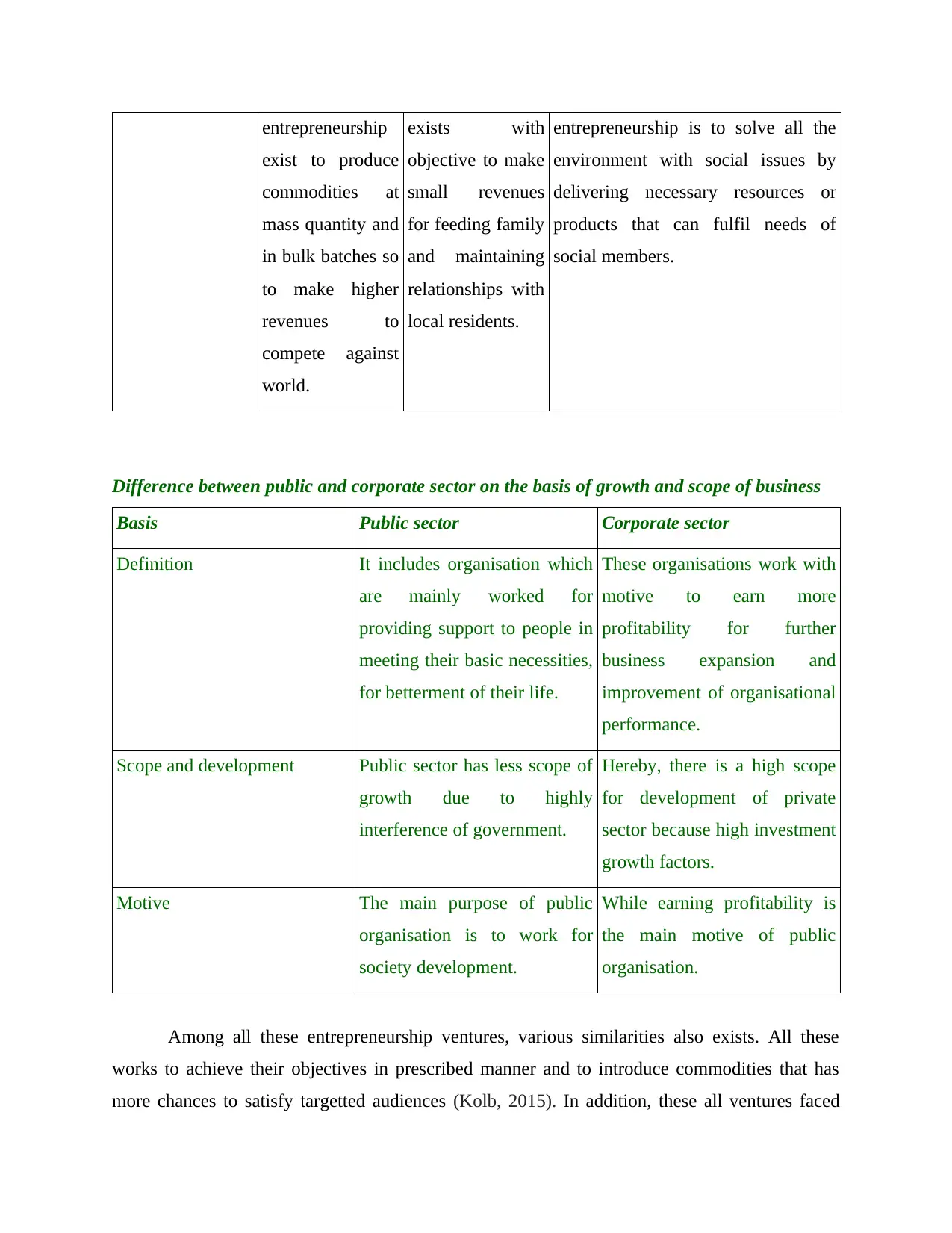
entrepreneurship
exist to produce
commodities at
mass quantity and
in bulk batches so
to make higher
revenues to
compete against
world.
exists with
objective to make
small revenues
for feeding family
and maintaining
relationships with
local residents.
entrepreneurship is to solve all the
environment with social issues by
delivering necessary resources or
products that can fulfil needs of
social members.
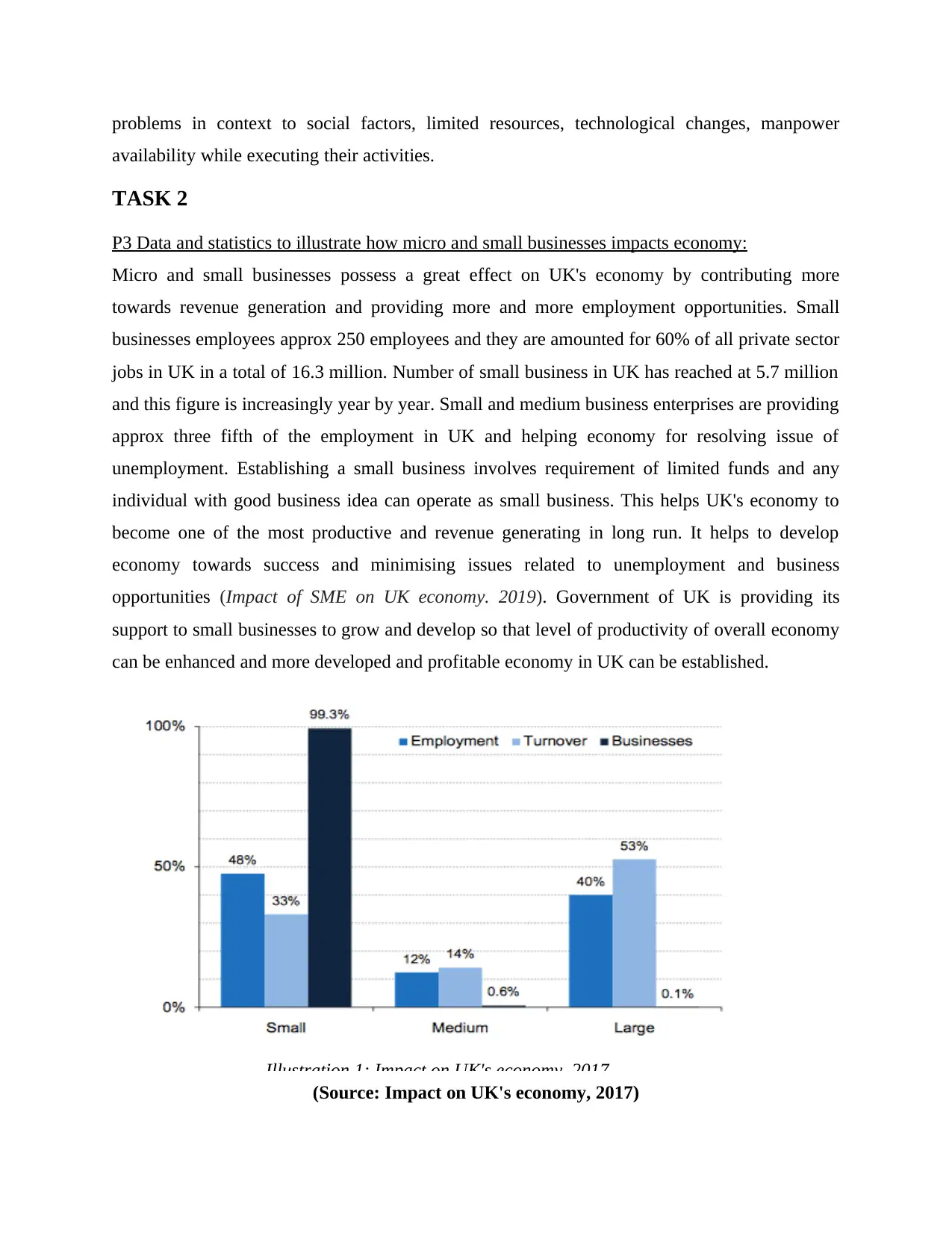
Difference between public and corporate sector on the basis of growth and scope of business
Basis Public sector Corporate sector
Definition It includes organisation which
are mainly worked for
providing support to people in
meeting their basic necessities,
for betterment of their life.
These organisations work with
motive to earn more
profitability for further
business expansion and
improvement of organisational
performance.
Scope and development Public sector has less scope of
growth due to highly
interference of government.
Hereby, there is a high scope
for development of private
sector because high investment
growth factors.
Motive The main purpose of public
organisation is to work for
society development.
While earning profitability is
the main motive of public
organisation.
Among all these entrepreneurship ventures, various similarities also exists. All these
works to achieve their objectives in prescribed manner and to introduce commodities that has
more chances to satisfy targetted audiences (Kolb, 2015). In addition, these all ventures faced
exist to produce
commodities at
mass quantity and
in bulk batches so
to make higher
revenues to
compete against
world.
exists with
objective to make
small revenues
for feeding family
and maintaining
relationships with
local residents.
entrepreneurship is to solve all the
environment with social issues by
delivering necessary resources or
products that can fulfil needs of
social members.
Difference between public and corporate sector on the basis of growth and scope of business
Basis Public sector Corporate sector
Definition It includes organisation which
are mainly worked for
providing support to people in
meeting their basic necessities,
for betterment of their life.
These organisations work with
motive to earn more
profitability for further
business expansion and
improvement of organisational
performance.
Scope and development Public sector has less scope of
growth due to highly
interference of government.
Hereby, there is a high scope
for development of private
sector because high investment
growth factors.
Motive The main purpose of public
organisation is to work for
society development.
While earning profitability is
the main motive of public
organisation.
Among all these entrepreneurship ventures, various similarities also exists. All these
works to achieve their objectives in prescribed manner and to introduce commodities that has
more chances to satisfy targetted audiences (Kolb, 2015). In addition, these all ventures faced
⊘ This is a preview!⊘
Do you want full access?
Subscribe today to unlock all pages.
Trusted by 1+ million students worldwide
problems in context to social factors, limited resources, technological changes, manpower
availability while executing their activities.
TASK 2
P3 Data and statistics to illustrate how micro and small businesses impacts economy:
Micro and small businesses possess a great effect on UK's economy by contributing more
towards revenue generation and providing more and more employment opportunities. Small
businesses employees approx 250 employees and they are amounted for 60% of all private sector
jobs in UK in a total of 16.3 million. Number of small business in UK has reached at 5.7 million
and this figure is increasingly year by year. Small and medium business enterprises are providing
approx three fifth of the employment in UK and helping economy for resolving issue of
unemployment. Establishing a small business involves requirement of limited funds and any
individual with good business idea can operate as small business. This helps UK's economy to
become one of the most productive and revenue generating in long run. It helps to develop
economy towards success and minimising issues related to unemployment and business
opportunities (Impact of SME on UK economy. 2019). Government of UK is providing its
support to small businesses to grow and develop so that level of productivity of overall economy
can be enhanced and more developed and profitable economy in UK can be established.
Illustration 1: Impact on UK's economy, 2017
(Source: Impact on UK's economy, 2017)
availability while executing their activities.
TASK 2
P3 Data and statistics to illustrate how micro and small businesses impacts economy:
Micro and small businesses possess a great effect on UK's economy by contributing more
towards revenue generation and providing more and more employment opportunities. Small
businesses employees approx 250 employees and they are amounted for 60% of all private sector
jobs in UK in a total of 16.3 million. Number of small business in UK has reached at 5.7 million
and this figure is increasingly year by year. Small and medium business enterprises are providing
approx three fifth of the employment in UK and helping economy for resolving issue of
unemployment. Establishing a small business involves requirement of limited funds and any
individual with good business idea can operate as small business. This helps UK's economy to
become one of the most productive and revenue generating in long run. It helps to develop
economy towards success and minimising issues related to unemployment and business
opportunities (Impact of SME on UK economy. 2019). Government of UK is providing its
support to small businesses to grow and develop so that level of productivity of overall economy
can be enhanced and more developed and profitable economy in UK can be established.
Illustration 1: Impact on UK's economy, 2017
(Source: Impact on UK's economy, 2017)
Paraphrase This Document
Need a fresh take? Get an instant paraphrase of this document with our AI Paraphraser
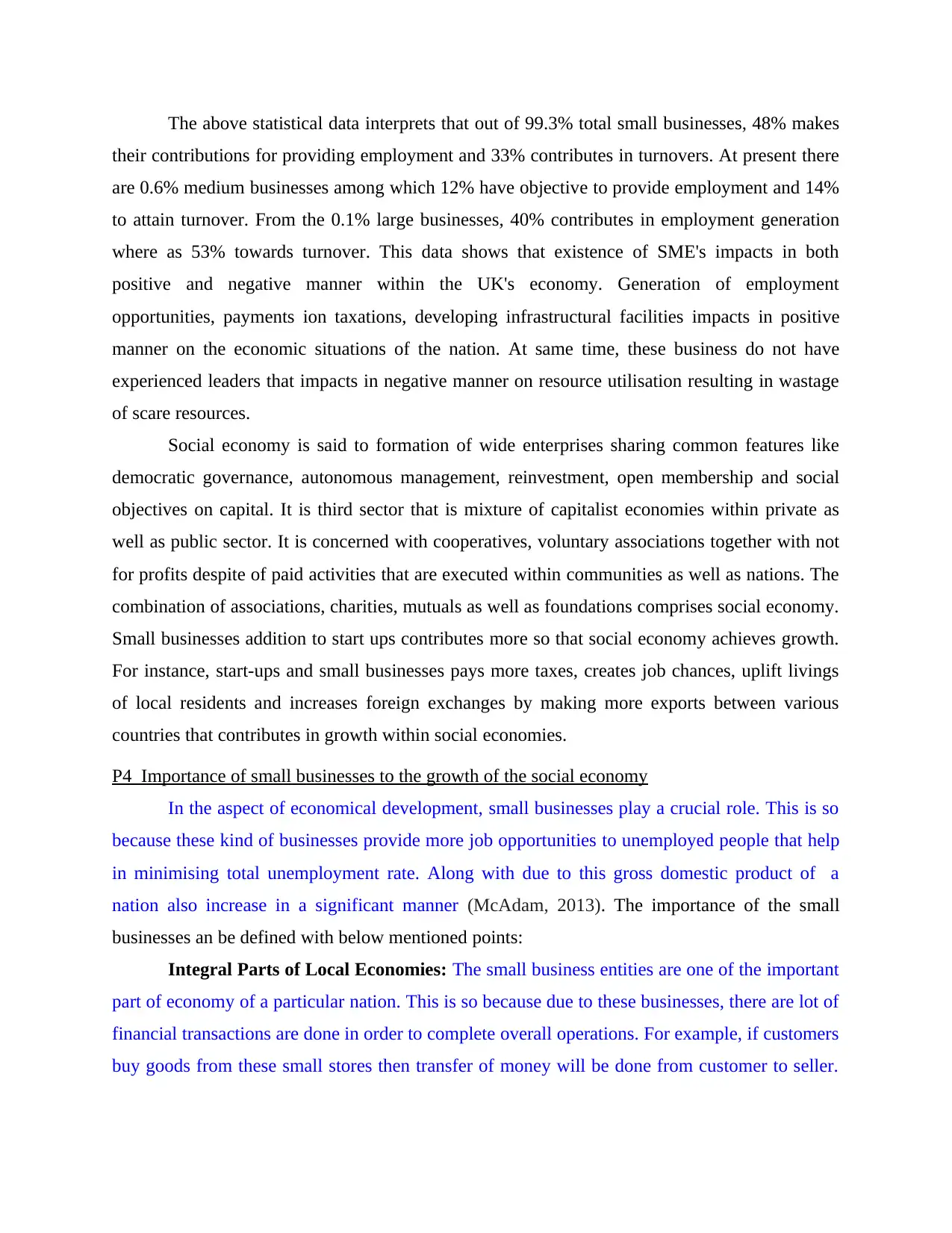
The above statistical data interprets that out of 99.3% total small businesses, 48% makes
their contributions for providing employment and 33% contributes in turnovers. At present there
are 0.6% medium businesses among which 12% have objective to provide employment and 14%
to attain turnover. From the 0.1% large businesses, 40% contributes in employment generation
where as 53% towards turnover. This data shows that existence of SME's impacts in both
positive and negative manner within the UK's economy. Generation of employment
opportunities, payments ion taxations, developing infrastructural facilities impacts in positive
manner on the economic situations of the nation. At same time, these business do not have
experienced leaders that impacts in negative manner on resource utilisation resulting in wastage
of scare resources.
Social economy is said to formation of wide enterprises sharing common features like
democratic governance, autonomous management, reinvestment, open membership and social
objectives on capital. It is third sector that is mixture of capitalist economies within private as
well as public sector. It is concerned with cooperatives, voluntary associations together with not
for profits despite of paid activities that are executed within communities as well as nations. The
combination of associations, charities, mutuals as well as foundations comprises social economy.
Small businesses addition to start ups contributes more so that social economy achieves growth.
For instance, start-ups and small businesses pays more taxes, creates job chances, uplift livings
of local residents and increases foreign exchanges by making more exports between various
countries that contributes in growth within social economies.
P4 Importance of small businesses to the growth of the social economy
In the aspect of economical development, small businesses play a crucial role. This is so
because these kind of businesses provide more job opportunities to unemployed people that help
in minimising total unemployment rate. Along with due to this gross domestic product of a
nation also increase in a significant manner (McAdam, 2013). The importance of the small
businesses an be defined with below mentioned points:
Integral Parts of Local Economies: The small business entities are one of the important
part of economy of a particular nation. This is so because due to these businesses, there are lot of
financial transactions are done in order to complete overall operations. For example, if customers
buy goods from these small stores then transfer of money will be done from customer to seller.
their contributions for providing employment and 33% contributes in turnovers. At present there
are 0.6% medium businesses among which 12% have objective to provide employment and 14%
to attain turnover. From the 0.1% large businesses, 40% contributes in employment generation
where as 53% towards turnover. This data shows that existence of SME's impacts in both
positive and negative manner within the UK's economy. Generation of employment
opportunities, payments ion taxations, developing infrastructural facilities impacts in positive
manner on the economic situations of the nation. At same time, these business do not have
experienced leaders that impacts in negative manner on resource utilisation resulting in wastage
of scare resources.
Social economy is said to formation of wide enterprises sharing common features like
democratic governance, autonomous management, reinvestment, open membership and social
objectives on capital. It is third sector that is mixture of capitalist economies within private as
well as public sector. It is concerned with cooperatives, voluntary associations together with not
for profits despite of paid activities that are executed within communities as well as nations. The
combination of associations, charities, mutuals as well as foundations comprises social economy.
Small businesses addition to start ups contributes more so that social economy achieves growth.
For instance, start-ups and small businesses pays more taxes, creates job chances, uplift livings
of local residents and increases foreign exchanges by making more exports between various
countries that contributes in growth within social economies.
P4 Importance of small businesses to the growth of the social economy
In the aspect of economical development, small businesses play a crucial role. This is so
because these kind of businesses provide more job opportunities to unemployed people that help
in minimising total unemployment rate. Along with due to this gross domestic product of a
nation also increase in a significant manner (McAdam, 2013). The importance of the small
businesses an be defined with below mentioned points:
Integral Parts of Local Economies: The small business entities are one of the important
part of economy of a particular nation. This is so because due to these businesses, there are lot of
financial transactions are done in order to complete overall operations. For example, if customers
buy goods from these small stores then transfer of money will be done from customer to seller.
Along with seller transfer the money to employees who work in small businesses. This supply
chain overall leads to become small businesses as internal part of economy.
Contributing to Local Government with Taxes : In addition, the small businesses play
an important role in the context of contributing local government of any particular nation in
which these businesses exist. It becomes possible because whenever a customers frequently buy
products and services from small businesses then overall revenues of companies increase. As a
result these small businesses pay higher amount of taxes to their government. It overall helps to
government in getting more funds for development of nation in which these small businesses
exists. On the other hand, if these small businesses will not pay taxes then it can be difficult for
government to ensure proper development.
Create Meaningful Jobs: This is one of the key benefit of small businesses that is
related with providing jobs to unemployed persons (Read, Sarasvathy, Dew and Wiltbank,
2016). As per the recent trends, most of the private jobs are offered by these small businesses.
Eventually, if individuals will have job then per person income ratio will increase and this can
lead to economical growth of that nation.
TASK 3
P5 Characteristics traits and skills of successful entrepreneurs
Entrepreneur are individuals who is involved in organising and operating a business
activity based on original idea by taking risk more than normal financial risk in order to become
successful and earn more and more profits. Operating a business as entrepreneur there must be
certain characteristics which make entrepreneur different from that of managers in business.
Some of such characteristics are as follows-
Risk Takers: A entrepreneur while operating business in challenging and competitive
business environment perform activities as risk takers. All the risk related to success and failure
of business lies with that of the owner and this makes an entrepreneur different from managers as
they does not bear any risk in business.
Motivation: An entrepreneur make goals and objective for business that needs to be
achieved in a specific time duration. Achievement of these set goals in business acts as a
motivational tool for entrepreneur and motivate them towards developing some new goals to
achieve for business success (Tornikoski and Maalaoui, 2019). For managers power that comes
chain overall leads to become small businesses as internal part of economy.
Contributing to Local Government with Taxes : In addition, the small businesses play
an important role in the context of contributing local government of any particular nation in
which these businesses exist. It becomes possible because whenever a customers frequently buy
products and services from small businesses then overall revenues of companies increase. As a
result these small businesses pay higher amount of taxes to their government. It overall helps to
government in getting more funds for development of nation in which these small businesses
exists. On the other hand, if these small businesses will not pay taxes then it can be difficult for
government to ensure proper development.
Create Meaningful Jobs: This is one of the key benefit of small businesses that is
related with providing jobs to unemployed persons (Read, Sarasvathy, Dew and Wiltbank,
2016). As per the recent trends, most of the private jobs are offered by these small businesses.
Eventually, if individuals will have job then per person income ratio will increase and this can
lead to economical growth of that nation.
TASK 3
P5 Characteristics traits and skills of successful entrepreneurs
Entrepreneur are individuals who is involved in organising and operating a business
activity based on original idea by taking risk more than normal financial risk in order to become
successful and earn more and more profits. Operating a business as entrepreneur there must be
certain characteristics which make entrepreneur different from that of managers in business.
Some of such characteristics are as follows-
Risk Takers: A entrepreneur while operating business in challenging and competitive
business environment perform activities as risk takers. All the risk related to success and failure
of business lies with that of the owner and this makes an entrepreneur different from managers as
they does not bear any risk in business.
Motivation: An entrepreneur make goals and objective for business that needs to be
achieved in a specific time duration. Achievement of these set goals in business acts as a
motivational tool for entrepreneur and motivate them towards developing some new goals to
achieve for business success (Tornikoski and Maalaoui, 2019). For managers power that comes
⊘ This is a preview!⊘
Do you want full access?
Subscribe today to unlock all pages.
Trusted by 1+ million students worldwide
with their position acts as a motivational tool and this makes a huge difference in managers and
owner of a business.
Flexibility: To be successful and effective in achieving goals and objectives in business
entrepreneurs possess a certain level of flexibility. This flexibility is because of the network or
relation that is developed by managers with others involved in business. This helps in taking
more accurate decisions to entrepreneurs. Managers needs to perform their part of activity in
specific limits of responsibilities provided to them this creates rigid behaviour among managers
and make them different form entrepreneur.
Responsibility: Entrepreneur in a business is responsible for all the actions taken by
business organisation in all the departments for conducting business operations. On the other
hand managers are responsible for their part of responsibility and this creates a difference among
managers and owners.
P6: Assess how aspects of the entrepreneurial personality reflect entrepreneurial motivation and
mindset
Entrepreneur personality represent the trait as well as skills of the particular individual
that help them to differentiate from the others. As they remain keen to analyse the external
environment and identify the opportunity that can be used by the firm to gain huge amount of
revenue. This aspect determine the mindset of the employees that motivate them to derive
innovation and faces the ongoing changes for the adequate functioning of business. Some of the
trait of these charismatic leader is that they have creative thinking and risk taking ability. Thus,
some of the essential component are described below:
Openness: It involve certain trait like imaginative thinking and innovation that
effectively assist the entrepreneur to success and attain long term success. These trait are adopted
by the well entrepreneur like Gates & Larry Page to remain motivated and attain the overall
objective effectively.
Conscientiousness: The role of entrepreneur are highly recognised everywhere because
the have the ability to do hard work and systematically organize the work that encourage them to
build positive mindset towards their objective (Wood, Davidson and Fielden, 2012).
Extraversion: It is the state which involve activities such as assertive, enthusiastic, and
being gregarious. All these emotional aspect energies the entrepreneur like Bill Gates & Larry
Page to overcome the day to day issues and carry out the functioning smoothly.
owner of a business.
Flexibility: To be successful and effective in achieving goals and objectives in business
entrepreneurs possess a certain level of flexibility. This flexibility is because of the network or
relation that is developed by managers with others involved in business. This helps in taking
more accurate decisions to entrepreneurs. Managers needs to perform their part of activity in
specific limits of responsibilities provided to them this creates rigid behaviour among managers
and make them different form entrepreneur.
Responsibility: Entrepreneur in a business is responsible for all the actions taken by
business organisation in all the departments for conducting business operations. On the other
hand managers are responsible for their part of responsibility and this creates a difference among
managers and owners.
P6: Assess how aspects of the entrepreneurial personality reflect entrepreneurial motivation and
mindset
Entrepreneur personality represent the trait as well as skills of the particular individual
that help them to differentiate from the others. As they remain keen to analyse the external
environment and identify the opportunity that can be used by the firm to gain huge amount of
revenue. This aspect determine the mindset of the employees that motivate them to derive
innovation and faces the ongoing changes for the adequate functioning of business. Some of the
trait of these charismatic leader is that they have creative thinking and risk taking ability. Thus,
some of the essential component are described below:
Openness: It involve certain trait like imaginative thinking and innovation that
effectively assist the entrepreneur to success and attain long term success. These trait are adopted
by the well entrepreneur like Gates & Larry Page to remain motivated and attain the overall
objective effectively.
Conscientiousness: The role of entrepreneur are highly recognised everywhere because
the have the ability to do hard work and systematically organize the work that encourage them to
build positive mindset towards their objective (Wood, Davidson and Fielden, 2012).
Extraversion: It is the state which involve activities such as assertive, enthusiastic, and
being gregarious. All these emotional aspect energies the entrepreneur like Bill Gates & Larry
Page to overcome the day to day issues and carry out the functioning smoothly.
Paraphrase This Document
Need a fresh take? Get an instant paraphrase of this document with our AI Paraphraser
Agreeableness: There are certain characteristic like generous attitude, honesty, kindness
and so on which is essential for an entrepreneur to have because due to this they will be able to
attract the interest of employee to perform all the task co-operatively.
Neuroticism: Certain entrepreneurs like Larry Page and Bill Gates are high neuroticism
that mean they have effectively handled the different circumstances smoothly. They are simply
emotional stable in terms of facing the hindrance and overcome them effectively.
TASK 4
P7: Examine, using relevant examples, how background and experience can hinder or foster
entrepreneurship
Background or experiences include the education and the role of family that function
together to develop the business as well as motivate employee to attain the successful position
within society (Long and Chrisman, 2014). This is explained through the examples of two
successful entrepreneurs which is described below:
Larry page
Background: Larry Page was the co-founder of Google that is known all over the globe
because of their innovative thinking ability. He was born in Michigan United State and is a great
American computer scientist. He constantly deal with different circumstances and due to the
immense support from the family he kept on doing the creative activities. Like, after resigning
from Google, he became the CEO of Alphabet. Today he is one of rich person in world with the
net worth of around $49.1 billion.
Experience: Initially, Larry Page see various struggles like in comparison to the other he
was not that popular. Also his experiments and innovative does not always helped the person to
gain the affirmative result. But later on the strong support from the family member and his hard
work assisted him to become as a well known entrepreneur.
Bill Gates:
Background: Bill gates was the founder of Microsoft that was born in 1955 at America.
He was fond of using the technology due to which his struggles and consistent effort assisted him
to introduce the software.
and so on which is essential for an entrepreneur to have because due to this they will be able to
attract the interest of employee to perform all the task co-operatively.
Neuroticism: Certain entrepreneurs like Larry Page and Bill Gates are high neuroticism
that mean they have effectively handled the different circumstances smoothly. They are simply
emotional stable in terms of facing the hindrance and overcome them effectively.
TASK 4
P7: Examine, using relevant examples, how background and experience can hinder or foster
entrepreneurship
Background or experiences include the education and the role of family that function
together to develop the business as well as motivate employee to attain the successful position
within society (Long and Chrisman, 2014). This is explained through the examples of two
successful entrepreneurs which is described below:
Larry page
Background: Larry Page was the co-founder of Google that is known all over the globe
because of their innovative thinking ability. He was born in Michigan United State and is a great
American computer scientist. He constantly deal with different circumstances and due to the
immense support from the family he kept on doing the creative activities. Like, after resigning
from Google, he became the CEO of Alphabet. Today he is one of rich person in world with the
net worth of around $49.1 billion.
Experience: Initially, Larry Page see various struggles like in comparison to the other he
was not that popular. Also his experiments and innovative does not always helped the person to
gain the affirmative result. But later on the strong support from the family member and his hard
work assisted him to become as a well known entrepreneur.
Bill Gates:
Background: Bill gates was the founder of Microsoft that was born in 1955 at America.
He was fond of using the technology due to which his struggles and consistent effort assisted him
to introduce the software.
Experience: The background of the Bill Gates was not that strong due to which he faces
certain challenges to invest time and fund in order to run the business. But he had the strong
vision due to which he they never give up all his efforts in order to makes his goal attainable.
CONCLUSION
With the help of this report, it can be concluded today's industries, business and
organizations are not capable to provide employment to such huge population. It is necessary to
develop and grow new businesses and ventures that can provide more employment to the
economy. Entrepreneurs nowadays with their characteristics, traits and creative skills are capable
to create new business ideas and start new ventures which have different objectives and aims to
fulfil organizational and societal needs and requirements. These entrepreneurial businesses are
having huge impact over the growth of the economy and making the globalization more useful
and effective.
certain challenges to invest time and fund in order to run the business. But he had the strong
vision due to which he they never give up all his efforts in order to makes his goal attainable.
CONCLUSION
With the help of this report, it can be concluded today's industries, business and
organizations are not capable to provide employment to such huge population. It is necessary to
develop and grow new businesses and ventures that can provide more employment to the
economy. Entrepreneurs nowadays with their characteristics, traits and creative skills are capable
to create new business ideas and start new ventures which have different objectives and aims to
fulfil organizational and societal needs and requirements. These entrepreneurial businesses are
having huge impact over the growth of the economy and making the globalization more useful
and effective.
⊘ This is a preview!⊘
Do you want full access?
Subscribe today to unlock all pages.
Trusted by 1+ million students worldwide

1 out of 13


Related Documents


Your All-in-One AI-Powered Toolkit for Academic Success.
+13062052269
info@desklib.com
Available 24*7 on WhatsApp / Email
![[object Object]](/_next/static/media/star-bottom.7253800d.svg)
Unlock your academic potential
Copyright © 2020–2026 A2Z Services. All Rights Reserved. Developed and managed by ZUCOL.