Entrepreneurship Report: Ventures, Impact, Mindset, and Brexit
VerifiedAdded on 2021/01/02
|16
|4776
|357
Report
AI Summary
This report provides a comprehensive overview of entrepreneurship, examining different types of ventures, including small business entrepreneurship, scalable start-up entrepreneurship, large company entrepreneurship, and social entrepreneurship. It explores the similarities and differences between male and female entrepreneurs, as well as the distinctions between social and large company entrepreneurship. The report also delves into the interpretation of data and statistics to illustrate the impact of micro and small businesses on the economy, highlighting their significant contribution to employment and turnover. Furthermore, it discusses the potential contribution of small businesses and start-ups to the growth of the social economy after Brexit. The report concludes by analyzing the characteristics, traits, skills, motivations, and mindsets of successful entrepreneurs, along with background experiences that can foster entrepreneurship.
Entrepreneurship

Paraphrase This Document
Need a fresh take? Get an instant paraphrase of this document with our AI Paraphraser
Table of Contents
INTRODUCTION...........................................................................................................................1
TASK 1............................................................................................................................................1
P1 Different types of entrepreneurship ventures and its relation with typology.........................1
P2 Similarities and differences between entrepreneurial ventures.............................................3
TASK 2............................................................................................................................................5
P3 Interpretation of data and statistics for illustrating micro and small business impact on
economy......................................................................................................................................5
P4 Important small businesses and business start –ups will contribute to the growth of the
social economy after ‘Brexit.......................................................................................................6
TASK 3............................................................................................................................................8
P5 Characteristics traits, skills of two successful entrepreneurs.................................................8
P6 Reflection on entrepreneurial motivation and mindset .........................................................9
TASK 4..........................................................................................................................................10
P7 Background and experience which can foster entrepreneurship..........................................10
CONCLUSION..............................................................................................................................11
REFERENCES..............................................................................................................................12
INTRODUCTION...........................................................................................................................1
TASK 1............................................................................................................................................1
P1 Different types of entrepreneurship ventures and its relation with typology.........................1
P2 Similarities and differences between entrepreneurial ventures.............................................3
TASK 2............................................................................................................................................5
P3 Interpretation of data and statistics for illustrating micro and small business impact on
economy......................................................................................................................................5
P4 Important small businesses and business start –ups will contribute to the growth of the
social economy after ‘Brexit.......................................................................................................6
TASK 3............................................................................................................................................8
P5 Characteristics traits, skills of two successful entrepreneurs.................................................8
P6 Reflection on entrepreneurial motivation and mindset .........................................................9
TASK 4..........................................................................................................................................10
P7 Background and experience which can foster entrepreneurship..........................................10
CONCLUSION..............................................................................................................................11
REFERENCES..............................................................................................................................12

⊘ This is a preview!⊘
Do you want full access?
Subscribe today to unlock all pages.

Trusted by 1+ million students worldwide
INTRODUCTION
Entrepreneurs are referred to the one who instead of working as an employee in an
organisation work independently. They have appropriate skills and knowledge which assist
company in anticipating current as well as future needs. Entrepreneurs who want to become
successful take risk of start-ups and tend to grab growth opportunities that are present in business
environment (Blackburn, Hart and Wainwright, 2013). Present report will focus on range of
ventures types which might be considered entrepreneurial. In addition to this, impact of small
business on the economy is included in this. Other than this, key aspects of an entrepreneurial
mindset is mentioned in this assignment. Lastly, different environment which can hinder the
process of entrepreneurship is involved in this report.
TASK 1
P1 Different types of entrepreneurship ventures and its relation with typology
Entrepreneurs are the individual who start a new business and take initiative of profit and
loss on their own (What is an Entrepreneur, 2017). Entrepreneurship can be defined as an
activity in which an entrepreneur set up his/her business and take risk for business by their own.
In terms of entrepreneurship ventures, these are categorised into four types which are explained
below:
Small Business Entrepreneurship: Today, number of small business entrepreneurs has
increased in overwhelming figures in United Kingdom. There have been around 5.4 million
small business in United Kingdom and they are making contribution of nearby 99.7% in the
economy of UK. Small Business entrepreneurship majorly includes grocery stores, travel agents,
plumbers, electricians etc. who run their business by their own. Moreover, for operating its
business, entrepreneurs hire local or family members. Their prime concern of running this is to
feed the family and make some kind of profits. As these companies are small so they doesn't
have efficient scale of attracting capital venture and moreover take loans from friends and
family.
Scalable Start-up Entrepreneurship: Aim of Scalable Start-ups is higher and
entrepreneurs who work in this believes that their business ideas can change the world.
Therefore, entrepreneurship who start this kind of enterprise work with a vision of occupying a
large number of market share in limited time frame. In addition to this, for operating their
1
Entrepreneurs are referred to the one who instead of working as an employee in an
organisation work independently. They have appropriate skills and knowledge which assist
company in anticipating current as well as future needs. Entrepreneurs who want to become
successful take risk of start-ups and tend to grab growth opportunities that are present in business
environment (Blackburn, Hart and Wainwright, 2013). Present report will focus on range of
ventures types which might be considered entrepreneurial. In addition to this, impact of small
business on the economy is included in this. Other than this, key aspects of an entrepreneurial
mindset is mentioned in this assignment. Lastly, different environment which can hinder the
process of entrepreneurship is involved in this report.
TASK 1
P1 Different types of entrepreneurship ventures and its relation with typology
Entrepreneurs are the individual who start a new business and take initiative of profit and
loss on their own (What is an Entrepreneur, 2017). Entrepreneurship can be defined as an
activity in which an entrepreneur set up his/her business and take risk for business by their own.
In terms of entrepreneurship ventures, these are categorised into four types which are explained
below:
Small Business Entrepreneurship: Today, number of small business entrepreneurs has
increased in overwhelming figures in United Kingdom. There have been around 5.4 million
small business in United Kingdom and they are making contribution of nearby 99.7% in the
economy of UK. Small Business entrepreneurship majorly includes grocery stores, travel agents,
plumbers, electricians etc. who run their business by their own. Moreover, for operating its
business, entrepreneurs hire local or family members. Their prime concern of running this is to
feed the family and make some kind of profits. As these companies are small so they doesn't
have efficient scale of attracting capital venture and moreover take loans from friends and
family.
Scalable Start-up Entrepreneurship: Aim of Scalable Start-ups is higher and
entrepreneurs who work in this believes that their business ideas can change the world.
Therefore, entrepreneurship who start this kind of enterprise work with a vision of occupying a
large number of market share in limited time frame. In addition to this, for operating their
1
Paraphrase This Document
Need a fresh take? Get an instant paraphrase of this document with our AI Paraphraser
business, they hire eligible candidates who are skilled enough in performing their activities
(Bridge and O'Neill, 2012). Main purpose of companies comes under scalable start-ups is to
develop business models and than follow them for getting better results.
Large Company Entrepreneurship: Enterprise that comes under this are often large in
size and have different branches in various locations. These firm offer new commodities which
are variants of its core products. Large companies work as per the choices and preferences of
customers, products provided by competitors so that firm can give best as compared to rival
enterprises.
Social Entrepreneurship: Companies that comes under this, mainly work with the
motive of solving social needs and problems of people. Like Scalable Start-ups their major goal
is to make society a better place to live. Thus, social entrepreneurship work with a purpose of
non-profit, for-profit or hybrid. For the economy of United Kingdom, social enterprises is
working as a standing feature as they are substantially making contribution in the generating
more and more revenues for the country.
Different kinds of ventures
Serial Entrepreneurs: Entrepreneurs working as a serial entrepreneurs, first set up their
business and bring their company to the stage of development from where they can move
towards other business whether by selling or finding a successors.
Lifestyle Entrepreneurs: These entrepreneurs opt for a business through which they can
reflect and show their passions instead of working with a motive of gaining profit. For their
business operations they make deliberate choices for example: giving time to their families and
children as well rather than focussing entirely on their business and passion.
Typologies of Entrepreneurship
Social Entrepreneurs: This sector of entrepreneurs are growing in rapid speed and they
are playing their important role in creating a good cause in the society. For the economy of
United Kingdom, Social enterprises is working as a standing feature as they are substantially
making contribution in the generating more and more revenues for the country. Thus, they are
the one who work after recognising the problems which are there in the society (Carsrud and
Brännback, 2011).
Solopreneurs: They work as a 'one man army' and operate business by their own without
any external forces. Apart from this, it has also been analysed that a solopreneur majorly
2
(Bridge and O'Neill, 2012). Main purpose of companies comes under scalable start-ups is to
develop business models and than follow them for getting better results.
Large Company Entrepreneurship: Enterprise that comes under this are often large in
size and have different branches in various locations. These firm offer new commodities which
are variants of its core products. Large companies work as per the choices and preferences of
customers, products provided by competitors so that firm can give best as compared to rival
enterprises.
Social Entrepreneurship: Companies that comes under this, mainly work with the
motive of solving social needs and problems of people. Like Scalable Start-ups their major goal
is to make society a better place to live. Thus, social entrepreneurship work with a purpose of
non-profit, for-profit or hybrid. For the economy of United Kingdom, social enterprises is
working as a standing feature as they are substantially making contribution in the generating
more and more revenues for the country.
Different kinds of ventures
Serial Entrepreneurs: Entrepreneurs working as a serial entrepreneurs, first set up their
business and bring their company to the stage of development from where they can move
towards other business whether by selling or finding a successors.
Lifestyle Entrepreneurs: These entrepreneurs opt for a business through which they can
reflect and show their passions instead of working with a motive of gaining profit. For their
business operations they make deliberate choices for example: giving time to their families and
children as well rather than focussing entirely on their business and passion.
Typologies of Entrepreneurship
Social Entrepreneurs: This sector of entrepreneurs are growing in rapid speed and they
are playing their important role in creating a good cause in the society. For the economy of
United Kingdom, Social enterprises is working as a standing feature as they are substantially
making contribution in the generating more and more revenues for the country. Thus, they are
the one who work after recognising the problems which are there in the society (Carsrud and
Brännback, 2011).
Solopreneurs: They work as a 'one man army' and operate business by their own without
any external forces. Apart from this, it has also been analysed that a solopreneur majorly
2
manages all the business activities of a business firm by his/her own. This individual stays
dependent over internet, email, VOIP and other related factors which helps in becoming a
multitasker.
Male entrepreneur: Male entrepreneur have high confidence level and tends to make
quick decisions for launching a business. They grow faster and more ambitious as well as a self-
promotion business tycoons. Apart from female counterpart, they do well and seek go long in
their businesses.
Female entrepreneur: Female entrepreneurs are comparatively more creative and tend to
do proper research for opening a business. Before commitment, they tend to re-think about a
situation and set business on good foundations (George and Bock, 2011).
P2 Similarities and differences between entrepreneurial ventures
Similarities between male and female entrepreneurs.
Males are more ambitious about their business which supports them in achieving their
targeted goals and objectives. On the other hand, Female entrepreneurs are also focused
towards work that helps in completing their task more effectively.
Both male and female entrepreneurs are leading their staff for achieving their targets. As
they own leadership skill and uses it in persuading team to become successful.
Difference between male and female entrepreneurs.
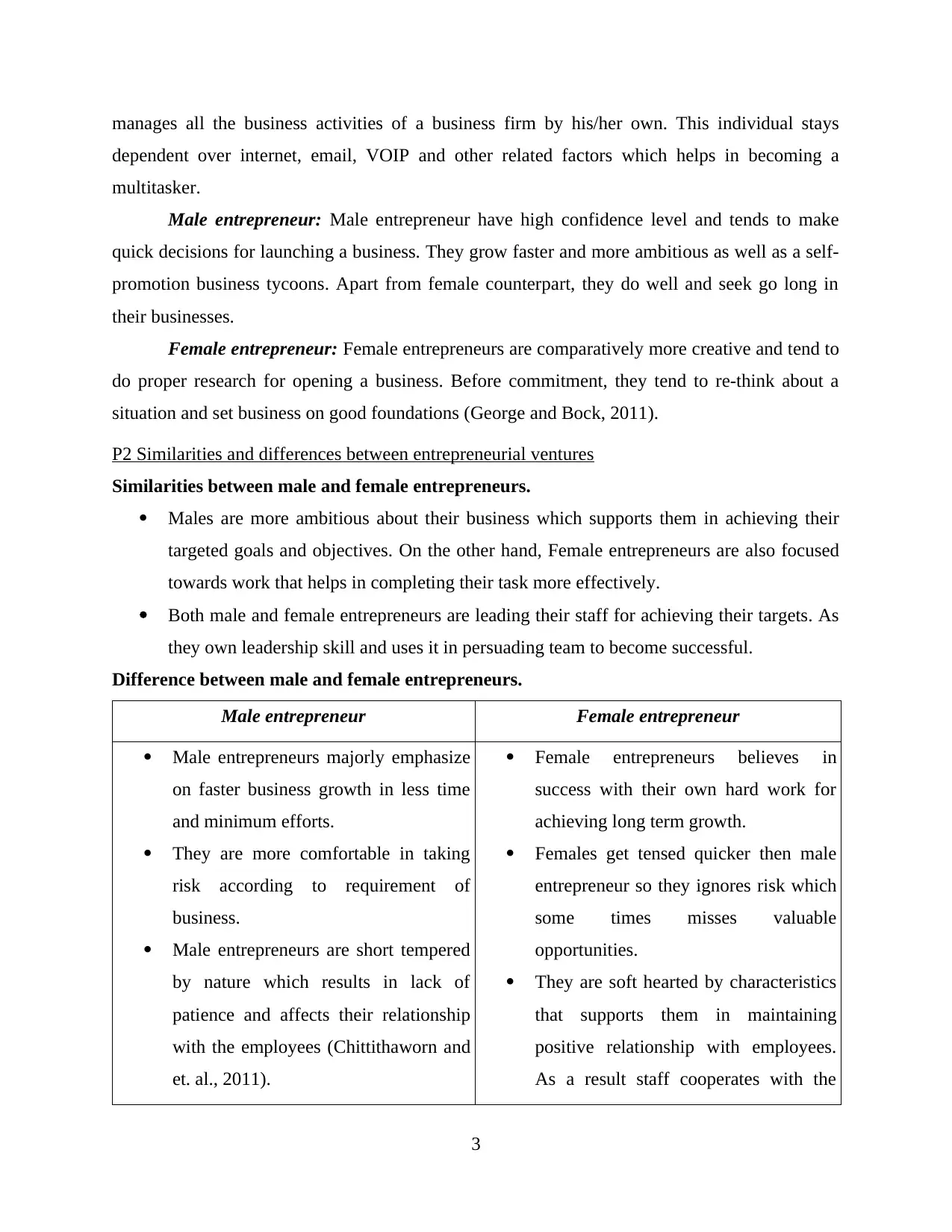
Male entrepreneur Female entrepreneur
Male entrepreneurs majorly emphasize
on faster business growth in less time
and minimum efforts.
They are more comfortable in taking
risk according to requirement of
business.
Male entrepreneurs are short tempered
by nature which results in lack of
patience and affects their relationship
with the employees (Chittithaworn and
et. al., 2011).
Female entrepreneurs believes in
success with their own hard work for
achieving long term growth.
Females get tensed quicker then male
entrepreneur so they ignores risk which
some times misses valuable
opportunities.
They are soft hearted by characteristics
that supports them in maintaining
positive relationship with employees.
As a result staff cooperates with the
3
dependent over internet, email, VOIP and other related factors which helps in becoming a
multitasker.
Male entrepreneur: Male entrepreneur have high confidence level and tends to make
quick decisions for launching a business. They grow faster and more ambitious as well as a self-
promotion business tycoons. Apart from female counterpart, they do well and seek go long in
their businesses.
Female entrepreneur: Female entrepreneurs are comparatively more creative and tend to
do proper research for opening a business. Before commitment, they tend to re-think about a
situation and set business on good foundations (George and Bock, 2011).
P2 Similarities and differences between entrepreneurial ventures
Similarities between male and female entrepreneurs.
Males are more ambitious about their business which supports them in achieving their
targeted goals and objectives. On the other hand, Female entrepreneurs are also focused
towards work that helps in completing their task more effectively.
Both male and female entrepreneurs are leading their staff for achieving their targets. As
they own leadership skill and uses it in persuading team to become successful.
Difference between male and female entrepreneurs.
Male entrepreneur Female entrepreneur
Male entrepreneurs majorly emphasize
on faster business growth in less time
and minimum efforts.
They are more comfortable in taking
risk according to requirement of
business.
Male entrepreneurs are short tempered
by nature which results in lack of
patience and affects their relationship
with the employees (Chittithaworn and
et. al., 2011).
Female entrepreneurs believes in
success with their own hard work for
achieving long term growth.
Females get tensed quicker then male
entrepreneur so they ignores risk which
some times misses valuable
opportunities.
They are soft hearted by characteristics
that supports them in maintaining
positive relationship with employees.
As a result staff cooperates with the
3
⊘ This is a preview!⊘
Do you want full access?
Subscribe today to unlock all pages.
Trusted by 1+ million students worldwide
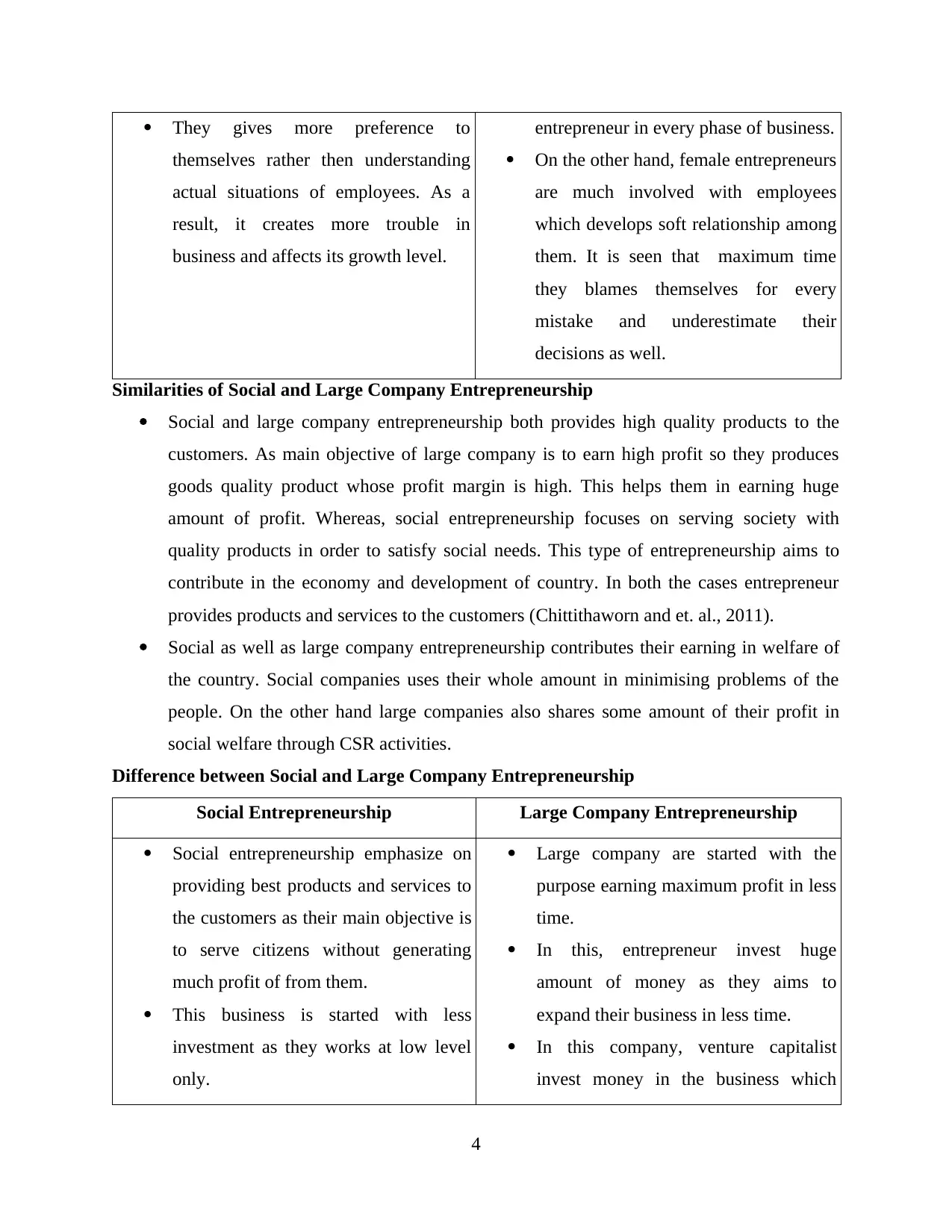
They gives more preference to
themselves rather then understanding
actual situations of employees. As a
result, it creates more trouble in
business and affects its growth level.
entrepreneur in every phase of business.
On the other hand, female entrepreneurs
are much involved with employees
which develops soft relationship among
them. It is seen that maximum time
they blames themselves for every
mistake and underestimate their
decisions as well.
Similarities of Social and Large Company Entrepreneurship
Social and large company entrepreneurship both provides high quality products to the
customers. As main objective of large company is to earn high profit so they produces
goods quality product whose profit margin is high. This helps them in earning huge
amount of profit. Whereas, social entrepreneurship focuses on serving society with
quality products in order to satisfy social needs. This type of entrepreneurship aims to
contribute in the economy and development of country. In both the cases entrepreneur
provides products and services to the customers (Chittithaworn and et. al., 2011).
Social as well as large company entrepreneurship contributes their earning in welfare of
the country. Social companies uses their whole amount in minimising problems of the
people. On the other hand large companies also shares some amount of their profit in
social welfare through CSR activities.
Difference between Social and Large Company Entrepreneurship
Social Entrepreneurship Large Company Entrepreneurship
Social entrepreneurship emphasize on
providing best products and services to
the customers as their main objective is
to serve citizens without generating
much profit of from them.
This business is started with less
investment as they works at low level
only.
Large company are started with the
purpose earning maximum profit in less
time.
In this, entrepreneur invest huge
amount of money as they aims to
expand their business in less time.
In this company, venture capitalist
invest money in the business which
4
themselves rather then understanding
actual situations of employees. As a
result, it creates more trouble in
business and affects its growth level.
entrepreneur in every phase of business.
On the other hand, female entrepreneurs
are much involved with employees
which develops soft relationship among
them. It is seen that maximum time
they blames themselves for every
mistake and underestimate their
decisions as well.
Similarities of Social and Large Company Entrepreneurship
Social and large company entrepreneurship both provides high quality products to the
customers. As main objective of large company is to earn high profit so they produces
goods quality product whose profit margin is high. This helps them in earning huge
amount of profit. Whereas, social entrepreneurship focuses on serving society with
quality products in order to satisfy social needs. This type of entrepreneurship aims to
contribute in the economy and development of country. In both the cases entrepreneur
provides products and services to the customers (Chittithaworn and et. al., 2011).
Social as well as large company entrepreneurship contributes their earning in welfare of
the country. Social companies uses their whole amount in minimising problems of the
people. On the other hand large companies also shares some amount of their profit in
social welfare through CSR activities.
Difference between Social and Large Company Entrepreneurship
Social Entrepreneurship Large Company Entrepreneurship
Social entrepreneurship emphasize on
providing best products and services to
the customers as their main objective is
to serve citizens without generating
much profit of from them.
This business is started with less
investment as they works at low level
only.
Large company are started with the
purpose earning maximum profit in less
time.
In this, entrepreneur invest huge
amount of money as they aims to
expand their business in less time.
In this company, venture capitalist
invest money in the business which
4
Paraphrase This Document
Need a fresh take? Get an instant paraphrase of this document with our AI Paraphraser
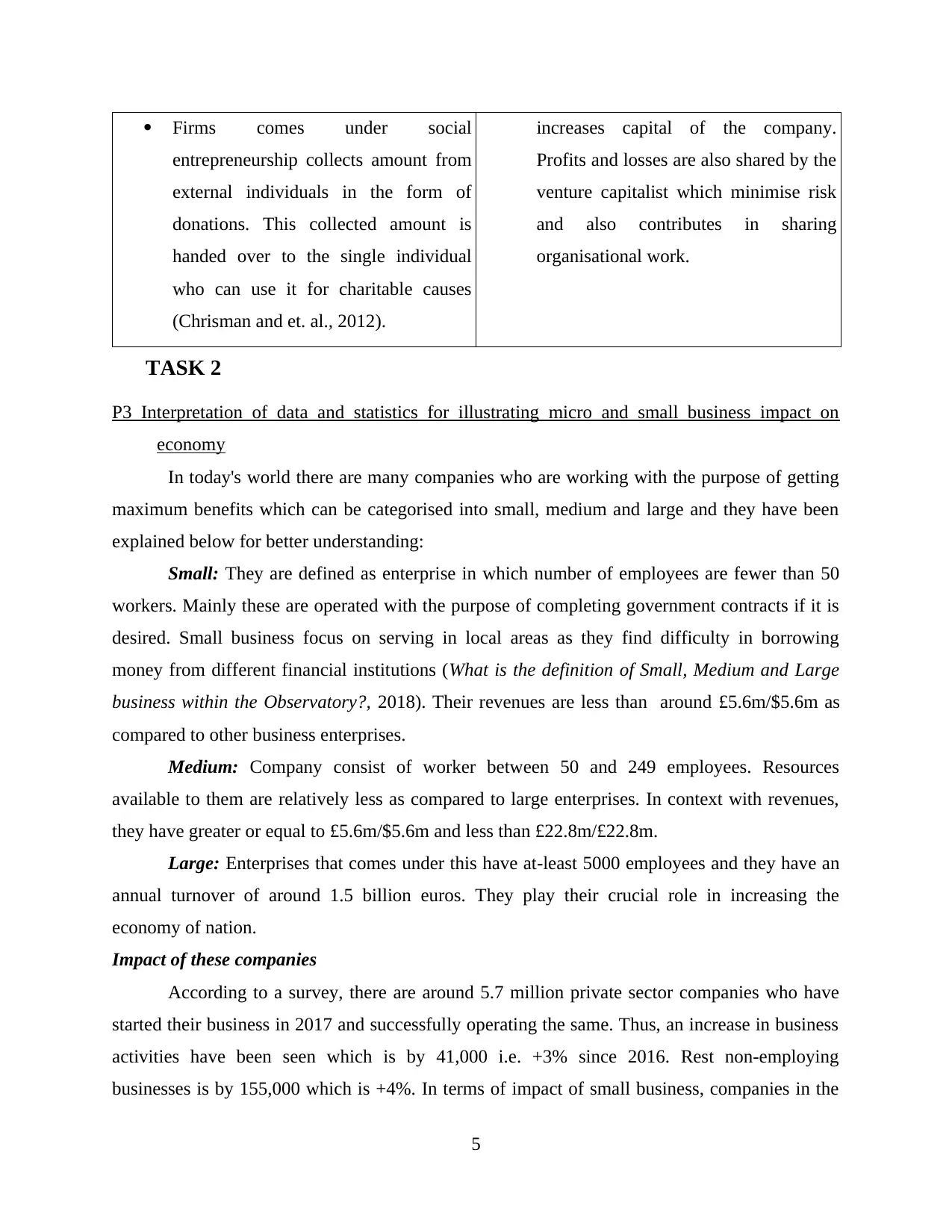
Firms comes under social
entrepreneurship collects amount from
external individuals in the form of
donations. This collected amount is
handed over to the single individual
who can use it for charitable causes
(Chrisman and et. al., 2012).
increases capital of the company.
Profits and losses are also shared by the
venture capitalist which minimise risk
and also contributes in sharing
organisational work.
TASK 2
P3 Interpretation of data and statistics for illustrating micro and small business impact on
economy
In today's world there are many companies who are working with the purpose of getting
maximum benefits which can be categorised into small, medium and large and they have been
explained below for better understanding:
Small: They are defined as enterprise in which number of employees are fewer than 50
workers. Mainly these are operated with the purpose of completing government contracts if it is
desired. Small business focus on serving in local areas as they find difficulty in borrowing
money from different financial institutions (What is the definition of Small, Medium and Large
business within the Observatory?, 2018). Their revenues are less than around £5.6m/$5.6m as
compared to other business enterprises.
Medium: Company consist of worker between 50 and 249 employees. Resources
available to them are relatively less as compared to large enterprises. In context with revenues,
they have greater or equal to £5.6m/$5.6m and less than £22.8m/£22.8m.
Large: Enterprises that comes under this have at-least 5000 employees and they have an
annual turnover of around 1.5 billion euros. They play their crucial role in increasing the
economy of nation.
Impact of these companies
According to a survey, there are around 5.7 million private sector companies who have
started their business in 2017 and successfully operating the same. Thus, an increase in business
activities have been seen which is by 41,000 i.e. +3% since 2016. Rest non-employing
businesses is by 155,000 which is +4%. In terms of impact of small business, companies in the
5
entrepreneurship collects amount from
external individuals in the form of
donations. This collected amount is
handed over to the single individual
who can use it for charitable causes
(Chrisman and et. al., 2012).
increases capital of the company.
Profits and losses are also shared by the
venture capitalist which minimise risk
and also contributes in sharing
organisational work.
TASK 2
P3 Interpretation of data and statistics for illustrating micro and small business impact on
economy
In today's world there are many companies who are working with the purpose of getting
maximum benefits which can be categorised into small, medium and large and they have been
explained below for better understanding:
Small: They are defined as enterprise in which number of employees are fewer than 50
workers. Mainly these are operated with the purpose of completing government contracts if it is
desired. Small business focus on serving in local areas as they find difficulty in borrowing
money from different financial institutions (What is the definition of Small, Medium and Large
business within the Observatory?, 2018). Their revenues are less than around £5.6m/$5.6m as
compared to other business enterprises.
Medium: Company consist of worker between 50 and 249 employees. Resources
available to them are relatively less as compared to large enterprises. In context with revenues,
they have greater or equal to £5.6m/$5.6m and less than £22.8m/£22.8m.
Large: Enterprises that comes under this have at-least 5000 employees and they have an
annual turnover of around 1.5 billion euros. They play their crucial role in increasing the
economy of nation.
Impact of these companies
According to a survey, there are around 5.7 million private sector companies who have
started their business in 2017 and successfully operating the same. Thus, an increase in business
activities have been seen which is by 41,000 i.e. +3% since 2016. Rest non-employing
businesses is by 155,000 which is +4%. In terms of impact of small business, companies in the
5
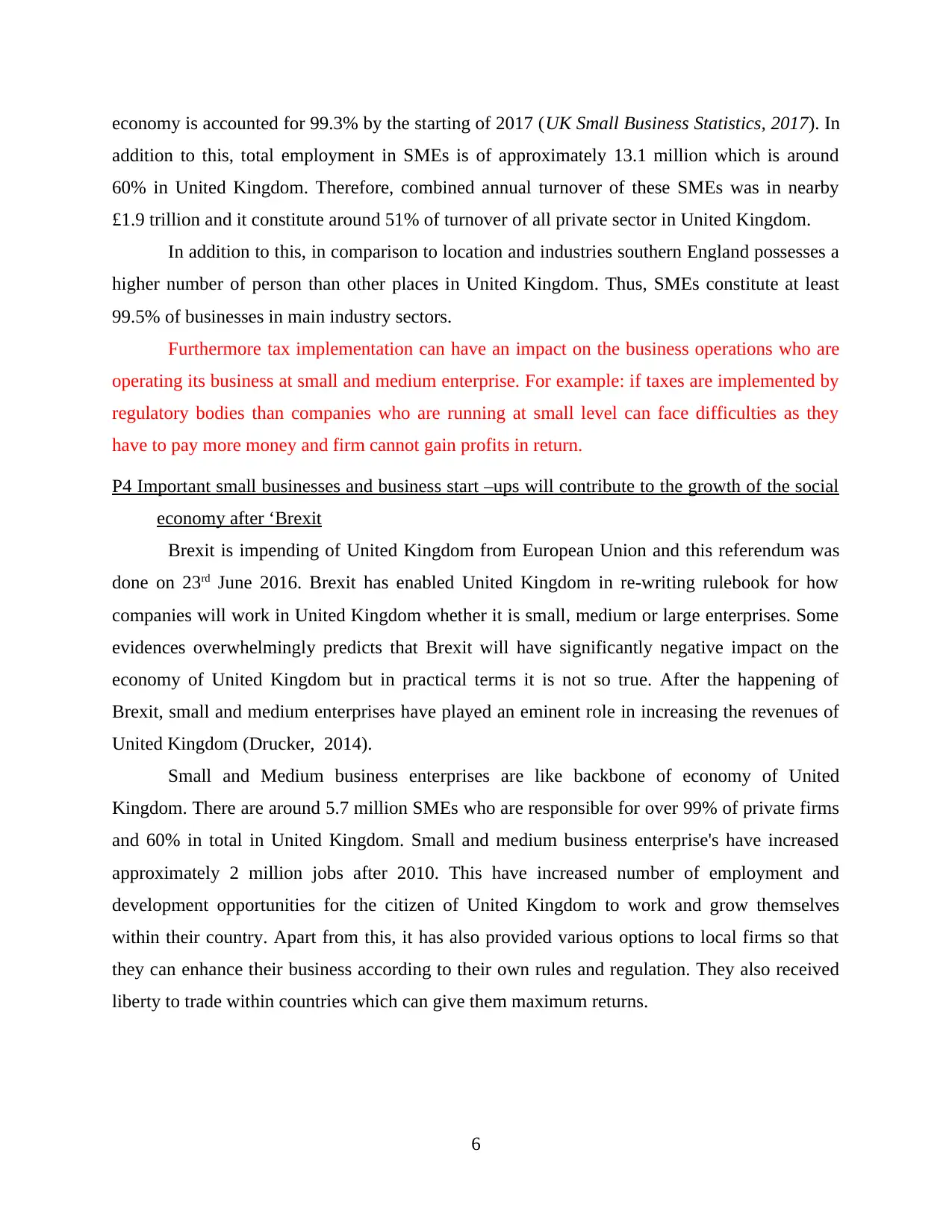
economy is accounted for 99.3% by the starting of 2017 (UK Small Business Statistics, 2017). In
addition to this, total employment in SMEs is of approximately 13.1 million which is around
60% in United Kingdom. Therefore, combined annual turnover of these SMEs was in nearby
£1.9 trillion and it constitute around 51% of turnover of all private sector in United Kingdom.
In addition to this, in comparison to location and industries southern England possesses a
higher number of person than other places in United Kingdom. Thus, SMEs constitute at least
99.5% of businesses in main industry sectors.
Furthermore tax implementation can have an impact on the business operations who are
operating its business at small and medium enterprise. For example: if taxes are implemented by
regulatory bodies than companies who are running at small level can face difficulties as they
have to pay more money and firm cannot gain profits in return.
P4 Important small businesses and business start –ups will contribute to the growth of the social
economy after ‘Brexit
Brexit is impending of United Kingdom from European Union and this referendum was
done on 23rd June 2016. Brexit has enabled United Kingdom in re-writing rulebook for how
companies will work in United Kingdom whether it is small, medium or large enterprises. Some
evidences overwhelmingly predicts that Brexit will have significantly negative impact on the
economy of United Kingdom but in practical terms it is not so true. After the happening of
Brexit, small and medium enterprises have played an eminent role in increasing the revenues of
United Kingdom (Drucker, 2014).
Small and Medium business enterprises are like backbone of economy of United
Kingdom. There are around 5.7 million SMEs who are responsible for over 99% of private firms
and 60% in total in United Kingdom. Small and medium business enterprise's have increased
approximately 2 million jobs after 2010. This have increased number of employment and
development opportunities for the citizen of United Kingdom to work and grow themselves
within their country. Apart from this, it has also provided various options to local firms so that
they can enhance their business according to their own rules and regulation. They also received
liberty to trade within countries which can give them maximum returns.
6
addition to this, total employment in SMEs is of approximately 13.1 million which is around
60% in United Kingdom. Therefore, combined annual turnover of these SMEs was in nearby
£1.9 trillion and it constitute around 51% of turnover of all private sector in United Kingdom.
In addition to this, in comparison to location and industries southern England possesses a
higher number of person than other places in United Kingdom. Thus, SMEs constitute at least
99.5% of businesses in main industry sectors.
Furthermore tax implementation can have an impact on the business operations who are
operating its business at small and medium enterprise. For example: if taxes are implemented by
regulatory bodies than companies who are running at small level can face difficulties as they
have to pay more money and firm cannot gain profits in return.
P4 Important small businesses and business start –ups will contribute to the growth of the social
economy after ‘Brexit
Brexit is impending of United Kingdom from European Union and this referendum was
done on 23rd June 2016. Brexit has enabled United Kingdom in re-writing rulebook for how
companies will work in United Kingdom whether it is small, medium or large enterprises. Some
evidences overwhelmingly predicts that Brexit will have significantly negative impact on the
economy of United Kingdom but in practical terms it is not so true. After the happening of
Brexit, small and medium enterprises have played an eminent role in increasing the revenues of
United Kingdom (Drucker, 2014).
Small and Medium business enterprises are like backbone of economy of United
Kingdom. There are around 5.7 million SMEs who are responsible for over 99% of private firms
and 60% in total in United Kingdom. Small and medium business enterprise's have increased
approximately 2 million jobs after 2010. This have increased number of employment and
development opportunities for the citizen of United Kingdom to work and grow themselves
within their country. Apart from this, it has also provided various options to local firms so that
they can enhance their business according to their own rules and regulation. They also received
liberty to trade within countries which can give them maximum returns.
6
⊘ This is a preview!⊘
Do you want full access?
Subscribe today to unlock all pages.
Trusted by 1+ million students worldwide
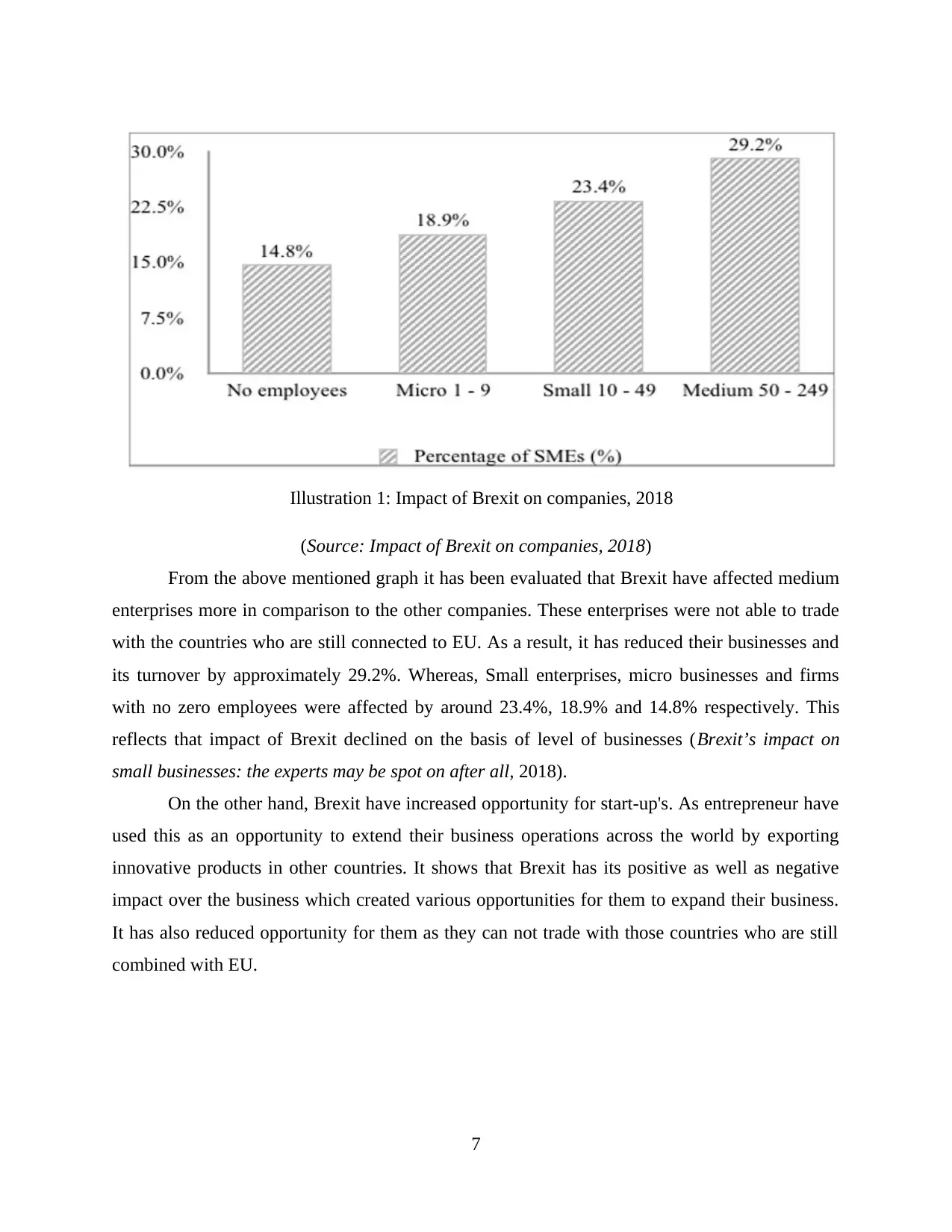
(Source: Impact of Brexit on companies, 2018)
From the above mentioned graph it has been evaluated that Brexit have affected medium
enterprises more in comparison to the other companies. These enterprises were not able to trade
with the countries who are still connected to EU. As a result, it has reduced their businesses and
its turnover by approximately 29.2%. Whereas, Small enterprises, micro businesses and firms
with no zero employees were affected by around 23.4%, 18.9% and 14.8% respectively. This
reflects that impact of Brexit declined on the basis of level of businesses (Brexit’s impact on
small businesses: the experts may be spot on after all, 2018).
On the other hand, Brexit have increased opportunity for start-up's. As entrepreneur have
used this as an opportunity to extend their business operations across the world by exporting
innovative products in other countries. It shows that Brexit has its positive as well as negative
impact over the business which created various opportunities for them to expand their business.
It has also reduced opportunity for them as they can not trade with those countries who are still
combined with EU.
7
Illustration 1: Impact of Brexit on companies, 2018
From the above mentioned graph it has been evaluated that Brexit have affected medium
enterprises more in comparison to the other companies. These enterprises were not able to trade
with the countries who are still connected to EU. As a result, it has reduced their businesses and
its turnover by approximately 29.2%. Whereas, Small enterprises, micro businesses and firms
with no zero employees were affected by around 23.4%, 18.9% and 14.8% respectively. This
reflects that impact of Brexit declined on the basis of level of businesses (Brexit’s impact on
small businesses: the experts may be spot on after all, 2018).
On the other hand, Brexit have increased opportunity for start-up's. As entrepreneur have
used this as an opportunity to extend their business operations across the world by exporting
innovative products in other countries. It shows that Brexit has its positive as well as negative
impact over the business which created various opportunities for them to expand their business.
It has also reduced opportunity for them as they can not trade with those countries who are still
combined with EU.
7
Illustration 1: Impact of Brexit on companies, 2018
Paraphrase This Document
Need a fresh take? Get an instant paraphrase of this document with our AI Paraphraser
TASK 3
P5 Characteristics traits, skills of two successful entrepreneurs
Skill refers to the ability of individual to perform assigned task in systematic manner
within given period of time. Whereas, traits can refer to inherent characteristic of individual
which they own from the birth and helps them in becoming kind human being. An entrepreneur
owns both trait as well as skills which helps them in becoming successful (Fassin, Van Rossem
and Buelens, 2011). Two of the most successful entrepreneurs who have changed the world are
Steve Jobs and Donald Trump. Both of them worked hard to convert their vision into reality.
Some of their essential skill and trait which contribute in their in their success are described
below:-
Skills of successful entrepreneurs:
Communication skill: Communication is the most essential skill which is required by an
entrepreneur to have. As this skills helps them in interacting with their teammates and also
motivates them to perform their work in effective manner. Communication skill helps an
entrepreneur in conveying their messages and vision with their employees so that they can
perform their work in similar direction. Steve Jobs and Donald Trump both owns this skill as
they communicates with their employees on regular basis. Along with this, effective
communication is used by them to motivate and encourage employees in order to increase their
work efficiency according to the requirement of time.
Risk taking: Risk is part of every business whether it is minor or big. As being an
entrepreneur, it is required by all of them to have this skill in order to become successful. In
many cases, business suffers from the situation in which entrepreneurs have to take risky
decision. These decision are unpredictable as they might change business scenario completely.
For example: Steve Jobs have introduced first touch screen iPhone which does not
consist any physical key. It was one of the most riskier decision as in that time no one have used
touch screen phone and people were more interested towards the Blackberry phones with keypad
function. But decision of Steve Jobs have changed whole market scenario as people were more
attracted towards new featured phone and accepted this innovation positively. As a result, Apple
became one of the favourite brand among the mobile phone and its sales which also increased
after the launching of touch screen iPhone. Hence, it is required by every entrepreneur to have
ability to take risky decisions for the success of their company.
8
P5 Characteristics traits, skills of two successful entrepreneurs
Skill refers to the ability of individual to perform assigned task in systematic manner
within given period of time. Whereas, traits can refer to inherent characteristic of individual
which they own from the birth and helps them in becoming kind human being. An entrepreneur
owns both trait as well as skills which helps them in becoming successful (Fassin, Van Rossem
and Buelens, 2011). Two of the most successful entrepreneurs who have changed the world are
Steve Jobs and Donald Trump. Both of them worked hard to convert their vision into reality.
Some of their essential skill and trait which contribute in their in their success are described
below:-
Skills of successful entrepreneurs:
Communication skill: Communication is the most essential skill which is required by an
entrepreneur to have. As this skills helps them in interacting with their teammates and also
motivates them to perform their work in effective manner. Communication skill helps an
entrepreneur in conveying their messages and vision with their employees so that they can
perform their work in similar direction. Steve Jobs and Donald Trump both owns this skill as
they communicates with their employees on regular basis. Along with this, effective
communication is used by them to motivate and encourage employees in order to increase their
work efficiency according to the requirement of time.
Risk taking: Risk is part of every business whether it is minor or big. As being an
entrepreneur, it is required by all of them to have this skill in order to become successful. In
many cases, business suffers from the situation in which entrepreneurs have to take risky
decision. These decision are unpredictable as they might change business scenario completely.
For example: Steve Jobs have introduced first touch screen iPhone which does not
consist any physical key. It was one of the most riskier decision as in that time no one have used
touch screen phone and people were more interested towards the Blackberry phones with keypad
function. But decision of Steve Jobs have changed whole market scenario as people were more
attracted towards new featured phone and accepted this innovation positively. As a result, Apple
became one of the favourite brand among the mobile phone and its sales which also increased
after the launching of touch screen iPhone. Hence, it is required by every entrepreneur to have
ability to take risky decisions for the success of their company.
8
Traits of successful entrepreneurs:
Leadership: This trait is required by every entrepreneur as they have to lead whole team
for achieving their targeted goals and objectives. It also helps them in persuading their team to
work in effective manner so that they will not get distracted and also complete their task with all
best result. Donald Trump and Steve Jobs both owned leadership trait which helped them in
directing their employees in one direction. As a result, they have achieved success in their
respective businesses and became example for upcoming entrepreneurs (George and Bock,
2011).
Vision: Entrepreneurs always finds opportunity everywhere as they believes that business
can grow in every direction if work is done in one common direction. This trait helps the
entrepreneur to become successful. For example: Donald trump's vision about real estate was
clear from his early age only. So he worked with his father in vacation for part time and later
joined real estate business as his career. Efforts of Donald trump towards his vision has changed
the complete scenario of real estate.
P6 Reflection on entrepreneurial motivation and mindset
Every entrepreneur have their own personality traits which helps them in performing their
roles and responsibilities effectively. Various major trait that are owned by Donald trump and
Steve Jobs have helped them in understanding their staff's mindset. Big five personality trait
model defines various types of personalities of individuals which helps them in achieving their
business goals as well as sometimes distracts from their work.
Big five personally traits are evaluated as below:
Openness: This trait reflects the open personality of individuals. Usually, people of
openness trait, likes to learn new concepts everyday and they also owns new imagination power
which help them to predict about future outcomes. These people are more interested in gaining
new experience through adventures.
Conscientiousness: This personality trait includes various characteristics like
thoughtfulness, goal oriented behaviour and good control over decisions. People who are high in
conscientiousness, they are organized and methodic. Entrepreneur must have this personality
trait as it guides them spend more time planning, preparing and completing essential work first
according to the need of their business (Gorgievski, Ascalon and Stephan, 2011).
9
Leadership: This trait is required by every entrepreneur as they have to lead whole team
for achieving their targeted goals and objectives. It also helps them in persuading their team to
work in effective manner so that they will not get distracted and also complete their task with all
best result. Donald Trump and Steve Jobs both owned leadership trait which helped them in
directing their employees in one direction. As a result, they have achieved success in their
respective businesses and became example for upcoming entrepreneurs (George and Bock,
2011).
Vision: Entrepreneurs always finds opportunity everywhere as they believes that business
can grow in every direction if work is done in one common direction. This trait helps the
entrepreneur to become successful. For example: Donald trump's vision about real estate was
clear from his early age only. So he worked with his father in vacation for part time and later
joined real estate business as his career. Efforts of Donald trump towards his vision has changed
the complete scenario of real estate.
P6 Reflection on entrepreneurial motivation and mindset
Every entrepreneur have their own personality traits which helps them in performing their
roles and responsibilities effectively. Various major trait that are owned by Donald trump and
Steve Jobs have helped them in understanding their staff's mindset. Big five personality trait
model defines various types of personalities of individuals which helps them in achieving their
business goals as well as sometimes distracts from their work.
Big five personally traits are evaluated as below:
Openness: This trait reflects the open personality of individuals. Usually, people of
openness trait, likes to learn new concepts everyday and they also owns new imagination power
which help them to predict about future outcomes. These people are more interested in gaining
new experience through adventures.
Conscientiousness: This personality trait includes various characteristics like
thoughtfulness, goal oriented behaviour and good control over decisions. People who are high in
conscientiousness, they are organized and methodic. Entrepreneur must have this personality
trait as it guides them spend more time planning, preparing and completing essential work first
according to the need of their business (Gorgievski, Ascalon and Stephan, 2011).
9
⊘ This is a preview!⊘
Do you want full access?
Subscribe today to unlock all pages.
Trusted by 1+ million students worldwide

1 out of 16


Related Documents


Your All-in-One AI-Powered Toolkit for Academic Success.
+13062052269
info@desklib.com
Available 24*7 on WhatsApp / Email
![[object Object]](/_next/static/media/star-bottom.7253800d.svg)
Unlock your academic potential
Copyright © 2020–2026 A2Z Services. All Rights Reserved. Developed and managed by ZUCOL.