Entrepreneurship Report: Ventures, Impact, and Skills
VerifiedAdded on 2020/06/04
|16
|4606
|50
Report
AI Summary
This report provides an overview of entrepreneurship, examining different types of entrepreneurial ventures such as lifestyle, managed growth, survival, and aggressive growth ventures, and their relation to typologies like private venture, scalable start-ups, large company, and social business enterprises. It highlights the similarities and differences between various entrepreneurial ventures, including small businesses, social enterprises, scalable start-ups, and large companies. The report also discusses the significant impact of micro and small businesses on the economy, emphasizing their role in job creation, economic growth, and industry development. Furthermore, it explores the characteristics, traits, and skills of successful entrepreneurs and how their personality acts as a motivational tool. The report also considers how background and experience can influence entrepreneurial success, offering insights into the factors that contribute to the development and sustainability of entrepreneurial ventures. Finally, the report compares small, medium, and large enterprises based on factors such as number of employees, financial resources, and operational strategies.

ENTREPRENEURSHIP

Paraphrase This Document
Need a fresh take? Get an instant paraphrase of this document with our AI Paraphraser
Table of Contents
INTRODUCTION...........................................................................................................................1
TASK 1............................................................................................................................................1
P 1 Different types of entrepreneurial ventures and their relation with typologies of
entrepreneurship.....................................................................................................................1
P 2 Similarities and differences between entrepreneurial ventures........................................3
TASK 2............................................................................................................................................5
P 3 How micro and small businesses impact on the economy...............................................5
P 4 Importance of small business and business start-ups in economy development..............7
TASK 3............................................................................................................................................9
P 5 Characteristics, traits and skills of two successful entrepreneurs....................................9
P 6 Personality of entrepreneur act as a motivational tool...................................................10
TASK 4..........................................................................................................................................11
P 7 Background and experience can hinder or foster entrepreneurship...............................11
CONCLUSION..............................................................................................................................11
REFERENCES..............................................................................................................................12
INTRODUCTION...........................................................................................................................1
TASK 1............................................................................................................................................1
P 1 Different types of entrepreneurial ventures and their relation with typologies of
entrepreneurship.....................................................................................................................1
P 2 Similarities and differences between entrepreneurial ventures........................................3
TASK 2............................................................................................................................................5
P 3 How micro and small businesses impact on the economy...............................................5
P 4 Importance of small business and business start-ups in economy development..............7
TASK 3............................................................................................................................................9
P 5 Characteristics, traits and skills of two successful entrepreneurs....................................9
P 6 Personality of entrepreneur act as a motivational tool...................................................10
TASK 4..........................................................................................................................................11
P 7 Background and experience can hinder or foster entrepreneurship...............................11
CONCLUSION..............................................................................................................................11
REFERENCES..............................................................................................................................12

⊘ This is a preview!⊘
Do you want full access?
Subscribe today to unlock all pages.

Trusted by 1+ million students worldwide
INTRODUCTION
Small corporations are those associations which are run and controlled by private firms,
sole merchants and ventures having minimum employees with less turnover. One who run those
associations are known as entrepreneurs (What is Entrepreneurship?, 2017). In other words, it
can be said that entrepreneurs are those people who start any business either small or large on
their own risk and are responsible for the losses as well as profit earned by themselves. It has
been observed that small business enterprise are contributing a lot in the economic development
of a country. There are various types of entrepreneur that are offering employment opportunities
to large number of local people of a nation. The present report is based on the entrepreneurship
whereby similarities as well as differences between entrepreneurial ventures is described. This
has been also explained how significant small business and business start-ups would contribute
in growing the social economy after Brexit.
TASK 1
P 1 Different types of entrepreneurial ventures and their relation with typologies of
entrepreneurship
Entrepreneurship: Entrepreneur is someone who used to sort out and deals with any
type of business specially a private venture commonly with impressive strides and hazards.
Entrepreneurship is the study of both how new business are started and in addition to this the real
steps or procedure of starting an enterprise (Storey and Greene, 2010). The common ambition of
these business visionaries is to make more and more profits by implementing proper measures.
Entrepreneurial endeavours try to focus on providing consultative administrations to
starting and mid phase of the company. It is the use of approachable resources and planning
everything by taking care of facts and figures regarding risks and prizes of their organisation (for
instance, private, social and public ventures). This is only about the ideas of new world and
improvement in-spite of present plan of action. The parts of endeavours changes from time to
time into different phases of system. Activities of entrepreneurship are required to be planned in
an appropriate way otherwise risks may occur.
Different ventures of entrepreneurs are listed below:
1
Small corporations are those associations which are run and controlled by private firms,
sole merchants and ventures having minimum employees with less turnover. One who run those
associations are known as entrepreneurs (What is Entrepreneurship?, 2017). In other words, it
can be said that entrepreneurs are those people who start any business either small or large on
their own risk and are responsible for the losses as well as profit earned by themselves. It has
been observed that small business enterprise are contributing a lot in the economic development
of a country. There are various types of entrepreneur that are offering employment opportunities
to large number of local people of a nation. The present report is based on the entrepreneurship
whereby similarities as well as differences between entrepreneurial ventures is described. This
has been also explained how significant small business and business start-ups would contribute
in growing the social economy after Brexit.
TASK 1
P 1 Different types of entrepreneurial ventures and their relation with typologies of
entrepreneurship
Entrepreneurship: Entrepreneur is someone who used to sort out and deals with any
type of business specially a private venture commonly with impressive strides and hazards.
Entrepreneurship is the study of both how new business are started and in addition to this the real
steps or procedure of starting an enterprise (Storey and Greene, 2010). The common ambition of
these business visionaries is to make more and more profits by implementing proper measures.
Entrepreneurial endeavours try to focus on providing consultative administrations to
starting and mid phase of the company. It is the use of approachable resources and planning
everything by taking care of facts and figures regarding risks and prizes of their organisation (for
instance, private, social and public ventures). This is only about the ideas of new world and
improvement in-spite of present plan of action. The parts of endeavours changes from time to
time into different phases of system. Activities of entrepreneurship are required to be planned in
an appropriate way otherwise risks may occur.
Different ventures of entrepreneurs are listed below:
1
Paraphrase This Document
Need a fresh take? Get an instant paraphrase of this document with our AI Paraphraser
Life style venture: These are those entrepreneurs who are likely to invest in those areas
where there is more competition. This venture is all about the taste of common people
and is associated with those goods and services which are manufactured for citizens as
per their demands and requirements. It also provides stableness in income of owners and
helps in maintaining working mode in proper manner. There is a limitation of this
venture as frequently a single location is chosen for the purpose of doing business
activities and the number of workers are also constant. In addition to this, they do not
seek to expand and has limited growth. It is also very difficult to achieve economic
operations or growing up his root in oversees.
Manages growth venture: Such kind of ventures look for being stable in context of its
business growth by implementing appropriate business models. In this case, current
reinvestment would take place as introduction of new goods or services, workers,
location, growth in expansion of facilities and a very popular and local brand which are
developed recently (Dennis Jr, 2011). Such type of businesses attempts and need to
continue moderation in their offering goods for developing their business. They can
provide guidance to their owners for doing good management of organisation.
Survival venture: This type of venture states that an individual would add a new market
in order to aid organisation in their survival. In this new market, entrepreneur has the
opportunities of promoting their products without facing any kind of competition and by
this way, it facilitates them with profitability that is required for survival.
Aggressive growth: Such type of ventures refers to advancement. It covers all technical
based firms. So, it can be said that technological based venture has more potential for
developing innovative goods and services (George and Bock, 2011). These type of firms
shows more interest in launching innovative things. They consist of a bright future as
people are more attracted towards the modern and technological goods. By this way,
company aids in rooting their business at prominent level and owners of business enjoy
the profitability.
Typology is nothing but classification of ventures on the basis of general types, social
science and psychology. Different typologies of organisations are discussed below:
2
where there is more competition. This venture is all about the taste of common people
and is associated with those goods and services which are manufactured for citizens as
per their demands and requirements. It also provides stableness in income of owners and
helps in maintaining working mode in proper manner. There is a limitation of this
venture as frequently a single location is chosen for the purpose of doing business
activities and the number of workers are also constant. In addition to this, they do not
seek to expand and has limited growth. It is also very difficult to achieve economic
operations or growing up his root in oversees.
Manages growth venture: Such kind of ventures look for being stable in context of its
business growth by implementing appropriate business models. In this case, current
reinvestment would take place as introduction of new goods or services, workers,
location, growth in expansion of facilities and a very popular and local brand which are
developed recently (Dennis Jr, 2011). Such type of businesses attempts and need to
continue moderation in their offering goods for developing their business. They can
provide guidance to their owners for doing good management of organisation.
Survival venture: This type of venture states that an individual would add a new market
in order to aid organisation in their survival. In this new market, entrepreneur has the
opportunities of promoting their products without facing any kind of competition and by
this way, it facilitates them with profitability that is required for survival.
Aggressive growth: Such type of ventures refers to advancement. It covers all technical
based firms. So, it can be said that technological based venture has more potential for
developing innovative goods and services (George and Bock, 2011). These type of firms
shows more interest in launching innovative things. They consist of a bright future as
people are more attracted towards the modern and technological goods. By this way,
company aids in rooting their business at prominent level and owners of business enjoy
the profitability.
Typology is nothing but classification of ventures on the basis of general types, social
science and psychology. Different typologies of organisations are discussed below:
2
Private venture entrepreneurship: These are those enterprises which are owned by
private owners in UK. In such type of ventures, a single person or its partners plays the
role of owner of business.
Scalable start-up: Small and higher-level company fall under this typology. These types
of small business are those who start their operational activities in a niche market having
a less financial tool. They commonly do not deal with big projects but only used to serve
normal people by not seeking or paying attention on luxury goods.
Large company entrepreneur: Such type of enterprises deals with large scale products
and mostly targets high class persons or people belonging to rich sections (Hall, Daneke
and Lenox, 2010). They consist of enough financial tools and techniques for surviving or
growing their business.
Social business enterprise: This type of venture may be profit or non – profit. The main
aim of such kind of firm is to do social services and provide goods and services to society
so that people living there will become satisfied. They do not seek to earn extra income
as are engaged in helping society.
P 2 Similarities and differences between entrepreneurial ventures
Basis Small business Social enterprises
Define Small business can be simply
defined as those firms which
are small in size as well as
work (Gorgievski, Ascalon,
and Stephan, 2011). But in
spite of this, they manage and
control their business in an
effectual manner.
Such type of companies
attempts to provide innovative
or creative goods and services
to their consumers and meet
their demands or needs.
Role The main role of such type of
organisations is to make high
amount of profits.
These are one of the leading
ventures whose aim is to serve
people by providing them
3
private owners in UK. In such type of ventures, a single person or its partners plays the
role of owner of business.
Scalable start-up: Small and higher-level company fall under this typology. These types
of small business are those who start their operational activities in a niche market having
a less financial tool. They commonly do not deal with big projects but only used to serve
normal people by not seeking or paying attention on luxury goods.
Large company entrepreneur: Such type of enterprises deals with large scale products
and mostly targets high class persons or people belonging to rich sections (Hall, Daneke
and Lenox, 2010). They consist of enough financial tools and techniques for surviving or
growing their business.
Social business enterprise: This type of venture may be profit or non – profit. The main
aim of such kind of firm is to do social services and provide goods and services to society
so that people living there will become satisfied. They do not seek to earn extra income
as are engaged in helping society.
P 2 Similarities and differences between entrepreneurial ventures
Basis Small business Social enterprises
Define Small business can be simply
defined as those firms which
are small in size as well as
work (Gorgievski, Ascalon,
and Stephan, 2011). But in
spite of this, they manage and
control their business in an
effectual manner.
Such type of companies
attempts to provide innovative
or creative goods and services
to their consumers and meet
their demands or needs.
Role The main role of such type of
organisations is to make high
amount of profits.
These are one of the leading
ventures whose aim is to serve
people by providing them
3
⊘ This is a preview!⊘
Do you want full access?
Subscribe today to unlock all pages.
Trusted by 1+ million students worldwide
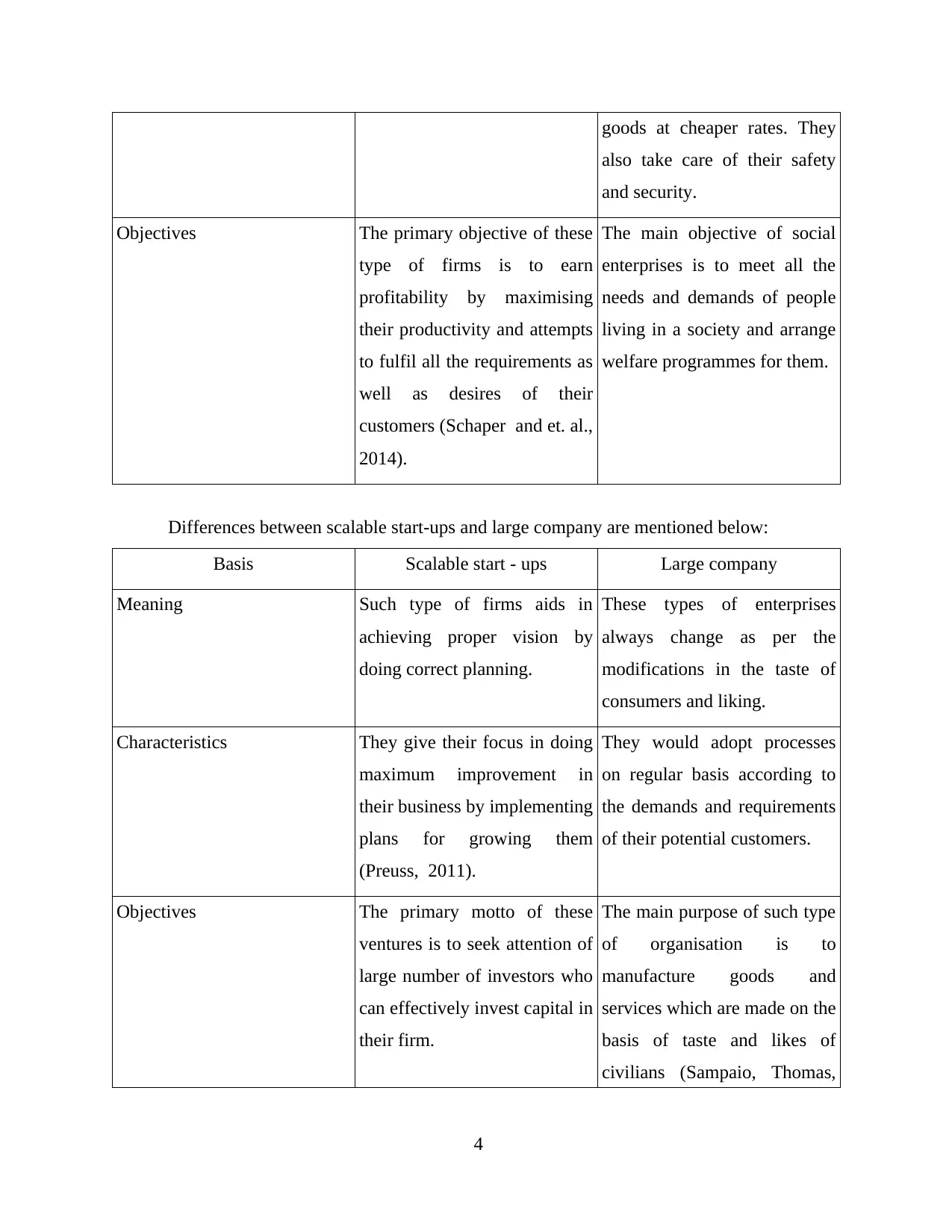
goods at cheaper rates. They
also take care of their safety
and security.
Objectives The primary objective of these
type of firms is to earn
profitability by maximising
their productivity and attempts
to fulfil all the requirements as
well as desires of their
customers (Schaper and et. al.,
2014).
The main objective of social
enterprises is to meet all the
needs and demands of people
living in a society and arrange
welfare programmes for them.
Differences between scalable start-ups and large company are mentioned below:
Basis Scalable start - ups Large company
Meaning Such type of firms aids in
achieving proper vision by
doing correct planning.
These types of enterprises
always change as per the
modifications in the taste of
consumers and liking.
Characteristics They give their focus in doing
maximum improvement in
their business by implementing
plans for growing them
(Preuss, 2011).
They would adopt processes
on regular basis according to
the demands and requirements
of their potential customers.
Objectives The primary motto of these
ventures is to seek attention of
large number of investors who
can effectively invest capital in
their firm.
The main purpose of such type
of organisation is to
manufacture goods and
services which are made on the
basis of taste and likes of
civilians (Sampaio, Thomas,
4
also take care of their safety
and security.
Objectives The primary objective of these
type of firms is to earn
profitability by maximising
their productivity and attempts
to fulfil all the requirements as
well as desires of their
customers (Schaper and et. al.,
2014).
The main objective of social
enterprises is to meet all the
needs and demands of people
living in a society and arrange
welfare programmes for them.
Differences between scalable start-ups and large company are mentioned below:
Basis Scalable start - ups Large company
Meaning Such type of firms aids in
achieving proper vision by
doing correct planning.
These types of enterprises
always change as per the
modifications in the taste of
consumers and liking.
Characteristics They give their focus in doing
maximum improvement in
their business by implementing
plans for growing them
(Preuss, 2011).
They would adopt processes
on regular basis according to
the demands and requirements
of their potential customers.
Objectives The primary motto of these
ventures is to seek attention of
large number of investors who
can effectively invest capital in
their firm.
The main purpose of such type
of organisation is to
manufacture goods and
services which are made on the
basis of taste and likes of
civilians (Sampaio, Thomas,
4
Paraphrase This Document
Need a fresh take? Get an instant paraphrase of this document with our AI Paraphraser
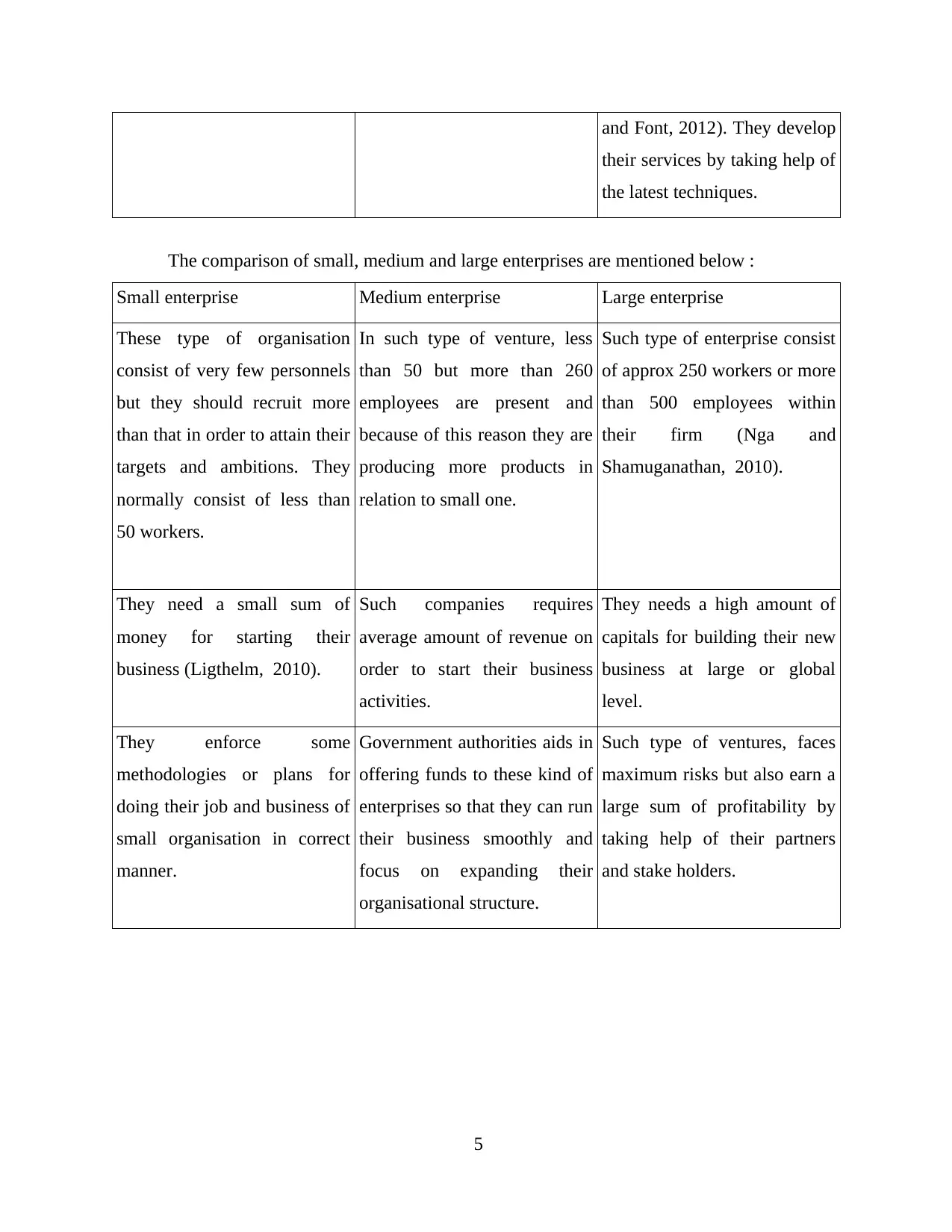
and Font, 2012). They develop
their services by taking help of
the latest techniques.
The comparison of small, medium and large enterprises are mentioned below :
Small enterprise Medium enterprise Large enterprise
These type of organisation
consist of very few personnels
but they should recruit more
than that in order to attain their
targets and ambitions. They
normally consist of less than
50 workers.
In such type of venture, less
than 50 but more than 260
employees are present and
because of this reason they are
producing more products in
relation to small one.
Such type of enterprise consist
of approx 250 workers or more
than 500 employees within
their firm (Nga and
Shamuganathan, 2010).
They need a small sum of
money for starting their
business (Ligthelm, 2010).
Such companies requires
average amount of revenue on
order to start their business
activities.
They needs a high amount of
capitals for building their new
business at large or global
level.
They enforce some
methodologies or plans for
doing their job and business of
small organisation in correct
manner.
Government authorities aids in
offering funds to these kind of
enterprises so that they can run
their business smoothly and
focus on expanding their
organisational structure.
Such type of ventures, faces
maximum risks but also earn a
large sum of profitability by
taking help of their partners
and stake holders.
5
their services by taking help of
the latest techniques.
The comparison of small, medium and large enterprises are mentioned below :
Small enterprise Medium enterprise Large enterprise
These type of organisation
consist of very few personnels
but they should recruit more
than that in order to attain their
targets and ambitions. They
normally consist of less than
50 workers.
In such type of venture, less
than 50 but more than 260
employees are present and
because of this reason they are
producing more products in
relation to small one.
Such type of enterprise consist
of approx 250 workers or more
than 500 employees within
their firm (Nga and
Shamuganathan, 2010).
They need a small sum of
money for starting their
business (Ligthelm, 2010).
Such companies requires
average amount of revenue on
order to start their business
activities.
They needs a high amount of
capitals for building their new
business at large or global
level.
They enforce some
methodologies or plans for
doing their job and business of
small organisation in correct
manner.
Government authorities aids in
offering funds to these kind of
enterprises so that they can run
their business smoothly and
focus on expanding their
organisational structure.
Such type of ventures, faces
maximum risks but also earn a
large sum of profitability by
taking help of their partners
and stake holders.
5
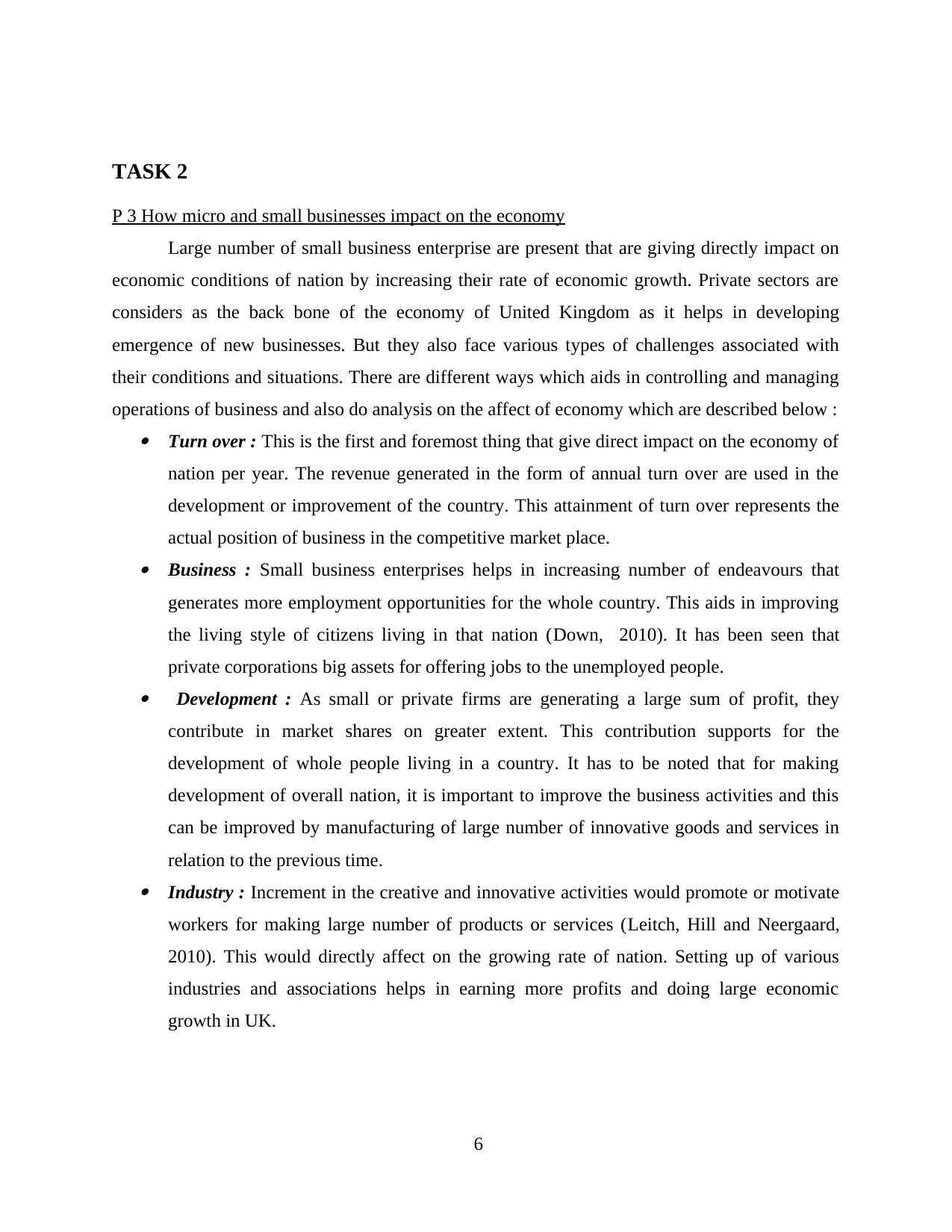
TASK 2
P 3 How micro and small businesses impact on the economy
Large number of small business enterprise are present that are giving directly impact on
economic conditions of nation by increasing their rate of economic growth. Private sectors are
considers as the back bone of the economy of United Kingdom as it helps in developing
emergence of new businesses. But they also face various types of challenges associated with
their conditions and situations. There are different ways which aids in controlling and managing
operations of business and also do analysis on the affect of economy which are described below : Turn over : This is the first and foremost thing that give direct impact on the economy of
nation per year. The revenue generated in the form of annual turn over are used in the
development or improvement of the country. This attainment of turn over represents the
actual position of business in the competitive market place. Business : Small business enterprises helps in increasing number of endeavours that
generates more employment opportunities for the whole country. This aids in improving
the living style of citizens living in that nation (Down, 2010). It has been seen that
private corporations big assets for offering jobs to the unemployed people. Development : As small or private firms are generating a large sum of profit, they
contribute in market shares on greater extent. This contribution supports for the
development of whole people living in a country. It has to be noted that for making
development of overall nation, it is important to improve the business activities and this
can be improved by manufacturing of large number of innovative goods and services in
relation to the previous time. Industry : Increment in the creative and innovative activities would promote or motivate
workers for making large number of products or services (Leitch, Hill and Neergaard,
2010). This would directly affect on the growing rate of nation. Setting up of various
industries and associations helps in earning more profits and doing large economic
growth in UK.
6
P 3 How micro and small businesses impact on the economy
Large number of small business enterprise are present that are giving directly impact on
economic conditions of nation by increasing their rate of economic growth. Private sectors are
considers as the back bone of the economy of United Kingdom as it helps in developing
emergence of new businesses. But they also face various types of challenges associated with
their conditions and situations. There are different ways which aids in controlling and managing
operations of business and also do analysis on the affect of economy which are described below : Turn over : This is the first and foremost thing that give direct impact on the economy of
nation per year. The revenue generated in the form of annual turn over are used in the
development or improvement of the country. This attainment of turn over represents the
actual position of business in the competitive market place. Business : Small business enterprises helps in increasing number of endeavours that
generates more employment opportunities for the whole country. This aids in improving
the living style of citizens living in that nation (Down, 2010). It has been seen that
private corporations big assets for offering jobs to the unemployed people. Development : As small or private firms are generating a large sum of profit, they
contribute in market shares on greater extent. This contribution supports for the
development of whole people living in a country. It has to be noted that for making
development of overall nation, it is important to improve the business activities and this
can be improved by manufacturing of large number of innovative goods and services in
relation to the previous time. Industry : Increment in the creative and innovative activities would promote or motivate
workers for making large number of products or services (Leitch, Hill and Neergaard,
2010). This would directly affect on the growing rate of nation. Setting up of various
industries and associations helps in earning more profits and doing large economic
growth in UK.
6
⊘ This is a preview!⊘
Do you want full access?
Subscribe today to unlock all pages.
Trusted by 1+ million students worldwide
Competitiveness : This element shows the presence of large number of company and
make it competitive at global level and also promotes competition in the nation.
Apart from this, this can summarized that management of ventures are giving direct
impact on the economical situation of UK and this made by the fluctuation of external and
internal factors. These are some activities that would contribute in easy going of business :
Adoption of creative and imaginative ideas plans
Satisfying and meeting the need of customers
Creation of different types of goods
Creating employment opportunities
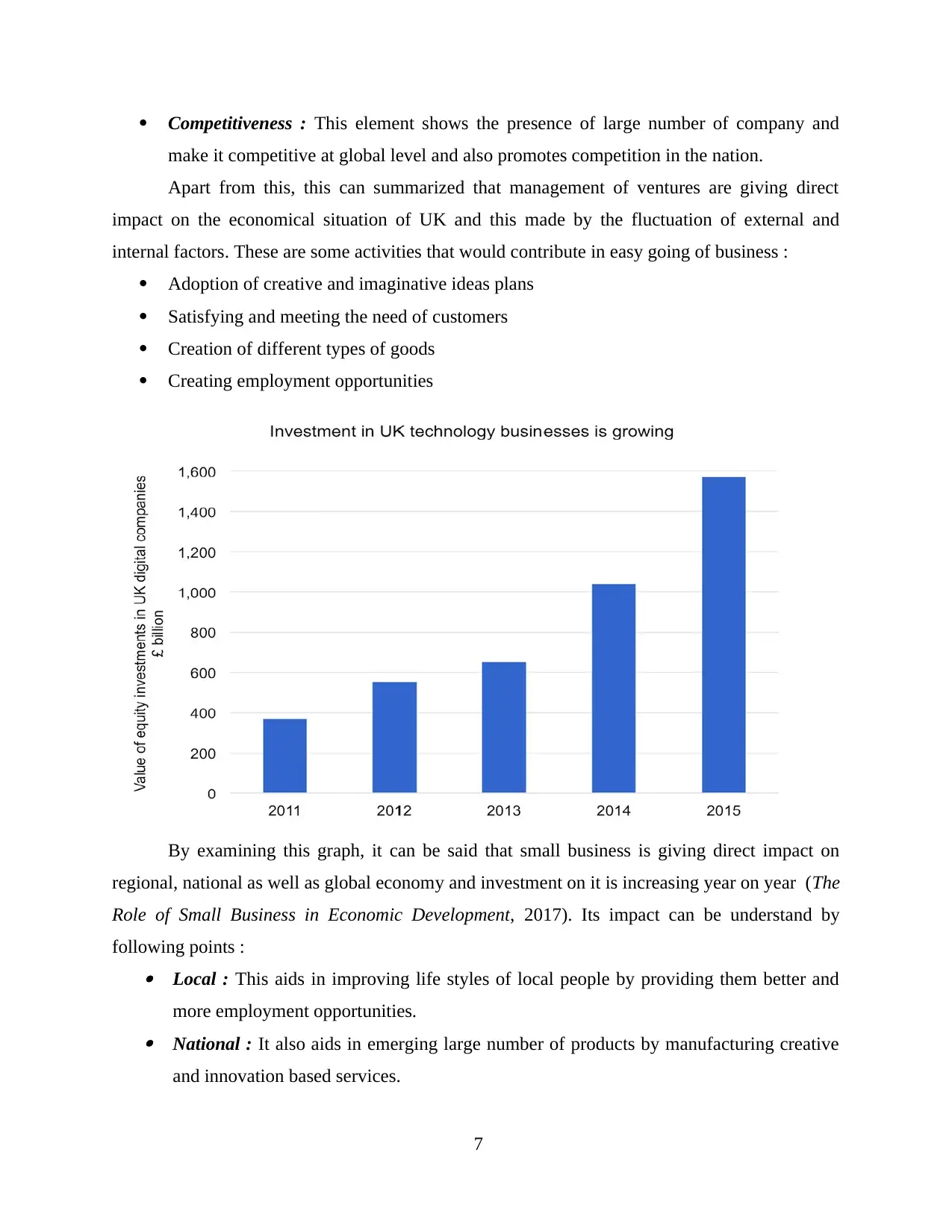
By examining this graph, it can be said that small business is giving direct impact on
regional, national as well as global economy and investment on it is increasing year on year (The
Role of Small Business in Economic Development, 2017). Its impact can be understand by
following points : Local : This aids in improving life styles of local people by providing them better and
more employment opportunities. National : It also aids in emerging large number of products by manufacturing creative
and innovation based services.
7
make it competitive at global level and also promotes competition in the nation.
Apart from this, this can summarized that management of ventures are giving direct
impact on the economical situation of UK and this made by the fluctuation of external and
internal factors. These are some activities that would contribute in easy going of business :
Adoption of creative and imaginative ideas plans
Satisfying and meeting the need of customers
Creation of different types of goods
Creating employment opportunities
By examining this graph, it can be said that small business is giving direct impact on
regional, national as well as global economy and investment on it is increasing year on year (The
Role of Small Business in Economic Development, 2017). Its impact can be understand by
following points : Local : This aids in improving life styles of local people by providing them better and
more employment opportunities. National : It also aids in emerging large number of products by manufacturing creative
and innovation based services.
7
Paraphrase This Document
Need a fresh take? Get an instant paraphrase of this document with our AI Paraphraser
International : It helps in maximising the rate of exchanging goods and services with
other or foreign countries that in turn increases the FDI (Foreign direct investment) .
P 4 Importance of small business and business start-ups in economy development
Small business and new start ups businesses contributes a lot in increasing the
economical growth and provides better standard of living to the civilians living in nation. At the
time of starting any new business, an entrepreneur is conscious about its own profit but their
business directly give a positive impact on the economy of country. A venture always work for
the state, community, nation and for a specific region of people. They contributes in making
some modifications in direct or indirect way which are discussed below : Improve relationship with individual : This is one of the positive impact of small
enterprises. They try to maintain good and healthy relationship with their purchasers and
investors. This can be happened when business owners do a deep research for identifying
the needs and necessitates of their customers. This creation and maintenance of good
relationship proved to be very beneficial for the organisation. Provide employment opportunities : There are large number of job seekers present in
every nation. The small business enterprises or the start – ups ventures generates so many
employment opportunities that aids every one in improving their standard of living
(Gorgievski, Ascalon and Stephan, 2011). Government of the nation also encourages
such type of business activities which helps in growing or improving their economic
condition. Regional development : New business and industrial activities also aids in doing regional
development of specific areas such as semi developed and back ward regions. This local
growth provides better roadways, electricity, railway links, supply of water, hospitals,
schools and various other public welfare facilities to the civilians. Thus, this can be said
that this type of business provides direct as well as indirect contribution to the growth of
economical situations of UK. Increasing standard of living : Life styles of regional people improves a lot after
establishment of any small firm within society and nation as wages or income of common
people increases and by this way they can invest some money in developing their living
standards easily (George and Bock, 2011). On the other hand, manufacturing of
8
other or foreign countries that in turn increases the FDI (Foreign direct investment) .
P 4 Importance of small business and business start-ups in economy development
Small business and new start ups businesses contributes a lot in increasing the
economical growth and provides better standard of living to the civilians living in nation. At the
time of starting any new business, an entrepreneur is conscious about its own profit but their
business directly give a positive impact on the economy of country. A venture always work for
the state, community, nation and for a specific region of people. They contributes in making
some modifications in direct or indirect way which are discussed below : Improve relationship with individual : This is one of the positive impact of small
enterprises. They try to maintain good and healthy relationship with their purchasers and
investors. This can be happened when business owners do a deep research for identifying
the needs and necessitates of their customers. This creation and maintenance of good
relationship proved to be very beneficial for the organisation. Provide employment opportunities : There are large number of job seekers present in
every nation. The small business enterprises or the start – ups ventures generates so many
employment opportunities that aids every one in improving their standard of living
(Gorgievski, Ascalon and Stephan, 2011). Government of the nation also encourages
such type of business activities which helps in growing or improving their economic
condition. Regional development : New business and industrial activities also aids in doing regional
development of specific areas such as semi developed and back ward regions. This local
growth provides better roadways, electricity, railway links, supply of water, hospitals,
schools and various other public welfare facilities to the civilians. Thus, this can be said
that this type of business provides direct as well as indirect contribution to the growth of
economical situations of UK. Increasing standard of living : Life styles of regional people improves a lot after
establishment of any small firm within society and nation as wages or income of common
people increases and by this way they can invest some money in developing their living
standards easily (George and Bock, 2011). On the other hand, manufacturing of
8
innovative goods focuses on education as well as learning of new things also. This is in
turn also increases the literacy rate of country. Flexibility : Such type of enterprises creates a flexibility within business as services
changes as per the time and perceptibility of people. Some of the services such as
hospitality, healthcare, educational, training, internship, etc. are now get changes and
remain changing as per the need of people. These all services helps a lot in the survival of
people. Minimum cost : Costing imposed by small firms on their goods in very less in
comparison to those of large sized organisations as less investment is done at the the time
of manufacturing goods and services of such ventures. Therefore, they provide good
quality products to the civilians at minimum price. This as a result aids in increasing the
purchasing power of customers.
Innovation : Small ventures do several types of researches before creating any products
so by this way, they focus on manufacturing of innovative goods and services. This seek
attention of large number of people as all of the citizens demand for innovational services
and products (Down, 2010).
TASK 3
P 5 Characteristics, traits and skills of two successful entrepreneurs
Entrepreneurs consist of different skills and characteristics which are very different from
those of business mangers. Individual have the capability of starting any new business and
running it on their own risks. But managers do not have such ability of posing risks as they do
not want to struggle but wish to do some easy task within organisation (Hall, Daneke and
Lenox, 2010). Mark Zuckerberg and Henry Ford are two famous entrepreneurs who are known
for their success and achievements. They both have the capability and potential to start a small
business and convert them into large one by earning huge amount of profits. Henry Ford on the
other hand was the owner of ford motors firm and consist of some unique qualities and attributes.
The skills, traits and characteristics of both of them are described below :
Qualities of Henry Ford
9
turn also increases the literacy rate of country. Flexibility : Such type of enterprises creates a flexibility within business as services
changes as per the time and perceptibility of people. Some of the services such as
hospitality, healthcare, educational, training, internship, etc. are now get changes and
remain changing as per the need of people. These all services helps a lot in the survival of
people. Minimum cost : Costing imposed by small firms on their goods in very less in
comparison to those of large sized organisations as less investment is done at the the time
of manufacturing goods and services of such ventures. Therefore, they provide good
quality products to the civilians at minimum price. This as a result aids in increasing the
purchasing power of customers.
Innovation : Small ventures do several types of researches before creating any products
so by this way, they focus on manufacturing of innovative goods and services. This seek
attention of large number of people as all of the citizens demand for innovational services
and products (Down, 2010).
TASK 3
P 5 Characteristics, traits and skills of two successful entrepreneurs
Entrepreneurs consist of different skills and characteristics which are very different from
those of business mangers. Individual have the capability of starting any new business and
running it on their own risks. But managers do not have such ability of posing risks as they do
not want to struggle but wish to do some easy task within organisation (Hall, Daneke and
Lenox, 2010). Mark Zuckerberg and Henry Ford are two famous entrepreneurs who are known
for their success and achievements. They both have the capability and potential to start a small
business and convert them into large one by earning huge amount of profits. Henry Ford on the
other hand was the owner of ford motors firm and consist of some unique qualities and attributes.
The skills, traits and characteristics of both of them are described below :
Qualities of Henry Ford
9
⊘ This is a preview!⊘
Do you want full access?
Subscribe today to unlock all pages.
Trusted by 1+ million students worldwide

1 out of 16


Related Documents


Your All-in-One AI-Powered Toolkit for Academic Success.
+13062052269
info@desklib.com
Available 24*7 on WhatsApp / Email
![[object Object]](/_next/static/media/star-bottom.7253800d.svg)
Unlock your academic potential
Copyright © 2020–2026 A2Z Services. All Rights Reserved. Developed and managed by ZUCOL.