Analysis of Entrepreneurship in Small Business Management Report
VerifiedAdded on 2020/07/23
|18
|5594
|45
Report
AI Summary
This report provides a comprehensive analysis of entrepreneurship within the context of small business management. It begins with an introduction to entrepreneurship, emphasizing its role in the UK economy and the importance of small businesses. The report then delves into the different types of entrepreneurial ventures, including local, global, social, and female entrepreneurship, and serial entrepreneurship, comparing their similarities and differences in terms of size, structure, aims, objectives, and sources of finance. The analysis further explores the characteristics, traits, and skills of successful entrepreneurs, the aspects of entrepreneurial personality, and the impact of personal background on entrepreneurial endeavors. The report also examines the impacts of small and micro businesses on local, regional, national, and international business, with a focus on the dynamic business environment and the adaptation of new technologies. The content covers various aspects of entrepreneurship, providing a holistic view of the subject matter.
Entrepreneurship in
small-business
management
small-business
management

Paraphrase This Document
Need a fresh take? Get an instant paraphrase of this document with our AI Paraphraser
Table of Contents
INTRODUCTION...........................................................................................................................1
TASK 1............................................................................................................................................1
P1 Entrepreneurial venture and Typology of Entrepreneurship.................................................1
P2 Similarities and difference between the Entrepreneurial Ventures........................................2
P3. Impacts of small and micro business on local, regional, national and international business
.....................................................................................................................................................4
P4 Importance of Business set-ups on the growth of the Social economy.................................5
TASK 2............................................................................................................................................6
P5 Characteristics, traits and skills of Successful Entrepreneur.................................................6
P6 Aspects of the Entrepreneurial personality and its reflects on entrepreneurial motivation
and mindsets................................................................................................................................8
P7 Person's background and past effects on Entrepreneurship...................................................9
CONCLUSION................................................................................................................................9
REFERENCES..............................................................................................................................11
Books and Journal.....................................................................................................................11
Online........................................................................................................................................12
INTRODUCTION...........................................................................................................................1
TASK 1............................................................................................................................................1
P1 Entrepreneurial venture and Typology of Entrepreneurship.................................................1
P2 Similarities and difference between the Entrepreneurial Ventures........................................2
P3. Impacts of small and micro business on local, regional, national and international business
.....................................................................................................................................................4
P4 Importance of Business set-ups on the growth of the Social economy.................................5
TASK 2............................................................................................................................................6
P5 Characteristics, traits and skills of Successful Entrepreneur.................................................6
P6 Aspects of the Entrepreneurial personality and its reflects on entrepreneurial motivation
and mindsets................................................................................................................................8
P7 Person's background and past effects on Entrepreneurship...................................................9
CONCLUSION................................................................................................................................9
REFERENCES..............................................................................................................................11
Books and Journal.....................................................................................................................11
Online........................................................................................................................................12
INTRODUCTION
Entrepreneurs are the innovators, who are ready to take risks and create unique and potential
solution which are profitable in modern day problems. The most common form of
entrepreneurship is starting up new business, with their innovation or revitalization of mature
organisation. UK economy is mainly driving through two pillars which are Entrepreneurship and
small business.
In UK, the Federation of small businesses(FSB) is representing small and medium sized
businesses. It helps the organisations to keep their trade local, FSB has launched real life
Entrepreneurs and providing back smallbusiness campaign (Short and et.al., 2010). Besides this
report is focusing on Entrepreneur-ventures which are the aims and objectives of small
businesses. After, the evaluation of difference between characteristics, skills and the traits of
Entrepreneur which help in becoming successful are discussed.
TASK 1
P1 Entrepreneurial venture and Typology of Entrepreneurship
Entrepreneurship is the setting up of small business by individual and earning of profit,
instead of working under any organisation. Starting up of entrepreneurial ventures with various
aims and objectives with proper study of market and successful business idea can results in profit
making to the entrepreneurs (Shane, 2012 ). Basically, there are four types of Entrepreneurial
ventures: -
Local Entrepreneurship: - The local Entrepreneurship can be considered as the small and local
businesses which are owned by local entrepreneur. This entrepreneurship fundamentally covers
small shops like grocery stores, small shop and others. The main objectives of these local
ventures to make profit and this profit is at small level. Local entrepreneurship are usually run by
1 or 2 entrepreneurs.
Global Entrepreneurship: -These are business which runs their dealings and operations
globally and having comparatively very much higher goals and objective. These businesses are
highly affected by their potential customers and for this they have to maintain their name and
image. These entrepreneurships ventures runs their operation in different countries at global level
and the rate of investment and profit making is very high as compared to local businesses.
(Jones, Coviello, and Tang, 2011). For example organisations like Apple, Google, Tesco and
others.
1
Entrepreneurs are the innovators, who are ready to take risks and create unique and potential
solution which are profitable in modern day problems. The most common form of
entrepreneurship is starting up new business, with their innovation or revitalization of mature
organisation. UK economy is mainly driving through two pillars which are Entrepreneurship and
small business.
In UK, the Federation of small businesses(FSB) is representing small and medium sized
businesses. It helps the organisations to keep their trade local, FSB has launched real life
Entrepreneurs and providing back smallbusiness campaign (Short and et.al., 2010). Besides this
report is focusing on Entrepreneur-ventures which are the aims and objectives of small
businesses. After, the evaluation of difference between characteristics, skills and the traits of
Entrepreneur which help in becoming successful are discussed.
TASK 1
P1 Entrepreneurial venture and Typology of Entrepreneurship
Entrepreneurship is the setting up of small business by individual and earning of profit,
instead of working under any organisation. Starting up of entrepreneurial ventures with various
aims and objectives with proper study of market and successful business idea can results in profit
making to the entrepreneurs (Shane, 2012 ). Basically, there are four types of Entrepreneurial
ventures: -
Local Entrepreneurship: - The local Entrepreneurship can be considered as the small and local
businesses which are owned by local entrepreneur. This entrepreneurship fundamentally covers
small shops like grocery stores, small shop and others. The main objectives of these local
ventures to make profit and this profit is at small level. Local entrepreneurship are usually run by
1 or 2 entrepreneurs.
Global Entrepreneurship: -These are business which runs their dealings and operations
globally and having comparatively very much higher goals and objective. These businesses are
highly affected by their potential customers and for this they have to maintain their name and
image. These entrepreneurships ventures runs their operation in different countries at global level
and the rate of investment and profit making is very high as compared to local businesses.
(Jones, Coviello, and Tang, 2011). For example organisations like Apple, Google, Tesco and
others.
1
⊘ This is a preview!⊘
Do you want full access?
Subscribe today to unlock all pages.

Trusted by 1+ million students worldwide
Social Entrepreneurship: - In this, the entrepreneur pursues to solve community problems with
their innovative ideas and potential. It is the phenomenon of exceeding popularity and
fascinating people with successful entrepreneurial. These provide innovative products and
services for the development and welfare of other Entrepreneur and offers other products and
activities in support to the society.
Female Entrepreneurship: - This entrepreneur consist of women who can develop and design
her own business from initial level and converting it to the large organisation. These Female
entrepreneur act as an idea for other to start their business and work accordingly to achieve great
success. For example- Cher Wang who had started HTC company at very small level and
converted it into such globally leading organisation. J.K Rowling, this female entrepreneur
started her business as a very small writer and now having the most selling book in the world i.e.,
Harry Potter.
Serial Entrepreneurship: - In this entrepreneur, set small business with an innovative idea.
These ideas are firstly applied on very small level to check how much successful the idea is?
After, this the business is analysed as according to its day to day development. If, the success is
achieved then with the help of investors the business is taken to higher level. For example: - Sir
Richard has started his small business with just an innovative idea and taken it to such great
success.
P2 Similarities and difference between the Entrepreneurial Ventures
Ventures are quite different from each other on the basis of their unlike belongings and
property to help entrepreneur for setting up their business.
Size and structure: - Similarly, small business and large business entrepreneurship both are
working for the development of their organisation. By providing every possible profitable idea
which can help a firm to promote their company at higher level and generate more profit along
with providing customer satisfaction. But there is huge difference in between the size of both
companies, Small business Venture is set by entrepreneur at very small level and low turnover.
Whereas, large business-venture is the organisation which is already working at very big level
and making profit to the entity (Hockerts and Wüstenhagen, 2010). There is huge difference
between the ideas and policies of entrepreneur in various ventures. The policies which are
applied by them on different ventures are very much different as according to the size and
potential of the companies.
2
their innovative ideas and potential. It is the phenomenon of exceeding popularity and
fascinating people with successful entrepreneurial. These provide innovative products and
services for the development and welfare of other Entrepreneur and offers other products and
activities in support to the society.
Female Entrepreneurship: - This entrepreneur consist of women who can develop and design
her own business from initial level and converting it to the large organisation. These Female
entrepreneur act as an idea for other to start their business and work accordingly to achieve great
success. For example- Cher Wang who had started HTC company at very small level and
converted it into such globally leading organisation. J.K Rowling, this female entrepreneur
started her business as a very small writer and now having the most selling book in the world i.e.,
Harry Potter.
Serial Entrepreneurship: - In this entrepreneur, set small business with an innovative idea.
These ideas are firstly applied on very small level to check how much successful the idea is?
After, this the business is analysed as according to its day to day development. If, the success is
achieved then with the help of investors the business is taken to higher level. For example: - Sir
Richard has started his small business with just an innovative idea and taken it to such great
success.
P2 Similarities and difference between the Entrepreneurial Ventures
Ventures are quite different from each other on the basis of their unlike belongings and
property to help entrepreneur for setting up their business.
Size and structure: - Similarly, small business and large business entrepreneurship both are
working for the development of their organisation. By providing every possible profitable idea
which can help a firm to promote their company at higher level and generate more profit along
with providing customer satisfaction. But there is huge difference in between the size of both
companies, Small business Venture is set by entrepreneur at very small level and low turnover.
Whereas, large business-venture is the organisation which is already working at very big level
and making profit to the entity (Hockerts and Wüstenhagen, 2010). There is huge difference
between the ideas and policies of entrepreneur in various ventures. The policies which are
applied by them on different ventures are very much different as according to the size and
potential of the companies.
2
Paraphrase This Document
Need a fresh take? Get an instant paraphrase of this document with our AI Paraphraser
Aim and objectives: - The major difference between the above entrepreneurship-ventures is their
aims and objectives for the establishment of their business. In social Entrepreneurship-venture,
the main objectives and aims of is to serve society. This venture does not focus on emphasizing
market share or revenue profiting. On the other hand, scalable start-up venture is a proof of
entrepreneur's new and innovative ideas in the market. These help in focusing within the
development of an organisation with long term growth and profit making strategies for current
and future market position (Von-Graevenitz, Harhoff and Weber, 2010). Besides this in Small
business ventures, the aims and objectives of entrepreneur are very simple focusing only on
serving customers and creating name of their company products and services by creating full
customer satisfaction and maintaining relation with them. Small entrepreneurship ventures are
focusing on creation of future policies which will make profit to their company.
Sources of finance: - Sources of finance of ventures are also different form each other. The large
business-Entrepreneur get their funds and share from bigger sources as compared to small and
social-entrepreneur ventures. The methods of getting finance for large business-entrepreneur are
their company's Sponsors, shareholders, loans from big banks and financial institutes, for the
development and business processes (Nga and Shamuganathan, 2010). On the other hand, small
business entrepreneur need little amount of funds for their business processing and its
maintenance. Basically, small ventures' arranger their fund by small bank loans and other small
sources. Unlike the policies of other Business Entrepreneur ventures, Social Entrepreneurship is
not interested in making profit. They work to help society and other new Entrepreneur to set up
their business and help them to make profits by motivating and providing them best appropriate
ideas and policies for the development of their business. Social Entrepreneurs get their funding
through different donations and system.
3
aims and objectives for the establishment of their business. In social Entrepreneurship-venture,
the main objectives and aims of is to serve society. This venture does not focus on emphasizing
market share or revenue profiting. On the other hand, scalable start-up venture is a proof of
entrepreneur's new and innovative ideas in the market. These help in focusing within the
development of an organisation with long term growth and profit making strategies for current
and future market position (Von-Graevenitz, Harhoff and Weber, 2010). Besides this in Small
business ventures, the aims and objectives of entrepreneur are very simple focusing only on
serving customers and creating name of their company products and services by creating full
customer satisfaction and maintaining relation with them. Small entrepreneurship ventures are
focusing on creation of future policies which will make profit to their company.
Sources of finance: - Sources of finance of ventures are also different form each other. The large
business-Entrepreneur get their funds and share from bigger sources as compared to small and
social-entrepreneur ventures. The methods of getting finance for large business-entrepreneur are
their company's Sponsors, shareholders, loans from big banks and financial institutes, for the
development and business processes (Nga and Shamuganathan, 2010). On the other hand, small
business entrepreneur need little amount of funds for their business processing and its
maintenance. Basically, small ventures' arranger their fund by small bank loans and other small
sources. Unlike the policies of other Business Entrepreneur ventures, Social Entrepreneurship is
not interested in making profit. They work to help society and other new Entrepreneur to set up
their business and help them to make profits by motivating and providing them best appropriate
ideas and policies for the development of their business. Social Entrepreneurs get their funding
through different donations and system.
3
P2 Similarities and difference between the Entrepreneurial Ventures
Ventures are quite different from each other on the basis of their unlike belongings and
property to help entrepreneur for setting up their business.
Size and structure: - Similarly, small business and large business entrepreneurship both are
working for the development of their organisation. By providing every possible profitable idea
which can help a firm to promote their company at higher level and generate more profit along
with providing customer satisfaction. But there is huge difference in between the size of both
companies, Small business Venture is set by entrepreneur at very small level and low turnover.
Whereas, large business-venture is the organisation which is already working at very big level
and making profit to the entity (Hockerts and Wüstenhagen, 2010). There is huge difference
between the ideas and policies of entrepreneur in various ventures. The policies which are
applied by them on different ventures are very much different as according to the size and
potential of the companies.
4
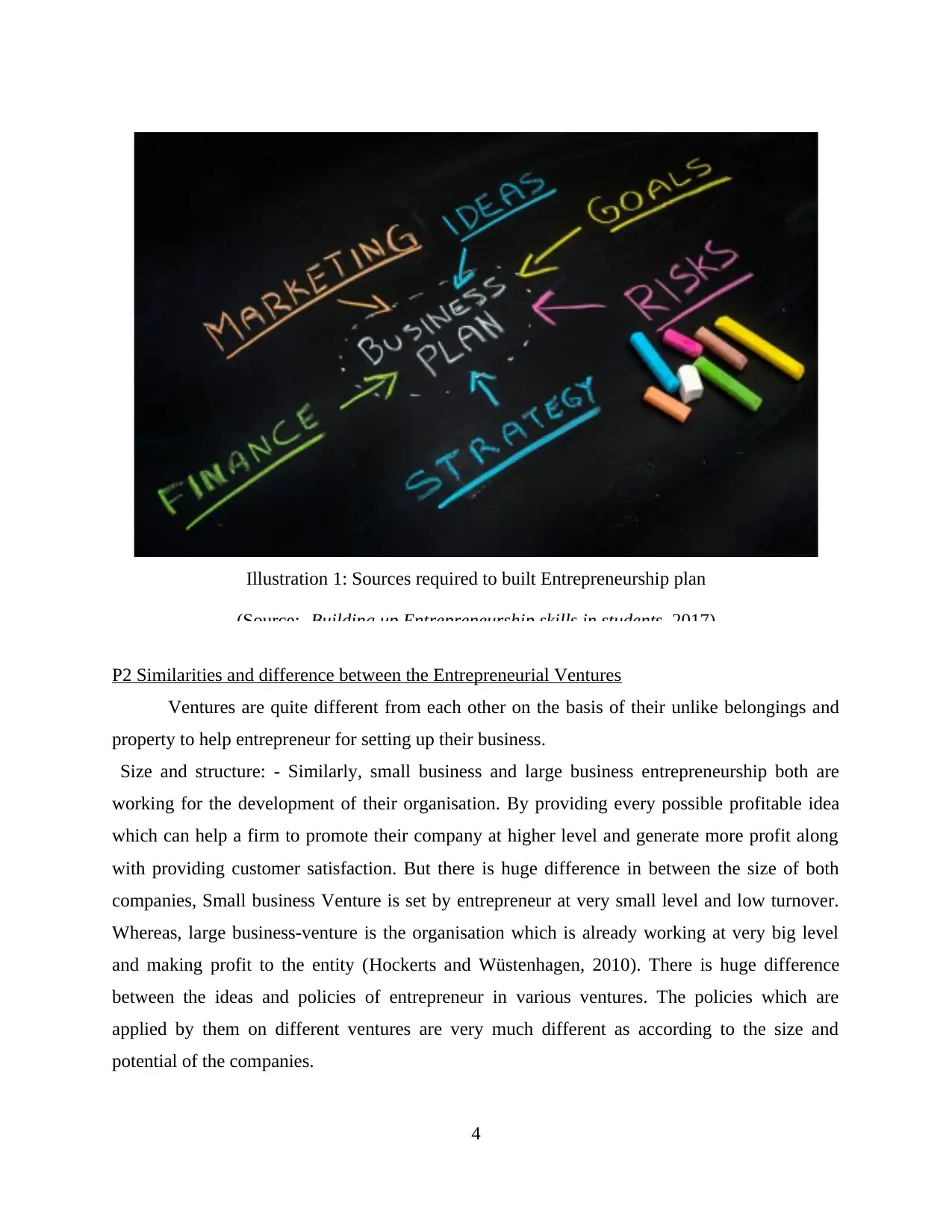
Illustration 1: Sources required to built Entrepreneurship plan
(Source:- Building up Entrepreneurship skills in students, 2017)
Ventures are quite different from each other on the basis of their unlike belongings and
property to help entrepreneur for setting up their business.
Size and structure: - Similarly, small business and large business entrepreneurship both are
working for the development of their organisation. By providing every possible profitable idea
which can help a firm to promote their company at higher level and generate more profit along
with providing customer satisfaction. But there is huge difference in between the size of both
companies, Small business Venture is set by entrepreneur at very small level and low turnover.
Whereas, large business-venture is the organisation which is already working at very big level
and making profit to the entity (Hockerts and Wüstenhagen, 2010). There is huge difference
between the ideas and policies of entrepreneur in various ventures. The policies which are
applied by them on different ventures are very much different as according to the size and
potential of the companies.
4
Illustration 1: Sources required to built Entrepreneurship plan
(Source:- Building up Entrepreneurship skills in students, 2017)
⊘ This is a preview!⊘
Do you want full access?
Subscribe today to unlock all pages.
Trusted by 1+ million students worldwide
Aim and objectives: - The major difference between the above entrepreneurship-ventures is their
aims and objectives for the establishment of their business. In social Entrepreneurship-venture,
the main objectives and aims of is to serve society. This venture does not focus on emphasizing
market share or revenue profiting. On the other hand, scalable start-up venture is a proof of
entrepreneur's new and innovative ideas in the market. These help in focusing within the
development of an organisation with long term growth and profit making strategies for current
and future market position (Von-Graevenitz, Harhoff and Weber, 2010). Besides this in Small
business ventures, the aims and objectives of entrepreneur are very simple focusing only on
serving customers and creating name of their company products and services by creating full
customer satisfaction and maintaining relation with them. Small entrepreneurship ventures are
focusing on creation of future policies which will make profit to their company.
Sources of finance: - Sources of finance of ventures are also different form each other. The large
business-Entrepreneur get their funds and share from bigger sources as compared to small and
social-entrepreneur ventures. The methods of getting finance for large business-entrepreneur are
their company's Sponsors, shareholders, loans from big banks and financial institutes, for the
development and business processes (Nga and Shamuganathan, 2010). On the other hand, small
business entrepreneur need little amount of funds for their business processing and its
maintenance. Basically, small ventures' arranger their fund by small bank loans and other small
sources. Unlike the policies of other Business Entrepreneur ventures, Social Entrepreneurship is
not interested in making profit. They work to help society and other new Entrepreneur to set up
their business and help them to make profits by motivating and providing them best appropriate
ideas and policies for the development of their business. Social Entrepreneurs get their funding
1) Social entrepreneurship
2) Corporate entrepreneurship
Similarities:
Both are having their vision and mission depending on their interest.
Entrepreneurship activities carried out in large areas.
Both pursue success by creating value for their companies.
Both are defined by innovative vision and strategy
5
aims and objectives for the establishment of their business. In social Entrepreneurship-venture,
the main objectives and aims of is to serve society. This venture does not focus on emphasizing
market share or revenue profiting. On the other hand, scalable start-up venture is a proof of
entrepreneur's new and innovative ideas in the market. These help in focusing within the
development of an organisation with long term growth and profit making strategies for current
and future market position (Von-Graevenitz, Harhoff and Weber, 2010). Besides this in Small
business ventures, the aims and objectives of entrepreneur are very simple focusing only on
serving customers and creating name of their company products and services by creating full
customer satisfaction and maintaining relation with them. Small entrepreneurship ventures are
focusing on creation of future policies which will make profit to their company.
Sources of finance: - Sources of finance of ventures are also different form each other. The large
business-Entrepreneur get their funds and share from bigger sources as compared to small and
social-entrepreneur ventures. The methods of getting finance for large business-entrepreneur are
their company's Sponsors, shareholders, loans from big banks and financial institutes, for the
development and business processes (Nga and Shamuganathan, 2010). On the other hand, small
business entrepreneur need little amount of funds for their business processing and its
maintenance. Basically, small ventures' arranger their fund by small bank loans and other small
sources. Unlike the policies of other Business Entrepreneur ventures, Social Entrepreneurship is
not interested in making profit. They work to help society and other new Entrepreneur to set up
their business and help them to make profits by motivating and providing them best appropriate
ideas and policies for the development of their business. Social Entrepreneurs get their funding
1) Social entrepreneurship
2) Corporate entrepreneurship
Similarities:
Both are having their vision and mission depending on their interest.
Entrepreneurship activities carried out in large areas.
Both pursue success by creating value for their companies.
Both are defined by innovative vision and strategy
5
Paraphrase This Document
Need a fresh take? Get an instant paraphrase of this document with our AI Paraphraser
Differences:
To be successful. Corporate ventures allocate all their resources in one direction just to be
successful. Whereas, social ventures allocate their resources to be a change agent for
society.
Social entrepreneurs are known for their goal to make world a better place unlike
corporate entrepreneurial ventures whose only goal is to make profit.
Business entrepreneurs must evolve under a more restrictive fiduciary and legal mandate
to maximize only their company owners’ wealth.
For a corporate entrepreneur 'success' most often means achieving financial and business
goals that conform to the interests of shareholders by ruthlessly chasing rapid growth and
profitability. On the other hand a social entrepreneur has to make difficult decisions to
strike a balance between his dual mottoes of social impact and sustainable profits.
While business entrepreneurs deliver value to their customers through competitive
pricing or better product or service offerings social entrepreneurs are primarily focused
on social value creation through positive impact on target communities along with
creation of economic value.
P3. Impacts of small and micro business on local, regional, national and international business
When it comes about starting of a new venture or a new business the first and foremost
thought an entrepreneur has is that of commencing a new business at the small scale. As staring
with small business leads to more efficiency and the growth of the business in the future
(Sarasvathy and Venkataraman, 2011). The business environment is dynamic and it keeps on
changing according to the tastes and preferences which leads to timely changes and upgrading of
the technologies in the existence business. Further, the impact that the business economy has on
small/ micro units are explained below:-
Local economy
Starting of a new small scale venture has a positive impact of the local economy because there
are a lot of variations and adaptation of new technologies that are available in the environment
and the adaptation of such technologies is easier in small business. New technologies leads to
growth of the venture because more and more customers would be attracted towards the latest
version of the product or services. Therefore, small/micro business environment are basically
more flexible when compared with large ventures. There are many examples of the popular firms
6
To be successful. Corporate ventures allocate all their resources in one direction just to be
successful. Whereas, social ventures allocate their resources to be a change agent for
society.
Social entrepreneurs are known for their goal to make world a better place unlike
corporate entrepreneurial ventures whose only goal is to make profit.
Business entrepreneurs must evolve under a more restrictive fiduciary and legal mandate
to maximize only their company owners’ wealth.
For a corporate entrepreneur 'success' most often means achieving financial and business
goals that conform to the interests of shareholders by ruthlessly chasing rapid growth and
profitability. On the other hand a social entrepreneur has to make difficult decisions to
strike a balance between his dual mottoes of social impact and sustainable profits.
While business entrepreneurs deliver value to their customers through competitive
pricing or better product or service offerings social entrepreneurs are primarily focused
on social value creation through positive impact on target communities along with
creation of economic value.
P3. Impacts of small and micro business on local, regional, national and international business
When it comes about starting of a new venture or a new business the first and foremost
thought an entrepreneur has is that of commencing a new business at the small scale. As staring
with small business leads to more efficiency and the growth of the business in the future
(Sarasvathy and Venkataraman, 2011). The business environment is dynamic and it keeps on
changing according to the tastes and preferences which leads to timely changes and upgrading of
the technologies in the existence business. Further, the impact that the business economy has on
small/ micro units are explained below:-
Local economy
Starting of a new small scale venture has a positive impact of the local economy because there
are a lot of variations and adaptation of new technologies that are available in the environment
and the adaptation of such technologies is easier in small business. New technologies leads to
growth of the venture because more and more customers would be attracted towards the latest
version of the product or services. Therefore, small/micro business environment are basically
more flexible when compared with large ventures. There are many examples of the popular firms
6
which started their business on small scale and now has its name in one of the largest leading
firms like Microsoft.
Regional economy
Small or micro scale business are generally more effective because as the culture, tastes, caste,
creed, colour etc. differs from region to region and according to that the needs of the consumers
also fluctuates which result in changing or upgrading of the existing product or services (Martin,
McNally and Kay, 2013). Small scale business units is flexible in nature which has the ability to
adapt any changes required for the growth of the venture. So, therefore we can say that
small/micro business has great impact on the regional economy.
National economy
Starting up a small business unit has a great impact on the national economy because the
commencement of new small business venture leads to generating of more employment
opportunities to those people who are willing and are searching for employment. Hiring of the
willing and skilled persons add innovation and creativeness to the existing things which
eventually leads to generating of more future growth of the business unit. Moreover, it also leads
to eradication of unemployment in the economy which results in increasing of economic growth.
International economy
Small scale business unit has a great impact on business economy because the small business
unit has more adaptability (Martin, McNally and Kay, 2013). Introduction of new technologies
are more easily adapted in small venture because the risk included is very less in case of micro
business firm. Now-a-days small scale ventures are exporting their products and services
globally which results in more growth and more expansion of the existing business and increase
in the profit. More profit leads to achievement of more economic growth.
P4 Importance of Business set-ups on the growth of the Social economy
Small-businesses are the backbone of UK's economy. It provides vital contribution in
driving growth, opening of new market and is creating new Jobs opportunities for individuals. As
small businesses do not make much money as compared to large organisations but they are
majorly contributes to strengthen local economies. Small business set-ups provides:-
Contribution:- Small businesses set-ups are those companies which are having around 500 or
fewer employees, According to UK's small administration (SBA) these small set-ups generates
around 64% of new job opportunities in UK (Bridge and O'Neill, 2012).
7
firms like Microsoft.
Regional economy
Small or micro scale business are generally more effective because as the culture, tastes, caste,
creed, colour etc. differs from region to region and according to that the needs of the consumers
also fluctuates which result in changing or upgrading of the existing product or services (Martin,
McNally and Kay, 2013). Small scale business units is flexible in nature which has the ability to
adapt any changes required for the growth of the venture. So, therefore we can say that
small/micro business has great impact on the regional economy.
National economy
Starting up a small business unit has a great impact on the national economy because the
commencement of new small business venture leads to generating of more employment
opportunities to those people who are willing and are searching for employment. Hiring of the
willing and skilled persons add innovation and creativeness to the existing things which
eventually leads to generating of more future growth of the business unit. Moreover, it also leads
to eradication of unemployment in the economy which results in increasing of economic growth.
International economy
Small scale business unit has a great impact on business economy because the small business
unit has more adaptability (Martin, McNally and Kay, 2013). Introduction of new technologies
are more easily adapted in small venture because the risk included is very less in case of micro
business firm. Now-a-days small scale ventures are exporting their products and services
globally which results in more growth and more expansion of the existing business and increase
in the profit. More profit leads to achievement of more economic growth.
P4 Importance of Business set-ups on the growth of the Social economy
Small-businesses are the backbone of UK's economy. It provides vital contribution in
driving growth, opening of new market and is creating new Jobs opportunities for individuals. As
small businesses do not make much money as compared to large organisations but they are
majorly contributes to strengthen local economies. Small business set-ups provides:-
Contribution:- Small businesses set-ups are those companies which are having around 500 or
fewer employees, According to UK's small administration (SBA) these small set-ups generates
around 64% of new job opportunities in UK (Bridge and O'Neill, 2012).
7
⊘ This is a preview!⊘
Do you want full access?
Subscribe today to unlock all pages.
Trusted by 1+ million students worldwide
Provides Economic Growth:- To the communities in which small business is established it
provides innovation and growth to the local economies. It also affects economic growth by
providing employment to the employees who might not employable for larger organisations. It
attracts new talented employees and provides them platform to invent new products and for the
implementation of new ideas and techniques better than existing ideas and polices of the
company.
Changing climate Adaptability:- Small businesses posses very quick responding and adapting
qualities to changing economic climate. This is because small businesses are very customers
oriented. Small business are able to create strong relation with their customers as compared to
Large organisation, this strong relationship with customers helps small organisation to stay afloat
during tough times. This further helps in strengthening local economies. At the time of Economic
crisis due to accumulation in less revenue than larger companies, small business have to face less
amount of loss.
Future Growth: - Small businesses do not remain small, Microsoft is the best example that how
small idea can change the world (Bruton, Ahlstrom and Li, 2010). With time these small
industries will develop and become large companies which often remains in the community of
business orientation, which can help in providing employment and affect the local economy.
8
provides innovation and growth to the local economies. It also affects economic growth by
providing employment to the employees who might not employable for larger organisations. It
attracts new talented employees and provides them platform to invent new products and for the
implementation of new ideas and techniques better than existing ideas and polices of the
company.
Changing climate Adaptability:- Small businesses posses very quick responding and adapting
qualities to changing economic climate. This is because small businesses are very customers
oriented. Small business are able to create strong relation with their customers as compared to
Large organisation, this strong relationship with customers helps small organisation to stay afloat
during tough times. This further helps in strengthening local economies. At the time of Economic
crisis due to accumulation in less revenue than larger companies, small business have to face less
amount of loss.
Future Growth: - Small businesses do not remain small, Microsoft is the best example that how
small idea can change the world (Bruton, Ahlstrom and Li, 2010). With time these small
industries will develop and become large companies which often remains in the community of
business orientation, which can help in providing employment and affect the local economy.
8
Paraphrase This Document
Need a fresh take? Get an instant paraphrase of this document with our AI Paraphraser
TASK 2
P5 Characteristics, traits and skills of Successful Entrepreneur
Entrepreneur is a person with high aptitude who innovates accordingly to the challenges
and needs for the succession of his business. The main reason for any business success and
development in its strategies is totally based on their Entrepreneur's attitude toward the
challenges and adverse and favourable situations (Burns, 2010). Thus, taking an example of
some top Entrepreneur and their succession traits, Steve Jobs founded Apple company, which is
now globally selling its products and having a very good market position, Jobs also started his
business just as small entrepreneur. Similarly, Mark Zuckerberg founded Facebook which is
having the top social-media ranking in world, Zuckerberg also started his work as a small
business entrepreneur with his innovative idea. Although, there is no particular fits for successful
entrepreneur some guidelines to embark successful entrepreneurial venture:-
9
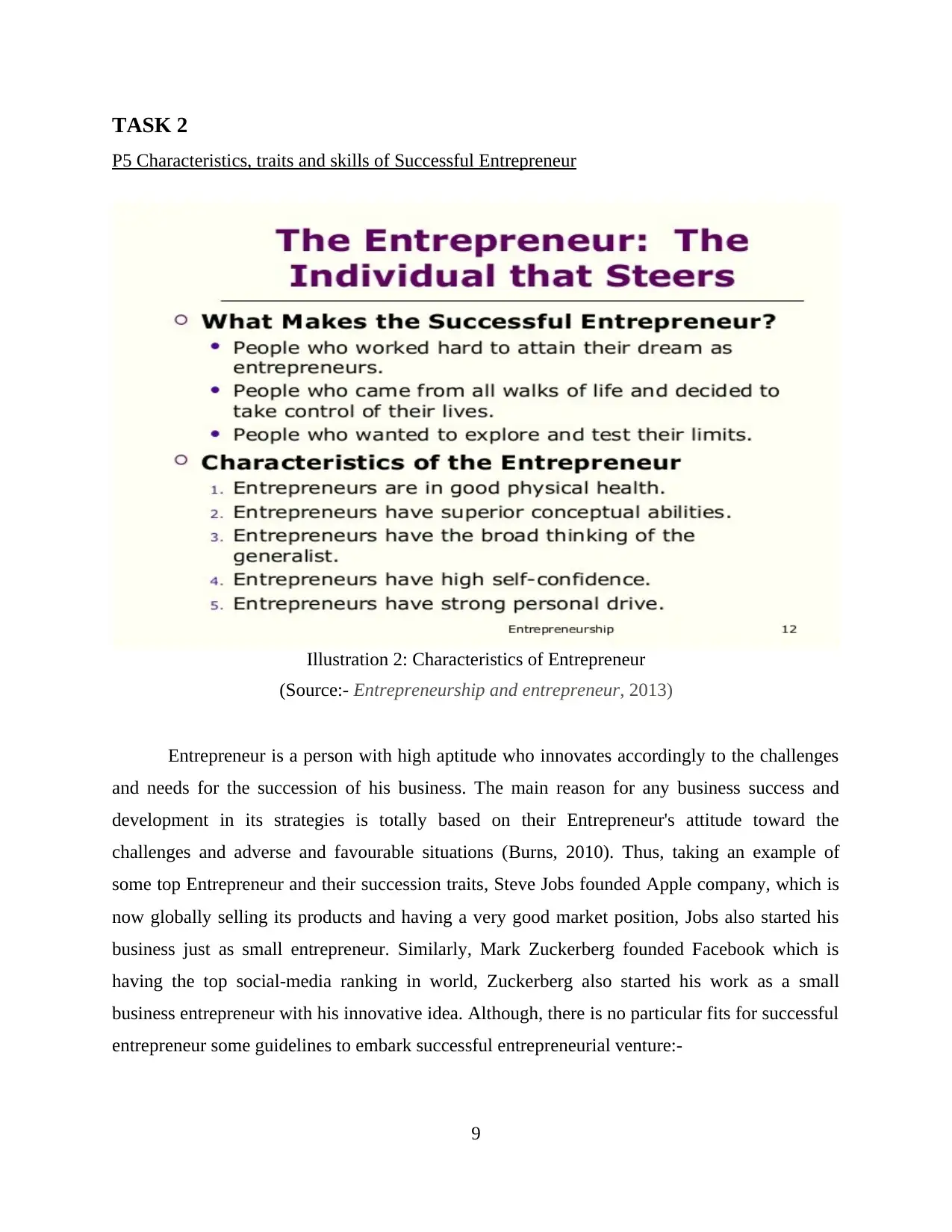
Illustration 2: Characteristics of Entrepreneur
(Source:- Entrepreneurship and entrepreneur, 2013)
P5 Characteristics, traits and skills of Successful Entrepreneur
Entrepreneur is a person with high aptitude who innovates accordingly to the challenges
and needs for the succession of his business. The main reason for any business success and
development in its strategies is totally based on their Entrepreneur's attitude toward the
challenges and adverse and favourable situations (Burns, 2010). Thus, taking an example of
some top Entrepreneur and their succession traits, Steve Jobs founded Apple company, which is
now globally selling its products and having a very good market position, Jobs also started his
business just as small entrepreneur. Similarly, Mark Zuckerberg founded Facebook which is
having the top social-media ranking in world, Zuckerberg also started his work as a small
business entrepreneur with his innovative idea. Although, there is no particular fits for successful
entrepreneur some guidelines to embark successful entrepreneurial venture:-
9
Illustration 2: Characteristics of Entrepreneur
(Source:- Entrepreneurship and entrepreneur, 2013)
Motivation and Passion: - This really matters in the succession of new Business that
how much passionate the Entrepreneur is about his business, and the factors motivating
him to proceed in direction to achieve success (Dacin, Dacin and Matear, 2010). The
things that matter to entrepreneur and motivated him to work with more passion, such as
family need, his dreams and determination to compete with their rivals in the same
market.
Risk Taking: - By keeping and understanding all the available resources, plans,
information measure to deal with unknown future in reserve and taking of the risk. This
risk is taken by using all the available potential and resources to get great success for the
company (Defourny and Nyssens, 2010). This risk is considered by entrepreneur that how
much it worth against his time, money and career.
Self belief, hard work and disciplined dedication towards the work:- For the succession of
new business Entrepreneur must be very much disciplined about his work with full of
belief on himself and his skills. Along with that great hard work is need by him to take
the organisation towards Success.
Adaptability and Flexibility: - Being passionate and stubborn about the organisation
and work is very good quality for an entrepreneur. But, inflexible about the market
conditions and clients will lead the organisation towards the failure. Successful
entrepreneur will accept all appropriate suggestions to modify their policies in terms of
succession of their business (Kuratko, 2016Drucker, 2014). They should enhance their
offering by accepting new strategies of current market according to its profit for
company, and satisfy market and clients needs.
Understanding offering: - Entrepreneur should always know everything about
marketplace where they are doing business and its dynamic inside and out.
Understanding and remaining aware of changing market needs, other external and
internal sources that can affect the business adversely and their competitors moves can
helps them to stay in market.
Management of Money: - The management of expenses is very crucial to get
profitability for any entrepreneurial venture. The capital should be utilised wisely
planning for present and future financial obligations. The successful entrepreneur will
always handle cash flow (Morris, Kuratko and Covin, 2010).
10
how much passionate the Entrepreneur is about his business, and the factors motivating
him to proceed in direction to achieve success (Dacin, Dacin and Matear, 2010). The
things that matter to entrepreneur and motivated him to work with more passion, such as
family need, his dreams and determination to compete with their rivals in the same
market.
Risk Taking: - By keeping and understanding all the available resources, plans,
information measure to deal with unknown future in reserve and taking of the risk. This
risk is taken by using all the available potential and resources to get great success for the
company (Defourny and Nyssens, 2010). This risk is considered by entrepreneur that how
much it worth against his time, money and career.
Self belief, hard work and disciplined dedication towards the work:- For the succession of
new business Entrepreneur must be very much disciplined about his work with full of
belief on himself and his skills. Along with that great hard work is need by him to take
the organisation towards Success.
Adaptability and Flexibility: - Being passionate and stubborn about the organisation
and work is very good quality for an entrepreneur. But, inflexible about the market
conditions and clients will lead the organisation towards the failure. Successful
entrepreneur will accept all appropriate suggestions to modify their policies in terms of
succession of their business (Kuratko, 2016Drucker, 2014). They should enhance their
offering by accepting new strategies of current market according to its profit for
company, and satisfy market and clients needs.
Understanding offering: - Entrepreneur should always know everything about
marketplace where they are doing business and its dynamic inside and out.
Understanding and remaining aware of changing market needs, other external and
internal sources that can affect the business adversely and their competitors moves can
helps them to stay in market.
Management of Money: - The management of expenses is very crucial to get
profitability for any entrepreneurial venture. The capital should be utilised wisely
planning for present and future financial obligations. The successful entrepreneur will
always handle cash flow (Morris, Kuratko and Covin, 2010).
10
⊘ This is a preview!⊘
Do you want full access?
Subscribe today to unlock all pages.
Trusted by 1+ million students worldwide

1 out of 18


Related Documents


Your All-in-One AI-Powered Toolkit for Academic Success.
+13062052269
info@desklib.com
Available 24*7 on WhatsApp / Email
![[object Object]](/_next/static/media/star-bottom.7253800d.svg)
Unlock your academic potential
Copyright © 2020–2026 A2Z Services. All Rights Reserved. Developed and managed by ZUCOL.