Report: Entrepreneurship and Small Business Management - Task 1 & 2
VerifiedAdded on 2021/02/22
|9
|2710
|45
Report
AI Summary
This report provides a comprehensive overview of entrepreneurship and small business management. Task 1 explores different types of entrepreneurial ventures, including small businesses, large businesses, social enterprises, and growth firms, along with their typologies and interrelationships. Task 2 delves into the similarities and differences between these ventures, analyzing their flexibility, funding, market area, and objectives. The report then interprets and assesses relevant data and statistics to illustrate the impact of small, medium, and large enterprises on the economy, considering regional and national impacts. Finally, it examines the importance of small businesses and startups in driving social economic growth, highlighting their role in job creation and revenue generation. The report concludes by emphasizing the significance of these businesses in the overall economic landscape.


Paraphrase This Document
Need a fresh take? Get an instant paraphrase of this document with our AI Paraphraser
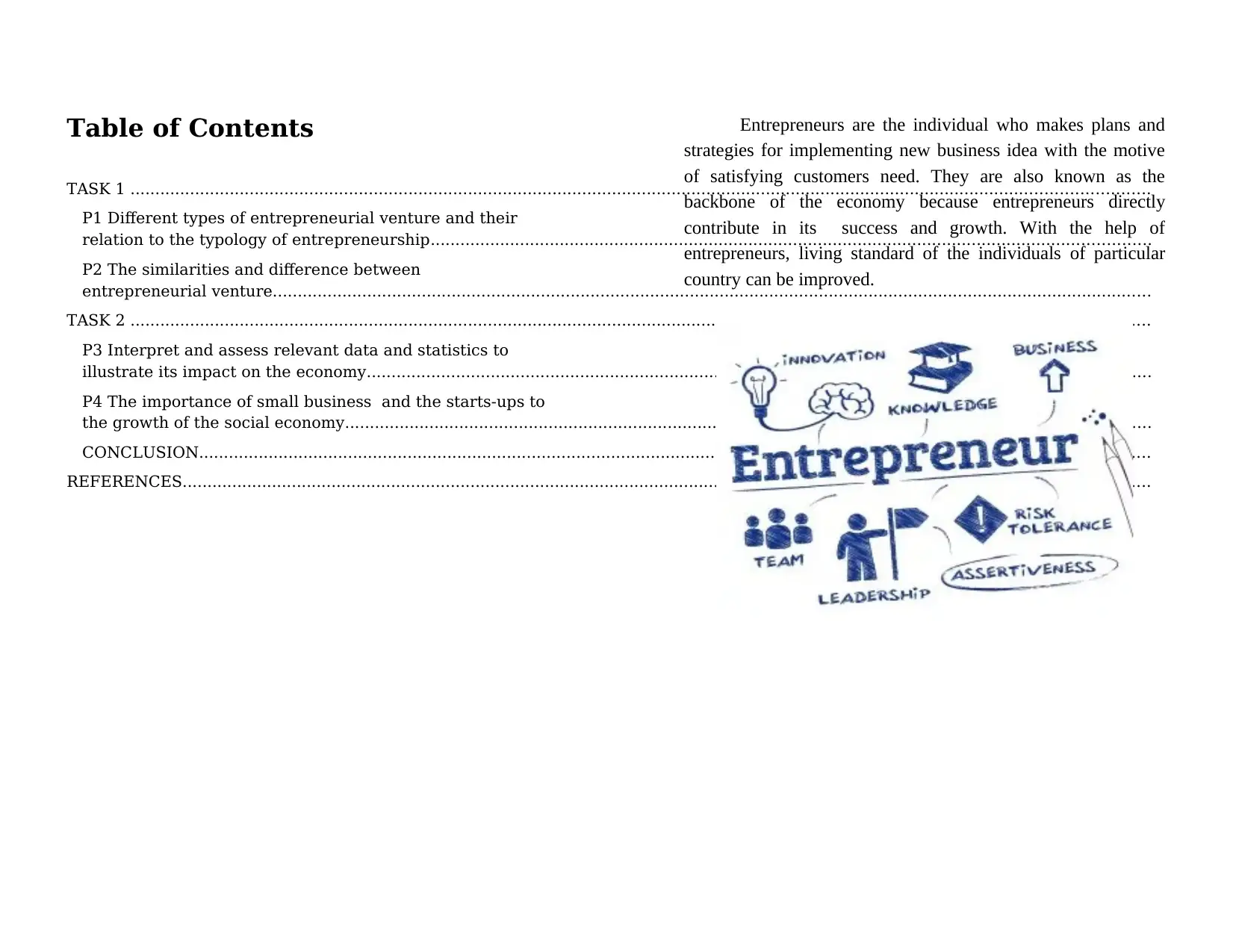
Table of Contents
TASK 1 .............................................................................................................................................................................................................
P1 Different types of entrepreneurial venture and their
relation to the typology of entrepreneurship.................................................................................................................................................
P2 The similarities and difference between
entrepreneurial venture.................................................................................................................................................................................
TASK 2 .............................................................................................................................................................................................................
P3 Interpret and assess relevant data and statistics to
illustrate its impact on the economy..............................................................................................................................................................
P4 The importance of small business and the starts-ups to
the growth of the social economy..................................................................................................................................................................
CONCLUSION...............................................................................................................................................................................................
REFERENCES...................................................................................................................................................................................................
Entrepreneurs are the individual who makes plans and
strategies for implementing new business idea with the motive
of satisfying customers need. They are also known as the
backbone of the economy because entrepreneurs directly
contribute in its success and growth. With the help of
entrepreneurs, living standard of the individuals of particular
country can be improved.
TASK 1 .............................................................................................................................................................................................................
P1 Different types of entrepreneurial venture and their
relation to the typology of entrepreneurship.................................................................................................................................................
P2 The similarities and difference between
entrepreneurial venture.................................................................................................................................................................................
TASK 2 .............................................................................................................................................................................................................
P3 Interpret and assess relevant data and statistics to
illustrate its impact on the economy..............................................................................................................................................................
P4 The importance of small business and the starts-ups to
the growth of the social economy..................................................................................................................................................................
CONCLUSION...............................................................................................................................................................................................
REFERENCES...................................................................................................................................................................................................
Entrepreneurs are the individual who makes plans and
strategies for implementing new business idea with the motive
of satisfying customers need. They are also known as the
backbone of the economy because entrepreneurs directly
contribute in its success and growth. With the help of
entrepreneurs, living standard of the individuals of particular
country can be improved.
TASK 1
P1 Different types of entrepreneurial venture and their relation
to the typology of entrepreneurship
Entrepreneurs are known as the individuals who makes
plans and strategies for implementing a new business idea in the
market. The major motive of entrepreneurs is to satisfy the need
of potential customers and earn high profits. The
entrepreneurial ventures are basically divided into different
scope, size and purpose.
Entrepreneurial activity is the on going process which is
majorly carried out with the motive of achieving economic
growth. This is activity is usually performed with the motive of
increasing profit and sale of the enterprise. Various type of
ventures along with their typologies are discussed below-
Type of business
Small business- These type of business enterprises
generally do not include large number of employees. Such
enterprises are formed for earning more and more profit and
satisfying the need of customer's. These ventures generally
operate on very low scale and are also operated by forming
partnership with other individuals. Small business includes less
than 50 employees and the net worth of these organisations are
approximately £2 million. The example of this enterprise is
Orion electriotech and travelogue company.
Large company- These type of organisations are
operated at high level and does not have any limitation
regarding their size and scope. Large business organisations are
generally formed with the motive of expanding their business in
various parts of the world. These type of company's manages to
sustain in the market for longer period of time by making plans
according to the preferences of customer's. Examples of these
organisations are NHS and TESCO which belongs from public
and private sector.
Social enterprise- These type of organisations are
formed with the motive of increasing the satisfaction level of
customer's and society. Plans and strategies in these type of
organisations are majorly implemented for enhancing the
satisfaction level and living standard of the individual of a
particular area. The example of social enterprise is save the
children.
Typologies of entrepreneurship
Lifestyle enterprise- The motive of these organisations
is to increase and enhance the lifestyle and living standard of
the society. Various kinds of opportunities are provided to the
individuals by these organisations ,so that they get equal
chances of growth and development. Products which are offered
by these organisations are also produced according to their need
and preferences. These are also known as social ventures.
Growth firms- Such type of organisation generally operate
for increasing their profitability and sale. This is done by
implementing new ideas and strategies for providing maximum
satisfaction to customer's. Such type of organisations generally
fall under the category of small and large scale organisations.
P1 Different types of entrepreneurial venture and their relation
to the typology of entrepreneurship
Entrepreneurs are known as the individuals who makes
plans and strategies for implementing a new business idea in the
market. The major motive of entrepreneurs is to satisfy the need
of potential customers and earn high profits. The
entrepreneurial ventures are basically divided into different
scope, size and purpose.
Entrepreneurial activity is the on going process which is
majorly carried out with the motive of achieving economic
growth. This is activity is usually performed with the motive of
increasing profit and sale of the enterprise. Various type of
ventures along with their typologies are discussed below-
Type of business
Small business- These type of business enterprises
generally do not include large number of employees. Such
enterprises are formed for earning more and more profit and
satisfying the need of customer's. These ventures generally
operate on very low scale and are also operated by forming
partnership with other individuals. Small business includes less
than 50 employees and the net worth of these organisations are
approximately £2 million. The example of this enterprise is
Orion electriotech and travelogue company.
Large company- These type of organisations are
operated at high level and does not have any limitation
regarding their size and scope. Large business organisations are
generally formed with the motive of expanding their business in
various parts of the world. These type of company's manages to
sustain in the market for longer period of time by making plans
according to the preferences of customer's. Examples of these
organisations are NHS and TESCO which belongs from public
and private sector.
Social enterprise- These type of organisations are
formed with the motive of increasing the satisfaction level of
customer's and society. Plans and strategies in these type of
organisations are majorly implemented for enhancing the
satisfaction level and living standard of the individual of a
particular area. The example of social enterprise is save the
children.
Typologies of entrepreneurship
Lifestyle enterprise- The motive of these organisations
is to increase and enhance the lifestyle and living standard of
the society. Various kinds of opportunities are provided to the
individuals by these organisations ,so that they get equal
chances of growth and development. Products which are offered
by these organisations are also produced according to their need
and preferences. These are also known as social ventures.
Growth firms- Such type of organisation generally operate
for increasing their profitability and sale. This is done by
implementing new ideas and strategies for providing maximum
satisfaction to customer's. Such type of organisations generally
fall under the category of small and large scale organisations.
⊘ This is a preview!⊘
Do you want full access?
Subscribe today to unlock all pages.

Trusted by 1+ million students worldwide

Paraphrase This Document
Need a fresh take? Get an instant paraphrase of this document with our AI Paraphraser
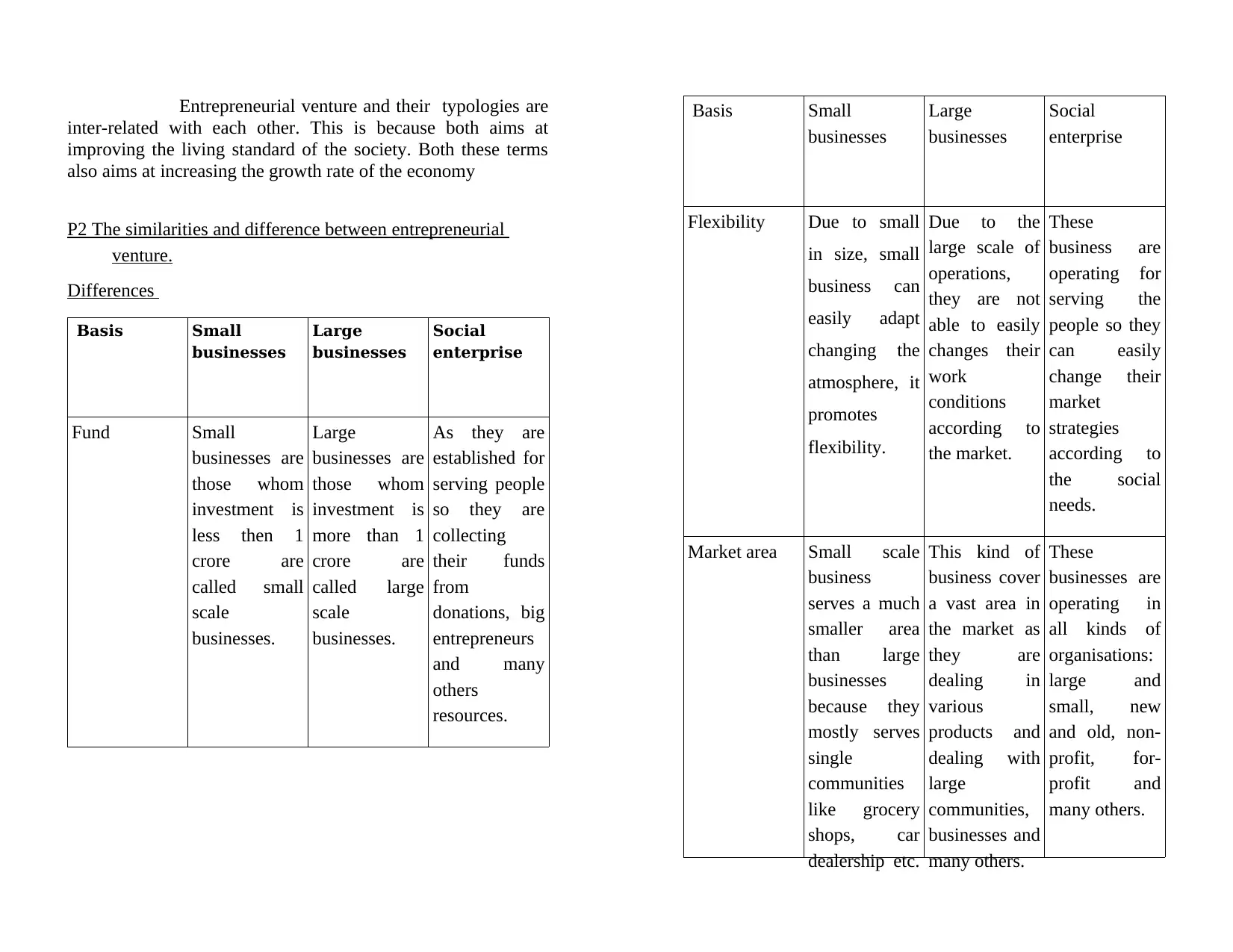
Entrepreneurial venture and their typologies are
inter-related with each other. This is because both aims at
improving the living standard of the society. Both these terms
also aims at increasing the growth rate of the economy
P2 The similarities and difference between entrepreneurial
venture.
Differences
Basis Small
businesses
Large
businesses
Social
enterprise
Fund Small
businesses are
those whom
investment is
less then 1
crore are
called small
scale
businesses.
Large
businesses are
those whom
investment is
more than 1
crore are
called large
scale
businesses.
As they are
established for
serving people
so they are
collecting
their funds
from
donations, big
entrepreneurs
and many
others
resources.
Basis Small
businesses
Large
businesses
Social
enterprise
Flexibility Due to small
in size, small
business can
easily adapt
changing the
atmosphere, it
promotes
flexibility.
Due to the
large scale of
operations,
they are not
able to easily
changes their
work
conditions
according to
the market.
These
business are
operating for
serving the
people so they
can easily
change their
market
strategies
according to
the social
needs.
Market area Small scale
business
serves a much
smaller area
than large
businesses
because they
mostly serves
single
communities
like grocery
shops, car
dealership etc.
This kind of
business cover
a vast area in
the market as
they are
dealing in
various
products and
dealing with
large
communities,
businesses and
many others.
These
businesses are
operating in
all kinds of
organisations:
large and
small, new
and old, non-
profit, for-
profit and
many others.
inter-related with each other. This is because both aims at
improving the living standard of the society. Both these terms
also aims at increasing the growth rate of the economy
P2 The similarities and difference between entrepreneurial
venture.
Differences
Basis Small
businesses
Large
businesses
Social
enterprise
Fund Small
businesses are
those whom
investment is
less then 1
crore are
called small
scale
businesses.
Large
businesses are
those whom
investment is
more than 1
crore are
called large
scale
businesses.
As they are
established for
serving people
so they are
collecting
their funds
from
donations, big
entrepreneurs
and many
others
resources.
Basis Small
businesses
Large
businesses
Social
enterprise
Flexibility Due to small
in size, small
business can
easily adapt
changing the
atmosphere, it
promotes
flexibility.
Due to the
large scale of
operations,
they are not
able to easily
changes their
work
conditions
according to
the market.
These
business are
operating for
serving the
people so they
can easily
change their
market
strategies
according to
the social
needs.
Market area Small scale
business
serves a much
smaller area
than large
businesses
because they
mostly serves
single
communities
like grocery
shops, car
dealership etc.
This kind of
business cover
a vast area in
the market as
they are
dealing in
various
products and
dealing with
large
communities,
businesses and
many others.
These
businesses are
operating in
all kinds of
organisations:
large and
small, new
and old, non-
profit, for-
profit and
many others.
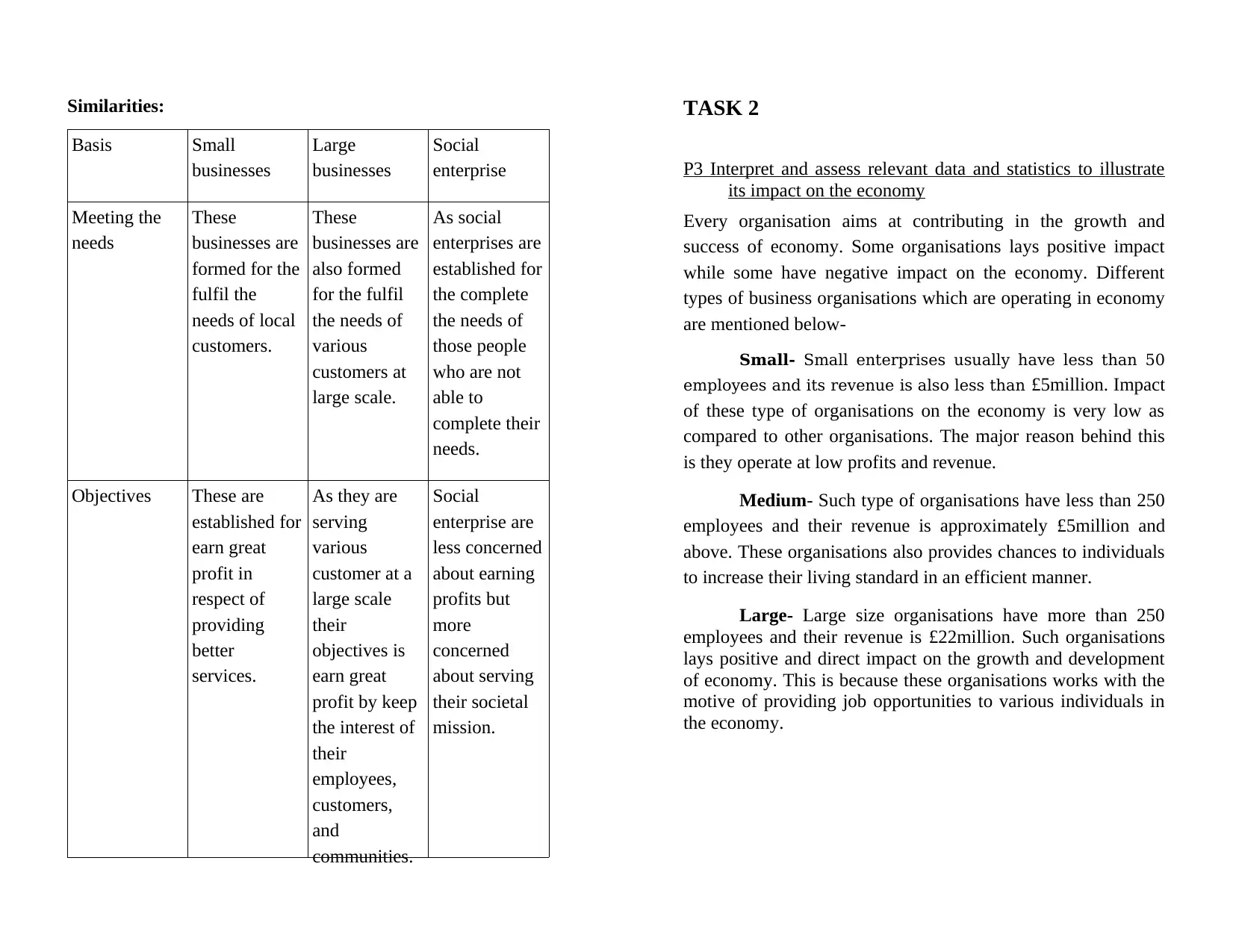
Similarities:
Basis Small
businesses
Large
businesses
Social
enterprise
Meeting the
needs
These
businesses are
formed for the
fulfil the
needs of local
customers.
These
businesses are
also formed
for the fulfil
the needs of
various
customers at
large scale.
As social
enterprises are
established for
the complete
the needs of
those people
who are not
able to
complete their
needs.
Objectives These are
established for
earn great
profit in
respect of
providing
better
services.
As they are
serving
various
customer at a
large scale
their
objectives is
earn great
profit by keep
the interest of
their
employees,
customers,
and
communities.
Social
enterprise are
less concerned
about earning
profits but
more
concerned
about serving
their societal
mission.
TASK 2
P3 Interpret and assess relevant data and statistics to illustrate
its impact on the economy
Every organisation aims at contributing in the growth and
success of economy. Some organisations lays positive impact
while some have negative impact on the economy. Different
types of business organisations which are operating in economy
are mentioned below-
Small- Small enterprises usually have less than 50
employees and its revenue is also less than £5million. Impact
of these type of organisations on the economy is very low as
compared to other organisations. The major reason behind this
is they operate at low profits and revenue.
Medium- Such type of organisations have less than 250
employees and their revenue is approximately £5million and
above. These organisations also provides chances to individuals
to increase their living standard in an efficient manner.
Large- Large size organisations have more than 250
employees and their revenue is £22million. Such organisations
lays positive and direct impact on the growth and development
of economy. This is because these organisations works with the
motive of providing job opportunities to various individuals in
the economy.
Basis Small
businesses
Large
businesses
Social
enterprise
Meeting the
needs
These
businesses are
formed for the
fulfil the
needs of local
customers.
These
businesses are
also formed
for the fulfil
the needs of
various
customers at
large scale.
As social
enterprises are
established for
the complete
the needs of
those people
who are not
able to
complete their
needs.
Objectives These are
established for
earn great
profit in
respect of
providing
better
services.
As they are
serving
various
customer at a
large scale
their
objectives is
earn great
profit by keep
the interest of
their
employees,
customers,
and
communities.
Social
enterprise are
less concerned
about earning
profits but
more
concerned
about serving
their societal
mission.
TASK 2
P3 Interpret and assess relevant data and statistics to illustrate
its impact on the economy
Every organisation aims at contributing in the growth and
success of economy. Some organisations lays positive impact
while some have negative impact on the economy. Different
types of business organisations which are operating in economy
are mentioned below-
Small- Small enterprises usually have less than 50
employees and its revenue is also less than £5million. Impact
of these type of organisations on the economy is very low as
compared to other organisations. The major reason behind this
is they operate at low profits and revenue.
Medium- Such type of organisations have less than 250
employees and their revenue is approximately £5million and
above. These organisations also provides chances to individuals
to increase their living standard in an efficient manner.
Large- Large size organisations have more than 250
employees and their revenue is £22million. Such organisations
lays positive and direct impact on the growth and development
of economy. This is because these organisations works with the
motive of providing job opportunities to various individuals in
the economy.
⊘ This is a preview!⊘
Do you want full access?
Subscribe today to unlock all pages.
Trusted by 1+ million students worldwide
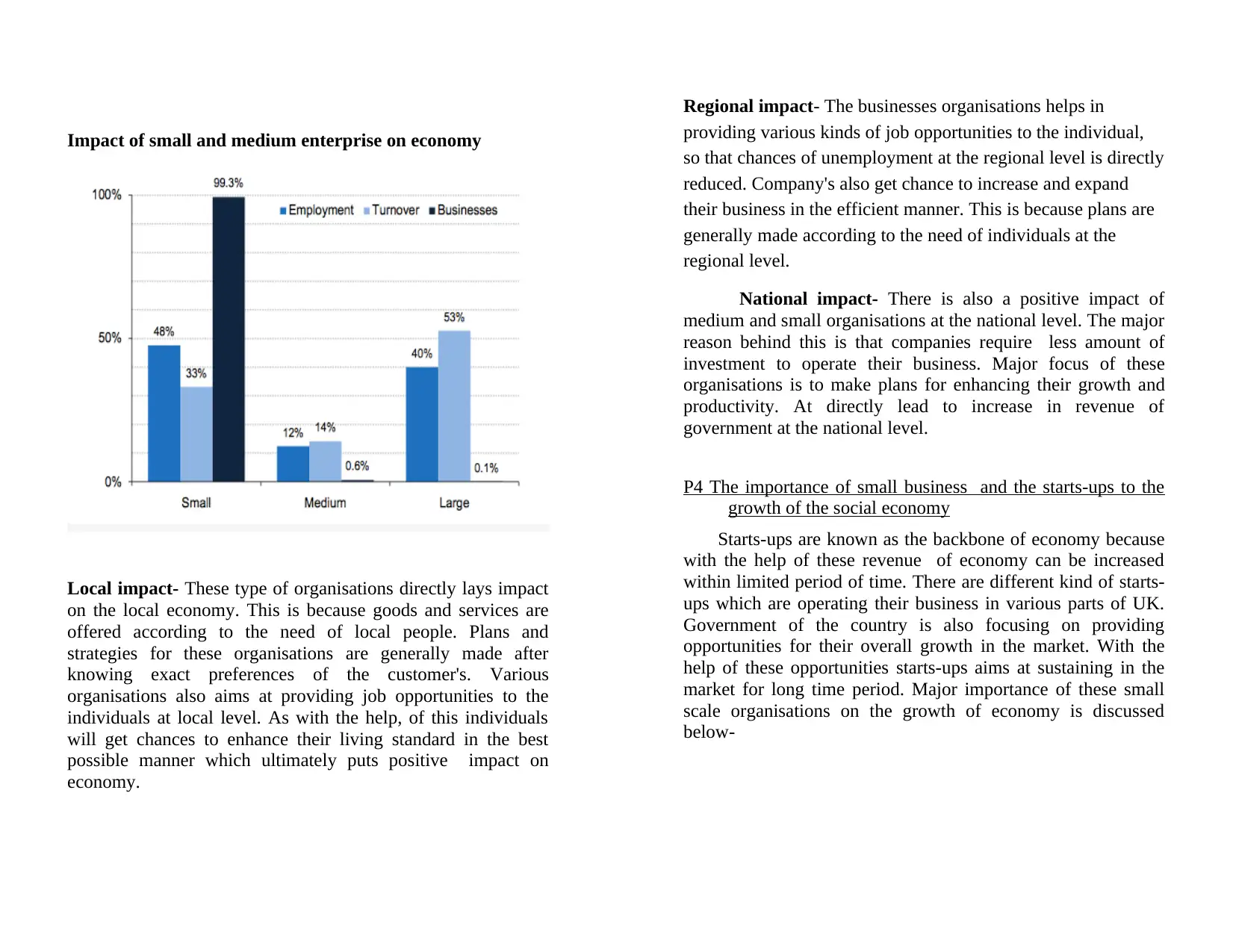
Impact of small and medium enterprise on economy
Local impact- These type of organisations directly lays impact
on the local economy. This is because goods and services are
offered according to the need of local people. Plans and
strategies for these organisations are generally made after
knowing exact preferences of the customer's. Various
organisations also aims at providing job opportunities to the
individuals at local level. As with the help, of this individuals
will get chances to enhance their living standard in the best
possible manner which ultimately puts positive impact on
economy.
Regional impact- The businesses organisations helps in
providing various kinds of job opportunities to the individual,
so that chances of unemployment at the regional level is directly
reduced. Company's also get chance to increase and expand
their business in the efficient manner. This is because plans are
generally made according to the need of individuals at the
regional level.
National impact- There is also a positive impact of
medium and small organisations at the national level. The major
reason behind this is that companies require less amount of
investment to operate their business. Major focus of these
organisations is to make plans for enhancing their growth and
productivity. At directly lead to increase in revenue of
government at the national level.
P4 The importance of small business and the starts-ups to the
growth of the social economy
Starts-ups are known as the backbone of economy because
with the help of these revenue of economy can be increased
within limited period of time. There are different kind of starts-
ups which are operating their business in various parts of UK.
Government of the country is also focusing on providing
opportunities for their overall growth in the market. With the
help of these opportunities starts-ups aims at sustaining in the
market for long time period. Major importance of these small
scale organisations on the growth of economy is discussed
below-
Local impact- These type of organisations directly lays impact
on the local economy. This is because goods and services are
offered according to the need of local people. Plans and
strategies for these organisations are generally made after
knowing exact preferences of the customer's. Various
organisations also aims at providing job opportunities to the
individuals at local level. As with the help, of this individuals
will get chances to enhance their living standard in the best
possible manner which ultimately puts positive impact on
economy.
Regional impact- The businesses organisations helps in
providing various kinds of job opportunities to the individual,
so that chances of unemployment at the regional level is directly
reduced. Company's also get chance to increase and expand
their business in the efficient manner. This is because plans are
generally made according to the need of individuals at the
regional level.
National impact- There is also a positive impact of
medium and small organisations at the national level. The major
reason behind this is that companies require less amount of
investment to operate their business. Major focus of these
organisations is to make plans for enhancing their growth and
productivity. At directly lead to increase in revenue of
government at the national level.
P4 The importance of small business and the starts-ups to the
growth of the social economy
Starts-ups are known as the backbone of economy because
with the help of these revenue of economy can be increased
within limited period of time. There are different kind of starts-
ups which are operating their business in various parts of UK.
Government of the country is also focusing on providing
opportunities for their overall growth in the market. With the
help of these opportunities starts-ups aims at sustaining in the
market for long time period. Major importance of these small
scale organisations on the growth of economy is discussed
below-
Paraphrase This Document
Need a fresh take? Get an instant paraphrase of this document with our AI Paraphraser
Job creation- With the help of starts-ups new
opportunities in the job sector can be created within limited
period of time. Job opportunities at the local level is provided
on the basis of current need of the market. Skills and knowledge
of individuals are analysed properly before providing them any
kind of job. This is because if skilled employees are hired by
starts-ups then they will be able to contribute in the growth of
economy. As better ideas will be provided by them for
enhancing the satisfaction level of society and individuals. It
will directly result in improvement in economical conditions.
Improve living standard- Starts-ups also provides the
chances of improvement in living standard of various people in
the economy. Their living standard is increased by offering high
quality of products at low prices. Major focus is emphasised on
increasing the satisfaction level of customer's and local people.
This is because if there needs are fulfilled than their living
standard will be improved directly.
Economic growth- Starts-ups can also help in growth of
the country within limited time period. This can be done by
using new and innovative ideas to satisfy the need of
individuals. With the help of starts-ups better use of the
available resources can also be done. Strategies for the
economical development is also made keeping in mind the
demand of potential customer's. As if the services are offered
according customer's demand than growth of the economy will
be increased automatically.
CONCLUSION
From the above given report it has been concluded
entrepreneurs are the individuals who continuously focuses on
attracting more and more customers within limited period of
time. Social, small and large scale enterprises directly
contributes in the growth and success of the economy. This is
because all theses enterprises provides various kinds of
employment opportunities to the individuals.
opportunities in the job sector can be created within limited
period of time. Job opportunities at the local level is provided
on the basis of current need of the market. Skills and knowledge
of individuals are analysed properly before providing them any
kind of job. This is because if skilled employees are hired by
starts-ups then they will be able to contribute in the growth of
economy. As better ideas will be provided by them for
enhancing the satisfaction level of society and individuals. It
will directly result in improvement in economical conditions.
Improve living standard- Starts-ups also provides the
chances of improvement in living standard of various people in
the economy. Their living standard is increased by offering high
quality of products at low prices. Major focus is emphasised on
increasing the satisfaction level of customer's and local people.
This is because if there needs are fulfilled than their living
standard will be improved directly.
Economic growth- Starts-ups can also help in growth of
the country within limited time period. This can be done by
using new and innovative ideas to satisfy the need of
individuals. With the help of starts-ups better use of the
available resources can also be done. Strategies for the
economical development is also made keeping in mind the
demand of potential customer's. As if the services are offered
according customer's demand than growth of the economy will
be increased automatically.
CONCLUSION
From the above given report it has been concluded
entrepreneurs are the individuals who continuously focuses on
attracting more and more customers within limited period of
time. Social, small and large scale enterprises directly
contributes in the growth and success of the economy. This is
because all theses enterprises provides various kinds of
employment opportunities to the individuals.
REFERENCES
Books and Journals
Acs, Z.J., and et. al., 2012. Growth and entrepreneurship. Small
Business Economics. 39(2). pp.289-300.
Dacin, M.T., Dacin, P.A. and Tracey, P., 2011. Social
entrepreneurship: A critique and future directions.
Organization science. 22(5). pp.1203-1213.
Dana, L.P. ed., 2010. Entrepreneurship and religion. Edward
Elgar Publishing.
De Clercq, D. and Voronov, M., 2011. Sustainability in
entrepreneurship: A tale of two logics. International
Small Business Journal. 29(4). pp.322-344.
Books and Journals
Acs, Z.J., and et. al., 2012. Growth and entrepreneurship. Small
Business Economics. 39(2). pp.289-300.
Dacin, M.T., Dacin, P.A. and Tracey, P., 2011. Social
entrepreneurship: A critique and future directions.
Organization science. 22(5). pp.1203-1213.
Dana, L.P. ed., 2010. Entrepreneurship and religion. Edward
Elgar Publishing.
De Clercq, D. and Voronov, M., 2011. Sustainability in
entrepreneurship: A tale of two logics. International
Small Business Journal. 29(4). pp.322-344.
⊘ This is a preview!⊘
Do you want full access?
Subscribe today to unlock all pages.
Trusted by 1+ million students worldwide

1 out of 9


Related Documents


Your All-in-One AI-Powered Toolkit for Academic Success.
+13062052269
info@desklib.com
Available 24*7 on WhatsApp / Email
![[object Object]](/_next/static/media/star-bottom.7253800d.svg)
Unlock your academic potential
Copyright © 2020–2026 A2Z Services. All Rights Reserved. Developed and managed by ZUCOL.