BTEC Unit 9: Entrepreneurship & Small Business Management Report
VerifiedAdded on 2023/01/12
|12
|4115
|20
Report
AI Summary
This report provides a comprehensive overview of entrepreneurship and small business management. It begins with an introduction to the field, defining entrepreneurship and its various levels of risk. The main body of the report explores different types of entrepreneurial ventures, including serial entrepreneurs, owner-managers, growth firms, lifestyle firms, corporate entrepreneurship, public sector entrepreneurship, and micro, small, and medium-sized businesses, as well as social enterprises. The report then examines the similarities and differences between these ventures. It further analyzes the impact of micro and small businesses on the economy, highlighting their contributions to GDP, employment, and the strengthening of local economies. The report also emphasizes the importance of small businesses and business start-ups to the growth of the social economy, detailing their role in providing employment opportunities, increasing living standards, and contributing to local government through taxes. The report discusses the characteristic traits and skills of successful entrepreneurs, as well as the aspects of the entrepreneurial personality that reflect motivation and mindset. Finally, it considers how background and experience can either hinder or foster entrepreneurship, concluding with a summary of the key findings.

SMALL BUSINESS AND
ENTREPRENEURSHIP
ENTREPRENEURSHIP

Paraphrase This Document
Need a fresh take? Get an instant paraphrase of this document with our AI Paraphraser
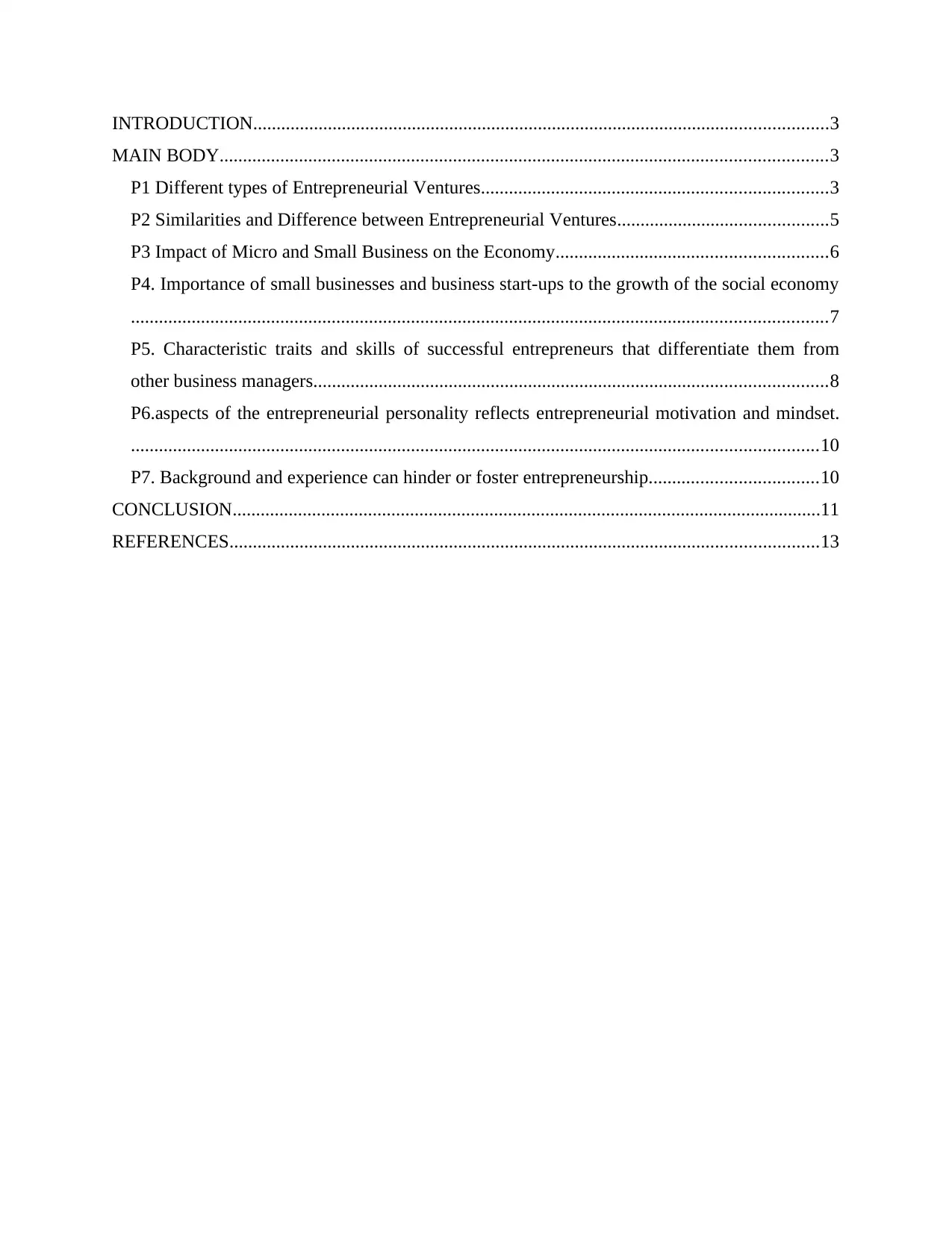
INTRODUCTION...........................................................................................................................3
MAIN BODY..................................................................................................................................3
P1 Different types of Entrepreneurial Ventures..........................................................................3
P2 Similarities and Difference between Entrepreneurial Ventures.............................................5
P3 Impact of Micro and Small Business on the Economy..........................................................6
P4. Importance of small businesses and business start-ups to the growth of the social economy
.....................................................................................................................................................7
P5. Characteristic traits and skills of successful entrepreneurs that differentiate them from
other business managers..............................................................................................................8
P6.aspects of the entrepreneurial personality reflects entrepreneurial motivation and mindset.
...................................................................................................................................................10
P7. Background and experience can hinder or foster entrepreneurship....................................10
CONCLUSION..............................................................................................................................11
REFERENCES..............................................................................................................................13
MAIN BODY..................................................................................................................................3
P1 Different types of Entrepreneurial Ventures..........................................................................3
P2 Similarities and Difference between Entrepreneurial Ventures.............................................5
P3 Impact of Micro and Small Business on the Economy..........................................................6
P4. Importance of small businesses and business start-ups to the growth of the social economy
.....................................................................................................................................................7
P5. Characteristic traits and skills of successful entrepreneurs that differentiate them from
other business managers..............................................................................................................8
P6.aspects of the entrepreneurial personality reflects entrepreneurial motivation and mindset.
...................................................................................................................................................10
P7. Background and experience can hinder or foster entrepreneurship....................................10
CONCLUSION..............................................................................................................................11
REFERENCES..............................................................................................................................13
INTRODUCTION
Entrepreneurship is considered to be there set up of business which are rested to their
various level of different risks as the financial and marginal one. The entrepreneurship has their
differentia level of structure which have the need of the various skills and certain level of
characterises for the effective development of business. In this report there is clear inclusion of
the differentiated experiences which will have the effect in fostering and hindering the business.
Small and medium enterprises have contributed highly in the growth of social economy. The
business idea is basically involved in attracting highly effective staff so that they tend to bring
new and innovative products and services. These businesses have the highly engaged in
increasing the gross domestic product value of the economy. They are also involved in
employing large number of employees. There are various traits of entrepreneurs such as
confidence and passion as these traits have assisted them in achieving goals and objectives of
business and helped them in growing. In this report, there will be clear inclusion of the different
types of entrepreneurial ventures and exploration of the similarities and differences between
Entrepreneurial ventures. There will be critical examination the scope, development and growth
of entrepreneurial ventures. In addition to that there will characteristic traits and skills of
successful entrepreneurs that differentiate them from other business managers.
MAIN BODY
P1 Different types of Entrepreneurial Ventures
Entrepreneurships are activity for setting business and taking financial risk for the profit
generation. Entrepreneurships are entrepreneurial business and ventures, they are operated and
managed with entrepreneurial activities these are operation of the business and their
administration (Morris and et.al., 2018). Success of enterprise and its operations depends on the
people and entrepreneurs which are operating and managing enterprises. Entrepreneurs are of
following types-
Serial Entrepreneurs
These entrepreneurs are those which keep starting and operating various businesses and
some of those get success and some also face failures. Entrepreneurs sell these businesses and
keep developing other entrepreneurial ventures on the basis of their different innovative idea.
1
Entrepreneurship is considered to be there set up of business which are rested to their
various level of different risks as the financial and marginal one. The entrepreneurship has their
differentia level of structure which have the need of the various skills and certain level of
characterises for the effective development of business. In this report there is clear inclusion of
the differentiated experiences which will have the effect in fostering and hindering the business.
Small and medium enterprises have contributed highly in the growth of social economy. The
business idea is basically involved in attracting highly effective staff so that they tend to bring
new and innovative products and services. These businesses have the highly engaged in
increasing the gross domestic product value of the economy. They are also involved in
employing large number of employees. There are various traits of entrepreneurs such as
confidence and passion as these traits have assisted them in achieving goals and objectives of
business and helped them in growing. In this report, there will be clear inclusion of the different
types of entrepreneurial ventures and exploration of the similarities and differences between
Entrepreneurial ventures. There will be critical examination the scope, development and growth
of entrepreneurial ventures. In addition to that there will characteristic traits and skills of
successful entrepreneurs that differentiate them from other business managers.
MAIN BODY
P1 Different types of Entrepreneurial Ventures
Entrepreneurships are activity for setting business and taking financial risk for the profit
generation. Entrepreneurships are entrepreneurial business and ventures, they are operated and
managed with entrepreneurial activities these are operation of the business and their
administration (Morris and et.al., 2018). Success of enterprise and its operations depends on the
people and entrepreneurs which are operating and managing enterprises. Entrepreneurs are of
following types-
Serial Entrepreneurs
These entrepreneurs are those which keep starting and operating various businesses and
some of those get success and some also face failures. Entrepreneurs sell these businesses and
keep developing other entrepreneurial ventures on the basis of their different innovative idea.
1
⊘ This is a preview!⊘
Do you want full access?
Subscribe today to unlock all pages.

Trusted by 1+ million students worldwide
Entrepreneurs
These are those entrepreneurs who design and develop their ventures and work on
attaining their vision. They start their venture and lead this and with help of other people ensure
that the vision for which they have started their entrepreneurship venture.
Owner Manager
These are those people who are owners of their business and venture and at the same time
are managers of their business (Burton and et.al., 2019). This is most common entrepreneurships
and small businesses are often managed by their owners.
Typology of Entrepreneurship
Growth Firms
These businesses are those business which sees market potential and potential for growth
of the business. This type of business includes Scalable business, equity and high-growth
business. In this technological innovations can be a basis for rapid growth of the business and
changing customer dynamics that create new opportunity in the market.
Lifestyle firms
Unlike Growth firms its objectives is not high and rapid growth. Though business owners
seek to earn profit but its focus is to provide a comfortable life style to the entrepreneurs along
with having freedom and work-life balance. Small businesses are this type of business and such
businesses are also based on passion and hobby of the entrepreneurs.
Corporate Entrepreneurships
These businesses are corporate businesses which are developed and operated on large
scale and large business entrepreneurships are part of corporate entrepreneurship (Neumeyer and
Santos, 2018). They are operated at large scale and earn a relatively high profit, employs many
employees and seek to fulfill gap of existing products and services and desired products and
services.
Public sector Entrepreneurship
These are operated and administered by central, state and local government and objective
of this is to provide facilities to public and profit earned from such business are reinvested for
that purpose.
Micro, Small and Medium Sized Business
2
These are those entrepreneurs who design and develop their ventures and work on
attaining their vision. They start their venture and lead this and with help of other people ensure
that the vision for which they have started their entrepreneurship venture.
Owner Manager
These are those people who are owners of their business and venture and at the same time
are managers of their business (Burton and et.al., 2019). This is most common entrepreneurships
and small businesses are often managed by their owners.
Typology of Entrepreneurship
Growth Firms
These businesses are those business which sees market potential and potential for growth
of the business. This type of business includes Scalable business, equity and high-growth
business. In this technological innovations can be a basis for rapid growth of the business and
changing customer dynamics that create new opportunity in the market.
Lifestyle firms
Unlike Growth firms its objectives is not high and rapid growth. Though business owners
seek to earn profit but its focus is to provide a comfortable life style to the entrepreneurs along
with having freedom and work-life balance. Small businesses are this type of business and such
businesses are also based on passion and hobby of the entrepreneurs.
Corporate Entrepreneurships
These businesses are corporate businesses which are developed and operated on large
scale and large business entrepreneurships are part of corporate entrepreneurship (Neumeyer and
Santos, 2018). They are operated at large scale and earn a relatively high profit, employs many
employees and seek to fulfill gap of existing products and services and desired products and
services.
Public sector Entrepreneurship
These are operated and administered by central, state and local government and objective
of this is to provide facilities to public and profit earned from such business are reinvested for
that purpose.
Micro, Small and Medium Sized Business
2
Paraphrase This Document
Need a fresh take? Get an instant paraphrase of this document with our AI Paraphraser
Micro businesses start with minimum required capital and employ maximum 10
employees in the business. These are operated at small level which limit to locality and a
particular market of the city. Profit is minimum to maintain a living for the business owner and
their family.
Small business operate on a bigger scale than micro but limit to city and maximum
employees employed in small business are 50 (Lee and Huang, 2018). Business earns profit more
than micro and owner can have a comfortable lifestyle.
Medium Size businesses are operated at a relatively high level and seek to increase their
profit and scale of operations which is intercity or extended to state. Employees employed in
such businesses are maximum 250.
Social Enterprise
These are the enterprises which are developed and operated with a motive to serve
society. Such organisations do not rum with the motive of profit earning and this is why the
profit earned by such organisations is invested back to the enterprise (Basole, R.C., Park, H. and
Chao, R.O., 2018). Such organisations can small and large and depends on the people who are
running such organizations.
P2 Similarities and Difference between Entrepreneurial Ventures
Similarities
On the basis of objectives social and public sector organisations have similarity as both of these
organisations operate with no profit objectives and objective to serve society and facilitate living
of society (Osunde, 2017).
Scalable organisation and large organisations both operate with a motive to increase their profit
and at the same time expand operation of their business.
Lifestyle and Small firms have similarity on the basis of their operations and purpose. Both the
type of ventures seeks to earn profit to have a comfortable life style and focus on narrow market
and at the same time have freedom.
Lifestyle and small business ventures also a similarity as lifestyle firms are based on passion and
hobby of the entrepreneur and at the same time small business owners most of the time start and
run their business with their knowledge and talent that they possess. For example, talent and
knowledge of banking and cooking can encourage individual to start a café and single café
3
employees in the business. These are operated at small level which limit to locality and a
particular market of the city. Profit is minimum to maintain a living for the business owner and
their family.
Small business operate on a bigger scale than micro but limit to city and maximum
employees employed in small business are 50 (Lee and Huang, 2018). Business earns profit more
than micro and owner can have a comfortable lifestyle.
Medium Size businesses are operated at a relatively high level and seek to increase their
profit and scale of operations which is intercity or extended to state. Employees employed in
such businesses are maximum 250.
Social Enterprise
These are the enterprises which are developed and operated with a motive to serve
society. Such organisations do not rum with the motive of profit earning and this is why the
profit earned by such organisations is invested back to the enterprise (Basole, R.C., Park, H. and
Chao, R.O., 2018). Such organisations can small and large and depends on the people who are
running such organizations.
P2 Similarities and Difference between Entrepreneurial Ventures
Similarities
On the basis of objectives social and public sector organisations have similarity as both of these
organisations operate with no profit objectives and objective to serve society and facilitate living
of society (Osunde, 2017).
Scalable organisation and large organisations both operate with a motive to increase their profit
and at the same time expand operation of their business.
Lifestyle and Small firms have similarity on the basis of their operations and purpose. Both the
type of ventures seeks to earn profit to have a comfortable life style and focus on narrow market
and at the same time have freedom.
Lifestyle and small business ventures also a similarity as lifestyle firms are based on passion and
hobby of the entrepreneur and at the same time small business owners most of the time start and
run their business with their knowledge and talent that they possess. For example, talent and
knowledge of banking and cooking can encourage individual to start a café and single café
3
operating at only one place is a type small business. This talent of banking and cooking when is a
passion and hobby for the individual this is known as lifestyle firm.
Difference
Similarities are limited but all the ventures are different from each other. On the basis of profit
large business entrepreneurships and small and micro businesses are different (Kollmann and
et.al., 2017). This difference also stands on the basis of employees and capital invested and scale
of operations of the business.
On the basis of objectives social entrepreneurship is different from all other business ventures
except public sector ventures (Osunde, 2017). This is because either small or large all the
business seek to earn profit and increase their profit except social enterprise whose main
objective is to serve society and facilitate their living.
Another difference is in public sector entrepreneurship and other types of business ventures as all
other are established and operated by private people and public sector ventures are only which
are operated and administered by government.
P3 Impact of Micro and Small Business on the Economy
Micro and Small business occupy biggest part of businesses in economy of a country.
Micro and Small Businesses contribute to economy is various ways they contribute in increasing
GDP and strengthens local economy of a country. They also contribute in increasing and
providing employment opportunities to local people.
In 2019 UK there were 5.9 million private sector businesses in UK. In this businesses with no
employees business accounts for almost 76% of the total businesses in the economy.
Figure 1Impact of Small and Micro Business in UK economy
On the basis of employees and scope of business businesses which employs less than 10
employees. Such businesses account for 96% of the total business and 5.6 million businesses
which contribute to around 9 million employments and £900 billion turnovers in the economy
4
passion and hobby for the individual this is known as lifestyle firm.
Difference
Similarities are limited but all the ventures are different from each other. On the basis of profit
large business entrepreneurships and small and micro businesses are different (Kollmann and
et.al., 2017). This difference also stands on the basis of employees and capital invested and scale
of operations of the business.
On the basis of objectives social entrepreneurship is different from all other business ventures
except public sector ventures (Osunde, 2017). This is because either small or large all the
business seek to earn profit and increase their profit except social enterprise whose main
objective is to serve society and facilitate their living.
Another difference is in public sector entrepreneurship and other types of business ventures as all
other are established and operated by private people and public sector ventures are only which
are operated and administered by government.
P3 Impact of Micro and Small Business on the Economy
Micro and Small business occupy biggest part of businesses in economy of a country.
Micro and Small Businesses contribute to economy is various ways they contribute in increasing
GDP and strengthens local economy of a country. They also contribute in increasing and
providing employment opportunities to local people.
In 2019 UK there were 5.9 million private sector businesses in UK. In this businesses with no
employees business accounts for almost 76% of the total businesses in the economy.
Figure 1Impact of Small and Micro Business in UK economy
On the basis of employees and scope of business businesses which employs less than 10
employees. Such businesses account for 96% of the total business and 5.6 million businesses
which contribute to around 9 million employments and £900 billion turnovers in the economy
4
⊘ This is a preview!⊘
Do you want full access?
Subscribe today to unlock all pages.
Trusted by 1+ million students worldwide
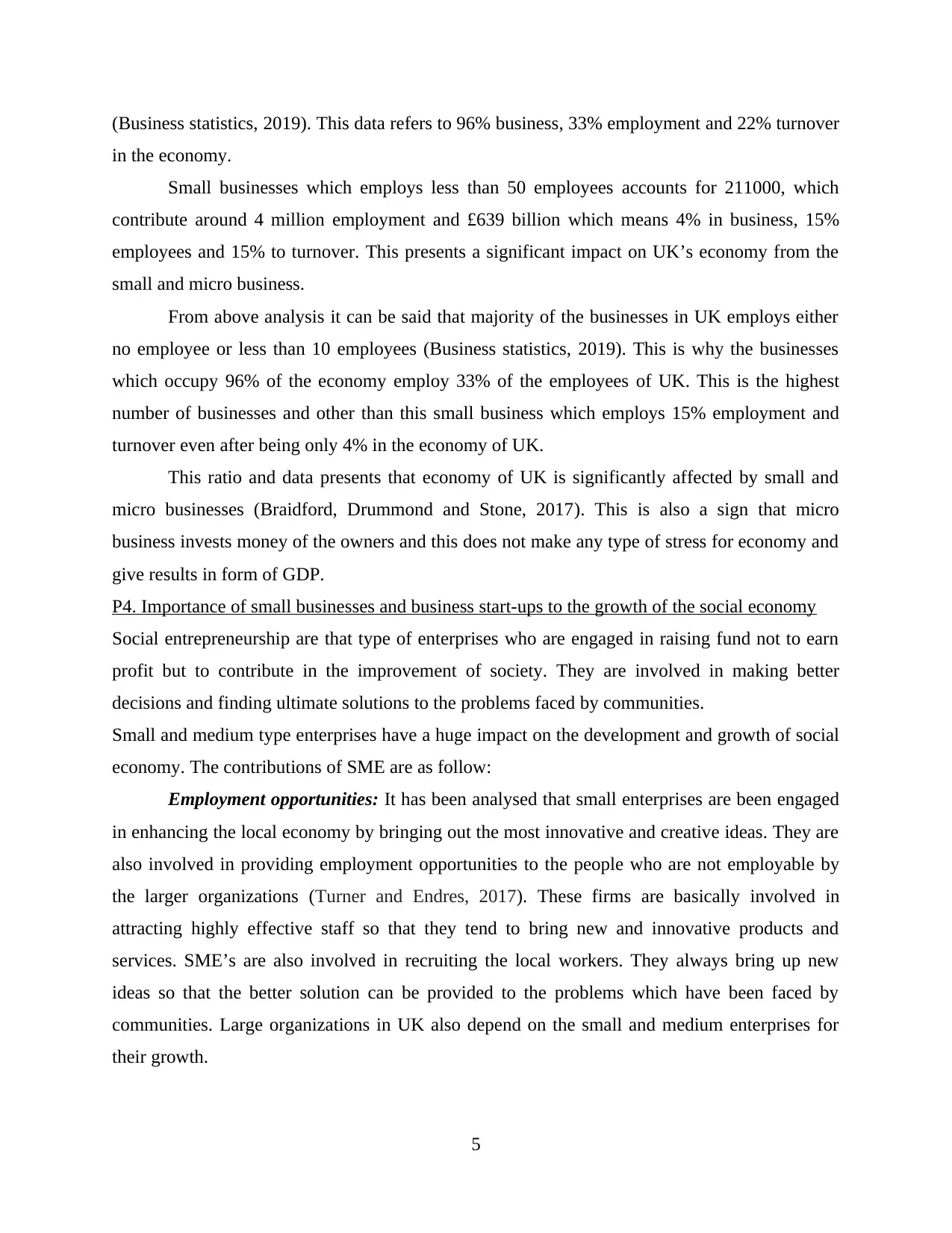
(Business statistics, 2019). This data refers to 96% business, 33% employment and 22% turnover
in the economy.
Small businesses which employs less than 50 employees accounts for 211000, which
contribute around 4 million employment and £639 billion which means 4% in business, 15%
employees and 15% to turnover. This presents a significant impact on UK’s economy from the
small and micro business.
From above analysis it can be said that majority of the businesses in UK employs either
no employee or less than 10 employees (Business statistics, 2019). This is why the businesses
which occupy 96% of the economy employ 33% of the employees of UK. This is the highest
number of businesses and other than this small business which employs 15% employment and
turnover even after being only 4% in the economy of UK.
This ratio and data presents that economy of UK is significantly affected by small and
micro businesses (Braidford, Drummond and Stone, 2017). This is also a sign that micro
business invests money of the owners and this does not make any type of stress for economy and
give results in form of GDP.
P4. Importance of small businesses and business start-ups to the growth of the social economy
Social entrepreneurship are that type of enterprises who are engaged in raising fund not to earn
profit but to contribute in the improvement of society. They are involved in making better
decisions and finding ultimate solutions to the problems faced by communities.
Small and medium type enterprises have a huge impact on the development and growth of social
economy. The contributions of SME are as follow:
Employment opportunities: It has been analysed that small enterprises are been engaged
in enhancing the local economy by bringing out the most innovative and creative ideas. They are
also involved in providing employment opportunities to the people who are not employable by
the larger organizations (Turner and Endres, 2017). These firms are basically involved in
attracting highly effective staff so that they tend to bring new and innovative products and
services. SME’s are also involved in recruiting the local workers. They always bring up new
ideas so that the better solution can be provided to the problems which have been faced by
communities. Large organizations in UK also depend on the small and medium enterprises for
their growth.
5
in the economy.
Small businesses which employs less than 50 employees accounts for 211000, which
contribute around 4 million employment and £639 billion which means 4% in business, 15%
employees and 15% to turnover. This presents a significant impact on UK’s economy from the
small and micro business.
From above analysis it can be said that majority of the businesses in UK employs either
no employee or less than 10 employees (Business statistics, 2019). This is why the businesses
which occupy 96% of the economy employ 33% of the employees of UK. This is the highest
number of businesses and other than this small business which employs 15% employment and
turnover even after being only 4% in the economy of UK.
This ratio and data presents that economy of UK is significantly affected by small and
micro businesses (Braidford, Drummond and Stone, 2017). This is also a sign that micro
business invests money of the owners and this does not make any type of stress for economy and
give results in form of GDP.
P4. Importance of small businesses and business start-ups to the growth of the social economy
Social entrepreneurship are that type of enterprises who are engaged in raising fund not to earn
profit but to contribute in the improvement of society. They are involved in making better
decisions and finding ultimate solutions to the problems faced by communities.
Small and medium type enterprises have a huge impact on the development and growth of social
economy. The contributions of SME are as follow:
Employment opportunities: It has been analysed that small enterprises are been engaged
in enhancing the local economy by bringing out the most innovative and creative ideas. They are
also involved in providing employment opportunities to the people who are not employable by
the larger organizations (Turner and Endres, 2017). These firms are basically involved in
attracting highly effective staff so that they tend to bring new and innovative products and
services. SME’s are also involved in recruiting the local workers. They always bring up new
ideas so that the better solution can be provided to the problems which have been faced by
communities. Large organizations in UK also depend on the small and medium enterprises for
their growth.
5
Paraphrase This Document
Need a fresh take? Get an instant paraphrase of this document with our AI Paraphraser
Increase in living standard: It has been analysed that SME’s are been engaged in
providing employment opportunities to local workers which has raise their life style and living
standards. By these contributions of SME, the local communities are also been able to gain
effective education as there income rises.
Contribution to local government with taxes: It has been analysed that as SME’s are
been engaged in providing employment opportunities to local communities and generating high
level of revenues. They will pay higher amount of taxes including the property tax. This in turn
is also increasing the income of local government. It has also enhanced the value of property.
The income is also been earned by the government with sales tax which is paid by all SME’s.
Growth of ventures in both public and private sector: It has been analysed that in United
Kingdom more than 200000 new private businesses have been opened. They have seen an
increase of 3.5% in private sector business in comparison with the last year statistics. It has also
been analysed that 99.9% of the private sector business running in UK are all SME’s. In
corporate sector 60% of the working population has been employed by them. It has been
analysed that retail organization comprises of 9.3% of all the business in UK but employees 18.4
private sector workers (Julien, 2018)’. They generate 33.7% revenue. The SME’s are highly
engaged in increasing the gross domestic product value of the economy. They are also involved
in employing large number of employees.
Innovative products and services: It has been analyse that SME are been engaged in
attracting highly skilled and efficient talent. They assist small and medium sized enterprises in
bringing more innovative and creative products and services. This assists them in growth of
economy.
P5. Characteristic traits and skills of successful entrepreneurs that differentiate them from other
business managers
The successful entrepreneurs have various types of skills and traits that makes them
different from the business managers.
Characteristic: There are various types of characteristics that an entrepreneur needs to
have in order to make business successful. The characteristic includes the following:
Motivation: It has been analyzed that a successful entrepreneur is highly motivated to
achieve their goals and objectives. Like for example Elizabeth Gooch was one of the most
successful female entrepreneurs. She was highly motivated in improvising the operational
6
providing employment opportunities to local workers which has raise their life style and living
standards. By these contributions of SME, the local communities are also been able to gain
effective education as there income rises.
Contribution to local government with taxes: It has been analysed that as SME’s are
been engaged in providing employment opportunities to local communities and generating high
level of revenues. They will pay higher amount of taxes including the property tax. This in turn
is also increasing the income of local government. It has also enhanced the value of property.
The income is also been earned by the government with sales tax which is paid by all SME’s.
Growth of ventures in both public and private sector: It has been analysed that in United
Kingdom more than 200000 new private businesses have been opened. They have seen an
increase of 3.5% in private sector business in comparison with the last year statistics. It has also
been analysed that 99.9% of the private sector business running in UK are all SME’s. In
corporate sector 60% of the working population has been employed by them. It has been
analysed that retail organization comprises of 9.3% of all the business in UK but employees 18.4
private sector workers (Julien, 2018)’. They generate 33.7% revenue. The SME’s are highly
engaged in increasing the gross domestic product value of the economy. They are also involved
in employing large number of employees.
Innovative products and services: It has been analyse that SME are been engaged in
attracting highly skilled and efficient talent. They assist small and medium sized enterprises in
bringing more innovative and creative products and services. This assists them in growth of
economy.
P5. Characteristic traits and skills of successful entrepreneurs that differentiate them from other
business managers
The successful entrepreneurs have various types of skills and traits that makes them
different from the business managers.
Characteristic: There are various types of characteristics that an entrepreneur needs to
have in order to make business successful. The characteristic includes the following:
Motivation: It has been analyzed that a successful entrepreneur is highly motivated to
achieve their goals and objectives. Like for example Elizabeth Gooch was one of the most
successful female entrepreneurs. She was highly motivated in improvising the operational
6
efficiency and performance of her enterprise on the other hand business managers are not highly
motivated, they do the assign task.
Passionate: Entrepreneurs are passionate about their work; they do not procrastinate task
and are fully enthusiast to achieve their goals and objectives. Like for example Tom Mercer was
really passionate to help the community workers by providing them healthy breakfast. He
worked day and night to achieve his dreams On the other hand business managers are not
passionate about the work they do.
Trait: There are various traits that have been possessed by successful entrepreneurs. Traits
discussed below make them different from business managers.
Disciplined: It has been analyzed that entrepreneurs need to be disciplined in their work.
They always focus their energy on making the business work, and for eliminating the distractions
or obstacles to their goals. Like for example Elizabeth Gooch was highly involved in overcoming
the barriers faced by her. On the other hand business managers are not highly disciplined in their
work.
Confident: A successful entrepreneur is confident upon the business idea which they are
going to launch. Like for example Tom Mercer was confident on the idea that his knowledge will
assist him in making the business successful. It is really necessary for the growth of business that
entrepreneur must be confident (Mamabolo, Kerrin and Kele, 2017). An entrepreneur who is not
confident can have many loose ends and their chances that the business many fail. On the other
hand business managers are not confident enough.
Skills:
Decision making: Successful entrepreneur needs to be firm in their decision. They must
be engaged in making decisions according to the demands and needs of people. Like for example
Tom Mercer has analyzed the community needs and launched MOMA. This idea has supported
so many community workers. On the other hand business managers many not are able to take
decision on their own.
Problem solving: It has been analyzed that the successful entrepreneurs must have the ability
to solve the problems faced by them and their business. This will assist them in removing the
conflict and barrier faced by them. this skill will also make their business more productive. Like
for example Elizabeth Gooch was firm in solving the issues so that operational efficiency of her
business can be improved. On the other hand business managers are nit problem solvers.
7
motivated, they do the assign task.
Passionate: Entrepreneurs are passionate about their work; they do not procrastinate task
and are fully enthusiast to achieve their goals and objectives. Like for example Tom Mercer was
really passionate to help the community workers by providing them healthy breakfast. He
worked day and night to achieve his dreams On the other hand business managers are not
passionate about the work they do.
Trait: There are various traits that have been possessed by successful entrepreneurs. Traits
discussed below make them different from business managers.
Disciplined: It has been analyzed that entrepreneurs need to be disciplined in their work.
They always focus their energy on making the business work, and for eliminating the distractions
or obstacles to their goals. Like for example Elizabeth Gooch was highly involved in overcoming
the barriers faced by her. On the other hand business managers are not highly disciplined in their
work.
Confident: A successful entrepreneur is confident upon the business idea which they are
going to launch. Like for example Tom Mercer was confident on the idea that his knowledge will
assist him in making the business successful. It is really necessary for the growth of business that
entrepreneur must be confident (Mamabolo, Kerrin and Kele, 2017). An entrepreneur who is not
confident can have many loose ends and their chances that the business many fail. On the other
hand business managers are not confident enough.
Skills:
Decision making: Successful entrepreneur needs to be firm in their decision. They must
be engaged in making decisions according to the demands and needs of people. Like for example
Tom Mercer has analyzed the community needs and launched MOMA. This idea has supported
so many community workers. On the other hand business managers many not are able to take
decision on their own.
Problem solving: It has been analyzed that the successful entrepreneurs must have the ability
to solve the problems faced by them and their business. This will assist them in removing the
conflict and barrier faced by them. this skill will also make their business more productive. Like
for example Elizabeth Gooch was firm in solving the issues so that operational efficiency of her
business can be improved. On the other hand business managers are nit problem solvers.
7
⊘ This is a preview!⊘
Do you want full access?
Subscribe today to unlock all pages.
Trusted by 1+ million students worldwide
P6.aspects of the entrepreneurial personality reflects entrepreneurial motivation and mindset.
The aspects of entrepreneurial personality can be explained with the help of big fiver personality
trait, ocean model. This includes the following:
Openness: In this the entrepreneurs are highly creative and are open to manage all the new
things and changes in environment. They are highly imaginative and have deep insight. Like for
example Tom Mercer has always dreamt about making his business idea work. In order to make
his business grow, he worked day and night. He also adopted innovative technique like engaged
in doing marketing campaign.
Consciousness: In this the entrepreneurs are clear in setting their goals and objectives. They
are engaged in taking full time for preparation. They are also involved in paying attention to
every little detail. Like for example Elizabeth Gooch was analysing each aspects of her business
so that success can be achieved (Collins, Worthington and Schoen, 2016).
Extraversion: In this entrepreneurs have empathy towards all type of social situations. In
this aspect they feel highly satisfied by helping other people. They communicate effectively so
that needs and demands of people can be analysed. Like for example Tom Mercer was really
keen to help the workers of community.
Agreeableness: In this entrepreneurs are involved in contributing to the happiness of others.
They are also involved in providing support to people who are in need. Like for example Tom
Mercer, he launched MOMA so that he can provide healthy breakfast to people who are working
for development of communities.
Neuroticism: In this entrepreneurs are really stable in their thought value. They take less
stress and are engaged in bringing solution to the problem. Like for example Elizabeth Gooch
was involved in overcoming the barrier faced by her business with any stress.
P7. Background and experience can hinder or foster entrepreneurship.
Elizabeth Gooch
Family and educational background: Elizabeth started her career by working in HSBC
bank for 8 years. She started with new idea of business while working in Bank. It has been
analysed that after some time she started her business known as EG consultancy. At that she was
aged 26, financed by £1,000 borrowed from family and friends and a credit card.
Experience: It has been analysed that initially EG consultancy provides training and
consultation to the training companies. They were involved in providing the suggestions related
8
The aspects of entrepreneurial personality can be explained with the help of big fiver personality
trait, ocean model. This includes the following:
Openness: In this the entrepreneurs are highly creative and are open to manage all the new
things and changes in environment. They are highly imaginative and have deep insight. Like for
example Tom Mercer has always dreamt about making his business idea work. In order to make
his business grow, he worked day and night. He also adopted innovative technique like engaged
in doing marketing campaign.
Consciousness: In this the entrepreneurs are clear in setting their goals and objectives. They
are engaged in taking full time for preparation. They are also involved in paying attention to
every little detail. Like for example Elizabeth Gooch was analysing each aspects of her business
so that success can be achieved (Collins, Worthington and Schoen, 2016).
Extraversion: In this entrepreneurs have empathy towards all type of social situations. In
this aspect they feel highly satisfied by helping other people. They communicate effectively so
that needs and demands of people can be analysed. Like for example Tom Mercer was really
keen to help the workers of community.
Agreeableness: In this entrepreneurs are involved in contributing to the happiness of others.
They are also involved in providing support to people who are in need. Like for example Tom
Mercer, he launched MOMA so that he can provide healthy breakfast to people who are working
for development of communities.
Neuroticism: In this entrepreneurs are really stable in their thought value. They take less
stress and are engaged in bringing solution to the problem. Like for example Elizabeth Gooch
was involved in overcoming the barrier faced by her business with any stress.
P7. Background and experience can hinder or foster entrepreneurship.
Elizabeth Gooch
Family and educational background: Elizabeth started her career by working in HSBC
bank for 8 years. She started with new idea of business while working in Bank. It has been
analysed that after some time she started her business known as EG consultancy. At that she was
aged 26, financed by £1,000 borrowed from family and friends and a credit card.
Experience: It has been analysed that initially EG consultancy provides training and
consultation to the training companies. They were involved in providing the suggestions related
8
Paraphrase This Document
Need a fresh take? Get an instant paraphrase of this document with our AI Paraphraser
to improvising the efficiency of business. In order to manage task, Elizabeth launched a new
software. It has been analysed that in the year 1993 operational intelligence software was beigng
launched by her. This software was developed to collect the data from all the departments of
company. It helps in finishing of task. After making use of this software they were able to
improve the operational efficiency and performance of company. She also advice to lay more
emphasis on implementation strategy and one should never give up because of the failure.
Tom Mercer
Family and educational background: Tom Mercer has studied from the Cambridge
University. He also worked as the management consultant with Bain and Company in London.
He always thought of business ideas and finally came up with providing health breakfast to the
city workers. He ran to his family and friends to share his idea with them (Linton and Solomon,
2017).
Experience: It has been analysed that he worked really hard to provide health breakfast to
community workers. Before going to work he will blend smoothie and prepare oats for them. He
worked day and night to make his business idea a success. He got positive feedback from his
friends and than by the end of summer 2008, Tom Mercer started his company MOMA. They
had 9 stalls and start selling it to few offices and shop. They also started their won shops and got
orders from Waitrose and Virgin. They are planning to extend company beyond London.
CONCLUSION
From the above study, it has been summarised that small and medium enterprises has
contributed highly in the growth of social economy. They have also provided employment
opportunities to local communities. This has assisted them in enhancing living standard of
people. These firms are basically involved in attracting highly effective staff so that they tend to
bring new and innovative products and services. It has also been analysed from the report that
SME have been involved in bringing highly creative and innovative products and services. It is
really necessary for their growth. There are various traits of entrepreneurs such as confidence
and passion. These traits has assisted them in achieving goals and objectives of business and
helped them in growing.
9
software. It has been analysed that in the year 1993 operational intelligence software was beigng
launched by her. This software was developed to collect the data from all the departments of
company. It helps in finishing of task. After making use of this software they were able to
improve the operational efficiency and performance of company. She also advice to lay more
emphasis on implementation strategy and one should never give up because of the failure.
Tom Mercer
Family and educational background: Tom Mercer has studied from the Cambridge
University. He also worked as the management consultant with Bain and Company in London.
He always thought of business ideas and finally came up with providing health breakfast to the
city workers. He ran to his family and friends to share his idea with them (Linton and Solomon,
2017).
Experience: It has been analysed that he worked really hard to provide health breakfast to
community workers. Before going to work he will blend smoothie and prepare oats for them. He
worked day and night to make his business idea a success. He got positive feedback from his
friends and than by the end of summer 2008, Tom Mercer started his company MOMA. They
had 9 stalls and start selling it to few offices and shop. They also started their won shops and got
orders from Waitrose and Virgin. They are planning to extend company beyond London.
CONCLUSION
From the above study, it has been summarised that small and medium enterprises has
contributed highly in the growth of social economy. They have also provided employment
opportunities to local communities. This has assisted them in enhancing living standard of
people. These firms are basically involved in attracting highly effective staff so that they tend to
bring new and innovative products and services. It has also been analysed from the report that
SME have been involved in bringing highly creative and innovative products and services. It is
really necessary for their growth. There are various traits of entrepreneurs such as confidence
and passion. These traits has assisted them in achieving goals and objectives of business and
helped them in growing.
9
REFERENCES
Books and Journals
Linton, J.D. and Solomon, G.T., 2017. Technology, innovation, entrepreneurship and the small
business—technology and innovation in small business. Journal of small business
management.55(2). pp.196-199.
Collins, J.D., Worthington, W.J. and Schoen, J.E., 2016. Family business CEO succession:
Examining personal retirement expectations. Journal of Small Business Strategy, 26(2),
pp.51-70.
Mamabolo, M.A., Kerrin, M. and Kele, T., 2017. Entrepreneurship management skills
requirements in an emerging economy: A South African outlook. The Southern African
Journal of Entrepreneurship and Small Business Management.9(1).pp.1-10.
Julien, P.A. ed., 2018. The state of the art in small business and entrepreneurship. Routledge.
Turner, S. and Endres, A., 2017. Strategies for enhancing small business owners' success
rates. International Journal of Applied Management and Technology. 16(1). p.3.
Morris, M.H and et.al., 2018. Distinguishing types of entrepreneurial ventures: An identity‐based
perspective. Journal of Small Business Management. 56(3). pp.453-474.
Burton, M.D and et.al., 2019. The organizational design of entrepreneurial ventures. Strategic
Entrepreneurship Journal. 13(3). pp.243-255.
Neumeyer, X. and Santos, S.C., 2018. Sustainable business models, venture typologies, and
entrepreneurial ecosystems: A social network perspective. Journal of Cleaner
Production. 172. pp.4565-4579.
Lee, M. and Huang, L., 2018. Gender bias, social impact framing, and evaluation of
entrepreneurial ventures. Organization Science. 29(1). pp.1-16.
Basole, R.C., Park, H. and Chao, R.O., 2018. Visual analysis of venture similarity in
entrepreneurial ecosystems. IEEE Transactions on Engineering Management. 66(4).
pp.568-582.
Kollmann, T and et.al., 2017. When members of entrepreneurial teams differ: linking diversity in
individual-level entrepreneurial orientation to team performance. Small Business
Economics, 48(4), pp.843-859.
Osunde, C., 2017. Family businesses and its impact on the economy. Journal of Business &
Financial Affairs, 6(1), pp.1-3.
Braidford, P., Drummond, I. and Stone, I., 2017. The impact of personal attitudes on the growth
ambitions of small business owners. Journal of Small Business and Enterprise
Development.
10
Books and Journals
Linton, J.D. and Solomon, G.T., 2017. Technology, innovation, entrepreneurship and the small
business—technology and innovation in small business. Journal of small business
management.55(2). pp.196-199.
Collins, J.D., Worthington, W.J. and Schoen, J.E., 2016. Family business CEO succession:
Examining personal retirement expectations. Journal of Small Business Strategy, 26(2),
pp.51-70.
Mamabolo, M.A., Kerrin, M. and Kele, T., 2017. Entrepreneurship management skills
requirements in an emerging economy: A South African outlook. The Southern African
Journal of Entrepreneurship and Small Business Management.9(1).pp.1-10.
Julien, P.A. ed., 2018. The state of the art in small business and entrepreneurship. Routledge.
Turner, S. and Endres, A., 2017. Strategies for enhancing small business owners' success
rates. International Journal of Applied Management and Technology. 16(1). p.3.
Morris, M.H and et.al., 2018. Distinguishing types of entrepreneurial ventures: An identity‐based
perspective. Journal of Small Business Management. 56(3). pp.453-474.
Burton, M.D and et.al., 2019. The organizational design of entrepreneurial ventures. Strategic
Entrepreneurship Journal. 13(3). pp.243-255.
Neumeyer, X. and Santos, S.C., 2018. Sustainable business models, venture typologies, and
entrepreneurial ecosystems: A social network perspective. Journal of Cleaner
Production. 172. pp.4565-4579.
Lee, M. and Huang, L., 2018. Gender bias, social impact framing, and evaluation of
entrepreneurial ventures. Organization Science. 29(1). pp.1-16.
Basole, R.C., Park, H. and Chao, R.O., 2018. Visual analysis of venture similarity in
entrepreneurial ecosystems. IEEE Transactions on Engineering Management. 66(4).
pp.568-582.
Kollmann, T and et.al., 2017. When members of entrepreneurial teams differ: linking diversity in
individual-level entrepreneurial orientation to team performance. Small Business
Economics, 48(4), pp.843-859.
Osunde, C., 2017. Family businesses and its impact on the economy. Journal of Business &
Financial Affairs, 6(1), pp.1-3.
Braidford, P., Drummond, I. and Stone, I., 2017. The impact of personal attitudes on the growth
ambitions of small business owners. Journal of Small Business and Enterprise
Development.
10
⊘ This is a preview!⊘
Do you want full access?
Subscribe today to unlock all pages.
Trusted by 1+ million students worldwide

1 out of 12


Related Documents


Your All-in-One AI-Powered Toolkit for Academic Success.
+13062052269
info@desklib.com
Available 24*7 on WhatsApp / Email
![[object Object]](/_next/static/media/star-bottom.7253800d.svg)
Unlock your academic potential
Copyright © 2020–2026 A2Z Services. All Rights Reserved. Developed and managed by ZUCOL.