Analysis of Entrepreneurship & Small Business Management UK
VerifiedAdded on 2022/11/30
|26
|3616
|327
Report
AI Summary
This report provides a comprehensive analysis of entrepreneurship and small business management, focusing on different types of entrepreneurship such as social, innovation, big business, small business, and scalable startups. It includes a primary research questionnaire assessing local businesses in the wood and furniture industry in the UK, highlighting challenges and customer segments. The report also examines situational factors affecting entrepreneurship, including economic factors like capital and raw materials, and contrasts local, global, and social enterprises, using examples like Prime Furniture, Ikea, Wayfair Inc., and Case Business School. It concludes by analyzing the impact of background and experience on entrepreneurial success.
ENTREPRENEURSHIP AND
SMALL BUSINESS
MANAGEMENT
SMALL BUSINESS
MANAGEMENT

Paraphrase This Document
Need a fresh take? Get an instant paraphrase of this document with our AI Paraphraser
TABLE OF CONTENTS
INTRODUCTION...........................................................................................................................3
Part 1................................................................................................................................................3
Types of entrepreneurship...........................................................................................................3
Questionnaire...............................................................................................................................7
CONCLUSION................................................................................................................................8
Part 2................................................................................................................................................8
Introduction......................................................................................................................................8
Situational factors........................................................................................................................9
Traits of entrepreneurs...............................................................................................................10
Analysis of factors which can affect entrepreneurship..............................................................11
CONCLUSION..............................................................................................................................12
REFERENCES..............................................................................................................................12
INTRODUCTION...........................................................................................................................3
Part 1................................................................................................................................................3
Types of entrepreneurship...........................................................................................................3
Questionnaire...............................................................................................................................7
CONCLUSION................................................................................................................................8
Part 2................................................................................................................................................8
Introduction......................................................................................................................................8
Situational factors........................................................................................................................9
Traits of entrepreneurs...............................................................................................................10
Analysis of factors which can affect entrepreneurship..............................................................11
CONCLUSION..............................................................................................................................12
REFERENCES..............................................................................................................................12
INTRODUCTION
The study is on entrepreneurship and its different types. Entrepreneurship is starting of a new
business by a single person or in a partnership. The example of local business taken is of
Prime furniture, a furniture company in UK. The range of ventures that are considered
entrepreneurial are emphasised. The impact of small business on the economy has been
discussed. Primary research has been done for the business through use of different methods.
Part 1
Types of entrepreneurship
Social entrepreneurship: The social conscious business is focused on solution of the social
problems existing in society. The access to food, money and education can be solved by this
entrepreneurship. The motive of this entrepreneurship is to make world a better place and these
organisations are also described as non-profit organisations. Economic impact of such
entrepreneurships is that they help government in achieving welfare of the public which it tries to
provide to people who are underprivileged. This way they decrease the work load of government
and help save government budget which can be used for other development activities. There are
organisations who donate for social causes in government welfare fund and thus help
government budget to be allocated elsewhere (Schaltegger, Beckmann and Hockerts, 2018).
The environment in which they operate is surrounded by sustainable nature being given priority
where companies are focusing on operations as well as energy-saving. Management keeps a
target of CSR activities which have to be accomplished in a given time frame.
Example: Seventh generation launched in 1980s sells eco-friendly personal care products in
response to the growing concerns about environment as there are household products which can
damage skin through chemicals present in them. Company has donated 10% of pre-tax profits to
community and environment focused businesses.
NGOs have also contributed to education with providing of education at minimum costs to
children from poor families. Case business school is one example of this in UK.
The study is on entrepreneurship and its different types. Entrepreneurship is starting of a new
business by a single person or in a partnership. The example of local business taken is of
Prime furniture, a furniture company in UK. The range of ventures that are considered
entrepreneurial are emphasised. The impact of small business on the economy has been
discussed. Primary research has been done for the business through use of different methods.
Part 1
Types of entrepreneurship
Social entrepreneurship: The social conscious business is focused on solution of the social
problems existing in society. The access to food, money and education can be solved by this
entrepreneurship. The motive of this entrepreneurship is to make world a better place and these
organisations are also described as non-profit organisations. Economic impact of such
entrepreneurships is that they help government in achieving welfare of the public which it tries to
provide to people who are underprivileged. This way they decrease the work load of government
and help save government budget which can be used for other development activities. There are
organisations who donate for social causes in government welfare fund and thus help
government budget to be allocated elsewhere (Schaltegger, Beckmann and Hockerts, 2018).
The environment in which they operate is surrounded by sustainable nature being given priority
where companies are focusing on operations as well as energy-saving. Management keeps a
target of CSR activities which have to be accomplished in a given time frame.
Example: Seventh generation launched in 1980s sells eco-friendly personal care products in
response to the growing concerns about environment as there are household products which can
damage skin through chemicals present in them. Company has donated 10% of pre-tax profits to
community and environment focused businesses.
NGOs have also contributed to education with providing of education at minimum costs to
children from poor families. Case business school is one example of this in UK.
⊘ This is a preview!⊘
Do you want full access?
Subscribe today to unlock all pages.

Trusted by 1+ million students worldwide
Innovation entrepreneurship
This form of entrepreneurship is based on inventions which are new and ideas which are
transformed in ventures. The firms have an aim on changing how people are living and find ways
how to make the products and services which can stand out, thus accomplishing on some new
innovation which other companies have not done so in past. This form of innovation does a
product positioning which can gather attention of customers and can help companies in setting a
niche for themselves in the market. The environment in which innovation entrepreneurs operate
is fast and ever-changing which compels the business to be on toes. Innovation and research
development has evolved in the past two decades with becoming a significant part of industry
and investment is being done with a separate budget for the same.
Innovative entrepreneurship is good for country’s economy as it can make the revenues go
higher in domestic market as well as global if the research appeals to people visiting as tourists
or other foreign companies who would like to come in a collaboration after seeing the research.
This can bring in foreign investment and international market to align with the host company
thus increasing gross national product (Schaltegger, Beckmann and Hockerts, 2018).
Example: Tata Nano was an innovation which changed the way people perceived automobile
industry. Earlier, the thought was that cars were for people who possessed wealth but with
launch of Nano, this psyche changed and middle class could also purchase the car for a minimal
price.
Big business entrepreneurship
The business as gets larger starts to move in a slow fashion. To avoid this, big business often try
method of jump starting entrepreneurship by acquiring a small company and then delegating task
of innovation to the new acquired company. The environment in which the companies are
operating is competitive and if a business starts facing loss then it goes behind in the race with
fellow competitors. Thus, it has to find out ways in which it can avoid coming in that phase with
This form of entrepreneurship is based on inventions which are new and ideas which are
transformed in ventures. The firms have an aim on changing how people are living and find ways
how to make the products and services which can stand out, thus accomplishing on some new
innovation which other companies have not done so in past. This form of innovation does a
product positioning which can gather attention of customers and can help companies in setting a
niche for themselves in the market. The environment in which innovation entrepreneurs operate
is fast and ever-changing which compels the business to be on toes. Innovation and research
development has evolved in the past two decades with becoming a significant part of industry
and investment is being done with a separate budget for the same.
Innovative entrepreneurship is good for country’s economy as it can make the revenues go
higher in domestic market as well as global if the research appeals to people visiting as tourists
or other foreign companies who would like to come in a collaboration after seeing the research.
This can bring in foreign investment and international market to align with the host company
thus increasing gross national product (Schaltegger, Beckmann and Hockerts, 2018).
Example: Tata Nano was an innovation which changed the way people perceived automobile
industry. Earlier, the thought was that cars were for people who possessed wealth but with
launch of Nano, this psyche changed and middle class could also purchase the car for a minimal
price.
Big business entrepreneurship
The business as gets larger starts to move in a slow fashion. To avoid this, big business often try
method of jump starting entrepreneurship by acquiring a small company and then delegating task
of innovation to the new acquired company. The environment in which the companies are
operating is competitive and if a business starts facing loss then it goes behind in the race with
fellow competitors. Thus, it has to find out ways in which it can avoid coming in that phase with
Paraphrase This Document
Need a fresh take? Get an instant paraphrase of this document with our AI Paraphraser
a new acquisition and thus delay the product life cycle (Prashantham, Eranova and Couper,
2018).
The company which is larger may leverage the product life cycle and use help of expertise to
take over rein of new projects.
Impact on economy is that the big businesses form a large part of GDP as they cater to customers
internationally and integrate the economy of the country with the world economy. They are
involved in exporting of their goods and generating capital. Big businesses also provide
employment to lot of youth in the country and thus stop brain drain by retaining talent for the
economy (Gandhi and Raina, 2018).
Example: Disney after being partner for years, purchased the animation studio Pixar in 2006.
Rather than creating own studio for competing with Pixar, Disney decided to buy the up coming
studio and has proven right decision for Disney.
Small business entrepreneurship
When a business is more conservative in accounting and does not have resources for a big
business, the entrepreneurship has to be more depending on the products existing like a
packaging innovation or introducing some new features to a product. In this entrepreneurship,
innovation is more modest and is based on new twist on the products which are currently
available or by doing a job well like increasing customer services (Prashantham, Eranova and
Couper, 2018). The impact on economy of these small and medium enterprises is significant and
they form a major part of country’s economy, their products and services have a major target
segment in form of local community, people become self-employed and also generate
employment for others. The environment is competitive as there exist many small competitors in
the arena although the business can cash in on the nearby local area where it is located, as these
shops are at a distance from each other many a times where they can catch on a new market. The
product or service given has to be satisfying for the customer with a little differentiation which
can help in customer retention for the business. Local businesses like restaurants are a good
example of small businesses which do a little bit of innovation and satisfy the customers.
2018).
The company which is larger may leverage the product life cycle and use help of expertise to
take over rein of new projects.
Impact on economy is that the big businesses form a large part of GDP as they cater to customers
internationally and integrate the economy of the country with the world economy. They are
involved in exporting of their goods and generating capital. Big businesses also provide
employment to lot of youth in the country and thus stop brain drain by retaining talent for the
economy (Gandhi and Raina, 2018).
Example: Disney after being partner for years, purchased the animation studio Pixar in 2006.
Rather than creating own studio for competing with Pixar, Disney decided to buy the up coming
studio and has proven right decision for Disney.
Small business entrepreneurship
When a business is more conservative in accounting and does not have resources for a big
business, the entrepreneurship has to be more depending on the products existing like a
packaging innovation or introducing some new features to a product. In this entrepreneurship,
innovation is more modest and is based on new twist on the products which are currently
available or by doing a job well like increasing customer services (Prashantham, Eranova and
Couper, 2018). The impact on economy of these small and medium enterprises is significant and
they form a major part of country’s economy, their products and services have a major target
segment in form of local community, people become self-employed and also generate
employment for others. The environment is competitive as there exist many small competitors in
the arena although the business can cash in on the nearby local area where it is located, as these
shops are at a distance from each other many a times where they can catch on a new market. The
product or service given has to be satisfying for the customer with a little differentiation which
can help in customer retention for the business. Local businesses like restaurants are a good
example of small businesses which do a little bit of innovation and satisfy the customers.
Example:
An example of local business which can be taken here is that of wooden furniture company
Prime furniture which is an upcoming business in UK where in a large number housing
and construction is going on and thus has erupted a need of furniture for the household.
The residential areas have seen an upsurge in furniture shops and showrooms selling
furniture of different types like windows, doors, dining tables, chairs etc. These are in
demand from the increasing hospitality function too with increase in tourism. Furniture
industry is now seeing innovation in the form of new design which are trendy and also
according to the wish of customer designs are being made which is satisfying customers.
Prime furniture is an upcoming example of wooden furniture business in UK.
There is competition prevailing in this sector although with rise in demand and
small businesses using new technology are getting orders in decent numbers.
Scalable business start up
This business has a belief that world can be changed by them. These businesses are funded
generally by venture capitalists who think that this business model can generate higher returns.
They hire high skilled and professionals who are educated to run the company and want to bring
a major change in normal functioning of industry (Gandhi and Raina, 2018).
Their impact on economy can be both ways, their industry may boom and give returns for the
economy; however, it can also cause the other industries to face loss and disrupt business
operations of others.
Example: mobile industry significantly changed norms in tele-communications and brought a
major change in the functioning of the industry, however it disrupted the landline business.
Primary research
Primary research was conducted for the business of wood and furniture. A questionnaire was
designed for entrepreneurs in the city dealing in small scale business of wood and feedback was
taken of the challenges being faced, what can be done to assist small businesses and which is the
target segment for them. The feedback received from them the true environment in which the
business is operating.
An example of local business which can be taken here is that of wooden furniture company
Prime furniture which is an upcoming business in UK where in a large number housing
and construction is going on and thus has erupted a need of furniture for the household.
The residential areas have seen an upsurge in furniture shops and showrooms selling
furniture of different types like windows, doors, dining tables, chairs etc. These are in
demand from the increasing hospitality function too with increase in tourism. Furniture
industry is now seeing innovation in the form of new design which are trendy and also
according to the wish of customer designs are being made which is satisfying customers.
Prime furniture is an upcoming example of wooden furniture business in UK.
There is competition prevailing in this sector although with rise in demand and
small businesses using new technology are getting orders in decent numbers.
Scalable business start up
This business has a belief that world can be changed by them. These businesses are funded
generally by venture capitalists who think that this business model can generate higher returns.
They hire high skilled and professionals who are educated to run the company and want to bring
a major change in normal functioning of industry (Gandhi and Raina, 2018).
Their impact on economy can be both ways, their industry may boom and give returns for the
economy; however, it can also cause the other industries to face loss and disrupt business
operations of others.
Example: mobile industry significantly changed norms in tele-communications and brought a
major change in the functioning of the industry, however it disrupted the landline business.
Primary research
Primary research was conducted for the business of wood and furniture. A questionnaire was
designed for entrepreneurs in the city dealing in small scale business of wood and feedback was
taken of the challenges being faced, what can be done to assist small businesses and which is the
target segment for them. The feedback received from them the true environment in which the
business is operating.
⊘ This is a preview!⊘
Do you want full access?
Subscribe today to unlock all pages.
Trusted by 1+ million students worldwide
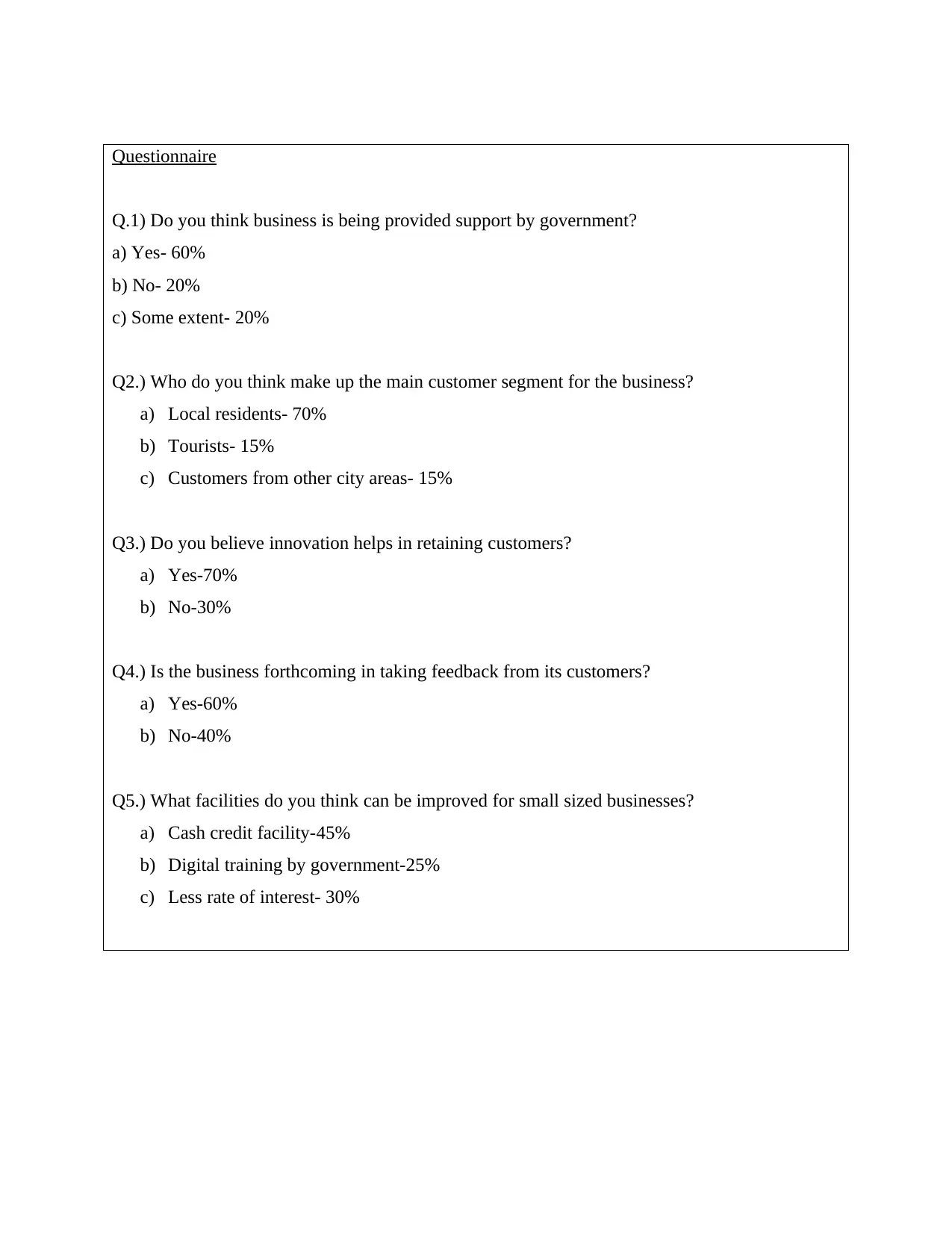
Questionnaire
Q.1) Do you think business is being provided support by government?
a) Yes- 60%
b) No- 20%
c) Some extent- 20%
Q2.) Who do you think make up the main customer segment for the business?
a) Local residents- 70%
b) Tourists- 15%
c) Customers from other city areas- 15%
Q3.) Do you believe innovation helps in retaining customers?
a) Yes-70%
b) No-30%
Q4.) Is the business forthcoming in taking feedback from its customers?
a) Yes-60%
b) No-40%
Q5.) What facilities do you think can be improved for small sized businesses?
a) Cash credit facility-45%
b) Digital training by government-25%
c) Less rate of interest- 30%
Q.1) Do you think business is being provided support by government?
a) Yes- 60%
b) No- 20%
c) Some extent- 20%
Q2.) Who do you think make up the main customer segment for the business?
a) Local residents- 70%
b) Tourists- 15%
c) Customers from other city areas- 15%
Q3.) Do you believe innovation helps in retaining customers?
a) Yes-70%
b) No-30%
Q4.) Is the business forthcoming in taking feedback from its customers?
a) Yes-60%
b) No-40%
Q5.) What facilities do you think can be improved for small sized businesses?
a) Cash credit facility-45%
b) Digital training by government-25%
c) Less rate of interest- 30%
Paraphrase This Document
Need a fresh take? Get an instant paraphrase of this document with our AI Paraphraser
CONCLUSION
This is to conclude that different types of entrepreneurships exist in business environment with
different structure and way of functioning. Examples of businesses were given respectively and
review of entrepreneurs taken in questionnaire.
Part 2
Introduction
The study is on entrepreneurship example covering the entrepreneurship scope on local
entrepreneur, global entrepreneur and social enterprise. The situational factors which affect the
business with similarities and differences are explained. The shared traits of entrepreneur and
characteristics have been discussed. The background and experience which can hinder or foster
the entrepreneurship have been analysed with specific examples given. The conclusion is drawn
from comparison and contrasting different entrepreneurs, background and experience and extent
up to which it influences them.
Example of local entrepreneur and scope
Local entrepreneur is one which operates on a small scale and thus caters to domestic markets.
The entrepreneurial scope is limited to the catering of local residents needs of products and
services. Prime furniture is an example of such a company which meets the demands and needs
of the local population.
Example of global entrepreneur and scope
Global entrepreneur is one which has business spread across the boundaries of a nation like Ikea
and Wayfair Inc. which are big names in furniture business. Their entrepreneurial scope is much
larger as it caters to international markets, has collaboration with a number of companies
worldwide and has sufficient resources for expansion and innovation. They are also high
employment generators for the country (Shaw, 2017).
This is to conclude that different types of entrepreneurships exist in business environment with
different structure and way of functioning. Examples of businesses were given respectively and
review of entrepreneurs taken in questionnaire.
Part 2
Introduction
The study is on entrepreneurship example covering the entrepreneurship scope on local
entrepreneur, global entrepreneur and social enterprise. The situational factors which affect the
business with similarities and differences are explained. The shared traits of entrepreneur and
characteristics have been discussed. The background and experience which can hinder or foster
the entrepreneurship have been analysed with specific examples given. The conclusion is drawn
from comparison and contrasting different entrepreneurs, background and experience and extent
up to which it influences them.
Example of local entrepreneur and scope
Local entrepreneur is one which operates on a small scale and thus caters to domestic markets.
The entrepreneurial scope is limited to the catering of local residents needs of products and
services. Prime furniture is an example of such a company which meets the demands and needs
of the local population.
Example of global entrepreneur and scope
Global entrepreneur is one which has business spread across the boundaries of a nation like Ikea
and Wayfair Inc. which are big names in furniture business. Their entrepreneurial scope is much
larger as it caters to international markets, has collaboration with a number of companies
worldwide and has sufficient resources for expansion and innovation. They are also high
employment generators for the country (Shaw, 2017).
Example of social enterprise and scope
Social enterprise is one which is doing business for society’s benefit. They are motivated to help
the society for welfare purpose and CSR activities. Case business school is one example which is
a social enterprise catering to education. The entrepreneurial scope is for helping of the society
underprivileged sections and using measurers to reach their benefits to more and more people.
They also get government grants and benefits for their function and have a social role in the
economy.
Situational factors
Situational factors are present in business environment like economic factors, social factors etc.
The following are some of the economic factors that influence entrepreneurship growth:
Economic factors
Capital
For a company’s establishment, capital is one of the most prominent factors of production.
Increase in capital spending in viable ventures takes to increase in income, which helps in the
capital accumulation process. The easy availability of funds for investing activities also boosts
entrepreneurship activity. Global businesses get the advantage of these capital generation
measures.
Raw Materials
The importance of raw materials in the establishing of any industrial activity, and also having
effect on the entrepreneurship rise, need no explanation. In the raw materials absence, no
business needs to be created, and no entrepreneur can flourish.
It is one of the necessary ingredients in the process of manufacturing. A lack of raw materials
can have an adverse impact on the entrepreneurial world. There is no industry which can work
properly without having a sufficient supply of raw material, and the entrepreneurship rise is
harmed.
SMEs and large businesses attach importance to the raw material supply as it is necessary for
their business to continue operations (Shaw, 2017).
Social enterprise is one which is doing business for society’s benefit. They are motivated to help
the society for welfare purpose and CSR activities. Case business school is one example which is
a social enterprise catering to education. The entrepreneurial scope is for helping of the society
underprivileged sections and using measurers to reach their benefits to more and more people.
They also get government grants and benefits for their function and have a social role in the
economy.
Situational factors
Situational factors are present in business environment like economic factors, social factors etc.
The following are some of the economic factors that influence entrepreneurship growth:
Economic factors
Capital
For a company’s establishment, capital is one of the most prominent factors of production.
Increase in capital spending in viable ventures takes to increase in income, which helps in the
capital accumulation process. The easy availability of funds for investing activities also boosts
entrepreneurship activity. Global businesses get the advantage of these capital generation
measures.
Raw Materials
The importance of raw materials in the establishing of any industrial activity, and also having
effect on the entrepreneurship rise, need no explanation. In the raw materials absence, no
business needs to be created, and no entrepreneur can flourish.
It is one of the necessary ingredients in the process of manufacturing. A lack of raw materials
can have an adverse impact on the entrepreneurial world. There is no industry which can work
properly without having a sufficient supply of raw material, and the entrepreneurship rise is
harmed.
SMEs and large businesses attach importance to the raw material supply as it is necessary for
their business to continue operations (Shaw, 2017).
⊘ This is a preview!⊘
Do you want full access?
Subscribe today to unlock all pages.
Trusted by 1+ million students worldwide
Market
For the entrepreneurship growth, the role and relevance of market and marketing are important.
In today's world of competition, no entrepreneur can think of survival without having up-to-date
knowledge of market and various techniques of marketing.
The truth is that business potential is the most significant determinant of potential reward from
entrepreneurship activity. Being honest, if the proof of pudding is in the eating, the proof of all
manufacturing, i.e. marketing, is in the consumption.
SME and large businesses indulge in marketing activities to make the reach of business wider
(Crawford, Kelder and Knox, 2020).
Social factors
Society attitude
Another factor which has to be considered is society's attitude toward entrepreneurship. Certain
societies value creativity and novelty, and thus, entrepreneurs' acts and incentives, such as
profits, are appreciated. Others won’t welcome change, and entrepreneurship won’t be able to
take root and do business in such an environment. Similarly, there are some cultures having a
natural aversion to some kind of profit-making.
Society attitude towards social enterprise has been encouraging as there comes donation for
social and environmental causes although more participation needs to be there. While in the case
of other businesses, people are only caring for the quality of product or service they get.
Traits of entrepreneurs
Successful entrepreneurs have a clear view of what their idea of business will be and can
accordingly articulate its aim, goals and position in market. They have identified all the questions
that can come up like who, what, where, when and why of their business.
A good entrepreneur has devotion for the business. It's quantity of work, and giving in
long hours if one doesn't like what one is doing would be difficult. People who are
passionate know what can motivate them to keep working for their goals.
For the entrepreneurship growth, the role and relevance of market and marketing are important.
In today's world of competition, no entrepreneur can think of survival without having up-to-date
knowledge of market and various techniques of marketing.
The truth is that business potential is the most significant determinant of potential reward from
entrepreneurship activity. Being honest, if the proof of pudding is in the eating, the proof of all
manufacturing, i.e. marketing, is in the consumption.
SME and large businesses indulge in marketing activities to make the reach of business wider
(Crawford, Kelder and Knox, 2020).
Social factors
Society attitude
Another factor which has to be considered is society's attitude toward entrepreneurship. Certain
societies value creativity and novelty, and thus, entrepreneurs' acts and incentives, such as
profits, are appreciated. Others won’t welcome change, and entrepreneurship won’t be able to
take root and do business in such an environment. Similarly, there are some cultures having a
natural aversion to some kind of profit-making.
Society attitude towards social enterprise has been encouraging as there comes donation for
social and environmental causes although more participation needs to be there. While in the case
of other businesses, people are only caring for the quality of product or service they get.
Traits of entrepreneurs
Successful entrepreneurs have a clear view of what their idea of business will be and can
accordingly articulate its aim, goals and position in market. They have identified all the questions
that can come up like who, what, where, when and why of their business.
A good entrepreneur has devotion for the business. It's quantity of work, and giving in
long hours if one doesn't like what one is doing would be difficult. People who are
passionate know what can motivate them to keep working for their goals.
Paraphrase This Document
Need a fresh take? Get an instant paraphrase of this document with our AI Paraphraser
Entrepreneurs keep going even when things get complicated. They are not defeated
easily. They learn from their mistakes and accept rejection. They are ready for change
and adapting their strategy in order to be successful the next time.
Being an entrepreneur is difficult than working for any organisation. To be effective, an
entrepreneur has to be willing for putting in the required time and effort, which is for
little or no compensation at first. Successful entrepreneurs understand the risks and effort
that shall be required to achieve their objectives (Crawford, Kelder and Knox, 2020).
Entrepreneurs who achieve success have belief in themselves and their businesses. They
should be convinced of their abilities and ideas. Setbacks can come with entrepreneurship
but successful are those who can go on despite setback.
Things do not always work as per schedule. An entrepreneur has to be versatile. They
have to adapt easily and improve on as they move further, learning by their mistakes.
They have to listen to advice of others and are willing for trying new things.
An entrepreneur remains at ease when it comes to sale. With having a sales team, the
leader should be a networking professional who can project themselves and their
company to bankers, clients, suppliers, and employees (Xing, Liu and Cooper, 2018).
Entrepreneurs become successful money managers with experience. They have to spend
wisely in overhead and keep records meticulously of their finances and cash flow.
Analysis of factors which can affect entrepreneurship
Government support: A business operating in an environment requires support of government
policies which can help in case of crisis or providing less rate of interest loans and providing
relief in tax if it is a new start up. Government helps the SMEs in providing loan for start up and
providing cash credit at less rate of interest as they are significant for growth of country’s
economy. Governments helps the social enterprises like NGOs by giving them grants and tax
relief. It is the big global businesses which have to give more taxes as their income is high
however, in case of crisis bailout packages are given to such companies as they are essential for
GDP and employment in country (Xing, Liu and Cooper, 2018).
Local support: Support of local community can be there for the social enterprises which are
working for social cause. Public can donate money to these organisations as philanthropic
easily. They learn from their mistakes and accept rejection. They are ready for change
and adapting their strategy in order to be successful the next time.
Being an entrepreneur is difficult than working for any organisation. To be effective, an
entrepreneur has to be willing for putting in the required time and effort, which is for
little or no compensation at first. Successful entrepreneurs understand the risks and effort
that shall be required to achieve their objectives (Crawford, Kelder and Knox, 2020).
Entrepreneurs who achieve success have belief in themselves and their businesses. They
should be convinced of their abilities and ideas. Setbacks can come with entrepreneurship
but successful are those who can go on despite setback.
Things do not always work as per schedule. An entrepreneur has to be versatile. They
have to adapt easily and improve on as they move further, learning by their mistakes.
They have to listen to advice of others and are willing for trying new things.
An entrepreneur remains at ease when it comes to sale. With having a sales team, the
leader should be a networking professional who can project themselves and their
company to bankers, clients, suppliers, and employees (Xing, Liu and Cooper, 2018).
Entrepreneurs become successful money managers with experience. They have to spend
wisely in overhead and keep records meticulously of their finances and cash flow.
Analysis of factors which can affect entrepreneurship
Government support: A business operating in an environment requires support of government
policies which can help in case of crisis or providing less rate of interest loans and providing
relief in tax if it is a new start up. Government helps the SMEs in providing loan for start up and
providing cash credit at less rate of interest as they are significant for growth of country’s
economy. Governments helps the social enterprises like NGOs by giving them grants and tax
relief. It is the big global businesses which have to give more taxes as their income is high
however, in case of crisis bailout packages are given to such companies as they are essential for
GDP and employment in country (Xing, Liu and Cooper, 2018).
Local support: Support of local community can be there for the social enterprises which are
working for social cause. Public can donate money to these organisations as philanthropic
measure whereas the SMEs and the big businesses do not get such investment as they have to
generate capital through either seed funding or market measures.
Capital generation: This factor is helpful for the big businesses who are listed on stock exchange
and it is easier for them to generate capital money through launching of their IPO, issuing bonds
etc. This can get public buying their shares and investing their money in the company. SMEs
have to rely on seed funding and loans from creditors or banks to generate capital for operations
or expansion while the social enterprises like NGOs do not have such facility to avail from the
market and have to work on seed funding, public donations and government grants.
CONCLUSION
It can be said that the sphere of operations for different entrepreneurships is different and thus
situational factors are too having an effect of business environment The common traits and
characteristics of entrepreneurs were discussed which are same for all types of entrepreneurship.
Every entrepreneur has different challenges and different advantages which were analysed.
generate capital through either seed funding or market measures.
Capital generation: This factor is helpful for the big businesses who are listed on stock exchange
and it is easier for them to generate capital money through launching of their IPO, issuing bonds
etc. This can get public buying their shares and investing their money in the company. SMEs
have to rely on seed funding and loans from creditors or banks to generate capital for operations
or expansion while the social enterprises like NGOs do not have such facility to avail from the
market and have to work on seed funding, public donations and government grants.
CONCLUSION
It can be said that the sphere of operations for different entrepreneurships is different and thus
situational factors are too having an effect of business environment The common traits and
characteristics of entrepreneurs were discussed which are same for all types of entrepreneurship.
Every entrepreneur has different challenges and different advantages which were analysed.
⊘ This is a preview!⊘
Do you want full access?
Subscribe today to unlock all pages.
Trusted by 1+ million students worldwide

1 out of 26


Related Documents


Your All-in-One AI-Powered Toolkit for Academic Success.
+13062052269
info@desklib.com
Available 24*7 on WhatsApp / Email
![[object Object]](/_next/static/media/star-bottom.7253800d.svg)
Unlock your academic potential
Copyright © 2020–2026 A2Z Services. All Rights Reserved. Developed and managed by ZUCOL.