ENTREPRENEURSHIP AND SMALL BUSINESS MANAGMENT Report - UK Context

Verified

Added on  2023/01/23

|21
|2206
|53
Report
AI Summary
This report delves into the core concepts of entrepreneurship and small business management, providing a comprehensive overview of the field. It begins by defining entrepreneurship and outlining different types of entrepreneurs, such as serial, lifestyle, innovative, and intra-entrepreneurs, with real-world examples. The report then identifies and contrasts various entrepreneurial ventures, including small business, scalable start-ups, large company, and social entrepreneurship, highlighting their similarities and differences in terms of objectives, value creation, financial resources, and scope. Furthermore, it explores entrepreneurial typologies, correlating different entrepreneur types with specific venture types, and discusses the applicability of entrepreneurship within the public sector. The report also examines the scope of new entrepreneurial ventures in delivering product innovation to the market and critically analyzes the development and growth of entrepreneurial ventures in the UK, considering factors like technological advancements and the role of SMEs. The conclusion summarizes the key findings, emphasizing the importance of entrepreneurship in driving economic development and innovation.
Document Page
ENTREPRENEURSHIP AND
SMALL BUSINESS
MANAGMENT
tabler-icon-diamond-filled.svg

Paraphrase This Document

Need a fresh take? Get an instant paraphrase of this document with our AI Paraphraser
Document Page
Table of contents
Introduction
Main body
Conclusion
References
Document Page
INTRODUCTION
Entrepreneurship defined as designing, launching and running the business activities
at the small level. This is defined as willingness and capacity to organize, develop
and manage activities of the entity along with risk in order to make profit. It is an
actual process of starting the business.
The present report is based on entrepreneurship and small business management.
Henceforth, this report will cover the activities as concept of entrepreneur,
identification on the type of entrepreneurial ventures, similarities and differences
between entrepreneurial ventures.
Lastly, critical examination will be defined in relation to development and growth of
entrepreneurial ventures within UK.
Document Page
MAIN BODY
tabler-icon-diamond-filled.svg

Paraphrase This Document

Need a fresh take? Get an instant paraphrase of this document with our AI Paraphraser
Document Page
1. Define concept of entrepreneur with some examples of different
entrepreneurs.
Entrepreneur is person who works as to search of something new and exploits ideas into gainful opportunities by accepting the risk and
uncertainty with the entrepreneurs. He is an individual who sets up and grows a business. Thus, different entrepreneurs defined in
following manner as-
Serial entrepreneur- An entrepreneur that come up with new ideas and starts new businesses. They are the entrepreneur who will
come up with the new idea, start the company and plays crucial role in day to day functioning within the enterprise.
For example- Foundation of the business conglomerate Virgin group has established in 1970, 20-year-old Richard Branson
started the mail order record business. Hence, today this entity owns over 200 different companies.
Lifestyle entrepreneur- This is defined as entrepreneur that sets up the business with purpose of having modification within their
personal lifestyle. They put their major focus on life awards provided to the people for the enjoy and they are having passion for
what they are doing. For example- Ferris is one of the probably the number one poster boy for the lifestyle entrepreneur
movement and defined as Indiana hones for the digital age and in present it listed as one of the fast company as most innovative
business people.
Innovative entrepreneur- They are the individual who invests in new ideas and commodities and methods of production. Hence,
these kinds of entrepreneur are having the unusual foresight in order to recognize the demand for goods and services. They
always ready to take up the challenge that has associated with little amount of risk.
Intra-entrepreneur- This is defined as employees who are assigned to work on the special idea and project. They are individual
who gives time and freedom to develop and project as entrepreneur.
Document Page
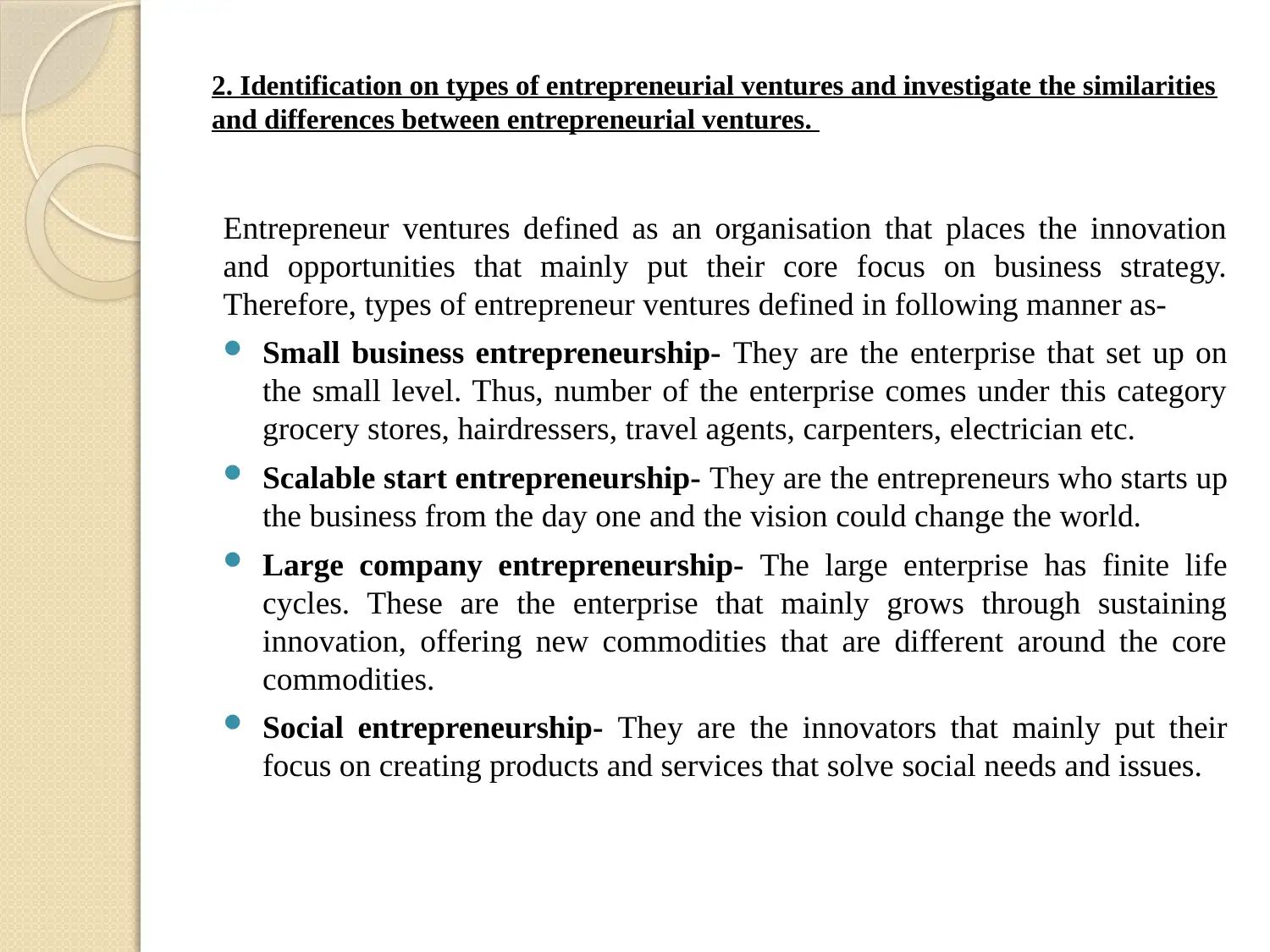
2. Identification on types of entrepreneurial ventures and investigate the similarities
and differences between entrepreneurial ventures.
Entrepreneur ventures defined as an organisation that places the innovation
and opportunities that mainly put their core focus on business strategy.
Therefore, types of entrepreneur ventures defined in following manner as-
Small business entrepreneurship- They are the enterprise that set up on
the small level. Thus, number of the enterprise comes under this category
grocery stores, hairdressers, travel agents, carpenters, electrician etc.
Scalable start entrepreneurship- They are the entrepreneurs who starts up
the business from the day one and the vision could change the world.
Large company entrepreneurship- The large enterprise has finite life
cycles. These are the enterprise that mainly grows through sustaining
innovation, offering new commodities that are different around the core
commodities.
Social entrepreneurship- They are the innovators that mainly put their
focus on creating products and services that solve social needs and issues.
Document Page
CONTINUED…
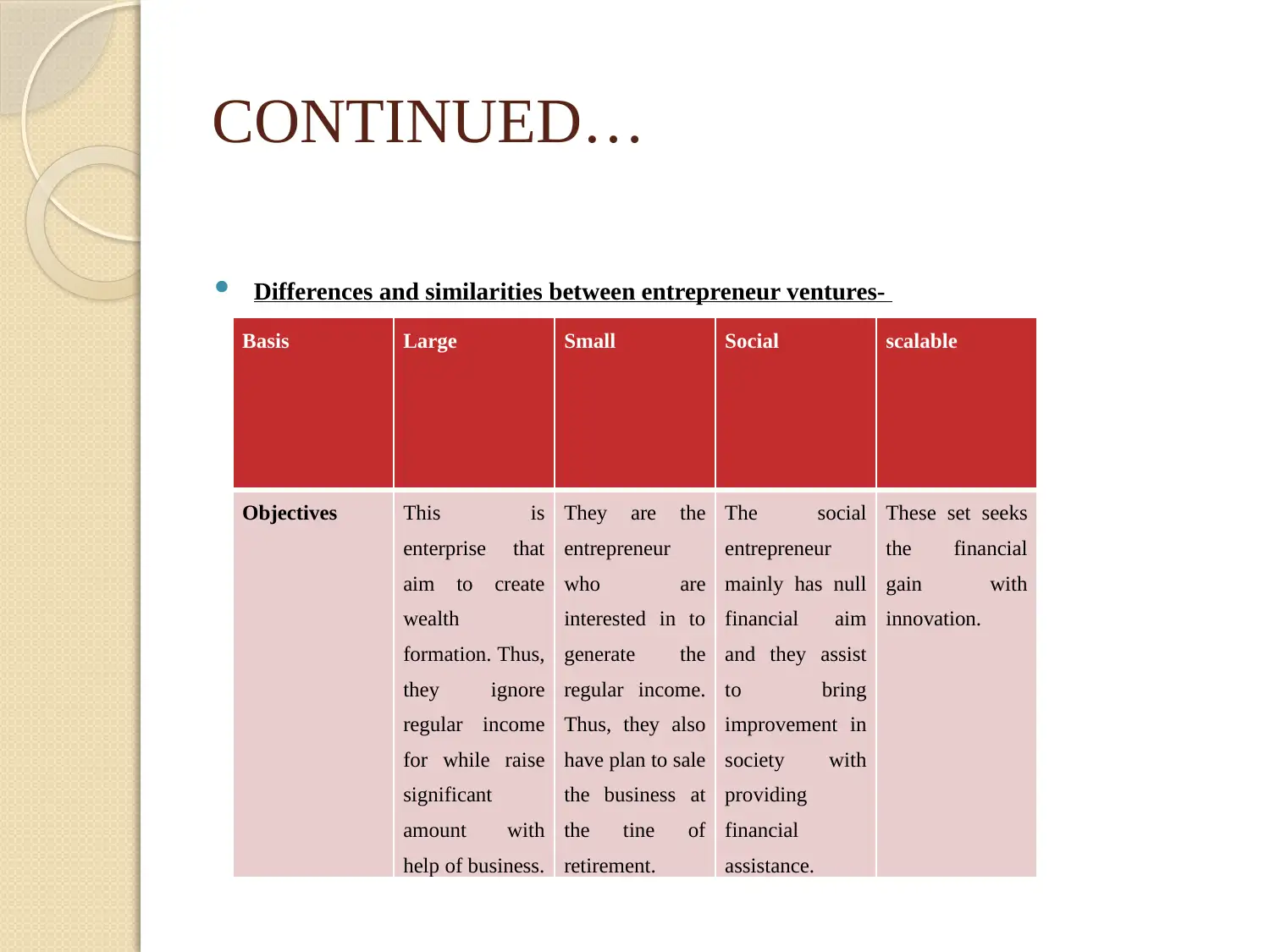
Differences and similarities between entrepreneur ventures-
Basis Large Small Social scalable
Objectives This is
enterprise that
aim to create
wealth
formation. Thus,
they ignore
regular income
for while raise
significant
amount with
help of business.
They are the
entrepreneur
who are
interested in to
generate the
regular income.
Thus, they also
have plan to sale
the business at
the tine of
retirement.
The social
entrepreneur
mainly has null
financial aim
and they assist
to bring
improvement in
society with
providing
financial
assistance.
These set seeks
the financial
gain with
innovation.
tabler-icon-diamond-filled.svg

Paraphrase This Document

Need a fresh take? Get an instant paraphrase of this document with our AI Paraphraser
Document Page
CONTINUED…
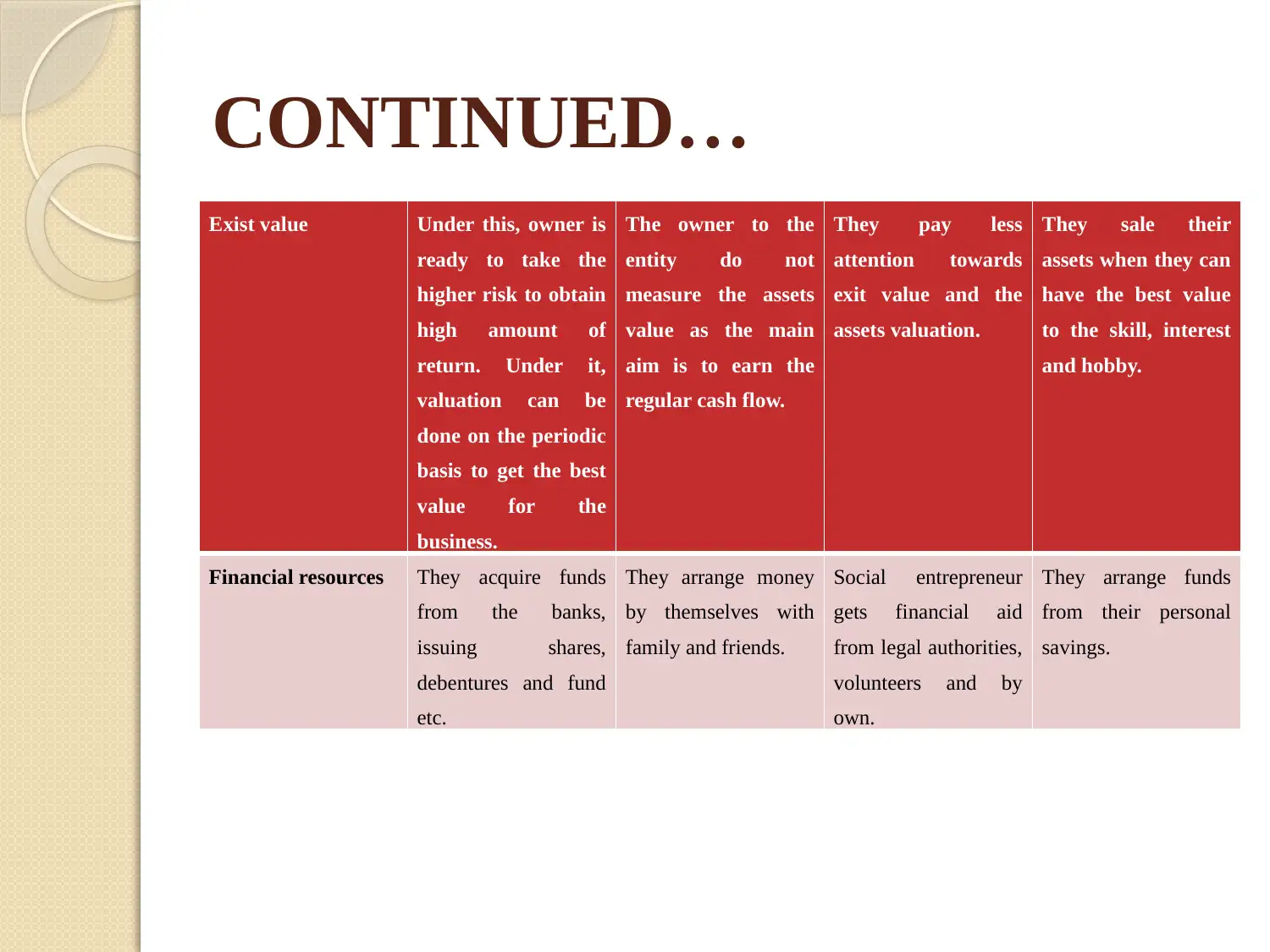
Exist value Under this, owner is
ready to take the
higher risk to obtain
high amount of
return. Under it,
valuation can be
done on the periodic
basis to get the best
value for the
business.
The owner to the
entity do not
measure the assets
value as the main
aim is to earn the
regular cash flow.
They pay less
attention towards
exit value and the
assets valuation.
They sale their
assets when they can
have the best value
to the skill, interest
and hobby.
Financial resources They acquire funds
from the banks,
issuing shares,
debentures and fund
etc.
They arrange money
by themselves with
family and friends.
Social entrepreneur
gets financial aid
from legal authorities,
volunteers and by
own.
They arrange funds
from their personal
savings.
Document Page
CONTINUED…
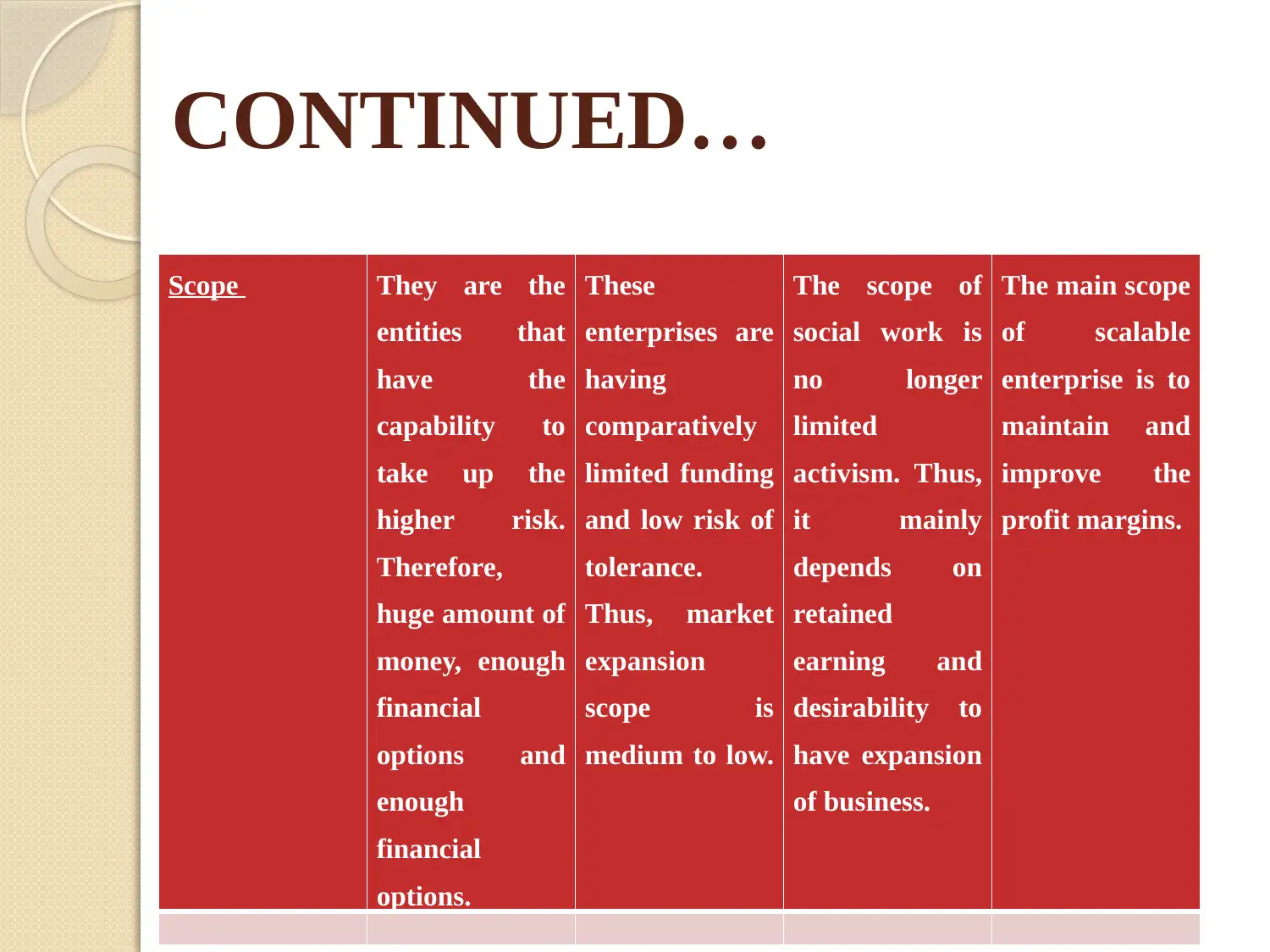
Scope They are the
entities that
have the
capability to
take up the
higher risk.
Therefore,
huge amount of
money, enough
financial
options and
enough
financial
options.
These
enterprises are
having
comparatively
limited funding
and low risk of
tolerance.
Thus, market
expansion
scope is
medium to low.
The scope of
social work is
no longer
limited
activism. Thus,
it mainly
depends on
retained
earning and
desirability to
have expansion
of business.
The main scope
of scalable
enterprise is to
maintain and
improve the
profit margins.
Document Page
3. Description on concept of entrepreneurial typology and correlate differ type of
entrepreneur to different types of entrepreneurial ventures with example.
Entrepreneur typology defined as to explore personality traits and typologies that
can lead to higher propensity of business in order to become an entrepreneur.
Correlate differ type of entrepreneur to different type of entrepreneur ventures
as-
There are various types of entrepreneur depending upon their background, sector,
etc. they possess different knowledge and skills. Also, the traits and characteristics
of entrepreneur vary from each other. The different types are as follows: -
Innovators- they are those who come up with new ideas and turn them into
business. Basically, in this entrepreneurship venture are small and start-ups. For
instance, social entrepreneurship is offering products or services.
Imitators – Here, the entrepreneur copy a particular business idea and improve it.
The changes can be in products, process, etc. For example – scalable start-up are
the ventures in it.
Researcher- These entrepreneurs do in depth research before starting a business.
It is because of rise in chances success of business. For example – large scale
entrepreneurship.
Buyer – Usually, they are those who likes to buy other business and start-ups.
They invest money in them.
tabler-icon-diamond-filled.svg

Paraphrase This Document

Need a fresh take? Get an instant paraphrase of this document with our AI Paraphraser
Document Page
4. Can entrepreneurship exist in public sector. Discussion on range of
entrepreneurial activities with use of real life examples.
No, entrepreneurship cannot exist in public sector as it is publicly
owned by the legal authorities. Therefore, it cannot exist in public
sector.
Entrepreneurship activity defined as enterprising human action that
pursuit varied generational values through the creation and
expansion of the human activities. Therefore, they mainly work as
to identifying and to exploit the new commodities, processes or
markets.
It is one of the phenomenon associated with the entrepreneurial
activity. This is defined as process of designing, launching and
running the new business activities effectively with the help of
undertaking innovative facilities.
Document Page
CONTINUED…
For example- British Broadcasting Corporation
(BBC) which is a public broadcasting
corporation whose founder was John Reith
stated in year 1922.
This is a perfect example of public undertaking
that is not having any entrepreneur as it is
managed by direct government intervention.
chevron_up_icon
1 out of 21
circle_padding
hide_on_mobile
zoom_out_icon
[object Object]