Entrepreneurship: Venture Scope, Development, and Management
VerifiedAdded on 2023/01/19
|15
|4406
|85
Report
AI Summary
This report provides a detailed analysis of entrepreneurship and small business management. It covers different types of entrepreneurial ventures such as small businesses, scalable start-ups, large companies, and social entrepreneurship, and their relation to typology. The report also examines the similarities and differences among these ventures, their impact on the economy, and the characteristic traits and skills of successful entrepreneurs. Furthermore, it explores how background and experience can influence entrepreneurship. The analysis includes relevant statistics and examples to illustrate the concepts discussed, highlighting the critical role of micro and small businesses in economic stability and growth. The document is available on Desklib, a platform offering a wide array of study tools and solved assignments for students.
Entrepreneurship and
small business
management
small business
management

Paraphrase This Document
Need a fresh take? Get an instant paraphrase of this document with our AI Paraphraser
Table of Contents
INTRODUCTION...........................................................................................................................3
TASK 1............................................................................................................................................3
P1 Different types of entrepreneurial ventures and their relation to typology:...........................3
P2 Similarities and differences among various entrepreneurial ventures:...................................4
M1 Understanding of entrepreneurship in both public and corporate sectors:............................6
D1 Critical examination of the scope, development and growth of entrepreneurial ventures:....6
TASK 2 ...........................................................................................................................................7
P3 Interpretation of how micro and small businesses impact on the economy:..........................7
......................................................................................................................................................8
P4 Importance of small business and start-ups on the growth of social economy......................9
M2 Difference among small, medium and large business with relevant statistics:.....................9
D2 Critical examination of how small business impact on different levels of economy:...........9
TASK 3..........................................................................................................................................10
P5 Characteristic traits and skills of successful entrepreneurs..................................................10
P6 Aspects of how entrepreneurial personality reflect motivation and mindset:......................11
M3 Examination of different lines of argument relating to entrepreneurial characteristics:.....12
D3 Analysis of characteristic traits, skills and motivational drivers of successful entrepreneurs:
....................................................................................................................................................13
TASK 4..........................................................................................................................................13
P7 & D4 Examination of how background and experience can hinder or foster
entrepreneurship:........................................................................................................................13
M4 Analysis of the link between entrepreneurial characteristics and influence of personal
background, experience to successful entrepreneurs:................................................................14
CONCLUSION..............................................................................................................................14
REFERENCES..............................................................................................................................15
INTRODUCTION...........................................................................................................................3
TASK 1............................................................................................................................................3
P1 Different types of entrepreneurial ventures and their relation to typology:...........................3
P2 Similarities and differences among various entrepreneurial ventures:...................................4
M1 Understanding of entrepreneurship in both public and corporate sectors:............................6
D1 Critical examination of the scope, development and growth of entrepreneurial ventures:....6
TASK 2 ...........................................................................................................................................7
P3 Interpretation of how micro and small businesses impact on the economy:..........................7
......................................................................................................................................................8
P4 Importance of small business and start-ups on the growth of social economy......................9
M2 Difference among small, medium and large business with relevant statistics:.....................9
D2 Critical examination of how small business impact on different levels of economy:...........9
TASK 3..........................................................................................................................................10
P5 Characteristic traits and skills of successful entrepreneurs..................................................10
P6 Aspects of how entrepreneurial personality reflect motivation and mindset:......................11
M3 Examination of different lines of argument relating to entrepreneurial characteristics:.....12
D3 Analysis of characteristic traits, skills and motivational drivers of successful entrepreneurs:
....................................................................................................................................................13
TASK 4..........................................................................................................................................13
P7 & D4 Examination of how background and experience can hinder or foster
entrepreneurship:........................................................................................................................13
M4 Analysis of the link between entrepreneurial characteristics and influence of personal
background, experience to successful entrepreneurs:................................................................14
CONCLUSION..............................................................................................................................14
REFERENCES..............................................................................................................................15
INTRODUCTION
An entrepreneur is a business person who individually bears all the risks which may arise
during the course of business. Any financial profits or rewards are borne by the owner of the
company which can be further distributed among the shareholders as per their percentage of
holding in the organisation. The following report highlights on different kinds of entrepreneurial
ventures and how they are related with typology, critical examination of the scope, development
and growth of different types of structures. Also, importance of small-business management and
other start-ups, traits & skills of successful entrepreneurs, impact of micro as well as small
enterprise on the economy etc. are also included under this report (Allen and Truman, 2016).
TASK 1
P1 Different types of entrepreneurial ventures and their relation to typology:
Entrepreneurship: It refers to an ability of individual to run a business by taking up all
the risks and responsibilities that may arise during the course of action. Entrepreneurship is a
process by which an individual or a team can identify growth opportunities in order to achieve
high profit margins.
For example, in London, a small business enterprise like a grocery or coffee shop may
not attain that much attention of the people but a large organisation or chain of cafe will attract
more customers since the company will have more funds to promote the business. Similarly,
considering the generating awareness among people, any NGO for children or animals etc. will
certainly attract a particular category of consumers who believe in welfare of the society.
Entrepreneurial ventures: These are defined as large of small business ventures which
can be formed according to the need or desire of the user (Ateljevic and Page, 2017). It includes
small business, scalable, large company, social entrepreneurship etc. which are described below:
Small business: These are small enterprises whose main purpose is to earn profit so that
they can make a living and support their families. As per the recent search, 99.7%
companies are small business joints who employ 50% of the local people to assist them in
their venture (Types of entrepreneurial ventures, 2019). For example, grocery shops,
carpenters, plumbers, electricians etc.
Scalable start-up: In this type of entrepreneurship, entrepreneurs start a business
enterprise with clear mission and vision that must be achieved. For this purpose, funding
An entrepreneur is a business person who individually bears all the risks which may arise
during the course of business. Any financial profits or rewards are borne by the owner of the
company which can be further distributed among the shareholders as per their percentage of
holding in the organisation. The following report highlights on different kinds of entrepreneurial
ventures and how they are related with typology, critical examination of the scope, development
and growth of different types of structures. Also, importance of small-business management and
other start-ups, traits & skills of successful entrepreneurs, impact of micro as well as small
enterprise on the economy etc. are also included under this report (Allen and Truman, 2016).
TASK 1
P1 Different types of entrepreneurial ventures and their relation to typology:
Entrepreneurship: It refers to an ability of individual to run a business by taking up all
the risks and responsibilities that may arise during the course of action. Entrepreneurship is a
process by which an individual or a team can identify growth opportunities in order to achieve
high profit margins.
For example, in London, a small business enterprise like a grocery or coffee shop may
not attain that much attention of the people but a large organisation or chain of cafe will attract
more customers since the company will have more funds to promote the business. Similarly,
considering the generating awareness among people, any NGO for children or animals etc. will
certainly attract a particular category of consumers who believe in welfare of the society.
Entrepreneurial ventures: These are defined as large of small business ventures which
can be formed according to the need or desire of the user (Ateljevic and Page, 2017). It includes
small business, scalable, large company, social entrepreneurship etc. which are described below:
Small business: These are small enterprises whose main purpose is to earn profit so that
they can make a living and support their families. As per the recent search, 99.7%
companies are small business joints who employ 50% of the local people to assist them in
their venture (Types of entrepreneurial ventures, 2019). For example, grocery shops,
carpenters, plumbers, electricians etc.
Scalable start-up: In this type of entrepreneurship, entrepreneurs start a business
enterprise with clear mission and vision that must be achieved. For this purpose, funding
⊘ This is a preview!⊘
Do you want full access?
Subscribe today to unlock all pages.

Trusted by 1+ million students worldwide
can be availed from various venture capitalists who hire best candidates for the job, for
example, online shopping site.
Large company: These are large enterprises which offer different products & services to
the users and develop the goods by considering advanced technology, customer need as
well as requirement etc. For example, United Biscuits is a large retail manufacturing
company based in UK and offers variety of biscuits, cookies in several shape and size to
the consumer (Burns and Dewhurst, 2016).
Social entrepreneurship: These are innovators who produce goods & services to solve
social needs and issues. Their main and only goal is to make the world a better place to
live by offering solutions to various problems faced by people. For example, National
Trust is a charitable institution based in UK.
Entrepreneurship typology: In the field of entrepreneurship, the term typology can be
defined as a classification related to different perspectives of the society. Some of them are
described below:
Male typology: In this typology, generally a male entrepreneur runs an entire business
enterprise, bearing all the risks and rewards that may arise during the course of action.
Female typology: These are the businesses which are especially owned by a female
participant for example, a NGO.
Managed growth: In this typology, both female and male participants have an equal part
of responsibility in running the business (Burns, 2016).
P2 Similarities and differences among various entrepreneurial ventures:
The similarities of various kinds of entrepreneurial ventures are mentioned below:
One of the major similarity among different types of entrepreneurial ventures is that all
the risks that arise during the course of business are borne by the owner of the company.
Thinking about the long-term objectives, planning & growth is one of the similarity
among various business ventures as it helps them in fulfilling future perspectives.
In terms of financial security, every business enterprise maintains a reserve out of the
profit which helps them in the future in case of any emergencies.
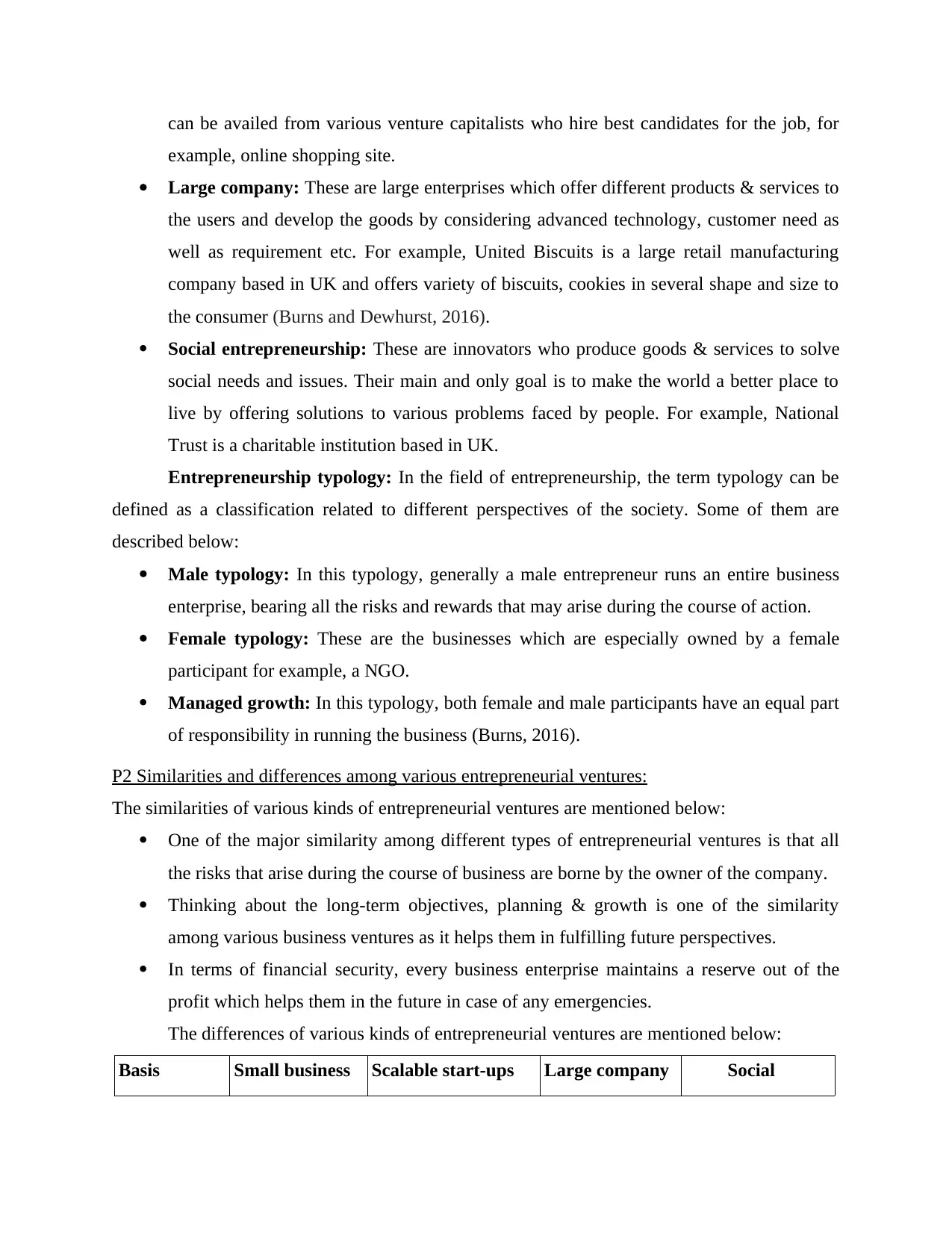
The differences of various kinds of entrepreneurial ventures are mentioned below:
Basis Small business Scalable start-ups Large company Social
example, online shopping site.
Large company: These are large enterprises which offer different products & services to
the users and develop the goods by considering advanced technology, customer need as
well as requirement etc. For example, United Biscuits is a large retail manufacturing
company based in UK and offers variety of biscuits, cookies in several shape and size to
the consumer (Burns and Dewhurst, 2016).
Social entrepreneurship: These are innovators who produce goods & services to solve
social needs and issues. Their main and only goal is to make the world a better place to
live by offering solutions to various problems faced by people. For example, National
Trust is a charitable institution based in UK.
Entrepreneurship typology: In the field of entrepreneurship, the term typology can be
defined as a classification related to different perspectives of the society. Some of them are
described below:
Male typology: In this typology, generally a male entrepreneur runs an entire business
enterprise, bearing all the risks and rewards that may arise during the course of action.
Female typology: These are the businesses which are especially owned by a female
participant for example, a NGO.
Managed growth: In this typology, both female and male participants have an equal part
of responsibility in running the business (Burns, 2016).
P2 Similarities and differences among various entrepreneurial ventures:
The similarities of various kinds of entrepreneurial ventures are mentioned below:
One of the major similarity among different types of entrepreneurial ventures is that all
the risks that arise during the course of business are borne by the owner of the company.
Thinking about the long-term objectives, planning & growth is one of the similarity
among various business ventures as it helps them in fulfilling future perspectives.
In terms of financial security, every business enterprise maintains a reserve out of the
profit which helps them in the future in case of any emergencies.
The differences of various kinds of entrepreneurial ventures are mentioned below:
Basis Small business Scalable start-ups Large company Social
Paraphrase This Document
Need a fresh take? Get an instant paraphrase of this document with our AI Paraphraser
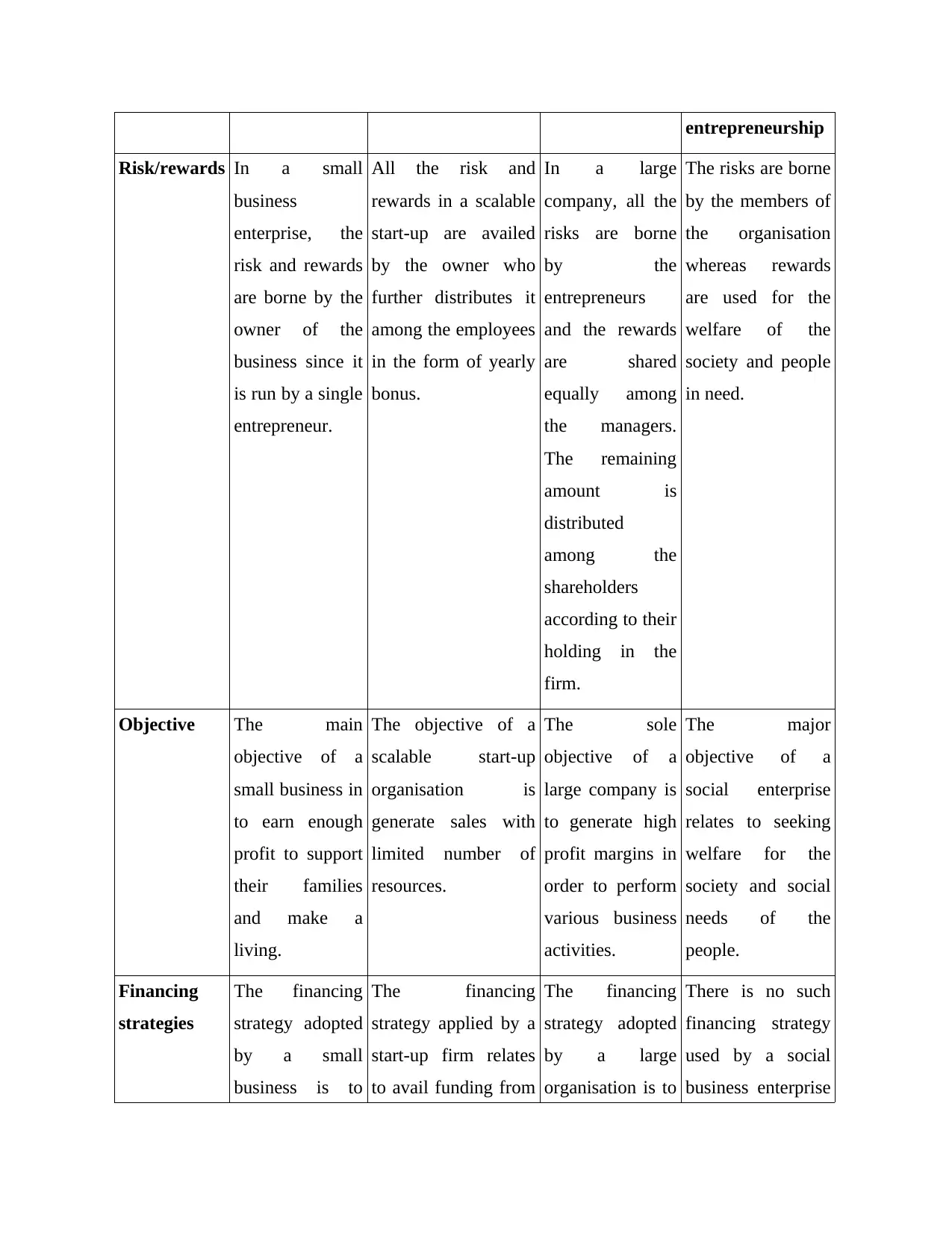
entrepreneurship
Risk/rewards In a small
business
enterprise, the
risk and rewards
are borne by the
owner of the
business since it
is run by a single
entrepreneur.
All the risk and
rewards in a scalable
start-up are availed
by the owner who
further distributes it
among the employees
in the form of yearly
bonus.
In a large
company, all the
risks are borne
by the
entrepreneurs
and the rewards
are shared
equally among
the managers.
The remaining
amount is
distributed
among the
shareholders
according to their
holding in the
firm.
The risks are borne
by the members of
the organisation
whereas rewards
are used for the
welfare of the
society and people
in need.
Objective The main
objective of a
small business in
to earn enough
profit to support
their families
and make a
living.
The objective of a
scalable start-up
organisation is
generate sales with
limited number of
resources.
The sole
objective of a
large company is
to generate high
profit margins in
order to perform
various business
activities.
The major
objective of a
social enterprise
relates to seeking
welfare for the
society and social
needs of the
people.
Financing
strategies
The financing
strategy adopted
by a small
business is to
The financing
strategy applied by a
start-up firm relates
to avail funding from
The financing
strategy adopted
by a large
organisation is to
There is no such
financing strategy
used by a social
business enterprise
Risk/rewards In a small
business
enterprise, the
risk and rewards
are borne by the
owner of the
business since it
is run by a single
entrepreneur.
All the risk and
rewards in a scalable
start-up are availed
by the owner who
further distributes it
among the employees
in the form of yearly
bonus.
In a large
company, all the
risks are borne
by the
entrepreneurs
and the rewards
are shared
equally among
the managers.
The remaining
amount is
distributed
among the
shareholders
according to their
holding in the
firm.
The risks are borne
by the members of
the organisation
whereas rewards
are used for the
welfare of the
society and people
in need.
Objective The main
objective of a
small business in
to earn enough
profit to support
their families
and make a
living.
The objective of a
scalable start-up
organisation is
generate sales with
limited number of
resources.
The sole
objective of a
large company is
to generate high
profit margins in
order to perform
various business
activities.
The major
objective of a
social enterprise
relates to seeking
welfare for the
society and social
needs of the
people.
Financing
strategies
The financing
strategy adopted
by a small
business is to
The financing
strategy applied by a
start-up firm relates
to avail funding from
The financing
strategy adopted
by a large
organisation is to
There is no such
financing strategy
used by a social
business enterprise
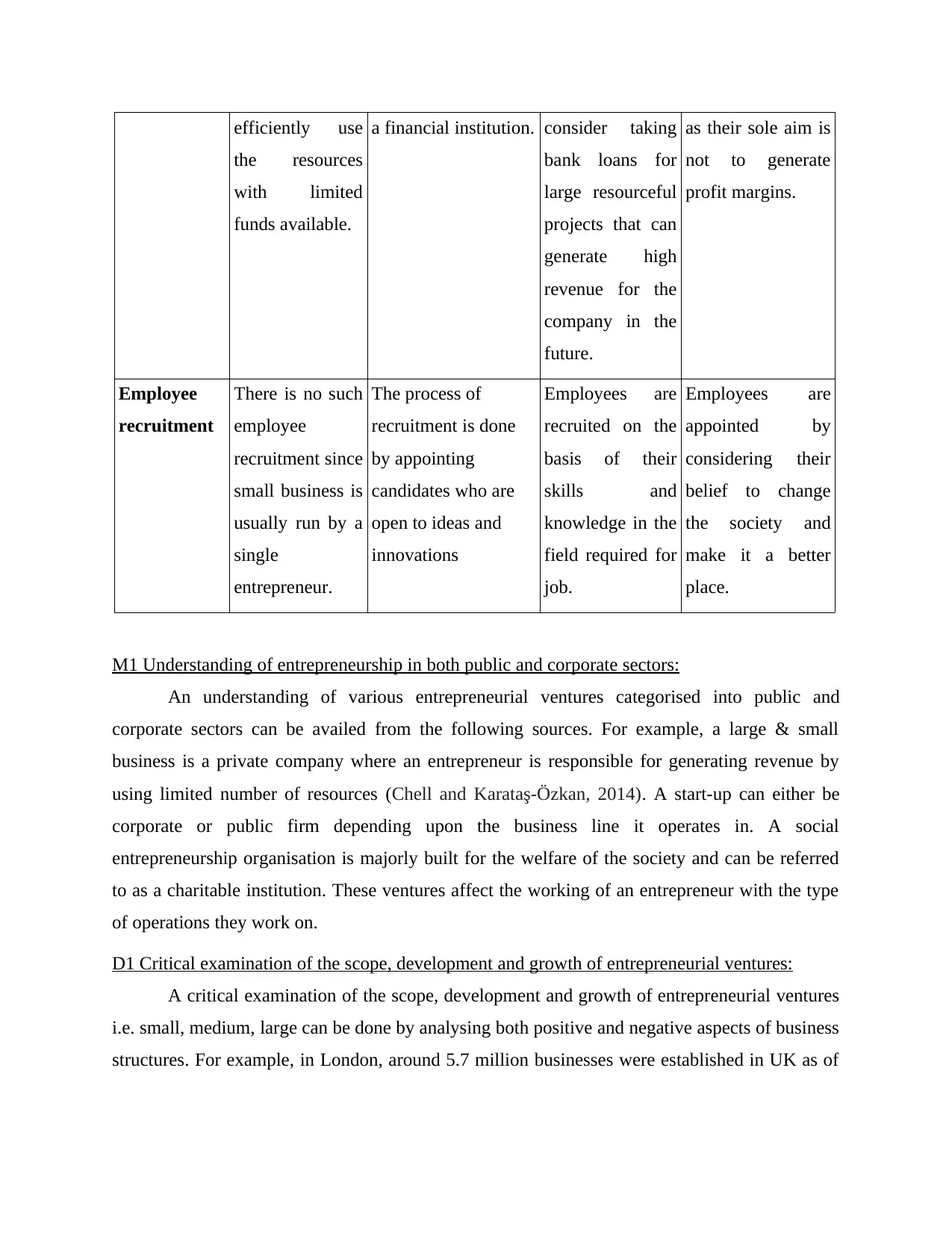
efficiently use
the resources
with limited
funds available.
a financial institution. consider taking
bank loans for
large resourceful
projects that can
generate high
revenue for the
company in the
future.
as their sole aim is
not to generate
profit margins.
Employee
recruitment
There is no such
employee
recruitment since
small business is
usually run by a
single
entrepreneur.
The process of
recruitment is done
by appointing
candidates who are
open to ideas and
innovations
Employees are
recruited on the
basis of their
skills and
knowledge in the
field required for
job.
Employees are
appointed by
considering their
belief to change
the society and
make it a better
place.
M1 Understanding of entrepreneurship in both public and corporate sectors:
An understanding of various entrepreneurial ventures categorised into public and
corporate sectors can be availed from the following sources. For example, a large & small
business is a private company where an entrepreneur is responsible for generating revenue by
using limited number of resources (Chell and Karataş-Özkan, 2014). A start-up can either be
corporate or public firm depending upon the business line it operates in. A social
entrepreneurship organisation is majorly built for the welfare of the society and can be referred
to as a charitable institution. These ventures affect the working of an entrepreneur with the type
of operations they work on.
D1 Critical examination of the scope, development and growth of entrepreneurial ventures:
A critical examination of the scope, development and growth of entrepreneurial ventures
i.e. small, medium, large can be done by analysing both positive and negative aspects of business
structures. For example, in London, around 5.7 million businesses were established in UK as of
the resources
with limited
funds available.
a financial institution. consider taking
bank loans for
large resourceful
projects that can
generate high
revenue for the
company in the
future.
as their sole aim is
not to generate
profit margins.
Employee
recruitment
There is no such
employee
recruitment since
small business is
usually run by a
single
entrepreneur.
The process of
recruitment is done
by appointing
candidates who are
open to ideas and
innovations
Employees are
recruited on the
basis of their
skills and
knowledge in the
field required for
job.
Employees are
appointed by
considering their
belief to change
the society and
make it a better
place.
M1 Understanding of entrepreneurship in both public and corporate sectors:
An understanding of various entrepreneurial ventures categorised into public and
corporate sectors can be availed from the following sources. For example, a large & small
business is a private company where an entrepreneur is responsible for generating revenue by
using limited number of resources (Chell and Karataş-Özkan, 2014). A start-up can either be
corporate or public firm depending upon the business line it operates in. A social
entrepreneurship organisation is majorly built for the welfare of the society and can be referred
to as a charitable institution. These ventures affect the working of an entrepreneur with the type
of operations they work on.
D1 Critical examination of the scope, development and growth of entrepreneurial ventures:
A critical examination of the scope, development and growth of entrepreneurial ventures
i.e. small, medium, large can be done by analysing both positive and negative aspects of business
structures. For example, in London, around 5.7 million businesses were established in UK as of
⊘ This is a preview!⊘
Do you want full access?
Subscribe today to unlock all pages.
Trusted by 1+ million students worldwide
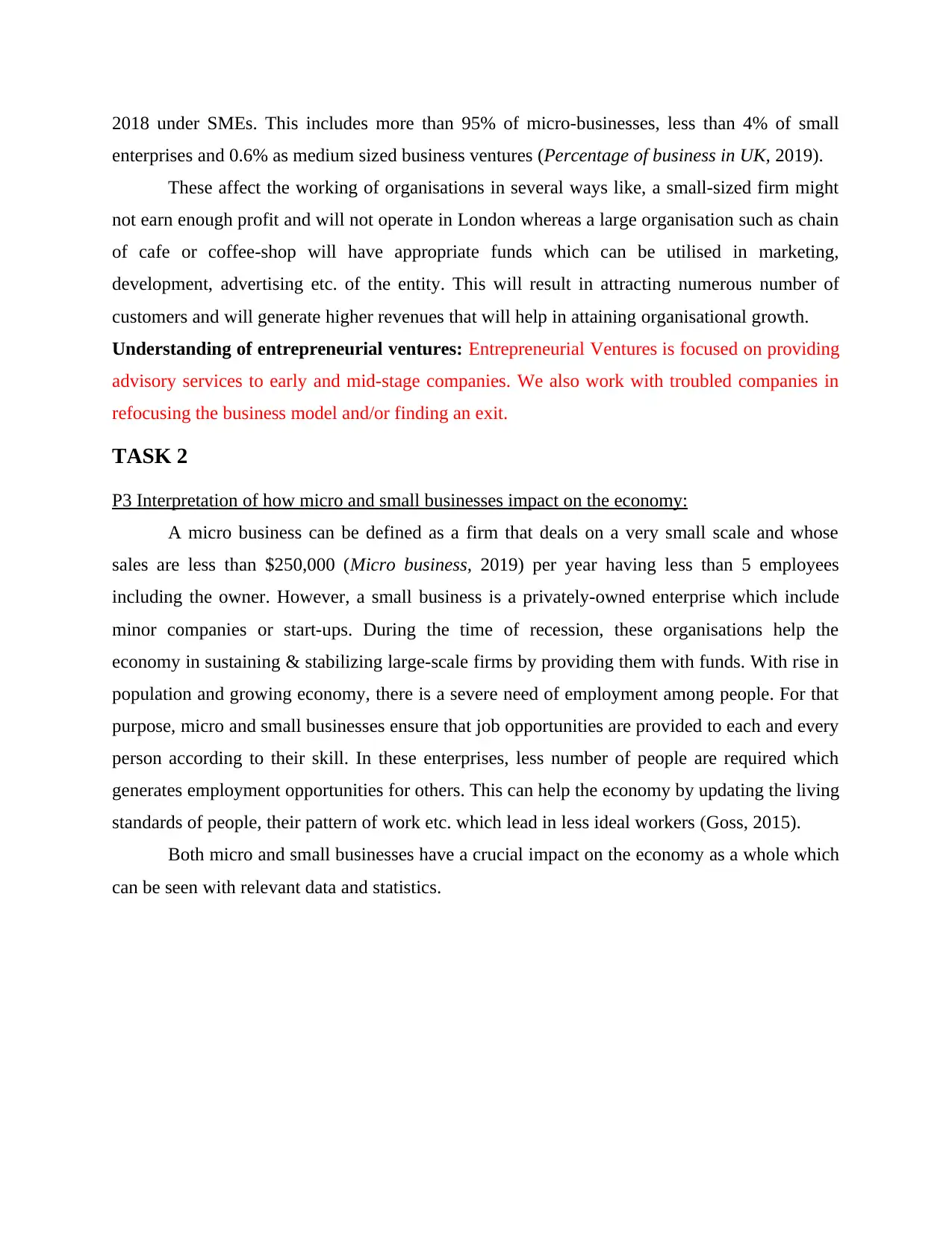
2018 under SMEs. This includes more than 95% of micro-businesses, less than 4% of small
enterprises and 0.6% as medium sized business ventures (Percentage of business in UK, 2019).
These affect the working of organisations in several ways like, a small-sized firm might
not earn enough profit and will not operate in London whereas a large organisation such as chain
of cafe or coffee-shop will have appropriate funds which can be utilised in marketing,
development, advertising etc. of the entity. This will result in attracting numerous number of
customers and will generate higher revenues that will help in attaining organisational growth.
Understanding of entrepreneurial ventures: Entrepreneurial Ventures is focused on providing
advisory services to early and mid-stage companies. We also work with troubled companies in
refocusing the business model and/or finding an exit.
TASK 2
P3 Interpretation of how micro and small businesses impact on the economy:
A micro business can be defined as a firm that deals on a very small scale and whose
sales are less than $250,000 (Micro business, 2019) per year having less than 5 employees
including the owner. However, a small business is a privately-owned enterprise which include
minor companies or start-ups. During the time of recession, these organisations help the
economy in sustaining & stabilizing large-scale firms by providing them with funds. With rise in
population and growing economy, there is a severe need of employment among people. For that
purpose, micro and small businesses ensure that job opportunities are provided to each and every
person according to their skill. In these enterprises, less number of people are required which
generates employment opportunities for others. This can help the economy by updating the living
standards of people, their pattern of work etc. which lead in less ideal workers (Goss, 2015).
Both micro and small businesses have a crucial impact on the economy as a whole which
can be seen with relevant data and statistics.
enterprises and 0.6% as medium sized business ventures (Percentage of business in UK, 2019).
These affect the working of organisations in several ways like, a small-sized firm might
not earn enough profit and will not operate in London whereas a large organisation such as chain
of cafe or coffee-shop will have appropriate funds which can be utilised in marketing,
development, advertising etc. of the entity. This will result in attracting numerous number of
customers and will generate higher revenues that will help in attaining organisational growth.
Understanding of entrepreneurial ventures: Entrepreneurial Ventures is focused on providing
advisory services to early and mid-stage companies. We also work with troubled companies in
refocusing the business model and/or finding an exit.
TASK 2
P3 Interpretation of how micro and small businesses impact on the economy:
A micro business can be defined as a firm that deals on a very small scale and whose
sales are less than $250,000 (Micro business, 2019) per year having less than 5 employees
including the owner. However, a small business is a privately-owned enterprise which include
minor companies or start-ups. During the time of recession, these organisations help the
economy in sustaining & stabilizing large-scale firms by providing them with funds. With rise in
population and growing economy, there is a severe need of employment among people. For that
purpose, micro and small businesses ensure that job opportunities are provided to each and every
person according to their skill. In these enterprises, less number of people are required which
generates employment opportunities for others. This can help the economy by updating the living
standards of people, their pattern of work etc. which lead in less ideal workers (Goss, 2015).
Both micro and small businesses have a crucial impact on the economy as a whole which
can be seen with relevant data and statistics.
Paraphrase This Document
Need a fresh take? Get an instant paraphrase of this document with our AI Paraphraser
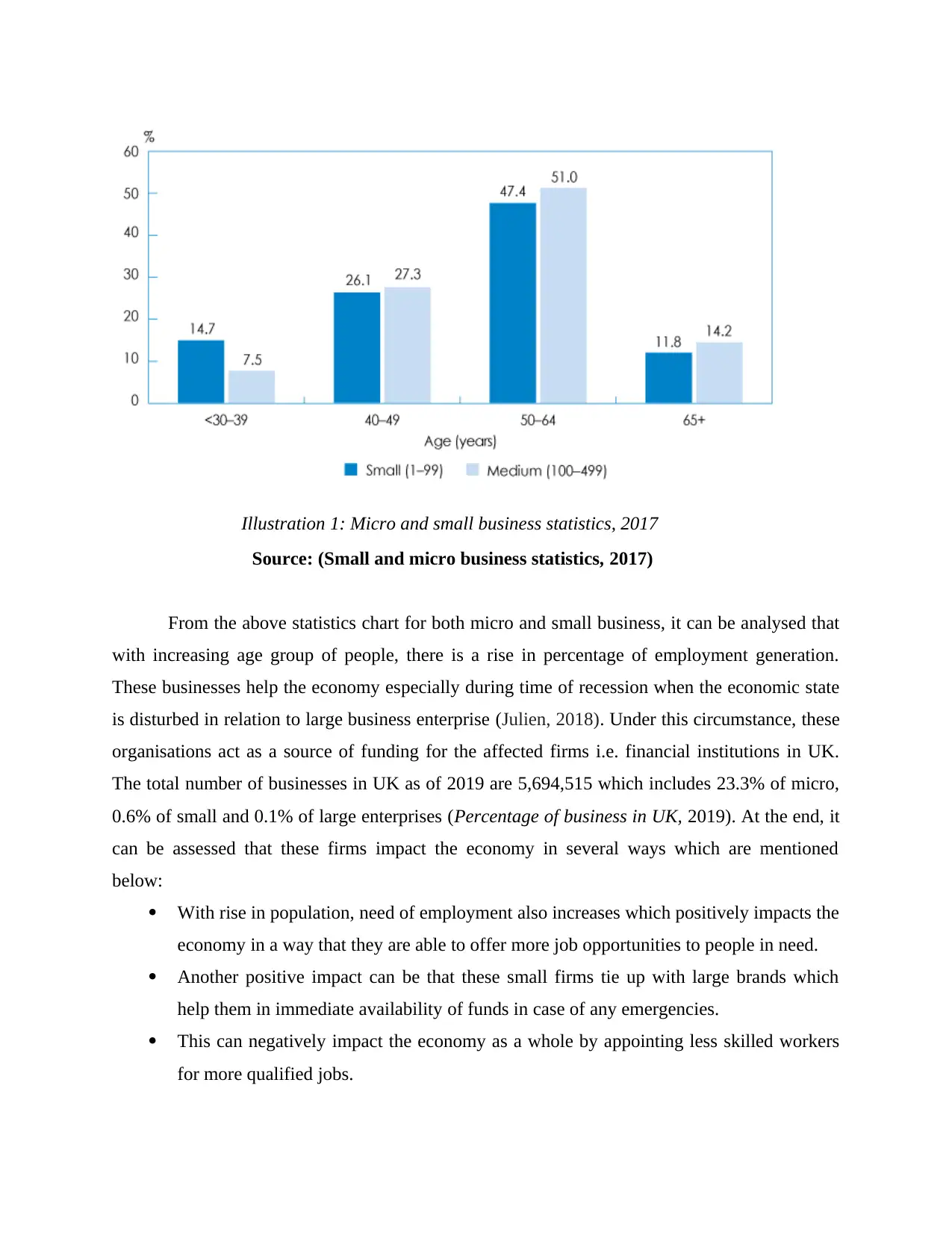
Illustration 1: Micro and small business statistics, 2017
Source: (Small and micro business statistics, 2017)
From the above statistics chart for both micro and small business, it can be analysed that
with increasing age group of people, there is a rise in percentage of employment generation.
These businesses help the economy especially during time of recession when the economic state
is disturbed in relation to large business enterprise (Julien, 2018). Under this circumstance, these
organisations act as a source of funding for the affected firms i.e. financial institutions in UK.
The total number of businesses in UK as of 2019 are 5,694,515 which includes 23.3% of micro,
0.6% of small and 0.1% of large enterprises (Percentage of business in UK, 2019). At the end, it
can be assessed that these firms impact the economy in several ways which are mentioned
below:
With rise in population, need of employment also increases which positively impacts the
economy in a way that they are able to offer more job opportunities to people in need.
Another positive impact can be that these small firms tie up with large brands which
help them in immediate availability of funds in case of any emergencies.
This can negatively impact the economy as a whole by appointing less skilled workers
for more qualified jobs.
Source: (Small and micro business statistics, 2017)
From the above statistics chart for both micro and small business, it can be analysed that
with increasing age group of people, there is a rise in percentage of employment generation.
These businesses help the economy especially during time of recession when the economic state
is disturbed in relation to large business enterprise (Julien, 2018). Under this circumstance, these
organisations act as a source of funding for the affected firms i.e. financial institutions in UK.
The total number of businesses in UK as of 2019 are 5,694,515 which includes 23.3% of micro,
0.6% of small and 0.1% of large enterprises (Percentage of business in UK, 2019). At the end, it
can be assessed that these firms impact the economy in several ways which are mentioned
below:
With rise in population, need of employment also increases which positively impacts the
economy in a way that they are able to offer more job opportunities to people in need.
Another positive impact can be that these small firms tie up with large brands which
help them in immediate availability of funds in case of any emergencies.
This can negatively impact the economy as a whole by appointing less skilled workers
for more qualified jobs.
P4 Importance of small business and start-ups on the growth of social economy
Following listed is the importance of small businesses and start-ups on the growth of
social economy:
Employment generation: With rise in population, the rate of employment has touched
higher levels. This is because the need for having a job is immensely generating among
candidates so they tend to work in any possible environment matching with their relevant
skills. So, for that purpose small businesses and start-ups are opened in every part of the
world either online or offline, that provides employment opportunities to individuals
based on their expertise and experience (Kadam and Ayarekar, 2014).
Spreading awareness among different sectors of the economy: The importance of
small firms in rural and urban areas is seen to be economically beneficial for the users as
in small towns. As, it acts as a only source or facility for the people living there whereas
in the city, these offer more diverse jobs to candidates with specific interest in the
relevant area. Usually, a small business enterprise or a start-up generate employment
opportunities for people coming from different parts of the world.
M2 Difference among small, medium and large business with relevant statistics:
Small, medium and large businesses contribute to the overall growth and development of
the economy in different ways. For example, a small firm will attract more personnels who are
looking for a job by providing them appropriate training relevant to the field whereas a large-
sized firm will be open to more ideas and innovations as it will help the economy as well as the
company in attracting growth opportunities for the people. By analysing the above statistics, it
can be concluded that the rise in small-medium business over the years and between age-groups
have majorly increased. This is beneficial for the economy as more employment can be
generated & as a result the deployment rate will be minimised.
D2 Critical examination of how small business impact on different levels of economy:
Small businesses have a major impact of different levels of economy i.e. local, regional
and national. The regional or state economy affect the workings of a small enterprise by
collecting tax on income generate by organisation. In a local territory, this business acts as a
symbol for recognition among the market participants whereas in a national economy, a small
firm helps in attaining gross domestic product (GDP) of the entire nation by hiring candidates
Following listed is the importance of small businesses and start-ups on the growth of
social economy:
Employment generation: With rise in population, the rate of employment has touched
higher levels. This is because the need for having a job is immensely generating among
candidates so they tend to work in any possible environment matching with their relevant
skills. So, for that purpose small businesses and start-ups are opened in every part of the
world either online or offline, that provides employment opportunities to individuals
based on their expertise and experience (Kadam and Ayarekar, 2014).
Spreading awareness among different sectors of the economy: The importance of
small firms in rural and urban areas is seen to be economically beneficial for the users as
in small towns. As, it acts as a only source or facility for the people living there whereas
in the city, these offer more diverse jobs to candidates with specific interest in the
relevant area. Usually, a small business enterprise or a start-up generate employment
opportunities for people coming from different parts of the world.
M2 Difference among small, medium and large business with relevant statistics:
Small, medium and large businesses contribute to the overall growth and development of
the economy in different ways. For example, a small firm will attract more personnels who are
looking for a job by providing them appropriate training relevant to the field whereas a large-
sized firm will be open to more ideas and innovations as it will help the economy as well as the
company in attracting growth opportunities for the people. By analysing the above statistics, it
can be concluded that the rise in small-medium business over the years and between age-groups
have majorly increased. This is beneficial for the economy as more employment can be
generated & as a result the deployment rate will be minimised.
D2 Critical examination of how small business impact on different levels of economy:
Small businesses have a major impact of different levels of economy i.e. local, regional
and national. The regional or state economy affect the workings of a small enterprise by
collecting tax on income generate by organisation. In a local territory, this business acts as a
symbol for recognition among the market participants whereas in a national economy, a small
firm helps in attaining gross domestic product (GDP) of the entire nation by hiring candidates
⊘ This is a preview!⊘
Do you want full access?
Subscribe today to unlock all pages.
Trusted by 1+ million students worldwide
from different parts of the world. On an international context, a small business can attain the
competitive advantage of external affairs and manage their operations accordingly.
Small Medium Large
In this they bring out new and
innovative ideas
These company might follow
the trends given by other
organizations
They only work to increase
profit.
TASK 3
P5 Characteristics, traits and skill of entrepreneur.
Successful entrepreneurs are those who have marked their place in the economy by their
prosperous actions and deeds. For this report, two business person are taken which are British
entrepreneurs namely Victoria Beckham and Sir Richard Charles Nicholas Branson.
Characteristics: It is a distinguishing feature which makes a person different from the
crowd and can be open-mindedness, risk-taking etc. Some of them are mentioned below:
Open-mindedness: For an entrepreneur to be successful, the person should have a open mind
towards learning new techniques as well as should be able to tackle any failure that might come
in way. Victoria Beckham and Sir Richard Branson have always been open to new ideas &
innovations, also have a 'never give-up' spirit which helped them in handling all the difficult
situations that came along their path. This characteristic made them different from the rest of
entrepreneurs because others do not have this feature built in themselves, hence they miss out on
the innovative techniques to apply in their business.
Professionalism: Both Victoria Beckham and Sir Richard Branson possess professional
behaviour in their work as well as with the employees. This characteristic makes them different
from other entrepreneurs as unlike them, others lack reliability and discipline which are some
important aspects in order to achieve targets.
Traits: It is a quality or attribute naturally built up in a person. Some of the traits are
discussed below:
Determination: Both Victoria Beckham and Sir Richard Branson have a built-up determination
trait among themselves which makes them stand out from the rest of the world. This trait makes
competitive advantage of external affairs and manage their operations accordingly.
Small Medium Large
In this they bring out new and
innovative ideas
These company might follow
the trends given by other
organizations
They only work to increase
profit.
TASK 3
P5 Characteristics, traits and skill of entrepreneur.
Successful entrepreneurs are those who have marked their place in the economy by their
prosperous actions and deeds. For this report, two business person are taken which are British
entrepreneurs namely Victoria Beckham and Sir Richard Charles Nicholas Branson.
Characteristics: It is a distinguishing feature which makes a person different from the
crowd and can be open-mindedness, risk-taking etc. Some of them are mentioned below:
Open-mindedness: For an entrepreneur to be successful, the person should have a open mind
towards learning new techniques as well as should be able to tackle any failure that might come
in way. Victoria Beckham and Sir Richard Branson have always been open to new ideas &
innovations, also have a 'never give-up' spirit which helped them in handling all the difficult
situations that came along their path. This characteristic made them different from the rest of
entrepreneurs because others do not have this feature built in themselves, hence they miss out on
the innovative techniques to apply in their business.
Professionalism: Both Victoria Beckham and Sir Richard Branson possess professional
behaviour in their work as well as with the employees. This characteristic makes them different
from other entrepreneurs as unlike them, others lack reliability and discipline which are some
important aspects in order to achieve targets.
Traits: It is a quality or attribute naturally built up in a person. Some of the traits are
discussed below:
Determination: Both Victoria Beckham and Sir Richard Branson have a built-up determination
trait among themselves which makes them stand out from the rest of the world. This trait makes
Paraphrase This Document
Need a fresh take? Get an instant paraphrase of this document with our AI Paraphraser
them unique from other entrepreneurs as unlike them, others consider failure as then end of
business whereas they take it as another stepping stone.
Decision-making: Victoria Beckham and Sir Richard Branson possess a high qualitative
decision-making trait among themselves which help them in taking judgements without major
planning. This trait makes them different from rest of the entrepreneurs as others lack the power
of taking effective decisions.
Skills: It is an inherent ability to perform a task with full expertise and some of the skills
of successful entrepreneurs are mentioned below:
Ambition: Victoria Beckham and Sir R. Branson always had an aim to succeed in life which
helped them in attaining the respected position they stand in. This skill make them different from
rest of the entrepreneurs as others do not have an ambition or agenda towards their business
projects.
Creativity: Richard Branson and Victoria Beckham possess a creative mind-set which helped
them in attracting new ideas and innovations during their profession. However, this skill make
them stand-out from rest of entrepreneurs as they do not try new techniques or experiences
which take them a step down from others.
P6 Entrepreneurial personality reflect motivation and mind-set:
Openness: This trait includes people who like to learn new things and enjoy different experiences
score wide on this characteristic (Putta, 2014). Openness help Victoria Beckham and Sir Richard
Branson in boosting up their motivation and developing a unique mindset as they both are open
to new ideas and have an excellent grasping power.
Conscientiousness: This includes people with high degree of reliableness and promptness
which includes various qualities like organized, methodic etc. Conscientiousness help Victoria
Beckham and Richard Branson in uplifting their motivation & changing their mindset as their
level of creativity assists them in attracting new ideas & plans.
Extraversion: It includes people who are of extrovert nature and includes traits like
energetic, talkative etc. Extraversion help the entrepreneurs in charging up their motivation as
both Victoria Beckham and Richard Branson are ambitious towards their life goals. However,
this trait changes their mindset by being well-determined and taking every task as a step to
success.
business whereas they take it as another stepping stone.
Decision-making: Victoria Beckham and Sir Richard Branson possess a high qualitative
decision-making trait among themselves which help them in taking judgements without major
planning. This trait makes them different from rest of the entrepreneurs as others lack the power
of taking effective decisions.
Skills: It is an inherent ability to perform a task with full expertise and some of the skills
of successful entrepreneurs are mentioned below:
Ambition: Victoria Beckham and Sir R. Branson always had an aim to succeed in life which
helped them in attaining the respected position they stand in. This skill make them different from
rest of the entrepreneurs as others do not have an ambition or agenda towards their business
projects.
Creativity: Richard Branson and Victoria Beckham possess a creative mind-set which helped
them in attracting new ideas and innovations during their profession. However, this skill make
them stand-out from rest of entrepreneurs as they do not try new techniques or experiences
which take them a step down from others.
P6 Entrepreneurial personality reflect motivation and mind-set:
Openness: This trait includes people who like to learn new things and enjoy different experiences
score wide on this characteristic (Putta, 2014). Openness help Victoria Beckham and Sir Richard
Branson in boosting up their motivation and developing a unique mindset as they both are open
to new ideas and have an excellent grasping power.
Conscientiousness: This includes people with high degree of reliableness and promptness
which includes various qualities like organized, methodic etc. Conscientiousness help Victoria
Beckham and Richard Branson in uplifting their motivation & changing their mindset as their
level of creativity assists them in attracting new ideas & plans.
Extraversion: It includes people who are of extrovert nature and includes traits like
energetic, talkative etc. Extraversion help the entrepreneurs in charging up their motivation as
both Victoria Beckham and Richard Branson are ambitious towards their life goals. However,
this trait changes their mindset by being well-determined and taking every task as a step to
success.
Agreeableness: This includes people who are friendly, cooperative, passionate towards
their work ethic and includes being kind, affectionate etc. Agreeableness help Richard Branson
and Victoria Beckham in changing their mindset, boosting up the motivation as they have always
been passionate about their work and possess professionalism.
Neuroticism: It relates to a person's emotional state as well as degree of negative
emotions and includes moody, tense people. Neuroticism help the entrepreneurs in enhancing
their motivation and changing the mindset by taking effective decisions in every situation and
coming up with instant solutions in case of any failure.
TASK 4
P7Background and experience that can hinder and foster
Background and experience can hinder or foster entrepreneurship. Eventually, she became a
member of band called Persuasion due to her interest in the field. Today, she is one of the
renowned English businesswoman, a fashion designer with her personal label of jeans named VB
rocks and singer with having a lot of experience.
Another entrepreneur named Sir Richard Branson was born in Blackheath, London and
has two younger siblings & is educated at Scaitcliffe School, in Surrey. Today, he is top-most
businessman, investor, author and philanthropist, also the founder of Virgin Group which is a
multinational venture capital and is incorporated since 1989 by Companies House.
The experience and background of successful entrepreneurs can positively impact them can
foster them by spreading awareness about relevant field among different age groups of people
and opening up more opportunities for them so that they can reach greater heights. Also, it can
help Sir Richard Branson and Victoria Beckham into accepting the sense of failure with the
attitude of never giving up.
CONCLUSION
From the above report, it can be concluded that for an entrepreneur to be successful in his
work and attain a respectable position in the society, the person should possess various
entrepreneurial characteristics, traits and skills. These will help them in developing their
personality and making them stand out from the other entrepreneurs. There should be a specific
link between the above mentioned traits as well as background, experience of a business-person
as this can certainly turn their future perspectives. The entrepreneur should be able to manage
their work ethic and includes being kind, affectionate etc. Agreeableness help Richard Branson
and Victoria Beckham in changing their mindset, boosting up the motivation as they have always
been passionate about their work and possess professionalism.
Neuroticism: It relates to a person's emotional state as well as degree of negative
emotions and includes moody, tense people. Neuroticism help the entrepreneurs in enhancing
their motivation and changing the mindset by taking effective decisions in every situation and
coming up with instant solutions in case of any failure.
TASK 4
P7Background and experience that can hinder and foster
Background and experience can hinder or foster entrepreneurship. Eventually, she became a
member of band called Persuasion due to her interest in the field. Today, she is one of the
renowned English businesswoman, a fashion designer with her personal label of jeans named VB
rocks and singer with having a lot of experience.
Another entrepreneur named Sir Richard Branson was born in Blackheath, London and
has two younger siblings & is educated at Scaitcliffe School, in Surrey. Today, he is top-most
businessman, investor, author and philanthropist, also the founder of Virgin Group which is a
multinational venture capital and is incorporated since 1989 by Companies House.
The experience and background of successful entrepreneurs can positively impact them can
foster them by spreading awareness about relevant field among different age groups of people
and opening up more opportunities for them so that they can reach greater heights. Also, it can
help Sir Richard Branson and Victoria Beckham into accepting the sense of failure with the
attitude of never giving up.
CONCLUSION
From the above report, it can be concluded that for an entrepreneur to be successful in his
work and attain a respectable position in the society, the person should possess various
entrepreneurial characteristics, traits and skills. These will help them in developing their
personality and making them stand out from the other entrepreneurs. There should be a specific
link between the above mentioned traits as well as background, experience of a business-person
as this can certainly turn their future perspectives. The entrepreneur should be able to manage
⊘ This is a preview!⊘
Do you want full access?
Subscribe today to unlock all pages.
Trusted by 1+ million students worldwide

1 out of 15


Related Documents


Your All-in-One AI-Powered Toolkit for Academic Success.
+13062052269
info@desklib.com
Available 24*7 on WhatsApp / Email
![[object Object]](/_next/static/media/star-bottom.7253800d.svg)
Unlock your academic potential
Copyright © 2020–2026 A2Z Services. All Rights Reserved. Developed and managed by ZUCOL.