Entrepreneurship Report: Venture Types, Impact on Economy, and SMEs
VerifiedAdded on 2023/01/19
|9
|1709
|70
Report
AI Summary
This report delves into the multifaceted world of entrepreneurship, exploring diverse venture types such as public, private, social, and lifestyle-based models. It examines the similarities and differences between these ventures, highlighting their contributions to the economy and society. The report further assesses the significant impact of Small and Medium Enterprises (SMEs) on the UK economy, discussing their role in job creation, revenue generation, and contribution to the gross value added. It also explores the UK government's initiatives to support SME growth, including financial assistance and training programs. The report concludes by emphasizing the crucial role of both entrepreneurship and SMEs in fostering economic growth and social development within the UK.

Paraphrase This Document
Need a fresh take? Get an instant paraphrase of this document with our AI Paraphraser


Table of Contents
INTRODUCTION................................................................................................................................4
MAIN BODY.......................................................................................................................................5
LO1 : EXPLORE AND ILLUSTRATE THE RANGE OF VENTURE TYPE THAT MIGHT BE
CONSIDERED ENTREPRENEURIAL.........................................................................................5
LO2 ASSESS THE IMPACT OF SMALL BUSINESS ON THE ECONOMY..............................6
CONCLUSION....................................................................................................................................8
REFERENCES.....................................................................................................................................9
INTRODUCTION................................................................................................................................4
MAIN BODY.......................................................................................................................................5
LO1 : EXPLORE AND ILLUSTRATE THE RANGE OF VENTURE TYPE THAT MIGHT BE
CONSIDERED ENTREPRENEURIAL.........................................................................................5
LO2 ASSESS THE IMPACT OF SMALL BUSINESS ON THE ECONOMY..............................6
CONCLUSION....................................................................................................................................8
REFERENCES.....................................................................................................................................9
⊘ This is a preview!⊘
Do you want full access?
Subscribe today to unlock all pages.

Trusted by 1+ million students worldwide

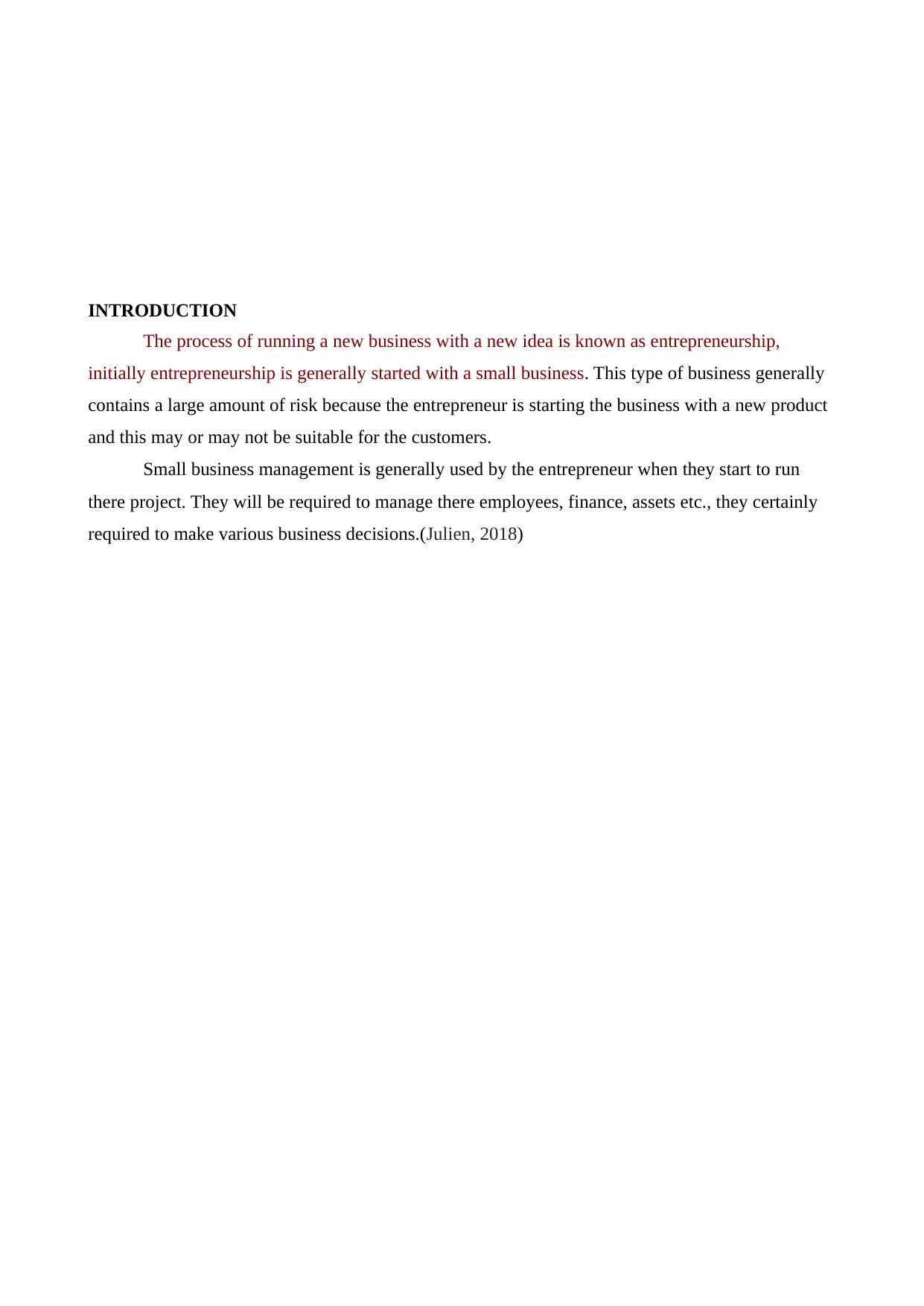
INTRODUCTION
The process of running a new business with a new idea is known as entrepreneurship,
initially entrepreneurship is generally started with a small business. This type of business generally
contains a large amount of risk because the entrepreneur is starting the business with a new product
and this may or may not be suitable for the customers.
Small business management is generally used by the entrepreneur when they start to run
there project. They will be required to manage there employees, finance, assets etc., they certainly
required to make various business decisions.(Julien, 2018)
The process of running a new business with a new idea is known as entrepreneurship,
initially entrepreneurship is generally started with a small business. This type of business generally
contains a large amount of risk because the entrepreneur is starting the business with a new product
and this may or may not be suitable for the customers.
Small business management is generally used by the entrepreneur when they start to run
there project. They will be required to manage there employees, finance, assets etc., they certainly
required to make various business decisions.(Julien, 2018)
Paraphrase This Document
Need a fresh take? Get an instant paraphrase of this document with our AI Paraphraser

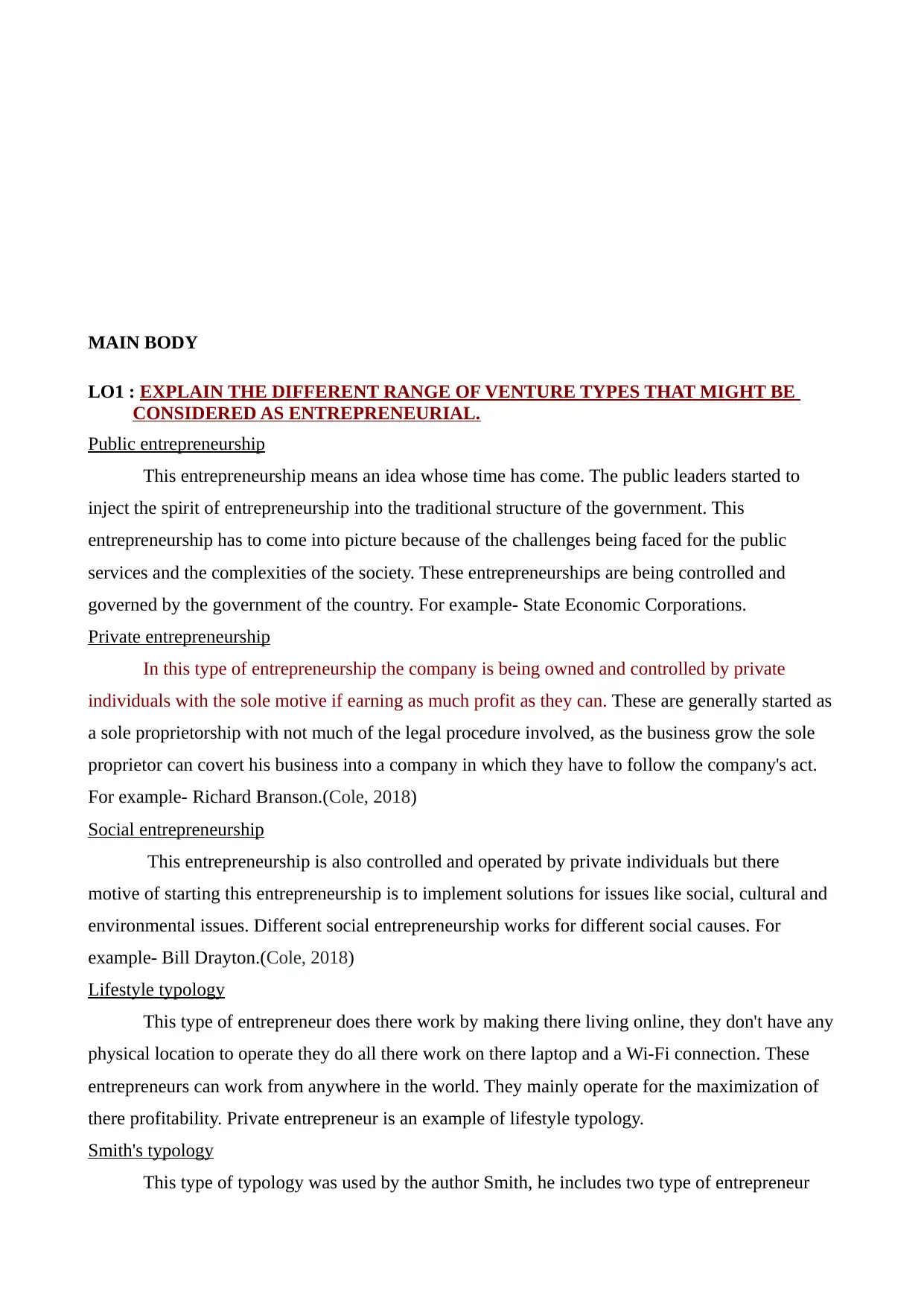
MAIN BODY
LO1 : EXPLAIN THE DIFFERENT RANGE OF VENTURE TYPES THAT MIGHT BE
CONSIDERED AS ENTREPRENEURIAL.
Public entrepreneurship
This entrepreneurship means an idea whose time has come. The public leaders started to
inject the spirit of entrepreneurship into the traditional structure of the government. This
entrepreneurship has to come into picture because of the challenges being faced for the public
services and the complexities of the society. These entrepreneurships are being controlled and
governed by the government of the country. For example- State Economic Corporations.
Private entrepreneurship
In this type of entrepreneurship the company is being owned and controlled by private
individuals with the sole motive if earning as much profit as they can. These are generally started as
a sole proprietorship with not much of the legal procedure involved, as the business grow the sole
proprietor can covert his business into a company in which they have to follow the company's act.
For example- Richard Branson.(Cole, 2018)
Social entrepreneurship
This entrepreneurship is also controlled and operated by private individuals but there
motive of starting this entrepreneurship is to implement solutions for issues like social, cultural and
environmental issues. Different social entrepreneurship works for different social causes. For
example- Bill Drayton.(Cole, 2018)
Lifestyle typology
This type of entrepreneur does there work by making there living online, they don't have any
physical location to operate they do all there work on there laptop and a Wi-Fi connection. These
entrepreneurs can work from anywhere in the world. They mainly operate for the maximization of
there profitability. Private entrepreneur is an example of lifestyle typology.
Smith's typology
This type of typology was used by the author Smith, he includes two type of entrepreneur
LO1 : EXPLAIN THE DIFFERENT RANGE OF VENTURE TYPES THAT MIGHT BE
CONSIDERED AS ENTREPRENEURIAL.
Public entrepreneurship
This entrepreneurship means an idea whose time has come. The public leaders started to
inject the spirit of entrepreneurship into the traditional structure of the government. This
entrepreneurship has to come into picture because of the challenges being faced for the public
services and the complexities of the society. These entrepreneurships are being controlled and
governed by the government of the country. For example- State Economic Corporations.
Private entrepreneurship
In this type of entrepreneurship the company is being owned and controlled by private
individuals with the sole motive if earning as much profit as they can. These are generally started as
a sole proprietorship with not much of the legal procedure involved, as the business grow the sole
proprietor can covert his business into a company in which they have to follow the company's act.
For example- Richard Branson.(Cole, 2018)
Social entrepreneurship
This entrepreneurship is also controlled and operated by private individuals but there
motive of starting this entrepreneurship is to implement solutions for issues like social, cultural and
environmental issues. Different social entrepreneurship works for different social causes. For
example- Bill Drayton.(Cole, 2018)
Lifestyle typology
This type of entrepreneur does there work by making there living online, they don't have any
physical location to operate they do all there work on there laptop and a Wi-Fi connection. These
entrepreneurs can work from anywhere in the world. They mainly operate for the maximization of
there profitability. Private entrepreneur is an example of lifestyle typology.
Smith's typology
This type of typology was used by the author Smith, he includes two type of entrepreneur

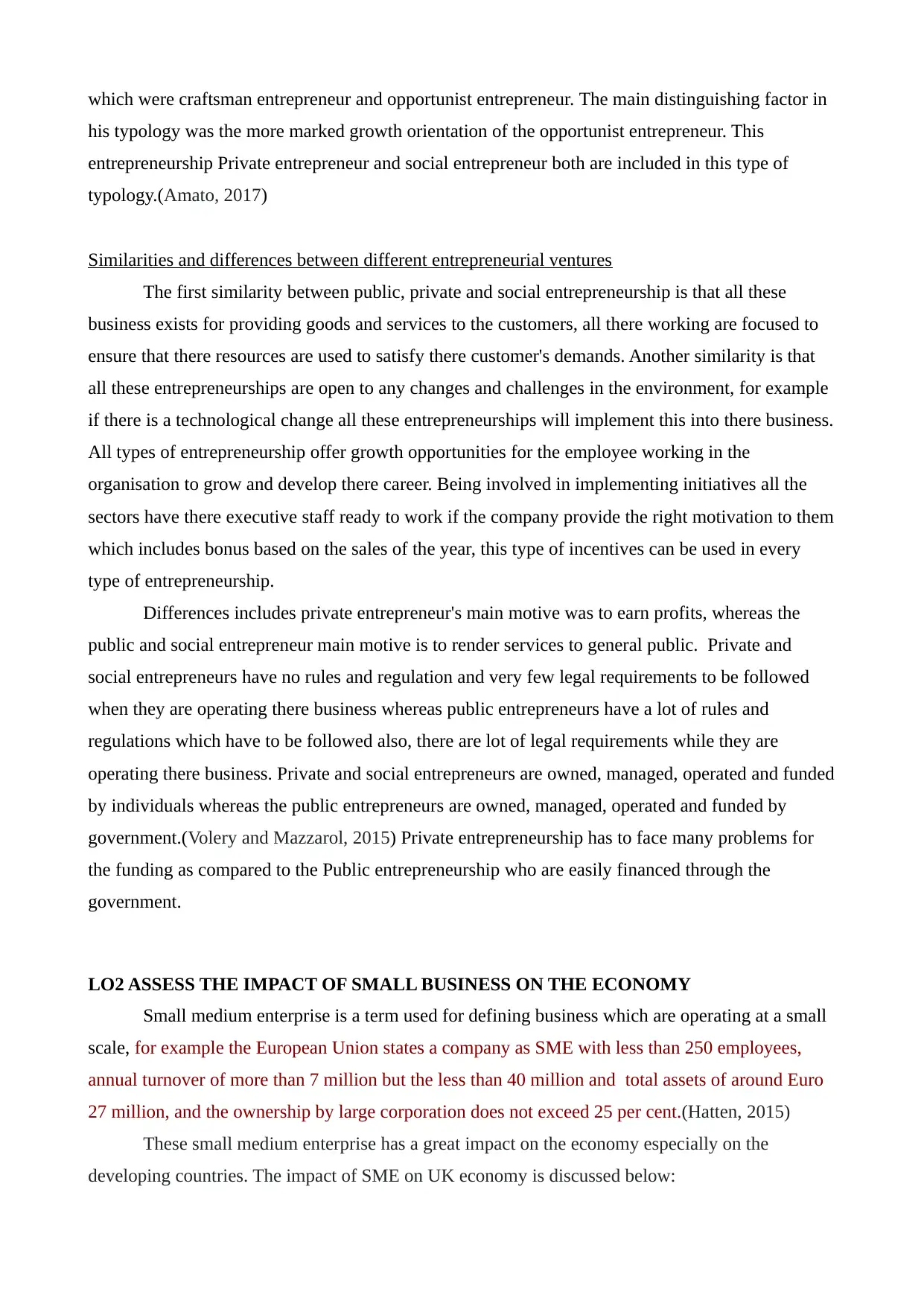
which were craftsman entrepreneur and opportunist entrepreneur. The main distinguishing factor in
his typology was the more marked growth orientation of the opportunist entrepreneur. This
entrepreneurship Private entrepreneur and social entrepreneur both are included in this type of
typology.(Amato, 2017)
Similarities and differences between different entrepreneurial ventures
The first similarity between public, private and social entrepreneurship is that all these
business exists for providing goods and services to the customers, all there working are focused to
ensure that there resources are used to satisfy there customer's demands. Another similarity is that
all these entrepreneurships are open to any changes and challenges in the environment, for example
if there is a technological change all these entrepreneurships will implement this into there business.
All types of entrepreneurship offer growth opportunities for the employee working in the
organisation to grow and develop there career. Being involved in implementing initiatives all the
sectors have there executive staff ready to work if the company provide the right motivation to them
which includes bonus based on the sales of the year, this type of incentives can be used in every
type of entrepreneurship.
Differences includes private entrepreneur's main motive was to earn profits, whereas the
public and social entrepreneur main motive is to render services to general public. Private and
social entrepreneurs have no rules and regulation and very few legal requirements to be followed
when they are operating there business whereas public entrepreneurs have a lot of rules and
regulations which have to be followed also, there are lot of legal requirements while they are
operating there business. Private and social entrepreneurs are owned, managed, operated and funded
by individuals whereas the public entrepreneurs are owned, managed, operated and funded by
government.(Volery and Mazzarol, 2015) Private entrepreneurship has to face many problems for
the funding as compared to the Public entrepreneurship who are easily financed through the
government.
LO2 ASSESS THE IMPACT OF SMALL BUSINESS ON THE ECONOMY
Small medium enterprise is a term used for defining business which are operating at a small
scale, for example the European Union states a company as SME with less than 250 employees,
annual turnover of more than 7 million but the less than 40 million and total assets of around Euro
27 million, and the ownership by large corporation does not exceed 25 per cent.(Hatten, 2015)
These small medium enterprise has a great impact on the economy especially on the
developing countries. The impact of SME on UK economy is discussed below:
his typology was the more marked growth orientation of the opportunist entrepreneur. This
entrepreneurship Private entrepreneur and social entrepreneur both are included in this type of
typology.(Amato, 2017)
Similarities and differences between different entrepreneurial ventures
The first similarity between public, private and social entrepreneurship is that all these
business exists for providing goods and services to the customers, all there working are focused to
ensure that there resources are used to satisfy there customer's demands. Another similarity is that
all these entrepreneurships are open to any changes and challenges in the environment, for example
if there is a technological change all these entrepreneurships will implement this into there business.
All types of entrepreneurship offer growth opportunities for the employee working in the
organisation to grow and develop there career. Being involved in implementing initiatives all the
sectors have there executive staff ready to work if the company provide the right motivation to them
which includes bonus based on the sales of the year, this type of incentives can be used in every
type of entrepreneurship.
Differences includes private entrepreneur's main motive was to earn profits, whereas the
public and social entrepreneur main motive is to render services to general public. Private and
social entrepreneurs have no rules and regulation and very few legal requirements to be followed
when they are operating there business whereas public entrepreneurs have a lot of rules and
regulations which have to be followed also, there are lot of legal requirements while they are
operating there business. Private and social entrepreneurs are owned, managed, operated and funded
by individuals whereas the public entrepreneurs are owned, managed, operated and funded by
government.(Volery and Mazzarol, 2015) Private entrepreneurship has to face many problems for
the funding as compared to the Public entrepreneurship who are easily financed through the
government.
LO2 ASSESS THE IMPACT OF SMALL BUSINESS ON THE ECONOMY
Small medium enterprise is a term used for defining business which are operating at a small
scale, for example the European Union states a company as SME with less than 250 employees,
annual turnover of more than 7 million but the less than 40 million and total assets of around Euro
27 million, and the ownership by large corporation does not exceed 25 per cent.(Hatten, 2015)
These small medium enterprise has a great impact on the economy especially on the
developing countries. The impact of SME on UK economy is discussed below:
⊘ This is a preview!⊘
Do you want full access?
Subscribe today to unlock all pages.

Trusted by 1+ million students worldwide

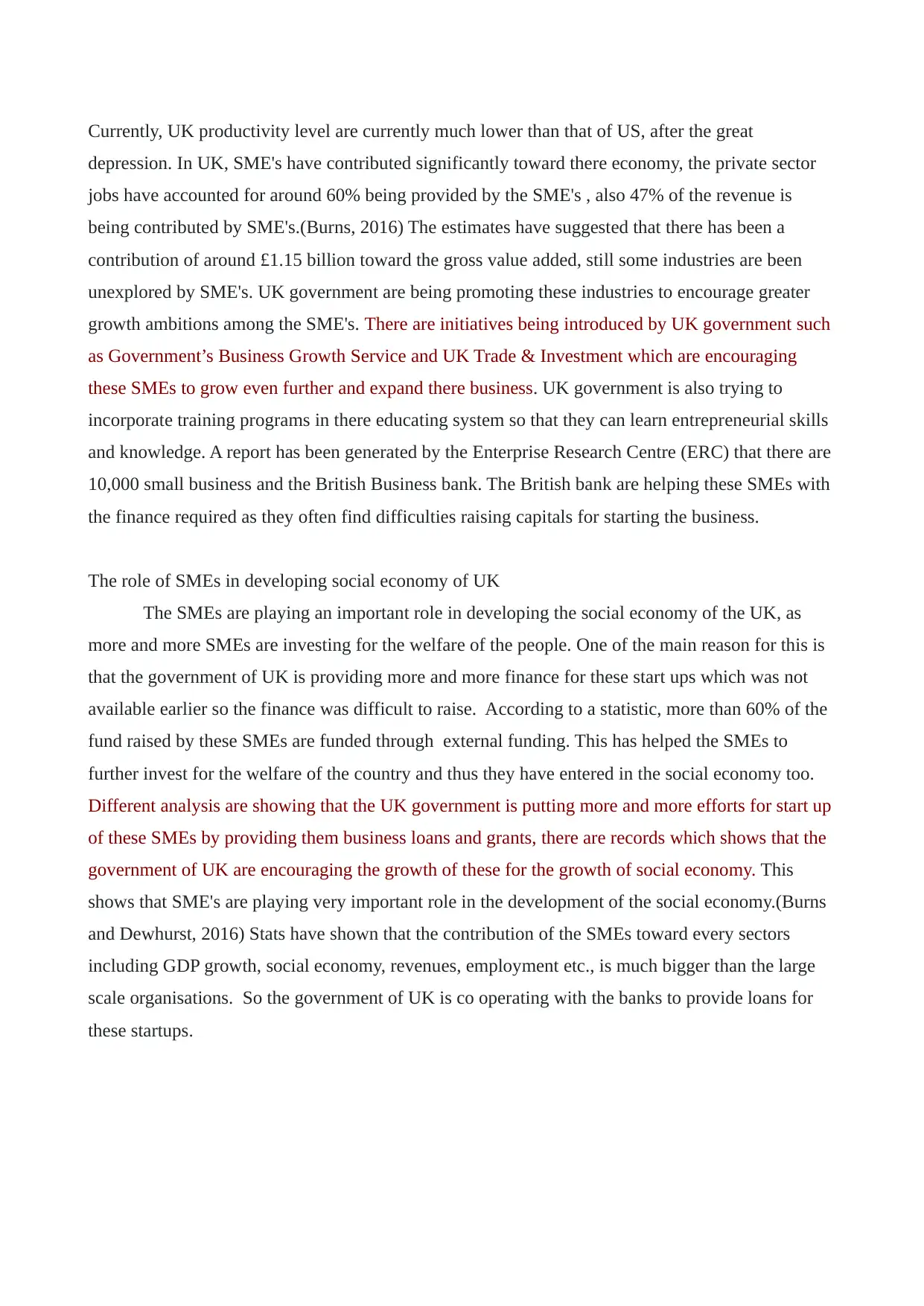
Currently, UK productivity level are currently much lower than that of US, after the great
depression. In UK, SME's have contributed significantly toward there economy, the private sector
jobs have accounted for around 60% being provided by the SME's , also 47% of the revenue is
being contributed by SME's.(Burns, 2016) The estimates have suggested that there has been a
contribution of around £1.15 billion toward the gross value added, still some industries are been
unexplored by SME's. UK government are being promoting these industries to encourage greater
growth ambitions among the SME's. There are initiatives being introduced by UK government such
as Government’s Business Growth Service and UK Trade & Investment which are encouraging
these SMEs to grow even further and expand there business. UK government is also trying to
incorporate training programs in there educating system so that they can learn entrepreneurial skills
and knowledge. A report has been generated by the Enterprise Research Centre (ERC) that there are
10,000 small business and the British Business bank. The British bank are helping these SMEs with
the finance required as they often find difficulties raising capitals for starting the business.
The role of SMEs in developing social economy of UK
The SMEs are playing an important role in developing the social economy of the UK, as
more and more SMEs are investing for the welfare of the people. One of the main reason for this is
that the government of UK is providing more and more finance for these start ups which was not
available earlier so the finance was difficult to raise. According to a statistic, more than 60% of the
fund raised by these SMEs are funded through external funding. This has helped the SMEs to
further invest for the welfare of the country and thus they have entered in the social economy too.
Different analysis are showing that the UK government is putting more and more efforts for start up
of these SMEs by providing them business loans and grants, there are records which shows that the
government of UK are encouraging the growth of these for the growth of social economy. This
shows that SME's are playing very important role in the development of the social economy.(Burns
and Dewhurst, 2016) Stats have shown that the contribution of the SMEs toward every sectors
including GDP growth, social economy, revenues, employment etc., is much bigger than the large
scale organisations. So the government of UK is co operating with the banks to provide loans for
these startups.
depression. In UK, SME's have contributed significantly toward there economy, the private sector
jobs have accounted for around 60% being provided by the SME's , also 47% of the revenue is
being contributed by SME's.(Burns, 2016) The estimates have suggested that there has been a
contribution of around £1.15 billion toward the gross value added, still some industries are been
unexplored by SME's. UK government are being promoting these industries to encourage greater
growth ambitions among the SME's. There are initiatives being introduced by UK government such
as Government’s Business Growth Service and UK Trade & Investment which are encouraging
these SMEs to grow even further and expand there business. UK government is also trying to
incorporate training programs in there educating system so that they can learn entrepreneurial skills
and knowledge. A report has been generated by the Enterprise Research Centre (ERC) that there are
10,000 small business and the British Business bank. The British bank are helping these SMEs with
the finance required as they often find difficulties raising capitals for starting the business.
The role of SMEs in developing social economy of UK
The SMEs are playing an important role in developing the social economy of the UK, as
more and more SMEs are investing for the welfare of the people. One of the main reason for this is
that the government of UK is providing more and more finance for these start ups which was not
available earlier so the finance was difficult to raise. According to a statistic, more than 60% of the
fund raised by these SMEs are funded through external funding. This has helped the SMEs to
further invest for the welfare of the country and thus they have entered in the social economy too.
Different analysis are showing that the UK government is putting more and more efforts for start up
of these SMEs by providing them business loans and grants, there are records which shows that the
government of UK are encouraging the growth of these for the growth of social economy. This
shows that SME's are playing very important role in the development of the social economy.(Burns
and Dewhurst, 2016) Stats have shown that the contribution of the SMEs toward every sectors
including GDP growth, social economy, revenues, employment etc., is much bigger than the large
scale organisations. So the government of UK is co operating with the banks to provide loans for
these startups.
Paraphrase This Document
Need a fresh take? Get an instant paraphrase of this document with our AI Paraphraser

CONCLUSION
From this report we have come to a conclusion about the different types of entrepreneurial
structures and there typologies. Then there is a clear distinction of the types of entrepreneurial
structures and there similarities are also discussed. Then the report discuss the SME's contribution
toward the development of UK economy and the social economy. Overall both entrepreneurship
and SMEs are important in contributing the growth prospective of the UK economy.
From this report we have come to a conclusion about the different types of entrepreneurial
structures and there typologies. Then there is a clear distinction of the types of entrepreneurial
structures and there similarities are also discussed. Then the report discuss the SME's contribution
toward the development of UK economy and the social economy. Overall both entrepreneurship
and SMEs are important in contributing the growth prospective of the UK economy.

REFERENCES
Books and journals
Amato, C., and et.al., 2017. Regulatory modes and entrepreneurship: the mediational role of
alertness in small business success. Journal of Small Business Management. 55. pp.27-42.
Burns, P. and Dewhurst, J. eds., 2016. Small business and entrepreneurship. Macmillan International
Higher Education.
Burns, P., 2016. Entrepreneurship and small business. Palgrave Macmillan Limited.
Cole, R.A., 2018. Bank credit, trade credit or no credit: Evidence from the Surveys of Small
Business Finances. Trade Credit or No Credit: Evidence from the Surveys of Small
Business Finances (July 31, 2018).
Cole, R.A., 2018. Bank credit, trade credit or no credit: Evidence from the Surveys of Small
Business Finances. Trade Credit or No Credit: Evidence from the Surveys of Small
Business Finances (July 31, 2018).
Hatten, T.S., 2015. Small business management: Entrepreneurship and beyond. Nelson Education.
Julien, P.A., 2018. The state of the art in small business and entrepreneurship. Routledge.
Volery, T. and Mazzarol, T., 2015. The evolution of the small business and entrepreneurship field: A
bibliometric investigation of articles published in the International Small Business Journal.
International Small Business Journal. 33(4). pp.374-396.
Books and journals
Amato, C., and et.al., 2017. Regulatory modes and entrepreneurship: the mediational role of
alertness in small business success. Journal of Small Business Management. 55. pp.27-42.
Burns, P. and Dewhurst, J. eds., 2016. Small business and entrepreneurship. Macmillan International
Higher Education.
Burns, P., 2016. Entrepreneurship and small business. Palgrave Macmillan Limited.
Cole, R.A., 2018. Bank credit, trade credit or no credit: Evidence from the Surveys of Small
Business Finances. Trade Credit or No Credit: Evidence from the Surveys of Small
Business Finances (July 31, 2018).
Cole, R.A., 2018. Bank credit, trade credit or no credit: Evidence from the Surveys of Small
Business Finances. Trade Credit or No Credit: Evidence from the Surveys of Small
Business Finances (July 31, 2018).
Hatten, T.S., 2015. Small business management: Entrepreneurship and beyond. Nelson Education.
Julien, P.A., 2018. The state of the art in small business and entrepreneurship. Routledge.
Volery, T. and Mazzarol, T., 2015. The evolution of the small business and entrepreneurship field: A
bibliometric investigation of articles published in the International Small Business Journal.
International Small Business Journal. 33(4). pp.374-396.
⊘ This is a preview!⊘
Do you want full access?
Subscribe today to unlock all pages.

Trusted by 1+ million students worldwide
1 out of 9
Related Documents
Your All-in-One AI-Powered Toolkit for Academic Success.
+13062052269
info@desklib.com
Available 24*7 on WhatsApp / Email
Unlock your academic potential
Copyright © 2020–2025 A2Z Services. All Rights Reserved. Developed and managed by ZUCOL.