CX554101: Introduction to Marketing - Environmental Analysis Report
VerifiedAdded on 2023/01/18
|16
|3434
|27
Report
AI Summary
This report presents a comprehensive marketing environmental analysis for the Otago Polytechnic International Campus (OPAIC) in Auckland CBD. It begins by defining marketing environmental analysis and outlining the micro-environmental, macro-environmental, and internal factors impacting OPAIC. The report delves into micro-environmental factors such as competitors and the international consumer market, and internal factors including student provisions and departmental structuring. A PESTEL analysis examines the political, economic, social, technological, and environmental factors influencing OPAIC's operations. A SWOT analysis identifies the institution's strengths, weaknesses, opportunities, and threats. The report also explores ethical and social responsibilities, highlighting their importance for OPAIC and providing examples of the institution's practices. Furthermore, the report examines buyer behavior, demonstrating the influence of reference groups, family life cycles, social class, and self-concept on consumer decisions. Examples from brands like Marmite, Air New Zealand, Honda, and Kellogg's illustrate these concepts. The report concludes with recommendations for OPAIC based on the analysis.
Running head: MARKETING ENVIRONMENTAL ANALYSIS
MARKETING ENVIRONMENTAL ANALYSIS
Name of the Student
Name of the University
Author Note
MARKETING ENVIRONMENTAL ANALYSIS
Name of the Student
Name of the University
Author Note

Paraphrase This Document
Need a fresh take? Get an instant paraphrase of this document with our AI Paraphraser
MARKETING ENVIRONMENTAL ANALYSIS 1
Table of Contents
Introduction................................................................................................................................3
Discussion..................................................................................................................................4
Marketing Environment-............................................................................................................4
Micro-environmental factors and Internal Factors:................................................................4
Micro-environmental Factors-...........................................................................................4
Internal Factors-.................................................................................................................4
Macro-environmental Factors:...............................................................................................5
PESTEL Analysis-.............................................................................................................5
SWOT Analysis:....................................................................................................................6
Ethics and social responsibility:.............................................................................................7
Importance of ethics and social responsibility for OPAIC-...............................................7
Examples demonstrated by OPAIC...................................................................................7
Recommendations for OPAIC:..............................................................................................8
Buyer Behaviour-.......................................................................................................................8
Demonstration of Reference Group on buyer behaviour:......................................................8
Family Life cycle:..................................................................................................................9
Influence of social class:......................................................................................................10
Self –Concept:......................................................................................................................11
Buyer decision making process:...........................................................................................11
Characteristics affecting consumer behaviour:....................................................................12
Conclusion:..............................................................................................................................12
Table of Contents
Introduction................................................................................................................................3
Discussion..................................................................................................................................4
Marketing Environment-............................................................................................................4
Micro-environmental factors and Internal Factors:................................................................4
Micro-environmental Factors-...........................................................................................4
Internal Factors-.................................................................................................................4
Macro-environmental Factors:...............................................................................................5
PESTEL Analysis-.............................................................................................................5
SWOT Analysis:....................................................................................................................6
Ethics and social responsibility:.............................................................................................7
Importance of ethics and social responsibility for OPAIC-...............................................7
Examples demonstrated by OPAIC...................................................................................7
Recommendations for OPAIC:..............................................................................................8
Buyer Behaviour-.......................................................................................................................8
Demonstration of Reference Group on buyer behaviour:......................................................8
Family Life cycle:..................................................................................................................9
Influence of social class:......................................................................................................10
Self –Concept:......................................................................................................................11
Buyer decision making process:...........................................................................................11
Characteristics affecting consumer behaviour:....................................................................12
Conclusion:..............................................................................................................................12
MARKETING ENVIRONMENTAL ANALYSIS 2
⊘ This is a preview!⊘
Do you want full access?
Subscribe today to unlock all pages.

Trusted by 1+ million students worldwide
MARKETING ENVIRONMENTAL ANALYSIS 3
Paraphrase This Document
Need a fresh take? Get an instant paraphrase of this document with our AI Paraphraser
MARKETING ENVIRONMENTAL ANALYSIS 4
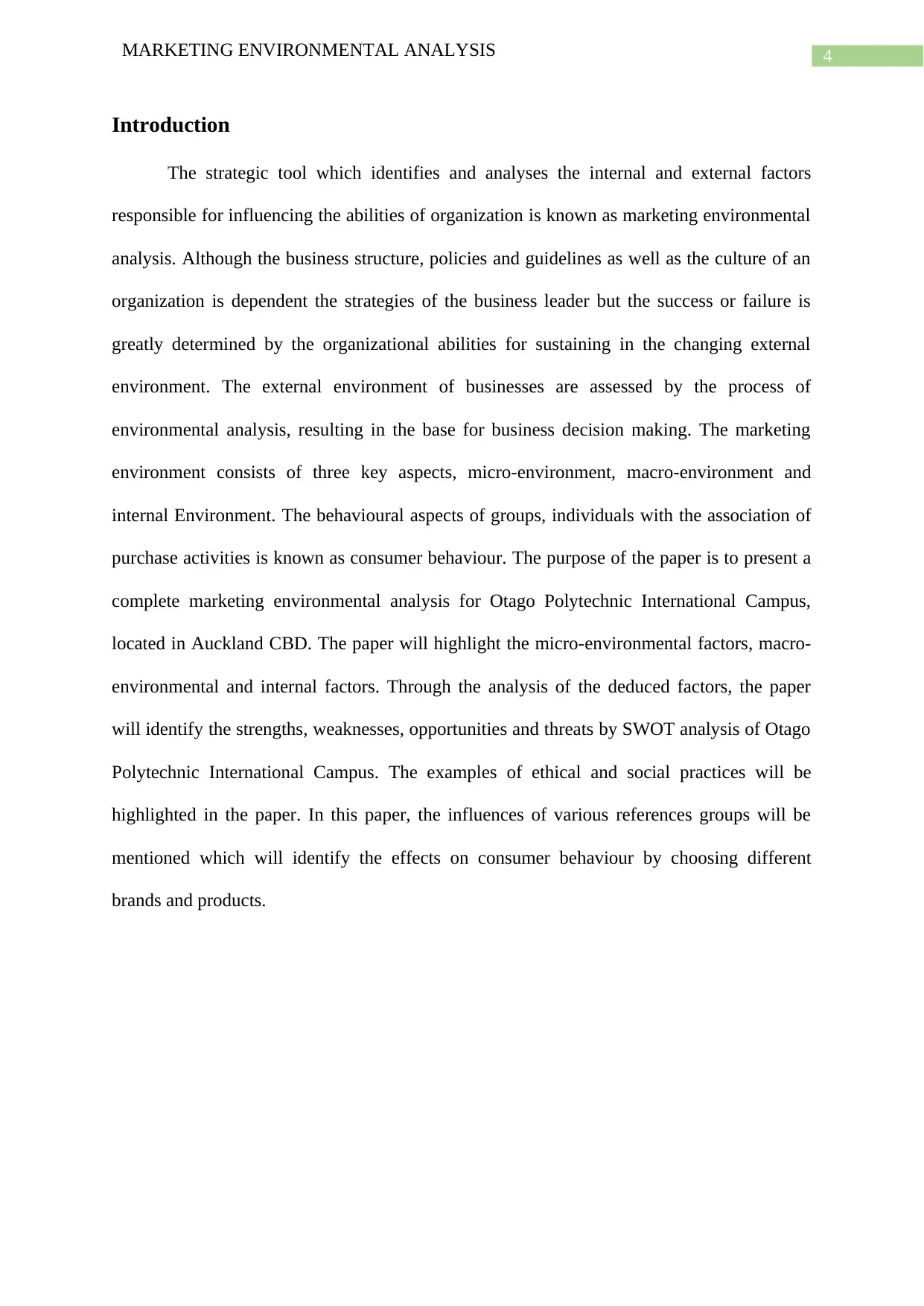
Introduction
The strategic tool which identifies and analyses the internal and external factors
responsible for influencing the abilities of organization is known as marketing environmental
analysis. Although the business structure, policies and guidelines as well as the culture of an
organization is dependent the strategies of the business leader but the success or failure is
greatly determined by the organizational abilities for sustaining in the changing external
environment. The external environment of businesses are assessed by the process of
environmental analysis, resulting in the base for business decision making. The marketing
environment consists of three key aspects, micro-environment, macro-environment and
internal Environment. The behavioural aspects of groups, individuals with the association of
purchase activities is known as consumer behaviour. The purpose of the paper is to present a
complete marketing environmental analysis for Otago Polytechnic International Campus,
located in Auckland CBD. The paper will highlight the micro-environmental factors, macro-
environmental and internal factors. Through the analysis of the deduced factors, the paper
will identify the strengths, weaknesses, opportunities and threats by SWOT analysis of Otago
Polytechnic International Campus. The examples of ethical and social practices will be
highlighted in the paper. In this paper, the influences of various references groups will be
mentioned which will identify the effects on consumer behaviour by choosing different
brands and products.
Introduction
The strategic tool which identifies and analyses the internal and external factors
responsible for influencing the abilities of organization is known as marketing environmental
analysis. Although the business structure, policies and guidelines as well as the culture of an
organization is dependent the strategies of the business leader but the success or failure is
greatly determined by the organizational abilities for sustaining in the changing external
environment. The external environment of businesses are assessed by the process of
environmental analysis, resulting in the base for business decision making. The marketing
environment consists of three key aspects, micro-environment, macro-environment and
internal Environment. The behavioural aspects of groups, individuals with the association of
purchase activities is known as consumer behaviour. The purpose of the paper is to present a
complete marketing environmental analysis for Otago Polytechnic International Campus,
located in Auckland CBD. The paper will highlight the micro-environmental factors, macro-
environmental and internal factors. Through the analysis of the deduced factors, the paper
will identify the strengths, weaknesses, opportunities and threats by SWOT analysis of Otago
Polytechnic International Campus. The examples of ethical and social practices will be
highlighted in the paper. In this paper, the influences of various references groups will be
mentioned which will identify the effects on consumer behaviour by choosing different
brands and products.
MARKETING ENVIRONMENTAL ANALYSIS 5
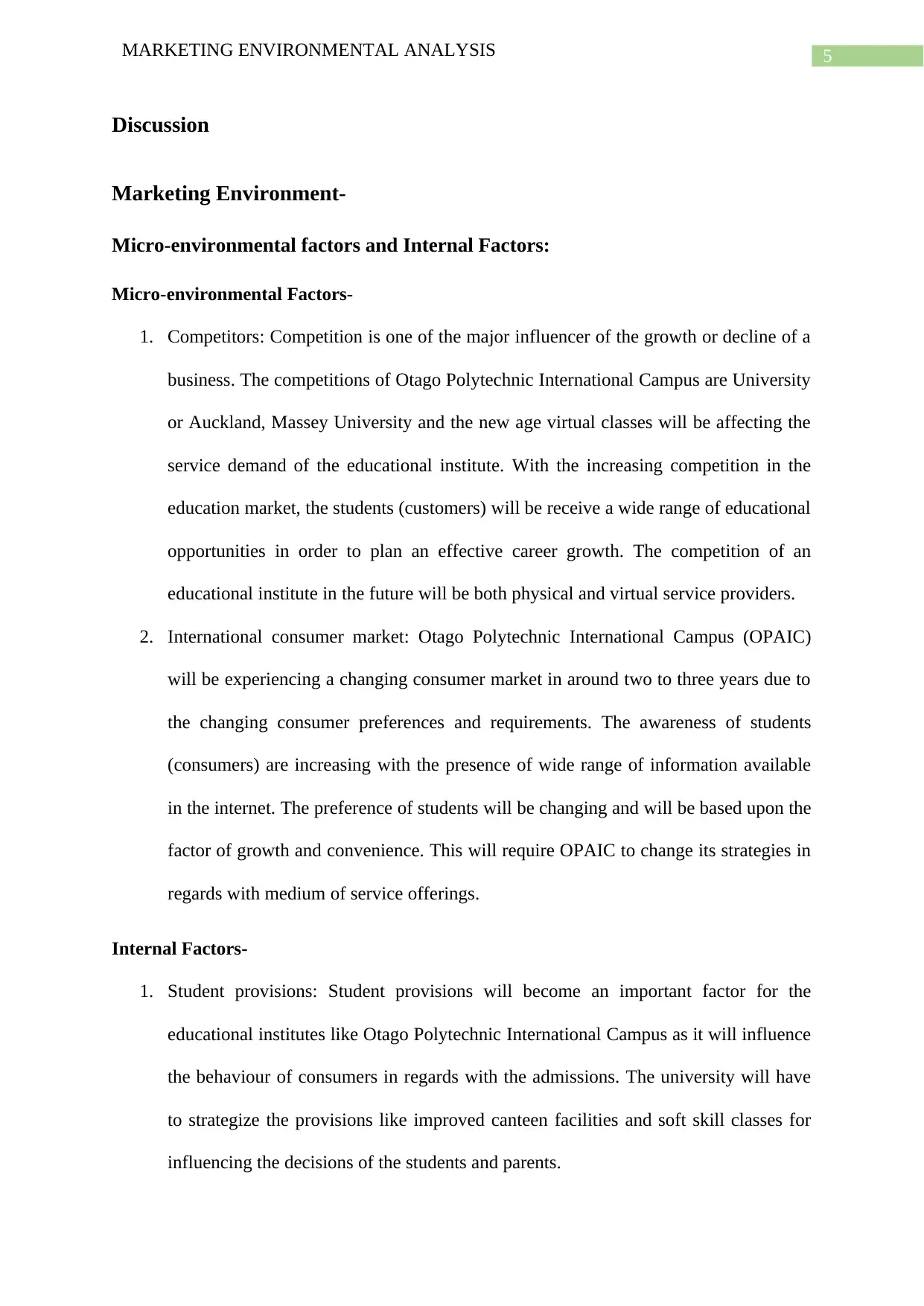
Discussion
Marketing Environment-
Micro-environmental factors and Internal Factors:
Micro-environmental Factors-
1. Competitors: Competition is one of the major influencer of the growth or decline of a
business. The competitions of Otago Polytechnic International Campus are University
or Auckland, Massey University and the new age virtual classes will be affecting the
service demand of the educational institute. With the increasing competition in the
education market, the students (customers) will be receive a wide range of educational
opportunities in order to plan an effective career growth. The competition of an
educational institute in the future will be both physical and virtual service providers.
2. International consumer market: Otago Polytechnic International Campus (OPAIC)
will be experiencing a changing consumer market in around two to three years due to
the changing consumer preferences and requirements. The awareness of students
(consumers) are increasing with the presence of wide range of information available
in the internet. The preference of students will be changing and will be based upon the
factor of growth and convenience. This will require OPAIC to change its strategies in
regards with medium of service offerings.
Internal Factors-
1. Student provisions: Student provisions will become an important factor for the
educational institutes like Otago Polytechnic International Campus as it will influence
the behaviour of consumers in regards with the admissions. The university will have
to strategize the provisions like improved canteen facilities and soft skill classes for
influencing the decisions of the students and parents.
Discussion
Marketing Environment-
Micro-environmental factors and Internal Factors:
Micro-environmental Factors-
1. Competitors: Competition is one of the major influencer of the growth or decline of a
business. The competitions of Otago Polytechnic International Campus are University
or Auckland, Massey University and the new age virtual classes will be affecting the
service demand of the educational institute. With the increasing competition in the
education market, the students (customers) will be receive a wide range of educational
opportunities in order to plan an effective career growth. The competition of an
educational institute in the future will be both physical and virtual service providers.
2. International consumer market: Otago Polytechnic International Campus (OPAIC)
will be experiencing a changing consumer market in around two to three years due to
the changing consumer preferences and requirements. The awareness of students
(consumers) are increasing with the presence of wide range of information available
in the internet. The preference of students will be changing and will be based upon the
factor of growth and convenience. This will require OPAIC to change its strategies in
regards with medium of service offerings.
Internal Factors-
1. Student provisions: Student provisions will become an important factor for the
educational institutes like Otago Polytechnic International Campus as it will influence
the behaviour of consumers in regards with the admissions. The university will have
to strategize the provisions like improved canteen facilities and soft skill classes for
influencing the decisions of the students and parents.
⊘ This is a preview!⊘
Do you want full access?
Subscribe today to unlock all pages.
Trusted by 1+ million students worldwide
MARKETING ENVIRONMENTAL ANALYSIS 6
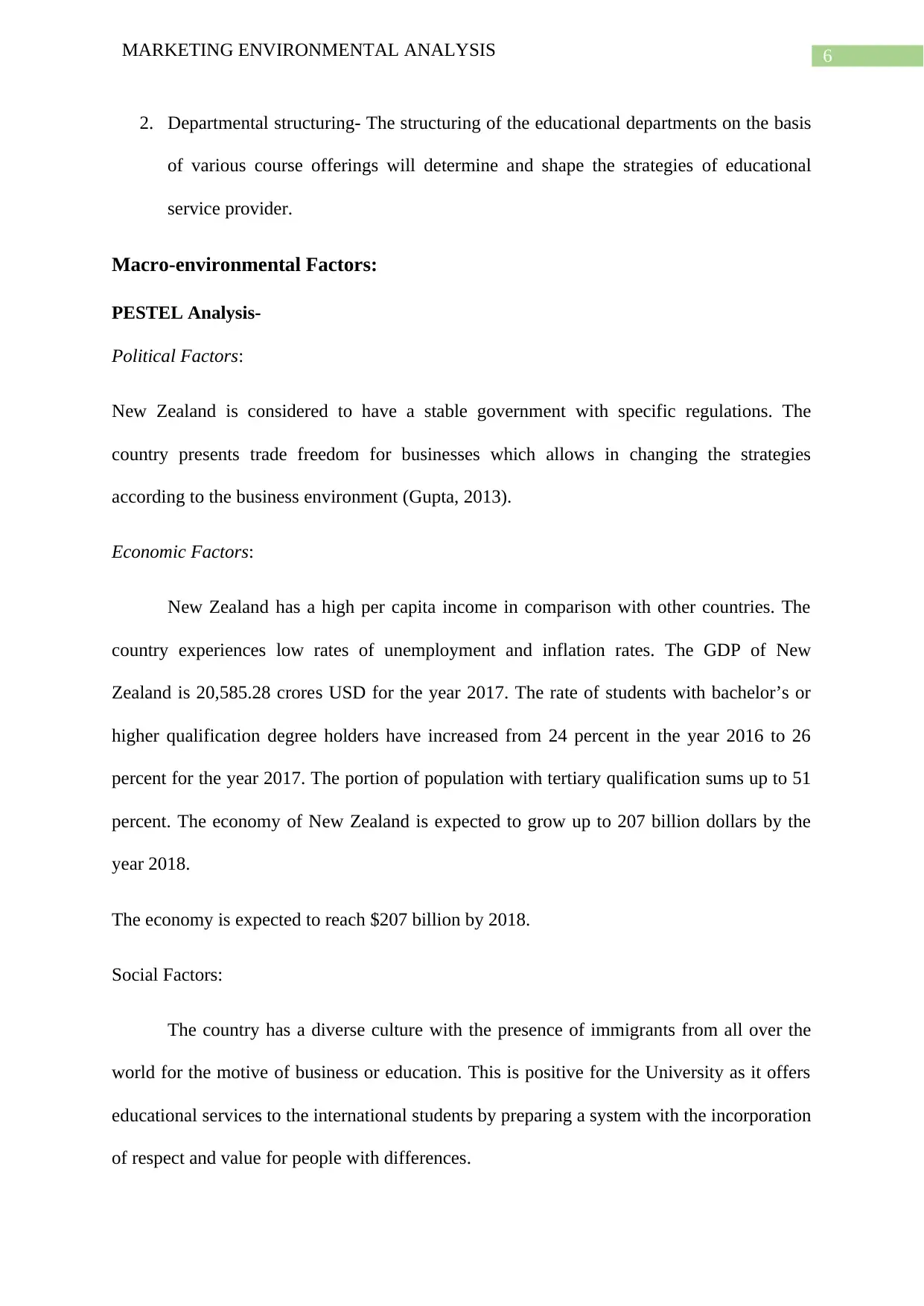
2. Departmental structuring- The structuring of the educational departments on the basis
of various course offerings will determine and shape the strategies of educational
service provider.
Macro-environmental Factors:
PESTEL Analysis-
Political Factors:
New Zealand is considered to have a stable government with specific regulations. The
country presents trade freedom for businesses which allows in changing the strategies
according to the business environment (Gupta, 2013).
Economic Factors:
New Zealand has a high per capita income in comparison with other countries. The
country experiences low rates of unemployment and inflation rates. The GDP of New
Zealand is 20,585.28 crores USD for the year 2017. The rate of students with bachelor’s or
higher qualification degree holders have increased from 24 percent in the year 2016 to 26
percent for the year 2017. The portion of population with tertiary qualification sums up to 51
percent. The economy of New Zealand is expected to grow up to 207 billion dollars by the
year 2018.
The economy is expected to reach $207 billion by 2018.
Social Factors:
The country has a diverse culture with the presence of immigrants from all over the
world for the motive of business or education. This is positive for the University as it offers
educational services to the international students by preparing a system with the incorporation
of respect and value for people with differences.
2. Departmental structuring- The structuring of the educational departments on the basis
of various course offerings will determine and shape the strategies of educational
service provider.
Macro-environmental Factors:
PESTEL Analysis-
Political Factors:
New Zealand is considered to have a stable government with specific regulations. The
country presents trade freedom for businesses which allows in changing the strategies
according to the business environment (Gupta, 2013).
Economic Factors:
New Zealand has a high per capita income in comparison with other countries. The
country experiences low rates of unemployment and inflation rates. The GDP of New
Zealand is 20,585.28 crores USD for the year 2017. The rate of students with bachelor’s or
higher qualification degree holders have increased from 24 percent in the year 2016 to 26
percent for the year 2017. The portion of population with tertiary qualification sums up to 51
percent. The economy of New Zealand is expected to grow up to 207 billion dollars by the
year 2018.
The economy is expected to reach $207 billion by 2018.
Social Factors:
The country has a diverse culture with the presence of immigrants from all over the
world for the motive of business or education. This is positive for the University as it offers
educational services to the international students by preparing a system with the incorporation
of respect and value for people with differences.
Paraphrase This Document
Need a fresh take? Get an instant paraphrase of this document with our AI Paraphraser
MARKETING ENVIRONMENTAL ANALYSIS 7
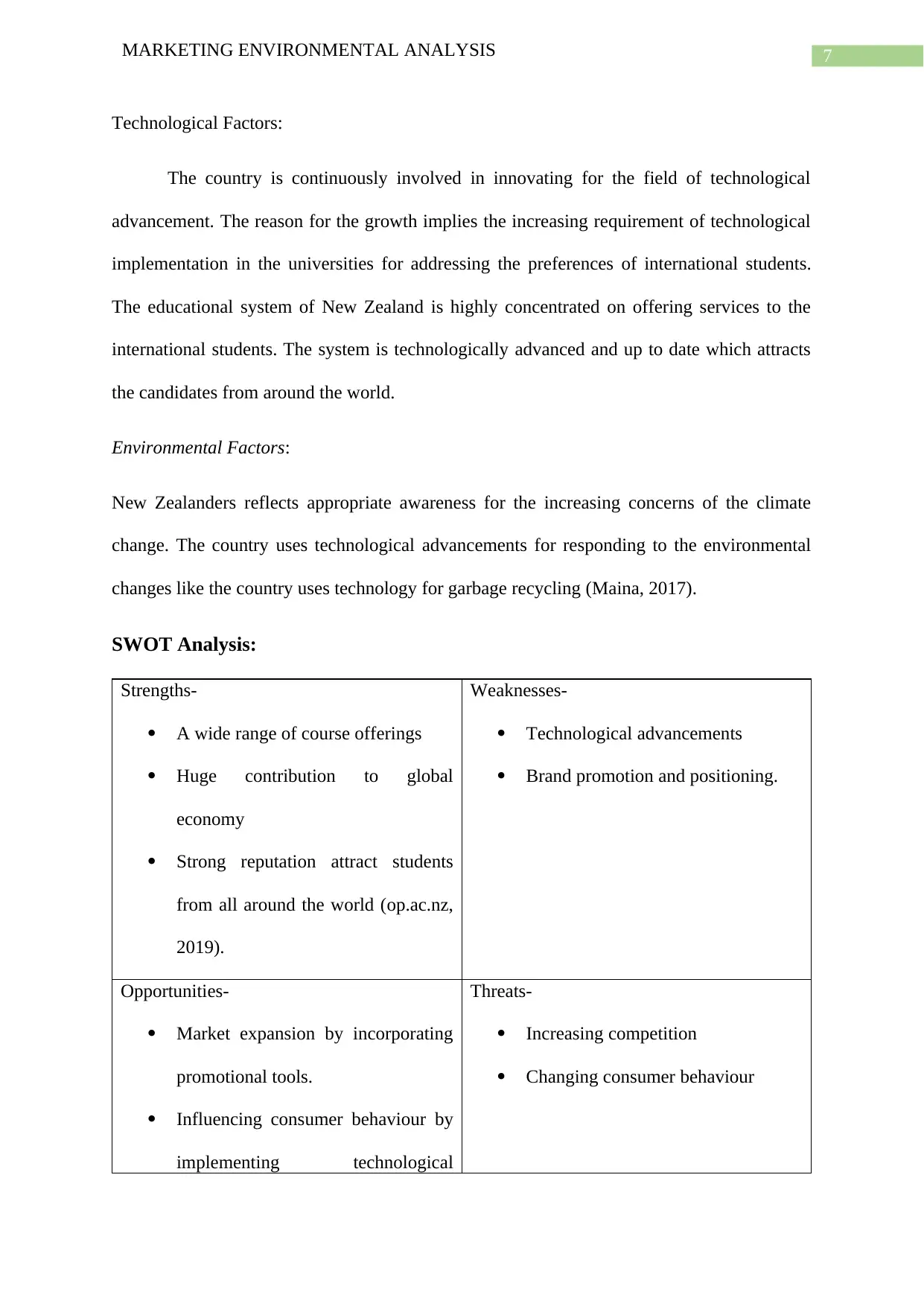
Technological Factors:
The country is continuously involved in innovating for the field of technological
advancement. The reason for the growth implies the increasing requirement of technological
implementation in the universities for addressing the preferences of international students.
The educational system of New Zealand is highly concentrated on offering services to the
international students. The system is technologically advanced and up to date which attracts
the candidates from around the world.
Environmental Factors:
New Zealanders reflects appropriate awareness for the increasing concerns of the climate
change. The country uses technological advancements for responding to the environmental
changes like the country uses technology for garbage recycling (Maina, 2017).
SWOT Analysis:
Strengths-
A wide range of course offerings
Huge contribution to global
economy
Strong reputation attract students
from all around the world (op.ac.nz,
2019).
Weaknesses-
Technological advancements
Brand promotion and positioning.
Opportunities-
Market expansion by incorporating
promotional tools.
Influencing consumer behaviour by
implementing technological
Threats-
Increasing competition
Changing consumer behaviour
Technological Factors:
The country is continuously involved in innovating for the field of technological
advancement. The reason for the growth implies the increasing requirement of technological
implementation in the universities for addressing the preferences of international students.
The educational system of New Zealand is highly concentrated on offering services to the
international students. The system is technologically advanced and up to date which attracts
the candidates from around the world.
Environmental Factors:
New Zealanders reflects appropriate awareness for the increasing concerns of the climate
change. The country uses technological advancements for responding to the environmental
changes like the country uses technology for garbage recycling (Maina, 2017).
SWOT Analysis:
Strengths-
A wide range of course offerings
Huge contribution to global
economy
Strong reputation attract students
from all around the world (op.ac.nz,
2019).
Weaknesses-
Technological advancements
Brand promotion and positioning.
Opportunities-
Market expansion by incorporating
promotional tools.
Influencing consumer behaviour by
implementing technological
Threats-
Increasing competition
Changing consumer behaviour
MARKETING ENVIRONMENTAL ANALYSIS 8
advancements.
Ethics and social responsibility:
Importance of ethics and social responsibility for OPAIC-
It is important for OPAIC as it helps in attracting international students and quality
teaching staff for meeting the diverse expectations of the students.
It is crucial for OPAIC as it helps in responding to the concerns of students.
It also helps in building and maintaining the brand image, which is needed in case of
targeting international candidates (op.ac.nz, 2019).
It is important for OPAIC as it helps the organization for attracting investors as well
as in the alignment of governmental guidelines (op.ac.nz, 2019).
It is crucial for OPAIC as it ensure the fair treatment of students with diverse culture
and social background, the customers of the brand (op.ac.nz, 2019).
Examples demonstrated by OPAIC-
OPAIC follows various rules and policies which ensure the practice of social
inclusion like rights and responsibilities for learners. The University ensures an
enjoyable and safe environment for learners and staff.
OPAIC ensures commitment towards the environmental concerns and attempt at
reducing the impacts of operation activities to the environment. For instance, OPAIC
conducted a campaign named Free Transport October in which they encouraged
students to opt for public transport or bicycles or electric car and rickshaw in the
campus to decrease the effects of pollution from initiating with the stakeholders.
Moreover, the students and staff were presented with the provision of ‘polybikes’,
which can use for commuting in the campus compound.
advancements.
Ethics and social responsibility:
Importance of ethics and social responsibility for OPAIC-
It is important for OPAIC as it helps in attracting international students and quality
teaching staff for meeting the diverse expectations of the students.
It is crucial for OPAIC as it helps in responding to the concerns of students.
It also helps in building and maintaining the brand image, which is needed in case of
targeting international candidates (op.ac.nz, 2019).
It is important for OPAIC as it helps the organization for attracting investors as well
as in the alignment of governmental guidelines (op.ac.nz, 2019).
It is crucial for OPAIC as it ensure the fair treatment of students with diverse culture
and social background, the customers of the brand (op.ac.nz, 2019).
Examples demonstrated by OPAIC-
OPAIC follows various rules and policies which ensure the practice of social
inclusion like rights and responsibilities for learners. The University ensures an
enjoyable and safe environment for learners and staff.
OPAIC ensures commitment towards the environmental concerns and attempt at
reducing the impacts of operation activities to the environment. For instance, OPAIC
conducted a campaign named Free Transport October in which they encouraged
students to opt for public transport or bicycles or electric car and rickshaw in the
campus to decrease the effects of pollution from initiating with the stakeholders.
Moreover, the students and staff were presented with the provision of ‘polybikes’,
which can use for commuting in the campus compound.
⊘ This is a preview!⊘
Do you want full access?
Subscribe today to unlock all pages.
Trusted by 1+ million students worldwide
MARKETING ENVIRONMENTAL ANALYSIS 9
Recommendations for OPAIC:
1. Changing the positioning of the institute into a more global targeting content, which
will help in targeting the students from around the world.
2. Introducing newer promotional tools for engaging with the students for
communicating the benefits for enrolling in one of the programs (Mihaela, 2015).
3. Conducting virtual classes for international students. It will increase the reach,
thereby facilitating the market expansion.
Buyer Behaviour-
Demonstration of Reference Group on buyer behaviour:
The two brands selected for the assessment of buyer behaviour are Marmite and Air New
Zealand.
There are two type of reference group which influences the consumer behaviour.
Direct Reference group- It is categorized in two parts the group which influences on a
daily basis and on occasional basis.
Indirect Reference group- It is categorised in two groups Positive reference group
(Inspirational) and negative reference group (Non-Inspirational).
Another categorical differentiation can be presented by the concept of Normative Reference
groups, which directly influences the attitudes, norms, behaviour and values. Another is
Comparative Reference Group, the values of which is considered as a base/reference for
making evaluation for a specific brand.
Marmite:
The reference group, which influences the buying behaviour of the consumers is normative
reference group as it is a consumer goods products which are popularly used in breakfasts in
Recommendations for OPAIC:
1. Changing the positioning of the institute into a more global targeting content, which
will help in targeting the students from around the world.
2. Introducing newer promotional tools for engaging with the students for
communicating the benefits for enrolling in one of the programs (Mihaela, 2015).
3. Conducting virtual classes for international students. It will increase the reach,
thereby facilitating the market expansion.
Buyer Behaviour-
Demonstration of Reference Group on buyer behaviour:
The two brands selected for the assessment of buyer behaviour are Marmite and Air New
Zealand.
There are two type of reference group which influences the consumer behaviour.
Direct Reference group- It is categorized in two parts the group which influences on a
daily basis and on occasional basis.
Indirect Reference group- It is categorised in two groups Positive reference group
(Inspirational) and negative reference group (Non-Inspirational).
Another categorical differentiation can be presented by the concept of Normative Reference
groups, which directly influences the attitudes, norms, behaviour and values. Another is
Comparative Reference Group, the values of which is considered as a base/reference for
making evaluation for a specific brand.
Marmite:
The reference group, which influences the buying behaviour of the consumers is normative
reference group as it is a consumer goods products which are popularly used in breakfasts in
Paraphrase This Document
Need a fresh take? Get an instant paraphrase of this document with our AI Paraphraser
MARKETING ENVIRONMENTAL ANALYSIS 10
New Zealand. The reference groups for this brand can be the family groups, friends and
social groups. The influence is exerted by the reference groups by sharing information in
social groups. The influences can also be demonstrated by the Television advertisements,
which reflects a positive impact on consumer buying behaviour.
Air New Zealand:
The reference groups in this brand are the Comparative reference groups. The influences on
the consumer behaviour by the reference group can be demonstrated by the celebrity
television advertisements. Flight booking discounts and offers can also be treated as the
demonstration of influences for changing the buyer behaviour.
Family Life cycle:
It reflects the constituents of education, income and preferences. The stages of Family
Life Cycle affects the nature and value of goods and services needed, volume of specific
products and consumption patterns of families. Family Life Cycle is a marketing strategy
which is used in for the purpose of segmentation, positioning and targeting of different
products in a brand. It stages of the Family Cycle comprises of bachelor, newly married,
family nest 1, family nest 2, empty nest and solitary survivor. The buyer behaviour changes
in all the stages of Family Life Cycle (Javalgi et al., 2015).
Examples:
1. Honda- Honda uses Family Life Cycle strategy by segmenting the market into family
size and age. The brand changes its brand communication strategies on the basis of
various stages of family life cycle. The brand comprises of a wide range of products
like motorcycles, cars, power products and Honda jet. The positioning differs for each
product segment depending on the requirement, age and family size of the consumers.
For instance the motorcycles are targeted to the bachelors and newly married segment
New Zealand. The reference groups for this brand can be the family groups, friends and
social groups. The influence is exerted by the reference groups by sharing information in
social groups. The influences can also be demonstrated by the Television advertisements,
which reflects a positive impact on consumer buying behaviour.
Air New Zealand:
The reference groups in this brand are the Comparative reference groups. The influences on
the consumer behaviour by the reference group can be demonstrated by the celebrity
television advertisements. Flight booking discounts and offers can also be treated as the
demonstration of influences for changing the buyer behaviour.
Family Life cycle:
It reflects the constituents of education, income and preferences. The stages of Family
Life Cycle affects the nature and value of goods and services needed, volume of specific
products and consumption patterns of families. Family Life Cycle is a marketing strategy
which is used in for the purpose of segmentation, positioning and targeting of different
products in a brand. It stages of the Family Cycle comprises of bachelor, newly married,
family nest 1, family nest 2, empty nest and solitary survivor. The buyer behaviour changes
in all the stages of Family Life Cycle (Javalgi et al., 2015).
Examples:
1. Honda- Honda uses Family Life Cycle strategy by segmenting the market into family
size and age. The brand changes its brand communication strategies on the basis of
various stages of family life cycle. The brand comprises of a wide range of products
like motorcycles, cars, power products and Honda jet. The positioning differs for each
product segment depending on the requirement, age and family size of the consumers.
For instance the motorcycles are targeted to the bachelors and newly married segment
MARKETING ENVIRONMENTAL ANALYSIS 11
(Karim, Yarlagadda & Yan, 2017). The cars are usually targeted to the families. The
brand changes the communication content according to the changing behaviour of
individual in different stages of family life cycle (Gabriel & Lang, 2015).
2. Kellogg’s- The major purpose of the brand is to help families to fulfil nourishment
needs. The brands consists of a wide range of products like Kellogg’s Cornflakes,
Kellogg’s Granola, Kellogg’s Chocos, Kellogg’s Oats, Kellogg’s special K and
Kellogg’s Muesli. Each category targets different stages of family life cycle. The
brand changes its communication strategies and advertisement content for facilitating
the different positioning statements. For example- Kellogg’s Oats is targeted to adults
and Kellogg’s Chocos is targeted to Kids.
Influence of social class:
Social class plays an important role in influencing the quantity and kinds of consumer
goods purchased. Social are based upon income groups, education, wealth and occupation
type. The consumer behaviour changes on the basis of various social classes. The different
groups of social classes reflects different characteristics for buying products and services (Shi
& Liao, 2017).
Examples-
1. Honda- The Company manufactures products like motorcycles, cars, power
products. Honda uses the strategy of social class influencing by designing the
content of the advertisements and by constructing the positioning statement. The
brand targets different social classes by offerings products with different prices
ranges and quality (Rippé et al., 2015).
(Karim, Yarlagadda & Yan, 2017). The cars are usually targeted to the families. The
brand changes the communication content according to the changing behaviour of
individual in different stages of family life cycle (Gabriel & Lang, 2015).
2. Kellogg’s- The major purpose of the brand is to help families to fulfil nourishment
needs. The brands consists of a wide range of products like Kellogg’s Cornflakes,
Kellogg’s Granola, Kellogg’s Chocos, Kellogg’s Oats, Kellogg’s special K and
Kellogg’s Muesli. Each category targets different stages of family life cycle. The
brand changes its communication strategies and advertisement content for facilitating
the different positioning statements. For example- Kellogg’s Oats is targeted to adults
and Kellogg’s Chocos is targeted to Kids.
Influence of social class:
Social class plays an important role in influencing the quantity and kinds of consumer
goods purchased. Social are based upon income groups, education, wealth and occupation
type. The consumer behaviour changes on the basis of various social classes. The different
groups of social classes reflects different characteristics for buying products and services (Shi
& Liao, 2017).
Examples-
1. Honda- The Company manufactures products like motorcycles, cars, power
products. Honda uses the strategy of social class influencing by designing the
content of the advertisements and by constructing the positioning statement. The
brand targets different social classes by offerings products with different prices
ranges and quality (Rippé et al., 2015).
⊘ This is a preview!⊘
Do you want full access?
Subscribe today to unlock all pages.
Trusted by 1+ million students worldwide

1 out of 16


Related Documents


Your All-in-One AI-Powered Toolkit for Academic Success.
+13062052269
info@desklib.com
Available 24*7 on WhatsApp / Email
![[object Object]](/_next/static/media/star-bottom.7253800d.svg)
Unlock your academic potential
Copyright © 2020–2026 A2Z Services. All Rights Reserved. Developed and managed by ZUCOL.