Analysis of Environmental Factors, BIM, and Project Delivery Report
VerifiedAdded on 2023/01/03
|20
|4522
|31
Report
AI Summary
This report delves into the critical aspects of engineering management and project organization within the context of construction, with a specific focus on environmental considerations and the application of Building Information Modeling (BIM). The report examines how environmental factors, such as weather, climate change, material availability, technology, and site location, can significantly impact project outcomes. It then explores the pivotal role of BIM in all stages of project delivery, from planning and design to construction and maintenance, highlighting its ability to facilitate efficient knowledge management, cost estimation, and site analysis. Furthermore, the report discusses the application of BIM in structural analysis, illumination design, and energy requirement analysis, emphasizing its collaborative environment for information sharing and its vital role in site utilization and design. The report provides valuable insights into how to mitigate environmental challenges and leverage BIM to enhance project success in civil engineering.

1
ENGINEERING MANAGEMENT AND PROJECT ORGANIZATION
By Name
Course
Instructor
Institution
Location
Date
ENGINEERING MANAGEMENT AND PROJECT ORGANIZATION
By Name
Course
Instructor
Institution
Location
Date

Paraphrase This Document
Need a fresh take? Get an instant paraphrase of this document with our AI Paraphraser
2
Question 1
Environmental issues affecting the construction and operations of the project
The idea of construction project development may be greatly compromised if there is no
sufficient knowledge and proper management of the impacts of the environmental factors
influencing the construction and the performance of such projects (Walker, 2014, p. 645). The
construction industry is complex in nature since it contains large numbers of parties such as
contractors, client, consultants’ regulators and shareholders among other. All the external factors
which affect the construction process of the project are referred to as environmental and they
include;
Weather elements
i) Rainfall
The presence of rainfall during the construction of the project will make the overall delivery of
the project to be challenging. This will lead to the delay in project delivery since there are
some construction activities which cannot be carried out during the rain season. Rain will
cause myriad problems for the construction workers who will be working on the project. The
presence of mud which will be as a result of rain will not only be a nuisance, but also it will be a
safety hazard for those who will be operating different machineries within the site (Guggemos,
2016, p. 116).
The constructions can also be greatly damaged by the rain. Materials such as paint will not be
applied because they have a limit to how much amount of moisture they can be exposed to
before it dries up. With the presence of rain the colour and the duration required for drying are
affected. Other materials such as cement and timber requires that they are stored in cool dry
Question 1
Environmental issues affecting the construction and operations of the project
The idea of construction project development may be greatly compromised if there is no
sufficient knowledge and proper management of the impacts of the environmental factors
influencing the construction and the performance of such projects (Walker, 2014, p. 645). The
construction industry is complex in nature since it contains large numbers of parties such as
contractors, client, consultants’ regulators and shareholders among other. All the external factors
which affect the construction process of the project are referred to as environmental and they
include;
Weather elements
i) Rainfall
The presence of rainfall during the construction of the project will make the overall delivery of
the project to be challenging. This will lead to the delay in project delivery since there are
some construction activities which cannot be carried out during the rain season. Rain will
cause myriad problems for the construction workers who will be working on the project. The
presence of mud which will be as a result of rain will not only be a nuisance, but also it will be a
safety hazard for those who will be operating different machineries within the site (Guggemos,
2016, p. 116).
The constructions can also be greatly damaged by the rain. Materials such as paint will not be
applied because they have a limit to how much amount of moisture they can be exposed to
before it dries up. With the presence of rain the colour and the duration required for drying are
affected. Other materials such as cement and timber requires that they are stored in cool dry

3
place. The availability of rain will make their usage difficult during the implementation of the
project.
ii) Thunderstorms
Occurrence of thunderstorms during the implementation of the project will be likely to cause
more damage to the project. This is due to the high winds which can disorganize the project site
and at some cases can result to destruction of the construction materials and equipment (Gresham
Smith, 2018, p. 792).
iii) Winter
The winter will negatively impact the project. The water and other construction materials which
are in liquid form can freeze, which slows down the curing rate. The winter will force the
winterization of the construction tools and equipment with the use of lubricants which are
designed to withstand the icy temperatures (Lancaster, 2010, p. 762). Other construction
materials such as concrete and construction blocks will be likely to be weakened when the ice
crystals forms in them.
The cold temperatures during winter also have a great impact on the performance of the workers.
They will be forced to wear an additional layer of the clothing during the construction period.
Some of the clothing worn by the workers restricts their movement and in some cases their
ability to handle materials (Fessenbecker, 2016, p. 92). The human joints and muscles are less
flexible during the cold which will put the workers at a greater risk of accidents.
iv) Heat
place. The availability of rain will make their usage difficult during the implementation of the
project.
ii) Thunderstorms
Occurrence of thunderstorms during the implementation of the project will be likely to cause
more damage to the project. This is due to the high winds which can disorganize the project site
and at some cases can result to destruction of the construction materials and equipment (Gresham
Smith, 2018, p. 792).
iii) Winter
The winter will negatively impact the project. The water and other construction materials which
are in liquid form can freeze, which slows down the curing rate. The winter will force the
winterization of the construction tools and equipment with the use of lubricants which are
designed to withstand the icy temperatures (Lancaster, 2010, p. 762). Other construction
materials such as concrete and construction blocks will be likely to be weakened when the ice
crystals forms in them.
The cold temperatures during winter also have a great impact on the performance of the workers.
They will be forced to wear an additional layer of the clothing during the construction period.
Some of the clothing worn by the workers restricts their movement and in some cases their
ability to handle materials (Fessenbecker, 2016, p. 92). The human joints and muscles are less
flexible during the cold which will put the workers at a greater risk of accidents.
iv) Heat
⊘ This is a preview!⊘
Do you want full access?
Subscribe today to unlock all pages.

Trusted by 1+ million students worldwide
4
Heat which occurs as a result of high temperatures will affect materials such as concrete,
construction blocks and paint. Heat is known to affect the strength of concrete and this will
require additional water. The high temperatures will also make the building blocks to be too dry
in that they will not be able to adhere to the mortal. Which will lead to construction of weak
retaining walls.
Climate change
With the climate change their unpredictable rain and flooding will lead to deteriorating and
slippery surfaces , which increase the risks of injuries and creates unsafe working conditions.
Also the higher temperatures which are associated with climate change will lead to heat stroke
and even death.
Materials
The availability of the construction material which will be required for the construction of the
project will have a great impact of the success of the project. If the construction materials are
locally available, it will reduce the costs of transportation, which in turn will reduce the overall
cost of the project. Also the sustainability of the materials that will be used will also have a
greater impact on the overall project (James C. Balogh, 2018, p. 438). In that it must be observed
that the materials that will be used in the construction of the project does not have a negative
impact on the environment.
Technology
Technology will also have a great impact on the project. This project will need the utilization of
the advanced technology to ensure that the project requirement are met. Some of the advanced
technology that will be used will include the BIM. It will have a wide application in the
Heat which occurs as a result of high temperatures will affect materials such as concrete,
construction blocks and paint. Heat is known to affect the strength of concrete and this will
require additional water. The high temperatures will also make the building blocks to be too dry
in that they will not be able to adhere to the mortal. Which will lead to construction of weak
retaining walls.
Climate change
With the climate change their unpredictable rain and flooding will lead to deteriorating and
slippery surfaces , which increase the risks of injuries and creates unsafe working conditions.
Also the higher temperatures which are associated with climate change will lead to heat stroke
and even death.
Materials
The availability of the construction material which will be required for the construction of the
project will have a great impact of the success of the project. If the construction materials are
locally available, it will reduce the costs of transportation, which in turn will reduce the overall
cost of the project. Also the sustainability of the materials that will be used will also have a
greater impact on the overall project (James C. Balogh, 2018, p. 438). In that it must be observed
that the materials that will be used in the construction of the project does not have a negative
impact on the environment.
Technology
Technology will also have a great impact on the project. This project will need the utilization of
the advanced technology to ensure that the project requirement are met. Some of the advanced
technology that will be used will include the BIM. It will have a wide application in the
Paraphrase This Document
Need a fresh take? Get an instant paraphrase of this document with our AI Paraphraser
5
execution this given project since it can be applied in the designing process, construction
process, maintenance and operation of the project. BIM facilitates control of knowledge creation,
sharing, storage, acquisition, dissemination and the application to the current project. The figure
below shows BIM knowledge management cycle.
Location
The location of the proposed site will have a great impact on the project. The location of the site
will have greater impact in that, it will determine how the materials will be availed to the
site. Also the services which will be required on site if they are connected to the site already. The
location of the site will also have an impact on the project, in that if the site is located in a
sloppy site it will require more attention as compared to the site which is located on the fairly
flat site (Kelleher, 2011, p. 782).
Question 2
Role of BIM in project delivery
Building information modelling is a modern approach to design, construct and management
construction projects. With the use of BIM in the project, an accurate virtual model of the
project can be constructed digitally, when the model is completed it contains accurate
geometry and all relevant data which will be required during the construction process.
With the continued growth in the information technology in the construction industry ,
numerical building information modelling and process simulation has developed to a fully
accepted and widely applied tools for the project life cycle management. The growing diversity
between the various construction arties, teams, tools, task and events. A growing diversity
between disciplines, participants, tasks, tools and events while project management in design and
execution this given project since it can be applied in the designing process, construction
process, maintenance and operation of the project. BIM facilitates control of knowledge creation,
sharing, storage, acquisition, dissemination and the application to the current project. The figure
below shows BIM knowledge management cycle.
Location
The location of the proposed site will have a great impact on the project. The location of the site
will have greater impact in that, it will determine how the materials will be availed to the
site. Also the services which will be required on site if they are connected to the site already. The
location of the site will also have an impact on the project, in that if the site is located in a
sloppy site it will require more attention as compared to the site which is located on the fairly
flat site (Kelleher, 2011, p. 782).
Question 2
Role of BIM in project delivery
Building information modelling is a modern approach to design, construct and management
construction projects. With the use of BIM in the project, an accurate virtual model of the
project can be constructed digitally, when the model is completed it contains accurate
geometry and all relevant data which will be required during the construction process.
With the continued growth in the information technology in the construction industry ,
numerical building information modelling and process simulation has developed to a fully
accepted and widely applied tools for the project life cycle management. The growing diversity
between the various construction arties, teams, tools, task and events. A growing diversity
between disciplines, participants, tasks, tools and events while project management in design and
6
construction stages , the rising pressure of costing competition and tighter production deadlines,
together with consistently increasing quality requirements and necessity of technological
enhancements, have been the driving force of information modeling and numerical simulation in
building industry (Kaneko, 2013, p. 651).
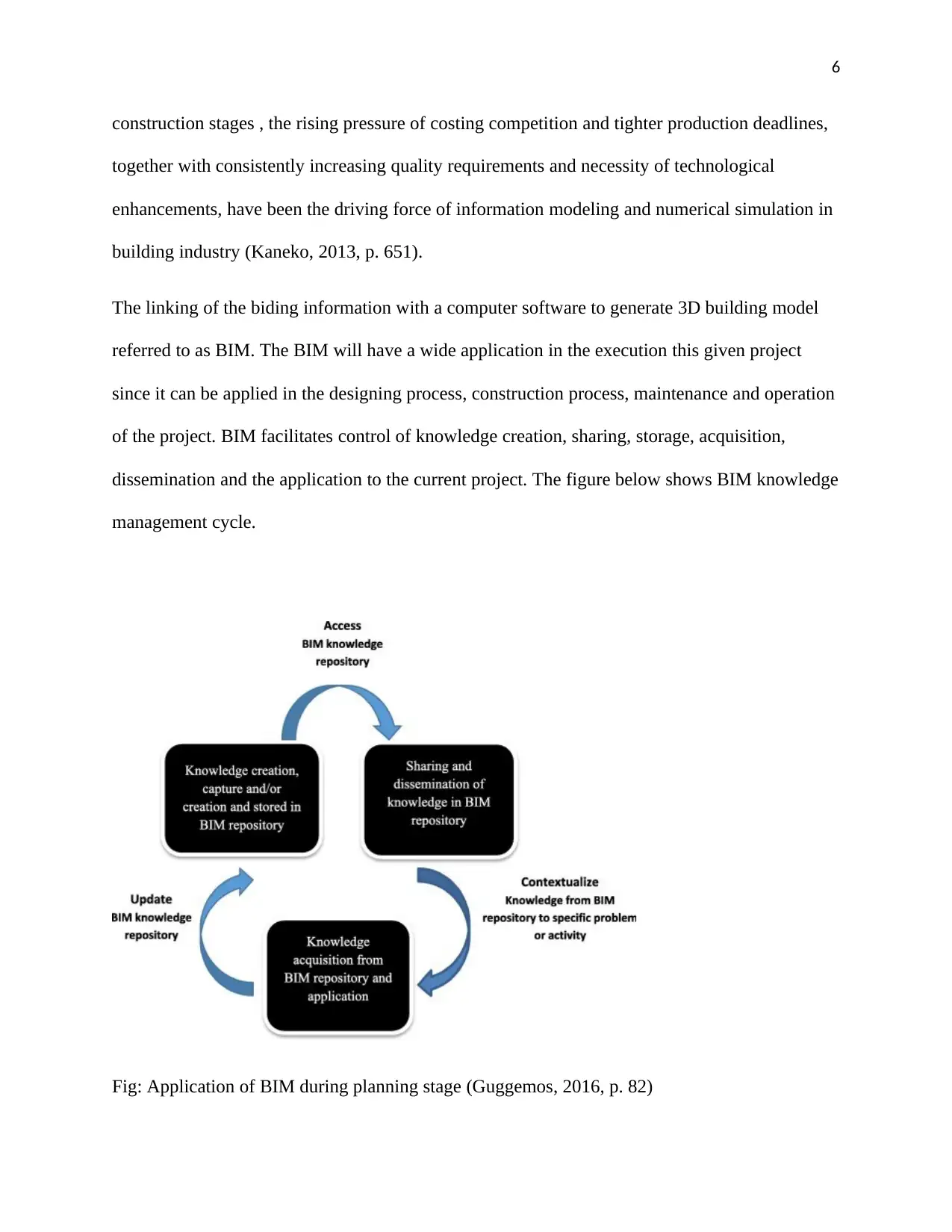
The linking of the biding information with a computer software to generate 3D building model
referred to as BIM. The BIM will have a wide application in the execution this given project
since it can be applied in the designing process, construction process, maintenance and operation
of the project. BIM facilitates control of knowledge creation, sharing, storage, acquisition,
dissemination and the application to the current project. The figure below shows BIM knowledge
management cycle.
Fig: Application of BIM during planning stage (Guggemos, 2016, p. 82)
construction stages , the rising pressure of costing competition and tighter production deadlines,
together with consistently increasing quality requirements and necessity of technological
enhancements, have been the driving force of information modeling and numerical simulation in
building industry (Kaneko, 2013, p. 651).
The linking of the biding information with a computer software to generate 3D building model
referred to as BIM. The BIM will have a wide application in the execution this given project
since it can be applied in the designing process, construction process, maintenance and operation
of the project. BIM facilitates control of knowledge creation, sharing, storage, acquisition,
dissemination and the application to the current project. The figure below shows BIM knowledge
management cycle.
Fig: Application of BIM during planning stage (Guggemos, 2016, p. 82)
⊘ This is a preview!⊘
Do you want full access?
Subscribe today to unlock all pages.
Trusted by 1+ million students worldwide
7
The activities which are involved in project planning will include master planning and urban
design, master planning refers to the regulatory framework which will control the
development of the collection of project components with the overall consideration for their
massing, connectivity, relationships and heights. The regulatory framework will give sufficient
details in the context of the social, environmental, economic, security, services and
infrastructure. All the information regarding to the above project components will be gathered
and be stored in the BIM repository. The stored data will be of great importance in the
subsequent project phases (Kotaji, 2017, p. 495).
Cost estimation during the planning stage will be carried out with the aid of BIM software. The
quantity surveyor will make carry out the estimation of the project to see if the project will fit
within the client’s budget. With BIM it is very easy to estimate the total cost of a given project,
this will prevent the construction cost overrun.
During the project planning BIM will be used to break down the project into phases and then
plan on how the stages will be implemented. The project phases will be further broken down into
manageable components which will ensure easy design and construction of the project. The
project will be broken down into the implementation stages i.e. the planning, designing,
construction, operation and maintenance. Also those stages of project implementation will also
be broken down for easy planning and implementation (Herbert Robinson, 2015, p. 116).
During planning BIM will be used to carry out site analysis where by the site will be analyzed
before the design and construction of the project. BIM will be used in the analysis of the site
topography by the surveyor, also during site analysts different elements will be analyzed for
instance the climate of the area will be analyzed and conclusions will be made on how it
The activities which are involved in project planning will include master planning and urban
design, master planning refers to the regulatory framework which will control the
development of the collection of project components with the overall consideration for their
massing, connectivity, relationships and heights. The regulatory framework will give sufficient
details in the context of the social, environmental, economic, security, services and
infrastructure. All the information regarding to the above project components will be gathered
and be stored in the BIM repository. The stored data will be of great importance in the
subsequent project phases (Kotaji, 2017, p. 495).
Cost estimation during the planning stage will be carried out with the aid of BIM software. The
quantity surveyor will make carry out the estimation of the project to see if the project will fit
within the client’s budget. With BIM it is very easy to estimate the total cost of a given project,
this will prevent the construction cost overrun.
During the project planning BIM will be used to break down the project into phases and then
plan on how the stages will be implemented. The project phases will be further broken down into
manageable components which will ensure easy design and construction of the project. The
project will be broken down into the implementation stages i.e. the planning, designing,
construction, operation and maintenance. Also those stages of project implementation will also
be broken down for easy planning and implementation (Herbert Robinson, 2015, p. 116).
During planning BIM will be used to carry out site analysis where by the site will be analyzed
before the design and construction of the project. BIM will be used in the analysis of the site
topography by the surveyor, also during site analysts different elements will be analyzed for
instance the climate of the area will be analyzed and conclusions will be made on how it
Paraphrase This Document
Need a fresh take? Get an instant paraphrase of this document with our AI Paraphraser
8
affects the implementation and operations of the project. The human activities carried out within
the proposed project site and the neighborhood will also be analyzed with the use of BIM.
During project planning BIM will also be used in the preparation of the project program on how
the project will run from, the design stage to maintenance. The breakdown of the project which
was done initially will also be used in the preparation of the program (Burns, 2017, p. 596).
Application of BIM in Designing stage
The information which was gather and stored in the BIM repository during the planning stage
will govern the design stage of the project. The main aim during the primary design is to ensure
that the development of design and construction documents which are required to ensure the
project delivered will be functional , liveable, secure, safe and sustainable. All the decisions
which will be made during the design stage should make consideration of the constructability,
operational and maintainability of the proposed project sharing at the design stage (Issa, 2013, p.
714).
BIM plays a very crucial role during the designing stage of the project since it will be used in
authoring of all professionals who will be involved in the project design. The authoring of the
professionals who took part in the project design will enable to track, the errors or any other
confirmations that might require some clarification.
During design BIM will also be used to carry out the structural analysis of the project. This will
involve the structural design of the structural, elements such beams and columns which will be
used in the construction of the bridges. It will be much easier to carry out the structural analysis
with the use of BIM , since the standards and specifications can be easily be fed into BIM and
generate a structural sound design for the elements, this will include the reinforcements which
affects the implementation and operations of the project. The human activities carried out within
the proposed project site and the neighborhood will also be analyzed with the use of BIM.
During project planning BIM will also be used in the preparation of the project program on how
the project will run from, the design stage to maintenance. The breakdown of the project which
was done initially will also be used in the preparation of the program (Burns, 2017, p. 596).
Application of BIM in Designing stage
The information which was gather and stored in the BIM repository during the planning stage
will govern the design stage of the project. The main aim during the primary design is to ensure
that the development of design and construction documents which are required to ensure the
project delivered will be functional , liveable, secure, safe and sustainable. All the decisions
which will be made during the design stage should make consideration of the constructability,
operational and maintainability of the proposed project sharing at the design stage (Issa, 2013, p.
714).
BIM plays a very crucial role during the designing stage of the project since it will be used in
authoring of all professionals who will be involved in the project design. The authoring of the
professionals who took part in the project design will enable to track, the errors or any other
confirmations that might require some clarification.
During design BIM will also be used to carry out the structural analysis of the project. This will
involve the structural design of the structural, elements such beams and columns which will be
used in the construction of the bridges. It will be much easier to carry out the structural analysis
with the use of BIM , since the standards and specifications can be easily be fed into BIM and
generate a structural sound design for the elements, this will include the reinforcements which
9
will be used in the construction of the structural elements. During design will greatly depend on
making application of BIM to attain the illumination required for given elements within the
project. This will guide the electrical engineers regarding on the types of lamps they will use for
the given project (Mahdjoubi, 2015, p. 52).
Ecotect as a component of BIM will also be used in to the analysis of energy requirements of
the project. This will have a great impact on determining the type of construction materials to be
used for the construction of the project.
Application of BIM in construction stage
BIM will provide a collaborative environment for the information and the knowledge which will
be required during the construction process. BIM will play a very vital role in the site utilization
and designing. This will involve the position of all the support facilities that will required,
construction of diversions, site clearing, and construction of storage facilities and provision of
services such as water (Reddy, 2016, p. 880).
Building information modelling (BIM) will also play a very important role in the designing of
the construction system. This will involve the construction of the false work and the scaffoldings
where they will be required. The formwork will first be designed in BIM before it is constructed
on site.
During the construction of the project BIM will enable a powerful visualization which will
facilitate the construction schedules in specific time frames as planned well .By viewing the
construction process and planning for it in advance it greatly helps in detection of the problems
which were likely to be encountered during the actual construction process.
will be used in the construction of the structural elements. During design will greatly depend on
making application of BIM to attain the illumination required for given elements within the
project. This will guide the electrical engineers regarding on the types of lamps they will use for
the given project (Mahdjoubi, 2015, p. 52).
Ecotect as a component of BIM will also be used in to the analysis of energy requirements of
the project. This will have a great impact on determining the type of construction materials to be
used for the construction of the project.
Application of BIM in construction stage
BIM will provide a collaborative environment for the information and the knowledge which will
be required during the construction process. BIM will play a very vital role in the site utilization
and designing. This will involve the position of all the support facilities that will required,
construction of diversions, site clearing, and construction of storage facilities and provision of
services such as water (Reddy, 2016, p. 880).
Building information modelling (BIM) will also play a very important role in the designing of
the construction system. This will involve the construction of the false work and the scaffoldings
where they will be required. The formwork will first be designed in BIM before it is constructed
on site.
During the construction of the project BIM will enable a powerful visualization which will
facilitate the construction schedules in specific time frames as planned well .By viewing the
construction process and planning for it in advance it greatly helps in detection of the problems
which were likely to be encountered during the actual construction process.
⊘ This is a preview!⊘
Do you want full access?
Subscribe today to unlock all pages.
Trusted by 1+ million students worldwide
10
BIM will be of great help in the digital fabrication of the construction components. For instance
in the fabrication of the steel beams and column which will required for the construction of the
project will be achieved through the application of BIM. The specification of the elements will
be fed into the BIM database whereby they will be used to fabricate the elements automatically.
The automatic fabrication of the building elements will make the project delivery to be much
faster and efficient which on the other hand will save a lot of time and resources. Which will be
channeled to other facilities within the project (Dana K. Smith, 2011, p. 117).
In 3D planning and controlling BIM will greatly be applied in the generation of the control
model which will be used as the reference point during the construction of the actual building
form. It will of great importance to the client to view how the final project will look like in
advance. In that the client will be able to control and plan together with the architect on how the
final form of the project will look like.
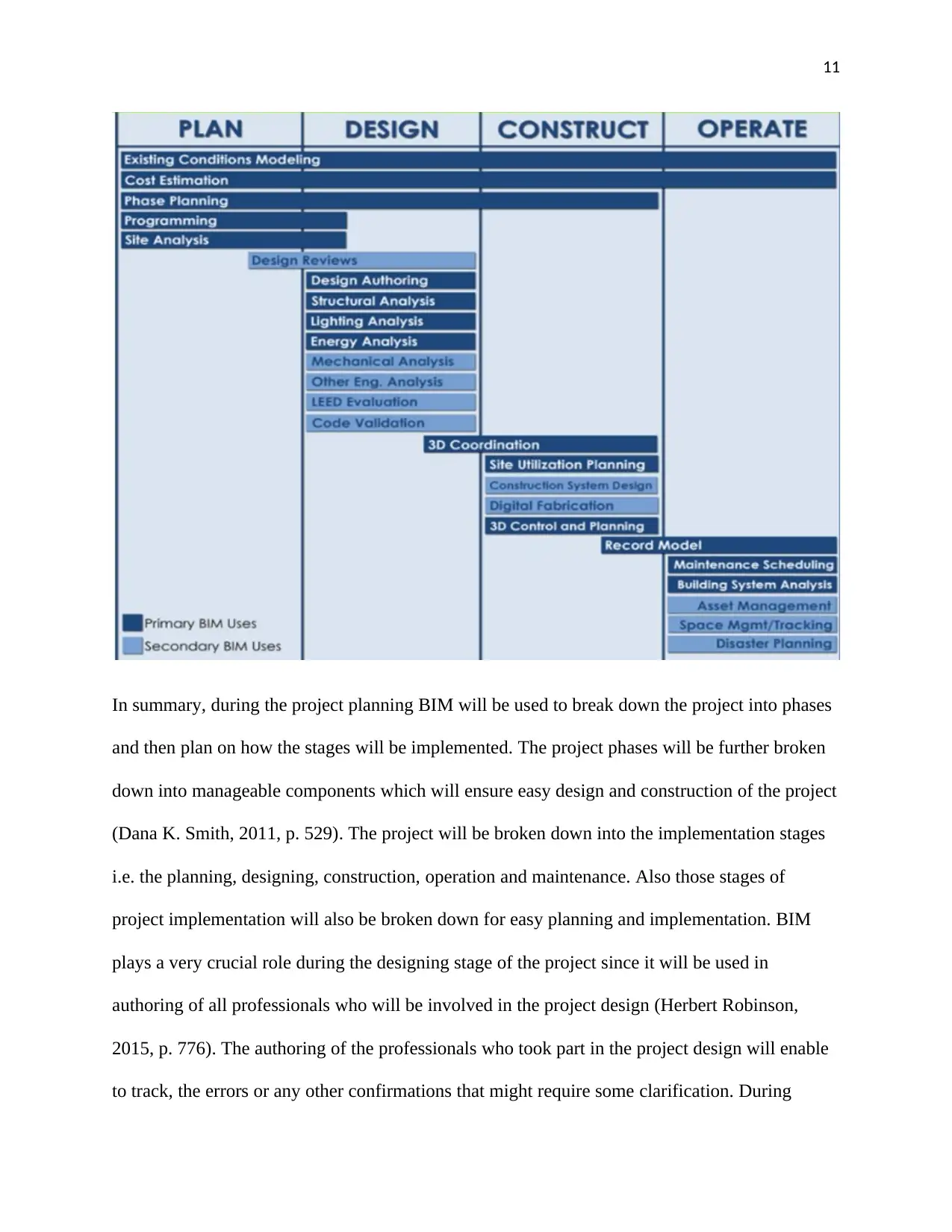
The table below is a summary of how BIM will be applied during the project implementation.
BIM will be of great help in the digital fabrication of the construction components. For instance
in the fabrication of the steel beams and column which will required for the construction of the
project will be achieved through the application of BIM. The specification of the elements will
be fed into the BIM database whereby they will be used to fabricate the elements automatically.
The automatic fabrication of the building elements will make the project delivery to be much
faster and efficient which on the other hand will save a lot of time and resources. Which will be
channeled to other facilities within the project (Dana K. Smith, 2011, p. 117).
In 3D planning and controlling BIM will greatly be applied in the generation of the control
model which will be used as the reference point during the construction of the actual building
form. It will of great importance to the client to view how the final project will look like in
advance. In that the client will be able to control and plan together with the architect on how the
final form of the project will look like.
The table below is a summary of how BIM will be applied during the project implementation.
Paraphrase This Document
Need a fresh take? Get an instant paraphrase of this document with our AI Paraphraser
11
In summary, during the project planning BIM will be used to break down the project into phases
and then plan on how the stages will be implemented. The project phases will be further broken
down into manageable components which will ensure easy design and construction of the project
(Dana K. Smith, 2011, p. 529). The project will be broken down into the implementation stages
i.e. the planning, designing, construction, operation and maintenance. Also those stages of
project implementation will also be broken down for easy planning and implementation. BIM
plays a very crucial role during the designing stage of the project since it will be used in
authoring of all professionals who will be involved in the project design (Herbert Robinson,
2015, p. 776). The authoring of the professionals who took part in the project design will enable
to track, the errors or any other confirmations that might require some clarification. During
In summary, during the project planning BIM will be used to break down the project into phases
and then plan on how the stages will be implemented. The project phases will be further broken
down into manageable components which will ensure easy design and construction of the project
(Dana K. Smith, 2011, p. 529). The project will be broken down into the implementation stages
i.e. the planning, designing, construction, operation and maintenance. Also those stages of
project implementation will also be broken down for easy planning and implementation. BIM
plays a very crucial role during the designing stage of the project since it will be used in
authoring of all professionals who will be involved in the project design (Herbert Robinson,
2015, p. 776). The authoring of the professionals who took part in the project design will enable
to track, the errors or any other confirmations that might require some clarification. During
12
design BIM will also be used to carry out the structural analysis of the project. This will involve
the structural design of the structural, elements such beams and columns which will be used in
the construction of the bridges (Walker, 2014, p. 63). During the construction of the project
BIM will enable a powerful visualization which will facilitate the construction schedules in
specific time frames as planned well .By viewing the construction process and planning for it
in advance it greatly helps in detection of the problems which were likely to be encountered
during the actual construction process.
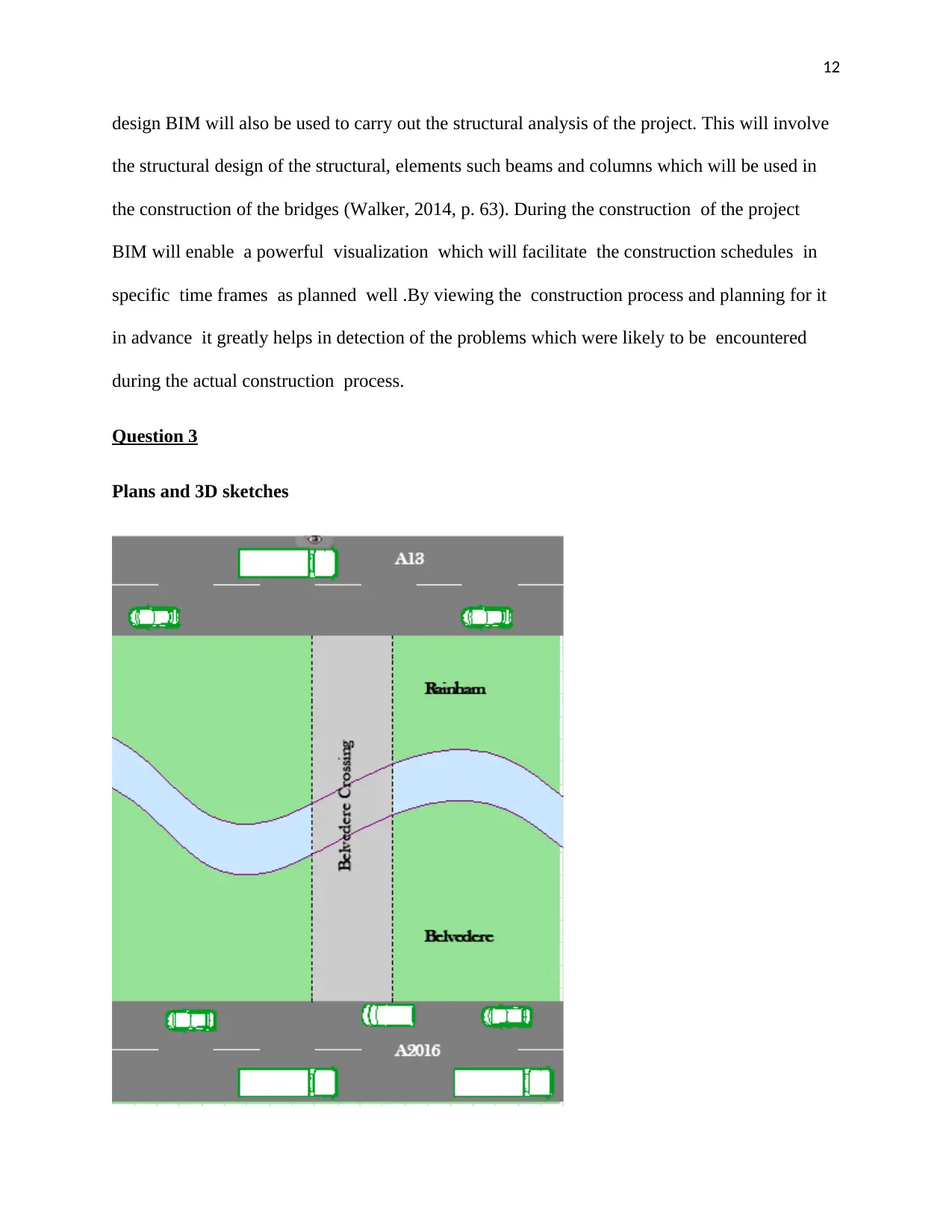
Question 3
Plans and 3D sketches
design BIM will also be used to carry out the structural analysis of the project. This will involve
the structural design of the structural, elements such beams and columns which will be used in
the construction of the bridges (Walker, 2014, p. 63). During the construction of the project
BIM will enable a powerful visualization which will facilitate the construction schedules in
specific time frames as planned well .By viewing the construction process and planning for it
in advance it greatly helps in detection of the problems which were likely to be encountered
during the actual construction process.
Question 3
Plans and 3D sketches
⊘ This is a preview!⊘
Do you want full access?
Subscribe today to unlock all pages.
Trusted by 1+ million students worldwide

1 out of 20


Related Documents


Your All-in-One AI-Powered Toolkit for Academic Success.
+13062052269
info@desklib.com
Available 24*7 on WhatsApp / Email
![[object Object]](/_next/static/media/star-bottom.7253800d.svg)
Unlock your academic potential
Copyright © 2020–2026 A2Z Services. All Rights Reserved. Developed and managed by ZUCOL.